


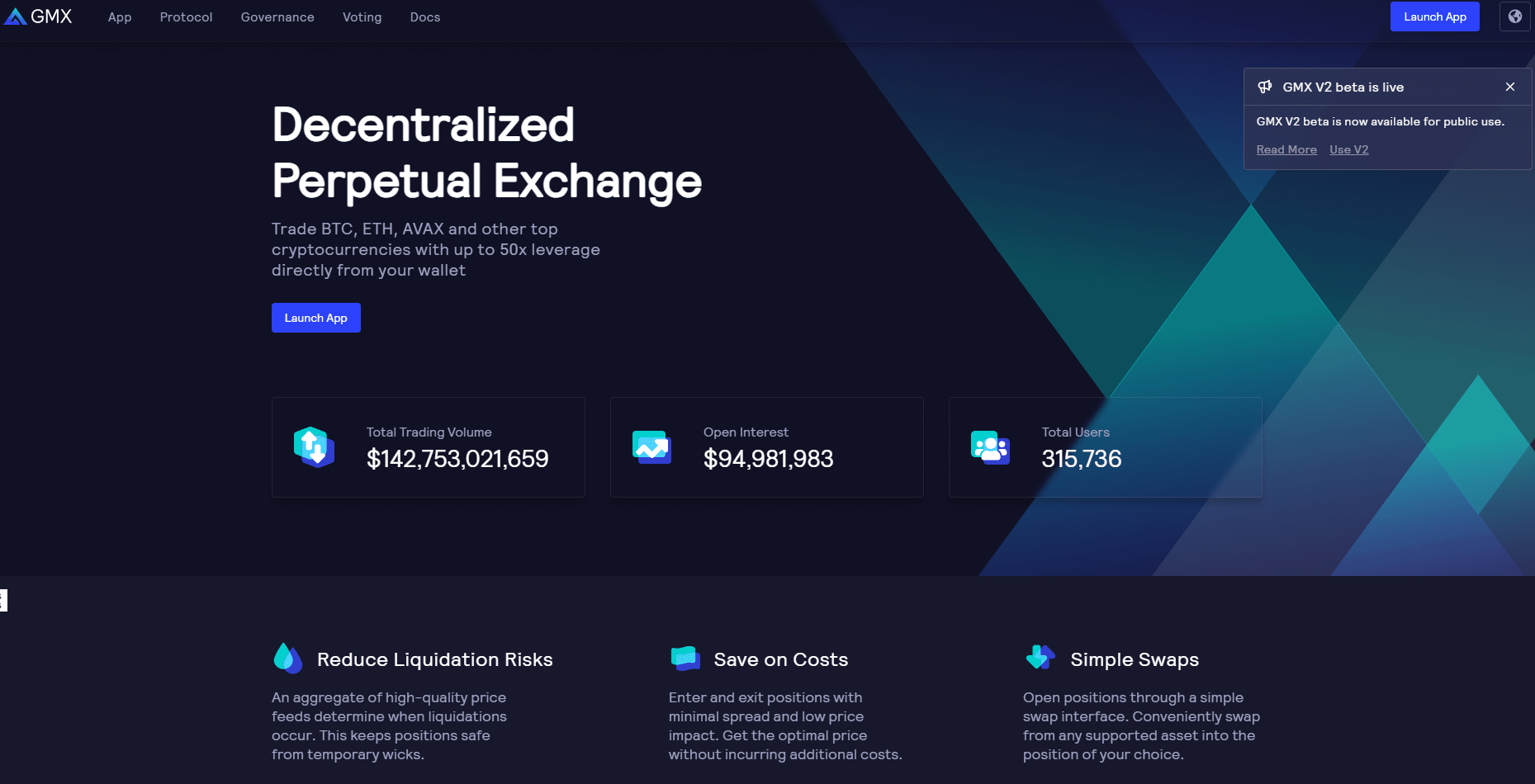
Today we continue to talk about a project with great potential. It is GMX, a decentralized perpetual contract exchange that supports transactions with a maximum leverage of 50 times. At first, I only heard that it was awesome, but I didn’t have a very concrete impression. But after today’s research, I have a huge respect for it. It is a very awesome project. GMX currently has a market value of 300 million US dollars and ranks 100+. For an exchange, this market value is really not high. Look at the currency An, look at uni, right? So the space for imagination is really huge.
Introduction
GMX was previously called Gambit and ran on the BSC chain. In September 21, all operations were transferred to Arbitrum, renamed GMX, and then expanded and deployed on the Avalanche chain. The GMX team remains anonymous, but the team previously mentioned in Community Proposal 2 has two full-time developers. Other business, including marketing, is handled by part-time community members. It is impossible to obtain more resume information of team members. Overall, it is impossible to obtain more resume information. Determine the strength level of team members. The founder’s Twitter name is X. According to community information, the team led by X is relatively small. The previously developed projects are called X1, GXM is an improved version of Gambit, and the team is developing the X4 of the new AMM. The Twitter account information of founder X is as follows
Features
Launched in September 2021, GMX is a decentralized perpetual and spot exchange, trading directly from user wallets on a fast and cheap network with 0% slippage, 10bps fees and up to 50x leverage BTC, ETH, AVAX, UNI and LINK, no KYC or geographical restrictions.
GMX has a liquidity pool, GLP, which is a multi-asset pool that provides liquidity for margin trading: users can go long/short and execute trades by minting and burning GLP tokens. The pool earns LP fees from trading and leveraged transactions, which are distributed to GMX and GLP holders.
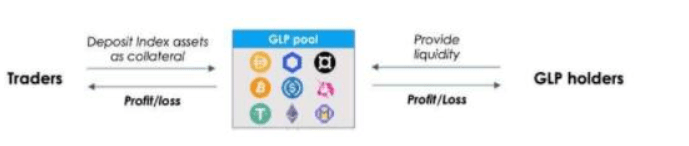
In order to trade with leverage, traders deposit collateral into the protocol. Traders can choose leverage up to 50 times. The higher the leverage, the higher the liquidation price. As borrowing fees increase, the liquidation price will gradually increase.
For example, when going long ETH, the trader is "renting out" the upside of ETH from the GLP pool; when going short ETH, the trader is "renting" the upside of the stablecoin relative to ETH from the GLP pool. But the assets in the GLP pool are not actually leased.
When closing a position, if the trader bets correctly, profits will be paid out from the GLP pool in the form of long tokens; otherwise, losses will be deducted from the collateral and paid into the pool. GLP profits from traders' losses and profits from traders' profits.
In the process, traders pay trading fees, opening/closing fees, and borrowing fees in exchange for the upside of going long/short against the U.S. dollar on designated tokens (btc, eth, avax, unl, and link).
If a trader chooses to withdraw collateral that is different from the deposited collateral, this is considered trading activity and a trading fee will be charged, which is a percentage of the collateral size.
GLP represents a share of a liquidity pool, similar to asset indices used for trading and leveraged trading. It can be minted using any asset in the index and destroyed to redeem any index asset.
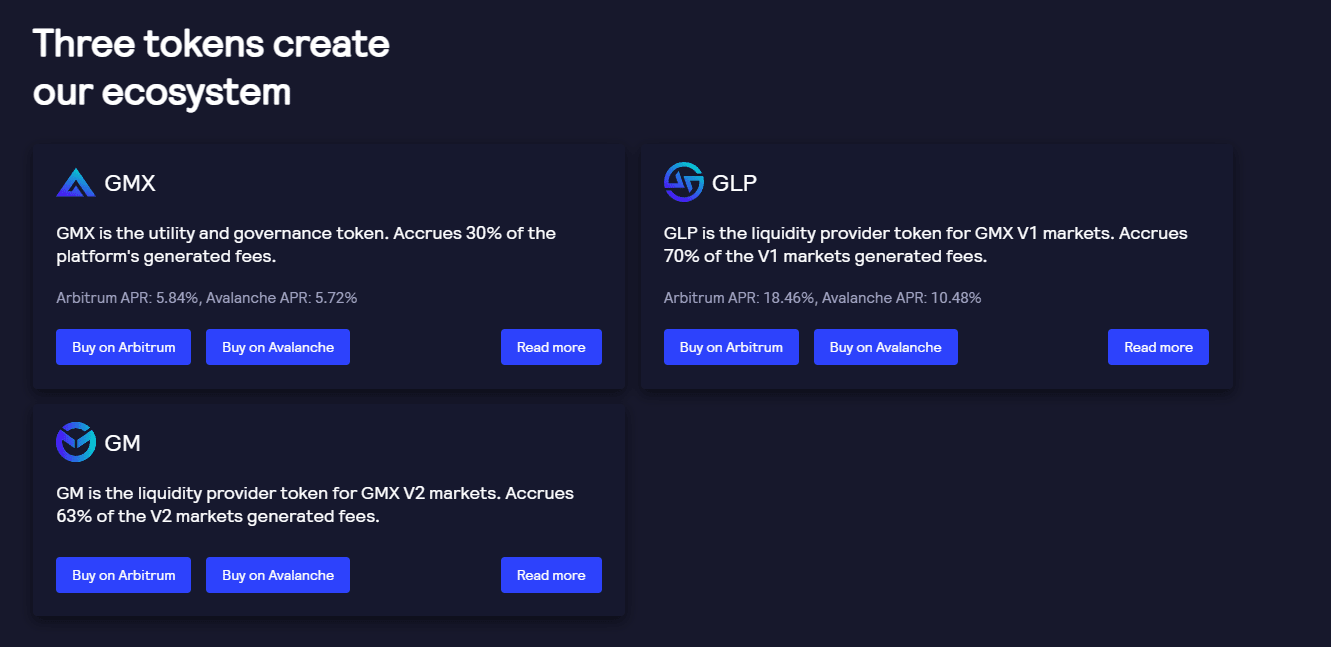
The GLP token price is the value of the total value of assets in the index, including unrealized profits and losses on unrealized positions, divided by the GLP supply. The basic assumption is that every open position is likely to be closed the next second.
By minting and holding GLP tokens, LPs bear the delta risk of the asset index, that is, holding a basket of crypto assets. If the LP deposits any specified assets, the market value of the asset pool increases with crypto assets.
Since GLPs are minted based on the market value of the pool, new minting activity will not make existing LP holders better/worse off.
The fee for minting/burning GLP depends on whether the index asset is underweighted/overweighted, i.e. the weight of the asset in the index is lower or higher than its target weight. If ETH is undersold, there is an incentive to mint GLP by depositing ETH with lower fees.
How is the target weight set? It is adjusted weekly based on open interest: if a large number of traders are long ETH on Arbitrum, the GLP pool will set a higher ETH target weight, and conversely, if a large portion of people are short, it will be stable The target weight of the coin will also increase.
For example, if the target of eth is 40%, then if it is only 20% now, the handling fee for depositing ETH into GLP may be 0.05%, but if there are 60% ETH now, then the deposit handling fee may be 0.4%. This mechanism ensures the liquidity of the overall pool and the balance of varieties. At the same time, in extreme cases, if an arbitrageur wants to take advantage of this mechanism, he will also need to pay a high fee to perform swap.
Target weighting is easier to achieve through DEX aggregators: when some index assets are underweight, cheaper swap fees coupled with zero slippage can provide the best price to facilitate large volumes of trades routed to GMIX, rebalancing GLP The weight of assets in the pool.
Holding GLP actually means:
• Provide liquidity (without impermanent losses, as explained below); · Earn 70% of platform fees paid in ETH or Avax;
•Earn 70% of platform fees paid in ETH or AVAX;
•As a leveraged trader’s counterparty (i.e. the house in the casino) profits from their losses;
•Earn hosting GMX rewards;
• Diversify your investment into the Honey Index.
Instead of using the standard automated market maker model (AMM) (x*y=k), GMX uses the dynamic aggregation oracle price feed provided by Chainlink (from Binance and FTX) to determine the "real price" of the asset. This helps achieve zero slippage in executing market orders.
Because GMX simply pulls prices from CEX in real time, it provides traders with the best execution without the need for arbitrageurs to adjust for price differences across different DEXs. LPs are also protected from impermanent losses because they do not need to bear price discovery costs.
GMX design principles
GLP holders, in return for taking on delta risk and counterparty risk (traders win), will receive 70% of platform fees, profit from trader losses, and esGMX, which is a matter of reciprocity.
Staking GMX tokens on the platform will earn you 30% of platform fees, esGMX and multiplier points. esGMX is a hosting model similar to CurveFinance’s ve model, but it does not have a hard lock system. On the contrary, if you choose to receive rewards, esGMX will be released linearly for one year.
esGMX rewards can be used in two ways: it can be staked like regular GMX to earn rewards, and it can become a GMX token within 1 year, as mentioned above.
To stake esGMX rewards now, you can get the exact same rewards as staking GMX normally - more esGMX, multipliers, and ETH/AVAX rewards from platform fees.
If you want to vest esGMX within 1 year, you will not receive any rewards, and the main tokens derived from esGMX (GLP or GMX) cannot be withdrawn during this period, otherwise esGMX will be deducted proportionally. For example, 50% of the principal token withdrawal = 50% of the rewards are cut.
What are multiplier points (MP)? MPs are not GMX, but can earn fees just like staking (except MPs cannot earn more MPs), thus providing long-term GMX holders by increasing the yield of GMX staking. bonus. Earn MP at a fixed rate of 100% every second.
Increase percentage = 100*(staking multiplier)/(GMX pledged + pledged esGMX); that is, the proportion of MPs to the total amount of user pledged GMX &esGMX.
GMX earns fees through:
1. Transaction fee: opening/closing a position is 0.1% of the position size;
2. Swap fee: If a swap is required when closing a position, 0.2-0.8% of the dynamic collateral size will be charged;
3. Borrowing fee: (borrowed assets/total GLP assets)*0.01%, accumulated every hour;
4. Dynamic fees for minting GLP, burning GLP, or executing a swap, depending on whether that action helps achieve the target weight of a specific asset in the GLP index.
operate
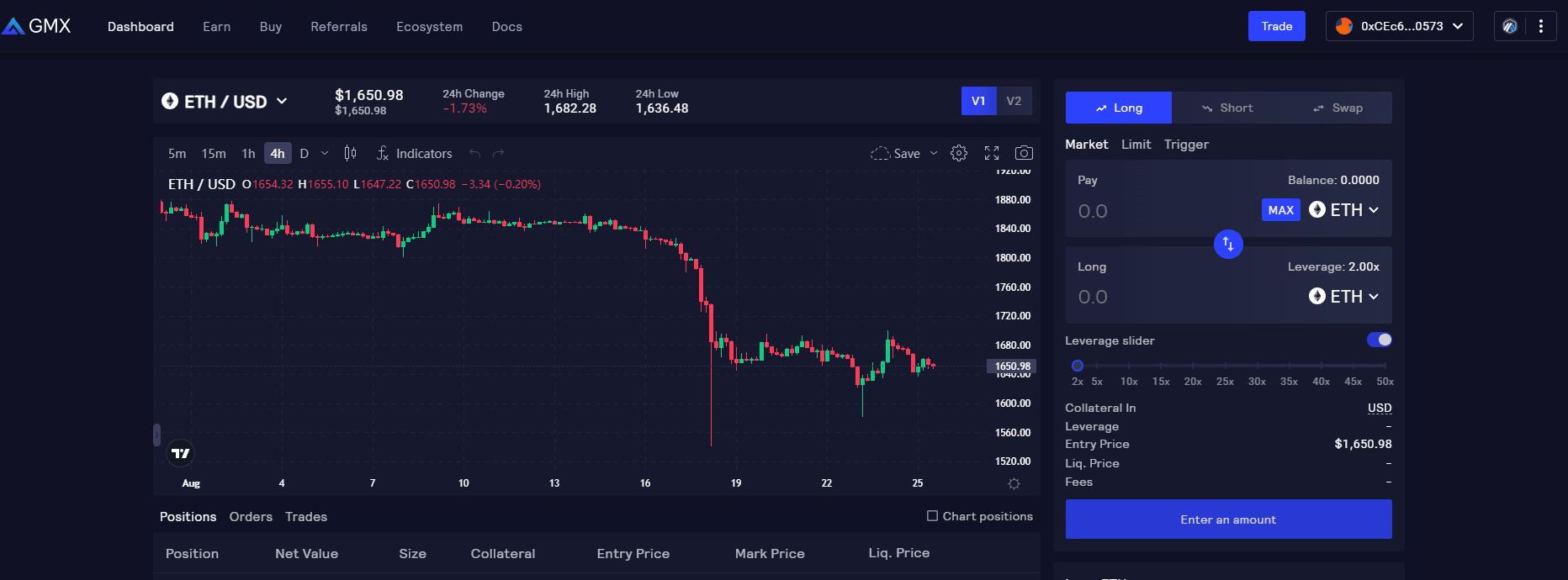
After entering the trading interface, you can place orders just like a normal platform. It is divided into long positions, short positions, and spot swaps. It supports leverage of 1-30x. You can see the corresponding transaction price and liquidation on this interface. Detailed information such as price and handling fee to be paid.
After clicking to place an order, the wallet will pop up for you to sign the transaction. Because everything is completed on the blockchain, all operations need to be signed and operated directly through the wallet.
After the order is placed successfully, the corresponding position number will appear on the position interface. You can perform leverage adjustment, margin replenishment, liquidation and other operations on this position in the later stage.
The overall transaction process is basically similar to that of ordinary platforms. The difference lies in whether the beneficiaries of the transaction are the general public or the CEX platform, and whether all processes are fully transparent and free of false information. Judging from the user experience, there will be a certain lag, about 5-10 seconds, no slippage, no pins, and the long funding rate is generally the same as or slightly smaller than the BA platform. You can choose the trading target according to the situation. .
Token distribution
The current supply is 9,308,144 GMX, and the circulation is 8,884,693 GMX. 95 have been unlocked so far. The current currency price is 36 US dollars, and the peak price was 90 US dollars, in April 23. In terms of currency holding distribution, the team still takes very little. It is a very good mechanism-based project. Then I checked the TVL on the chain and found that it was 480 million U.S. dollars, and the daily transaction volume was in the tens of millions.
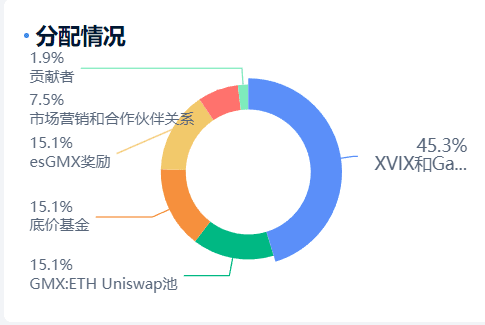
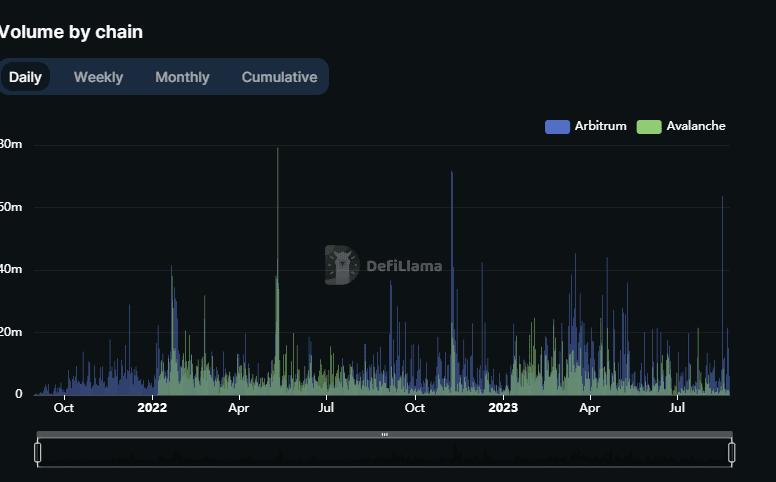
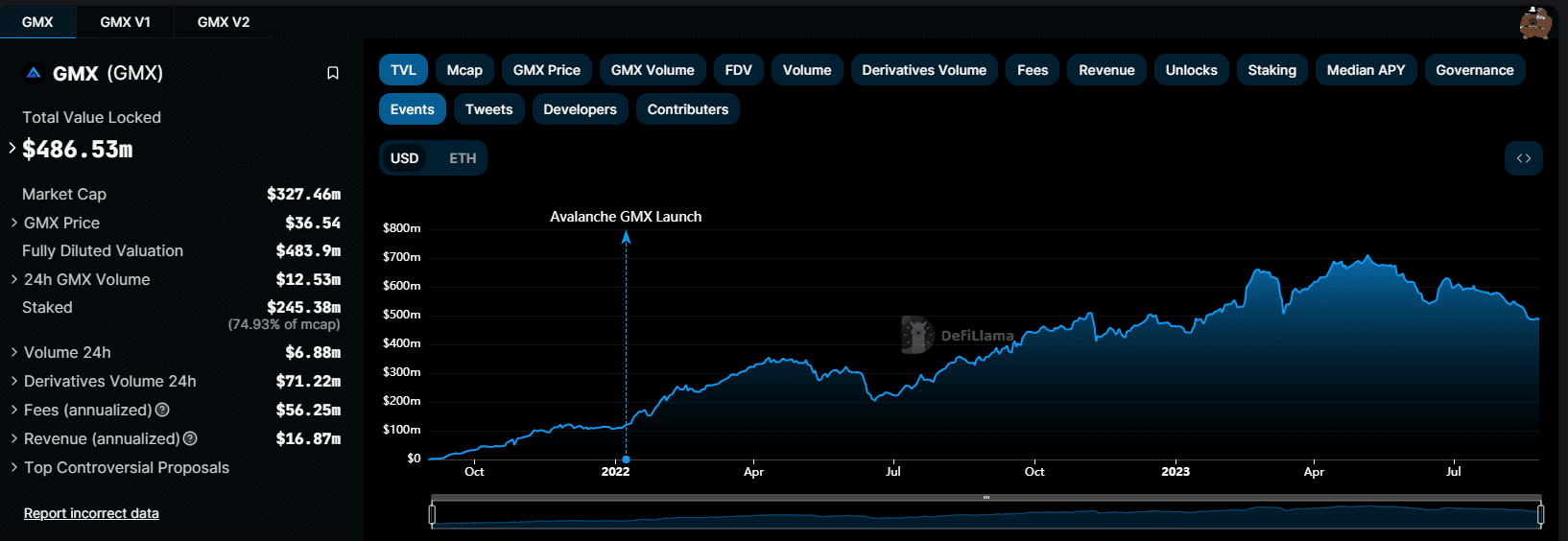
In conclusion, the innovation of GMX is its GLP. Everyone plays in a big pool, everything is open and transparent, and you fully understand the situation of the counterparty. This is completely different from CEX, and it is completely based on Running on the chain, the only risk may be the credibility of his Oracle price feed and the collective decision-making of GMX holders. It is an exchange that is very consistent with the concept of blockchain. The current market value is relatively low, the TVL on the chain is also huge, and the daily trading volume is OK. So the overall project is very good and has great potential. However, the current trading pairs are It may be relatively small, but it should get better and better with future updates.
In fact, for those who are long-term investors, it is currently at a relatively low position, because the fundamentals of the project itself are not problematic and it is also a very good project. In the short term, there may be some room for decline, but It won't be very big, there will be a support around 33, but it still depends on the fluctuation of the overall market, but in the medium term, it can still be bullish.