

If you ask "Why do we need blockchain games?", "Autonomous World" is obviously a perfect answer. As a new game category, the most exciting thing about "Autonomous World" is the unexpected things that naturally arise from the game, which even developers and initial publishers cannot predict, and the potential to release players' unlimited creativity. Blockchain technology is the premise for its existence. In other words, "Autonomous World" can only be realized on blockchain technology, and will challenge traditional game categories with a new game design model and gameplay.
OPcraft, a full-chain game that was online for only two weeks, proved to us the potential of a new game category called "autonomous world". It only provides a "physical reality" with minimal rules and a permissionless "component system" that can be used to expand the game experience and new rules. This minimalist game design can fully mobilize the creativity and enthusiasm of the players, from which highly tense dramatic conflicts can grow, from one event to the next, and continuously advance the plot through elements such as conflict, collaboration, and governance.
It can be said that compared to "making money", "drama" is the key factor to maintain the long-term development of the game, because it can continue to attract the attention of human players and drive players to spontaneously invest and participate in the game. Although making money is not the goal of the game, the drama generated by the game itself is enough to generate sufficient other revenue methods, thereby unlocking a new business paradigm.
Autonomous World
History tells us that every time a new computing paradigm emerges, it unlocks a whole new gaming use case:
With the rise of transistors, microprocessors, and television came computer games
The popularity of PC has expanded new game categories: "Strategy and Simulation" games
The advent of the Internet and the rise of multiplayer games
With the emergence of social networks, social network games began to rise
The emergence of mobile Internet has led to the rise of casual games.
Blockchain is no exception, it has brought us a whole new category of games - "Autonomous Worlds".
Documented network records show that the term "autonomous world" first came from Lattice, a team known for participating in the construction of the full-chain game "Dark Forest" and its subsequent development of the first full-chain game engine MUD framework, and is known for incubating Ethereum's technology and infrastructure projects under the name of the 0xPARC Foundation.
In August 2022, Lattice member Ludens first introduced the concept of "autonomous world" to the world through an article titled "Autonomous World (Part 1)" and a keynote speech at DEFCON 2022.
In this article, Ludens mentioned that in order to go beyond the concepts of tokens, NFTs, and liquidity and create a digital world beyond Ethereum, three conditions must be met, namely "autonomy, permissionless creation, and compliance with basic physical rules in the digital world." He also invented the term "autonomous world," which represents a completely self-sustaining open source digital realm.
Autonomous World — More Than Just On-Chain Games
On-chain games refer to the use of blockchain to store all data and smart contracts in the game. The assets and game status of the game are stored on the chain, and the game logic and rules are formulated in a client-independent manner.
In the article "The Strongest Crypto Gaming Thesis", Gubsheep (Brian - 0xPARC/Dark Forest) proposed a widely accepted definition of on-chain games, which believes that on-chain games must meet the following 5 conditions:
“The real source of game data is blockchain.”
“Game logic and rules are implemented through smart contracts.”
“The game was developed based on open ecosystem principles.”
“This game has nothing to do with the client.”
“The game contains digital assets with real-world value.
“Autonomous World” is a type of on-chain game, but the meaning of “Autonomous World” goes far beyond that.
The "autonomous world" does not have specific set tasks and goals (such as players need to "conquer more land" or "kill more enemies"), nor does it have preset game parties (such as the need to fight and compete with other players). It only sets the simplest underlying rules - "digital physical reality" as a constraint, and by providing publicly accessible programmable interfaces, allows players to freely create within the boundaries of this digital physical reality, enhance and expand the game experience, and expand the game plot.
Note: "Digital physical reality" refers to the system of basic laws that exist in the computational world. Each world has its own set of basic laws that govern everything that happens in this world. These laws are the physics of that world. Please note that the physics here does not refer to the physical laws in the narrow atomic world where humans live, but refers to the system of basic laws that exist in any "world".
The basic rules in the "autonomous world" are immutable.
The "autonomous world" always runs independently according to predefined rules, with no end. The autonomous world is a world that exists and evolves without external dependence. Even if there is no external support, no one's control, and even no citizens visiting or living in the world, it still exists objectively. Moreover, this world allows anyone to join at any time, and the expansion built on the game will also exist forever with the game.
Blockchain is the prerequisite for the existence of an autonomous world
The unique characteristics of blockchain technology, such as "programmability", "permissionless composability", "persistent storage" and "immutability", have opened up new possibilities for creating a virtual, fully autonomous world on the chain.
The "basic rules" of this autonomous world will be defined in the form of code in the Ethereum smart contract. The autonomous world runs completely according to these rules, without external intervention or maintenance, and cannot be shut down even by malicious attacks. As long as Ethereum continues to exist, this virtual world will not disappear. Even if the original developers leave, the world will continue to develop and evolve, presenting a form of coexistence of multiple realities through the release of new rules and improvement suggestions by players.
To maintain the operation of an autonomous world, a properly designed incentive mechanism is required, so that builders can spontaneously create and expand new world realities through new components and systems. The autonomous world built on the blockchain, with its underlying financial programmability, can establish sufficient incentive mechanisms for games to stimulate the long-term operation of an open world. The game itself can become an economic system with currency, markets, and economic rules, creating a new form of economic organization that coexists with the traditional economy.
However, we need to note that motivation does not necessarily have to be tied to money, it can also be status within a community, a sense of achievement, pure love, faith and passion, which human history tells us can inspire humans to create amazing things.
OPCraft: The full-chain game that best embodies the autonomous world
Most of the games on the blockchain currently have nothing to do with the autonomous world. If you want to better understand the "autonomous world" from a practical perspective, OPcraft must be the best interpretation. This is a full-chain version of a 3D Minecraft-themed game created by the Dark Forest founding team Lattice in October 2022. The original intention was just to test the performance of Mud, the first full-chain game engine developed by it.
OPCraft only sets simple rules, among which players are only allowed to perform 4 in-game operations, including destroying voxel blocks, synthesizing voxel blocks, placing voxel blocks, and claiming a 16x16 piece of land (need to become the highest diamond pledger of the land). In addition, players can also customize the front end and deploy customized components and systems through the official publicly accessible plug-in system.
However, in just two weeks after its launch, this game with only simple rules exceeded the expectations of the game developers. It was not only very successful in terms of statistics, attracting more than 1,500 participating players, more than 3.5 million on-chain records, various user-generated pixel creation wonders, and some player-made plug-ins for specific purposes, but also generated a series of spontaneous competition and gaming behaviors, group governance behaviors, and some malicious and well-intentioned player behaviors.
Unlocking the creativity of artists, architects, and developers
In the "Autonomous World", all players can participate in creation, including artists, architects, and developers. OPCraft allows us to witness this.
OPCraft unlocks the creativity of artists and architects. From making simple wooden houses and towers at the beginning of the game, to building large castles and monuments of various shapes after your skills mature, such as Mario and Flame Flower, a huge phoenix statue spanning hundreds of blocks, and other breathtaking artistic buildings.
On the other hand, engineers and "scientists" can use another weapon - coding ability, to explore another limit of the OPCraft world. Through the system's provision of a simple, usable, and permissionless plug-in system for players to integrate World1, gamers began to use their ingenuity to explore the possibilities of technology. For example, a player released a plug-in that automatically mines materials regardless of geographic coordinates, and another player released a drill tool that automatically mines diamonds, as well as a chat plug-in tool that can be used for text communication, and so on.
Evolution: Improvements in tools and productivity
Basically, everything that happens in the OPcraft game is a microcosm of the development of human society.
In the initial wild period, players can only perform some basic operations, such as picking flowers, chopping trees, mining rocks, digging holes, building wooden houses and single-block-wide towers, as well as making some rough digital objects that cannot be seen.
Over time, players began to slowly understand the world and learned to make more complex items, such as making glass, wool dyeing and bricks, and then these more complex materials can be compounded to build larger works of art and buildings. For example, colored wool blocks can be used to make giant pixel art, such as the Union Jack, pandas, and of course, an advertisement that openly promotes its own NFT project; there are also players who use synthetic materials including sand, stone, wood and bedrock to build a majestic sky pyramid; and a huge space-themed planet that pays tribute to "Dark Forest" was made by a gamer using 6360 pieces of bedrock.
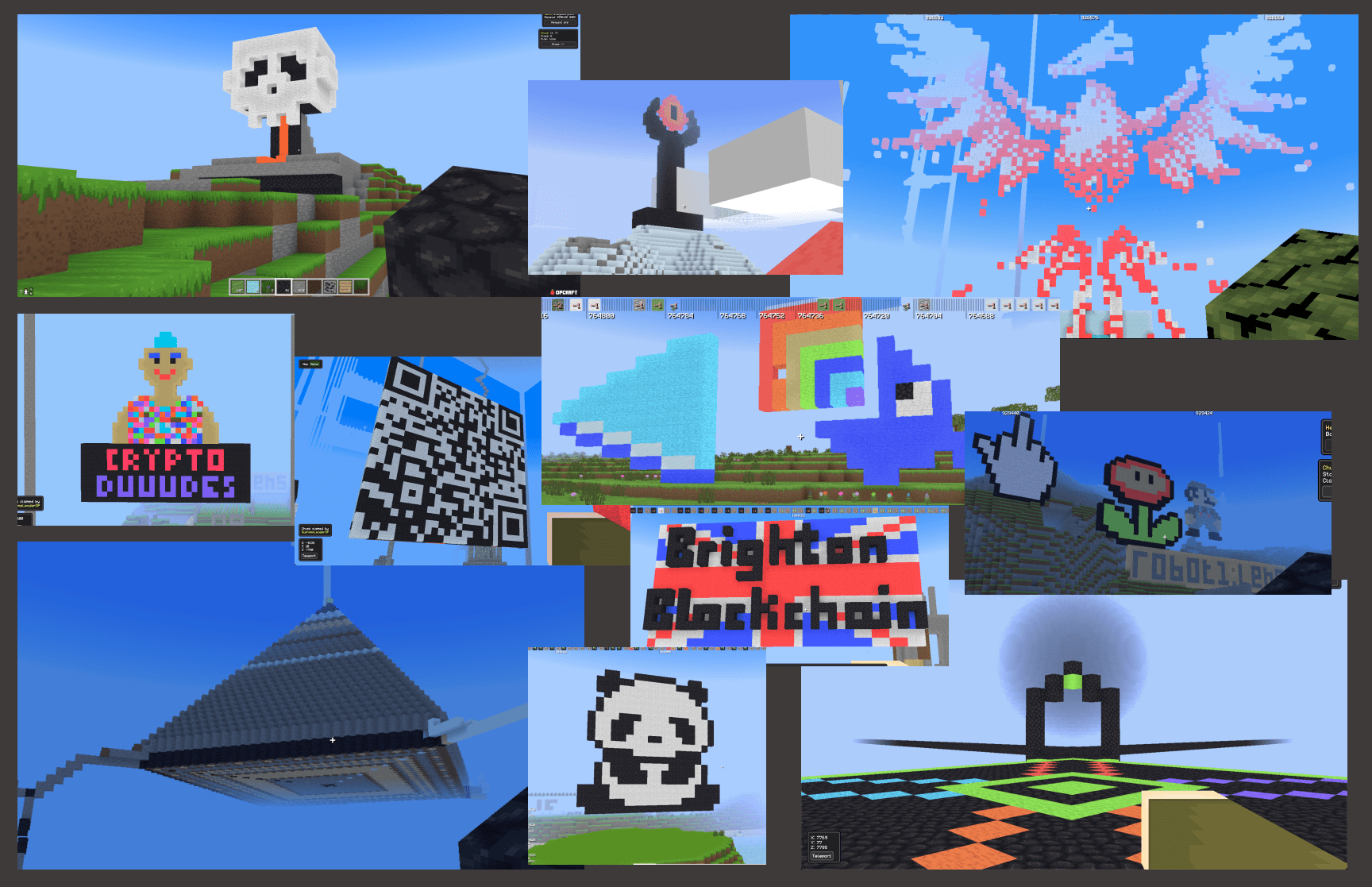
Complex items
When players know that there is a plug-in system that can be used, they start to make more advanced tools, including the above-mentioned automatic material mining rig, text chat tools, and teleportation plug-ins for traveling. The plug-in system gives humans the ability to create production tools, which can maximize productivity and work efficiency. The plug-in system is equivalent to providing players with scaffolding to create new tools. Just like in the real world, when there is the ability to create new tools, human civilization will accelerate forward.
This is exactly the composable engineering mentioned by guiltygyoza in the article "Composable Engineering". When the autonomous world supports composable engineering, it provides infinite availability for the world. It allows recursive combination of engineering artifacts with no limit on the recursive depth.
Composable engineered artifacts in an autonomous world allow for invention compounding, enabling knowledge combination processes similar to those that have driven human history in the atomic world, thereby driving the evolution of the computational world.
Composable engineering also allows for knowledge encapsulation, meaning, “I don’t need to understand the specific details of an invention to incorporate it into the invention process.” Knowledge encapsulation is in some ways the equivalent of the separation of concerns principle in software development. By achieving separation of concerns, large engineering tasks can be broken down into smaller engineering tasks and then combined to complete. Since different tasks require different types of skills and resources, it naturally encourages specialization of the workforce. As the workforce specializes, the world becomes more inclusive than it was before—inhabitants of different backgrounds, skills, and interests can find their place in the world as creators and contributors.
Conflict and drama
In the article "Composable Engineering", guiltygyoza also mentioned the importance of "drama" in maintaining the long-term evolution of the autonomous world:
The drama of the world depends in part on the enumeration of the objects that exist in it... When the enumeration of objects stagnates, whatever the combinatorial possibilities of those objects, they eventually become saturated. Metas—the dominant strategies for getting out in the world—are established and become rigid. The distribution of resources and power among human actors also tends to stagnate. All of these effects inhibit the development of drama.
In the atomic reality of human life, new things constantly emerge through natural evolution or human discovery/invention, which disrupts civilization and social norms and causes dramatic events. The adaptive mutation of the virus caused the collapse of the global supply chain. The invention of printing made it possible to form imaginable communities among strangers, and thus began to generate nation-states. If all the items in the world were made by a single company, then the world might be subject to the life cycle, delivery ability and willingness of this company, and thus encounter bottlenecks because the world as a whole has reduced autonomy.
OPcraft is a perfect example of how drama can grow naturally in an autonomous game, driving the plot forward and moving forward.
Digging and filling holes
Whether out of prank, bad taste, or group gaming behavior, some players in OPcraft began to dig extremely deep holes, and many unsuspecting players fell into the trap.
However, there was a turnaround for this vicious incident. When someone fell into a trap, some players launched a search and rescue plan, rescuing the trapped person by filling the hole or putting stairs directly in the hole. Some players even developed a teleportation plug-in that can be used to avoid the pit.
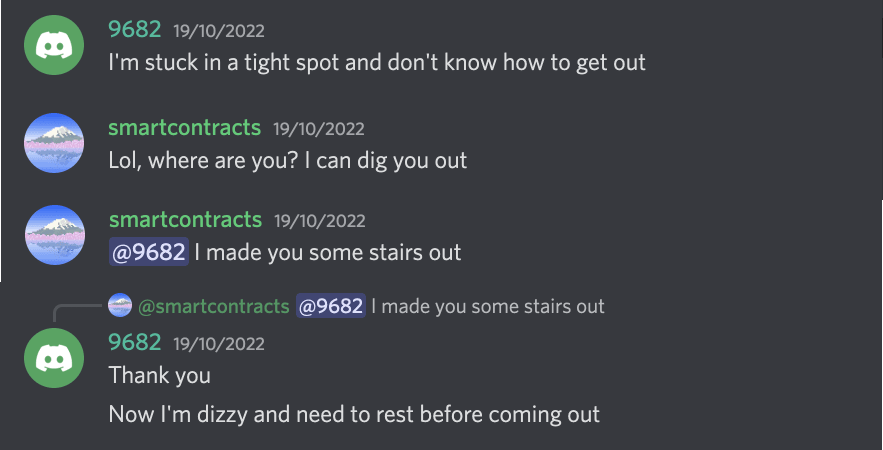
The trapped person who fell into the hole sent a rescue plan to the community, and another player offered to make a ladder to rescue the trapped person.
SupremeLeaderOP Republic: Join or Rebel
On October 29, two days before the end of the OPcraft testing period, a very dramatic scene occurred. On that day, a player named SupremeLeaderOP appeared and announced the establishment of a world government on Discord and Twitter. He also claimed that he (or his team) had mined 135,200 diamonds and acquired large tracts of land by pledging these diamonds.
According to the rules of OPcraft, players need to mine and accumulate diamonds. The role of diamonds is to claim a plot of land (16x16x16) pixels after staking. When multiple people participate in staking a plot of land, the one with the most pledged diamonds will have priority to claim it. Once claimed, the plot of land belongs to the claimant. Ownership is exclusive, which means that when a plot of land is owned by a specific player, others cannot use it, whether to mine minerals or build buildings on it.
However, SupremeLeaderOP provides players with an option. Players can use the apro-comrade plug-in to take an oath (ceremony) to join the republic. Once joined, they have the right to use government "public property". Not only can they use the smart contract to mine materials for the government, but they can also build buildings on this government-owned land. However, there is a prerequisite, which is to confiscate their private property.
Players have mixed attitudes towards the Republic.
Some players, out of "belief", choose to join the organization, become a comrade, and become a member under the leadership of the Supreme Leader. After joining the system, they work hard to upgrade their comrade level (which is the rule in this subsystem) and begin to build large statues and paintings of various Supreme Leader themes around the world.
Some players also choose to join the organization out of "economic interests" in order to obtain the right to mine more materials and the right to build on the land.
However, there is another type of player who is very opposed to joining this republic, strongly condemns its control and collectivist policies, and mobilizes everyone to rise up in rebellion and fight for freedom.
Another player named PhiMarHal discovered that the Republic only claimed and controlled the land on the ground, while the space in the sky was still available, so he mobilized players to fly into the sky and build a sky city.
No preset plot means infinite possibilities
The most interesting thing about OPcraft is that this republic was not designed in advance, but was initiated spontaneously by the players.
There is no preset script in OPcraft, no set tasks/goals, and even no ultimate villain to defeat. Instead, a series of spontaneous player actions are generated, leading from one event to another, and thus resulting in a very dramatic development of events.
Players can quickly deploy smart contracts and add new rules to the game without a license through the official full-chain game engine MUD. This means that social organizations and other "augmented realities" in the autonomous world are completely unlimited; unlike players in World of Warcraft who must operate within the scope of the preset guild system, players in OPCraft can spontaneously create social organizations of various structures through MUD deployment components. Like countries, economic and religious groups in the real world, players can choose to join voluntarily, and after joining, they must abide by the consensus rules of the organization. (In OPCraft, the oath of joining is made through the apro-comrade plug-in. After joining, all private property will be confiscated, and the mining and construction rights of government land resources will be obtained.)
The success of OPcraft tells us that in order to gain the continued attention and participation of human participants, on-chain games should not make money as the main purpose of players, but need to continuously generate drama and use drama as a touchpoint to explore other income possibilities. Just like the football industry, football matches as a "game" itself are not aimed at making money, but the drama it generates is enough to generate sufficient revenue methods, such as gambling and advertising.
The extremely simple underlying game rules and permissionless creation rights are the premise for the continuous evolution of the "autonomous world" and the creation of a "non-artificial drama". Developers do not know more about what will happen next in the autonomous world than players do. The progress of the game is completely controlled by the players themselves, and the players' behavior will affect the future progress of the game. Everything in the game depends on the players' creativity.
References:
https://lattice.xyz/blog/making-of-opcraft-part-3-what-happened-in-two-weeks-of-opcraft