


Yesterday, we were still saying that one of the highlights of this week would be Nvidia’s financial report. As a result, U.S. stocks rose sharply last night because of the expectation of good Nvidia’s financial report, and with the help of Tesla, SoftBank’s semiconductor division Arm is likely to become the largest IPO in the United States this year, which has driven the rise of technology stocks. So until the close of this morning, the Nasdaq 100 index rose 1.65% and the S&P 500 rose 0.69%, ending the four-day decline of U.S. stocks. Of course, although the U.S. stock market’s stop in the decline did not bring positive sentiment to the currency market, at least BTC still maintained a stable price of US$26,000, which is the same as we expected. If the U.S. stock market does not continue to dive, at least BTC and ETH can maintain price stability. But it is still necessary to note that Nvidia’s financial report is only an estimate, not an actual announcement.

And although the outbreak of technology stocks has driven the rise of US stocks, there is still bad news in the market. After Moody's downgraded the credit ratings of ten US banks at the beginning of the month, Standard & Poor's also issued a series of reports in the early morning of this morning, downgrading the ratings of five US banks, KeyCorp, Comerica Inc., Valley National Bancorp, UMB Financial Corp. and Associated Banc-Corp, by one level, and downgrading the outlook of two other banks, River City Bank and S&T Bank, to negative, and stated that after review, the negative rating of Zions Bancorp will still be maintained. Although this seems to be far away from us, the reason for the downgrade is actually that the pressure combination makes the life of the bank "difficult".
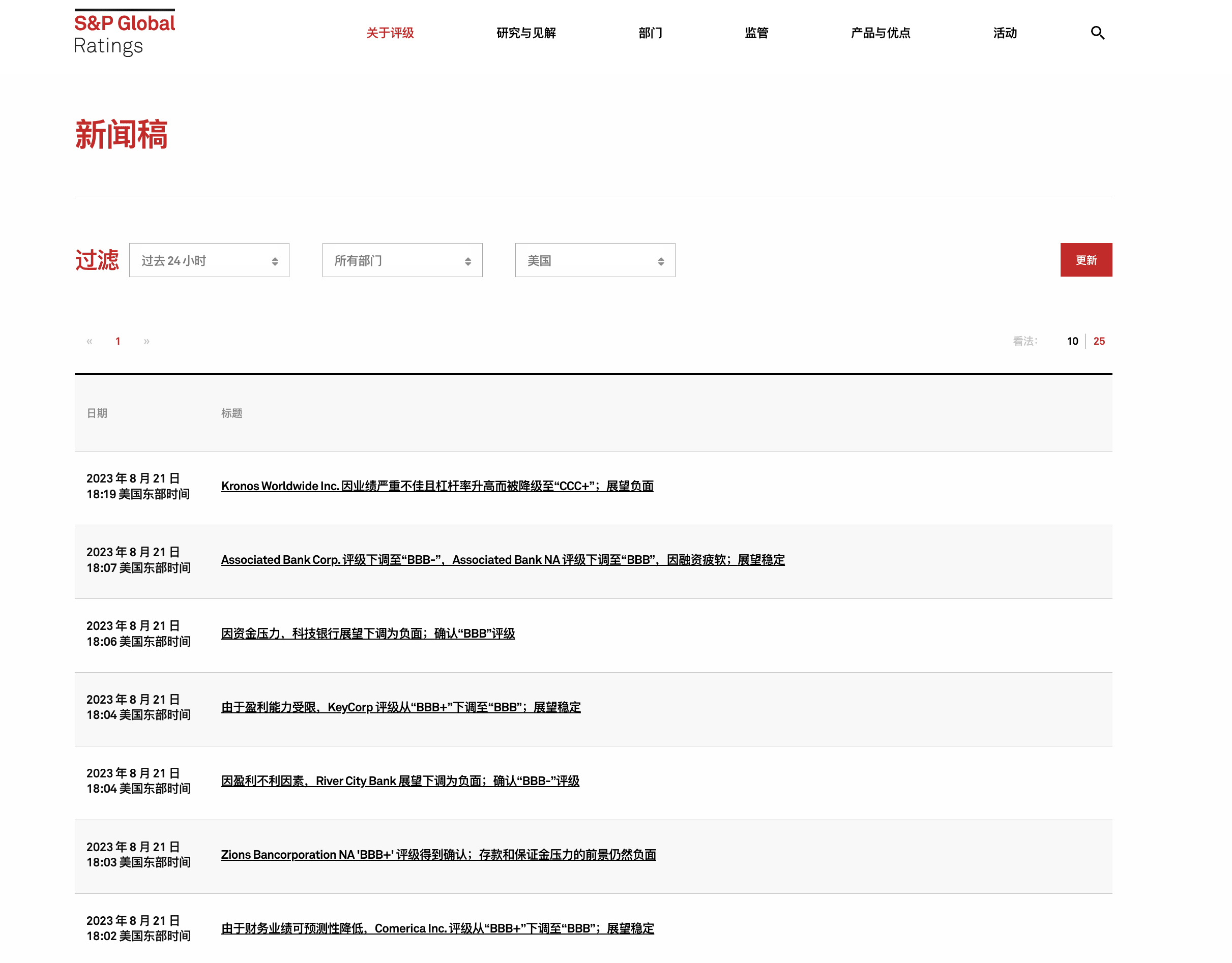
In layman's terms, many depositors have transferred their funds to high-interest accounts, increasing the financing costs of banks. The decline in deposits has squeezed the liquidity of many banks, and the value of securities, which account for a large part of their liquidity, has also declined. To put it more clearly, the Fed's continued interest rate hikes are oppressing almost all small and medium-sized banks. More funds have entered money market funds, U.S. bonds, and even U.S. stocks, which are more profitable than deposits in banks, causing Wuxi deposits to fall by 23% in the past five quarters. With the loss of depositors and funds, banks' financing will become more difficult, and if the Fed continues to maintain high interest rates, the problems of banks, especially regional banks, will become more serious. Remember that we have always mentioned the crisis that commercial real estate may bring? This time, Standard & Poor's also mentioned it in detail.
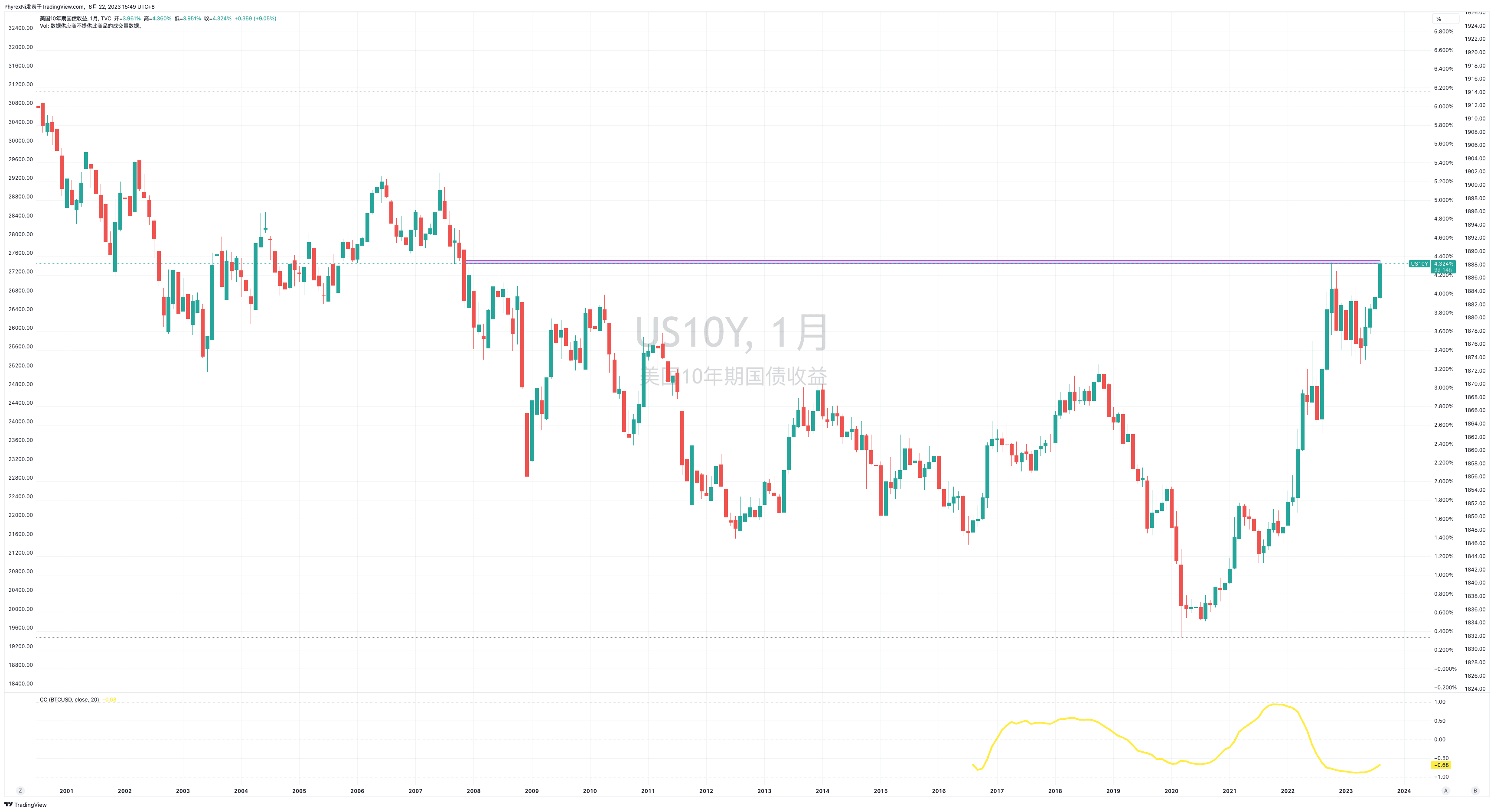
All of these contents may reflect that the US economy is not so optimistic, especially the US Treasury market continued to be sold off after opening on Monday. The yield of 10-year Treasury bonds has risen to a 16-year high, the highest level since the financial crisis, and once exceeded 4.35%. There are two reasons for this. First, at the Jackson Hole Annual Meeting on Thursday and Friday this week, the market generally expects Powell to take a tough attitude to express his fight against inflation. On the other hand, as more analysts believe that a recession will not come, employment will continue to be stable, and the unemployment rate will continue to remain low, which will increase the high interest rate for a longer period of time. In other words, the public now believes that although the economy is improving, the price is that interest rate cuts will be more distant.
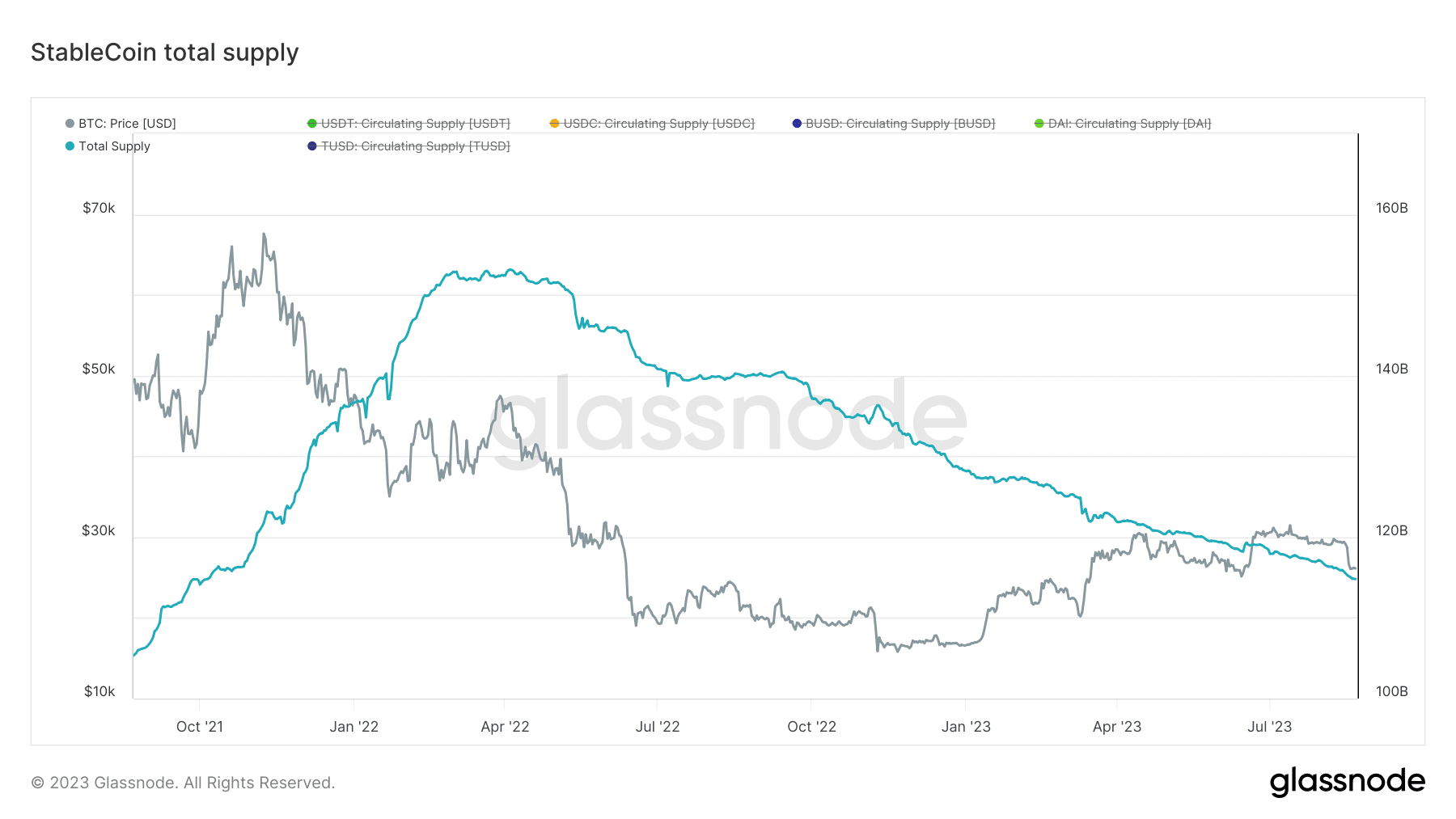
This is not an optimistic message for the current cryptocurrency market. Although the continuous collapse of Silicon Valley Bank, First Republic Bank and Regional Bank has provided a traffic entrance for BTC since March last year, the choices of depositors have basically been determined today, and there is almost no positive sentiment in March and April. More funds have either entered the stock market, the bond market, or directly purchased US dollar cash, but there is no obvious sign of entering the cryptocurrency market. We also saw in yesterday's data that the market value of the main stablecoins was declining sharply, and more funds were flowing out of the cryptocurrency market.
Fish will not die because of the slow decrease in water in the pond, as long as the water can cover the fish's whole body, but when the water level continues to drop and cannot cover the fish, the fish will die in large numbers. Now the prices of BTC and ETH are like fish in these gradually depleted pools. Although the decrease in water level has not yet caused the death of the fish, it is inevitable that stronger fish will occupy deeper water positions, while small fish (ALT) will only be squeezed to the edge when the water level drops, and then gradually suffocate due to lack of water. At that time, who can say whether they will help each other or forget each other?