

Source: Mint Venture
Impossible Triangle
Graphics: Mint Ventures
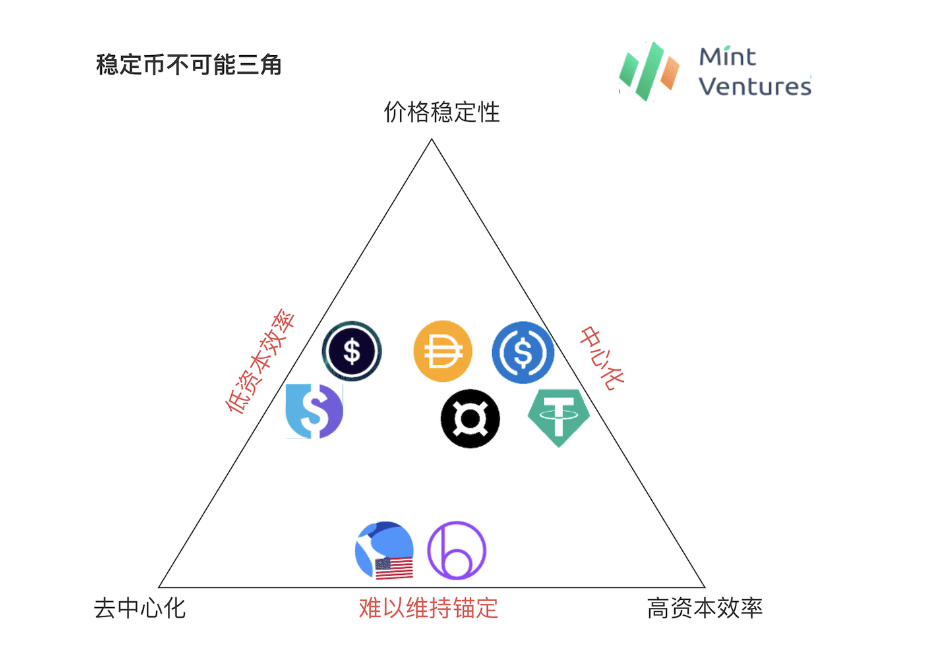
There has always been an impossible triangle in the field of crypto stablecoins, that is, price stability, decentralization and capital efficiency cannot be achieved at the same time.
Centralized stablecoins such as USDT and USDC have the best price stability on the chain and capital efficiency up to 100%. The only problem is the risk brought by centralization. BUSD stopped new business due to regulation and the impact of the SVB incident on USDC in March this year clearly revealed this point.
The algorithmic stablecoin craze that began in the second half of 2020 attempted to achieve undercollateralization based on decentralization. During this period, projects such as Empty Set Dollar and Basis Cash quickly collapsed. Later, Luna used the credit of the entire public chain as an implicit guarantee and did not require overcollateralization for users in the process of minting UST. For a long time (2020-May 2022), it achieved the trinity of decentralization, capital efficiency and price stability, but eventually it collapsed into a death spiral due to credit collapse. Since then, projects such as Beanstalk have also appeared in undercollateralized tokens, but they have not attracted much attention from the market. The difficulty of stable anchoring of such tokens is the Achilles' heel of their development.
The other path starts from MakerDAO, which hopes to achieve price stability by over-collateralizing the underlying decentralized assets at the expense of a certain amount of capital efficiency. At present, Liquity's LUSD is the largest stablecoin fully supported by decentralized assets. However, in order to ensure the price stability of LUSD, Liquity's capital efficiency is indeed low. The collateral rate of the entire system is above 250% all year round, which means that every 1 LUSD in circulation requires more than 2.5U of ETH as collateral. Synthetix's sUSD is even more extreme. Due to the greater volatility of the collateral SNX, the minimum collateral rate required by Synthetix is usually more than 500%. Low capital efficiency means a low ceiling for scale, which also means low attractiveness to users. The main problem that Liquity wants to solve in its planned V2 version is the low capital efficiency of V1. Synthetix also plans to introduce other assets as collateral in its planned V3 version to reduce the requirements for the minimum collateral rate.
In fact, the early DAI (2020 and before) also had the problem of low capital efficiency, and because the market value of the entire crypto market was small at the time, the volatility of DAI's collateral ETH was large, and the price of DAI was also large. In order to solve this problem, MakerDAO introduced PSM (price stability module, which allows the use of centralized stablecoins such as USDC to generate DAI) since 2020. DAI partially abandoned decentralization in the trade-off between decentralization, capital efficiency and price stability, thereby bringing DAI a more stable price anchor and higher capital efficiency, thereby better helping DAI to grow rapidly with the overall development of DeFi. FRAX, which was launched at the end of 2020, also uses centralized stablecoins as its main collateral. At present, DAI and FRAX are the top two in terms of circulation scale in the category of decentralized stablecoins, which certainly proves that their strategy is appropriate and provides users with more in-demand stablecoins, but it also indirectly illustrates the constraints of "maintaining decentralization" on the scale of stablecoins.
But there are still a series of stablecoins that try to achieve high capital efficiency and strong price stability while maintaining decentralization. They all try to provide users with such a stablecoin:
Generated by decentralized assets (such as ETH), avoiding censorship risks;
Using $1 worth of assets can generate $1 worth of stablecoins, without the need for over-collateralization, which is more conducive to scalability;
The value of stablecoins remains stable.
In fact, this is also the most intuitive and theoretically the best decentralized stablecoin. We use Liquity V2's name for this type of protocol - decentralized reserve protocol to name this type of stablecoin. It should be pointed out that, unlike the traditional stablecoin generated by over-collateralization, for users, after their assets are exchanged for this type of stablecoin, the assets used to generate the stablecoin belong to the protocol and are no longer associated with the user. In other words, the user is more like doing an ETH -> stablecoin swap operation. This type of stablecoin is more similar to centralized stablecoins such as USDT. You can use $1 of assets to exchange for $1 of stablecoins, and vice versa. It's just that the assets accepted by the decentralized reserve protocol are crypto assets.
(Some people may think that since the collateral is not owned by the user, such stablecoins do not have the leverage function, which will lose a major use case of stablecoins. However, the author believes that the stablecoins in our real life do not have the leverage function, and centralized stablecoins such as USDT and USDC have never had the leverage function. Settlement tools, accounting units and means of storing value are the core functions of currency. Leverage is only a special function of CDP (collateralized debt position) type stablecoins, not a general use case of stablecoins)
However, the reason why stablecoin protocols in the past have not been able to continue to provide such stablecoins is that the above-mentioned stablecoins have a problem that is simple to say but difficult to solve: the prices of decentralized assets fluctuate greatly, how can they guarantee the redemption of the stablecoins they issue at a 100% collateral rate?
From the perspective of the balance sheet of the stablecoin protocol, the collateral deposited by users is assets, while the stablecoins issued by the protocol are liabilities. How can we ensure that assets are always greater than or equal to liabilities?
Or a more intuitive example is that when ETH = 2000U, a user sends 1 ETH to the protocol to mint 2000 stablecoins. Then when ETH falls to 1000U, how can the protocol ensure that these 2000 stablecoins can still be exchanged for assets worth 2000U?
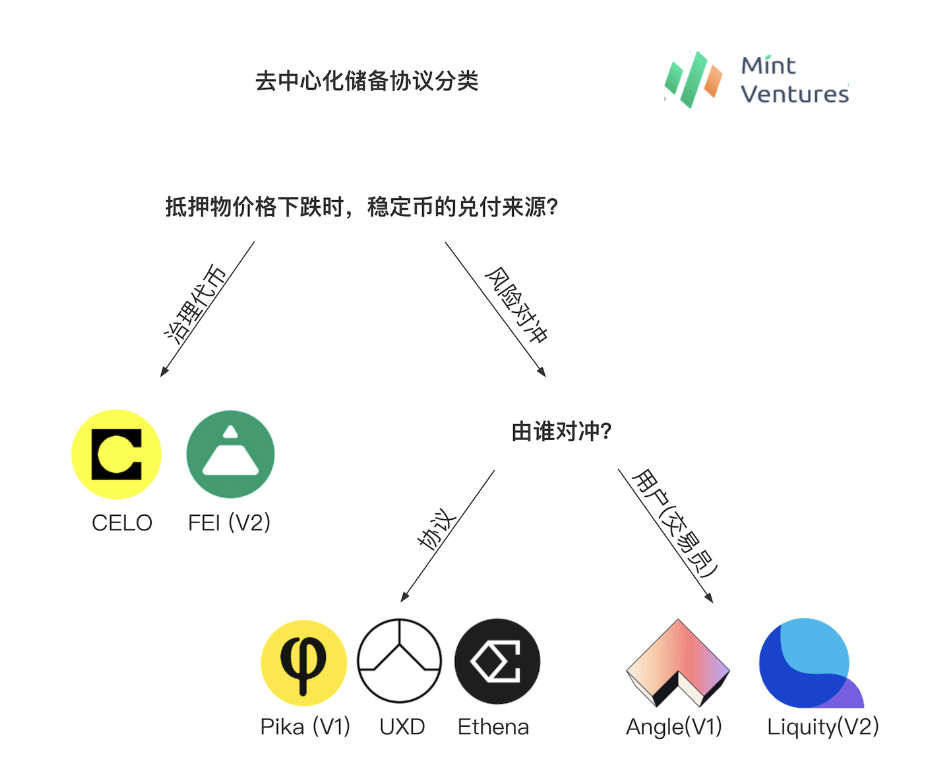
From the development history of decentralized reserve protocols, there are two main approaches to solving this problem: using governance tokens as reserves and hedging reserve asset risks. Based on the method of hedging reserve asset risks, there are decentralized reserve protocols that hedge risks with protocols and decentralized reserve protocols that hedge risks with users. Let’s take a look at them one by one.
Graphics: Mint Ventures
Decentralized reserve protocol with governance tokens as reserves
The idea of the first type of protocol is to use the protocol's own governance token as the "new collateral" of the protocol. When the price of the collateral asset drops sharply, the protocol will mint more governance tokens to redeem the stablecoins of stablecoin holders. We can call it a decentralized reserve protocol with governance tokens as reserves. In the above example, when ETH falls from 2000U to 1000U, the decentralized reserve protocol with governance tokens as reserves uses 1000U worth of ETH + 1000U worth of protocol governance tokens to redeem 2000 stablecoins in the hands of users.
Protocols that adopt this approach include Celo and Fei Protocol.
Forehead
Celo is a stablecoin project launched in 2020. They previously existed as an independent L1. In July of this year, the core team proposed to transition Celo to the Ethereum ecosystem through OP stack. Celo's stablecoin mechanism is as follows:
Celo's stablecoin is backed by a reserve pool composed of a set of comprehensive assets. The reserve rate of the reserve pool (the ratio of the value of reserve assets divided by the value of circulating stablecoins) is much higher than 1, which provides the most core support for the intrinsic value of its stablecoin.
Celo's stablecoin is not minted by over-collateralization, but obtained by sending Celo tokens to the official stablecoin module Mento. Users can send $1 worth of Celo to get $1 of cUSD and other stablecoins, or send $1 worth of cUSD to Mento in return for $1 of Celo. Under this mechanism, when the market price of cUSD is lower than $1, someone will buy cUSD at a low price in exchange for $1 of Celo. Similarly, when cUSD is higher than $1, someone will use Celo to mint cUSD and sell it. The existence of arbitrageurs will ensure that cUSD will not deviate too far from its anchor price.
There are three mechanisms that will be used to ensure sufficient funds in the reserve pool: 1. When the reserve rate is lower than the threshold, the Celo produced by the block will be included in the reserve pool to supplement capital; 2. A certain transfer fee rate can be charged to supplement capital (currently not enabled); 3. A certain stability fee is charged in the Mento transaction module to supplement reserve capital.
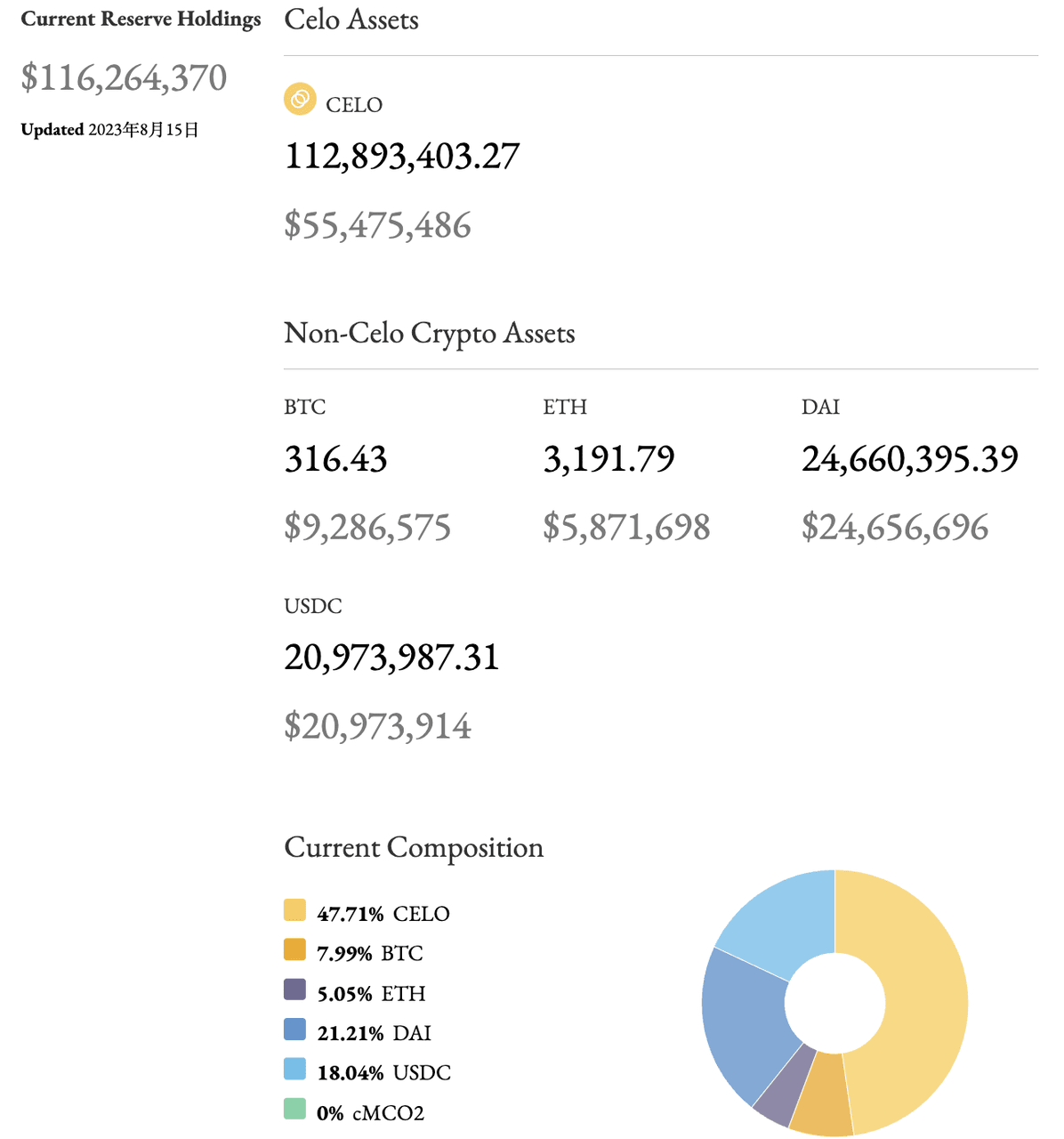
To improve the security of the reserve, its asset portfolio is more diverse, currently including Celo, BTC, ETH, Dai and carbon credit token cMCO2, which will be safer than using only project tokens as collateral (Terra is similar to this scheme, Luna is the invisible margin of its native stablecoin)
Source: Mint Ventures Celo Research Report
It can be seen that Celo is similar to Luna, and is an L1 centered on stablecoins. It is also very close to Luna/UST in terms of minting and redemption mechanisms. The main difference is that when the entire system enters a potential undercollateralization state, Celo will first use the $CELO produced by the block as collateral for the protocol to ensure the redemption of its stablecoin cUSD.
Source: https://reserve.mento.org/
At present, the total collateral of the Celo system is 116 million US dollars, and the total amount of issued stablecoins is 46 million US dollars, with an overall over-collateralization rate of 254%. Although the entire system is in an over-collateralized state, for users who want to use its stablecoin cUSD, they can exchange 1U of CELO for 1 cUSD at any time, which is an excellent capital utilization rate. Of course, from the perspective of the composition of collateral, half of Celo's collateral comes from centralized USDC and semi-centralized DAI, and Celo cannot be considered a completely decentralized stablecoin.
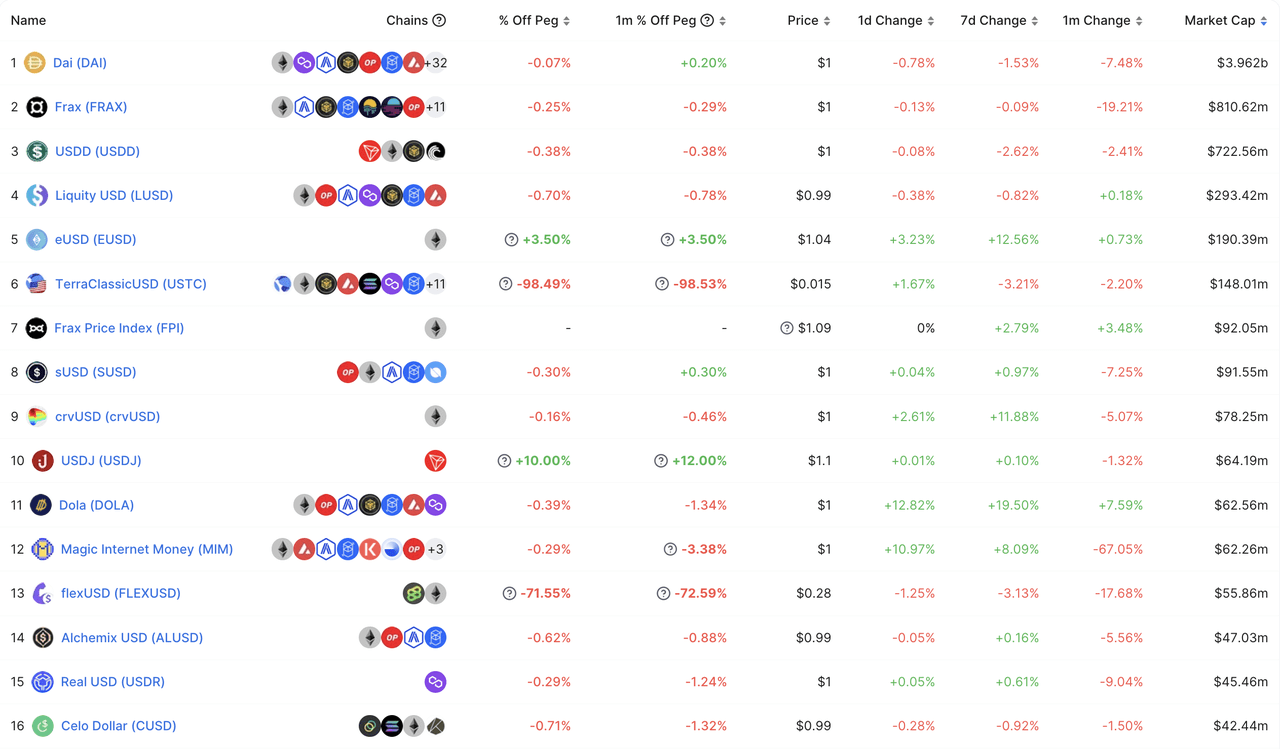
Currently, Celo's stablecoin size ranks 16th among decentralized stablecoins (14th if UST and flexUSD, which can no longer be PEGed, are excluded).
Source: https://defillama.com/stablecoins?backing=CRYPTOSTABLES&backing=ALGOSTABLES
Fei
At the beginning of 2021, Fei Protocol, which received $19 million in financing from institutions such as A16Z and Coinbase, attracted widespread attention from the market because it also had the hottest algorithmic stablecoin concept in the market at the time. In the initial stage of their project issuance (end of March), they attracted 639,000 ETH to participate in the minting of the stablecoin FEI, generating a total of 1.3 billion FEI, which also made FEI the second most decentralized stablecoin after DAI (DAI's circulating market value was $3 billion at the time).
Later, due to the fact that the demand for FEI was oversatisfied in the genesis phase (users mainly wanted to obtain Fei Protocol's governance token TRIBE), the supply of FEI was seriously oversupplied, and the newly launched stablecoin FEI had no application scenarios, so FEI was below $1 for a long time. Soon after, the market volatility in May came again, and the panic of price drops caused users to redeem FEI, causing the protocol to fall into a slump since its launch.
Subsequently, in the V2 version launched at the end of 2021, Fei Protocol proposed a series of measures to try to get the development of the protocol back on track, including modifying its price stabilization mechanism. In V2, FEI can be directly generated by collateral such as ETH, DAI, LUSD at a 100% collateral rate. After the stablecoin is generated, the user's collateral is included in the protocol controlled value (PCV, Protocol Controlled Value). When the collateral rate of the protocol (= PCV/circulating FEI) is higher than 100%, it means that the asset appreciation of the protocol is good, and there is no pressure on the repayment of FEI. The protocol will issue a part of FEI to purchase TRIBE, thereby reducing the collateral rate of the protocol; similarly, when the collateral rate of the protocol is lower than 100%, there is a possibility that the protocol will not be able to fully repay all FEI, and the protocol will also issue a part of TRIBE to purchase FEI, thereby increasing the collateral rate of the protocol.
Under this mechanism, the governance token TRIBE becomes the reserve payment for the entire FEI system in case of potential risks, and can also obtain additional benefits when the system grows (this mechanism is similar to the Float Protocol launched with Fei V1). Unfortunately, the launch of Fei V2 coincided with the peak of the entire bull market, and the price of ETH has been falling since then. Fei was unfortunately attacked by hackers in April 2022 and lost 80 million FEI. Finally, in August 2022, it decided to terminate the protocol development.
The decentralized reserve protocol with governance tokens as reserves essentially guarantees the payment of stablecoins by diluting the rights and interests of all governance token holders. In the bull market cycle of the market, as the scale of stablecoins increases, governance tokens also rise accordingly, which can easily form an upward flywheel. However, in the bear market cycle of the market, as the reserve assets on the asset side of the protocol fall, the total market value of governance tokens will also fall with the market. At this time, if more governance tokens need to be issued, the governance tokens are likely to fall further, forming a death spiral in the price of governance tokens. If the market value of governance tokens drops below a certain proportion of stablecoins, the entire protocol's commitment to pay stablecoins will no longer be credible in the eyes of stablecoin holders, ultimately accelerating the escape and causing a death spiral for the entire system. Whether or not such stablecoins can survive the bear market is the key to their survival. In fact, the reason why Celo can survive in the current bear market is closely related to the overall "over-collateralization" status of the protocol. The reason why the protocol is in an over-collateralized state is that when the market was at a high point, Celo allocated more of its reserves to USDC/DAI and BTC/ETH, allowing the protocol to remain secure as the price of CELO fell from 10 to 0.5.
Decentralized reserve protocol for risk hedging of reserve assets (risk-neutral stablecoin protocol)
The idea of the second type of protocol is to hedge the risks of these crypto assets on the protocol asset side. When the price of the collateral asset falls sharply, the hedge realizes profits to ensure that the assets of the stablecoin protocol can always repay the liabilities. We call this type of protocol a decentralized reserve protocol for reserve asset risk hedging, or a risk-neutral stablecoin protocol. In the above example, after receiving 1 ETH worth 2000U, the decentralized reserve protocol for reserve asset risk hedging will hedge the risk of this 1 ETH (such as opening a short order on the exchange). When ETH falls from 2000U to 1000U, the decentralized reserve protocol for reserve asset risk hedging uses 1000U worth of ETH + 1000U worth of hedging income to redeem 2000 stablecoins in the hands of the user.
Specifically, depending on the specific hedger, it is divided into a decentralized reserve protocol for protocol hedging risks and a decentralized reserve protocol for user hedging risks.
Decentralized reserve protocol for protocol hedging risk
Stablecoin protocols that adopt this approach include Pika Protocol V1, UXD Protocol, and Ethena, which recently announced financing.
Long V1
Pika Protocol is currently a derivatives protocol deployed on the Optimism network. However, in its initial V1 version, Pika had planned to launch stablecoins, and its hedging was achieved through Bitmex's Inverse Perpetual Contract. The Inverse Perpetual Contract (or Currency-Based Perpetual Contract) is also one of Bitmex's inventions. Compared with the more popular "Linear Perpetual Contract" that tracks the price of the currency in U-based, the characteristic of the Inverse Perpetual Contract is to track the price denominated in U in currency-based. An example of the income of the Inverse Perpetual Contract is as follows:
A trader goes long 50,000 contracts of XBTUSD at a price of 10,000. A few days later the price of the contract increases to 11,000.
A trader goes long 50,000 XBTUSD contracts at 10,000. A few days later, the contract price rises to 11,000.
The trader』s profit will be: 50,000 * 1 * (1/10,000 - 1/11,000) = 0.4545 XBT
The trader's profit would be: 50,000 * 1 * (1/10,000 - 1/11,000) = 0.4545 XBT
If the price had in fact dropped to 9,000, the trader』s loss would have been: 50,000 * 1 * (1/10,000 - 1/9,000) = -0.5556 XBT. The loss is greater because of the inverse and non-linear nature of the contract. Conversely, if the trader was short then the trader』s profit would be greater if the price moved down than the loss if it moved up.
If the price actually drops to 9,000, the trader's loss would be: 50,000 * 1 * (1/10,000 - 1/9,000) = -0.5556 XBT The loss is much greater due to the inverse and non-linear nature of the contract. Conversely, if the trader goes short, then if the price drops, the trader's profit would be greater than the loss if the price rises.
Source: https://www.bitmex.com/app/inversePerpetualsGuide
A little analysis will reveal that the reverse perpetual contract and the decentralized reserve protocol for risk hedging of reserve assets are a perfect match. Still using the above example, assuming that when ETH = 2000U, Pika Protocol uses 1 ETH as margin to short 2000 ETH reverse perpetual contracts on Bitmex after receiving 1 ETH from the user. When the ETH price drops to 1000U, Pika Protocol's profit = 2000 * 1 * (1/1000-1/2000) = 1 ETH = 1000U. In other words, when the ETH price drops from 2000U to 1000U, the Pika Protocol's reserves at this time change from 1 ETH to 2 ETH, and it can still effectively redeem the 2000 stablecoins in the hands of the user (the transaction fee and funding rate cost are not considered above). The product design of Pika Protocol V1 is exactly the same as the NUSD product design mentioned by Bitmex founder Arthur Hayes in his blog post, and can always perfectly hedge the long positions in the coin.
Unfortunately, for most crypto investors who use USDT as the base, reverse perpetual contracts have the characteristics of reverse and nonlinear returns (there is no linear relationship between the rise and fall of the native currency and the rise and fall of the contract), which is not very easy for ordinary users to understand. In the subsequent development process, the development of reverse perpetual contracts (currency-based perpetual contracts) is far less than that of the currently popular linear perpetual contracts (U-based perpetual contracts). In mainstream exchanges, the trading volume of reverse perpetual contracts is only about 20-25% of that of linear perpetual contracts. Affected by regulation, BitMex has gradually degenerated from a first-tier contract exchange to a current state where the contract market share is less than 0.5%. Pika believes that linear perpetual contracts cannot meet their hedging needs, and the market space for reverse perpetual contracts is relatively small. In its V2 version, it gave up the stablecoin business and officially turned to derivatives exchanges.
UXD
UXD Protocol is a stablecoin protocol running on the Solana network, which was launched in January 2022. UXD completed a $3 million financing led by Multicoin in 2021 and raised $57 million in IDO. In January of this year, UXD decided to cross-chain into the Ethereum ecosystem, launched Arbirturm in April, and plans to launch Optimism later.
When it was first launched, UXD Protocol supported users to deposit SOL, BTC and ETH to mint its stablecoin UXD at a 1:1 USD value. The collateral deposited by users would be hedged through Solana's lending and perpetual contract exchange Mango Markets to open short orders, and the stablecoin would be redeemed through hedging. The funding fees charged for short orders will be used as protocol income, while the funding fees paid will be paid by the funds raised by the protocol. For a long time after the launch, the UXD protocol worked well, and the protocol even needed to limit the issuance limit of UXD. This is because Mango Markets' overall open positions are below 100 million US dollars. If UXD's short positions reach tens of millions of US dollars, it will face the risk of potential non-payment; in addition, too many short positions will make the funding rate more inclined to become negative, thereby increasing the hedging cost.
Unfortunately, Mango Markets suffered a governance attack in October 2022, and UXD lost nearly $20 million in this incident. At that time, UXD's insurance fund balance was still more than $55 million, so UXD could be redeemed normally. Although Mango Markets subsequently returned the funds of the UXD protocol, Mango Markets has never recovered since then. It also coincided with the FTX crash, which caused funds to flow out of Solana rapidly. UXD could not find a suitable exchange to hedge their long positions. Since then, the only collateral supported by the UXD protocol is USDC, and USDC does not need to hedge risks, so they invested the user's collateral USDC in various on-chain USDC vaults and RWA. It was also after this that UXD decided to cross-chain into the Ethereum ecosystem. Arbirturm was launched in April, and Optimism is planned to be launched later. They are also continuing to look for suitable on-chain hedging venues.
Currently, the circulation of UXD is $14.3 million, and the balance of the protocol insurance fund is $53.2 million.
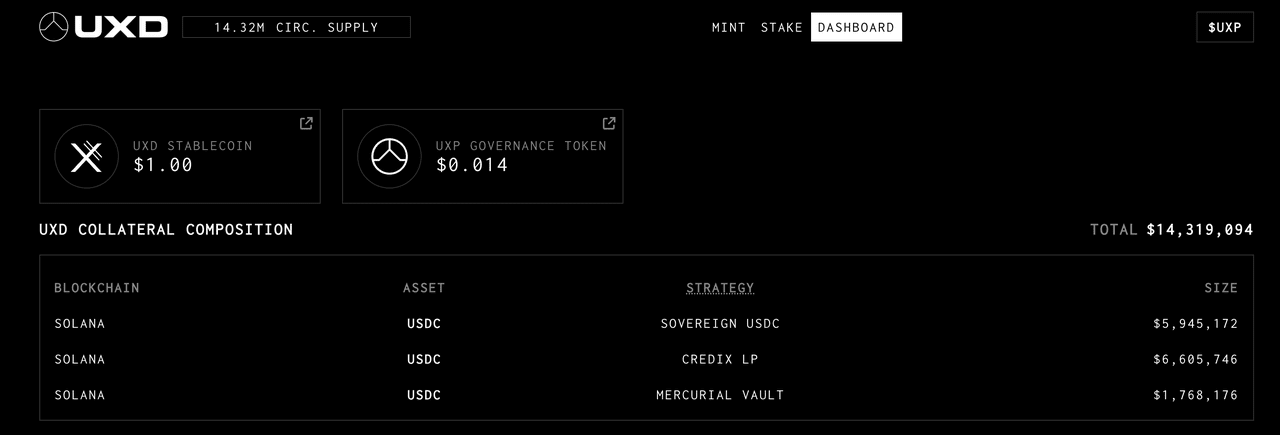
Source: https://dashboard.uxd.fi/
In addition, Ethena Finance, a stablecoin protocol that recently announced financing, will also use risk hedging to hedge its reserve assets. Ethena Finance received $6 million in financing led by Dragonfly, with participation from centralized exchanges such as Bybit, OKX, Deribit, Gemeni, and Huobi. Ethena's financing institutions include many second-tier derivatives exchanges, which will be helpful for its collateral hedging. In addition, Ethena also plans to cooperate with the decentralized derivatives protocol Synthetix to open a short position as a liquidity provider in Synthetix and bring more use cases to its stablecoin USDe (allowing USDe to be used as collateral for certain pools).
For decentralized reserve protocols that hedge risks, the advantages are obvious. By hedging the crypto assets of collateral, the protocol can obtain a risk-neutral position as a whole, thereby ensuring the payment of stablecoins, and ultimately achieving 100% capital efficiency based on decentralization (mainly depending on the hedging venue). At the same time, if the protocol can complete position hedging in a highly capital-efficient way, the collateral reserves owned by the protocol can also generate interest in many forms. In addition, the funding rate can be used as protocol income, giving the protocol more room for maneuver: these income can be distributed to stablecoin holders, creating interest-bearing stablecoins and giving stablecoins more use cases; they can also be distributed to governance token holders.
In fact, the governance token of any stablecoin protocol has an implicit use case as the "lender of last resort" of its stablecoin. Stablecoin protocols that hedge against reserve asset risks can also use their governance tokens as a source of redemption for their stablecoins in extreme cases. For stablecoin holders, holding such stablecoins provides an extra layer of protection compared to stablecoins that simply use governance tokens as reserves. And from a mechanism perspective, the logic of hedging against reserve asset risks is more self-consistent, and in theory will not be affected by market cycles, so there is no need to test the governance token's own ability to resist price drops in a bear market.
But there are also many limitations to development:
Centralization risk of hedging venues. At present, centralized exchanges still account for the vast majority of the liquidity of perpetual contracts, and the design of most decentralized derivatives exchanges is not suitable for stablecoin protocols to hedge, so it is inevitable that protocols will face centralization risks. The centralization risks here can be divided into two categories: 1. The inherent risk of centralized exchanges themselves; 2. Because the total number of hedging venues is small, a single hedging venue will inevitably occupy a large proportion of the protocol's hedging positions. If a hedging venue has problems, it will also have a greater impact on the protocol. The UXD Protocol suffered losses due to the attack on Mango Markets, which caused the protocol to stop operating. This is an extreme example of this centralization risk.
There are certain limitations in the choice of hedging tools. The current mainstream linear perpetual contract method cannot perfectly hedge their long positions. Let's take ETH as an example. The stablecoin protocol requires ETH-based short positions to be hedged with ETH as collateral. The linear perpetual contract with the largest trading volume currently requires USDT as collateral, and its short-selling yield curve is also based on the USD standard, which cannot be perfectly hedged with the ETH position. Even if the stablecoin protocol uses ETH to obtain USDT through some kind of lending, this will increase the operating costs and the difficulty of position risk management, and will also reduce capital efficiency. From the above example of Pika Protocol, we know that the reverse perpetual contract is a perfect choice for decentralized reserve protocols that try to hedge the risk of reserve assets. Unfortunately, the market share of the reverse perpetual contract is not large enough.
The growth of scale has certain self-limitations. The growth of the stablecoin scale of the protocol means that there needs to be a persistent and sufficient number of perpetual contract short positions for hedging. In addition to the complexity of obtaining enough short positions, the more short positions the protocol itself holds, the higher the liquidity requirements for the counterparty when closing the position, and the more likely the funding rate is to be negative, which means potentially higher hedging costs and operational difficulties. For stablecoins with a scale of tens of millions of US dollars, this may not be a big problem. However, if you want to scale further and reach a scale of hundreds of millions or even billions, this problem will obviously restrict its ceiling.
Operational risk. Regardless of the form of hedging, it will involve high-frequency opening, adjusting, and collateral management operations. These processes inevitably require manual intervention, which will generate considerable operational risks and even moral risks.
Decentralized reserve protocol for users to hedge risks
Protocols that adopt this approach include Angle Protocol V1 and Liquity V2.
Angle V1
Angle Protocol went online on the Ethereum network in November 2021. They had previously received $5 million in funding led by a16z.
For more information about the protocol design of Angle Protocol V1, please visit Mint Ventures’ previous research report. We briefly describe it as follows:
Like other decentralized reserve protocols, Angle also supports users to generate 1 agUSD stablecoin with 1U of ETH in an ideal state (of course, the first stablecoin launched by Angle is agEUR anchored to the euro, but the logic is the same. For the sake of context consistency, we still use the US dollar stablecoin as an example). The difference is that in addition to traditional stablecoin demanders, Angle's users also include perpetual contract traders, which Angle calls HA (Hedging Agency).
Still taking the example we gave above, when ETH = 2000U, a user sends 1 ETH to Angle to mint 2000 USD stablecoins. At this time, Angle will open a leveraged position worth 1 ETH for traders to open. We assume that HA uses 0.2 ETH (worth 400U) as collateral and opens a 5x leveraged position. At this time, the collateral of the protocol totals 1.2 ETH, worth 2400U, and the liability side totals 2000U of stablecoins.
When ETH rises to 2200U, the protocol only needs to retain the ETH that can be redeemed for 2000U stablecoins, that is, 0.909 ETH, and the remaining 0.291 ETH (worth 640U) can be withdrawn by HA.
When ETH drops to 1800 U, the protocol still needs to retain ETH that can be redeemed for 2000U stablecoins, that is, 1.111 ETH. At this time, HA's margin position will become 0.089 (worth 160U).
It can be seen that traders are essentially long ETH in the currency standard. When the price of ETH rises, in addition to the increase in ETH itself, they can also obtain part of the ETH of the protocol's "surplus" (in the above example, the ETH price rises by 10%, and the trader earns 60%); and when the price of ETH falls, in addition to the decline in ETH itself, they also need to bear the decline in the protocol's collateral ETH (in the above example, the ETH price falls by 10%, and the trader loses 60%). From the perspective of Angle Protocol, traders hedge the risk of falling collateral prices for the protocol, which is also the origin of its name hedging agent. The long leverage of traders depends on the ratio between the hedgeable position opened by the protocol (0.2ETH in the above example) and the stablecoin position of the protocol (1ETH in the above example).
For perpetual contract traders, there are certain advantages to long perpetual contract trading through Angle: 1. They do not need to pay funding fees (centralized exchanges usually have longs pay shorts funding fees), and 2. The transaction price is directly traded according to the oracle price without slippage. Angle hopes to achieve a win-win situation for stablecoin holders and perpetual contract traders: stablecoin holders gain high capital efficiency and decentralization; contract traders can also get a better trading experience. Of course, this is only an ideal situation. In reality, there will be situations where there are no traders to open long orders. Angle introduces Standard Liquidity Provider (SLP) to provide additional collateral (stablecoins) for the protocol to continue to ensure the security of the protocol, while automatically earning interest, transaction fees and governance token $ANGLE rewards.
The actual operation of Angle is not ideal. Although traders also have a lot of $ANGLE as a reward, the collateral of the protocol is not fully hedged most of the time. The core reason is that I think Angle does not provide a product that is attractive enough to traders. With the decline in the price of $ANGLE tokens, the TVL of the protocol has also fallen from $250 million at the time of launch to around $50 million.
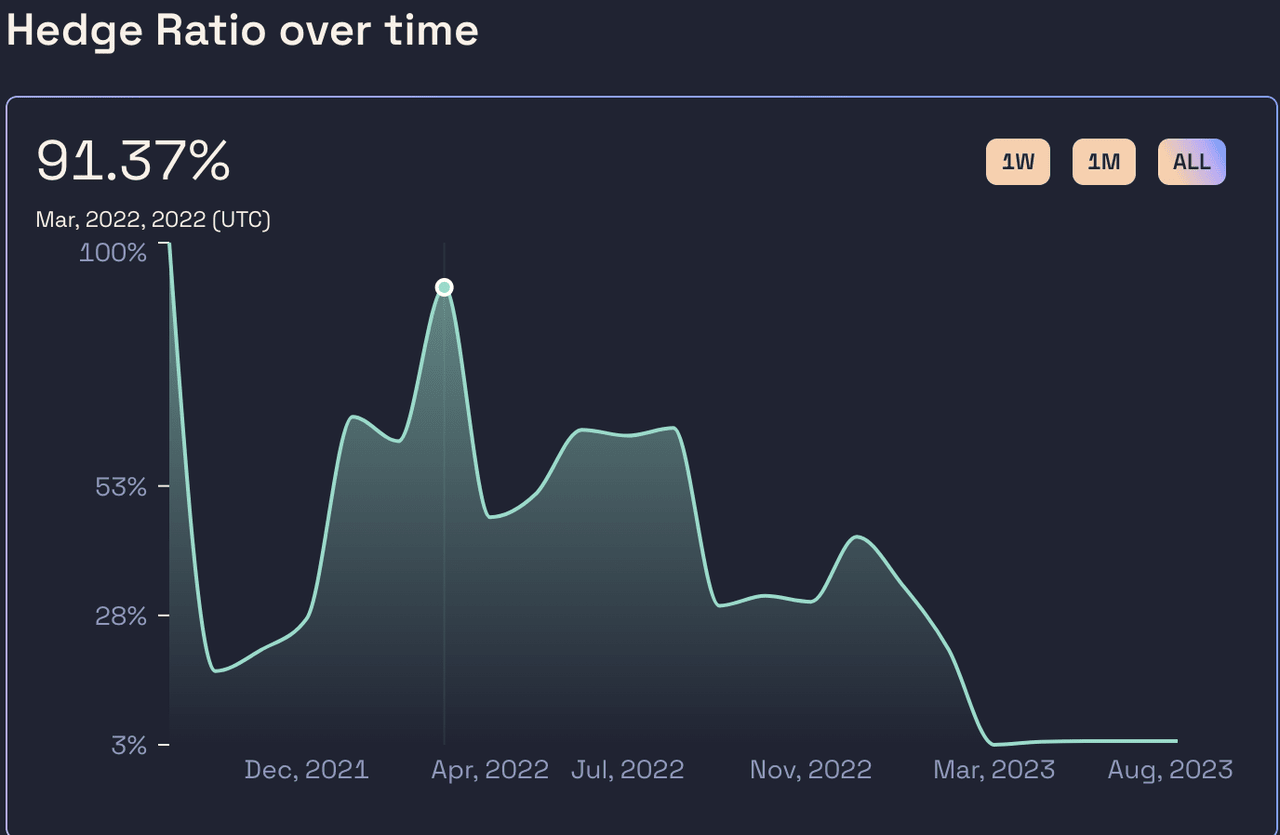
The main collateral source of Angle stablecoin - the hedging rate of the USDC pool / Source: https://analytics.angle.money/core/EUR/USDC

Source: https://defillama.com/protocol/angle
In March 2023, Angle’s reserve assets used for interest-bearing were unfortunately attacked by Euler’s hacker. Although the hacker eventually returned the corresponding assets, Angle was seriously injured. In May, Angle announced the end of the product with the above logic, which they called Angle Protocol V1, and launched the V2 plan. Angle Protocol V2 changed to the traditional over-collateralization model and was just launched in early August.
Liquity V2
Since its launch in March 2021, LUSD issued by Liquity has become the third largest decentralized stablecoin in the entire market (after DAI and FRAX), and the largest fully decentralized stablecoin. We have published research reports in July 2021 and April 2023, respectively, discussing the mechanism of Liquity V1 and subsequent product updates and use case expansion. Interested readers can go and learn more.
The Liquity team believes that LUSD has achieved a relatively good level in terms of decentralization and price stability. However, in terms of capital efficiency, Liquity's performance is relatively average. Since its launch, Liquity's system collateralization rate has been around 250%, which means that every LUSD in circulation requires 2.5U worth of ETH as collateral.
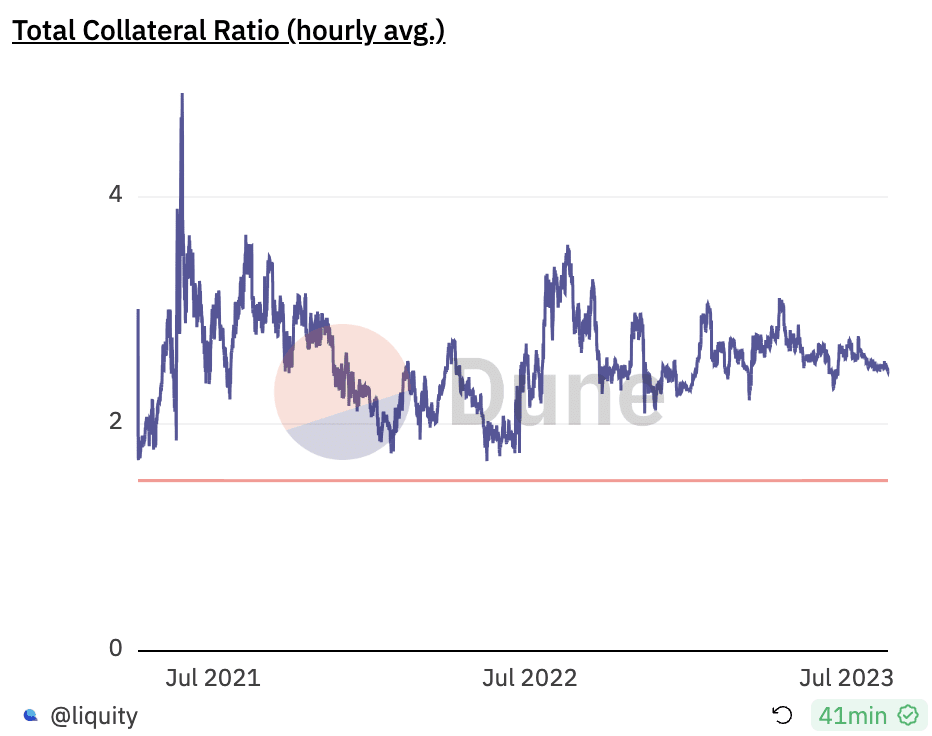
Source: https://dune.com/liquity/liquity
Liquity officially introduced the features of its V2 on July 28. In addition to supporting LSD as collateral, the core content mainly claims that it can achieve high capital efficiency through delta-neutral hedging of the entire protocol.
At present, Liquity has not released specific product documents. The public information about V2 mainly comes from founder Robert Lauko’s speech at ETHCC, the introduction article previously released by Liquity, and the discussion in Discord. We will mainly organize the above information below.
In terms of product logic, Liquity V2 is similar to Angle V1. It hopes to introduce traders to conduct leveraged trading on Liquity, use the margin of these traders as supplementary collateral for the protocol, and use traders to hedge the risks of the entire protocol. At the same time, for traders, Liquity provides them with attractive trading products.
Specifically, Liquity proposed two innovations. The first is the so-called "leveraged trading with principal protection". Liquity will provide contract traders with a leveraged trading product that protects the principal. Users can use this function after paying a certain premium. This function allows them to recover a certain amount of U even if ETH falls sharply. According to the example in the Liquity article, when the ETH price is 1000U, the user pays 12ETH (including 10ETH principal and 2ETH premium), and can obtain a 10ETH 2x leverage long position + downside protection. That is to say, when the ETH price doubles, the 2x leverage long position takes effect, and the rise allows the user to obtain a total of 40ETH; when the ETH price goes down, the put option purchased by the user takes effect, and the user can withdraw his own 10000U (10*1000) at any time.
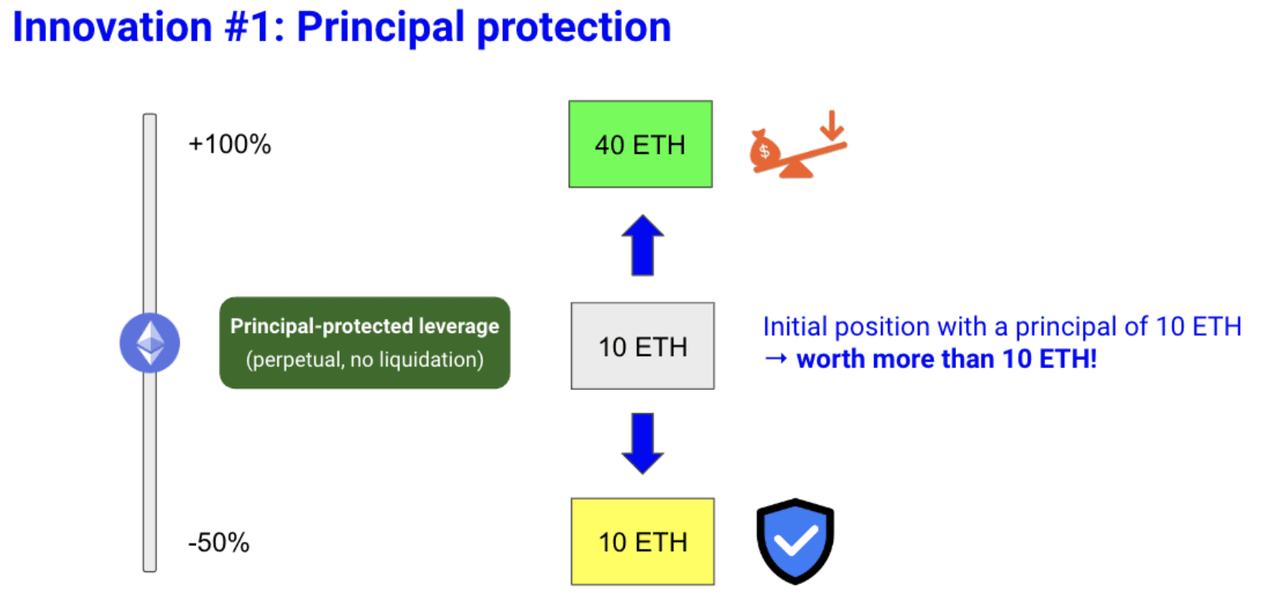
Source: https://www.liquity.org/blog/introducing-liquity-v2
It can be seen that the innovation of Liquity's product based on Angle is mainly this "principal protection" function. Although Liquity did not explain how to implement it, based on the product form and the discussion in Discord, this "principal protection" function is very similar to a call option.
Liquity believes that this combination product will be more attractive to traders because it can protect the principal. Call options allow traders to obtain leveraged returns when prices rise, and to protect the principal when prices fall. From the perspective of traders, it may indeed be more attractive than Angle's pure leveraged trading products (of course, it also depends on Liquity's pricing of premiums). From the perspective of the protocol, the premium paid by users can become a safety cushion for the protocol: when the price of ETH falls, Liquity can use this part of the premium as supplementary collateral to pay stablecoin holders; when the price rises, the increase in the value of Liquity's own collateral can also be distributed to contract traders as profit.
Of course, there are obvious problems in this mechanism. When traders want to close their positions and get back their ETH, Liquity will fall into a dilemma: traders have the right to close their positions at any time, but if they close their positions, the proportion of Liquity's entire protocol position being hedged will decrease, and the security of the Liquity protocol will become fragile as this part of the "collateral" is withdrawn. In fact, the same problem has occurred in the actual operation of Angle. The hedging rate of Angle's system has remained at a low level all year round, and traders have not fully hedged the overall position of the protocol.
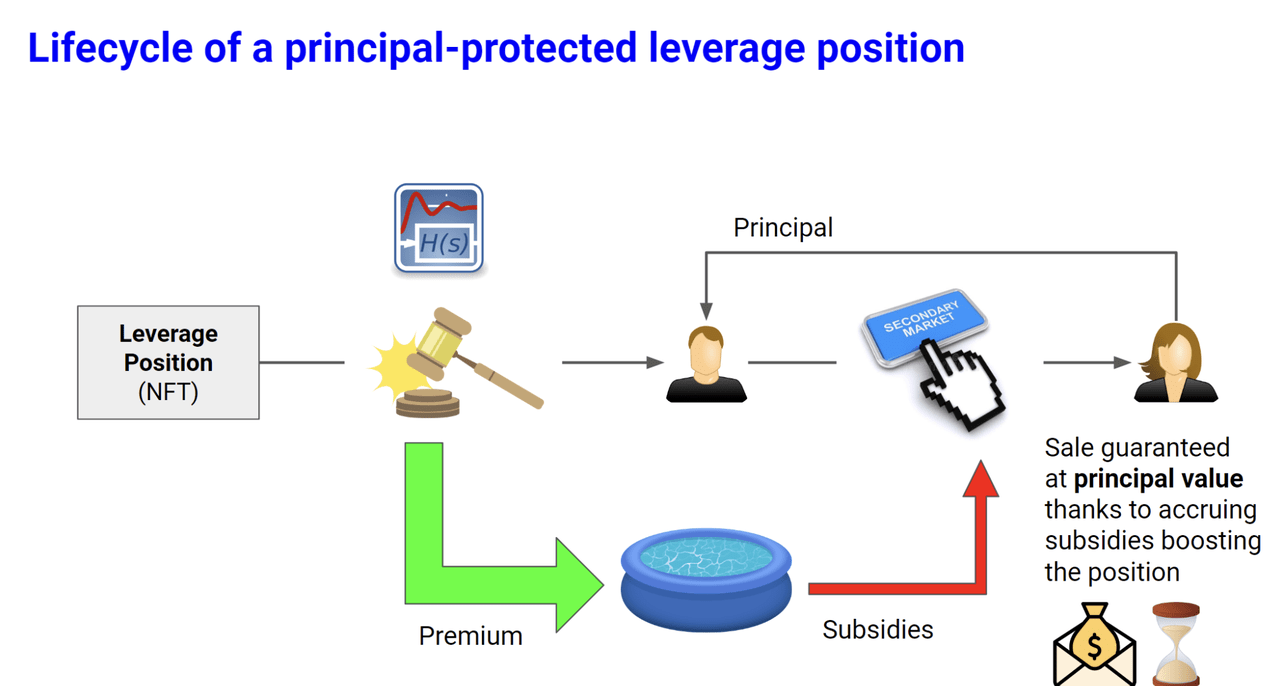
To solve this problem, Liquity proposed a second innovation, an officially subsidized secondary market.
That is to say, in addition to opening and closing positions like normal leveraged trading positions, leveraged trading positions (NFTs) in Liquity V2 can also be sold on the secondary market. In fact, for Liquity, they are worried that traders will close their positions because this will reduce the hedging ratio of the protocol. When a trader wants to close a position, if there are other traders willing to buy from the secondary market at a price higher than the intrinsic value of the current position, they will naturally be happy to get more cash. For Liquity, although this "current position intrinsic value" is subsidized by the protocol, a relatively small proportion of subsidies can maintain the hedging rate of the entire system, thereby increasing the security of the protocol at a lower cost.
Source: https://www.liquity.org/blog/introducing-liquity-v2
For example, Alice opened a position of 10 ETH when the ETH price was 1000U, with a premium of 2ETH. This position corresponds to the value of 10 ETH long + principal protection. However, ETH has fallen to 800U at this time, and the value of the 12000U ETH invested by Alice can only be exchanged for 10ETH (8000U). At this time, in addition to directly closing this position to obtain 10ETH (8000U), Alice can also sell this position in the secondary market at a price between 8000U-12000U. For Bob who wants to buy Alice's position, the act of buying Alice's position is a bit like buying (8000U + a call option with an exercise price of 1000U) when ETH is 800U. This option must be valuable, so this also determines that the price of Alice's position must be higher than 8000U. For Liquity, as long as Bob purchases Alice's position, the collateralization rate of the protocol will not change, because the premium collected by the protocol is still in the protocol fund pool. If Bob does not purchase Alice's position for a long time, the Liquity protocol will slowly increase the value of Alice's position over time (the specific form is not specified, but for example, lowering the strike price and increasing the number of call options can increase the value of this position), and the subsidy comes from the protocol's premium pool (note that this situation will slightly reduce Liquity's overall excess collateralization rate). Liquity believes that not all positions need to be subsidized by the protocol, and the subsidy does not necessarily require a large proportion of the position's income to be subsidized, so the protocol's hedging ratio can be effectively maintained by subsidizing the secondary market.
Finally, these two innovations may still not be able to completely solve the lack of liquidity in extreme situations. Liquity will also use a standard liquidity provider mechanism similar to Angle as a final supplement (a possible way is that the protocol will also allow users to deposit a portion of V1 LUSD into the stable pool to support the redemption of V2 LUSD in extreme situations).
Liquity V2 is scheduled to be launched in Q2 of 24.
In general, Liquity V2 has many similarities with Angle V1, but it also makes targeted improvements to the problems encountered by Angle: it proposes the innovation of "principal protection" to provide more attractive products to traders; it proposes an "official subsidized secondary market" to protect the overall hedging ratio of the protocol.
However, Liquity V2 is essentially the same as Angle Protocol, where the stablecoin team attempts to cross-border and create a derivative product with certain innovations to feed back to its stablecoin business. The Liquity team’s ability in the stablecoin field has been proven, but whether it can also design excellent derivatives, find PMF (Product Market Fit) and successfully promote it is questionable.
Conclusion
A decentralized reserve protocol that can achieve decentralization, high capital efficiency, and price stability is certainly exciting, but a sophisticated and reasonable mechanism design is only the first step in a stablecoin protocol. What is more important is the expansion of stablecoin use cases. Currently, decentralized stablecoins are generally slow in expanding use cases. Most decentralized stablecoins only have one real use case, which is "mining tools", and the incentives for mining are not inexhaustible.
To some extent, the issue of PYUSD by Paypal is a wake-up call for all crypto stablecoin projects, because it means that well-known institutions in the web2 field have begun to enter the stablecoin field, and the time window left for stablecoins may not be too long. In fact, when we talk about the centralization risk of custodial stablecoins, we are more worried about the risks brought by the unreliability of custodians and issuers (Silicon Valley Bank is only the 16th bank in the United States, and Tether and Circle are only "crypto-native" financial institutions). If there are "too big to fail" financial institutions in the traditional financial field (such as JP Morgan) to issue stablecoins, the national credit implied behind them will not only make Tether and Circle lose their foothold instantly, but also greatly weaken the decentralized value advocated by decentralized stablecoins: when centralized services are stable and powerful enough, people may not need decentralization at all.
Until then, we hope that decentralized stablecoins will gain enough use cases to reach the Schelling point of stablecoins (referring to the natural tendency of people to communicate without communication), although this is difficult.
Original link


