

The social field is still popular. Recently, friend.tech, the most popular social platform on Base, has attracted a large number of users on its own. Friends who are interested in the social field should have played friend.tech. After the news of Paradigm's participation was released, the transaction data of the protocol skyrocketed. As of the time of writing, data showed that friend.tech's transaction volume exceeded 30,000 ETH, and the protocol revenue reached 1,383 ETH, which was even outrageous enough to drive the TVL of the Base chain.
In fact, after Elon took office, he frequently made "massive changes" to Twitter. Many people were looking for the next application suitable for Web3. Friend.tech appeared. Its biggest advantage is that it can easily and quickly gain benefits by leveraging the influence of Twitter. Second, the model of the application is very simple. The popularity also surged, but many people on social media also raised concerns about the application, including:
-On iOS, it is only inserted into the desktop as a plug-in, which raises concerns about the security of the plug-in;
- The second is the creation of fake accounts. For some KOLs, there are many fake accounts that can sell their "shares" on a first-come, first-served basis. In the case of non-standard or unchecked evaluation, it is easy for users to buy the shares of fake KOLs, and many robot accounts trade shares faster than real accounts;
-friend.tech has limited scalability as a social application, currently only has chat to purchase shares;
- Also be aware of concerns about data privacy and platform pricing, which is not too different from fan tokens, which generally don’t fare well;
- There is very little information about the project, no common information about the project such as roadmap, founders or whitepaper;
-The user experience is not good, such as network failure, delay, etc.
In fact, in addition to friend.tech, another event worth noting in the social field is that DeBank launched the Debank Chain based on OP stack. This L2 aims to become the social layer of cryptocurrency (currently in the test network, the main network is expected to be launched in 2024), and DeBank’s social applications seem to be doing very well at present.
Debank Chain
Regarding DeBank Chain, the official social media of the application gave an introduction. This L2 is based on OP stack and focuses on solving three key problems while maintaining strong security: minimizing Gas costs, providing a native experience similar to account abstraction, and ensuring the security of L1 assets. Most importantly, DeBank Chain is committed to becoming a cryptocurrency social layer.
The updates made by DeBank Chain mainly include:
The consensus mechanism was modified to reduce the gas cost of a single transaction by 100 to 400 times to adapt to the high-frequency nature of social interactions.
A system similar to AA (Account Abstraction) is natively integrated at the chain level, allowing users to enjoy a near-Web2 experience while maintaining 100% compatibility with current EVM standards.
The new account system supports dedicated L2 private key signature transactions, reducing the use of L1 private keys in social scenarios and enhancing the security of users’ L1 assets.
Play Debank Social
In fact, most people know DeBank for its ability to analyze on-chain data and track wallet transactions, but DeBank has been expanding itself, such as the Rabby wallet and its efforts in the social field. Based on the launch of its L2 in the future, DeBank Stream and DeBank Hi as main applications are more worthy of interaction and experience. The following is a tutorial:
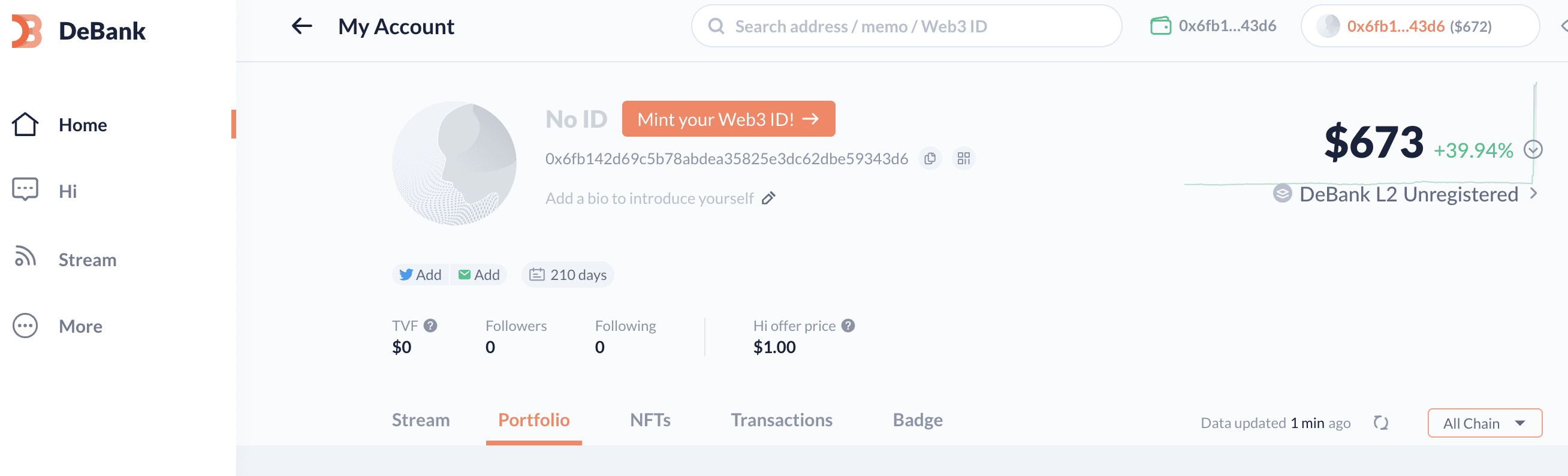
Click to enter Debank’s official website and connect your wallet. You can use Little Fox or DeBank’s own Rabby wallet. (This article uses Little Fox wallet, you can also import Little Fox wallet into Rabby)
Click DeBank L2 Unregistered and select OP, Arb or Polygon chain (lower Gas);
Set a password (6-digit password, used for payment or confirmation of transactions, etc.);
After completion, select Deposit L2, choose the chain with USDT/USDC assets, and deposit more than 100u of U into DeBank L2. In addition, you can withdraw assets back to L1 at any time;
After depositing U, click on the homepage to mint your own domain name (currently it takes 96U to mint a domain name), bind your Email and Twitter and verify them, and you can also choose the wallet NFT you hold as your avatar;
After completion, you can publish some content on the platform according to your preferences. In addition, you can also mint some badges on DeBank Stream, such as wallets with more than 100 followers, wallets that have received project airdrops (1INCH, ARB, OP, DYDX, etc.), wallets that have spent more than a certain amount of ETH Gas on the Ethereum mainnet, etc. These badges may become the standards for some rewards in the future;
As a social application, DeBank Stream is very similar to Twitter, rewarding users for the value they create (based on time and attention). Users can receive rewards of a corresponding amount after publishing content. The reward value is based on the exposure of the user's content and some promotions obtained during the dissemination process on Stream, such as the number of attention, clicks, comments and reposts from other users, as well as the asset value of these users.
In addition, Threads and Polls (similar to Twitter) can also be published on DeBank. For Polls (voting surveys), users can select questions and options, and can also set the range of users who answer questions, such as user assets, user TVF, the age of the address, and the number of followers.
What’s even more innovative is that the DeBank Stream app also comes with a lottery function. After following the user who initiates the lottery, the user can describe the specific content of the lottery and then choose the lottery amount, quantity, range of participants, etc.
Therefore, on DeBank Stream, the time users spend, the content they post or read, their comments and reposts will all be calculated as value contributions and credited to their accounts.
In comparison, although Twitter also has similar rewards, the threshold for Twitter is very high, requiring extremely high views and fans. Secondly, for Chinese KOLs, they need to bind Stripe to receive rewards (which is not very easy). In comparison, DeBank seems to be simpler and more universal.
Other well-known Web3 social protocols include Lens, but it seems that Lens has been trying to attract users in terms of airdrop rewards. DeBank Stream is ahead of the two and has begun to focus on the cryptocurrency social layer. Compared with other social protocols, DeBank is still a tool for tracking wallets, and can see other users' wallet assets and investment portfolios. This is unique for social applications and is also the application closest to the Web 3 social protocol.
Debank Hi also has a function similar to friend.tech. Users need to pay a certain fee when sending messages to others (both parties can chat for free after following each other). The difference is that Debank Hi is a paid chat, and the payment does not belong to the "user share" of friend.tech. The fee is judged according to the number of fans and contribution of the other party.
In addition, the DeBank application interface also displays "Tokens Soon", which is worth our interaction.
Conclusion
The reason friend.tech became popular is that it is very efficient in “seeking profits” and it can quickly earn profits. However, it cannot be said to be a perfect social application at present. Its popularity two days ago was also hyped up after Paradigm announced its financing. In comparison, DeBank also completed a financing of 25 million US dollars with a valuation of 200 million US dollars. The more famous investment institutions include Sequoia China, Dragonfly, Coinbase Venture, Circle, Ledger, etc. The social application developed by DeBank has obvious advantages, such as wallet binding, which is also the best way to track real users.
Compared with friend.tech, DeBank has more obvious advantages, including:
Investment institutions are more hardcore;
The wallet binding method is more Web3;
Closer to social applications;
More real users;
Launched its own L2.
We don’t know how long the friend.tech myth can last, but in comparison, DeBank, a platform that is preparing to go all out into Socialfi, is clearly more promising.