
#tbv
tbv
3,674 views
113 Discussing
Hot
Latest

·
--
#baby Continues to attract attention as project @babylonlabs_io evolves, especially with the concept of Trustless Bitcoin Vaults (#TBV ), which aims to enhance Bitcoin security without needing to trust a third party.
I carefully monitor support and resistance levels, and I believe that risk management is the most important factor before any investment decision. If the positive momentum continues, we may see good opportunities, but sticking to a clear trading plan remains the foundation.
#baby
#baby Continues to attract attention as project @BabylonLabs_io evolves, especially with the concept of Trustless Bitcoin Vaults (#TBV ), which aims to enhance Bitcoin security without needing to trust a third party.
I carefully monitor support and resistance levels, and I believe that risk management is the most important factor before any investment decision. If the positive momentum continues, we may see good opportunities, but sticking to a clear trading plan remains the foundation.
#baby
I carefully monitor support and resistance levels, and I believe that risk management is the most important factor before any investment decision. If the positive momentum continues, we may see good opportunities, but sticking to a clear trading plan remains the foundation.
#baby
16

·
--
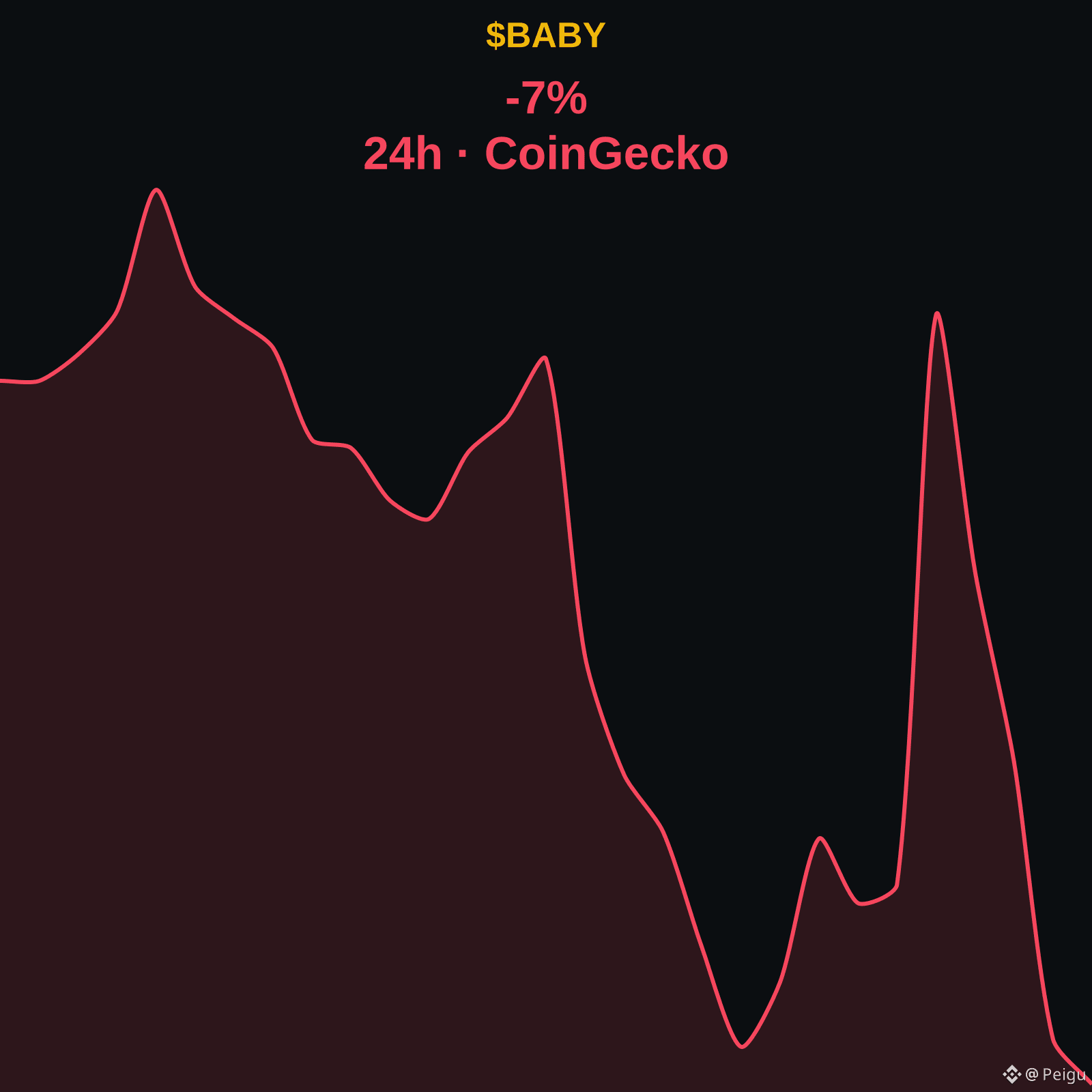
That Coldcard drain story bouncing around today (CZ chimed in that nothing is fully safe) sent me back into @BabylonLabs_io's TBV docs — exit chapter only.
I used to skip that part. Deposit side is clean. BTC never wraps and stays on Bitcoin. The part I'm stuck on is the unbonding wait after you ask to leave. That delay is intentional, it's how TBV stays trustless. $BABY shows up in every Square thread on this.
I'm going through that full unlock sequence next.
#baby #Babylon #TBV
That Coldcard drain story bouncing around today (CZ chimed in that nothing is fully safe) sent me back into @BabylonLabs_io's TBV docs — exit chapter only.
I used to skip that part. Deposit side is clean. BTC never wraps and stays on Bitcoin. The part I'm stuck on is the unbonding wait after you ask to leave. That delay is intentional, it's how TBV stays trustless. $BABY shows up in every Square thread on this.
I'm going through that full unlock sequence next.
#baby #Babylon #TBV
I used to skip that part. Deposit side is clean. BTC never wraps and stays on Bitcoin. The part I'm stuck on is the unbonding wait after you ask to leave. That delay is intentional, it's how TBV stays trustless. $BABY shows up in every Square thread on this.
I'm going through that full unlock sequence next.
#baby #Babylon #TBV
1
54

#baby $BABY 🚀 Babylon ($BABY) Highlight Article
#baby $BABY
Bitcoin is the most secure blockchain in the world, and Babylon is building innovative solutions to extend that security across the broader crypto ecosystem.
One of Babylon's most exciting developments is Trustless Bitcoin Vaults (TBV). TBV is designed to enhance self-custody, transparency, and decentralization, allowing Bitcoin holders to maintain control of their assets without relying on centralized intermediaries.
As blockchain technology continues to evolve, security remains the foundation of long-term adoption. Babylon's vision is to unlock Bitcoin's security for new use cases while preserving the core principles that have made Bitcoin successful for over a decade.
With growing interest in Bitcoin-native innovation, $BABY is attracting attention as a project focused on strengthening infrastructure, improving trust, and supporting the future of decentralized networks.
The next phase of crypto growth will depend on secure and reliable systems—and Babylon is positioning itself at the center of that evolution.
#baby #BABY #Bitcoin #BTC #Crypto #Blockchain #Web3 #Babylon #TBV
#baby $BABY 🚀 Babylon ($BABY ) Highlight Article
#baby $BABY
Bitcoin is the most secure blockchain in the world, and Babylon is building innovative solutions to extend that security across the broader crypto ecosystem.
One of Babylon's most exciting developments is Trustless Bitcoin Vaults (TBV). TBV is designed to enhance self-custody, transparency, and decentralization, allowing Bitcoin holders to maintain control of their assets without relying on centralized intermediaries.
As blockchain technology continues to evolve, security remains the foundation of long-term adoption. Babylon's vision is to unlock Bitcoin's security for new use cases while preserving the core principles that have made Bitcoin successful for over a decade.
With growing interest in Bitcoin-native innovation, $BABY is attracting attention as a project focused on strengthening infrastructure, improving trust, and supporting the future of decentralized networks.
The next phase of crypto growth will depend on secure and reliable systems—and Babylon is positioning itself at the center of that evolution.
#baby #BABY #Bitcoin #BTC #Crypto #Blockchain #Web3 #Babylon #TBV
#baby $BABY
Bitcoin is the most secure blockchain in the world, and Babylon is building innovative solutions to extend that security across the broader crypto ecosystem.
One of Babylon's most exciting developments is Trustless Bitcoin Vaults (TBV). TBV is designed to enhance self-custody, transparency, and decentralization, allowing Bitcoin holders to maintain control of their assets without relying on centralized intermediaries.
As blockchain technology continues to evolve, security remains the foundation of long-term adoption. Babylon's vision is to unlock Bitcoin's security for new use cases while preserving the core principles that have made Bitcoin successful for over a decade.
With growing interest in Bitcoin-native innovation, $BABY is attracting attention as a project focused on strengthening infrastructure, improving trust, and supporting the future of decentralized networks.
The next phase of crypto growth will depend on secure and reliable systems—and Babylon is positioning itself at the center of that evolution.
#baby #BABY #Bitcoin #BTC #Crypto #Blockchain #Web3 #Babylon #TBV

36

#baby $BABY
⚡ Every new innovation brings Bitcoin one step closer to a stronger decentralized future. Trustless Bitcoin Vaults (TBV) by @BabylonLabs_io showcase how BTC can be used beyond simple storage while keeping transparency and security at the core. It's great to see builders expanding the Bitcoin ecosystem with practical solutions. 🌍🚀
$BABY #baby #Bitcoin #TBV
#baby $BABY
⚡ Every new innovation brings Bitcoin one step closer to a stronger decentralized future. Trustless Bitcoin Vaults (TBV) by @BabylonLabs_io showcase how BTC can be used beyond simple storage while keeping transparency and security at the core. It's great to see builders expanding the Bitcoin ecosystem with practical solutions. 🌍🚀
$BABY #baby #Bitcoin #TBV
⚡ Every new innovation brings Bitcoin one step closer to a stronger decentralized future. Trustless Bitcoin Vaults (TBV) by @BabylonLabs_io showcase how BTC can be used beyond simple storage while keeping transparency and security at the core. It's great to see builders expanding the Bitcoin ecosystem with practical solutions. 🌍🚀
$BABY #baby #Bitcoin #TBV
4

·
--
Having Bitcoin stopped for a bit due to some pain, but the truth is that sending it to a bridge or using wrapped BTC always creates distrust because of hacking risks. I was reading about the Trustless Bitcoin Vaults #TBV from @BabylonLabs_io and the approach changes completely. Having your BTC locked in its own network under clear conditions, but still serving as collateral in DeFi without losing custody, is a true before and after. This gives real utility to the ecosystem and puts token $BABY in a very interesting position for the long term. Have you already tested it on the testnet with Aave v4, or do you still prefer keeping the BTC cold? #baby
Having Bitcoin stopped for a bit due to some pain, but the truth is that sending it to a bridge or using wrapped BTC always creates distrust because of hacking risks. I was reading about the Trustless Bitcoin Vaults #TBV from @BabylonLabs_io and the approach changes completely. Having your BTC locked in its own network under clear conditions, but still serving as collateral in DeFi without losing custody, is a true before and after. This gives real utility to the ecosystem and puts token $BABY in a very interesting position for the long term. Have you already tested it on the testnet with Aave v4, or do you still prefer keeping the BTC cold? #baby
102

·
--
Bullish
#baby $BABY We talked for two days about TBV and shared security. Today, I’ll take a turn and talk about something more fundamental—and less noticed—Babylon’s Bitcoin Timestamping protocol.
TBV is the star at the application layer, but what truly makes the whole system run is this primitive hidden underneath. What it does sounds rather ordinary: it periodically “stamps” block headers from other chains onto the Bitcoin mainnet, using Bitcoin’s PoW hashpower to provide those chains’ history with an unforgeable proof of time.
It may seem plain, but its impact is much bigger than it looks.
It solves one of the old soft spots of PoS chains: long-range “attacks.” PoS finality depends on the validator set at the time. Once an attacker obtains private keys from a historical period, in theory they can rewrite ancient history and produce a longer fork chain. Traditional solutions are “social consensus” or “weak subjective checkpoints”—none of them are elegant. Babylon instead lets Bitcoin arbitrate: if you want to change history, first go change Bitcoin’s blocks.
The clever part is that it borrows Bitcoin’s security in a “read-only” way. It doesn’t require cross-chain communication or smart contracts—just leaving a hash on the Bitcoin chain is enough. Minimalist security spillover.
Following this thread, there’s more you can unlock than TBV:
First, on-chain audit credentials. Enterprise evidence storage, regulatory reports, audit snapshots—everything can be fixed onto BTC. In 2026, as compliance narratives heat up, this is a real need.
Second, the terminal anchoring for Rollups. Most Rollup finality today is anchored on Ethereum. If a Rollup wants to take a “BTC-aligned” route, Babylon Timestamping is a natural anchoring layer. In the BTC L2 track, whoever makes the best use of this primitive first will have a differentiated moat.
Third, the historical proof market. Oracles, cross-chain bridges, and the DA layer all need proof that “something happened at some time.” If Timestamping becomes standardized as a service, then it is, by itself, monetizable infrastructure.
TBV borrows Bitcoin’s economic security; Timestamping borrows Bitcoin’s time consensus. The former is sexier, the latter more durable. Infrastructure value often doesn’t lie in the most eye-catching layer, but in the layer that gets called on repeatedly.
@babylonlabs_io You’ve got two cards in hand, and the market is only looking at one right now. When the other will be seen is an interesting observation point for this cycle.
#baby #Babylon #TBV
{future}(BABYUSDT)
$BTC
{future}(BTCUSDT)
#baby $BABY We talked for two days about TBV and shared security. Today, I’ll take a turn and talk about something more fundamental—and less noticed—Babylon’s Bitcoin Timestamping protocol.
TBV is the star at the application layer, but what truly makes the whole system run is this primitive hidden underneath. What it does sounds rather ordinary: it periodically “stamps” block headers from other chains onto the Bitcoin mainnet, using Bitcoin’s PoW hashpower to provide those chains’ history with an unforgeable proof of time.
It may seem plain, but its impact is much bigger than it looks.
It solves one of the old soft spots of PoS chains: long-range “attacks.” PoS finality depends on the validator set at the time. Once an attacker obtains private keys from a historical period, in theory they can rewrite ancient history and produce a longer fork chain. Traditional solutions are “social consensus” or “weak subjective checkpoints”—none of them are elegant. Babylon instead lets Bitcoin arbitrate: if you want to change history, first go change Bitcoin’s blocks.
The clever part is that it borrows Bitcoin’s security in a “read-only” way. It doesn’t require cross-chain communication or smart contracts—just leaving a hash on the Bitcoin chain is enough. Minimalist security spillover.
Following this thread, there’s more you can unlock than TBV:
First, on-chain audit credentials. Enterprise evidence storage, regulatory reports, audit snapshots—everything can be fixed onto BTC. In 2026, as compliance narratives heat up, this is a real need.
Second, the terminal anchoring for Rollups. Most Rollup finality today is anchored on Ethereum. If a Rollup wants to take a “BTC-aligned” route, Babylon Timestamping is a natural anchoring layer. In the BTC L2 track, whoever makes the best use of this primitive first will have a differentiated moat.
Third, the historical proof market. Oracles, cross-chain bridges, and the DA layer all need proof that “something happened at some time.” If Timestamping becomes standardized as a service, then it is, by itself, monetizable infrastructure.
TBV borrows Bitcoin’s economic security; Timestamping borrows Bitcoin’s time consensus. The former is sexier, the latter more durable. Infrastructure value often doesn’t lie in the most eye-catching layer, but in the layer that gets called on repeatedly.
@BabylonLabs_io You’ve got two cards in hand, and the market is only looking at one right now. When the other will be seen is an interesting observation point for this cycle.
#baby #Babylon #TBV
$BTC
TBV is the star at the application layer, but what truly makes the whole system run is this primitive hidden underneath. What it does sounds rather ordinary: it periodically “stamps” block headers from other chains onto the Bitcoin mainnet, using Bitcoin’s PoW hashpower to provide those chains’ history with an unforgeable proof of time.
It may seem plain, but its impact is much bigger than it looks.
It solves one of the old soft spots of PoS chains: long-range “attacks.” PoS finality depends on the validator set at the time. Once an attacker obtains private keys from a historical period, in theory they can rewrite ancient history and produce a longer fork chain. Traditional solutions are “social consensus” or “weak subjective checkpoints”—none of them are elegant. Babylon instead lets Bitcoin arbitrate: if you want to change history, first go change Bitcoin’s blocks.
The clever part is that it borrows Bitcoin’s security in a “read-only” way. It doesn’t require cross-chain communication or smart contracts—just leaving a hash on the Bitcoin chain is enough. Minimalist security spillover.
Following this thread, there’s more you can unlock than TBV:
First, on-chain audit credentials. Enterprise evidence storage, regulatory reports, audit snapshots—everything can be fixed onto BTC. In 2026, as compliance narratives heat up, this is a real need.
Second, the terminal anchoring for Rollups. Most Rollup finality today is anchored on Ethereum. If a Rollup wants to take a “BTC-aligned” route, Babylon Timestamping is a natural anchoring layer. In the BTC L2 track, whoever makes the best use of this primitive first will have a differentiated moat.
Third, the historical proof market. Oracles, cross-chain bridges, and the DA layer all need proof that “something happened at some time.” If Timestamping becomes standardized as a service, then it is, by itself, monetizable infrastructure.
TBV borrows Bitcoin’s economic security; Timestamping borrows Bitcoin’s time consensus. The former is sexier, the latter more durable. Infrastructure value often doesn’t lie in the most eye-catching layer, but in the layer that gets called on repeatedly.
@BabylonLabs_io You’ve got two cards in hand, and the market is only looking at one right now. When the other will be seen is an interesting observation point for this cycle.
#baby #Babylon #TBV
$BTC

112

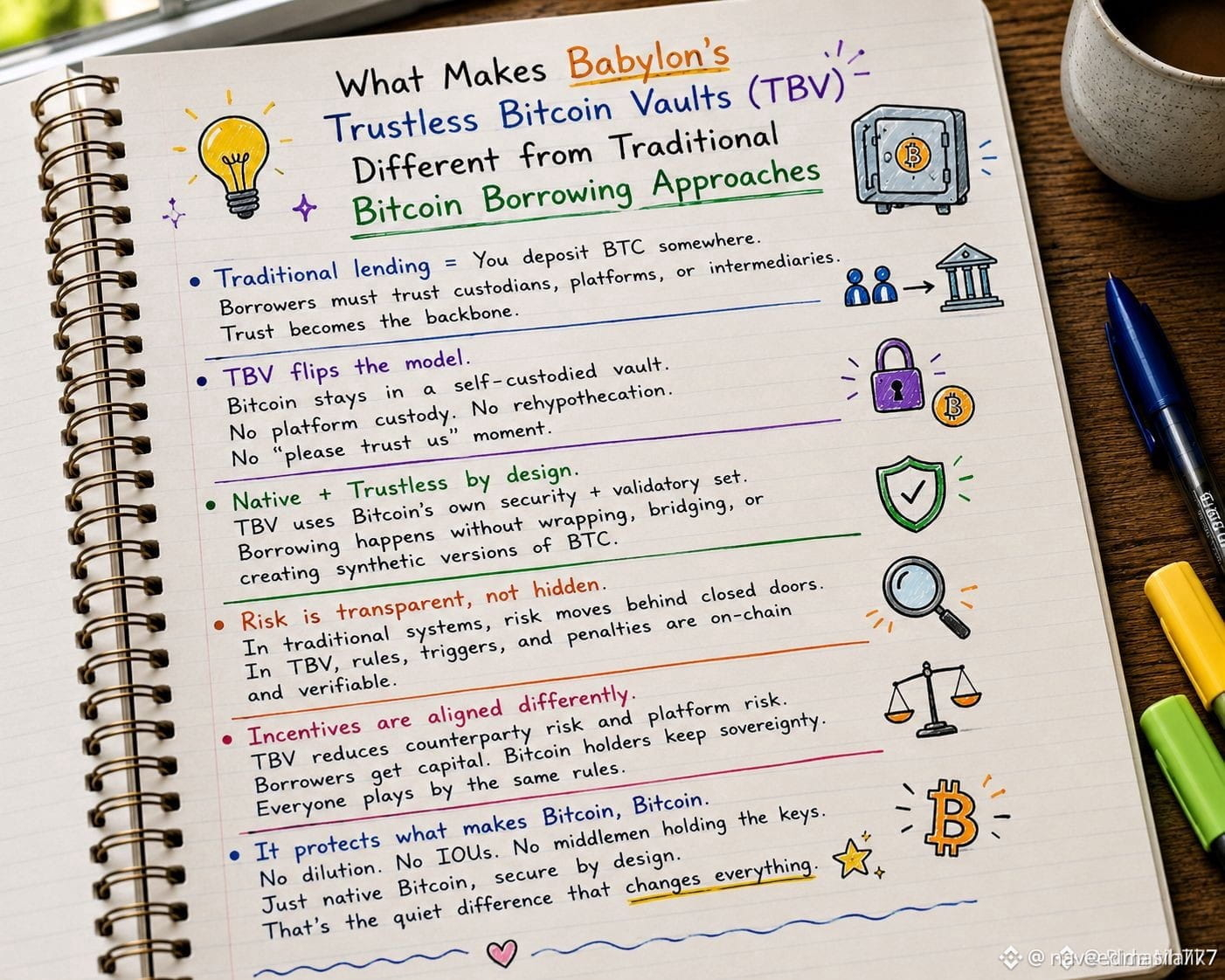
$BABY | The Future of Bitcoin Lending?
Most people never question how Bitcoin-backed borrowing works—until they realize what they're sacrificing: custody and trust.
After learning more about Babylon and its vision, I found myself looking beyond the price chart and into the technology powering the ecosystem.
One concept that stood out is Trustless Bitcoin Vaults (TBV).
Instead of relying on a third party to hold your Bitcoin as collateral, TBV explores whether users can borrow while keeping Bitcoin aligned with its core principles of security and self-sovereignty.
This shifts the conversation from "Who holds your Bitcoin?" to "Does anyone need to hold it at all?"
If this model continues to evolve, the biggest innovation may not just be the technology—it could redefine how we think about Bitcoin-backed finance and reduce the need for trusted intermediaries.
The future of Bitcoin isn't only about price. It's about building a more secure, decentralized financial system.
What are your thoughts on Trustless Bitcoin Vaults and the future of Bitcoin lending?
@babylonlabs_io
{spot}(BABYUSDT)
#baby #Babylon #BabylonLabs #bitcoin #TBV
$BABY | The Future of Bitcoin Lending?
Most people never question how Bitcoin-backed borrowing works—until they realize what they're sacrificing: custody and trust.
After learning more about Babylon and its vision, I found myself looking beyond the price chart and into the technology powering the ecosystem.
One concept that stood out is Trustless Bitcoin Vaults (TBV).
Instead of relying on a third party to hold your Bitcoin as collateral, TBV explores whether users can borrow while keeping Bitcoin aligned with its core principles of security and self-sovereignty.
This shifts the conversation from "Who holds your Bitcoin?" to "Does anyone need to hold it at all?"
If this model continues to evolve, the biggest innovation may not just be the technology—it could redefine how we think about Bitcoin-backed finance and reduce the need for trusted intermediaries.
The future of Bitcoin isn't only about price. It's about building a more secure, decentralized financial system.
What are your thoughts on Trustless Bitcoin Vaults and the future of Bitcoin lending?
@BabylonLabs_io
#baby #Babylon #BabylonLabs #bitcoin #TBV
Most people never question how Bitcoin-backed borrowing works—until they realize what they're sacrificing: custody and trust.
After learning more about Babylon and its vision, I found myself looking beyond the price chart and into the technology powering the ecosystem.
One concept that stood out is Trustless Bitcoin Vaults (TBV).
Instead of relying on a third party to hold your Bitcoin as collateral, TBV explores whether users can borrow while keeping Bitcoin aligned with its core principles of security and self-sovereignty.
This shifts the conversation from "Who holds your Bitcoin?" to "Does anyone need to hold it at all?"
If this model continues to evolve, the biggest innovation may not just be the technology—it could redefine how we think about Bitcoin-backed finance and reduce the need for trusted intermediaries.
The future of Bitcoin isn't only about price. It's about building a more secure, decentralized financial system.
What are your thoughts on Trustless Bitcoin Vaults and the future of Bitcoin lending?
@BabylonLabs_io
#baby #Babylon #BabylonLabs #bitcoin #TBV
1
49
·
--
Verified
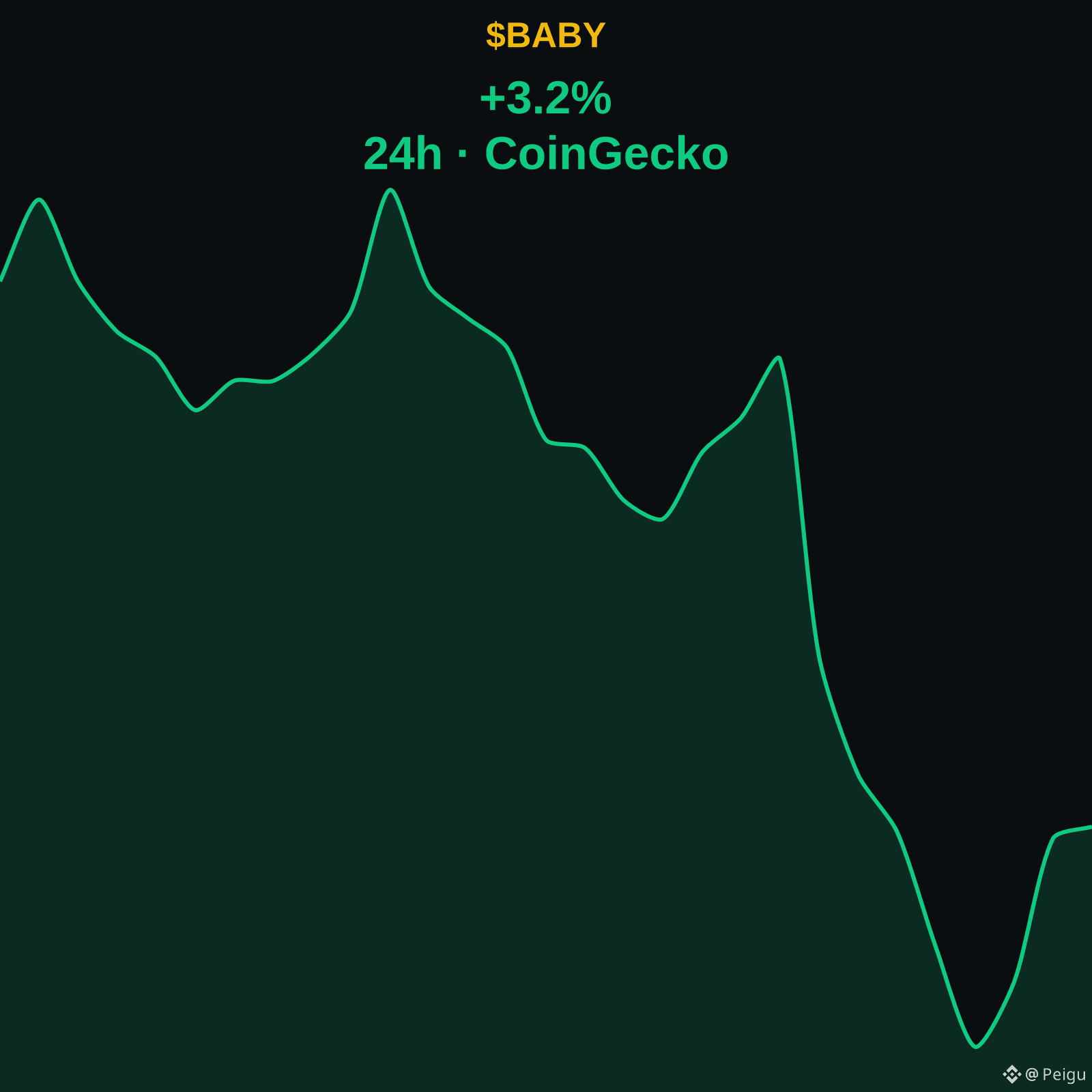
$BABY had a quiet 2.5% green day near $0.012 and yeah my feed is all over that candle.
I've been looking at Trustless Bitcoin Vaults from @BabylonLabs_io.
TBV is the part that changes how this works. You put BTC in the vault and keep the keys yourself. No custodian in the middle. $BABY sits under that design for me.
#baby #Babylon #TBV
$BABY had a quiet 2.5% green day near $0.012 and yeah my feed is all over that candle.
I've been looking at Trustless Bitcoin Vaults from @BabylonLabs_io.
TBV is the part that changes how this works. You put BTC in the vault and keep the keys yourself. No custodian in the middle. $BABY sits under that design for me.
#baby #Babylon #TBV
I've been looking at Trustless Bitcoin Vaults from @BabylonLabs_io.
TBV is the part that changes how this works. You put BTC in the vault and keep the keys yourself. No custodian in the middle. $BABY sits under that design for me.
#baby #Babylon #TBV
5
1
81

·
--
Bullish
Verified
"My BTC never left the vault"
I Spent some time on the TBV testnet today, actually went through the borrow flow instead of just reading about it.
I Grabbed test BTC from the faucet, locked it into a vault, then borrowed test USDC against it through Aave v4. No wrapping step anywhere, no separate token showing up in my wallet standing in for the BTC.
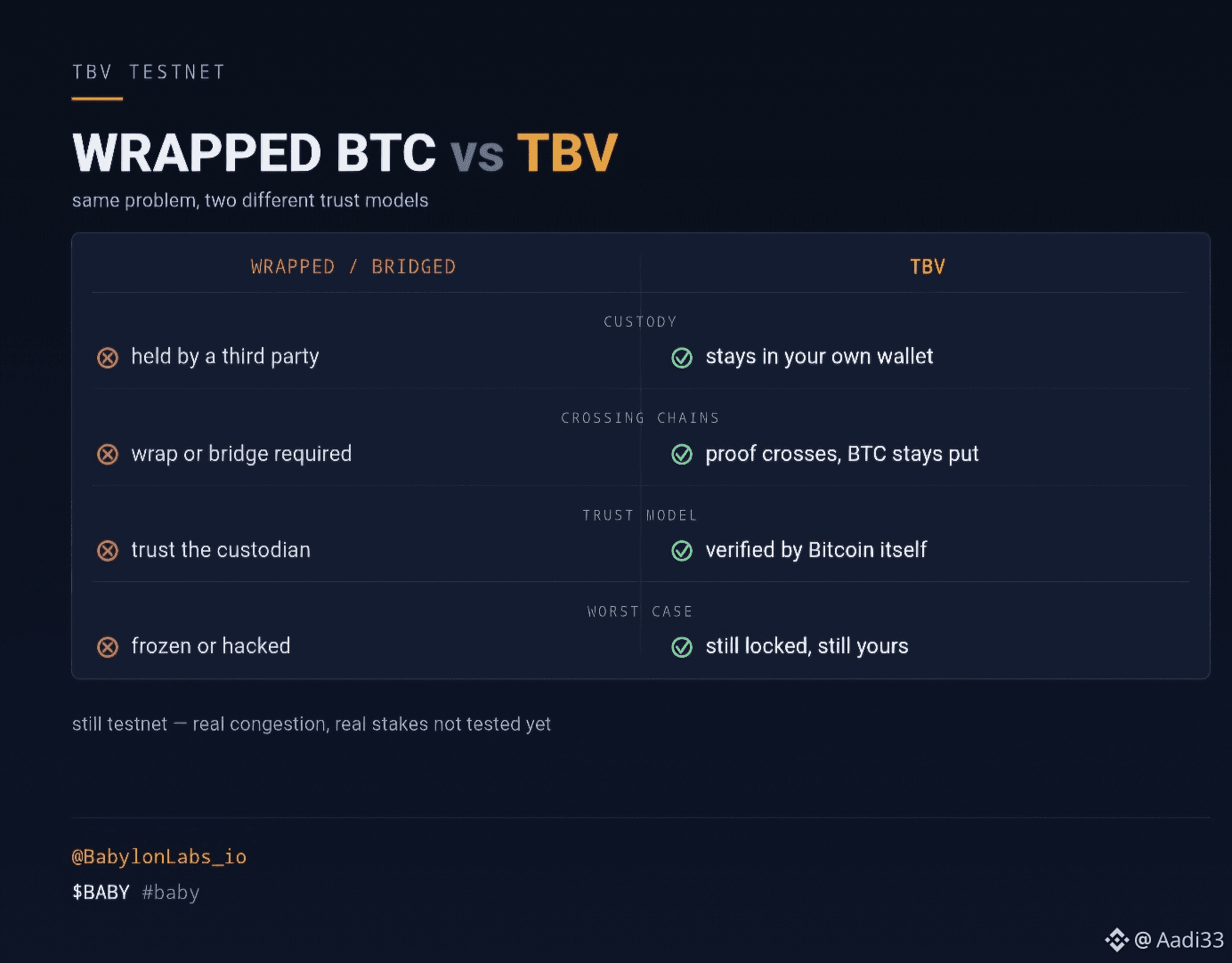
the part that stood out was that my BTC never left the vault. From the user's perspective, it just stayed locked on the Bitcoin side while the Ethereum side treated that vault as collateral. At no point did I end up holding a wrapped version of my BTC.
That's different from how I've used BTC in DeFi before, where there's usually a custodian or wrapped asset somewhere in the middle.
still testnet though, so peg in and unlock timing don't tell you much yet. Real congestion and real economic conditions are usually where systems get properly tested.
I am going to run it again this week and actually try repaying and unlocking. Curious if that side feels as smooth as borrowing did.
@babylonlabs_io $BABY #baby
#testnet #TBV #curiosity $ZEC $ETH
"My BTC never left the vault"
I Spent some time on the TBV testnet today, actually went through the borrow flow instead of just reading about it.
I Grabbed test BTC from the faucet, locked it into a vault, then borrowed test USDC against it through Aave v4. No wrapping step anywhere, no separate token showing up in my wallet standing in for the BTC.
the part that stood out was that my BTC never left the vault. From the user's perspective, it just stayed locked on the Bitcoin side while the Ethereum side treated that vault as collateral. At no point did I end up holding a wrapped version of my BTC.
That's different from how I've used BTC in DeFi before, where there's usually a custodian or wrapped asset somewhere in the middle.
still testnet though, so peg in and unlock timing don't tell you much yet. Real congestion and real economic conditions are usually where systems get properly tested.
I am going to run it again this week and actually try repaying and unlocking. Curious if that side feels as smooth as borrowing did.
@BabylonLabs_io $BABY #baby
#testnet #TBV #curiosity $ZEC $ETH
I Spent some time on the TBV testnet today, actually went through the borrow flow instead of just reading about it.
I Grabbed test BTC from the faucet, locked it into a vault, then borrowed test USDC against it through Aave v4. No wrapping step anywhere, no separate token showing up in my wallet standing in for the BTC.
the part that stood out was that my BTC never left the vault. From the user's perspective, it just stayed locked on the Bitcoin side while the Ethereum side treated that vault as collateral. At no point did I end up holding a wrapped version of my BTC.
That's different from how I've used BTC in DeFi before, where there's usually a custodian or wrapped asset somewhere in the middle.
still testnet though, so peg in and unlock timing don't tell you much yet. Real congestion and real economic conditions are usually where systems get properly tested.
I am going to run it again this week and actually try repaying and unlocking. Curious if that side feels as smooth as borrowing did.
@BabylonLabs_io $BABY #baby
#testnet #TBV #curiosity $ZEC $ETH
13
16
327

Been digging into the latest $BABY developments and there's actually a lot moving right now, not just price chop.
The testnet launch integrating Aave v4 for native Bitcoin-backed borrowing is the piece I care about most. That's the TBV thesis starting to show up in real infrastructure instead of just a whitepaper promise. Add the integrations with Manta, Plume, and Corn and you've got a genuine expansion of where secured BTC can actually go to work. Then Upbit picked it up, which matters more than people give it credit for. South Korean retail volume isn't a small thing, and it opens BABY up to a market that's historically been very active in this space.
There's also talk of shifting toward a service fee model for PoS chains, which could mean actual buybacks and burns for stakers down the line. If that materializes, it changes the value accrual story, which honestly has been the weak point so far. Right now there's a real gap between the BTC value being secured and what BABY's market cap reflects, and that mismatch is worth sitting with before getting too bullish.
I'm not ignoring the risks either. The Covenant Committee multisig setup plus recent hardware wallet vulnerabilities are legitimate security concerns, not fear mongering. And between the 42 day unbonding period and the 3 day TBV challenge window, capital isn't exactly nimble here. That's a real cost.
Watching this closely, not calling any tops or bottoms.
DYOR, not financial advice.@babylonlabs_io
$BABY
#baby #babylonlabs #TBV
Been digging into the latest $BABY developments and there's actually a lot moving right now, not just price chop.
The testnet launch integrating Aave v4 for native Bitcoin-backed borrowing is the piece I care about most. That's the TBV thesis starting to show up in real infrastructure instead of just a whitepaper promise. Add the integrations with Manta, Plume, and Corn and you've got a genuine expansion of where secured BTC can actually go to work. Then Upbit picked it up, which matters more than people give it credit for. South Korean retail volume isn't a small thing, and it opens BABY up to a market that's historically been very active in this space.
There's also talk of shifting toward a service fee model for PoS chains, which could mean actual buybacks and burns for stakers down the line. If that materializes, it changes the value accrual story, which honestly has been the weak point so far. Right now there's a real gap between the BTC value being secured and what BABY's market cap reflects, and that mismatch is worth sitting with before getting too bullish.
I'm not ignoring the risks either. The Covenant Committee multisig setup plus recent hardware wallet vulnerabilities are legitimate security concerns, not fear mongering. And between the 42 day unbonding period and the 3 day TBV challenge window, capital isn't exactly nimble here. That's a real cost.
Watching this closely, not calling any tops or bottoms.
DYOR, not financial advice.@BabylonLabs_io
$BABY
#baby #babylonlabs #TBV
The testnet launch integrating Aave v4 for native Bitcoin-backed borrowing is the piece I care about most. That's the TBV thesis starting to show up in real infrastructure instead of just a whitepaper promise. Add the integrations with Manta, Plume, and Corn and you've got a genuine expansion of where secured BTC can actually go to work. Then Upbit picked it up, which matters more than people give it credit for. South Korean retail volume isn't a small thing, and it opens BABY up to a market that's historically been very active in this space.
There's also talk of shifting toward a service fee model for PoS chains, which could mean actual buybacks and burns for stakers down the line. If that materializes, it changes the value accrual story, which honestly has been the weak point so far. Right now there's a real gap between the BTC value being secured and what BABY's market cap reflects, and that mismatch is worth sitting with before getting too bullish.
I'm not ignoring the risks either. The Covenant Committee multisig setup plus recent hardware wallet vulnerabilities are legitimate security concerns, not fear mongering. And between the 42 day unbonding period and the 3 day TBV challenge window, capital isn't exactly nimble here. That's a real cost.
Watching this closely, not calling any tops or bottoms.
DYOR, not financial advice.@BabylonLabs_io
$BABY
#baby #babylonlabs #TBV
5
1
245

·
--
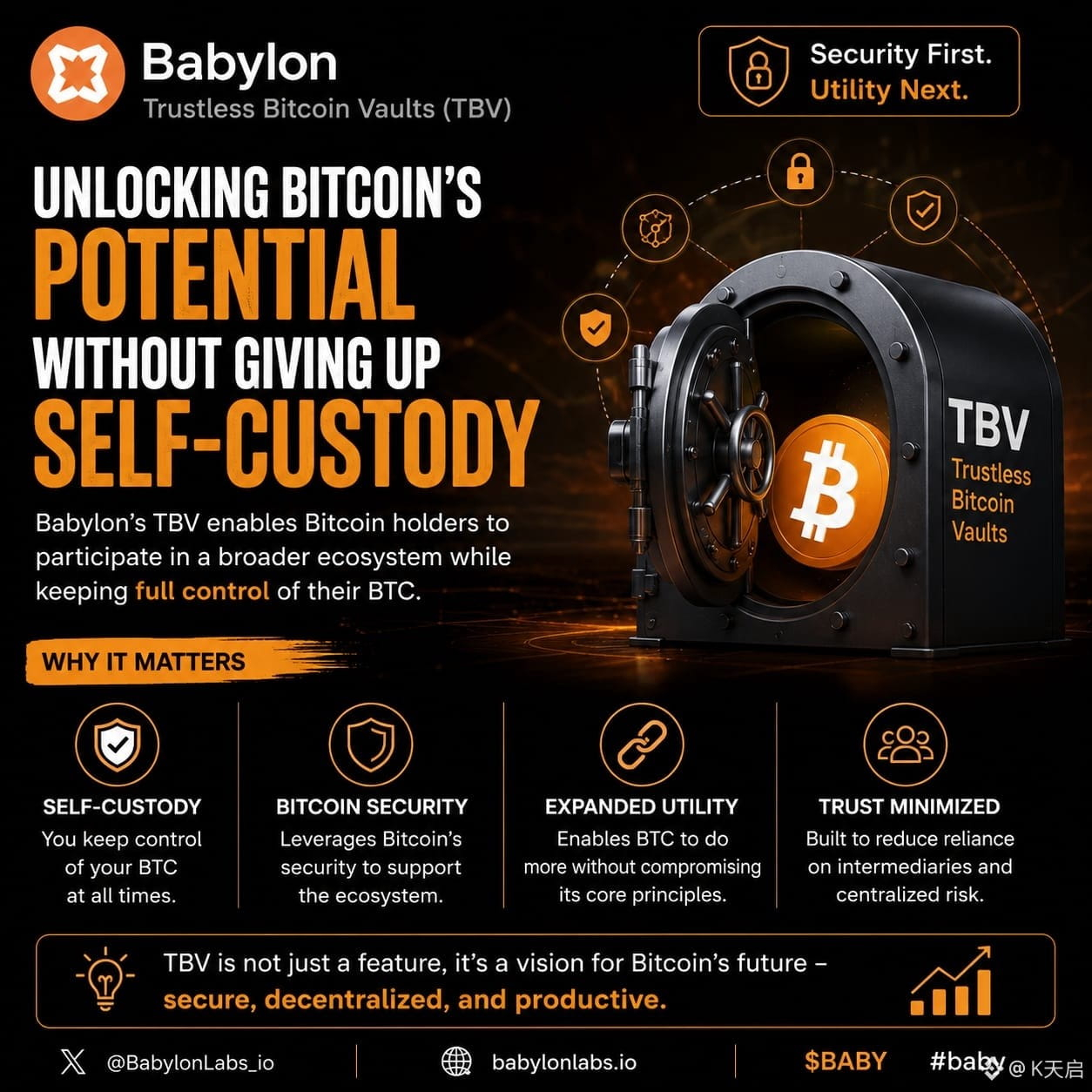
🌟For a long time, Bitcoin holders have faced a simple trade-off: keep your BTC safe in self-custody or move it elsewhere to unlock additional utility. Most existing solutions ask users to trust a third party, which goes against one of Bitcoin's biggest strengths.
😶🌫️That's why Babylon's Trustless Bitcoin Vaults (TBV) caught my attention. The concept isn't about replacing Bitcoin or changing how it works. Instead, it's about exploring ways for BTC to participate in a broader ecosystem while preserving user ownership and minimizing trust assumptions.
🌟I think this is the right direction. If Bitcoin is going to play a larger role in decentralized finance, the foundation should remain security first, not convenience first. TBV reflects that mindset by focusing on trustless design instead of requiring users to hand over control of their assets.
🪙It's still early, but I believe innovations like this are worth following because they respect the principles that made Bitcoin valuable in the first place.
🌟Do you think trustless infrastructure is the key to Bitcoin's next phase of adoption?
@babylonlabs_io $BABY #baby #TBV #Babylon #campaign #cryptotoken
$LAB $VANRY
{future}(BABYUSDT)
🌟For a long time, Bitcoin holders have faced a simple trade-off: keep your BTC safe in self-custody or move it elsewhere to unlock additional utility. Most existing solutions ask users to trust a third party, which goes against one of Bitcoin's biggest strengths.
😶🌫️That's why Babylon's Trustless Bitcoin Vaults (TBV) caught my attention. The concept isn't about replacing Bitcoin or changing how it works. Instead, it's about exploring ways for BTC to participate in a broader ecosystem while preserving user ownership and minimizing trust assumptions.
🌟I think this is the right direction. If Bitcoin is going to play a larger role in decentralized finance, the foundation should remain security first, not convenience first. TBV reflects that mindset by focusing on trustless design instead of requiring users to hand over control of their assets.
🪙It's still early, but I believe innovations like this are worth following because they respect the principles that made Bitcoin valuable in the first place.
🌟Do you think trustless infrastructure is the key to Bitcoin's next phase of adoption?
@BabylonLabs_io $BABY #baby #TBV #Babylon #campaign #cryptotoken
$LAB $VANRY
😶🌫️That's why Babylon's Trustless Bitcoin Vaults (TBV) caught my attention. The concept isn't about replacing Bitcoin or changing how it works. Instead, it's about exploring ways for BTC to participate in a broader ecosystem while preserving user ownership and minimizing trust assumptions.
🌟I think this is the right direction. If Bitcoin is going to play a larger role in decentralized finance, the foundation should remain security first, not convenience first. TBV reflects that mindset by focusing on trustless design instead of requiring users to hand over control of their assets.
🪙It's still early, but I believe innovations like this are worth following because they respect the principles that made Bitcoin valuable in the first place.
🌟Do you think trustless infrastructure is the key to Bitcoin's next phase of adoption?
@BabylonLabs_io $BABY #baby #TBV #Babylon #campaign #cryptotoken
$LAB $VANRY
2
209

·
--
Babylon Trustless Bitcoin Vaults (TBV) as a new post-launch On-Chain Earn option.
On Binance Earn, I can help you check whether there’s a live Babylon-related On-Chain Yield product
#baby #babylonlab_io #TBV https://app.binance.com/uni-qr/cpro/Binance_Announcement?l=en&r=ZWG4VOBD&uc=app_square_share_link&us=copyli
[https://app.binance.com/uni-qr/cpro/babylonlabs_io?l=en&r=C121O9HC&uc=app_square_share_link&us=copylink](https://app.binance.com/uni-qr/cpro/babylonlabs_io?l=en&r=C121O9HC&uc=app_square_share_link&us=copylink)
Babylon Trustless Bitcoin Vaults (TBV) as a new post-launch On-Chain Earn option.
On Binance Earn, I can help you check whether there’s a live Babylon-related On-Chain Yield product
#baby #babylonlab_io #TBV https://app.binance.com/uni-qr/cpro/Binance_Announcement?l=en&r=ZWG4VOBD&uc=app_square_share_link&us=copyli
https://app.binance.com/uni-qr/cpro/babylonlabs_io?l=en&r=C121O9HC&uc=app_square_share_link&us=copylink
On Binance Earn, I can help you check whether there’s a live Babylon-related On-Chain Yield product
#baby #babylonlab_io #TBV https://app.binance.com/uni-qr/cpro/Binance_Announcement?l=en&r=ZWG4VOBD&uc=app_square_share_link&us=copyli
https://app.binance.com/uni-qr/cpro/babylonlabs_io?l=en&r=C121O9HC&uc=app_square_share_link&us=copylink
69

·
--
Bullish
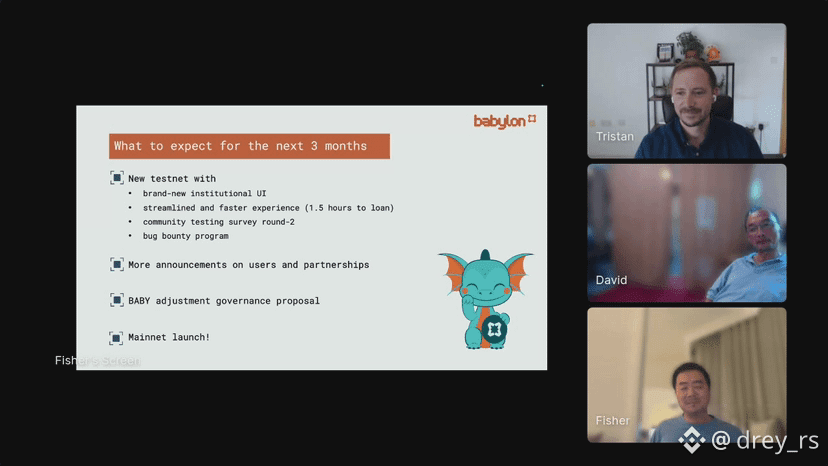
The quarterly founders call from @babylonlabs_io just wrapped up, and I’m even more excited about where Bitcoin DeFi is heading.
The vision has always been straightforward: make Bitcoin productive without compromising its security or requiring wrapped assets. That’s exactly what Trustless Bitcoin Vaults (TBV) are designed to achieve.
Here’s how TBV works in simple terms:
Your native BTC is lorked on the Bitcoin network under predefined spending conditions.
A verifiable record of that locked Bitcoin is recognized by integrated applications, allowing your BTC to be used as collateral without leaving Bitcoin or relying on custodians.
On the first deployment with Aave v4, you can borrow supported assets against your native BTC. When the loan is repaid, your Bitcoin can be redeemed. If your collateral ratio becomes too low, predefined liquidation rules keep the system solvent and transparent.
Why does this matter today?
Most Bitcoin is still sitting idle because participating in DeFi often means wrapping BTC, bridging it to another chain, or trusting an intermediary. TBV addresses that demand by letting native Bitcoin become programmable collateral while preserving Bitcoin’s security model.
And borrowing is only the beginning. The same infrastructure can support BTC-backed stablecoins, derivatives margin, institutional lending, and many other Bitcoin-native financial applications.
If you missed the founders call, it’s worth watching to better understand where Bitcoin-native DeFi is heading.
Rewatch the session:
• X: https://x.com/i/broadcasts/1pKkOOwVXbNKj
• YouTube: https://www.youtube.com/watch?v=ERKE0ZlUUQ8
@babylonlabs_io $BABY #baby #Bitcoin #DeFi #TBV
The quarterly founders call from @BabylonLabs_io just wrapped up, and I’m even more excited about where Bitcoin DeFi is heading.
The vision has always been straightforward: make Bitcoin productive without compromising its security or requiring wrapped assets. That’s exactly what Trustless Bitcoin Vaults (TBV) are designed to achieve.
Here’s how TBV works in simple terms:
Your native BTC is lorked on the Bitcoin network under predefined spending conditions.
A verifiable record of that locked Bitcoin is recognized by integrated applications, allowing your BTC to be used as collateral without leaving Bitcoin or relying on custodians.
On the first deployment with Aave v4, you can borrow supported assets against your native BTC. When the loan is repaid, your Bitcoin can be redeemed. If your collateral ratio becomes too low, predefined liquidation rules keep the system solvent and transparent.
Why does this matter today?
Most Bitcoin is still sitting idle because participating in DeFi often means wrapping BTC, bridging it to another chain, or trusting an intermediary. TBV addresses that demand by letting native Bitcoin become programmable collateral while preserving Bitcoin’s security model.
And borrowing is only the beginning. The same infrastructure can support BTC-backed stablecoins, derivatives margin, institutional lending, and many other Bitcoin-native financial applications.
If you missed the founders call, it’s worth watching to better understand where Bitcoin-native DeFi is heading.
Rewatch the session:
• X: https://x.com/i/broadcasts/1pKkOOwVXbNKj
• YouTube: https://www.youtube.com/watch?v=ERKE0ZlUUQ8
@BabylonLabs_io $BABY #baby #Bitcoin #DeFi #TBV
The vision has always been straightforward: make Bitcoin productive without compromising its security or requiring wrapped assets. That’s exactly what Trustless Bitcoin Vaults (TBV) are designed to achieve.
Here’s how TBV works in simple terms:
Your native BTC is lorked on the Bitcoin network under predefined spending conditions.
A verifiable record of that locked Bitcoin is recognized by integrated applications, allowing your BTC to be used as collateral without leaving Bitcoin or relying on custodians.
On the first deployment with Aave v4, you can borrow supported assets against your native BTC. When the loan is repaid, your Bitcoin can be redeemed. If your collateral ratio becomes too low, predefined liquidation rules keep the system solvent and transparent.
Why does this matter today?
Most Bitcoin is still sitting idle because participating in DeFi often means wrapping BTC, bridging it to another chain, or trusting an intermediary. TBV addresses that demand by letting native Bitcoin become programmable collateral while preserving Bitcoin’s security model.
And borrowing is only the beginning. The same infrastructure can support BTC-backed stablecoins, derivatives margin, institutional lending, and many other Bitcoin-native financial applications.
If you missed the founders call, it’s worth watching to better understand where Bitcoin-native DeFi is heading.
Rewatch the session:
• X: https://x.com/i/broadcasts/1pKkOOwVXbNKj
• YouTube: https://www.youtube.com/watch?v=ERKE0ZlUUQ8
@BabylonLabs_io $BABY #baby #Bitcoin #DeFi #TBV
2
1
38

·
--
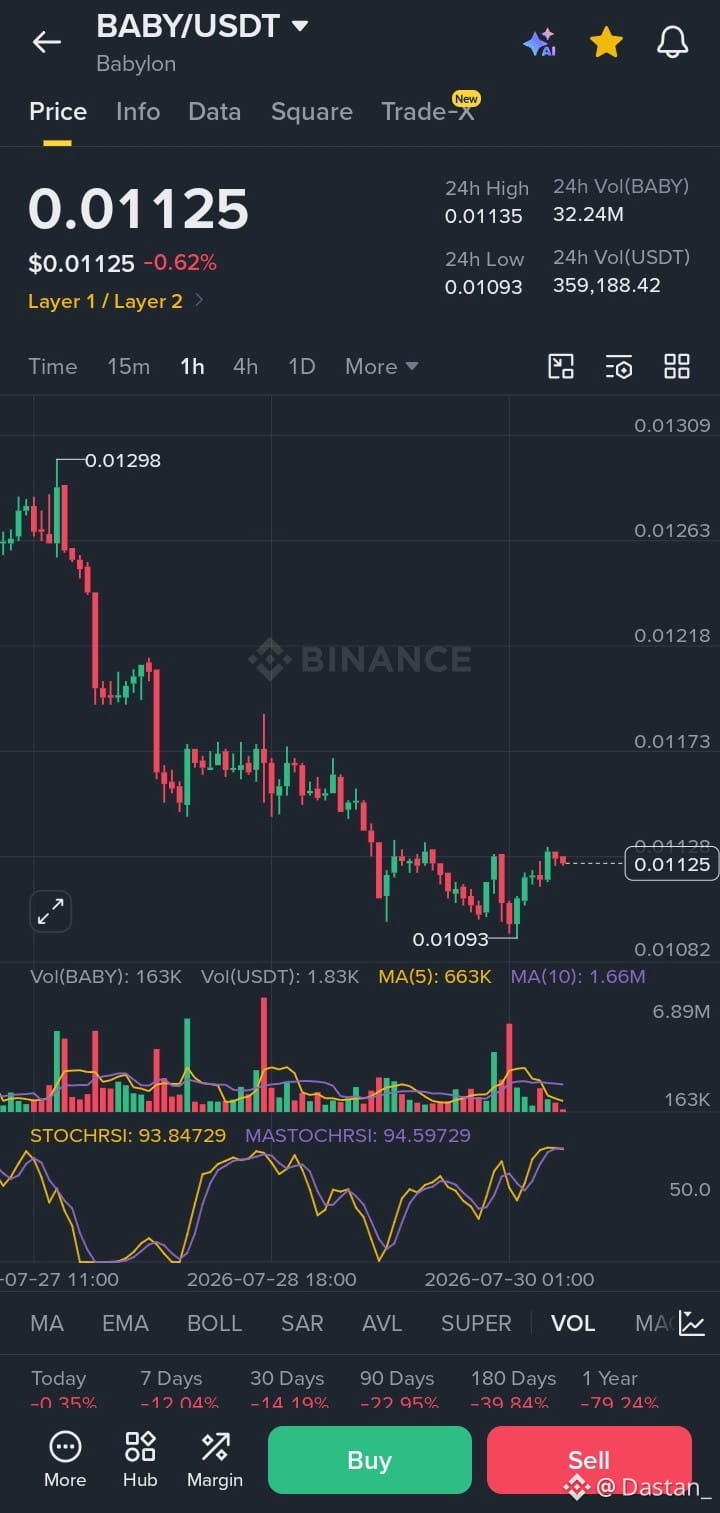
@babylonlabs_io is redefining Bitcoin with TBV ..
$BABY powers an ecosystem focused on Bitcoin security and innovation ..
Infrastructure wins in the long run ...
#baby #TBV
{spot}(BABYUSDT)
@BabylonLabs_io is redefining Bitcoin with TBV ..
$BABY powers an ecosystem focused on Bitcoin security and innovation ..
Infrastructure wins in the long run ...
#baby #TBV
$BABY powers an ecosystem focused on Bitcoin security and innovation ..
Infrastructure wins in the long run ...
#baby #TBV
2
3
108

Verified
#baby $BABY
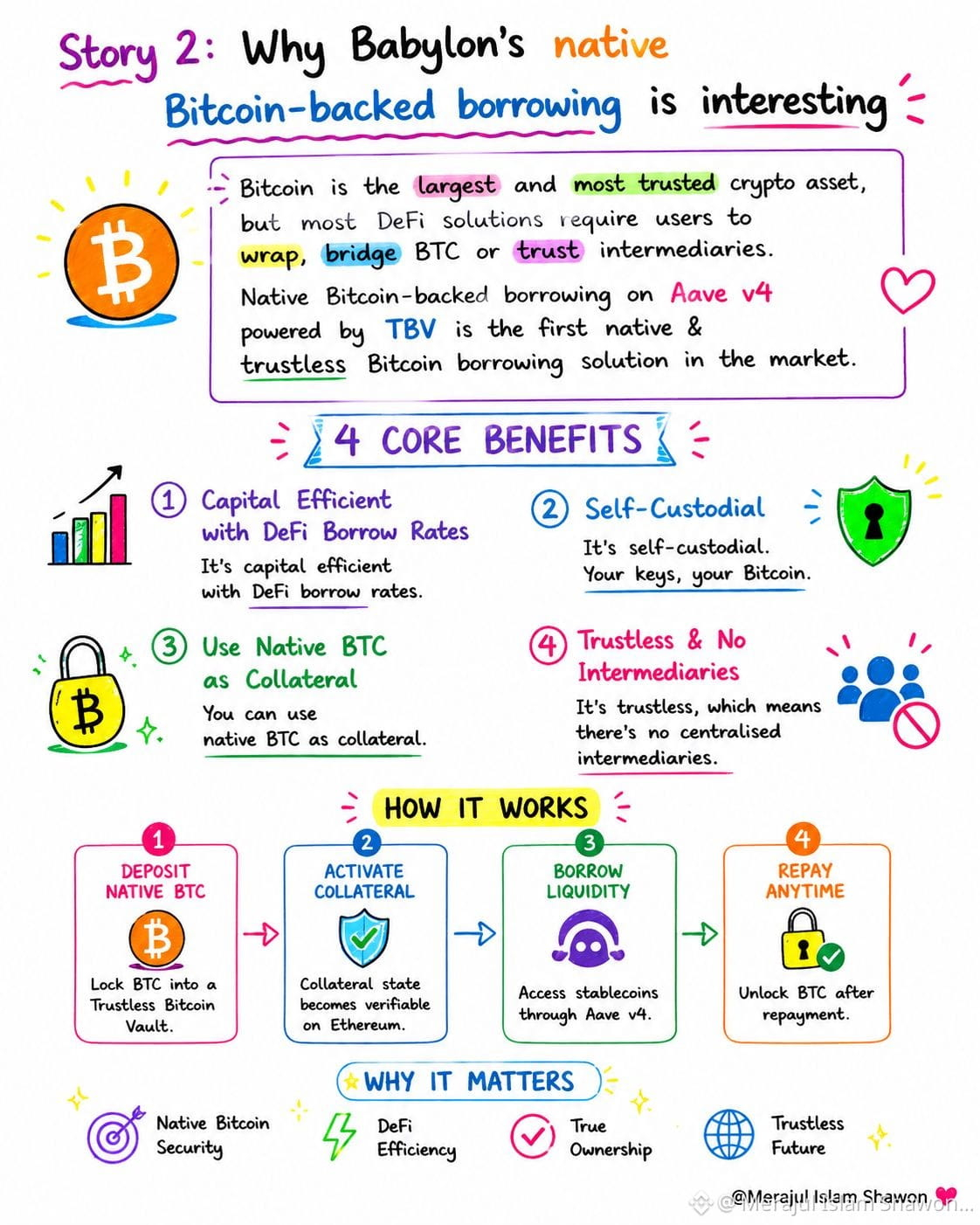
@babylonlabs_io continues to expand Bitcoin’s real-world utility through Trustless Bitcoin Vaults (TBV), introducing a new way to unlock liquidity while keeping Bitcoin native, secure, and self-custodied. This infographic explains why native Bitcoin-backed borrowing is a major step forward for decentralized finance and highlights how TBV integrates with Aave v4 to create a trustless borrowing experience.
Bitcoin is the world’s largest and most trusted digital asset, yet many DeFi protocols require users to wrap or bridge BTC before using it as collateral. TBV changes this by allowing users to use native Bitcoin directly as collateral, eliminating the need for wrapped assets and reducing reliance on intermediaries. This preserves Bitcoin’s security while expanding its financial utility.
The infographic highlights four core benefits. First, it is capital efficient, giving users access to competitive DeFi borrowing rates. Second, it is self-custodial, meaning users retain full control of their private keys and Bitcoin throughout the process. Third, it enables native BTC collateral, allowing Bitcoin holders to borrow without converting their assets. Finally, the system is trustless, with transparent, code-based execution instead of centralized control.
The borrowing process is simple and efficient: Deposit native BTC into a Trustless Bitcoin Vault, activate collateral so it becomes verifiable on Ethereum, borrow liquidity through Aave v4, and repay anytime to unlock your Bitcoin. This streamlined workflow combines security, efficiency, and decentralization in a single protocol.
With TBV, @babylonlabs_io is helping transform Bitcoin from a passive store of value into productive collateral for DeFi, unlocking new opportunities while preserving Bitcoin’s core principles.
$BABY #baby #TBV #Meraj_910
{future}(BABYUSDT)
$AAVE
{spot}(AAVEUSDT)
#BTC
{future}(BTCUSDT)
#baby $BABY
@BabylonLabs_io continues to expand Bitcoin’s real-world utility through Trustless Bitcoin Vaults (TBV), introducing a new way to unlock liquidity while keeping Bitcoin native, secure, and self-custodied. This infographic explains why native Bitcoin-backed borrowing is a major step forward for decentralized finance and highlights how TBV integrates with Aave v4 to create a trustless borrowing experience.
Bitcoin is the world’s largest and most trusted digital asset, yet many DeFi protocols require users to wrap or bridge BTC before using it as collateral. TBV changes this by allowing users to use native Bitcoin directly as collateral, eliminating the need for wrapped assets and reducing reliance on intermediaries. This preserves Bitcoin’s security while expanding its financial utility.
The infographic highlights four core benefits. First, it is capital efficient, giving users access to competitive DeFi borrowing rates. Second, it is self-custodial, meaning users retain full control of their private keys and Bitcoin throughout the process. Third, it enables native BTC collateral, allowing Bitcoin holders to borrow without converting their assets. Finally, the system is trustless, with transparent, code-based execution instead of centralized control.
The borrowing process is simple and efficient: Deposit native BTC into a Trustless Bitcoin Vault, activate collateral so it becomes verifiable on Ethereum, borrow liquidity through Aave v4, and repay anytime to unlock your Bitcoin. This streamlined workflow combines security, efficiency, and decentralization in a single protocol.
With TBV, @BabylonLabs_io is helping transform Bitcoin from a passive store of value into productive collateral for DeFi, unlocking new opportunities while preserving Bitcoin’s core principles.
$BABY #baby #TBV #Meraj_910
$AAVE
#BTC
@BabylonLabs_io continues to expand Bitcoin’s real-world utility through Trustless Bitcoin Vaults (TBV), introducing a new way to unlock liquidity while keeping Bitcoin native, secure, and self-custodied. This infographic explains why native Bitcoin-backed borrowing is a major step forward for decentralized finance and highlights how TBV integrates with Aave v4 to create a trustless borrowing experience.
Bitcoin is the world’s largest and most trusted digital asset, yet many DeFi protocols require users to wrap or bridge BTC before using it as collateral. TBV changes this by allowing users to use native Bitcoin directly as collateral, eliminating the need for wrapped assets and reducing reliance on intermediaries. This preserves Bitcoin’s security while expanding its financial utility.
The infographic highlights four core benefits. First, it is capital efficient, giving users access to competitive DeFi borrowing rates. Second, it is self-custodial, meaning users retain full control of their private keys and Bitcoin throughout the process. Third, it enables native BTC collateral, allowing Bitcoin holders to borrow without converting their assets. Finally, the system is trustless, with transparent, code-based execution instead of centralized control.
The borrowing process is simple and efficient: Deposit native BTC into a Trustless Bitcoin Vault, activate collateral so it becomes verifiable on Ethereum, borrow liquidity through Aave v4, and repay anytime to unlock your Bitcoin. This streamlined workflow combines security, efficiency, and decentralization in a single protocol.
With TBV, @BabylonLabs_io is helping transform Bitcoin from a passive store of value into productive collateral for DeFi, unlocking new opportunities while preserving Bitcoin’s core principles.
$BABY #baby #TBV #Meraj_910
$AAVE
#BTC
4
2
3
112
·
--
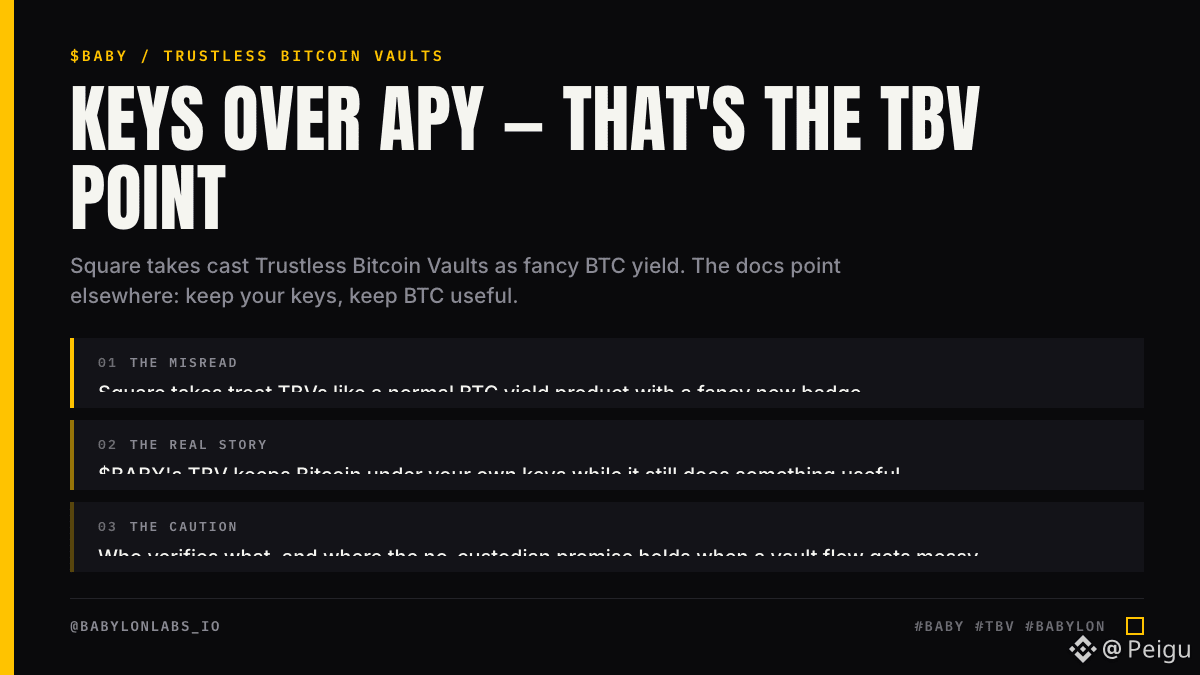
Saw another wave of Square takes under @BabylonLabs_io this afternoon treating Trustless Bitcoin Vaults like a normal BTC yield product with a fancy new badge.
I read the TBV docs with that claim in mind. What clicked right away: $BABY's TBV story isn't really about chasing a pretty APY — it's about Bitcoin staying under your own keys while it still does something useful. What I had to re-read — and I'm still cautious on — is the trustless path itself: who verifies what, and where the "no custodian" promise actually holds when a vault flow gets messy.
#baby #TBV #Babylon
Saw another wave of Square takes under @BabylonLabs_io this afternoon treating Trustless Bitcoin Vaults like a normal BTC yield product with a fancy new badge.
I read the TBV docs with that claim in mind. What clicked right away: $BABY 's TBV story isn't really about chasing a pretty APY — it's about Bitcoin staying under your own keys while it still does something useful. What I had to re-read — and I'm still cautious on — is the trustless path itself: who verifies what, and where the "no custodian" promise actually holds when a vault flow gets messy.
#baby #TBV #Babylon
I read the TBV docs with that claim in mind. What clicked right away: $BABY 's TBV story isn't really about chasing a pretty APY — it's about Bitcoin staying under your own keys while it still does something useful. What I had to re-read — and I'm still cautious on — is the trustless path itself: who verifies what, and where the "no custodian" promise actually holds when a vault flow gets messy.
#baby #TBV #Babylon
67

·
--
#baby $BABY People are going crazy and spreading it everywhere! Babylon TBV directly smashed the Bitcoin DeFi ceiling 🔥 No cross-chain, no wrapping, no losing your private keys. Native BTC is locked in an on-chain treasury vault, and you can still stake, borrow, and play with Aave v4. No one can move your BTC cake!
While others are still getting their fees sliced by middlemen, TBV hard-fights the trust crisis with cryptography—isolating the treasury and never mixing pools. Maximum security, and it also unlocks liquidity. This is where Bitcoin truly comes alive. The DeFi landscape gets reshuffled instantly—if you haven’t rushed to TBV, you’re really missing out!
#Babylon #TBV #BitcoinDeFi
#baby $BABY People are going crazy and spreading it everywhere! Babylon TBV directly smashed the Bitcoin DeFi ceiling 🔥 No cross-chain, no wrapping, no losing your private keys. Native BTC is locked in an on-chain treasury vault, and you can still stake, borrow, and play with Aave v4. No one can move your BTC cake!
While others are still getting their fees sliced by middlemen, TBV hard-fights the trust crisis with cryptography—isolating the treasury and never mixing pools. Maximum security, and it also unlocks liquidity. This is where Bitcoin truly comes alive. The DeFi landscape gets reshuffled instantly—if you haven’t rushed to TBV, you’re really missing out!
#Babylon #TBV #BitcoinDeFi
While others are still getting their fees sliced by middlemen, TBV hard-fights the trust crisis with cryptography—isolating the treasury and never mixing pools. Maximum security, and it also unlocks liquidity. This is where Bitcoin truly comes alive. The DeFi landscape gets reshuffled instantly—if you haven’t rushed to TBV, you’re really missing out!
#Babylon #TBV #BitcoinDeFi
118

·
--
Verified
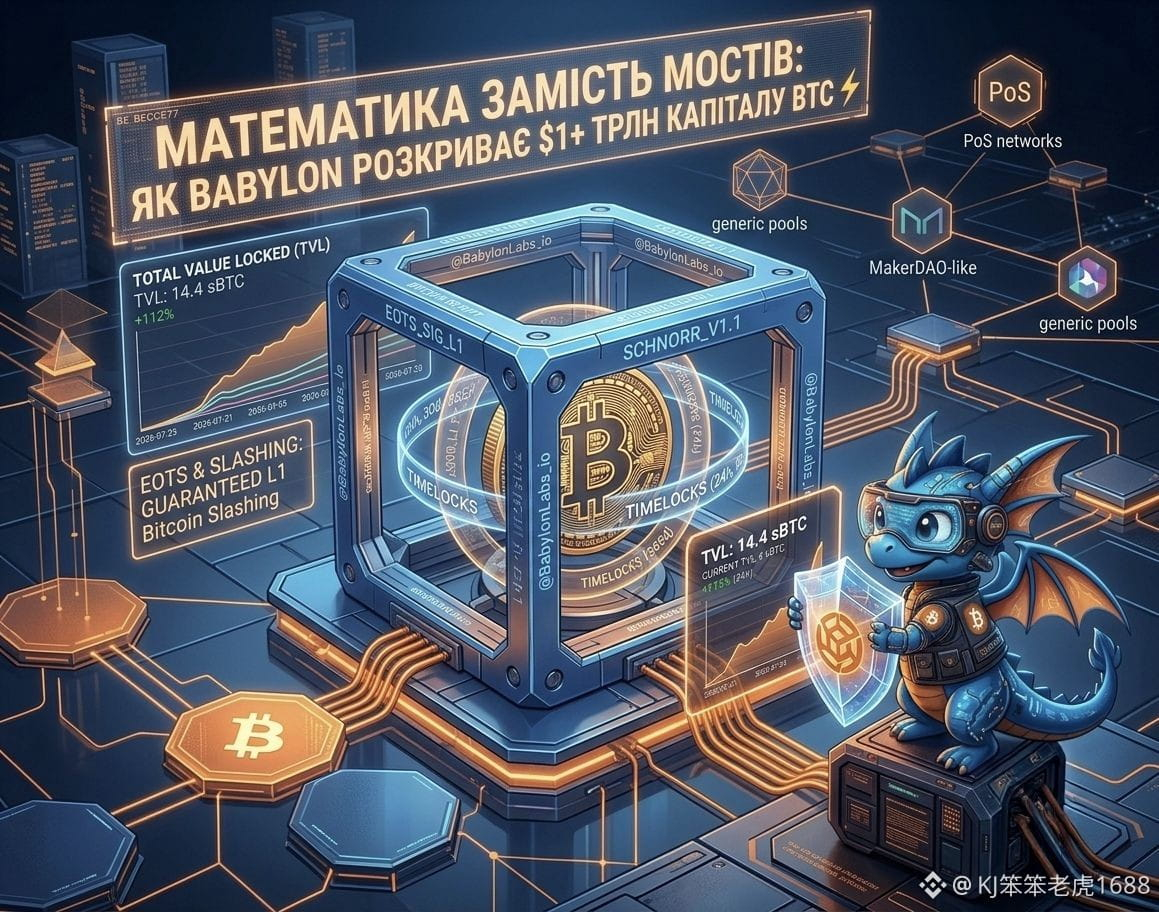
Mathematics instead of bridges: How Babylon unlocks $1 Trln in BTC capital ⚡
The main problem with BTC DeFi has always been the choice between security and yield. Want interest? Hand over the keys to a bridge like wBTC or a custodian. Afraid of hacks? Keep BTC as “dead weight” in a cold wallet.
Team @babylonlabs_io broke this dilemma with Trustless Bitcoin Vaults (TBV).
How does it work at the cryptography level?
No key custody (Non-Custodial): BTC is sealed in an L1 script via timelocks. No smart contracts from external networks.
EOTS and Slashing: Using one-time extractable signatures, the protocol guarantees that if a validator tries to trick the PoS network (double-signing), its BTC collateral is automatically burned on the Bitcoin network.
Ecosystem $BABY : The very $BTC serves as a security stake, while the $BABY token coordinates the entire system’s operation — from transaction payments to dual-staking and DAO voting.
This isn’t just another “farming project”; it’s a fundamental transformation of Bitcoin from monetary gold into a liquid collateral asset.
What do you think—will BTC DeFi become the main trend of this cycle?
#baby #BTCFi #creatorsPad #TBV
Mathematics instead of bridges: How Babylon unlocks $1 Trln in BTC capital ⚡
The main problem with BTC DeFi has always been the choice between security and yield. Want interest? Hand over the keys to a bridge like wBTC or a custodian. Afraid of hacks? Keep BTC as “dead weight” in a cold wallet.
Team @BabylonLabs_io broke this dilemma with Trustless Bitcoin Vaults (TBV).
How does it work at the cryptography level?
No key custody (Non-Custodial): BTC is sealed in an L1 script via timelocks. No smart contracts from external networks.
EOTS and Slashing: Using one-time extractable signatures, the protocol guarantees that if a validator tries to trick the PoS network (double-signing), its BTC collateral is automatically burned on the Bitcoin network.
Ecosystem $BABY : The very $BTC serves as a security stake, while the $BABY token coordinates the entire system’s operation — from transaction payments to dual-staking and DAO voting.
This isn’t just another “farming project”; it’s a fundamental transformation of Bitcoin from monetary gold into a liquid collateral asset.
What do you think—will BTC DeFi become the main trend of this cycle?
#baby #BTCFi #creatorsPad #TBV
The main problem with BTC DeFi has always been the choice between security and yield. Want interest? Hand over the keys to a bridge like wBTC or a custodian. Afraid of hacks? Keep BTC as “dead weight” in a cold wallet.
Team @BabylonLabs_io broke this dilemma with Trustless Bitcoin Vaults (TBV).
How does it work at the cryptography level?
No key custody (Non-Custodial): BTC is sealed in an L1 script via timelocks. No smart contracts from external networks.
EOTS and Slashing: Using one-time extractable signatures, the protocol guarantees that if a validator tries to trick the PoS network (double-signing), its BTC collateral is automatically burned on the Bitcoin network.
Ecosystem $BABY : The very $BTC serves as a security stake, while the $BABY token coordinates the entire system’s operation — from transaction payments to dual-staking and DAO voting.
This isn’t just another “farming project”; it’s a fundamental transformation of Bitcoin from monetary gold into a liquid collateral asset.
What do you think—will BTC DeFi become the main trend of this cycle?
#baby #BTCFi #creatorsPad #TBV
9
1
4
378

·
--
#baby $BABY
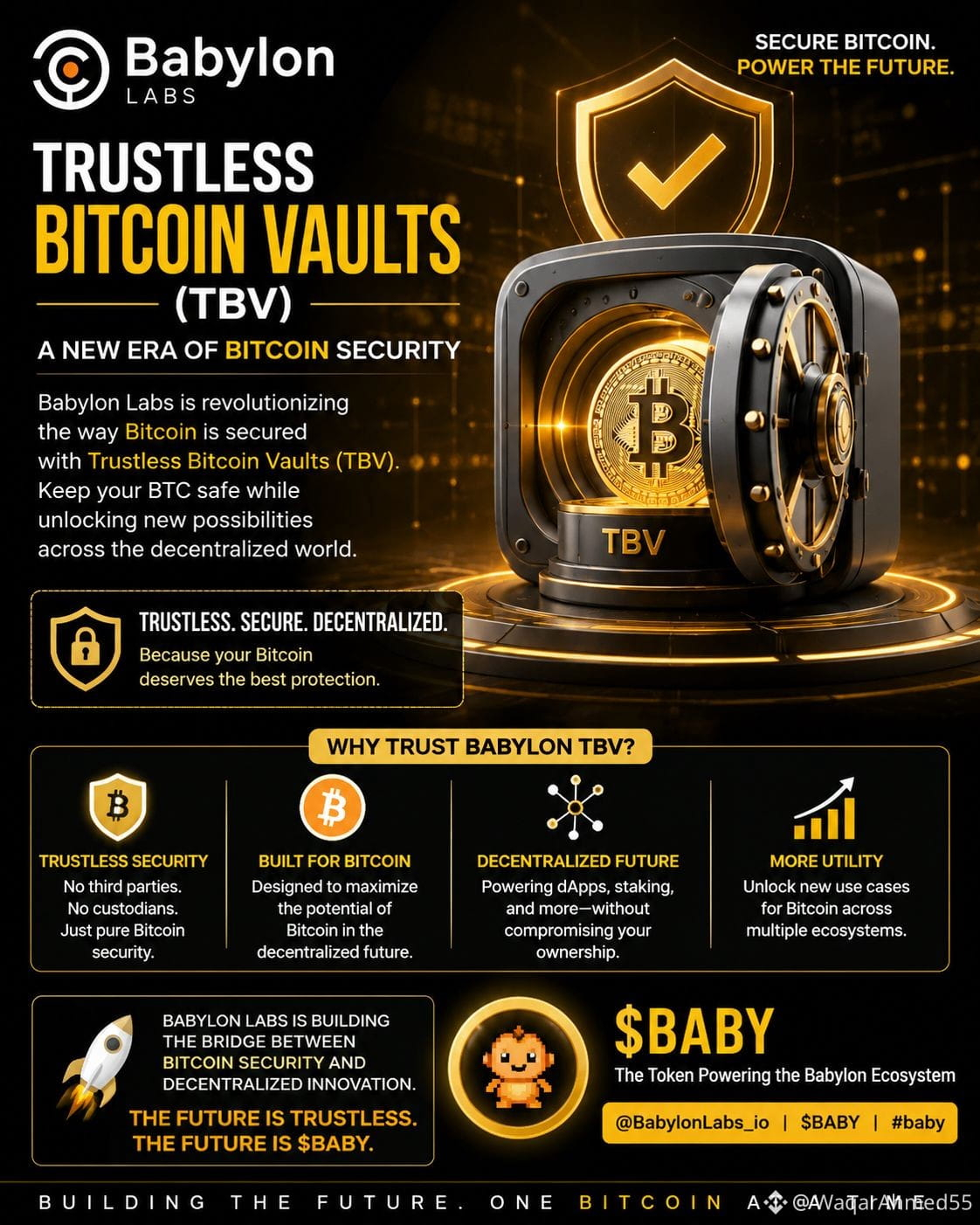
🚀 The future of Bitcoin isn't just about holding BTC—it's about unlocking its full potential. @BabylonLabs_io is building Trustless Bitcoin Vaults (TBV), bringing stronger security and new opportunities to the Bitcoin ecosystem. Innovation like this can shape the next generation of decentralized finance. Supporting the vision behind $BABY! 🔥 #baby #Bitcoin #TBV
#baby $BABY
🚀 The future of Bitcoin isn't just about holding BTC—it's about unlocking its full potential. @BabylonLabs_io is building Trustless Bitcoin Vaults (TBV), bringing stronger security and new opportunities to the Bitcoin ecosystem. Innovation like this can shape the next generation of decentralized finance. Supporting the vision behind $BABY ! 🔥 #baby #Bitcoin #TBV
🚀 The future of Bitcoin isn't just about holding BTC—it's about unlocking its full potential. @BabylonLabs_io is building Trustless Bitcoin Vaults (TBV), bringing stronger security and new opportunities to the Bitcoin ecosystem. Innovation like this can shape the next generation of decentralized finance. Supporting the vision behind $BABY ! 🔥 #baby #Bitcoin #TBV
2
1
81

·
--
Bullish
#baby $BABY The support of a16z Crypto's $15M investment marks a major step toward expanding the Babylon ecosystem and accelerating the development of Trustless Bitcoin Vaults (TBV).
TBV has the potential to unlock powerful new utility for $BABY, bringing native Bitcoin collateral closer to reality.
Exciting times ahead for the Babylon community! 🔥
@babylonlabs_io #BABY #Bitcoin #TBV
#baby $BABY The support of a16z Crypto's $15M investment marks a major step toward expanding the Babylon ecosystem and accelerating the development of Trustless Bitcoin Vaults (TBV).
TBV has the potential to unlock powerful new utility for $BABY , bringing native Bitcoin collateral closer to reality.
Exciting times ahead for the Babylon community! 🔥
@BabylonLabs_io #BABY #Bitcoin #TBV
TBV has the potential to unlock powerful new utility for $BABY , bringing native Bitcoin collateral closer to reality.
Exciting times ahead for the Babylon community! 🔥
@BabylonLabs_io #BABY #Bitcoin #TBV
12
Log in to explore more content
Join global crypto users on Binance Square
⚡️ Get latest and useful information about crypto.
💬 Trusted by the world’s largest crypto exchange.
👍 Discover real insights from verified creators.
Email / Phone number
Trending Topics
1
#BitcoinReboundsTo$79K
25,956 views
241 Discussing
2
#USDCOnChainVolumeTops$100Trillion
23 views
9 Discussing
3
#BitcoinSpotETFsNetInflow$160M
955 views
59 Discussing
4
#SouthKoreaCryptoTaxDelayPetitionTops50000
19,271 views
592 Discussing
5
#SolanaTransactionV1GoesLiveOnMainnet
13,332 views
388 Discussing
6
#RussianCentralBankFlagsCryptoAsFinancialRisk
10,304 views
338 Discussing
7
#GrayscalePutsXRPAt26.11%InAdvisorPortfolio
25,372 views
462 Discussing
8
#PhiladelphiaSemiconductorIndexFalls5.9%
9,925 views
288 Discussing
9
#SECChairUrgesCongressToAdvanceClarityAct
24,670 views
310 Discussing
10
#FedHikeOddsRiseTo89%
125,970 views
1,351 Discussing