
#sui
sui
38.3M views
70,972 Discussing
Hot
Latest

$SUI Coin Price Prediction 🚀💥🔥
Sui Historical
According to the latest data gathered, the current price of Sui is $0.77, and SUI is presently ranked No. 12 in the entire crypto ecosystem. The circulation supply of Sui is 3,792,180,000 SUI, with a market cap of $5,635,490,000.00.
During the last month, the price of SUI has increased by 25.06%, adding a colossal average amount of $0.10 to its current value. This sudden growth means that the coin can become a solid asset now if it continues to grow.
Price Prediction 2026
According to the technical analysis of prices expected in 2026, the minimum cost of will be $0.71 The maximum level that the SUI price can reach is $4.78. The average trading price is expected around $3.52.
Price Prediction 2027
After the analysis of the prices of in previous years, it is assumed that in 2027, the minimum price of will be around $3.59. The maximum expected SUI price may be around $5.46. On average, the trading price might be $5.33 in 2027.
Price Prediction 2028
Based on the technical analysis by cryptocurrency experts regarding the prices of , in 2028, SUI is expected to have the following minimum and maximum prices: about $5.44 and $7.92, respectively. The average expected trading cost is $7.53.
Price Prediction 2029
The experts in the field of cryptocurrency have analyzed the prices of and their fluctuations during the previous years. It is assumed that in 2029, the minimum SUI price might drop to $7.47, while its maximum can reach $9.24. On average, the trading cost will be around $8.57.
Stay tuned for more updates ❤
#sui
$SUI Coin Price Prediction 🚀💥🔥
Sui Historical
According to the latest data gathered, the current price of Sui is $0.77, and SUI is presently ranked No. 12 in the entire crypto ecosystem. The circulation supply of Sui is 3,792,180,000 SUI, with a market cap of $5,635,490,000.00.
During the last month, the price of SUI has increased by 25.06%, adding a colossal average amount of $0.10 to its current value. This sudden growth means that the coin can become a solid asset now if it continues to grow.
Price Prediction 2026
According to the technical analysis of prices expected in 2026, the minimum cost of will be $0.71 The maximum level that the SUI price can reach is $4.78. The average trading price is expected around $3.52.
Price Prediction 2027
After the analysis of the prices of in previous years, it is assumed that in 2027, the minimum price of will be around $3.59. The maximum expected SUI price may be around $5.46. On average, the trading price might be $5.33 in 2027.
Price Prediction 2028
Based on the technical analysis by cryptocurrency experts regarding the prices of , in 2028, SUI is expected to have the following minimum and maximum prices: about $5.44 and $7.92, respectively. The average expected trading cost is $7.53.
Price Prediction 2029
The experts in the field of cryptocurrency have analyzed the prices of and their fluctuations during the previous years. It is assumed that in 2029, the minimum SUI price might drop to $7.47, while its maximum can reach $9.24. On average, the trading cost will be around $8.57.
Stay tuned for more updates ❤
#sui
Sui Historical
According to the latest data gathered, the current price of Sui is $0.77, and SUI is presently ranked No. 12 in the entire crypto ecosystem. The circulation supply of Sui is 3,792,180,000 SUI, with a market cap of $5,635,490,000.00.
During the last month, the price of SUI has increased by 25.06%, adding a colossal average amount of $0.10 to its current value. This sudden growth means that the coin can become a solid asset now if it continues to grow.
Price Prediction 2026
According to the technical analysis of prices expected in 2026, the minimum cost of will be $0.71 The maximum level that the SUI price can reach is $4.78. The average trading price is expected around $3.52.
Price Prediction 2027
After the analysis of the prices of in previous years, it is assumed that in 2027, the minimum price of will be around $3.59. The maximum expected SUI price may be around $5.46. On average, the trading price might be $5.33 in 2027.
Price Prediction 2028
Based on the technical analysis by cryptocurrency experts regarding the prices of , in 2028, SUI is expected to have the following minimum and maximum prices: about $5.44 and $7.92, respectively. The average expected trading cost is $7.53.
Price Prediction 2029
The experts in the field of cryptocurrency have analyzed the prices of and their fluctuations during the previous years. It is assumed that in 2029, the minimum SUI price might drop to $7.47, while its maximum can reach $9.24. On average, the trading cost will be around $8.57.
Stay tuned for more updates ❤
#sui

AngelOfCrypto_-:
nice
4
8
2.7k

·
--
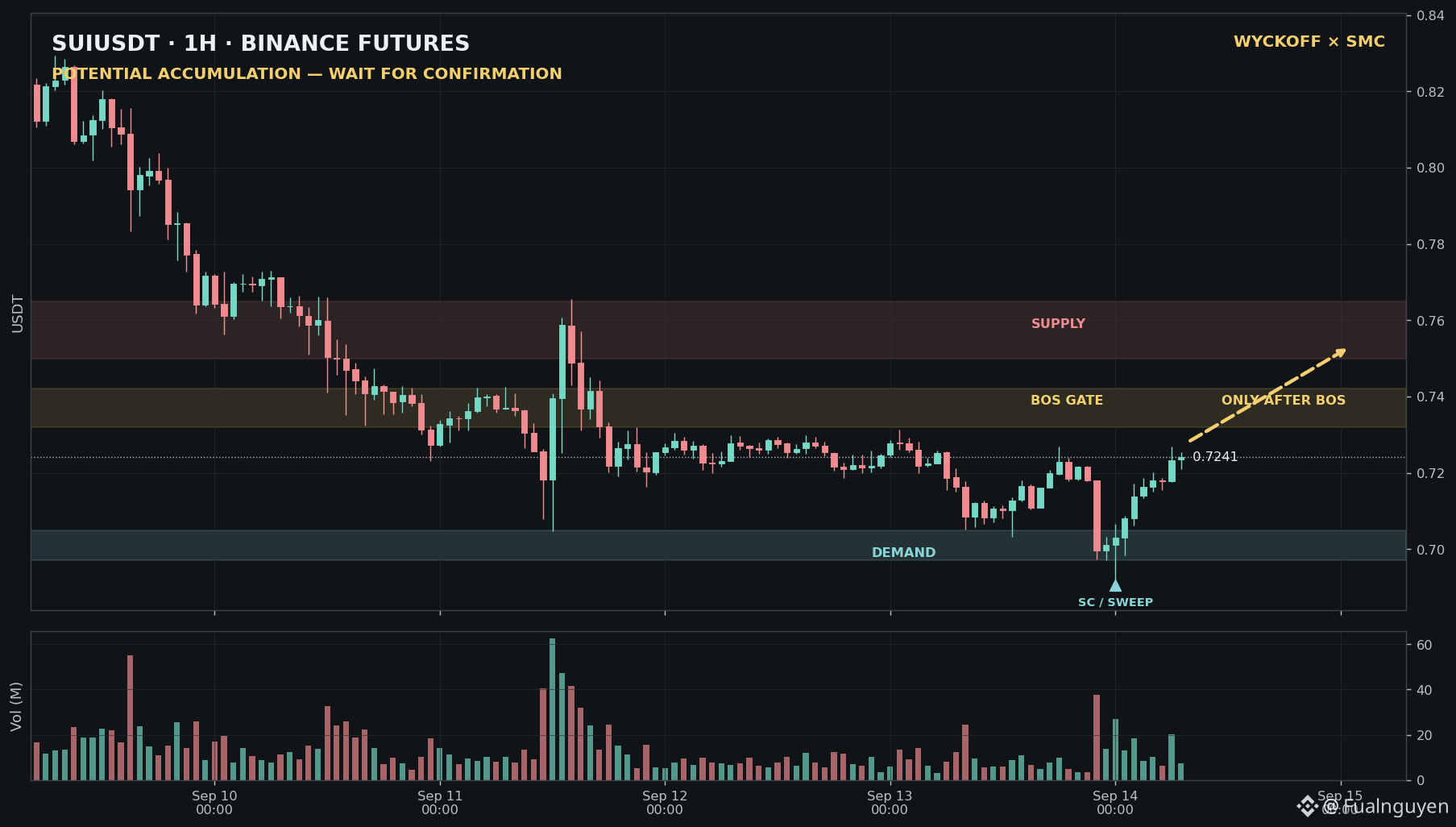
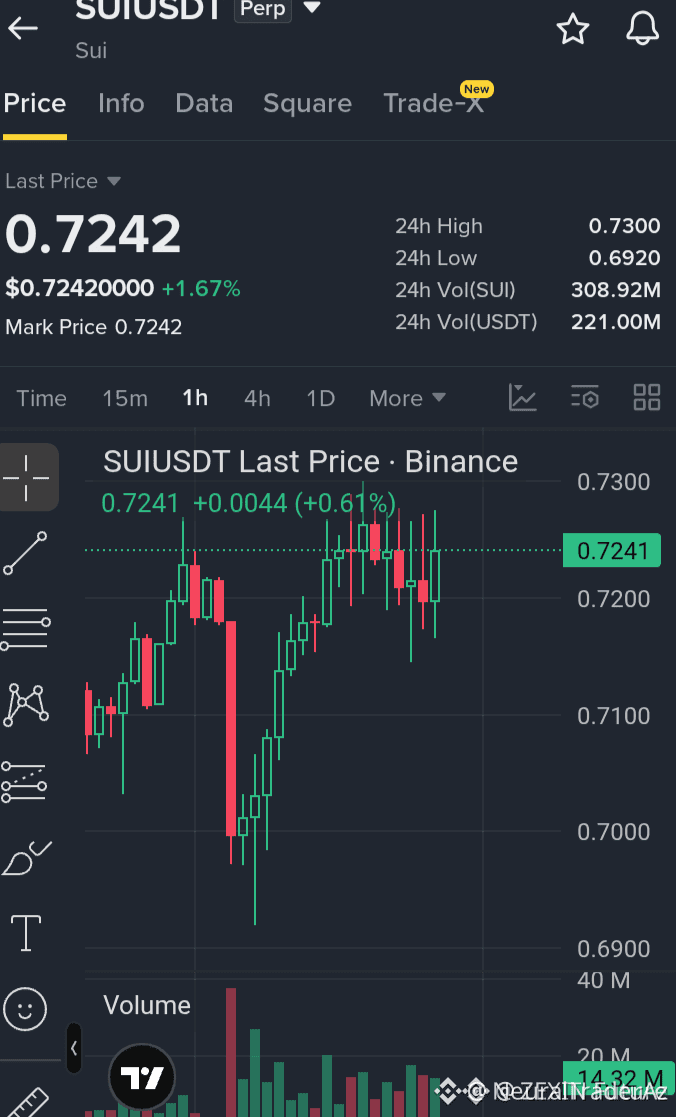
THE MARKET JUST SWEPT $SUI — BUT THIS IS NOT A BUY SIGNAL YET.
SUIUSDT H1 Futures has printed what may become a Wyckoff accumulation structure after an aggressive sell-off.
Price swept liquidity into $0.692, produced a sharp reaction, and recovered to a confirmed closed-candle price of $0.7241. In Wyckoff terms, that low may be acting as a Selling Climax or Spring candidate. In SMC terms, buyers have reclaimed nearby demand—but the larger bearish structure has not been fully broken.
The confirmation gate is clear:
🟢 An H1 close above $0.732–$0.742, followed by a successful retest, would confirm BOS and expose the $0.750–$0.765 supply zone.
🟡 Holding above $0.697–$0.705 keeps the accumulation thesis alive, but without BOS this remains WATCH—not TRADE READY.
🔴 A decisive H1 close below $0.692 invalidates the recovery thesis and raises the probability of markdown continuation.
The trap here is buying the bounce before confirmation—or shorting directly into recovered demand.
Smart Money may have tested the sell-side liquidity. Now I want proof that buyers can take control of structure.
Which happens first: BOS above $0.742 or another sweep below $0.692? 👀
Paper analysis only. Not financial advice.
#SUI #Wyckoff #SMC
THE MARKET JUST SWEPT $SUI — BUT THIS IS NOT A BUY SIGNAL YET.
SUIUSDT H1 Futures has printed what may become a Wyckoff accumulation structure after an aggressive sell-off.
Price swept liquidity into $0.692, produced a sharp reaction, and recovered to a confirmed closed-candle price of $0.7241. In Wyckoff terms, that low may be acting as a Selling Climax or Spring candidate. In SMC terms, buyers have reclaimed nearby demand—but the larger bearish structure has not been fully broken.
The confirmation gate is clear:
🟢 An H1 close above $0.732–$0.742, followed by a successful retest, would confirm BOS and expose the $0.750–$0.765 supply zone.
🟡 Holding above $0.697–$0.705 keeps the accumulation thesis alive, but without BOS this remains WATCH—not TRADE READY.
🔴 A decisive H1 close below $0.692 invalidates the recovery thesis and raises the probability of markdown continuation.
The trap here is buying the bounce before confirmation—or shorting directly into recovered demand.
Smart Money may have tested the sell-side liquidity. Now I want proof that buyers can take control of structure.
Which happens first: BOS above $0.742 or another sweep below $0.692? 👀
Paper analysis only. Not financial advice.
#SUI #Wyckoff #SMC
SUIUSDT H1 Futures has printed what may become a Wyckoff accumulation structure after an aggressive sell-off.
Price swept liquidity into $0.692, produced a sharp reaction, and recovered to a confirmed closed-candle price of $0.7241. In Wyckoff terms, that low may be acting as a Selling Climax or Spring candidate. In SMC terms, buyers have reclaimed nearby demand—but the larger bearish structure has not been fully broken.
The confirmation gate is clear:
🟢 An H1 close above $0.732–$0.742, followed by a successful retest, would confirm BOS and expose the $0.750–$0.765 supply zone.
🟡 Holding above $0.697–$0.705 keeps the accumulation thesis alive, but without BOS this remains WATCH—not TRADE READY.
🔴 A decisive H1 close below $0.692 invalidates the recovery thesis and raises the probability of markdown continuation.
The trap here is buying the bounce before confirmation—or shorting directly into recovered demand.
Smart Money may have tested the sell-side liquidity. Now I want proof that buyers can take control of structure.
Which happens first: BOS above $0.742 or another sweep below $0.692? 👀
Paper analysis only. Not financial advice.
#SUI #Wyckoff #SMC
Kmay2ts:
Hello Fual, e ko còn dùng tl kia nữa, có 1 số vấn đề bên square cần sự giup đỡ của anh, nếu có thể a kết nối lại với tl mới của em nha : @kmayyyy . Thank kiu anh
5
4
2.6k

·
--
$SUI
{spot}(SUIUSDT)
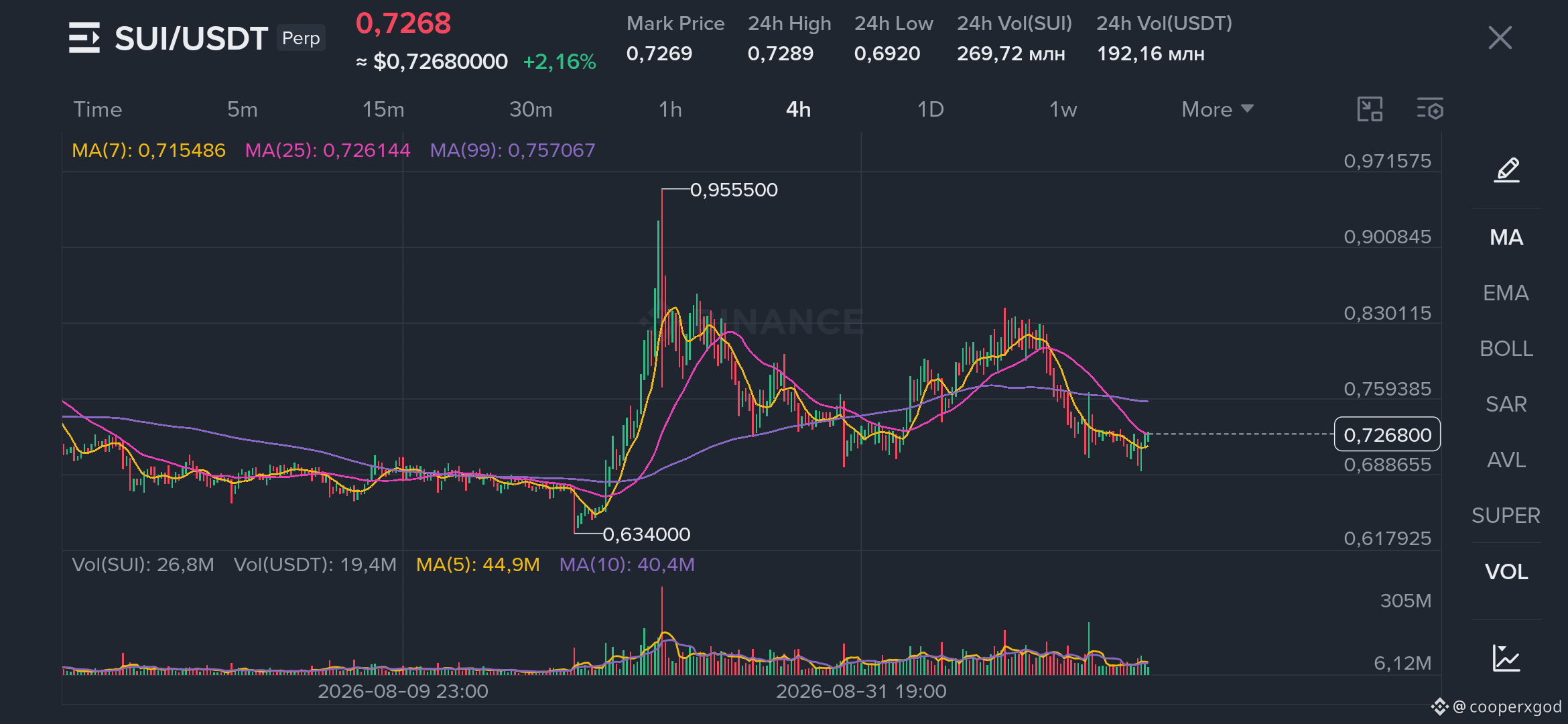
0.704-0.721 has been touched seven times since June, as support and as resistance.
The September run to 0.8447 started there - and has now fully retraced back to it.
Sep 13-14 wicked below to 0.6926 and got bought straight back.
Invalid on a daily close under 0.6926.
Entry: 0.715 - 0.728
Targets: 0.768 / 0.781 / 0.845
SL: 0.688
#sui #Binance
$SUI
0.704-0.721 has been touched seven times since June, as support and as resistance.
The September run to 0.8447 started there - and has now fully retraced back to it.
Sep 13-14 wicked below to 0.6926 and got bought straight back.
Invalid on a daily close under 0.6926.
Entry: 0.715 - 0.728
Targets: 0.768 / 0.781 / 0.845
SL: 0.688
#sui #Binance
0.704-0.721 has been touched seven times since June, as support and as resistance.
The September run to 0.8447 started there - and has now fully retraced back to it.
Sep 13-14 wicked below to 0.6926 and got bought straight back.
Invalid on a daily close under 0.6926.
Entry: 0.715 - 0.728
Targets: 0.768 / 0.781 / 0.845
SL: 0.688
#sui #Binance
1
1.6k

🚀 Sui- BOTTOM IS IN! Perfect Long Setup Loading*
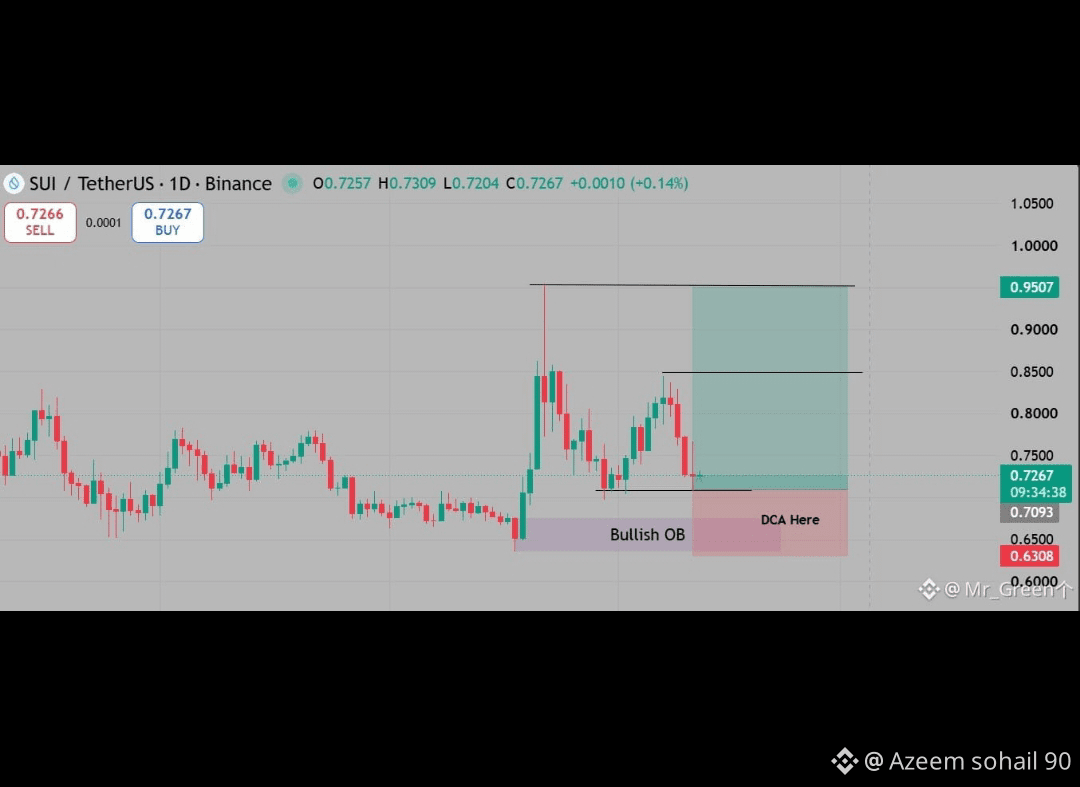
*Chart: SUI / USDT - 1D - Binance*
Price has finally hit its bottom. The level we have been watching for months has shown a strong reaction.
*🔍 Technical Breakdown:*
*1. Bullish Order Block (OB): $0.65 - $0.70*
This is the same zone from where the last major pump started. Price has retested this OB and bullish pin bars are forming. Smart money is entering from here.
*2. DCA Zone: $0.68 - $0.71*
If you missed it, don't worry. This is the best zone for DCA. I am adding to my position here.
*3. Structure:*
After forming a Higher High, a Higher Low has now been formed. Retest DONE!
*📈 My Trade Plan:*
*Entry:* $0.70 - $0.72 (DCA Zone)
*Stop Loss:* $0.6308 (Below Bullish OB - 10% Risk)
*Targets:*
TP1: $0.85 (+20%)
TP2: $0.95 (+35%) - Main liquidity
TP3: $1.05 (+50%)
Risk / Reward: 1 : 4.5 🔥
*💰 I'm Holding SUi18.9 USDT and adding more.*
This is not the time to panic, this is the time to buy. In Altseason, SUI always leads.
Not Financial Advice. DYOR.
$SUI
{future}(SUIUSDT)
$LSK
{future}(LSKUSDT)
$STEEM
{future}(STEEMUSDT)
#SUI #SUIUSDT #crypto #altcoins #bullish
🚀 Sui- BOTTOM IS IN! Perfect Long Setup Loading*
*Chart: SUI / USDT - 1D - Binance*
Price has finally hit its bottom. The level we have been watching for months has shown a strong reaction.
*🔍 Technical Breakdown:*
*1. Bullish Order Block (OB): $0.65 - $0.70*
This is the same zone from where the last major pump started. Price has retested this OB and bullish pin bars are forming. Smart money is entering from here.
*2. DCA Zone: $0.68 - $0.71*
If you missed it, don't worry. This is the best zone for DCA. I am adding to my position here.
*3. Structure:*
After forming a Higher High, a Higher Low has now been formed. Retest DONE!
*📈 My Trade Plan:*
*Entry:* $0.70 - $0.72 (DCA Zone)
*Stop Loss:* $0.6308 (Below Bullish OB - 10% Risk)
*Targets:*
TP1: $0.85 (+20%)
TP2: $0.95 (+35%) - Main liquidity
TP3: $1.05 (+50%)
Risk / Reward: 1 : 4.5 🔥
*💰 I'm Holding SUi18.9 USDT and adding more.*
This is not the time to panic, this is the time to buy. In Altseason, SUI always leads.
Not Financial Advice. DYOR.
$SUI
$LSK
$STEEM
#SUI #SUIUSDT #crypto #altcoins #bullish
*Chart: SUI / USDT - 1D - Binance*
Price has finally hit its bottom. The level we have been watching for months has shown a strong reaction.
*🔍 Technical Breakdown:*
*1. Bullish Order Block (OB): $0.65 - $0.70*
This is the same zone from where the last major pump started. Price has retested this OB and bullish pin bars are forming. Smart money is entering from here.
*2. DCA Zone: $0.68 - $0.71*
If you missed it, don't worry. This is the best zone for DCA. I am adding to my position here.
*3. Structure:*
After forming a Higher High, a Higher Low has now been formed. Retest DONE!
*📈 My Trade Plan:*
*Entry:* $0.70 - $0.72 (DCA Zone)
*Stop Loss:* $0.6308 (Below Bullish OB - 10% Risk)
*Targets:*
TP1: $0.85 (+20%)
TP2: $0.95 (+35%) - Main liquidity
TP3: $1.05 (+50%)
Risk / Reward: 1 : 4.5 🔥
*💰 I'm Holding SUi18.9 USDT and adding more.*
This is not the time to panic, this is the time to buy. In Altseason, SUI always leads.
Not Financial Advice. DYOR.
$SUI
$LSK
$STEEM
#SUI #SUIUSDT #crypto #altcoins #bullish
369

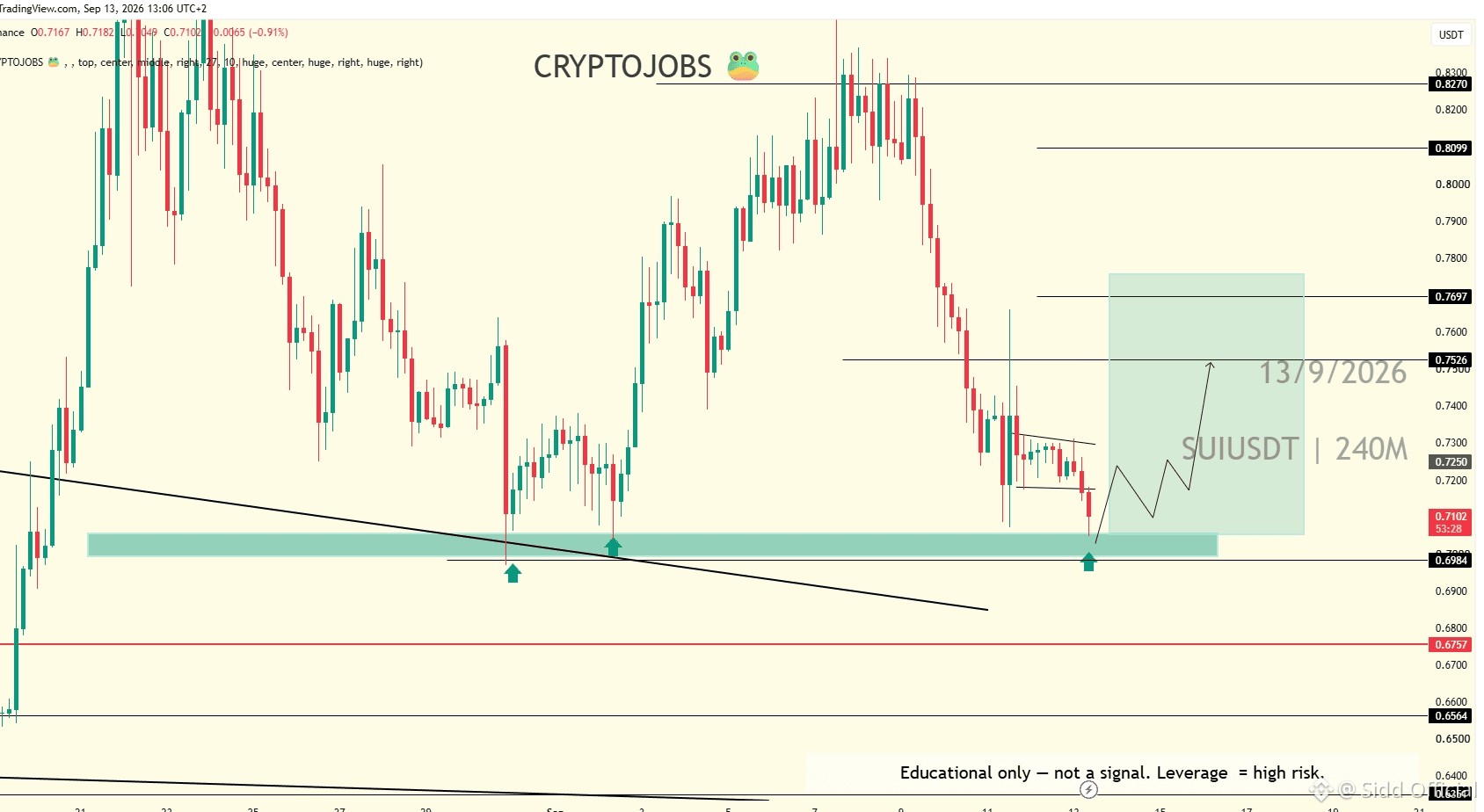
🚨 $SUI Long Setup
While the market is panicking, $SUI is retesting a strong demand zone with a triple bottom, RSI bullish divergence & Ichimoku support.
🎯 Entry: 0.7095–0.7020
🛑 SL: 0.6745
📈 TP: 0.7195 → 0.7321 → 0.7463 → 0.7599
⚠️ Breakdown below 0.6800 could invalidate the setup.
#SUI #AnthropicCEOCallsForAISlowdown
{future}(SUIUSDT)
🚨 $SUI Long Setup
While the market is panicking, $SUI is retesting a strong demand zone with a triple bottom, RSI bullish divergence & Ichimoku support.
🎯 Entry: 0.7095–0.7020
🛑 SL: 0.6745
📈 TP: 0.7195 → 0.7321 → 0.7463 → 0.7599
⚠️ Breakdown below 0.6800 could invalidate the setup.
#SUI #AnthropicCEOCallsForAISlowdown
While the market is panicking, $SUI is retesting a strong demand zone with a triple bottom, RSI bullish divergence & Ichimoku support.
🎯 Entry: 0.7095–0.7020
🛑 SL: 0.6745
📈 TP: 0.7195 → 0.7321 → 0.7463 → 0.7599
⚠️ Breakdown below 0.6800 could invalidate the setup.
#SUI #AnthropicCEOCallsForAISlowdown
2
656

·
--
Bullish
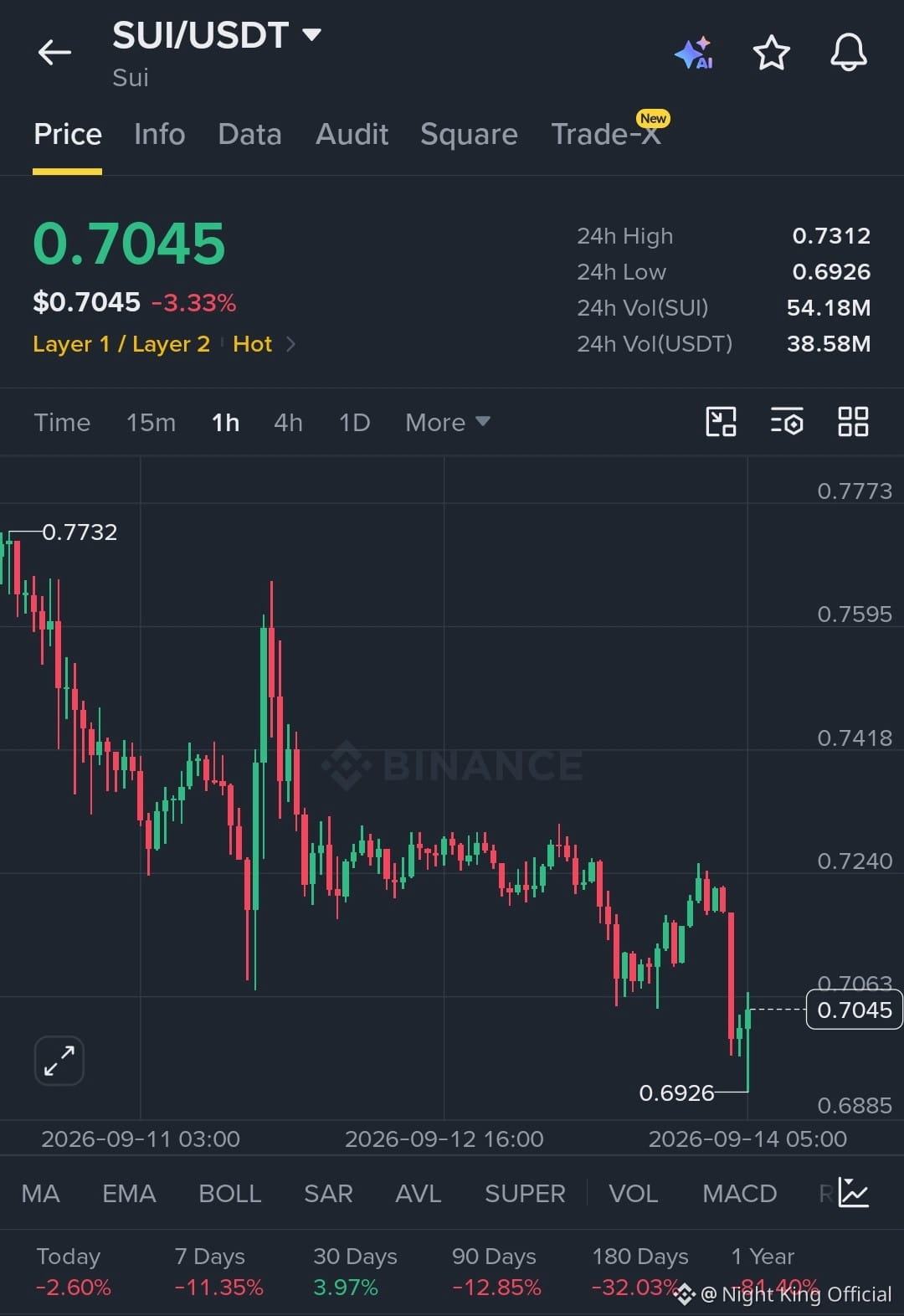
$SUI at 0.7045 on the 1h chart after a -3.33% move.
The visible action shows a decline from the 0.77 area, some consolidation, then a dip to the 0.6926 low before a bounce.
The 24h range sits between 0.6926 and 0.7312 with 54M+ SUI volume.
Price remains under short-term pressure on this timeframe, though buyers appeared near the session low.
Which hourly level stands out most to you for $SUI right now?
{future}(SUIUSDT)
#SUI #Crypto #Write2Earn
$SUI at 0.7045 on the 1h chart after a -3.33% move.
The visible action shows a decline from the 0.77 area, some consolidation, then a dip to the 0.6926 low before a bounce.
The 24h range sits between 0.6926 and 0.7312 with 54M+ SUI volume.
Price remains under short-term pressure on this timeframe, though buyers appeared near the session low.
Which hourly level stands out most to you for $SUI right now?
#SUI #Crypto #Write2Earn
The visible action shows a decline from the 0.77 area, some consolidation, then a dip to the 0.6926 low before a bounce.
The 24h range sits between 0.6926 and 0.7312 with 54M+ SUI volume.
Price remains under short-term pressure on this timeframe, though buyers appeared near the session low.
Which hourly level stands out most to you for $SUI right now?
#SUI #Crypto #Write2Earn
1
588

·
--
Bullish
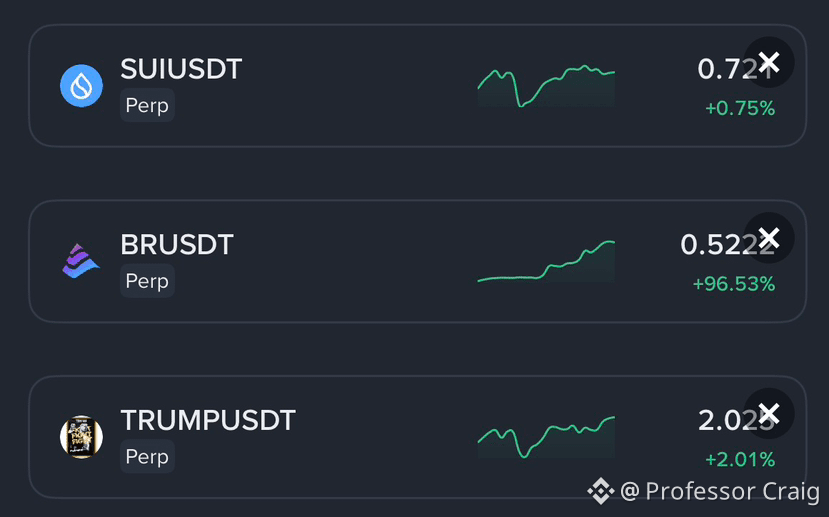
Hey guys, i’m planning to add $TRUMP Coin on my Portfolio after Recent News about this token👀
In addition to that im also thinking of buying $BR and $SUI in my Spot Trading wallet.
Matter of fact, these all 3 tokens will only be moving in one Direction and that is Upward Bullish Direction.🚀
What would you guys be buying for Hold?.
{future}(SUIUSDT)
{future}(BRUSDT)
{future}(TRUMPUSDT)
#sui #TRUMP #bedrockofficial #BR
Hey guys, i’m planning to add $TRUMP Coin on my Portfolio after Recent News about this token👀
In addition to that im also thinking of buying $BR and $SUI in my Spot Trading wallet.
Matter of fact, these all 3 tokens will only be moving in one Direction and that is Upward Bullish Direction.🚀
What would you guys be buying for Hold?.
#sui #TRUMP #bedrockofficial #BR
In addition to that im also thinking of buying $BR and $SUI in my Spot Trading wallet.
Matter of fact, these all 3 tokens will only be moving in one Direction and that is Upward Bullish Direction.🚀
What would you guys be buying for Hold?.
#sui #TRUMP #bedrockofficial #BR
Orangie - Pump Tracker:
I’m also seeing the rumours about trump token news, what do u think are rumour true?
3
1
3
562

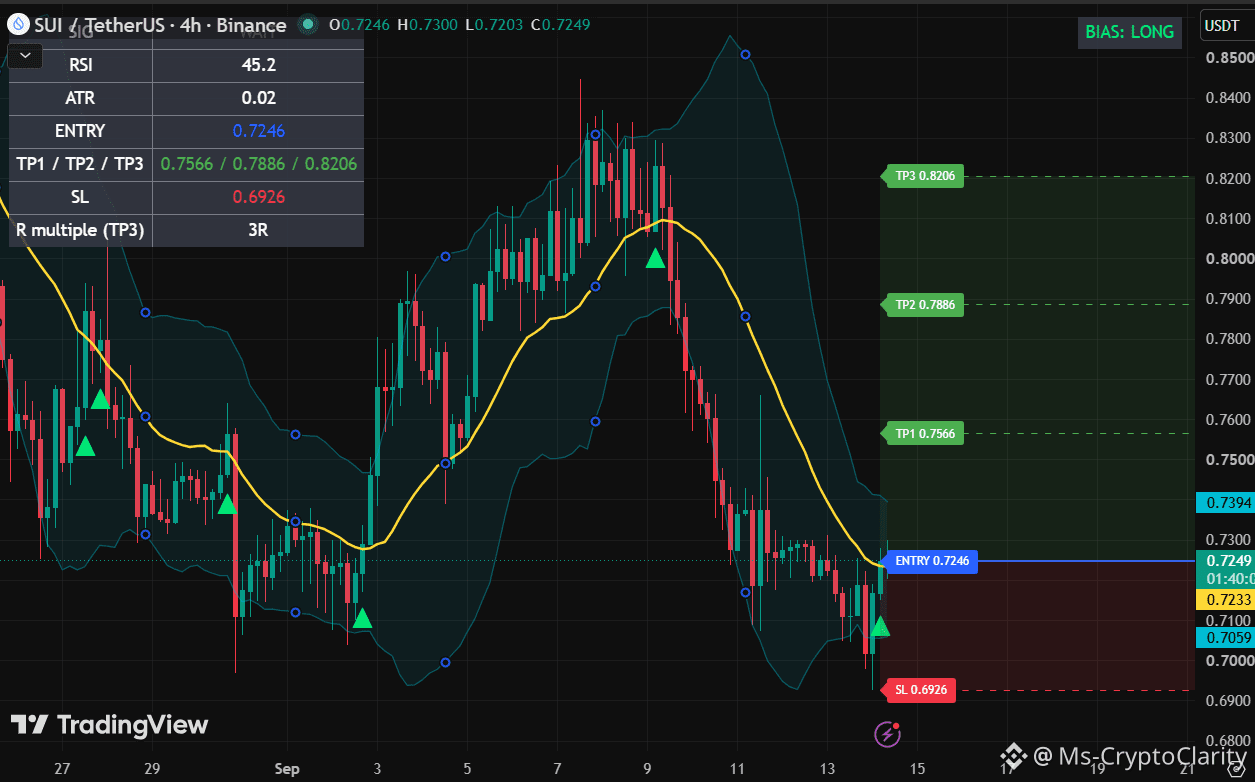
$SUI is sitting right in the primary buy zone, signaling a fresh spot long setup off the bottom support. ✨
Buy Zone: $0.7246 – $0.7249
Key Support Floor: $0.6926 (invalidation below this)
TP1: $0.7566
TP2: $0.7886
TP3: $0.8206
Why this setup?
- Risking roughly 3.2 cents to capture a 9.6 cent run toward the $0.82 target.
- RSI sitting at a reset level of 45.2 gives the asset massive runway before hitting resistance.
- ATR of 0.02 confirms price is compressing for an expansion move back to local highs.
As long as the $0.6926 support floor holds intact, targets stay locked on $0.82.
NFA. Always conduct your own research before trading.
#SUI #CryptoTrading #SpotTrading #BinanceSquare
{spot}(SUIUSDT)
$SUI is sitting right in the primary buy zone, signaling a fresh spot long setup off the bottom support. ✨
Buy Zone: $0.7246 – $0.7249
Key Support Floor: $0.6926 (invalidation below this)
TP1: $0.7566
TP2: $0.7886
TP3: $0.8206
Why this setup?
- Risking roughly 3.2 cents to capture a 9.6 cent run toward the $0.82 target.
- RSI sitting at a reset level of 45.2 gives the asset massive runway before hitting resistance.
- ATR of 0.02 confirms price is compressing for an expansion move back to local highs.
As long as the $0.6926 support floor holds intact, targets stay locked on $0.82.
NFA. Always conduct your own research before trading.
#SUI #CryptoTrading #SpotTrading #BinanceSquare
Buy Zone: $0.7246 – $0.7249
Key Support Floor: $0.6926 (invalidation below this)
TP1: $0.7566
TP2: $0.7886
TP3: $0.8206
Why this setup?
- Risking roughly 3.2 cents to capture a 9.6 cent run toward the $0.82 target.
- RSI sitting at a reset level of 45.2 gives the asset massive runway before hitting resistance.
- ATR of 0.02 confirms price is compressing for an expansion move back to local highs.
As long as the $0.6926 support floor holds intact, targets stay locked on $0.82.
NFA. Always conduct your own research before trading.
#SUI #CryptoTrading #SpotTrading #BinanceSquare
1
147

·
--
Bullish
𝗦𝗨𝗜 (𝗦𝘂𝗶) — 𝗠𝗢𝗠𝗘𝗡𝗧𝗨𝗠 𝗟𝗢𝗡𝗚🔥 𝗦𝗨𝗜 𝗕𝗥𝗘𝗔𝗞𝗢𝗨𝗧 𝗔𝗖𝗧𝗜𝗩𝗔𝗧𝗘𝗗: 𝗪𝗛𝗔𝗟𝗘𝗦 𝗗𝗥𝗜𝗩𝗜𝗡𝗚 𝗡𝗘𝗪 𝗠𝗔𝗖𝗥𝗢 𝗛𝗜𝗚𝗛𝗦
Sui $SUI has captured top trending spots on CoinGecko after shattering a key multi-week resistance block with massive volume confirmation. The asset is showing immense relative strength against Bitcoin, making it a primary target for momentum buyers.
Liquidation heatmaps reveal a massive cluster of short liquidations tightly packed just above the current price level, which will act as rocket fuel for the next leg up. On-chain metrics track significant stablecoin inflows into Sui trading pairs, proving that Smart Money is aggressively backing this breakout. We enter strictly via limit orders on a quick retest of the broken structural block.
➡️ 𝗗𝗜𝗥𝗘𝗖𝗧𝗜𝗢𝗡: Long
➡️ 𝗠𝗔𝗥𝗚𝗜𝗡 𝗧𝗬𝗣𝗘: Isolated
➡️ 𝗟𝗘𝗩𝗘𝗥𝗔𝗚𝗘: 20x - 40x
➡️ 𝗘𝗡𝗧𝗥𝗬 𝗭𝗢𝗡𝗘 (𝗟𝗜𝗠𝗜𝗧𝗦): 1.6250 - 1.6550
🎯 𝗧𝗔𝗞𝗘 𝗣𝗥𝗢𝗙𝗜𝗧 𝟭: 1.7400 (Fast Cash Resistance Sweep)
🎯 𝗧𝗔𝗞𝗘 𝗣𝗥𝗢𝗙𝗜𝗧 𝟮: 1.8300 (Trend Continuation Target)
🎯 𝗧𝗔𝗞𝗘 𝗣𝗥𝗢𝗙𝗜𝗧 𝟯: 1.9500 (Macro Whale FOMO Peak)
🛑 𝗦𝗧𝗢𝗣 𝗟𝗢𝗦𝗦: 1.5450
Disclaimer: Not financial advice. Do your own research (DYOR).
{future}(SUIUSDT)
#SUI #SuiNetwork #CryptoSignals
𝗦𝗨𝗜 (𝗦𝘂𝗶) — 𝗠𝗢𝗠𝗘𝗡𝗧𝗨𝗠 𝗟𝗢𝗡𝗚🔥 𝗦𝗨𝗜 𝗕𝗥𝗘𝗔𝗞𝗢𝗨𝗧 𝗔𝗖𝗧𝗜𝗩𝗔𝗧𝗘𝗗: 𝗪𝗛𝗔𝗟𝗘𝗦 𝗗𝗥𝗜𝗩𝗜𝗡𝗚 𝗡𝗘𝗪 𝗠𝗔𝗖𝗥𝗢 𝗛𝗜𝗚𝗛𝗦
Sui $SUI has captured top trending spots on CoinGecko after shattering a key multi-week resistance block with massive volume confirmation. The asset is showing immense relative strength against Bitcoin, making it a primary target for momentum buyers.
Liquidation heatmaps reveal a massive cluster of short liquidations tightly packed just above the current price level, which will act as rocket fuel for the next leg up. On-chain metrics track significant stablecoin inflows into Sui trading pairs, proving that Smart Money is aggressively backing this breakout. We enter strictly via limit orders on a quick retest of the broken structural block.
➡️ 𝗗𝗜𝗥𝗘𝗖𝗧𝗜𝗢𝗡: Long
➡️ 𝗠𝗔𝗥𝗚𝗜𝗡 𝗧𝗬𝗣𝗘: Isolated
➡️ 𝗟𝗘𝗩𝗘𝗥𝗔𝗚𝗘: 20x - 40x
➡️ 𝗘𝗡𝗧𝗥𝗬 𝗭𝗢𝗡𝗘 (𝗟𝗜𝗠𝗜𝗧𝗦): 1.6250 - 1.6550
🎯 𝗧𝗔𝗞𝗘 𝗣𝗥𝗢𝗙𝗜𝗧 𝟭: 1.7400 (Fast Cash Resistance Sweep)
🎯 𝗧𝗔𝗞𝗘 𝗣𝗥𝗢𝗙𝗜𝗧 𝟮: 1.8300 (Trend Continuation Target)
🎯 𝗧𝗔𝗞𝗘 𝗣𝗥𝗢𝗙𝗜𝗧 𝟯: 1.9500 (Macro Whale FOMO Peak)
🛑 𝗦𝗧𝗢𝗣 𝗟𝗢𝗦𝗦: 1.5450
Disclaimer: Not financial advice. Do your own research (DYOR).
#SUI #SuiNetwork #CryptoSignals
Sui $SUI has captured top trending spots on CoinGecko after shattering a key multi-week resistance block with massive volume confirmation. The asset is showing immense relative strength against Bitcoin, making it a primary target for momentum buyers.
Liquidation heatmaps reveal a massive cluster of short liquidations tightly packed just above the current price level, which will act as rocket fuel for the next leg up. On-chain metrics track significant stablecoin inflows into Sui trading pairs, proving that Smart Money is aggressively backing this breakout. We enter strictly via limit orders on a quick retest of the broken structural block.
➡️ 𝗗𝗜𝗥𝗘𝗖𝗧𝗜𝗢𝗡: Long
➡️ 𝗠𝗔𝗥𝗚𝗜𝗡 𝗧𝗬𝗣𝗘: Isolated
➡️ 𝗟𝗘𝗩𝗘𝗥𝗔𝗚𝗘: 20x - 40x
➡️ 𝗘𝗡𝗧𝗥𝗬 𝗭𝗢𝗡𝗘 (𝗟𝗜𝗠𝗜𝗧𝗦): 1.6250 - 1.6550
🎯 𝗧𝗔𝗞𝗘 𝗣𝗥𝗢𝗙𝗜𝗧 𝟭: 1.7400 (Fast Cash Resistance Sweep)
🎯 𝗧𝗔𝗞𝗘 𝗣𝗥𝗢𝗙𝗜𝗧 𝟮: 1.8300 (Trend Continuation Target)
🎯 𝗧𝗔𝗞𝗘 𝗣𝗥𝗢𝗙𝗜𝗧 𝟯: 1.9500 (Macro Whale FOMO Peak)
🛑 𝗦𝗧𝗢𝗣 𝗟𝗢𝗦𝗦: 1.5450
Disclaimer: Not financial advice. Do your own research (DYOR).
#SUI #SuiNetwork #CryptoSignals
1
69

·
--
Bullish
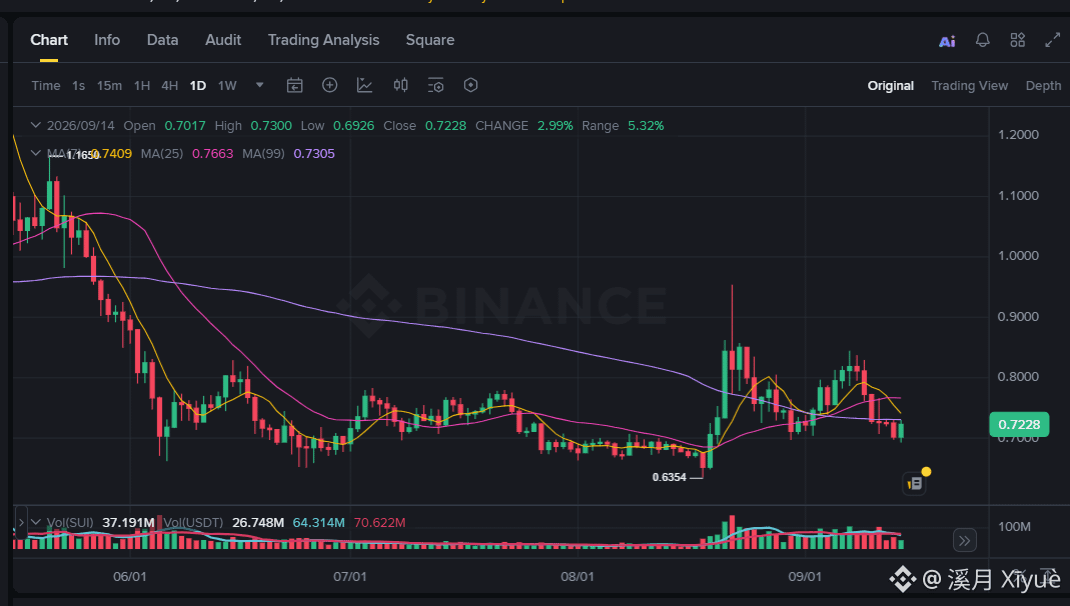
Buyers are attempting a bounce, though the daily trend still looks fragile.
$SUI is trading at $0.7239, up 2.04% in 24 hours, while recent rebounds have formed lower highs. Volume has cooled from the earlier rally, so I’d want stronger follow-through before trusting this recovery. The $0.7300 daily high is the immediate level to watch, with the $0.6926 daily low providing a downside reference if selling returns.
One green day leaves plenty to prove. Can buyers hold this bounce and start breaking the pattern of lower highs?
#sui #SUI🔥
Buyers are attempting a bounce, though the daily trend still looks fragile.
$SUI is trading at $0.7239, up 2.04% in 24 hours, while recent rebounds have formed lower highs. Volume has cooled from the earlier rally, so I’d want stronger follow-through before trusting this recovery. The $0.7300 daily high is the immediate level to watch, with the $0.6926 daily low providing a downside reference if selling returns.
One green day leaves plenty to prove. Can buyers hold this bounce and start breaking the pattern of lower highs?
#sui #SUI🔥
$SUI is trading at $0.7239, up 2.04% in 24 hours, while recent rebounds have formed lower highs. Volume has cooled from the earlier rally, so I’d want stronger follow-through before trusting this recovery. The $0.7300 daily high is the immediate level to watch, with the $0.6926 daily low providing a downside reference if selling returns.
One green day leaves plenty to prove. Can buyers hold this bounce and start breaking the pattern of lower highs?
#sui #SUI🔥
213

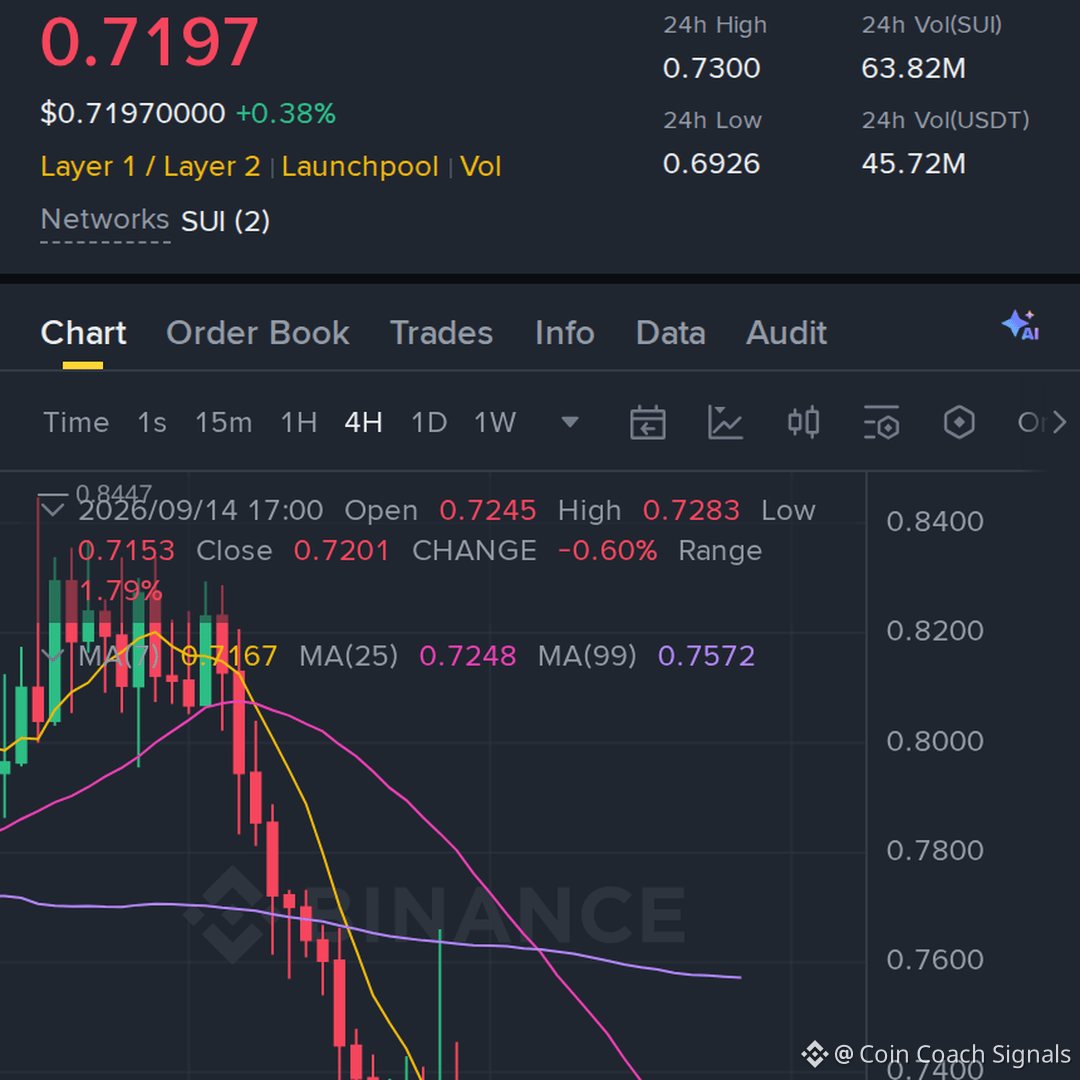
📉 $SUI 1H Market Update
SUI is currently trading around $0.7195, with short-term price action remaining weak.
🔹 24H High: $0.7312
🔹 24H Low: $0.7190
🔹 Important support: around $0.7072
🔹 MA(7): $0.7247
🔹 MA(25): $0.7252
🔹 MA(99): $0.7498
Price is currently below the short-term moving averages, so buyers may need to regain the $0.724–$0.725 area before momentum improves.
The $0.7072 zone is also worth watching as a key support area. 👀
What do you think? Can $SUI reclaim $0.725 soon?
#SUI #SuiNetwork #SUIUSDT #Crypto #CryptoMarket
📉 $SUI 1H Market Update
SUI is currently trading around $0.7195, with short-term price action remaining weak.
🔹 24H High: $0.7312
🔹 24H Low: $0.7190
🔹 Important support: around $0.7072
🔹 MA(7): $0.7247
🔹 MA(25): $0.7252
🔹 MA(99): $0.7498
Price is currently below the short-term moving averages, so buyers may need to regain the $0.724–$0.725 area before momentum improves.
The $0.7072 zone is also worth watching as a key support area. 👀
What do you think? Can $SUI reclaim $0.725 soon?
#SUI #SuiNetwork #SUIUSDT #Crypto #CryptoMarket
SUI is currently trading around $0.7195, with short-term price action remaining weak.
🔹 24H High: $0.7312
🔹 24H Low: $0.7190
🔹 Important support: around $0.7072
🔹 MA(7): $0.7247
🔹 MA(25): $0.7252
🔹 MA(99): $0.7498
Price is currently below the short-term moving averages, so buyers may need to regain the $0.724–$0.725 area before momentum improves.
The $0.7072 zone is also worth watching as a key support area. 👀
What do you think? Can $SUI reclaim $0.725 soon?
#SUI #SuiNetwork #SUIUSDT #Crypto #CryptoMarket
anik031:
$SUI Good
3
4
1.4k

·
--
Price action is quiet, but volume tells a different story.
$SUI is currently trading at $0.7239, posting a 2.02% gain. While the price remains steady, $43.59M in 24h volume suggests active positioning under the surface.
Watch the liquidity flow closely: a sustained increase in volume on green candles could signal a move toward local resistance. Conversely, if volume spikes alongside a price breakdown below current support, it may indicate a trend reversal.
Smart capital often moves before the breakout. Is this volume accumulation or a temporary trap?
Click SUI for the live chart and let me know your take below
Tap $SUI for the live chart. #SUI #BinanceSquare
Price action is quiet, but volume tells a different story.
$SUI is currently trading at $0.7239, posting a 2.02% gain. While the price remains steady, $43.59M in 24h volume suggests active positioning under the surface.
Watch the liquidity flow closely: a sustained increase in volume on green candles could signal a move toward local resistance. Conversely, if volume spikes alongside a price breakdown below current support, it may indicate a trend reversal.
Smart capital often moves before the breakout. Is this volume accumulation or a temporary trap?
Click SUI for the live chart and let me know your take below
Tap $SUI for the live chart. #SUI #BinanceSquare
$SUI is currently trading at $0.7239, posting a 2.02% gain. While the price remains steady, $43.59M in 24h volume suggests active positioning under the surface.
Watch the liquidity flow closely: a sustained increase in volume on green candles could signal a move toward local resistance. Conversely, if volume spikes alongside a price breakdown below current support, it may indicate a trend reversal.
Smart capital often moves before the breakout. Is this volume accumulation or a temporary trap?
Click SUI for the live chart and let me know your take below
Tap $SUI for the live chart. #SUI #BinanceSquare
17

·
--
Bearish
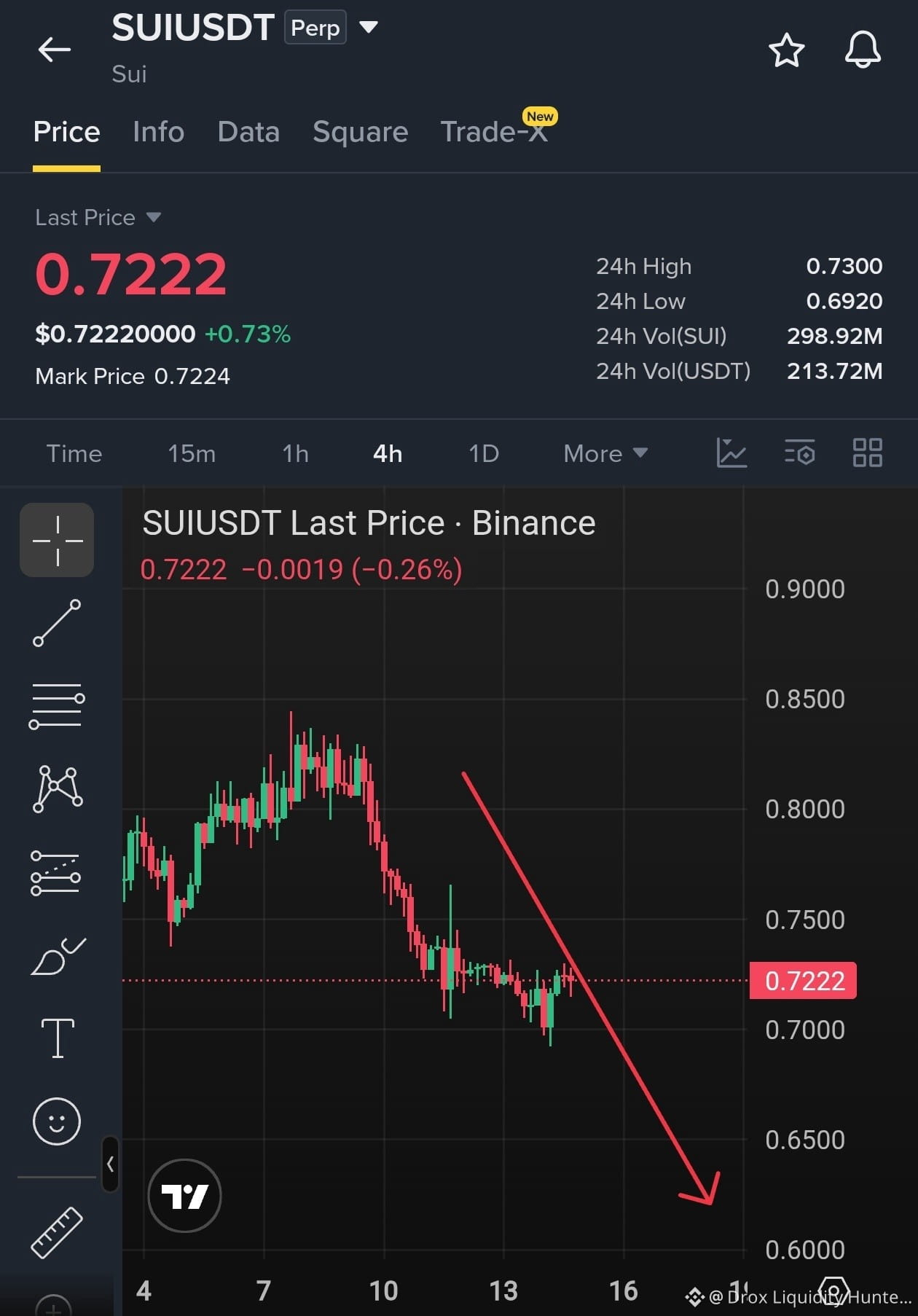
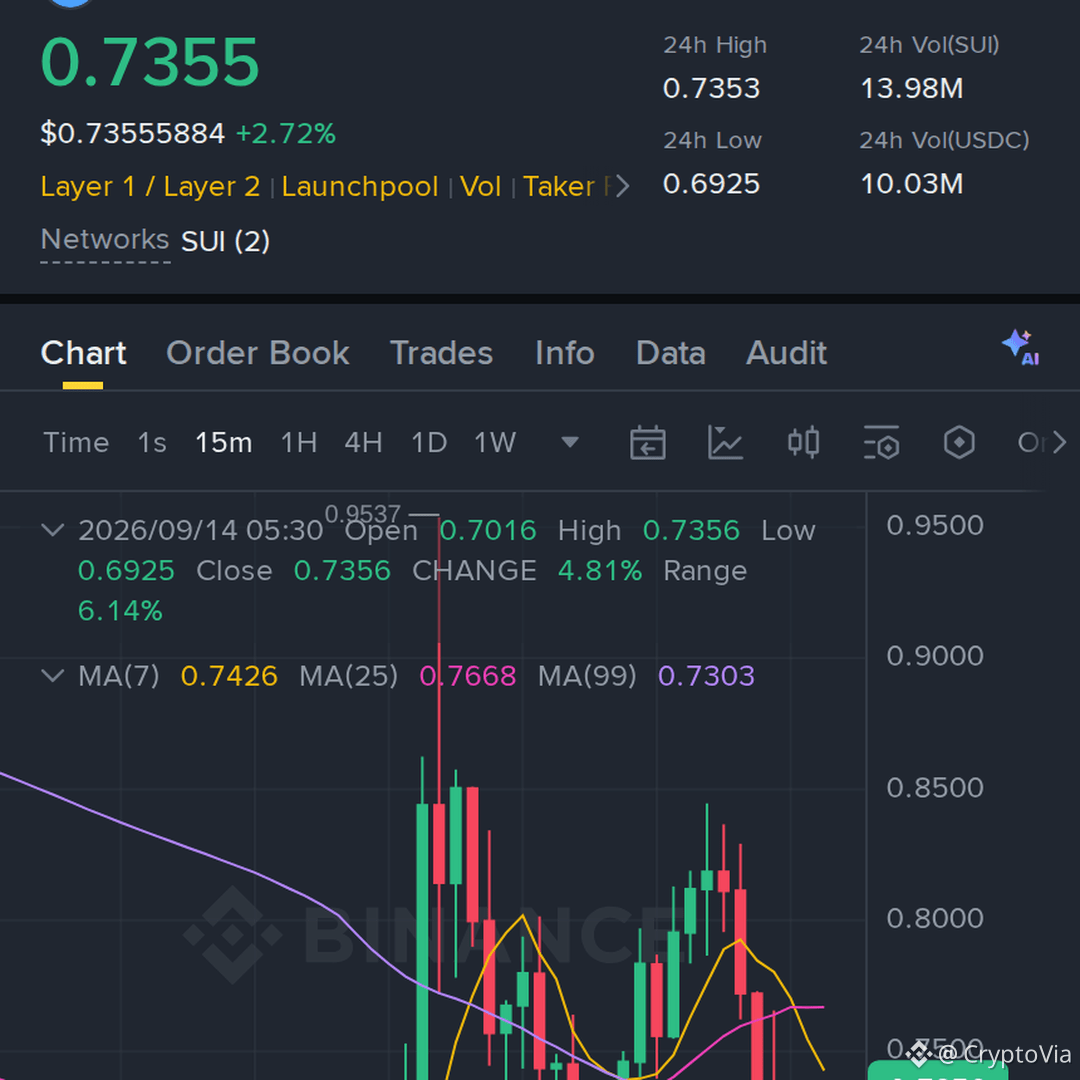
$SUI Sellers Refuse To Back Down..... 🔴SHORT It NOW🔴
🔴Open Short Position on #SUI
🔴Short $SOL
🔴More Weakness Expected On $ZEC
$SUI Sellers Refuse To Back Down..... 🔴SHORT It NOW🔴
🔴Open Short Position on #SUI
🔴Short $SOL
🔴More Weakness Expected On $ZEC
🔴Open Short Position on #SUI
🔴Short $SOL
🔴More Weakness Expected On $ZEC
74


·
--
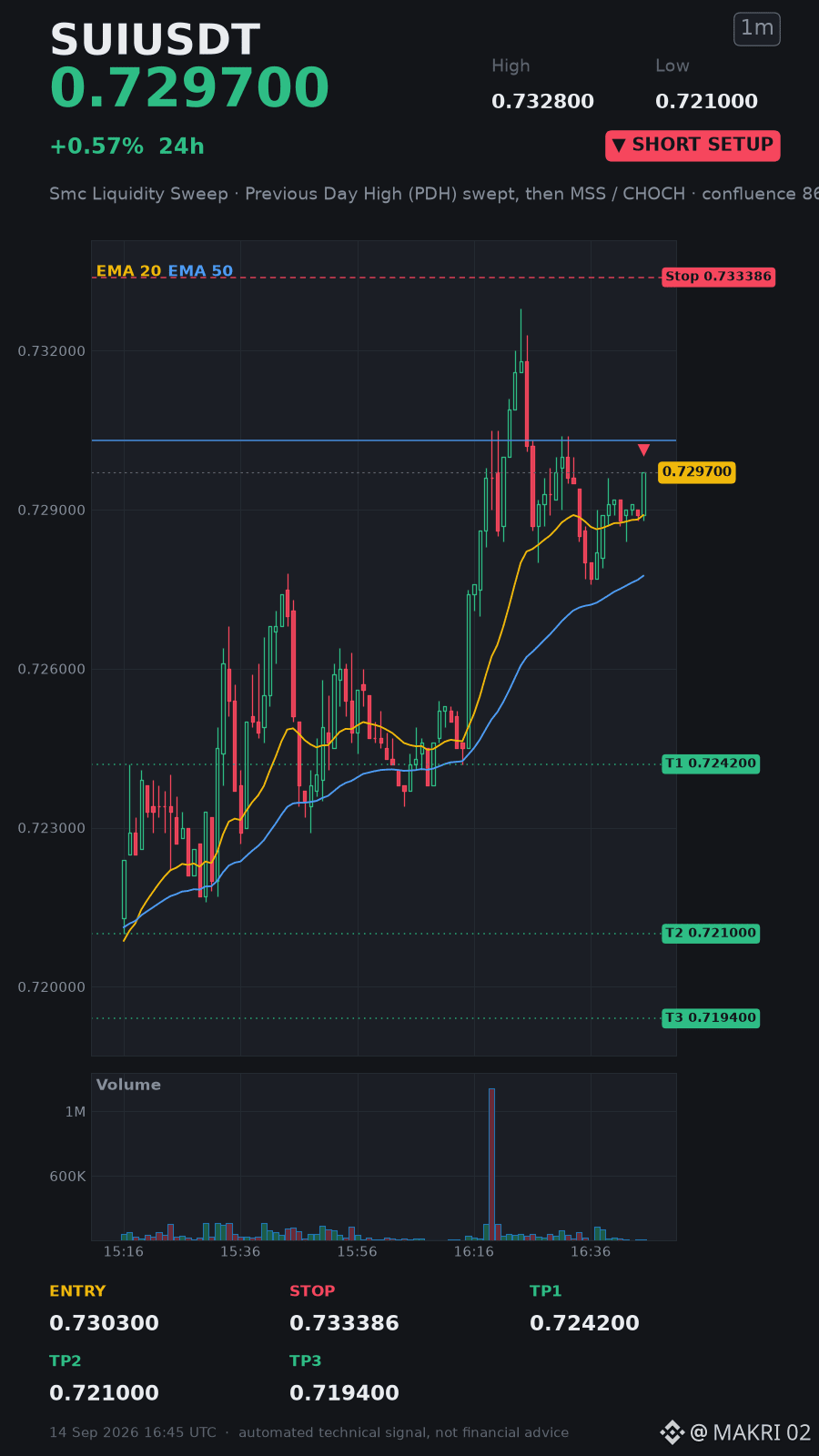
🚨 #SUI SMC SWEEP CRASHING DOWN! 🤯📉
I’m shorting hard right now. $SUI 👇
Short..... Fast..... Feel the swing..... Ride it.....‼️‼️‼️
Entry: 0.7303 – 0.7316
Stop-loss: 0.7334
🟢 TP1: 0.7242
🟢 TP2: 0.721
🟢 TP3: 0.7194
Join my trade, let’s dominate 👇⬇️⬇️ Short.. With meee...👇⬇️ $SUI
🚨 #SUI SMC SWEEP CRASHING DOWN! 🤯📉
I’m shorting hard right now. $SUI 👇
Short..... Fast..... Feel the swing..... Ride it.....‼️‼️‼️
Entry: 0.7303 – 0.7316
Stop-loss: 0.7334
🟢 TP1: 0.7242
🟢 TP2: 0.721
🟢 TP3: 0.7194
Join my trade, let’s dominate 👇⬇️⬇️ Short.. With meee...👇⬇️ $SUI
I’m shorting hard right now. $SUI 👇
Short..... Fast..... Feel the swing..... Ride it.....‼️‼️‼️
Entry: 0.7303 – 0.7316
Stop-loss: 0.7334
🟢 TP1: 0.7242
🟢 TP2: 0.721
🟢 TP3: 0.7194
Join my trade, let’s dominate 👇⬇️⬇️ Short.. With meee...👇⬇️ $SUI

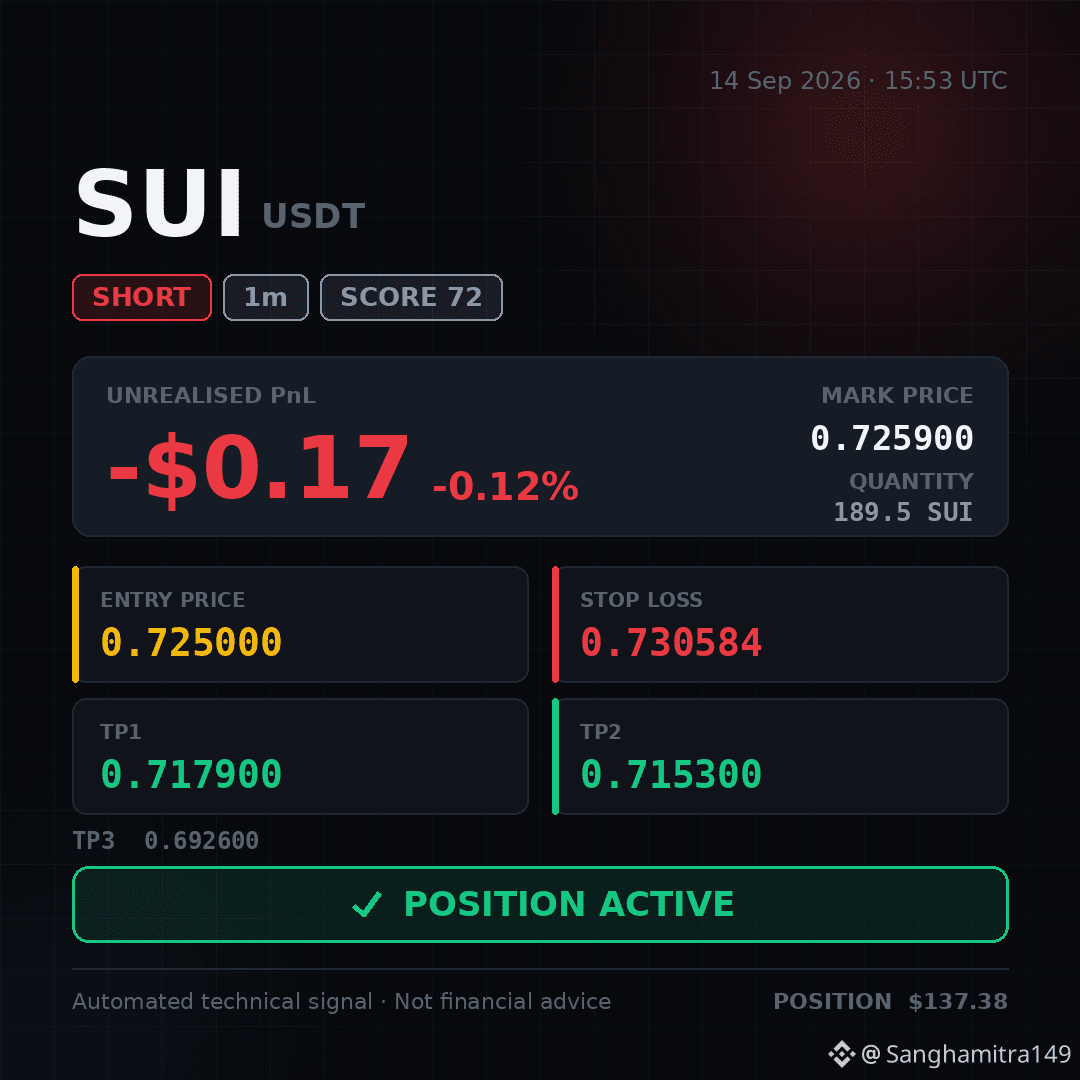
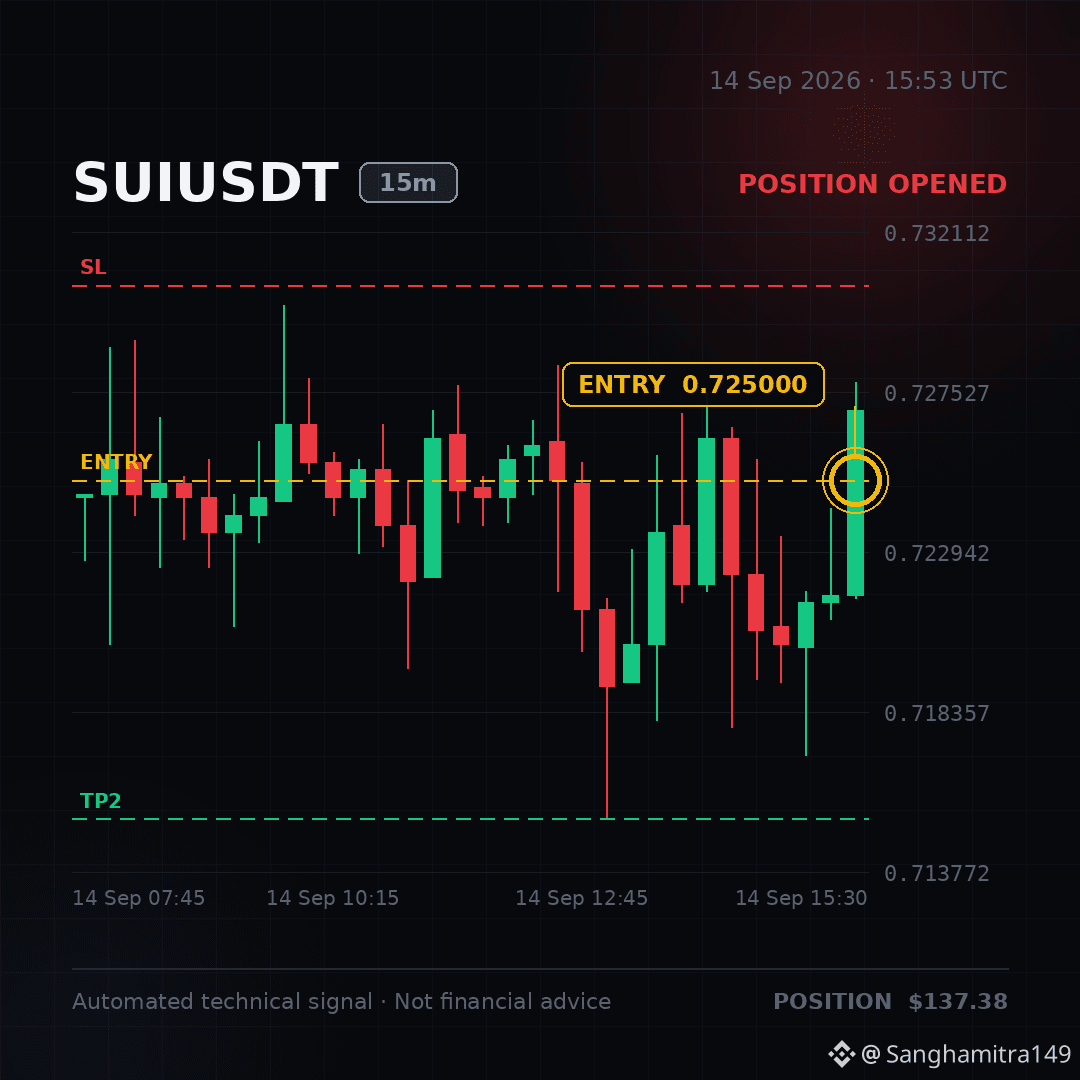
✅ POSITION ACTIVE — I've taken this short. Running at -0.12%.
🚨 #SUI SMC SWEEP STUNNING DROP! 🤯⚡
I'm taking this trade now $SUI 👇
Short..... Quick..... Feel the rush.....‼️‼️‼️
Entry: 0.725 – 0.7268
Stop-loss: 0.7306
🟢 TP1: 0.7179
🟢 TP2: 0.7153
🟢 TP3: 0.6926
Join me, trade the swing! 👇⬇️⬇️ Short.. With meee...👇⬇️ $SUI
✅ POSITION ACTIVE — I've taken this short. Running at -0.12%.
🚨 #SUI SMC SWEEP STUNNING DROP! 🤯⚡
I'm taking this trade now $SUI 👇
Short..... Quick..... Feel the rush.....‼️‼️‼️
Entry: 0.725 – 0.7268
Stop-loss: 0.7306
🟢 TP1: 0.7179
🟢 TP2: 0.7153
🟢 TP3: 0.6926
Join me, trade the swing! 👇⬇️⬇️ Short.. With meee...👇⬇️ $SUI
🚨 #SUI SMC SWEEP STUNNING DROP! 🤯⚡
I'm taking this trade now $SUI 👇
Short..... Quick..... Feel the rush.....‼️‼️‼️
Entry: 0.725 – 0.7268
Stop-loss: 0.7306
🟢 TP1: 0.7179
🟢 TP2: 0.7153
🟢 TP3: 0.6926
Join me, trade the swing! 👇⬇️⬇️ Short.. With meee...👇⬇️ $SUI
5

·
--
Bullish
🚨 $SUI BEFORE THE NEXT BIG EVENT — COULD THIS BE THE NEXT GAINER? 👀
$SUI — Sui Network
Why is $SUI getting attention?
SUI has an important upcoming ecosystem event on September 24, 2026: Phantom Wallet is scheduled to end native Sui network support. Users will still retain access to their assets through compatible wallets, so this is an important ecosystem transition, not a token delisting.
That makes SUI interesting from both sides: the market will be watching how the ecosystem handles the transition, while Sui continues competing for DeFi and on-chain activity.
Potential upside:
If SUI volume and ecosystem activity strengthen ahead of the event, another 5–10% move could be possible. Not guaranteed.
Risk:
The Phantom change is also a negative catalyst and could create selling pressure. Don't treat the event itself as automatically bullish.
👀 BIG QUESTION: Can SUI turn the upcoming ecosystem transition into renewed buying interest?
🔥 Follow me for before-the-move Binance opportunities.
⚠️ High volatility. DYOR & don't FOMO.
#SUI #SuiNetwork #Binance #CryptoGainers #Crypto
{spot}(SUIUSDT)
#Altcoins #DeFi #Web3 #CryptoNews #Trading #DYOR
🚨 $SUI BEFORE THE NEXT BIG EVENT — COULD THIS BE THE NEXT GAINER? 👀
$SUI — Sui Network
Why is $SUI getting attention?
SUI has an important upcoming ecosystem event on September 24, 2026: Phantom Wallet is scheduled to end native Sui network support. Users will still retain access to their assets through compatible wallets, so this is an important ecosystem transition, not a token delisting.
That makes SUI interesting from both sides: the market will be watching how the ecosystem handles the transition, while Sui continues competing for DeFi and on-chain activity.
Potential upside:
If SUI volume and ecosystem activity strengthen ahead of the event, another 5–10% move could be possible. Not guaranteed.
Risk:
The Phantom change is also a negative catalyst and could create selling pressure. Don't treat the event itself as automatically bullish.
👀 BIG QUESTION: Can SUI turn the upcoming ecosystem transition into renewed buying interest?
🔥 Follow me for before-the-move Binance opportunities.
⚠️ High volatility. DYOR & don't FOMO.
#SUI #SuiNetwork #Binance #CryptoGainers #Crypto
#Altcoins #DeFi #Web3 #CryptoNews #Trading #DYOR
$SUI — Sui Network
Why is $SUI getting attention?
SUI has an important upcoming ecosystem event on September 24, 2026: Phantom Wallet is scheduled to end native Sui network support. Users will still retain access to their assets through compatible wallets, so this is an important ecosystem transition, not a token delisting.
That makes SUI interesting from both sides: the market will be watching how the ecosystem handles the transition, while Sui continues competing for DeFi and on-chain activity.
Potential upside:
If SUI volume and ecosystem activity strengthen ahead of the event, another 5–10% move could be possible. Not guaranteed.
Risk:
The Phantom change is also a negative catalyst and could create selling pressure. Don't treat the event itself as automatically bullish.
👀 BIG QUESTION: Can SUI turn the upcoming ecosystem transition into renewed buying interest?
🔥 Follow me for before-the-move Binance opportunities.
⚠️ High volatility. DYOR & don't FOMO.
#SUI #SuiNetwork #Binance #CryptoGainers #Crypto
#Altcoins #DeFi #Web3 #CryptoNews #Trading #DYOR
Onchain Crypto X
·
--
🚨 POTENTIAL GAINER — $SUI 👀
$SUI — Sui Network
Why could SUI become a gainer?
🔥 Sui recently crossed 16 BILLION transactions, a major network-activity milestone that strengthens its adoption narrative.
At the same time, SUI remains one of the large-cap Layer-1 tokens being watched for higher volatility and potential momentum in September.
Potential upside:
📈 If volume expands and SUI breaks nearby resistance with strong buying, a 5–10% move could be possible. A stronger altcoin rotation could provide additional momentum.
Risk:
⚠️ SUI is already a heavily watched coin, so resistance and profit-taking can appear quickly. A failed breakout could send it back into consolidation.
👀 Watch:
• 16B+ transaction milestone
• Trading volume
• Breakout above resistance
• L1/altcoin rotation
🔥 Could $SUI be one of the next Binance Gainers?
⚠️ High volatility. DYOR & don't FOMO.
#SUI #Sui #BinanceSquareFamily #PotentialGainer #Crypto #Altcoins #Layer1 #Trading
$SUI — Sui Network
Why could SUI become a gainer?
🔥 Sui recently crossed 16 BILLION transactions, a major network-activity milestone that strengthens its adoption narrative.
At the same time, SUI remains one of the large-cap Layer-1 tokens being watched for higher volatility and potential momentum in September.
Potential upside:
📈 If volume expands and SUI breaks nearby resistance with strong buying, a 5–10% move could be possible. A stronger altcoin rotation could provide additional momentum.
Risk:
⚠️ SUI is already a heavily watched coin, so resistance and profit-taking can appear quickly. A failed breakout could send it back into consolidation.
👀 Watch:
• 16B+ transaction milestone
• Trading volume
• Breakout above resistance
• L1/altcoin rotation
🔥 Could $SUI be one of the next Binance Gainers?
⚠️ High volatility. DYOR & don't FOMO.
#SUI #Sui #BinanceSquareFamily #PotentialGainer #Crypto #Altcoins #Layer1 #Trading
4

·
--
🚨 $SUI STRUCTURAL BREAKDOWN ACCELERATES AS LIQUIDITY HUNTS LOWER LEVELS! 📉
Entry: 0.7129 🔻
Target: 0.6807 - 0.6449 🎯
Stop Loss: 0.7380 ⚠️
$SUI has confirmed a decisive market structure shift following a breakdown below key moving average support. 📉 Buyers failed to show any responsive absorption on the retest, leaving structural inefficiencies open for a deep sell-side liquidity hunt.
📌 Order flow indicates institutional distribution around this supply pivot, opening a clear imbalance fill down toward key lower demand blocks. 📊 As long as price remains capped beneath local resistance, lower targets present the path of least resistance.
💬 Are you positioning for this short expansion toward support or waiting for a structural reclaim first? 👇
⚠️ Not financial advice. Always manage your risk. 🛡️
🏷️ #SUI #ShortSetup #Crypto #MarketStructure #Trading
📉 🛡️
🚨 $SUI STRUCTURAL BREAKDOWN ACCELERATES AS LIQUIDITY HUNTS LOWER LEVELS! 📉
Entry: 0.7129 🔻
Target: 0.6807 - 0.6449 🎯
Stop Loss: 0.7380 ⚠️
$SUI has confirmed a decisive market structure shift following a breakdown below key moving average support. 📉 Buyers failed to show any responsive absorption on the retest, leaving structural inefficiencies open for a deep sell-side liquidity hunt.
📌 Order flow indicates institutional distribution around this supply pivot, opening a clear imbalance fill down toward key lower demand blocks. 📊 As long as price remains capped beneath local resistance, lower targets present the path of least resistance.
💬 Are you positioning for this short expansion toward support or waiting for a structural reclaim first? 👇
⚠️ Not financial advice. Always manage your risk. 🛡️
🏷️ #SUI #ShortSetup #Crypto #MarketStructure #Trading
📉 🛡️
Entry: 0.7129 🔻
Target: 0.6807 - 0.6449 🎯
Stop Loss: 0.7380 ⚠️
$SUI has confirmed a decisive market structure shift following a breakdown below key moving average support. 📉 Buyers failed to show any responsive absorption on the retest, leaving structural inefficiencies open for a deep sell-side liquidity hunt.
📌 Order flow indicates institutional distribution around this supply pivot, opening a clear imbalance fill down toward key lower demand blocks. 📊 As long as price remains capped beneath local resistance, lower targets present the path of least resistance.
💬 Are you positioning for this short expansion toward support or waiting for a structural reclaim first? 👇
⚠️ Not financial advice. Always manage your risk. 🛡️
🏷️ #SUI #ShortSetup #Crypto #MarketStructure #Trading
📉 🛡️

28

🚨 $SUI RECLAIMING INSTITUTIONAL DEMAND AS LIQUIDITY SWEEP EXHAUSTS SELLER PRESSURE! ⚡
Entry: 0.7150 - 0.7250 ⚡
Target: 0.7500 - 0.7800 🚀
Stop Loss: 0.6900 ⚠️
📌 Smart money is quietly building positions in the 0.7150 - 0.7250 demand block after absorbing sell-side liquidity. 🔍 Order flow shows sell volume exhausting rapidly on lower timeframes, setting up a clean structural pivot toward overhead market inefficiencies.
💡 As long as price holds above structural invalidation at 0.6900, the path of least resistance points directly toward upper liquidity pools resting near target expansion levels. 💬 Are you bidding inside this demand zone or waiting for secondary confirmation? 👇
⚠️ Not financial advice. Always manage your risk. 🛡️
🏷️ #SUI #Crypto #Altcoins #TradingSetup #SMC
🎯 🦈
🚨 $SUI RECLAIMING INSTITUTIONAL DEMAND AS LIQUIDITY SWEEP EXHAUSTS SELLER PRESSURE! ⚡
Entry: 0.7150 - 0.7250 ⚡
Target: 0.7500 - 0.7800 🚀
Stop Loss: 0.6900 ⚠️
📌 Smart money is quietly building positions in the 0.7150 - 0.7250 demand block after absorbing sell-side liquidity. 🔍 Order flow shows sell volume exhausting rapidly on lower timeframes, setting up a clean structural pivot toward overhead market inefficiencies.
💡 As long as price holds above structural invalidation at 0.6900, the path of least resistance points directly toward upper liquidity pools resting near target expansion levels. 💬 Are you bidding inside this demand zone or waiting for secondary confirmation? 👇
⚠️ Not financial advice. Always manage your risk. 🛡️
🏷️ #SUI #Crypto #Altcoins #TradingSetup #SMC
🎯 🦈
Entry: 0.7150 - 0.7250 ⚡
Target: 0.7500 - 0.7800 🚀
Stop Loss: 0.6900 ⚠️
📌 Smart money is quietly building positions in the 0.7150 - 0.7250 demand block after absorbing sell-side liquidity. 🔍 Order flow shows sell volume exhausting rapidly on lower timeframes, setting up a clean structural pivot toward overhead market inefficiencies.
💡 As long as price holds above structural invalidation at 0.6900, the path of least resistance points directly toward upper liquidity pools resting near target expansion levels. 💬 Are you bidding inside this demand zone or waiting for secondary confirmation? 👇
⚠️ Not financial advice. Always manage your risk. 🛡️
🏷️ #SUI #Crypto #Altcoins #TradingSetup #SMC
🎯 🦈
15

Log in to explore more content
Join global crypto users on Binance Square
⚡️ Get latest and useful information about crypto.
💬 Trusted by the world’s largest crypto exchange.
👍 Discover real insights from verified creators.
Email / Phone number
Trending Topics
1
#BitcoinHoldsAbove$77000
3,725 views
117 Discussing
2
#FedHikeOddsRiseTo89%
16,991 views
468 Discussing
3
#BitcoinCrosses$78000
6,633 views
179 Discussing
4
#RLUSDSupplyHitsRecord$2.442B
557 views
17 Discussing
5
#AvalancheIntegratesIntoUAEPassDigitalVault
29,518 views
639 Discussing
6
#UKSeeksViewsOnTokenizingGold
20,588 views
446 Discussing
7
#AnthropicCEOCallsForAISlowdown
186,258 views
2,924 Discussing
8
#RevolutDataLeakReportedlyPostedAttackersThreatenDailyReleases
3,413 views
75 Discussing
9
#BrazilCentralBankRaisesVASPCapitalRequirements
25,645 views
630 Discussing
10
#BitcoinThirdSingleBlockReorgInFourWeeks
66,657 views
1,405 Discussing