
#oracleflags$20badditionalcapitalraise
oracleflags$20badditionalcapitalraise
109,218 views
109 Discussing
Hot
Latest

📰 Oracle announces plans for an additional $20B capital raise.
News should encourage learning—not emotional decisions.
Take time to understand the company's strategy before forming conclusions. #OracleFlags$20BAdditionalCapitalRaise
📰 Oracle announces plans for an additional $20B capital raise.
News should encourage learning—not emotional decisions.
Take time to understand the company's strategy before forming conclusions. #OracleFlags$20BAdditionalCapitalRaise
News should encourage learning—not emotional decisions.
Take time to understand the company's strategy before forming conclusions. #OracleFlags$20BAdditionalCapitalRaise
1
140


·
--
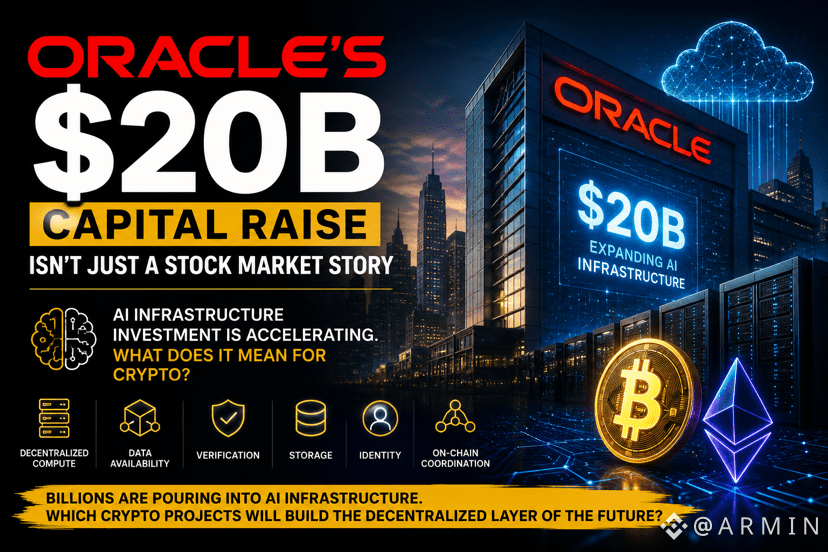
Oracle’s $20B Capital Raise Isn’t Just a Stock Market Story
One trend caught my attention today: Oracle is reportedly raising an additional $20 billion to expand its AI infrastructure.
Most people see this as a traditional finance headline. I think it says something bigger.
Companies don’t commit tens of billions of dollars unless they believe demand will last for years, not months. AI has moved beyond experimentation. The race is now about owning the infrastructure that powers it.
Crypto investors should pay attention because this shift creates opportunities beyond centralized cloud providers.
As AI adoption grows, demand will also grow for decentralized compute, data availability, verification, identity, storage, and on-chain coordination. These are areas where crypto networks are already building.
The next wave of value may not come only from AI applications themselves, but from the infrastructure that enables them to operate securely and at scale.
That’s why I’m spending more time researching projects working at the intersection of AI and blockchain rather than chasing short-term narratives.
When traditional tech is investing billions into infrastructure, it’s worth asking which crypto ecosystems are building the decentralized pieces that could complement that future.
Sometimes the biggest crypto signal doesn’t come from a crypto headline at all.
#OracleFlags$20BAdditionalCapitalRaise
1
2
574
🚀 $20 billion is no small number.
Oracle's latest capital raise announcement has the market talking.
Is this a sign of the next wave of AI infrastructure investment?
Share your thoughts below. 👇 #OracleFlags$20BAdditionalCapitalRaise
🚀 $20 billion is no small number.
Oracle's latest capital raise announcement has the market talking.
Is this a sign of the next wave of AI infrastructure investment?
Share your thoughts below. 👇 #OracleFlags$20BAdditionalCapitalRaise
Oracle's latest capital raise announcement has the market talking.
Is this a sign of the next wave of AI infrastructure investment?
Share your thoughts below. 👇 #OracleFlags$20BAdditionalCapitalRaise
1
127

·
--
#OracleFlags$20BAdditionalCapitalRaise
🚀 ORACLE'S $20B AI BET: THE NEXT CRYPTO OPPORTUNITY?
Oracle is raising $20B to expand AI infrastructure, signaling massive long-term confidence in the AI industry.
✅ AI infrastructure investment is accelerating
✅ AI + Blockchain projects could benefit from this trend
✅ Decentralized compute, storage, and data networks may see rising demand
Billions are flowing into AI infrastructure—not speculation. Smart investors are watching the crypto projects building the technology behind the next AI wave.
📊 Trading View: BUY fundamentally strong AI-related crypto projects on pullbacks. Focus on quality projects and avoid chasing hype.'CLICK ON THE BELOW YELLOW COIN TAG TO GO TO DESIRED TRADING PAGE TO GET BENEFIT TRADE"👇👇👇
$ORCL $ORCL.US
#CryptoNewss
{stock_us}(ORCL.US)
{future}(ORCLUSDT)
#OracleFlags$20BAdditionalCapitalRaise
🚀 ORACLE'S $20B AI BET: THE NEXT CRYPTO OPPORTUNITY?
Oracle is raising $20B to expand AI infrastructure, signaling massive long-term confidence in the AI industry.
✅ AI infrastructure investment is accelerating
✅ AI + Blockchain projects could benefit from this trend
✅ Decentralized compute, storage, and data networks may see rising demand
Billions are flowing into AI infrastructure—not speculation. Smart investors are watching the crypto projects building the technology behind the next AI wave.
📊 Trading View: BUY fundamentally strong AI-related crypto projects on pullbacks. Focus on quality projects and avoid chasing hype.'CLICK ON THE BELOW YELLOW COIN TAG TO GO TO DESIRED TRADING PAGE TO GET BENEFIT TRADE"👇👇👇
$ORCL $ORCL.US
#CryptoNewss
3
458

Verified
Article
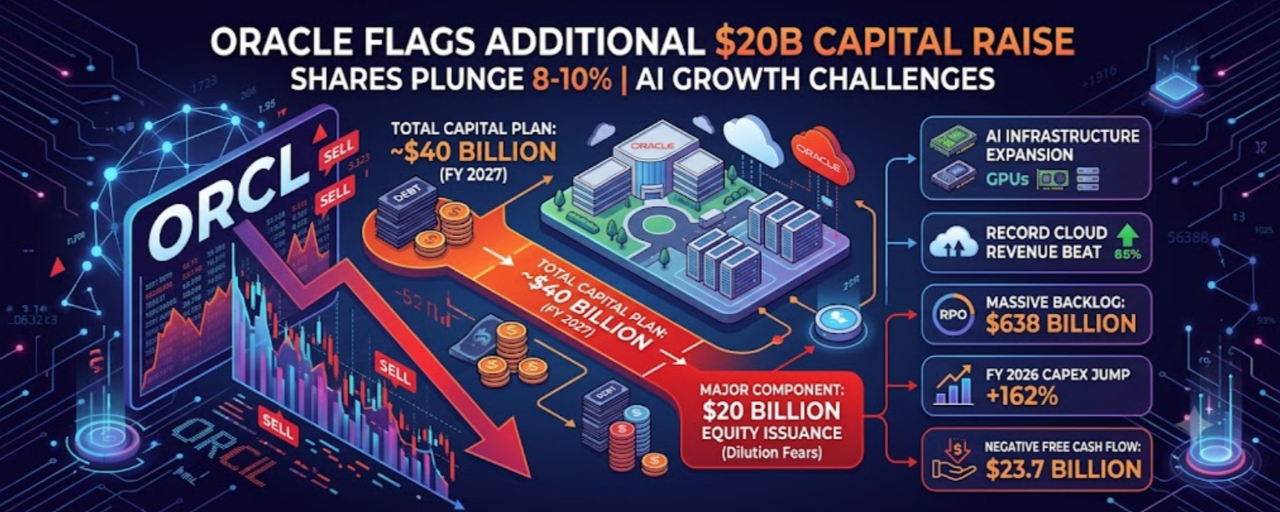
ORACLE PLUNGES DESPITE EARNINGS BEAT: THE $40B CAPITAL RAISE SHOCKER!Tech and macro traders, we have a massive divergence unfolding on the charts for Oracle (NYSE: ORCL). Despite posting record-breaking quarterly results, Oracle shares took an 8% to 10% dive following a shocking forward-looking financial disclosure.
Here is the data-driven breakdown of why Wall Street is hitting the sell button despite a massive AI revenue beat:
📊 The Earnings Beat
On the surface, Oracle’s Q4 Fiscal 2026 numbers were fundamentally spectacular, driven by surging AI infrastructure demand:
Record Revenues: Total Q4 revenue climbed 21% year-over-year to $19.2 billion, easily beating analyst estimates.Cloud Explosion: Cloud Infrastructure (IaaS) revenue skyrocketed by an incredible 93% to $5.8 billion.Massive Backlog: Oracle's Remaining Performance Obligations (RPO)—a key measure of contracted future revenue—ballooned by 363% to a staggering $638 billion.EPS Beat: Non-GAAP earnings per share came in at $2.11, handily beating the $1.96 Wall Street consensus.
⚠️ The Catalyst for the Drop: Severe CapEx & Dilution Fears
If the earnings were stellar, why the sudden selloff? The market was spooked by the sheer cost of keeping up in the AI infrastructure arms race:
The $20B+ Capital Raise: Management announced plans to raise approximately $40 billion in debt and equity financing for fiscal 2027. Crucially, this includes a $20 billion share sale (at-the-market equity issuance), immediately sparking fears of massive shareholder dilution.Burning Cash: To build out its data centers and secure advanced AI hardware, Oracle's capital expenditures jumped 162% to $55.7 billion in FY 2026.Negative Cash Flow: Because of this aggressive spending, the company reported a negative free cash flow of $23.7 billion for the fiscal year.
💡 The Takeaway
Oracle is aggressively transitioning into a foundational AI infrastructure giant, going head-to-head with AWS and Microsoft Azure. However, the market is signaling major concerns about the short-term balance sheet strain and the equity dilution required to fund this $40 billion expansion.
Are you viewing this aggressive drop as a prime buy-the-dip opportunity for long-term AI growth, or is the $20 billion stock dilution keeping you on the sidelines? Let's discuss your strategies below! 👇
#OracleFlags$20BAdditionalCapitalRaise #Velvet #EVAA #LABTokenDrops94%
#LABUSDT
$VELVET
{future}(VELVETUSDT)
$EVAA
{future}(EVAAUSDT)
$SKL
{future}(SKLUSDT)
ORACLE PLUNGES DESPITE EARNINGS BEAT: THE $40B CAPITAL RAISE SHOCKER!
Tech and macro traders, we have a massive divergence unfolding on the charts for Oracle (NYSE: ORCL). Despite posting record-breaking quarterly results, Oracle shares took an 8% to 10% dive following a shocking forward-looking financial disclosure.
Here is the data-driven breakdown of why Wall Street is hitting the sell button despite a massive AI revenue beat:
📊 The Earnings Beat
On the surface, Oracle’s Q4 Fiscal 2026 numbers were fundamentally spectacular, driven by surging AI infrastructure demand:
Record Revenues: Total Q4 revenue climbed 21% year-over-year to $19.2 billion, easily beating analyst estimates.Cloud Explosion: Cloud Infrastructure (IaaS) revenue skyrocketed by an incredible 93% to $5.8 billion.Massive Backlog: Oracle's Remaining Performance Obligations (RPO)—a key measure of contracted future revenue—ballooned by 363% to a staggering $638 billion.EPS Beat: Non-GAAP earnings per share came in at $2.11, handily beating the $1.96 Wall Street consensus.
⚠️ The Catalyst for the Drop: Severe CapEx & Dilution Fears
If the earnings were stellar, why the sudden selloff? The market was spooked by the sheer cost of keeping up in the AI infrastructure arms race:
The $20B+ Capital Raise: Management announced plans to raise approximately $40 billion in debt and equity financing for fiscal 2027. Crucially, this includes a $20 billion share sale (at-the-market equity issuance), immediately sparking fears of massive shareholder dilution.Burning Cash: To build out its data centers and secure advanced AI hardware, Oracle's capital expenditures jumped 162% to $55.7 billion in FY 2026.Negative Cash Flow: Because of this aggressive spending, the company reported a negative free cash flow of $23.7 billion for the fiscal year.
💡 The Takeaway
Oracle is aggressively transitioning into a foundational AI infrastructure giant, going head-to-head with AWS and Microsoft Azure. However, the market is signaling major concerns about the short-term balance sheet strain and the equity dilution required to fund this $40 billion expansion.
Are you viewing this aggressive drop as a prime buy-the-dip opportunity for long-term AI growth, or is the $20 billion stock dilution keeping you on the sidelines? Let's discuss your strategies below! 👇
#OracleFlags$20BAdditionalCapitalRaise #Velvet #EVAA #LABTokenDrops94%
#LABUSDT
$VELVET
$EVAA
$SKL
4
3
912

·
--
Bullish
#OracleFlags$20BAdditionalCapitalRaise
ORACLE FLAGS MASSIVE $20 BILLION CAPITAL RAISE! 🚀🏢
The global AI data center land grab just reached an entirely new level of financial scale. Tech titan Oracle (ORCL) has officially signaled intentions to raise an astonishing $20 Billion in additional capital to fund its aggressive cloud infrastructure expansion.
If you are trading tech equities, data center infrastructure, or macro liquidity, this is a monumental move. Here is the pro-level breakdown:
⚡ Fueling the Sovereign AI & Cloud Moat
Oracle isn't raising cash out of weakness—it is building an impenetrable infrastructure moat.
Insatiable Data Center Demand: The funds are heavily earmarked for constructing massive, next-generation AI data center clusters equipped with tens of thousands of Nvidia GPUs.Sovereign Cloud Dominance: Oracle is rapidly expanding its footprint in government-specific and localized sovereign cloud regions worldwide, locking in long-term enterprise monopolies.The CAPEX Supercycle: This additional capital highlights that the physical hardware and utility infrastructure requirements for generative AI models are expanding exponentially.
💡 The Big Takeaway for Traders
When a mature, massive tech giant raises an extra $20 Billion, it signals that the monetization runway for AI infrastructure is backed by long-term corporate conviction. This influx of capital will feed directly down the supply chain, serving as a massive bullish catalyst for chipmakers, power grids, and cooling technology providers.
The physical backbone of artificial intelligence remains the highest-conviction trade on Wall Street. 💻✨
Will Oracle's aggressive $20B buildout allow them to overtake legacy cloud giants like AWS and Microsoft Azure? Let's talk strategy below! 👇
#OracleFlags20BAdditionalCapitalRaise #Oracle #TechStocks
104

·
--
Bullish
Verified
#OracleFlags$20BAdditionalCapitalRaise
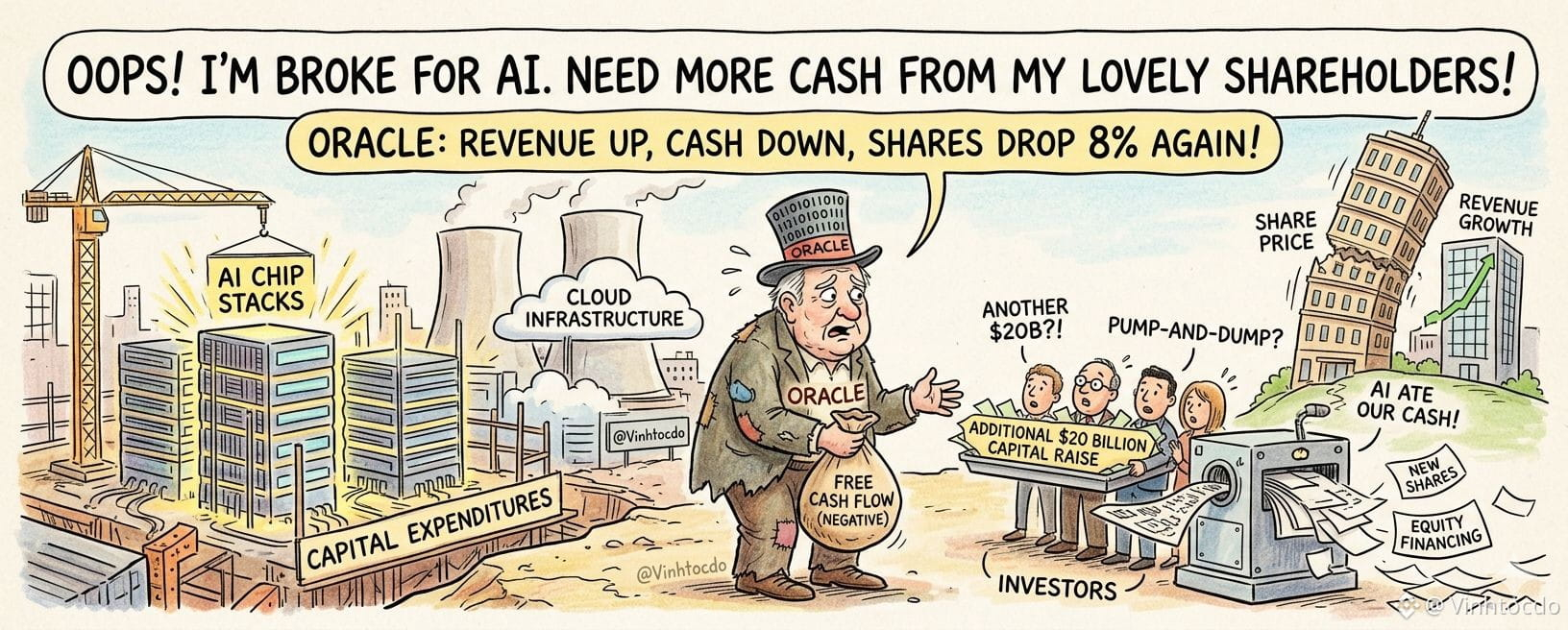
💻 So when the money runs out, do they mobilize "on paper" again, folks? 😎 Uncle Oracle just made a move to raise another $20 billion in equity capital, bringing the total amount of this "asking for money" round to $40 billion, causing the stock to drop immediately by 8%!
Revenue looks great, and the backlog/orders waiting (RPO) reached $63.8 billion, but the unfortunate part is that free cash flow is deeply negative at -$23.7 billion because they burned it all on the AI chip warehouse race. Yep—big tech spending like water; when they run short, they knock on shareholders’ doors for more right away! 💸
What should traders do right now?
Avoid holding long-term Long positions; wait for the stock dilution pressure to pass. If you like swing trading, you can time the bottom when the Cloud money flow rebounds—up 93%.
👉 Register at Binance with code: VINHTOCDO
⚠️ This is not financial advice!
#USstock #Oracle #TradingSignals #VINHTOCDO
$NVDAB
{spot}(NVDABUSDT)
$TSLAB
{spot}(TSLABUSDT)
#OracleFlags$20BAdditionalCapitalRaise
💻 So when the money runs out, do they mobilize "on paper" again, folks? 😎 Uncle Oracle just made a move to raise another $20 billion in equity capital, bringing the total amount of this "asking for money" round to $40 billion, causing the stock to drop immediately by 8%!
Revenue looks great, and the backlog/orders waiting (RPO) reached $63.8 billion, but the unfortunate part is that free cash flow is deeply negative at -$23.7 billion because they burned it all on the AI chip warehouse race. Yep—big tech spending like water; when they run short, they knock on shareholders’ doors for more right away! 💸
What should traders do right now?
Avoid holding long-term Long positions; wait for the stock dilution pressure to pass. If you like swing trading, you can time the bottom when the Cloud money flow rebounds—up 93%.
👉 Register at Binance with code: VINHTOCDO
⚠️ This is not financial advice!
#USstock #Oracle #TradingSignals #VINHTOCDO
$NVDAB
$TSLAB
1
217

Situation around Oracle (ORCL)#OracleFlags$20BAdditionalCapitalRaise
This is one of the hottest and most discussed topics on Wall Street right now. The situation around Oracle (ORCL) looks like a classic "two-edged sword"—huge upside against a daunting debt burden.
If you break everything down point by point, here's what’s happening:
1. What’s the essence of this Capital Raise?
Situation around Oracle (ORCL)
#OracleFlags$20BAdditionalCapitalRaise
This is one of the hottest and most discussed topics on Wall Street right now. The situation around Oracle (ORCL) looks like a classic "two-edged sword"—huge upside against a daunting debt burden.
If you break everything down point by point, here's what’s happening:
1. What’s the essence of this Capital Raise?
1
7
337

·
--
Bullish
#OracleFlags$20BAdditionalCapitalRaise
On July 9, S&P downgraded $ORCL to BBB- (one notch above junk), citing balance sheet strain from its AI infrastructure buildout. The stock still closed +2.65% .
{future}(ORCLUSDT)
Oracle is raising $40B+ this year — including $20B in new equity — to fund FY2027 CapEx of $90B–$95B . The result is a projected -$42B free cash flow deficit and 4x adjusted leverage , with total debt reaching ~$167B. OpenAI alone accounts for ~50% of the $638B backlog .
The bull case: $638B RPO will eventually convert into cash flows. Cloud revenue grew 47% YoY, OCI surged 93%. The market is betting Oracle becomes the fourth hyperscaler.
The risk: bond spreads already widened from 1.75pp to 1.84pp. If AI demand softens, Oracle carries the heaviest leverage in tech.
Bottom line: Napoleonic bet. The FY2027 earnings will tell us if the backlog justifies the debt.
Disclaimer: Not financial advice.
#MicronPostsRecord84.9%GrossMargin #MetaLaunchesPaidAIModelMuseSpark1.1 #SKHynixIPOBankFeesTop$140M #KRXHaltsKOSDAQProgramBuyingFor5Min
#OracleFlags$20BAdditionalCapitalRaise
On July 9, S&P downgraded $ORCL to BBB- (one notch above junk), citing balance sheet strain from its AI infrastructure buildout. The stock still closed +2.65% .
Oracle is raising $40B+ this year — including $20B in new equity — to fund FY2027 CapEx of $90B–$95B . The result is a projected -$42B free cash flow deficit and 4x adjusted leverage , with total debt reaching ~$167B. OpenAI alone accounts for ~50% of the $638B backlog .
The bull case: $638B RPO will eventually convert into cash flows. Cloud revenue grew 47% YoY, OCI surged 93%. The market is betting Oracle becomes the fourth hyperscaler.
The risk: bond spreads already widened from 1.75pp to 1.84pp. If AI demand softens, Oracle carries the heaviest leverage in tech.
Bottom line: Napoleonic bet. The FY2027 earnings will tell us if the backlog justifies the debt.
Disclaimer: Not financial advice.
#MicronPostsRecord84.9%GrossMargin #MetaLaunchesPaidAIModelMuseSpark1.1 #SKHynixIPOBankFeesTop$140M #KRXHaltsKOSDAQProgramBuyingFor5Min
1
123
📈 Big headline: Oracle flags a $20B capital raise.
Strong companies often raise capital to support future growth and expansion.
What impact could this have on the AI industry? #OracleFlags$20BAdditionalCapitalRaise
📈 Big headline: Oracle flags a $20B capital raise.
Strong companies often raise capital to support future growth and expansion.
What impact could this have on the AI industry? #OracleFlags$20BAdditionalCapitalRaise
Strong companies often raise capital to support future growth and expansion.
What impact could this have on the AI industry? #OracleFlags$20BAdditionalCapitalRaise
1
111
💰 Oracle is seeking an additional $20B in funding.
Capital raises can reshape a company's future—but understanding why matters more than reacting to headlines.
📚 Always research before making investment decisions. #OracleFlags$20BAdditionalCapitalRaise
💰 Oracle is seeking an additional $20B in funding.
Capital raises can reshape a company's future—but understanding why matters more than reacting to headlines.
📚 Always research before making investment decisions. #OracleFlags$20BAdditionalCapitalRaise
Capital raises can reshape a company's future—but understanding why matters more than reacting to headlines.
📚 Always research before making investment decisions. #OracleFlags$20BAdditionalCapitalRaise
1
55

·
--
Verified
#OracleFlags$20BAdditionalCapitalRaise 🚨 Oracle Stock Just Crashed. Should Investors Be Worried About Oracle Stock?
Oracle, the company with the stock symbol ORCL did something that surprised Wall Street.
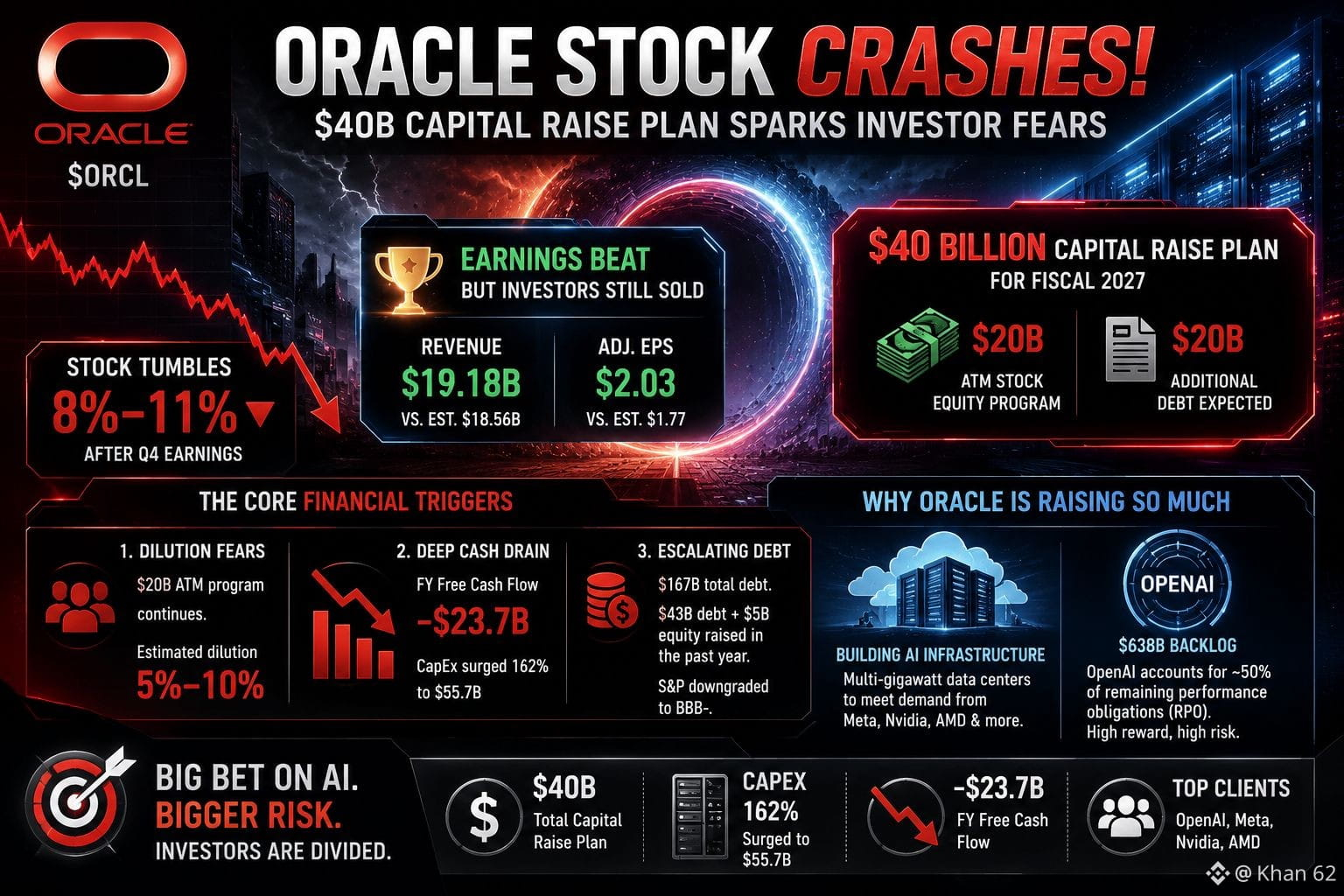
Even though Oracle made money than people thought it would the price of Oracle stock went down by 8 to 11 percent. This happened after Oracle said it was going to borrow $40 billion to pay for its plans to get into Artificial Intelligence or Oracles AI expansion.
Here are some reasons why the market did not like this news about Oracle:
🔹 Oracle might issue $20 billion in stock which could mean that the stock people already own is not worth as much and this could hurt existing shareholders of Oracle.
🔹 Oracle is spending a lot of money on its Artificial Intelligence data centers so it does not have as much free cash flow as it used to and this free cash flow is now deeply negative.
🔹 Oracles debt is getting bigger and this is making people worried about the financial health of Oracle and its balance sheet.
👀 So why is Oracle borrowing much money for its AI expansion?
Oracle wants to make its Artificial Intelligence cloud better because a lot of companies like OpenAI, Meta, Nvidia and AMD want to use it.
The people in charge of Oracle think that spending money now will help the company grow in the future. Investors are worried about how much it is going to cost Oracle.
This is a decision for Oracle because it has to choose between dealing with problems now or taking a chance that its Artificial Intelligence plans will work out in the long run and this is a classic battle between short term pain and long term Artificial Intelligence opportunity for Oracle.
👀 What do you think about Oracle and its plans for Artificial Intelligence?
Is Oracle making a decision by spending a lot of money on Artificial Intelligence or is the company taking too much of a financial risk with its AI expansion?
👇
#Oracle #AI #Khan62 #crypto
$ORCA $AMD $META
{future}(METAUSDT)
{future}(AMDUSDT)
{future}(ORCAUSDT)
#OracleFlags$20BAdditionalCapitalRaise 🚨 Oracle Stock Just Crashed. Should Investors Be Worried About Oracle Stock?
Oracle, the company with the stock symbol ORCL did something that surprised Wall Street.
Even though Oracle made money than people thought it would the price of Oracle stock went down by 8 to 11 percent. This happened after Oracle said it was going to borrow $40 billion to pay for its plans to get into Artificial Intelligence or Oracles AI expansion.
Here are some reasons why the market did not like this news about Oracle:
🔹 Oracle might issue $20 billion in stock which could mean that the stock people already own is not worth as much and this could hurt existing shareholders of Oracle.
🔹 Oracle is spending a lot of money on its Artificial Intelligence data centers so it does not have as much free cash flow as it used to and this free cash flow is now deeply negative.
🔹 Oracles debt is getting bigger and this is making people worried about the financial health of Oracle and its balance sheet.
👀 So why is Oracle borrowing much money for its AI expansion?
Oracle wants to make its Artificial Intelligence cloud better because a lot of companies like OpenAI, Meta, Nvidia and AMD want to use it.
The people in charge of Oracle think that spending money now will help the company grow in the future. Investors are worried about how much it is going to cost Oracle.
This is a decision for Oracle because it has to choose between dealing with problems now or taking a chance that its Artificial Intelligence plans will work out in the long run and this is a classic battle between short term pain and long term Artificial Intelligence opportunity for Oracle.
👀 What do you think about Oracle and its plans for Artificial Intelligence?
Is Oracle making a decision by spending a lot of money on Artificial Intelligence or is the company taking too much of a financial risk with its AI expansion?
👇
#Oracle #AI #Khan62 #crypto
$ORCA $AMD $META
1
288
🚨 Oracle plans to raise an additional $20B in capital.
A move of this size often signals major long-term investment plans rather than short-term market noise.
💬 What do you think Oracle is preparing for? #OracleFlags$20BAdditionalCapitalRaise
🚨 Oracle plans to raise an additional $20B in capital.
A move of this size often signals major long-term investment plans rather than short-term market noise.
💬 What do you think Oracle is preparing for? #OracleFlags$20BAdditionalCapitalRaise
A move of this size often signals major long-term investment plans rather than short-term market noise.
💬 What do you think Oracle is preparing for? #OracleFlags$20BAdditionalCapitalRaise
55
Article
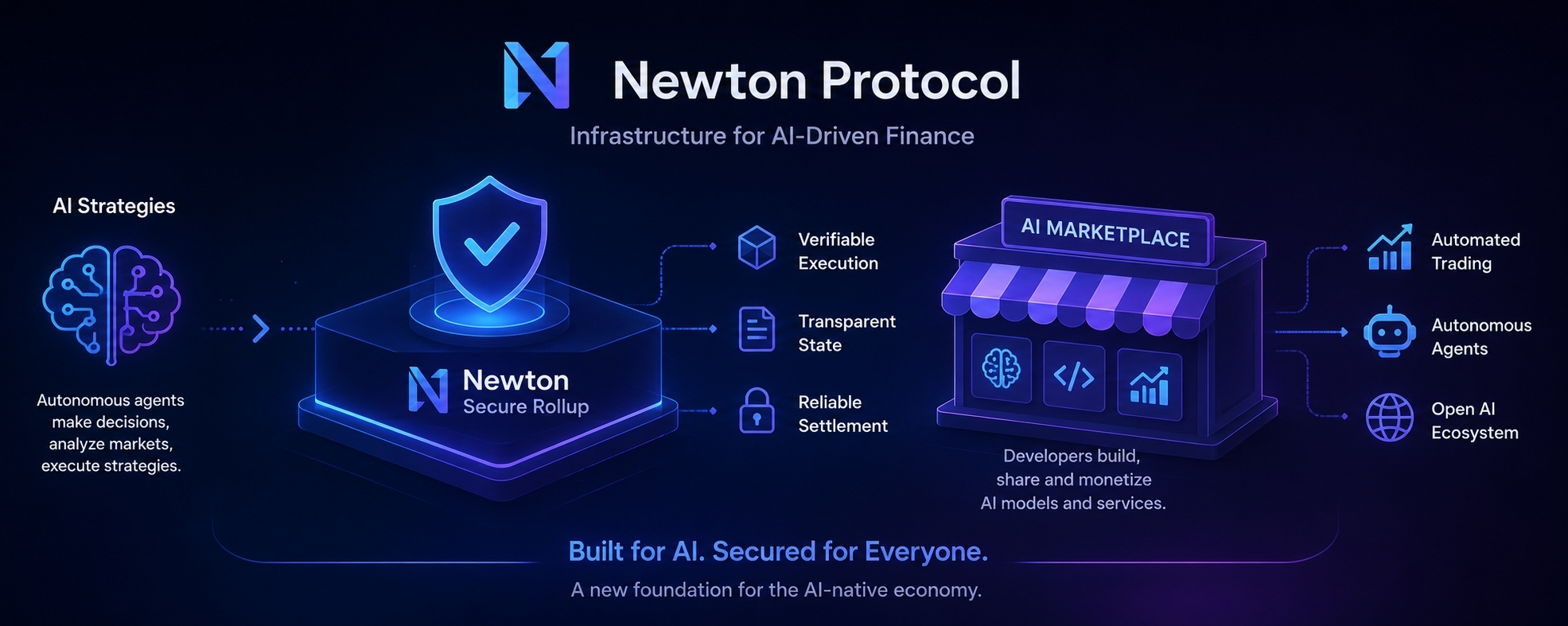
The Quiet Architecture Behind Newton Protocol's Next ChapterMost shifts in crypto do not begin with a headline. They begin with infrastructure that almost nobody notices while everyone is watching prices, narratives, or the latest trend. Newton Protocol feels like one of those stories. The more I looked beyond the surface, the less it resembled another blockchain competing for attention and the more it looked like an attempt to solve a problem that has been slowly growing alongside artificial intelligence itself.
AI is becoming increasingly capable of making decisions without constant human involvement. Trading systems react in milliseconds, autonomous agents negotiate tasks, and software can execute strategies that evolve over time. Yet the underlying environment often remains surprisingly fragile. The harder these systems work, the more difficult it becomes to understand what they did, why they acted, and whether their execution can be trusted.
That is where Newton's direction begins to separate itself.
Rather than treating AI as an isolated application running above a blockchain, Newton is building around the idea that autonomous intelligence needs infrastructure designed specifically for machine-driven activity. A secure rollup is not simply another scaling choice in this context. It becomes a controlled execution environment where AI strategies can operate with predictable settlement, transparent state transitions, and verifiable outcomes.
The distinction may sound technical, but it changes the conversation.
For years, crypto networks focused on helping humans interact with decentralized systems. Wallets, exchanges, governance, and payments were designed around individual users signing transactions. Newton shifts attention toward software becoming an active participant in the economy. If AI agents eventually negotiate, trade, coordinate liquidity, or purchase services independently, the surrounding infrastructure must handle far more than transaction throughput. It must provide confidence that automated decisions remain observable and accountable.
That challenge extends beyond execution.
Newton also introduces the idea of a marketplace for AI developers, a component that could become more significant than it initially appears. Many AI ecosystems struggle because valuable models remain fragmented across private deployments, isolated APIs, or closed platforms. Building a marketplace creates the possibility that developers contribute reusable intelligence rather than repeatedly rebuilding similar systems from scratch.
Success, however, depends on incentives that remain balanced over time. A marketplace without active developers becomes an empty catalog. One without meaningful demand becomes difficult to sustain economically. Newton therefore faces a familiar but difficult question that many blockchain ecosystems encounter: engineering can create possibility, but communities ultimately determine whether that possibility becomes reality.
There is another layer that deserves attention.
Automated trading has become one of the protocol's central themes, yet automation has historically introduced new forms of risk alongside efficiency. Markets increasingly reward speed, but speed alone does not produce resilience. AI-driven strategies require environments that minimize unexpected behavior during execution while remaining resistant to manipulation or inconsistent settlement conditions. Newton's architectural choices suggest that reliability may become just as valuable as raw performance if autonomous financial systems continue expanding.
That emphasis reflects a broader evolution taking place across digital infrastructure. Earlier blockchain cycles often celebrated maximum decentralization without always considering how complex applications would actually operate. Today's discussion feels more practical. Developers increasingly ask whether specialized infrastructure can deliver stronger guarantees for specific workloads instead of expecting one design to solve every problem equally well.
Newton appears to belong to that second generation of thinking.
None of this guarantees adoption. Building sophisticated infrastructure is often easier than attracting the network effects needed to justify it. AI itself is changing rapidly, and protocols built around today's assumptions may need substantial adaptation tomorrow. Regulatory expectations surrounding autonomous financial systems also remain uncertain, particularly as machine-driven execution becomes more common.
Those uncertainties should not be dismissed. They are part of the story rather than exceptions to it.
Still, what stands out is not a dramatic announcement or a single breakthrough. It is the steady accumulation of architectural decisions pointing in one direction. Secure execution, AI-oriented infrastructure, automated strategies, and an ecosystem intended for developers all reinforce the same underlying vision instead of existing as disconnected features.
Crypto has repeatedly shown that lasting influence rarely arrives with the loudest entrance. It grows through systems that quietly become useful before the broader market realizes their significance. Newton Protocol has not yet proven that its model will define the next generation of AI-native finance, but it is assembling the kind of foundation that makes such a future conceivable.
Sometimes the most important transformation is not the one everyone notices first. It is the one already taking shape beneath the surface, waiting for the rest of the industry to catch up.
@NewtonProtocol #Newt $NEWT
$TAC
{alpha}(560x1219c409fabe2c27bd0d1a565daeed9bd9f271de)
$VELVET #OracleFlags$20BAdditionalCapitalRaise #WarshNamesLeadersForFiveFedTaskForces #OpenAILaunchesGPT5.6Family
The Quiet Architecture Behind Newton Protocol's Next Chapter
Most shifts in crypto do not begin with a headline. They begin with infrastructure that almost nobody notices while everyone is watching prices, narratives, or the latest trend. Newton Protocol feels like one of those stories. The more I looked beyond the surface, the less it resembled another blockchain competing for attention and the more it looked like an attempt to solve a problem that has been slowly growing alongside artificial intelligence itself.
AI is becoming increasingly capable of making decisions without constant human involvement. Trading systems react in milliseconds, autonomous agents negotiate tasks, and software can execute strategies that evolve over time. Yet the underlying environment often remains surprisingly fragile. The harder these systems work, the more difficult it becomes to understand what they did, why they acted, and whether their execution can be trusted.
That is where Newton's direction begins to separate itself.
Rather than treating AI as an isolated application running above a blockchain, Newton is building around the idea that autonomous intelligence needs infrastructure designed specifically for machine-driven activity. A secure rollup is not simply another scaling choice in this context. It becomes a controlled execution environment where AI strategies can operate with predictable settlement, transparent state transitions, and verifiable outcomes.
The distinction may sound technical, but it changes the conversation.
For years, crypto networks focused on helping humans interact with decentralized systems. Wallets, exchanges, governance, and payments were designed around individual users signing transactions. Newton shifts attention toward software becoming an active participant in the economy. If AI agents eventually negotiate, trade, coordinate liquidity, or purchase services independently, the surrounding infrastructure must handle far more than transaction throughput. It must provide confidence that automated decisions remain observable and accountable.
That challenge extends beyond execution.
Newton also introduces the idea of a marketplace for AI developers, a component that could become more significant than it initially appears. Many AI ecosystems struggle because valuable models remain fragmented across private deployments, isolated APIs, or closed platforms. Building a marketplace creates the possibility that developers contribute reusable intelligence rather than repeatedly rebuilding similar systems from scratch.
Success, however, depends on incentives that remain balanced over time. A marketplace without active developers becomes an empty catalog. One without meaningful demand becomes difficult to sustain economically. Newton therefore faces a familiar but difficult question that many blockchain ecosystems encounter: engineering can create possibility, but communities ultimately determine whether that possibility becomes reality.
There is another layer that deserves attention.
Automated trading has become one of the protocol's central themes, yet automation has historically introduced new forms of risk alongside efficiency. Markets increasingly reward speed, but speed alone does not produce resilience. AI-driven strategies require environments that minimize unexpected behavior during execution while remaining resistant to manipulation or inconsistent settlement conditions. Newton's architectural choices suggest that reliability may become just as valuable as raw performance if autonomous financial systems continue expanding.
That emphasis reflects a broader evolution taking place across digital infrastructure. Earlier blockchain cycles often celebrated maximum decentralization without always considering how complex applications would actually operate. Today's discussion feels more practical. Developers increasingly ask whether specialized infrastructure can deliver stronger guarantees for specific workloads instead of expecting one design to solve every problem equally well.
Newton appears to belong to that second generation of thinking.
None of this guarantees adoption. Building sophisticated infrastructure is often easier than attracting the network effects needed to justify it. AI itself is changing rapidly, and protocols built around today's assumptions may need substantial adaptation tomorrow. Regulatory expectations surrounding autonomous financial systems also remain uncertain, particularly as machine-driven execution becomes more common.
Those uncertainties should not be dismissed. They are part of the story rather than exceptions to it.
Still, what stands out is not a dramatic announcement or a single breakthrough. It is the steady accumulation of architectural decisions pointing in one direction. Secure execution, AI-oriented infrastructure, automated strategies, and an ecosystem intended for developers all reinforce the same underlying vision instead of existing as disconnected features.
Crypto has repeatedly shown that lasting influence rarely arrives with the loudest entrance. It grows through systems that quietly become useful before the broader market realizes their significance. Newton Protocol has not yet proven that its model will define the next generation of AI-native finance, but it is assembling the kind of foundation that makes such a future conceivable.
Sometimes the most important transformation is not the one everyone notices first. It is the one already taking shape beneath the surface, waiting for the rest of the industry to catch up.
@NewtonProtocol #Newt $NEWT
$TAC
$VELVET #OracleFlags$20BAdditionalCapitalRaise #WarshNamesLeadersForFiveFedTaskForces #OpenAILaunchesGPT5.6Family
19
14
304


Article
Solana (SOL) Today UpdateWhy the Market Is Watching Solana Closely
Introduction
Solana (SOL) remains one of the most closely watched cryptocurrencies in the digital asset market. Known for its high-speed blockchain, low transaction costs, and growing ecosystem of decentralized applications (dApps), Solana continues to attract developers, investors, and institutions alike. As the crypto market evolves, Solana's performance is increasingly viewed as a key indicator of investor confidence in next-generation blockchain technology.
Strong Network Activity Continues
One of Solana's greatest strengths is its ability to process thousands of transactions per second while keeping fees extremely low. This combination has made it a preferred blockchain for decentralized finance (DeFi), NFT platforms, blockchain gaming, and payment applications.
Daily transaction volumes remain strong, and developer activity continues to expand, demonstrating that the network is being used for more than speculation. New projects launching on Solana are helping strengthen its long-term ecosystem.
Investor Sentiment
Market participants remain cautiously optimistic about Solana. While the cryptocurrency market continues to experience price fluctuations, many investors believe Solana has the potential to benefit from the next major crypto growth cycle.
Institutional interest has also increased as professional investors look beyond Bitcoin and Ethereum for high-growth blockchain platforms. Solana's scalability and improving infrastructure have made it one of the leading alternatives.
Ecosystem Expansion
The Solana ecosystem continues to grow across several sectors:
Decentralized Finance (DeFi)
NFT marketplaces
Blockchain gaming
Artificial Intelligence (AI) integrations
Stablecoin payment systems
Real-world asset tokenization
This diversification reduces dependence on a single industry and creates multiple opportunities for long-term adoption.
Technology Advantages
Solana offers several technical advantages over many competing blockchains:
Extremely fast transaction speeds
Very low transaction fees
High network throughput
Energy-efficient Proof-of-Stake consensus
Growing developer community
Expanding validator network
These strengths continue to attract startups and established blockchain companies looking for scalable infrastructure.
Market Outlook
Analysts believe Solana's future performance will depend on several important factors:
Overall cryptocurrency market direction
Continued ecosystem development
Institutional adoption
Regulatory developments
Network stability and security improvements
If these factors remain favorable, Solana could continue strengthening its position among the world's leading blockchain networks.
Risks to Watch
Despite its strong fundamentals, investors should remain aware of potential risks:
Crypto market volatility
Regulatory uncertainty
Competition from other Layer-1 blockchains
Macroeconomic conditions affecting investor sentiment
Long-term success will depend on sustained innovation and continued user adoption.
Conclusion
Solana remains one of the most innovative blockchain platforms in the cryptocurrency industry. Its combination of speed, affordability, and ecosystem growth continues to attract developers, businesses, and investors worldwide. Although short-term price movements may remain unpredictable, Solana's expanding real-world utility and active community position it as one of the most promising digital assets for the years ahead.
As the blockchain industry continues to mature, Solana is expected to remain a major player, making it a cryptocurrency worth watching closely in today's rapidly evolving digital economy.
#SKHynixIPOBankFeesTop$140M #SKHynixADRBiggestForeignCorporateFundraising #OpenAILaunchesGPT5.6Family #SKHynixIPOBankFeesTop$140M #SKHynixADRBiggestForeignCorporateFundraising #UPSFedExFallOnAmazonShippingThreat #SKHynixIPOBankFeesTop$140M #OracleFlags$20BAdditionalCapitalRaise
Solana (SOL) Today Update
Why the Market Is Watching Solana Closely
Introduction
Solana (SOL) remains one of the most closely watched cryptocurrencies in the digital asset market. Known for its high-speed blockchain, low transaction costs, and growing ecosystem of decentralized applications (dApps), Solana continues to attract developers, investors, and institutions alike. As the crypto market evolves, Solana's performance is increasingly viewed as a key indicator of investor confidence in next-generation blockchain technology.
Strong Network Activity Continues
One of Solana's greatest strengths is its ability to process thousands of transactions per second while keeping fees extremely low. This combination has made it a preferred blockchain for decentralized finance (DeFi), NFT platforms, blockchain gaming, and payment applications.
Daily transaction volumes remain strong, and developer activity continues to expand, demonstrating that the network is being used for more than speculation. New projects launching on Solana are helping strengthen its long-term ecosystem.
Investor Sentiment
Market participants remain cautiously optimistic about Solana. While the cryptocurrency market continues to experience price fluctuations, many investors believe Solana has the potential to benefit from the next major crypto growth cycle.
Institutional interest has also increased as professional investors look beyond Bitcoin and Ethereum for high-growth blockchain platforms. Solana's scalability and improving infrastructure have made it one of the leading alternatives.
Ecosystem Expansion
The Solana ecosystem continues to grow across several sectors:
Decentralized Finance (DeFi)
NFT marketplaces
Blockchain gaming
Artificial Intelligence (AI) integrations
Stablecoin payment systems
Real-world asset tokenization
This diversification reduces dependence on a single industry and creates multiple opportunities for long-term adoption.
Technology Advantages
Solana offers several technical advantages over many competing blockchains:
Extremely fast transaction speeds
Very low transaction fees
High network throughput
Energy-efficient Proof-of-Stake consensus
Growing developer community
Expanding validator network
These strengths continue to attract startups and established blockchain companies looking for scalable infrastructure.
Market Outlook
Analysts believe Solana's future performance will depend on several important factors:
Overall cryptocurrency market direction
Continued ecosystem development
Institutional adoption
Regulatory developments
Network stability and security improvements
If these factors remain favorable, Solana could continue strengthening its position among the world's leading blockchain networks.
Risks to Watch
Despite its strong fundamentals, investors should remain aware of potential risks:
Crypto market volatility
Regulatory uncertainty
Competition from other Layer-1 blockchains
Macroeconomic conditions affecting investor sentiment
Long-term success will depend on sustained innovation and continued user adoption.
Conclusion
Solana remains one of the most innovative blockchain platforms in the cryptocurrency industry. Its combination of speed, affordability, and ecosystem growth continues to attract developers, businesses, and investors worldwide. Although short-term price movements may remain unpredictable, Solana's expanding real-world utility and active community position it as one of the most promising digital assets for the years ahead.
As the blockchain industry continues to mature, Solana is expected to remain a major player, making it a cryptocurrency worth watching closely in today's rapidly evolving digital economy.
#SKHynixIPOBankFeesTop$140M #SKHynixADRBiggestForeignCorporateFundraising #OpenAILaunchesGPT5.6Family #SKHynixIPOBankFeesTop$140M #SKHynixADRBiggestForeignCorporateFundraising #UPSFedExFallOnAmazonShippingThreat #SKHynixIPOBankFeesTop$140M #OracleFlags$20BAdditionalCapitalRaise
1
101

BNB Coin Maintains Strong Market Presence as Ecosystem Continues to GrowBNB Coin continues to demonstrate strong momentum as one of the leading digital assets in the cryptocurrency market. Backed by the expanding Binance ecosystem, BNB remains an important utility token used for trading fee discounts, ecosystem services, and various blockchain applications.
The continued growth of the BNB ecosystem, combined with increasing adoption of decentralized applications and blockchain services, has helped maintain investor confidence. Market analysts believe that ongoing network development and ecosystem expansion could further strengthen BNB's long-term value.
As the cryptocurrency industry evolves, BNB continues to play a key role in supporting innovation across decentralized finance (DeFi), Web3, and blockchain technology, making it one of the most closely watched digital assets in the market.
Disclaimer: This article is for informational purposes only and should not be considered financial or investment advice. Always do your own research before investing in cryptocurrencies.
#OracleFlags$20BAdditionalCapitalRaise #OpenAILaunchesGPT5.6Family #UPSFedExFallOnAmazonShippingThreat
$BNB
{future}(BNBUSDT)
$BNB
BNB Coin Maintains Strong Market Presence as Ecosystem Continues to Grow
BNB Coin continues to demonstrate strong momentum as one of the leading digital assets in the cryptocurrency market. Backed by the expanding Binance ecosystem, BNB remains an important utility token used for trading fee discounts, ecosystem services, and various blockchain applications.
The continued growth of the BNB ecosystem, combined with increasing adoption of decentralized applications and blockchain services, has helped maintain investor confidence. Market analysts believe that ongoing network development and ecosystem expansion could further strengthen BNB's long-term value.
As the cryptocurrency industry evolves, BNB continues to play a key role in supporting innovation across decentralized finance (DeFi), Web3, and blockchain technology, making it one of the most closely watched digital assets in the market.
Disclaimer: This article is for informational purposes only and should not be considered financial or investment advice. Always do your own research before investing in cryptocurrencies.
#OracleFlags$20BAdditionalCapitalRaise #OpenAILaunchesGPT5.6Family #UPSFedExFallOnAmazonShippingThreat
$BNB
$BNB
107

Article
Today Update of BTCBulls Defend Momentum as the Market Awaits the Next Big Breakout
Introduction
Bitcoin (BTC), the world's largest cryptocurrency, continues to dominate global financial headlines as investors closely monitor its next move. Following months of strong institutional demand and increasing mainstream adoption, Bitcoin remains one of the most watched assets in both traditional finance and the digital economy.
While price movements have recently become more measured, market sentiment remains optimistic. Traders are focusing on macroeconomic developments, central bank policies, institutional inflows, and blockchain activity to determine whether Bitcoin is preparing for another major rally or entering a period of consolidation.
Market Overview
Bitcoin is currently trading within a key technical range after experiencing significant volatility earlier in the year. Rather than showing signs of panic, the market is displaying patience as buyers and sellers compete for control.
Long-term investors continue accumulating Bitcoin, while short-term traders are waiting for a decisive breakout above resistance or a breakdown below support. This balanced environment often precedes large price movements, making the coming weeks especially important.
Institutional Investors Continue to Strengthen Bitcoin
One of Bitcoin's strongest long-term advantages remains growing institutional participation. Investment firms, hedge funds, asset managers, and publicly traded companies continue treating Bitcoin as a strategic digital asset.
Institutional demand has helped reduce market uncertainty by providing steady buying pressure. Unlike previous market cycles driven mainly by retail speculation, today's Bitcoin market is increasingly influenced by professional investors with longer investment horizons.
Global Economic Factors Driving Bitcoin
Several macroeconomic developments continue shaping Bitcoin's direction:
Inflation concerns remain important for investors seeking alternative stores of value.
Interest-rate decisions by major central banks influence capital flows into risk assets.
Currency fluctuations encourage some investors to diversify into digital assets.
Global economic uncertainty increases interest in decentralized financial systems.
Bitcoin increasingly responds not only to crypto-specific events but also to broader global financial conditions.
Blockchain Activity Remains Healthy
On-chain data continues showing healthy network activity. Long-term holders are maintaining their positions, while Bitcoin's decentralized network remains secure through strong mining participation.
Wallet growth, transaction volume, and network security all indicate that Bitcoin's underlying fundamentals remain solid despite short-term price fluctuations.
Technical Outlook
From a technical perspective, Bitcoin remains in a consolidation phase. Analysts are watching several important signals:
Strong buying interest near key support levels.
Resistance zones where sellers may attempt to limit further gains.
Trading volume that could confirm the next major trend.
Momentum indicators that suggest increasing market activity.
A successful breakout above resistance could attract renewed buying interest, while failure to hold support may trigger temporary selling pressure.
Market Sentiment
Investor sentiment remains cautiously optimistic.
Fear has largely disappeared from the market, but excessive optimism has also cooled. This balanced emotional environment often allows healthier long-term price trends to develop.
Professional investors continue emphasizing disciplined risk management instead of chasing short-term market excitement.
Risks Investors Should Watch
Although Bitcoin's long-term outlook remains positive, several risks could create volatility:
Unexpected regulatory announcements.
Changes in monetary policy.
Global geopolitical tensions.
Large-scale profit-taking by major investors.
Sudden shifts in overall market sentiment.
Volatility remains one of Bitcoin's defining characteristics, making careful investment planning essential.
Future Outlook
Bitcoin continues evolving from a speculative digital asset into an increasingly recognized component of the global financial system. Institutional adoption, expanding blockchain innovation, and growing public awareness continue supporting its long-term potential.
If favorable economic conditions continue and institutional demand remains strong, Bitcoin could maintain its upward trajectory. However, investors should expect periods of consolidation and volatility as part of the market's natural cycle.
Conclusion
Today's Bitcoin market reflects confidence balanced with caution. Strong fundamentals, increasing institutional participation, and healthy blockchain activity continue supporting the world's largest cryptocurrency. While short-term price movements remain uncertain, Bitcoin's long-term narrative as a leading digital asset remains intact.
For investors and market observers alike, the coming weeks could prove pivotal as Bitcoin attempts to establish its next major trend in an ever-evolving global financial landscape.#OracleFlags$20BAdditionalCapitalRaise #MetaLaunchesPaidAIModelMuseSpark1.1 #SKHynixIPOBankFeesTop$140M #SKHynixADRBiggestForeignCorporateFundraising #SKHynixADRBiggestForeignCorporateFundraising #SKHynixIPOBankFeesTop$140M #OpenAILaunchesGPT5.6Family
Today Update of BTC
Bulls Defend Momentum as the Market Awaits the Next Big Breakout
Introduction
Bitcoin (BTC), the world's largest cryptocurrency, continues to dominate global financial headlines as investors closely monitor its next move. Following months of strong institutional demand and increasing mainstream adoption, Bitcoin remains one of the most watched assets in both traditional finance and the digital economy.
While price movements have recently become more measured, market sentiment remains optimistic. Traders are focusing on macroeconomic developments, central bank policies, institutional inflows, and blockchain activity to determine whether Bitcoin is preparing for another major rally or entering a period of consolidation.
Market Overview
Bitcoin is currently trading within a key technical range after experiencing significant volatility earlier in the year. Rather than showing signs of panic, the market is displaying patience as buyers and sellers compete for control.
Long-term investors continue accumulating Bitcoin, while short-term traders are waiting for a decisive breakout above resistance or a breakdown below support. This balanced environment often precedes large price movements, making the coming weeks especially important.
Institutional Investors Continue to Strengthen Bitcoin
One of Bitcoin's strongest long-term advantages remains growing institutional participation. Investment firms, hedge funds, asset managers, and publicly traded companies continue treating Bitcoin as a strategic digital asset.
Institutional demand has helped reduce market uncertainty by providing steady buying pressure. Unlike previous market cycles driven mainly by retail speculation, today's Bitcoin market is increasingly influenced by professional investors with longer investment horizons.
Global Economic Factors Driving Bitcoin
Several macroeconomic developments continue shaping Bitcoin's direction:
Inflation concerns remain important for investors seeking alternative stores of value.
Interest-rate decisions by major central banks influence capital flows into risk assets.
Currency fluctuations encourage some investors to diversify into digital assets.
Global economic uncertainty increases interest in decentralized financial systems.
Bitcoin increasingly responds not only to crypto-specific events but also to broader global financial conditions.
Blockchain Activity Remains Healthy
On-chain data continues showing healthy network activity. Long-term holders are maintaining their positions, while Bitcoin's decentralized network remains secure through strong mining participation.
Wallet growth, transaction volume, and network security all indicate that Bitcoin's underlying fundamentals remain solid despite short-term price fluctuations.
Technical Outlook
From a technical perspective, Bitcoin remains in a consolidation phase. Analysts are watching several important signals:
Strong buying interest near key support levels.
Resistance zones where sellers may attempt to limit further gains.
Trading volume that could confirm the next major trend.
Momentum indicators that suggest increasing market activity.
A successful breakout above resistance could attract renewed buying interest, while failure to hold support may trigger temporary selling pressure.
Market Sentiment
Investor sentiment remains cautiously optimistic.
Fear has largely disappeared from the market, but excessive optimism has also cooled. This balanced emotional environment often allows healthier long-term price trends to develop.
Professional investors continue emphasizing disciplined risk management instead of chasing short-term market excitement.
Risks Investors Should Watch
Although Bitcoin's long-term outlook remains positive, several risks could create volatility:
Unexpected regulatory announcements.
Changes in monetary policy.
Global geopolitical tensions.
Large-scale profit-taking by major investors.
Sudden shifts in overall market sentiment.
Volatility remains one of Bitcoin's defining characteristics, making careful investment planning essential.
Future Outlook
Bitcoin continues evolving from a speculative digital asset into an increasingly recognized component of the global financial system. Institutional adoption, expanding blockchain innovation, and growing public awareness continue supporting its long-term potential.
If favorable economic conditions continue and institutional demand remains strong, Bitcoin could maintain its upward trajectory. However, investors should expect periods of consolidation and volatility as part of the market's natural cycle.
Conclusion
Today's Bitcoin market reflects confidence balanced with caution. Strong fundamentals, increasing institutional participation, and healthy blockchain activity continue supporting the world's largest cryptocurrency. While short-term price movements remain uncertain, Bitcoin's long-term narrative as a leading digital asset remains intact.
For investors and market observers alike, the coming weeks could prove pivotal as Bitcoin attempts to establish its next major trend in an ever-evolving global financial landscape.#OracleFlags$20BAdditionalCapitalRaise #MetaLaunchesPaidAIModelMuseSpark1.1 #SKHynixIPOBankFeesTop$140M #SKHynixADRBiggestForeignCorporateFundraising #SKHynixADRBiggestForeignCorporateFundraising #SKHynixIPOBankFeesTop$140M #OpenAILaunchesGPT5.6Family
1
181
·
--
#metalaunchespaidaimodelmusespark1.1 — Meta's First Paid API Play
On July 9 , Meta launched Muse Spark 1.1 — its first-ever paid AI developer model. Zuckerberg posted on X for the first time in 3 years to announce it. The stock jumped ~4.7% on the day.
{future}(METAUSDT)
The Model
Muse Spark 1.1 is a multimodal reasoning model built for agentic tasks and coding — writing/debugging code, using tools, understanding text/images/video, and executing multi-step workflows. It features a 1M-token context window and is API-compatible with both the OpenAI SDK and Anthropic Messages format. It tops the MCP Atlas benchmark at 88.1 (vs 82.2 for Opus 4.8, 75.3 for GPT-5.5), and leads on professional tool-use benchmarks. However, it's not the coding-accuracy leader — Opus and GPT-5.5 still beat it there.
The Pricing Play
Meta is pricing aggressively: $1.25 per million input tokens and $4.25 per million output tokens — roughly 6x cheaper than GPT-5.5 on output. Every new account gets $20 in free credits. Zuck's strategy: price low, let developers discover the capability, then grow from inference volume.
$META $NVDA.US $AAPL.US #OracleFlags$20BAdditionalCapitalRaise #MicronPostsRecord84.9%GrossMargin #USNaturalGasFallsOver6% #OpenAILaunchesGPT5.6Family
#metalaunchespaidaimodelmusespark1.1 — Meta's First Paid API Play
On July 9 , Meta launched Muse Spark 1.1 — its first-ever paid AI developer model. Zuckerberg posted on X for the first time in 3 years to announce it. The stock jumped ~4.7% on the day.
The Model
Muse Spark 1.1 is a multimodal reasoning model built for agentic tasks and coding — writing/debugging code, using tools, understanding text/images/video, and executing multi-step workflows. It features a 1M-token context window and is API-compatible with both the OpenAI SDK and Anthropic Messages format. It tops the MCP Atlas benchmark at 88.1 (vs 82.2 for Opus 4.8, 75.3 for GPT-5.5), and leads on professional tool-use benchmarks. However, it's not the coding-accuracy leader — Opus and GPT-5.5 still beat it there.
The Pricing Play
Meta is pricing aggressively: $1.25 per million input tokens and $4.25 per million output tokens — roughly 6x cheaper than GPT-5.5 on output. Every new account gets $20 in free credits. Zuck's strategy: price low, let developers discover the capability, then grow from inference volume.
$META $NVDA.US $AAPL.US #OracleFlags$20BAdditionalCapitalRaise #MicronPostsRecord84.9%GrossMargin #USNaturalGasFallsOver6% #OpenAILaunchesGPT5.6Family
1
2.4k

·
--
📈 Learn • Trade • Grow with Binance
💛 Start small, think big, and build your financial future—one$NVDAB $MSFTB $GOOGLB #OracleFlags$20BAdditionalCapitalRaise PKKINDOM
📈 Learn • Trade • Grow with Binance 💛 Start small, think big, and build your financial future—one
1
27

·
--
Article
The Trillion-Dollar BTCFi Illusion: Why Bitcoin L2s Are Fighting a Latency TrapThe market thinks the breakout of BTC into DeFi is a liquidity triumph, but beneath the surface of the Bitcoin L2 expansion, developers are hitting a massive, mathematically unforgiving wall. The popular narrative celebrates native yield and EVM compatibility on Bitcoin, yet the overlooked structural reality is that Bitcoin was architected to be an immutable settlement anchor, not a high-frequency state verifier. By forcing complex execution models onto a 10-minute block architecture, we aren't just scaling Bitcoin—we are pricing the cost of trust.
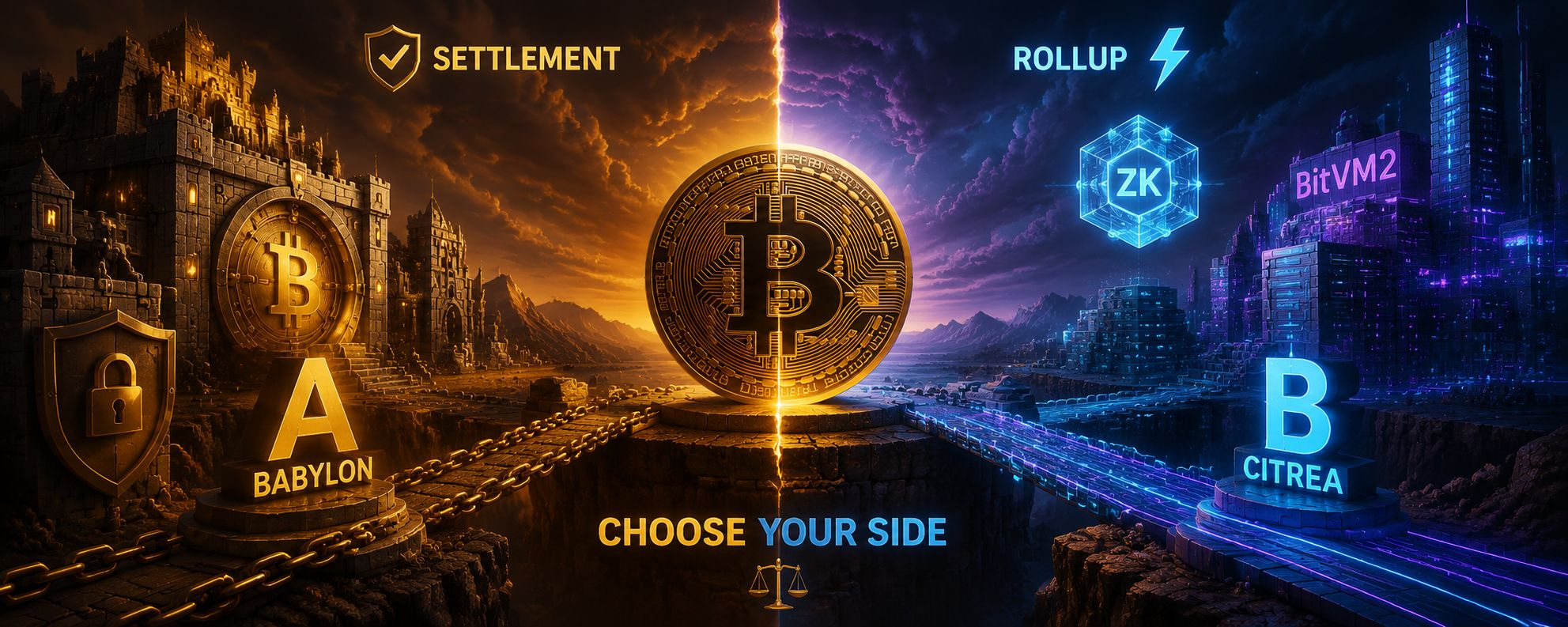
This friction exists because Bitcoin L2s cannot inherit Bitcoin’s security model natively without introducing either extreme operational latency or centralized liveness assumptions. The scaling ecosystem is fundamentally split into two conflicting design architectures, and both demand a brutal security trade-off. On one side, BitVM2 and ZK-Rollups like Citrea attempt trust-minimized optimistic challenge windows via fraud proofs, but they face a severe latency bottleneck where final settlement delays can stretch across multiple L1 blocks to ensure verification correctness. On the other side, script-locked staking protocols like Babylon enforce native UTXO time-locks with cryptographic slashing via Extra-Fast One-Time Signatures (EOTS), but this creates a liveness bottleneck where validator node failures on peripheral Proof-of-Stake networks directly jeopardize pristine base-layer assets.
When you deploy BTC into an advanced ZK-Rollup, the execution happens in a fast, off-chain environment, but the state diffs must be posted directly to Bitcoin L1 for data availability. This creates a paradox where the faster the L2 execution layer runs, the higher the amplification of base-layer congestion. If the transaction fees on Bitcoin L1 spike during high volatility, the cost of submitting a validity proof or processing an optimistic dispute challenge scales exponentially. If an L2 sequencer encounters heavy L1 mempool backlog, the challenge window shrinks, leaving an honest operator with a game-theoretic nightmare: spend ruinous gas fees to force a settlement proof onto the base layer, or let the challenge window expire and risk a systemic capital drain. The asset with the highest monetary premium in human history is being structurally forced to lean on imperfect, time-sensitive coordination layers just to earn a marginal yield, proving that the true victors of the BTCFi era won't be the platforms that promise the highest synthetic APY, but the protocols that successfully balance execution throughput without turning a pristine sovereign asset into an operational liability.
The Trillion-Dollar BTCFi Divide: If you are allocating capital into the Bitcoin ecosystem, where does your loyalty lie? Choose your side and defend it below. 👇
Team A (The Settlement Purists): Lock BTC natively via Babylon script-locks. Keep assets on the home chain and accept PoS slashing risks to preserve absolute L1 finality.
Team B (The Rollup Pragmatists): Route BTC into BitVM2/ZK environments like Citrea. Accept the sequencer liveness dependencies and L1 proof latency to gain full EVM program utility.
$BTC $ETH $XAU #OilTankersGoDarkAsHormuzShippingSlows #IEACutsRussiaOilOutputForecast #LABTokenDrops94% #OracleFlags$20BAdditionalCapitalRaise #MicronPostsRecord84.9%GrossMargin
The Trillion-Dollar BTCFi Illusion: Why Bitcoin L2s Are Fighting a Latency Trap
The market thinks the breakout of BTC into DeFi is a liquidity triumph, but beneath the surface of the Bitcoin L2 expansion, developers are hitting a massive, mathematically unforgiving wall. The popular narrative celebrates native yield and EVM compatibility on Bitcoin, yet the overlooked structural reality is that Bitcoin was architected to be an immutable settlement anchor, not a high-frequency state verifier. By forcing complex execution models onto a 10-minute block architecture, we aren't just scaling Bitcoin—we are pricing the cost of trust.
This friction exists because Bitcoin L2s cannot inherit Bitcoin’s security model natively without introducing either extreme operational latency or centralized liveness assumptions. The scaling ecosystem is fundamentally split into two conflicting design architectures, and both demand a brutal security trade-off. On one side, BitVM2 and ZK-Rollups like Citrea attempt trust-minimized optimistic challenge windows via fraud proofs, but they face a severe latency bottleneck where final settlement delays can stretch across multiple L1 blocks to ensure verification correctness. On the other side, script-locked staking protocols like Babylon enforce native UTXO time-locks with cryptographic slashing via Extra-Fast One-Time Signatures (EOTS), but this creates a liveness bottleneck where validator node failures on peripheral Proof-of-Stake networks directly jeopardize pristine base-layer assets.
When you deploy BTC into an advanced ZK-Rollup, the execution happens in a fast, off-chain environment, but the state diffs must be posted directly to Bitcoin L1 for data availability. This creates a paradox where the faster the L2 execution layer runs, the higher the amplification of base-layer congestion. If the transaction fees on Bitcoin L1 spike during high volatility, the cost of submitting a validity proof or processing an optimistic dispute challenge scales exponentially. If an L2 sequencer encounters heavy L1 mempool backlog, the challenge window shrinks, leaving an honest operator with a game-theoretic nightmare: spend ruinous gas fees to force a settlement proof onto the base layer, or let the challenge window expire and risk a systemic capital drain. The asset with the highest monetary premium in human history is being structurally forced to lean on imperfect, time-sensitive coordination layers just to earn a marginal yield, proving that the true victors of the BTCFi era won't be the platforms that promise the highest synthetic APY, but the protocols that successfully balance execution throughput without turning a pristine sovereign asset into an operational liability.
The Trillion-Dollar BTCFi Divide: If you are allocating capital into the Bitcoin ecosystem, where does your loyalty lie? Choose your side and defend it below. 👇
Team A (The Settlement Purists): Lock BTC natively via Babylon script-locks. Keep assets on the home chain and accept PoS slashing risks to preserve absolute L1 finality.
Team B (The Rollup Pragmatists): Route BTC into BitVM2/ZK environments like Citrea. Accept the sequencer liveness dependencies and L1 proof latency to gain full EVM program utility.
$BTC $ETH $XAU #OilTankersGoDarkAsHormuzShippingSlows #IEACutsRussiaOilOutputForecast #LABTokenDrops94% #OracleFlags$20BAdditionalCapitalRaise #MicronPostsRecord84.9%GrossMargin
2
6
256
Log in to explore more content
Join global crypto users on Binance Square
⚡️ Get latest and useful information about crypto.
💬 Trusted by the world’s largest crypto exchange.
👍 Discover real insights from verified creators.
Email / Phone number
Trending Topics
1
#WillMarketsStageAThanksgivingReliefRally?
72,782 views
1,103 Discussing
2
#WillOctCorePCEShiftFedHikeExpectations?
19,766 views
346 Discussing
3
#BessentSoftensStanceOnHuang’sNvidiaReturn
48,722 views
711 Discussing
4
#EvolveAtBinanceBlockchainWeek
66,171 views
647 Discussing
5
#TrumpBackedAmericanBitcoinRaisesHoldingsToOver8500BTC
0 views
2 Discussing
6
#MuskWarnsOfAICashCrunch
36,212 views
530 Discussing
7
#SkyPSMUSDCLiquidityReboundsTo$1.77B
170 views
6 Discussing
8
#SouthKoreaPlansToReleaseDigitalAssetBasicActDraft
3,969 views
65 Discussing
9
#ChinaKoreaTaiwanPrepareStockRescuesAheadOfMonday
9,000 views
70 Discussing
10
#SouthKoreaToTightenOversightOfCryptoTransfersAbroad
4,504 views
43 Discussing