
#onlinescams
onlinescams
5,749 views
7 Discussing
Hot
Latest

·
--
Article
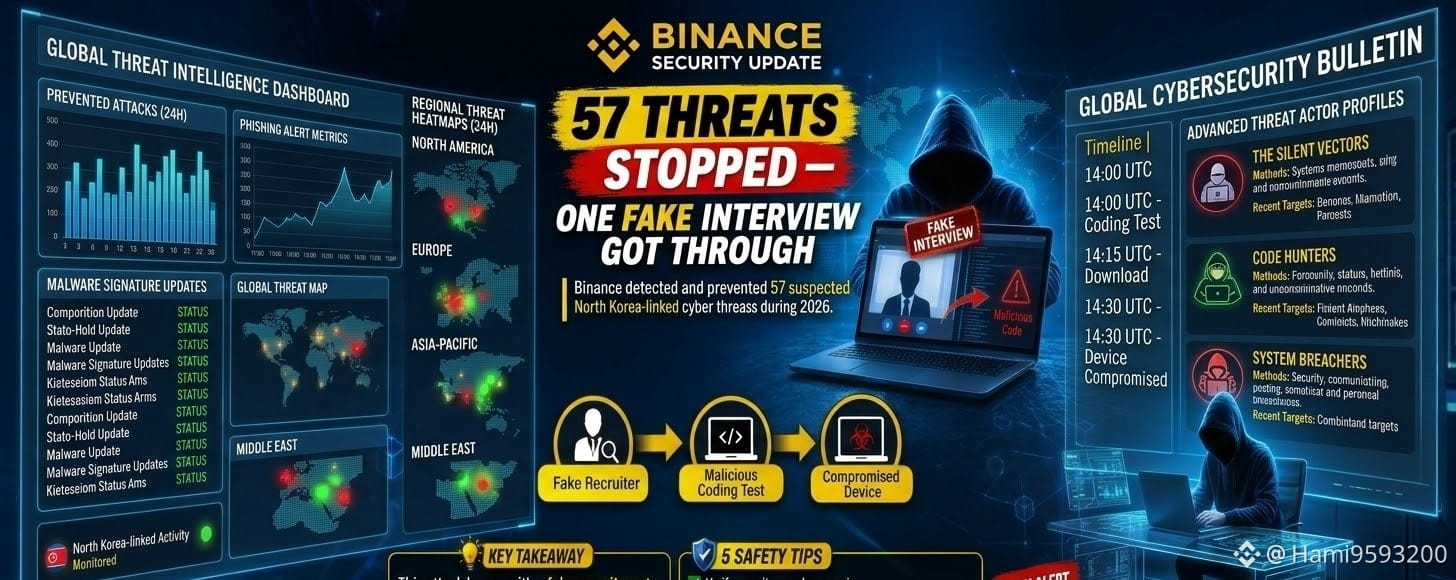
BINANCE STOPPED 57 CYBER THREATS.......! BINANCE STOPPED 57 CYBER THREATS — BUT ONE FAKE JOB INTERVIEW GOT THROUGH!
Binance Security Investigation | November 9, 2026
Cybersecurity has become one of the biggest challenges facing the cryptocurrency industry. A recent security disclosure by Binance has highlighted how even advanced security systems can face serious risks from carefully planned social engineering attacks.
According to Binance, its security team detected and prevented 57 suspected North Korea-linked cyber threat cases during 2026. However, one sophisticated attack managed to compromise an employee through a fake recruitment process.
🔍 How Did the Attack Begin?
The incident reportedly started in September 2026 when a Binance software engineer was contacted through a legitimate job-hunting platform.
The attackers did not immediately send suspicious links. Instead, they built trust through a carefully planned recruitment process.
Here is how the reported attack developed:
1. Fake Recruitment Contact
An individual pretending to be a project director contacted the employee and offered a professional-looking job opportunity.
2. Fake Online Interviews
The attackers arranged multiple interviews. One person acted as an HR representative, while another claimed to be the CEO of a fictional company. They reportedly used convincing social media profiles to appear genuine.
3. Malicious Coding Assignment
During the second interview, the employee was asked to download a coding assignment onto a work computer. The assignment contained malicious code hidden inside a software repository.
4. Malware Infection
When the assignment was set up, malicious code executed on the employee's device. It helped attackers establish unauthorized access and communicate with an external server.
5. Wider Internal Access
According to Binance's investigation, attackers later used compromised devices, stolen credentials and an internal AI tool to reach additional engineering systems connected to wallet infrastructure.
This was not simply a case of someone clicking a suspicious link. It was a multi-stage operation that reportedly involved weeks or months of preparation.
🛡️ Why Is This Incident Important?
The incident demonstrates that cybersecurity is not only about passwords, firewalls or antivirus software. Human behaviour can also become a major security risk.
A fake recruiter can look professional. A video interview can appear genuine. Even a coding assignment may look like a normal part of the hiring process.
That is why employees and organizations must verify every important request before taking action.
5 Cybersecurity Lessons Everyone Should Follow
1. Verify Recruiters: Check the company website, official email address and recruiter's identity.
2. Avoid Unknown Code: Never run unfamiliar scripts or coding assignments on your personal or work computer.
3. Download Carefully: Only install software from trusted and verified sources.
4. Enable 2FA: Use Two-Factor Authentication to add another layer of account protection.
5. Report Suspicious Activity: Inform your company's security team about unusual recruitment messages, files or software requests.
Final Thoughts
Binance's disclosure is a reminder that cybercriminals continuously improve their methods. A trusted-looking job opportunity can become a security threat when the people behind it have malicious intentions.
Whether you work in cryptocurrency, technology, finance or any other industry, online security should always be a priority.
Remember: Never sacrifice your digital security for an opportunity that you have not properly verified.
💬 Question for the Community: Have you ever received a suspicious job offer or interview invitation online? Share your experience and help others stay safe.
#Binance #CyberSecurity #CryptoSafety #OnlineScams #Blockchain
BINANCE STOPPED 57 CYBER THREATS.......!
BINANCE STOPPED 57 CYBER THREATS — BUT ONE FAKE JOB INTERVIEW GOT THROUGH!
Binance Security Investigation | November 9, 2026
Cybersecurity has become one of the biggest challenges facing the cryptocurrency industry. A recent security disclosure by Binance has highlighted how even advanced security systems can face serious risks from carefully planned social engineering attacks.
According to Binance, its security team detected and prevented 57 suspected North Korea-linked cyber threat cases during 2026. However, one sophisticated attack managed to compromise an employee through a fake recruitment process.
🔍 How Did the Attack Begin?
The incident reportedly started in September 2026 when a Binance software engineer was contacted through a legitimate job-hunting platform.
The attackers did not immediately send suspicious links. Instead, they built trust through a carefully planned recruitment process.
Here is how the reported attack developed:
1. Fake Recruitment Contact
An individual pretending to be a project director contacted the employee and offered a professional-looking job opportunity.
2. Fake Online Interviews
The attackers arranged multiple interviews. One person acted as an HR representative, while another claimed to be the CEO of a fictional company. They reportedly used convincing social media profiles to appear genuine.
3. Malicious Coding Assignment
During the second interview, the employee was asked to download a coding assignment onto a work computer. The assignment contained malicious code hidden inside a software repository.
4. Malware Infection
When the assignment was set up, malicious code executed on the employee's device. It helped attackers establish unauthorized access and communicate with an external server.
5. Wider Internal Access
According to Binance's investigation, attackers later used compromised devices, stolen credentials and an internal AI tool to reach additional engineering systems connected to wallet infrastructure.
This was not simply a case of someone clicking a suspicious link. It was a multi-stage operation that reportedly involved weeks or months of preparation.
🛡️ Why Is This Incident Important?
The incident demonstrates that cybersecurity is not only about passwords, firewalls or antivirus software. Human behaviour can also become a major security risk.
A fake recruiter can look professional. A video interview can appear genuine. Even a coding assignment may look like a normal part of the hiring process.
That is why employees and organizations must verify every important request before taking action.
5 Cybersecurity Lessons Everyone Should Follow
1. Verify Recruiters: Check the company website, official email address and recruiter's identity.
2. Avoid Unknown Code: Never run unfamiliar scripts or coding assignments on your personal or work computer.
3. Download Carefully: Only install software from trusted and verified sources.
4. Enable 2FA: Use Two-Factor Authentication to add another layer of account protection.
5. Report Suspicious Activity: Inform your company's security team about unusual recruitment messages, files or software requests.
Final Thoughts
Binance's disclosure is a reminder that cybercriminals continuously improve their methods. A trusted-looking job opportunity can become a security threat when the people behind it have malicious intentions.
Whether you work in cryptocurrency, technology, finance or any other industry, online security should always be a priority.
Remember: Never sacrifice your digital security for an opportunity that you have not properly verified.
💬 Question for the Community: Have you ever received a suspicious job offer or interview invitation online? Share your experience and help others stay safe.
#Binance #CyberSecurity #CryptoSafety #OnlineScams #Blockchain
152
Log in to explore more content
Join global crypto users on Binance Square
⚡️ Get latest and useful information about crypto.
💬 Trusted by the world’s largest crypto exchange.
👍 Discover real insights from verified creators.
Email / Phone number
Trending Topics
1
#CPITestsDecemberRateOutlook
697,994 views
3,140 Discussing
2
#NvidiaInvestigatesAfterHuang’sAffairApology
253,868 views
2,024 Discussing
3
#AnthropicRejectsIPODelayValuationinQuestion
61,616 views
580 Discussing
4
#US-IranTalksFuelStrongStockMarketRebound
7,252 views
109 Discussing
5
#BitcoinFiveWeeklyLosses
279,329 views
2,390 Discussing
6
#AIChipSlumpNasdaq
156,099 views
1,446 Discussing
7
#CryptoLiquidationsReach$1.16BIn24Hours
22,462 views
57 Discussing
8
#StrategyBuys1037BTCLastWeek
4,340 views
60 Discussing
9
#NYSEToUseAvalancheToSettleTokenizedStocks
3,218 views
38 Discussing
10
#TradFiForBeginners
380,692 views
2,682 Discussing