
#monerofalls13
monerofalls13
441 views
20 Discussing
Hot
Latest

·
--
$XMR is about to lose its biggest spot market, yet the Monero blockchain is still running. So what did this week's drop price in?
Short answer: access, not the coin. My read is that traders are pricing fewer places to trade, and the cutoff is still ahead.
The notice, decoded:
- KuCoin said on November 26 it will delist all four XMR spot pairs (USDT, USDC, ETH, BTC) at 08:00 UTC on November 30. Deposits are already closed; withdrawals stay open until December 31, unless KuCoin closes them earlier.
- U.Today, citing CoinMarketCap, says KuCoin's XMR/USDT pair did $73.8M in 24h volume on Thursday, the largest Monero spot market and 47% of XMR spot trading.
- TokenPost had XMR down 12.4% at about $446 by 12:16 p.m. ET Thursday after the announcement. MEXC also delisted XMR earlier this month.
- Per U.Today, the notice did not mention KuCoin's XMR perpetual contract.
Why the headline number is not the whole story:
- Fewer order books means fewer buyers and sellers in one place. Coinpaper notes this could widen spreads, the gap between the best bid and the best ask.
- With deposits shut, coins already on KuCoin can only leave, not arrive.
- The chain itself keeps working. What shrinks is the list of exits.
What I am watching into Sunday:
- XMR spot volume on CoinMarketCap after 08:00 UTC on November 30, once KuCoin's 47% share is gone.
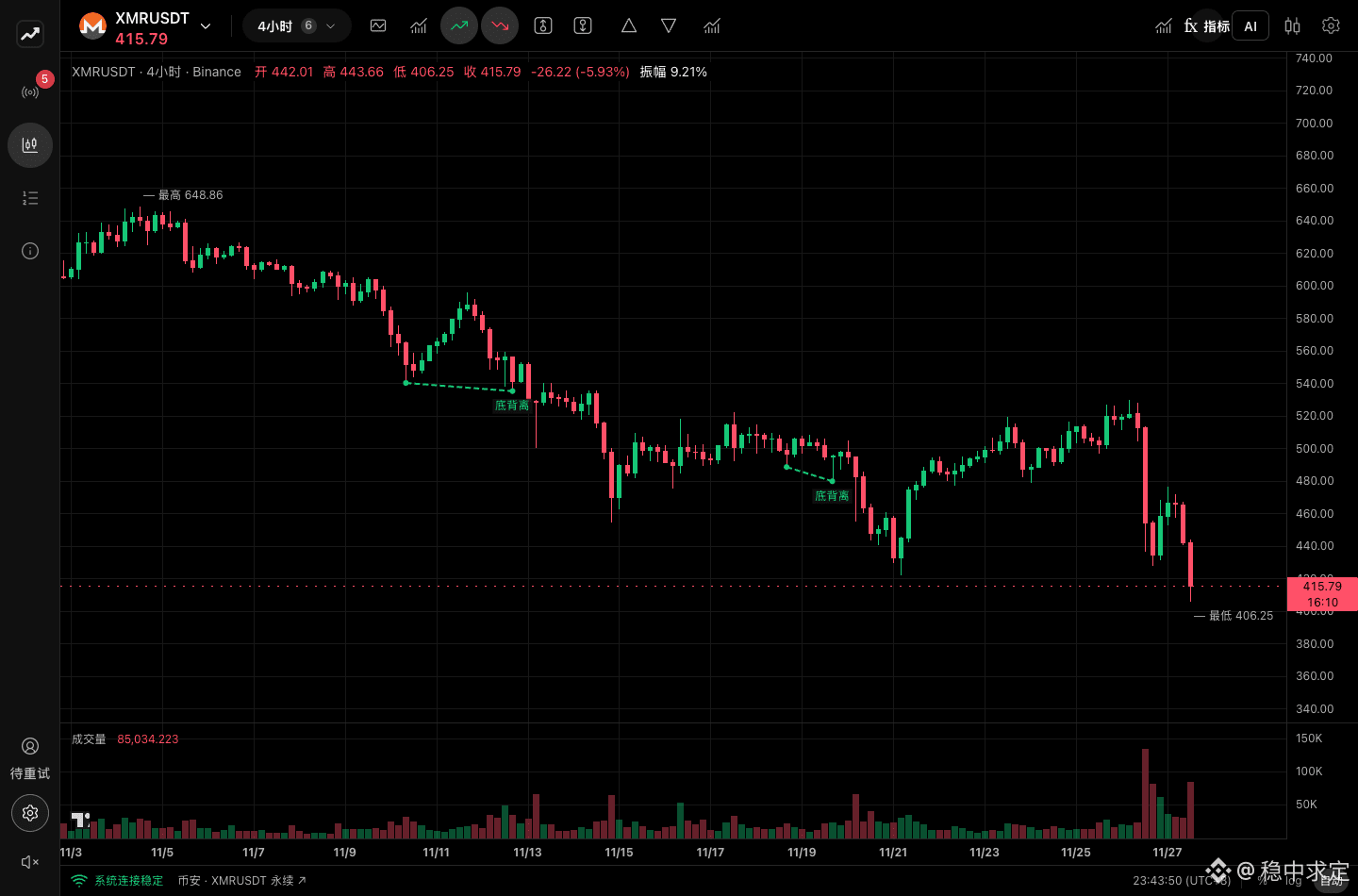
- The XMR perpetual on Binance Futures: 415.65 USDT at 15:33 UTC, -6.9% over the rolling 24h, with a 24h low of 406.25. I am watching whether that low holds through the cutoff.
- Whether KuCoin keeps withdrawals open until December 31.
My rule for delisting news: I read the exit date and the volume share before I read the price.
Follow for a plain-English breakdown of every big crypto story.
#MoneroFalls13%OnDelistings #Write2Earn
When an exchange delists a coin you hold, what do you check first, and why?
181

·
--
Picture this: while everyone was watching $BTC drift through extreme fear, one of the oldest privacy assets quietly dropped over 13% with zero headline warnings.
Most traders treat privacy coins like untouchable counter-cyclical hedges, until they realize how thin order books actually become when exit doors shrink. Getting trapped in an asset where depth evaporates in minutes is an expensive lesson in modern market structure.
What unfolded with $XMR was not an isolated technical breakdown. When macro sentiment sinks and capital consolidates into cash, secondary liquidity on compliance-sensitive assets vanishes first. As surveillance frameworks tighten globally, market makers quietly pulled their spread depth, leaving spot holders absorbing aggressive slippage against $USDT.
The quiet risk going forward is structural isolation. When exchange depth collapses, even modest selling volume triggers violent downswings that look completely disproportionate to the rest of the market. Assuming that protocol utility alone shields an asset from regulatory friction overlooks how fragile execution becomes once primary fiat and stablecoin gateways dry up.
Are privacy protocols facing an inevitable liquidity quarantine, or is the market overreacting to regulatory pressure?
#MoneroFalls13 #ZcashDevelopersUrgeZECMoveToIronwood #SwitzerlandApproves57JurisdictionsForCryptoDataExchange

2

Everyone thinks privacy coins sit outside the panic, but actually $XMR just dropped 13 percent like it was any other risk asset.
The real sting is watching a coin you bought for safety bleed while you freeze, sell into $USDT, or add more without asking why a privacy coin was falling this fast.
Think of Monero like a house with blackout curtains. The curtains hide who lives there. They do not stop the house from catching fire when the whole street is burning. With the Fear and Greed Index at 9, traders are not pricing privacy. They are pricing an exit. Liquidity on $XMR thins out, and the chart still follows $BTC because fear does not care about cryptography.
Three mistakes keep showing up. First, treating untraceable as uncrashable. Second, ignoring how fast the bid disappears when everyone wants cash. Third, calling a 13 percent drop a gift without asking whether this fear has further to run.
Have you been treating privacy coins like a bunker, or are you looking at this the same way you look at everything else right now?
#MoneroFalls13 #CanMarketsReboundAfterThanksgiving #ZcashDevelopersUrgeZECMoveToIronwood

·
--
#MoneroFalls13%OnDelistings
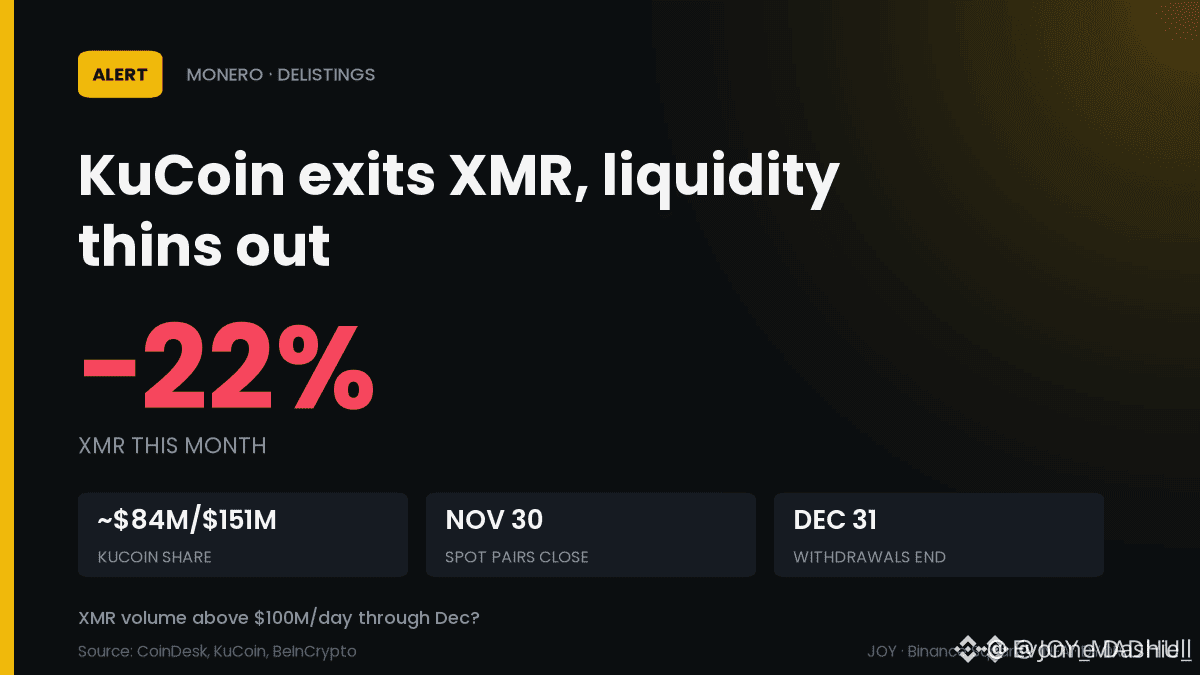
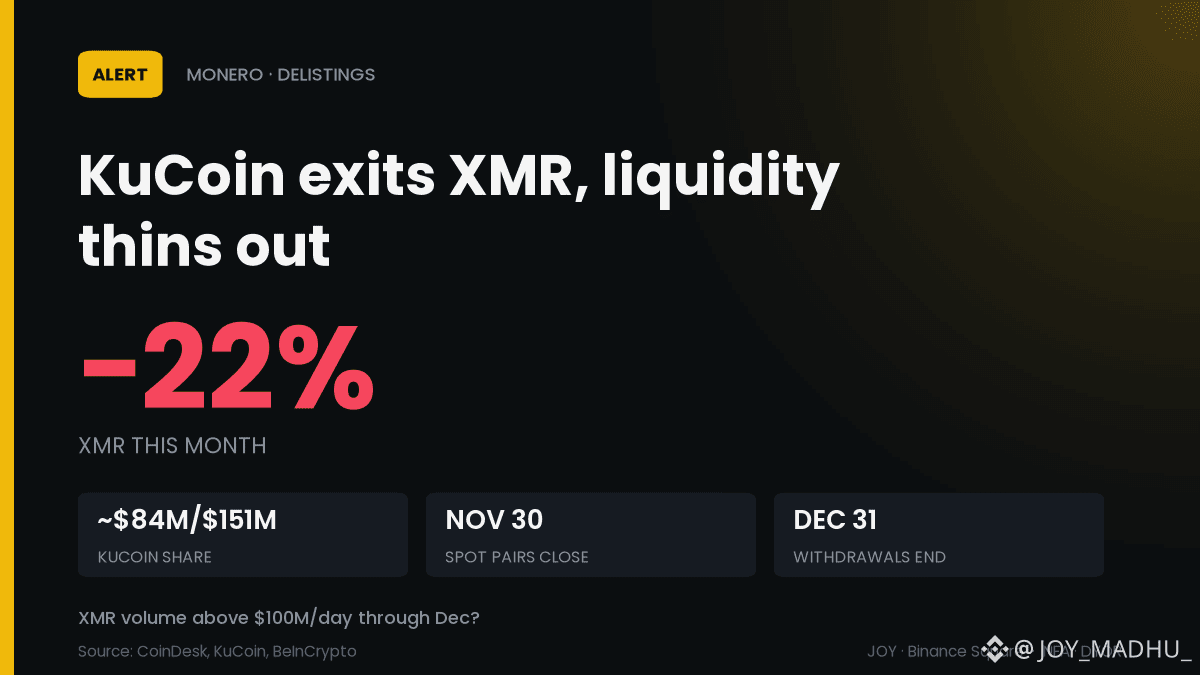
🔒 KuCoin Had Over Half of XMR Volume. It Exits Nov 30.
Monero slid about 13% in a day after KuCoin said it will delist XMR, shrinking one of its last big liquid venues.
📉 XMR down 22% this month, near $464 after a $430 low Thursday
📊 KuCoin's XMR/USDT did ~$84M of ~$151M in daily volume
📅 KuCoin XMR spot pairs close Nov 30; withdrawals end Dec 31
⚠️ MEXC cut XMR Nov 13; Binance and OKX already don't list it
Zoom out: EU AML rules bar anonymity coins on regulated platforms from July 2027.
XMR volume above $100M a day through December, or not? 👇
$XMR
#MoneroFalls13%OnDelistings #Monero #PrivacyCoins
152

·
--
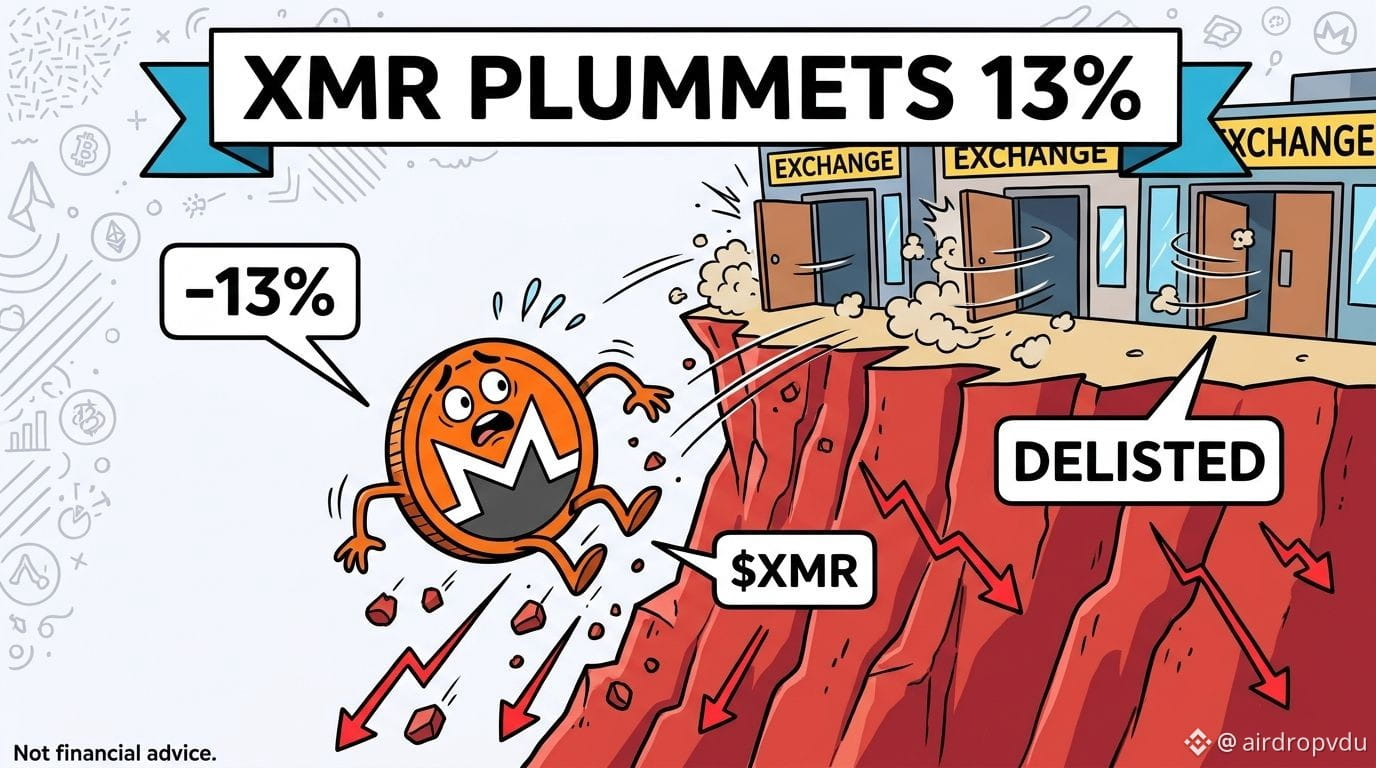
🚨 BREAKING: $XMR PLUMMETS 13% ON DELISTINGS
$XMR crashed 13 percent following major exchange delistings, sparking 60 posts and 2,923 views on Square.
Privacy coins face mounting pressure as platforms pull support.
Is this the end of the privacy era, or a dip to buy?
Not financial advice. DYOR.
#MoneroFalls13%OnDelistings $XMR
$XMR crashed 13 percent following major exchange delistings, sparking 60 posts and 2,923 views on Square.
Privacy coins face mounting pressure as platforms pull support.
Is this the end of the privacy era, or a dip to buy?
Not financial advice. DYOR.
#MoneroFalls13%OnDelistings $XMR
380

·
--
XMR delisting hot-topic follow-up | Collateralized lending risks come before the spot deadline | No bottom-fishing near $400
My view is to manage liquidation risk first and talk about a rebound later. The trending topic currently gaining traction on Binance Square is still #MoneroFalls13%OnDelistings. I previously wrote that KuCoin planned to delist four XMR spot trading pairs at 08:00 UTC on November 30, with withdrawals scheduled to close at the same time on December 31. After checking the official announcement again, I focused on another easily overlooked detail: KuCoin says that starting November 30, XMR will no longer be accepted as collateral for VIP loans, and it advises users who have already pledged XMR to add other supported assets. Otherwise, an excessively high loan-to-value ratio could trigger liquidation. The platform's spot, Earn, convert, trading bot, and collateral features have different timelines and risks, so don't focus only on the final spot trading time. The announcement also states that XMR deposits are currently suspended; the withdrawal deadline does not mean deposits will remain open until then.
Why would a change to collateral rules affect the crypto market? When an asset is removed from the list of eligible collateral, borrowers may need to add collateral, repay their loans, or adjust their positions. When prices are already falling, these forced actions could amplify short-term selling pressure and widen spreads. But the announcement does not disclose how much XMR is being used for loans, so I can't claim that large-scale liquidations have already occurred, nor can I attribute every dollar of the decline to KuCoin. An official announcement from another exchange, MEXC, shows that XMR spot trading there stopped on November 17. This indicates that liquidity exits are contracting at different rates across platforms—not that the entire market is delisting XMR at the same time. Traders should verify deposits and withdrawals, order-book depth, and order-cancellation deadlines on their own platforms rather than shorting in response to a percentage in a trending topic.
Price comparisons also need to use consistent benchmarks. When I checked XMR/USD on Kraken, the price was about $408.6, with a rolling 24-hour open of $456.95, a low of $398.04, and a high of $475.66. Based on that open and the current price, the decline was about 10.6%—not the same calculation window as the 13% in the trending topic. The $398–$400 area is the visible low zone for now. If it breaks and the price cannot quickly recover, there is no price evidence to support the claim that the decline has stabilized. First, watch whether the price can reclaim and hold $425–$430, then look to $440. One bounce does not mean the impact of the delisting has been fully absorbed. If the exchange publishes collateral balance or liquidation data, or changes the timeline, I will reassess based on the new announcement.
If I were trading this myself, I would stay out for now and avoid leveraged shorts. My only directional plan would be a very small spot long after a rebound is confirmed. I would wait until the relevant feature changes are completed on November 30, XMR deposits and withdrawals and spreads are back to normal, and a four-hour close is above $430 followed by a retest that holds $425–$430. Only then would I test the position with at most 0.1% of my total capital. The first target is $440, where I would halve the position; the second target is $456, where I would close the remainder. After entering, I would stop out if a four-hour close falls back below $418. If the price breaks below $398 before that happens, I would cancel the entire plan. Anyone with collateralized loans should first check their collateral eligibility and loan-to-value ratio against the platform's announcement, rather than leaving risk management until after the deadline. These are conditions, not a claim that I have traded or made a profit.
#MoneroFalls13%OnDelistings #XMR
The above is solely my personal market observation and does not constitute investment advice.

4
·
--
XMR Delisting Topic Heats Up | Verify the Basis for the Decline | Preserve Cash, Don’t Chase a Rebound
My stance is not to buy the dip for now, but to first address trading venue and liquidity risks. The exact topic #MoneroFalls13%OnDelistings is currently appearing on Binance Square, but the “13%” in the topic text cannot be applied directly to every exchange or observation window. KuCoin’s official announcement states that trading in four spot pairs—XMR/USDT, XMR/USDC, XMR/ETH, and XMR/BTC—is scheduled to stop at 08:00 UTC on November 30. Deposits will remain closed, and withdrawals are scheduled to close at 08:00 UTC on December 31, with the possibility of these dates being adjusted earlier. Another exchange, MEXC, had already suspended XMR spot trading at 09:00 UTC on November 17, according to its official announcement. The two platforms’ timelines differ. This does not mean that all venues worldwide are delisting XMR at the same time, nor does it mean that the Monero mainnet has stopped operating.
Unlike earlier posts that focused only on the dates, I’m more concerned with how price discovery may change: losing one tradable venue means one fewer cross-platform quote and arbitrage route, while holders moving assets before the deadline could increase short-term flows. But the announcements themselves do not prove that every transfer is a sale, and all same-day declines cannot be attributed solely to the delisting. Spreads, order-book depth, actual deposits and withdrawals, and platform risk controls are more useful for assessing whether a trade can be executed safely than a single percentage in a trending topic’s headline. Users planning to withdraw from affected venues should first verify the address, network status, and the platform’s latest deadlines, to avoid turning an asset transfer into a price-chasing move.
The market reaction is already quite noticeable: at the time of writing, Kraken XMR/USD is around $412.48, with a rolling 24-hour open of $456.95, a low of $405.90, and a high of $475.66. Calculated from the open and current price on this specific order book, the decline is about 9.7%, not the 13% in the trending topic; different starting points, time zones, or exchanges will produce different figures. Around $405 is the current observable short-term low, while around $430 is the first resistance level for recovering the decline. Even if a rebound occurs during a sharp drop, it may simply reflect a brief replenishment of liquidity rather than a return to normal supply and demand. I would not cite recent code review proposals by project developers as the cause of the spot price decline.
If I were trading this myself: I would stay out for now. The only direction I would consider afterward is a leveraged-free spot long, with a position size capped at 0.15% of total assets. The entry trigger would be to wait until after KuCoin spot trading stops on November 30, confirm that deposits, withdrawals, and spreads are normal on a venue that still offers XMR, then wait for a four-hour close above $430 followed by a retest that holds $425–$430. Without these conditions, I would remain in cash. If triggered, I would sell half around $445 and close the remaining position around $460; the initial stop-loss would be set at $414, with an immediate exit if that level breaks. If the price first loses $405.90, or if remaining venues introduce new deposit or withdrawal restrictions, I would withdraw my rebound thesis. Even after entry, if the price falls back below $425 on a four-hour basis, I would close the position proactively. The plan has not yet been triggered; I will not present observation as a completed trade or profit.
Sources: Official delisting announcements from KuCoin and MEXC, public Kraken XMR/USD market data, and the trending topic page on Binance Square. #MoneroFalls13%OnDelistings #XMR
This is solely my personal market observation and does not constitute investment advice.

3

·
--
Privacy coins just split in two — and the market is picking a winner.
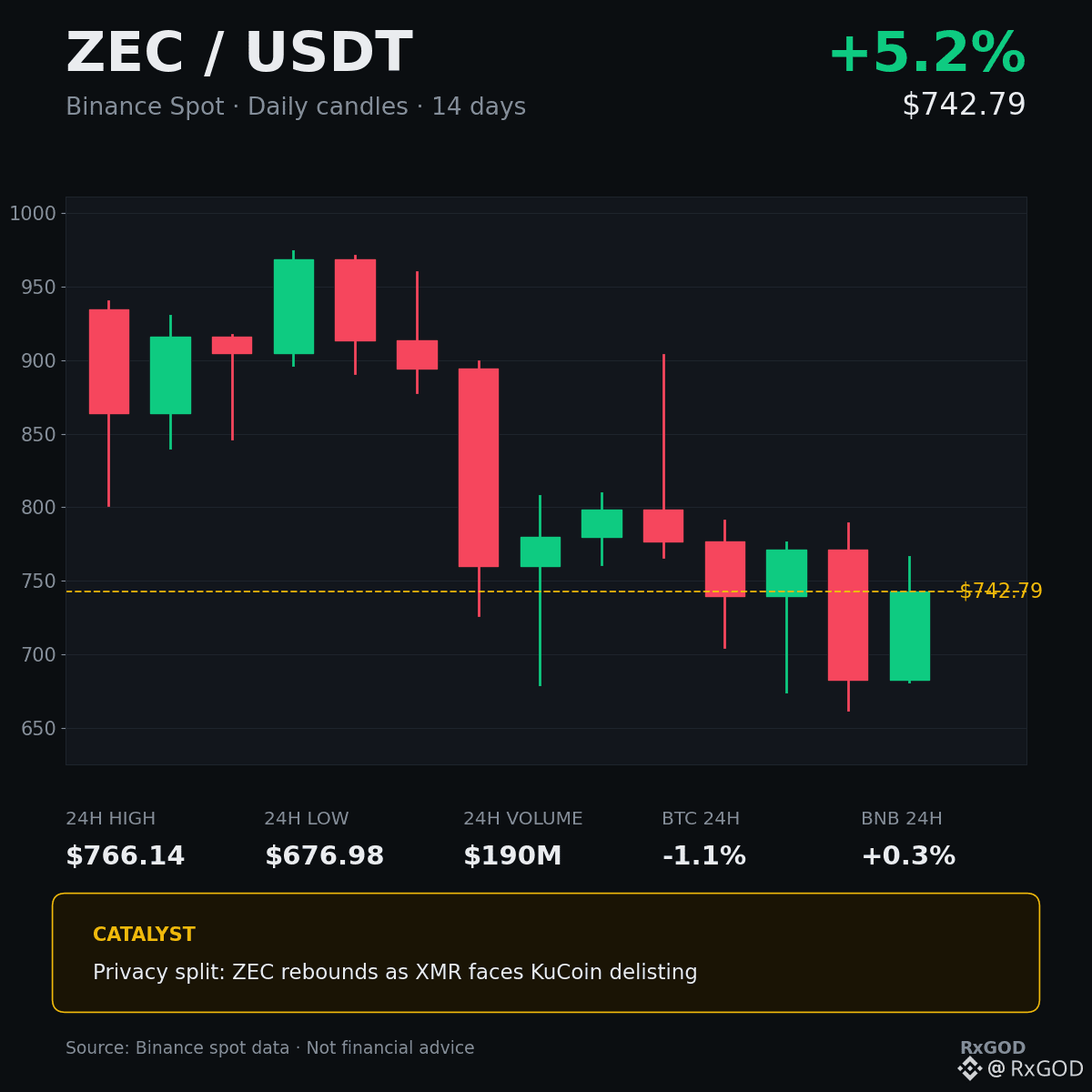
Zcash ($ZEC) is up 5.2% to $742.79 on $190.1M Binance volume, bouncing off a $677 low to an intraday high of $766.14. CoinDesk reports ZEC drew capital inflows for a second straight day, open interest up 7.7% — fresh money, not a short squeeze.
Meanwhile Monero ($XMR) fell 10.5% to ~$450 after KuCoin said it will delist XMR on November 30 — deposits suspended, withdrawals closing December 31. The second major exchange to drop XMR this month after MEXC; XMR slid from ~$625 on November 3.
The dividing line is regulation: from July 10, 2027, EU AML rules bar regulated firms from anonymity-enhancing coins. Grayscale research head Zach Pandl argues Zcash is different: shielding is optional, and view keys let holders disclose transactions to auditors. Grayscale, which launched the first US spot ZEC ETF in August, says its commitment runs "many years to come."
Stay honest, though: the EU definition could still catch optional privacy, developers called to move ~$300M out of the older Sapling pool, and ZEC is still -14.5% in 14 days, -42% in a month, at just 24.5% of its 14-day range. A bounce off the floor, not a breakout — $766 the gate, $677 the floor — while $BTC sits back below $60K at $59,978, -1.0% in 24 hours.
Which privacy model survives — optional shielding with view keys, or is all on-chain privacy on borrowed time? ZEC holds $700 or retests $663 first?
Not financial advice — DYOR.
#MoneroFalls13%OnDelistings #CanMarketsReboundAfterThanksgiving? #ExtremeFear
Privacy coins just split in two — and the market is picking a winner.
Zcash ($ZEC ) is up 5.2% to $742.79 on $190.1M Binance volume, bouncing off a $677 low to an intraday high of $766.14. CoinDesk reports ZEC drew capital inflows for a second straight day, open interest up 7.7% — fresh money, not a short squeeze.
Meanwhile Monero ($XMR ) fell 10.5% to ~$450 after KuCoin said it will delist XMR on November 30 — deposits suspended, withdrawals closing December 31. The second major exchange to drop XMR this month after MEXC; XMR slid from ~$625 on November 3.
The dividing line is regulation: from July 10, 2027, EU AML rules bar regulated firms from anonymity-enhancing coins. Grayscale research head Zach Pandl argues Zcash is different: shielding is optional, and view keys let holders disclose transactions to auditors. Grayscale, which launched the first US spot ZEC ETF in August, says its commitment runs "many years to come."
Stay honest, though: the EU definition could still catch optional privacy, developers called to move ~$300M out of the older Sapling pool, and ZEC is still -14.5% in 14 days, -42% in a month, at just 24.5% of its 14-day range. A bounce off the floor, not a breakout — $766 the gate, $677 the floor — while $BTC sits back below $60K at $59,978, -1.0% in 24 hours.
Which privacy model survives — optional shielding with view keys, or is all on-chain privacy on borrowed time? ZEC holds $700 or retests $663 first?
Not financial advice — DYOR.
#MoneroFalls13%OnDelistings #CanMarketsReboundAfterThanksgiving? #ExtremeFear

·
--
Verified
Article
KuCoin to delist XMR on November 30: Privacy coin liquidity shrinks further, and price moves are about more than the declineKuCoin to delist XMR on November 30: Privacy coin liquidity shrinks further, and price moves are about more than the decline
KuCoin has announced that it will delist four spot trading pairs—XMR/USDT, XMR/USDC, XMR/ETH, and XMR/BTC—at 08:00 UTC on November 30, while also suspending related trading services. The most important thing to watch is not simply how much XMR has fallen, but that centralized exchange liquidity for privacy coins is shrinking further.
First, review the announcement details. KuCoin’s official notice (KuCoin Will Delist Monero (XMR) on 2026-11-30), dated November 26, 2026, also states that XMR deposits have been closed and will not be reopened, and that withdrawals are scheduled to close on December 31 at 08:00 UTC, though they may be closed earlier due to project-related issues. Any remaining assets in accounts may subsequently be converted into stablecoins, but the conversion price is not guaranteed. The schedule and account handling should be confirmed against KuCoin’s original announcement.
KuCoin to delist XMR on November 30: Privacy coin liquidity shrinks further, and price moves are about more than the decline
KuCoin to delist XMR on November 30: Privacy coin liquidity shrinks further, and price moves are about more than the decline
KuCoin has announced that it will delist four spot trading pairs—XMR/USDT, XMR/USDC, XMR/ETH, and XMR/BTC—at 08:00 UTC on November 30, while also suspending related trading services. The most important thing to watch is not simply how much XMR has fallen, but that centralized exchange liquidity for privacy coins is shrinking further.
First, review the announcement details. KuCoin’s official notice (KuCoin Will Delist Monero (XMR) on 2026-11-30), dated November 26, 2026, also states that XMR deposits have been closed and will not be reopened, and that withdrawals are scheduled to close on December 31 at 08:00 UTC, though they may be closed earlier due to project-related issues. Any remaining assets in accounts may subsequently be converted into stablecoins, but the conversion price is not guaranteed. The schedule and account handling should be confirmed against KuCoin’s original announcement.
566

·
--
The feed says what happened to $XMR is the exchange’s fault. False comfort: KuCoin handled nearly half of spot volume and is delisting it on 30/11, and from July 2027 the EU will ban privacy coins on regulated platforms. Privacy without liquidity doesn’t trade. A bottoming-out move or just noise? #MoneroFalls13%OnDelistings
The feed says what happened to $XMR is the exchange’s fault. False comfort: KuCoin handled nearly half of spot volume and is delisting it on 30/11, and from July 2027 the EU will ban privacy coins on regulated platforms. Privacy without liquidity doesn’t trade. A bottoming-out move or just noise? #MoneroFalls13%OnDelistings

1
63
Here's what happened when Switzerland, the old king of financial secrecy, opened the door to crypto data sharing across 57 jurisdictions.
People in this space already struggle with not knowing when governments will change the rules mid-trade. Now the thought of tax authorities getting easier access to wallet activity adds another layer of uncertainty, especially when you're trying not to get wrecked in a fearful market.
This isn't the first time a privacy haven has opened the books. Switzerland's move mirrors what we saw when they finally complied with CRS for regular banking after years of holding out, and it also tracks the US FATCA rollout that sent some capital hunting for new hiding spots. The difference this time is crypto's speed. Information travels faster, so the reaction in $BTC and $USDT pairs could be sharper.
History suggests the initial scare fades. After those earlier reporting expansions, the market didn't die. It just got more institutional. Chains and platforms that leaned into compliance, including several in the $SOL ecosystem, ended up better positioned for the next cycle of inflows.
Where do you think this goes from here?
#SwitzerlandApproves57JurisdictionsForCryptoDataExchange #CanMarketsReboundAfterThanksgiving #MoneroFalls13

·
--
Have you noticed how the country that sold itself as Crypto Valley just volunteered to feed your wallet data to 57 governments?
Traders already sitting through extreme fear and watching $BTC bleed now have to factor in a new reporting layer that could force more selling from anyone who parked coins in a “reputable” jurisdiction. Nobody wants a surprise letter because their exchange or custodian just became a data pipeline.
Switzerland spent years attracting projects and $USDT flows by looking like the professional, grown-up option. That same reputation is now the case study in how fast privacy gets traded away once tax authorities and the OECD apply pressure. Approving automatic crypto data exchange with 57 jurisdictions is not a quiet admin update. It is the surveillance playbook landing in one of the last places people assumed still offered some discretion.
The desks that routed $SOL and other assets through Swiss structures are staring at a regime that maps counterparties, volumes, and wallets. Mainstream voices will call this maturity and legitimacy. I see it as the moment even the so-called safe hubs stop pretending crypto still has any meaningful privacy left.
Where do you think this actually leaves people who were still counting on jurisdiction shopping?
#SwitzerlandApproves57JurisdictionsForCryptoDataExchange #MoneroFalls13 #CanMarketsReboundAfterThanksgiving

·
--
Surging Fed rate-hike expectations and record outflows from Bitcoin ETFs push crypto markets into a critical standoff
I. Macro storm: Probability of a Fed rate hike surges to 93%
Global financial markets have been shrouded in a deepening shadow of monetary tightening this week. According to the latest data from prediction market Kalshi, traders have priced in a 93% probability of the Federal Open Market Committee raising interest rates by 25 basis points on December 9. The U.S. Dollar Index has risen for the third consecutive month. This signal is putting direct pressure on risk assets.
Renowned trader Arthur Hayes warned that unless the Fed sends dovish signals before entering its quiet period, the crypto market could face a wave of selling pressure. Meanwhile, Bitcoin options worth as much as $6.8 billion expire this Wednesday, further amplifying the risk of market volatility. The Bitcoin Fear and Greed Index has now fallen to around 12, deep in the extreme fear zone, while miners are under enormous pressure, with prices about $26,000 below production costs.
II. A major capital shift: Bitcoin ETFs see record net outflows of $5.39 billion in November
Echoing rate-hike expectations, spot Bitcoin ETFs have seen unprecedented capital outflows. As of November 25, U.S. spot Bitcoin ETFs had recorded cumulative net outflows of $5.39 billion for the month, the largest monthly outflow since their launch in January 2024. On Wednesday alone, $453 million flowed out. As a result, Bitcoin briefly fell below $59,000 intraday. Although it rebounded above $61,000, its overall trend remains under pressure.
Notably, Morgan Stanley's Bitcoin trust product bucked the trend and recorded inflows, making it one of the market's few bright spots. This indicates that some traditional financial institutions are still positioning themselves against the trend and remain confident in Bitcoin's long-term value.
III. Whales accumulate against the tide: 121,000 Bitcoin added in Q4
As retail investors flee in panic, on-chain data shows that Bitcoin whales are aggressively buying the dip. Throughout the fourth quarter, whale addresses holding large amounts of Bitcoin added a cumulative 121,117 BTC, completely breaking with the usual fourth-quarter selling pattern of previous years. Abraxas Capital also withdrew around 1,700 BTC from the Kraken exchange and transferred them to cold wallets.
On-chain indicators further confirm the market's extreme conditions: Bitcoin's supply in profit-to-loss ratio has fallen to its lowest level in 11 years, meaning the vast majority of holders are sitting on losses. However, historical experience suggests that extreme fear often coincides with important market bottoms. Whales accumulating against the trend is a clear demonstration of this pattern.
IV. Binance Blockchain Week opens in Bangkok: Tokenized IPO plan draws attention
As traditional financial markets face turmoil, the blockchain industry is gearing up for a major event. Binance Blockchain Week will take place in Bangkok on November 28–29, with thousands of industry participants expected to attend. CZ and He Yi will appear as keynote guests, and the BNB Demo Night AMA has already attracted considerable attention.
The market is paying the most attention to the tokenized IPO plan announced by He Yi. Binance is recruiting experienced professionals from Wall Street's IPO and equity capital markets sectors to identify issuers and develop transaction structures. Once regulatory approval is obtained, Binance will launch an on-chain stock issuance program. In addition, tokenized U.S. stocks continued trading while markets were closed for Thanksgiving, demonstrating the around-the-clock advantages of on-chain finance.
Meanwhile, BNB Chain announced plans for an entirely new L1 blockchain, focused on trading, privacy finance, and AI applications. Its public testnet is expected to launch in the first quarter of 2027. The chain will run alongside BNB Smart Chain and use BNB as its native gas token.
V. U.S. Bitcoin reserve bill advances to a full House vote
There has also been an important legislative development. The U.S. House Financial Services Committee has advanced the U.S. Reserve Modernization Act to a full vote in the House of Representatives. The bill would allow the U.S. government to purchase up to 1.05 million Bitcoin, around 5% of the current total supply, and lock up the holdings for 20 years. Traders are closely watching whether the bill can pass before Congress adjourns.
Overall, the market is currently at the intersection of traditional financial tightening and the blockchain industry's rapid growth. In the short term, the Fed's policy direction and ETF fund flows will continue to drive price volatility. Over the medium to long term, however, continued whale accumulation, the rapid expansion of tokenized assets, and positive legislative developments are all building momentum for the next market cycle. Investors should stay calm, assess risks rationally, and avoid making impulsive decisions amid extreme emotions.
This article was written and published by AI. I take no sides and do not endorse the cryptocurrencies mentioned in it. I do not hold any of the tokens mentioned in this article. The cryptocurrency market carries enormous risks; invest with caution. Stay away from leveraged contracts.
#MoneroFalls13%OnDelistings #EvolveAtBinanceBlockchainWeek #BitcoinETF
1

·
--
$DOGE · Fri, 27 Nov 2026 17:37:23 +0000
When looking at the news and the market together, there’s some interesting context here.
China sets March 2027 rollout for blockchain identity regulations
This headline provides some additional background for interpreting the asset currently in the spotlight.
The reaction over the next few candles will help show whether the impact lasts.
Use the news as context, then let the price data show the response.
Source: CoinTelegraph
NFA · context only
$FET ZEC
#EAECEF #MoneroFalls13

Log in to explore more content
Join global crypto users on Binance Square
⚡️ Get latest and useful information about crypto.
💬 Trusted by the world’s largest crypto exchange.
👍 Discover real insights from verified creators.
Email / Phone number
Trending Topics
1
#MoneroFalls13%OnDelistings
25,551 views
300 Discussing
2
#EvolveAtBinanceBlockchainWeek
1.2M views
14,123 Discussing
3
#EthereumGlamsterdamKeepsStorageFeeChange
13,660 views
154 Discussing
4
#XRPLedgerVaultGets29Votes
36,119 views
416 Discussing
5
#UKFCAProposesDeFiAccessLimitsForExchanges
1,759 views
26 Discussing
6
#CanMarketsReboundAfterThanksgiving?
461,976 views
3,383 Discussing
7
#SwitzerlandApproves57JurisdictionsForCryptoDataExchange
10,953 views
44 Discussing
8
#CouldSpaceX’sOrbitalDataCentersBoostAIChipDemand?
175,335 views
1,739 Discussing
9
#ZcashDevelopersUrgeZECMoveToIronwood
104,634 views
503 Discussing
10
#OpenAIReportedlySuesAppleOverTradeSecrets
0 views
0 Discussing