

#labormarket
labormarket
218,457 views
630 Discussing
Hot
Latest

The US Department of Labor released its weekly jobless claims report on September 26, showing initial filings held steady at 197,000. This came in lower than the consensus forecast of 200,000, while continuing claims fell to 1.701 million against expectations of 1.725 million.
These figures highlight persistent resilience in the US labor market despite ongoing macro tightening. By staying well below historical stress levels, the data signals that corporate layoffs remain muted and employment conditions are tighter than expected.
In broader financial markets, this strong labor print provides the Federal Reserve with additional headroom to maintain higher benchmark rates for longer. Treasury yields and the US Dollar Index often find solid support following such strong economic resilient data, dampening near-term rate cut hopes.
For the crypto ecosystem, tighter monetary conditions continue to constrain broad market liquidity and speculative appetite. While major digital assets like $BTC may experience localized volatility from dollar strength, long-term investors are monitoring whether sustained macro pressure eventually forces a shift in central bank policy.
#MacroEconomics #LaborMarket #CryptoMarket
The US Department of Labor released its weekly jobless claims report on September 26, showing initial filings held steady at 197,000. This came in lower than the consensus forecast of 200,000, while continuing claims fell to 1.701 million against expectations of 1.725 million.
These figures highlight persistent resilience in the US labor market despite ongoing macro tightening. By staying well below historical stress levels, the data signals that corporate layoffs remain muted and employment conditions are tighter than expected.
In broader financial markets, this strong labor print provides the Federal Reserve with additional headroom to maintain higher benchmark rates for longer. Treasury yields and the US Dollar Index often find solid support following such strong economic resilient data, dampening near-term rate cut hopes.
For the crypto ecosystem, tighter monetary conditions continue to constrain broad market liquidity and speculative appetite. While major digital assets like $BTC may experience localized volatility from dollar strength, long-term investors are monitoring whether sustained macro pressure eventually forces a shift in central bank policy.
#MacroEconomics #LaborMarket #CryptoMarket
These figures highlight persistent resilience in the US labor market despite ongoing macro tightening. By staying well below historical stress levels, the data signals that corporate layoffs remain muted and employment conditions are tighter than expected.
In broader financial markets, this strong labor print provides the Federal Reserve with additional headroom to maintain higher benchmark rates for longer. Treasury yields and the US Dollar Index often find solid support following such strong economic resilient data, dampening near-term rate cut hopes.
For the crypto ecosystem, tighter monetary conditions continue to constrain broad market liquidity and speculative appetite. While major digital assets like $BTC may experience localized volatility from dollar strength, long-term investors are monitoring whether sustained macro pressure eventually forces a shift in central bank policy.
#MacroEconomics #LaborMarket #CryptoMarket
5

·
--
196,000 got the headline. The dates are what I'm checking next.
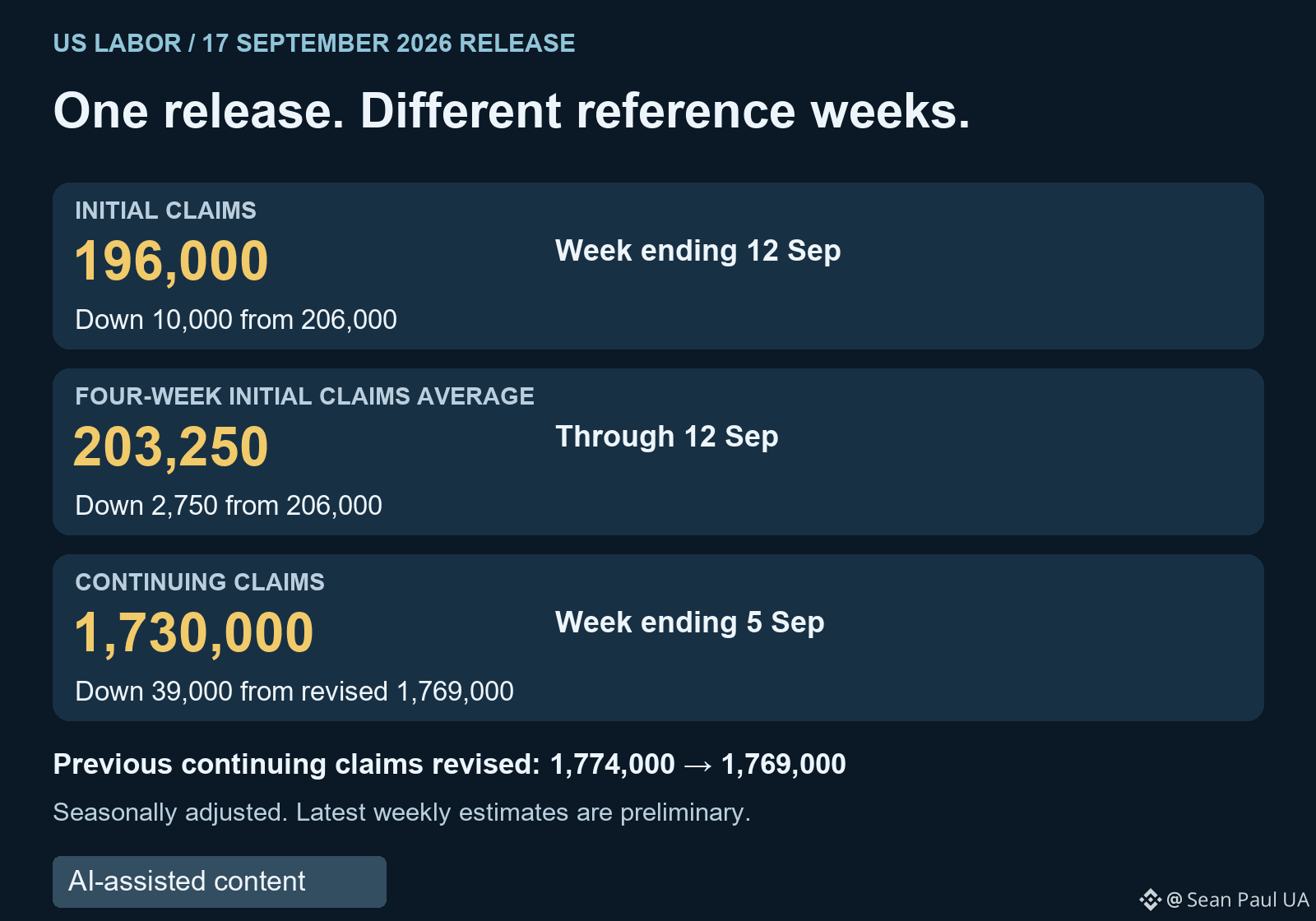
The US Labor Department's September 17 release puts initial jobless claims at 196,000 for the week ending September 12, down 10,000. The four-week average fell to 203,250.
Continuing claims were 1.73 million, down 39,000, but that number covers the week ending September 5. Different measures, different reference weeks. I wouldn't add them together or describe them as one week's total.
There's a revision worth keeping: the previous continuing-claims figure was cut from 1.774 million to 1.769 million. The reported 39,000 decline uses that revised baseline.
All those figures are seasonally adjusted, and the latest weekly estimates are preliminary. For my crypto macro notebook, getting the dates and revisions right comes before drawing a conclusion about rates. This release alone doesn't settle BTC's next move.
Which gets the most weight in your reading of the labor market: A) new claims, B) the four-week average, or C) continuing claims? What makes it more useful to you?
#Macro #LaborMarket
196,000 got the headline. The dates are what I'm checking next.
The US Labor Department's September 17 release puts initial jobless claims at 196,000 for the week ending September 12, down 10,000. The four-week average fell to 203,250.
Continuing claims were 1.73 million, down 39,000, but that number covers the week ending September 5. Different measures, different reference weeks. I wouldn't add them together or describe them as one week's total.
There's a revision worth keeping: the previous continuing-claims figure was cut from 1.774 million to 1.769 million. The reported 39,000 decline uses that revised baseline.
All those figures are seasonally adjusted, and the latest weekly estimates are preliminary. For my crypto macro notebook, getting the dates and revisions right comes before drawing a conclusion about rates. This release alone doesn't settle BTC's next move.
Which gets the most weight in your reading of the labor market: A) new claims, B) the four-week average, or C) continuing claims? What makes it more useful to you?
#Macro #LaborMarket
The US Labor Department's September 17 release puts initial jobless claims at 196,000 for the week ending September 12, down 10,000. The four-week average fell to 203,250.
Continuing claims were 1.73 million, down 39,000, but that number covers the week ending September 5. Different measures, different reference weeks. I wouldn't add them together or describe them as one week's total.
There's a revision worth keeping: the previous continuing-claims figure was cut from 1.774 million to 1.769 million. The reported 39,000 decline uses that revised baseline.
All those figures are seasonally adjusted, and the latest weekly estimates are preliminary. For my crypto macro notebook, getting the dates and revisions right comes before drawing a conclusion about rates. This release alone doesn't settle BTC's next move.
Which gets the most weight in your reading of the labor market: A) new claims, B) the four-week average, or C) continuing claims? What makes it more useful to you?
#Macro #LaborMarket
1
29
Traders across global financial desks are positioning ahead of the upcoming release of the US ADP private employment data, a critical weekly indicator measuring private sector hiring dynamics. As market participants await the precise figures, this report serves as an immediate litmus test for the health of the American labor market amid shifting macroeconomic conditions.
This release carries heightened importance as an early signal leading into broader non-farm payroll assessments. Investors are scrutinizing whether employment growth is cooling at a controlled pace or deteriorating faster than expected, which directly shapes market pricing for the Federal Reserve's upcoming monetary policy path and interest rate trajectory.
Across traditional finance, a stronger-than-expected print typically bolsters the US Dollar index and pushes Treasury yields higher, creating short-term pressure on commodities like gold. Conversely, signs of labor cooling tend to reinforce expectations of monetary easing, providing relief to sovereign bond markets.
For the crypto ecosystem, employment data serves as a key driver of broader risk appetite. A softening labor picture could strengthen the case for aggressive liquidity injections, ultimately providing a constructive tailwind for $BTC and the broader digital asset market as capital seeks higher-beta upside. #ADP #LaborMarket #Fed
Traders across global financial desks are positioning ahead of the upcoming release of the US ADP private employment data, a critical weekly indicator measuring private sector hiring dynamics. As market participants await the precise figures, this report serves as an immediate litmus test for the health of the American labor market amid shifting macroeconomic conditions.
This release carries heightened importance as an early signal leading into broader non-farm payroll assessments. Investors are scrutinizing whether employment growth is cooling at a controlled pace or deteriorating faster than expected, which directly shapes market pricing for the Federal Reserve's upcoming monetary policy path and interest rate trajectory.
Across traditional finance, a stronger-than-expected print typically bolsters the US Dollar index and pushes Treasury yields higher, creating short-term pressure on commodities like gold. Conversely, signs of labor cooling tend to reinforce expectations of monetary easing, providing relief to sovereign bond markets.
For the crypto ecosystem, employment data serves as a key driver of broader risk appetite. A softening labor picture could strengthen the case for aggressive liquidity injections, ultimately providing a constructive tailwind for $BTC and the broader digital asset market as capital seeks higher-beta upside. #ADP #LaborMarket #Fed
This release carries heightened importance as an early signal leading into broader non-farm payroll assessments. Investors are scrutinizing whether employment growth is cooling at a controlled pace or deteriorating faster than expected, which directly shapes market pricing for the Federal Reserve's upcoming monetary policy path and interest rate trajectory.
Across traditional finance, a stronger-than-expected print typically bolsters the US Dollar index and pushes Treasury yields higher, creating short-term pressure on commodities like gold. Conversely, signs of labor cooling tend to reinforce expectations of monetary easing, providing relief to sovereign bond markets.
For the crypto ecosystem, employment data serves as a key driver of broader risk appetite. A softening labor picture could strengthen the case for aggressive liquidity injections, ultimately providing a constructive tailwind for $BTC and the broader digital asset market as capital seeks higher-beta upside. #ADP #LaborMarket #Fed
3

#USJoblessClaimsFallToNearly60YearLow
More background on the job market! 🚨 New unemployment claims have fallen to the lowest levels since 1969.
With only 187,000 filings last week, the data completely wiped out the forecast of 215,000. The U.S. workforce is showing surprising strength right now: businesses are vigorously keeping their talent, signaling massive underlying economic resilience! 📈🇺🇸
For those who review the charts, this kind of unexpected macroeconomic strength often injects sudden volatility, creating ideal conditions for liquidity sweeps. Keep a close watch on how risky assets react around key structural levels as the market digests what this resilience
means for future monetary policy.
⚠️ Not financial advice.
#MacroEconomics #LaborMarket #USjobs
$EUL
{future}(EULUSDT)
$SYN
{future}(SYNUSDT)
$XAU
{future}(XAUUSDT)
#USJoblessClaimsFallToNearly60YearLow
More background on the job market! 🚨 New unemployment claims have fallen to the lowest levels since 1969.
With only 187,000 filings last week, the data completely wiped out the forecast of 215,000. The U.S. workforce is showing surprising strength right now: businesses are vigorously keeping their talent, signaling massive underlying economic resilience! 📈🇺🇸
For those who review the charts, this kind of unexpected macroeconomic strength often injects sudden volatility, creating ideal conditions for liquidity sweeps. Keep a close watch on how risky assets react around key structural levels as the market digests what this resilience
means for future monetary policy.
⚠️ Not financial advice.
#MacroEconomics #LaborMarket #USjobs
$EUL
$SYN
$XAU
More background on the job market! 🚨 New unemployment claims have fallen to the lowest levels since 1969.
With only 187,000 filings last week, the data completely wiped out the forecast of 215,000. The U.S. workforce is showing surprising strength right now: businesses are vigorously keeping their talent, signaling massive underlying economic resilience! 📈🇺🇸
For those who review the charts, this kind of unexpected macroeconomic strength often injects sudden volatility, creating ideal conditions for liquidity sweeps. Keep a close watch on how risky assets react around key structural levels as the market digests what this resilience
means for future monetary policy.
⚠️ Not financial advice.
#MacroEconomics #LaborMarket #USjobs
$EUL
$SYN
$XAU

1
105

#USMayADPJobsExceedExpectations
The U.S. labor market is carrying strong momentum into the summer. According to the latest ADP National Employment Report, private employers added 122,000 jobs in May, comfortably outperforming the projected 110,000.
This marks the fastest hiring pace since January 2025, signaling a resilient workforce despite broader economic headwinds. Growth was impressively broad-based, with 8 out of 10 supersectors adding positions—led by massive gains in education and health services. With wage growth holding steady at 4.4% for job-stayers, the economic engine is proving it still has plenty of fuel left.
#USMayADPJobsExceedExpectations #LaborMarket #USJobs #EconomicGrowth #EmploymentTrends #HiringMomentum
#USMayADPJobsExceedExpectations
The U.S. labor market is carrying strong momentum into the summer. According to the latest ADP National Employment Report, private employers added 122,000 jobs in May, comfortably outperforming the projected 110,000.
This marks the fastest hiring pace since January 2025, signaling a resilient workforce despite broader economic headwinds. Growth was impressively broad-based, with 8 out of 10 supersectors adding positions—led by massive gains in education and health services. With wage growth holding steady at 4.4% for job-stayers, the economic engine is proving it still has plenty of fuel left.
#USMayADPJobsExceedExpectations #LaborMarket #USJobs #EconomicGrowth #EmploymentTrends #HiringMomentum
The U.S. labor market is carrying strong momentum into the summer. According to the latest ADP National Employment Report, private employers added 122,000 jobs in May, comfortably outperforming the projected 110,000.
This marks the fastest hiring pace since January 2025, signaling a resilient workforce despite broader economic headwinds. Growth was impressively broad-based, with 8 out of 10 supersectors adding positions—led by massive gains in education and health services. With wage growth holding steady at 4.4% for job-stayers, the economic engine is proving it still has plenty of fuel left.
#USMayADPJobsExceedExpectations #LaborMarket #USJobs #EconomicGrowth #EmploymentTrends #HiringMomentum

1
170

·
--
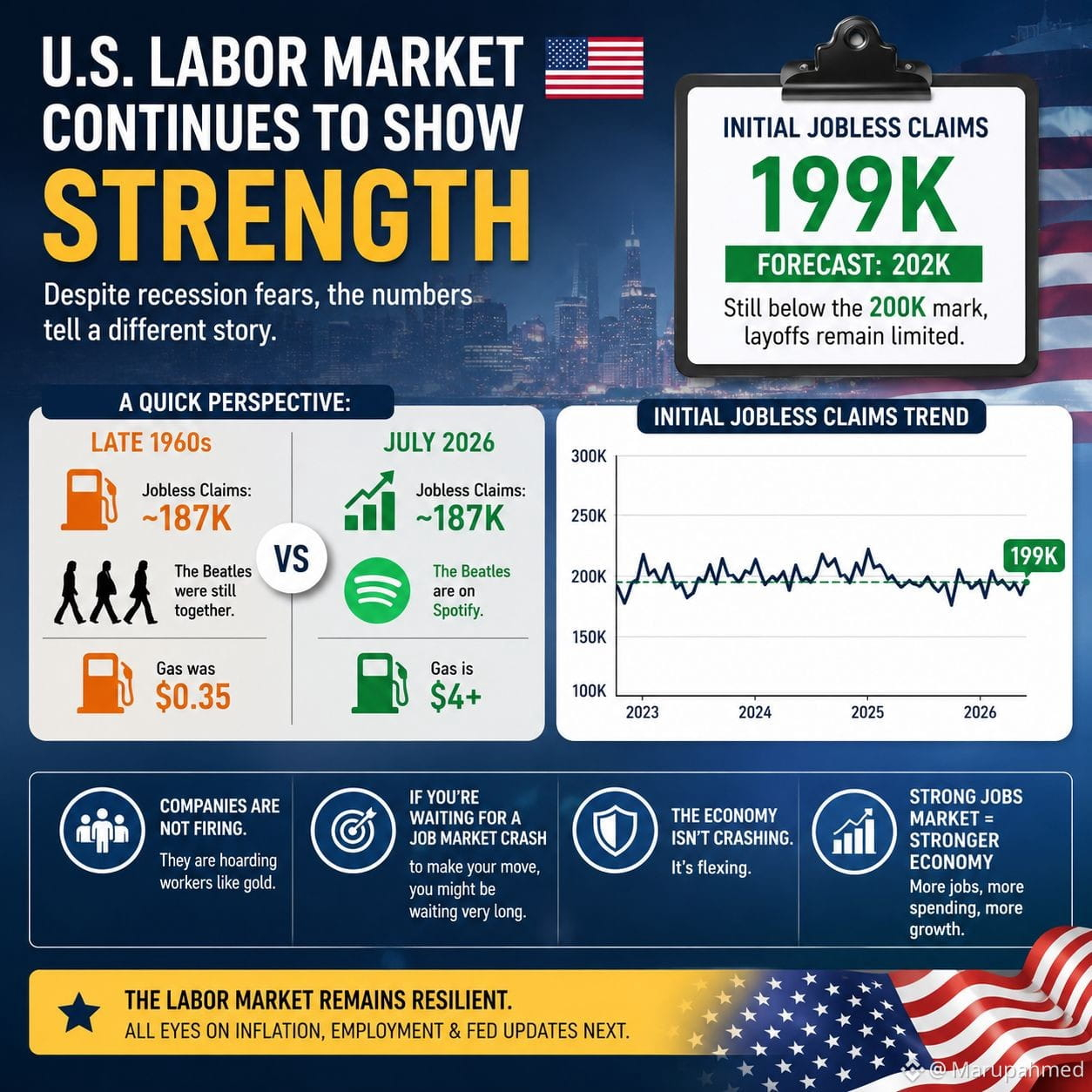
🇺🇸 U.S. Labor Market Continues to Show Strength
Despite ongoing recession concerns, the latest labor data tells a different story.
📊 Initial Jobless Claims: 199K
✅ Forecast: 202K
✅ Still below the 200K mark, suggesting layoffs remain limited.
A quick perspective:
• In the late 1960s, jobless claims were around 187K.
• Today, despite a completely different economic environment, claims have once again moved close to that level.
What does this mean?
🔹 Employers appear to be holding onto workers rather than cutting jobs.
🔹 The labor market remains resilient.
🔹 A strong jobs market can continue to influence consumer spending and overall economic confidence.
While one report doesn't define the entire economy, current employment data continues to point toward stability rather than widespread weakness.
📌 Markets will still be watching upcoming inflation, employment, and Federal Reserve updates for the next major signals.
#USJobs #Economy #LaborMarket #MarketSentimentToday
🇺🇸 U.S. Labor Market Continues to Show Strength
Despite ongoing recession concerns, the latest labor data tells a different story.
📊 Initial Jobless Claims: 199K
✅ Forecast: 202K
✅ Still below the 200K mark, suggesting layoffs remain limited.
A quick perspective:
• In the late 1960s, jobless claims were around 187K.
• Today, despite a completely different economic environment, claims have once again moved close to that level.
What does this mean?
🔹 Employers appear to be holding onto workers rather than cutting jobs.
🔹 The labor market remains resilient.
🔹 A strong jobs market can continue to influence consumer spending and overall economic confidence.
While one report doesn't define the entire economy, current employment data continues to point toward stability rather than widespread weakness.
📌 Markets will still be watching upcoming inflation, employment, and Federal Reserve updates for the next major signals.
#USJobs #Economy #LaborMarket #MarketSentimentToday
Despite ongoing recession concerns, the latest labor data tells a different story.
📊 Initial Jobless Claims: 199K
✅ Forecast: 202K
✅ Still below the 200K mark, suggesting layoffs remain limited.
A quick perspective:
• In the late 1960s, jobless claims were around 187K.
• Today, despite a completely different economic environment, claims have once again moved close to that level.
What does this mean?
🔹 Employers appear to be holding onto workers rather than cutting jobs.
🔹 The labor market remains resilient.
🔹 A strong jobs market can continue to influence consumer spending and overall economic confidence.
While one report doesn't define the entire economy, current employment data continues to point toward stability rather than widespread weakness.
📌 Markets will still be watching upcoming inflation, employment, and Federal Reserve updates for the next major signals.
#USJobs #Economy #LaborMarket #MarketSentimentToday
71

·
--
$BTC SURGES AFTER JOLTS DATA SURPRISE—LABOR MARKET DEFIES EXPECTATIONS 🔥
The U.S. job openings jumped to 7.6M in May, sharply beating the 6.975M consensus estimate. This marks the highest reading in nearly two years and shows the labor market is stabilizing despite geopolitical uncertainty.
For risk assets like Bitcoin, this data reduces recession fears and tightens the macro narrative. The immediate reaction has been a strong bid into key liquidity zones on the 4H chart. All eyes are now on whether this momentum can hold above the previous week's high.
Are you positioning for continuation or a retest of the breakout level?
Not financial advice. Always manage your risk.
#BTC #MacroData #LaborMarket #RiskOn
⚡
$BTC SURGES AFTER JOLTS DATA SURPRISE—LABOR MARKET DEFIES EXPECTATIONS 🔥
The U.S. job openings jumped to 7.6M in May, sharply beating the 6.975M consensus estimate. This marks the highest reading in nearly two years and shows the labor market is stabilizing despite geopolitical uncertainty.
For risk assets like Bitcoin, this data reduces recession fears and tightens the macro narrative. The immediate reaction has been a strong bid into key liquidity zones on the 4H chart. All eyes are now on whether this momentum can hold above the previous week's high.
Are you positioning for continuation or a retest of the breakout level?
Not financial advice. Always manage your risk.
#BTC #MacroData #LaborMarket #RiskOn
⚡
The U.S. job openings jumped to 7.6M in May, sharply beating the 6.975M consensus estimate. This marks the highest reading in nearly two years and shows the labor market is stabilizing despite geopolitical uncertainty.
For risk assets like Bitcoin, this data reduces recession fears and tightens the macro narrative. The immediate reaction has been a strong bid into key liquidity zones on the 4H chart. All eyes are now on whether this momentum can hold above the previous week's high.
Are you positioning for continuation or a retest of the breakout level?
Not financial advice. Always manage your risk.
#BTC #MacroData #LaborMarket #RiskOn
⚡
48

·
--
$BTC US JOBLESS CLAIMS DROP BELOW EXPECTATIONS – WHAT'S NEXT 🔥
Entry: Not specified 🔥
Target: Not specified 🚀
Stop Loss: Not specified ⚠️
The U.S. Department of Labor reported 215,000 initial jobless claims for the week ending June 27th — 5,000 below the 220,000 consensus. This is the second consecutive beat, signaling a tightening labor market that typically supports risk appetite on a macro level.
For BTC, lower claims reduce immediate recession fears, which can sustain bid-side liquidity in the short term. The question is whether this data shifts the narrative enough to break the current consolidation zone.
How do you read this print for your crypto positioning?
Not financial advice. Always manage your risk.
#BTC #MacroData #JoblessClaims #LaborMarket
🔥
$BTC US JOBLESS CLAIMS DROP BELOW EXPECTATIONS – WHAT'S NEXT 🔥
Entry: Not specified 🔥
Target: Not specified 🚀
Stop Loss: Not specified ⚠️
The U.S. Department of Labor reported 215,000 initial jobless claims for the week ending June 27th — 5,000 below the 220,000 consensus. This is the second consecutive beat, signaling a tightening labor market that typically supports risk appetite on a macro level.
For BTC, lower claims reduce immediate recession fears, which can sustain bid-side liquidity in the short term. The question is whether this data shifts the narrative enough to break the current consolidation zone.
How do you read this print for your crypto positioning?
Not financial advice. Always manage your risk.
#BTC #MacroData #JoblessClaims #LaborMarket
🔥
Entry: Not specified 🔥
Target: Not specified 🚀
Stop Loss: Not specified ⚠️
The U.S. Department of Labor reported 215,000 initial jobless claims for the week ending June 27th — 5,000 below the 220,000 consensus. This is the second consecutive beat, signaling a tightening labor market that typically supports risk appetite on a macro level.
For BTC, lower claims reduce immediate recession fears, which can sustain bid-side liquidity in the short term. The question is whether this data shifts the narrative enough to break the current consolidation zone.
How do you read this print for your crypto positioning?
Not financial advice. Always manage your risk.
#BTC #MacroData #JoblessClaims #LaborMarket
🔥
38

·
--
#USJoblessClaimsFallToNearly60YearLow
The U.S. labor market continues to demonstrate remarkable resilience, with initial jobless claims remaining near levels not seen in almost six decades. This signals that layoffs are still relatively limited, despite ongoing concerns about inflation, elevated interest rates, and global economic uncertainty.
What are jobless claims?Initial jobless claims measure the number of people filing for unemployment benefits for the first time. Economists closely monitor this data because it serves as one of the earliest indicators of changes in the labor market.
Why does this matter?
✅ Fewer layoffs suggest employers are holding on to workers.
✅ A strong labor market can support consumer spending and overall economic growth.
✅ It reflects continued demand for workers across many industries.
✅ The data may influence expectations about future monetary policy decisions.
However, there are important considerations:• Low jobless claims don't necessarily mean hiring is accelerating.• Some sectors continue to experience slower hiring and restructuring.• Wage growth, inflation, labor force participation, and broader employment trends all provide additional context when evaluating the health of the economy.
Key takeaway:Near-60-year-low jobless claims highlight the resilience of the U.S. labor market. While economic challenges remain, the persistently low level of unemployment claims suggests businesses are still reluctant to reduce their workforce, reinforcing confidence in the economy's underlying strength.
📊 A single economic indicator never tells the whole story, but consistently low jobless claims remain one of the strongest signals of labor market stability.
#USJoblessClaimsFallToNearly60YearLow #USjobs #LaborMarket #economy
#USJoblessClaimsFallToNearly60YearLow
The U.S. labor market continues to demonstrate remarkable resilience, with initial jobless claims remaining near levels not seen in almost six decades. This signals that layoffs are still relatively limited, despite ongoing concerns about inflation, elevated interest rates, and global economic uncertainty.
What are jobless claims?Initial jobless claims measure the number of people filing for unemployment benefits for the first time. Economists closely monitor this data because it serves as one of the earliest indicators of changes in the labor market.
Why does this matter?
✅ Fewer layoffs suggest employers are holding on to workers.
✅ A strong labor market can support consumer spending and overall economic growth.
✅ It reflects continued demand for workers across many industries.
✅ The data may influence expectations about future monetary policy decisions.
However, there are important considerations:• Low jobless claims don't necessarily mean hiring is accelerating.• Some sectors continue to experience slower hiring and restructuring.• Wage growth, inflation, labor force participation, and broader employment trends all provide additional context when evaluating the health of the economy.
Key takeaway:Near-60-year-low jobless claims highlight the resilience of the U.S. labor market. While economic challenges remain, the persistently low level of unemployment claims suggests businesses are still reluctant to reduce their workforce, reinforcing confidence in the economy's underlying strength.
📊 A single economic indicator never tells the whole story, but consistently low jobless claims remain one of the strongest signals of labor market stability.
#USJoblessClaimsFallToNearly60YearLow #USjobs #LaborMarket #economy
The U.S. labor market continues to demonstrate remarkable resilience, with initial jobless claims remaining near levels not seen in almost six decades. This signals that layoffs are still relatively limited, despite ongoing concerns about inflation, elevated interest rates, and global economic uncertainty.
What are jobless claims?Initial jobless claims measure the number of people filing for unemployment benefits for the first time. Economists closely monitor this data because it serves as one of the earliest indicators of changes in the labor market.
Why does this matter?
✅ Fewer layoffs suggest employers are holding on to workers.
✅ A strong labor market can support consumer spending and overall economic growth.
✅ It reflects continued demand for workers across many industries.
✅ The data may influence expectations about future monetary policy decisions.
However, there are important considerations:• Low jobless claims don't necessarily mean hiring is accelerating.• Some sectors continue to experience slower hiring and restructuring.• Wage growth, inflation, labor force participation, and broader employment trends all provide additional context when evaluating the health of the economy.
Key takeaway:Near-60-year-low jobless claims highlight the resilience of the U.S. labor market. While economic challenges remain, the persistently low level of unemployment claims suggests businesses are still reluctant to reduce their workforce, reinforcing confidence in the economy's underlying strength.
📊 A single economic indicator never tells the whole story, but consistently low jobless claims remain one of the strongest signals of labor market stability.
#USJoblessClaimsFallToNearly60YearLow #USjobs #LaborMarket #economy

129

📉 Decline in the share of labor from income in the United States to 43%
Recent data showed that the labor share of total income in the United States has fallen to 43%, hitting its lowest level since 1929. This decline suggests a possible shift in the distribution of wealth and income, and could have wide-ranging economic implications.
━━━━━━━━━━━━━━
📊 Impact: 📊 Medium
🏷️ OTHER
#Economy #LaborMarket #US #IncomeInequality #Macroeconomics
📰 Source: cryptobriefing.com
📉 Decline in the share of labor from income in the United States to 43%
Recent data showed that the labor share of total income in the United States has fallen to 43%, hitting its lowest level since 1929. This decline suggests a possible shift in the distribution of wealth and income, and could have wide-ranging economic implications.
━━━━━━━━━━━━━━
📊 Impact: 📊 Medium
🏷️ OTHER
#Economy #LaborMarket #US #IncomeInequality #Macroeconomics
📰 Source: cryptobriefing.com
Recent data showed that the labor share of total income in the United States has fallen to 43%, hitting its lowest level since 1929. This decline suggests a possible shift in the distribution of wealth and income, and could have wide-ranging economic implications.
━━━━━━━━━━━━━━
📊 Impact: 📊 Medium
🏷️ OTHER
#Economy #LaborMarket #US #IncomeInequality #Macroeconomics
📰 Source: cryptobriefing.com
22

·
--

Article
Australia's July Seasonally Adjusted Labor Force Participation Rate at 66.9%Australia's seasonally adjusted labor force participation rate for July was reported at 66.9%, according to Jin10. This figure matches the forecast of 66.90% and represents a slight decline from the previous reading of 67.00%.
The marginal decrease in participation rate indicates that fewer individuals in Australia were active in the labor market in July compared to earlier months. The data reflects ongoing shifts in employment trends and workforce engagement within the country.
While the change is small, it continues to be a point of interest for economists and policymakers analyzing the health of Australia's economy. The participation rate is a key indicator of labor market flexibility and economic vitality, influencing monetary policy decisions and economic forecasts.
Observers will be watching future releases to see if this trend persists or if the rate stabilizes or increases again as the economy adjusts to current conditions. The data underscores the importance of labor market metrics in assessing economic resilience and growth prospects. #Australia #LaborMarket #Economy
Australia's July Seasonally Adjusted Labor Force Participation Rate at 66.9%
Australia's seasonally adjusted labor force participation rate for July was reported at 66.9%, according to Jin10. This figure matches the forecast of 66.90% and represents a slight decline from the previous reading of 67.00%.
The marginal decrease in participation rate indicates that fewer individuals in Australia were active in the labor market in July compared to earlier months. The data reflects ongoing shifts in employment trends and workforce engagement within the country.
While the change is small, it continues to be a point of interest for economists and policymakers analyzing the health of Australia's economy. The participation rate is a key indicator of labor market flexibility and economic vitality, influencing monetary policy decisions and economic forecasts.
Observers will be watching future releases to see if this trend persists or if the rate stabilizes or increases again as the economy adjusts to current conditions. The data underscores the importance of labor market metrics in assessing economic resilience and growth prospects. #Australia #LaborMarket #Economy
The marginal decrease in participation rate indicates that fewer individuals in Australia were active in the labor market in July compared to earlier months. The data reflects ongoing shifts in employment trends and workforce engagement within the country.
While the change is small, it continues to be a point of interest for economists and policymakers analyzing the health of Australia's economy. The participation rate is a key indicator of labor market flexibility and economic vitality, influencing monetary policy decisions and economic forecasts.
Observers will be watching future releases to see if this trend persists or if the rate stabilizes or increases again as the economy adjusts to current conditions. The data underscores the importance of labor market metrics in assessing economic resilience and growth prospects. #Australia #LaborMarket #Economy
184

·
--
Vietnam Raises Minimum Wage 🚀
Vietnam's minimum wage has been increased to 2.53 million dong from 2.34 million dong, effective July 1. This change is expected to have a ripple effect on the economy, impacting not only the salaries of civil servants and military personnel but also various social benefits such as insurance and allowances. As the new minimum wage serves as a basis for calculating actual salaries, the hike is likely to influence the overall labor market and consumer spending. The increase may also have implications for businesses, potentially leading to higher production costs and subsequently affecting the prices of goods and services.
#VietnamEconomy #MinimumWage #LaborMarket #EmergingMarkets
Vietnam Raises Minimum Wage 🚀
Vietnam's minimum wage has been increased to 2.53 million dong from 2.34 million dong, effective July 1. This change is expected to have a ripple effect on the economy, impacting not only the salaries of civil servants and military personnel but also various social benefits such as insurance and allowances. As the new minimum wage serves as a basis for calculating actual salaries, the hike is likely to influence the overall labor market and consumer spending. The increase may also have implications for businesses, potentially leading to higher production costs and subsequently affecting the prices of goods and services.
#VietnamEconomy #MinimumWage #LaborMarket #EmergingMarkets
Vietnam's minimum wage has been increased to 2.53 million dong from 2.34 million dong, effective July 1. This change is expected to have a ripple effect on the economy, impacting not only the salaries of civil servants and military personnel but also various social benefits such as insurance and allowances. As the new minimum wage serves as a basis for calculating actual salaries, the hike is likely to influence the overall labor market and consumer spending. The increase may also have implications for businesses, potentially leading to higher production costs and subsequently affecting the prices of goods and services.
#VietnamEconomy #MinimumWage #LaborMarket #EmergingMarkets
20

·
--
Bullish
Nearly 16% of US job seekers are already working multiple jobs, showing income pressure beneath the surface of the labor market
📌 New data from Indeed shows that by Q4/2025, nearly 16% of active job seekers on its platform were already holding two or more jobs. This is not the rate for the entire US workforce, but for people actively looking for work, making it a clearer signal of pressure among those seeking extra income or a better job.
💡 The key contrast is that official BLS data put the multiple-jobholding rate at around 5.2% in May 2026. This gap suggests that the broader labor market may still look stable at the macro level, while pressure is much more visible inside the group actively searching for work.
🔎 The impact is most concentrated in hourly, shift-based, and service jobs. Food preparation and service accounts for nearly 17% of multiple-jobholder profiles, while delivery driver is the most prominent job title, alongside roles such as nursing assistant, customer service, server, bartender, cashier, and caregiver.
⚠️ One important signal is that application intensity rises sharply before workers take on a second job. This suggests many people are not simply picking up extra work for optional income, but may be trying to offset living costs, unstable hours, or wages that are not enough to cover basic expenses.
✅ The nearly 16% figure should not be read as a sign that the US labor market is collapsing. Instead, it shows that part of the workforce remains employed but not fully financially stable. This is an important under-the-surface data point to watch alongside inflation, consumer spending, and interest-rate policy in the months ahead.
#LaborMarket $BTC $BNB $TON
Nearly 16% of US job seekers are already working multiple jobs, showing income pressure beneath the surface of the labor market
📌 New data from Indeed shows that by Q4/2025, nearly 16% of active job seekers on its platform were already holding two or more jobs. This is not the rate for the entire US workforce, but for people actively looking for work, making it a clearer signal of pressure among those seeking extra income or a better job.
💡 The key contrast is that official BLS data put the multiple-jobholding rate at around 5.2% in May 2026. This gap suggests that the broader labor market may still look stable at the macro level, while pressure is much more visible inside the group actively searching for work.
🔎 The impact is most concentrated in hourly, shift-based, and service jobs. Food preparation and service accounts for nearly 17% of multiple-jobholder profiles, while delivery driver is the most prominent job title, alongside roles such as nursing assistant, customer service, server, bartender, cashier, and caregiver.
⚠️ One important signal is that application intensity rises sharply before workers take on a second job. This suggests many people are not simply picking up extra work for optional income, but may be trying to offset living costs, unstable hours, or wages that are not enough to cover basic expenses.
✅ The nearly 16% figure should not be read as a sign that the US labor market is collapsing. Instead, it shows that part of the workforce remains employed but not fully financially stable. This is an important under-the-surface data point to watch alongside inflation, consumer spending, and interest-rate policy in the months ahead.
#LaborMarket $BTC $BNB $TON
📌 New data from Indeed shows that by Q4/2025, nearly 16% of active job seekers on its platform were already holding two or more jobs. This is not the rate for the entire US workforce, but for people actively looking for work, making it a clearer signal of pressure among those seeking extra income or a better job.
💡 The key contrast is that official BLS data put the multiple-jobholding rate at around 5.2% in May 2026. This gap suggests that the broader labor market may still look stable at the macro level, while pressure is much more visible inside the group actively searching for work.
🔎 The impact is most concentrated in hourly, shift-based, and service jobs. Food preparation and service accounts for nearly 17% of multiple-jobholder profiles, while delivery driver is the most prominent job title, alongside roles such as nursing assistant, customer service, server, bartender, cashier, and caregiver.
⚠️ One important signal is that application intensity rises sharply before workers take on a second job. This suggests many people are not simply picking up extra work for optional income, but may be trying to offset living costs, unstable hours, or wages that are not enough to cover basic expenses.
✅ The nearly 16% figure should not be read as a sign that the US labor market is collapsing. Instead, it shows that part of the workforce remains employed but not fully financially stable. This is an important under-the-surface data point to watch alongside inflation, consumer spending, and interest-rate policy in the months ahead.
#LaborMarket $BTC $BNB $TON

88

·
--
🔴 HIGH IMPACT — Friday August 1
NFP — Non Farm Payrolls (July) 🔥
📅 8:30 AM ET · Forecast: ~150K · Prev: +57K
Biggest jobs number of the month — the day after PCE. A strong rebound from June's weak 57K would confirm last week's jobless claims signal and kill any rate cut hope. A second weak print = labor market cracking = cuts possible. 💼
#nfp #job #LaborMarket #dyor
{future}(BTCUSDT)
{future}(XAUUSDT)
{future}(XAGUSDT)
🔴 HIGH IMPACT — Friday August 1
NFP — Non Farm Payrolls (July) 🔥
📅 8:30 AM ET · Forecast: ~150K · Prev: +57K
Biggest jobs number of the month — the day after PCE. A strong rebound from June's weak 57K would confirm last week's jobless claims signal and kill any rate cut hope. A second weak print = labor market cracking = cuts possible. 💼
#nfp #job #LaborMarket #dyor
NFP — Non Farm Payrolls (July) 🔥
📅 8:30 AM ET · Forecast: ~150K · Prev: +57K
Biggest jobs number of the month — the day after PCE. A strong rebound from June's weak 57K would confirm last week's jobless claims signal and kill any rate cut hope. A second weak print = labor market cracking = cuts possible. 💼
#nfp #job #LaborMarket #dyor
255

Hassett, the newly appointed chair of the U.S. National Economic Council, has recently made public remarks saying that Trump and his team will fully respect any policy decisions made the next day by Federal Reserve Governor Christopher Waller. Echoing this, the latest U.S. data released for the week ending August 29 showed that ADP employment changes came in at 16,250, up noticeably from the prior value of 12,000. With the political establishment’s forward-looking commentary on Fed decision-making layered on top of slightly firmer employment data, market attention has once again been pulled back into the tug-of-war over the interest-rate policy path.
From a macro fundamentals perspective, the rebound in employment indicates that the U.S. labor market remains resilient and has not cooled as quickly as some dovish expectations had anticipated. By signaling in advance “respect for the central bank’s decision,” Hassett appears to be granting space for policy independence, but in substance it reflects the White House and the Fed striking a delicate balance between economic slowdown and sticky inflation. With employment not yet showing material deterioration, the market’s aggressive expectations for the Fed to turn much more dovish face the risk of being revised again.
This chain of developments has exerted a significant suppressing effect on traditional financial markets. Employment data stronger than the prior reading often lifts short-term Treasury yields and provides support for the U.S. dollar index, which in turn weighs on valuations as risk assets attempt to recover. If Waller’s subsequent remarks continue a hawkish— or even more cautious—tone, market expectations for rate cuts could be set back again, and the global liquidity backdrop is likely to remain somewhat tight in the near term. Non-yielding assets such as gold may also face bouts of volatility.
For the cryptocurrency market, the repeated swings in macro liquidity expectations undoubtedly increase the downside risks for major tokens such as $BTC . Against the backdrop of liquidity tailwinds failing to materialize for an extended period, in-market funds are more inclined to adopt a defensive posture, and inflows into spot ETFs may slow or even turn into net outflows. Investors should remain highly alert to the risks of liquidity withdrawal and heightened volatility once policy decisions are implemented, and should not chase short-term rallies blindly.
#Fed #ADP #LaborMarket
Hassett, the newly appointed chair of the U.S. National Economic Council, has recently made public remarks saying that Trump and his team will fully respect any policy decisions made the next day by Federal Reserve Governor Christopher Waller. Echoing this, the latest U.S. data released for the week ending August 29 showed that ADP employment changes came in at 16,250, up noticeably from the prior value of 12,000. With the political establishment’s forward-looking commentary on Fed decision-making layered on top of slightly firmer employment data, market attention has once again been pulled back into the tug-of-war over the interest-rate policy path.
From a macro fundamentals perspective, the rebound in employment indicates that the U.S. labor market remains resilient and has not cooled as quickly as some dovish expectations had anticipated. By signaling in advance “respect for the central bank’s decision,” Hassett appears to be granting space for policy independence, but in substance it reflects the White House and the Fed striking a delicate balance between economic slowdown and sticky inflation. With employment not yet showing material deterioration, the market’s aggressive expectations for the Fed to turn much more dovish face the risk of being revised again.
This chain of developments has exerted a significant suppressing effect on traditional financial markets. Employment data stronger than the prior reading often lifts short-term Treasury yields and provides support for the U.S. dollar index, which in turn weighs on valuations as risk assets attempt to recover. If Waller’s subsequent remarks continue a hawkish— or even more cautious—tone, market expectations for rate cuts could be set back again, and the global liquidity backdrop is likely to remain somewhat tight in the near term. Non-yielding assets such as gold may also face bouts of volatility.
For the cryptocurrency market, the repeated swings in macro liquidity expectations undoubtedly increase the downside risks for major tokens such as $BTC . Against the backdrop of liquidity tailwinds failing to materialize for an extended period, in-market funds are more inclined to adopt a defensive posture, and inflows into spot ETFs may slow or even turn into net outflows. Investors should remain highly alert to the risks of liquidity withdrawal and heightened volatility once policy decisions are implemented, and should not chase short-term rallies blindly.
#Fed #ADP #LaborMarket
From a macro fundamentals perspective, the rebound in employment indicates that the U.S. labor market remains resilient and has not cooled as quickly as some dovish expectations had anticipated. By signaling in advance “respect for the central bank’s decision,” Hassett appears to be granting space for policy independence, but in substance it reflects the White House and the Fed striking a delicate balance between economic slowdown and sticky inflation. With employment not yet showing material deterioration, the market’s aggressive expectations for the Fed to turn much more dovish face the risk of being revised again.
This chain of developments has exerted a significant suppressing effect on traditional financial markets. Employment data stronger than the prior reading often lifts short-term Treasury yields and provides support for the U.S. dollar index, which in turn weighs on valuations as risk assets attempt to recover. If Waller’s subsequent remarks continue a hawkish— or even more cautious—tone, market expectations for rate cuts could be set back again, and the global liquidity backdrop is likely to remain somewhat tight in the near term. Non-yielding assets such as gold may also face bouts of volatility.
For the cryptocurrency market, the repeated swings in macro liquidity expectations undoubtedly increase the downside risks for major tokens such as $BTC . Against the backdrop of liquidity tailwinds failing to materialize for an extended period, in-market funds are more inclined to adopt a defensive posture, and inflows into spot ETFs may slow or even turn into net outflows. Investors should remain highly alert to the risks of liquidity withdrawal and heightened volatility once policy decisions are implemented, and should not chase short-term rallies blindly.
#Fed #ADP #LaborMarket
8

The UK Office for National Statistics has released the latest employment market data. The figures show that in August, the unemployment rate came in at 4.4%, slightly up from the prior 4.30%; the number of people claiming unemployment benefits at the beginning of August was 278,000 (27,800), with the prior value revised from -110,000 to -118,000. Meanwhile, the three-month ILO unemployment rate through July remained at 4.9%, better than the market expectation of 5.0%.
From a macro technical perspective, the labor market shows a moderate slowdown rather than a sharp downturn. Although the monthly unemployment rate inched up to 4.4%, the three-month ILO unemployment rate stayed steadily at a relatively low 4.9%, breaking prior market pessimism about a rapid deterioration in employment. The resilience of the overall employment structure provides the Bank of England with excellent policy room to balance the timing of rate cuts against the fight against inflation, resulting in a classic soft-landing data combination.
For the FX and rates markets, this data weakens overheated bets on aggressive rate cuts by the Bank of England. GBP against major currencies demonstrates solid technical support at the base, and the short-term moving average system shows signs of stabilizing and rebounding. Overall risk appetite has not been harmed; instead, confidence in European assets has been boosted as the economic fundamentals help avoid a recession. Bond yields have seen reduced volatility, which is positive for a favorable global cross-market liquidity environment.
For risk-on assets such as cryptocurrencies, the macro expectation of a soft landing is a sustained positive. With liquidity conditions staying moderate and without suppression from systemic recession risk, key assets such as $BTC continue to maintain a bullish continuation structure. As mainstream coins complete turnover at key support levels, the removal of tail macro risks will attract more incremental capital to enter and cover during the breakout rally.🚀
#UKJobs #LaborMarket #MacroEconomics
The UK Office for National Statistics has released the latest employment market data. The figures show that in August, the unemployment rate came in at 4.4%, slightly up from the prior 4.30%; the number of people claiming unemployment benefits at the beginning of August was 278,000 (27,800), with the prior value revised from -110,000 to -118,000. Meanwhile, the three-month ILO unemployment rate through July remained at 4.9%, better than the market expectation of 5.0%.
From a macro technical perspective, the labor market shows a moderate slowdown rather than a sharp downturn. Although the monthly unemployment rate inched up to 4.4%, the three-month ILO unemployment rate stayed steadily at a relatively low 4.9%, breaking prior market pessimism about a rapid deterioration in employment. The resilience of the overall employment structure provides the Bank of England with excellent policy room to balance the timing of rate cuts against the fight against inflation, resulting in a classic soft-landing data combination.
For the FX and rates markets, this data weakens overheated bets on aggressive rate cuts by the Bank of England. GBP against major currencies demonstrates solid technical support at the base, and the short-term moving average system shows signs of stabilizing and rebounding. Overall risk appetite has not been harmed; instead, confidence in European assets has been boosted as the economic fundamentals help avoid a recession. Bond yields have seen reduced volatility, which is positive for a favorable global cross-market liquidity environment.
For risk-on assets such as cryptocurrencies, the macro expectation of a soft landing is a sustained positive. With liquidity conditions staying moderate and without suppression from systemic recession risk, key assets such as $BTC continue to maintain a bullish continuation structure. As mainstream coins complete turnover at key support levels, the removal of tail macro risks will attract more incremental capital to enter and cover during the breakout rally.🚀
#UKJobs #LaborMarket #MacroEconomics
From a macro technical perspective, the labor market shows a moderate slowdown rather than a sharp downturn. Although the monthly unemployment rate inched up to 4.4%, the three-month ILO unemployment rate stayed steadily at a relatively low 4.9%, breaking prior market pessimism about a rapid deterioration in employment. The resilience of the overall employment structure provides the Bank of England with excellent policy room to balance the timing of rate cuts against the fight against inflation, resulting in a classic soft-landing data combination.
For the FX and rates markets, this data weakens overheated bets on aggressive rate cuts by the Bank of England. GBP against major currencies demonstrates solid technical support at the base, and the short-term moving average system shows signs of stabilizing and rebounding. Overall risk appetite has not been harmed; instead, confidence in European assets has been boosted as the economic fundamentals help avoid a recession. Bond yields have seen reduced volatility, which is positive for a favorable global cross-market liquidity environment.
For risk-on assets such as cryptocurrencies, the macro expectation of a soft landing is a sustained positive. With liquidity conditions staying moderate and without suppression from systemic recession risk, key assets such as $BTC continue to maintain a bullish continuation structure. As mainstream coins complete turnover at key support levels, the removal of tail macro risks will attract more incremental capital to enter and cover during the breakout rally.🚀
#UKJobs #LaborMarket #MacroEconomics
5

·
--
$AI IS EXPOSING THE LIMITS OF AUTOMATION IN THE CORPORATE WORLD ⚡
Entry: Not provided
The data is clear: 39% of business leaders cut staff due to AI, yet 55% now admit those decisions were flawed. Ford is rehiring hundreds of engineers after automated systems failed to handle quality issues. Commonwealth Bank reversed layoffs when its AI voice bot couldn't keep up with call volume.
The critical metric here is the 6% exception rate at IBM — routine tasks are automated, but edge cases like ethical dilemmas require human judgment. Companies are discovering that machine efficiency without human oversight creates structural inefficiencies.
How do you see this playing out in the crypto sector as firms automate customer support and compliance?
Not financial advice. Always manage your risk.
#AI #Automation #LaborMarket #TechTrends
⚡
$AI IS EXPOSING THE LIMITS OF AUTOMATION IN THE CORPORATE WORLD ⚡
Entry: Not provided
The data is clear: 39% of business leaders cut staff due to AI, yet 55% now admit those decisions were flawed. Ford is rehiring hundreds of engineers after automated systems failed to handle quality issues. Commonwealth Bank reversed layoffs when its AI voice bot couldn't keep up with call volume.
The critical metric here is the 6% exception rate at IBM — routine tasks are automated, but edge cases like ethical dilemmas require human judgment. Companies are discovering that machine efficiency without human oversight creates structural inefficiencies.
How do you see this playing out in the crypto sector as firms automate customer support and compliance?
Not financial advice. Always manage your risk.
#AI #Automation #LaborMarket #TechTrends
⚡
Entry: Not provided
The data is clear: 39% of business leaders cut staff due to AI, yet 55% now admit those decisions were flawed. Ford is rehiring hundreds of engineers after automated systems failed to handle quality issues. Commonwealth Bank reversed layoffs when its AI voice bot couldn't keep up with call volume.
The critical metric here is the 6% exception rate at IBM — routine tasks are automated, but edge cases like ethical dilemmas require human judgment. Companies are discovering that machine efficiency without human oversight creates structural inefficiencies.
How do you see this playing out in the crypto sector as firms automate customer support and compliance?
Not financial advice. Always manage your risk.
#AI #Automation #LaborMarket #TechTrends
⚡
64
·
--
🔴 HIGH IMPACT — Thursday May 29
GDP Q1 2026 — 2nd Estimate
📅 8:30 AM ET · The advance estimate put Q1 GDP at +2.0% annualized — a rebound from Q4's +0.5%. If the revision comes in lower it confirms the economy is weaker than thought. Big mover.
Initial Jobless Claims
📅 8:30 AM ET · Forecast: ~225K · Prev: 200K
Same time as GDP — double release at 8:30AM. Rising claims = labor market softening = more pressure on the Fed. Watch both together. 💼
{future}(BTCUSDT)
#gdp #Inflation #LaborMarket #Q1
🔴 HIGH IMPACT — Thursday May 29
GDP Q1 2026 — 2nd Estimate
📅 8:30 AM ET · The advance estimate put Q1 GDP at +2.0% annualized — a rebound from Q4's +0.5%. If the revision comes in lower it confirms the economy is weaker than thought. Big mover.
Initial Jobless Claims
📅 8:30 AM ET · Forecast: ~225K · Prev: 200K
Same time as GDP — double release at 8:30AM. Rising claims = labor market softening = more pressure on the Fed. Watch both together. 💼
#gdp #Inflation #LaborMarket #Q1
GDP Q1 2026 — 2nd Estimate
📅 8:30 AM ET · The advance estimate put Q1 GDP at +2.0% annualized — a rebound from Q4's +0.5%. If the revision comes in lower it confirms the economy is weaker than thought. Big mover.
Initial Jobless Claims
📅 8:30 AM ET · Forecast: ~225K · Prev: 200K
Same time as GDP — double release at 8:30AM. Rising claims = labor market softening = more pressure on the Fed. Watch both together. 💼
#gdp #Inflation #LaborMarket #Q1
161

·
--
#usweeklyjoblessclaimsfallto197000
🚨 The U.S. labor market still isn’t breaking.
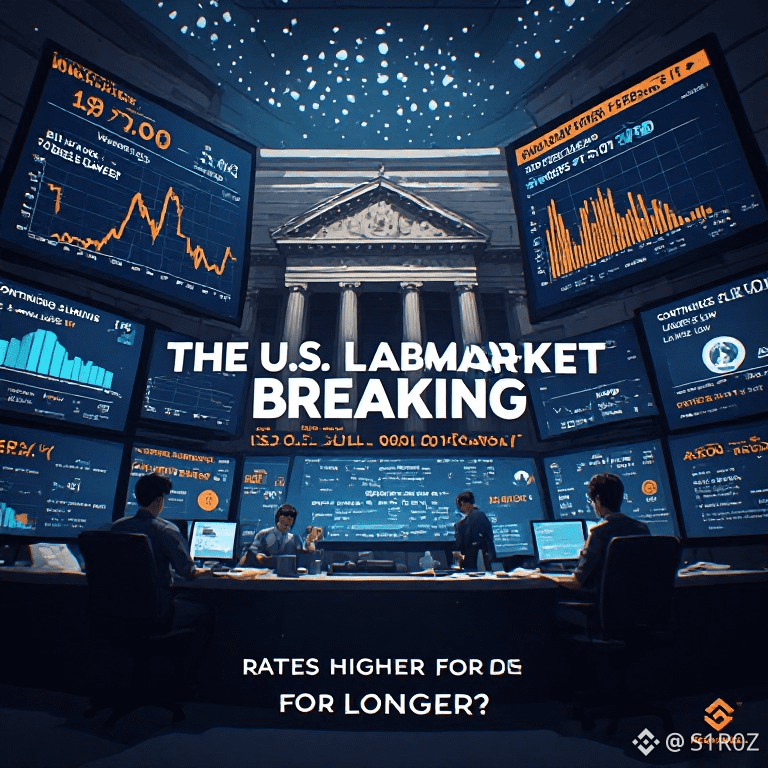
Weekly jobless claims fell to 197,000, down 1,000 from the prior week. The 4-week average also slipped to 200,000, while continuing claims eased to 1.701M.
That creates an interesting macro setup:
📉 Inflation is cooling
🐢 Hiring is slowing
💼 But layoffs remain very low
For the Fed, that combination makes the path toward aggressive easing less straightforward. A resilient labor market can keep rates higher for longer even as inflation moves lower.
And that keeps the market tug-of-war alive: softer inflation versus a still-resilient jobs market.
For $BTC, $QQQ, $SPX and $XAU, the next macro data points could remain important as markets assess where rates go from here.
$BTC | $QQQ |
{future}(QQQUSDT)
{future}(SPXUSDT)
| $XAU
{future}(XAUUSDT)
#Bitcoin #macroeconomic #Fed #LaborMarket #crypto
#usweeklyjoblessclaimsfallto197000
🚨 The U.S. labor market still isn’t breaking.
Weekly jobless claims fell to 197,000, down 1,000 from the prior week. The 4-week average also slipped to 200,000, while continuing claims eased to 1.701M.
That creates an interesting macro setup:
📉 Inflation is cooling
🐢 Hiring is slowing
💼 But layoffs remain very low
For the Fed, that combination makes the path toward aggressive easing less straightforward. A resilient labor market can keep rates higher for longer even as inflation moves lower.
And that keeps the market tug-of-war alive: softer inflation versus a still-resilient jobs market.
For $BTC, $QQQ , $SPX and $XAU , the next macro data points could remain important as markets assess where rates go from here.
$BTC | $QQQ |
| $XAU
#Bitcoin #macroeconomic #Fed #LaborMarket #crypto
🚨 The U.S. labor market still isn’t breaking.
Weekly jobless claims fell to 197,000, down 1,000 from the prior week. The 4-week average also slipped to 200,000, while continuing claims eased to 1.701M.
That creates an interesting macro setup:
📉 Inflation is cooling
🐢 Hiring is slowing
💼 But layoffs remain very low
For the Fed, that combination makes the path toward aggressive easing less straightforward. A resilient labor market can keep rates higher for longer even as inflation moves lower.
And that keeps the market tug-of-war alive: softer inflation versus a still-resilient jobs market.
For $BTC, $QQQ , $SPX and $XAU , the next macro data points could remain important as markets assess where rates go from here.
$BTC | $QQQ |
| $XAU
#Bitcoin #macroeconomic #Fed #LaborMarket #crypto
1
191

·
--
#usweeklyjoblessclaimsfallto197000
🚨 Macro Economic Update: US Weekly Jobless Claims Fall to 197,000!
The Market Update: Labor market resilience continues to defy expectations as US initial jobless claims drop significantly down to 197,000, signaling stronger-than-anticipated employment stability. As tracked by our macro economic analytics dashboard, lower jobless claims point to persistent economic strength, directly influencing Federal Reserve interest rate projections and overall risk sentiment across global financial markets. 📊
What This Means for Traders:
Stronger employment data reduces immediate pressure for aggressive monetary easing, impacting bond yields, currency valuations, and liquidity flows into high-beta risk assets. Market participants are closely watching order book depth and macro correlations to gauge how employment sustainability affects broader market momentum.
Highlighted Tradeable Coins to Watch (Macro & High-Beta Sectors):
$BTC (Bitcoin): The premier institutional asset; tracking how labor market strength and shifting liquidity expectations influence broader digital asset store-of-value demand.
$ETH (Ethereum): Leading smart contract settlement layer; monitoring decentralized finance capital flows and network activity during macro economic data releases.
$SOL (Solana): High-throughput layer-1 network; observing high-velocity trading volume and ecosystem liquidity shifts amid macro-driven volatility.
How do you view the impact of stronger employment figures and falling jobless claims on overall market sentiment and crypto momentum this quarter? Let's discuss your strategy in the comments below! 👇
{spot}(BTCUSDT)
{spot}(ETHUSDT)
{spot}(SOLUSDT)
#LaborMarket #FederalReserve #cryptotrading #MarketUpdate
#usweeklyjoblessclaimsfallto197000
🚨 Macro Economic Update: US Weekly Jobless Claims Fall to 197,000!
The Market Update: Labor market resilience continues to defy expectations as US initial jobless claims drop significantly down to 197,000, signaling stronger-than-anticipated employment stability. As tracked by our macro economic analytics dashboard, lower jobless claims point to persistent economic strength, directly influencing Federal Reserve interest rate projections and overall risk sentiment across global financial markets. 📊
What This Means for Traders:
Stronger employment data reduces immediate pressure for aggressive monetary easing, impacting bond yields, currency valuations, and liquidity flows into high-beta risk assets. Market participants are closely watching order book depth and macro correlations to gauge how employment sustainability affects broader market momentum.
Highlighted Tradeable Coins to Watch (Macro & High-Beta Sectors):
$BTC (Bitcoin): The premier institutional asset; tracking how labor market strength and shifting liquidity expectations influence broader digital asset store-of-value demand.
$ETH (Ethereum): Leading smart contract settlement layer; monitoring decentralized finance capital flows and network activity during macro economic data releases.
$SOL (Solana): High-throughput layer-1 network; observing high-velocity trading volume and ecosystem liquidity shifts amid macro-driven volatility.
How do you view the impact of stronger employment figures and falling jobless claims on overall market sentiment and crypto momentum this quarter? Let's discuss your strategy in the comments below! 👇
#LaborMarket #FederalReserve #cryptotrading #MarketUpdate
🚨 Macro Economic Update: US Weekly Jobless Claims Fall to 197,000!
The Market Update: Labor market resilience continues to defy expectations as US initial jobless claims drop significantly down to 197,000, signaling stronger-than-anticipated employment stability. As tracked by our macro economic analytics dashboard, lower jobless claims point to persistent economic strength, directly influencing Federal Reserve interest rate projections and overall risk sentiment across global financial markets. 📊
What This Means for Traders:
Stronger employment data reduces immediate pressure for aggressive monetary easing, impacting bond yields, currency valuations, and liquidity flows into high-beta risk assets. Market participants are closely watching order book depth and macro correlations to gauge how employment sustainability affects broader market momentum.
Highlighted Tradeable Coins to Watch (Macro & High-Beta Sectors):
$BTC (Bitcoin): The premier institutional asset; tracking how labor market strength and shifting liquidity expectations influence broader digital asset store-of-value demand.
$ETH (Ethereum): Leading smart contract settlement layer; monitoring decentralized finance capital flows and network activity during macro economic data releases.
$SOL (Solana): High-throughput layer-1 network; observing high-velocity trading volume and ecosystem liquidity shifts amid macro-driven volatility.
How do you view the impact of stronger employment figures and falling jobless claims on overall market sentiment and crypto momentum this quarter? Let's discuss your strategy in the comments below! 👇
#LaborMarket #FederalReserve #cryptotrading #MarketUpdate

3
3.6k
Log in to explore more content
Join global crypto users on Binance Square
⚡️ Get latest and useful information about crypto.
💬 Trusted by the world’s largest crypto exchange.
👍 Discover real insights from verified creators.
Email / Phone number
Trending Topics
1
#IMFApproves$139MDisbursementToElSalvador
0 views
1 Discussing
2
#AnthropicTargetsIPOAsSoonAsMidNovember
475 views
31 Discussing
3
#EtherGains70.9%InQ3
192,686 views
1,265 Discussing
4
#TreasuryLetsStatesFileStablecoinCertificationsEarly
13,208 views
99 Discussing
5
#US10YearYieldNears5.3%
167,008 views
1,216 Discussing
6
#DollarIndexHitsHighestSinceMay2025
52,691 views
676 Discussing
7
#USWeeklyJoblessClaimsFallTo197000
40,685 views
543 Discussing
8
#BitcoinETFsTake$6.34BillionInQ3
10,820 views
77 Discussing
9
#KoreaProposesTokenizingStocksAndBonds
78,508 views
856 Discussing
10
#MetaMaskExitsLidoValidatorsAfterSecurityIncident
179,566 views
1,583 Discussing