
#fungo
fungo
216 views
4 Discussing
Hot
Latest

·
--
The most fascinating thing about Web3 is that some people spend money every day farming interactions, only to end up with less than someone who simply writes thoughtful posts.
This time, FungoLabs is putting up 300 million $FUNGO tokens, targeting creators on X.
What did airdrops used to reward?
How much you invested, how many wallets you had, and how fast your scripts ran.
Now, some people are starting to think rewards should go to those who actually create content.
I can get behind that approach.
After all, what a project really needs isn’t tens of thousands of wallets that disappear after claiming an airdrop, but people willing to research, discuss, and spread the word about its ecosystem.
Of course, 300 million tokens doesn’t mean $300 million. How much people will ultimately receive and what the tokens will be worth are still unknown.
But at least it gives smaller accounts another path.
Here’s the question: Should Web3 airdrops reward people for farming interactions, or those who create value?
#FungoLabs #FUNGO
https://fungolabs.org/launchpad/c/cfpdxjt4

·
--
🟨FungoLabs has officially announced the rules for the Genesis sealed-bid auction.
The core logic is simple: all winning bidders pay the same price—the lowest winning bid. Any excess is refunded to the original payment method, and unsuccessful bidders receive a full refund.
You only need to bid what you believe it’s worth. In the end, you’ll pay only the market-clearing price, so there’s no need to worry about overbidding or underbidding.
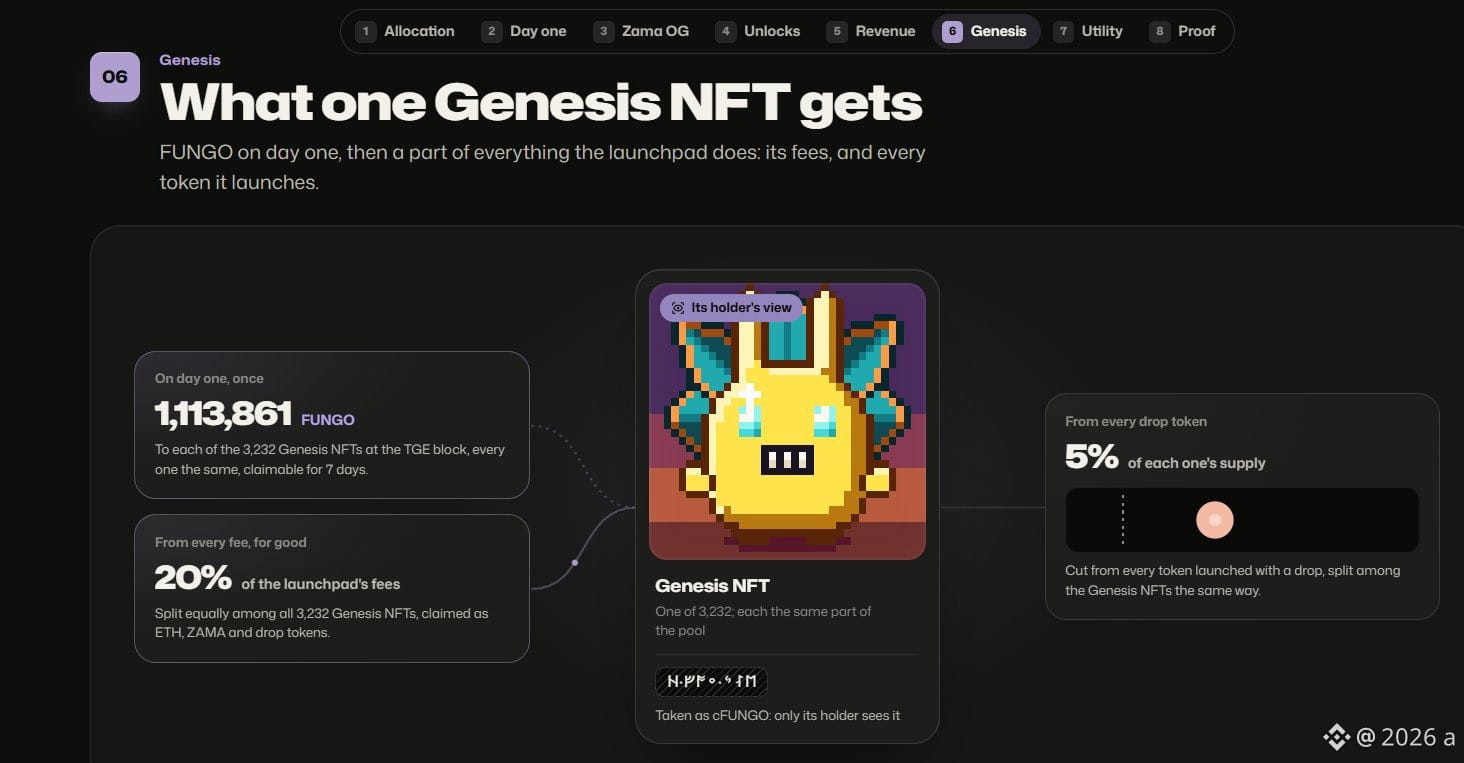
🟨The tokenomics are very clean (full page👇):
https://fungolabs.org/launchpad/tokenomics
No VCs, no presale, no transaction tax.
34% of the total supply goes directly into the liquidity pool and is permanently locked. 20% of fees are regularly used to buy back and burn tokens with real funds.
The team’s allocation won’t be released linearly until after a 12-month lockup. Unclaimed airdrops are burned after 7 days.
I think this structure is surprisingly clean. There are no tricks like locking first and dumping later, or any fancy unlock traps. The key details are all written into the contracts and publicly verifiable.
🟨Based on current market prices:
The Zama OG floor is currently holding steady at around 30U, with a single airdrop of 140,112 $FUNGO.
That implies a price of approximately 0.000214U per $FUNGO,
corresponding to an FDV of around $2.14 million.
The Genesis airdrop per token is about 7.95 times that of Zama OG,
implying an airdrop value of around $238–240,
or about 3,700 cZAMA at the current ZAMA price.
Personally, I think this estimate is just a baseline. During the actual auction, the market may also add a premium for future fee-sharing and project-token distributions.
Lastly, I recommend reading both the auction rules and the tokenomics before deciding whether to participate. All the information is already out in the open.
@FungoLabs #FUNGO @zama
411
Log in to explore more content
Join global crypto users on Binance Square
⚡️ Get latest and useful information about crypto.
💬 Trusted by the world’s largest crypto exchange.
👍 Discover real insights from verified creators.
Email / Phone number
Trending Topics
1
#BitcoinRebounds$75KAsChipsLead
8,987 views
131 Discussing
2
#JobsReportRaisesHikeOdds
113,429 views
1,017 Discussing
3
#US Data Center Rules May Constrain AI Expansion
15,858 views
106 Discussing
4
#AnthropicStillPlansPreThanksgivingIPO
0 views
0 Discussing
5
#FinCENAndFedWithdraw$250CryptoTransferProposal
74 views
1 Discussing
6
#$2TWipedOutHedgeFundsFaceLiquidation
18,745 views
105 Discussing
7
#WillAnthropicListOnTime
21,696 views
324 Discussing
8
#USNovemberMichiganExpectationsIndexPrelimAt50.9
25,610 views
417 Discussing
9
#OilPlungesBelow$100
25,599 views
44 Discussing
10
#TradFiForBeginners
16,680 views
268 Discussing