
#fincenandfedwithdraw
fincenandfedwithdraw
165 views
11 Discussing
Hot
Latest

·
--
#FinCENAndFedWithdraw$250CryptoTransferProposal
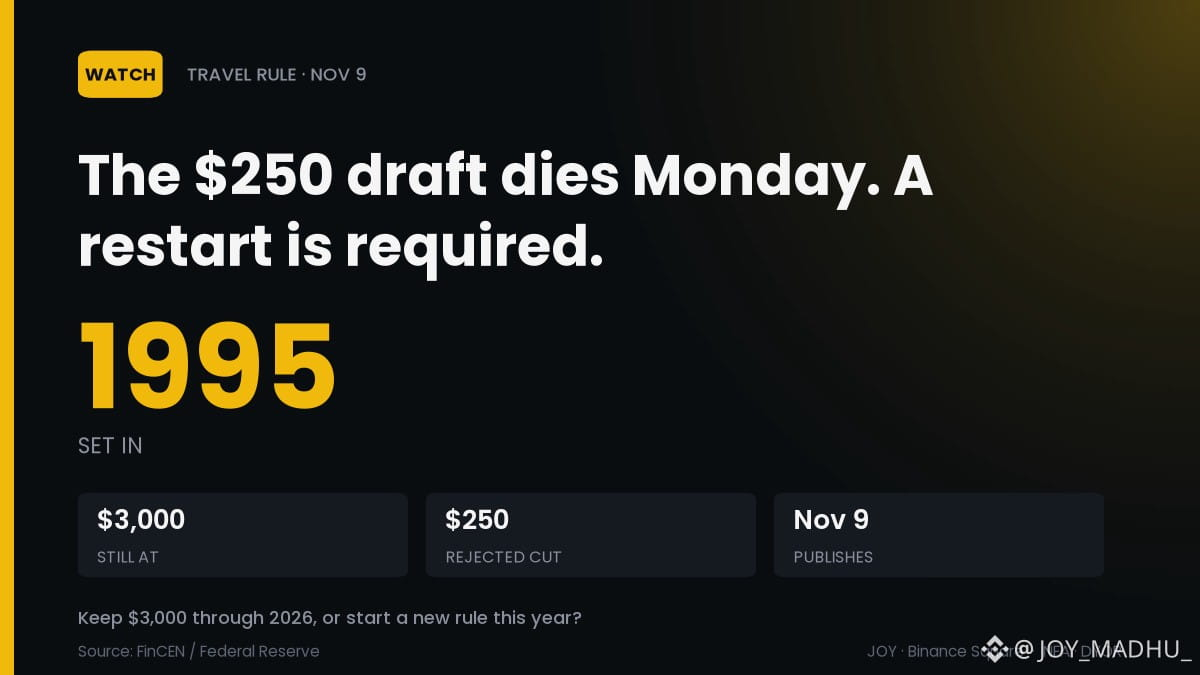
❓ Since 1995, Should $3,000 Move Up — Not Down?
FinCEN and the Fed will not finish their 2020 plan to cut the Travel Rule to $250.
📊 The $3,000 threshold dates to 1995, commenters noted
📅 Federal Register publishes the withdrawal tomorrow, Nov 9
⚠️ No final rule without a fresh proposal and comment period
📈 GENIUS Act (July 2025) was cited as a reason to rethink the rules
The catch: they can still rewrite the line — they just have to start over.
Keep $3,000 through 2026, or start a new rule this year? 👇
$BTC $ETH
#FinCENAndFedWithdraw$250CryptoTransferProposal #Crypto #Regulation
61

·
--
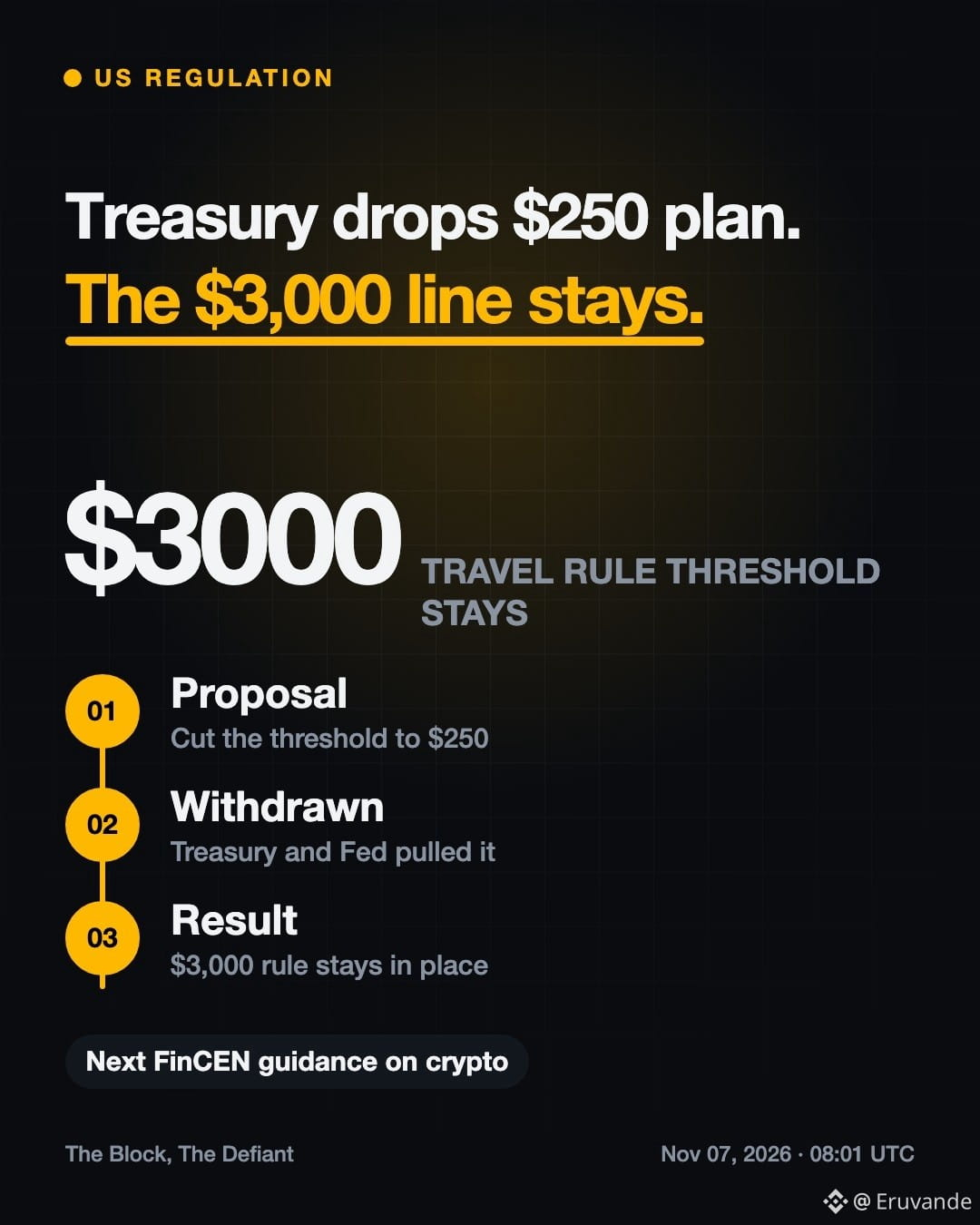
The US Treasury and the Fed just dropped a plan to cut the cross-border travel rule threshold to $250.
The current $3,000 limit stays, including for qualifying crypto transfers under FinCEN guidance.
A lower bar would have put far more small $BTC and $ETH transfers under data-sharing rules.
Does this make you more likely to move crypto across borders?
#FinCENAndFedWithdraw$250CryptoTransferProposal #Bitcoin
126
·
--
#FinCENAndFedWithdraw$250CryptoTransferProposal
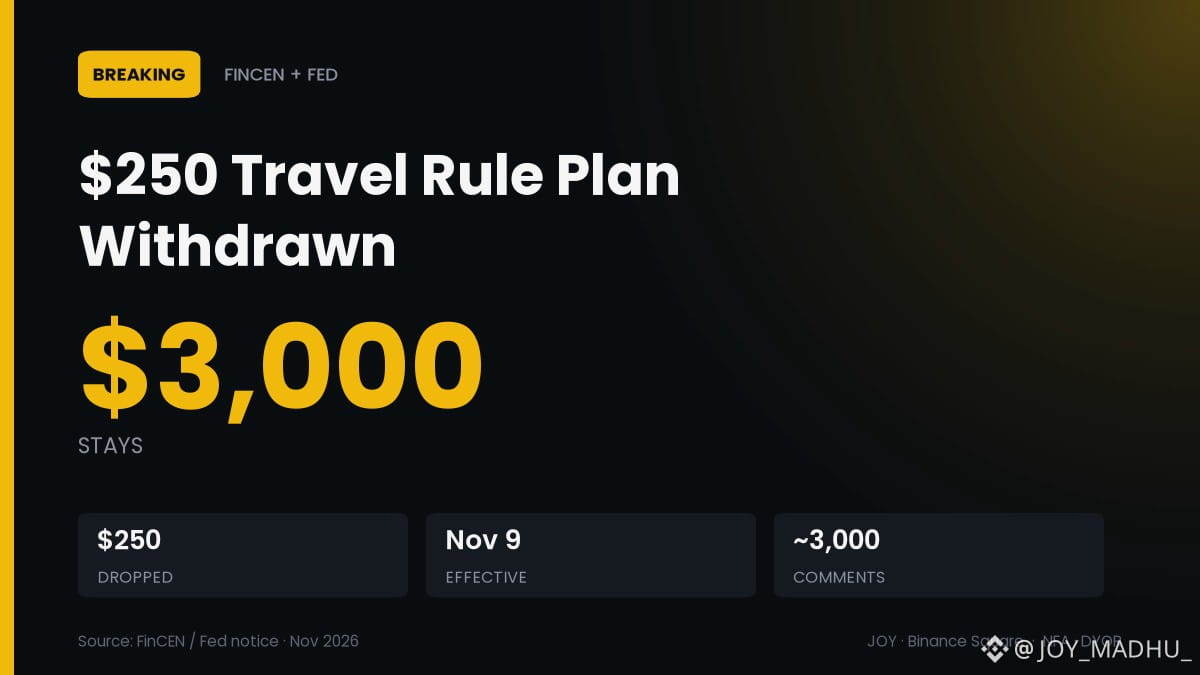
🏦 $250 Plan Scrapped — $3,000 Line Still Stands
FinCEN and the Fed shelved a 2020 plan that would have pulled far more crypto transfers into Travel Rule reporting.
📊 Cross-border threshold stays at $3,000 for banks and crypto MSBs
📅 Withdrawal effective with Federal Register publication Nov 9
⚠️ 2020 NPRM would have cut that line to $250
🏦 Nearly 3,000 comments opposed costs and data collection
The catch: Travel Rule still applies — only the lower bar is gone.
Keep $3,000 for good, or rewrite a new rule later? 👇
$BTC $ETH
#FinCENAndFedWithdraw$250CryptoTransferProposal #Crypto #Regulation
56

·
--
ZEC and U.S. transfer rules | $250 threshold proposal withdrawn | Don’t chase the rally around 1262
My view is that this regulatory news should be treated as a change in the boundary of compliance costs, not as a signal that ZEC has been granted an exemption. Binance Square is discussing #FinCENAndFedWithdraw$250CryptoTransferProposal. On November 6, the U.S. Financial Crimes Enforcement Network (FinCEN) announced that it and the Federal Reserve had jointly withdrawn a proposed rule introduced in 2020. The proposal sought to lower the recordkeeping and information-sharing threshold for certain funds transfers beginning or ending outside the United States from $3,000 to $250, and to clarify the scope of its application to convertible virtual currencies. The Federal Register’s public inspection document also states that the two agencies will no longer pursue this proposal, and that the document is scheduled for official publication on November 9. Today is November 8, so the announcement, public inspection, and official publication dates should be distinguished; it would be inaccurate to say that “all regulatory rules were repealed today.”
The connection to ZEC is through trading channels, not the blockchain itself. Had the $250 threshold taken effect, regulated financial institutions handling more small cross-border transfers might have faced additional recordkeeping, information-sharing, and verification procedures. Its withdrawal means that this proposed additional burden will not be implemented under the original proposal. However, the existing $3,000 rule, anti-money-laundering obligations, suspicious activity reporting, and individual platform policies have not disappeared as a result. The Federal Register document does not mention ZEC, nor does it approve unrestricted deposits and withdrawals of shielded transactions on any exchange. The availability of privacy assets still depends on the specific jurisdiction, platform rules, and network conditions. Claiming that “the withdrawal of a proposed threshold means ZEC’s compliance risk is zero” goes beyond what the document supports.
The market has not shown a clear, one-way confirmation either. ZEC/USDT on Binance was around $1,262.35, with a rolling 24-hour open of $1,315.16, high of $1,330.08, and low of $1,236.64—about 4.02% below the open. These are current price facts; the entire decline cannot be attributed to this regulatory document. Farside’s latest complete data for November 6 showed net inflows of about $1.8 million into ZEC funds for the day, following $11 million in net outflows the previous day. A modest one-day inflow is not enough to prove sustained institutional buying. The levels I’m watching are the low near 1236, the recovery level at 1275, and the opening area around 1315. If ZEC first breaks below 1236 and then fails to reclaim it on a retest, my view of short-term support is invalidated. If it holds above 1275 and subsequent fund flows and platform access do not deteriorate, I’ll become more confident that a rebound can continue. If the policy proposal is reopened for comments or exchanges change the scope of their ZEC support, I’ll reassess immediately.
If I were trading this myself, I would not enter now; my position would be 0%. I would consider only a small spot long after a conditional trigger, capped at 0.3% of total capital, with no leverage. Entry would require an hourly close above 1275, followed by a retest that holds between 1270 and 1275, and confirmation that ZEC deposits and withdrawals and order-book depth are normal on the platform I’m using. The first target is 1315, where I would sell half; the second target is 1330, but I would exit early if volume is insufficient. I’d set a hard stop at 1234 and close the entire position if it is hit. If the price falls back below 1270 after entry and fails to recover within one hour, I’d also exit completely. If the price breaks below 1236 first, I’d cancel the plan and remain out of the market. This is a contingency plan, not a report of a trade already executed.
Sources: FinCEN announcement, Federal Register public inspection document, Farside ZEC fund table, Binance spot quote. #ZEC
This is solely my personal market observation and does not constitute investment advice.

12
·
--
BTC Holds Above $75,000 | $250 Cross-Border Transfer Proposal Withdrawn | Good News? Check the Rules First
My stance is to wait and see, rather than chase a rally based on the phrase “regulatory easing.” Binance Square currently has the exact topic “FinCEN and the Fed Withdraw $250 Crypto Transfer Proposal.” This relates to cross-border fund services offered by trading platforms, so it’s worth reading the original text. In a November 6 announcement, FinCEN said it had withdrawn an earlier proposed rule jointly put forward with the Federal Reserve Board. Looking back at the Fed’s 2020 joint announcement, the proposal at the time would have lowered the information-collection threshold for certain international fund transfers from $3,000 to $250 and clarified the scope of covered transactions, including convertible virtual currencies. What has been withdrawn is a proposal that had not yet taken effect—not all existing anti-money-laundering, identity-verification, and recordkeeping obligations, and certainly not “BTC transfers under $250 are now unregulated.” Personal on-chain transfers, rules governing fund transfers by regulated institutions, and platform terms of service should not be conflated.
The impact on BTC is mainly on expectations and service costs, not a sudden change in protocol supply. If the lower cross-border threshold does not take effect, some institutions may face less of the additional compliance burden they had anticipated, potentially improving expectations around access to trading services. But how much actual cost might be reduced depends on institutions’ existing processes and other applicable rules; it cannot be quantified from a withdrawal announcement alone. The market has not confirmed a one-way move either: Farside shows that U.S. BTC funds saw combined net outflows of about $411.9 million on November 6, indicating continued redemption pressure on the product side that day. Friday’s data should not be misrepresented as immediate weekend selling. The latest purchase announcement currently available on Strategy’s website is still dated October 12; social media hints are not evidence of another completed purchase.
On price, when I checked Kraken, BTC was around $75,643.80, with a daily open of $75,741.60, an intraday low of $75,525, a high of $76,146.90, and a rolling 24-hour low of $75,402.80. The price remains above $75,000 but is below the daily open, so it would be inaccurate to say the regulatory news has driven a strong breakout. Around $75,400 is the zone to watch based on the 24-hour low; if the price breaks below it and fails to recover, the short-term support thesis is invalidated. Around $76,150 is the intraday high; only a move above it followed by a successful retest would make further upside worth discussing. Employment data have made interest-rate expectations more sensitive, while the Fed’s actual decision on October 28 was to keep its target range at 3.75%–4%. Policy expectations and decisions already made must be kept separate.
If I were trading myself, I would sit this one out for now, stay directionally neutral, and hold a 0% position. Only if BTC closes a four-hour candle above $76,150, retests and holds $76,000, and fund-flow updates do not worsen further would I use at most 0.4% of total capital to test a long position in unleveraged spot. I’d take half off at the first target of $76,800 and close the rest at the second target of $77,500. After entry, if the price closes a four-hour candle back below $75,740, I’d reduce the position; if it breaks below $75,400, I’d stop out and close everything. If it breaks below $75,400 before entry, the original plan is canceled. If new implementation details emerge in the regulatory documents, I’d verify them again before placing an order. No trigger means no trade. Staying disciplined matters more than chasing a narrative.
Sources: FinCEN’s November 6 announcement; the Fed’s 2020 joint announcement; Farside BTC ETF Flow; Strategy’s website; Kraken BTC/USD; Binance Square Trends.
#FinCENAndFedWithdraw$250CryptoTransferProposal #BTC
The above is solely my personal market observation and does not constitute investment advice.

5
·
--
U.S. withdraws $250 transfer proposal | BNB still trending | I don’t treat compliance news as immediate buying pressure
My stance is cautious to neutral. Binance Square’s English page has a new, accurately worded topic, “#FinCENAndFedWithdraw$250CryptoTransferProposal,” and BNB is still marked as trending upward on the six-hour search rankings. The topic itself is worth discussing, but first, let’s clarify the policy facts: On November 6, the U.S. Treasury’s Financial Crimes Enforcement Network (FinCEN) announced that it and the Federal Reserve Board had jointly withdrawn a rule proposal put forward in 2020. The original proposal would have lowered the recordkeeping and information-sharing threshold from $3,000 to $250 for certain funds transfers involving a point of origin or destination outside the United States. It also proposed clarifying how convertible virtual currencies and certain digital assets would be covered under the relevant rules. The Federal Register’s prepublication document also lists the withdrawal, with formal publication scheduled for November 9.
This is not “the U.S. is ending crypto transfer regulation.” What was withdrawn was an old proposal that had not yet taken effect. Existing recordkeeping, Travel Rule, and anti-money-laundering obligations have not therefore disappeared across the board. Nor does this set or remove a uniform $250 limit on all on-chain BNB transfers. The document concerns covered financial institutions and funds-transfer processes; users’ self-custodied on-chain transfers, exchanges’ internal risk controls, and requirements in different jurisdictions should not be conflated. FinCEN’s stated reasons include that more than five years have passed since the proposal was introduced, that new public input is needed, and that market and legal frameworks have changed. New proposals may still follow; withdrawal does not mean a permanent exemption.
Any potential impact on BNB is indirect. If some regulated intermediaries no longer need to immediately rebuild their systems for this unadopted $250-threshold proposal, short-term policy uncertainty may ease. But BNB Chain transaction fees, validator revenue, and actual demand for BNB will not automatically rise because of a withdrawal notice. Higher search volume on Binance Square indicates attention, not necessarily higher trading volume or net buying. I’m more focused on whether regulated service providers issue clear guidance on implementation and whether the price can sustain its gains. The fact that a policy event and a coin’s price movement happen at the same time is not enough to establish causation.
Market prices also aren’t signaling a strong trend right now. At the time of writing, Kraken BNB/USD is around $694.06, with today’s open at $692.73, an intraday low of $692.23, and a high of $696.31; the rolling 24-hour low is $685.96 and the high is $698.30. The price is slightly above the daily open but remains below the 24-hour high. I see $696.31 as the first short-term resistance level and $698.30 as the more important confirmation level. To the downside, I’m watching $692.23 first, followed by $685.96. If the price breaks below $692.23 and fails to reclaim it on a rebound, that would suggest the trending topic and regulatory discussion have not translated into sustained buying. If it spikes and then falls back into the range, I’d also avoid chasing the price.
If I were trading this myself, I’d stay out for now, with 0% of my portfolio committed and only a small spot position as a possible long setup. I’d enter with no more than 0.3% of my total capital, without leverage, only if two one-hour candles close above $698.30, the price holds $696.31 on a retest, and volume improves. My first target would be $704, where I’d take half off; my second target would be $710, but I’d close the remaining position if momentum weakened. I’d set a hard stop at $691.80; if the price breaks below $692.23 before the stop is hit, I’d cancel the plan. If the final Federal Register text materially differs from the prepublication version, I’d also update my policy assessment. A plan or expectation should not be presented as realized profit.
#FinCENAndFedWithdraw$250CryptoTransferProposal #BNB
The above is solely my personal market observation and does not constitute investment advice.

9

·
--
The latest news indicates that the U.S. Financial Crimes Enforcement Network (FinCEN) and the Federal Reserve have proposed lowering the threshold for cryptocurrency transfers from the current $1,000 to $250, while requiring stricter reporting for virtual asset service providers (VASPs) linked to bank accounts. I believe this proposal is necessary because the current threshold makes it difficult to effectively track illicit activity. However, it could also increase compliance costs and make transactions less convenient for small-scale investors. Overall, raising the regulatory bar appropriately is worth supporting in the interest of financial security and combating money laundering. #FinCENAndFedWithdraw$250CryptoTransferProposal
$BTC
$BTC
92
·
--
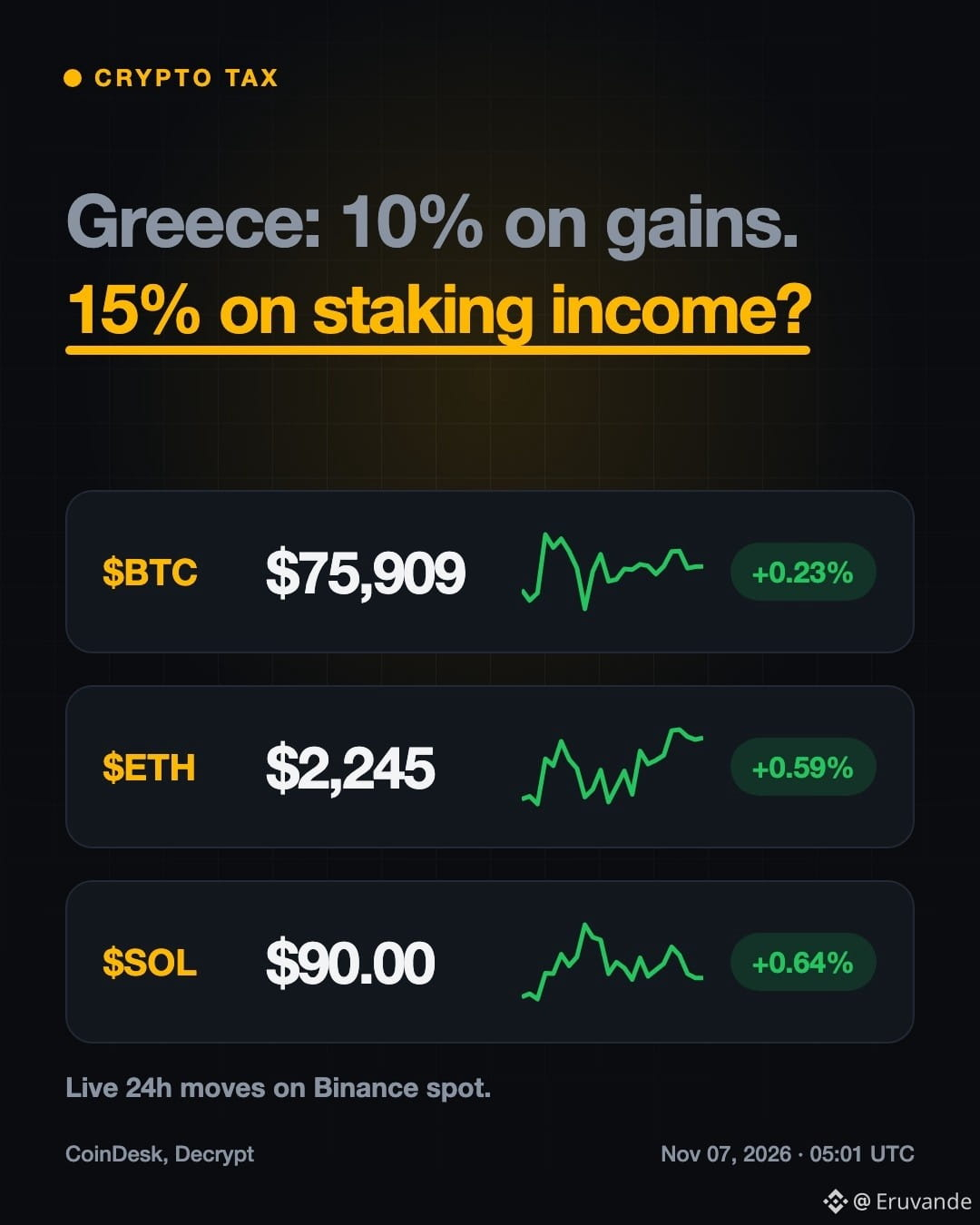
Greece just passed a 10% tax on crypto gains and 15% on staking and DeFi income.
It starts in 2027, with the first 500 euros of yearly gains exempt. Swaps between tokens are still unclear.
$BTC $75,909 (+0.23%) | $ETH $2,244.78 (+0.59%) | $SOL $90.00 (+0.64%) on 24h.
Would a 15% staking tax change how you earn yield?
#FinCENAndFedWithdraw$250CryptoTransferProposal #Bitcoin
It starts in 2027, with the first 500 euros of yearly gains exempt. Swaps between tokens are still unclear.
$BTC $75,909 (+0.23%) | $ETH $2,244.78 (+0.59%) | $SOL $90.00 (+0.64%) on 24h.
Would a 15% staking tax change how you earn yield?
#FinCENAndFedWithdraw$250CryptoTransferProposal #Bitcoin
102
·
--
$250 Proposal Withdrawn | XMR Still Faces Separate Compliance Risks | I’ll Wait for Price Confirmation
My stance is neutral to cautious. I wouldn’t interpret the withdrawal of an old U.S. proposal as a green light for privacy coins. The English trending topic on Binance Square currently reads “#FinCENAndFedWithdraw$250CryptoTransferProposal,” which makes it especially easy to misconstrue as “regulatory easing.” In its November 6 announcement, FinCEN stated that it and the Federal Reserve Board had jointly withdrawn a 2020 proposal to revise recordkeeping and Travel Rule requirements. The proposal would have lowered the threshold for certain funds transfers that begin or end outside the United States, and clarified the scope of the rules as they apply to convertible virtual currencies and certain digital assets. The prepublished Federal Register document provides a cross-check. What was withdrawn was a proposal that had not yet been finalized—not the repeal of current anti-money-laundering requirements.
For XMR, the key issue is who the rules apply to, not speculation about every on-chain transaction. The document discusses how financial institutions covered by the rules should retain and transmit information. It does not say that regulators have endorsed the Monero network, nor does it give exchanges the green light to list XMR. Monero’s privacy design and whether trading venues can offer services involving XMR are separate compliance questions, dependent on local regulations and platform risk controls. There have also been discussions of a separate proposal targeting mixer transactions; that should not be conflated with this $250 threshold for records of cross-border transfers. Blending the two old rules into a claim that “privacy assets are fully deregulated” would directly mislead position decisions.
From a trading-mechanics perspective, if the market’s concern about a particular compliance cost proves unfounded, risk appetite could improve at the margin. But that does not automatically create net buying pressure in spot XMR. The latest official release on Monero’s website remains version 0.18.5.4, released on October 16; there has been no project upgrade prompted by this policy. At the time of writing, XMR/USD on Kraken was around $611.94, with an intraday open of $611.30, a low of $603.03, and a high of $612.48; the rolling 24-hour high was $624.29. The price is only slightly above the daily open and remains well below the 24-hour high. What I see is a narrow-range rebound. That does not prove the policy news is being priced in sustainably, and I can’t attribute the price movement to FinCEN’s announcement.
My key levels are $612.48 and $624.29: the former is the intraday ceiling, while the latter is stronger 24-hour resistance. Below, $603.03 is the current low. If the price moves above $612.48 without follow-through in volume and quickly falls back toward $611, that would invalidate the breakout thesis. A break below $603.03 would signal insufficient risk appetite. Even if the news remains a trending topic, price action has the final say. Going forward, I’ll be watching for guidance from financial institutions, changes in trading access, and sustained volume—not commentators’ claims that XMR has been “unbanned.”
If I were trading this myself, I wouldn’t enter now. My position would be 0%, while keeping open only the possibility of a small spot position in the long direction. The conditions would be two consecutive one-hour candles closing above $612.48, followed by a retest that holds above $611.30, with volume higher than the average across the previous three hourly candles. Only then would I enter, risking no more than 0.35% of total capital, with no leverage. My first target would be $618, where I’d sell half; my second target would be $624.29, near which I’d close the remainder. I’d set a hard stop at $607.50. If the price first breaks below $603.03 before entry, I’d cancel the entire plan. If new official rule text or an exchange announcement appears, I’ll verify the facts again before deciding whether to revise the plan. I will not describe conditions that have not been triggered as executed trades.
#FinCENAndFedWithdraw$250CryptoTransferProposal #XMR
The above is solely my personal market observation and does not constitute investment advice.

12
Log in to explore more content
Join global crypto users on Binance Square
⚡️ Get latest and useful information about crypto.
💬 Trusted by the world’s largest crypto exchange.
👍 Discover real insights from verified creators.
Email / Phone number
Trending Topics
1
#BitcoinFiveWeeklyLosses
2,527 views
203 Discussing
2
#AIChipSlumpNasdaq
1,797 views
115 Discussing
3
#NvidiaInvestigatesAfterHuang’sAffairApology
513 views
32 Discussing
4
#BinanceReopensWithdrawalsForHYPE&APT
150,888 views
1,191 Discussing
5
#SouthKoreaDraftLawTargets15To20%ShareholderCap
151,583 views
794 Discussing
6
#TradFiForBeginners
224,106 views
2,035 Discussing
7
#KeplrAdvisesSocialLoginUsersToTransferAssets
70,503 views
598 Discussing
8
#TetherPlans€28.8MForJuventusCapitalIncrease
53,926 views
447 Discussing
9
#JobsReportRaisesHikeOdds
969,587 views
4,548 Discussing
10
#CPITestsDecemberRateOutlook
431,080 views
1,976 Discussing