
#dataavailability
dataavailability
22,644 views
384 Discussing
Hot
Latest

·
--
*0G records 0.2085$ now on Binance*
Break 0.20$ + AI Infra trend is on 🔥
#### *📊 Key Points:*
- *Current Price*: 0.2085$ on Binance
- *Move*: broke the psychological resistance of 0.20$ by +12% today
- *Platform*: SPOT trading
- *Context*: 0G- Data Availability Layer for AI. It provides 50GB/s data speed. Partnerships with many AI projects preparing for launch
Volume exploded 3x and the Whales are buying above 0.205$
#### *📌 Projections*
$0G at 0.2085$
- *Hold above 0.205$* = targeting 0.220$ → 0.235$ → 0.250$
- *Retest 0.200$* = best buy zone if a correction happens
*Summary*: Breaking 0.20$ changes the game. $0G entered the institutional watchlist in the AI sector. Any mainnet announcement will push it to 0.30$. Entry 0.2085$ - 0.2100$ | Target 0.235$ | Stop 0.1980$ 👇
$0G
{spot}(0GUSDT)
#Binance #Layer2 #breakouts #DataAvailability #Crypto_Jobs🎯
*0G records 0.2085$ now on Binance*
Break 0.20$ + AI Infra trend is on 🔥
#### *📊 Key Points:*
- *Current Price*: 0.2085$ on Binance
- *Move*: broke the psychological resistance of 0.20$ by +12% today
- *Platform*: SPOT trading
- *Context*: 0G- Data Availability Layer for AI. It provides 50GB/s data speed. Partnerships with many AI projects preparing for launch
Volume exploded 3x and the Whales are buying above 0.205$
#### *📌 Projections*
$0G at 0.2085$
- *Hold above 0.205$* = targeting 0.220$ → 0.235$ → 0.250$
- *Retest 0.200$* = best buy zone if a correction happens
*Summary*: Breaking 0.20$ changes the game. $0G entered the institutional watchlist in the AI sector. Any mainnet announcement will push it to 0.30$. Entry 0.2085$ - 0.2100$ | Target 0.235$ | Stop 0.1980$ 👇
$0G
#Binance #Layer2 #breakouts #DataAvailability #Crypto_Jobs🎯
Break 0.20$ + AI Infra trend is on 🔥
#### *📊 Key Points:*
- *Current Price*: 0.2085$ on Binance
- *Move*: broke the psychological resistance of 0.20$ by +12% today
- *Platform*: SPOT trading
- *Context*: 0G- Data Availability Layer for AI. It provides 50GB/s data speed. Partnerships with many AI projects preparing for launch
Volume exploded 3x and the Whales are buying above 0.205$
#### *📌 Projections*
$0G at 0.2085$
- *Hold above 0.205$* = targeting 0.220$ → 0.235$ → 0.250$
- *Retest 0.200$* = best buy zone if a correction happens
*Summary*: Breaking 0.20$ changes the game. $0G entered the institutional watchlist in the AI sector. Any mainnet announcement will push it to 0.30$. Entry 0.2085$ - 0.2100$ | Target 0.235$ | Stop 0.1980$ 👇
$0G
#Binance #Layer2 #breakouts #DataAvailability #Crypto_Jobs🎯

1
74

·
--
Data Availability: The Silent Race Reshaping Layer 1s
Most investors track TPS or TVL. Fewer track data availability — and that gap is where the real Layer 1 divergence is unfolding.
Data availability (DA) is the backbone of scalable blockchains. It answers one question: can any participant verify that the data underlying a block actually exists? Without robust DA, rollups are blind, fraud proofs collapse, and decentralization is theater.
$ETH recognized this early. EIP-4844 (proto-danksharding) introduced blob transactions — a dedicated, cheaper data lane for rollups. Ethereum is no longer just a settlement layer; it is actively competing to be the canonical DA layer for its entire rollup ecosystem.
$SOL takes a different path: monolithic architecture where execution, consensus, and DA are tightly coupled. High throughput, but the trade-off is validator hardware requirements that push toward centralization over time.
$DOT with its shared security model and parachain architecture offers another DA topology — blockspace auctioned through a relay chain, with each parachain inheriting guarantees from the broader validator pool.
No single architecture wins universally. But as rollup adoption scales, DA becomes the premium infrastructure layer. Watch where builders choose to post data — that choice, repeated at scale, will define the next Layer 1 valuation cycle.
The race is no longer about who is fastest. It is about who becomes the trust anchor for verifiable data at internet scale.
#DataAvailability #Layer1 #CryptoInfrastructure #Web3
Data Availability: The Silent Race Reshaping Layer 1s
Most investors track TPS or TVL. Fewer track data availability — and that gap is where the real Layer 1 divergence is unfolding.
Data availability (DA) is the backbone of scalable blockchains. It answers one question: can any participant verify that the data underlying a block actually exists? Without robust DA, rollups are blind, fraud proofs collapse, and decentralization is theater.
$ETH recognized this early. EIP-4844 (proto-danksharding) introduced blob transactions — a dedicated, cheaper data lane for rollups. Ethereum is no longer just a settlement layer; it is actively competing to be the canonical DA layer for its entire rollup ecosystem.
$SOL takes a different path: monolithic architecture where execution, consensus, and DA are tightly coupled. High throughput, but the trade-off is validator hardware requirements that push toward centralization over time.
$DOT with its shared security model and parachain architecture offers another DA topology — blockspace auctioned through a relay chain, with each parachain inheriting guarantees from the broader validator pool.
No single architecture wins universally. But as rollup adoption scales, DA becomes the premium infrastructure layer. Watch where builders choose to post data — that choice, repeated at scale, will define the next Layer 1 valuation cycle.
The race is no longer about who is fastest. It is about who becomes the trust anchor for verifiable data at internet scale.
#DataAvailability #Layer1 #CryptoInfrastructure #Web3
Most investors track TPS or TVL. Fewer track data availability — and that gap is where the real Layer 1 divergence is unfolding.
Data availability (DA) is the backbone of scalable blockchains. It answers one question: can any participant verify that the data underlying a block actually exists? Without robust DA, rollups are blind, fraud proofs collapse, and decentralization is theater.
$ETH recognized this early. EIP-4844 (proto-danksharding) introduced blob transactions — a dedicated, cheaper data lane for rollups. Ethereum is no longer just a settlement layer; it is actively competing to be the canonical DA layer for its entire rollup ecosystem.
$SOL takes a different path: monolithic architecture where execution, consensus, and DA are tightly coupled. High throughput, but the trade-off is validator hardware requirements that push toward centralization over time.
$DOT with its shared security model and parachain architecture offers another DA topology — blockspace auctioned through a relay chain, with each parachain inheriting guarantees from the broader validator pool.
No single architecture wins universally. But as rollup adoption scales, DA becomes the premium infrastructure layer. Watch where builders choose to post data — that choice, repeated at scale, will define the next Layer 1 valuation cycle.
The race is no longer about who is fastest. It is about who becomes the trust anchor for verifiable data at internet scale.
#DataAvailability #Layer1 #CryptoInfrastructure #Web3
130

·
--
Bullish
Verified
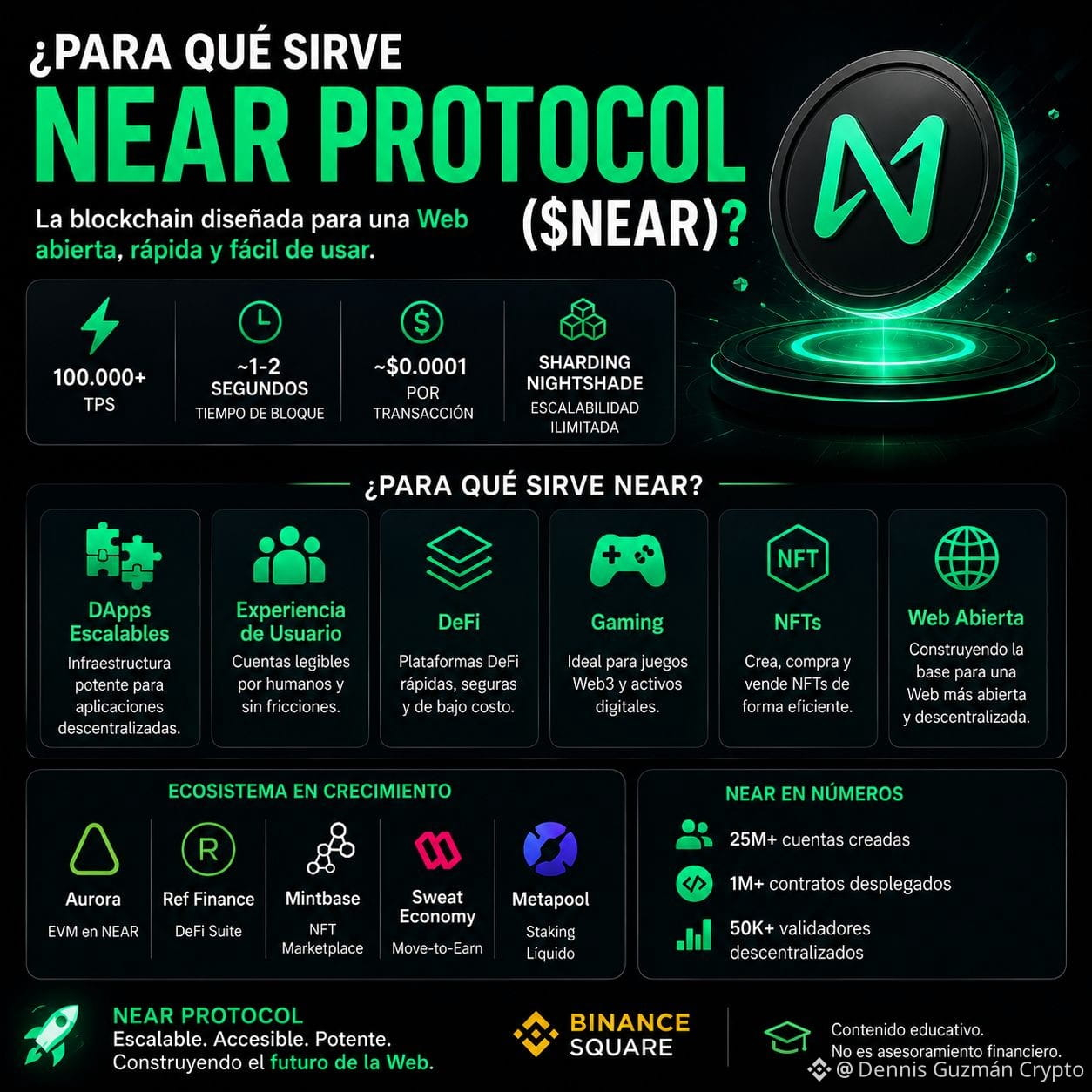
The infrastructure of Near Protocol ($NEAR ) in the development of Artificial Intelligence? Beyond speculation, its real technical utility is to serve as a decentralized layer for data availability and massive storage.
{future}(NEARUSDT)
The NEAR token is the essential fuel that smart software applications pay to securely and quickly log their historical data models on-chain, with drastically reduced costs compared to other traditional networks. #NEAR #DataAvailability #artificialintelligence
The infrastructure of Near Protocol ($NEAR ) in the development of Artificial Intelligence? Beyond speculation, its real technical utility is to serve as a decentralized layer for data availability and massive storage.
The NEAR token is the essential fuel that smart software applications pay to securely and quickly log their historical data models on-chain, with drastically reduced costs compared to other traditional networks. #NEAR #DataAvailability #artificialintelligence
The NEAR token is the essential fuel that smart software applications pay to securely and quickly log their historical data models on-chain, with drastically reduced costs compared to other traditional networks. #NEAR #DataAvailability #artificialintelligence
3
622


·
--
The Data Availability Wars Are Heating Up 🔥📊
Layer 2s need cheap places to store transaction data. The intense competition between Ethereum calldata, Celestia, EigenDA, and Avail is driving transaction costs down to zero.
#DataAvailability #Celestia #Layer2 #EthereumDA .
The Data Availability Wars Are Heating Up 🔥📊
Layer 2s need cheap places to store transaction data. The intense competition between Ethereum calldata, Celestia, EigenDA, and Avail is driving transaction costs down to zero.
#DataAvailability #Celestia #Layer2 #EthereumDA .
Layer 2s need cheap places to store transaction data. The intense competition between Ethereum calldata, Celestia, EigenDA, and Avail is driving transaction costs down to zero.
#DataAvailability #Celestia #Layer2 #EthereumDA .
186

·
--
Oh look, $TIA decided to do something! A 'technical breakout' they say. Meanwhile, the bears are still crying about token unlocks while whales are busy accumulating. V9 upgrade, faster blocks, more data – but don't tell the herd, they're too busy watching the 📉. Still waiting for their moon, aren't we? 🤡💅 #Modular #DataAvailability
Oh look, $TIA decided to do something! A 'technical breakout' they say. Meanwhile, the bears are still crying about token unlocks while whales are busy accumulating. V9 upgrade, faster blocks, more data – but don't tell the herd, they're too busy watching the 📉. Still waiting for their moon, aren't we? 🤡💅 #Modular #DataAvailability
30
·
--
Modular Blockchains Are Quietly Solving AI's Data Problem
The AI infrastructure boom has a hidden bottleneck: verifiable, tamper-proof data availability. Traditional cloud systems can't provide cryptographic guarantees that data used to train or run AI models hasn't been manipulated. Modular blockchains are quietly stepping in to fix that.
The modular thesis separates execution, consensus, and data availability into specialized layers. This isn't just a blockchain scalability play — it's foundational infrastructure for trustless AI pipelines. When an AI agent queries on-chain data, settles a trade, or triggers an automated action, the integrity of that data layer is everything.
$ETH's Danksharding roadmap expands blob throughput specifically to support high-frequency data posting — a prerequisite for AI agents operating at scale. $SOL's low-latency finality makes it the preferred settlement layer when AI agents need sub-second execution guarantees. $AVAX subnets offer isolated execution environments purpose-built for AI workloads with custom validator sets.
The next 24 months won't just see AI using crypto for payments. AI systems will use modular chains as their memory, audit trail, and coordination layer. The protocols that win won't necessarily have the most users — they'll have the most AI agents building on top of them.
Infrastructure always prices in last. This cycle, modular data availability might be the most underpriced primitive.
#Crypto #AI #ModularBlockchain #Web3 #DataAvailability
Modular Blockchains Are Quietly Solving AI's Data Problem
The AI infrastructure boom has a hidden bottleneck: verifiable, tamper-proof data availability. Traditional cloud systems can't provide cryptographic guarantees that data used to train or run AI models hasn't been manipulated. Modular blockchains are quietly stepping in to fix that.
The modular thesis separates execution, consensus, and data availability into specialized layers. This isn't just a blockchain scalability play — it's foundational infrastructure for trustless AI pipelines. When an AI agent queries on-chain data, settles a trade, or triggers an automated action, the integrity of that data layer is everything.
$ETH 's Danksharding roadmap expands blob throughput specifically to support high-frequency data posting — a prerequisite for AI agents operating at scale. $SOL 's low-latency finality makes it the preferred settlement layer when AI agents need sub-second execution guarantees. $AVAX subnets offer isolated execution environments purpose-built for AI workloads with custom validator sets.
The next 24 months won't just see AI using crypto for payments. AI systems will use modular chains as their memory, audit trail, and coordination layer. The protocols that win won't necessarily have the most users — they'll have the most AI agents building on top of them.
Infrastructure always prices in last. This cycle, modular data availability might be the most underpriced primitive.
#Crypto #AI #ModularBlockchain #Web3 #DataAvailability
The AI infrastructure boom has a hidden bottleneck: verifiable, tamper-proof data availability. Traditional cloud systems can't provide cryptographic guarantees that data used to train or run AI models hasn't been manipulated. Modular blockchains are quietly stepping in to fix that.
The modular thesis separates execution, consensus, and data availability into specialized layers. This isn't just a blockchain scalability play — it's foundational infrastructure for trustless AI pipelines. When an AI agent queries on-chain data, settles a trade, or triggers an automated action, the integrity of that data layer is everything.
$ETH 's Danksharding roadmap expands blob throughput specifically to support high-frequency data posting — a prerequisite for AI agents operating at scale. $SOL 's low-latency finality makes it the preferred settlement layer when AI agents need sub-second execution guarantees. $AVAX subnets offer isolated execution environments purpose-built for AI workloads with custom validator sets.
The next 24 months won't just see AI using crypto for payments. AI systems will use modular chains as their memory, audit trail, and coordination layer. The protocols that win won't necessarily have the most users — they'll have the most AI agents building on top of them.
Infrastructure always prices in last. This cycle, modular data availability might be the most underpriced primitive.
#Crypto #AI #ModularBlockchain #Web3 #DataAvailability
87

·
--
The foundational architecture of the decentralized internet is undergoing a massive structural decoupling. The legacy monolithic model—where a single base layer attempts to manage execution, settlement, consensus, and data availability simultaneously—has proven to be fundamentally unscalable and mathematically insolvent for global throughput.
Institutional capital is executing a definitive pivot away from these bottlenecked networks and directly into modular blockchain architecture. We are tracking a heavy capital rotation into dedicated Data Availability (DA) layers and customized rollup infrastructure.
By stripping the immense weight of raw transaction data off the execution layer and utilizing cryptographic proofs for verification, these protocols drastically reduce friction while exponentially increasing network capacity. The smart money is no longer betting on who will win the execution war; they are aggressively monopolizing the underlying modular plumbing that every single future application will be forced to rent.
$TIA $DYM $ALT
#Write2Earn #ModularBlockchain #DataAvailability #Infrastructure
The foundational architecture of the decentralized internet is undergoing a massive structural decoupling. The legacy monolithic model—where a single base layer attempts to manage execution, settlement, consensus, and data availability simultaneously—has proven to be fundamentally unscalable and mathematically insolvent for global throughput.
Institutional capital is executing a definitive pivot away from these bottlenecked networks and directly into modular blockchain architecture. We are tracking a heavy capital rotation into dedicated Data Availability (DA) layers and customized rollup infrastructure.
By stripping the immense weight of raw transaction data off the execution layer and utilizing cryptographic proofs for verification, these protocols drastically reduce friction while exponentially increasing network capacity. The smart money is no longer betting on who will win the execution war; they are aggressively monopolizing the underlying modular plumbing that every single future application will be forced to rent.
$TIA $DYM $ALT
#Write2Earn #ModularBlockchain #DataAvailability #Infrastructure
Institutional capital is executing a definitive pivot away from these bottlenecked networks and directly into modular blockchain architecture. We are tracking a heavy capital rotation into dedicated Data Availability (DA) layers and customized rollup infrastructure.
By stripping the immense weight of raw transaction data off the execution layer and utilizing cryptographic proofs for verification, these protocols drastically reduce friction while exponentially increasing network capacity. The smart money is no longer betting on who will win the execution war; they are aggressively monopolizing the underlying modular plumbing that every single future application will be forced to rent.
$TIA $DYM $ALT
#Write2Earn #ModularBlockchain #DataAvailability #Infrastructure

739
·
--
Modular data availability layers are optimizing how blockchains store transaction records to increase scalability and lower user fees.
Instead of forcing a single network to handle both computation and data storage developers offload storage to specialized chains, These layers use data availability sampling to prove that transaction data is accessible to anyone without requiring nodes to download entire datasets.
This architectural separation drastically reduces overhead and allows layer two rollups to process millions of transactions cheaply.
#DataAvailability #Celestia #ModularWeb3 #Scalability #RollupTech
Modular data availability layers are optimizing how blockchains store transaction records to increase scalability and lower user fees.
Instead of forcing a single network to handle both computation and data storage developers offload storage to specialized chains, These layers use data availability sampling to prove that transaction data is accessible to anyone without requiring nodes to download entire datasets.
This architectural separation drastically reduces overhead and allows layer two rollups to process millions of transactions cheaply.
#DataAvailability #Celestia #ModularWeb3 #Scalability #RollupTech
Instead of forcing a single network to handle both computation and data storage developers offload storage to specialized chains, These layers use data availability sampling to prove that transaction data is accessible to anyone without requiring nodes to download entire datasets.
This architectural separation drastically reduces overhead and allows layer two rollups to process millions of transactions cheaply.
#DataAvailability #Celestia #ModularWeb3 #Scalability #RollupTech
147

·
--
📡 Data Availability Is the Next Big Conversation
Scalability isn't only about processing transactions.
It's also about making blockchain data accessible and verifiable.
Projects like Avail are building data availability layers that help future blockchains become faster, lighter, and more efficient.
Sometimes the most important technology is the one users never notice.
$AVAIL
#AVAI #Blockchain #DataAvailability #Web3 #Innovation
📡 Data Availability Is the Next Big Conversation
Scalability isn't only about processing transactions.
It's also about making blockchain data accessible and verifiable.
Projects like Avail are building data availability layers that help future blockchains become faster, lighter, and more efficient.
Sometimes the most important technology is the one users never notice.
$AVAIL
#AVAI #Blockchain #DataAvailability #Web3 #Innovation
Scalability isn't only about processing transactions.
It's also about making blockchain data accessible and verifiable.
Projects like Avail are building data availability layers that help future blockchains become faster, lighter, and more efficient.
Sometimes the most important technology is the one users never notice.
$AVAIL
#AVAI #Blockchain #DataAvailability #Web3 #Innovation

1
213

🦈 $TIA JUST DELIVERED ITS STRONGEST MONTHLY REPORT CARD OF 2025 SO FAR 💥
Entry: 5.84 ⚡
Target: 7.85 🚀
Stop Loss: 5.10 ⚠️
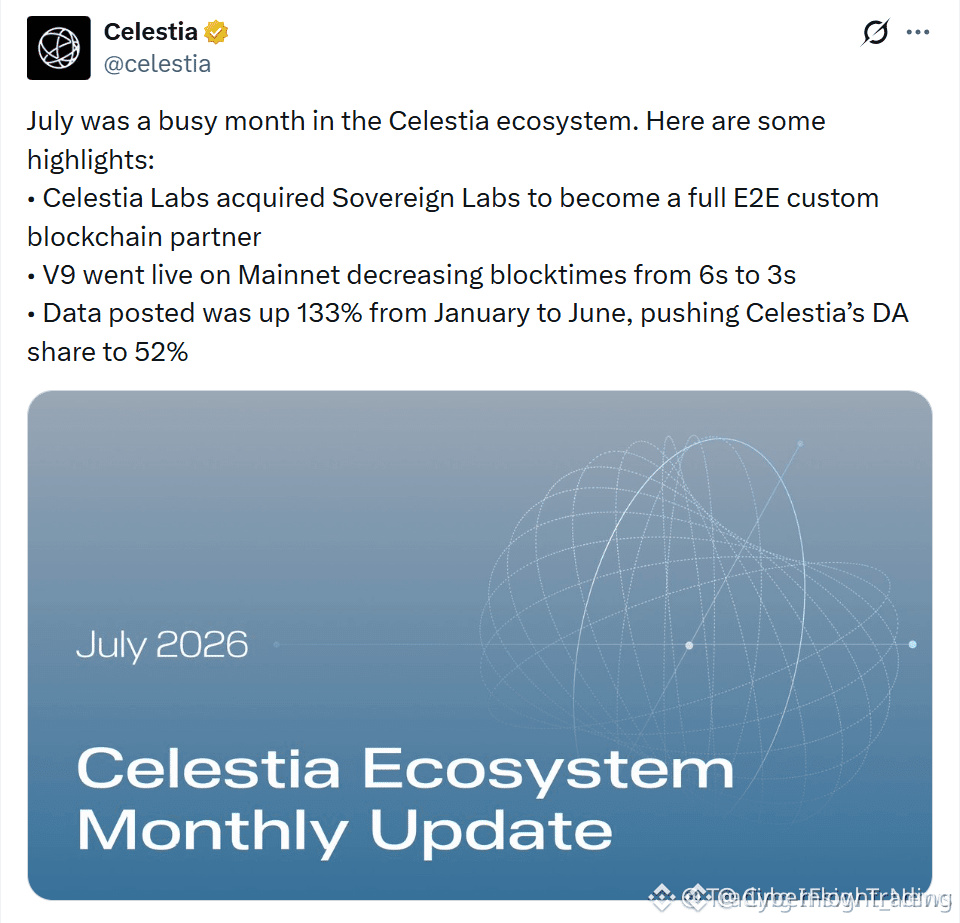
🚀 July wasn't just another month for Celestia — it was a total infrastructure upgrade. The Sovereign Labs acquisition expands their reach into custom rollups end-to-end, while the blocktime cut from 6s to 3s doubles the chain's throughput capacity overnight. 📊 That's the kind of velocity upgrade that separates L1s that compound from ones that fade.
🦈 Here's the number that grabbed my attention: DA share at 52% means more than half the on-chain data market flows through Celestia, backed by a 133% surge in uploads since January. 📌 When the underlying product is quietly capturing market share while the price consolidates, the bid usually catches up. 💬 The modular thesis is playing out — are you positioned for the DA dominance trade? 👇
⚠️ Not financial advice. Always manage your risk. 🛡️
🏷️ #TIA #Celestia #DataAvailability #ModularBlockchain #Crypto
🔥 💎
🦈 $TIA JUST DELIVERED ITS STRONGEST MONTHLY REPORT CARD OF 2025 SO FAR 💥
Entry: 5.84 ⚡
Target: 7.85 🚀
Stop Loss: 5.10 ⚠️
🚀 July wasn't just another month for Celestia — it was a total infrastructure upgrade. The Sovereign Labs acquisition expands their reach into custom rollups end-to-end, while the blocktime cut from 6s to 3s doubles the chain's throughput capacity overnight. 📊 That's the kind of velocity upgrade that separates L1s that compound from ones that fade.
🦈 Here's the number that grabbed my attention: DA share at 52% means more than half the on-chain data market flows through Celestia, backed by a 133% surge in uploads since January. 📌 When the underlying product is quietly capturing market share while the price consolidates, the bid usually catches up. 💬 The modular thesis is playing out — are you positioned for the DA dominance trade? 👇
⚠️ Not financial advice. Always manage your risk. 🛡️
🏷️ #TIA #Celestia #DataAvailability #ModularBlockchain #Crypto
🔥 💎
Entry: 5.84 ⚡
Target: 7.85 🚀
Stop Loss: 5.10 ⚠️
🚀 July wasn't just another month for Celestia — it was a total infrastructure upgrade. The Sovereign Labs acquisition expands their reach into custom rollups end-to-end, while the blocktime cut from 6s to 3s doubles the chain's throughput capacity overnight. 📊 That's the kind of velocity upgrade that separates L1s that compound from ones that fade.
🦈 Here's the number that grabbed my attention: DA share at 52% means more than half the on-chain data market flows through Celestia, backed by a 133% surge in uploads since January. 📌 When the underlying product is quietly capturing market share while the price consolidates, the bid usually catches up. 💬 The modular thesis is playing out — are you positioned for the DA dominance trade? 👇
⚠️ Not financial advice. Always manage your risk. 🛡️
🏷️ #TIA #Celestia #DataAvailability #ModularBlockchain #Crypto
🔥 💎
52

🌌 $0G Labs: The giant building the AI infrastructure 🚀
If market movements scare you, it’s because you don’t understand the fundamentals. Today, I want to summarize what Zero Gravity (0G) has achieved to date and why it’s a project that defines an era.
What is 0G in a nutshell?
It’s the first Decentralized AI Operating System. It’s not just storage; it’s a network designed for Artificial Intelligence to be fast, cheap, and, above all, sovereign.
📌 Key milestones to date (April 2026):
🤝 Heavyweight partnerships (Alibaba Cloud): The integration with Alibaba's infrastructure was no coincidence. 0G is proving that big tech trusts its Data Availability (DA) layer to scale AI applications.
⚡ Unprecedented speed: 0G has managed to process data at a speed of 50 GB per second. To give you an idea, it’s thousands of times faster than competitors like Celestia or EigenLayer. This is infrastructure for real-world AI!
🏗️ Expanding ecosystem: Since its launch, over 100 projects are already building on its testnet and mainnet, focusing on decentralized Language Models (LLM).
💰 Institutional backing: With over $35 million raised in pre-seed and seed rounds from funds like Hack VC and OKX Ventures, the financial muscle to keep developing is enormous.
🤖 AI security: They’ve implemented AI alignment nodes that ensure data is not only stored but also accurate, tackling the problem of AI "hallucinations" from the data foundation.
{spot}(0GUSDT)
Are you the type who looks at the 5-minute candlestick or the one who understands the coming infrastructure? 🤜🤛
#0GLabs #ZeroGravity #AI #CryptoInfrastructure #Web3 #BinanceSquare #AlibabaCloud #DataAvailability
🌌 $0G Labs: The giant building the AI infrastructure 🚀
If market movements scare you, it’s because you don’t understand the fundamentals. Today, I want to summarize what Zero Gravity (0G) has achieved to date and why it’s a project that defines an era.
What is 0G in a nutshell?
It’s the first Decentralized AI Operating System. It’s not just storage; it’s a network designed for Artificial Intelligence to be fast, cheap, and, above all, sovereign.
📌 Key milestones to date (April 2026):
🤝 Heavyweight partnerships (Alibaba Cloud): The integration with Alibaba's infrastructure was no coincidence. 0G is proving that big tech trusts its Data Availability (DA) layer to scale AI applications.
⚡ Unprecedented speed: 0G has managed to process data at a speed of 50 GB per second. To give you an idea, it’s thousands of times faster than competitors like Celestia or EigenLayer. This is infrastructure for real-world AI!
🏗️ Expanding ecosystem: Since its launch, over 100 projects are already building on its testnet and mainnet, focusing on decentralized Language Models (LLM).
💰 Institutional backing: With over $35 million raised in pre-seed and seed rounds from funds like Hack VC and OKX Ventures, the financial muscle to keep developing is enormous.
🤖 AI security: They’ve implemented AI alignment nodes that ensure data is not only stored but also accurate, tackling the problem of AI "hallucinations" from the data foundation.
Are you the type who looks at the 5-minute candlestick or the one who understands the coming infrastructure? 🤜🤛
#0GLabs #ZeroGravity #AI #CryptoInfrastructure #Web3 #BinanceSquare #AlibabaCloud #DataAvailability
If market movements scare you, it’s because you don’t understand the fundamentals. Today, I want to summarize what Zero Gravity (0G) has achieved to date and why it’s a project that defines an era.
What is 0G in a nutshell?
It’s the first Decentralized AI Operating System. It’s not just storage; it’s a network designed for Artificial Intelligence to be fast, cheap, and, above all, sovereign.
📌 Key milestones to date (April 2026):
🤝 Heavyweight partnerships (Alibaba Cloud): The integration with Alibaba's infrastructure was no coincidence. 0G is proving that big tech trusts its Data Availability (DA) layer to scale AI applications.
⚡ Unprecedented speed: 0G has managed to process data at a speed of 50 GB per second. To give you an idea, it’s thousands of times faster than competitors like Celestia or EigenLayer. This is infrastructure for real-world AI!
🏗️ Expanding ecosystem: Since its launch, over 100 projects are already building on its testnet and mainnet, focusing on decentralized Language Models (LLM).
💰 Institutional backing: With over $35 million raised in pre-seed and seed rounds from funds like Hack VC and OKX Ventures, the financial muscle to keep developing is enormous.
🤖 AI security: They’ve implemented AI alignment nodes that ensure data is not only stored but also accurate, tackling the problem of AI "hallucinations" from the data foundation.
Are you the type who looks at the 5-minute candlestick or the one who understands the coming infrastructure? 🤜🤛
#0GLabs #ZeroGravity #AI #CryptoInfrastructure #Web3 #BinanceSquare #AlibabaCloud #DataAvailability

2
2
8
902

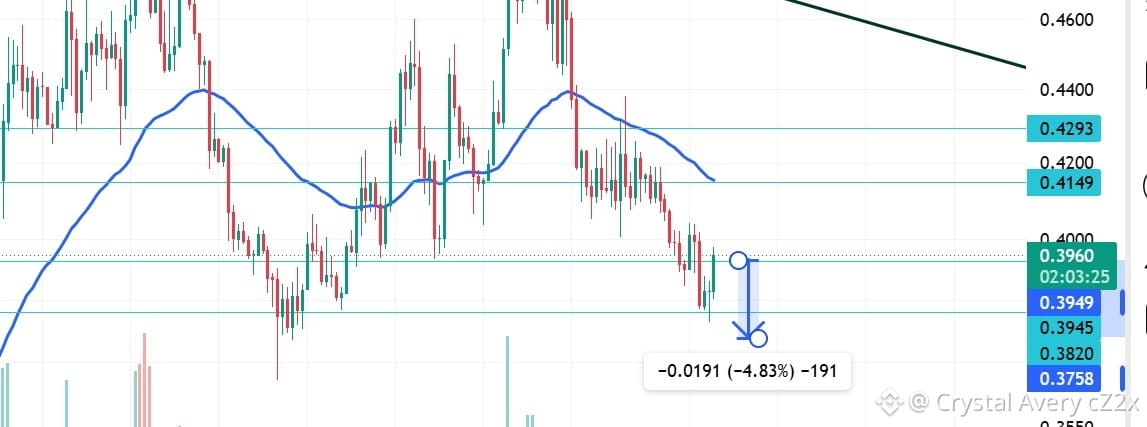
$TIA looking good for a scalp
Tia /usdt
buy at CMP
SL : 0.3755
TP:0.4125
amid #DataAvailability #NarrativeMomentum
$TIA looking good for a scalp
Tia /usdt
buy at CMP
SL : 0.3755
TP:0.4125
amid #DataAvailability #NarrativeMomentum
Tia /usdt
buy at CMP
SL : 0.3755
TP:0.4125
amid #DataAvailability #NarrativeMomentum
1
175

·
--
Bullish
Data availability just got a major upgrade 🚀! 🌟 @WalrusProtocol is building a scalable, secure solution for Web3 – and $WAL is leading the charge 💪. #walrus #crypto #DataAvailability
Data availability just got a major upgrade 🚀! 🌟 @Walrus 🦭/acc is building a scalable, secure solution for Web3 – and $WAL is leading the charge 💪. #walrus #crypto #DataAvailability
·
--
Bullish
Hey crypto fam! 🌟 @WalrusProtocol is building a decentralized data availability layer that's scalable, secure, and community-driven 🚀. $WAL is at the heart of it all! What's your take on data availability in Web3? 🌐 #walrus #crypto #DataAvailability
Hey crypto fam! 🌟 @Walrus 🦭/acc is building a decentralized data availability layer that's scalable, secure, and community-driven 🚀. $WAL is at the heart of it all! What's your take on data availability in Web3? 🌐 #walrus #crypto #DataAvailability
4

·
--
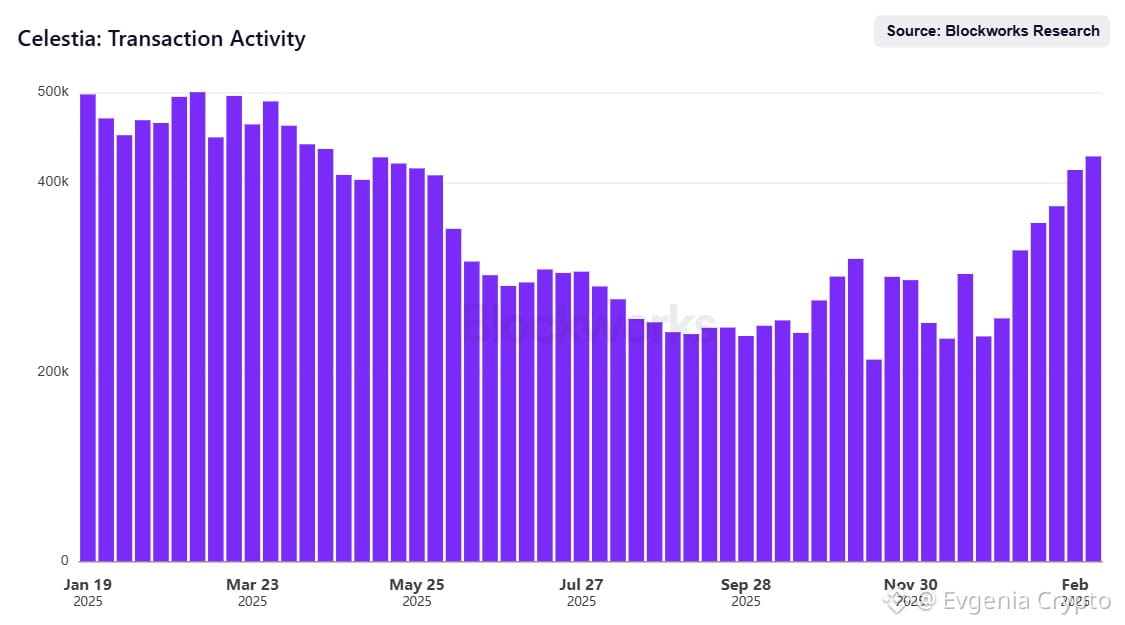
🤫 Hidden growth and Why $TIA is a sleeping giant?
While the market looks at the price, we look at on-chain data. 👇🥳🥳🥳🥳
A 60% increase in transactions over two months indicates that the Celestia ecosystem is becoming a "main artery" for L2 solutions.
When the activity converts into demand for the token, it will be too late to enter. 💯💯💯
{future}(TIAUSDT)
#TIA #DataAvailability #Web3 #Ecosystem
🤫 Hidden growth and Why $TIA is a sleeping giant?
While the market looks at the price, we look at on-chain data. 👇🥳🥳🥳🥳
A 60% increase in transactions over two months indicates that the Celestia ecosystem is becoming a "main artery" for L2 solutions.
When the activity converts into demand for the token, it will be too late to enter. 💯💯💯
#TIA #DataAvailability #Web3 #Ecosystem
While the market looks at the price, we look at on-chain data. 👇🥳🥳🥳🥳
A 60% increase in transactions over two months indicates that the Celestia ecosystem is becoming a "main artery" for L2 solutions.
When the activity converts into demand for the token, it will be too late to enter. 💯💯💯
#TIA #DataAvailability #Web3 #Ecosystem
3
1.2k

·
--
#walrus $WAL Walrus is disrupting the notion of decentralized storage by offering a scalable, verifiable, and economically viable solution for data availability in Web3 applications. Whether it is AI data sets, NFT media, or rollups, it is the answer to the biggest problem in blockchain: data storage. Infrastructure is the real alpha layer.🧊📦🔐
#Walrus #Web3Storage #DataAvailability @WalrusProtocol $WAL
#walrus $WAL Walrus is disrupting the notion of decentralized storage by offering a scalable, verifiable, and economically viable solution for data availability in Web3 applications. Whether it is AI data sets, NFT media, or rollups, it is the answer to the biggest problem in blockchain: data storage. Infrastructure is the real alpha layer.🧊📦🔐
#Walrus #Web3Storage #DataAvailability @Walrus 🦭/acc $WAL
#Walrus #Web3Storage #DataAvailability @Walrus 🦭/acc $WAL
2
3
63
·
--
Bearish
@WalrusProtocol is cooking up something 🔥! 🌟 $WAL is powering a data availability solution that's fast, secure, and community-led. Perfect for DeFi, gaming, and NFTs 🚀. #Walrus #Crypto #DataAvailability
@Walrus 🦭/acc is cooking up something 🔥! 🌟 $WAL is powering a data availability solution that's fast, secure, and community-led. Perfect for DeFi, gaming, and NFTs 🚀. #Walrus #Crypto #DataAvailability
·
--
Monolithic architecture is dead. Forcing a single blockchain to simultaneously handle execution, consensus, and data storage creates a massive computational bottleneck. When network demand spikes, the entire system chokes, driving gas fees to astronomical levels. Institutional capital will never deploy billions into an infrastructure layer that inevitably grinds to a halt under real-world load. It is the architectural equivalent of running a global financial system on a single dial-up server.
We are tracking a relentless, multi-billion dollar structural rotation into Modular Blockchain Architecture. Instead of forcing one network to do everything, the smart money is aggressively accumulating the protocols that mathematically unbundle the stack. Execution is pushed to specialized, lightning-fast off-chain environments, while decentralized Data Availability (DA) layers act as the ultimate, immutable anchor, guaranteeing that all transaction data is permanently verifiable at a fraction of the legacy cost.
This structural decoupling is the only mathematical path to infinite global scale without sacrificing decentralized security. The infrastructure protocols building these universal DA layers and specialized settlement engines are quietly becoming the foundational base layer for thousands of future rollups. They are no longer just blockchains; they are actively selling the foundational blockspace bandwidth that the entire next-generation digital economy requires to function.
$TIA $MANTA $DYM
#Write2Earn #ModularBlockchains #DataAvailability #Web3
Monolithic architecture is dead. Forcing a single blockchain to simultaneously handle execution, consensus, and data storage creates a massive computational bottleneck. When network demand spikes, the entire system chokes, driving gas fees to astronomical levels. Institutional capital will never deploy billions into an infrastructure layer that inevitably grinds to a halt under real-world load. It is the architectural equivalent of running a global financial system on a single dial-up server.
We are tracking a relentless, multi-billion dollar structural rotation into Modular Blockchain Architecture. Instead of forcing one network to do everything, the smart money is aggressively accumulating the protocols that mathematically unbundle the stack. Execution is pushed to specialized, lightning-fast off-chain environments, while decentralized Data Availability (DA) layers act as the ultimate, immutable anchor, guaranteeing that all transaction data is permanently verifiable at a fraction of the legacy cost.
This structural decoupling is the only mathematical path to infinite global scale without sacrificing decentralized security. The infrastructure protocols building these universal DA layers and specialized settlement engines are quietly becoming the foundational base layer for thousands of future rollups. They are no longer just blockchains; they are actively selling the foundational blockspace bandwidth that the entire next-generation digital economy requires to function.
$TIA $MANTA $DYM
#Write2Earn #ModularBlockchains #DataAvailability #Web3
We are tracking a relentless, multi-billion dollar structural rotation into Modular Blockchain Architecture. Instead of forcing one network to do everything, the smart money is aggressively accumulating the protocols that mathematically unbundle the stack. Execution is pushed to specialized, lightning-fast off-chain environments, while decentralized Data Availability (DA) layers act as the ultimate, immutable anchor, guaranteeing that all transaction data is permanently verifiable at a fraction of the legacy cost.
This structural decoupling is the only mathematical path to infinite global scale without sacrificing decentralized security. The infrastructure protocols building these universal DA layers and specialized settlement engines are quietly becoming the foundational base layer for thousands of future rollups. They are no longer just blockchains; they are actively selling the foundational blockspace bandwidth that the entire next-generation digital economy requires to function.
$TIA $MANTA $DYM
#Write2Earn #ModularBlockchains #DataAvailability #Web3

667

·
--
Article
Web3 Isn’t Slow — It’s Drowning in Data. Walrus Knows ItEveryone keeps arguing about faster blockchains, cheaper gas, and higher TPS. But there’s a problem most people prefer to ignore: Web3 is choking on its own data. Transactions are useless if the data behind them can’t be stored, retrieved, and verified at scale.
That’s why Walrus immediately caught my attention.
@WalrusProtocol isn’t another “decentralized cloud” pitch. It’s an infrastructure layer built specifically for data availability in Web3 — large files, media, archives, and historical blockchain data that most networks simply aren’t designed to handle. Instead of patching old models, Walrus treats heavy data as a first-class citizen.
What makes this approach powerful is its focus on availability under pressure. Data that exists but disappears when demand spikes is a hidden failure point. Walrus is engineered to keep data accessible even when networks are stressed — a critical requirement for rollups, DePIN systems, and next-generation dApps.
The market rarely prices infrastructure correctly in the early stages. $WAL doesn’t follow hype cycles, and that’s exactly why it’s interesting. Historically, the layers everything else depends on get recognized last — and revalued fastest.
If Web3 is serious about scaling beyond theory, projects like Walrus won’t be optional. They’ll be unavoidable.
#walrus #Web3 #DataAvailability #DePIN #crypto
Web3 Isn’t Slow — It’s Drowning in Data. Walrus Knows It
Everyone keeps arguing about faster blockchains, cheaper gas, and higher TPS. But there’s a problem most people prefer to ignore: Web3 is choking on its own data. Transactions are useless if the data behind them can’t be stored, retrieved, and verified at scale.
That’s why Walrus immediately caught my attention.
@Walrus 🦭/acc isn’t another “decentralized cloud” pitch. It’s an infrastructure layer built specifically for data availability in Web3 — large files, media, archives, and historical blockchain data that most networks simply aren’t designed to handle. Instead of patching old models, Walrus treats heavy data as a first-class citizen.
What makes this approach powerful is its focus on availability under pressure. Data that exists but disappears when demand spikes is a hidden failure point. Walrus is engineered to keep data accessible even when networks are stressed — a critical requirement for rollups, DePIN systems, and next-generation dApps.
The market rarely prices infrastructure correctly in the early stages. $WAL doesn’t follow hype cycles, and that’s exactly why it’s interesting. Historically, the layers everything else depends on get recognized last — and revalued fastest.
If Web3 is serious about scaling beyond theory, projects like Walrus won’t be optional. They’ll be unavoidable.
#walrus #Web3 #DataAvailability #DePIN #crypto
That’s why Walrus immediately caught my attention.
@Walrus 🦭/acc isn’t another “decentralized cloud” pitch. It’s an infrastructure layer built specifically for data availability in Web3 — large files, media, archives, and historical blockchain data that most networks simply aren’t designed to handle. Instead of patching old models, Walrus treats heavy data as a first-class citizen.
What makes this approach powerful is its focus on availability under pressure. Data that exists but disappears when demand spikes is a hidden failure point. Walrus is engineered to keep data accessible even when networks are stressed — a critical requirement for rollups, DePIN systems, and next-generation dApps.
The market rarely prices infrastructure correctly in the early stages. $WAL doesn’t follow hype cycles, and that’s exactly why it’s interesting. Historically, the layers everything else depends on get recognized last — and revalued fastest.
If Web3 is serious about scaling beyond theory, projects like Walrus won’t be optional. They’ll be unavoidable.
#walrus #Web3 #DataAvailability #DePIN #crypto
1
2
411
Log in to explore more content
Join global crypto users on Binance Square
⚡️ Get latest and useful information about crypto.
💬 Trusted by the world’s largest crypto exchange.
👍 Discover real insights from verified creators.
Email / Phone number
Trending Topics
1
#AnthropicCEOCallsForAISlowdown
120,535 views
2,047 Discussing
2
#RevolutDataLeakReportedlyPostedAttackersThreatenDailyReleases
760 views
30 Discussing
3
#BrazilCentralBankRaisesVASPCapitalRequirements
2,954 views
186 Discussing
4
#BitcoinThirdSingleBlockReorgInFourWeeks
29,961 views
842 Discussing
5
#EthereumFallsBelow$2500
2,499 views
83 Discussing
6
#BitcoinDropsToIntradayLow$76367
1,206 views
37 Discussing
7
#WhiteHouseRejectsAISlowdownCalls
14,253 views
362 Discussing
8
#UKMayExemptTokenizedGoldFromFundRules
7,961 views
245 Discussing
9
#BitcoinSpotETFsRecord$463MNetOutflowLastWeek
822 views
21 Discussing
10
#LSKSurgesOver515%In24Hours
27,809 views
431 Discussing