

#custodysync
custodysync
51 views
5 Discussing
Hot
Latest

·
--
Article
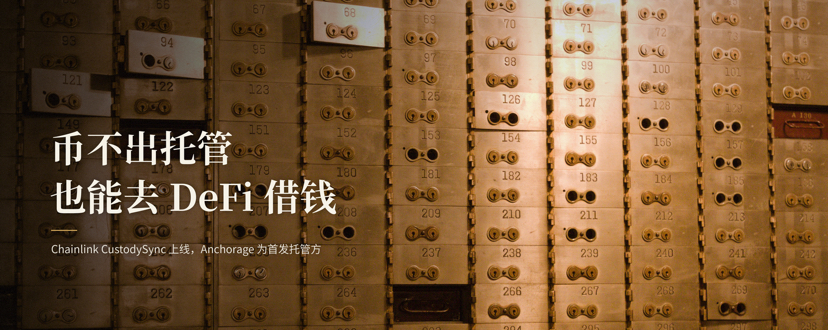
Institutions can now borrow in DeFi without moving their crypto out of custodyAt 12:16 a.m. Beijing time on October 27, Chainlink’s official account announced its new product, CustodySync, with Anchorage Digital Bank as its launch partner. Eleven minutes later, Anchorage posted to confirm the news. By 10 a.m., Chainlink’s post had received about 64,000 impressions.
1. What it aims to solve
A Chainlink blog post offered a comparison: digital asset custody totals about $700 billion, less than 0.5% of the $250 trillion in traditional asset custody. The same post says deposits in the DeFi lending market exceed $80 billion, with more than $30 billion in outstanding loans.
Institutions can now borrow in DeFi without moving their crypto out of custody
At 12:16 a.m. Beijing time on October 27, Chainlink’s official account announced its new product, CustodySync, with Anchorage Digital Bank as its launch partner. Eleven minutes later, Anchorage posted to confirm the news. By 10 a.m., Chainlink’s post had received about 64,000 impressions.
1. What it aims to solve
A Chainlink blog post offered a comparison: digital asset custody totals about $700 billion, less than 0.5% of the $250 trillion in traditional asset custody. The same post says deposits in the DeFi lending market exceed $80 billion, with more than $30 billion in outstanding loans.
59

·
--
Institutional participation in DeFi lending has often run into the same roadblock: assets must be held by a qualified custodian before they can be brought on-chain as collateral—forcing a choice between compliance and liquidity. On 10/26, Chainlink announced CustodySync, with U.S. federally chartered digital asset bank Anchorage Digital Bank, N.A. as its launch partner, aiming to turn that roadblock into a “bridge.”
The mechanism has three layers:
1) Assets remain in custody: custody balances are verifiable on-chain through Chainlink Proof of Reserve.
2) Only a transfer-restricted receipt token appears on-chain: its supply corresponds to the custodial collateral, and it does not represent a claim on the underlying assets outside this lending integration; borrowing, repayment, and interest accrual are recorded back to the custody ledger.
3) Both sides use the same prices to calculate LTV: Data Feeds + Data Streams provide identical values—to prevent “erroneous liquidations” or “liquidations that happen too late” when the two sides fall out of sync.
Liquidations are handled through a designated collateral agent (Anchorage Atlas). Figures cited in the official blog: approximately $700B in digital asset custody; DeFi lending deposits of >$80B and >$30B in loans outstanding.
Caveats: the official blog includes forward-looking statements; Chainlink Labs does not custody assets or act as a lending counterparty.
#Chainlink #CustodySync #Anchorage #DeFi
For informational purposes only; not investment advice / NFA
58

·
--
Assets Stay with the Custodian: Chainlink Connects Institutions to BorrowingInstitutions used to have to move assets out of custody before using them to borrow in DeFi. On October 26, Chainlink announced CustodySync. According to the company, qualified custodians can enable institutional clients to access DeFi lending while their assets remain in custody.
The first launch partner is Anchorage Digital Bank, N.A., integrated with its Atlas Collateral Management platform. The publicly described mechanism works roughly as follows: custody balances are brought on-chain using Chainlink Proof of Reserve; restricted-transfer receipt tokens represent the collateral on-chain; lending markets and custody systems use the same Chainlink price data to calculate LTV; and, in the event of default, a designated collateral agent handles the disposition under custody procedures, then syncs the transaction results back on-chain.
Assets Stay with the Custodian: Chainlink Connects Institutions to Borrowing
Institutions used to have to move assets out of custody before using them to borrow in DeFi. On October 26, Chainlink announced CustodySync. According to the company, qualified custodians can enable institutional clients to access DeFi lending while their assets remain in custody.
The first launch partner is Anchorage Digital Bank, N.A., integrated with its Atlas Collateral Management platform. The publicly described mechanism works roughly as follows: custody balances are brought on-chain using Chainlink Proof of Reserve; restricted-transfer receipt tokens represent the collateral on-chain; lending markets and custody systems use the same Chainlink price data to calculate LTV; and, in the event of default, a designated collateral agent handles the disposition under custody procedures, then syncs the transaction results back on-chain.
The first launch partner is Anchorage Digital Bank, N.A., integrated with its Atlas Collateral Management platform. The publicly described mechanism works roughly as follows: custody balances are brought on-chain using Chainlink Proof of Reserve; restricted-transfer receipt tokens represent the collateral on-chain; lending markets and custody systems use the same Chainlink price data to calculate LTV; and, in the event of default, a designated collateral agent handles the disposition under custody procedures, then syncs the transaction results back on-chain.
107

·
--
Institutions want to enter DeFi without moving assets out of custody accounts—Chainlink has built a bridge.
According to reports from PANews and others, Chainlink has launched CustodySync, which lets institutions participate in DeFi lending while their assets remain in the custody of a custodian. Anchorage Digital is the launch partner. The general approach is to use Proof of Reserve to provide on-chain proof of custodial balances, then issue tokenized claims that can be used as collateral, rather than transferring the underlying assets directly to self-custody wallets.
How to read this: The key point isn’t “yet another collateral narrative,” but who is responsible for custody, on-chain proof, and lending liquidations. Proof of Reserve makes balances visible; it doesn’t eliminate counterparty risk. Redemption and unbonding delays, oracles, and liquidation parameters also warrant close attention. For traditional financial ledgers, this is an entry point at the pilot stage; for on-chain protocols, the question is whether this incremental source of collateral is sustainable.
#Chainlink #CustodySync #DeFi #Institutions
14
Log in to explore more content
Join global crypto users on Binance Square
⚡️ Get latest and useful information about crypto.
💬 Trusted by the world’s largest crypto exchange.
👍 Discover real insights from verified creators.
Email / Phone number
Trending Topics
1
#FOMCWatch
8.9M views
26,673 Discussing
2
#EthereumDropsBelow$2300
2,443 views
92 Discussing
3
#BitcoinSlipsBelow$80KAgain
7,407 views
59 Discussing
4
#ThailandLaunchesWORPTStablecoinToQRPaymentApp
13,115 views
301 Discussing
5
#StrategySkipsBitcoinPurchasesSpends$205MOnSTRCBuybacks
4,976 views
79 Discussing
6
#BitmineAdds10452ETH
50,611 views
730 Discussing
7
#SouthKoreaConsidersEducationTaxOnCryptoExchanges
28,971 views
559 Discussing
8
#OCCUrgesCommunityBanksToEnterStablecoinPayments
22,519 views
394 Discussing
9
#RippleWinsFullApprovalAsNationalTrustBank
32,421 views
391 Discussing
10
#AkashSelectsSolanaAsMigrationTarget
13,363 views
189 Discussing