
#bakong
bakong
224 views
3 Discussing
Hot
Latest

·
--
Article
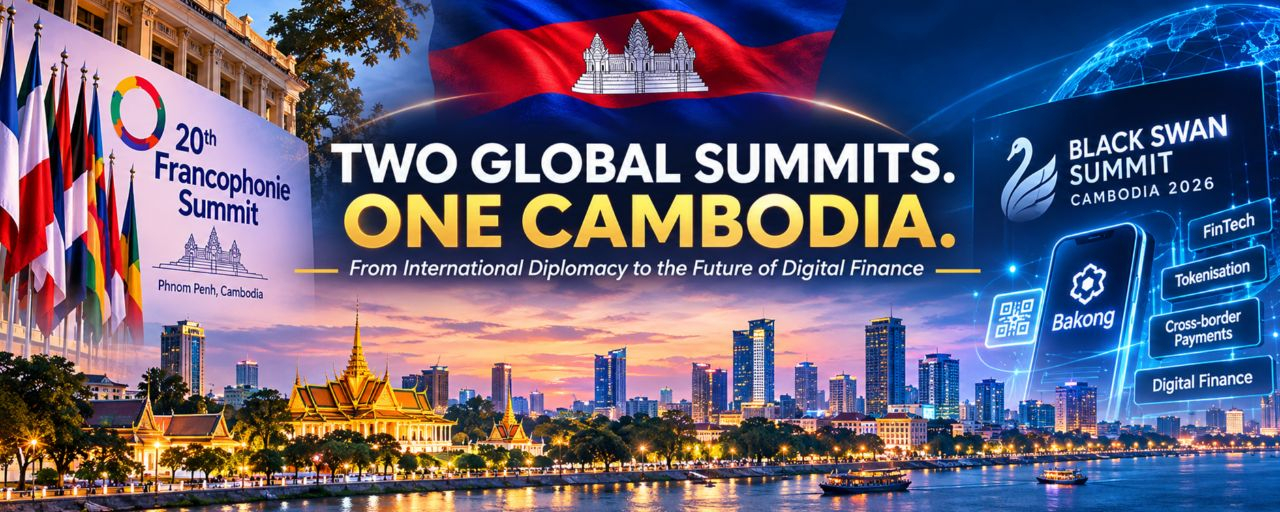
Two Global Summits, One Cambodia: From International Diplomacy to the Future of Digital FinanceThe world came to Phnom Penh for two major international gatherings. But beyond the ceremonies, speeches and diplomatic meetings, something more interesting was happening: Cambodia was stepping into a bigger conversation about the future of global cooperation, financial infrastructure and technology.
November 2026 has been an important moment for Cambodia.
Within just a few days, Phnom Penh became the host city for two major international events: the 20th Francophonie Summit and the inaugural Black Swan Summit Cambodia 2026.
At first glance, these events seem to belong to completely different worlds.
One focuses on diplomacy, language, culture and international cooperation. The other brings together central banks, financial institutions, technology companies, investors and fintech innovators.
But look closer, and there is an interesting connection.
Both events put Cambodia at the centre of conversations about how countries can build stronger international relationships and prepare for the next generation of economic development.
1. Francophonie: Cambodia on the international diplomatic stage
From November 14–16, Phnom Penh hosted the 20th Francophonie Summit, marking the first time Cambodia has hosted this major gathering.
Under the theme "Reinvest in Peace for Shared Prosperity and Lasting Stability," the summit brought together leaders and representatives from across the French-speaking world.
French President Emmanuel Macron was among the prominent international leaders attending.
For Cambodia, this was more than a diplomatic gathering. It was an opportunity to showcase its history, culture, economic potential and growing international engagement.
The summit also created opportunities beyond political discussions:
Strengthening diplomatic relationships with countries across five continents.Expanding trade, investment and business cooperation.Promoting Cambodian culture and heritage internationally.Encouraging cooperation in education, science and technology.Connecting Francophone economies with ASEAN and the wider Asia-Pacific region.
One particularly interesting outcome was the establishment of a Francophone economic cooperation office in Phnom Penh, intended to strengthen connections with ASEAN and the Pacific.
The summit adopted three key documents: the Phnom Penh Declaration, a resolution on crisis recovery and peacebuilding, and the Phnom Penh Appeal on cultural heritage and diversity.
These are important developments because international relationships should not end when visiting leaders leave the country. They should create opportunities for long-term cooperation.
2. Black Swan Summit: Cambodia's financial infrastructure enters the global conversation
While Francophonie focused on international cooperation, another major gathering was exploring a different question:
Can emerging economies build the financial systems of tomorrow instead of simply inheriting those designed by others?
That was one of the central ideas behind Black Swan Summit Cambodia 2026, held on November 15–16.
Co-hosted by the National Bank of Cambodia (NBC) and the Global Finance & Technology Network (GFTN), the summit brought together financial policymakers, central bankers, fintech leaders, investors and technology innovators.
More than 5,000 participants registered from 60 countries, according to the organisers.
And Cambodia had something meaningful to bring to the discussion: Bakong.
Bakong: A Cambodian financial technology story
Cambodia's Bakong system demonstrates how a country can develop its own digital payment infrastructure.
In 2025, Bakong processed approximately $241.84 billion in transaction volume, equivalent to around six times Cambodia's GDP.
Even more interesting, 58% of the transactions were settled in Khmer Riel, compared with 17% in 2020.
These figures show the scale of activity running through the payment ecosystem and the increasing role of the national currency.
Bakong is not simply another payment application. It is blockchain-based financial infrastructure connecting banks and payment providers, supporting Cambodia's national QR-payment ecosystem.
Its development also reflects a broader ambition: making domestic payments more accessible while expanding international connectivity.
The announcements that caught my attention
Black Swan Summit was not just about discussing the future. It also showcased initiatives intended to connect Cambodia's financial infrastructure with international markets.
Some notable developments included:
Japan: Stablecoin and bond tokenisation pilot initiatives.Rwanda: A proposed remittance corridor connecting Cambodia and Africa.International payments: Initiatives to expand Bakong's international payment reach.
Think about the implications.
A Cambodian payment ecosystem connecting with African financial networks and Japanese financial technology initiatives creates possibilities beyond traditional regional payment partnerships.
It could open new pathways for remittances, small-value trade, cross-border payments and financial cooperation between emerging economies.
This is where the conversation becomes particularly interesting for anyone following blockchain and digital finance.
3. The bigger picture: Connecting ASEAN with the Francophone world
Here is where these two summits become particularly interesting together.
Francophonie connects Cambodia with a broad international community, including countries in Africa, Europe and beyond.
Black Swan explores how financial infrastructure and technology can connect economies across borders.
Put these two developments together, and a bigger opportunity emerges.
Imagine a future where:
A Cambodian business can receive payments more easily from customers in African markets.Remittance corridors make sending money across borders faster and more affordable.Digital payment infrastructure supports trade between ASEAN and Francophone economies.Financial technology companies from emerging markets collaborate instead of competing in isolation.Cambodian startups gain access to new international partnerships and investment opportunities.
These are opportunities to pursue, not outcomes guaranteed by hosting a summit.
But the direction of discussion matters.
For decades, many developing economies have relied heavily on financial infrastructure designed and operated elsewhere.
Now, countries are exploring how to build systems around their own economic realities while remaining connected to the global financial ecosystem.
Cambodia is becoming part of that conversation.
4. What does this mean for Cambodia's next generation?
International summits are valuable, but their real impact should be measured by what happens after the events.
For me, there are three areas worth watching.
First: Economic opportunities.
Diplomatic relationships should translate into business partnerships, investment, employment and opportunities for local entrepreneurs.
Second: Technology and financial inclusion.
Bakong demonstrates that digital infrastructure can play an important role in connecting people, businesses and financial institutions.
The next challenge is expanding access, improving interoperability and ensuring that innovation benefits ordinary people.
Third: Global competitiveness.
Cambodia should not only aim to attract international attention. It should develop the talent, businesses and infrastructure needed to participate in the industries shaping the future.
AI, blockchain, digital payments, tokenisation and cross-border financial technology are no longer distant concepts. They are becoming part of the global economic landscape.
Young Cambodians should pay attention.
5. The real question is what happens next
Hosting the Francophonie Summit and Black Swan Summit within the same period sends an interesting signal.
Cambodia is engaging with the world through two different but complementary channels: diplomacy and financial innovation.
One builds relationships between nations. The other explores the infrastructure that could connect their economies.
Neither summit alone will transform Cambodia overnight.
The real test will be whether the discussions, agreements and initiatives turn into practical cooperation, investment, technology adoption and opportunities for ordinary Cambodians.
But one thing is clear: Cambodia has a seat at these international discussions, and it should make the most of it.
The next chapter should not simply be about hosting the world. It should be about building something with the world.
🇰🇭 Cambodia is more than a destination. It can be a bridge between regions, economies and the next generation of digital innovation.
What do you think? Can Cambodia turn this international attention into a meaningful role in the future of global finance and technology?
#Cambodia #Francophonie2026 #BlackSwanSummit #Bakong #fintech
Two Global Summits, One Cambodia: From International Diplomacy to the Future of Digital Finance
The world came to Phnom Penh for two major international gatherings. But beyond the ceremonies, speeches and diplomatic meetings, something more interesting was happening: Cambodia was stepping into a bigger conversation about the future of global cooperation, financial infrastructure and technology.
November 2026 has been an important moment for Cambodia.
Within just a few days, Phnom Penh became the host city for two major international events: the 20th Francophonie Summit and the inaugural Black Swan Summit Cambodia 2026.
At first glance, these events seem to belong to completely different worlds.
One focuses on diplomacy, language, culture and international cooperation. The other brings together central banks, financial institutions, technology companies, investors and fintech innovators.
But look closer, and there is an interesting connection.
Both events put Cambodia at the centre of conversations about how countries can build stronger international relationships and prepare for the next generation of economic development.
1. Francophonie: Cambodia on the international diplomatic stage
From November 14–16, Phnom Penh hosted the 20th Francophonie Summit, marking the first time Cambodia has hosted this major gathering.
Under the theme "Reinvest in Peace for Shared Prosperity and Lasting Stability," the summit brought together leaders and representatives from across the French-speaking world.
French President Emmanuel Macron was among the prominent international leaders attending.
For Cambodia, this was more than a diplomatic gathering. It was an opportunity to showcase its history, culture, economic potential and growing international engagement.
The summit also created opportunities beyond political discussions:
Strengthening diplomatic relationships with countries across five continents.Expanding trade, investment and business cooperation.Promoting Cambodian culture and heritage internationally.Encouraging cooperation in education, science and technology.Connecting Francophone economies with ASEAN and the wider Asia-Pacific region.
One particularly interesting outcome was the establishment of a Francophone economic cooperation office in Phnom Penh, intended to strengthen connections with ASEAN and the Pacific.
The summit adopted three key documents: the Phnom Penh Declaration, a resolution on crisis recovery and peacebuilding, and the Phnom Penh Appeal on cultural heritage and diversity.
These are important developments because international relationships should not end when visiting leaders leave the country. They should create opportunities for long-term cooperation.
2. Black Swan Summit: Cambodia's financial infrastructure enters the global conversation
While Francophonie focused on international cooperation, another major gathering was exploring a different question:
Can emerging economies build the financial systems of tomorrow instead of simply inheriting those designed by others?
That was one of the central ideas behind Black Swan Summit Cambodia 2026, held on November 15–16.
Co-hosted by the National Bank of Cambodia (NBC) and the Global Finance & Technology Network (GFTN), the summit brought together financial policymakers, central bankers, fintech leaders, investors and technology innovators.
More than 5,000 participants registered from 60 countries, according to the organisers.
And Cambodia had something meaningful to bring to the discussion: Bakong.
Bakong: A Cambodian financial technology story
Cambodia's Bakong system demonstrates how a country can develop its own digital payment infrastructure.
In 2025, Bakong processed approximately $241.84 billion in transaction volume, equivalent to around six times Cambodia's GDP.
Even more interesting, 58% of the transactions were settled in Khmer Riel, compared with 17% in 2020.
These figures show the scale of activity running through the payment ecosystem and the increasing role of the national currency.
Bakong is not simply another payment application. It is blockchain-based financial infrastructure connecting banks and payment providers, supporting Cambodia's national QR-payment ecosystem.
Its development also reflects a broader ambition: making domestic payments more accessible while expanding international connectivity.
The announcements that caught my attention
Black Swan Summit was not just about discussing the future. It also showcased initiatives intended to connect Cambodia's financial infrastructure with international markets.
Some notable developments included:
Japan: Stablecoin and bond tokenisation pilot initiatives.Rwanda: A proposed remittance corridor connecting Cambodia and Africa.International payments: Initiatives to expand Bakong's international payment reach.
Think about the implications.
A Cambodian payment ecosystem connecting with African financial networks and Japanese financial technology initiatives creates possibilities beyond traditional regional payment partnerships.
It could open new pathways for remittances, small-value trade, cross-border payments and financial cooperation between emerging economies.
This is where the conversation becomes particularly interesting for anyone following blockchain and digital finance.
3. The bigger picture: Connecting ASEAN with the Francophone world
Here is where these two summits become particularly interesting together.
Francophonie connects Cambodia with a broad international community, including countries in Africa, Europe and beyond.
Black Swan explores how financial infrastructure and technology can connect economies across borders.
Put these two developments together, and a bigger opportunity emerges.
Imagine a future where:
A Cambodian business can receive payments more easily from customers in African markets.Remittance corridors make sending money across borders faster and more affordable.Digital payment infrastructure supports trade between ASEAN and Francophone economies.Financial technology companies from emerging markets collaborate instead of competing in isolation.Cambodian startups gain access to new international partnerships and investment opportunities.
These are opportunities to pursue, not outcomes guaranteed by hosting a summit.
But the direction of discussion matters.
For decades, many developing economies have relied heavily on financial infrastructure designed and operated elsewhere.
Now, countries are exploring how to build systems around their own economic realities while remaining connected to the global financial ecosystem.
Cambodia is becoming part of that conversation.
4. What does this mean for Cambodia's next generation?
International summits are valuable, but their real impact should be measured by what happens after the events.
For me, there are three areas worth watching.
First: Economic opportunities.
Diplomatic relationships should translate into business partnerships, investment, employment and opportunities for local entrepreneurs.
Second: Technology and financial inclusion.
Bakong demonstrates that digital infrastructure can play an important role in connecting people, businesses and financial institutions.
The next challenge is expanding access, improving interoperability and ensuring that innovation benefits ordinary people.
Third: Global competitiveness.
Cambodia should not only aim to attract international attention. It should develop the talent, businesses and infrastructure needed to participate in the industries shaping the future.
AI, blockchain, digital payments, tokenisation and cross-border financial technology are no longer distant concepts. They are becoming part of the global economic landscape.
Young Cambodians should pay attention.
5. The real question is what happens next
Hosting the Francophonie Summit and Black Swan Summit within the same period sends an interesting signal.
Cambodia is engaging with the world through two different but complementary channels: diplomacy and financial innovation.
One builds relationships between nations. The other explores the infrastructure that could connect their economies.
Neither summit alone will transform Cambodia overnight.
The real test will be whether the discussions, agreements and initiatives turn into practical cooperation, investment, technology adoption and opportunities for ordinary Cambodians.
But one thing is clear: Cambodia has a seat at these international discussions, and it should make the most of it.
The next chapter should not simply be about hosting the world. It should be about building something with the world.
🇰🇭 Cambodia is more than a destination. It can be a bridge between regions, economies and the next generation of digital innovation.
What do you think? Can Cambodia turn this international attention into a meaningful role in the future of global finance and technology?
#Cambodia #Francophonie2026 #BlackSwanSummit #Bakong #fintech
4
234
Log in to explore more content
Join global crypto users on Binance Square
⚡️ Get latest and useful information about crypto.
💬 Trusted by the world’s largest crypto exchange.
👍 Discover real insights from verified creators.
Email / Phone number
Trending Topics
1
#NvidiaBeatsEstimatesAICloudStocksRiseAfterHours
6,539 views
83 Discussing
2
#A Packed Week of Earnings and Data Tests Markets
154,162 views
668 Discussing
3
#AnthropicIPOTestsInvestorAppetiteForAI
340,344 views
2,942 Discussing
4
#NvidiaBoardNotConsideringHuang’sReturnasCEO
130,114 views
1,004 Discussing
5
#KOSPIFalls2.59%ToLowestCloseSinceFebruary
34,383 views
342 Discussing
6
#AnthropicClearedToListOnNasdaqAsANT
28,703 views
284 Discussing
7
#WhatInvestmentSignalsDo13FFilingsReveal?
70,891 views
682 Discussing
8
#TetherCapitalMakesStrategicInvestmentInStables
16,130 views
122 Discussing
9
#EvernorthRecords$505MImpairmentOnPreListingXRP
2,000 views
21 Discussing
10
#GoldmanSachsReports$1.22BInEtherETFHoldings
1,413 views
17 Discussing