

#afrique
afrique
14,393 views
198 Discussing
Hot
Latest
·
--
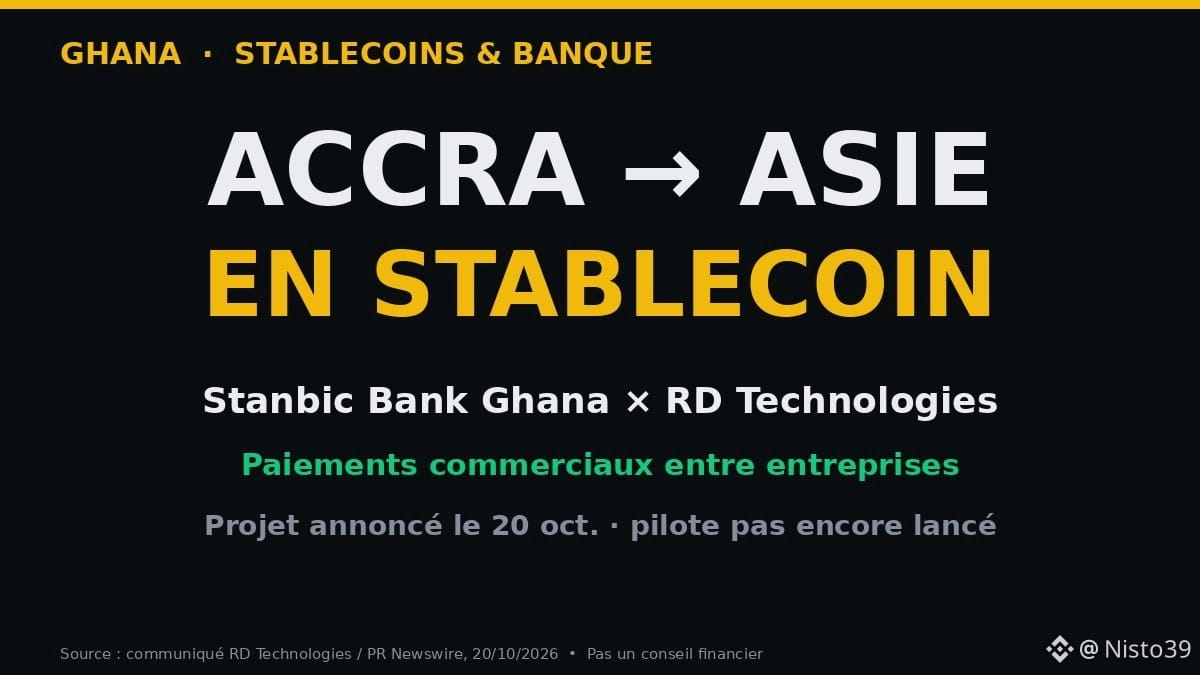
🇬🇭 Pay a supplier in China from Accra… in stablecoin, but through your bank? That’s the project announced in Ghana.
📌 The facts (20 October 2026)
• Stanbic Bank Ghana and RD Technologies (Hong Kong) are studying a system for settling commercial payments Ghana → Asia based on stablecoin technology
• Target: business-to-business payments (Ghanaian importers to Asian suppliers)
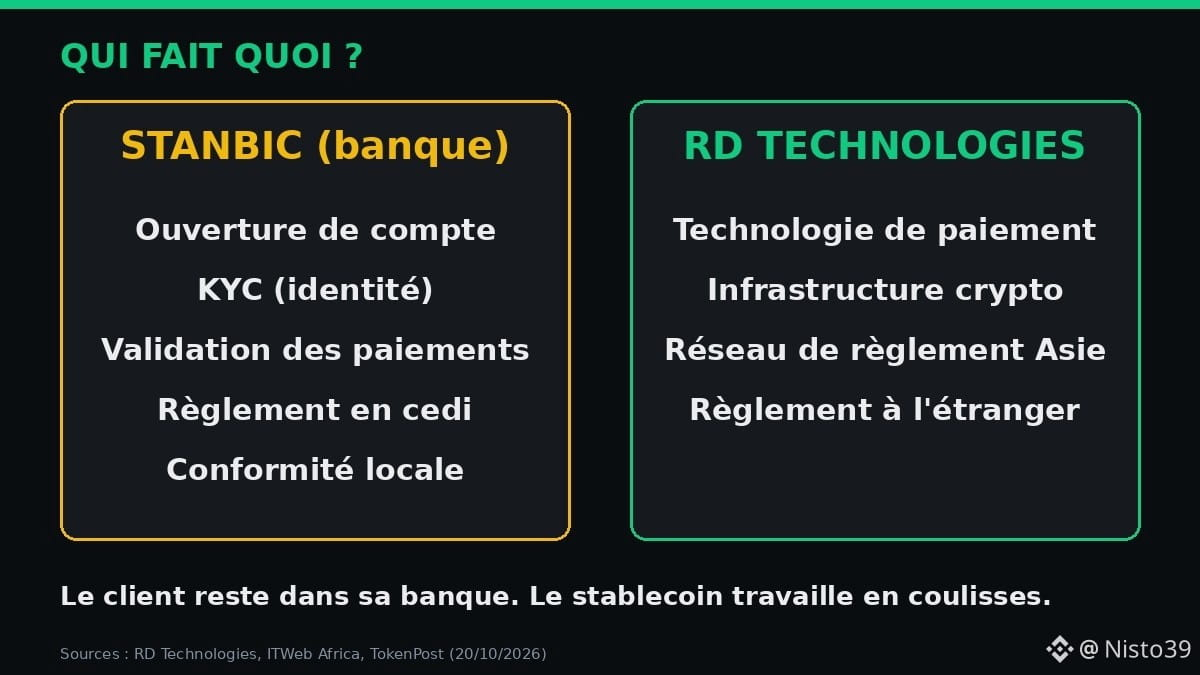
• The bank keeps the customer relationship: account opening, KYC (identity verification), payment validation, settlement in cedi
• RD Technologies provides the crypto infrastructure and its settlement network in Asia
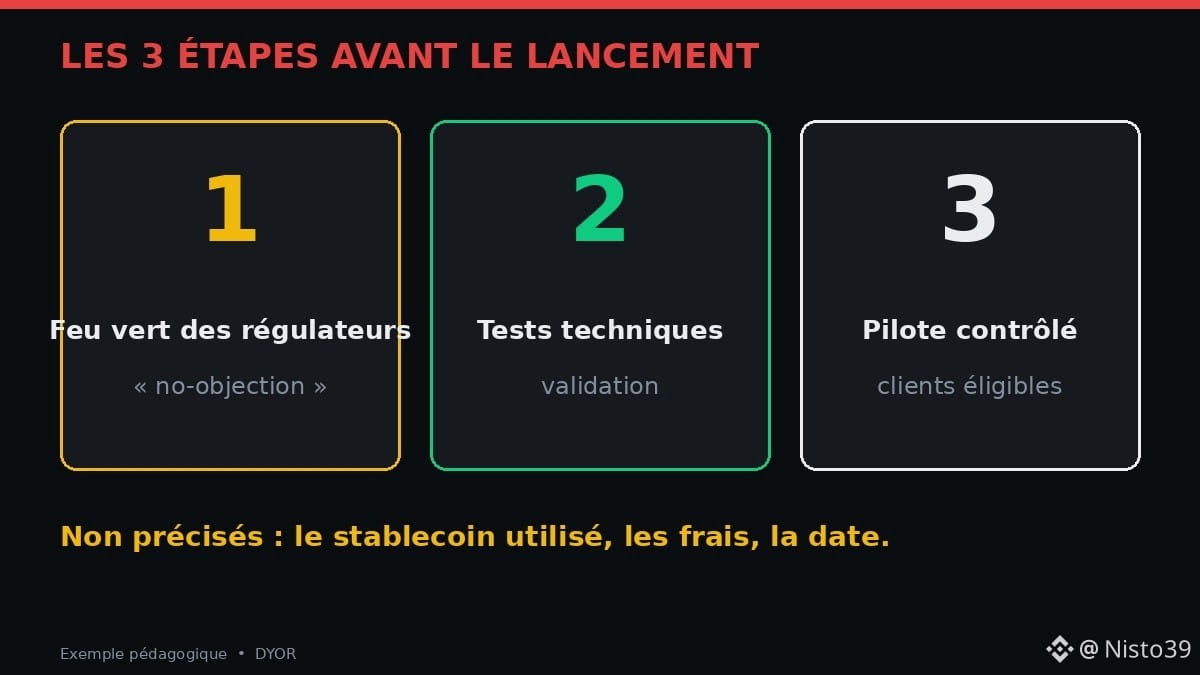
• Not launched yet: it first needs a “no-objection” (green light) from regulators, then tests and a controlled pilot
🔍 Why does it matter?
Today, a transfer from Accra → Guangzhou often passes through several intermediary banks (correspondent banks), often in dollars. Each step takes time, costs money, and makes tracking unclear. A stablecoin (a token that tracks the value of a currency like the dollar) can make the journey in a single step, 24/7.
⚖️ Nuance
• The stablecoin used has not been specified
• No fee or timing figures have been announced
• This is not a service for individuals, nor a launch date
👤 Akosua (fictional character) imports motorcycle parts to Kumasi. If the pilot goes ahead, she would still pay from her bank account in cedis, without handling crypto herself. The blockchain would work behind the scenes.
💡 The real change: crypto entering the bank, instead of staying informal.
💬 Would you rather pay your foreign suppliers 🏦 through the bank or 📱 directly in stablecoin? 👇
Not financial advice. DYOR.
Sources: RD Technologies press release / PR Newswire (20/10), ITWeb Africa (20/10), TokenPost (20/10).
$USDT #CryptoNews #Ghana #Africa
23
·
--
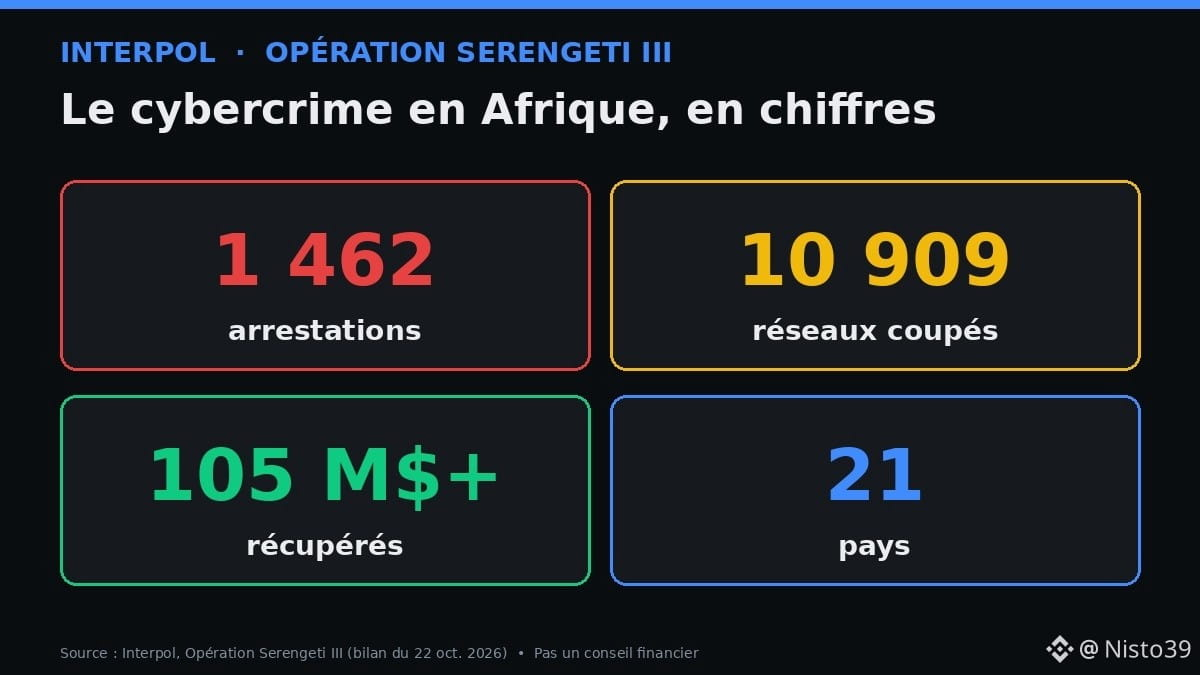
🚨 1 462 arrests, 10 909 malicious networks taken down, and more than 105 million $ recovered. Interpol has just released the report on one of the largest anti-cybercrime operations ever carried out in Africa.
📌 The facts (Operation Serengeti III, report published on Oct. 22, 2026)
• 21 countries, from June 29 to August 31, 2026
• 65,929 victims identified, with more than 385 M$ in related losses
• Uganda: 365 foreign nationals arrested, fake trading sites targeting retirees in Asia
• Angola: 2 illegal crypto mining centers shut down, more than 2,000 machines seized (electricity stolen via 6 rogue transformers)
• Nigeria: an investment scam via messaging apps, more than 2.4 M$ moved, largely laundered in crypto
🧠 How do these scams work?
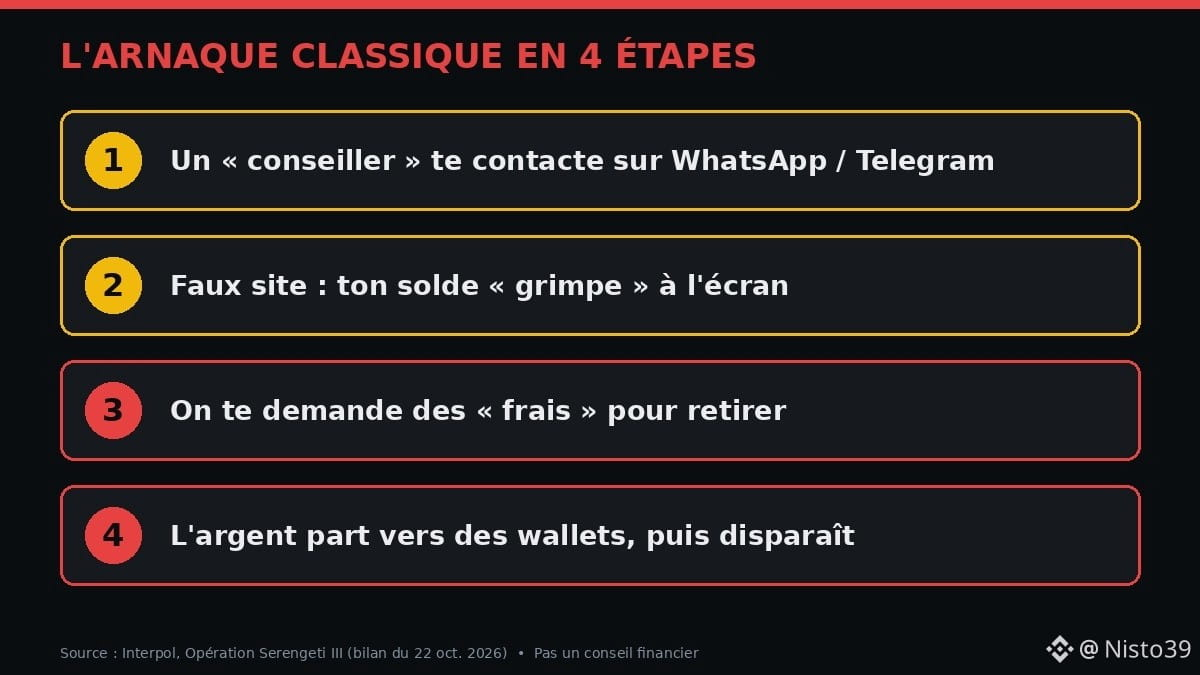
An “advisor” contacts you on WhatsApp or Telegram, shows you a fake site where your balance keeps rising, then asks you for “fees” to withdraw. The money goes to a wallet, and crypto is then used to move it quickly between multiple addresses.
👤 Imagine Grâce (fictional character), a shopkeeper in Pointe-Noire. She is promised 30% per month on $USDT. Her screen shows profits... which she will never be able to withdraw. The blockchain is not the scam: the fake middleman is.
⚖️ Nuances
• Arresting suspects does not mean victims will be reimbursed
• Transactions are public: this is also what helps investigators trace the funds
• Several investigations are still open; the figures may change
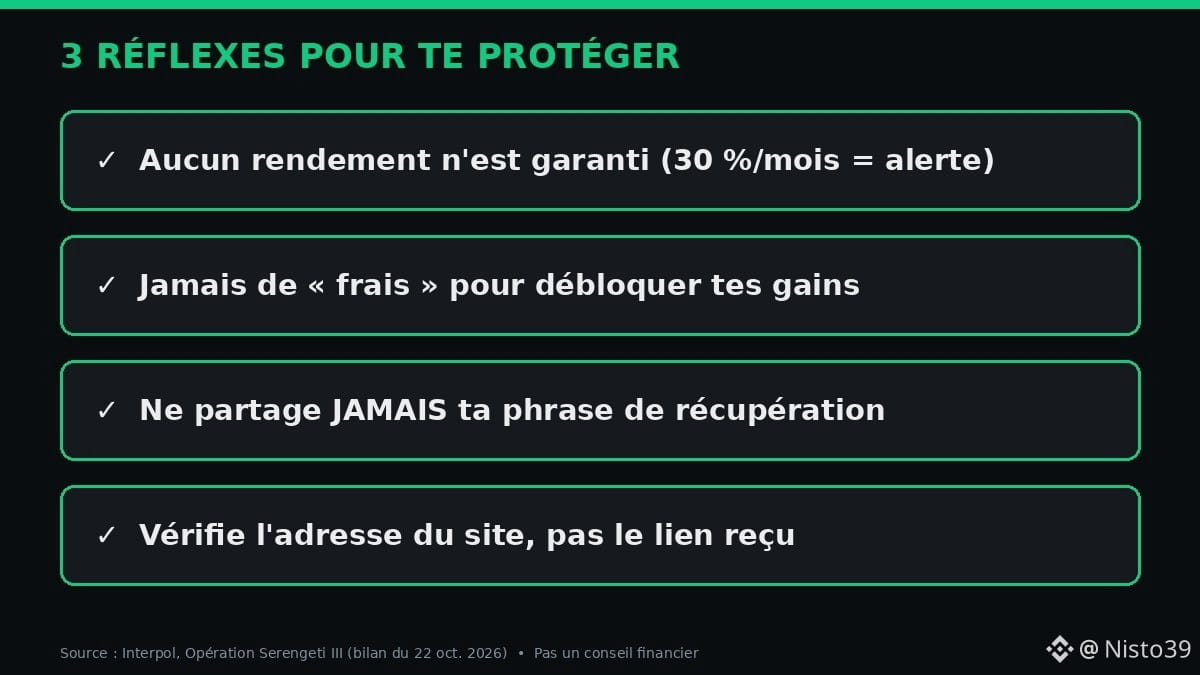
🛡️ Simple rule: no guaranteed returns, never any “fee to unlock” your profits, and never share your recovery phrase.
💬 Have you ever received this kind of message? 🟢 Yes / 🔴 Never 👇
Not financial advice. DYOR.
Sources: Interpol (Oct. 22, 2026), Decrypt, Group-IB.
#CryptoNews #Afrique #Arnaque
18
·
--
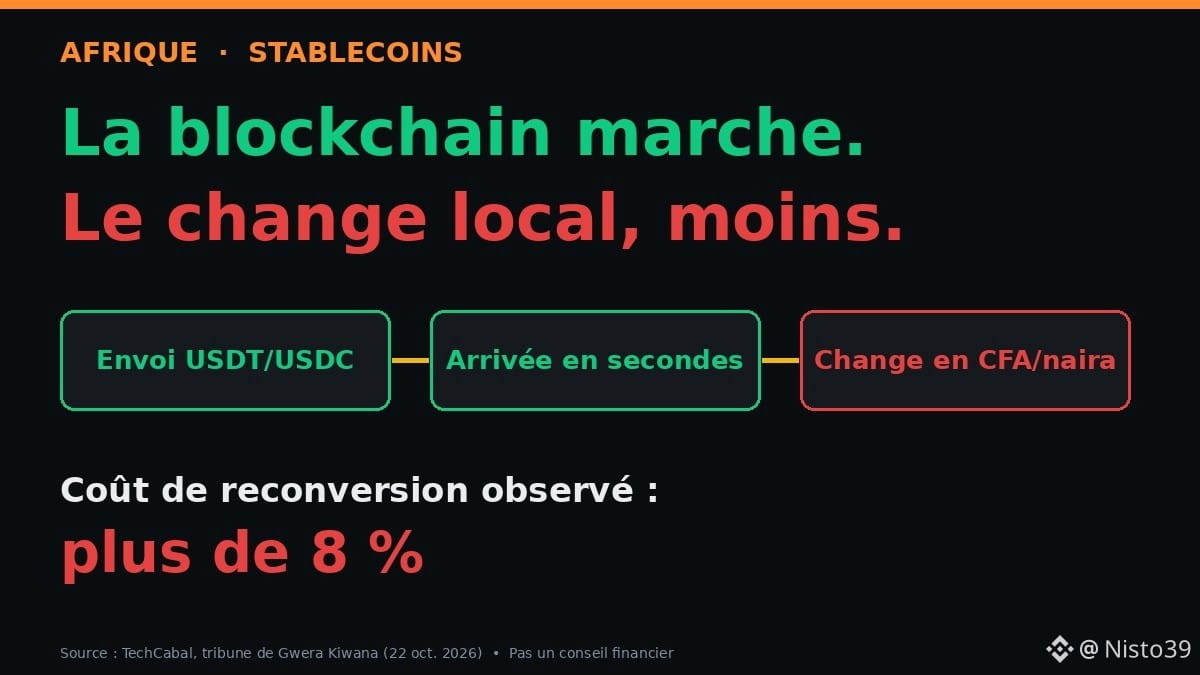
🌍 The stablecoin arrives in seconds… but the biggest cost comes when you need to convert it into CFA francs, naira, or shillings.
📌 What was observed (TechCabal, Oct. 22, 2026)
• Three major African payment providers tested stablecoin rails for three years
• The promise: cut the cost of cross-border transfers by 10×
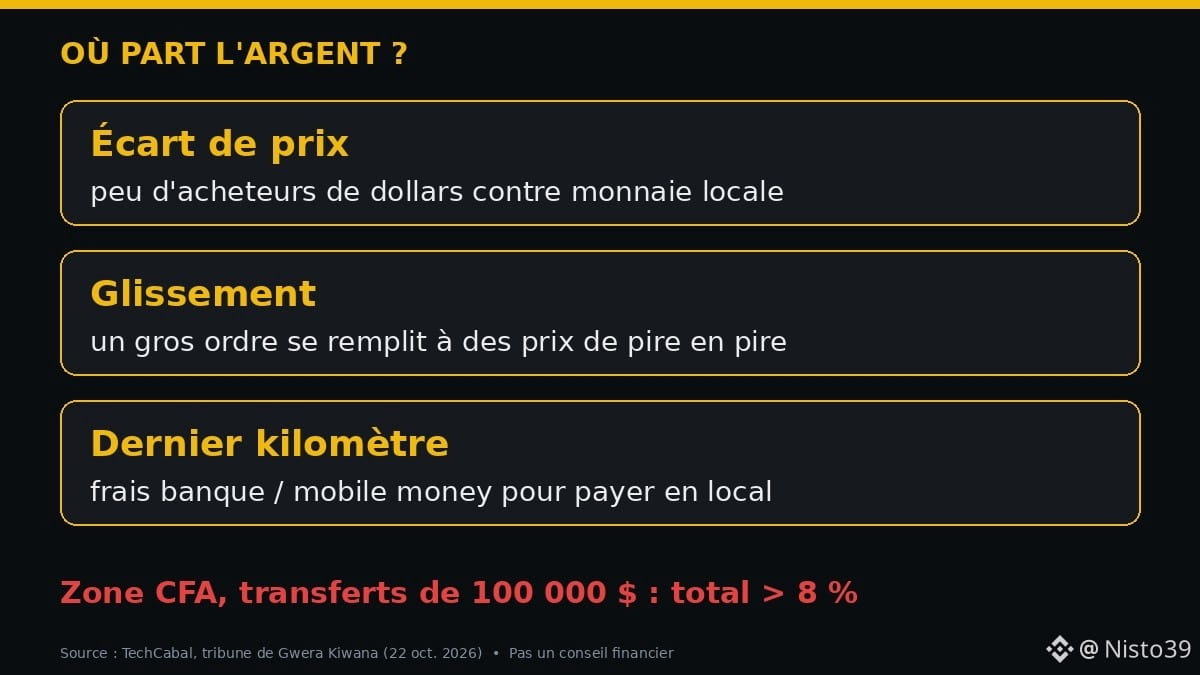
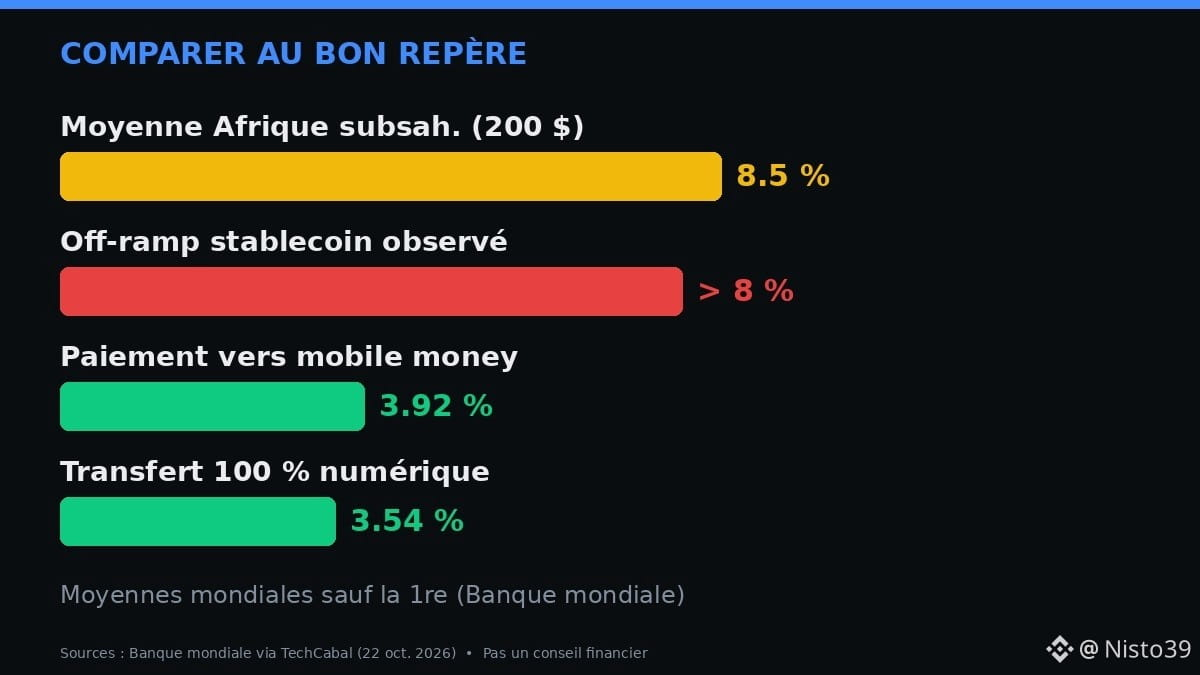
• The result: the blockchain works, but converting into local currency (“off-ramp”) costs more than 8%
• In the CFA zone, on transfers of $100,000, the spread + slippage + payment fees exceeded 8%
• All three ended up combining stablecoins with traditional bank transfers
🧠 How it works
A $USDT or a $USDC is “final” in a few seconds, but you can’t pay your rent in USDT. You need someone who has CFA francs, wants dollars, and can exchange them immediately, at the right volume. When those buyers are scarce, the real price drifts far from the displayed price. Add last-mile fees (mobile money, bank) and the savings disappear.
👤 Imagine Aminata (a fictional character), a trader in Bamako, paid by a European client. The transfer arrives quickly, but if she loses 8% on the exchange, she might sometimes have been better off using a simple transfer service to mobile money (around 3.9% on average worldwide, according to the World Bank).
⚖️ A caveat: this is an opinion piece (Gwera Kiwana, Morse), not an official study. Stablecoins remain useful for saving in dollars or in corridors where local liquidity is deep.
✅ Is the real challenge for stablecoins in Africa the blockchain 🔵 or local currency exchange 🟠? 👇
Not financial advice. DYOR.
Sources: TechCabal (op-ed by Gwera Kiwana, Oct. 22, 2026), World Bank, Chainalysis.
#Stablecoins #Afrique #CryptoNews
62
·
--
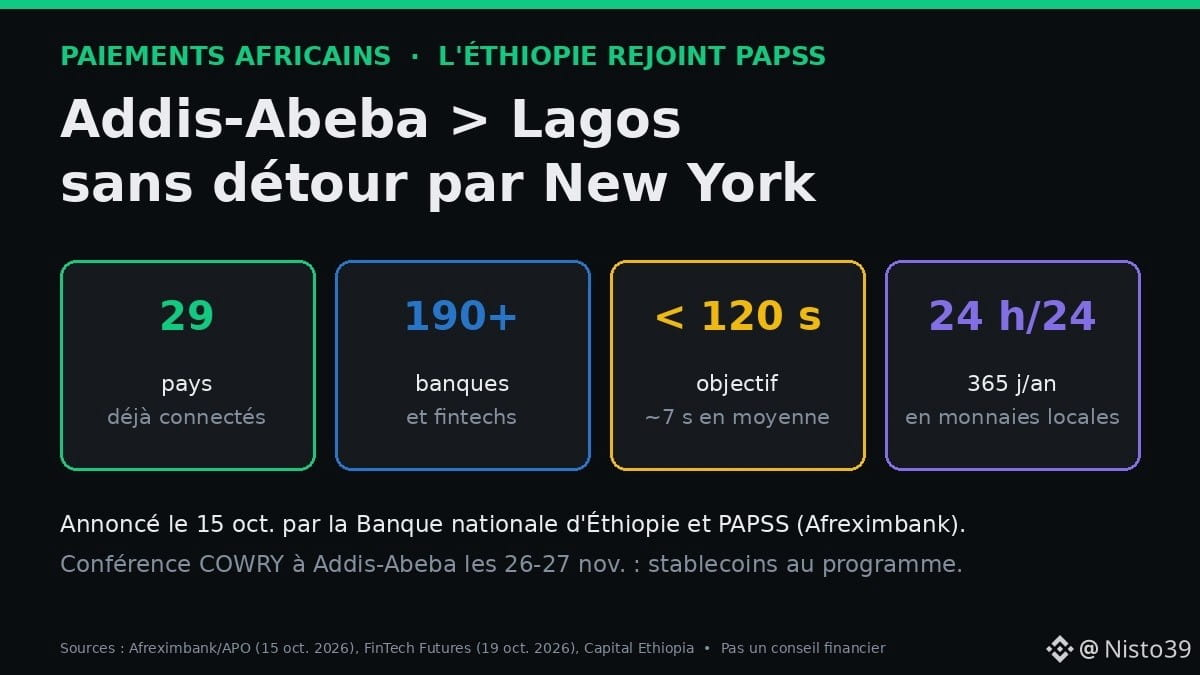
🌍 A payment from Addis Ababa to Lagos in 120 seconds, in African currencies, without going through New York. Ethiopia has just joined the network that promises to make it possible.
📌 The facts
• Oct. 15: The National Bank of Ethiopia announces that it has joined PAPSS, the pan-African payment system launched in 2022 by Afreximbank, the African Union and the AfCFTA
• PAPSS already connects 29 countries and more than 190 banks and fintechs (FinTech Futures, Oct. 19)
• Stated goal: settlement in under 120 seconds, averaging around 7 seconds, 24/7
• Mobile wallets (telebirr, M-Pesa) are preparing to connect through EthSwitch, subject to prior approval from the central bank
• Addis Ababa will host the COWRY conference on Nov. 26–27, with stablecoins and digital assets on the agenda
🧠 How it works
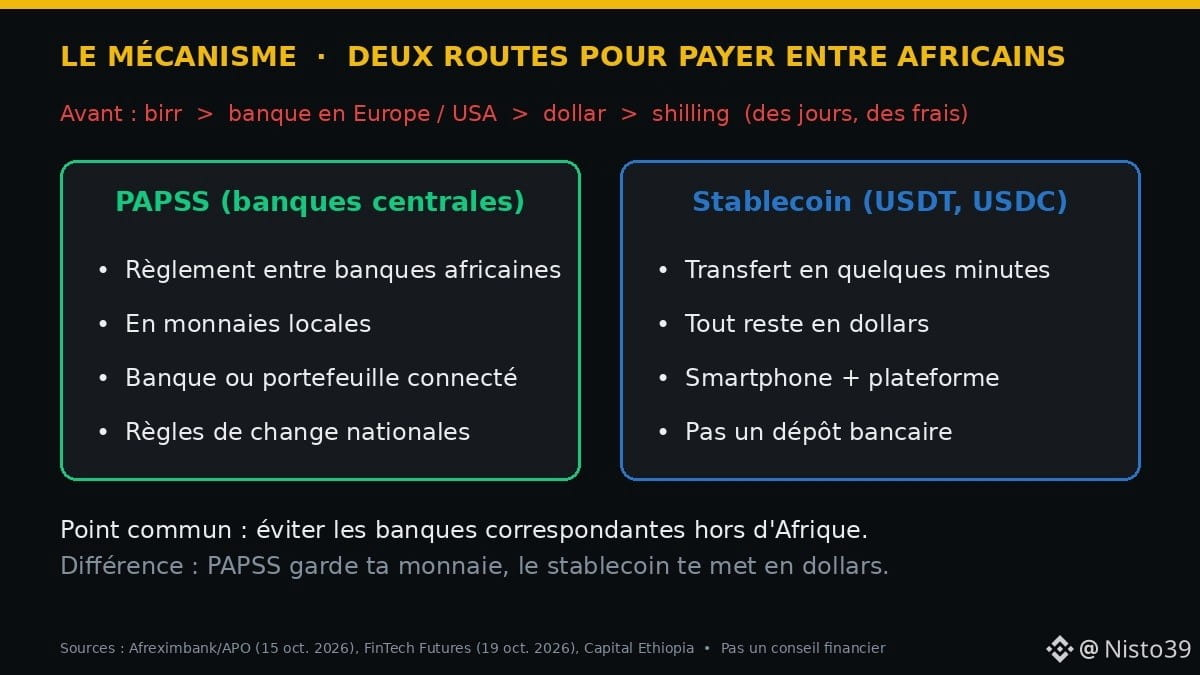
Today, a payment between two African countries often goes through a bank in Europe or the United States, with two currency conversions into dollars. PAPSS settles payments directly between African banks, in local currencies. A stablecoin like $USDT is just as fast, but everything remains in dollars.
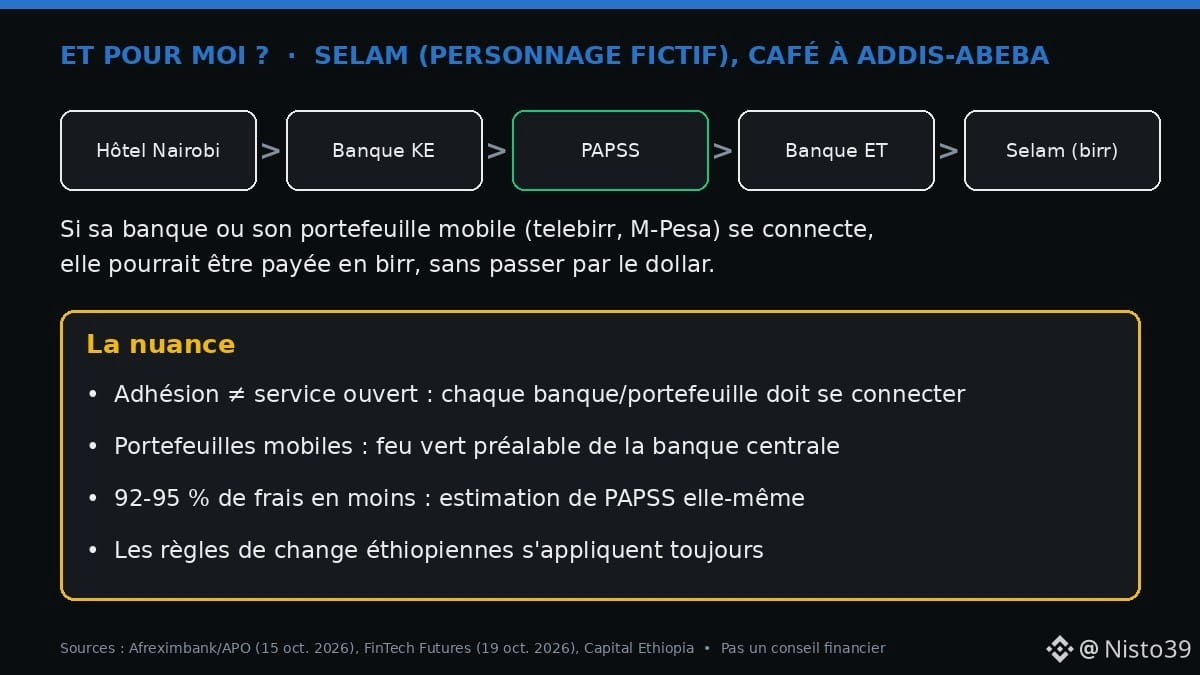
👤 Selam (a fictional character) roasts coffee in Addis Ababa and sells it to a hotel in Nairobi. If her bank or mobile wallet connects, she could be paid in birr without going through the dollar.
⚖️ The caveat
• Joining ≠ service available: each bank and wallet still has to connect
• The 92–95% fee savings are an estimate made by PAPSS itself
• Ethiopian foreign exchange rules still apply
✅ Two options are emerging for payments between Africans: central bank rails and stablecoins.
Which would you choose to get paid? 👇
Not financial advice. DYOR.
Sources: Afreximbank/APO (Oct. 15), FinTech Futures (Oct. 19), Capital Ethiopia.
#Afrique #Paiements #Stablecoins #Ethiopia
49
·
--
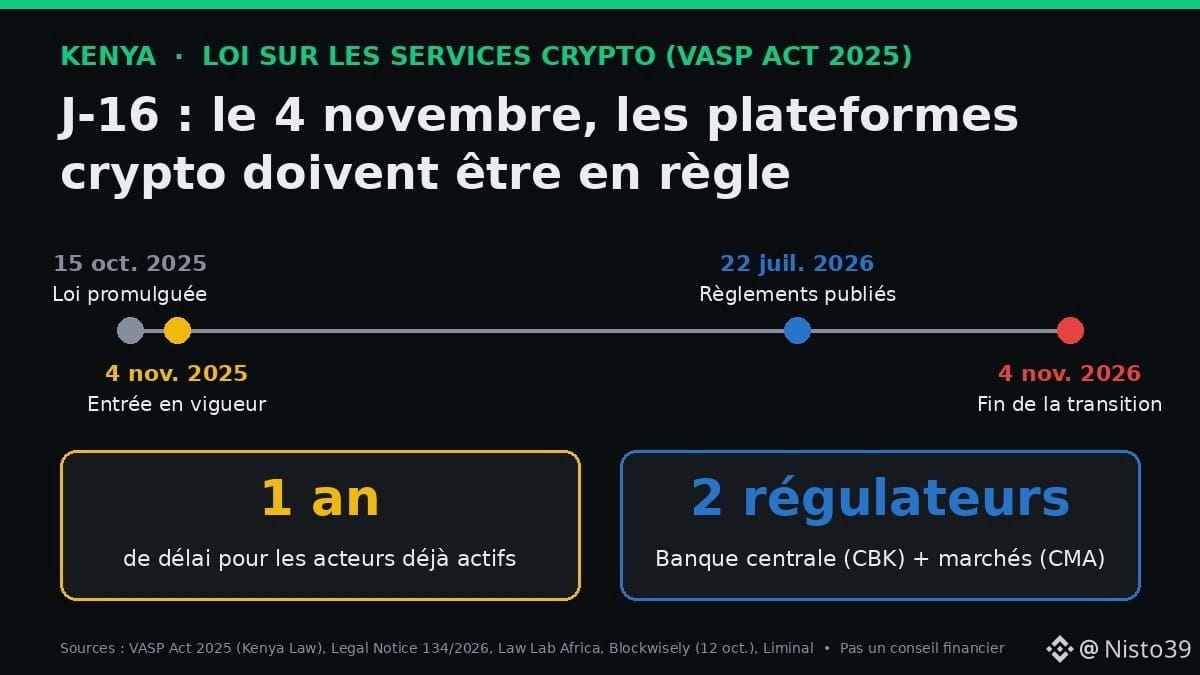
🇰🇪 D-16. By November 4, 2026, crypto platforms already operating in Kenya must comply with the new law. After that, the grace period ends.
📌 The facts (VASP Act 2025, Law Lab Africa, Blockwisely)
• The Virtual Asset Service Providers (VASP) Act has been in force since November 4, 2025
• Section 47 gives existing operators one year: until November 4, 2026
• The detailed regulations were only published on July 22, 2026, leaving around 15 weeks to prepare applications
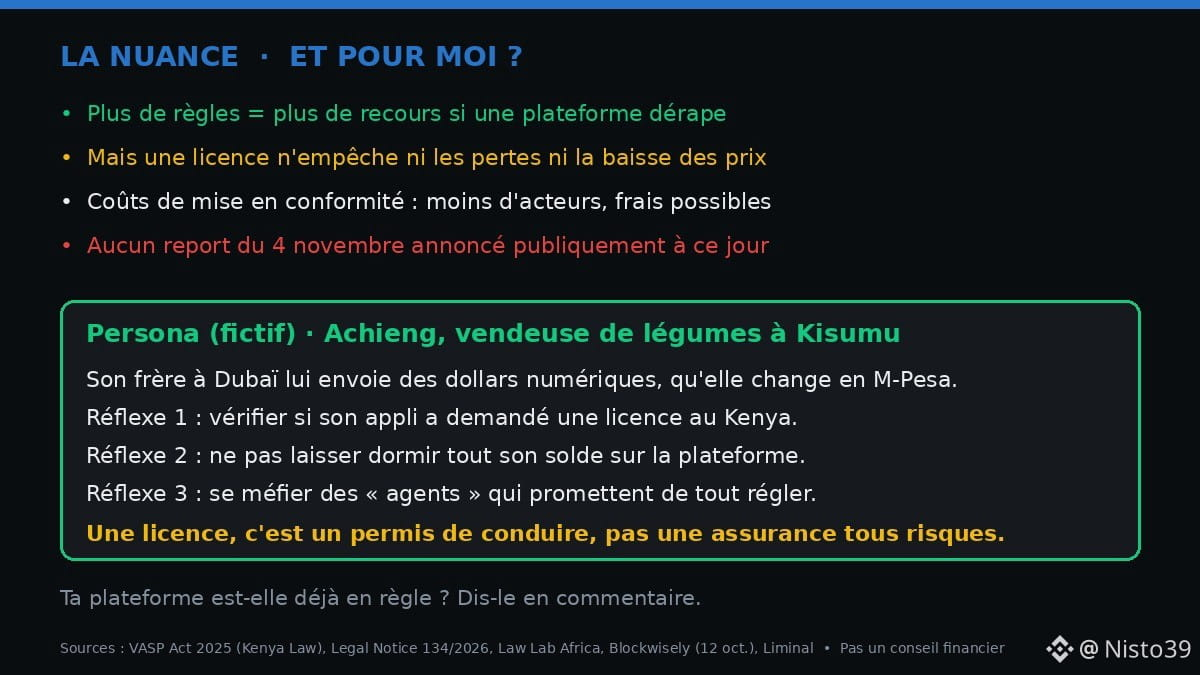
• No extension has been publicly announced to date
🧠 How it works
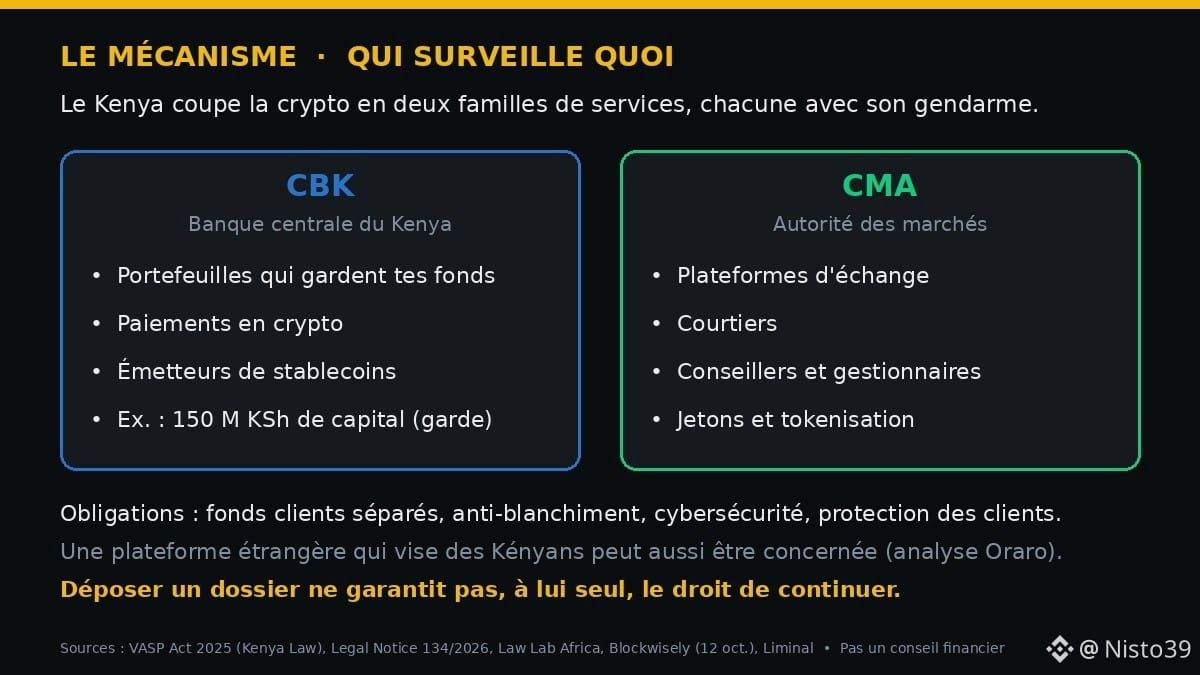
Two types of services, two regulators:
• Central Bank (CBK): wallets that hold your funds, payments, stablecoin issuers such as $USDT. Example: 150 million shillings in capital for custody services
• Capital Markets Authority (CMA): exchanges, brokers, advisers
Requirements: segregated customer funds, anti-money laundering measures, cybersecurity. According to law firm Oraro, a foreign platform targeting Kenyans may also be covered.
⚖️ The nuance
• More rules, more recourse if a platform goes off the rails
• But a license prevents neither losses nor falling prices
• It’s expensive: smaller operators may leave or raise their fees
• Filing an application alone does not guarantee the right to keep operating
👤 Achieng (a fictional character), a vegetable seller in Kisumu, receives digital dollars from her brother in Dubai and converts them to M-Pesa. Her checklist: check whether her app has applied for a license in Kenya, don’t leave her entire balance sitting there, and ignore “agents” who promise to sort everything out in exchange for her access codes.
✅ A license is a driver’s permit, not all-risk insurance.
Should your country copy this model? 👇
Not financial advice. DYOR.
Sources: VASP Act 2025, Legal Notice 134/2026, Law Lab Africa, Blockwisely, Liminal.
#Kenya #Régulation #Crypto #Afrique
28
·
--
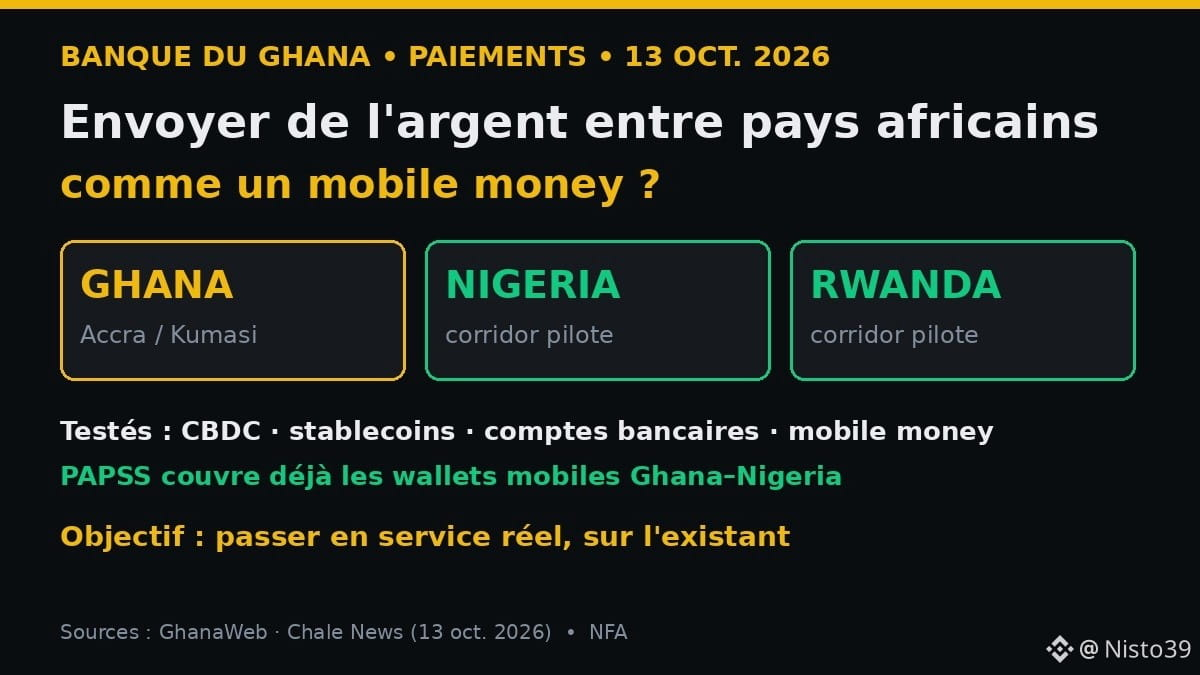
🌍 Sending money from Ghana to Nigeria as easily as using mobile money? The Bank of Ghana is testing just that right now, with stablecoins in its toolkit.
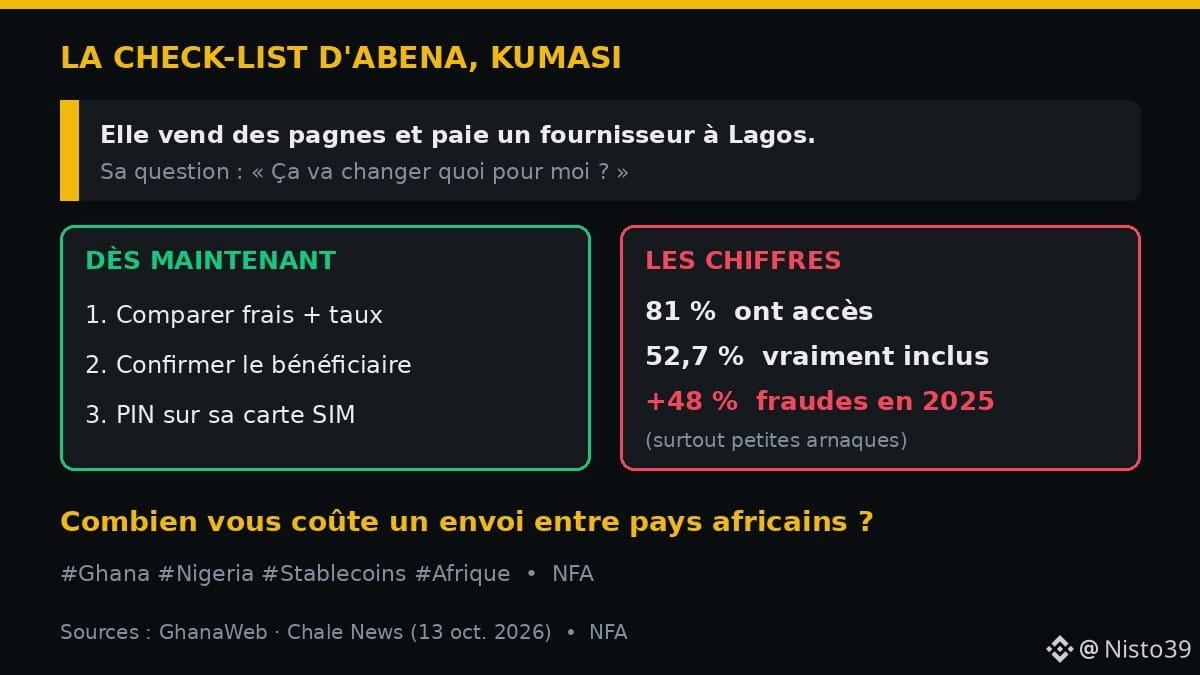
Abena sells wax-print fabric in Kumasi and pays her supplier in Lagos. Today, it’s either an expensive bank transfer or an informal intermediary. Her question: “What will this change for me?”
📌 The facts (BoG, Oct. 13, 2026, IMF–World Bank meetings in Bangkok)
• Two pilot corridors: Ghana–Rwanda and Ghana–Nigeria.
• Tools being tested: central bank digital currencies (CBDCs), stablecoins, bank accounts and mobile money wallets.
• The pan-African PAPSS system already covers mobile wallets on the Ghana–Nigeria corridor.
• Governor Asiama’s goal: move to live service by building on what already exists, rather than creating new systems.
🧠 How it works
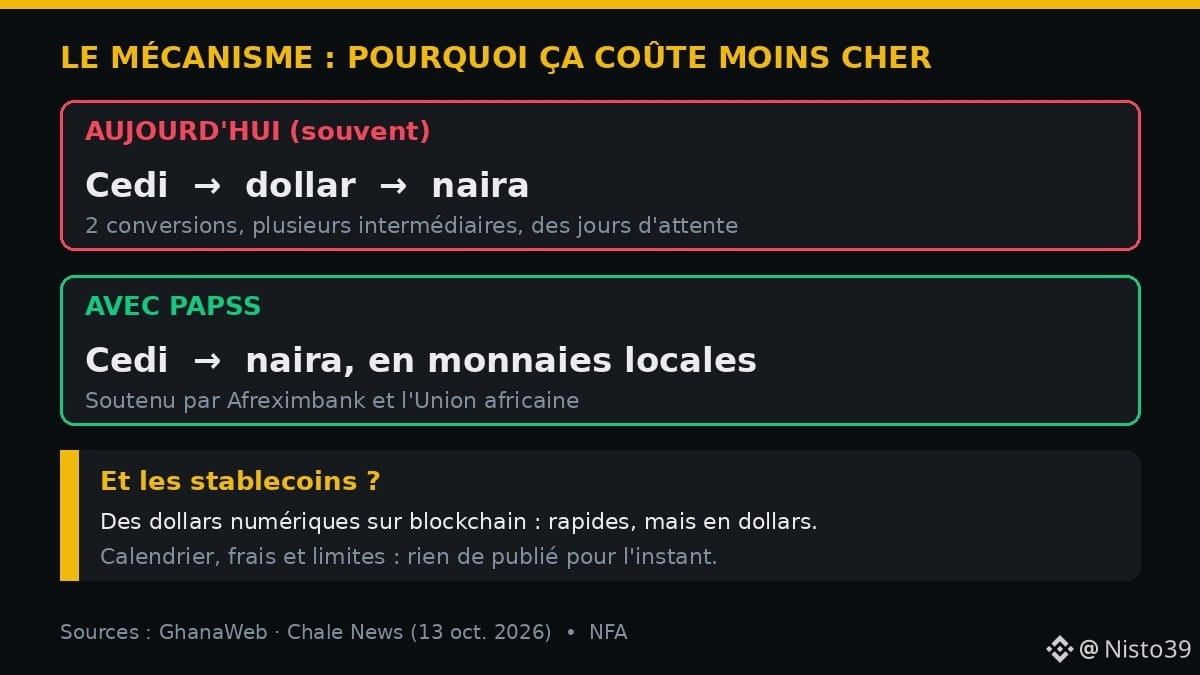
PAPSS (backed by Afreximbank and the African Union) settles payments in local currencies, without going through the dollar. Fewer conversions = lower fees and less waiting. A stablecoin like $USDT does something similar, but through a blockchain and in digital dollars.
⚖️ The caveats
• No timeline, fees or limits have been published yet.
• 81% of Ghanaian adults have access to financial services, but only 52.7% are actually included (real-world usage).
• Reported fraud: +48% in 2025, mostly small scams targeting ordinary people.
👉 What Abena can do right now
1. Compare fees and exchange rates before each transfer.
2. Confirm the recipient’s name before approving the transfer.
3. Protect her SIM (PIN code): SIM-swapping is a common scam.
Do you send money between African countries? How much does it cost you? 👇
Not financial advice. DYOR.
Sources: GhanaWeb; Chale News (Oct. 13, 2026).
#Ghana #Nigeria #Stablecoins #Afrique
52
·
--
Article
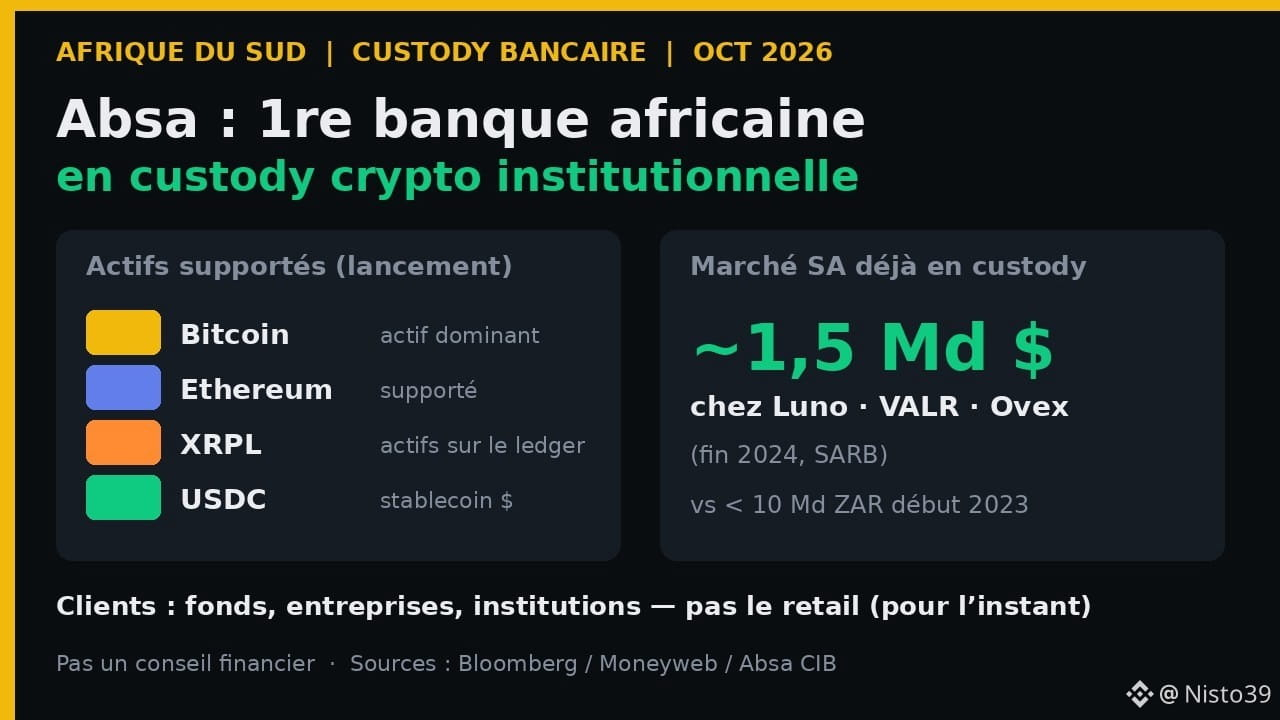
Absa: Africa’s 1st bank to offer crypto custody (BTC, ETH, XRPL, USDC)Absa has just crossed a symbolic threshold: it is the **first African bank** to offer **digital asset custody** to institutional clients in South Africa. The key takeaway: **a bank on the continent can now hold Bitcoin, Ether, XRPL assets and USDC in a regulated vault** — but for now, **not for retail customers** who use Luno or a mobile wallet.
📋 The facts (Bloomberg / Moneyweb / Absa CIB, 2 Oct. 2026; platform launched in late Sept.)
Absa: Africa’s 1st bank to offer crypto custody (BTC, ETH, XRPL, USDC)
Absa has just crossed a symbolic threshold: it is the **first African bank** to offer **digital asset custody** to institutional clients in South Africa. The key takeaway: **a bank on the continent can now hold Bitcoin, Ether, XRPL assets and USDC in a regulated vault** — but for now, **not for retail customers** who use Luno or a mobile wallet.
📋 The facts (Bloomberg / Moneyweb / Absa CIB, 2 Oct. 2026; platform launched in late Sept.)
📋 The facts (Bloomberg / Moneyweb / Absa CIB, 2 Oct. 2026; platform launched in late Sept.)
22
·
--
Absa: first African bank to offer crypto custodyIn South Africa, Absa becomes the first African bank to offer digital asset custody for institutional clients. The central idea is not “everyone can buy Bitcoin at Absa tomorrow.” It’s an infrastructure shift: the private keys of major players (funds, companies, treasuries) can be held under banking supervision—not just by crypto fintechs.
📋 What’s being announced (late Sept. / early Oct. 2026)
• Absa Digital Asset Custody: custody, administration and transfers for institutional clients and large companies in South Africa
Absa: first African bank to offer crypto custody
In South Africa, Absa becomes the first African bank to offer digital asset custody for institutional clients. The central idea is not “everyone can buy Bitcoin at Absa tomorrow.” It’s an infrastructure shift: the private keys of major players (funds, companies, treasuries) can be held under banking supervision—not just by crypto fintechs.
📋 What’s being announced (late Sept. / early Oct. 2026)
• Absa Digital Asset Custody: custody, administration and transfers for institutional clients and large companies in South Africa
📋 What’s being announced (late Sept. / early Oct. 2026)
• Absa Digital Asset Custody: custody, administration and transfers for institutional clients and large companies in South Africa
44
·
--

Article
How to practically protect your purchasing power in West Africa in the era of the ECO?With the ECO coming in and inflation eroding all the currencies in the world, one question becomes urgent: how can you practically protect your purchasing power in West Africa in 2026?
Here’s a simple framework in 4 steps.
Step 1 — Understand what you really own.
Your bank account isn’t wealth.
It’s money—which is devaluing.
True wealth is what you own in assets: real estate, gold, stocks, crypto.
First question to ask yourself:
What proportion of your wealth is in fiat currency—and what proportion is in real assets?
How to practically protect your purchasing power in West Africa in the era of the ECO?
With the ECO coming in and inflation eroding all the currencies in the world, one question becomes urgent: how can you practically protect your purchasing power in West Africa in 2026?
Here’s a simple framework in 4 steps.
Step 1 — Understand what you really own.
Your bank account isn’t wealth.
It’s money—which is devaluing.
True wealth is what you own in assets: real estate, gold, stocks, crypto.
First question to ask yourself:
What proportion of your wealth is in fiat currency—and what proportion is in real assets?
1
175

Article
Africa, the Future Global Superpower: Gold and Resources are Changing the GameThe global financial landscape is shifting rapidly. As the US dollar loses its grip, gold is asserting itself more than ever as the ultimate safe haven. This isn't just a trend; it's a mathematical reality: the world is tipping.
The Turning Point: Gold Outshines the Dollar
For the first time in three decades, the dominance of the greenback is being challenged. While the dollar remains a major transactional currency, gold has reclaimed its status as the preferred reserve asset for central banks.
Africa, the Future Global Superpower: Gold and Resources are Changing the Game
The global financial landscape is shifting rapidly. As the US dollar loses its grip, gold is asserting itself more than ever as the ultimate safe haven. This isn't just a trend; it's a mathematical reality: the world is tipping.
The Turning Point: Gold Outshines the Dollar
For the first time in three decades, the dominance of the greenback is being challenged. While the dollar remains a major transactional currency, gold has reclaimed its status as the preferred reserve asset for central banks.
The Turning Point: Gold Outshines the Dollar
For the first time in three decades, the dominance of the greenback is being challenged. While the dollar remains a major transactional currency, gold has reclaimed its status as the preferred reserve asset for central banks.
112
·
--

Article
Africa doesn’t lack capital.It lacks the structure to make it grow. It’s not the same thing — and this distinction changes absolutely everything.
Here is the evidence.
Capital exists.
→ The African diaspora sends over $100 billion to the continent every year
→ African entrepreneurs generate billions of FCFA in profits every quarter
→ African SMEs sitting on cash reserves of several tens of millions without knowing what to do with them
→ Families that inherit land, real estate, cash — with no infrastructure to optimize it
Africa doesn’t lack capital.
It lacks the structure to make it grow. It’s not the same thing — and this distinction changes absolutely everything.
Here is the evidence.
Capital exists.
→ The African diaspora sends over $100 billion to the continent every year
→ African entrepreneurs generate billions of FCFA in profits every quarter
→ African SMEs sitting on cash reserves of several tens of millions without knowing what to do with them
→ Families that inherit land, real estate, cash — with no infrastructure to optimize it
365
·
--
#MT Technology Abidjan 😊
MT TECHNOLOGY ARRIVES IN ABIDJAN! 🇨🇮
A new momentum is taking shape in Côte d’Ivoire with MT Technology.
Our ambition: to contribute to the development of a modern network of top-up services and to create new opportunities for Ivorian partners and entrepreneurs.
📍 Abidjan – Côte d’Ivoire
🚀 A vision focused on innovation
🤝 Opportunities to discover
🌍 An ambition for Côte d’Ivoire and West Africa
MT Technology: let’s build the future together.
📲 For more information, contact us and discover how to join the adventure.
#MTTechnology #Abidjan #CotedIvoire #Innovation #Entrepreneuriat #Opportunités #Afrique

1
226
·
--

Article
Binance invests in Africa. Coinbase opens offices in Lagos.BlackRock is keeping an eye on the continent. When global giants arrive, it means one thing: the market exists. The question is who will structure it locally.
Let's take a look at what these giants are doing.
Binance:
→ Binance Academy is expanding its educational programs across the continent
→ Binance Angels are organizing in dozens of African countries
→ University tours like the one in Parakou in June 2026 and dozens of others in Cotonou and Porto-Novo since 2023.
→ Objective: capture the African crypto market during the adoption phase
Binance invests in Africa. Coinbase opens offices in Lagos.
BlackRock is keeping an eye on the continent. When global giants arrive, it means one thing: the market exists. The question is who will structure it locally.
Let's take a look at what these giants are doing.
Binance:
→ Binance Academy is expanding its educational programs across the continent
→ Binance Angels are organizing in dozens of African countries
→ University tours like the one in Parakou in June 2026 and dozens of others in Cotonou and Porto-Novo since 2023.
→ Objective: capture the African crypto market during the adoption phase
174
·
--
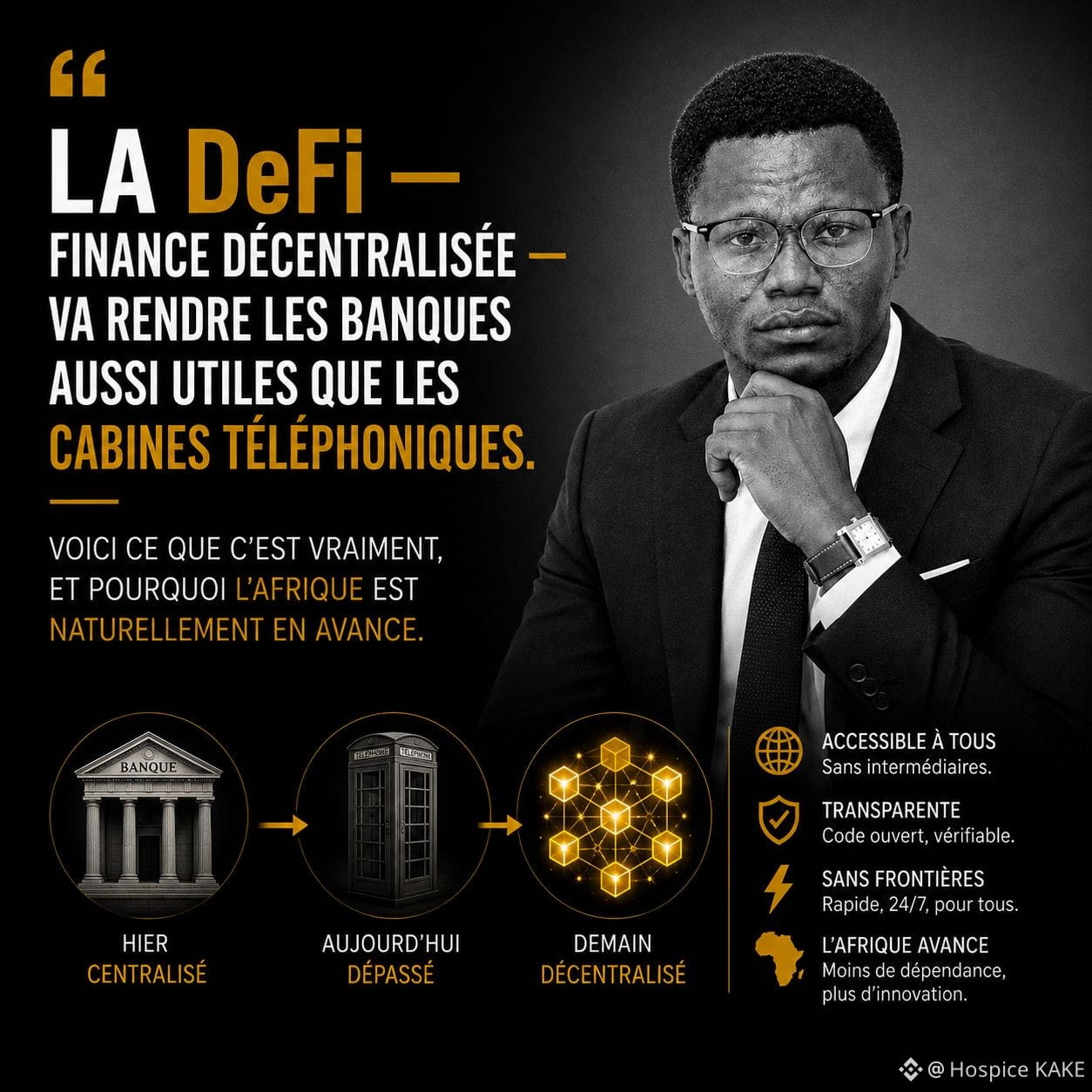
DeFi — decentralized finance — is going to make banks as useful as payphones. Here’s what it really is and why Africa is naturally ahead.
DeFi: simple definition.
DeFi encompasses all financial services — lending, saving, trading, insurance —
that operate on the blockchain, without banks, intermediaries, or permission.
Everything is managed by smart contracts. The code replaces the banker.
Concrete examples of what you can do in DeFi today.
Borrowing without banks.
You deposit 1 million FCFA in Bitcoin as collateral.
You borrow 500,000 FCFA in stablecoin — instantly, no paperwork, no justification.
Interest rates are set by the market in real-time. Not by a credit committee.
Lending and earning interest.
You deposit your cryptos into a lending protocol.
Other users borrow them. You earn interest — often between 4% and 15% annually.
Trading without intermediaries.
DEXs (decentralized exchanges) allow you to swap cryptos
directly wallet to wallet, without a centralized platform that can freeze your funds.
Why Africa is naturally ahead.
In Africa, distrust of traditional financial institutions is already structural.
Africans have developed disintermediation habits with mobile money.
Hundreds of millions of electronic money accounts — without traditional banks.
DeFi is the next natural step.
Not a brutal replacement — a logical evolution.
The future of African finance is not in the glass towers of central banks.
It’s in protocols that run at 3 AM, never stopping.
Had you ever heard of DeFi? What attracts or concerns you about it?
👇 I read everything.
#DeFi #Blockchain #Bitcoin #GoldenBridge #DecentralizedFinance #Afrique #Web3Africa #Finance #Crypto #Innovation
168
·
--
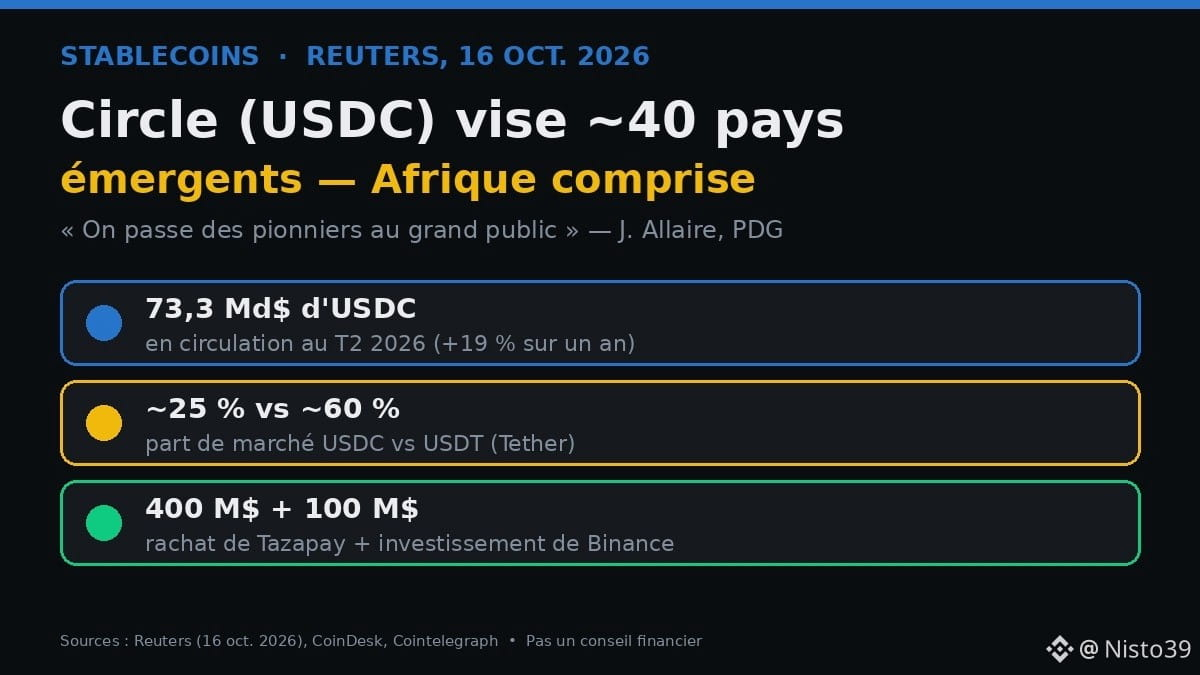
🌍 Circle (the issuer of $USDC) wants to establish a presence in ~40 emerging markets, including Africa. But what does that change for a merchant in Douala or Dakar?
📌 The facts (Reuters, Oct. 16, 2026, IMF/World Bank meetings in Bangkok)
• Target: ~40 markets (Southeast Asia, Latin America, Africa, the Middle East)
• Jeremy Allaire (CEO): moving from “pioneers” to the “mainstream”
• USDC: $73.3B in circulation in Q2 (+19% year over year), ~25% of the market, compared with ~60% for USDT
• Growth drivers: acquisition of Tazapay ($400M, local payment networks) + $100M investment from Binance
• The US GENIUS Act is due to take effect in January
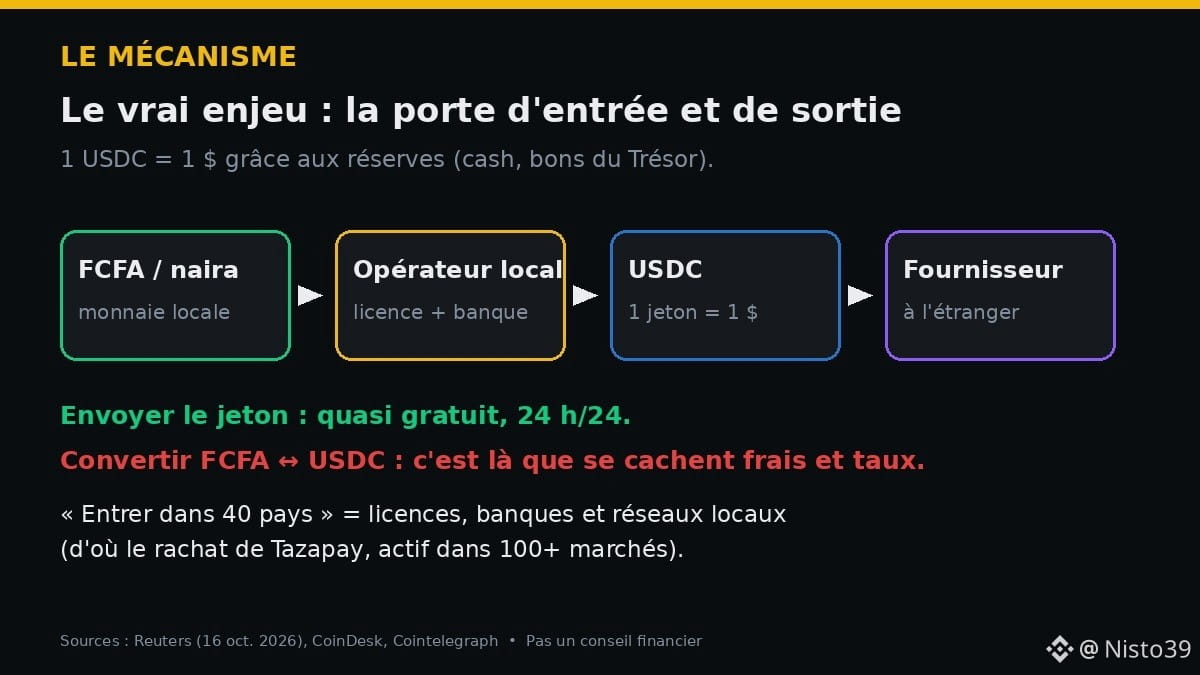
🧠 How it works
A stablecoin is worth $1 because the issuer holds an equivalent amount in reserves (cash, Treasury bills). “Entering a country” mainly means finding local licenses, banks, and payment providers to convert USDC ↔ CFA francs, naira, cedi… That’s where it all happens.
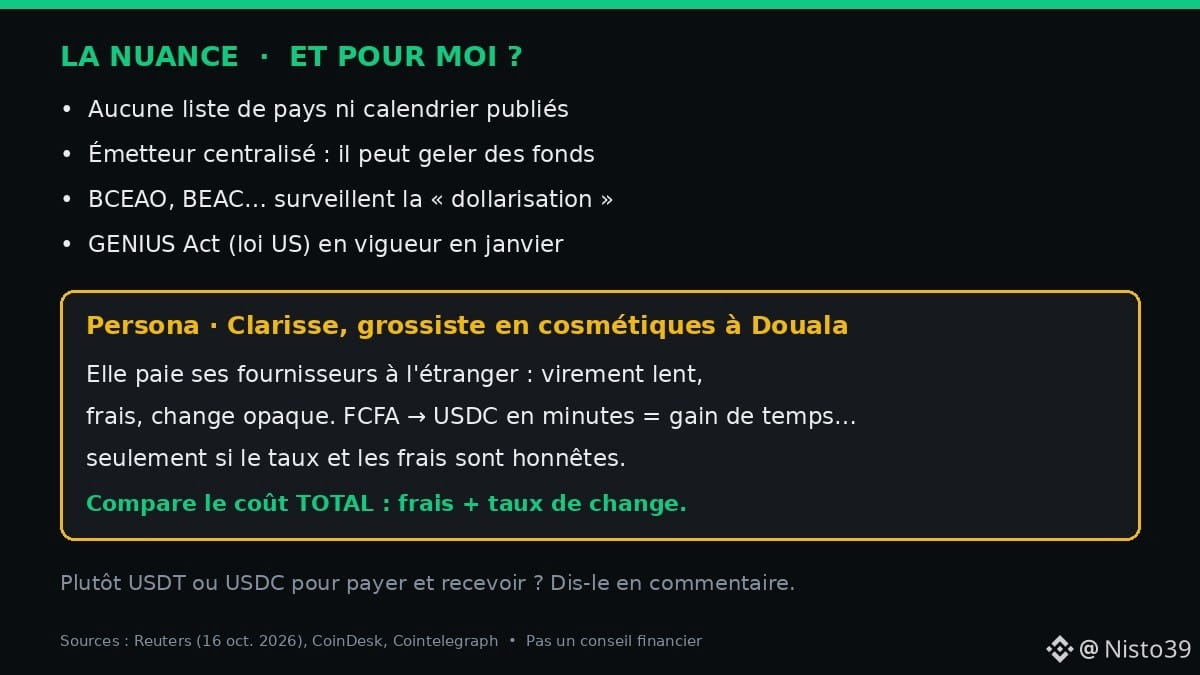
⚖️ The caveats
• No list of countries or timeline has been published
• Sending the token costs little; converting it into local currency does not
• The issuer is centralized: it can freeze funds
• BCEAO, BEAC… are monitoring “dollarization”
👤 Clarisse, a cosmetics wholesaler in Douala, pays suppliers abroad: slow bank transfers, fees, opaque exchange rates. Converting CFA francs → USDC in a few minutes saves time… but only if the rates and fees are fair.
✅ Always compare the total cost (fees + exchange rate).
Do you already pay or get paid in stablecoins? USDT or USDC? 👇
Not financial advice. DYOR.
Sources: Reuters, CoinDesk, Cointelegraph (Oct. 16–17, 2026).
#Stablecoins #USDC #Afrique #Crypto
🌍 Circle (the issuer of $USDC ) wants to establish a presence in ~40 emerging markets, including Africa. But what does that change for a merchant in Douala or Dakar?
📌 The facts (Reuters, Oct. 16, 2026, IMF/World Bank meetings in Bangkok)
• Target: ~40 markets (Southeast Asia, Latin America, Africa, the Middle East)
• Jeremy Allaire (CEO): moving from “pioneers” to the “mainstream”
• USDC: $73.3B in circulation in Q2 (+19% year over year), ~25% of the market, compared with ~60% for USDT
• Growth drivers: acquisition of Tazapay ($400M, local payment networks) + $100M investment from Binance
• The US GENIUS Act is due to take effect in January
🧠 How it works
A stablecoin is worth $1 because the issuer holds an equivalent amount in reserves (cash, Treasury bills). “Entering a country” mainly means finding local licenses, banks, and payment providers to convert USDC ↔ CFA francs, naira, cedi… That’s where it all happens.
⚖️ The caveats
• No list of countries or timeline has been published
• Sending the token costs little; converting it into local currency does not
• The issuer is centralized: it can freeze funds
• BCEAO, BEAC… are monitoring “dollarization”
👤 Clarisse, a cosmetics wholesaler in Douala, pays suppliers abroad: slow bank transfers, fees, opaque exchange rates. Converting CFA francs → USDC in a few minutes saves time… but only if the rates and fees are fair.
✅ Always compare the total cost (fees + exchange rate).
Do you already pay or get paid in stablecoins? USDT or USDC? 👇
Not financial advice. DYOR.
Sources: Reuters, CoinDesk, Cointelegraph (Oct. 16–17, 2026).
#Stablecoins #USDC #Afrique #Crypto
93
·
--
Article
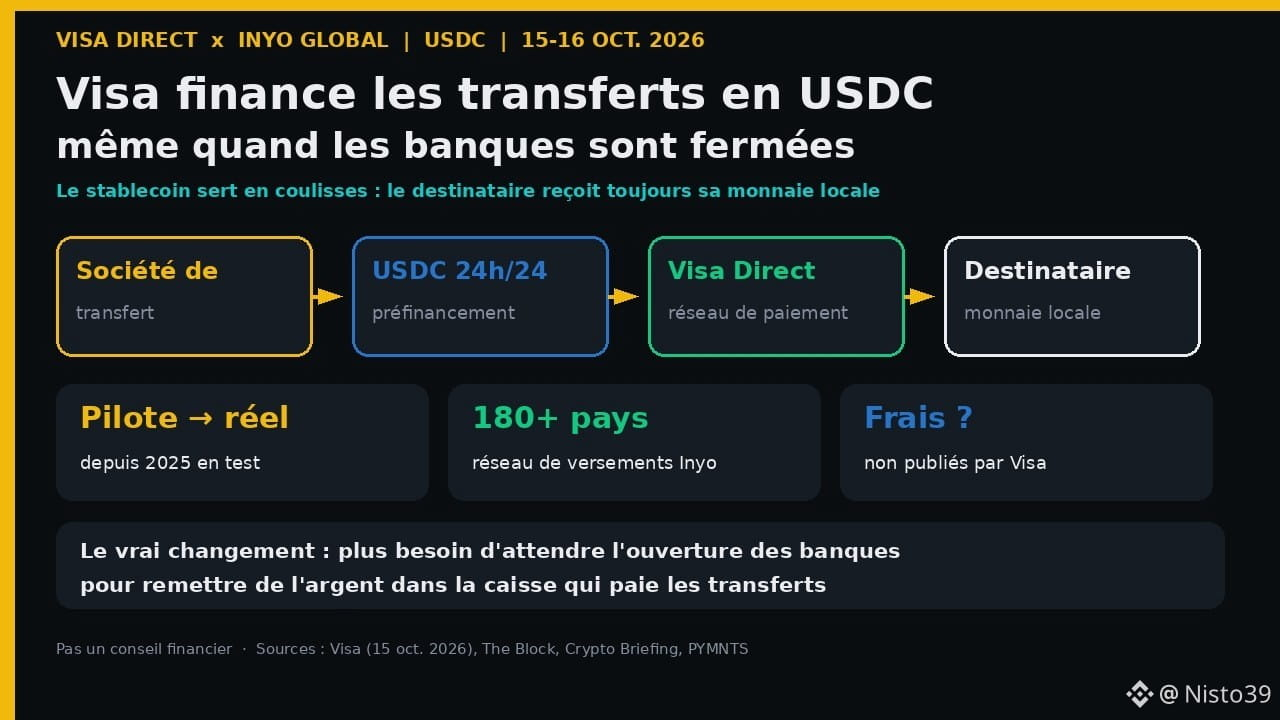
Visa now pays behind the scenes with USDC: what this means for transfers to AfricaWhen you send money to your family from abroad, you imagine your money is “traveling.” In reality, the money transfer company often pays your relative with money it has already deposited in the country. And it’s exactly this step, invisible to you, that Visa has just connected to a stablecoin: $USDC. Not another experiment: a service in production. Let’s break down what this really changes—and what it doesn’t.
📋 The facts (Visa press release, Oct. 15, 2026; The Block, Crypto Briefing, PYMNTS, Oct. 15–16, 2026)
Visa now pays behind the scenes with USDC: what this means for transfers to Africa
When you send money to your family from abroad, you imagine your money is “traveling.” In reality, the money transfer company often pays your relative with money it has already deposited in the country. And it’s exactly this step, invisible to you, that Visa has just connected to a stablecoin: $USDC . Not another experiment: a service in production. Let’s break down what this really changes—and what it doesn’t.
📋 The facts (Visa press release, Oct. 15, 2026; The Block, Crypto Briefing, PYMNTS, Oct. 15–16, 2026)
📋 The facts (Visa press release, Oct. 15, 2026; The Block, Crypto Briefing, PYMNTS, Oct. 15–16, 2026)
22
·
--
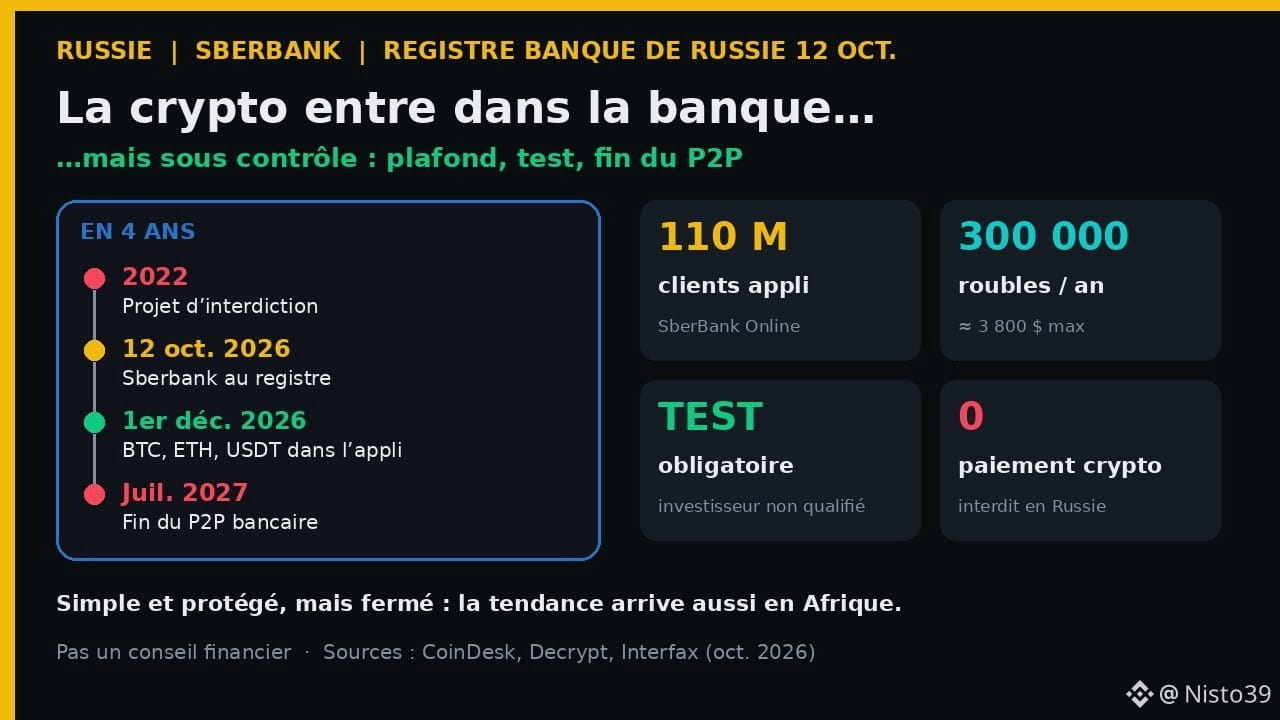
Article
Sberbank sells bitcoin: crypto enters the bank, but under controlIn 2022, the Bank of Russia wanted to ban crypto. In October 2026, it authorized the country’s largest bank, Sberbank, to sell it to its customers. This isn’t a complete opening up: it’s crypto “inside the bank,” with limits, a mandatory test, and an end to P2P. And this model resembles what several African countries are beginning to shape.
📋 The facts (CoinDesk, Decrypt, Interfax, Bank of Russia)
• On October 12, 2026, the Bank of Russia added Sberbank to its register of crypto exchange operators. The bank had already been registered as a “digital custodian” a few days earlier.
Sberbank sells bitcoin: crypto enters the bank, but under control
In 2022, the Bank of Russia wanted to ban crypto. In October 2026, it authorized the country’s largest bank, Sberbank, to sell it to its customers. This isn’t a complete opening up: it’s crypto “inside the bank,” with limits, a mandatory test, and an end to P2P. And this model resembles what several African countries are beginning to shape.
📋 The facts (CoinDesk, Decrypt, Interfax, Bank of Russia)
• On October 12, 2026, the Bank of Russia added Sberbank to its register of crypto exchange operators. The bank had already been registered as a “digital custodian” a few days earlier.
📋 The facts (CoinDesk, Decrypt, Interfax, Bank of Russia)
• On October 12, 2026, the Bank of Russia added Sberbank to its register of crypto exchange operators. The bank had already been registered as a “digital custodian” a few days earlier.
83
·
--
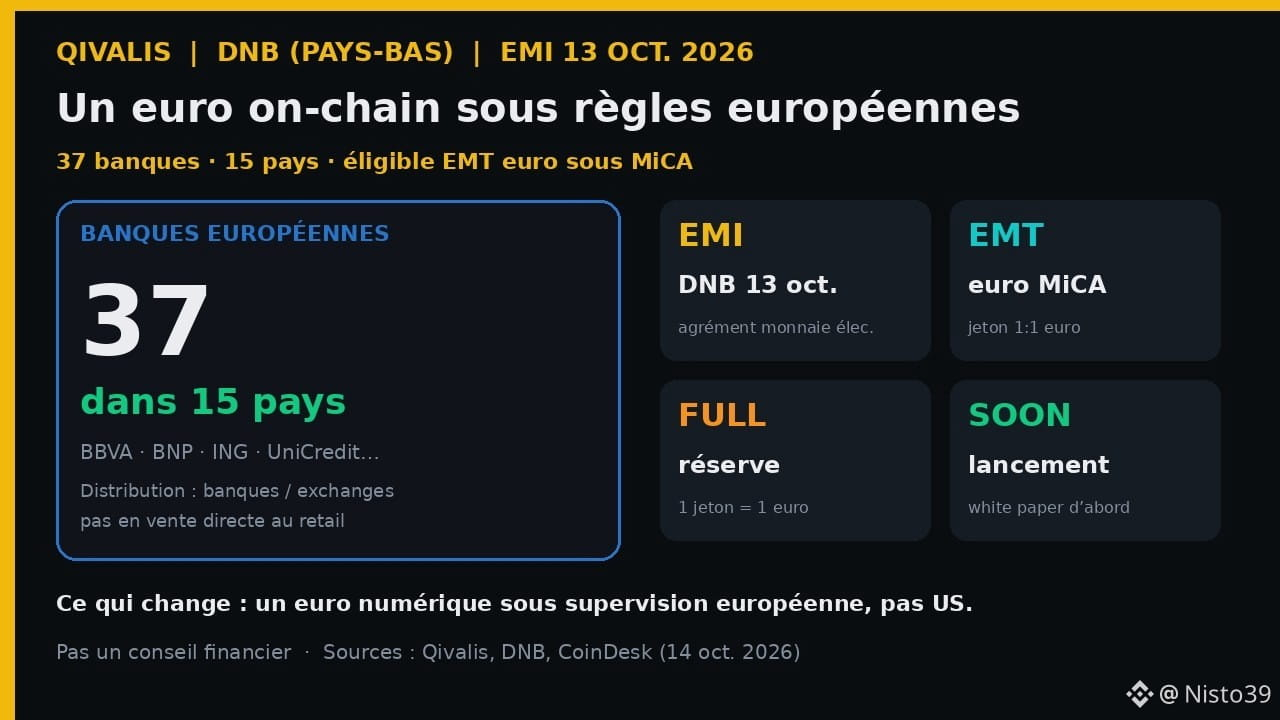
Article
Qivalis: 37 banks behind a MiCA-compliant on-chain euroWhile the dollar still dominates stablecoins in Africa, a European project has just reached a rare milestone: Qivalis B.V. (Amsterdam) received an electronic money institution (EMI) licence from the Dutch central bank (DNB) on October 13, 2026. For an exporter in Abidjan paid in euros by a client in Lyon, the idea isn’t “just another crypto” — it’s a digital euro governed by European rules rather than American ones.
📋 The facts (Qivalis press release, Oct. 14, 2026)
Qivalis: 37 banks behind a MiCA-compliant on-chain euro
While the dollar still dominates stablecoins in Africa, a European project has just reached a rare milestone: Qivalis B.V. (Amsterdam) received an electronic money institution (EMI) licence from the Dutch central bank (DNB) on October 13, 2026. For an exporter in Abidjan paid in euros by a client in Lyon, the idea isn’t “just another crypto” — it’s a digital euro governed by European rules rather than American ones.
📋 The facts (Qivalis press release, Oct. 14, 2026)
📋 The facts (Qivalis press release, Oct. 14, 2026)
91
·
--
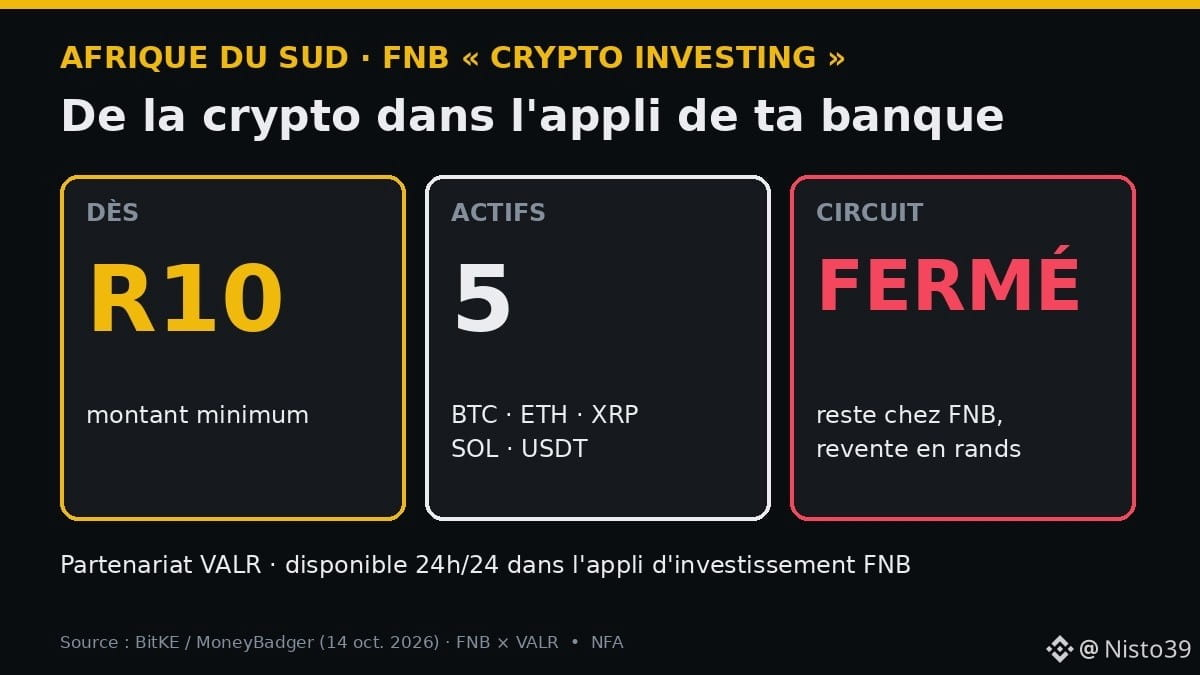
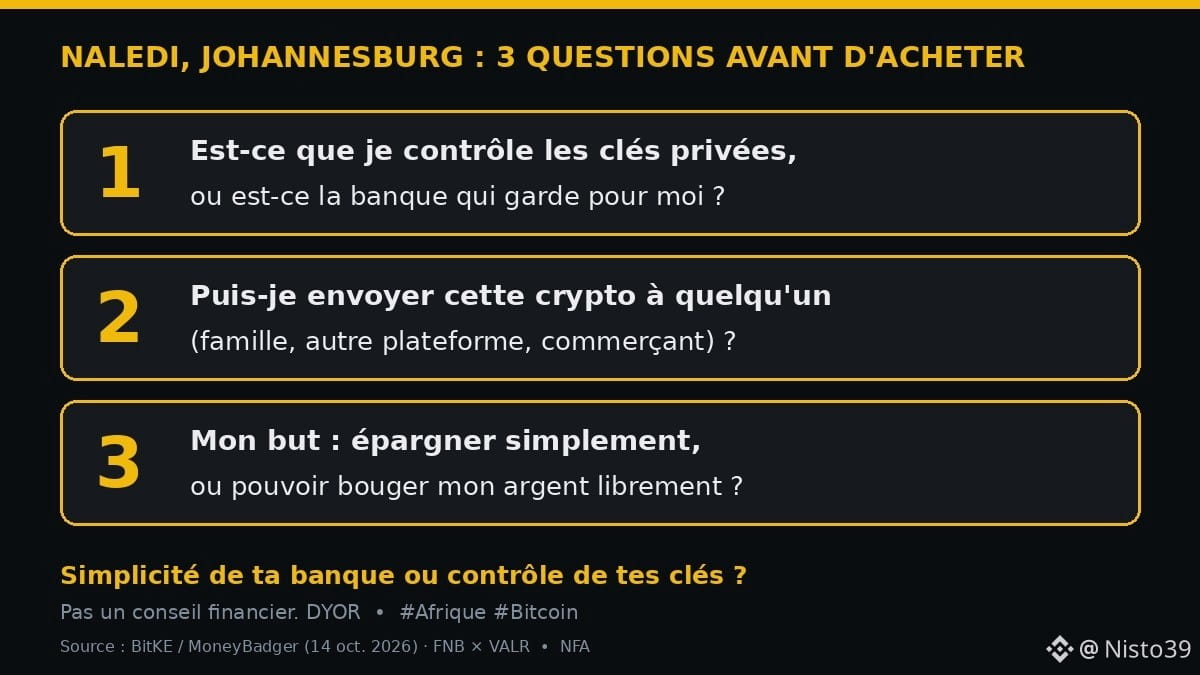
🏦 Buy bitcoin in your banking app from just 10 rand… but you can’t withdraw it. That’s FNB’s new “Crypto Investing” service in South Africa.
📌 The facts
• Service launched by FNB with the VALR platform
• 5 assets: Bitcoin, Ethereum, XRP, Solana and USDT, from R10
• Available 24/7 in the FNB investment app, already used by millions of customers
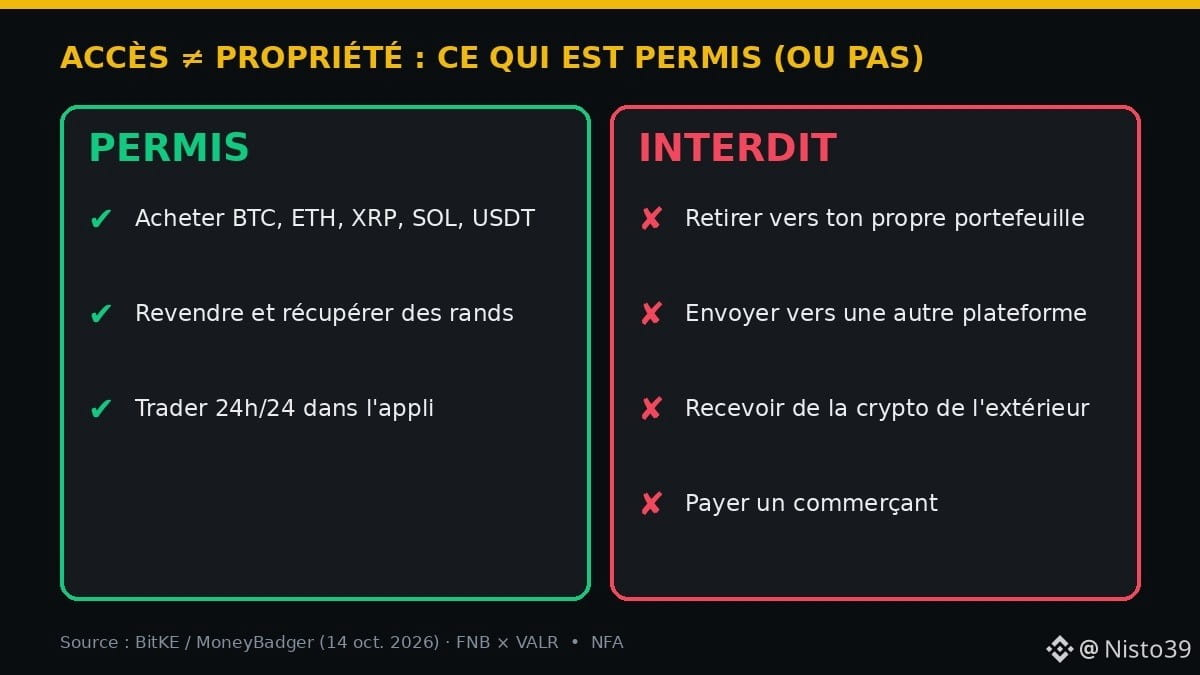
🚫 What you CANNOT do: withdraw to your own wallet, send crypto to another platform, receive crypto from outside, or pay a merchant. You can only sell it back for rand.
🧠 How it works
It’s a “closed loop”: the bank holds the crypto for you (custodial). Self-custody is the opposite: YOU control the private keys, so you can send your coins wherever you want — but you’re solely responsible for keeping them safe.
⚖️ The nuance
Access ≠ ownership. You gain convenience, but lose the right to move your crypto. According to BitKE/MoneyBadger (a crypto payments company, so not neutral), uncertainty around the Treasury and SARB’s capital flow rules could explain this choice.
👤 Naledi, in Johannesburg, puts R10 a week into crypto through her banking app. It’s simple for saving. But if she ever wants to send USDT to her brother in Maputo, this product won’t let her.
What about you: do you prefer the convenience of your bank, or control of your keys? 👇
Not financial advice. DYOR.
Sources: BitKE / MoneyBadger (14 Oct. 2026), FNB × VALR.
#Afrique #Bitcoin
1
68
·
--
Article
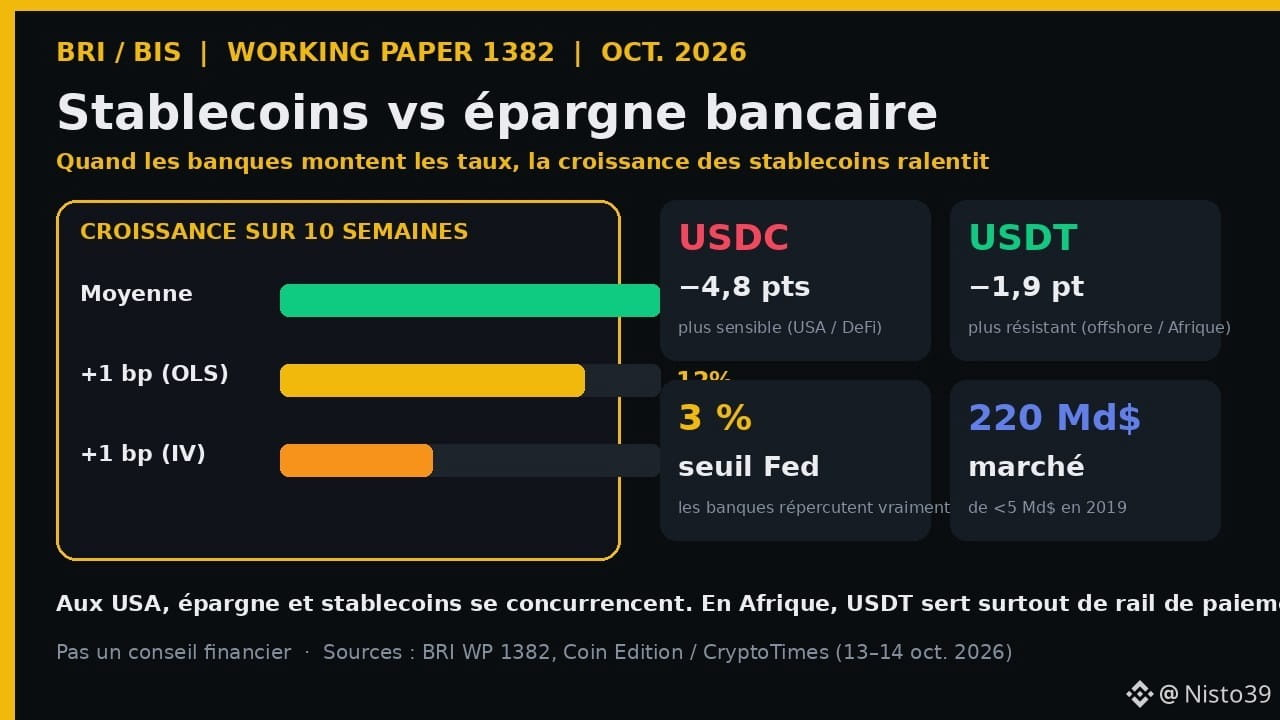
Stablecoins vs. bank savings: what the BIS says (and why USDT holds up better in Africa)You put some of your money in a savings account at a bank. A friend, meanwhile, keeps digital dollars (“stablecoins”) in a crypto app. When the bank raises its savings rate a little, who comes out ahead? A recently published study by the Bank for International Settlements (BIS) offers a data-backed answer: the two compete with each other. And $USDT, widely used in Africa and across the diaspora, holds up better than $USDC.
📋 The facts (BIS Working Paper 1382, reported Oct. 13–14, 2026)
Stablecoins vs. bank savings: what the BIS says (and why USDT holds up better in Africa)
You put some of your money in a savings account at a bank. A friend, meanwhile, keeps digital dollars (“stablecoins”) in a crypto app. When the bank raises its savings rate a little, who comes out ahead? A recently published study by the Bank for International Settlements (BIS) offers a data-backed answer: the two compete with each other. And $USDT, widely used in Africa and across the diaspora, holds up better than $USDC .
📋 The facts (BIS Working Paper 1382, reported Oct. 13–14, 2026)
📋 The facts (BIS Working Paper 1382, reported Oct. 13–14, 2026)
11
Log in to explore more content
Join global crypto users on Binance Square
⚡️ Get latest and useful information about crypto.
💬 Trusted by the world’s largest crypto exchange.
👍 Discover real insights from verified creators.
Email / Phone number
Trending Topics
1
#BinancePick
3.3M views
161,733 Discussing
2
#EarningsSeason
5.4M views
26,572 Discussing
3
#StrategySkipsBitcoinPurchasesSpends$205MOnSTRCBuybacks
86 views
6 Discussing
4
#BitmineAdds10452ETH
4,269 views
111 Discussing
5
#SouthKoreaConsidersEducationTaxOnCryptoExchanges
4,018 views
103 Discussing
6
#OCCUrgesCommunityBanksToEnterStablecoinPayments
3,375 views
64 Discussing
7
#RippleWinsFullApprovalAsNationalTrustBank
3,261 views
67 Discussing
8
#AkashSelectsSolanaAsMigrationTarget
1,348 views
27 Discussing
9
#OndoToOpenSubscriptionsForOpenAIPreIPOTokenizedNotes
120 views
8 Discussing
10
#AnthropicTTMRevenueGrewAbout1200%
51,954 views
541 Discussing