
#usjapanjointyeninterventionfirstsince2011
usjapanjointyeninterventionfirstsince2011
187,374 views
1,208 Discussing
Hot
Latest

·
--
🚨BREAKING: Japan just dropped a $34 BILLION hammer on forex speculators. 🇯🇵
The Bank of Japan’s latest data reveals a massive 11.4 trillion yen funding gap—completely shattering market expectations of 5.66–6.70 trillion.
The verdict? Japan didn’t just talk... they took action.
Estimates show a staggering ~$34 BILLION intervention on Friday alone. Tokyo and Washington are sending a crystal-clear message to yen short-sellers:
Play with fire, get burned. 📉🔥
Are you holding or shorting the JPY right now?
#YenRisesTo156 #USJapanJointYenInterventionFirstSince2011 #
#JapanEconomy #BinanceSquare
$BTC
{future}(BTCUSDT)
$BLESS
{future}(BLESSUSDT)
$BICO
{future}(BICOUSDT)
🚨BREAKING: Japan just dropped a $34 BILLION hammer on forex speculators. 🇯🇵
The Bank of Japan’s latest data reveals a massive 11.4 trillion yen funding gap—completely shattering market expectations of 5.66–6.70 trillion.
The verdict? Japan didn’t just talk... they took action.
Estimates show a staggering ~$34 BILLION intervention on Friday alone. Tokyo and Washington are sending a crystal-clear message to yen short-sellers:
Play with fire, get burned. 📉🔥
Are you holding or shorting the JPY right now?
#YenRisesTo156 #USJapanJointYenInterventionFirstSince2011 #
#JapanEconomy #BinanceSquare
$BTC
$BLESS
$BICO
The Bank of Japan’s latest data reveals a massive 11.4 trillion yen funding gap—completely shattering market expectations of 5.66–6.70 trillion.
The verdict? Japan didn’t just talk... they took action.
Estimates show a staggering ~$34 BILLION intervention on Friday alone. Tokyo and Washington are sending a crystal-clear message to yen short-sellers:
Play with fire, get burned. 📉🔥
Are you holding or shorting the JPY right now?
#YenRisesTo156 #USJapanJointYenInterventionFirstSince2011 #
#JapanEconomy #BinanceSquare
$BTC
$BLESS
$BICO

147

·
--
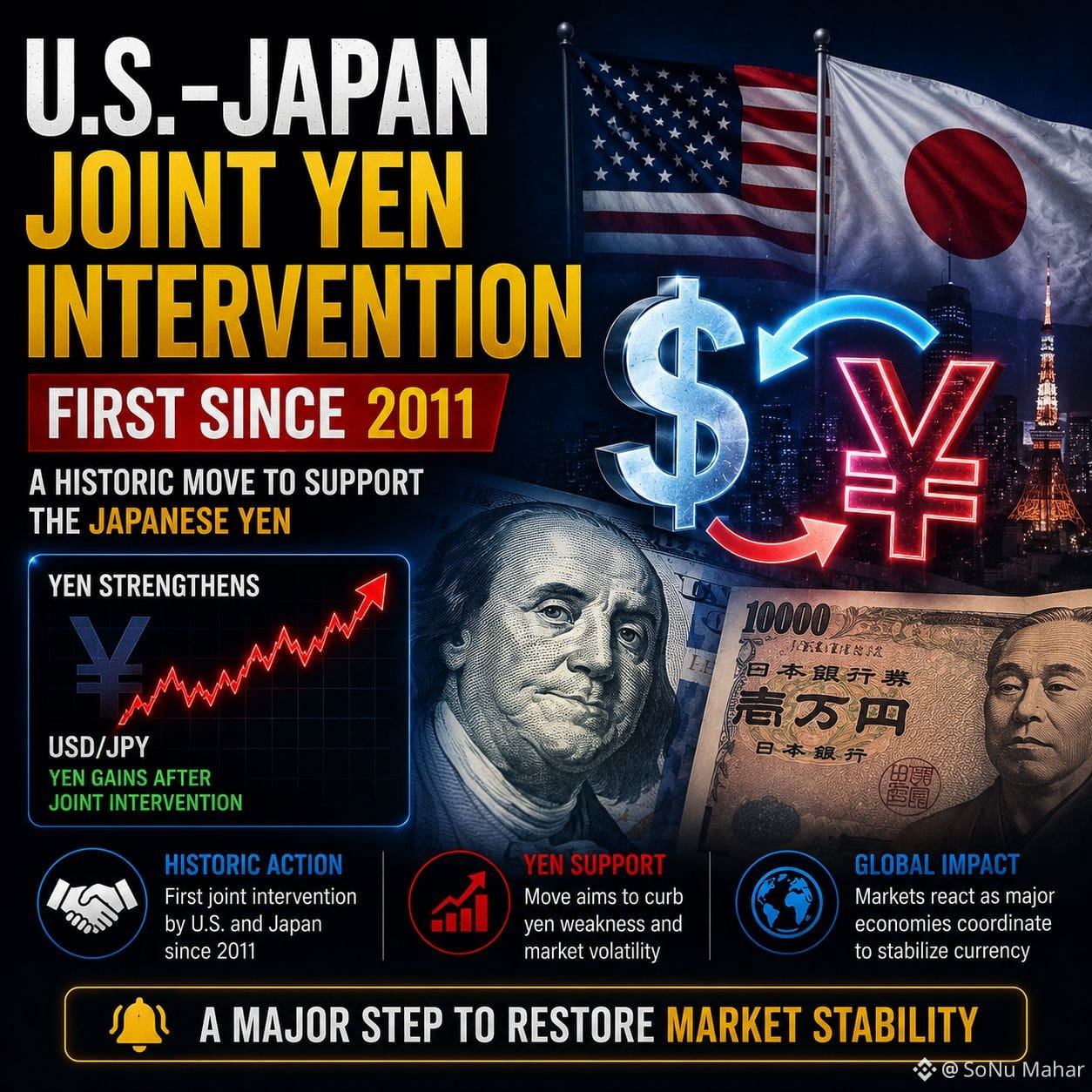
#USJapanJointYenInterventionFirstSince2011 🚨# U.S. and Japan Launch First Joint Yen Intervention Since 2011
The United States and Japan have reportedly carried out their first coordinated intervention in the currency market since 2011, aiming to stabilize the Japanese yen after a prolonged period of weakness. The rare move highlights growing concerns over excessive currency volatility and its impact on the global economy.
The joint action is designed to support the yen by influencing foreign exchange markets, helping restore confidence and reduce sharp fluctuations. Currency traders reacted quickly, with increased volatility seen across major forex pairs following the announcement.
A stronger yen could help ease import costs for Japan while affecting global trade dynamics and investor sentiment. Financial markets will now closely watch whether the coordinated effort has a lasting impact or if additional interventions become necessary.
The historic cooperation between the U.S. and Japan underscores the importance of international coordination during periods of financial uncertainty and could influence currency markets in the weeks ahead.
$BICO $CLO $BTC
#USJapanJointYenInterventionFirstSince2011 🚨# U.S. and Japan Launch First Joint Yen Intervention Since 2011
The United States and Japan have reportedly carried out their first coordinated intervention in the currency market since 2011, aiming to stabilize the Japanese yen after a prolonged period of weakness. The rare move highlights growing concerns over excessive currency volatility and its impact on the global economy.
The joint action is designed to support the yen by influencing foreign exchange markets, helping restore confidence and reduce sharp fluctuations. Currency traders reacted quickly, with increased volatility seen across major forex pairs following the announcement.
A stronger yen could help ease import costs for Japan while affecting global trade dynamics and investor sentiment. Financial markets will now closely watch whether the coordinated effort has a lasting impact or if additional interventions become necessary.
The historic cooperation between the U.S. and Japan underscores the importance of international coordination during periods of financial uncertainty and could influence currency markets in the weeks ahead.
$BICO $CLO $BTC
The United States and Japan have reportedly carried out their first coordinated intervention in the currency market since 2011, aiming to stabilize the Japanese yen after a prolonged period of weakness. The rare move highlights growing concerns over excessive currency volatility and its impact on the global economy.
The joint action is designed to support the yen by influencing foreign exchange markets, helping restore confidence and reduce sharp fluctuations. Currency traders reacted quickly, with increased volatility seen across major forex pairs following the announcement.
A stronger yen could help ease import costs for Japan while affecting global trade dynamics and investor sentiment. Financial markets will now closely watch whether the coordinated effort has a lasting impact or if additional interventions become necessary.
The historic cooperation between the U.S. and Japan underscores the importance of international coordination during periods of financial uncertainty and could influence currency markets in the weeks ahead.
$BICO $CLO $BTC
1
83

#USJapanJointYenInterventionFirstSince2011
The United States and Japan have officially confirmed a rare, coordinated currency intervention to buy the Japanese yen, marking their first joint market operation since 2011. The historic joint action, executed on Friday and confirmed by officials today, Monday, August 3, 2026, aims to rescue the yen after it collapsed to a 40-year low against the U.S. dollar. Japanese Finance Minister Satsuki Katayama and U.S. Treasury Secretary Scott Bessent both issued statements warning that they "will not hesitate" to conduct further joint interventions to counter excessive market volatility.$AAPL.US $NVDA.US $NVDAB
#USJapanJointYenInterventionFirstSince2011
The United States and Japan have officially confirmed a rare, coordinated currency intervention to buy the Japanese yen, marking their first joint market operation since 2011. The historic joint action, executed on Friday and confirmed by officials today, Monday, August 3, 2026, aims to rescue the yen after it collapsed to a 40-year low against the U.S. dollar. Japanese Finance Minister Satsuki Katayama and U.S. Treasury Secretary Scott Bessent both issued statements warning that they "will not hesitate" to conduct further joint interventions to counter excessive market volatility.$AAPL.US $NVDA.US $NVDAB
The United States and Japan have officially confirmed a rare, coordinated currency intervention to buy the Japanese yen, marking their first joint market operation since 2011. The historic joint action, executed on Friday and confirmed by officials today, Monday, August 3, 2026, aims to rescue the yen after it collapsed to a 40-year low against the U.S. dollar. Japanese Finance Minister Satsuki Katayama and U.S. Treasury Secretary Scott Bessent both issued statements warning that they "will not hesitate" to conduct further joint interventions to counter excessive market volatility.$AAPL.US $NVDA.US $NVDAB
75

#USJapanJointYenInterventionFirstSince2011
Here is a concise post tailored for Binance Square:
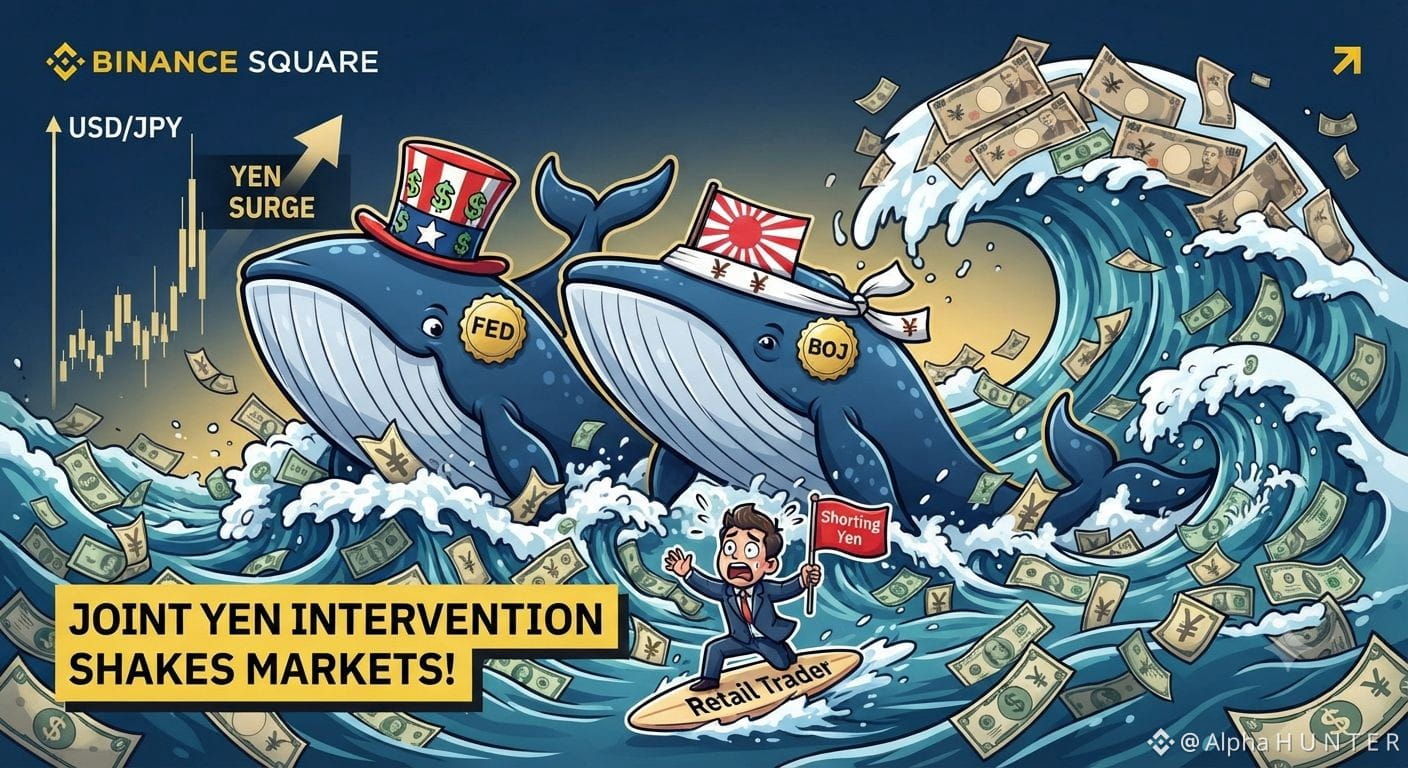
The US and Japan have shaken the global markets with their first joint yen intervention since 2011. Unlike past actions in 1998 to rescue a weak yen or 2011 to combat excessive strength, this modern move highlights high-stakes central bank coordination. Reports of a massive capital injection—highlighted by leaked notes pointing to a multi-billion dollar yen buy—signal that major institutional whales are actively shifting the tides.
For traders navigating this volatile shift, the golden rule remains clear: never fight the central banks. Shorting the yen in the face of direct intervention is a high-risk gamble. Instead, stay flexible, manage your leverage tightly, and closely monitor official currency flows to align with the new macro trend.
Not financial advice!
#YenIntervention #USDJPY #MacroEconomics #CryptoTrading.
$BTC
{future}(BTCUSDT)
$BLESS
{future}(BLESSUSDT)
$TAKE
{future}(TAKEUSDT)
#USJapanJointYenInterventionFirstSince2011
Here is a concise post tailored for Binance Square:
The US and Japan have shaken the global markets with their first joint yen intervention since 2011. Unlike past actions in 1998 to rescue a weak yen or 2011 to combat excessive strength, this modern move highlights high-stakes central bank coordination. Reports of a massive capital injection—highlighted by leaked notes pointing to a multi-billion dollar yen buy—signal that major institutional whales are actively shifting the tides.
For traders navigating this volatile shift, the golden rule remains clear: never fight the central banks. Shorting the yen in the face of direct intervention is a high-risk gamble. Instead, stay flexible, manage your leverage tightly, and closely monitor official currency flows to align with the new macro trend.
Not financial advice!
#YenIntervention #USDJPY #MacroEconomics #CryptoTrading.
$BTC
$BLESS
$TAKE
Here is a concise post tailored for Binance Square:
The US and Japan have shaken the global markets with their first joint yen intervention since 2011. Unlike past actions in 1998 to rescue a weak yen or 2011 to combat excessive strength, this modern move highlights high-stakes central bank coordination. Reports of a massive capital injection—highlighted by leaked notes pointing to a multi-billion dollar yen buy—signal that major institutional whales are actively shifting the tides.
For traders navigating this volatile shift, the golden rule remains clear: never fight the central banks. Shorting the yen in the face of direct intervention is a high-risk gamble. Instead, stay flexible, manage your leverage tightly, and closely monitor official currency flows to align with the new macro trend.
Not financial advice!
#YenIntervention #USDJPY #MacroEconomics #CryptoTrading.
$BTC
$BLESS
$TAKE
93


·
--

Article
US–Japan Joint Yen Intervention: First Since 2011#USJapanJointYenInterventionFirstSince2011
The United States and Japan have carried out a rare coordinated intervention to support the Japanese yen, marking the first joint action between the two countries since 2011. The move came after the yen weakened to around a 40-year low against the U.S. dollar, raising concerns about financial stability and imported inflation in Japan.
The intervention involved both governments buying yen in the foreign exchange market to slow the currency's sharp decline. Following the announcement, the yen strengthened noticeably, signaling that policymakers are prepared to act against excessive market volatility. Japanese officials also indicated that further coordinated action remains possible if needed.
While the intervention provided immediate support, many analysts believe its long-term success will depend on broader economic factors, particularly the interest-rate gap between the U.S. and Japan and future monetary policy decisions by the Bank of Japan. Without structural changes, currency interventions alone may only have temporary effects.
For investors, the event highlights how government actions can quickly reshape currency markets, influencing forex trading, bond yields, and global risk sentiment. It also underscores the close financial coordination between two of the world's largest economies during periods of market stress.
US–Japan Joint Yen Intervention: First Since 2011
#USJapanJointYenInterventionFirstSince2011
The United States and Japan have carried out a rare coordinated intervention to support the Japanese yen, marking the first joint action between the two countries since 2011. The move came after the yen weakened to around a 40-year low against the U.S. dollar, raising concerns about financial stability and imported inflation in Japan.
The intervention involved both governments buying yen in the foreign exchange market to slow the currency's sharp decline. Following the announcement, the yen strengthened noticeably, signaling that policymakers are prepared to act against excessive market volatility. Japanese officials also indicated that further coordinated action remains possible if needed.
While the intervention provided immediate support, many analysts believe its long-term success will depend on broader economic factors, particularly the interest-rate gap between the U.S. and Japan and future monetary policy decisions by the Bank of Japan. Without structural changes, currency interventions alone may only have temporary effects.
For investors, the event highlights how government actions can quickly reshape currency markets, influencing forex trading, bond yields, and global risk sentiment. It also underscores the close financial coordination between two of the world's largest economies during periods of market stress.
The United States and Japan have carried out a rare coordinated intervention to support the Japanese yen, marking the first joint action between the two countries since 2011. The move came after the yen weakened to around a 40-year low against the U.S. dollar, raising concerns about financial stability and imported inflation in Japan.
The intervention involved both governments buying yen in the foreign exchange market to slow the currency's sharp decline. Following the announcement, the yen strengthened noticeably, signaling that policymakers are prepared to act against excessive market volatility. Japanese officials also indicated that further coordinated action remains possible if needed.
While the intervention provided immediate support, many analysts believe its long-term success will depend on broader economic factors, particularly the interest-rate gap between the U.S. and Japan and future monetary policy decisions by the Bank of Japan. Without structural changes, currency interventions alone may only have temporary effects.
For investors, the event highlights how government actions can quickly reshape currency markets, influencing forex trading, bond yields, and global risk sentiment. It also underscores the close financial coordination between two of the world's largest economies during periods of market stress.
1
4
161

🚨 BREAKING :🚨U.S. & JAPAN MAKE A RARE MARKET MOVE! 🇺🇸🇯🇵💴
The United States and Japan have confirmed a rare joint foreign exchange intervention to support the Japanese yen amid ongoing currency volatility.
💱 The coordinated action signals growing concern over instability in global currency markets.
🌍 Traders are now watching for ripple effects across forex, equities, bonds, and crypto as major economies step in to stabilize financial markets. 📈🔥
Stay tuned for updates ⚡
$BICO $UB $VIC
#USJapanJointYenInterventionFirstSince2011
🚨 BREAKING :🚨U.S. & JAPAN MAKE A RARE MARKET MOVE! 🇺🇸🇯🇵💴
The United States and Japan have confirmed a rare joint foreign exchange intervention to support the Japanese yen amid ongoing currency volatility.
💱 The coordinated action signals growing concern over instability in global currency markets.
🌍 Traders are now watching for ripple effects across forex, equities, bonds, and crypto as major economies step in to stabilize financial markets. 📈🔥
Stay tuned for updates ⚡
$BICO $UB $VIC
#USJapanJointYenInterventionFirstSince2011
The United States and Japan have confirmed a rare joint foreign exchange intervention to support the Japanese yen amid ongoing currency volatility.
💱 The coordinated action signals growing concern over instability in global currency markets.
🌍 Traders are now watching for ripple effects across forex, equities, bonds, and crypto as major economies step in to stabilize financial markets. 📈🔥
Stay tuned for updates ⚡
$BICO $UB $VIC
#USJapanJointYenInterventionFirstSince2011
92

·
--

Article
US and Japan Join Forces to Prop Up the Yen—How Does This Impact Bitcoin and Risk Assets?In a historic move, the United States and Japan have conducted their first joint currency intervention to support the yen since 1998. 🇺🇸🇯🇵 This coordinated action, confirmed by President Trump and Treasury Secretary Scott Bessent, sent the yen soaring from its 40-year low of 163.99 per dollar to around 155. The question for crypto investors: what does this mean for $BTC and the broader risk-on sentiment? Let's break it down. 🧐
The Mechanics: Why They Intervened ⚙️
The yen has been battered by a massive interest rate differential. The Bank of Japan's rate (1.0%) is far below the US Federal Reserve's (3.5-3.75%). This gap fuels the popular "carry trade," where investors borrow cheap yen to invest in higher-yielding assets elsewhere. This weakens the yen further.
The Action: On Friday, the US and Japan jointly bought yen, marking the first such collaboration since 1998. The exact scale of the intervention remains undisclosed, but the impact was immediate and significant.The Message: President Trump called it a "signal of friendship" and "good for the world economy." Treasury Secretary Bessent stated that the US "strongly support[s] Japan's decisive market and monetary steps to correct the substantial undervaluation of the yen."
The Ripple Effect: A Liquidity Warning for Risk Assets 🌊
This is where it gets interesting for crypto. The yen carry trade has been a major source of cheap global liquidity. A significant unwind of these positions—as the yen strengthens—can have a cascading effect on risk assets.
Tighter Liquidity: When traders are forced to buy back yen to cover their positions, they often sell off riskier assets like stocks and $BTC to raise cash. This is precisely the dynamic we've been monitoring.The Macro Link: As we discussed recently, the yen's strength and rising US Treasury yields create a tightening of financial conditions, which is a headwind for BTC.
The Bigger Picture: A Pivotal Moment 📊
Economists view joint interventions as potentially marking key turning points in exchange rates. Michael Wan at MUFG noted that these events "have typically taken place around key turning points," though he cautioned that the fundamentals still need to change for a durable move.
The Fed's Role: The BoJ is expected to hike rates further, but the Fed might also be forced to raise rates to combat inflation, particularly given geopolitical tensions. This could keep the interest rate differential wide, limiting the yen's upside.
The Bottom Line: Volatility Ahead 📝
The coordinated intervention is a significant development that signals serious concern from both governments about the yen's weakness. For BTC and crypto, this reinforces the macro theme of tightening liquidity and potential deleveraging. A strong yen can act as a headwind for risk assets in the short term, as carry trades unwind.
However, it's not all doom and gloom. If this intervention stabilizes the yen and reduces uncertainty, it could eventually pave the way for a more stable macro environment, which would be positive for BTC in the long run. For now, expect continued volatility as the market digests this historic move.
Will the yen's strength lead to a sell-off in Bitcoin, or is this a healthy correction? Share your thoughts below! 👇
$ETH $BNB
#usjapanjointyeninterventionfirstsince2011
US and Japan Join Forces to Prop Up the Yen—How Does This Impact Bitcoin and Risk Assets?
In a historic move, the United States and Japan have conducted their first joint currency intervention to support the yen since 1998. 🇺🇸🇯🇵 This coordinated action, confirmed by President Trump and Treasury Secretary Scott Bessent, sent the yen soaring from its 40-year low of 163.99 per dollar to around 155. The question for crypto investors: what does this mean for $BTC and the broader risk-on sentiment? Let's break it down. 🧐
The Mechanics: Why They Intervened ⚙️
The yen has been battered by a massive interest rate differential. The Bank of Japan's rate (1.0%) is far below the US Federal Reserve's (3.5-3.75%). This gap fuels the popular "carry trade," where investors borrow cheap yen to invest in higher-yielding assets elsewhere. This weakens the yen further.
The Action: On Friday, the US and Japan jointly bought yen, marking the first such collaboration since 1998. The exact scale of the intervention remains undisclosed, but the impact was immediate and significant.The Message: President Trump called it a "signal of friendship" and "good for the world economy." Treasury Secretary Bessent stated that the US "strongly support[s] Japan's decisive market and monetary steps to correct the substantial undervaluation of the yen."
The Ripple Effect: A Liquidity Warning for Risk Assets 🌊
This is where it gets interesting for crypto. The yen carry trade has been a major source of cheap global liquidity. A significant unwind of these positions—as the yen strengthens—can have a cascading effect on risk assets.
Tighter Liquidity: When traders are forced to buy back yen to cover their positions, they often sell off riskier assets like stocks and $BTC to raise cash. This is precisely the dynamic we've been monitoring.The Macro Link: As we discussed recently, the yen's strength and rising US Treasury yields create a tightening of financial conditions, which is a headwind for BTC.
The Bigger Picture: A Pivotal Moment 📊
Economists view joint interventions as potentially marking key turning points in exchange rates. Michael Wan at MUFG noted that these events "have typically taken place around key turning points," though he cautioned that the fundamentals still need to change for a durable move.
The Fed's Role: The BoJ is expected to hike rates further, but the Fed might also be forced to raise rates to combat inflation, particularly given geopolitical tensions. This could keep the interest rate differential wide, limiting the yen's upside.
The Bottom Line: Volatility Ahead 📝
The coordinated intervention is a significant development that signals serious concern from both governments about the yen's weakness. For BTC and crypto, this reinforces the macro theme of tightening liquidity and potential deleveraging. A strong yen can act as a headwind for risk assets in the short term, as carry trades unwind.
However, it's not all doom and gloom. If this intervention stabilizes the yen and reduces uncertainty, it could eventually pave the way for a more stable macro environment, which would be positive for BTC in the long run. For now, expect continued volatility as the market digests this historic move.
Will the yen's strength lead to a sell-off in Bitcoin, or is this a healthy correction? Share your thoughts below! 👇
$ETH $BNB
#usjapanjointyeninterventionfirstsince2011
The Mechanics: Why They Intervened ⚙️
The yen has been battered by a massive interest rate differential. The Bank of Japan's rate (1.0%) is far below the US Federal Reserve's (3.5-3.75%). This gap fuels the popular "carry trade," where investors borrow cheap yen to invest in higher-yielding assets elsewhere. This weakens the yen further.
The Action: On Friday, the US and Japan jointly bought yen, marking the first such collaboration since 1998. The exact scale of the intervention remains undisclosed, but the impact was immediate and significant.The Message: President Trump called it a "signal of friendship" and "good for the world economy." Treasury Secretary Bessent stated that the US "strongly support[s] Japan's decisive market and monetary steps to correct the substantial undervaluation of the yen."
The Ripple Effect: A Liquidity Warning for Risk Assets 🌊
This is where it gets interesting for crypto. The yen carry trade has been a major source of cheap global liquidity. A significant unwind of these positions—as the yen strengthens—can have a cascading effect on risk assets.
Tighter Liquidity: When traders are forced to buy back yen to cover their positions, they often sell off riskier assets like stocks and $BTC to raise cash. This is precisely the dynamic we've been monitoring.The Macro Link: As we discussed recently, the yen's strength and rising US Treasury yields create a tightening of financial conditions, which is a headwind for BTC.
The Bigger Picture: A Pivotal Moment 📊
Economists view joint interventions as potentially marking key turning points in exchange rates. Michael Wan at MUFG noted that these events "have typically taken place around key turning points," though he cautioned that the fundamentals still need to change for a durable move.
The Fed's Role: The BoJ is expected to hike rates further, but the Fed might also be forced to raise rates to combat inflation, particularly given geopolitical tensions. This could keep the interest rate differential wide, limiting the yen's upside.
The Bottom Line: Volatility Ahead 📝
The coordinated intervention is a significant development that signals serious concern from both governments about the yen's weakness. For BTC and crypto, this reinforces the macro theme of tightening liquidity and potential deleveraging. A strong yen can act as a headwind for risk assets in the short term, as carry trades unwind.
However, it's not all doom and gloom. If this intervention stabilizes the yen and reduces uncertainty, it could eventually pave the way for a more stable macro environment, which would be positive for BTC in the long run. For now, expect continued volatility as the market digests this historic move.
Will the yen's strength lead to a sell-off in Bitcoin, or is this a healthy correction? Share your thoughts below! 👇
$ETH $BNB
#usjapanjointyeninterventionfirstsince2011
2
1
555

·
--
#USJapanJointYenInterventionFirstSince2011
MARKET Shift: US JAPAN JOINT YEN INTERVENTION
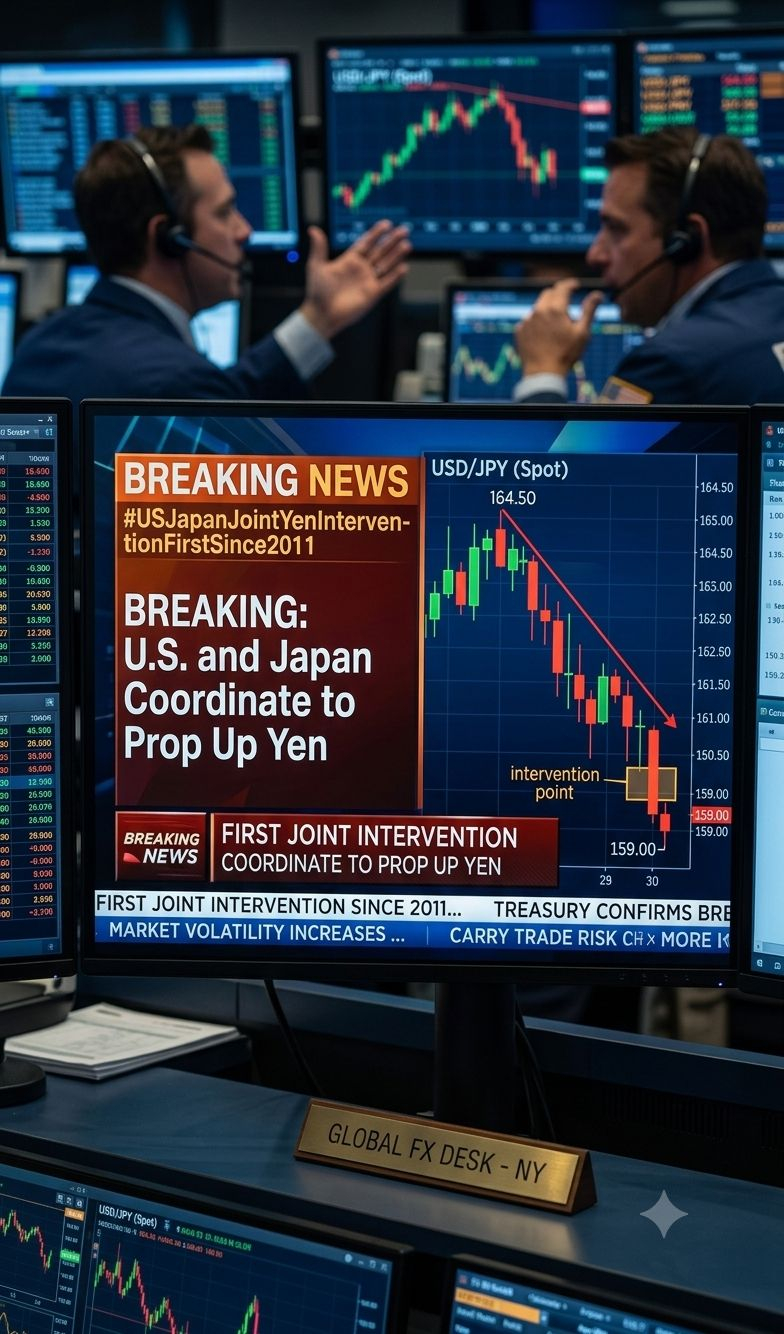
For the first time since 2011, the US Treasury and Japan’s Ministry of Finance executed a coordinated yen-buying intervention. Propping up the yen from 40-year lows near 164 marks a massive geopolitical and macroeconomic signal.
Key Takeaways:
Carry Trade Risk: A rapid yen rally forces unwind pressure on global risk assets funded by low-interest yen loans.
Policy Alignment: Direct US backing reinforces joint commitment to FX stability.
Liquidity Ripple: Cross-border capital adjustments could drive volatility across FX, Treasuries, and broader risk markets.
Watch key support bands closely as market leverage recalibrates.
$COTY.US
{stock_us}(COTY.US)
$KAITO LONG
{future}(KAITOUSDT)
$DOGE
{future}(DOGEUSDT)
#write2earn🌐💹
#Market_Update
#USJapanJointYenInterventionFirstSince2011
MARKET Shift: US JAPAN JOINT YEN INTERVENTION
For the first time since 2011, the US Treasury and Japan’s Ministry of Finance executed a coordinated yen-buying intervention. Propping up the yen from 40-year lows near 164 marks a massive geopolitical and macroeconomic signal.
Key Takeaways:
Carry Trade Risk: A rapid yen rally forces unwind pressure on global risk assets funded by low-interest yen loans.
Policy Alignment: Direct US backing reinforces joint commitment to FX stability.
Liquidity Ripple: Cross-border capital adjustments could drive volatility across FX, Treasuries, and broader risk markets.
Watch key support bands closely as market leverage recalibrates.
$COTY.US
$KAITO LONG
$DOGE
#write2earn🌐💹
#Market_Update
MARKET Shift: US JAPAN JOINT YEN INTERVENTION
For the first time since 2011, the US Treasury and Japan’s Ministry of Finance executed a coordinated yen-buying intervention. Propping up the yen from 40-year lows near 164 marks a massive geopolitical and macroeconomic signal.
Key Takeaways:
Carry Trade Risk: A rapid yen rally forces unwind pressure on global risk assets funded by low-interest yen loans.
Policy Alignment: Direct US backing reinforces joint commitment to FX stability.
Liquidity Ripple: Cross-border capital adjustments could drive volatility across FX, Treasuries, and broader risk markets.
Watch key support bands closely as market leverage recalibrates.
$COTY.US
$KAITO LONG
$DOGE
#write2earn🌐💹
#Market_Update
1
212

#usjapanjointyeninterventionfirstsince2011
🚨 Yen Roars Back as the U.S. & Japan Join Forces! 🇺🇸🇯🇵💴
For the first time in years, the U.S. and Japan reportedly coordinated to support the Japanese Yen, shaking up the global FX market. Traders are now watching whether this marks the beginning of a stronger Yen trend or just a short-term intervention.
📊 Market Take:
💴 JPY gains momentum
💵 USD faces downside pressure
📈 Forex volatility rises
🪙 Crypto could benefit if the Dollar continues to weaken
Crypto Watch 👀
A softer U.S. Dollar has historically improved liquidity conditions for risk assets. If the trend continues, #BTC and #ETH could see renewed buying interest, although macro-driven volatility is likely to remain high.
Bias: 🟢 Bullish JPY | 🔴 Bearish USD | 🟡 Cautiously Bullish Crypto
⚠️ Keep an eye on upcoming statements from the Bank of Japan and the U.S. Treasury. Their next moves could decide whether this is the start of a new trend or just a temporary market squeeze.
#Japan #USDJPY #Forex #Bitcoin
$CLICK TO BELOW TRADE👇👈
$PAXG
$BTC
$USDC
{spot}(BTCUSDT)
{spot}(USDCUSDT)
{spot}(PAXGUSDT)
#usjapanjointyeninterventionfirstsince2011
🚨 Yen Roars Back as the U.S. & Japan Join Forces! 🇺🇸🇯🇵💴
For the first time in years, the U.S. and Japan reportedly coordinated to support the Japanese Yen, shaking up the global FX market. Traders are now watching whether this marks the beginning of a stronger Yen trend or just a short-term intervention.
📊 Market Take:
💴 JPY gains momentum
💵 USD faces downside pressure
📈 Forex volatility rises
🪙 Crypto could benefit if the Dollar continues to weaken
Crypto Watch 👀
A softer U.S. Dollar has historically improved liquidity conditions for risk assets. If the trend continues, #BTC and #ETH could see renewed buying interest, although macro-driven volatility is likely to remain high.
Bias: 🟢 Bullish JPY | 🔴 Bearish USD | 🟡 Cautiously Bullish Crypto
⚠️ Keep an eye on upcoming statements from the Bank of Japan and the U.S. Treasury. Their next moves could decide whether this is the start of a new trend or just a temporary market squeeze.
#Japan #USDJPY #Forex #Bitcoin
$CLICK TO BELOW TRADE👇👈
$PAXG
$BTC
$USDC
🚨 Yen Roars Back as the U.S. & Japan Join Forces! 🇺🇸🇯🇵💴
For the first time in years, the U.S. and Japan reportedly coordinated to support the Japanese Yen, shaking up the global FX market. Traders are now watching whether this marks the beginning of a stronger Yen trend or just a short-term intervention.
📊 Market Take:
💴 JPY gains momentum
💵 USD faces downside pressure
📈 Forex volatility rises
🪙 Crypto could benefit if the Dollar continues to weaken
Crypto Watch 👀
A softer U.S. Dollar has historically improved liquidity conditions for risk assets. If the trend continues, #BTC and #ETH could see renewed buying interest, although macro-driven volatility is likely to remain high.
Bias: 🟢 Bullish JPY | 🔴 Bearish USD | 🟡 Cautiously Bullish Crypto
⚠️ Keep an eye on upcoming statements from the Bank of Japan and the U.S. Treasury. Their next moves could decide whether this is the start of a new trend or just a temporary market squeeze.
#Japan #USDJPY #Forex #Bitcoin
$CLICK TO BELOW TRADE👇👈
$PAXG
$BTC
$USDC
4
4
2.5k

·
--

Article
The biggest market shock of 2026 points to Japan: Will Bitcoin hold up or suffer?Japan could officially confirm joint currency intervention with Washington on Monday, and an official told Reuters that the operation is still ongoing, turning this announcement into an event that could directly impact the market.
Bitcoin is currently trading around $63,000, being affected by an issue in the bond market that most retail investors in crypto have not really been paying attention to.
The biggest market shock of 2026 points to Japan: Will Bitcoin hold up or suffer?
Japan could officially confirm joint currency intervention with Washington on Monday, and an official told Reuters that the operation is still ongoing, turning this announcement into an event that could directly impact the market.
Bitcoin is currently trading around $63,000, being affected by an issue in the bond market that most retail investors in crypto have not really been paying attention to.
Bitcoin is currently trading around $63,000, being affected by an issue in the bond market that most retail investors in crypto have not really been paying attention to.
1
4
376

#USJapanJointYenInterventionFirstSince2011 "The joint intervention between Japan and the U.S. is a reminder that, however decentralized the market may seem, macro policies are still what move the needle. Beyond the initial shock in USD/JPY, the key here is how this will affect global liquidity and capital flows into risk assets.
My advice: don’t trade the panic. Central bank interventions create a lot of volatility, but the underlying trend prevails after the storm. How are you adjusting your portfolios in response to this macro move?"
#USJapanJointYenInterventionFirstSince2011 "The joint intervention between Japan and the U.S. is a reminder that, however decentralized the market may seem, macro policies are still what move the needle. Beyond the initial shock in USD/JPY, the key here is how this will affect global liquidity and capital flows into risk assets.
My advice: don’t trade the panic. Central bank interventions create a lot of volatility, but the underlying trend prevails after the storm. How are you adjusting your portfolios in response to this macro move?"
My advice: don’t trade the panic. Central bank interventions create a lot of volatility, but the underlying trend prevails after the storm. How are you adjusting your portfolios in response to this macro move?"
1
279

·
--
Bullish
#usjapanjointyeninterventionfirstsince2011
🚨 US AND JAPAN CONFIRM JOINT YEN INTERVENTION
Tokyo and Washington jointly bought yen to stop its slide.
This is their first coordinated FX intervention since 2011 — but the direction is reversed. Back then, authorities sold JPY after Fukushima. Now they are buying it.
💴 For crypto, this is not automatically #bullish
The lazy take is:
👉 stronger yen → weaker dollar → BTC up
The real mechanics are harder.
A controlled JPY recovery can support crypto later if the dollar softens while Nasdaq and BTC remain stable.
A violent yen squeeze does the opposite first.
Funds that borrowed cheap #JPY may be forced to buy it back, cut leverage and sell assets held on the other side of the carry trade. Stocks weaken, open interest falls and crypto gets hit before any benefit from a softer dollar arrives.
⚠️ Watch the reaction, not the headline
— USD/JPY falls while #NASDAQ and #BTC hold: healthy repricing
— USD/JPY falls while stocks, OI and crypto drop: carry-trade unwind
— more intervention signals: macro volatility stays elevated
This is no longer one isolated FX candle.
The market now knows that the US and Japan are prepared to defend the yen together — and another intervention can arrive without warning.
🤖 Markets like this punish emotional execution. Crypto Resources trading robots for Binance follow predefined long and short rules automatically, while filters, position limits and risk management control exposure.
$BLESS $BICO $CLO
#usjapanjointyeninterventionfirstsince2011
🚨 US AND JAPAN CONFIRM JOINT YEN INTERVENTION
Tokyo and Washington jointly bought yen to stop its slide.
This is their first coordinated FX intervention since 2011 — but the direction is reversed. Back then, authorities sold JPY after Fukushima. Now they are buying it.
💴 For crypto, this is not automatically #bullish
The lazy take is:
👉 stronger yen → weaker dollar → BTC up
The real mechanics are harder.
A controlled JPY recovery can support crypto later if the dollar softens while Nasdaq and BTC remain stable.
A violent yen squeeze does the opposite first.
Funds that borrowed cheap #JPY may be forced to buy it back, cut leverage and sell assets held on the other side of the carry trade. Stocks weaken, open interest falls and crypto gets hit before any benefit from a softer dollar arrives.
⚠️ Watch the reaction, not the headline
— USD/JPY falls while #NASDAQ and #BTC hold: healthy repricing
— USD/JPY falls while stocks, OI and crypto drop: carry-trade unwind
— more intervention signals: macro volatility stays elevated
This is no longer one isolated FX candle.
The market now knows that the US and Japan are prepared to defend the yen together — and another intervention can arrive without warning.
🤖 Markets like this punish emotional execution. Crypto Resources trading robots for Binance follow predefined long and short rules automatically, while filters, position limits and risk management control exposure.
$BLESS $BICO $CLO
🚨 US AND JAPAN CONFIRM JOINT YEN INTERVENTION
Tokyo and Washington jointly bought yen to stop its slide.
This is their first coordinated FX intervention since 2011 — but the direction is reversed. Back then, authorities sold JPY after Fukushima. Now they are buying it.
💴 For crypto, this is not automatically #bullish
The lazy take is:
👉 stronger yen → weaker dollar → BTC up
The real mechanics are harder.
A controlled JPY recovery can support crypto later if the dollar softens while Nasdaq and BTC remain stable.
A violent yen squeeze does the opposite first.
Funds that borrowed cheap #JPY may be forced to buy it back, cut leverage and sell assets held on the other side of the carry trade. Stocks weaken, open interest falls and crypto gets hit before any benefit from a softer dollar arrives.
⚠️ Watch the reaction, not the headline
— USD/JPY falls while #NASDAQ and #BTC hold: healthy repricing
— USD/JPY falls while stocks, OI and crypto drop: carry-trade unwind
— more intervention signals: macro volatility stays elevated
This is no longer one isolated FX candle.
The market now knows that the US and Japan are prepared to defend the yen together — and another intervention can arrive without warning.
🤖 Markets like this punish emotional execution. Crypto Resources trading robots for Binance follow predefined long and short rules automatically, while filters, position limits and risk management control exposure.
$BLESS $BICO $CLO

2
12
4.5k

·
--
#USJapanJointYenInterventionFirstSince2011
#USJapanJointYenInterventionFirstSince2011
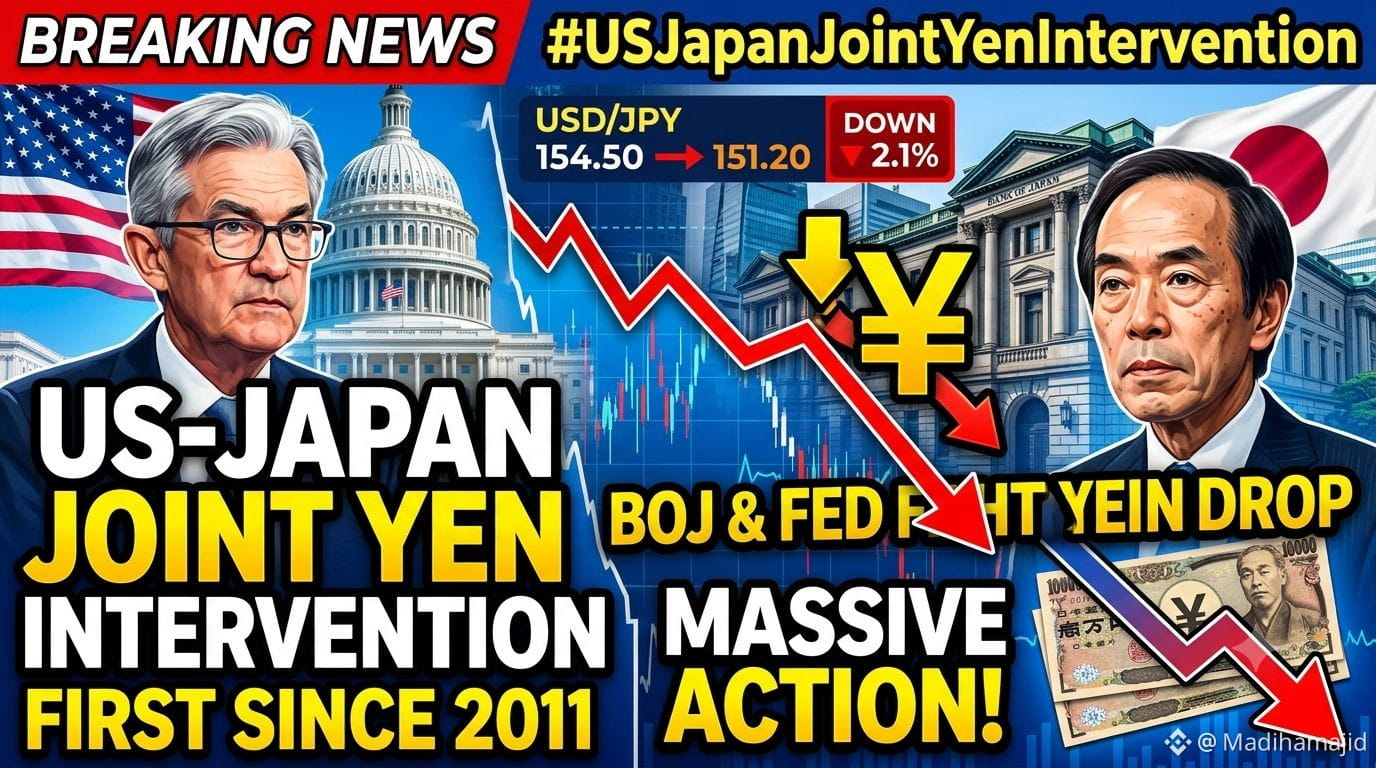
The United States and Japan have reportedly carried out their first joint intervention in the foreign exchange market since 2011, marking a significant step to stabilize the Japanese yen amid heightened currency volatility.
The coordinated action reflects growing concern over the yen's sharp depreciation and its impact on inflation, import costs, and broader financial stability. Joint interventions of this scale are rare and often signal a strong commitment by major economies to restore orderly market conditions.
The move has drawn global attention, as coordinated currency interventions can influence investor sentiment across foreign exchange, bond, and equity markets.
Traders will now watch whether the intervention has a lasting impact on the yen or if additional policy measures from Japanese authorities and central banks become necessary.
The outcome could shape expectations for future monetary policy, regional trade, and global currency markets.
#USJapanJointYenInterventionFirstSince2011
#USJapanJointYenInterventionFirstSince2011
#USJapanJointYenInterventionFirstSince2011
The United States and Japan have reportedly carried out their first joint intervention in the foreign exchange market since 2011, marking a significant step to stabilize the Japanese yen amid heightened currency volatility.
The coordinated action reflects growing concern over the yen's sharp depreciation and its impact on inflation, import costs, and broader financial stability. Joint interventions of this scale are rare and often signal a strong commitment by major economies to restore orderly market conditions.
The move has drawn global attention, as coordinated currency interventions can influence investor sentiment across foreign exchange, bond, and equity markets.
Traders will now watch whether the intervention has a lasting impact on the yen or if additional policy measures from Japanese authorities and central banks become necessary.
The outcome could shape expectations for future monetary policy, regional trade, and global currency markets.
#USJapanJointYenInterventionFirstSince2011
#USJapanJointYenInterventionFirstSince2011
The United States and Japan have reportedly carried out their first joint intervention in the foreign exchange market since 2011, marking a significant step to stabilize the Japanese yen amid heightened currency volatility.
The coordinated action reflects growing concern over the yen's sharp depreciation and its impact on inflation, import costs, and broader financial stability. Joint interventions of this scale are rare and often signal a strong commitment by major economies to restore orderly market conditions.
The move has drawn global attention, as coordinated currency interventions can influence investor sentiment across foreign exchange, bond, and equity markets.
Traders will now watch whether the intervention has a lasting impact on the yen or if additional policy measures from Japanese authorities and central banks become necessary.
The outcome could shape expectations for future monetary policy, regional trade, and global currency markets.
#USJapanJointYenInterventionFirstSince2011
1
89

·
--
#USJapanJointYenInterventionFirstSince2011 : A Rare Currency Move That Could Reshape Global Markets
One of the biggest macro stories this week isn't about stocks or crypto, it's about the Japanese yen.
The United States and Japan have confirmed a coordinated yen-buying intervention, marking the first joint currency intervention since 2011. The move came after the yen weakened to multi-decade lows, raising concerns over imported inflation, financial stability, and broader market disruptions.
What makes this significant is its rarity.
Major economies generally allow currencies to move freely. When two governments step into the foreign exchange market together, it's usually a sign that policymakers believe volatility has become excessive rather than reflecting normal market forces. Following the intervention, the yen strengthened sharply against the U.S. dollar, showing that coordinated action can quickly influence market sentiment.
However, history suggests intervention alone rarely changes a long-term trend. The yen's direction will still depend on the interest-rate gap between the Federal Reserve and the Bank of Japan, inflation dynamics, and future monetary policy decisions. Without those fundamentals shifting, the impact of intervention could fade over time.
My View
I see this as more than a currency story, it's a signal that governments are increasingly willing to act when financial stability is at risk. For investors, this reinforces an important lesson: policy decisions can move markets just as quickly as economic data.
#Write2Earn #BinanceSquare
#USJapanJointYenInterventionFirstSince2011 : A Rare Currency Move That Could Reshape Global Markets
One of the biggest macro stories this week isn't about stocks or crypto, it's about the Japanese yen.
The United States and Japan have confirmed a coordinated yen-buying intervention, marking the first joint currency intervention since 2011. The move came after the yen weakened to multi-decade lows, raising concerns over imported inflation, financial stability, and broader market disruptions.
What makes this significant is its rarity.
Major economies generally allow currencies to move freely. When two governments step into the foreign exchange market together, it's usually a sign that policymakers believe volatility has become excessive rather than reflecting normal market forces. Following the intervention, the yen strengthened sharply against the U.S. dollar, showing that coordinated action can quickly influence market sentiment.
However, history suggests intervention alone rarely changes a long-term trend. The yen's direction will still depend on the interest-rate gap between the Federal Reserve and the Bank of Japan, inflation dynamics, and future monetary policy decisions. Without those fundamentals shifting, the impact of intervention could fade over time.
My View
I see this as more than a currency story, it's a signal that governments are increasingly willing to act when financial stability is at risk. For investors, this reinforces an important lesson: policy decisions can move markets just as quickly as economic data.
#Write2Earn #BinanceSquare
One of the biggest macro stories this week isn't about stocks or crypto, it's about the Japanese yen.
The United States and Japan have confirmed a coordinated yen-buying intervention, marking the first joint currency intervention since 2011. The move came after the yen weakened to multi-decade lows, raising concerns over imported inflation, financial stability, and broader market disruptions.
What makes this significant is its rarity.
Major economies generally allow currencies to move freely. When two governments step into the foreign exchange market together, it's usually a sign that policymakers believe volatility has become excessive rather than reflecting normal market forces. Following the intervention, the yen strengthened sharply against the U.S. dollar, showing that coordinated action can quickly influence market sentiment.
However, history suggests intervention alone rarely changes a long-term trend. The yen's direction will still depend on the interest-rate gap between the Federal Reserve and the Bank of Japan, inflation dynamics, and future monetary policy decisions. Without those fundamentals shifting, the impact of intervention could fade over time.
My View
I see this as more than a currency story, it's a signal that governments are increasingly willing to act when financial stability is at risk. For investors, this reinforces an important lesson: policy decisions can move markets just as quickly as economic data.
#Write2Earn #BinanceSquare
1
2
213

·
--
Bullish
Verified
#usjapanjointyeninterventionfirstsince2011 🇺🇸🇯🇵 BREAKING: The U.S. and Japan reportedly carried out their first joint yen intervention since 2011.
This is a major development in global currency markets.
After years of letting the market dictate the yen's direction, both countries have now stepped in together to stabilize the currency. A coordinated intervention of this scale is extremely rare and signals growing concern over excessive FX volatility.
Why does it matter?
🔹 A stronger yen can reshape global capital flows.
🔹 It may impact Japanese exports and multinational earnings.
🔹 Currency moves often spill over into stocks, bonds, commodities, and crypto.
🔹 Traders should also watch how this influences the U.S. dollar, as major FX shifts can change overall market sentiment.
History shows that coordinated interventions don't happen often. When they do, markets pay attention because they usually reflect concerns that go beyond normal price fluctuations.
$PAXG $BTC $USDC #USJapanJointYenInterventionFirstSince2011
{spot}(BTCUSDT)
{spot}(USDCUSDT)
#usjapanjointyeninterventionfirstsince2011 🇺🇸🇯🇵 BREAKING: The U.S. and Japan reportedly carried out their first joint yen intervention since 2011.
This is a major development in global currency markets.
After years of letting the market dictate the yen's direction, both countries have now stepped in together to stabilize the currency. A coordinated intervention of this scale is extremely rare and signals growing concern over excessive FX volatility.
Why does it matter?
🔹 A stronger yen can reshape global capital flows.
🔹 It may impact Japanese exports and multinational earnings.
🔹 Currency moves often spill over into stocks, bonds, commodities, and crypto.
🔹 Traders should also watch how this influences the U.S. dollar, as major FX shifts can change overall market sentiment.
History shows that coordinated interventions don't happen often. When they do, markets pay attention because they usually reflect concerns that go beyond normal price fluctuations.
$PAXG $BTC $USDC #USJapanJointYenInterventionFirstSince2011
This is a major development in global currency markets.
After years of letting the market dictate the yen's direction, both countries have now stepped in together to stabilize the currency. A coordinated intervention of this scale is extremely rare and signals growing concern over excessive FX volatility.
Why does it matter?
🔹 A stronger yen can reshape global capital flows.
🔹 It may impact Japanese exports and multinational earnings.
🔹 Currency moves often spill over into stocks, bonds, commodities, and crypto.
🔹 Traders should also watch how this influences the U.S. dollar, as major FX shifts can change overall market sentiment.
History shows that coordinated interventions don't happen often. When they do, markets pay attention because they usually reflect concerns that go beyond normal price fluctuations.
$PAXG $BTC $USDC #USJapanJointYenInterventionFirstSince2011

1
2
785

·
--
Bullish
Verified
#usjapanjointyeninterventionfirstsince2011
🇺🇸🇯🇵 US–Japan Yen Intervention: Why Crypto Tradrs Should Pay Attention
The United States and Japan have confirmed a coordinated intervention to support the Japanese yen, marking their first joint action in the foreign exchange market since 2011. Unlike the post-Fukushima intervention, when authorities worked to weaken the yen, this time they are stepping in to strengthen it.
For crypto markets, this is not an automatic bullish signal.
A common assumption is that a stronger yen leads to a weaker US dollar, which benefits Bitcoin and other digital assets. While that relationship can develop over time, the short-term market reaction is often more complicated.
If the yen appreciates gradually and risk assets remain resilient, a softer dollar could eventually create a more supportive backdrop for cryptocurrencies. However, if the yen rallies too aggressively, investors involved in yen-funded carry trades may be forced to unwind leveraged positions. That process can trigger selling across equities and crypto, reduce open interest, and increase market volatility before conditions stabilize.
Key Signals to Watch
- USD/JPY declines while Bitcoin and Nasdaq remain firm: A healthy market adjustment that may support risk assets over time.
- USD/JPY declines alongside falling stocks and crypto: A potential carry-trade unwind with broader deleveraging across financial markets.
- Additional intervention signals: Increased macro uncertainty and higher volatility across global markets.
The key message is to focus on market reaction rather than headlines. With US and Japanese authorities now showing a willingness to intervene together, currency markets could remain highly sensitive, and unexpected policy actions may continue to influence crypto sentiment.
#USToCancelIranAttackSubjectToDeal
#CardanoRisesNearly10%
#ColdcardHaltsShipmentsAfterFirmwareFlaw
#KOSPIFalls3.28%
{future}(BTCUSDT)
{future}(BICOUSDT)
{future}(CLOUSDT)
#usjapanjointyeninterventionfirstsince2011
🇺🇸🇯🇵 US–Japan Yen Intervention: Why Crypto Tradrs Should Pay Attention
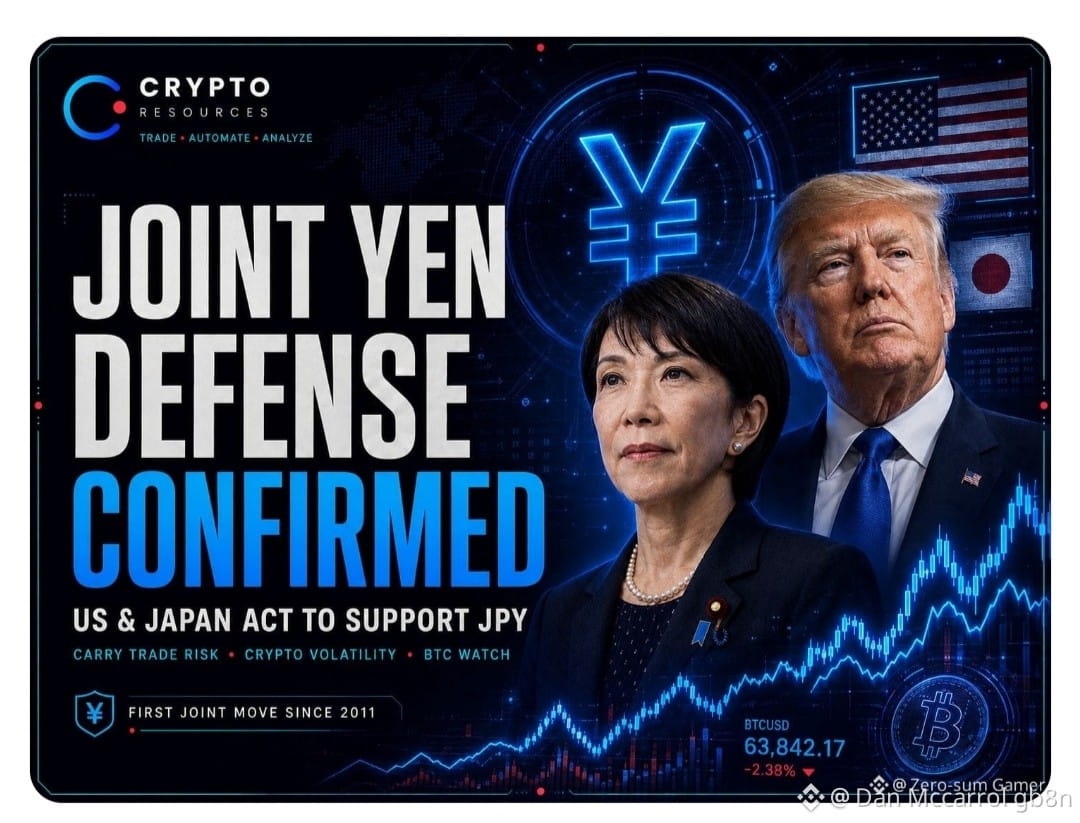
The United States and Japan have confirmed a coordinated intervention to support the Japanese yen, marking their first joint action in the foreign exchange market since 2011. Unlike the post-Fukushima intervention, when authorities worked to weaken the yen, this time they are stepping in to strengthen it.
For crypto markets, this is not an automatic bullish signal.
A common assumption is that a stronger yen leads to a weaker US dollar, which benefits Bitcoin and other digital assets. While that relationship can develop over time, the short-term market reaction is often more complicated.
If the yen appreciates gradually and risk assets remain resilient, a softer dollar could eventually create a more supportive backdrop for cryptocurrencies. However, if the yen rallies too aggressively, investors involved in yen-funded carry trades may be forced to unwind leveraged positions. That process can trigger selling across equities and crypto, reduce open interest, and increase market volatility before conditions stabilize.
Key Signals to Watch
- USD/JPY declines while Bitcoin and Nasdaq remain firm: A healthy market adjustment that may support risk assets over time.
- USD/JPY declines alongside falling stocks and crypto: A potential carry-trade unwind with broader deleveraging across financial markets.
- Additional intervention signals: Increased macro uncertainty and higher volatility across global markets.
The key message is to focus on market reaction rather than headlines. With US and Japanese authorities now showing a willingness to intervene together, currency markets could remain highly sensitive, and unexpected policy actions may continue to influence crypto sentiment.
#USToCancelIranAttackSubjectToDeal
#CardanoRisesNearly10%
#ColdcardHaltsShipmentsAfterFirmwareFlaw
#KOSPIFalls3.28%
🇺🇸🇯🇵 US–Japan Yen Intervention: Why Crypto Tradrs Should Pay Attention
The United States and Japan have confirmed a coordinated intervention to support the Japanese yen, marking their first joint action in the foreign exchange market since 2011. Unlike the post-Fukushima intervention, when authorities worked to weaken the yen, this time they are stepping in to strengthen it.
For crypto markets, this is not an automatic bullish signal.
A common assumption is that a stronger yen leads to a weaker US dollar, which benefits Bitcoin and other digital assets. While that relationship can develop over time, the short-term market reaction is often more complicated.
If the yen appreciates gradually and risk assets remain resilient, a softer dollar could eventually create a more supportive backdrop for cryptocurrencies. However, if the yen rallies too aggressively, investors involved in yen-funded carry trades may be forced to unwind leveraged positions. That process can trigger selling across equities and crypto, reduce open interest, and increase market volatility before conditions stabilize.
Key Signals to Watch
- USD/JPY declines while Bitcoin and Nasdaq remain firm: A healthy market adjustment that may support risk assets over time.
- USD/JPY declines alongside falling stocks and crypto: A potential carry-trade unwind with broader deleveraging across financial markets.
- Additional intervention signals: Increased macro uncertainty and higher volatility across global markets.
The key message is to focus on market reaction rather than headlines. With US and Japanese authorities now showing a willingness to intervene together, currency markets could remain highly sensitive, and unexpected policy actions may continue to influence crypto sentiment.
#USToCancelIranAttackSubjectToDeal
#CardanoRisesNearly10%
#ColdcardHaltsShipmentsAfterFirmwareFlaw
#KOSPIFalls3.28%
2.7k

·
--
Bullish
#USJapanJointYenInterventionFirstSince2011
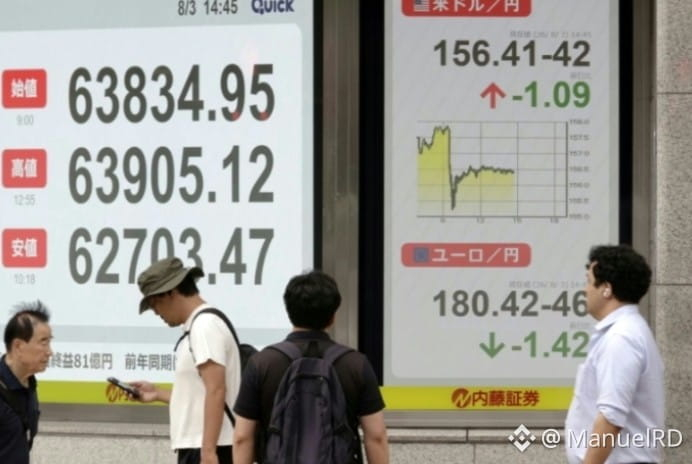
Within the pact between the United States and Japan to carry out the first joint intervention in the yen market since 2011.
Tokyo and Washington carried out a coordinated yen-buying intervention and will not hesitate to take additional steps, Japan’s Finance Ministry said on Monday, confirming an unusual bilateral move to halt the yen’s fall to fresh 40-year lows.
The move underscored both countries’ determination to prevent a massive selling of the yen and Japanese government bonds (JGBs) from triggering global repercussions, such as additional upward pressure on U.S. Treasury bond yields, which are already rising.
#YenRisesTo156
$NVDAB
{spot}(NVDABUSDT)
$NVDA.US
{stock_us}(NVDA.US)
$BNB
{spot}(BNBUSDT)
#USJapanJointYenInterventionFirstSince2011
Within the pact between the United States and Japan to carry out the first joint intervention in the yen market since 2011.
Tokyo and Washington carried out a coordinated yen-buying intervention and will not hesitate to take additional steps, Japan’s Finance Ministry said on Monday, confirming an unusual bilateral move to halt the yen’s fall to fresh 40-year lows.
The move underscored both countries’ determination to prevent a massive selling of the yen and Japanese government bonds (JGBs) from triggering global repercussions, such as additional upward pressure on U.S. Treasury bond yields, which are already rising.
#YenRisesTo156
$NVDAB
$NVDA.US
$BNB
Within the pact between the United States and Japan to carry out the first joint intervention in the yen market since 2011.
Tokyo and Washington carried out a coordinated yen-buying intervention and will not hesitate to take additional steps, Japan’s Finance Ministry said on Monday, confirming an unusual bilateral move to halt the yen’s fall to fresh 40-year lows.
The move underscored both countries’ determination to prevent a massive selling of the yen and Japanese government bonds (JGBs) from triggering global repercussions, such as additional upward pressure on U.S. Treasury bond yields, which are already rising.
#YenRisesTo156
$NVDAB
$NVDA.US
$BNB
1
1
545
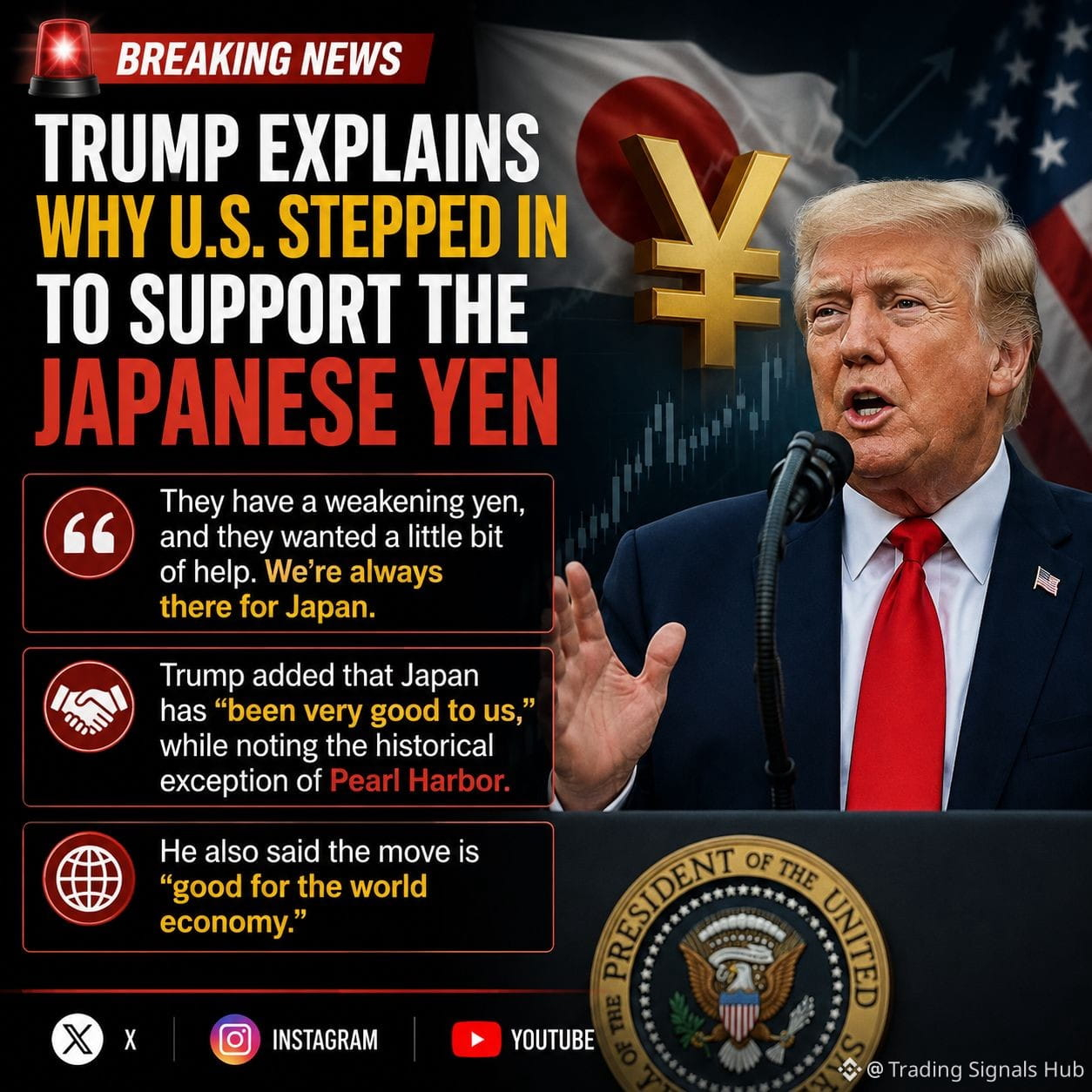
🚨 Trump Says U.S. Supported Japan Over Weakening Yen
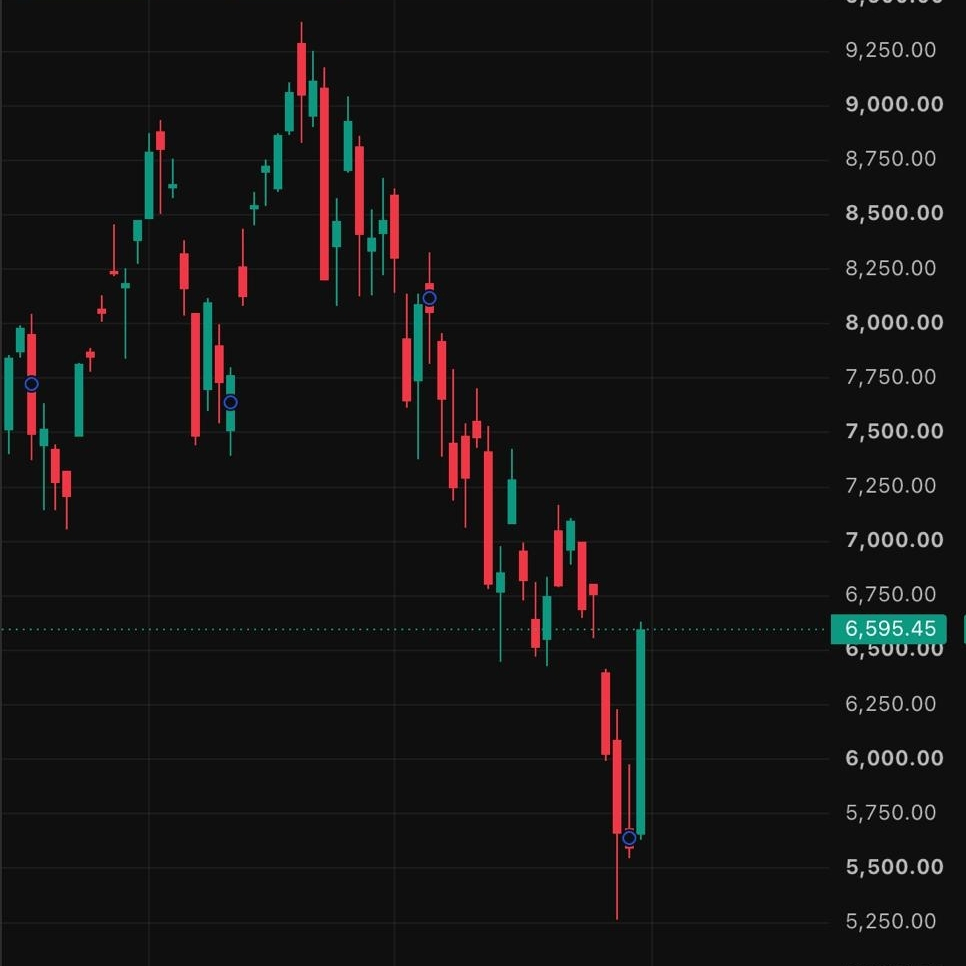
• President Trump said the U.S. stepped in to support the Japanese yen as it weakened.
• He said Japan has “been very good to us.”
• Trump described the move as “good for the world economy.”
• Markets are watching the impact on the yen, dollar and global economy. 🌎📊
#USJapanJointYenInterventionFirstSince2011 #YenRisesTo156 #USToCancelIranAttackSubjectToDeal #ColdcardHaltsShipmentsAfterFirmwareFlaw #CardanoRisesNearly10%
🚨 Trump Says U.S. Supported Japan Over Weakening Yen
• President Trump said the U.S. stepped in to support the Japanese yen as it weakened.
• He said Japan has “been very good to us.”
• Trump described the move as “good for the world economy.”
• Markets are watching the impact on the yen, dollar and global economy. 🌎📊
#USJapanJointYenInterventionFirstSince2011 #YenRisesTo156 #USToCancelIranAttackSubjectToDeal #ColdcardHaltsShipmentsAfterFirmwareFlaw #CardanoRisesNearly10%
• President Trump said the U.S. stepped in to support the Japanese yen as it weakened.
• He said Japan has “been very good to us.”
• Trump described the move as “good for the world economy.”
• Markets are watching the impact on the yen, dollar and global economy. 🌎📊
#USJapanJointYenInterventionFirstSince2011 #YenRisesTo156 #USToCancelIranAttackSubjectToDeal #ColdcardHaltsShipmentsAfterFirmwareFlaw #CardanoRisesNearly10%
1
1
103

#USJapanJointYenInterventionFirstSince2011 It's a historic FX move — first joint US-Japan yen intervention since 2011.
What happened:
Yen collapsed to a 40-year low last week, hitting ∼163-164 per dollar. Japan intervened first — BoJ data suggests it sold up to $58.97B to buy yen on Thursday. Then the US Treasury joined on Friday, buying yen by selling euros via Goldman and Morgan Stanley. 
That pushed USD/JPY from 164 down to 157 in 2 days — a 4% jump for yen. 
Why it matters:
Last joint action was March 18, 2011, when G7 sold yen after the Tohoku earthquake to stop yen from surging. This time it was the opposite — to strengthen yen. 
Officials confirmed Monday:
• Treasury Sec. Scott Bessent: action "countered disorderly yen movements"
• Finance Minister Satsuki Katayama confirmed the joint move
Why US joined:
Analysts say it was to prevent yen/JGB selloff spilling into US Treasuries. Japan is the biggest foreign holder of US debt, and solo intervention would mean selling Treasuries and pushing US yields higher. $BNB
{spot}(BNBUSDT)
$SOL
{spot}(SOLUSDT)
$BTC
{spot}(BTCUSDT)
#USJapanJointYenInterventionFirstSince2011
#USJapanJointYenInterventionFirstSince2011 It's a historic FX move — first joint US-Japan yen intervention since 2011.
What happened:
Yen collapsed to a 40-year low last week, hitting ∼163-164 per dollar. Japan intervened first — BoJ data suggests it sold up to $58.97B to buy yen on Thursday. Then the US Treasury joined on Friday, buying yen by selling euros via Goldman and Morgan Stanley. 
That pushed USD/JPY from 164 down to 157 in 2 days — a 4% jump for yen. 
Why it matters:
Last joint action was March 18, 2011, when G7 sold yen after the Tohoku earthquake to stop yen from surging. This time it was the opposite — to strengthen yen. 
Officials confirmed Monday:
• Treasury Sec. Scott Bessent: action "countered disorderly yen movements"
• Finance Minister Satsuki Katayama confirmed the joint move
Why US joined:
Analysts say it was to prevent yen/JGB selloff spilling into US Treasuries. Japan is the biggest foreign holder of US debt, and solo intervention would mean selling Treasuries and pushing US yields higher. $BNB
$SOL
$BTC
#USJapanJointYenInterventionFirstSince2011
What happened:
Yen collapsed to a 40-year low last week, hitting ∼163-164 per dollar. Japan intervened first — BoJ data suggests it sold up to $58.97B to buy yen on Thursday. Then the US Treasury joined on Friday, buying yen by selling euros via Goldman and Morgan Stanley. 
That pushed USD/JPY from 164 down to 157 in 2 days — a 4% jump for yen. 
Why it matters:
Last joint action was March 18, 2011, when G7 sold yen after the Tohoku earthquake to stop yen from surging. This time it was the opposite — to strengthen yen. 
Officials confirmed Monday:
• Treasury Sec. Scott Bessent: action "countered disorderly yen movements"
• Finance Minister Satsuki Katayama confirmed the joint move
Why US joined:
Analysts say it was to prevent yen/JGB selloff spilling into US Treasuries. Japan is the biggest foreign holder of US debt, and solo intervention would mean selling Treasuries and pushing US yields higher. $BNB
$SOL
$BTC
#USJapanJointYenInterventionFirstSince2011
117

·
--
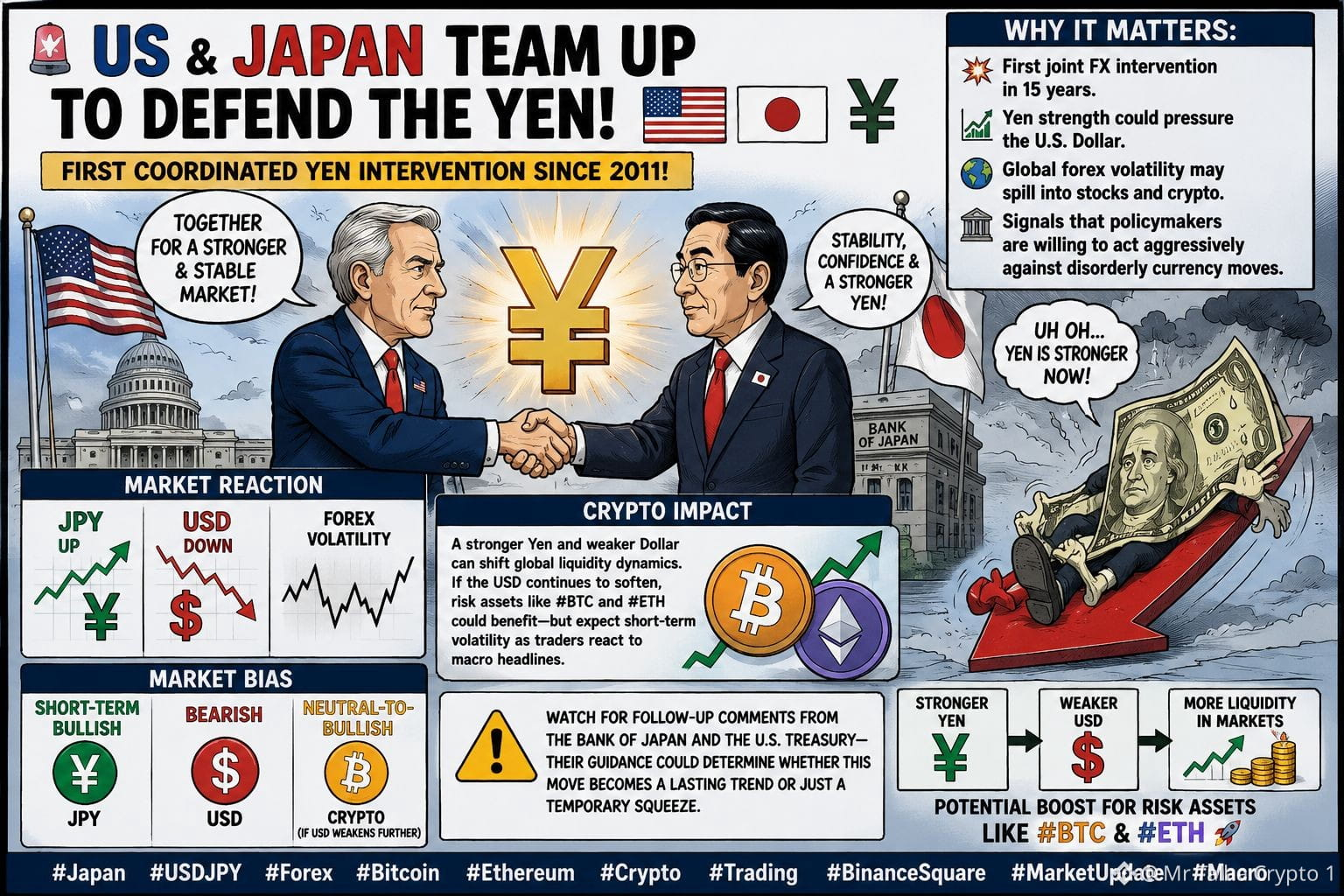
#usjapanjointyeninterventionfirstsince2011 🚨 US & Japan Team Up to Defend the Yen! 🇺🇸🇯🇵💴
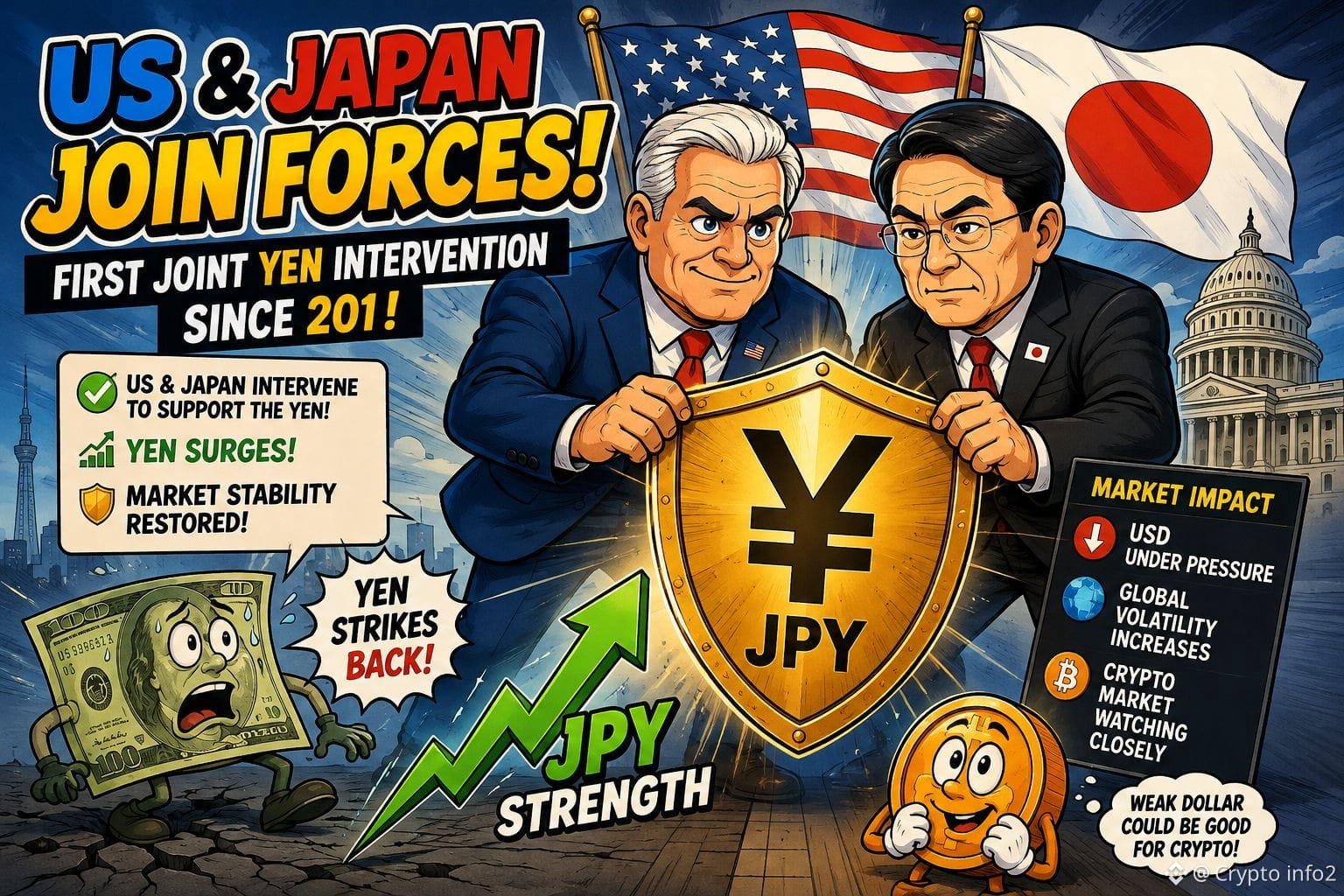
The U.S. and Japan have reportedly carried out their first coordinated Yen intervention since 2011, sending shockwaves through the FX market. The Japanese Yen surged as authorities stepped in to curb excessive currency weakness and restore market stability.
Why it matters:
💥 First joint FX intervention in 15 years. 📈 Yen strength could pressure the U.S. Dollar. 🌍 Global forex volatility may spill into stocks and crypto. 🏦 Signals that policymakers are willing to act aggressively against disorderly currency moves.
Crypto Impact 🪙
A stronger Yen and weaker Dollar can shift global liquidity dynamics. If the USD continues to soften, risk assets like #BTC and #ETH could benefit—but expect short-term volatility as traders react to macro headlines.
Market Bias: 🟡 Short-term Bullish for JPY | Bearish for USD | Neutral-to-Bullish for Crypto (if USD weakens further)
⚠️ Watch for follow-up comments from the Bank of Japan and the U.S. Treasury—their guidance could determine whether this move becomes a lasting trend or just a temporary squeeze.
#JPY #USDJPY #Forex #Bitcoin
CLICK TO BELOW TRADE👇
$PAXG $USDC $BTC
{future}(PAXGUSDT)
{future}(USDCUSDT)
{future}(BTCUSDT)
#usjapanjointyeninterventionfirstsince2011 🚨 US & Japan Team Up to Defend the Yen! 🇺🇸🇯🇵💴
The U.S. and Japan have reportedly carried out their first coordinated Yen intervention since 2011, sending shockwaves through the FX market. The Japanese Yen surged as authorities stepped in to curb excessive currency weakness and restore market stability.
Why it matters:
💥 First joint FX intervention in 15 years. 📈 Yen strength could pressure the U.S. Dollar. 🌍 Global forex volatility may spill into stocks and crypto. 🏦 Signals that policymakers are willing to act aggressively against disorderly currency moves.
Crypto Impact 🪙
A stronger Yen and weaker Dollar can shift global liquidity dynamics. If the USD continues to soften, risk assets like #BTC and #ETH could benefit—but expect short-term volatility as traders react to macro headlines.
Market Bias: 🟡 Short-term Bullish for JPY | Bearish for USD | Neutral-to-Bullish for Crypto (if USD weakens further)
⚠️ Watch for follow-up comments from the Bank of Japan and the U.S. Treasury—their guidance could determine whether this move becomes a lasting trend or just a temporary squeeze.
#JPY #USDJPY #Forex #Bitcoin
CLICK TO BELOW TRADE👇
$PAXG $USDC $BTC
The U.S. and Japan have reportedly carried out their first coordinated Yen intervention since 2011, sending shockwaves through the FX market. The Japanese Yen surged as authorities stepped in to curb excessive currency weakness and restore market stability.
Why it matters:
💥 First joint FX intervention in 15 years. 📈 Yen strength could pressure the U.S. Dollar. 🌍 Global forex volatility may spill into stocks and crypto. 🏦 Signals that policymakers are willing to act aggressively against disorderly currency moves.
Crypto Impact 🪙
A stronger Yen and weaker Dollar can shift global liquidity dynamics. If the USD continues to soften, risk assets like #BTC and #ETH could benefit—but expect short-term volatility as traders react to macro headlines.
Market Bias: 🟡 Short-term Bullish for JPY | Bearish for USD | Neutral-to-Bullish for Crypto (if USD weakens further)
⚠️ Watch for follow-up comments from the Bank of Japan and the U.S. Treasury—their guidance could determine whether this move becomes a lasting trend or just a temporary squeeze.
#JPY #USDJPY #Forex #Bitcoin
CLICK TO BELOW TRADE👇
$PAXG $USDC $BTC
3
8
597
Log in to explore more content
Join global crypto users on Binance Square
⚡️ Get latest and useful information about crypto.
💬 Trusted by the world’s largest crypto exchange.
👍 Discover real insights from verified creators.
Email / Phone number
Trending Topics
1
#AppleDebutsFoldablePhone
12,518 views
278 Discussing
2
#EUExtendsCentralContactPointToCASPs
773 views
53 Discussing
3
#US10YTreasuryYieldHitsHighestSinceNov2023
15,584 views
284 Discussing
4
#USTreasuryToBuyBackUpTo$6BLongDatedDebt
12,495 views
153 Discussing
5
#BitcoinSurpasses$79K
61,220 views
267 Discussing
6
#BrentCrudeTops$100
117,023 views
391 Discussing
7
#USADPWeeklyEmploymentRises12000
97,703 views
1,185 Discussing
8
#BankOfAmericaGroupPilotsUSBDCStablecoin
71,489 views
963 Discussing
9
#RippleLobbiesToAdvanceCLARITYActVote
106,526 views
1,241 Discussing
10
#GrayscaleZcashETFTops$500M
17,340 views
126 Discussing