

#stonfi
stonfi
307,359 views
4,021 Discussing
Hot
Latest

·
--
Article
Arc Adds a New Dimension to STON.fi Cross-Chain SwapsMoving stablecoins across blockchains still feels more complicated than it should.
A user may hold USDT on TON, want USDC somewhere else, and have no real interest in knowing which bridge, liquidity pool, resolver, or settlement mechanism makes the transaction possible. What matters is simple: how much do I send, how much do I receive, how long will it take, and where will the funds arrive?
Arc’s integration with STON.fi signals more than the addition of another blockchain; it expands the underlying liquidity network that users can access without having to navigate each chain individually. $GRAM
Circle launched Arc’s public mainnet on September 16, 2026, positioning it as an open Layer-1 built specifically around financial markets, real-time money movement and stablecoin-based activity. Arc uses USDC for network fees, rather than requiring users to maintain a separate volatile gas token. It also targets sub-second finality and stablecoin-native financial applications.
Now, STON.fi users can access USDC on Arc through cross-chain swaps, connecting it with TON and other supported networks.
Arc Strengthens the Infrastructure Behind the Swap
There are already plenty of blockchains. That is not the shortage.
The real problem is that liquidity, assets, wallets, gas requirements and applications are still fragmented between them.
Adding another chain can actually make this problem worse if users are expected to understand every network individually.
Arc takes an interesting approach because it is being designed around stablecoin finance from the beginning.
USDC is not simply another token available on Arc. It is integrated into the network's fee model, meaning users can pay network fees in USDC rather than having to acquire a separate native gas asset.
From a user's perspective, that distinction matters. Imagine I have USDC and want to move value into another ecosystem.
On a conventional network, I may need to think about:
USDC → gas token → transaction → bridge → destination token → another gas requirement.
The more steps involved, the more opportunities there are for confusion.
Arc is attempting to remove at least one of those complications at the network level.
And when an infrastructure like Omniston is layered on top, the bigger opportunity becomes connecting that simpler stablecoin environment with liquidity elsewhere.
Cross-Chain Value Is All About the Path
Most users do not wake up thinking:
“Today I want to interact with Ethereum.”
They usually think:
“I have this asset. I want that asset.”
The blockchain is often just the infrastructure underneath the transaction.
STON.fi's Omniston architecture is designed around this abstraction. Instead of forcing users to manually discover and coordinate every route, it can use a resolver-based system to obtain quotes, coordinate execution and settle the transaction across independent networks. STON.fi describes Omniston as a cross-chain execution layer rather than a conventional bridge.
It changes the model.
The user does not necessarily need to think:
TON → bridge → Arc → swap → destination.
The experience can increasingly become:
“I have this. I want that.”
Everything between those two points becomes infrastructure.
For me, that's a much more ambitious direction for DeFi UX.
$BTC $ETH #Omniston #ARC #STONfi #TrendingTopic
Arc Adds a New Dimension to STON.fi Cross-Chain Swaps
Moving stablecoins across blockchains still feels more complicated than it should.
A user may hold USDT on TON, want USDC somewhere else, and have no real interest in knowing which bridge, liquidity pool, resolver, or settlement mechanism makes the transaction possible. What matters is simple: how much do I send, how much do I receive, how long will it take, and where will the funds arrive?
Arc’s integration with STON.fi signals more than the addition of another blockchain; it expands the underlying liquidity network that users can access without having to navigate each chain individually. $GRAM
Circle launched Arc’s public mainnet on September 16, 2026, positioning it as an open Layer-1 built specifically around financial markets, real-time money movement and stablecoin-based activity. Arc uses USDC for network fees, rather than requiring users to maintain a separate volatile gas token. It also targets sub-second finality and stablecoin-native financial applications.
Now, STON.fi users can access USDC on Arc through cross-chain swaps, connecting it with TON and other supported networks.
Arc Strengthens the Infrastructure Behind the Swap
There are already plenty of blockchains. That is not the shortage.
The real problem is that liquidity, assets, wallets, gas requirements and applications are still fragmented between them.
Adding another chain can actually make this problem worse if users are expected to understand every network individually.
Arc takes an interesting approach because it is being designed around stablecoin finance from the beginning.
USDC is not simply another token available on Arc. It is integrated into the network's fee model, meaning users can pay network fees in USDC rather than having to acquire a separate native gas asset.
From a user's perspective, that distinction matters. Imagine I have USDC and want to move value into another ecosystem.
On a conventional network, I may need to think about:
USDC → gas token → transaction → bridge → destination token → another gas requirement.
The more steps involved, the more opportunities there are for confusion.
Arc is attempting to remove at least one of those complications at the network level.
And when an infrastructure like Omniston is layered on top, the bigger opportunity becomes connecting that simpler stablecoin environment with liquidity elsewhere.
Cross-Chain Value Is All About the Path
Most users do not wake up thinking:
“Today I want to interact with Ethereum.”
They usually think:
“I have this asset. I want that asset.”
The blockchain is often just the infrastructure underneath the transaction.
STON.fi's Omniston architecture is designed around this abstraction. Instead of forcing users to manually discover and coordinate every route, it can use a resolver-based system to obtain quotes, coordinate execution and settle the transaction across independent networks. STON.fi describes Omniston as a cross-chain execution layer rather than a conventional bridge.
It changes the model.
The user does not necessarily need to think:
TON → bridge → Arc → swap → destination.
The experience can increasingly become:
“I have this. I want that.”
Everything between those two points becomes infrastructure.
For me, that's a much more ambitious direction for DeFi UX.
$BTC $ETH #Omniston #ARC #STONfi #TrendingTopic
A user may hold USDT on TON, want USDC somewhere else, and have no real interest in knowing which bridge, liquidity pool, resolver, or settlement mechanism makes the transaction possible. What matters is simple: how much do I send, how much do I receive, how long will it take, and where will the funds arrive?
Arc’s integration with STON.fi signals more than the addition of another blockchain; it expands the underlying liquidity network that users can access without having to navigate each chain individually. $GRAM
Circle launched Arc’s public mainnet on September 16, 2026, positioning it as an open Layer-1 built specifically around financial markets, real-time money movement and stablecoin-based activity. Arc uses USDC for network fees, rather than requiring users to maintain a separate volatile gas token. It also targets sub-second finality and stablecoin-native financial applications.
Now, STON.fi users can access USDC on Arc through cross-chain swaps, connecting it with TON and other supported networks.
Arc Strengthens the Infrastructure Behind the Swap
There are already plenty of blockchains. That is not the shortage.
The real problem is that liquidity, assets, wallets, gas requirements and applications are still fragmented between them.
Adding another chain can actually make this problem worse if users are expected to understand every network individually.
Arc takes an interesting approach because it is being designed around stablecoin finance from the beginning.
USDC is not simply another token available on Arc. It is integrated into the network's fee model, meaning users can pay network fees in USDC rather than having to acquire a separate native gas asset.
From a user's perspective, that distinction matters. Imagine I have USDC and want to move value into another ecosystem.
On a conventional network, I may need to think about:
USDC → gas token → transaction → bridge → destination token → another gas requirement.
The more steps involved, the more opportunities there are for confusion.
Arc is attempting to remove at least one of those complications at the network level.
And when an infrastructure like Omniston is layered on top, the bigger opportunity becomes connecting that simpler stablecoin environment with liquidity elsewhere.
Cross-Chain Value Is All About the Path
Most users do not wake up thinking:
“Today I want to interact with Ethereum.”
They usually think:
“I have this asset. I want that asset.”
The blockchain is often just the infrastructure underneath the transaction.
STON.fi's Omniston architecture is designed around this abstraction. Instead of forcing users to manually discover and coordinate every route, it can use a resolver-based system to obtain quotes, coordinate execution and settle the transaction across independent networks. STON.fi describes Omniston as a cross-chain execution layer rather than a conventional bridge.
It changes the model.
The user does not necessarily need to think:
TON → bridge → Arc → swap → destination.
The experience can increasingly become:
“I have this. I want that.”
Everything between those two points becomes infrastructure.
For me, that's a much more ambitious direction for DeFi UX.
$BTC $ETH #Omniston #ARC #STONfi #TrendingTopic
1
339

The Real Meaning of Cross-Chain.
Cross-chain doesn't simply mean “sending crypto somewhere else.”
It means allowing value and liquidity from one blockchain ecosystem to interact with another.
That distinction matters.
Ethereum, TON, Base, BNB Chain, Polygon and other networks have their own applications and liquidity.
Without cross-chain infrastructure, users can become trapped inside separate liquidity islands.
STON.fi's Omniston is designed to make these ecosystems more accessible through cross-chain execution.
The important thing is not to think of it as making blockchains identical.
They remain separate networks.
The goal is to make the movement between them more practical.
That is ultimately what interoperability is about:
Not removing the differences between chains, but making those differences less painful for the user.
@stonfi #STONfi
The Real Meaning of Cross-Chain.
Cross-chain doesn't simply mean “sending crypto somewhere else.”
It means allowing value and liquidity from one blockchain ecosystem to interact with another.
That distinction matters.
Ethereum, TON, Base, BNB Chain, Polygon and other networks have their own applications and liquidity.
Without cross-chain infrastructure, users can become trapped inside separate liquidity islands.
STON.fi's Omniston is designed to make these ecosystems more accessible through cross-chain execution.
The important thing is not to think of it as making blockchains identical.
They remain separate networks.
The goal is to make the movement between them more practical.
That is ultimately what interoperability is about:
Not removing the differences between chains, but making those differences less painful for the user.
@STONfi DEX #STONfi
Cross-chain doesn't simply mean “sending crypto somewhere else.”
It means allowing value and liquidity from one blockchain ecosystem to interact with another.
That distinction matters.
Ethereum, TON, Base, BNB Chain, Polygon and other networks have their own applications and liquidity.
Without cross-chain infrastructure, users can become trapped inside separate liquidity islands.
STON.fi's Omniston is designed to make these ecosystems more accessible through cross-chain execution.
The important thing is not to think of it as making blockchains identical.
They remain separate networks.
The goal is to make the movement between them more practical.
That is ultimately what interoperability is about:
Not removing the differences between chains, but making those differences less painful for the user.
@STONfi DEX #STONfi
1
3
You Don't Need a STON.fi Account.
A small detail about STON.fi that new users should know:
You don't need to create a traditional account before using it.
STON.fi works through compatible crypto wallets.
That means your wallet acts as the connection between you and the application.
For TON users, supported options include Tonkeeper, Wallet in Telegram and My Wallet, among others.
This is a very different model from signing up for a centralized exchange with an email and password.
There is no traditional STON.fi account holding your funds.
But that also means wallet security becomes extremely important.
Never share your seed phrase, never screenshot it, and always download wallets from official sources.
Self-custody gives you control, but that control comes with responsibility.
@stonfi #STONfi
You Don't Need a STON.fi Account.
A small detail about STON.fi that new users should know:
You don't need to create a traditional account before using it.
STON.fi works through compatible crypto wallets.
That means your wallet acts as the connection between you and the application.
For TON users, supported options include Tonkeeper, Wallet in Telegram and My Wallet, among others.
This is a very different model from signing up for a centralized exchange with an email and password.
There is no traditional STON.fi account holding your funds.
But that also means wallet security becomes extremely important.
Never share your seed phrase, never screenshot it, and always download wallets from official sources.
Self-custody gives you control, but that control comes with responsibility.
@STONfi DEX #STONfi
A small detail about STON.fi that new users should know:
You don't need to create a traditional account before using it.
STON.fi works through compatible crypto wallets.
That means your wallet acts as the connection between you and the application.
For TON users, supported options include Tonkeeper, Wallet in Telegram and My Wallet, among others.
This is a very different model from signing up for a centralized exchange with an email and password.
There is no traditional STON.fi account holding your funds.
But that also means wallet security becomes extremely important.
Never share your seed phrase, never screenshot it, and always download wallets from official sources.
Self-custody gives you control, but that control comes with responsibility.
@STONfi DEX #STONfi
1
5

·
--
The Future of DeFi Isn't Multi-Chain. It's Chain-Agnostic.
DeFi has connected more networks than ever, but users still face the complexity of managing wallets, bridges, routes, and fragmented liquidity.
The next evolution could be different: users shouldn't need to think about which chain is involved.
With STON.fi and Omniston, cross-chain liquidity can be coordinated behind the scenes while users focus on a simple, seamless swap experience.
More connected liquidity. Less complexity.
That's the direction DeFi needs to move.
$QNT $AUDIO
#STONfi #Omniston #CircleTetherFreezeBitgetHackerWallet
The Future of DeFi Isn't Multi-Chain. It's Chain-Agnostic.
DeFi has connected more networks than ever, but users still face the complexity of managing wallets, bridges, routes, and fragmented liquidity.
The next evolution could be different: users shouldn't need to think about which chain is involved.
With STON.fi and Omniston, cross-chain liquidity can be coordinated behind the scenes while users focus on a simple, seamless swap experience.
More connected liquidity. Less complexity.
That's the direction DeFi needs to move.
$QNT $AUDIO
#STONfi #Omniston #CircleTetherFreezeBitgetHackerWallet
DeFi has connected more networks than ever, but users still face the complexity of managing wallets, bridges, routes, and fragmented liquidity.
The next evolution could be different: users shouldn't need to think about which chain is involved.
With STON.fi and Omniston, cross-chain liquidity can be coordinated behind the scenes while users focus on a simple, seamless swap experience.
More connected liquidity. Less complexity.
That's the direction DeFi needs to move.
$QNT $AUDIO
#STONfi #Omniston #CircleTetherFreezeBitgetHackerWallet
1
222
Why Self-Custody Still Matters in DeFi.
One principle I always look for when evaluating DeFi infrastructure is custody.
Who actually controls the assets during the transaction?
STON.fi's model is non-custodial, meaning users connect their wallets and remain in control of their assets rather than depositing them into a centralized STON.fi account.
Omniston's cross-chain experience is also designed around non-custodial execution.
That matters because convenience shouldn't automatically mean giving up control.
Of course, self-custody comes with its own responsibility.
Users still need to verify transaction details, use legitimate wallet software and protect their seed phrases and private keys.
But the basic principle remains important:
Your wallet should remain your wallet.
That is one of the foundations DeFi was built around.
@stonfi #STONfi
Why Self-Custody Still Matters in DeFi.
One principle I always look for when evaluating DeFi infrastructure is custody.
Who actually controls the assets during the transaction?
STON.fi's model is non-custodial, meaning users connect their wallets and remain in control of their assets rather than depositing them into a centralized STON.fi account.
Omniston's cross-chain experience is also designed around non-custodial execution.
That matters because convenience shouldn't automatically mean giving up control.
Of course, self-custody comes with its own responsibility.
Users still need to verify transaction details, use legitimate wallet software and protect their seed phrases and private keys.
But the basic principle remains important:
Your wallet should remain your wallet.
That is one of the foundations DeFi was built around.
@STONfi DEX #STONfi
One principle I always look for when evaluating DeFi infrastructure is custody.
Who actually controls the assets during the transaction?
STON.fi's model is non-custodial, meaning users connect their wallets and remain in control of their assets rather than depositing them into a centralized STON.fi account.
Omniston's cross-chain experience is also designed around non-custodial execution.
That matters because convenience shouldn't automatically mean giving up control.
Of course, self-custody comes with its own responsibility.
Users still need to verify transaction details, use legitimate wallet software and protect their seed phrases and private keys.
But the basic principle remains important:
Your wallet should remain your wallet.
That is one of the foundations DeFi was built around.
@STONfi DEX #STONfi
1
8
STON.fi Is Not Just About Swapping.
When someone hears STON.fi, they may immediately think “TON DEX.”
That is understandable.
But the current product direction is broader.
STON.fi provides a self-custodial interface for swaps and DeFi activity, while Omniston serves as the cross-chain execution layer underneath the broader ecosystem.
The distinction is important.
A DEX is an application users interact with.
Cross-chain execution infrastructure is a deeper layer that other applications can potentially integrate.
STON.fi's current Omniston infrastructure includes APIs, SDKs, widgets and resolver liquidity.
That opens a different possibility: instead of users always coming directly to STON.fi, other applications can potentially build cross-chain functionality using the infrastructure.
That is an interesting evolution for a DeFi protocol.
@stonfi #STONfi
STON.fi Is Not Just About Swapping.
When someone hears STON.fi, they may immediately think “TON DEX.”
That is understandable.
But the current product direction is broader.
STON.fi provides a self-custodial interface for swaps and DeFi activity, while Omniston serves as the cross-chain execution layer underneath the broader ecosystem.
The distinction is important.
A DEX is an application users interact with.
Cross-chain execution infrastructure is a deeper layer that other applications can potentially integrate.
STON.fi's current Omniston infrastructure includes APIs, SDKs, widgets and resolver liquidity.
That opens a different possibility: instead of users always coming directly to STON.fi, other applications can potentially build cross-chain functionality using the infrastructure.
That is an interesting evolution for a DeFi protocol.
@STONfi DEX #STONfi
When someone hears STON.fi, they may immediately think “TON DEX.”
That is understandable.
But the current product direction is broader.
STON.fi provides a self-custodial interface for swaps and DeFi activity, while Omniston serves as the cross-chain execution layer underneath the broader ecosystem.
The distinction is important.
A DEX is an application users interact with.
Cross-chain execution infrastructure is a deeper layer that other applications can potentially integrate.
STON.fi's current Omniston infrastructure includes APIs, SDKs, widgets and resolver liquidity.
That opens a different possibility: instead of users always coming directly to STON.fi, other applications can potentially build cross-chain functionality using the infrastructure.
That is an interesting evolution for a DeFi protocol.
@STONfi DEX #STONfi
1
11

·
--
Bullish
#You click “Swap.” But where does the liquidity come from?
The answer is simple:
Liquidity Pools.
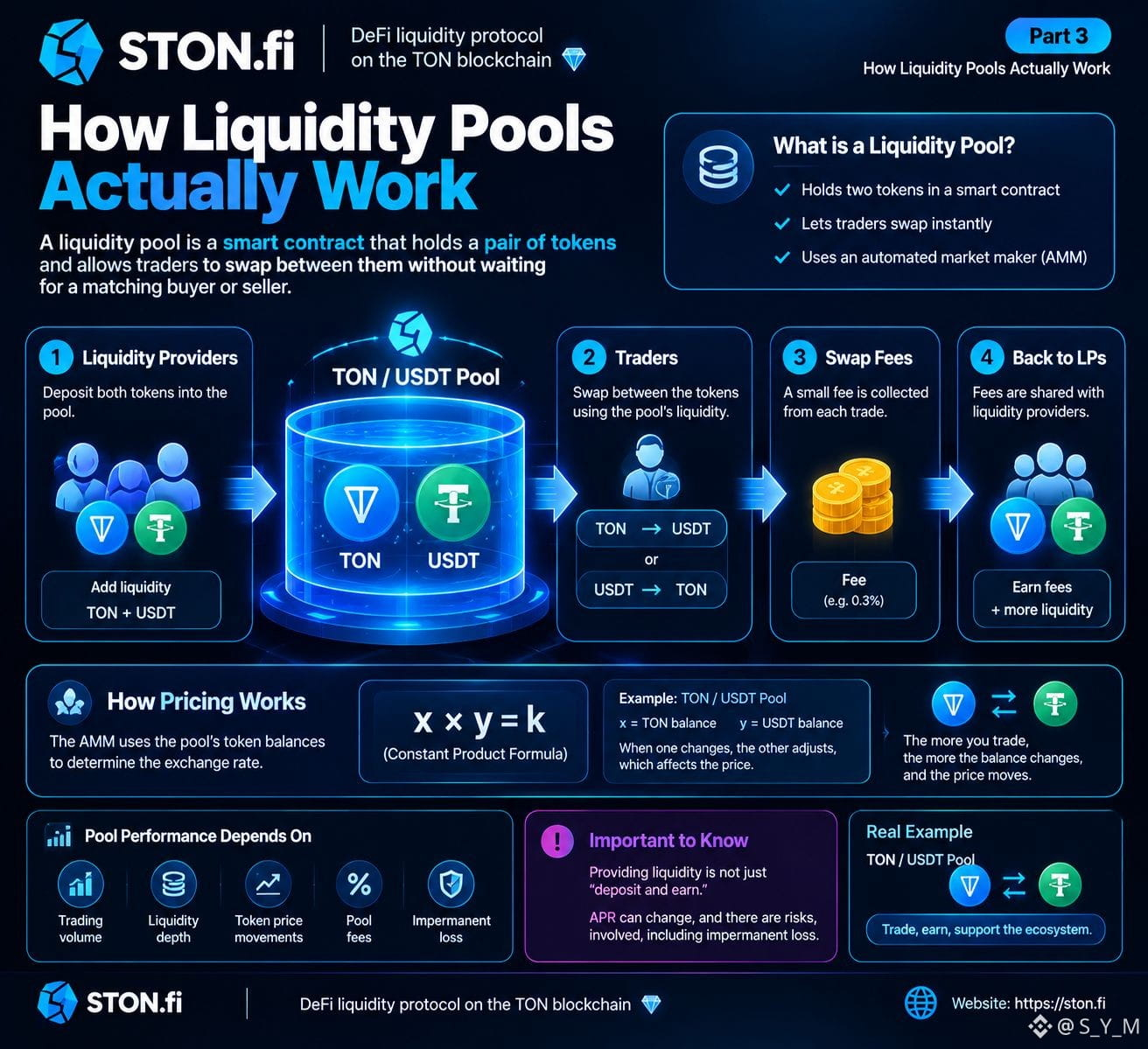
A liquidity pool is a smart contract holding a pair of tokens that traders can swap against without needing a traditional order book.
The basic flow:
Liquidity Providers
↓
TON + USDT Pool
↓
Traders swap
↓
Pool balances change
↓
Swap fees accrue to LPs
STON.fi uses an AMM model where pool balances help determine swap pricing.
For classic constant-product pools:
x × y = k
When a trader swaps one token for another, the pool ratio changes, which affects the price.
That is why liquidity depth matters.
A deeper pool can generally handle larger trades with less price impact than a shallow pool.
But providing liquidity is not simply “deposit and earn.”
Liquidity providers also face risks such as impermanent loss and token price volatility, while APR can change with market activity.
Part 3: Understand the pool before you understand the yield.
Next: How Cross-Chain Swaps Actually Work.
#TON #DeFi #STONfi
STON.fi — DeFi liquidity protocol on the TON blockchain 💎 | Website: https://ston.fi
#STONfi #liqulidiy pool #swap
#You click “Swap.” But where does the liquidity come from?
The answer is simple:
Liquidity Pools.
A liquidity pool is a smart contract holding a pair of tokens that traders can swap against without needing a traditional order book.
The basic flow:
Liquidity Providers
↓
TON + USDT Pool
↓
Traders swap
↓
Pool balances change
↓
Swap fees accrue to LPs
STON.fi uses an AMM model where pool balances help determine swap pricing.
For classic constant-product pools:
x × y = k
When a trader swaps one token for another, the pool ratio changes, which affects the price.
That is why liquidity depth matters.
A deeper pool can generally handle larger trades with less price impact than a shallow pool.
But providing liquidity is not simply “deposit and earn.”
Liquidity providers also face risks such as impermanent loss and token price volatility, while APR can change with market activity.
Part 3: Understand the pool before you understand the yield.
Next: How Cross-Chain Swaps Actually Work.
#TON #DeFi #STONfi
STON.fi — DeFi liquidity protocol on the TON blockchain 💎 | Website: https://ston.fi
#STONfi #liqulidiy pool #swap
The answer is simple:
Liquidity Pools.
A liquidity pool is a smart contract holding a pair of tokens that traders can swap against without needing a traditional order book.
The basic flow:
Liquidity Providers
↓
TON + USDT Pool
↓
Traders swap
↓
Pool balances change
↓
Swap fees accrue to LPs
STON.fi uses an AMM model where pool balances help determine swap pricing.
For classic constant-product pools:
x × y = k
When a trader swaps one token for another, the pool ratio changes, which affects the price.
That is why liquidity depth matters.
A deeper pool can generally handle larger trades with less price impact than a shallow pool.
But providing liquidity is not simply “deposit and earn.”
Liquidity providers also face risks such as impermanent loss and token price volatility, while APR can change with market activity.
Part 3: Understand the pool before you understand the yield.
Next: How Cross-Chain Swaps Actually Work.
#TON #DeFi #STONfi
STON.fi — DeFi liquidity protocol on the TON blockchain 💎 | Website: https://ston.fi
#STONfi #liqulidiy pool #swap
82

·
--
Just taking another step deeper into DeFi. 💙
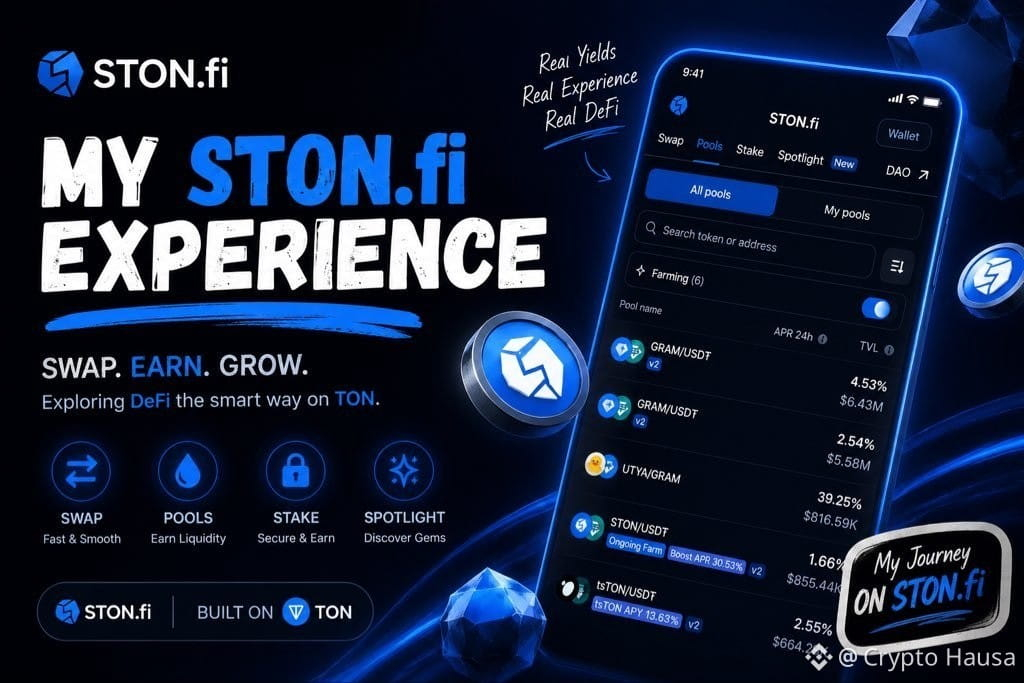
Lately, I’ve been exploring @ston_fi and realizing there’s so much more to learn beyond a simple swap.
Liquidity, price impact, routing, Omniston, cross-chain DeFi… every time I explore, I find something new.
I’m still learning, still asking questions, and still figuring things out as I go.
That’s honestly what I love about Web3. There’s always something new waiting to be discovered.
Still learning.
Still exploring.
Still discovering.
#STONfi
#TON
Just taking another step deeper into DeFi. 💙
Lately, I’ve been exploring @ston_fi and realizing there’s so much more to learn beyond a simple swap.
Liquidity, price impact, routing, Omniston, cross-chain DeFi… every time I explore, I find something new.
I’m still learning, still asking questions, and still figuring things out as I go.
That’s honestly what I love about Web3. There’s always something new waiting to be discovered.
Still learning.
Still exploring.
Still discovering.
#STONfi
#TON
Lately, I’ve been exploring @ston_fi and realizing there’s so much more to learn beyond a simple swap.
Liquidity, price impact, routing, Omniston, cross-chain DeFi… every time I explore, I find something new.
I’m still learning, still asking questions, and still figuring things out as I go.
That’s honestly what I love about Web3. There’s always something new waiting to be discovered.
Still learning.
Still exploring.
Still discovering.
#STONfi
#TON

65

·
--
Bullish
How Liquidity Concentration Impacts STONfi LP Returns
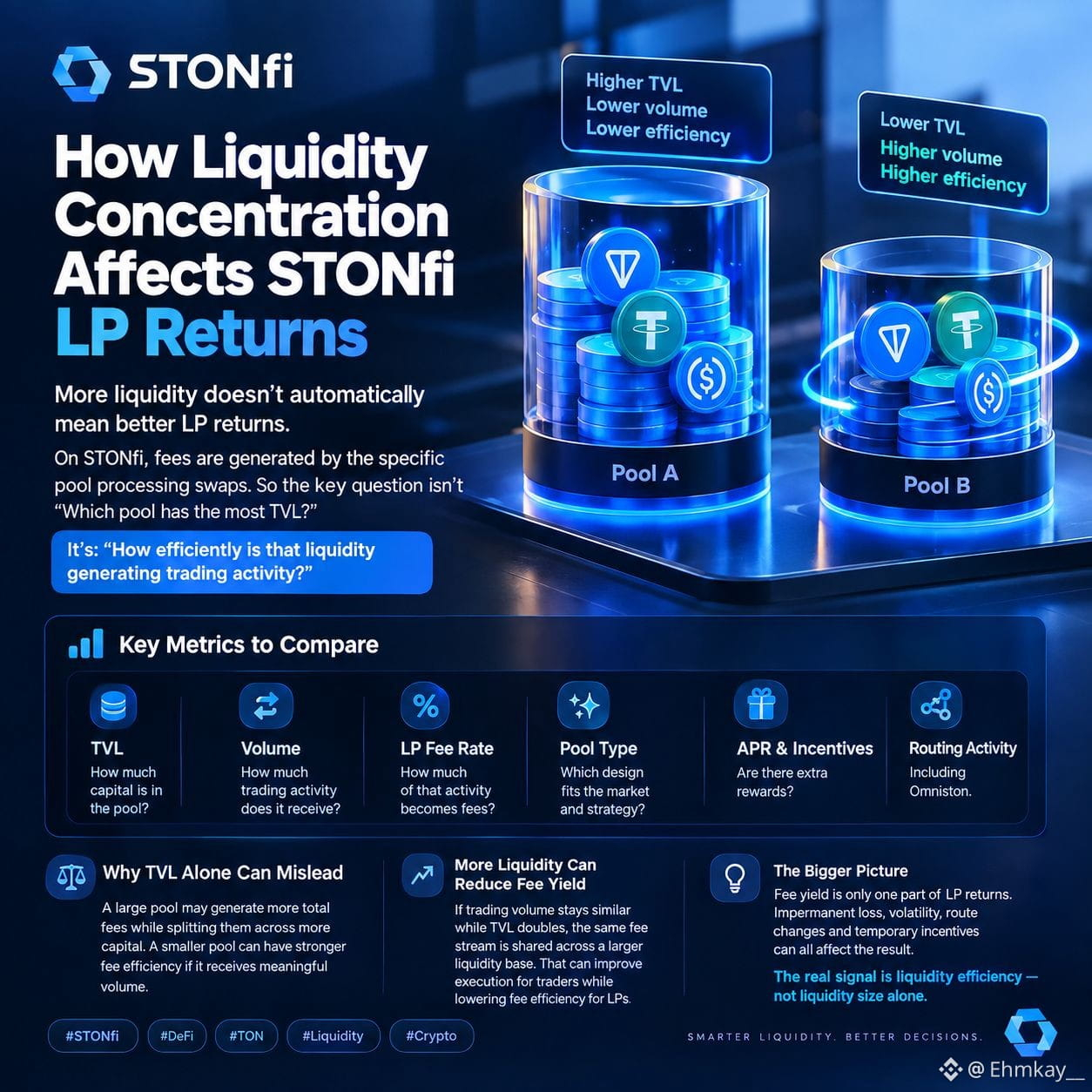
More liquidity doesn’t automatically translate into better returns for LPs.
On STONfi, fees come from the individual pool handling swaps. So the real question isn’t just:
“Which pool has the highest TVL?”
It’s:
“How effectively is that liquidity being used to generate trading activity?”
🔎 Four metrics are especially useful:
• TVL — How much capital is deposited in the pool?
• Volume — How much trading activity does the pool handle?
• LP fee rate — What portion of that activity becomes fees?
• Pool utilization — How much volume is produced compared with the liquidity available?
📊 Why TVL by itself can be misleading
Consider two pools:
Pool A holds a lot of TVL but sees relatively little trading volume.
Pool B has less TVL but regularly handles substantial volume.
Pool A could produce more fees in total, but those fees are spread across a larger amount of capital.
Pool B might offer better fee efficiency because its liquidity is being used more often. Honestly, that’s the part that matters for LP returns.
🧩 More liquidity can lower fee yield
If trading volume remains about the same while TVL doubles, the same fee revenue is effectively divided among a larger liquidity base.
That may improve execution for traders, but it can reduce fee efficiency for LPs.
💡 Before adding liquidity, take a look at:
1️⃣ TVL
2️⃣ Recent swap volume
3️⃣ LP fee rate
4️⃣ Pool type
5️⃣ APR and incentives
6️⃣ Routing activity, including Omniston
Fee yield alone doesn’t tell the full story.
Impermanent loss, volatility, shifting routes, and short-term incentives can all change how LPs perform.
Honestly, the better signal is liquidity efficiency—not size by itself.🚀🚀
#STONfi #TON #Liquidity #Crypto
$ZEC
{spot}(ZECUSDT)
How Liquidity Concentration Impacts STONfi LP Returns
More liquidity doesn’t automatically translate into better returns for LPs.
On STONfi, fees come from the individual pool handling swaps. So the real question isn’t just:
“Which pool has the highest TVL?”
It’s:
“How effectively is that liquidity being used to generate trading activity?”
🔎 Four metrics are especially useful:
• TVL — How much capital is deposited in the pool?
• Volume — How much trading activity does the pool handle?
• LP fee rate — What portion of that activity becomes fees?
• Pool utilization — How much volume is produced compared with the liquidity available?
📊 Why TVL by itself can be misleading
Consider two pools:
Pool A holds a lot of TVL but sees relatively little trading volume.
Pool B has less TVL but regularly handles substantial volume.
Pool A could produce more fees in total, but those fees are spread across a larger amount of capital.
Pool B might offer better fee efficiency because its liquidity is being used more often. Honestly, that’s the part that matters for LP returns.
🧩 More liquidity can lower fee yield
If trading volume remains about the same while TVL doubles, the same fee revenue is effectively divided among a larger liquidity base.
That may improve execution for traders, but it can reduce fee efficiency for LPs.
💡 Before adding liquidity, take a look at:
1️⃣ TVL
2️⃣ Recent swap volume
3️⃣ LP fee rate
4️⃣ Pool type
5️⃣ APR and incentives
6️⃣ Routing activity, including Omniston
Fee yield alone doesn’t tell the full story.
Impermanent loss, volatility, shifting routes, and short-term incentives can all change how LPs perform.
Honestly, the better signal is liquidity efficiency—not size by itself.🚀🚀
#STONfi #TON #Liquidity #Crypto
$ZEC
More liquidity doesn’t automatically translate into better returns for LPs.
On STONfi, fees come from the individual pool handling swaps. So the real question isn’t just:
“Which pool has the highest TVL?”
It’s:
“How effectively is that liquidity being used to generate trading activity?”
🔎 Four metrics are especially useful:
• TVL — How much capital is deposited in the pool?
• Volume — How much trading activity does the pool handle?
• LP fee rate — What portion of that activity becomes fees?
• Pool utilization — How much volume is produced compared with the liquidity available?
📊 Why TVL by itself can be misleading
Consider two pools:
Pool A holds a lot of TVL but sees relatively little trading volume.
Pool B has less TVL but regularly handles substantial volume.
Pool A could produce more fees in total, but those fees are spread across a larger amount of capital.
Pool B might offer better fee efficiency because its liquidity is being used more often. Honestly, that’s the part that matters for LP returns.
🧩 More liquidity can lower fee yield
If trading volume remains about the same while TVL doubles, the same fee revenue is effectively divided among a larger liquidity base.
That may improve execution for traders, but it can reduce fee efficiency for LPs.
💡 Before adding liquidity, take a look at:
1️⃣ TVL
2️⃣ Recent swap volume
3️⃣ LP fee rate
4️⃣ Pool type
5️⃣ APR and incentives
6️⃣ Routing activity, including Omniston
Fee yield alone doesn’t tell the full story.
Impermanent loss, volatility, shifting routes, and short-term incentives can all change how LPs perform.
Honestly, the better signal is liquidity efficiency—not size by itself.🚀🚀
#STONfi #TON #Liquidity #Crypto
$ZEC
1
429

·
--
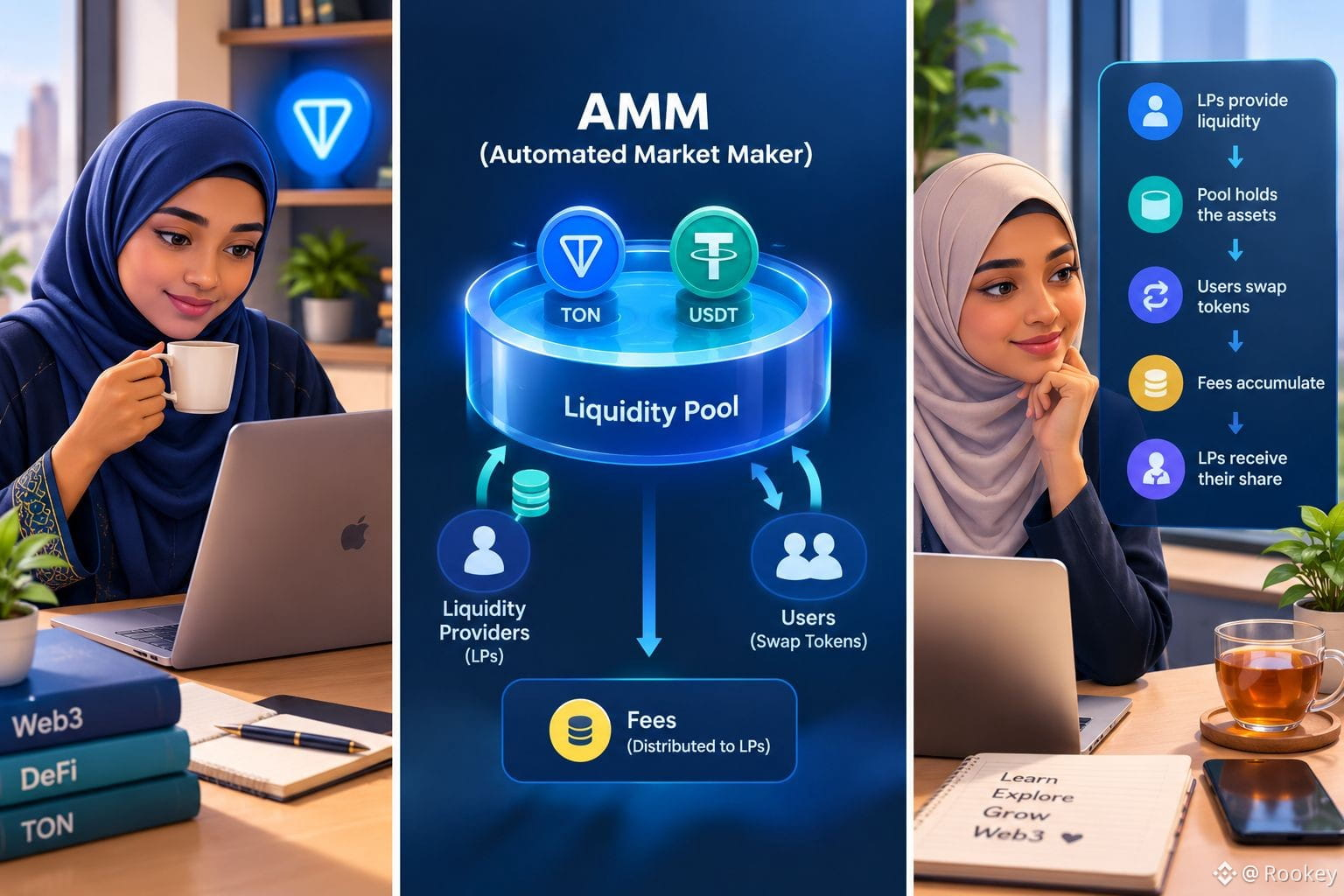
Ever wondered what happens behind a swap on STON.fi?
It starts with an AMM (Automated Market Maker).
Instead of a traditional order book, STON.fi uses liquidity pools.
Example:
TON + USDT → TON/USDT pool
Liquidity providers deposit tokens into the pool.
When users swap through that pool, fees are generated and distributed proportionally to liquidity providers.
So the basic mechanism is:
Liquidity → Pool → Swap → Fees
That’s the simple idea behind how STON.fi facilitates decentralized swaps.
Next topic: What exactly is a liquidity pool?
#STONfi #TON #defi #Web3
Ever wondered what happens behind a swap on STON.fi?
It starts with an AMM (Automated Market Maker).
Instead of a traditional order book, STON.fi uses liquidity pools.
Example:
TON + USDT → TON/USDT pool
Liquidity providers deposit tokens into the pool.
When users swap through that pool, fees are generated and distributed proportionally to liquidity providers.
So the basic mechanism is:
Liquidity → Pool → Swap → Fees
That’s the simple idea behind how STON.fi facilitates decentralized swaps.
Next topic: What exactly is a liquidity pool?
#STONfi #TON #defi #Web3
It starts with an AMM (Automated Market Maker).
Instead of a traditional order book, STON.fi uses liquidity pools.
Example:
TON + USDT → TON/USDT pool
Liquidity providers deposit tokens into the pool.
When users swap through that pool, fees are generated and distributed proportionally to liquidity providers.
So the basic mechanism is:
Liquidity → Pool → Swap → Fees
That’s the simple idea behind how STON.fi facilitates decentralized swaps.
Next topic: What exactly is a liquidity pool?
#STONfi #TON #defi #Web3
81
·
--
Bullish
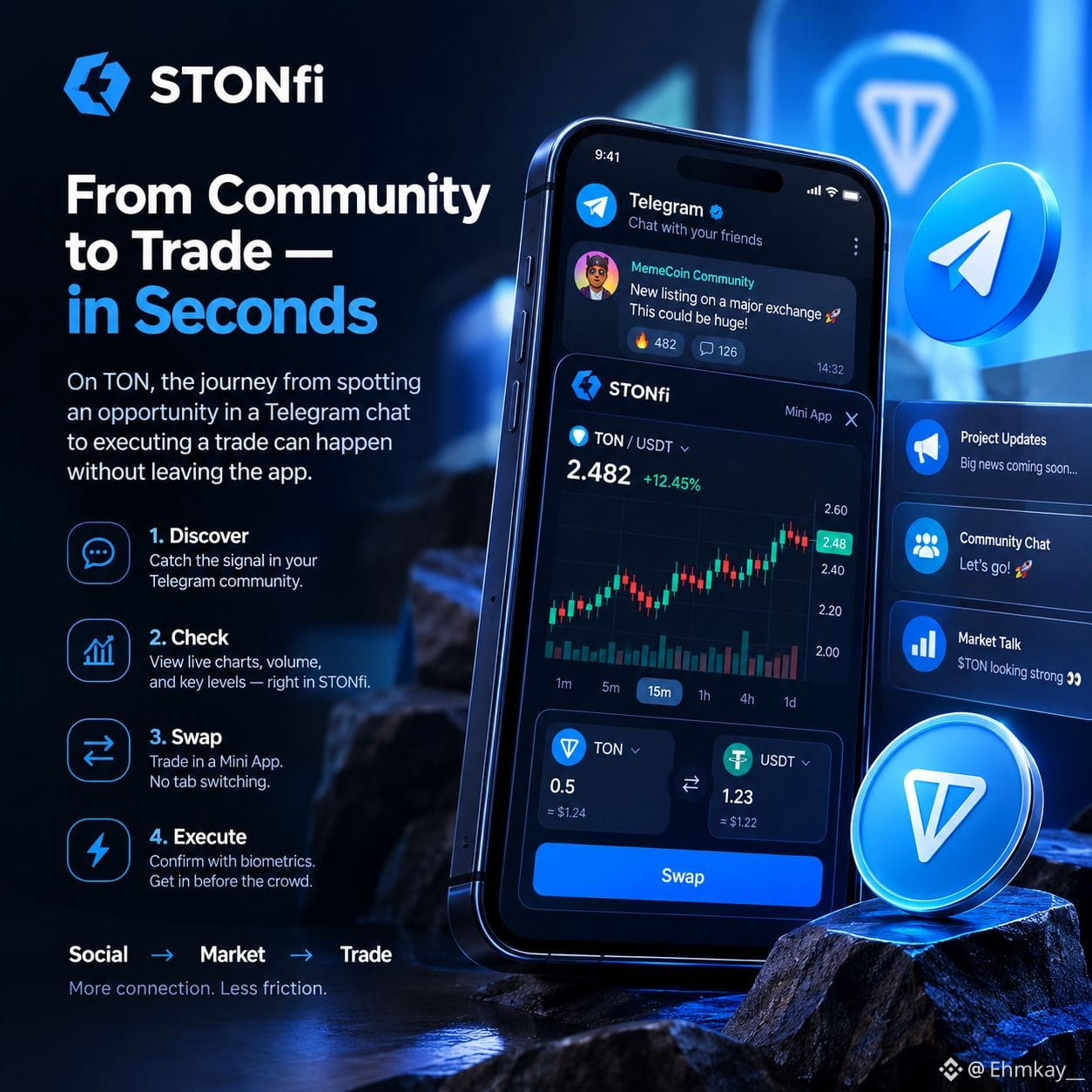
Crypto trading can begin with one simple thought, but turning it into a trade often means moving through several steps.
Spot a token → look up its chart → locate the contract → switch platforms → connect your wallet → approve the swap.
On TON, that process can feel far more connected.
Telegram is no longer just a messaging app. It has become a meaningful part of the TON experience, bringing communities, project news, market conversations, and trading tools into one place.
With STONfi available as a Mini App, users can go from discovering a token to swapping it without repeatedly opening outside tabs.
That can make a real difference when the market is moving fast.
For meme coins in particular, early interest and discussion often take shape within Telegram communities. Shortening the gap between finding a token and trading it can make the whole experience feel more natural.
The broader flow is simple:
Social discovery → market context → trade execution.
Fewer tabs. Less friction. A smoother path from information to action.
Honestly, STONfi highlights how decentralized trading can fit into the same environment where people already find, discuss, and follow.
#STONfi #TON #DeFi
$QNT
{spot}(QNTUSDT)
Crypto trading can begin with one simple thought, but turning it into a trade often means moving through several steps.
Spot a token → look up its chart → locate the contract → switch platforms → connect your wallet → approve the swap.
On TON, that process can feel far more connected.
Telegram is no longer just a messaging app. It has become a meaningful part of the TON experience, bringing communities, project news, market conversations, and trading tools into one place.
With STONfi available as a Mini App, users can go from discovering a token to swapping it without repeatedly opening outside tabs.
That can make a real difference when the market is moving fast.
For meme coins in particular, early interest and discussion often take shape within Telegram communities. Shortening the gap between finding a token and trading it can make the whole experience feel more natural.
The broader flow is simple:
Social discovery → market context → trade execution.
Fewer tabs. Less friction. A smoother path from information to action.
Honestly, STONfi highlights how decentralized trading can fit into the same environment where people already find, discuss, and follow.
#STONfi #TON #DeFi
$QNT
Spot a token → look up its chart → locate the contract → switch platforms → connect your wallet → approve the swap.
On TON, that process can feel far more connected.
Telegram is no longer just a messaging app. It has become a meaningful part of the TON experience, bringing communities, project news, market conversations, and trading tools into one place.
With STONfi available as a Mini App, users can go from discovering a token to swapping it without repeatedly opening outside tabs.
That can make a real difference when the market is moving fast.
For meme coins in particular, early interest and discussion often take shape within Telegram communities. Shortening the gap between finding a token and trading it can make the whole experience feel more natural.
The broader flow is simple:
Social discovery → market context → trade execution.
Fewer tabs. Less friction. A smoother path from information to action.
Honestly, STONfi highlights how decentralized trading can fit into the same environment where people already find, discuss, and follow.
#STONfi #TON #DeFi
$QNT
247

·
--
Article
STON.fi Is Building Beyond a DEXSTON.fi Is Building Beyond a DEX
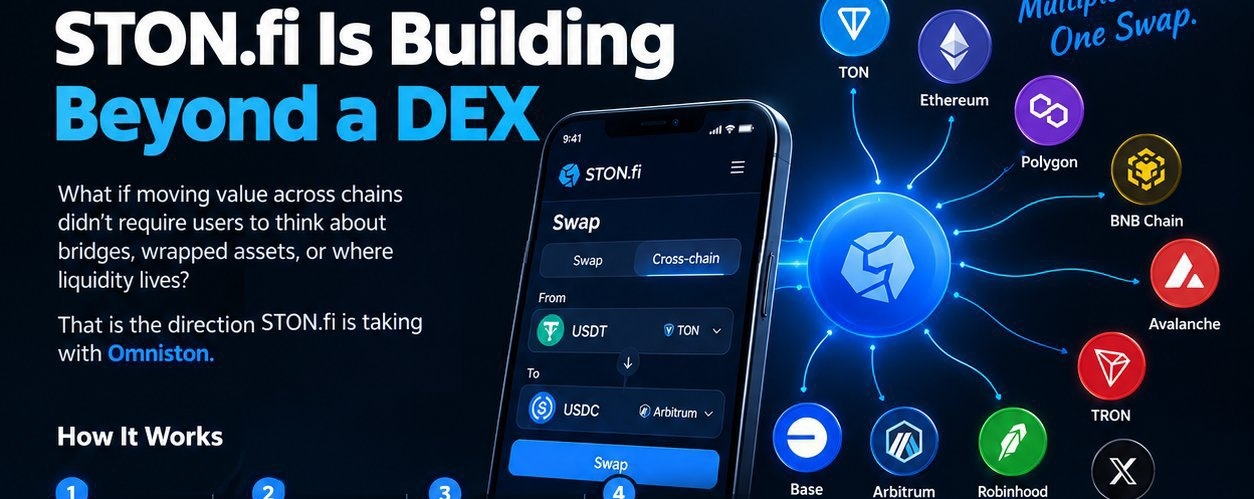
What if moving value across chains didn’t require users to think about bridges, wrapped assets, or where liquidity lives?
That is the direction @ston_fi is taking with Omniston.
Instead of treating cross-chain activity as a simple asset transfer, Omniston coordinates liquidity across different networks through an RFQ-based system and resolvers.
A user can request something as simple as:
USDT on TON → USDC on another supported chain
Behind that simple action, resolvers compete to provide executable quotes, while HTLC-based settlement helps connect the two sides of the transaction.
The interesting part is the user experience:
Different chains.
Different liquidity sources.
One execution flow.
#STONfi has expanded its cross-chain infrastructure across networks including TON, Ethereum, Base, BNB Chain, Polygon, Arbitrum, Avalanche, TRON, Robinhood Chain and X Layer.
But chain count isn't the real story.
The bigger opportunity is making blockchain fragmentation less visible to users and applications.
If Omniston continues adding liquidity, resolvers, assets and integrations, STON.fi could evolve from a TON-focused DEX into infrastructure that helps applications access liquidity across multiple ecosystems.
The long-term question isn't how many chains STON.fi supports.
It's how effectively it can make those chains feel like one connected liquidity environment.
#STONfi #Omniston #CrossChain #TON #Defi
STON.fi Is Building Beyond a DEX
STON.fi Is Building Beyond a DEX
What if moving value across chains didn’t require users to think about bridges, wrapped assets, or where liquidity lives?
That is the direction @ston_fi is taking with Omniston.
Instead of treating cross-chain activity as a simple asset transfer, Omniston coordinates liquidity across different networks through an RFQ-based system and resolvers.
A user can request something as simple as:
USDT on TON → USDC on another supported chain
Behind that simple action, resolvers compete to provide executable quotes, while HTLC-based settlement helps connect the two sides of the transaction.
The interesting part is the user experience:
Different chains.
Different liquidity sources.
One execution flow.
#STONfi has expanded its cross-chain infrastructure across networks including TON, Ethereum, Base, BNB Chain, Polygon, Arbitrum, Avalanche, TRON, Robinhood Chain and X Layer.
But chain count isn't the real story.
The bigger opportunity is making blockchain fragmentation less visible to users and applications.
If Omniston continues adding liquidity, resolvers, assets and integrations, STON.fi could evolve from a TON-focused DEX into infrastructure that helps applications access liquidity across multiple ecosystems.
The long-term question isn't how many chains STON.fi supports.
It's how effectively it can make those chains feel like one connected liquidity environment.
#STONfi #Omniston #CrossChain #TON #Defi
What if moving value across chains didn’t require users to think about bridges, wrapped assets, or where liquidity lives?
That is the direction @ston_fi is taking with Omniston.
Instead of treating cross-chain activity as a simple asset transfer, Omniston coordinates liquidity across different networks through an RFQ-based system and resolvers.
A user can request something as simple as:
USDT on TON → USDC on another supported chain
Behind that simple action, resolvers compete to provide executable quotes, while HTLC-based settlement helps connect the two sides of the transaction.
The interesting part is the user experience:
Different chains.
Different liquidity sources.
One execution flow.
#STONfi has expanded its cross-chain infrastructure across networks including TON, Ethereum, Base, BNB Chain, Polygon, Arbitrum, Avalanche, TRON, Robinhood Chain and X Layer.
But chain count isn't the real story.
The bigger opportunity is making blockchain fragmentation less visible to users and applications.
If Omniston continues adding liquidity, resolvers, assets and integrations, STON.fi could evolve from a TON-focused DEX into infrastructure that helps applications access liquidity across multiple ecosystems.
The long-term question isn't how many chains STON.fi supports.
It's how effectively it can make those chains feel like one connected liquidity environment.
#STONfi #Omniston #CrossChain #TON #Defi
52


·
--
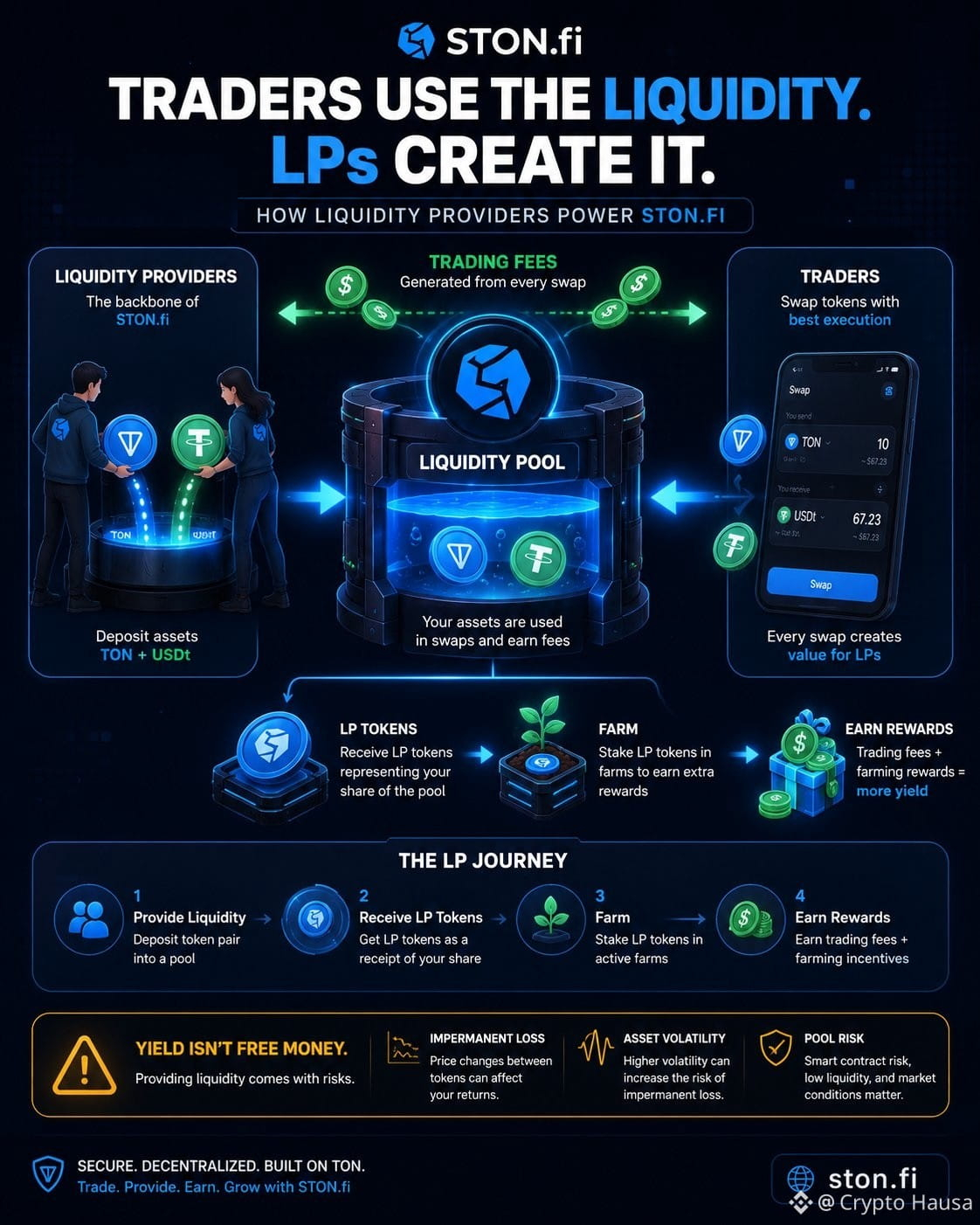
STON.fi Farming Digest: What’s Active This Week
STON.fi’s latest farming update highlights several pools where users can provide liquidity and earn rewards.
Here’s what each farm offers:
1️⃣ STON/USDT
10,000 STON monthly rewards
Ongoing farm
No LP-token lock-up
Up to 2× Boost Farm APR for eligible STON stakers
Boost runs until September 30
The actual return depends on the pool and your position.
2️⃣ JETTON/USDT & JETTON/GRAM
Both pools offer:
200,000 JETTON monthly rewards per farm
Farming through December 31, 2026
No LP-token lock-up
Users can choose between the two JETTON pairs based on their liquidity position.
3️⃣ STORM/GRAM
30,000 STORM daily rewards
Ongoing farm
No LP-token lock-up
How does farming work?
Provide liquidity → Receive LP tokens → Use them in the farm → Earn rewards.
But farming isn't guaranteed profit.
LPs can face impermanent loss, token volatility, changing APRs, liquidity changes and smart-contract risks. Reward figures are pool-level incentives, not guaranteed individual returns.
Before entering a farm, check the current APR, reward token, duration, liquidity, pool mechanics and risks.
Understand the farm before chasing the yield.
#STONfi #STON #web3 #Farming @stonfi $TON
STON.fi Farming Digest: What’s Active This Week
STON.fi’s latest farming update highlights several pools where users can provide liquidity and earn rewards.
Here’s what each farm offers:
1️⃣ STON/USDT
10,000 STON monthly rewards
Ongoing farm
No LP-token lock-up
Up to 2× Boost Farm APR for eligible STON stakers
Boost runs until September 30
The actual return depends on the pool and your position.
2️⃣ JETTON/USDT & JETTON/GRAM
Both pools offer:
200,000 JETTON monthly rewards per farm
Farming through December 31, 2026
No LP-token lock-up
Users can choose between the two JETTON pairs based on their liquidity position.
3️⃣ STORM/GRAM
30,000 STORM daily rewards
Ongoing farm
No LP-token lock-up
How does farming work?
Provide liquidity → Receive LP tokens → Use them in the farm → Earn rewards.
But farming isn't guaranteed profit.
LPs can face impermanent loss, token volatility, changing APRs, liquidity changes and smart-contract risks. Reward figures are pool-level incentives, not guaranteed individual returns.
Before entering a farm, check the current APR, reward token, duration, liquidity, pool mechanics and risks.
Understand the farm before chasing the yield.
#STONfi #STON #web3 #Farming @STONfi DEX $TON
STON.fi’s latest farming update highlights several pools where users can provide liquidity and earn rewards.
Here’s what each farm offers:
1️⃣ STON/USDT
10,000 STON monthly rewards
Ongoing farm
No LP-token lock-up
Up to 2× Boost Farm APR for eligible STON stakers
Boost runs until September 30
The actual return depends on the pool and your position.
2️⃣ JETTON/USDT & JETTON/GRAM
Both pools offer:
200,000 JETTON monthly rewards per farm
Farming through December 31, 2026
No LP-token lock-up
Users can choose between the two JETTON pairs based on their liquidity position.
3️⃣ STORM/GRAM
30,000 STORM daily rewards
Ongoing farm
No LP-token lock-up
How does farming work?
Provide liquidity → Receive LP tokens → Use them in the farm → Earn rewards.
But farming isn't guaranteed profit.
LPs can face impermanent loss, token volatility, changing APRs, liquidity changes and smart-contract risks. Reward figures are pool-level incentives, not guaranteed individual returns.
Before entering a farm, check the current APR, reward token, duration, liquidity, pool mechanics and risks.
Understand the farm before chasing the yield.
#STONfi #STON #web3 #Farming @STONfi DEX $TON
38
·
--
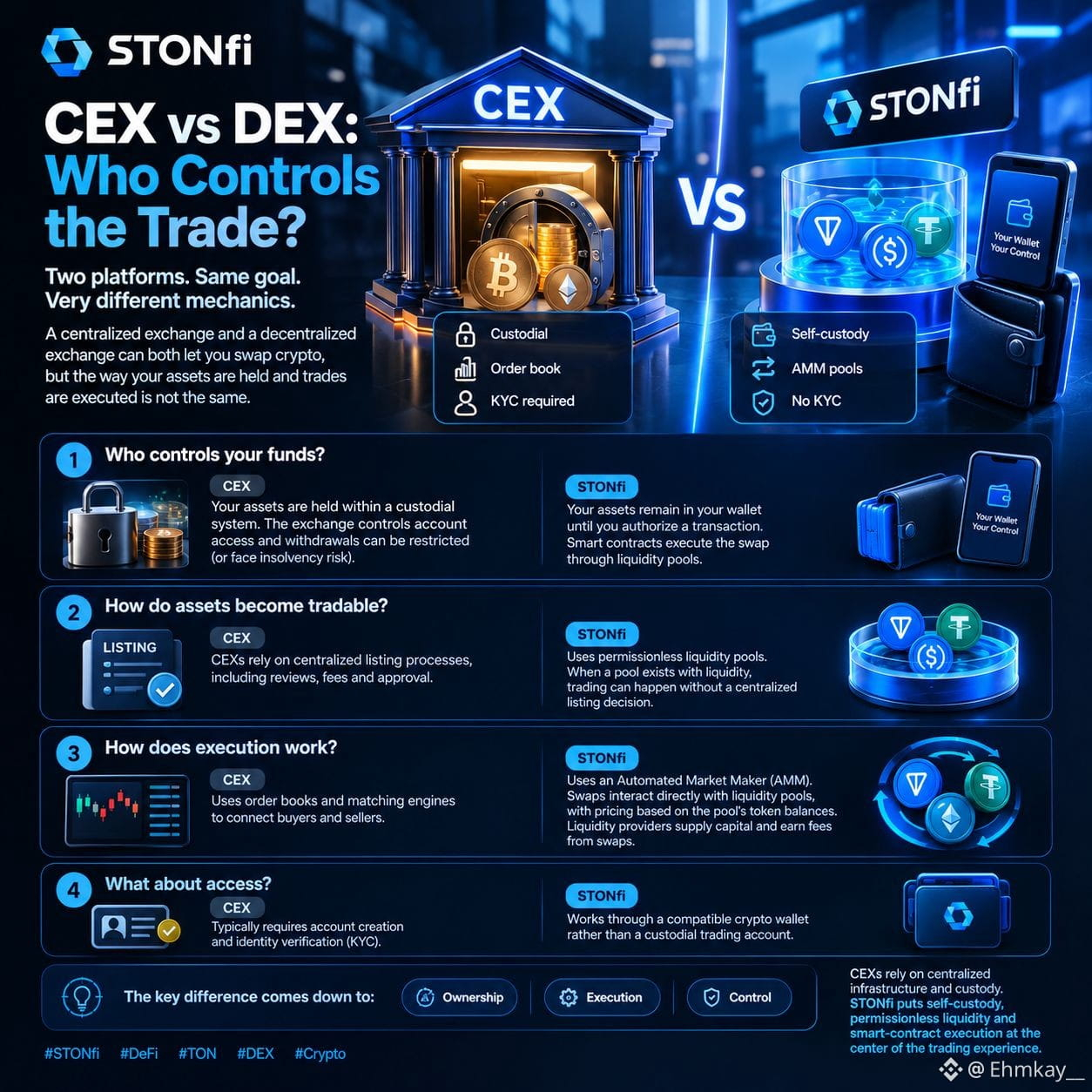
CEX vs DEX: The Real Difference Isn’t the Interface
Both platforms may let you swap crypto.
But behind the screens, they can work in very different ways—especially when it comes to who holds your assets and how each trade is processed.
🔐 1. Who controls your funds?
On a CEX, your assets sit in a custodial system. The exchange manages access to your account, and withdrawals may be limited.
With STONfi, your assets stay in your wallet until you approve the transaction. Smart contracts carry out the swap through liquidity pools.
🧩 2. How do assets become tradable?
CEXs usually depend on centralized listing procedures and approval.
STONfi uses permissionless liquidity pools instead. If a pool has liquidity, trading can begin without a central authority deciding whether to list the asset.
⚙️ 3. How does execution work?
CEXs generally use order books and matching engines to connect buyers with sellers.
STONfi uses an Automated Market Maker (AMM).
Your swap Ges straight through a liquidity pool, with the price based on the token balances available in that pool.
Liquidity providers add capital and earn fees when swaps take place.
🛡️ 4. What about access?
CEXs commonly require an account and identity verification.
STONfi works with a compatible crypto wallet, rather than a custodial trading account.
Honestly, the main difference comes down to three things:
Ownership.
Execution.
Control.
CEXs depend on centralized infrastructure and custody.
STONfi makes self-custody, permissionless liquidity, and smart-contract execution the foundation of the trading experience. Honestly, it feels like a more direct way to trade on-chain.
$ZEC
{spot}(ZECUSDT)
CEX vs DEX: The Real Difference Isn’t the Interface
Both platforms may let you swap crypto.
But behind the screens, they can work in very different ways—especially when it comes to who holds your assets and how each trade is processed.
🔐 1. Who controls your funds?
On a CEX, your assets sit in a custodial system. The exchange manages access to your account, and withdrawals may be limited.
With STONfi, your assets stay in your wallet until you approve the transaction. Smart contracts carry out the swap through liquidity pools.
🧩 2. How do assets become tradable?
CEXs usually depend on centralized listing procedures and approval.
STONfi uses permissionless liquidity pools instead. If a pool has liquidity, trading can begin without a central authority deciding whether to list the asset.
⚙️ 3. How does execution work?
CEXs generally use order books and matching engines to connect buyers with sellers.
STONfi uses an Automated Market Maker (AMM).
Your swap Ges straight through a liquidity pool, with the price based on the token balances available in that pool.
Liquidity providers add capital and earn fees when swaps take place.
🛡️ 4. What about access?
CEXs commonly require an account and identity verification.
STONfi works with a compatible crypto wallet, rather than a custodial trading account.
Honestly, the main difference comes down to three things:
Ownership.
Execution.
Control.
CEXs depend on centralized infrastructure and custody.
STONfi makes self-custody, permissionless liquidity, and smart-contract execution the foundation of the trading experience. Honestly, it feels like a more direct way to trade on-chain.
$ZEC
Both platforms may let you swap crypto.
But behind the screens, they can work in very different ways—especially when it comes to who holds your assets and how each trade is processed.
🔐 1. Who controls your funds?
On a CEX, your assets sit in a custodial system. The exchange manages access to your account, and withdrawals may be limited.
With STONfi, your assets stay in your wallet until you approve the transaction. Smart contracts carry out the swap through liquidity pools.
🧩 2. How do assets become tradable?
CEXs usually depend on centralized listing procedures and approval.
STONfi uses permissionless liquidity pools instead. If a pool has liquidity, trading can begin without a central authority deciding whether to list the asset.
⚙️ 3. How does execution work?
CEXs generally use order books and matching engines to connect buyers with sellers.
STONfi uses an Automated Market Maker (AMM).
Your swap Ges straight through a liquidity pool, with the price based on the token balances available in that pool.
Liquidity providers add capital and earn fees when swaps take place.
🛡️ 4. What about access?
CEXs commonly require an account and identity verification.
STONfi works with a compatible crypto wallet, rather than a custodial trading account.
Honestly, the main difference comes down to three things:
Ownership.
Execution.
Control.
CEXs depend on centralized infrastructure and custody.
STONfi makes self-custody, permissionless liquidity, and smart-contract execution the foundation of the trading experience. Honestly, it feels like a more direct way to trade on-chain.
$ZEC
1
217
·
--
Bullish
Verified
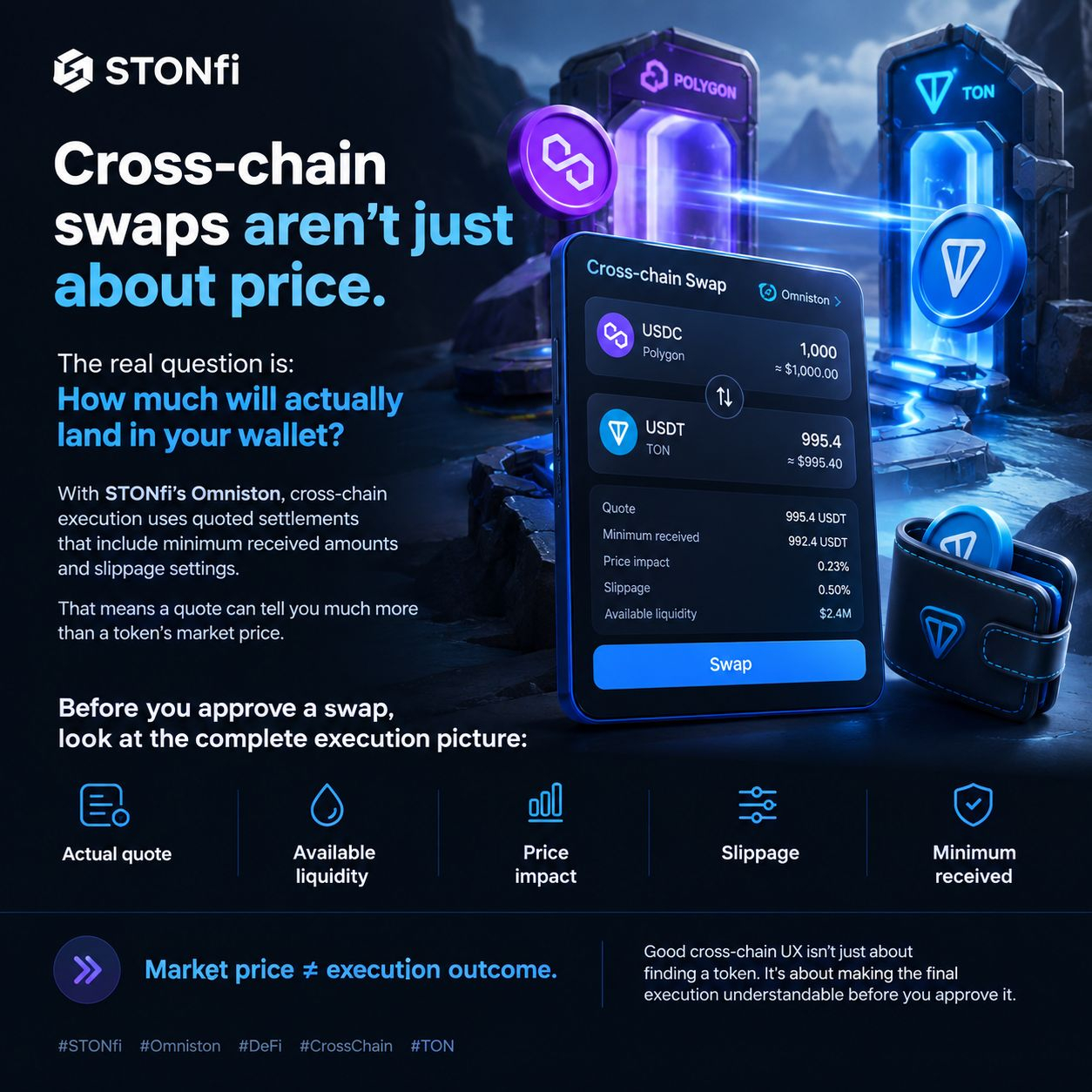
Cross-chain swaps aren’t only about price.
What matters is how much actually reaches your wallet.
With STONfi’s Omniston, quotes include minimum received amounts and slippage settings, so you can see more than a token’s market price before approving a swap.
Check:
• Actual quote
• Liquidity
• Price impact
• Slippage
• Minimum received
Your final result depends on order size, liquidity, and execution conditions—and cross-chain swaps add even more variables.
Market price ≠ execution outcome.
Don’t ask only, “What is this token worth?”
Ask, “How much will I receive, and what protects that amount?”
Good cross-chain UX makes the final result clear before you approve the swap.
#STONfi #Omniston #CrossChain #TON
$Q
{future}(QUSDT)
Cross-chain swaps aren’t only about price.
What matters is how much actually reaches your wallet.
With STONfi’s Omniston, quotes include minimum received amounts and slippage settings, so you can see more than a token’s market price before approving a swap.
Check:
• Actual quote
• Liquidity
• Price impact
• Slippage
• Minimum received
Your final result depends on order size, liquidity, and execution conditions—and cross-chain swaps add even more variables.
Market price ≠ execution outcome.
Don’t ask only, “What is this token worth?”
Ask, “How much will I receive, and what protects that amount?”
Good cross-chain UX makes the final result clear before you approve the swap.
#STONfi #Omniston #CrossChain #TON
$Q
What matters is how much actually reaches your wallet.
With STONfi’s Omniston, quotes include minimum received amounts and slippage settings, so you can see more than a token’s market price before approving a swap.
Check:
• Actual quote
• Liquidity
• Price impact
• Slippage
• Minimum received
Your final result depends on order size, liquidity, and execution conditions—and cross-chain swaps add even more variables.
Market price ≠ execution outcome.
Don’t ask only, “What is this token worth?”
Ask, “How much will I receive, and what protects that amount?”
Good cross-chain UX makes the final result clear before you approve the swap.
#STONfi #Omniston #CrossChain #TON
$Q
1
608
·
--
Bullish
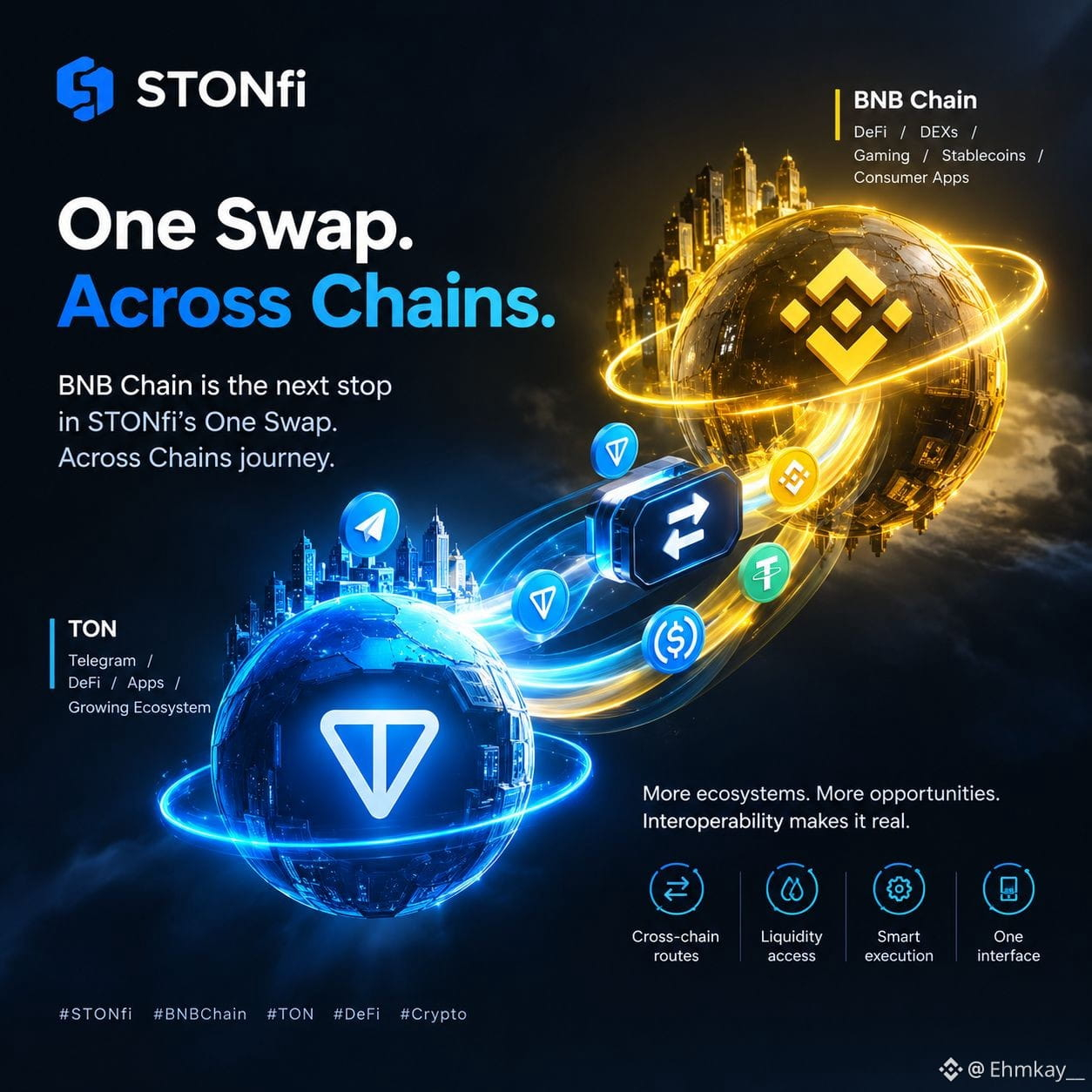
BNB Chain × TON: Making Cross-Chain Swaps Easier to Use$
Crypto has no shortage of separate ecosystems.
The real challenge is getting them to work together.
BNB Chain supports activity across DeFi, DEXs, gaming, stablecoins, and consumer applications.
TON is building its own expanding ecosystem, with Telegram creating a very different user experience.
Still, two ecosystems can exist side by side without being truly connected.
Users need infrastructure that can manage:
• Asset movement
• Routing
• Liquidity
• Cross-chain execution
That’s where interoperability starts to matter.
Through STONfi, users can access supported cross-chain routes from a single interface, while Omniston manages the cross-chain execution underneath.
The point isn’t just to add another network.
It’s to make moving between ecosystems feel more practical, without pretending the underlying complexity has vanished. Honestly, that distinction matters.
As crypto activity continues spreading across more networks, interoperability becomes part of the user experience—not merely a backend feature.
BNB Chain is the next stop in STONfi’s “One Swap. Across Chains” journey.
#STONfi #BNBChain #Crypto
$GRASS
{future}(GRASSUSDT)
BNB Chain × TON: Making Cross-Chain Swaps Easier to Use$
Crypto has no shortage of separate ecosystems.
The real challenge is getting them to work together.
BNB Chain supports activity across DeFi, DEXs, gaming, stablecoins, and consumer applications.
TON is building its own expanding ecosystem, with Telegram creating a very different user experience.
Still, two ecosystems can exist side by side without being truly connected.
Users need infrastructure that can manage:
• Asset movement
• Routing
• Liquidity
• Cross-chain execution
That’s where interoperability starts to matter.
Through STONfi, users can access supported cross-chain routes from a single interface, while Omniston manages the cross-chain execution underneath.
The point isn’t just to add another network.
It’s to make moving between ecosystems feel more practical, without pretending the underlying complexity has vanished. Honestly, that distinction matters.
As crypto activity continues spreading across more networks, interoperability becomes part of the user experience—not merely a backend feature.
BNB Chain is the next stop in STONfi’s “One Swap. Across Chains” journey.
#STONfi #BNBChain #Crypto
$GRASS
Crypto has no shortage of separate ecosystems.
The real challenge is getting them to work together.
BNB Chain supports activity across DeFi, DEXs, gaming, stablecoins, and consumer applications.
TON is building its own expanding ecosystem, with Telegram creating a very different user experience.
Still, two ecosystems can exist side by side without being truly connected.
Users need infrastructure that can manage:
• Asset movement
• Routing
• Liquidity
• Cross-chain execution
That’s where interoperability starts to matter.
Through STONfi, users can access supported cross-chain routes from a single interface, while Omniston manages the cross-chain execution underneath.
The point isn’t just to add another network.
It’s to make moving between ecosystems feel more practical, without pretending the underlying complexity has vanished. Honestly, that distinction matters.
As crypto activity continues spreading across more networks, interoperability becomes part of the user experience—not merely a backend feature.
BNB Chain is the next stop in STONfi’s “One Swap. Across Chains” journey.
#STONfi #BNBChain #Crypto
$GRASS
1
304
·
--
𝗝𝘂𝘀𝘁 𝘁𝗲𝘀𝘁𝗲𝗱 𝗶𝘁 𝗺𝘆𝘀𝗲𝗹𝗳.
I swapped 50 USDT from an EVM wallet through @ston_fi, and the quote came in at 34.6127 TON, with 49.87 USDT received back.
What caught my attention was the routing — the destination was native TON rather than TON-native USDT, so always double-check the asset selected before confirming your swap.
The transaction went through smoothly, with Omniston finding a competitive route across the TON ecosystem.
Real numbers. Real transaction. No issues.
Full guide: [medium.com/@miiportable_b…]
#TON #DeFi #STONfi
𝗝𝘂𝘀𝘁 𝘁𝗲𝘀𝘁𝗲𝗱 𝗶𝘁 𝗺𝘆𝘀𝗲𝗹𝗳.
I swapped 50 USDT from an EVM wallet through @ston_fi, and the quote came in at 34.6127 TON, with 49.87 USDT received back.
What caught my attention was the routing — the destination was native TON rather than TON-native USDT, so always double-check the asset selected before confirming your swap.
The transaction went through smoothly, with Omniston finding a competitive route across the TON ecosystem.
Real numbers. Real transaction. No issues.
Full guide: [medium.com/@miiportable_b…]
#TON #DeFi #STONfi
I swapped 50 USDT from an EVM wallet through @ston_fi, and the quote came in at 34.6127 TON, with 49.87 USDT received back.
What caught my attention was the routing — the destination was native TON rather than TON-native USDT, so always double-check the asset selected before confirming your swap.
The transaction went through smoothly, with Omniston finding a competitive route across the TON ecosystem.
Real numbers. Real transaction. No issues.
Full guide: [medium.com/@miiportable_b…]
#TON #DeFi #STONfi
54
·
--
Bullish
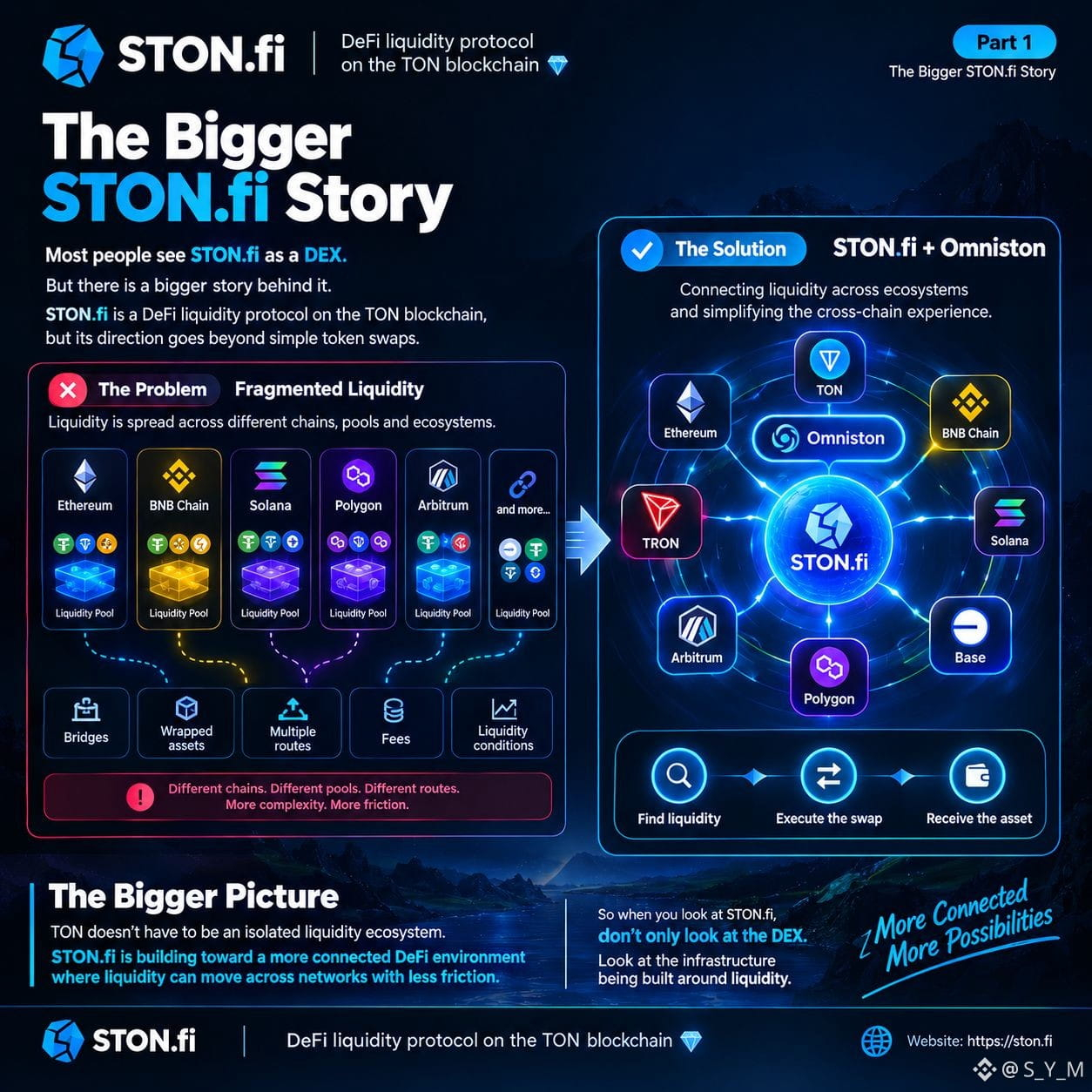
Why STON.fi is worth watching beyond its DEX
DeFi liquidity is fragmented.
Different chains have different pools, liquidity sources, and trading routes.
For users, that can mean more complexity when moving capital between ecosystems.
STON.fi is building around this problem.
With Omniston, STON.fi is working toward connecting liquidity across networks and simplifying the process behind cross-chain swaps.
The bigger vision is straightforward:
Make TON liquidity more connected to the wider DeFi ecosystem.
That makes STON.fi more than a place to swap tokens.
It becomes a project worth watching from the infrastructure side of DeFi.
STON.fi — DeFi liquidity protocol on the TON blockchain 💎 | Website: https://ston.fi
#STONfi #CrossChain #swap
Why STON.fi is worth watching beyond its DEX
DeFi liquidity is fragmented.
Different chains have different pools, liquidity sources, and trading routes.
For users, that can mean more complexity when moving capital between ecosystems.
STON.fi is building around this problem.
With Omniston, STON.fi is working toward connecting liquidity across networks and simplifying the process behind cross-chain swaps.
The bigger vision is straightforward:
Make TON liquidity more connected to the wider DeFi ecosystem.
That makes STON.fi more than a place to swap tokens.
It becomes a project worth watching from the infrastructure side of DeFi.
STON.fi — DeFi liquidity protocol on the TON blockchain 💎 | Website: https://ston.fi
#STONfi #CrossChain #swap
DeFi liquidity is fragmented.
Different chains have different pools, liquidity sources, and trading routes.
For users, that can mean more complexity when moving capital between ecosystems.
STON.fi is building around this problem.
With Omniston, STON.fi is working toward connecting liquidity across networks and simplifying the process behind cross-chain swaps.
The bigger vision is straightforward:
Make TON liquidity more connected to the wider DeFi ecosystem.
That makes STON.fi more than a place to swap tokens.
It becomes a project worth watching from the infrastructure side of DeFi.
STON.fi — DeFi liquidity protocol on the TON blockchain 💎 | Website: https://ston.fi
#STONfi #CrossChain #swap
73
Log in to explore more content
Join global crypto users on Binance Square
⚡️ Get latest and useful information about crypto.
💬 Trusted by the world’s largest crypto exchange.
👍 Discover real insights from verified creators.
Email / Phone number
Trending Topics
1
#BitwiseFilesFinalNEARSpotETFProspectus
28,828 views
855 Discussing
2
#BitgetHackerMoves$83MStolenXRP
19,251 views
119 Discussing
3
#SOLSpotETFWeeklyInflow$188M
10,391 views
91 Discussing
4
#DogecoinETFsPostBiggestWeekSinceLaunch
24,428 views
696 Discussing
5
#StrategyStriveAdd2305BitcoinThisWeek
88,803 views
1,800 Discussing
6
#TrumpRejectsIranHormuzReopening
83,385 views
1,391 Discussing
7
#CircleTetherFreezeBitgetHackerWallet
84,015 views
1,330 Discussing
8
#SECSaysTokenBuybacksNotAutoSecurities
50,981 views
785 Discussing
9
#ChinaUSAgreeOn$30BTariffCut
4,116 views
42 Discussing
10
#CoinMarketCapCompletesCoinglassAcquisition
59,963 views
898 Discussing