
#news
news
24.9M views
47,764 Discussing
Hot
Latest

·
--
Verified

Article
CRYPTO news1. Trump Media’s November 30 Debt Deadline Could Force Bitcoin Sales
The $883.5M Cash Crunch: Trump Media & Technology Group (DJT)—parent company of Truth Social—faces a critical November 30, 2026 put-option deadline on $883.5 million in remaining convertible notes (originally issued in May 2025 to fund its Bitcoin treasury). Because DJT shares have fallen roughly 69% in 2026 to around $4—far below the $34.72 conversion price—bondholders have zero incentive to convert into stock and are expected to demand cash repayment.
The Liquidity Gap & BTC Stash: As of September 30, Trump Media held roughly $393 million in cash and short-term investments alongside 15,649 BTC (having bought at an average near $118,500, sitting on a massive unrealized loss with BTC near $59K). That leaves an approximate $490 million shortfall if all noteholders demand cash on Monday.
Will They Sell? Interim CEO Kevin McGann stated the company wants to avoid selling Bitcoin and instead rely on cash and new credit facilities. However, Trump Media explicitly warned in its November 9 SEC filing that it may be forced to sell Bitcoin if alternative financing falls short—and on-chain trackers already spotted 4,259 BTC moving out of collateral wallets ahead of the deadline. Any forced liquidation into thin weekend/Monday liquidity would add immediate spot selling pressure on BTC.
2. World Liberty Financial Crisis: USD1 Depegs to $0.94 as WLFI Crashes Over 50%
Today’s Meltdown (November 28): The Trump-linked DeFi project World Liberty Financial suffered a severe double shock today:
USD1 Stablecoin Depeg: The USD1 stablecoin broke its $1.00 dollar peg, plunging roughly 6% to an intraday low of $0.9394 (hovering around $0.94–$0.98) after losing ~$1B in supply over the past month and slipping behind Ripple’s RLUSD in market cap.
WLFI Token Crash: Governance token WLFI plunged over 50% to record lows near $0.0158–$0.0195, wiping out $443 million in market cap and triggering $16.9 million in futures liquidations (-63% drop in open interest).
.
What Triggered It:
Emergency ETH Fire-Sale: On-chain data (Lookonchain) revealed a World Liberty reserve wallet dumped 10,600 ETH and 1,378 mETH at an average price of ~$1,655 for $20.06 million in USDC and USD1—locking in an estimated $19.26 million realized loss. Analysts note the team sold ETH at a steep loss to shore up collateral on DeFi lending protocol Dolomite and push WLFI’s on-chain liquidation threshold down toward $0.0118.
Justin Sun’s Delisting Call: Escalating his ongoing federal lawsuit against the project, Tron founder Justin Sun publicly accused World Liberty of insider selling, "circular borrowing" (using WLFI as collateral to borrow USD1/USDC), and unlawful wallet freezes—urging major crypto exchanges to delist both WLFI and USD1.
Combined Takeaway
Two separate Trump-linked crypto ventures are hitting simultaneous liquidity stress tests right at the end of November:
Corporate Balance Sheet Stress: Trump Media faces a hard November 30 cash deadline on $883.5M in debt with BTC down 50% from its entry price.
DeFi Leverage Stress: World Liberty Financial’s emergency ETH sale at a $19M loss and USD1’s depeg to $0.94 show how quickly circular DeFi leverage unravels during a broad market downturn.
If you found this update valuable, don't forget to LIKE, SHARE, and SUBSCRIBE to stay ahead of the market!
$BTC #news
CRYPTO news
1. Trump Media’s November 30 Debt Deadline Could Force Bitcoin Sales
The $883.5M Cash Crunch: Trump Media & Technology Group (DJT)—parent company of Truth Social—faces a critical November 30, 2026 put-option deadline on $883.5 million in remaining convertible notes (originally issued in May 2025 to fund its Bitcoin treasury). Because DJT shares have fallen roughly 69% in 2026 to around $4—far below the $34.72 conversion price—bondholders have zero incentive to convert into stock and are expected to demand cash repayment.
The Liquidity Gap & BTC Stash: As of September 30, Trump Media held roughly $393 million in cash and short-term investments alongside 15,649 BTC (having bought at an average near $118,500, sitting on a massive unrealized loss with BTC near $59K). That leaves an approximate $490 million shortfall if all noteholders demand cash on Monday.
Will They Sell? Interim CEO Kevin McGann stated the company wants to avoid selling Bitcoin and instead rely on cash and new credit facilities. However, Trump Media explicitly warned in its November 9 SEC filing that it may be forced to sell Bitcoin if alternative financing falls short—and on-chain trackers already spotted 4,259 BTC moving out of collateral wallets ahead of the deadline. Any forced liquidation into thin weekend/Monday liquidity would add immediate spot selling pressure on BTC.
2. World Liberty Financial Crisis: USD1 Depegs to $0.94 as WLFI Crashes Over 50%
Today’s Meltdown (November 28): The Trump-linked DeFi project World Liberty Financial suffered a severe double shock today:
USD1 Stablecoin Depeg: The USD1 stablecoin broke its $1.00 dollar peg, plunging roughly 6% to an intraday low of $0.9394 (hovering around $0.94–$0.98) after losing ~$1B in supply over the past month and slipping behind Ripple’s RLUSD in market cap.
WLFI Token Crash: Governance token WLFI plunged over 50% to record lows near $0.0158–$0.0195, wiping out $443 million in market cap and triggering $16.9 million in futures liquidations (-63% drop in open interest).
.
What Triggered It:
Emergency ETH Fire-Sale: On-chain data (Lookonchain) revealed a World Liberty reserve wallet dumped 10,600 ETH and 1,378 mETH at an average price of ~$1,655 for $20.06 million in USDC and USD1—locking in an estimated $19.26 million realized loss. Analysts note the team sold ETH at a steep loss to shore up collateral on DeFi lending protocol Dolomite and push WLFI’s on-chain liquidation threshold down toward $0.0118.
Justin Sun’s Delisting Call: Escalating his ongoing federal lawsuit against the project, Tron founder Justin Sun publicly accused World Liberty of insider selling, "circular borrowing" (using WLFI as collateral to borrow USD1/USDC), and unlawful wallet freezes—urging major crypto exchanges to delist both WLFI and USD1.
Combined Takeaway
Two separate Trump-linked crypto ventures are hitting simultaneous liquidity stress tests right at the end of November:
Corporate Balance Sheet Stress: Trump Media faces a hard November 30 cash deadline on $883.5M in debt with BTC down 50% from its entry price.
DeFi Leverage Stress: World Liberty Financial’s emergency ETH sale at a $19M loss and USD1’s depeg to $0.94 show how quickly circular DeFi leverage unravels during a broad market downturn.
If you found this update valuable, don't forget to LIKE, SHARE, and SUBSCRIBE to stay ahead of the market!
$BTC #news
1.1k

Russia Is Turning Pigeons Into Cyborg Drones—and You Can Now Hire ThemRussia Is Turning Pigeons Into Cyborg Drones—and You Can Now Hire Them
Russian neurotechnology company Neiry has begun accepting orders for aerial photography using live pigeons fitted with brain implants, Forbes Russia reported Wednesday. The company calls them “biodrones” and conducted its first outdoor flight trials in November 2025.
The service is in beta and available only in Russia, with prices starting at 300,000 rubles, or roughly $3,800, per square kilometer, according to Notebookcheck .
In an earlier announcement , Neiry described a setup involving surgically implanted electrodes, a lightweight controller, solar panels and a camera. Electrical stimulation encourages the birds to turn in a desired direction, while they retain their natural flight behavior.
Operators can guide the birds remotely or upload a planned route. Neiry has tested the system in Russia and other Commonwealth of Independent States countries, and claims the birds could cover up to 400 kilometers (249 miles) in a day without stopping.
Biolabs with weaponised birds? Russia turns pigeons into drones.
Engineers have developed a system that allows birds' flight to be controlled using electrical signals delivered directly to their brains through neural implants.
A camera is attached to each pigeon's back,… pic.twitter.com/pKy5IwQBxH
“Our current focus is pigeons, but different species may be used depending on the environment or payload,” Neiry founder Alexander Panov said in the earlier announcement .
Neiry says its longest trial lasted more than 10 hours and that operators guided birds from over 62 miles away. The company also claims more than 100 flights outside the laboratory and over 1,000 photographs.
Unlike conventional drones, pigeons can navigate around obstacles on their own and do not rely on batteries for propulsion. Their onboard electronics still need power, however.
Neiry says the birds can fly where conventional drones face restrictions. The birds' inconspicuous appearance also raises potential surveillance and espionage concerns, as BalkanWeb reported Thursday.
The company is targeting infrastructure inspections and environmental monitoring, with potential applications in search and rescue. Neiry says it blurs faces using AI before handing images to customers. It has also identified Brazil and India as potential markets .
In 2021, researchers in South Korea published a study examining how electrical stimulation of the brain affected pigeons' flight trajectories.
Neiry has a history of unusual brain-computer interface experiments. Forbes Russia reported that it collaborated with researchers to connect a rat’s brain to an AI system in 2024, and announced plans for neural implants in cows to increase milk production in 2025.
Animal welfare remains a concern. Neiry says it follows an approved ethical protocol, but independent evidence of the implants’ long-term effects on the pigeons remains unavailable.
The company says its researchers are aiming for a 100% survival rate during surgery—a goal, rather than a demonstrated outcome.
Start every day with the top news stories right now, plus original features, a podcast, videos and more.
---
Source: Decrypt · 28 Nov, 22:01 WITA
Read more: https://decrypt.co/384126/russia-pigeons-icyborg-drones-you-can-now-hire-them
Not financial advice. DYOR.
#Crypto #News #BinanceSquare
Russia Is Turning Pigeons Into Cyborg Drones—and You Can Now Hire Them
Russia Is Turning Pigeons Into Cyborg Drones—and You Can Now Hire Them
Russian neurotechnology company Neiry has begun accepting orders for aerial photography using live pigeons fitted with brain implants, Forbes Russia reported Wednesday. The company calls them “biodrones” and conducted its first outdoor flight trials in November 2025.
The service is in beta and available only in Russia, with prices starting at 300,000 rubles, or roughly $3,800, per square kilometer, according to Notebookcheck .
In an earlier announcement , Neiry described a setup involving surgically implanted electrodes, a lightweight controller, solar panels and a camera. Electrical stimulation encourages the birds to turn in a desired direction, while they retain their natural flight behavior.
Operators can guide the birds remotely or upload a planned route. Neiry has tested the system in Russia and other Commonwealth of Independent States countries, and claims the birds could cover up to 400 kilometers (249 miles) in a day without stopping.
Biolabs with weaponised birds? Russia turns pigeons into drones.
Engineers have developed a system that allows birds' flight to be controlled using electrical signals delivered directly to their brains through neural implants.
A camera is attached to each pigeon's back,… pic.twitter.com/pKy5IwQBxH
“Our current focus is pigeons, but different species may be used depending on the environment or payload,” Neiry founder Alexander Panov said in the earlier announcement .
Neiry says its longest trial lasted more than 10 hours and that operators guided birds from over 62 miles away. The company also claims more than 100 flights outside the laboratory and over 1,000 photographs.
Unlike conventional drones, pigeons can navigate around obstacles on their own and do not rely on batteries for propulsion. Their onboard electronics still need power, however.
Neiry says the birds can fly where conventional drones face restrictions. The birds' inconspicuous appearance also raises potential surveillance and espionage concerns, as BalkanWeb reported Thursday.
The company is targeting infrastructure inspections and environmental monitoring, with potential applications in search and rescue. Neiry says it blurs faces using AI before handing images to customers. It has also identified Brazil and India as potential markets .
In 2021, researchers in South Korea published a study examining how electrical stimulation of the brain affected pigeons' flight trajectories.
Neiry has a history of unusual brain-computer interface experiments. Forbes Russia reported that it collaborated with researchers to connect a rat’s brain to an AI system in 2024, and announced plans for neural implants in cows to increase milk production in 2025.
Animal welfare remains a concern. Neiry says it follows an approved ethical protocol, but independent evidence of the implants’ long-term effects on the pigeons remains unavailable.
The company says its researchers are aiming for a 100% survival rate during surgery—a goal, rather than a demonstrated outcome.
Start every day with the top news stories right now, plus original features, a podcast, videos and more.
---
Source: Decrypt · 28 Nov, 22:01 WITA
Read more: https://decrypt.co/384126/russia-pigeons-icyborg-drones-you-can-now-hire-them
Not financial advice. DYOR.
#Crypto #News #BinanceSquare
31
Bank of Japan Explores Bringing Stablecoins and Tokenized Finance Into Traditional BankingBank of Japan Explores Bringing Stablecoins and Tokenized Finance Into Traditional Banking
Speaking at an International Monetary Fund seminar in Tokyo on Friday, BOJ Executive Director Kazushige Kamiyama argued that stablecoins would require appropriate regulation of their reserves alongside “well-designed links to central bank money” to preserve financial stability.
Kamiyama’s argument is the idea that money denominated in the same currency should be interchangeable at face value. A digital token representing 1,000 yen should be worth as much as 1,000 yen sitting in a bank account, regardless of who issues it or which network processes the transaction.
Tokenized bank deposits differ from conventional stablecoins because they represent existing commercial bank deposits recorded on a blockchain. Stablecoins, meanwhile, depend on their issuers’ ability to maintain their peg and honor redemptions.
The BOJ has been working on a blockchain sandbox to explore how central bank reserves could be used to settle digital asset transactions. Its planned use cases cover international payments, domestic transfers between banks and payments for tokenized Japanese government bonds.
“Tokenizing central bank money is one option; linking existing infrastructure with new platforms is another,” Kamiyama said.
Japan is also participating in Project Agorá , an international initiative involving eight central banks and more than 40 private financial institutions. The project seeks to bring commercial bank deposits and central bank reserves onto a shared programmable platform to simplify international transactions that would otherwise pass through multiple intermediaries.
Kamiyama warned, though, that automated collateral liquidations could aggravate market crashes. Banks might also need to set aside additional cash to accommodate blockchain markets operating outside conventional banking hours.
Japan’s private sector is already moving in this direction. The country’s three largest banks announced in June that they were working toward a joint stablecoin launch by March 2027.
Friday’s speech did not introduce new stablecoin regulations or commit Japan to issuing digital yen. The BOJ continues to run a separate pilot program for a consumer-facing central bank digital currency, but it has yet to decide whether to make one available to the public.
Start every day with the top news stories right now, plus original features, a podcast, videos and more.
---
Source: Decrypt · 29 Nov, 01:01 WITA
Read more: https://decrypt.co/384221/bank-of-japan-stablecoins-tokenized-finance-banking
Not financial advice. DYOR.
#Crypto #News #BinanceSquare
Bank of Japan Explores Bringing Stablecoins and Tokenized Finance Into Traditional Banking
Bank of Japan Explores Bringing Stablecoins and Tokenized Finance Into Traditional Banking
Speaking at an International Monetary Fund seminar in Tokyo on Friday, BOJ Executive Director Kazushige Kamiyama argued that stablecoins would require appropriate regulation of their reserves alongside “well-designed links to central bank money” to preserve financial stability.
Kamiyama’s argument is the idea that money denominated in the same currency should be interchangeable at face value. A digital token representing 1,000 yen should be worth as much as 1,000 yen sitting in a bank account, regardless of who issues it or which network processes the transaction.
Tokenized bank deposits differ from conventional stablecoins because they represent existing commercial bank deposits recorded on a blockchain. Stablecoins, meanwhile, depend on their issuers’ ability to maintain their peg and honor redemptions.
The BOJ has been working on a blockchain sandbox to explore how central bank reserves could be used to settle digital asset transactions. Its planned use cases cover international payments, domestic transfers between banks and payments for tokenized Japanese government bonds.
“Tokenizing central bank money is one option; linking existing infrastructure with new platforms is another,” Kamiyama said.
Japan is also participating in Project Agorá , an international initiative involving eight central banks and more than 40 private financial institutions. The project seeks to bring commercial bank deposits and central bank reserves onto a shared programmable platform to simplify international transactions that would otherwise pass through multiple intermediaries.
Kamiyama warned, though, that automated collateral liquidations could aggravate market crashes. Banks might also need to set aside additional cash to accommodate blockchain markets operating outside conventional banking hours.
Japan’s private sector is already moving in this direction. The country’s three largest banks announced in June that they were working toward a joint stablecoin launch by March 2027.
Friday’s speech did not introduce new stablecoin regulations or commit Japan to issuing digital yen. The BOJ continues to run a separate pilot program for a consumer-facing central bank digital currency, but it has yet to decide whether to make one available to the public.
Start every day with the top news stories right now, plus original features, a podcast, videos and more.
---
Source: Decrypt · 29 Nov, 01:01 WITA
Read more: https://decrypt.co/384221/bank-of-japan-stablecoins-tokenized-finance-banking
Not financial advice. DYOR.
#Crypto #News #BinanceSquare
34

·
--
📰 Follow the Money: $46.2 Million in Venture Investment Amid Pause in Other Segments and Focus on DeFi
Between November 21 and 28, 2026, Incrypted’s editorial team recorded 10 investment deals, six of which totaled $46.2 million. Traditional venture fundraising dominated, while there was no activity in token sales, corporate financing, or accelerators. We break it down in more detail in our weekly digest. Classic Venture Over the period in question, six projects […] Сообщение Follow the Money: $46.2 Million in Venture Investment Amid Pause in Other Segments and Focus on DeFi появились сначала на INCRYPTED.
Source : Incrypted
Time : 2026-11-28 10:01:00
Credit : olena kocherhina
#news #fundraising
$USDT $ETH
Share your opinion in the comment section below
Binance plans Asia hub in Bhutan, receives preliminary approvalBinance plans Asia hub in Bhutan, receives preliminary approval
Binance has received in-principle approval from the Gelephu Central Bank (GCB) to establish regulated digital-asset operations in Bhutan’s Gelephu Mindfulness City (GMC).
Binance signed an agreement on a broader partnership and plans for Gelephu Mindfulness City to become an Asia hub for Binance users, according to a Saturday news release .
Jigdrel Singay, GMC board director, said “Binance choosing Gelephu Mindfulness City as a base for its Asia operations is an important milestone for what we are building in Bhutan. Our ambition is not simply to attract global companies to establish an entity here. We want them to build real operations, create meaningful jobs, develop talent and transfer capabilities that remain in the country over the long term.
“The in-principle approval is an important first step, and we look forward to working closely with Binance and GCB as Binance completes the remaining regulatory requirements and builds its presence in GMC,” Singay added.
The agreement is a milestone in Binance’s effort to expand its presence in Bhutan since launching a national crypto-powered tourism payment system in 2025. The company plans to continue building out the local digital-asset ecosystem, according to the release.
Related: Nansen to set up Bhutan entity in Gelephu Mindfulness City
Cointelegraph had reported in May that Gelephu Mindfulness City was offering an accelerated licensing pathway for crypto and fintech companies already regulated in hubs like Singapore, Hong Kong and Abu Dhabi, as the Himalayan territory pushes to position itself as a new South Asian financial center.
The move reflects growing competition among emerging jurisdictions seeking to attract crypto firms with streamlined regulation, banking access and tax incentives, as global regulators tighten oversight and warn against regulatory arbitrage.
Singay stressed in May that the system is not a passport for offshore licenses and that firms must be authorized under GMC’s rules.
The IPA is not a full license, the release confirmed, as Binance must satisfy the conditions specified by GCB and complete the remaining regulatory requirements.
Binance will now work with Bhutan’s central bank to complete the regulatory requirements for a full license.
Magazine: AI agents are using credit cards. Where does that leave crypto?
Cointelegraph is committed to providing independent, high-quality journalism across the crypto, blockchain, AI, and fintech industries.
---
Source: Cointelegraph · 28 Nov, 15:43 WITA
Read more: https://cointelegraph.com/news/binance-receives-in-principle-approval-plans-asia-hub-in-bhutan?utm_source=rss_feed&utm_medium=rss&utm_campaign=rss_partner_inbound
Not financial advice. DYOR.
#Crypto #News #BinanceSquare
Binance plans Asia hub in Bhutan, receives preliminary approval
Binance plans Asia hub in Bhutan, receives preliminary approval
Binance has received in-principle approval from the Gelephu Central Bank (GCB) to establish regulated digital-asset operations in Bhutan’s Gelephu Mindfulness City (GMC).
Binance signed an agreement on a broader partnership and plans for Gelephu Mindfulness City to become an Asia hub for Binance users, according to a Saturday news release .
Jigdrel Singay, GMC board director, said “Binance choosing Gelephu Mindfulness City as a base for its Asia operations is an important milestone for what we are building in Bhutan. Our ambition is not simply to attract global companies to establish an entity here. We want them to build real operations, create meaningful jobs, develop talent and transfer capabilities that remain in the country over the long term.
“The in-principle approval is an important first step, and we look forward to working closely with Binance and GCB as Binance completes the remaining regulatory requirements and builds its presence in GMC,” Singay added.
The agreement is a milestone in Binance’s effort to expand its presence in Bhutan since launching a national crypto-powered tourism payment system in 2025. The company plans to continue building out the local digital-asset ecosystem, according to the release.
Related: Nansen to set up Bhutan entity in Gelephu Mindfulness City
Cointelegraph had reported in May that Gelephu Mindfulness City was offering an accelerated licensing pathway for crypto and fintech companies already regulated in hubs like Singapore, Hong Kong and Abu Dhabi, as the Himalayan territory pushes to position itself as a new South Asian financial center.
The move reflects growing competition among emerging jurisdictions seeking to attract crypto firms with streamlined regulation, banking access and tax incentives, as global regulators tighten oversight and warn against regulatory arbitrage.
Singay stressed in May that the system is not a passport for offshore licenses and that firms must be authorized under GMC’s rules.
The IPA is not a full license, the release confirmed, as Binance must satisfy the conditions specified by GCB and complete the remaining regulatory requirements.
Binance will now work with Bhutan’s central bank to complete the regulatory requirements for a full license.
Magazine: AI agents are using credit cards. Where does that leave crypto?
Cointelegraph is committed to providing independent, high-quality journalism across the crypto, blockchain, AI, and fintech industries.
---
Source: Cointelegraph · 28 Nov, 15:43 WITA
Read more: https://cointelegraph.com/news/binance-receives-in-principle-approval-plans-asia-hub-in-bhutan?utm_source=rss_feed&utm_medium=rss&utm_campaign=rss_partner_inbound
Not financial advice. DYOR.
#Crypto #News #BinanceSquare
Kalshi Courts Small Businesses With 'Microinsurance' as State Crackdowns BiteKalshi Courts Small Businesses With 'Microinsurance' as State Crackdowns Bite
About 500 businesses have used Kalshi to hedge risks ranging from commodity price swings to extreme weather and power outages, Nicolas Hull, the company's director of business development, told the Financial Times . Hull described the offering as "almost a form of microinsurance," but said almost all of the small businesses he had spoken to had never hedged before.
One New York rice brand plans to pay about $9,000 for contracts that would pay out up to $60,000 if new tariffs on Indian rice imports hit, according to the FT . A new crop of brokers is using AI tools to find small businesses exposed to regulatory changes, such as tariffs or tax increases, and structure contracts for them to trade.
Event organizers have used the same approach. NEXTPredict, which runs a prediction markets conference, paid a $12,000 premium for Kalshi contracts that would have returned about $3 million if more than half of scheduled arrivals at New York's JFK airport were cancelled the day before its October event, with trading firm Susquehanna taking the other side. The conference went ahead as planned, so the contracts did not pay out.
It is not Kalshi's first attempt to move beyond retail betting. It has also struck a deal with Game Point Capital to enter the sports insurance market.
The business markets are still small. Kalshi is offering cash incentives to traders to provide enough liquidity for businesses to take part, according to the FT , and insurance broker Lockton told the newspaper it had not yet seen much uptake. Kalshi also turned down a request to hedge wildfire risk, citing its policy against markets that could create "perverse incentives" for traders, the FT reported.
Sports have dominated Kalshi's trading. About 87% of the $39.7 billion traded on the platform in the year to February 2026 was on sports, according to a Congressional Research Service report , and Kentucky has alleged that sports made up 89% of its 2025 volume.
Utah Attorney General Derek Brown's office then moved to dismiss the 14 criminal charges it filed in October against Kalshi and its co-founders, CEO Tarek Mansour and COO Luana Lopes Lara, after Kalshi agreed to block users in the state, the office said . The dismissal is without prejudice, meaning the charges can be refiled. Including Kalshi, seven prediction market companies have agreed to stop operating in Utah.
Kalshi has stopped taking bets from Utahns. Utah law treats betting on sports and other events as gambling, and that includes prediction markets. The Office is moving to dismiss its 14 criminal charges against Kalshi and individual defendants, and may refile them if Kalshi takes… pic.twitter.com/vjLJpoynaO
— Office of the Utah Attorney General (@UtahAG) November 24, 2026
"Kalshi has pulled out of Utah, and if it returns, so will the charges," Brown said. Kalshi general counsel Yaakov Roth tweeted that "good faith jurisdictional disagreements should never be criminalized."
Elsewhere, Arkansas has sued Kalshi, and New York's attorney general is seeking $3.6 billion from the company. On Monday, a New York judge denied the state's request for a temporary restraining order that risked shutting Kalshi down nationwide, and urged it to limit bets by users under 21, Scripps News reported. The Commodity Futures Trading Commission (CFTC) has invoked emergency powers to keep Kalshi trading there.
Kalshi expects the question of who regulates prediction markets to reach the Supreme Court. So far, three federal appeals courts have ruled that states can regulate the platforms, and one has found they cannot. Meanwhile, the CFTC has set out new rules to separate prediction markets from gambling, and the Senate has passed a bill banning bets on war, terrorism and death.
Start every day with the top news stories right now, plus original features, a podcast, videos and more.
---
Source: Decrypt · 27 Nov, 19:19 WITA
Read more: https://decrypt.co/384118/kalshi-courts-small-businesses-with-microinsurance-as-state-crackdowns-bite
Not financial advice. DYOR.
#Crypto #News #BinanceSquare
Kalshi Courts Small Businesses With 'Microinsurance' as State Crackdowns Bite
Kalshi Courts Small Businesses With 'Microinsurance' as State Crackdowns Bite
About 500 businesses have used Kalshi to hedge risks ranging from commodity price swings to extreme weather and power outages, Nicolas Hull, the company's director of business development, told the Financial Times . Hull described the offering as "almost a form of microinsurance," but said almost all of the small businesses he had spoken to had never hedged before.
One New York rice brand plans to pay about $9,000 for contracts that would pay out up to $60,000 if new tariffs on Indian rice imports hit, according to the FT . A new crop of brokers is using AI tools to find small businesses exposed to regulatory changes, such as tariffs or tax increases, and structure contracts for them to trade.
Event organizers have used the same approach. NEXTPredict, which runs a prediction markets conference, paid a $12,000 premium for Kalshi contracts that would have returned about $3 million if more than half of scheduled arrivals at New York's JFK airport were cancelled the day before its October event, with trading firm Susquehanna taking the other side. The conference went ahead as planned, so the contracts did not pay out.
It is not Kalshi's first attempt to move beyond retail betting. It has also struck a deal with Game Point Capital to enter the sports insurance market.
The business markets are still small. Kalshi is offering cash incentives to traders to provide enough liquidity for businesses to take part, according to the FT , and insurance broker Lockton told the newspaper it had not yet seen much uptake. Kalshi also turned down a request to hedge wildfire risk, citing its policy against markets that could create "perverse incentives" for traders, the FT reported.
Sports have dominated Kalshi's trading. About 87% of the $39.7 billion traded on the platform in the year to February 2026 was on sports, according to a Congressional Research Service report , and Kentucky has alleged that sports made up 89% of its 2025 volume.
Utah Attorney General Derek Brown's office then moved to dismiss the 14 criminal charges it filed in October against Kalshi and its co-founders, CEO Tarek Mansour and COO Luana Lopes Lara, after Kalshi agreed to block users in the state, the office said . The dismissal is without prejudice, meaning the charges can be refiled. Including Kalshi, seven prediction market companies have agreed to stop operating in Utah.
Kalshi has stopped taking bets from Utahns. Utah law treats betting on sports and other events as gambling, and that includes prediction markets. The Office is moving to dismiss its 14 criminal charges against Kalshi and individual defendants, and may refile them if Kalshi takes… pic.twitter.com/vjLJpoynaO
— Office of the Utah Attorney General (@UtahAG) November 24, 2026
"Kalshi has pulled out of Utah, and if it returns, so will the charges," Brown said. Kalshi general counsel Yaakov Roth tweeted that "good faith jurisdictional disagreements should never be criminalized."
Elsewhere, Arkansas has sued Kalshi, and New York's attorney general is seeking $3.6 billion from the company. On Monday, a New York judge denied the state's request for a temporary restraining order that risked shutting Kalshi down nationwide, and urged it to limit bets by users under 21, Scripps News reported. The Commodity Futures Trading Commission (CFTC) has invoked emergency powers to keep Kalshi trading there.
Kalshi expects the question of who regulates prediction markets to reach the Supreme Court. So far, three federal appeals courts have ruled that states can regulate the platforms, and one has found they cannot. Meanwhile, the CFTC has set out new rules to separate prediction markets from gambling, and the Senate has passed a bill banning bets on war, terrorism and death.
Start every day with the top news stories right now, plus original features, a podcast, videos and more.
---
Source: Decrypt · 27 Nov, 19:19 WITA
Read more: https://decrypt.co/384118/kalshi-courts-small-businesses-with-microinsurance-as-state-crackdowns-bite
Not financial advice. DYOR.
#Crypto #News #BinanceSquare
25
China's Google Just Released Its Fast New AI Model for FreeChina's Google Just Released Its Fast New AI Model for Free
The release comes nearly two weeks after Baidu introduced the model through its cloud computing platform. Developers can now download it, modify it and build commercial products around it under the permissive Apache 2.0 license, without paying Baidu for every interaction.
Baidu has been pursuing computational efficiency for some time. In May, the company released ERNIE 5.1 , claiming its pre-training cost was just 6% of that of comparable AI models.
ERNIE 5.5 Flash Preview uses a mixture-of-experts architecture , which divides the neural network into specialized subnetworks. The model has 280 billion parameters—the numerical values that encode what an AI learned during training—but uses only 14 billion to process each token.
Baidu also compressed most of the model's weights to four-bit precision to reduce memory consumption and incorporated a technique called speculative decoding , which drafts several tokens in parallel for the main model to verify. Its context window exceeds one million tokens, allowing it to process hundreds of thousands of words within a single session.
In one demonstration , Baidu tasked the model with developing a third-person martial arts video game using Unreal Engine 5.8. The model spent 11 hours writing code, integrating existing graphical assets and iteratively fixing bugs, despite being unable to process images natively.
On Terminal-Bench 4.0 , which measures an AI agent's ability to complete computer tasks through a command-line interface, ERNIE achieved 46.5%. DeepSeek V4.1 Flash scored 42.3%, GLM-5.3-Flash achieved 35.8%, and OpenAI's GPT-6.1 Sol scored 56.1%.
The Chinese model also outperformed both GPT-6.1 Sol and Claude Opus 5.5 on AutomationBench , which evaluates business workflows across different applications. ERNIE scored 61.9%, compared with 49.3% for GPT and 58% for Claude, according to Baidu's evaluations.
These are manufacturer-reported results , however, and the evaluations use different software environments for some competing models.
Baidu's international API pricing is $0.28 per million input tokens and $1.13 per million output tokens. The model is also available through a free tier on OpenRouter.
The decision to release the model puts Baidu alongside Chinese competitors like Alibaba and DeepSeek, which have made increasingly capable AI models available for businesses to run on their own infrastructure.
The model is technically open-weight rather than fully open-source AI , since the release does not provide everything necessary to reproduce its training. Running it independently also requires substantial hardware: Even its most compressed official version contains approximately 166 GB of model files.
Baidu says the model is still undergoing training and has yet to announce a date for the final release of ERNIE 5.5 Flash.
Start every day with the top news stories right now, plus original features, a podcast, videos and more.
---
Source: Decrypt · 26 Nov, 06:38 WITA
Read more: https://decrypt.co/384015/china-google-released-fast-new-ai-model-free-baidu-ernie
Not financial advice. DYOR.
#Crypto #News #BinanceSquare
China's Google Just Released Its Fast New AI Model for Free
China's Google Just Released Its Fast New AI Model for Free
The release comes nearly two weeks after Baidu introduced the model through its cloud computing platform. Developers can now download it, modify it and build commercial products around it under the permissive Apache 2.0 license, without paying Baidu for every interaction.
Baidu has been pursuing computational efficiency for some time. In May, the company released ERNIE 5.1 , claiming its pre-training cost was just 6% of that of comparable AI models.
ERNIE 5.5 Flash Preview uses a mixture-of-experts architecture , which divides the neural network into specialized subnetworks. The model has 280 billion parameters—the numerical values that encode what an AI learned during training—but uses only 14 billion to process each token.
Baidu also compressed most of the model's weights to four-bit precision to reduce memory consumption and incorporated a technique called speculative decoding , which drafts several tokens in parallel for the main model to verify. Its context window exceeds one million tokens, allowing it to process hundreds of thousands of words within a single session.
In one demonstration , Baidu tasked the model with developing a third-person martial arts video game using Unreal Engine 5.8. The model spent 11 hours writing code, integrating existing graphical assets and iteratively fixing bugs, despite being unable to process images natively.
On Terminal-Bench 4.0 , which measures an AI agent's ability to complete computer tasks through a command-line interface, ERNIE achieved 46.5%. DeepSeek V4.1 Flash scored 42.3%, GLM-5.3-Flash achieved 35.8%, and OpenAI's GPT-6.1 Sol scored 56.1%.
The Chinese model also outperformed both GPT-6.1 Sol and Claude Opus 5.5 on AutomationBench , which evaluates business workflows across different applications. ERNIE scored 61.9%, compared with 49.3% for GPT and 58% for Claude, according to Baidu's evaluations.
These are manufacturer-reported results , however, and the evaluations use different software environments for some competing models.
Baidu's international API pricing is $0.28 per million input tokens and $1.13 per million output tokens. The model is also available through a free tier on OpenRouter.
The decision to release the model puts Baidu alongside Chinese competitors like Alibaba and DeepSeek, which have made increasingly capable AI models available for businesses to run on their own infrastructure.
The model is technically open-weight rather than fully open-source AI , since the release does not provide everything necessary to reproduce its training. Running it independently also requires substantial hardware: Even its most compressed official version contains approximately 166 GB of model files.
Baidu says the model is still undergoing training and has yet to announce a date for the final release of ERNIE 5.5 Flash.
Start every day with the top news stories right now, plus original features, a podcast, videos and more.
---
Source: Decrypt · 26 Nov, 06:38 WITA
Read more: https://decrypt.co/384015/china-google-released-fast-new-ai-model-free-baidu-ernie
Not financial advice. DYOR.
#Crypto #News #BinanceSquare
62

gm! 💛
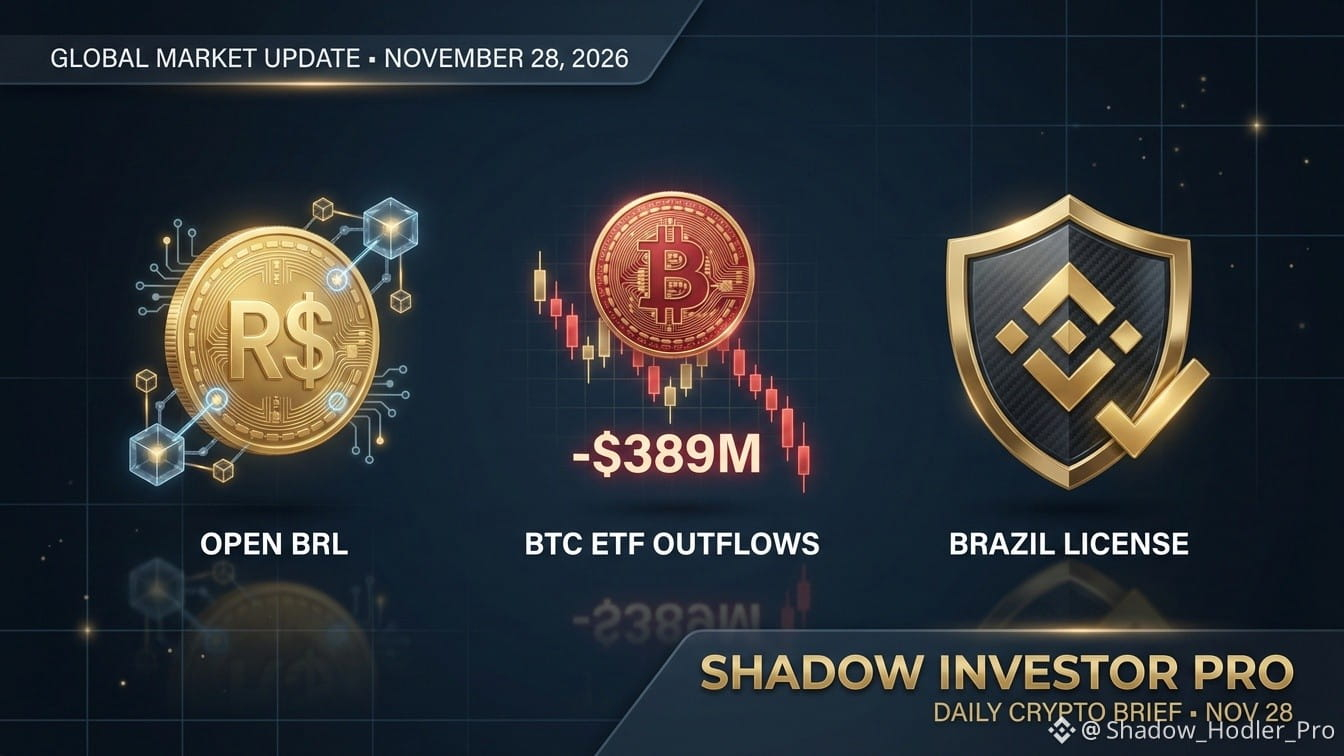
Top 3 news stories today - November 28, 2026
🏦 Brazil's stock exchange "B3" and six financial companies agreed to develop "Open BRL," a stablecoin pegged to the Brazilian real ...
📉 U.S. spot Bitcoin ETFs recorded net outflows of $389 million on November 27, marking the eighth consecutive day of outflows ...
🇧🇷 "Binance" announced that its Brazilian business unit had obtained a foreign exchange broker license from the country's central bank. ..
#news #Binance #crypto
1
171

·
--
📌 Summary of the main events for 27.11
🟡 Telegram: Pavel Durov announced that all gift trading on Telegram has moved on-chain.
📊 Yield Fields: Announced the start dates for farming through NFT farms.
⚡ DWF Labs: The CEO of one of the largest market makers in crypto hinted that many similar projects have already shut down or are shutting down.
🔍 Practically all top traders $UNI on Hyperliquid are holding short positions.
💰 The US Air Force's key cloud platform, Cloud One, was hacked. Classified information was put at risk.
🛡️ Elon Musk changed his mind and promised to give one share $SPCX to every child in the US each year.
🚶♀️ If you farmed Osero, its Discord is now open, and you can farm the OG role.
🧩 Variational awarded points for the trading week.
📌 Doma launched an additional event that will run until December 31.
#crypto #news

1
169

·
--

Article
28.11.261. Today's Latest Crypto Market News
Regional regulatory cooperation in Asia: China, Japan, South Korea, and ASEAN countries announced the formation of a task force to jointly address digital payments and crypto regulations. A Bank of Japan official also called for strict reserve requirements for stablecoins.
28.11.26
1. Today's Latest Crypto Market News
Regional regulatory cooperation in Asia: China, Japan, South Korea, and ASEAN countries announced the formation of a task force to jointly address digital payments and crypto regulations. A Bank of Japan official also called for strict reserve requirements for stablecoins.
Regional regulatory cooperation in Asia: China, Japan, South Korea, and ASEAN countries announced the formation of a task force to jointly address digital payments and crypto regulations. A Bank of Japan official also called for strict reserve requirements for stablecoins.
69

·
--
Bullish
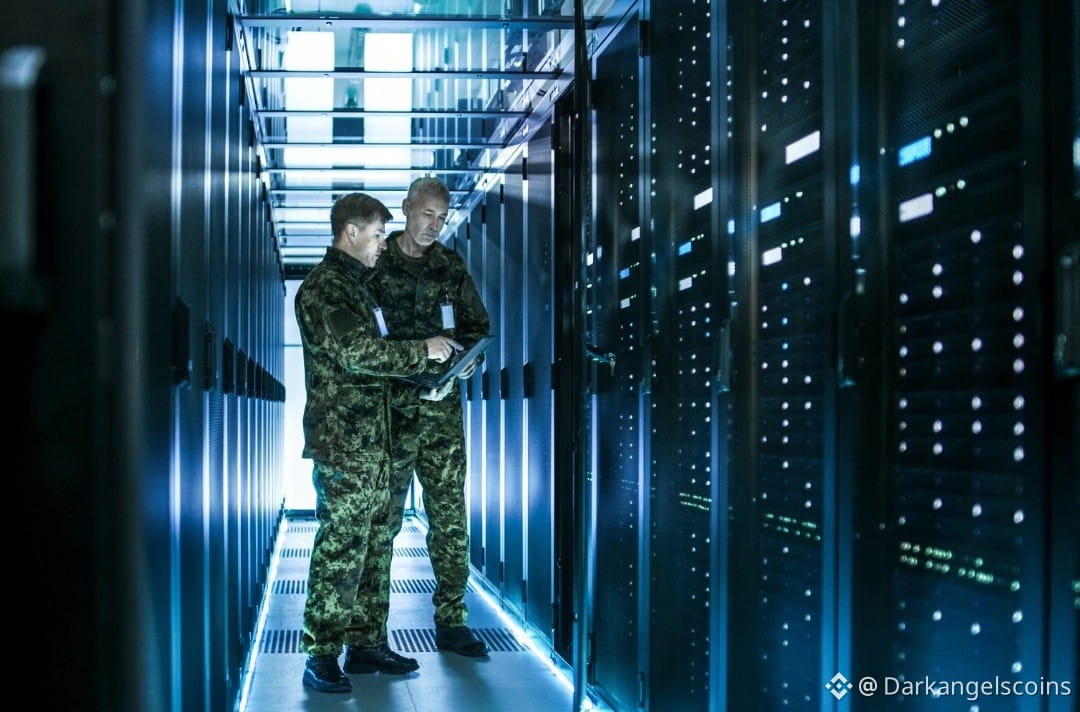
A group of hackers gained access to the control plane of Cloud One, the U.S. Air Force’s flagship cloud platform, by exploiting a software flaw. The incident, disclosed on November 27, 2026, mobilized U.S. Cyber Command and forced the suspension of system migrations, the revocation of administrative access, and a freeze on updates.
Cloud One centralizes key military applications, from air defense radar to munitions tracking and logistics. Although neither data theft nor the perpetrators have been confirmed, access to the control plane has reignited concerns about artificial intelligence-assisted cyberattacks and added to tensions following a series of recent intrusions targeting Washington’s federal agencies.
#news $BTC
1.1k
·
--
📌 Digest of the main events on 26.11
🟡 BNB Chain: The team published a litepaper for a new L1 blockchain.
📊 Switzerland: Approved the launch of the first spot $BTC ETF on the SIX Swiss Exchange.
⚡ Coinbase: Coinbase Wallet users can receive part or all of their salary in $USDC without fees on the Base network.
🔍 Binance Wallet: The gacha craze has reached here too—they launched the option to open packs of collectible cards from Renaiss Protocol.
💰 Pump.Fun: Introducing an additional fee for bundlers and snipers in the zero block of a token launch.
🛡️ Telegram: Pavel Durov sold the Telegram username liar for $1 million.
🚶♀️ Leopold Aschenbrenner: The fund of the young genius and philanthropist is on the verge of liquidation.
🧩 Standard Chartered's crypto division was hacked, and customer and employee data leaked online.
📌 1Password, a password manager, was hacked. The team says that secret keys and passwords are safe.
💡 Elon Musk doubled the number of shares children in the US will receive. One $SPCX will be allocated next month, the other when...
#crypto #news

1
178
Florida Man Jailed for Using AI to Pose as Streamer N3ON in $260K Crypto ScamFlorida Man Jailed for Using AI to Pose as Streamer N3ON in $260K Crypto Scam
David Anthony Sanchez, 36, who also went by "Dave the Jewler" and other aliases, was sentenced by U.S. District Judge Melissa Damian after pleading guilty to money laundering and aggravated identity theft, the U.S. Attorney's Office for the Southern District of Florida said on Tuesday. He was also ordered to pay restitution to his victims.
A Port St. Lucie man was sentenced to 47 months in federal prison for using artificial intelligence to impersonate a popular online streamer and deceive investors in a cryptocurrency fraud scheme that caused approximately $260,000 in losses. The case serves as a warning that… pic.twitter.com/4DZnaiaPNt
— US Attorney's Office Southern District of Florida (@USAO_SDFL) November 24, 2026
According to court records, Sanchez set up online accounts made to look as though they belonged to N3ON, and contacted the organizers of a crypto meme coin project while posing as both the streamer and his representative.
He signed agreements using N3ON's identity and sent the organizers an AI-generated voice recording that mimicked the streamer, falsely confirming that N3ON would endorse, promote and take part in the project, prosecutors said. Believing the deal was real, the organizers sent about $260,000 in crypto to accounts Sanchez controlled.
Sanchez then converted much of the crypto into U.S. dollars through transactions designed to hide where the money came from and who owned it, and spent it on himself, according to prosecutors. The press release did not name the meme coin project.
"The defendant exploited artificial intelligence to manipulate the trust of unsuspecting victims and deprive them of their money," Acting U.S. Attorney Yara Lorenzo Klukas said in a statement.
The case is a small example of a fast-growing type of crypto fraud. Impersonation scams grew more than 1,400% year on year in 2025, driven in part by AI tools, as crypto scam losses reached a record $17 billion, blockchain analytics firm Chainalysis estimated in January.
AI deepfakes of government officials, billionaires and celebrities accounted for 40% of high-value crypto frauds in 2024, according to a report from crypto exchange Bitget. Earlier this month, the Justice Department said North Korean hackers had stolen more than $400 million in crypto over 18 months through a scheme it calls "FaceStealer," which uses recorded webcam footage and deepfake videos to impersonate victims' trusted contacts on video calls. The same tactics have been used to target crypto workers.
AI-assisted money laundering, one of the charges Sanchez pleaded guilty to, would carry fines of up to $1 million or three times the value of the transaction, alongside up to 20 years in prison. The bill has not advanced beyond the House Judiciary Committee.
Start every day with the top news stories right now, plus original features, a podcast, videos and more.
---
Source: Decrypt · 25 Nov, 19:52 WITA
Read more: https://decrypt.co/383941/florida-man-jailed-for-using-ai-to-pose-as-streamer-n3on-in-260k-crypto-scam
Not financial advice. DYOR.
#Crypto #News #BinanceSquare
Florida Man Jailed for Using AI to Pose as Streamer N3ON in $260K Crypto Scam
Florida Man Jailed for Using AI to Pose as Streamer N3ON in $260K Crypto Scam
David Anthony Sanchez, 36, who also went by "Dave the Jewler" and other aliases, was sentenced by U.S. District Judge Melissa Damian after pleading guilty to money laundering and aggravated identity theft, the U.S. Attorney's Office for the Southern District of Florida said on Tuesday. He was also ordered to pay restitution to his victims.
A Port St. Lucie man was sentenced to 47 months in federal prison for using artificial intelligence to impersonate a popular online streamer and deceive investors in a cryptocurrency fraud scheme that caused approximately $260,000 in losses. The case serves as a warning that… pic.twitter.com/4DZnaiaPNt
— US Attorney's Office Southern District of Florida (@USAO_SDFL) November 24, 2026
According to court records, Sanchez set up online accounts made to look as though they belonged to N3ON, and contacted the organizers of a crypto meme coin project while posing as both the streamer and his representative.
He signed agreements using N3ON's identity and sent the organizers an AI-generated voice recording that mimicked the streamer, falsely confirming that N3ON would endorse, promote and take part in the project, prosecutors said. Believing the deal was real, the organizers sent about $260,000 in crypto to accounts Sanchez controlled.
Sanchez then converted much of the crypto into U.S. dollars through transactions designed to hide where the money came from and who owned it, and spent it on himself, according to prosecutors. The press release did not name the meme coin project.
"The defendant exploited artificial intelligence to manipulate the trust of unsuspecting victims and deprive them of their money," Acting U.S. Attorney Yara Lorenzo Klukas said in a statement.
The case is a small example of a fast-growing type of crypto fraud. Impersonation scams grew more than 1,400% year on year in 2025, driven in part by AI tools, as crypto scam losses reached a record $17 billion, blockchain analytics firm Chainalysis estimated in January.
AI deepfakes of government officials, billionaires and celebrities accounted for 40% of high-value crypto frauds in 2024, according to a report from crypto exchange Bitget. Earlier this month, the Justice Department said North Korean hackers had stolen more than $400 million in crypto over 18 months through a scheme it calls "FaceStealer," which uses recorded webcam footage and deepfake videos to impersonate victims' trusted contacts on video calls. The same tactics have been used to target crypto workers.
AI-assisted money laundering, one of the charges Sanchez pleaded guilty to, would carry fines of up to $1 million or three times the value of the transaction, alongside up to 20 years in prison. The bill has not advanced beyond the House Judiciary Committee.
Start every day with the top news stories right now, plus original features, a podcast, videos and more.
---
Source: Decrypt · 25 Nov, 19:52 WITA
Read more: https://decrypt.co/383941/florida-man-jailed-for-using-ai-to-pose-as-streamer-n3on-in-260k-crypto-scam
Not financial advice. DYOR.
#Crypto #News #BinanceSquare
·
--
📌 Digest of the main events for 25.11
🟡 US core inflation: The figure came in higher than forecast, rising to 3.3%.
📊 BlackRock: The financial giant opened its first tokenized fund in Hong Kong.
⚡ UniCredit: The Italian bank launched an investment product based on $BTC with 100% capital protection.
🔍 CPI (crypto): The Coinbase Premium Index shows that US investors have been actively selling $BTC for 63 consecutive days.
💰 Rialto finally raised its first $5 million funding round from Robinhood and Offchain.
🛡️ Update your Google Chrome urgently—a critical vulnerability has emerged that could be used to steal crypto from...
🚶♀️ Abraxas Capital's fund closed all its positions and left the Hyperliquid platform, taking $530 million in net profit.
🧩 The wallet of Tonnel's founder was hacked, with losses amounting to $150,000.
📌 Melee added a 2x points boost for certain events on its marketplace.
💡 Sign up for a new AI project with a fresh $20 million funding round, focused on analyzing and implementing investment ideas.
#crypto #news

118

·
--
Article
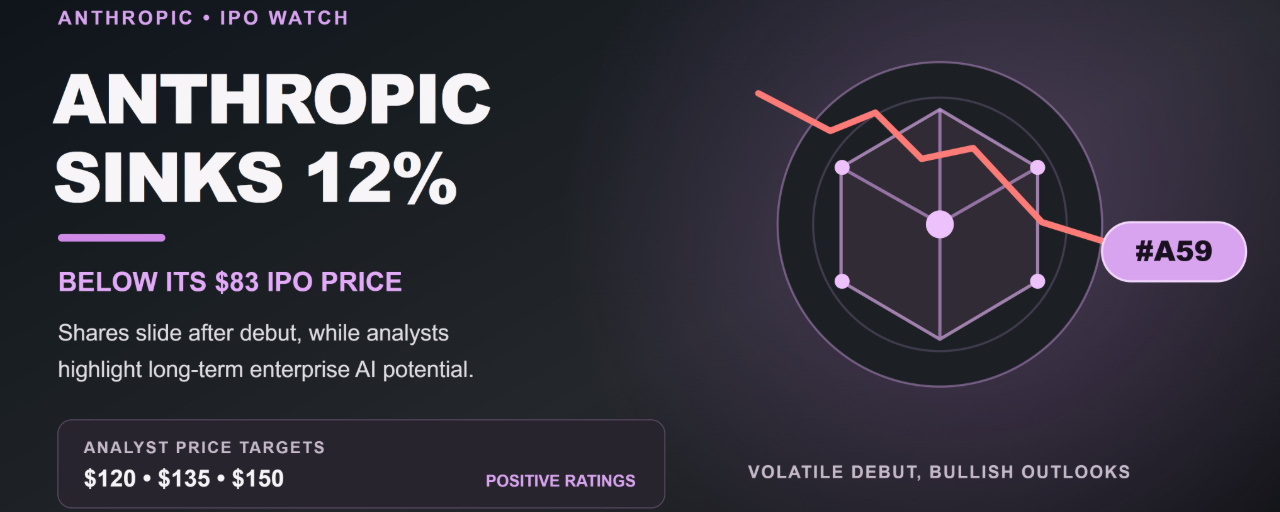
Anthropic sinks 12%, falling below $83 IPO price, but analysts are still largely positivesourch : CNBC Ashley Capoot Published Tue, Nov 24 20269:33 AM EST
Shares of Anthropic $ANTB
{spot}(ANTBUSDT)
fell 12% on Tuesday, sending the stock below the artificial intelligence company’s $83 IPO price.
The AI lab’s stock has been sinking steadily since opening at $111.50 on the Nasdaq on Thursday, after Anthropic raised $81.3 billion in the largest offering of all time. Investors eagerly awaited Anthropic’s debut in hopes that the company would revitalize the broader AI trade, which has been volatile in recent weeks over concerns about the feasibility of a multitrillion-dollar infrastructure buildout.
Anthropic’s initial public offering was oversubscribed, and roughly half of the institutional investors that placed orders for the stock were left empty-handed, as CNBC previously reported. But at least for now, as the market wavers, those firms don’t appear to be racing to scoop up shares.
Chip stocks Nvidia $NVDAB
{spot}(NVDABUSDT)
, Advanced Micro Devices $AMDB and Intel , as well as neoclouds CoreWeave, IREN and Nebius, all fell during intraday trading on Tuesday. The market is still reeling after Nvidia reinstated Jensen Huang as CEO, a dramatic reversal from his ouster earlier this month. Nvidia shares surged more than 30% on Monday, but pared those gains Tuesday.
Analysts at Canaccord Genuity said Tuesday that they’re focused on Anthropic’s long-term potential. They said they believe that the company is building “one of the most important enterprise technology franchises of the AI era” and that the “opportunity is considerably larger than traditional software spending.”
Canaccord Genuity initiated coverage of Anthropic with a buy rating and a $135 price target.
“The risks are unusually large, particularly around infrastructure commitments and the durability of competitive differentiation, but we believe the combination of exceptional growth, emerging earnings capacity, and an attractive entry valuation support a compelling investment opportunity,” the analysts wrote in a Tuesday note.
Wedbush analysts initiated coverage of Anthropic with an outperform rating and a $120 price target on Monday. They said Anthropic went public in a “tumultuous market” as debate around the AI buildout continues, but that they expect the company to navigate the competitive environment and “capture a uniquely large addressable market.”
“While there’s going to continue to be many ups and downs, and winners and losers as this ecosystem gets built, in our view there is no real question that it does get built over time,” the analysts wrote in a Monday note. “The genie is out of the bottle. And ANT is a strong play on that theme.”
Analysts at Oppenheimer initiated coverage of Anthropic with an outperform rating on Tuesday, and they set a $150 price target for the stock.
They said their “bullish stance” on the company stems from their belief that Anthropic will capture growing enterprise AI spending, that its improving compute efficiency lowers cost per task and that its multi-chip strategy optimizes price performance. The analysts added that Anthropic’s focus on the enterprise also relies less on consumer subsidies, and that rising customer adoption creates “a substantial runway” for the company.
“While competition and compute commitments remain risks, we believe Anthropic can translate its leadership into durable growth and operating leverage,” the analysts wrote in a Tuesday note.
#A59 #AnthropicBreaksBelowIPOPriceAmidAISlump #news
Anthropic sinks 12%, falling below $83 IPO price, but analysts are still largely positive
sourch : CNBC Ashley Capoot Published Tue, Nov 24 20269:33 AM EST
Shares of Anthropic $ANTB
fell 12% on Tuesday, sending the stock below the artificial intelligence company’s $83 IPO price.
The AI lab’s stock has been sinking steadily since opening at $111.50 on the Nasdaq on Thursday, after Anthropic raised $81.3 billion in the largest offering of all time. Investors eagerly awaited Anthropic’s debut in hopes that the company would revitalize the broader AI trade, which has been volatile in recent weeks over concerns about the feasibility of a multitrillion-dollar infrastructure buildout.
Anthropic’s initial public offering was oversubscribed, and roughly half of the institutional investors that placed orders for the stock were left empty-handed, as CNBC previously reported. But at least for now, as the market wavers, those firms don’t appear to be racing to scoop up shares.
Chip stocks Nvidia $NVDAB
, Advanced Micro Devices $AMDB and Intel , as well as neoclouds CoreWeave, IREN and Nebius, all fell during intraday trading on Tuesday. The market is still reeling after Nvidia reinstated Jensen Huang as CEO, a dramatic reversal from his ouster earlier this month. Nvidia shares surged more than 30% on Monday, but pared those gains Tuesday.
Analysts at Canaccord Genuity said Tuesday that they’re focused on Anthropic’s long-term potential. They said they believe that the company is building “one of the most important enterprise technology franchises of the AI era” and that the “opportunity is considerably larger than traditional software spending.”
Canaccord Genuity initiated coverage of Anthropic with a buy rating and a $135 price target.
“The risks are unusually large, particularly around infrastructure commitments and the durability of competitive differentiation, but we believe the combination of exceptional growth, emerging earnings capacity, and an attractive entry valuation support a compelling investment opportunity,” the analysts wrote in a Tuesday note.
Wedbush analysts initiated coverage of Anthropic with an outperform rating and a $120 price target on Monday. They said Anthropic went public in a “tumultuous market” as debate around the AI buildout continues, but that they expect the company to navigate the competitive environment and “capture a uniquely large addressable market.”
“While there’s going to continue to be many ups and downs, and winners and losers as this ecosystem gets built, in our view there is no real question that it does get built over time,” the analysts wrote in a Monday note. “The genie is out of the bottle. And ANT is a strong play on that theme.”
Analysts at Oppenheimer initiated coverage of Anthropic with an outperform rating on Tuesday, and they set a $150 price target for the stock.
They said their “bullish stance” on the company stems from their belief that Anthropic will capture growing enterprise AI spending, that its improving compute efficiency lowers cost per task and that its multi-chip strategy optimizes price performance. The analysts added that Anthropic’s focus on the enterprise also relies less on consumer subsidies, and that rising customer adoption creates “a substantial runway” for the company.
“While competition and compute commitments remain risks, we believe Anthropic can translate its leadership into durable growth and operating leverage,” the analysts wrote in a Tuesday note.
#A59 #AnthropicBreaksBelowIPOPriceAmidAISlump #news
205
·
--

Article
“Could an AI Bubble Collapse Undermine Trump?” Democratic Regulatory Pressure Heightens Uncertai....“Could an AI Bubble Collapse Undermine Trump?” Democratic Regulatory Pressure Heightens Uncertainty Over Big Tech’s AI Investment, Raising Fears of Cascading Financial and Political Crises
sourch ; The Economy by Oliver Griffin
Authored On
Nov 24, 2026 02:44
Modified
Nov 24, 2026 03:25
Elon Musk, CEO of SpaceX $SPCXB and Tesla $TSLAB , has warned that the artificial intelligence (AI) industry could face a massive liquidity shortfall. With the Democrats gaining the upper hand in the U.S. midterm elections and increasing the likelihood of tighter data center regulations, AI companies that have committed to enormous capital expenditures are expected to face even greater funding pressures. Against this backdrop, market observers suggest that an AI bubble collapse could send shock waves across financial markets, including bonds, private credit and equities, and raise questions about the policy responsibility of Donald Trump’s administration, which has pursued a pro-AI agenda.
Musk Warns of Cash Shortages at AI Companies
According to Business Insider on the 22nd (local time), Musk said on X (formerly Twitter) that day, “The cash shortfall (at AI companies) next year will be enormous,” adding, “If delays of several months accumulate between paying for compute and getting it running reliably enough to generate revenue, hundreds of billions of USD in additional funding will be needed.” Major technology companies have recently been rapidly expanding capital expenditures, committing vast sums to AI data centers and advanced semiconductors. Combined capital spending this year by four companies—Amazon, Alphabet, Meta and Microsoft ($MSFTB )—is estimated to exceed USD 700 billion, while SpaceX has also announced plans to invest USD 24 billion in building a data center in Texas.
The problem is that public sentiment toward data center projects in the United States is deteriorating rapidly. Opposition from local residents, in particular, has been growing noticeably stronger. Concerns have intensified that data centers’ enormous electricity demand could drive up household electricity bills and strain local power grids. Water depletion caused by cooling facilities, along with noise and air pollution from cooling equipment and emergency generators, has also emerged as a major source of conflict. Some residents argue that data centers impose excessive environmental and economic burdens relative to the jobs and economic benefits they provide to communities, and have launched campaigns opposing construction and lawsuits seeking to revoke permits. A growing number of local governments have also temporarily halted new data center construction or tightened site-selection and environmental review requirements.
Republicans Blame Pro-AI Policies for Election Defeat
Conflicts over data centers have also emerged as a major issue in U.S. politics. With Democrats gaining the upper hand by taking control of both the Senate and the House in the U.S. midterm elections held on the 3rd, voices within President Trump’s core MAGA (Make America Great Again) support base are criticizing the administration’s overly favorable policies toward the AI industry and Big Tech. Kevin Roberts, president of the conservative Heritage Foundation think tank, identified voters’ distrust of the AI industry as a primary reason for the Republicans’ midterm defeat. He said it had been a political mistake not to listen sufficiently to residents concerned about the industry’s growing influence. In his assessment, Democrats won voters’ support by taking the advantageous position on the data center issue first.
Republican U.S. Representative Chip Roy of Texas also cited the party leadership’s stance toward the AI industry as a reason for the defeat at a Heritage Foundation event. “Voters’ grievances are not limited to data centers’ electricity and water use,” Roy said. “The prospect of AI replacing jobs and technology executives’ unilateral approach to development have fueled residents’ resentment.” Texas, where Roy’s district is located, was among the states where the rapid expansion of AI data centers emerged as a major election issue. Democratic candidate Gina Hinojosa was elected governor.
Democrats Signal Tighter Data Center Regulations
Having secured majorities in both the Senate and the House, Democrats are moving in earnest to tighten regulations on AI data centers. According to a Reuters report on the 6th, Democratic lawmakers plan to introduce a series of bills expanding data center operators’ responsibilities after the new Congress convenes next January. The central aim is to prevent the cost of expanding power grids for large-scale data center construction from being passed on to households and small and medium-sized businesses through their electricity bills. To that end, they intend to require large data center operators to directly cover the costs of new power generation and transmission facilities and grid upgrades, while also expanding disclosure of electricity consumption and related costs.
This push for tighter regulation was also clearly reflected in Democratic candidates’ campaign pledges. For example, Wisconsin Governor-elect David Crowley supported a temporary halt to new data center permits and the elimination of sales tax exemptions for operators. Texas Governor-elect Hinojosa also said she would deny permits for data centers that had not secured sufficient resident consent and community benefits. Ohio Governor-elect Amy Acton likewise pledged to block data center projects that fail to meet certain environmental and business standards, while Georgia Governor-elect Keisha Lance Bottoms proposed a statewide pause on new data center construction.
Table 1. Democratic Governors-Elect’s Data Center Regulation Pledges
WISCONSIN — David Crowley
Temporarily halt new permits and eliminate sales tax exemptions.
TEXAS — Gina Hinojosa
Suspend all permits until protective legislation is in place.
OHIO — Amy Acton
Restrict projects that fail to meet cost, environmental, and community benefit standards.
GEORGIA — Keisha Lance Bottoms
Halt new construction while economic and community impacts are assessed.
Source: Compiled from foreign media reports
Red Flags for AI Companies’ Financial Health
Market participants are concerned that the trend toward tighter data center regulation could place considerable pressure on AI companies’ financial health. If data center construction is delayed or halted, companies may struggle to recover money already spent on land purchases, design and equipment, while revenue from operating the facilities would also be pushed back. Companies that have financed their projects through substantial borrowing, in particular, must continue to pay interest and financing fees during construction delays. Prolonged setbacks could also make it difficult to refinance existing loans or secure additional funding.
The AI infrastructure industry’s heavy reliance on external financing further compounds these risks. Major technology companies and data center developers have recently been increasing their funding through corporate bond issuance, private credit loans and project financing through special-purpose vehicles (SPVs). According to the Financial Stability Report released by the U.S. Federal Reserve (Fed) on the 13th, debt issuance related to advanced computing infrastructure, including bonds and loans, exceeded USD 680 billion from January through October this year. That is roughly 5 times the USD 130 billion issued during all of 2023. As of last month, outstanding related public-market debt also exceeded USD 1.1 trillion.
Financial and Political Risks From the AI Bubble
If the AI bubble collapses, the shock is expected to spread across global financial markets. In its Financial Stability Review released this month, the European Central Bank (ECB) warned that the rapid expansion of debt financing in the AI industry was reminiscent of the dot-com bubble and the subprime mortgage crisis. It explained that a sharp decline in the value of AI-related assets could trigger a chain reaction of investment fund redemptions and forced asset sales, with losses spreading to banks, private credit and bond markets and potentially damaging the real economy. Moreover, with AI investment now a major growth driver for U.S. equities and businesses, a sharp contraction in the industry could directly undermine confidence in the broader U.S. economy.
Political observers also suggest that a crisis in the AI industry could weaken the Trump administration’s position. If an AI industry downturn leads to large financial losses and an economic slowdown, distrust of the economic management capabilities of the administration, which has pursued pro-business and pro-AI policies, would likely grow, intensifying criticism within the Republican Party and deepening Trump’s lame-duck status (the erosion of power toward the end of a term). The responses of major technology executives such as Elon Musk, whose political and economic interests are intertwined with President Trump’s, are also expected to emerge as a variable in this process. If they characterize the AI industry’s contraction as the result of tighter political regulation rather than individual companies’ strategic failures and demand a policy response, the debate surrounding the industry could turn into a blame game between businesses and politicians.
#A59 #news #AI
“Could an AI Bubble Collapse Undermine Trump?” Democratic Regulatory Pressure Heightens Uncertai....
“Could an AI Bubble Collapse Undermine Trump?” Democratic Regulatory Pressure Heightens Uncertainty Over Big Tech’s AI Investment, Raising Fears of Cascading Financial and Political Crises
sourch ; The Economy by Oliver Griffin
Authored On
Nov 24, 2026 02:44
Modified
Nov 24, 2026 03:25
Elon Musk, CEO of SpaceX $SPCXB and Tesla $TSLAB , has warned that the artificial intelligence (AI) industry could face a massive liquidity shortfall. With the Democrats gaining the upper hand in the U.S. midterm elections and increasing the likelihood of tighter data center regulations, AI companies that have committed to enormous capital expenditures are expected to face even greater funding pressures. Against this backdrop, market observers suggest that an AI bubble collapse could send shock waves across financial markets, including bonds, private credit and equities, and raise questions about the policy responsibility of Donald Trump’s administration, which has pursued a pro-AI agenda.
Musk Warns of Cash Shortages at AI Companies
According to Business Insider on the 22nd (local time), Musk said on X (formerly Twitter) that day, “The cash shortfall (at AI companies) next year will be enormous,” adding, “If delays of several months accumulate between paying for compute and getting it running reliably enough to generate revenue, hundreds of billions of USD in additional funding will be needed.” Major technology companies have recently been rapidly expanding capital expenditures, committing vast sums to AI data centers and advanced semiconductors. Combined capital spending this year by four companies—Amazon, Alphabet, Meta and Microsoft ($MSFTB )—is estimated to exceed USD 700 billion, while SpaceX has also announced plans to invest USD 24 billion in building a data center in Texas.
The problem is that public sentiment toward data center projects in the United States is deteriorating rapidly. Opposition from local residents, in particular, has been growing noticeably stronger. Concerns have intensified that data centers’ enormous electricity demand could drive up household electricity bills and strain local power grids. Water depletion caused by cooling facilities, along with noise and air pollution from cooling equipment and emergency generators, has also emerged as a major source of conflict. Some residents argue that data centers impose excessive environmental and economic burdens relative to the jobs and economic benefits they provide to communities, and have launched campaigns opposing construction and lawsuits seeking to revoke permits. A growing number of local governments have also temporarily halted new data center construction or tightened site-selection and environmental review requirements.
Republicans Blame Pro-AI Policies for Election Defeat
Conflicts over data centers have also emerged as a major issue in U.S. politics. With Democrats gaining the upper hand by taking control of both the Senate and the House in the U.S. midterm elections held on the 3rd, voices within President Trump’s core MAGA (Make America Great Again) support base are criticizing the administration’s overly favorable policies toward the AI industry and Big Tech. Kevin Roberts, president of the conservative Heritage Foundation think tank, identified voters’ distrust of the AI industry as a primary reason for the Republicans’ midterm defeat. He said it had been a political mistake not to listen sufficiently to residents concerned about the industry’s growing influence. In his assessment, Democrats won voters’ support by taking the advantageous position on the data center issue first.
Republican U.S. Representative Chip Roy of Texas also cited the party leadership’s stance toward the AI industry as a reason for the defeat at a Heritage Foundation event. “Voters’ grievances are not limited to data centers’ electricity and water use,” Roy said. “The prospect of AI replacing jobs and technology executives’ unilateral approach to development have fueled residents’ resentment.” Texas, where Roy’s district is located, was among the states where the rapid expansion of AI data centers emerged as a major election issue. Democratic candidate Gina Hinojosa was elected governor.
Democrats Signal Tighter Data Center Regulations
Having secured majorities in both the Senate and the House, Democrats are moving in earnest to tighten regulations on AI data centers. According to a Reuters report on the 6th, Democratic lawmakers plan to introduce a series of bills expanding data center operators’ responsibilities after the new Congress convenes next January. The central aim is to prevent the cost of expanding power grids for large-scale data center construction from being passed on to households and small and medium-sized businesses through their electricity bills. To that end, they intend to require large data center operators to directly cover the costs of new power generation and transmission facilities and grid upgrades, while also expanding disclosure of electricity consumption and related costs.
This push for tighter regulation was also clearly reflected in Democratic candidates’ campaign pledges. For example, Wisconsin Governor-elect David Crowley supported a temporary halt to new data center permits and the elimination of sales tax exemptions for operators. Texas Governor-elect Hinojosa also said she would deny permits for data centers that had not secured sufficient resident consent and community benefits. Ohio Governor-elect Amy Acton likewise pledged to block data center projects that fail to meet certain environmental and business standards, while Georgia Governor-elect Keisha Lance Bottoms proposed a statewide pause on new data center construction.
Table 1. Democratic Governors-Elect’s Data Center Regulation Pledges
WISCONSIN — David Crowley
Temporarily halt new permits and eliminate sales tax exemptions.
TEXAS — Gina Hinojosa
Suspend all permits until protective legislation is in place.
OHIO — Amy Acton
Restrict projects that fail to meet cost, environmental, and community benefit standards.
GEORGIA — Keisha Lance Bottoms
Halt new construction while economic and community impacts are assessed.
Source: Compiled from foreign media reports
Red Flags for AI Companies’ Financial Health
Market participants are concerned that the trend toward tighter data center regulation could place considerable pressure on AI companies’ financial health. If data center construction is delayed or halted, companies may struggle to recover money already spent on land purchases, design and equipment, while revenue from operating the facilities would also be pushed back. Companies that have financed their projects through substantial borrowing, in particular, must continue to pay interest and financing fees during construction delays. Prolonged setbacks could also make it difficult to refinance existing loans or secure additional funding.
The AI infrastructure industry’s heavy reliance on external financing further compounds these risks. Major technology companies and data center developers have recently been increasing their funding through corporate bond issuance, private credit loans and project financing through special-purpose vehicles (SPVs). According to the Financial Stability Report released by the U.S. Federal Reserve (Fed) on the 13th, debt issuance related to advanced computing infrastructure, including bonds and loans, exceeded USD 680 billion from January through October this year. That is roughly 5 times the USD 130 billion issued during all of 2023. As of last month, outstanding related public-market debt also exceeded USD 1.1 trillion.
Financial and Political Risks From the AI Bubble
If the AI bubble collapses, the shock is expected to spread across global financial markets. In its Financial Stability Review released this month, the European Central Bank (ECB) warned that the rapid expansion of debt financing in the AI industry was reminiscent of the dot-com bubble and the subprime mortgage crisis. It explained that a sharp decline in the value of AI-related assets could trigger a chain reaction of investment fund redemptions and forced asset sales, with losses spreading to banks, private credit and bond markets and potentially damaging the real economy. Moreover, with AI investment now a major growth driver for U.S. equities and businesses, a sharp contraction in the industry could directly undermine confidence in the broader U.S. economy.
Political observers also suggest that a crisis in the AI industry could weaken the Trump administration’s position. If an AI industry downturn leads to large financial losses and an economic slowdown, distrust of the economic management capabilities of the administration, which has pursued pro-business and pro-AI policies, would likely grow, intensifying criticism within the Republican Party and deepening Trump’s lame-duck status (the erosion of power toward the end of a term). The responses of major technology executives such as Elon Musk, whose political and economic interests are intertwined with President Trump’s, are also expected to emerge as a variable in this process. If they characterize the AI industry’s contraction as the result of tighter political regulation rather than individual companies’ strategic failures and demand a policy response, the debate surrounding the industry could turn into a blame game between businesses and politicians.
#A59 #news #AI
382

·
--
Verified
Today there are three things to watch: Bitcoin remains under pressure, the U.S. inflation data is out, and Dell reported its results.
October’s PCE inflation came in at 3.8% year over year; excluding food and energy, it was 3.3%.
In simple terms: consumer prices are still higher than they were a year ago.
This data helps explain the debate over interest rates, but it doesn’t let us predict Bitcoin’s next move.
On the AI front, Dell reported US$22 billion in AI server revenue for its fiscal quarter. That shows actual sales; it doesn’t guarantee the stock will rise.
$BTC #news

5.5k
Trump Says He 'Made the Deal' to Reinstate Jensen Huang, Sparking Bipartisan BacklashTrump Says He 'Made the Deal' to Reinstate Jensen Huang, Sparking Bipartisan Backlash
"I convinced them," Trump told CNBC in a phone interview on Monday, shortly after Nvidia reinstated Huang as president and CEO. "I made the deal."
Trump said the board had asked for assurances that Huang was not a national security threat, and that the administration provided them based on "everything we know." He said a government investigation had found that Huang himself was exonerated. Asked whether last week's stock losses had shaped his view, Trump said "probably so."
The board's decision was sealed by a personal promise from Trump on Sunday, CNBC reported, citing three people familiar with its thinking. Senior administration officials had contacted directors overnight on Friday, and Huang then joined meetings with the board over the weekend, the outlet said. The board's statement cited input from "senior levels of the United States government" without naming anyone.
Attorney General Todd Blanche told Trump and Vice President JD Vance on Saturday that Huang was not the target or subject of any Justice Department investigation, and that there was no evidence he had broken laws, The Wall Street Journal reported, citing U.S. officials.
During a marathon board session on Sunday, Huang disclosed additional affairs beyond the two that had been widely reported, but was contrite, the newspaper said, citing people familiar with the discussion.
Trump told The New York Times that he had consulted Blanche and Director of National Intelligence Jay Clayton before recommending Huang's return. "I had to go to them before I recommended this," he said. A day earlier, Clayton had said that the U.S. investigation into Alice Huang and her former company, Megaspeed, was ongoing.
The reversal came six days after board chair Harvey Jones said directors did not intend to bring Huang back. Trump later posted an AI-generated image on Truth Social showing Huang holding a red bra aloft in his raised fist, in a pose modeled on the photo of Trump after the 2024 assassination attempt on his life.
Huang's reinstatement drew the ire of lawmakers on both sides of the aisle.
"The reckless decision to bring Jensen Huang back as CEO does not change the fact that Mr. Huang, NVIDIA executives, and the company's board still owe Congress answers," Sen. Elizabeth Warren (D-MA), ranking member of the Senate Banking Committee, said in a statement . She called on the administration to explain what input was given, and by which officials.
Republicans also pushed back. Sen. Tom Cotton (R-AR), chair of the Senate Intelligence Committee, tweeted that the controversy over Nvidia and Megaspeed was "not resolved because Jensen Huang has his job back," and pledged to pass chip export-control bills including his Chip Security Act.
I have warned the administration from the start about Communist China obtaining our most advanced chips through both smuggling and remote access. The controversy with Nvidia and Megaspeed is just the tip of the iceberg, and it’s not resolved because Jensen Huang has his job back.…
"No national security risk? Based on what?" Sen. John Cornyn (R-TX) tweeted , quoting the board's statement. Sen. John Curtis (R-UT) asked who in government had weighed in and what they told the board, noting that it had ruled out Huang's return only a week earlier. "I'd like to know what changed," he wrote.
Sen. Pete Ricketts (R-NE) tweeted that Huang's behavior "does not support reinstatement," adding that Nvidia still had to answer for national security concerns and "unaccounted-for chips."
Rep. Hakeem Jeffries (D-NY), who is expected to become House Speaker in January, called the board's decision "indefensible, irresponsible and incomprehensible" in a statement . He promised an investigation into Nvidia and into what he called "corrupt abuse of power" by Commerce Secretary Howard Lutnick and his department.
Trump's own Nvidia holdings may have gained as much as $15 million in value on Monday, according to the Financial Times , which calculated that he could have held up to 370,000 shares as of September 30, based on his latest ethics disclosure. At the low end of the disclosure's ranges, he would have held about 32,000 shares and gained $1.3 million. The White House did not respond to the newspaper's request for comment.
Sen. Ruben Gallego (D-AZ) tweeted that the president was "selling out our national security to keep the stock market high," calling for an investigation into stock trades made before the announcement.
Huang is due to sit for a closed-door interview with three House committees on December 1, and to testify before the Senate Banking Committee on December 3. On Monday, the Commerce Department also added Megaspeed to its Entity List trade blacklist.
Start every day with the top news stories right now, plus original features, a podcast, videos and more.
---
Source: Decrypt · 24 Nov, 19:35 WITA
Read more: https://decrypt.co/383853/trump-says-he-made-the-deal-to-reinstate-jensen-huang-sparking-bipartisan-backlash
Not financial advice. DYOR.
#Crypto #News #BinanceSquare
Trump Says He 'Made the Deal' to Reinstate Jensen Huang, Sparking Bipartisan Backlash
Trump Says He 'Made the Deal' to Reinstate Jensen Huang, Sparking Bipartisan Backlash
"I convinced them," Trump told CNBC in a phone interview on Monday, shortly after Nvidia reinstated Huang as president and CEO. "I made the deal."
Trump said the board had asked for assurances that Huang was not a national security threat, and that the administration provided them based on "everything we know." He said a government investigation had found that Huang himself was exonerated. Asked whether last week's stock losses had shaped his view, Trump said "probably so."
The board's decision was sealed by a personal promise from Trump on Sunday, CNBC reported, citing three people familiar with its thinking. Senior administration officials had contacted directors overnight on Friday, and Huang then joined meetings with the board over the weekend, the outlet said. The board's statement cited input from "senior levels of the United States government" without naming anyone.
Attorney General Todd Blanche told Trump and Vice President JD Vance on Saturday that Huang was not the target or subject of any Justice Department investigation, and that there was no evidence he had broken laws, The Wall Street Journal reported, citing U.S. officials.
During a marathon board session on Sunday, Huang disclosed additional affairs beyond the two that had been widely reported, but was contrite, the newspaper said, citing people familiar with the discussion.
Trump told The New York Times that he had consulted Blanche and Director of National Intelligence Jay Clayton before recommending Huang's return. "I had to go to them before I recommended this," he said. A day earlier, Clayton had said that the U.S. investigation into Alice Huang and her former company, Megaspeed, was ongoing.
The reversal came six days after board chair Harvey Jones said directors did not intend to bring Huang back. Trump later posted an AI-generated image on Truth Social showing Huang holding a red bra aloft in his raised fist, in a pose modeled on the photo of Trump after the 2024 assassination attempt on his life.
Huang's reinstatement drew the ire of lawmakers on both sides of the aisle.
"The reckless decision to bring Jensen Huang back as CEO does not change the fact that Mr. Huang, NVIDIA executives, and the company's board still owe Congress answers," Sen. Elizabeth Warren (D-MA), ranking member of the Senate Banking Committee, said in a statement . She called on the administration to explain what input was given, and by which officials.
Republicans also pushed back. Sen. Tom Cotton (R-AR), chair of the Senate Intelligence Committee, tweeted that the controversy over Nvidia and Megaspeed was "not resolved because Jensen Huang has his job back," and pledged to pass chip export-control bills including his Chip Security Act.
I have warned the administration from the start about Communist China obtaining our most advanced chips through both smuggling and remote access. The controversy with Nvidia and Megaspeed is just the tip of the iceberg, and it’s not resolved because Jensen Huang has his job back.…
"No national security risk? Based on what?" Sen. John Cornyn (R-TX) tweeted , quoting the board's statement. Sen. John Curtis (R-UT) asked who in government had weighed in and what they told the board, noting that it had ruled out Huang's return only a week earlier. "I'd like to know what changed," he wrote.
Sen. Pete Ricketts (R-NE) tweeted that Huang's behavior "does not support reinstatement," adding that Nvidia still had to answer for national security concerns and "unaccounted-for chips."
Rep. Hakeem Jeffries (D-NY), who is expected to become House Speaker in January, called the board's decision "indefensible, irresponsible and incomprehensible" in a statement . He promised an investigation into Nvidia and into what he called "corrupt abuse of power" by Commerce Secretary Howard Lutnick and his department.
Trump's own Nvidia holdings may have gained as much as $15 million in value on Monday, according to the Financial Times , which calculated that he could have held up to 370,000 shares as of September 30, based on his latest ethics disclosure. At the low end of the disclosure's ranges, he would have held about 32,000 shares and gained $1.3 million. The White House did not respond to the newspaper's request for comment.
Sen. Ruben Gallego (D-AZ) tweeted that the president was "selling out our national security to keep the stock market high," calling for an investigation into stock trades made before the announcement.
Huang is due to sit for a closed-door interview with three House committees on December 1, and to testify before the Senate Banking Committee on December 3. On Monday, the Commerce Department also added Megaspeed to its Entity List trade blacklist.
Start every day with the top news stories right now, plus original features, a podcast, videos and more.
---
Source: Decrypt · 24 Nov, 19:35 WITA
Read more: https://decrypt.co/383853/trump-says-he-made-the-deal-to-reinstate-jensen-huang-sparking-bipartisan-backlash
Not financial advice. DYOR.
#Crypto #News #BinanceSquare
·
--

Article
CRYPTO news1. Nvidia Reinstates Jensen Huang as CEO After 11-Day Absence—Sparking a 30%+ Surge
The Reversal: Just 11 days after stepping down on November 12 amid a personal scandal involving alleged export-control and espionage probes, Nvidia’s board unanimously reinstated co-founder Jensen Huang as President, CEO, and Board Director today (November 23).
Behind the Scenes: The board noted it received input from senior U.S. government officials confirming Huang’s return poses "no national security risk," while President Donald Trump claimed credit for brokering the reversal. To appease regulators, Nvidia established a new National Security and Export Control Oversight Committee and is hiring a Chief Compliance Officer as SEC and DOJ inquiries continue.
Market & Crypto Impact: Nvidia shares rocketed over 30%–33% at Monday's open, erasing over half of last week's broader stock market plunge. Because Bitcoin and AI-linked tokens have been trading in tight lockstep with Nasdaq tech sentiment, removing the leadership vacuum at the heart of the AI trade delivered immediate relief across risk assets—helping BTC bounce back above $62,700 (+3%) from last week's sub-$59K lows.
2. Cross River Bank Enters Bitcoin-Backed Lending With Loans Up to $250,000
The Product: Regulated U.S. banking powerhouse Cross River Bank—in partnership with consumer lender LendingUSA—launched its first direct Bitcoin-backed loan program as an originator today, offering eligible U.S. borrowers loans from $10,000 to $250,000.
How It Works:
LTV & Structure: Borrowers can select a starting Loan-to-Value (LTV) ratio of 30%, 50%, or 70% on a one-year term with interest rates ranging from 8.99% to 15.24% (plus a 1% origination fee and zero prepayment penalties). At 30% or 50% LTV, borrowers can defer monthly payments entirely until maturity; at 70% LTV, monthly interest-only payments are required.
Custody & Liquidation Risk: Pledged BTC is held by qualified third-party custodian BitGo (outside FDIC insurance). If Bitcoin's price drops sharply, borrowers face margin calls or forced liquidation of their collateral.
Crypto Impact: Traditional U.S. banks are increasingly building regulated credit rails around Bitcoin—allowing long-term holders to unlock dollar liquidity without triggering taxable sales or adding spot selling pressure. At the same time, high-LTV borrowing (70%) in a volatile market carries real liquidation risk if BTC retests lower support.
Combined Takeaway
Today brings a double dose of relief for crypto bulls:
1. Macro Relief: Jensen Huang’s return stabilizes the AI and Nasdaq trade that dragged Bitcoin down last week.
2. Institutional Infrastructure: Cross River Bank’s entry shows traditional U.S. banks continue expanding Bitcoin-collateralized credit even during market drawdowns.
If you found this update valuable, don't forget to LIKE, SHARE, and SUBSCRIBE to stay ahead of the market! Drop your rawest take in the comments below!
$BTC #news
CRYPTO news
1. Nvidia Reinstates Jensen Huang as CEO After 11-Day Absence—Sparking a 30%+ Surge
The Reversal: Just 11 days after stepping down on November 12 amid a personal scandal involving alleged export-control and espionage probes, Nvidia’s board unanimously reinstated co-founder Jensen Huang as President, CEO, and Board Director today (November 23).
Behind the Scenes: The board noted it received input from senior U.S. government officials confirming Huang’s return poses "no national security risk," while President Donald Trump claimed credit for brokering the reversal. To appease regulators, Nvidia established a new National Security and Export Control Oversight Committee and is hiring a Chief Compliance Officer as SEC and DOJ inquiries continue.
Market & Crypto Impact: Nvidia shares rocketed over 30%–33% at Monday's open, erasing over half of last week's broader stock market plunge. Because Bitcoin and AI-linked tokens have been trading in tight lockstep with Nasdaq tech sentiment, removing the leadership vacuum at the heart of the AI trade delivered immediate relief across risk assets—helping BTC bounce back above $62,700 (+3%) from last week's sub-$59K lows.
2. Cross River Bank Enters Bitcoin-Backed Lending With Loans Up to $250,000
The Product: Regulated U.S. banking powerhouse Cross River Bank—in partnership with consumer lender LendingUSA—launched its first direct Bitcoin-backed loan program as an originator today, offering eligible U.S. borrowers loans from $10,000 to $250,000.
How It Works:
LTV & Structure: Borrowers can select a starting Loan-to-Value (LTV) ratio of 30%, 50%, or 70% on a one-year term with interest rates ranging from 8.99% to 15.24% (plus a 1% origination fee and zero prepayment penalties). At 30% or 50% LTV, borrowers can defer monthly payments entirely until maturity; at 70% LTV, monthly interest-only payments are required.
Custody & Liquidation Risk: Pledged BTC is held by qualified third-party custodian BitGo (outside FDIC insurance). If Bitcoin's price drops sharply, borrowers face margin calls or forced liquidation of their collateral.
Crypto Impact: Traditional U.S. banks are increasingly building regulated credit rails around Bitcoin—allowing long-term holders to unlock dollar liquidity without triggering taxable sales or adding spot selling pressure. At the same time, high-LTV borrowing (70%) in a volatile market carries real liquidation risk if BTC retests lower support.
Combined Takeaway
Today brings a double dose of relief for crypto bulls:
1. Macro Relief: Jensen Huang’s return stabilizes the AI and Nasdaq trade that dragged Bitcoin down last week.
2. Institutional Infrastructure: Cross River Bank’s entry shows traditional U.S. banks continue expanding Bitcoin-collateralized credit even during market drawdowns.
If you found this update valuable, don't forget to LIKE, SHARE, and SUBSCRIBE to stay ahead of the market! Drop your rawest take in the comments below!
$BTC #news
1
72
·
--
📌 Digest of key events for 23.11
🟡 United Kingdom: The authorities plan to ban exchanges from acting as market makers starting in October 2027.
📊 South Korea: A bill regulating the country's crypto market will be released today.
⚡ Arthur Hayes: The BitMEX co-founder suggested that $BTC could retest the $55,000 level.
🔍 Yield Fields: The project launched a portal where users can buy and open seed packs for the game.
💰 Polymarket: They have begun introducing mandatory KYC for users with a PnL of more than $100,000.
🛡️ JPMorgan: The bank is no longer optimistic about the U.S. stock market.
🚶♀️ Last week, Strategy added 457 $BTC to its balance sheet.
🧩 Omenx, a leveraged prediction market, closed a $2 million seed funding round.
📌 Bridges $CYBER and ACE were attacked, with preliminary losses estimated at $7 million.
💡 Hyperliquid's most active traders have a chance to receive physical gifts from the project.
#crypto #news

225
Log in to explore more content
Join global crypto users on Binance Square
⚡️ Get latest and useful information about crypto.
💬 Trusted by the world’s largest crypto exchange.
👍 Discover real insights from verified creators.
Email / Phone number
Trending Topics
1
#EvolveAtBinanceBlockchainWeek
2.4M views
20,244 Discussing
2
#WorldLibertyActsToCutLiquidationRisk
23,892 views
281 Discussing
3
#LiquidHackerMoves598BTC
19,598 views
196 Discussing
4
#TrumpMediaCouldFace883.5MRepaymentDemand
6,604 views
56 Discussing
5
#BitcoinETFsExtendOutflowStreakToEightDays
89,836 views
760 Discussing
6
#FranklinTempletonPlansToAddHYPEToCryptoIndexETF
21,188 views
255 Discussing
7
#FranceEntersRecessionDebtHits119%OfGDP
2,418 views
37 Discussing
8
#VitalikWantsWalletChipDesignsOpened
127,540 views
706 Discussing
9
#GoogleLaunchesFourNewGeminiModels
0 views
0 Discussing
10
#IBSGovAccountMints1BTokensDrains5.71M
152 views
4 Discussing