

#mica
mica
2.2M views
3,669 Discussing
Hot
Latest

·
--
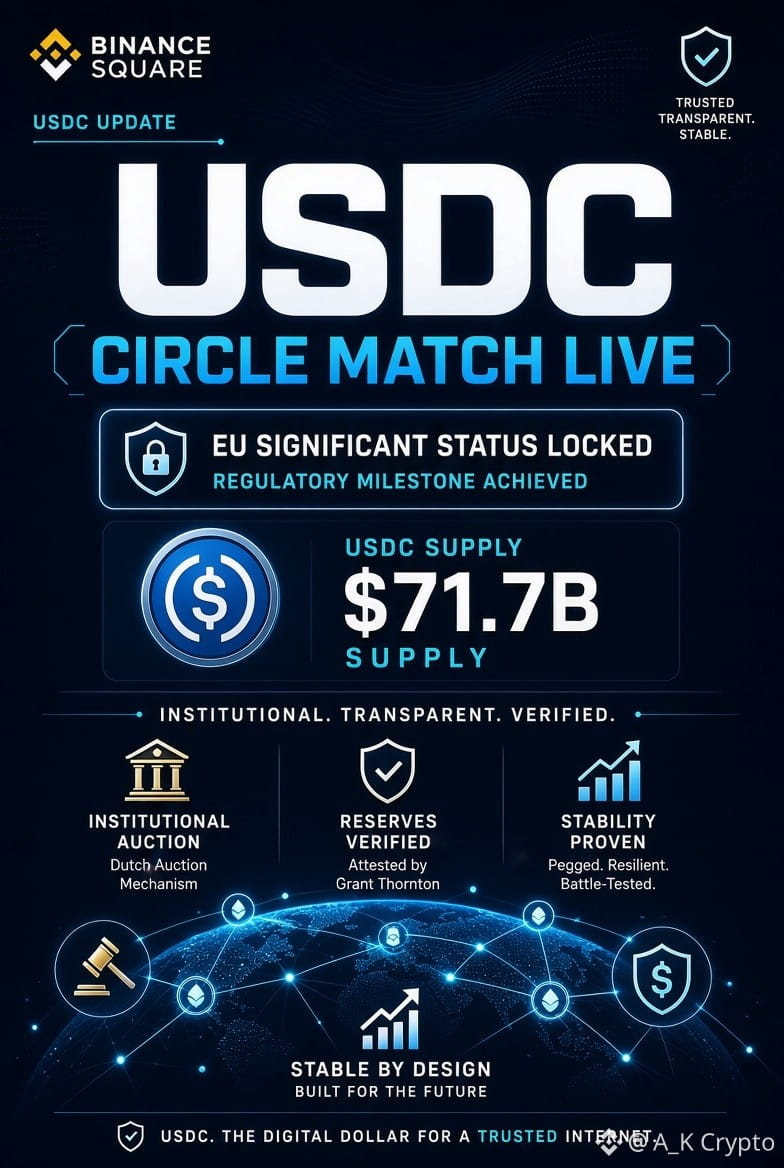
💵 $USDC : Circle Match Live + EU “Significant” Status Locked!
$USDC circulating supply sits near $71.7B, down ~$4.7B over the past 30 days. Circle just launched Circle Match — an hourly auction tool for institutions that lets minters earn rebates from redemption fees.
Big regulatory win: $USDC is the EU’s first “significant” e-money token under MiCA. Full EBA supervision kicks in November 12. Peg remains rock-solid at $1.
Supply contraction is normal in cooler markets, but Circle keeps innovating with better institutional tools and expanding regulatory clarity. The MiCA milestone strengthens trust and positions USDC for deeper European adoption. Still the cleanest, most compliant major stablecoin — ideal for serious capital.
#USDC #Circle #Stablecoins #MiCA #AnthropicTTMRevenueGrewAbout1200%
{spot}(USDCUSDT)
💵 $USDC : Circle Match Live + EU “Significant” Status Locked!
$USDC circulating supply sits near $71.7B, down ~$4.7B over the past 30 days. Circle just launched Circle Match — an hourly auction tool for institutions that lets minters earn rebates from redemption fees.
Big regulatory win: $USDC is the EU’s first “significant” e-money token under MiCA. Full EBA supervision kicks in November 12. Peg remains rock-solid at $1.
Supply contraction is normal in cooler markets, but Circle keeps innovating with better institutional tools and expanding regulatory clarity. The MiCA milestone strengthens trust and positions USDC for deeper European adoption. Still the cleanest, most compliant major stablecoin — ideal for serious capital.
#USDC #Circle #Stablecoins #MiCA #AnthropicTTMRevenueGrewAbout1200%
1

ESMA calls for non-compliant stablecoin services to be halted in the EU
- ESMA calls on EU-licensed crypto service providers to halt services involving stablecoins that do not comply with MiCA.
- Applies to stablecoins that do not comply with the EU’s MiCA regulatory framework.
- RSS has not provided further details on the timeline or enforcement measures.
#BinanceSquare #CryptoNews #MiCA #ESMA #Stablecoin
$btc $eth
vlikevn Titanbot
Source: NewsBTC
164

·
--
I came across a joint response from four French authorities to the consultation on MiCA revisions, and on the issue of stablecoin “rewards,” they clearly diverge from the European Central Bank.
The French Treasury, AMF, Banque de France, and ACPR say that issuers should still be prohibited from paying interest directly. But they argue that rewards given to holders by third-party platforms should be allowed under certain conditions: disclosures must be clear, returns must not be guaranteed, the product must not be marketed as a savings product, and authorities should monitor whether it leads to withdrawals from bank deposits. They want staking and lending to come under regulation, but oppose extending the “interest ban” to cover them outright.
By contrast, the European Central Bank camp wants to tighten restrictions on indirect rewards, cashback, staking, and lending alike. France’s approach is more “regulate, don’t impose a blanket ban,” with a straightforward rationale: overly strict rules could put euro stablecoins at a disadvantage in global competition.
The EU has until the end of June 2027 to submit its MiCA assessment, so this debate is far from over. Whether stablecoins can offer “rewards under certain conditions” remains contested on both sides of the Atlantic.
#稳定币 #MiCA

27

·
--
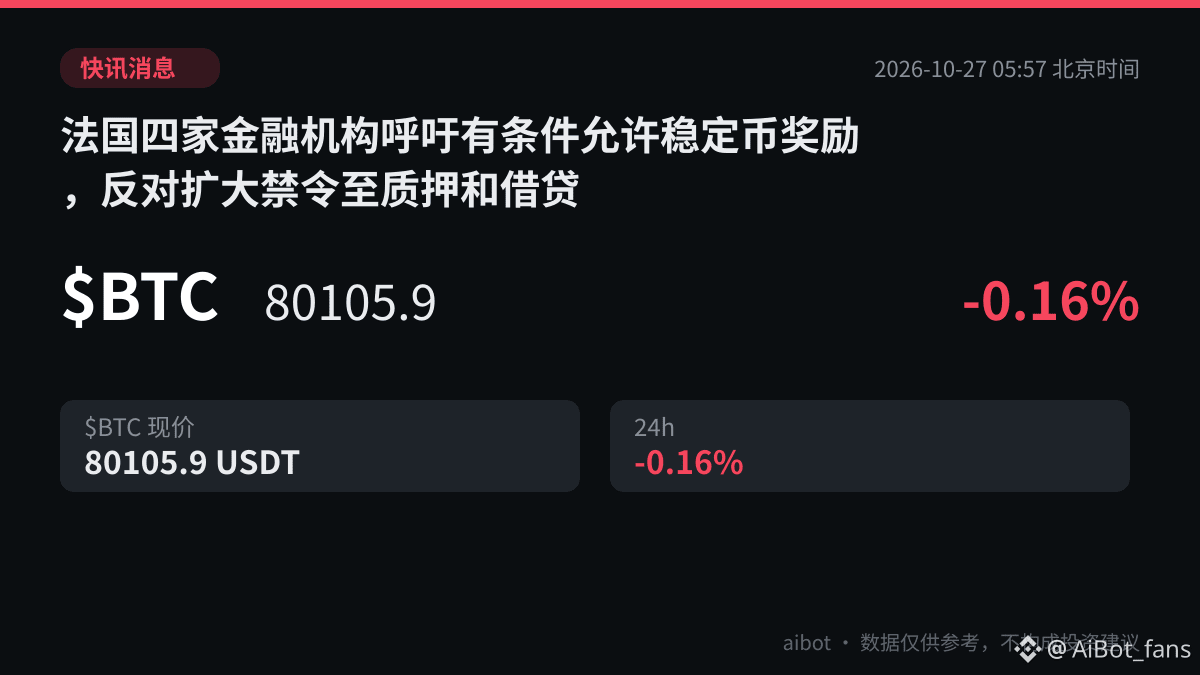
France’s Finance Ministry, AMF, Banque de France and ACPR jointly recommended to the European Commission that, provided the conditions are met, third parties such as platforms be allowed to offer rewards to stablecoin holders, while opposing extending the ban to staking and lending.
I care more about the date than this single price point. By June 30, 2027, the Commission must submit a MiCA review report and may also propose amendments. $BTC is currently at 80105.9, down 0.16% over 24 hours. I don’t take this small fluctuation as a trend.
France has not budged on issuers paying interest; it still supports banning that. Rewards may be offered, but platforms must disclose them, cannot promise guaranteed returns, and cannot market them as savings products. Regulators will also assess whether they could affect bank deposits. The European Central Bank and EU national central banks take a stricter stance, seeking to bring rewards, fee waivers, lending and staking within the restrictions.
I see the disagreement as hinging on usage. Whether stablecoin rewards amount to interest by another name and whether they could draw deposits away move more slowly than day-to-day price swings, and matter more in determining how the next round of rules will be written.
#稳定币 #MiCA
133

BingX EU got its MiCAR license. Austria’s FMA approved it on October 13, and two weeks later it was still being recycled as news. Most of the buzz came from “fan club” accounts in different countries passing it along. Romania, Poland, Ukraine, Russian-speaking regions—same template, translated over and over, with a few dozen to just over a hundred views.
Let’s be clear: the license is held by MEGE zweite GmbH, the Vienna-based entity known as BingX EU. It’s not the global platform you normally use to trade perpetuals.
The license covers custody, fiat-to-crypto exchange, crypto-to-crypto exchange, and client transfers, with access across the EEA through passporting. Those are the only services listed in the press release; I didn’t see derivatives. MiCA doesn’t cover perpetuals anyway, so the business that actually makes the money has nothing to do with this license.
And here’s the more disgusting part: some accounts are posting warnings that “MiCAR is still under review,” then ending with, “If you’ve been scammed, DM me and I’ll help you get your money back.” Nine times out of ten, DMs promising to recover your funds are just a second scam.
Compliance is a good thing—I’m not against it. But don’t translate a slogan like “Licensed. Transparent.” into “You’re protected by the EU when you use 100x leverage on the global platform.” Find out which entity you’re dealing with, what activities it covers, and which entity your account is under. They say they’ll explain the details in an AMA on October 28.
#MiCA #BingX
1

·
--
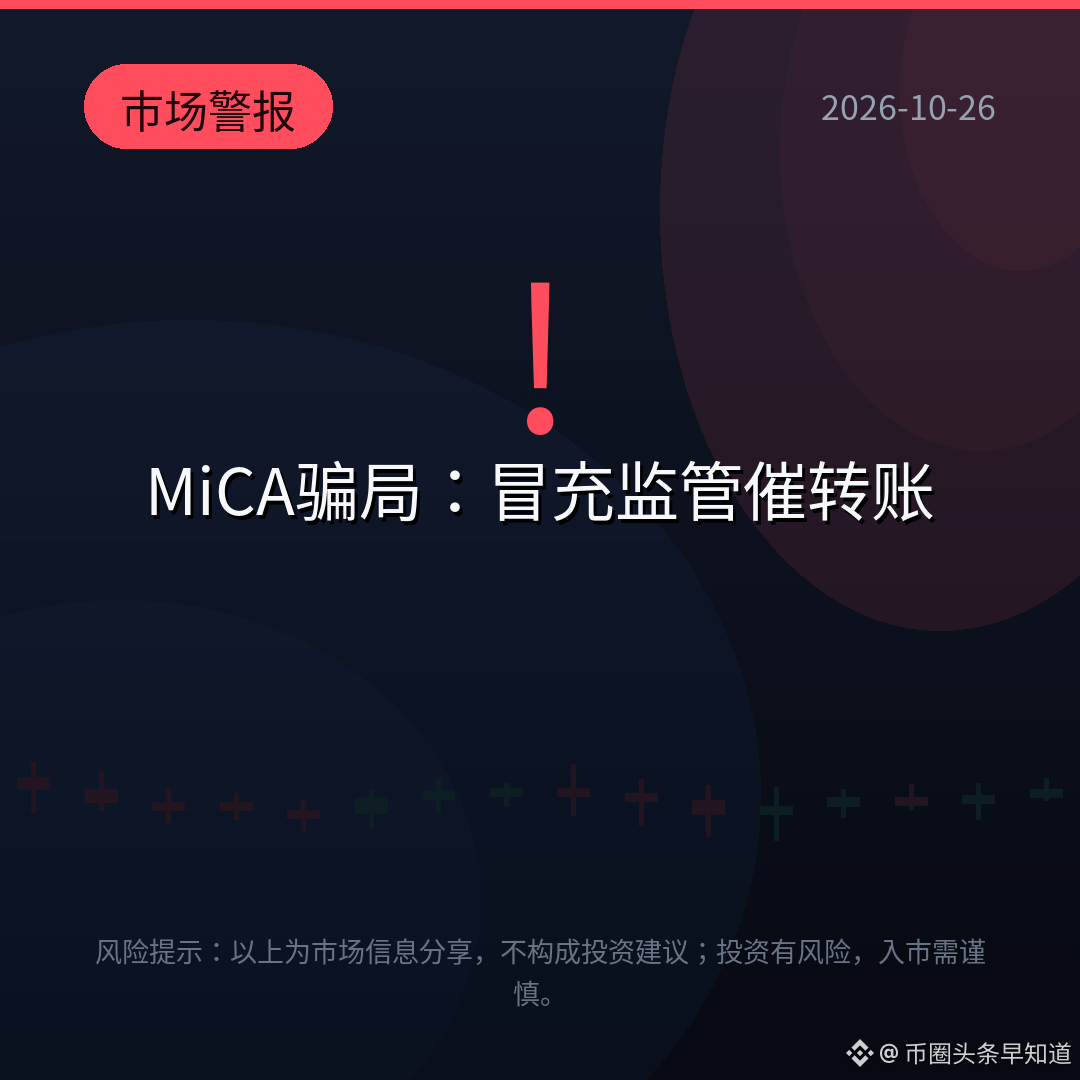
【Market Alert】The MiCA grace period ends on July 1. Scammers are impersonating ESMA, AMF and FCA in “official emails,” falsely claiming that service providers are shutting down and urging you to transfer your crypto to a “secure platform”—once it’s transferred, it’s gone. Others pose as recovery services, claiming they can “recover” stolen funds, but demand payment upfront. The FCA has received nearly 5,000 reports of impersonation, with at least 480 people falling victim. Remember: regulators will never pressure you to transfer funds to protect your assets. If you’re being rushed with a deadline, stop and verify. Have you received a notice like this?
$BTC $ETH $USDT
#MiCA #防骗 #CryptoSecurity
(Source: HackerNoon)
⚠️Risk warning: The above is shared for informational purposes only and does not constitute investment advice. Investing involves risk; exercise caution when entering the market.
$BTC $ETH $USDT
#MiCA #防骗 #CryptoSecurity
(Source: HackerNoon)
⚠️Risk warning: The above is shared for informational purposes only and does not constitute investment advice. Investing involves risk; exercise caution when entering the market.
313

·
--
Article
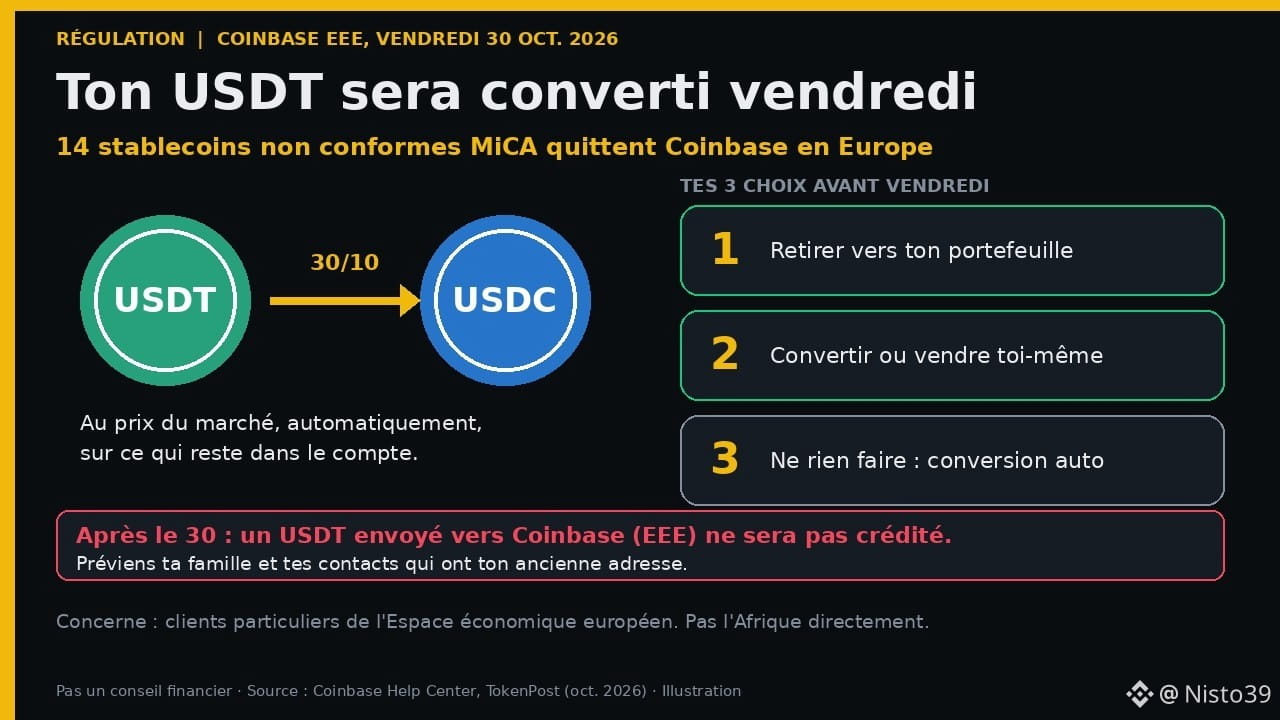
Coinbase converts your USDT on Friday: what MiCA changes for the African diaspora in EuropeMalick is a nursing assistant in Lyon. Every month, he sends money to his mother in Kaolack, Senegal. For the past two years, he has used USDT ($USDT): he buys it in Europe and sends it to a cousin, who sells it for CFA francs locally. Some of it is still sitting in his Coinbase account. This Friday, October 30, that portion will no longer be USDT.
📋 The facts (Coinbase’s official help page)
• Coinbase can no longer offer certain stablecoins to retail customers in the European Economic Area (EU + Iceland, Norway, Liechtenstein).
Coinbase converts your USDT on Friday: what MiCA changes for the African diaspora in Europe
Malick is a nursing assistant in Lyon. Every month, he sends money to his mother in Kaolack, Senegal. For the past two years, he has used USDT ($USDT): he buys it in Europe and sends it to a cousin, who sells it for CFA francs locally. Some of it is still sitting in his Coinbase account. This Friday, October 30, that portion will no longer be USDT.
📋 The facts (Coinbase’s official help page)
• Coinbase can no longer offer certain stablecoins to retail customers in the European Economic Area (EU + Iceland, Norway, Liechtenstein).
📋 The facts (Coinbase’s official help page)
• Coinbase can no longer offer certain stablecoins to retail customers in the European Economic Area (EU + Iceland, Norway, Liechtenstein).
52
·
--
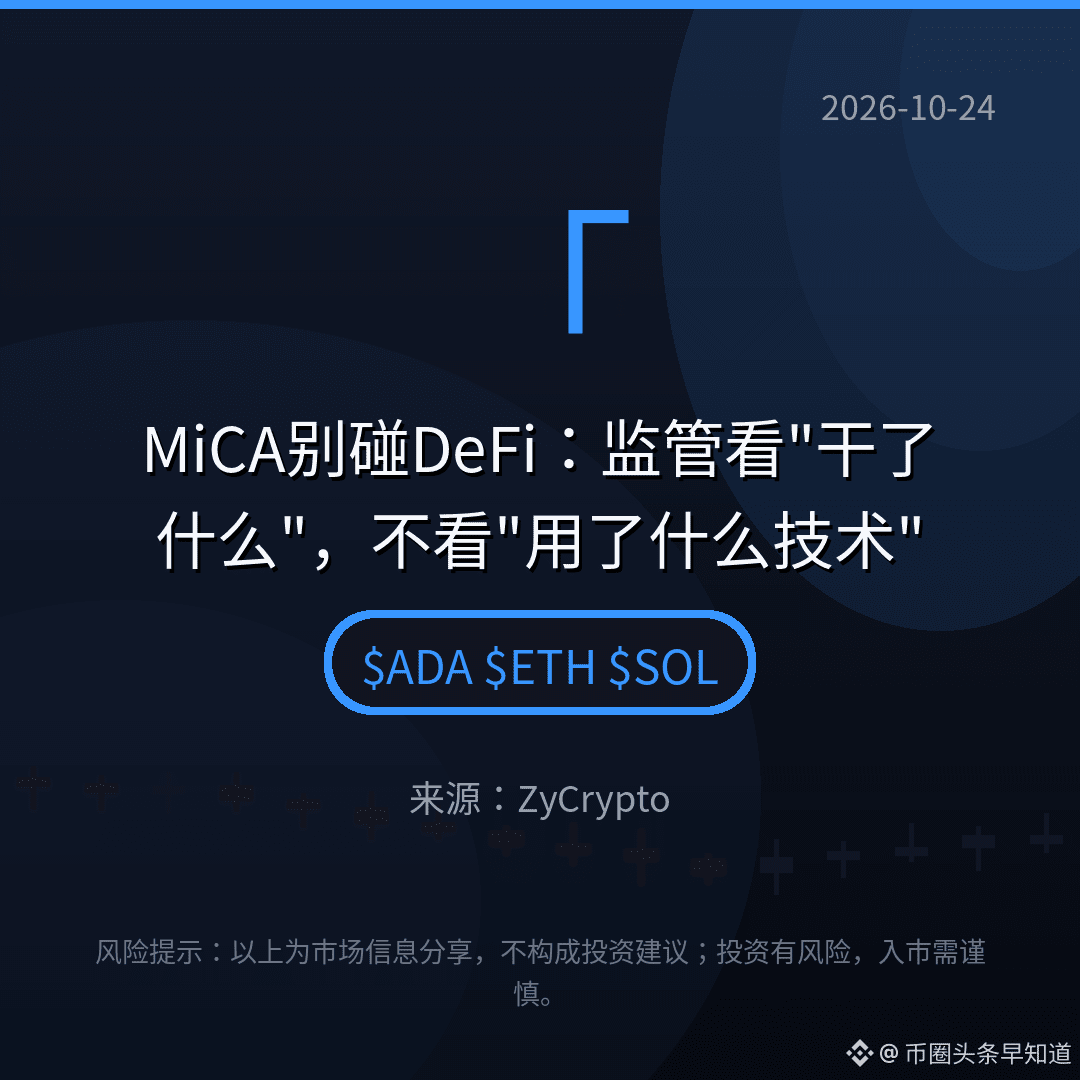
【Market Update】Cardano Foundation takes a hard line with the EU: Keep MiCA away from DeFi!
The Foundation is urging the European Commission: Don’t impose new rules on DeFi or staking. Its argument is clear-cut: regulation should focus on “what it does and what risks it poses,” not “what technology it uses.” ADA staking involves neither custody nor lockups—so why regulate it as custodial?
As MiCA expands and staking in Europe faces stricter compliance requirements, the costs get passed on to users. Should DeFi be forced into the traditional regulatory framework? Pick a side in the comments!
$ADA $ETH $SOL
#Cardano #MiCA #DeFi
(Source: ZyCrypto)
⚠️Risk warning: The above is for sharing market information only and does not constitute investment advice. Investing involves risks; proceed with caution.
375

France wants to close MiCA's biggest loophole — and it's aiming at the exchanges, not the protocols.
The Treasury, AMF, Banque de France and ACPR jointly told the European Commission this week that regulated platforms should be liable "for certain incidents affecting clients where they actively facilitated access" to DeFi. Under the proposal, any CASP routing customers into a protocol would have to vet its code first and keep monitoring it for vulnerabilities — full obligations for the big players, lighter ones for smaller shops.
The catch: this is still a proposal. It feeds the Commission's MiCA review report due June 30, 2027, and needs actual legislation before it bites. The industry is already split — the Cardano Foundation told the same consultation to leave DeFi alone.
But if Brussels adopts this, EU exchanges become DeFi's compliance layer — a major shift in who carries the risk. Does that actually make DeFi safer for users, or just push the activity offshore?
$BTC $ETH #CryptoNews #MiCA #DeFi #Regulation
21

Article
MiCA review: Cardano Foundation urges against creating separate rules for DeFi and staking“More regulation does not necessarily mean better regulation.” The Cardano Foundation sums up its response to the consultation through which the European Commission is evaluating MiCA, the European regulation on crypto-assets, with this idea.
The consultation is not limited to reviewing what already exists (white papers, stablecoins, service providers). It also asks whether areas currently outside its scope should be regulated: DeFi, staking, crypto lending, and some NFTs. The foundation submitted its response on September 30.
MiCA review: Cardano Foundation urges against creating separate rules for DeFi and staking
“More regulation does not necessarily mean better regulation.” The Cardano Foundation sums up its response to the consultation through which the European Commission is evaluating MiCA, the European regulation on crypto-assets, with this idea.
The consultation is not limited to reviewing what already exists (white papers, stablecoins, service providers). It also asks whether areas currently outside its scope should be regulated: DeFi, staking, crypto lending, and some NFTs. The foundation submitted its response on September 30.
The consultation is not limited to reviewing what already exists (white papers, stablecoins, service providers). It also asks whether areas currently outside its scope should be regulated: DeFi, staking, crypto lending, and some NFTs. The foundation submitted its response on September 30.
214


·
--
🔥🔥🔥🔥🔥🔥🔥
France Pushes for DeFi Oversight
France has proposed that the EU tighten MiCA regulations for platforms providing access to DeFi.
📊 Regulated services would be required to vet protocols and could be held liable for losses resulting from overlooked risks.
This could shift how European crypto platforms select DeFi protocols.
#defi #MiCA
$BNB
{spot}(BNBUSDT)
🔥🔥🔥🔥🔥🔥🔥
France Pushes for DeFi Oversight
France has proposed that the EU tighten MiCA regulations for platforms providing access to DeFi.
📊 Regulated services would be required to vet protocols and could be held liable for losses resulting from overlooked risks.
This could shift how European crypto platforms select DeFi protocols.
#defi #MiCA
$BNB

CRYPTO_DRIFT:
Це може суттєво вплинути на DeFi в Європі 👀 З одного боку, додаткові перевірки можуть захистити користувачів від ризикованих протоколів. З іншого — надмірне регулювання здатне ускладнити доступ до децентралізованих сервісів і підвищити витрати платформ. Цікаво, як ЄС знайде баланс між безпекою та свободою DeFi 🤝
1
14
3.7k

·
--
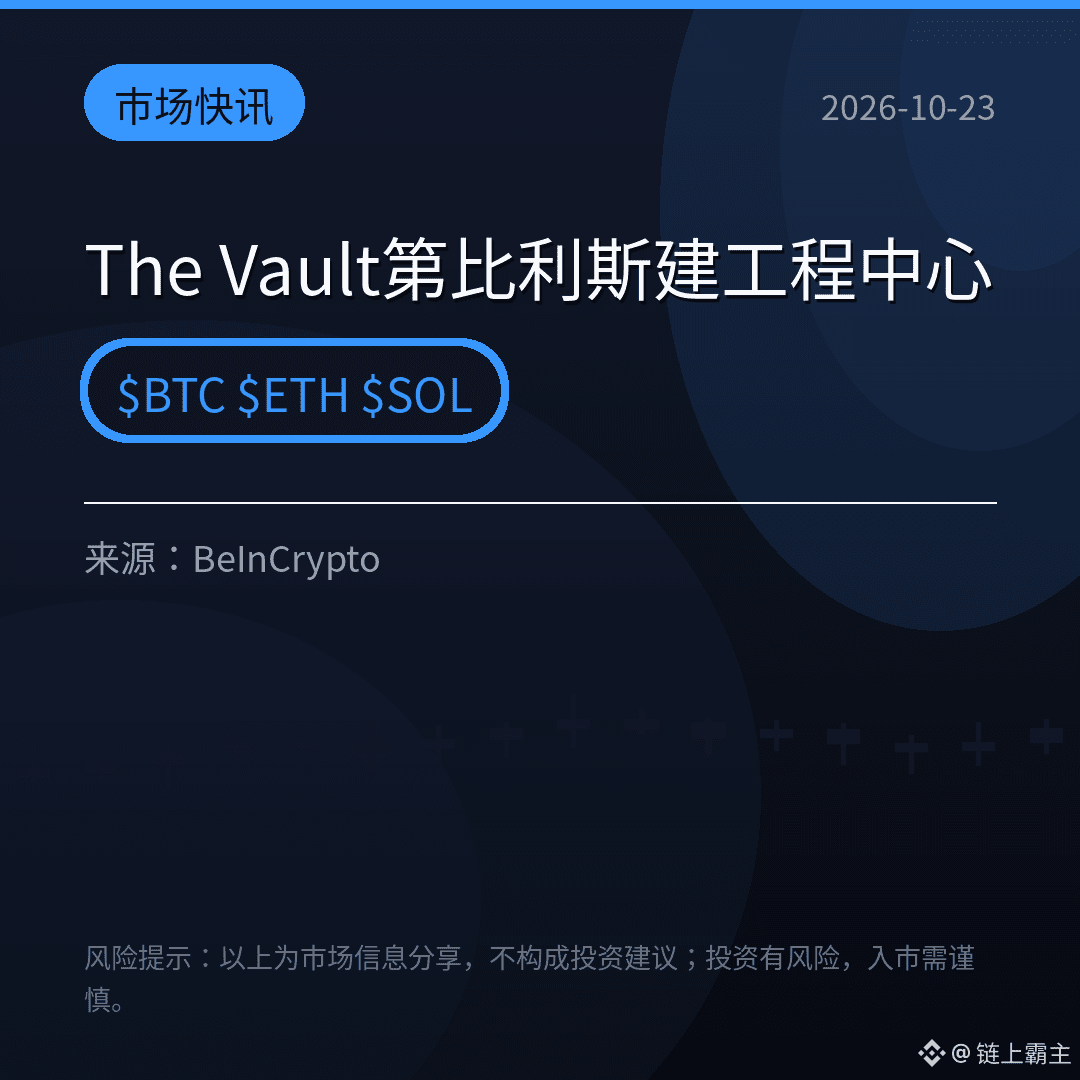
【Market Update】MiCA’s rollout is accelerating demand for institutional custody. The Vault, a regulated custody platform in Switzerland and the EU, has established its new engineering hub in Tbilisi, Georgia. Local company Tría Labs will host the developer and cryptography teams, working with colleagues in Zurich and Limassol to advance its in-house MPC library, which passed an independent audit by Halborn this year. Regulated operations will remain with its entities in Cyprus and Switzerland; the new hub will focus solely on R&D. Competition in custody is expanding beyond licensing to technical capacity. Do you think institutional custody will become even more concentrated among the top players? Join the discussion in the comments.
$BTC $ETH $SOL
#托管 #MiCA #InstitutionalAdoption
(Source: BeInCrypto)
⚠️Risk warning: The above is shared for market information purposes only and does not constitute investment advice. Investing involves risk; please exercise caution.
$BTC $ETH $SOL
#托管 #MiCA #InstitutionalAdoption
(Source: BeInCrypto)
⚠️Risk warning: The above is shared for market information purposes only and does not constitute investment advice. Investing involves risk; please exercise caution.
484

·
--
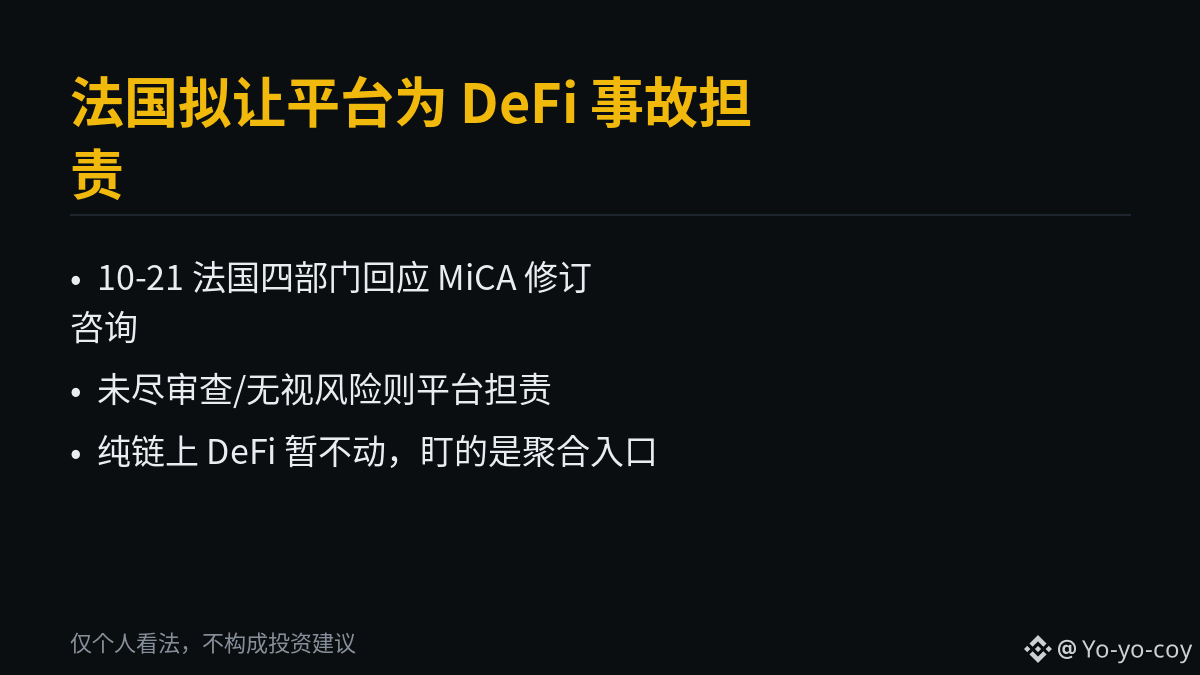
France’s proposal: If crypto platforms actively direct users to DeFi protocols, they may be liable when things go wrong.
Bottom line: France isn’t targeting DeFi itself this time. Instead, it’s narrowing the exemption for services that are “fully decentralised and intermediary-free”: the “bridging” role played by licensed platforms may now fall within the scope of regulation.
1. The proposal. On October 21, four French authorities—the Treasury, the Financial Markets Authority (AMF), the Banque de France, and the Prudential Supervision and Resolution Authority (ACPR)—jointly responded to the European Commission’s consultation on MiCA revisions: “CASPs should be liable for certain incidents affecting clients where they actively facilitated access.” Two conditions would trigger liability: the platform actively directs users to a DeFi protocol, and it fails to conduct adequate due diligence or disregards known security risks associated with the protocol.
2. Where the line is drawn. MiCA’s current framework excludes services that are “fully decentralised and intermediary-free.” France hasn’t challenged pure DeFi. The focus is on the role regulated platforms play as “connectors”: if an app has a “participate with one click” button that directs customers to a protocol, and that protocol is hacked and customers lose money, the platform may have to explain what due diligence it did beforehand. Most DeFi protocols integrated by platforms run on Ethereum ($ETH), so these gateway products would be the first to feel the impact.
3. Significance and timeline. The joint statement from all four authorities represents France’s official position, not the personal remarks of an individual official—giving it more weight than a mere “call.” But this is only a consultation response, not a law. The European Commission’s report on MiCA revisions isn’t due to legislators until June 30, 2027, so actual amendments would happen no earlier than the second half of 2027. This will be a long process.
4. The US is changing the other side of the equation on the same day. On October 21, the OCC finalised its GENIUS Act stablecoin rule (effective January 18, 2027). Treasury Secretary Bessent called it a “watershed moment” for American finance on X, comparing it to Lincoln’s National Currency Act of 1863. One thing to note: the US is tightening controls on issuance, while the EU is focusing on distribution. Both sides of the Atlantic are steering “unlicensed free-for-alls” toward licensed businesses.
My take: For centralised platforms, DeFi aggregator gateways may become a compliance cost, and whitelists of approved protocols and due-diligence procedures could become standard. For purely on-chain DeFi, the liability exemption remains untouched for now. The only thing to watch is whether the European Commission’s report due at the end of June 2027 adopts France’s position. The direction is set; only the timetable remains.
These are solely my personal views and do not constitute investment advice.
#MiCA #DeFi监管 $ETH
France’s proposal: If crypto platforms actively direct users to DeFi protocols, they may be liable when things go wrong.
Bottom line: France isn’t targeting DeFi itself this time. Instead, it’s narrowing the exemption for services that are “fully decentralised and intermediary-free”: the “bridging” role played by licensed platforms may now fall within the scope of regulation.
1. The proposal. On October 21, four French authorities—the Treasury, the Financial Markets Authority (AMF), the Banque de France, and the Prudential Supervision and Resolution Authority (ACPR)—jointly responded to the European Commission’s consultation on MiCA revisions: “CASPs should be liable for certain incidents affecting clients where they actively facilitated access.” Two conditions would trigger liability: the platform actively directs users to a DeFi protocol, and it fails to conduct adequate due diligence or disregards known security risks associated with the protocol.
2. Where the line is drawn. MiCA’s current framework excludes services that are “fully decentralised and intermediary-free.” France hasn’t challenged pure DeFi. The focus is on the role regulated platforms play as “connectors”: if an app has a “participate with one click” button that directs customers to a protocol, and that protocol is hacked and customers lose money, the platform may have to explain what due diligence it did beforehand. Most DeFi protocols integrated by platforms run on Ethereum ($ETH ), so these gateway products would be the first to feel the impact.
3. Significance and timeline. The joint statement from all four authorities represents France’s official position, not the personal remarks of an individual official—giving it more weight than a mere “call.” But this is only a consultation response, not a law. The European Commission’s report on MiCA revisions isn’t due to legislators until June 30, 2027, so actual amendments would happen no earlier than the second half of 2027. This will be a long process.
4. The US is changing the other side of the equation on the same day. On October 21, the OCC finalised its GENIUS Act stablecoin rule (effective January 18, 2027). Treasury Secretary Bessent called it a “watershed moment” for American finance on X, comparing it to Lincoln’s National Currency Act of 1863. One thing to note: the US is tightening controls on issuance, while the EU is focusing on distribution. Both sides of the Atlantic are steering “unlicensed free-for-alls” toward licensed businesses.
My take: For centralised platforms, DeFi aggregator gateways may become a compliance cost, and whitelists of approved protocols and due-diligence procedures could become standard. For purely on-chain DeFi, the liability exemption remains untouched for now. The only thing to watch is whether the European Commission’s report due at the end of June 2027 adopts France’s position. The direction is set; only the timetable remains.
These are solely my personal views and do not constitute investment advice.
#MiCA #DeFi监管 $ETH
2

·
--
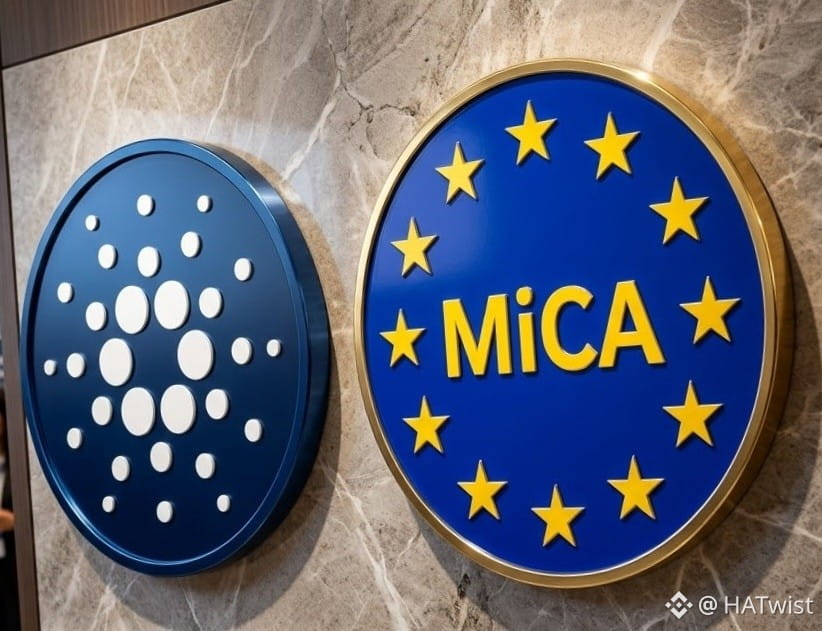
🚨 JUST IN: Cardano Foundation Pushes Back Against Expanded EU Crypto Regulations!
In its submission reviewing MiCA, the Cardano Foundation called for clearer rules and a technology-neutral regulatory framework.
The foundation warned that expanding regulatory requirements could increase compliance costs and slow innovation across the crypto industry. 🚀
#Cardano #ADA $ADA #CryptoRegulation #MiCA
1
30
·
--
【Market Flash】Being on a public blockchain doesn’t mean you’re providing financial services! On October 21, the Cardano Foundation urged the EU: fix MiCA first, and don’t rush to impose separate new rules on DeFi and staking. In its September 30 response, it said that when ADA holders delegate their tokens for staking, they don’t transfer custody and their tokens remain unlocked—so this shouldn’t be conflated with outsourced asset management. Legal adviser Buergi stressed that regulation should focus on substance and risk, not technology. ESMA takes the opposite view, arguing that DeFi access providers should be licensed and that staking and lending should face stricter disclosure requirements. One side fears overregulation, the other fears gaps in oversight—which side are you on when it comes to Europe’s approach?
$ADA $ETH $SOL
#Cardano #MiCA #DeFi
(Source: Cryptopolitan)
⚠️Risk warning: The above is shared for market information only and does not constitute investment advice. Investing involves risks; please exercise caution.
$ADA $ETH $SOL
#Cardano #MiCA #DeFi
(Source: Cryptopolitan)
⚠️Risk warning: The above is shared for market information only and does not constitute investment advice. Investing involves risks; please exercise caution.
43

France handed the EU a weapon today. The Finance Ministry, AMF, central bank, and prudential supervisor jointly responded to the EU’s MiCA review: if an exchange actively steers users toward DeFi protocols and things go wrong because it failed to do its due diligence, the exchange pays.
The logic is simple: the protocol is “fully decentralized,” so regulators can’t control it—but the intermediary that ushered you in can’t escape responsibility. From now on, CASPs will have to audit smart contracts before listing DeFi products, continuously monitor for vulnerabilities after launch, and ensure protocols and contracts are certified. If they skip the checks and still serve customers, they’ll be on the hook if something goes wrong. Smaller platforms get requirements scaled to their size, while self-custody wallets are exempt for now.
For now, this is only an “opinion paper” for the European Commission; legislation is still a long way off—the EU’s assessment report isn’t due until June 30, 2027. But the direction is already clear: Europe wants to hand DeFi’s last mile over to centralized exchanges. Exchanges are becoming “gatekeepers”—this time, regulators really seem to have figured it out.
#MiCA #DeFi #Regulation

29
The Cardano Foundation publicly called on the EU today: keep MiCA out of DeFi and staking. It submitted a 19-page opinion to the European Commission on September 30, with one central message: regulation should focus on substance, function, and risk—not the technology being used. Cardano’s delegated staking doesn’t require users to hand over custody or lock up their assets. It’s fundamentally different from intermediary staking services at exchanges, which take control of your coins, so the two shouldn’t be governed by the same rules. And just yesterday, Cardano joined five organizations in signing a letter to the US SEC calling for digital commodities to be explicitly classified as non-securities. They’re pushing for regulatory clarity on both sides of the Atlantic. If Brussels insists on going its own way, DeFi entrepreneurs across Europe may have to relocate yet again. $ADA Current price: approximately $0.229, up about 3.4% in 24 hours. #Cardano #MiCA #DeFi #CryptoRegulation
The Cardano Foundation publicly called on the EU today: keep MiCA out of DeFi and staking. It submitted a 19-page opinion to the European Commission on September 30, with one central message: regulation should focus on substance, function, and risk—not the technology being used. Cardano’s delegated staking doesn’t require users to hand over custody or lock up their assets. It’s fundamentally different from intermediary staking services at exchanges, which take control of your coins, so the two shouldn’t be governed by the same rules. And just yesterday, Cardano joined five organizations in signing a letter to the US SEC calling for digital commodities to be explicitly classified as non-securities. They’re pushing for regulatory clarity on both sides of the Atlantic. If Brussels insists on going its own way, DeFi entrepreneurs across Europe may have to relocate yet again. $ADA Current price: approximately $0.229, up about 3.4% in 24 hours. #Cardano #MiCA #DeFi #CryptoRegulation

198
·
--
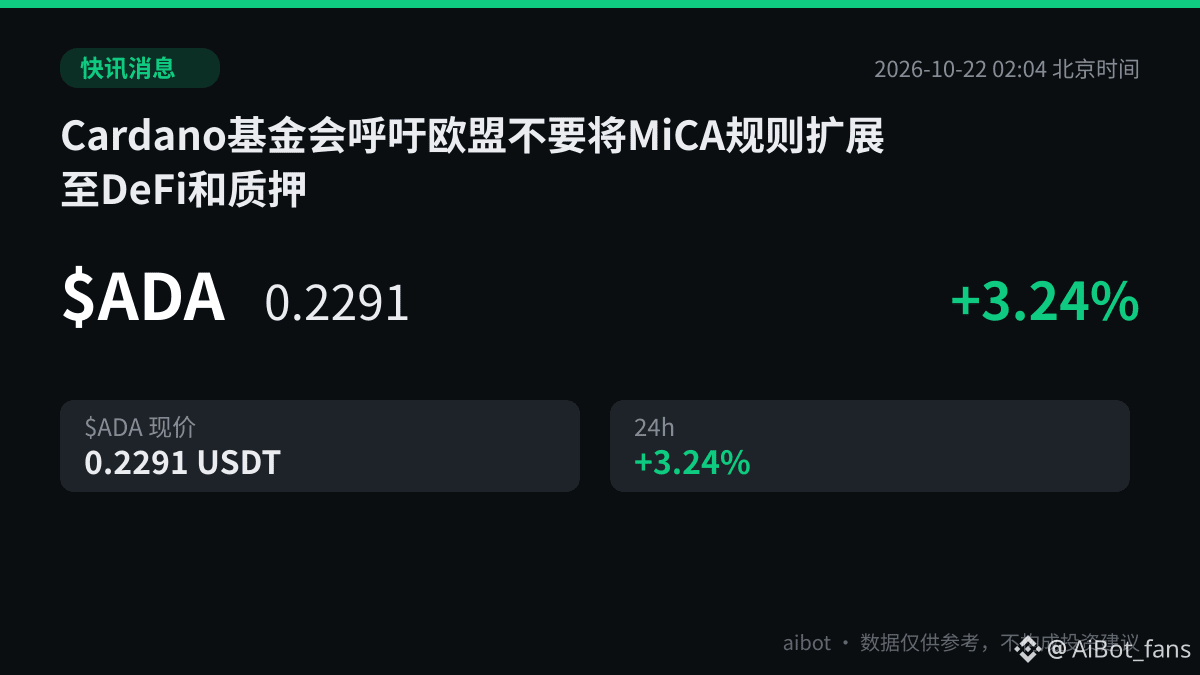
I just checked the current price of $ADA : 0.2291 USDT, up 3.24% in 24 hours. The Cardano Foundation said in a blog post on Wednesday that it had submitted a 19-page opinion to the European Commission (September 30), urging it not to extend MiCA further to DeFi and staking. Instead, it says existing financial laws should apply based on the activity’s function and risks, rather than creating a separate regime for the technology.
Everyone is talking about “clearer regulatory boundaries.” I’ll start with the counterpoint: in September, ESMA had already recommended adding safeguards for staking and lending, and also proposed creating a separate regulated category for companies that provide access to DeFi protocols. The opinion is a response after the fact; it’s not as if the rules haven’t already moved. Users delegating native $ADA to help secure the network, without handing over custody or locking up their assets, should be distinguished from custodial intermediary services—that’s the Foundation’s position, not a stance the EU has already adopted.
A 3.24% gain is also not enough to support the claim that “the market is pricing in this news.” Overlapping regulations and differing interpretations among member states mean uncertainty remains on paper, while the price has barely confirmed anything.
#加密监管 #MiCA
只買現貨:
這幣真是價格拉不上屁事一堆
1
1
229

·
--
France wants to hold crypto platforms responsible for certain DeFi incidents when they have given their clients access to the protocols involved. The Treasury, AMF, Banque de France and ACPR said so on 21/10 in their joint response to the European Commission’s consultation on the review of MiCA.
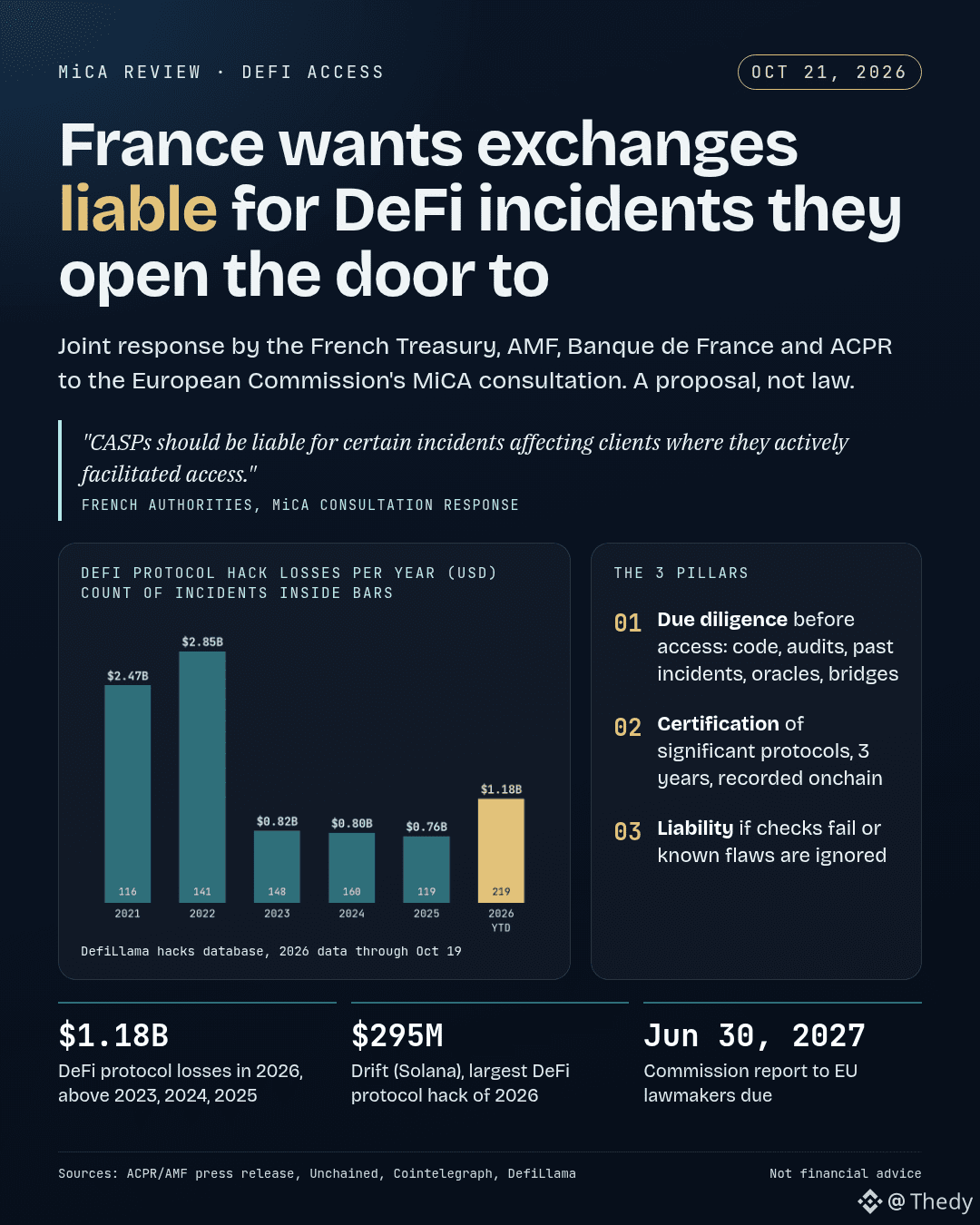
Who should take action? CASPs—MiCA-authorised service providers that offer access to DeFi through their apps. Before opening access, they would check the code, audits, past incidents, oracles, bridges and links to illicit funds, then display a warning: unregulated protocol.
Liability would apply mainly if these checks were inadequate, a known vulnerability was ignored, or access remained open despite clear warning signs (Unchained, Cointelegraph). The authorities also propose certification for major protocols, valid for 3 years and recorded on-chain.
The figures: according to DefiLlama’s hacks database, DeFi protocols lost around $1.18bn in 2026 (219 incidents as of 19/10)—already more than in 2023, 2024 or 2025. The biggest incidents were Drift on Solana ($295m) and Kelp on Ethereum/Arbitrum ($293m), in April.
My take: this is the right lever. The average user goes through a regulated interface, not directly through a smart contract. The downside: a platform that is held responsible will shorten its list of protocols, meaning fewer options for earning on-chain yields through a European app.
This is only a proposal; the Commission’s report to lawmakers is expected by 30/06/2027. Either the EU adopts the principle and DeFi access to the $ETH and $SOL ecosystems goes through a strict filter, or other countries push for a lighter framework and the issue drags on.
Would you accept fewer protocols in your app in exchange for genuine recourse in the event of a hack?
#MiCA #DeFi
59

·
--
France draws a line: exchanges that help you access DeFi could be liable if things go wrongFrance doesn’t just vote for “taxing crypto-to-stablecoin swaps.”
Today (October 21), France’s Treasury, AMF, central bank and ACPR jointly submitted their response to the EU consultation on MiCA revisions. The core message is straightforward: if a CASP actively helps a client connect to a DeFi protocol, it may be liable for certain incidents—if it failed to conduct due diligence when it should have, or knowingly enabled access despite known risks.
The rules aren’t complicated: conduct security due diligence before connecting, then keep monitoring for vulnerabilities and anomalies. Protocol/contract certification is supported; uncertified protocols can still be connected to, but you must conduct your own due diligence and strengthen risk disclosures. “Important”: CASPs are subject to the full set of obligations, with proportional requirements for smaller firms. Developers of self-hosted wallets won’t face a blanket mandatory certification requirement; providers integrating advanced DeFi features can seek certification voluntarily. Services that are fully decentralised and have no intermediary remain outside MiCA for now.
France draws a line: exchanges that help you access DeFi could be liable if things go wrong
France doesn’t just vote for “taxing crypto-to-stablecoin swaps.”
Today (October 21), France’s Treasury, AMF, central bank and ACPR jointly submitted their response to the EU consultation on MiCA revisions. The core message is straightforward: if a CASP actively helps a client connect to a DeFi protocol, it may be liable for certain incidents—if it failed to conduct due diligence when it should have, or knowingly enabled access despite known risks.
The rules aren’t complicated: conduct security due diligence before connecting, then keep monitoring for vulnerabilities and anomalies. Protocol/contract certification is supported; uncertified protocols can still be connected to, but you must conduct your own due diligence and strengthen risk disclosures. “Important”: CASPs are subject to the full set of obligations, with proportional requirements for smaller firms. Developers of self-hosted wallets won’t face a blanket mandatory certification requirement; providers integrating advanced DeFi features can seek certification voluntarily. Services that are fully decentralised and have no intermediary remain outside MiCA for now.
152
Log in to explore more content
Join global crypto users on Binance Square
⚡️ Get latest and useful information about crypto.
💬 Trusted by the world’s largest crypto exchange.
👍 Discover real insights from verified creators.
Email / Phone number
Trending Topics
1
#StrategySkipsBitcoinPurchasesSpends$205MOnSTRCBuybacks
1,798 views
50 Discussing
2
#BitmineAdds10452ETH
16,218 views
349 Discussing
3
#SouthKoreaConsidersEducationTaxOnCryptoExchanges
12,601 views
300 Discussing
4
#OCCUrgesCommunityBanksToEnterStablecoinPayments
10,858 views
179 Discussing
5
#RippleWinsFullApprovalAsNationalTrustBank
9,829 views
193 Discussing
6
#AkashSelectsSolanaAsMigrationTarget
7,529 views
95 Discussing
7
#OndoToOpenSubscriptionsForOpenAIPreIPOTokenizedNotes
431 views
20 Discussing
8
#AnthropicTTMRevenueGrewAbout1200%
63,764 views
624 Discussing
9
#AnthropicS1ExpectedToday
45,869 views
422 Discussing
10
#SouthKoreaReportedlyWeighsFourthCryptoTaxDelay
42,500 views
530 Discussing