
#korea
korea
259,216 views
2,205 Discussing
Hot
Latest

·
--
#SouthKoreaDigitalAssetBillProposes20%ShareholderCap
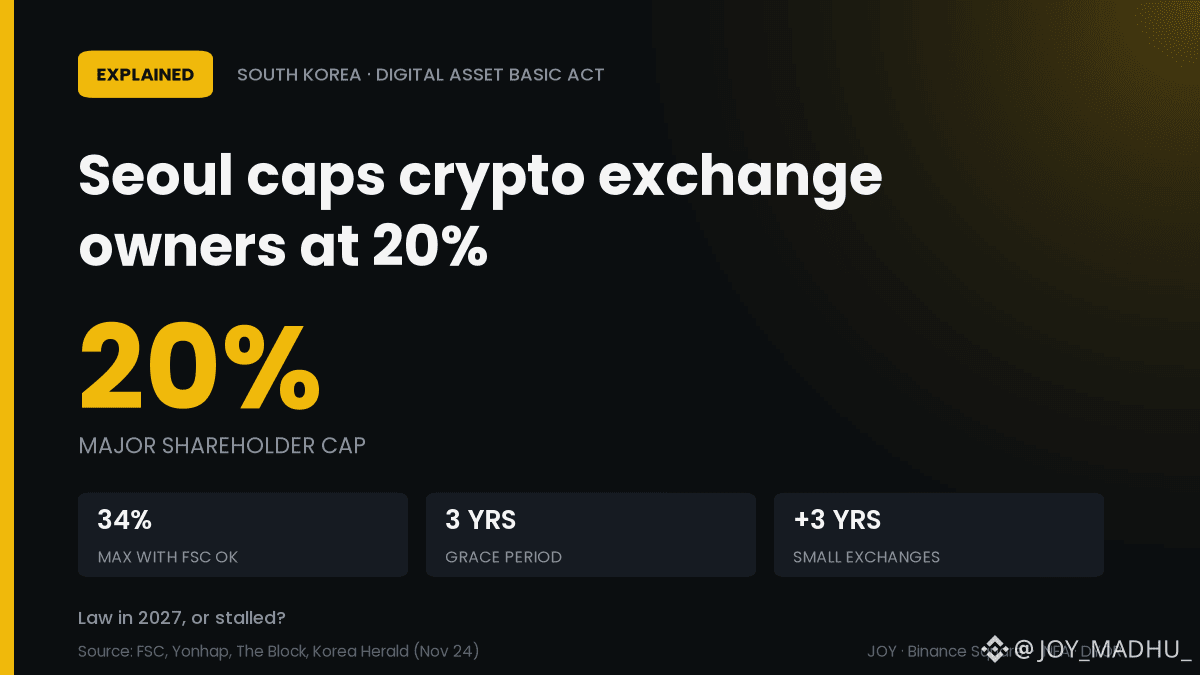
🏛️ 20% Cap, 34% Max: Seoul Rewrites Who Owns Exchanges
Korea's FSC unveiled a draft crypto law on Nov 24 that limits how much one big shareholder can own of an exchange.
📊 Major shareholder cap 20%, up to 34% with FSC approval
⚠️ Shares above the cap lose their voting rights
📅 3-year grace period, up to 3 more for smaller exchanges
My read: it could reshape deals like Naver-Dunamu, but it's a draft lawmakers can still change.
Passed by the National Assembly in 2027, or stalled past 2027? 👇
#SouthKoreaDigitalAssetBillProposes20%ShareholderCap #Korea #CryptoRegulation
·
--
#SouthKoreaBeginsCryptoProviderShareholderReviews
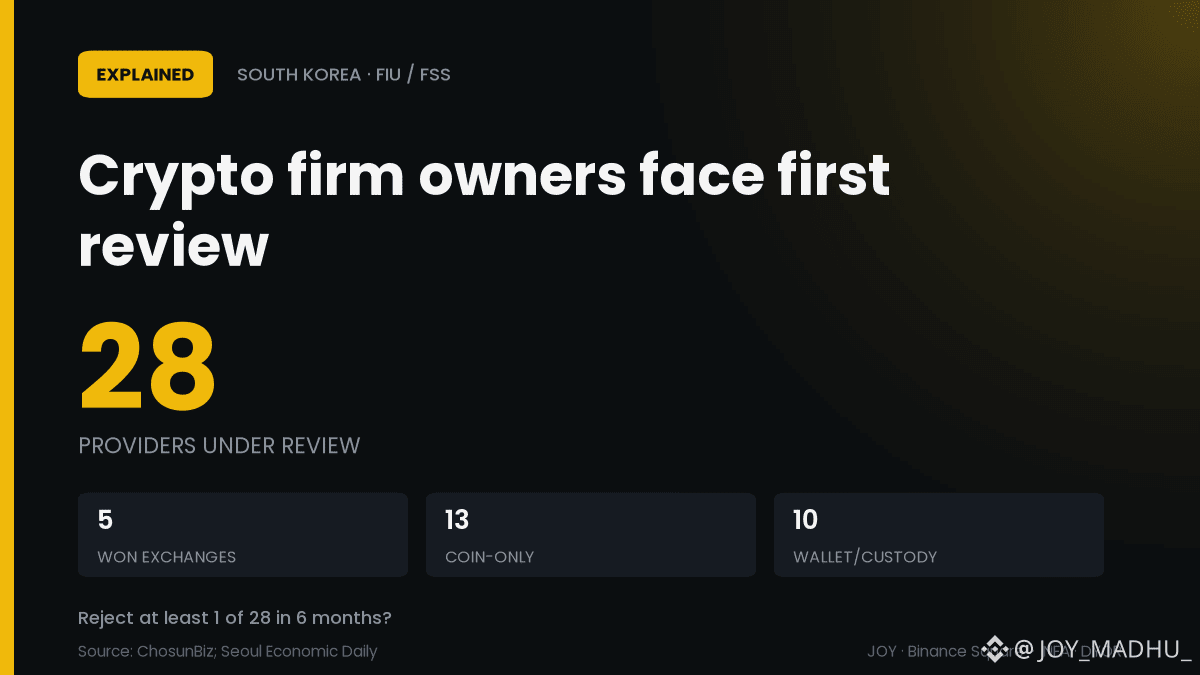
🔍 28 Crypto Firms, One New Test: Korea Vets the Owners
Korea's FIU and FSS began reviewing all 28 crypto providers on Nov 23, screening major shareholders for the first time.
📊 5 won exchanges, 13 coin-only exchanges, 10 wallet/custody firms
🏦 Covers the largest holder and anyone with 10%+
⚠️ False or missing details alone can sink a report
📅 200% debt-ratio rule deferred a year for existing firms
My read: this tests who owns the exchanges, not what they list.
Within 6 months, does Korea reject 1+ of the 28 or clear them all? 👇
#SouthKoreaBeginsCryptoProviderShareholderReviews #Korea #CryptoRegulation
4
·
--
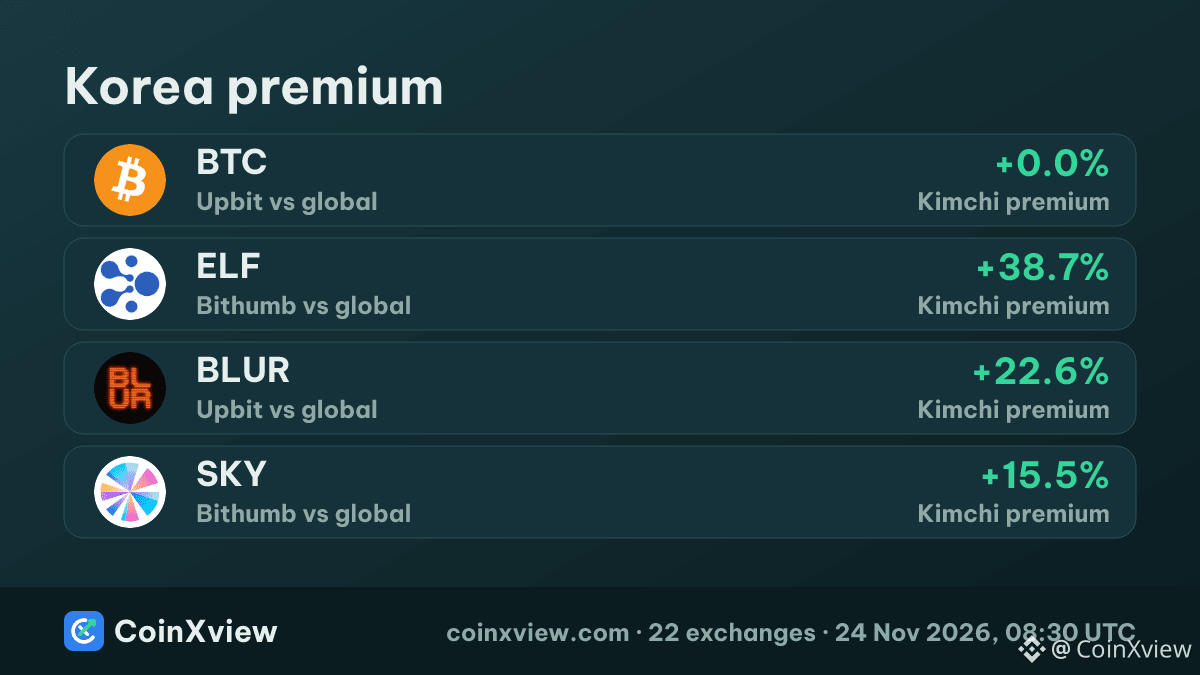
Korean traders pay +0.0% more for $BTC than the rest of the world
$ELF +38.7% on Bithumb
BLUR +22.6% on Upbit
SKY +15.5% on Bithumb
Positive premium = Korean buyers paying more than global exchanges.
Is Korean retail back?
#Bitcoin #Korea
Korean traders pay +0.0% more for $BTC than the rest of the world
$ELF +38.7% on Bithumb
BLUR +22.6% on Upbit
SKY +15.5% on Bithumb
Positive premium = Korean buyers paying more than global exchanges.
Is Korean retail back?
#Bitcoin #Korea
$ELF +38.7% on Bithumb
BLUR +22.6% on Upbit
SKY +15.5% on Bithumb
Positive premium = Korean buyers paying more than global exchanges.
Is Korean retail back?
#Bitcoin #Korea
162
·
--
#SouthKoreaPlansToReleaseDigitalAssetBasicActDraft
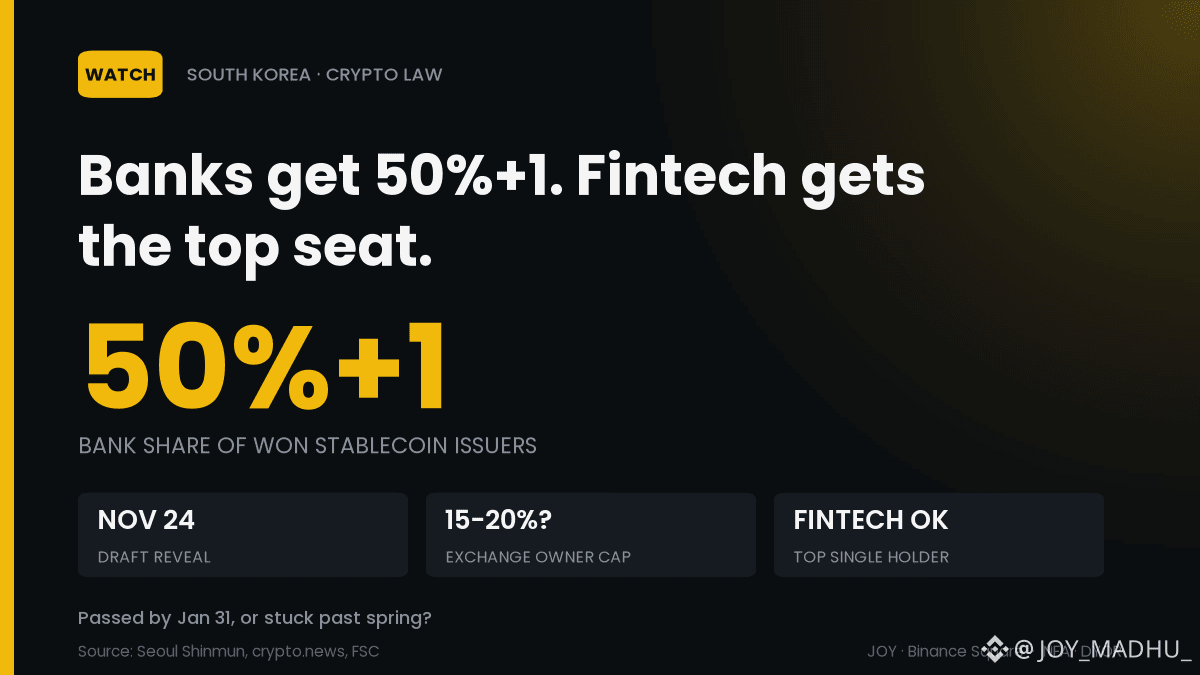
🇰🇷 Banks Get 50%+1, Fintech Gets the Top Seat
Korea's FSC unveils its crypto law draft tomorrow, setting who issues won stablecoins.
📅 FSC crypto committee meets Nov 24, 3 p.m. Seoul time
🏦 Banks to hold 50%+1 share of won stablecoin issuers
📊 A fintech can still be the largest single shareholder
⚠️ Exchange owner cap of 15-20% floated, not final
My read: a real won stablecoin path, but the owner cap is the fight.
Bill passed by Jan 31, or stuck past spring? 👇
$USDT $BTC
#SouthKoreaPlansToReleaseDigitalAssetBasicActDraft #Stablecoins #Korea
28

·
--
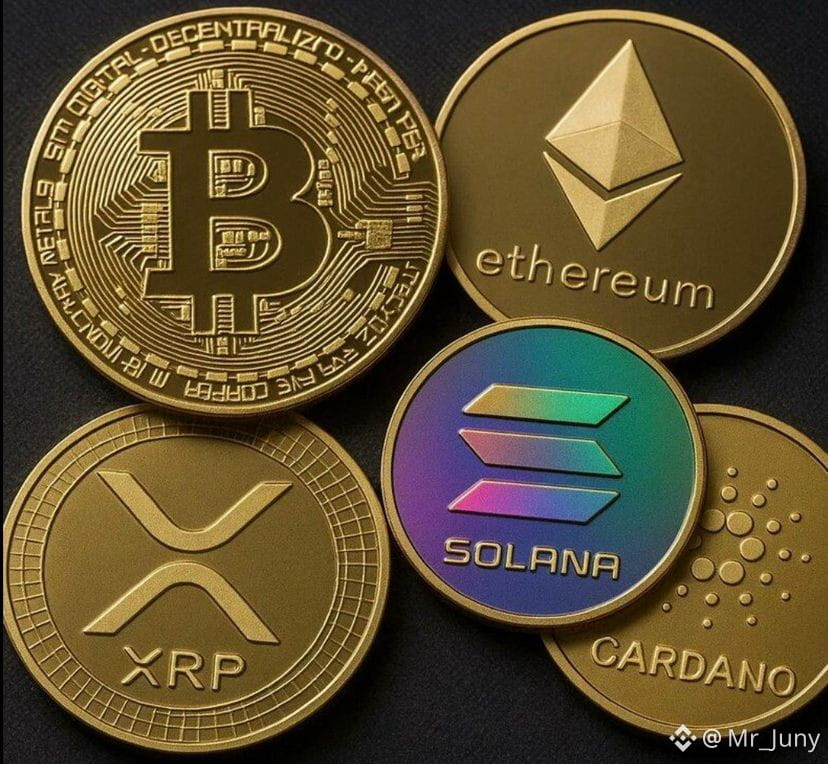
South Korea has just unveiled a digital asset bill stipulating that won stablecoins may only be issued by consortia majority-owned by banks, with minimum equity of 5 billion won (~$3.6 million), reserves of at least 100% of the amount issued, and a commitment to redeem them at par.
At the same time, major shareholders in crypto exchanges would generally be limited to a 20% stake, or up to 34% with FSC approval. Domestic ICOs would be allowed to return if they disclose all required information.
But this is only a bill unveiled by the government; it still has to pass through the National Assembly, and implementing regulations must be issued before it becomes law. The earliest we could see won stablecoins is one year after the law is enacted, not counting the licensing process.
If banks control stablecoins, would they be safer—or would they just become “bank stablecoins,” losing all their decentralized meaning? What do you think?
#stablecoin #Korea #Crypto
100

·
--
South Korea has finally opened the door to won stablecoins — and the rules are stricter than many people expected.
The facts: today, Nov. 24, 2026, South Korea’s financial regulator (FSC) unveiled a draft Digital Asset Basic Act at the 6th Virtual Asset Committee meeting. The key points: initially, won stablecoins may only be issued by consortia in which banks hold a majority stake, with minimum equity capital of 5 billion won (about $3.5 million). Crypto exchange shareholdings are capped at 20 percent in principle, but can reach 34 percent with FSC approval, with a grace period of up to 6 years. Domestic ICOs will be legalized, but issuers must submit a white paper to the FSC before offering tokens to the public. The bill still needs to pass parliament (MoneyToday + 4Pillars, Nov. 24).
My take: this is the most concrete regulatory framework yet from one of the world’s largest retail crypto markets. Banks will be the first gatekeepers for won stablecoins — not fintech companies — and the exchange ownership cap directly targets the structures of Upbit and Bithumb. BTC is around $60,400 as I write this — the market hasn’t reacted much yet, which makes sense: this is a legal framework story, not a price catalyst for today. On the plus side, there’s legal certainty for ICOs and stablecoins; the caveat is that all the implementation details are still awaiting decrees and parliamentary approval.
What I’m watching next: parliamentary debate (with passage targeted for January) and the contents of the implementing decrees — especially when non-bank consortia will be allowed to issue won stablecoins. This is my analysis, not financial advice — always DYOR.
Do you think this kind of bank-led model will be adopted by other countries, or will it slow innovation in local stablecoins?
#Korea #Regulasi $BTC
16
·
--
South Korea is getting more serious about monitoring where crypto goes—and today its regulator reaffirmed that approach.
The facts: Financial Services Commission (FSC) Chairman Lee Eok-won reaffirmed crypto anti-money laundering measures on Nov. 23, 2026 (Crypto Briefing). The background: a bill introduced by lawmaker Kim Hyun-jung on Nov. 15–16 would require exchanges (VASPs) to verify both parties to a transaction and screen counterparties before funds move—including verifying the owners of self-custody wallets. Violations could result in business relationships being terminated, with fines of up to 100 million won (about $72,000). This follows an August 2026 rule that removed the 1 million won threshold for the Travel Rule, making it applicable to all transfers.
My take: this isn’t a ban on self-custody—it’s verification. That distinction matters: personal wallets can still be used, but exchanges must know who owns them before funds leave. For a retail market as large as South Korea’s, the friction is real: withdrawals to personal wallets will require identity confirmation, and transfers to overseas exchanges deemed high-risk by the FIU could be blocked. The bill still needs approval from the National Assembly, so it isn’t law yet.
What I’m watching: the bill’s progress through parliament, the FIU’s classification of overseas exchanges, and the follow-up rules taking effect in February 2027.
What do you think: is verifying personal wallets before transfers a reasonable safeguard, or excessive friction?
This is my analysis, not financial advice—always DYOR.
#RegulasiCrypto #Korea
2
·
--
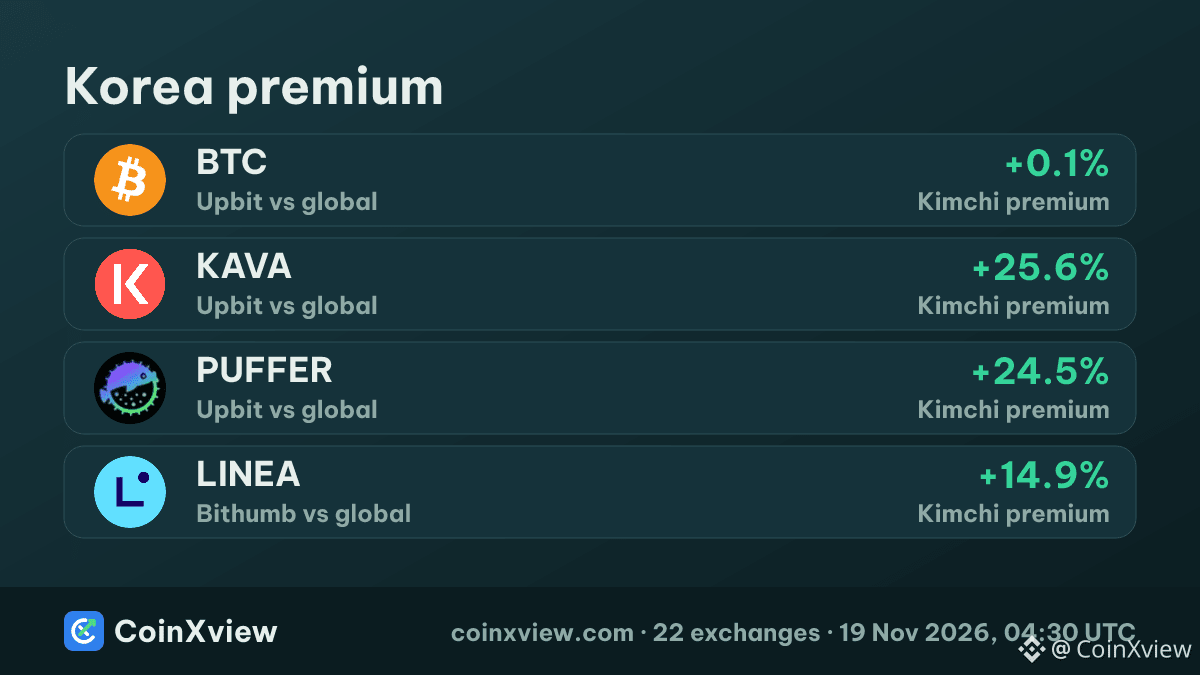
Korean traders pay +0.1% more for $BTC than the rest of the world
$KAVA +25.6% on Upbit
PUFFER +24.5% on Upbit
LINEA +14.9% on Bithumb
Positive premium = Korean buyers paying more than global exchanges.
Is Korean retail back?
#Bitcoin #Korea
Korean traders pay +0.1% more for $BTC than the rest of the world
$KAVA +25.6% on Upbit
PUFFER +24.5% on Upbit
LINEA +14.9% on Bithumb
Positive premium = Korean buyers paying more than global exchanges.
Is Korean retail back?
#Bitcoin #Korea
$KAVA +25.6% on Upbit
PUFFER +24.5% on Upbit
LINEA +14.9% on Bithumb
Positive premium = Korean buyers paying more than global exchanges.
Is Korean retail back?
#Bitcoin #Korea
121

·
--
Korea's Toss is rolling out a non-custodial in-app wallet for its roughly 30 million users: send and receive ETH, USDT and USDC, even to contacts. No Toss fee, only Ethereum gas. #Korea #Ethereum
Korea's Toss is rolling out a non-custodial in-app wallet for its roughly 30 million users: send and receive ETH, USDT and USDC, even to contacts. No Toss fee, only Ethereum gas. #Korea #Ethereum
1
60
·
--
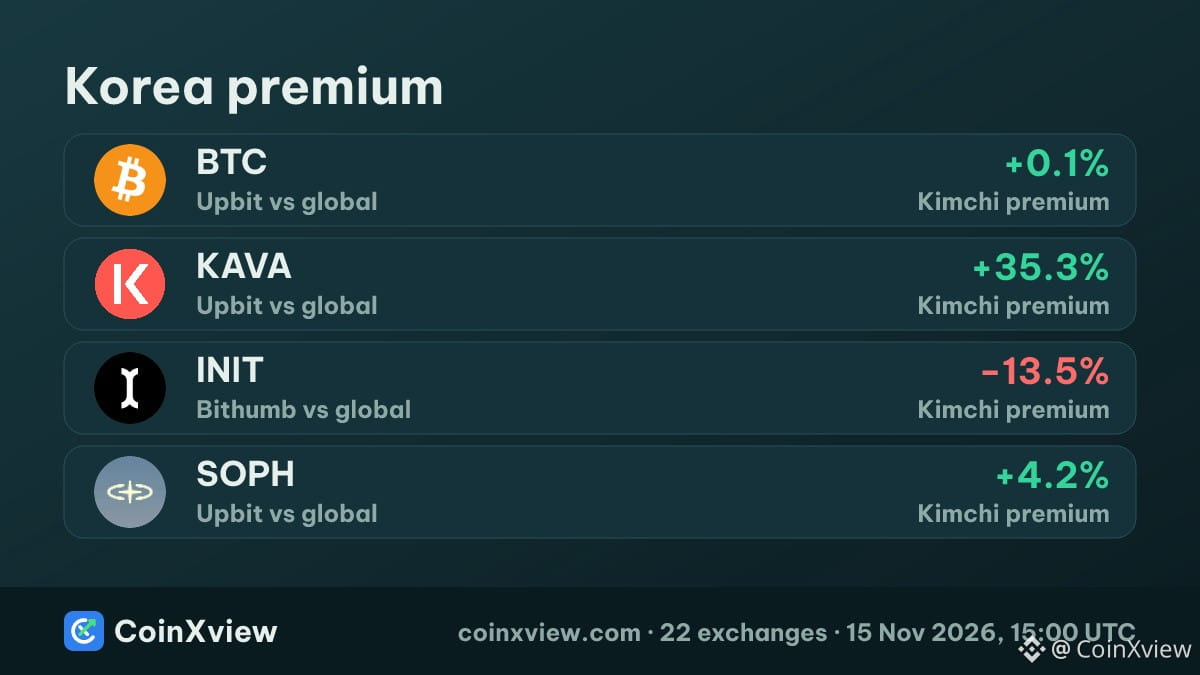
Korean traders pay +0.1% more for $BTC than the rest of the world
$KAVA +35.3% on Upbit
INIT −13.5% on Bithumb
SOPH +4.2% on Upbit
Positive premium = Korean buyers paying more than global exchanges.
Do you follow the Korea premium?
#Bitcoin #Korea
Korean traders pay +0.1% more for $BTC than the rest of the world
$KAVA +35.3% on Upbit
INIT −13.5% on Bithumb
SOPH +4.2% on Upbit
Positive premium = Korean buyers paying more than global exchanges.
Do you follow the Korea premium?
#Bitcoin #Korea
$KAVA +35.3% on Upbit
INIT −13.5% on Bithumb
SOPH +4.2% on Upbit
Positive premium = Korean buyers paying more than global exchanges.
Do you follow the Korea premium?
#Bitcoin #Korea
427


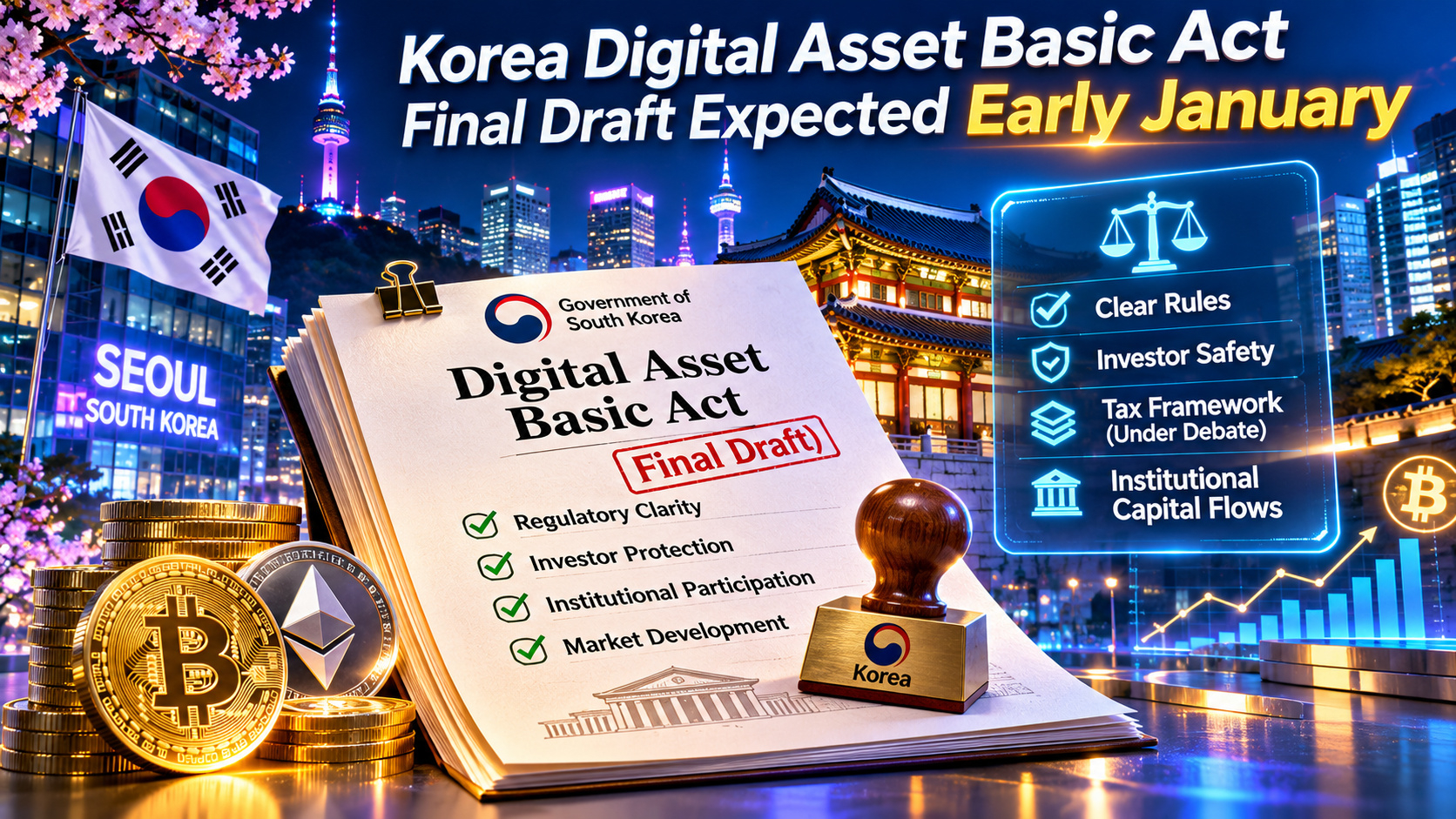
#KoreaDigitalAssetBasicActFinalDraftExpectedEarlyJanuary
🇰🇷 Korea Digital Asset Basic Act Final Draft Expected Early January 📜
In the neon-lit streets of Seoul, a quiet revolution is being drafted behind closed doors. The architects of tomorrow are finally drawing the blueprints for a digital frontier.
South Korea is preparing to unveil the final draft of its Digital Asset Basic Act in early January.
This isn't just another regulatory memo. It represents a fundamental shift from reactive policing to proactive framework building in one of Asia's most active crypto markets.
The primary driver here is regulatory clarity. By establishing clear rules of engagement, the government aims to protect retail investors while fostering institutional capital flows.
When a major economic hub provides legal certainty, it removes the friction that keeps traditional money on the sidelines.
Of course, the true test will be in the enforcement and the specific tax implications, which remain points of heavy debate.
For traders and builders, this signals that the Asian market is maturing into a structured, compliant ecosystem rather than a wild frontier.
The rules of the game are being written, and those who adapt first will hold the ultimate advantage.
How will this new regulatory clarity impact the flow of institutional capital into the broader Asian crypto market?
This article is for educational purposes only and does not constitute financial advice. Always do your own research.
#Korea #CryptoRegulation #GrowWithSAC $SUI $AVAX $NEAR
1
363

·
--
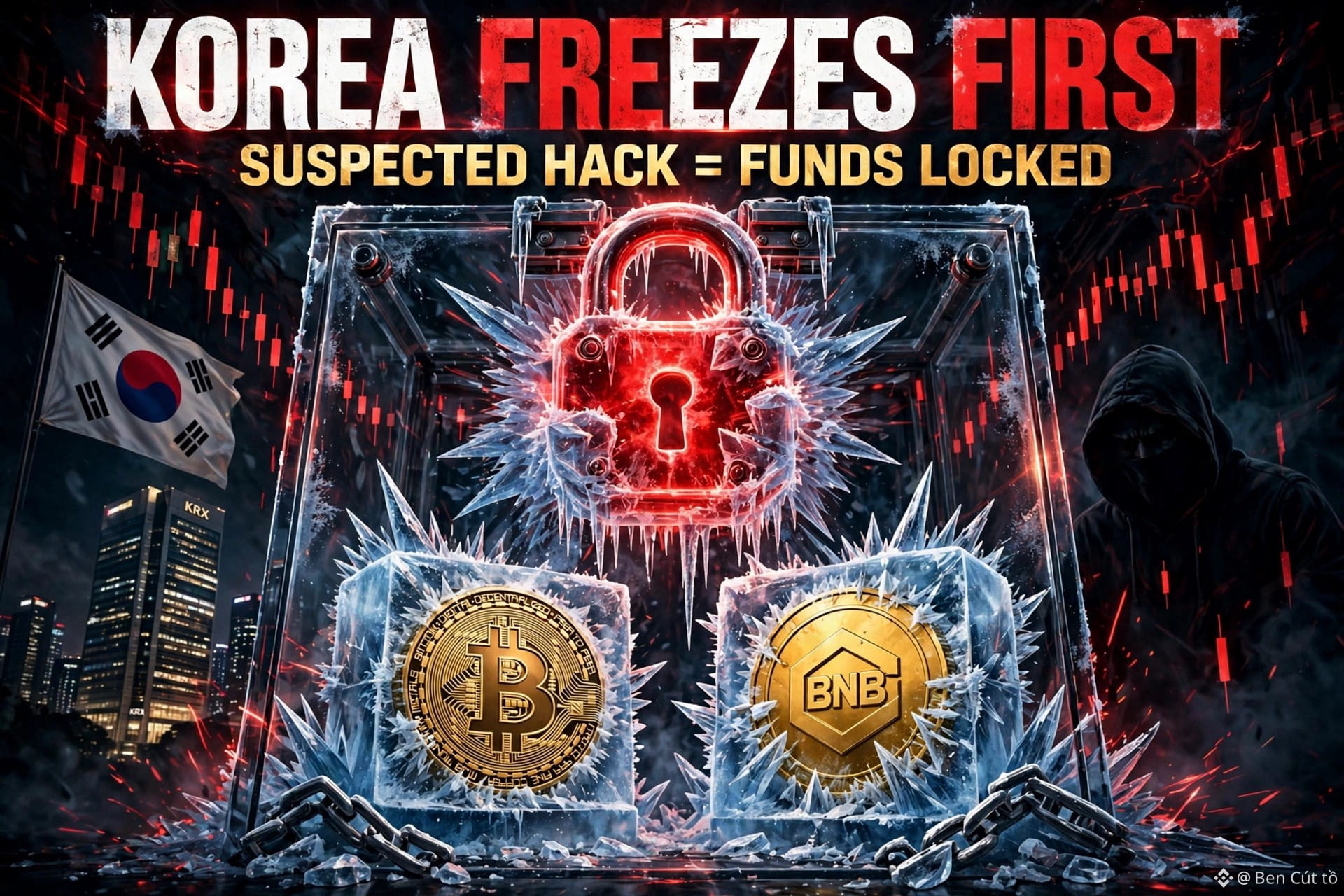
🚨 BREAKING: South Korea has just given crypto exchanges the green light to FREEZE your funds, even if they only SUSPECT a hack—no evidence required!
On 12/11, the Financial Services Commission (FSC) announced that exchanges can block deposits and withdrawals as soon as they detect suspicious transactions. Previously, the law only allowed freezes when a hack had been clearly confirmed.
The reason: the $6.3 billion Binance hack in late October showed that a one-minute delay in blocking transactions can cost billions. GOPAX exchange acted ahead of the curve, freezing all transactions starting on 6/11 over an unverified threat email.
Alongside this, exchanges must monitor activity 24/7 and keep at least 80% of assets in cold wallets. In practice, the industry already holds more than 95% this way.
Does this make things safer, or are your rights being eroded? Meanwhile, BTC is still languishing around $71,400 after yesterday’s drop.
Save this—this law could absolutely spread to other countries!
Follow me—I post about it here first.
$BTC $BNB
#Korea #Binance #Crypto
596
·
--
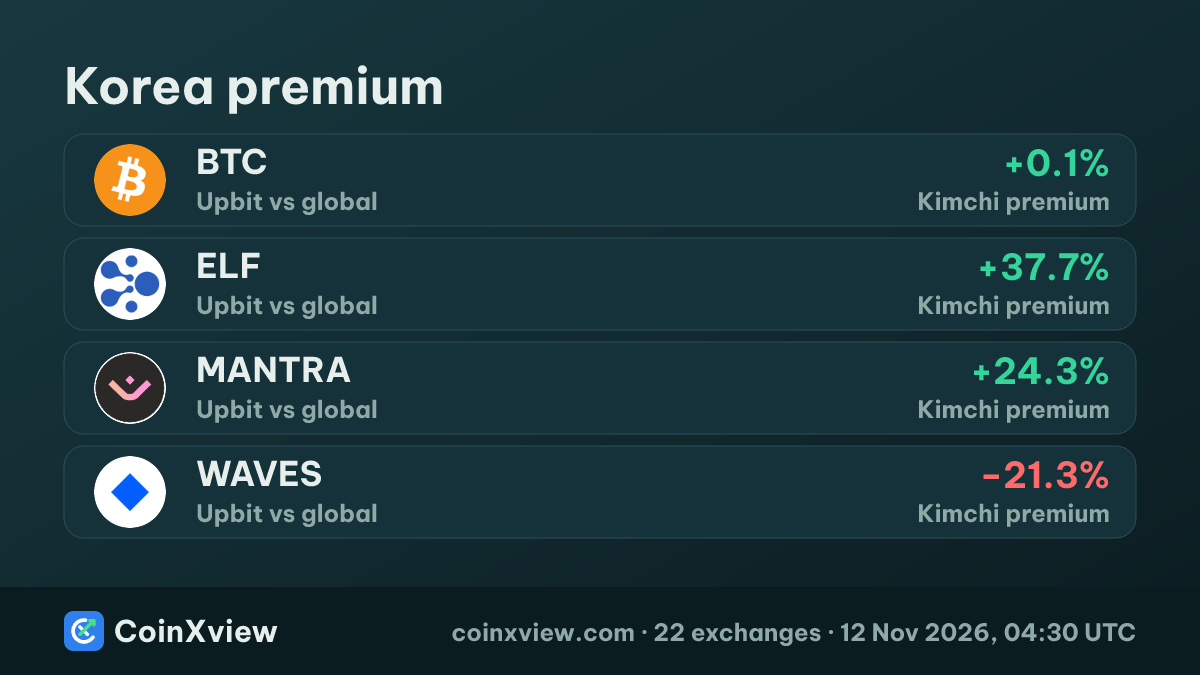
Korean traders pay +0.1% more for $BTC than the rest of the world
$ELF +37.7% on Upbit
MANTRA +24.3% on Upbit
WAVES −21.3% on Upbit
Positive premium = Korean buyers paying more than global exchanges.
Do you follow the Korea premium?
#Bitcoin #Korea
Korean traders pay +0.1% more for $BTC than the rest of the world
$ELF +37.7% on Upbit
MANTRA +24.3% on Upbit
WAVES −21.3% on Upbit
Positive premium = Korean buyers paying more than global exchanges.
Do you follow the Korea premium?
#Bitcoin #Korea
$ELF +37.7% on Upbit
MANTRA +24.3% on Upbit
WAVES −21.3% on Upbit
Positive premium = Korean buyers paying more than global exchanges.
Do you follow the Korea premium?
#Bitcoin #Korea
636
·
--
Korea’s two largest exchanges are listing HYPE today — while the market is still in the red.
The facts: Upbit, South Korea’s largest exchange, is opening HYPE trading today at 15:00 KST (13:00 WIB) in three pairs: Korean won (KRW), BTC, and USDT. Bithumb, the second-largest exchange, is following with a won pair later the same day. Deposits and withdrawals are only available via HyperEVM. Upbit’s reference price is 99,608 won (about $74.03), around 2.4 percent below the previous close — and HYPE is up 0.73 percent over 24 hours, while the overall crypto market cap is down 2.47 percent.
My take: what matters here isn’t just the listing, but the won pair. Korean traders can now buy HYPE directly from their bank accounts without first converting to a stablecoin — and Korea is among the world’s five largest crypto markets by adoption. Ecosystem momentum is building: the Elysium mainnet launched just yesterday. But a listing provides access, not guaranteed demand: HYPE is still below its 50- and 100-day averages, and around two-thirds of its derivatives open interest remains concentrated on Hyperliquid itself. The key question is whether Korean spot volume actually flows in over the next few days.
What I’m watching next: HYPE volume on both Korean exchanges, whether HYPE holds above $74 (currently around $74.16), and U.S. CPI tonight at 20:30 WIB — a market-moving release ahead of the Fed’s December decision.
Do you think this Korean listing is enough to change HYPE’s direction, or is it just a pause in a still-cautious market?
This is my analysis, not financial advice — always DYOR.
#Hyperliquid #Korea $HYPE
103

·
--
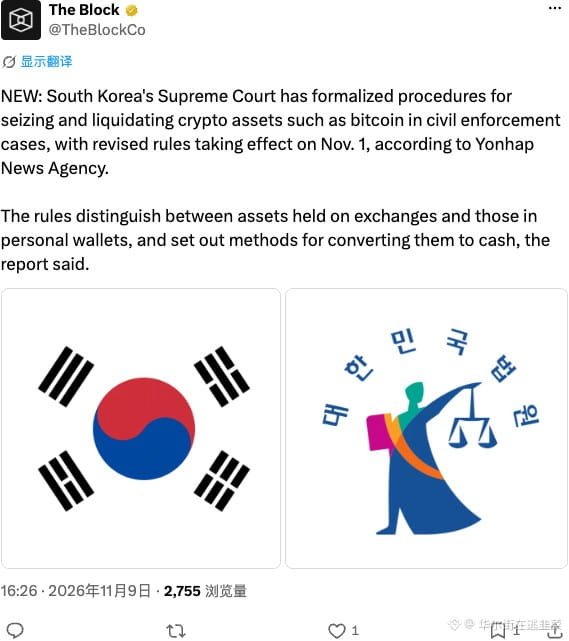
South Korea’s Supreme Court is treating Bitcoin just like any other asset and seizing it. New rules take effect on November 1, requiring funds in both exchange and personal wallets to be liquidated to repay debts. This regulatory crackdown is set to drain liquidity from South Korea once again. Institutions have already fled, while retail investors are still holding on.
$BTC #Korea
$BTC #Korea
10
·
--
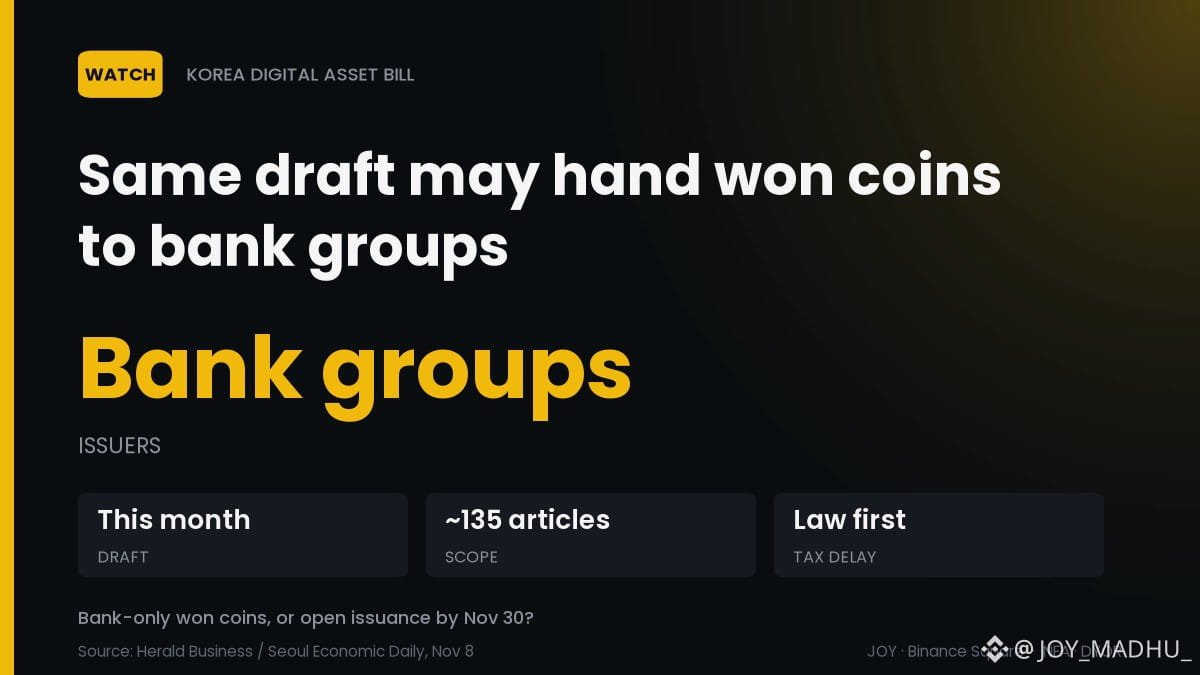
#SouthKoreaDraftLawTargets15To20%ShareholderCap
🏦 The Cap Was Only Half the Draft. Banks May Get Won Coins.
Seoul's bill, due this month, also aims to decide who may issue won stablecoins.
📊 The FSC chair said the bill could run to 135 articles
🏦 Won stablecoins are expected to go through bank-led consortiums
⚠️ Fintechs want in; the FSC and Bank of Korea favor bank groups
📅 The ruling party ties the law to delaying next year's crypto tax
Why it matters: one bill could recast ownership and who issues the won coin.
Bank-only won coins, or open issuance by Nov 30? 👇
$BTC
#SouthKoreaDraftLawTargets15To20%ShareholderCap #Korea #Stablecoins
3
·
--
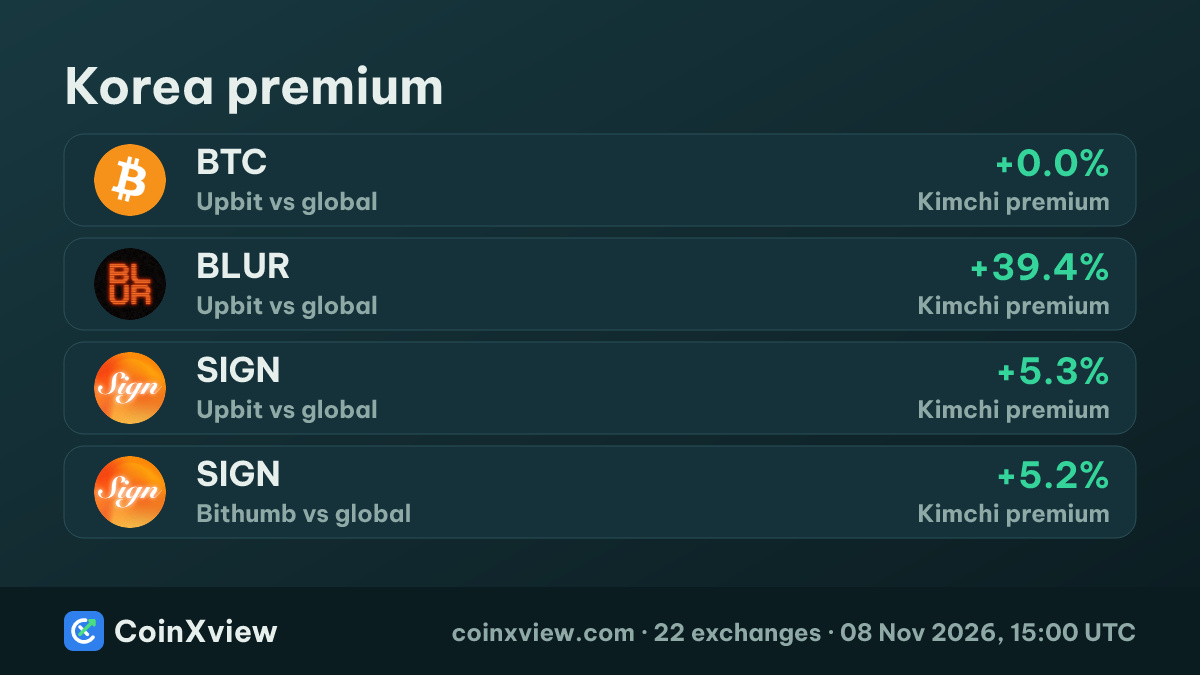
Korean traders pay +0.0% more for $BTC than the rest of the world
$BLUR +39.4% on Upbit
SIGN +5.3% on Upbit
SIGN +5.2% on Bithumb
Positive premium = Korean buyers paying more than global exchanges.
Is Korean retail back?
Follow for daily exchange data.
#Bitcoin #Korea
Korean traders pay +0.0% more for $BTC than the rest of the world
$BLUR +39.4% on Upbit
SIGN +5.3% on Upbit
SIGN +5.2% on Bithumb
Positive premium = Korean buyers paying more than global exchanges.
Is Korean retail back?
Follow for daily exchange data.
#Bitcoin #Korea
$BLUR +39.4% on Upbit
SIGN +5.3% on Upbit
SIGN +5.2% on Bithumb
Positive premium = Korean buyers paying more than global exchanges.
Is Korean retail back?
Follow for daily exchange data.
#Bitcoin #Korea
690
·
--
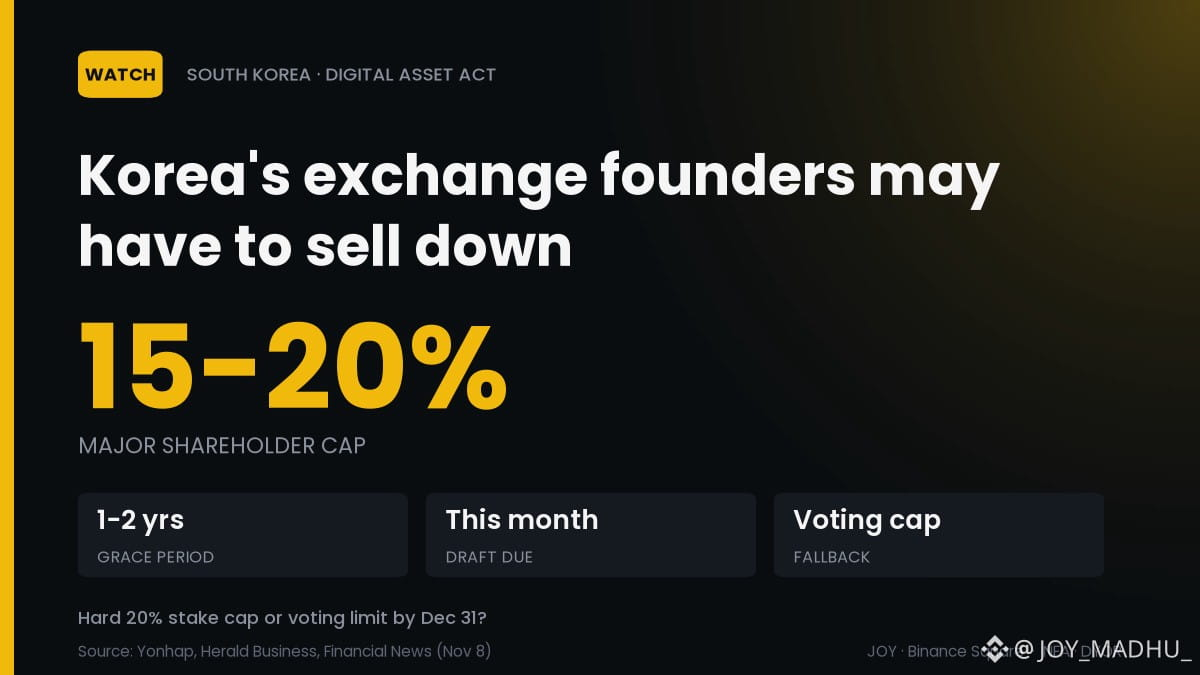
#SouthKoreaDraftLawTargets15To20%ShareholderCap
🇰🇷 Korea's Exchange Founders May Have to Sell Down to 20%
Seoul's crypto framework bill is due this month, and the fight is how much of an exchange one owner may keep.
📊 Likely cap: 15-20% per major shareholder
📅 Existing exchanges may get 1-2 years to comply
🏦 Registration would become a full license
⚠️ Industry cites property rights; a voting cap is the fallback
The catch: nothing is final, and lawmakers can rewrite the cap.
Hard 20% stake cap or voting limit by Dec 31? 👇
$BTC
#SouthKoreaDraftLawTargets15To20%ShareholderCap #Korea #CryptoRegulation
11
·
--
South Korea postpones its 22% crypto income tax again — start date pushed to 2029 (4th delay). Govt cites US tax-data exchange timing and new digital-asset rules. #Crypto #Korea
South Korea postpones its 22% crypto income tax again — start date pushed to 2029 (4th delay). Govt cites US tax-data exchange timing and new digital-asset rules. #Crypto #Korea
72
·
--
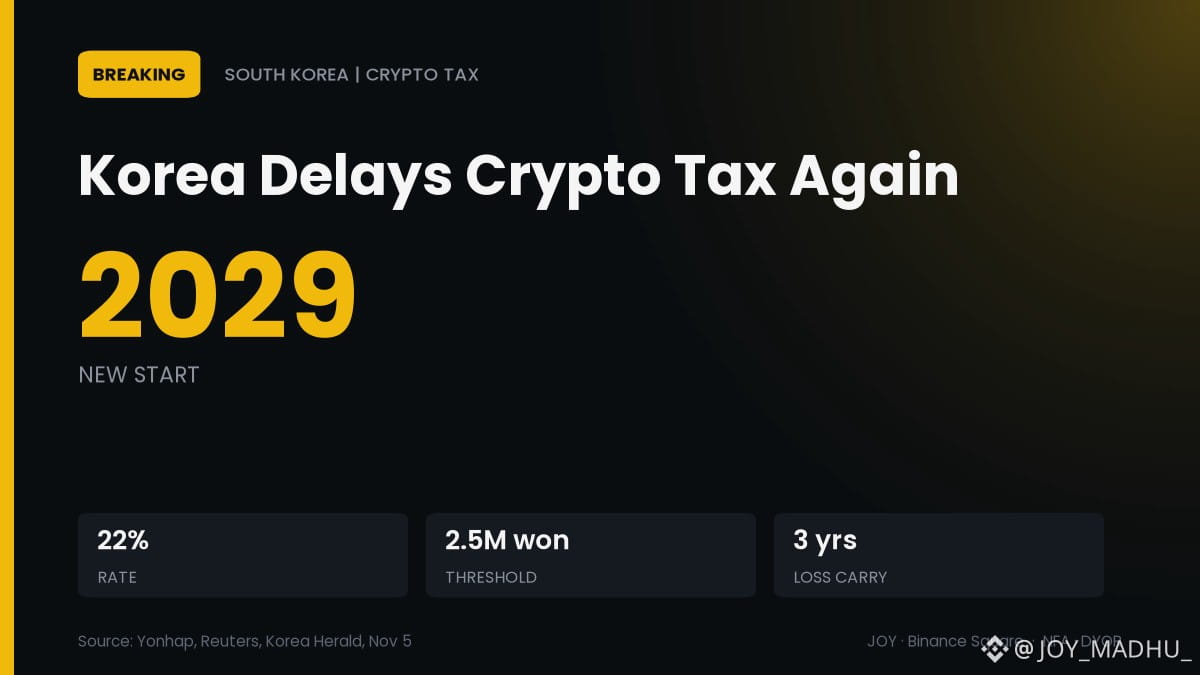
#SouthKoreaSeeksCryptoTaxDelayUntil2029
⏳ Korea's Crypto Tax Slips a 4th Time, Now to 2029
Seoul formally asked for a two-year delay today and added a loss carryforward for traders.
📅 Start moves from Jan 2027 to 2029, pending an Assembly vote
📊 22% rate (incl. local tax) on gains above 2.5M won (~$1,869)
📉 New: losses carry forward 3 years, offsetting gains through 2032
🏦 Reason: US crypto data sharing only starts in 2029
Watch next: the Assembly must amend the Income Tax Act before January.
Tax start: 2029 delay passes, or Jan 1, 2027 stands? 👇
$BTC
#Korea #CryptoTax #SouthKoreaSeeksCryptoTaxDelayUntil2029
42
Log in to explore more content
Join global crypto users on Binance Square
⚡️ Get latest and useful information about crypto.
💬 Trusted by the world’s largest crypto exchange.
👍 Discover real insights from verified creators.
Email / Phone number
Trending Topics
1
#BitcoinAndStocksSlipAgainAmidTrump’sTariffPlans
11,592 views
228 Discussing
2
#JensenHuangSaysNvidiaDoesn’tNeedASuccessionPlan
10,519 views
163 Discussing
3
#AnthropicBreaksBelowIPOPriceAmidAISlump
102,616 views
930 Discussing
4
#FidelityCryptoAddsAAVELINKAndUNITrading
1,034 views
41 Discussing
5
#UKToBanExchangesMakingMarketsOnOwnPlatforms
787 views
34 Discussing
6
#CFTCApprovesTradeReportingRuleForPredictionMarkets
8,924 views
122 Discussing
7
#Bitcoin'sReboundFadesBelow$60K
161,141 views
442 Discussing
8
#WillMarketsStageAThanksgivingReliefRally?
695,645 views
3,743 Discussing
9
#EthereumFoundationPlansShiftToHashBasedSignaturesBy2028
7,455 views
148 Discussing
10
#ADPWeeklyPrivatePayrollsSlowTo21000
22,099 views
343 Discussing