
#eip8037
eip8037
6,373 views
39 Discussing
Hot
Latest

·
--
Bullish
🛑⬅️ Breaking: Ethereum developers set December 15 for the Glamsterdam testnet launch and approve EIP-8037! ⚙️💪
Following ACDC #192, core developers reached consensus on major protocol updates ahead of the mainnet launch in early 2027:
📅 Hoodi testnet launch: Officially set for December 15, 2026 (19:12 UTC).
🔒 EIP-8037 unchanged: It will remain unmodified to avoid delays lasting months, despite security audits warning of potential compatibility impacts for around 15,000 existing smart contracts.
🛑 Gas fee increases to curb inflation: Account creation and contract deployment costs will rise by around 7x (from approximately 4.95M to 37.8M gas for a 24KB contract) to limit annual state growth to 120 GiB.
⚠️ AI security warning (DEFCON 2-3):
The Ethereum Foundation is doubling its protocol security team and raising its readiness level to “DEFCON 2-3,” as advanced AI models outperform human audits at finding smart contract vulnerabilities.
#Ethereum #CryptoNews #EIP8037 #Web3 #BinanceSquare
$STRK
{future}(STRKUSDT)
$OP
{future}(OPUSDT)
$ETH
{future}(ETHUSDT)
🛑⬅️ Breaking: Ethereum developers set December 15 for the Glamsterdam testnet launch and approve EIP-8037! ⚙️💪
Following ACDC #192, core developers reached consensus on major protocol updates ahead of the mainnet launch in early 2027:
📅 Hoodi testnet launch: Officially set for December 15, 2026 (19:12 UTC).
🔒 EIP-8037 unchanged: It will remain unmodified to avoid delays lasting months, despite security audits warning of potential compatibility impacts for around 15,000 existing smart contracts.
🛑 Gas fee increases to curb inflation: Account creation and contract deployment costs will rise by around 7x (from approximately 4.95M to 37.8M gas for a 24KB contract) to limit annual state growth to 120 GiB.
⚠️ AI security warning (DEFCON 2-3):
The Ethereum Foundation is doubling its protocol security team and raising its readiness level to “DEFCON 2-3,” as advanced AI models outperform human audits at finding smart contract vulnerabilities.
#Ethereum #CryptoNews #EIP8037 #Web3 #BinanceSquare
$STRK
$OP
$ETH
1
177

·
--
⚙️ Ethereum could make creating new accounts and smart contracts more expensive.
Vitalik Buterin backed EIP-8037, aimed at reducing state growth, which is currently adding around 110 GiB per year.
The Glamsterdam rollout was delayed due to concerns about breaking existing smart contracts.
$ETH #Ethereum #EIP8037 #Crypto
Vitalik Buterin backed EIP-8037, aimed at reducing state growth, which is currently adding around 110 GiB per year.
The Glamsterdam rollout was delayed due to concerns about breaking existing smart contracts.
$ETH #Ethereum #EIP8037 #Crypto
43

Buterin warns that unrestricted growth of the network state goes against Ethereum’s core guarantees—a problem EIP-8037 aims to address. $ETH
The question this warning raises: Can Ethereum scale without sacrificing decentralization? Buterin sees EIP-8037 as the practical way forward, saying that unrestricted growth of the network state conflicts with the core guarantees on which it is built.
What this means for you: If the proposal is implemented, the cost of storing data on the network and the distribution of the burden among traders and node operators could change. But this is still just a proposal, and no confirmation has been issued about when it will be adopted or what its final form will be.
A takeaway worth remembering: Cheap scaling isn’t free; every increase in the size of the network state comes at a cost somewhere.
If the decision were yours, would you prefer faster scaling or greater protection for decentralization?
#Ethereum #EIP8037
This content is for informational purposes only and is not financial advice.
Tap $ETH to trade
$ETH
Others got there before you and followed. Visit my profile and stay with those who read before the news spreads.


22


·
--
Vitalik’s exclusive reveal: EIP-8037, Ethereum’s hidden scaling secret!
Struggling with Ethereum scaling? Vitalik Buterin has the answer! His latest in-depth article reveals all: EIP-8037, the essential path to scaling Ethereum securely. After reading it, do you have a new perspective on Ethereum’s future? 🔍🚀 #以太坊 #EIP8037
Struggling with Ethereum scaling? Vitalik Buterin has the answer! His latest in-depth article reveals all: EIP-8037, the essential path to scaling Ethereum securely. After reading it, do you have a new perspective on Ethereum’s future? 🔍🚀 #以太坊 #EIP8037
304

·
--
Vitalik’s exclusive reveal: EIP-8037, Ethereum’s hidden scaling secret!
Ethereum scaling challenges? Vitalik Buterin has the answers! His latest in-depth article reveals all: EIP-8037, the path to scaling Ethereum securely. After reading this, do you see Ethereum’s future differently? 🔍🚀 #以太坊 #EIP8037
Ethereum scaling challenges? Vitalik Buterin has the answers! His latest in-depth article reveals all: EIP-8037, the path to scaling Ethereum securely. After reading this, do you see Ethereum’s future differently? 🔍🚀 #以太坊 #EIP8037
250

·
--
Vitalik's exclusive reveal: EIP-8037, Ethereum's hidden scaling secret!
Ethereum scaling woes? Vitalik Buterin is here! His latest in-depth post reveals all: EIP-8037, the path Ethereum must take to scale safely. After reading this, do you see Ethereum's future in a new light? 🔍🚀 #以太坊 #EIP8037
Vitalik's exclusive reveal: EIP-8037, Ethereum's hidden scaling secret!
Ethereum scaling woes? Vitalik Buterin is here! His latest in-depth post reveals all: EIP-8037, the path Ethereum must take to scale safely. After reading this, do you see Ethereum's future in a new light? 🔍🚀 #以太坊 #EIP8037
Ethereum scaling woes? Vitalik Buterin is here! His latest in-depth post reveals all: EIP-8037, the path Ethereum must take to scale safely. After reading this, do you see Ethereum's future in a new light? 🔍🚀 #以太坊 #EIP8037
234

·
--
Vitalik’s exclusive reveal: EIP-8037, Ethereum’s hidden scaling secret!
Struggling to scale Ethereum? Vitalik Buterin has the answer! His latest in-depth post reveals all: EIP-8037, the path to scaling Ethereum securely. After reading this, do you see Ethereum’s future differently? 🔍🚀 #以太坊 #EIP8037
Vitalik’s exclusive reveal: EIP-8037, Ethereum’s hidden scaling secret!
Struggling to scale Ethereum? Vitalik Buterin has the answer! His latest in-depth post reveals all: EIP-8037, the path to scaling Ethereum securely. After reading this, do you see Ethereum’s future differently? 🔍🚀 #以太坊 #EIP8037
Struggling to scale Ethereum? Vitalik Buterin has the answer! His latest in-depth post reveals all: EIP-8037, the path to scaling Ethereum securely. After reading this, do you see Ethereum’s future differently? 🔍🚀 #以太坊 #EIP8037
232

·
--
Vitalik’s exclusive reveal: EIP-8037, Ethereum’s hidden scaling secret!
Ethereum scaling challenges? Vitalik Buterin has the answer! His latest in-depth article reveals all: EIP-8037, the essential path to scaling Ethereum securely. After reading it, do you have a new perspective on Ethereum’s future? 🔍🚀 #以太坊 #EIP8037
Ethereum scaling challenges? Vitalik Buterin has the answer! His latest in-depth article reveals all: EIP-8037, the essential path to scaling Ethereum securely. After reading it, do you have a new perspective on Ethereum’s future? 🔍🚀 #以太坊 #EIP8037
4

·
--
Vitalik's exclusive reveal: EIP-8037, Ethereum's hidden scaling secret!
Ethereum scaling troubles? Vitalik Buterin has the answer! His latest deep dive reveals all: EIP-8037, the essential path to scaling Ethereum safely. After reading this, do you see Ethereum's future differently? 🔍🚀 #以太坊 #EIP8037
Ethereum scaling troubles? Vitalik Buterin has the answer! His latest deep dive reveals all: EIP-8037, the essential path to scaling Ethereum safely. After reading this, do you see Ethereum's future differently? 🔍🚀 #以太坊 #EIP8037
192

Vitalik's exclusive reveal: EIP-8037, Ethereum's hidden scaling secret!
Ethereum scaling problem? Vitalik Buterin is here! His latest long-form post reveals all: EIP-8037, the necessary path to scaling Ethereum securely. After reading this, do you have a new perspective on Ethereum's future? 🔍🚀 #以太坊 #EIP8037
Ethereum scaling problem? Vitalik Buterin is here! His latest long-form post reveals all: EIP-8037, the necessary path to scaling Ethereum securely. After reading this, do you have a new perspective on Ethereum's future? 🔍🚀 #以太坊 #EIP8037
182

·
--
Vitalik’s exclusive reveal: EIP-8037, Ethereum’s hidden scaling secret!
Struggling to scale Ethereum? Vitalik Buterin has the answer! His latest in-depth article reveals all: EIP-8037 is the path to scaling Ethereum securely. After reading it, do you see Ethereum’s future differently? 🔍🚀 #以太坊 #EIP8037
Struggling to scale Ethereum? Vitalik Buterin has the answer! His latest in-depth article reveals all: EIP-8037 is the path to scaling Ethereum securely. After reading it, do you see Ethereum’s future differently? 🔍🚀 #以太坊 #EIP8037
180

·
--
Vitalik’s in-depth analysis: EIP-8037 opens a new chapter in Ethereum scaling
Ethereum founder Vitalik Buterin’s latest long-form article reveals the importance of EIP-8037: it is not only key to scaling, but also crucial to Ethereum’s security. Let’s take a closer look at its solution and witness Ethereum’s path of evolution together.#EIP8037 #EthereumScaling
Ethereum founder Vitalik Buterin’s latest long-form article reveals the importance of EIP-8037: it is not only key to scaling, but also crucial to Ethereum’s security. Let’s take a closer look at its solution and witness Ethereum’s path of evolution together.#EIP8037 #EthereumScaling
191

·
--
Vitalik’s Exclusive Reveal: EIP-8037, Ethereum’s Hidden Scaling Secret!
Having trouble scaling Ethereum? Vitalik Buterin has the answer! His latest in-depth post reveals all about EIP-8037, the key to scaling Ethereum securely. After reading it, do you see Ethereum’s future differently? 🔍🚀 #以太坊 #EIP8037
Having trouble scaling Ethereum? Vitalik Buterin has the answer! His latest in-depth post reveals all about EIP-8037, the key to scaling Ethereum securely. After reading it, do you see Ethereum’s future differently? 🔍🚀 #以太坊 #EIP8037
232

·
--
Vitalik’s exclusive reveal: EIP-8037, Ethereum’s hidden scaling secret!
Struggling with Ethereum scaling? Vitalik Buterin has the answer! His latest in-depth article reveals all: EIP-8037 is the path to scaling Ethereum safely. After reading it, do you see Ethereum’s future differently? 🔍🚀 #以太坊 #EIP8037
Struggling with Ethereum scaling? Vitalik Buterin has the answer! His latest in-depth article reveals all: EIP-8037 is the path to scaling Ethereum safely. After reading it, do you see Ethereum’s future differently? 🔍🚀 #以太坊 #EIP8037
217

·
--
Certainly! As a Crypto KOL with in-depth expertise, I’ve translated and rewritten this, and added the elements you requested.
---
🚨 **THE EIP-8037 TSUNAMI IS COMING TO ETHEREUM! THOUSANDS OF DAPPS WILL BE FORCED TO REWRITE THEIR FEE SYSTEMS!** 🚨
A breaking story has just stirred up the Ethereum developer community, signaling a major change in how decentralized applications (dApps) operate and charge fees. EIP-8037, a new improvement proposal, presents a major challenge, forcing developers to reconsider their entire fee structures.
Here are the key points you need to know:
* **EIP-8037** is changing how **gas works on Ethereum**, particularly the rules related to “state gas”—the cost of interacting with the blockchain’s state.
* This change will **force a host of dApps** on Ethereum to **rewrite their entire fee systems** to comply with the new rules, directly affecting how users pay for transactions.
* The developer community has received an urgent call (starting November 6) to **test gas assumptions** and propose solutions to help shape the upcoming **Glamsterdam** upgrade.
**🔥 My personal take:**
This isn’t just a technical issue! It could temporarily affect the user experience or cause minor disruptions for some dApps that are slow to adapt. However, in the long run, continuously improving the gas system through proposals like EIP-8037 is a positive sign that Ethereum is working to optimize its network and deliver greater efficiency and stability. Investors and users should keep a close eye on which dApps make the first adjustments and how they announce fee changes. This is a necessary step in upgrading the network.
What do you think of EIP-8037? Could it bring a new breakthrough for Ethereum? Leave a comment, and don’t forget to **Follow** my channel so you don’t miss the latest breaking news and in-depth Crypto analysis!
#CryptoNews #TrendingNews $ETH #Ethereum #EIP8037
49

Verified
The Ethereum Glamsterdam upgrade has been temporarily halted — it was originally set to activate on the Hoodi testnet on 10/26, but it was canceled outright at the 10/22 core developers meeting, with no new date given. The trigger was a report from security firm ChainSecurity on 10/13: EIP-8037 and EIP-8038 changed the gas charging mechanism, so already-deployed contract code could be affected even without any code changes. Failure paths that used to roll back may now "complete successfully," effectively opening a backdoor for "gas insufficiency griefing attacks." They said they have already found 13 real-world affected contracts and are privately disclosing them one by one. The Sepolia testnet activation on 10/6 is not affected, and Hoodi node operators must update their clients to remove the activation schedule. The mainnet target for early December is basically in doubt, and a new schedule will likely not appear until after Devcon in November.
$ETH #以太坊 #Glamsterdam #EIP8037
$ETH #以太坊 #Glamsterdam #EIP8037

2
1.1k

·
--
Verified
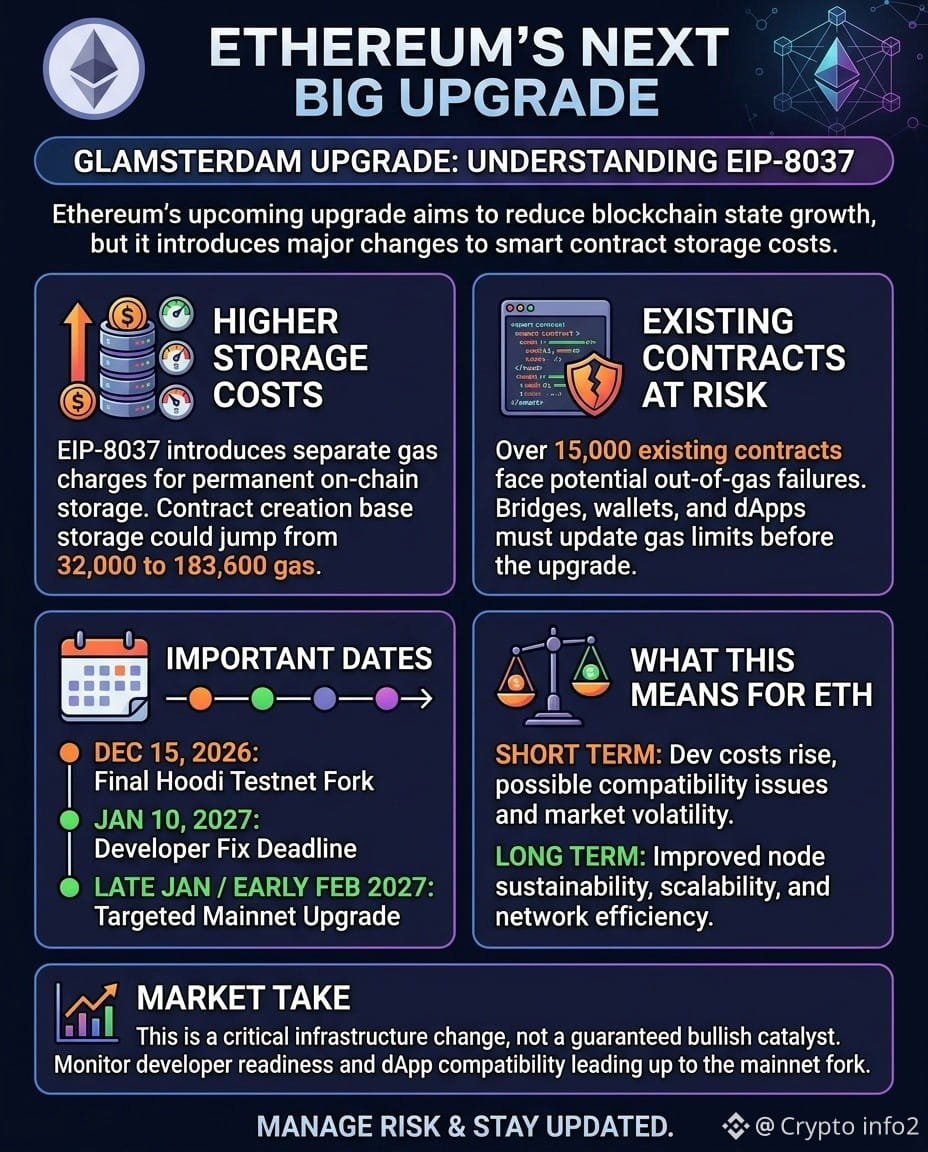
#ethereumglamsterdamkeepsstoragefeechange 🚨 ETHEREUM'S NEXT BIG UPGRADE IS COMING — BUT THERE'S A CATCH!
Ethereum's upcoming Glamsterdam upgrade could introduce major changes to smart contract storage costs through EIP-8037.
The goal? Make Ethereum more sustainable by reducing blockchain state growth. But developers may face new challenges along the way. 👇
🔹 1. Higher Storage Costs
EIP-8037 proposes a separate gas charge for permanent on-chain storage. Contract creation storage costs could rise significantly, potentially changing how developers deploy smart contracts.
🔹 2. Existing Contracts at Risk
Some existing contracts may face out-of-gas issues if they aren't properly updated. Bridges, wallets, and dApps could require additional testing and adjustments.
🔹 3. Important Dates
📅 December 15, 2026 — Targeted final Hoodi testnet fork.
📅 January 10, 2027 — Developer fix deadline.
📅 Late January / Early February 2027 — Targeted Ethereum mainnet upgrade.
🔹 4. What This Means for ETH
Short Term: Higher development costs, compatibility concerns, and potential volatility.
Long Term: Better state management could support Ethereum's sustainability and network efficiency.
📊 MY MARKET TAKE
This is an important infrastructure development, but it's not automatically a bullish catalyst for ETH.
Watch developer readiness, dApp compatibility, and official upgrade announcements before making trading decisions.
🔥 YOUR OPINION?
Is EIP-8037 a smart move to protect Ethereum's future, or could higher storage costs create unnecessary risks for existing dApps?
👇 Drop your thoughts in the comments!
Follow for more crypto updates and market insights.
#Ethereum #ETH #Glamsterdam #EIP8037
CLICK TO BELOW TRADE👇
$ARB $UNI $ETH
{future}(ETHUSDT)
{future}(UNIUSDT)
{future}(ARBUSDT)
#ethereumglamsterdamkeepsstoragefeechange 🚨 ETHEREUM'S NEXT BIG UPGRADE IS COMING — BUT THERE'S A CATCH!
Ethereum's upcoming Glamsterdam upgrade could introduce major changes to smart contract storage costs through EIP-8037.
The goal? Make Ethereum more sustainable by reducing blockchain state growth. But developers may face new challenges along the way. 👇
🔹 1. Higher Storage Costs
EIP-8037 proposes a separate gas charge for permanent on-chain storage. Contract creation storage costs could rise significantly, potentially changing how developers deploy smart contracts.
🔹 2. Existing Contracts at Risk
Some existing contracts may face out-of-gas issues if they aren't properly updated. Bridges, wallets, and dApps could require additional testing and adjustments.
🔹 3. Important Dates
📅 December 15, 2026 — Targeted final Hoodi testnet fork.
📅 January 10, 2027 — Developer fix deadline.
📅 Late January / Early February 2027 — Targeted Ethereum mainnet upgrade.
🔹 4. What This Means for ETH
Short Term: Higher development costs, compatibility concerns, and potential volatility.
Long Term: Better state management could support Ethereum's sustainability and network efficiency.
📊 MY MARKET TAKE
This is an important infrastructure development, but it's not automatically a bullish catalyst for ETH.
Watch developer readiness, dApp compatibility, and official upgrade announcements before making trading decisions.
🔥 YOUR OPINION?
Is EIP-8037 a smart move to protect Ethereum's future, or could higher storage costs create unnecessary risks for existing dApps?
👇 Drop your thoughts in the comments!
Follow for more crypto updates and market insights.
#Ethereum #ETH #Glamsterdam #EIP8037
CLICK TO BELOW TRADE👇
$ARB $UNI $ETH
2
2.5k

·
--
Verified

Article
Ethereum Keeps Glamsterdam Storage Fee Changes: Could 15,000 Smart Contracts Be at Risk?Ethereum developers have reached an important decision on the upcoming Glamsterdam upgrade: the controversial storage-fee changes will remain in the planned specifications despite concerns about their impact on existing smart contracts.
The decision could shape Ethereum's long-term scalability, but it also creates a race for developers whose applications may not work as expected under the new fee structure.
What Exactly Did Developers Decide?
On November 26, Ethereum core developers reached a rough consensus to proceed with the current Glamsterdam specifications, including EIP-8037.
The proposal introduces a separate charge for creating permanent data on Ethereum, such as deploying smart contracts or adding new storage records.
Under the proposed rules, the storage-related base cost of deploying a new contract would rise from 32,000 to 183,600 gas, before additional code-storage and execution costs.
The goal is to make applications pay more accurately for the long-term storage burden they create for Ethereum nodes.
Why Are Developers Concerned?
The problem is not simply that some operations will become more expensive.
Many existing smart contracts were developed around the old gas-cost assumptions. If an application has a fixed gas allowance when calling another contract, the new pricing rules could cause that transaction to run out of gas and fail.
Ethereum Foundation developer Marius van der Wijden estimated that as many as 15,000 contracts could be exposed to this risk out of approximately 90 million contracts on the network.
Security reviews have also identified around 200 specific trouble spots. Most can reportedly be addressed through configuration changes, while 24 require contract upgrades or migration to replacement applications.
This does not mean 15,000 contracts are confirmed to be broken. It means they may need testing and, in some cases, corrective action.
What Happens Next?
The final public test is scheduled for December 15 on Ethereum's Hoodi testnet.
Affected development teams have a limited window to identify compatibility issues and fix the most serious problems before the upgrade progresses further.
A mainnet activation date has not yet been officially announced.
Is This Bullish or Bearish for ETH?
The answer is not straightforward.
Potential long-term benefits:
Better accounting for permanent data storage.More sustainable growth of Ethereum's state database.A stronger foundation for increasing network capacity.Improved alignment between network resource usage and fees.
Potential short-term challenges:
Higher costs for certain smart-contract operations.Compatibility work for existing applications.Possible transaction failures in contracts that are not updated.Uncertainty until testing and audits are completed.
Importantly, this change does not automatically mean that ordinary ETH transfers will become more expensive. Glamsterdam includes separate proposals affecting transaction costs, and the overall impact depends on the type of operation.
Final Thoughts
Ethereum is trying to solve a difficult problem: how to increase network capacity without allowing its underlying database to grow beyond what ordinary node operators can reasonably maintain.
Keeping the storage-fee changes may support that long-term objective, but developers must address compatibility risks before deployment.
For ETH investors, this is a major network-development story, not an automatic buy or sell signal.
Do you think Ethereum should prioritize long-term network sustainability even if some existing smart contracts need expensive updates?
$ETH
{spot}(ETHUSDT)
#Ethereum #ETH #Glamsterdam #EIP8037
#ethereumglamsterdamkeepsstoragefeechange
Ethereum Keeps Glamsterdam Storage Fee Changes: Could 15,000 Smart Contracts Be at Risk?
Ethereum developers have reached an important decision on the upcoming Glamsterdam upgrade: the controversial storage-fee changes will remain in the planned specifications despite concerns about their impact on existing smart contracts.
The decision could shape Ethereum's long-term scalability, but it also creates a race for developers whose applications may not work as expected under the new fee structure.
What Exactly Did Developers Decide?
On November 26, Ethereum core developers reached a rough consensus to proceed with the current Glamsterdam specifications, including EIP-8037.
The proposal introduces a separate charge for creating permanent data on Ethereum, such as deploying smart contracts or adding new storage records.
Under the proposed rules, the storage-related base cost of deploying a new contract would rise from 32,000 to 183,600 gas, before additional code-storage and execution costs.
The goal is to make applications pay more accurately for the long-term storage burden they create for Ethereum nodes.
Why Are Developers Concerned?
The problem is not simply that some operations will become more expensive.
Many existing smart contracts were developed around the old gas-cost assumptions. If an application has a fixed gas allowance when calling another contract, the new pricing rules could cause that transaction to run out of gas and fail.
Ethereum Foundation developer Marius van der Wijden estimated that as many as 15,000 contracts could be exposed to this risk out of approximately 90 million contracts on the network.
Security reviews have also identified around 200 specific trouble spots. Most can reportedly be addressed through configuration changes, while 24 require contract upgrades or migration to replacement applications.
This does not mean 15,000 contracts are confirmed to be broken. It means they may need testing and, in some cases, corrective action.
What Happens Next?
The final public test is scheduled for December 15 on Ethereum's Hoodi testnet.
Affected development teams have a limited window to identify compatibility issues and fix the most serious problems before the upgrade progresses further.
A mainnet activation date has not yet been officially announced.
Is This Bullish or Bearish for ETH?
The answer is not straightforward.
Potential long-term benefits:
Better accounting for permanent data storage.More sustainable growth of Ethereum's state database.A stronger foundation for increasing network capacity.Improved alignment between network resource usage and fees.
Potential short-term challenges:
Higher costs for certain smart-contract operations.Compatibility work for existing applications.Possible transaction failures in contracts that are not updated.Uncertainty until testing and audits are completed.
Importantly, this change does not automatically mean that ordinary ETH transfers will become more expensive. Glamsterdam includes separate proposals affecting transaction costs, and the overall impact depends on the type of operation.
Final Thoughts
Ethereum is trying to solve a difficult problem: how to increase network capacity without allowing its underlying database to grow beyond what ordinary node operators can reasonably maintain.
Keeping the storage-fee changes may support that long-term objective, but developers must address compatibility risks before deployment.
For ETH investors, this is a major network-development story, not an automatic buy or sell signal.
Do you think Ethereum should prioritize long-term network sustainability even if some existing smart contracts need expensive updates?
$ETH
#Ethereum #ETH #Glamsterdam #EIP8037
#ethereumglamsterdamkeepsstoragefeechange
1
18

·
--
$ETH just decided to make storage expensive. On purpose.
{spot}(ETHUSDT)
Core devs met on Nov 26. ACDC 192. Rough consensus: Keep EIP 8037 as is. No changes. No delay. No simplification.
Translation: Glamsterdam is shipping with the contested storage fee. Deal with it.
Here is the change. Creating a new contract used to cost 32,000 gas. Now it will cost 183,600 gas in storage charges alone. That is 5.7x more.
New storage slot: 20,000 to 97,920 gas. New account: 25,000 to 183,600 gas. A 24 kB contract: 4.9 million to 37.7 million gas.
Why? Vitalik said it clearly. If Ethereum 10x capacity without this, state grows 1,100 GiB per year. Over 1 terabyte. Every node must store it forever. Today it is 110 GiB.
But here is the risk. Up to 15,000 contracts could run out of gas mid transaction and fail. ChainSecurity found 200 problem spots. Bridges. Wallets. Exchanges. Oracles. 24 need full upgrade or migration.
Deadline is brutal. Fix critical issues by Dec 15. Fix the rest by Jan 10. Mainnet late Jan or early Feb at earliest.
Final test: Dec 15 on Hoodi. 19:12 UTC. Seven weeks late. Original Oct 26 test was cancelled.
For normal users: Sending ETH to an existing address barely changes. No action needed.
For devs: Check your contracts NOW. Do not rely on old gas rules.
Is EIP 8037 smart scaling, or a breaking change too far?
Share your insights | 💬 0 | 🔁 0 | 👍 1 | ↗️
$ETH $ARB $OP $BASE $LDO
#Ethereum #Glamsterdam #ETH #EIP8037 #Crypto
#EthereumGlamsterdamKeepsStorageFeeChange
$ETH just decided to make storage expensive. On purpose.
Core devs met on Nov 26. ACDC 192. Rough consensus: Keep EIP 8037 as is. No changes. No delay. No simplification.
Translation: Glamsterdam is shipping with the contested storage fee. Deal with it.
Here is the change. Creating a new contract used to cost 32,000 gas. Now it will cost 183,600 gas in storage charges alone. That is 5.7x more.
New storage slot: 20,000 to 97,920 gas. New account: 25,000 to 183,600 gas. A 24 kB contract: 4.9 million to 37.7 million gas.
Why? Vitalik said it clearly. If Ethereum 10x capacity without this, state grows 1,100 GiB per year. Over 1 terabyte. Every node must store it forever. Today it is 110 GiB.
But here is the risk. Up to 15,000 contracts could run out of gas mid transaction and fail. ChainSecurity found 200 problem spots. Bridges. Wallets. Exchanges. Oracles. 24 need full upgrade or migration.
Deadline is brutal. Fix critical issues by Dec 15. Fix the rest by Jan 10. Mainnet late Jan or early Feb at earliest.
Final test: Dec 15 on Hoodi. 19:12 UTC. Seven weeks late. Original Oct 26 test was cancelled.
For normal users: Sending ETH to an existing address barely changes. No action needed.
For devs: Check your contracts NOW. Do not rely on old gas rules.
Is EIP 8037 smart scaling, or a breaking change too far?
Share your insights | 💬 0 | 🔁 0 | 👍 1 | ↗️
$ETH $ARB $OP $BASE $LDO
#Ethereum #Glamsterdam #ETH #EIP8037 #Crypto
#EthereumGlamsterdamKeepsStorageFeeChange
1
84
Log in to explore more content
Join global crypto users on Binance Square
⚡️ Get latest and useful information about crypto.
💬 Trusted by the world’s largest crypto exchange.
👍 Discover real insights from verified creators.
Email / Phone number
Trending Topics
1
#EvolveAtBinanceBlockchainWeek
1.4M views
15,207 Discussing
2
#EthereumGlamsterdamKeepsStorageFeeChange
31,671 views
322 Discussing
3
#MoneroFalls13%OnDelistings
75,384 views
595 Discussing
4
#ChinaBlockchainIDRulesEffectMarch2027
5,356 views
92 Discussing
5
#BitwiseNodeHYPEStakingTops6.5M
0 views
0 Discussing
6
#SECIssuesNoActionLetterOnMoleculeModel
0 views
4 Discussing
7
#ClaudeAccusedOfDroppingUserPreferences
10 views
3 Discussing
8
#FearGreedIndexFallsTo10ExtremeFear
1 views
4 Discussing
9
#WhaleHolds1.38MHYPELongUp$34M
12 views
23 Discussing
10
#SpeculatorsCutNasdaqFuturesBy17%In6Weeks
45 views
10 Discussing