
#braiins
braiins
525 views
10 Discussing
Hot
Latest


Article
Braiins: Stratum V1 hashrate hijacking via forged BGP routes diverted up to 1.9 EH/s of $BTCBraiins: Stratum V1 hashrate hijacking via forged BGP routes diverted up to 1.9 EH/s of $BTC
The log line that started it was a share difficulty of 536,870,912. Braiins says three Antminer S19s in Brazil each dropped their pool connection in early November, reconnected to the same hostname and the same IP address, and then saw difficulty climb in steps to that figure. The machines kept hashing. The owner's pool dashboard showed zero.
Braiins Pool, its security advisory says, never sets share difficulty above 16,777,216. Its records for the previous 30 days showed nothing that high sent to any miner. The miners were talking to someone else.
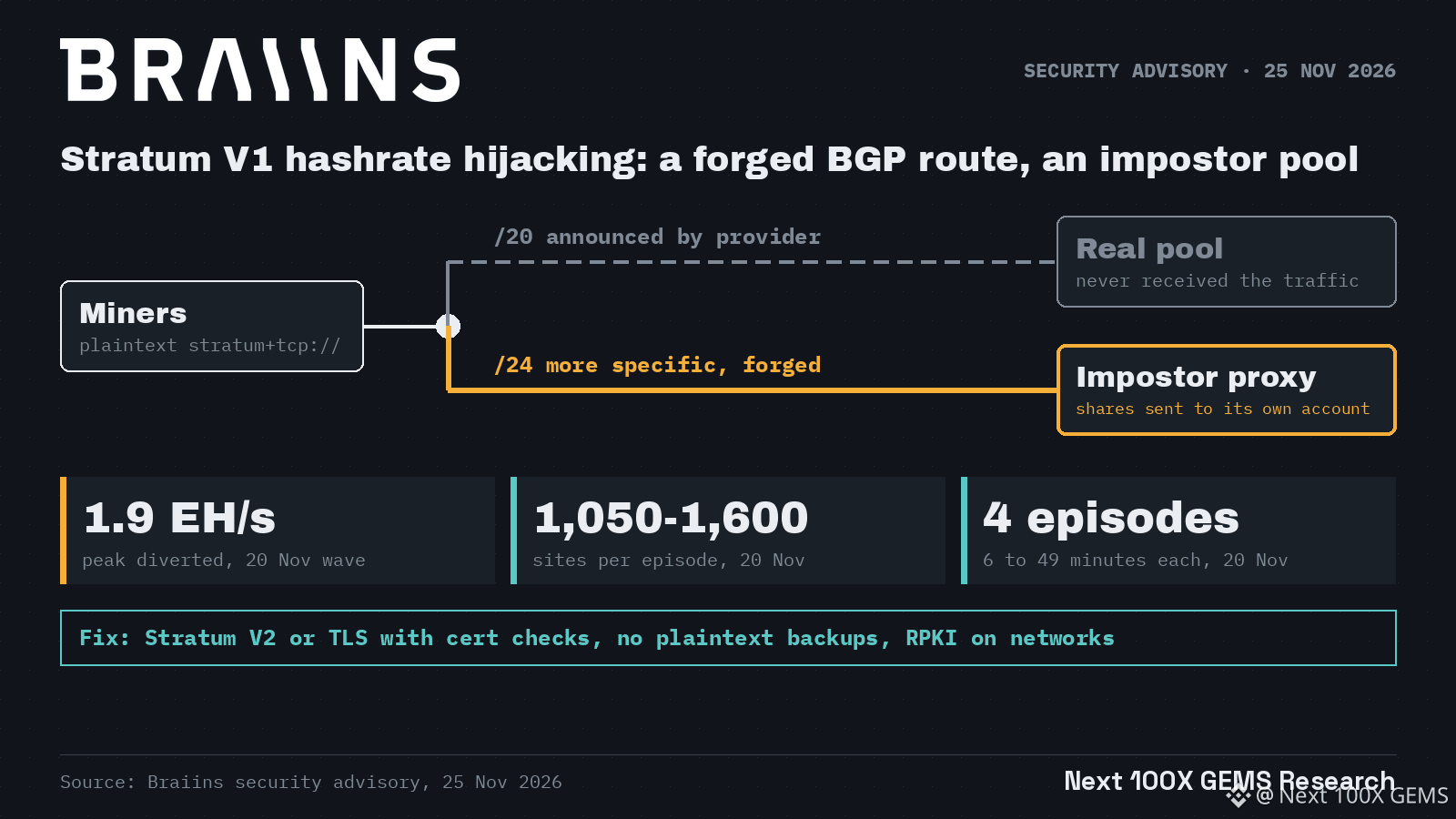
That is the incident in one sentence: according to Braiins's advisory of 25 November 2026, an attacker hijacked internet routes to a pool's Stratum endpoint, impersonated the pool to miners on unencrypted Stratum V1, and diverted up to 1.9 EH/s in the 20 November wave. Braiins says neither its pool nor the mining hardware was compromised, and that pool accounts, balances and payout settings were not affected.
The episodes, by Braiins's count
| Dates | Where | Episodes | Size of one episode | Length |
|---|---|---|---|---|
| 7 to 12 Nov | Latin America, mostly Brazil and Argentina | 19 | 120 to 400 sites, 36 to 174 PH/s | 1.5 minutes to 3 hours |
| 16 Nov | Brazil | 1, captured packet by packet | 3 miners in the capture | 3 minutes |
| 20 Nov | Mostly Europe | 4 | 1,050 to 1,600 sites, 0.6 to 1.9 EH/s | 6 to 49 minutes |
All figures are from the Braiins advisory. The site range is per episode in the 20 November wave, which is why outlets report it as "more than 1,000" (Decrypt, The Block) or as 1,050 to 1,600 per episode (Bitcoin.com News). Braiins says the first wave "is not confirmed in the same detail yet."
The route
BGP is how independent networks tell each other which addresses they can reach. Routers prefer the most specific matching announcement. Braiins says the pool's Stratum address sat inside a block of 4,096 addresses, a /20, announced by the pool's network provider. On 20 November someone announced a /24, a block of 256 addresses that contained the pool's address. Networks that accepted it sent miners' traffic to the attacker.
The forged route appeared four times that day. Braiins says the owner of the address block confirmed it never announced the route and that the diverted connections never reached its network. The provider blocked the network that had propagated it the same evening, and the route had not returned as of the advisory.
Two details explain why it worked. Networks running RPKI route origin validation rejected the forged route, but many networks do not validate. And the announcement listed the real owner as its origin, so monitors that only watch for origin changes raised no alarm.
The impostor
Every affected miner received a TCP reset in the same second, Braiins says, then reconnected within a second to the same hostname and IP. DNS was untouched, so this was not DNS spoofing. A different server answered: from Brazil it replied to the Stratum handshake in about 30 milliseconds, against about 280 for the real pool, and accepted any username and password.
The 16 November capture showed jobs from a different large public pool, with that pool's tag and payout addresses in the coinbase. Braiins's reading: the attacker ran a proxy holding a worker account at that pool, relayed its jobs to hijacked miners, and submitted their shares as its own. Braiins says that pool was not part of the attack, and that every pool should assume its accounts can be used the same way.
Braiins ruled out its pool, Braiins OS and other pools' infrastructure. Affected miners ran at least 12 firmware types across hundreds of networks, so no single firmware or provider was the cause.
Why the rigs did not notice
Stratum V1 has carried work between miners and pools in plain text since 2012, with no way for a miner to verify the server. A hijacked miner reports normal hashrate, normal temperature and a live pool. Backup URLs that resolve to the same address do not help. In one log, a stock miner failed over to a backup on a different address, then returned to the hijacked primary two minutes later because the fake pool looked stable.
Braiins notes the technique is old. It cites a 2014 case documented by Dell SecureWorks in which an attacker took about 83,000 dollars in mining rewards. It says public routing data shows the same kind of announcement against blocks hosting Stratum endpoints of several other large pools, some still receiving them on 22 November.
The fixes Braiins lists
Miners: no pool entry, backups included, should start with stratum+tcp://. Use Stratum V2, which checks the pool's public key, or Stratum V1 over TLS on firmware that verifies the certificate and hostname.
Firmware: Braiins tested seven implementations on 20 and 23 November. Braiins OS 26.11, released on 25 November, rejected every bad certificate; two other widely used firmwares offered TLS but accepted invalid certificates. Braiins says upgrading alone changes nothing until pool URLs are switched to TLS.
Miners without either option: Braiins released a free SV2 proxy that speaks Stratum V1 on the local network and Stratum V2 to the pool.
Pools: offer TLS-only ports with public certificates, add Stratum V2, and watch RIPE RIS or RouteViews for more-specific prefixes.
Network operators: turn on RPKI route origin validation. Braiins says the 20 November route was invalid and reached only miners behind networks that do not check.
Encryption does not stop the resets. It stops the miner from working for a server that cannot prove it is the pool.
Neither Braiins nor The Block gave an estimate of rewards taken. Decrypt framed Braiins as the second firm in weeks to flag diverted hashrate, after Luxor's report on 15 November, which Bitcoin.com News notes involved unauthorized configuration changes rather than intercepted connections.
Sources
Braiins, "SECURITY ALERT: Bitcoin Hashrate Hijacking Detected on Stratum V1," 25 Nov 2026
Braiins Academy, Connection Security
The Block, 25 Nov 2026
Decrypt, 25 Nov 2026
Bitcoin.com News, 25 Nov 2026
#Braiins #Bitcoin
NFA. DYOR.
Braiins: Stratum V1 hashrate hijacking via forged BGP routes diverted up to 1.9 EH/s of $BTC
Braiins: Stratum V1 hashrate hijacking via forged BGP routes diverted up to 1.9 EH/s of $BTC
The log line that started it was a share difficulty of 536,870,912. Braiins says three Antminer S19s in Brazil each dropped their pool connection in early November, reconnected to the same hostname and the same IP address, and then saw difficulty climb in steps to that figure. The machines kept hashing. The owner's pool dashboard showed zero.
Braiins Pool, its security advisory says, never sets share difficulty above 16,777,216. Its records for the previous 30 days showed nothing that high sent to any miner. The miners were talking to someone else.
That is the incident in one sentence: according to Braiins's advisory of 25 November 2026, an attacker hijacked internet routes to a pool's Stratum endpoint, impersonated the pool to miners on unencrypted Stratum V1, and diverted up to 1.9 EH/s in the 20 November wave. Braiins says neither its pool nor the mining hardware was compromised, and that pool accounts, balances and payout settings were not affected.
The episodes, by Braiins's count
| Dates | Where | Episodes | Size of one episode | Length |
|---|---|---|---|---|
| 7 to 12 Nov | Latin America, mostly Brazil and Argentina | 19 | 120 to 400 sites, 36 to 174 PH/s | 1.5 minutes to 3 hours |
| 16 Nov | Brazil | 1, captured packet by packet | 3 miners in the capture | 3 minutes |
| 20 Nov | Mostly Europe | 4 | 1,050 to 1,600 sites, 0.6 to 1.9 EH/s | 6 to 49 minutes |
All figures are from the Braiins advisory. The site range is per episode in the 20 November wave, which is why outlets report it as "more than 1,000" (Decrypt, The Block) or as 1,050 to 1,600 per episode (Bitcoin.com News). Braiins says the first wave "is not confirmed in the same detail yet."
The route
BGP is how independent networks tell each other which addresses they can reach. Routers prefer the most specific matching announcement. Braiins says the pool's Stratum address sat inside a block of 4,096 addresses, a /20, announced by the pool's network provider. On 20 November someone announced a /24, a block of 256 addresses that contained the pool's address. Networks that accepted it sent miners' traffic to the attacker.
The forged route appeared four times that day. Braiins says the owner of the address block confirmed it never announced the route and that the diverted connections never reached its network. The provider blocked the network that had propagated it the same evening, and the route had not returned as of the advisory.
Two details explain why it worked. Networks running RPKI route origin validation rejected the forged route, but many networks do not validate. And the announcement listed the real owner as its origin, so monitors that only watch for origin changes raised no alarm.
The impostor
Every affected miner received a TCP reset in the same second, Braiins says, then reconnected within a second to the same hostname and IP. DNS was untouched, so this was not DNS spoofing. A different server answered: from Brazil it replied to the Stratum handshake in about 30 milliseconds, against about 280 for the real pool, and accepted any username and password.
The 16 November capture showed jobs from a different large public pool, with that pool's tag and payout addresses in the coinbase. Braiins's reading: the attacker ran a proxy holding a worker account at that pool, relayed its jobs to hijacked miners, and submitted their shares as its own. Braiins says that pool was not part of the attack, and that every pool should assume its accounts can be used the same way.
Braiins ruled out its pool, Braiins OS and other pools' infrastructure. Affected miners ran at least 12 firmware types across hundreds of networks, so no single firmware or provider was the cause.
Why the rigs did not notice
Stratum V1 has carried work between miners and pools in plain text since 2012, with no way for a miner to verify the server. A hijacked miner reports normal hashrate, normal temperature and a live pool. Backup URLs that resolve to the same address do not help. In one log, a stock miner failed over to a backup on a different address, then returned to the hijacked primary two minutes later because the fake pool looked stable.
Braiins notes the technique is old. It cites a 2014 case documented by Dell SecureWorks in which an attacker took about 83,000 dollars in mining rewards. It says public routing data shows the same kind of announcement against blocks hosting Stratum endpoints of several other large pools, some still receiving them on 22 November.
The fixes Braiins lists
Miners: no pool entry, backups included, should start with stratum+tcp://. Use Stratum V2, which checks the pool's public key, or Stratum V1 over TLS on firmware that verifies the certificate and hostname.
Firmware: Braiins tested seven implementations on 20 and 23 November. Braiins OS 26.11, released on 25 November, rejected every bad certificate; two other widely used firmwares offered TLS but accepted invalid certificates. Braiins says upgrading alone changes nothing until pool URLs are switched to TLS.
Miners without either option: Braiins released a free SV2 proxy that speaks Stratum V1 on the local network and Stratum V2 to the pool.
Pools: offer TLS-only ports with public certificates, add Stratum V2, and watch RIPE RIS or RouteViews for more-specific prefixes.
Network operators: turn on RPKI route origin validation. Braiins says the 20 November route was invalid and reached only miners behind networks that do not check.
Encryption does not stop the resets. It stops the miner from working for a server that cannot prove it is the pool.
Neither Braiins nor The Block gave an estimate of rewards taken. Decrypt framed Braiins as the second firm in weeks to flag diverted hashrate, after Luxor's report on 15 November, which Bitcoin.com News notes involved unauthorized configuration changes rather than intercepted connections.
Sources
Braiins, "SECURITY ALERT: Bitcoin Hashrate Hijacking Detected on Stratum V1," 25 Nov 2026
Braiins Academy, Connection Security
The Block, 25 Nov 2026
Decrypt, 25 Nov 2026
Bitcoin.com News, 25 Nov 2026
#Braiins #Bitcoin
NFA. DYOR.
65

·
--
🚨 Bitcoin Miners Targeted in Active Hashrate Hijacking Attack!
Mining pool Braiins warned that attackers are exploiting unencrypted Stratum V1 connections to hijack miner hash power and redirect rewards to their own wallets.
Rapid Surge: Targeted computing power jumped 10x in two weeks—from 175 PH/s to 1.9 EH/s—spreading from Latin America to Europe.
How to Stay Safe: Braiins systems remain unaffected, but miners must switch to Stratum V2 or enable TLS/SSL encryption immediately.
Impact on $BTC : The Bitcoin network itself was not hacked and block production remains completely intact. While short-term FUD or stolen reward sell-offs may cause minor noise, this accelerates Stratum V2 adoption—strengthening long-term network security and decentralization.
Not financial advice. #Bitcoin❗ #BTC #CryptoMining #braiins
Braiins Security Alert: https://braiins.com/blog/bitcoin-hashrate-hijacking-unencrypted-stratum-v1
The Block Report: https://www.theblock.co/news/ecosystems/2026-11-25-bitcoin-miners-hit-hashrate-hijacking-attack-exploiting-unencrypted-connections-446723
5

Miners’ hashrate “hijacked”: Traffic from 1,000+ mining farms redirected to fake pools
Mining pool operator Braiins issued a security alert on Wednesday: Attackers used forged network routes to redirect traffic from mining machines using the plaintext Stratum V1 protocol to impostor mining pools. Everything appeared normal to the miners, but the rewards went straight into the attackers’ wallets.
Key figures:
• Four attacks took place on November 20, each affecting 1,050–1,600 mining farms
• Each attack redirected 0.6–1.9 EH/s of hashrate for 6–49 minutes
• Another wave of attacks, concentrated mainly in Latin America, occurred in early November
• Braiins said its mining pool systems and mining hardware were not compromised, and described this as an ongoing threat
Why it matters: No one hacked into the mining machines this time—the attackers targeted the “route,” not the “device.” As long as miners continue to use unencrypted Stratum V1, they remain at risk of being redirected to an impostor pool. Braiins recommends switching to Stratum V2 or using TLS connections with certificate verification.
According to The Block and Cointelegraph, the hashrate involved in each attack represented a small share of the network total. But the attack methods escalated significantly over two weeks, warranting the entire mining industry’s attention.
Do you think mining companies will switch to encrypted protocols soon, or will they wait for bigger losses before taking action?
#BTC #挖矿 #Braiins $BTC

108

⚡ BRAIINS REVOLUTIONIZES BITCOIN MINING ⚡
In a context where profit margins are tightening more and more, Braiins has just launched a tool that changes the game for $BTC miners 🔥
🔋 What does it do? It automates the management of electricity consumption for mining equipment, allowing miners not only to reduce costs, but also to generate additional income by participating in energy markets.
💡 Why does it matter? Mining is no longer just "turn on the equipment and wait". Now, energy efficiency becomes a key competitive advantage. Whoever optimizes their consumption best will survive and thrive in this cycle.
📊 The context: With network difficulty at all-time highs and the halving reducing rewards, every bit of efficiency matters. Tools like this could be the difference between profitable and unprofitable operations.
🚀 This kind of innovation shows that the $BTC ecosystem keeps evolving beyond price: infrastructure, energy efficiency, and new revenue models for miners.
Do you think energy automation will be the next big differentiator in mining? 👇
#bitcoin #Mining #braiins #BTC #CryptoNewss

1
227


Article
Hashrate attacks: Bitcoin mining under pressure in NovemberFor investors and traders, Bitcoin network security is more relevant than ever following a series of unprecedented attacks in early November.
More than 1,000 miners saw their computing power diverted to a fake pool, exposing a persistent vulnerability in the Stratum V1 protocol. This vulnerability, known since 2014, is still being exploited twelve years after the protocol was released.
The first attacks targeted Latin America (particularly Brazil and Argentina) before spreading to Europe. At the height of the attacks, up to 1.9 EH/s of hashrate was diverted, representing 0.19% of the Bitcoin network (1,016 EH/s). This figure represents the capacity of several industrial-scale farms.
Hashrate attacks: Bitcoin mining under pressure in November
For investors and traders, Bitcoin network security is more relevant than ever following a series of unprecedented attacks in early November.
More than 1,000 miners saw their computing power diverted to a fake pool, exposing a persistent vulnerability in the Stratum V1 protocol. This vulnerability, known since 2014, is still being exploited twelve years after the protocol was released.
The first attacks targeted Latin America (particularly Brazil and Argentina) before spreading to Europe. At the height of the attacks, up to 1.9 EH/s of hashrate was diverted, representing 0.19% of the Bitcoin network (1,016 EH/s). This figure represents the capacity of several industrial-scale farms.
89

·
--
Article
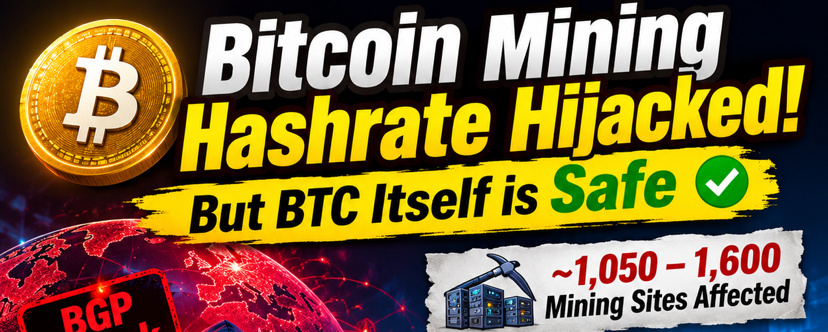
🚨 BITCOIN MINING HASHRATE HIJACKED — BUT BTC IS SAFE!Imagine your mining rig is working normally… but someone secretly redirects where your mining power is going. 😳
Braiins reported a BGP route-hijacking campaign that affected roughly 1,050–1,600 mining sites in attack waves, with up to 1.9 EH/s of hashrate redirected.
The good news? 🛡️ The $BTC blockchain itself was not hacked.
The attack targeted miners using unencrypted Stratum V1 connections.
🔐 The lesson: mining infrastructure needs stronger security. Moving toward Stratum V2 and encrypted connections can help reduce these risks.
$BTC may be strong — but the infrastructure around it still needs protection.
Would you trust your mining setup after an attack like this? 👇
#bitcoin #BTC #BitcoinMining #CryptoSecurityIncidents #Braiins
{spot}(BTCUSDT)
🚨 BITCOIN MINING HASHRATE HIJACKED — BUT BTC IS SAFE!
Imagine your mining rig is working normally… but someone secretly redirects where your mining power is going. 😳
Braiins reported a BGP route-hijacking campaign that affected roughly 1,050–1,600 mining sites in attack waves, with up to 1.9 EH/s of hashrate redirected.
The good news? 🛡️ The $BTC blockchain itself was not hacked.
The attack targeted miners using unencrypted Stratum V1 connections.
🔐 The lesson: mining infrastructure needs stronger security. Moving toward Stratum V2 and encrypted connections can help reduce these risks.
$BTC may be strong — but the infrastructure around it still needs protection.
Would you trust your mining setup after an attack like this? 👇
#bitcoin #BTC #BitcoinMining #CryptoSecurityIncidents #Braiins
116
Log in to explore more content
Join global crypto users on Binance Square
⚡️ Get latest and useful information about crypto.
💬 Trusted by the world’s largest crypto exchange.
👍 Discover real insights from verified creators.
Email / Phone number
Trending Topics
1
#CanMarketsReboundAfterThanksgiving?
34,983 views
734 Discussing
2
#CouldSpaceX’sOrbitalDataCentersBoostAIChipDemand?
21,860 views
450 Discussing
3
#EvolveAtBinanceBlockchainWeek
684,528 views
7,728 Discussing
4
#CorePCEBeatLiftsFedHikeOdds
191,894 views
1,484 Discussing
5
#BitcoinAndStocksSlipAgainAmidTrump’sTariffPlans
234,713 views
2,244 Discussing
6
#JensenHuangSaysNvidiaDoesn’tNeedASuccessionPlan
111,775 views
1,335 Discussing
7
#NasdaqFuturesSlideMoreThan3%
48,785 views
427 Discussing
8
#USOctoberPCEPriceIndexAt0.3%MoM
55,686 views
428 Discussing
9
#BitcoinETFsPostRecord$4.94BNovemberOutflows
10,347 views
54 Discussing
10
#TetherInvestsInArgentinasLemon
21,060 views
245 Discussing