

Marvin Alvis
12.7k Posts

Marvin Alvis
 Square Verified
Report
Block User
Open Trade
Frequent Trader
1.9 Years
803 Following
30.7K+ Followers
18.6K+ Liked
Posts
Portfolio
All
Quotes
Live
·
--
Article
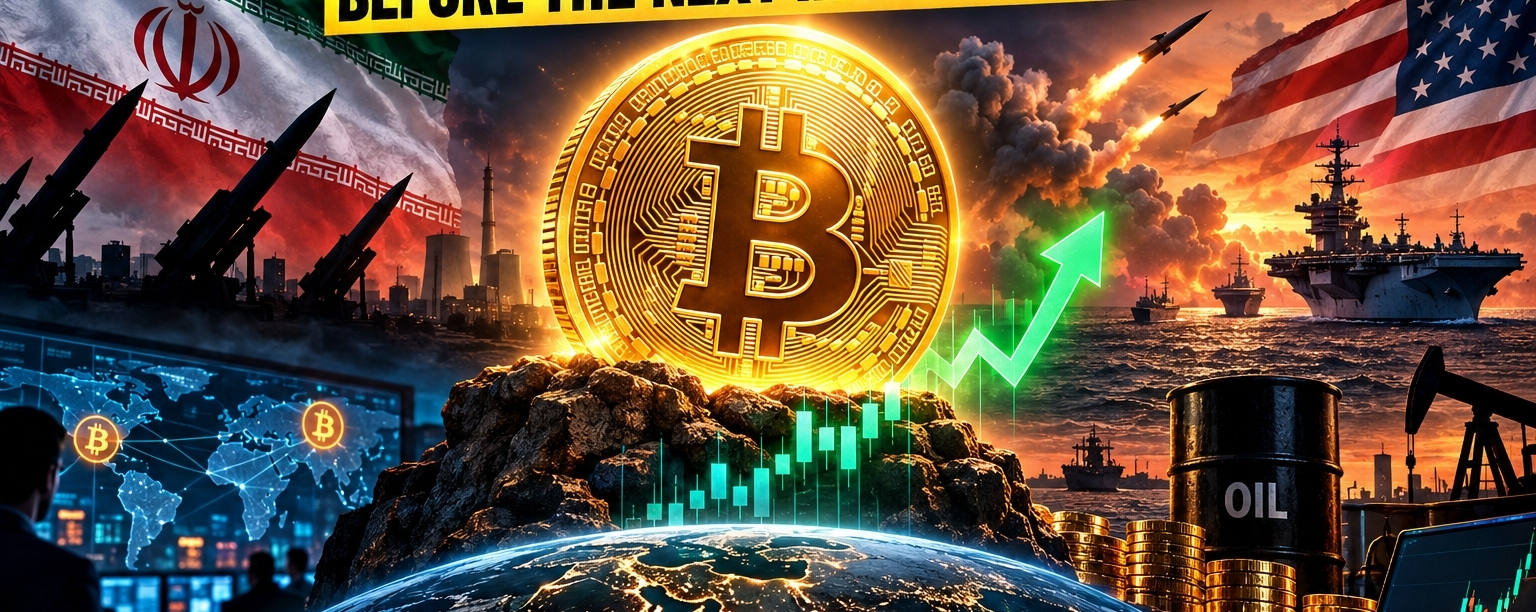
BITCOIN IS LOADING UP: WILL CRYPTO EXPLODE BEFORE THE NEXT IRAN–US STRIKES?I've been thinking about the phrase "Bitcoin is loading up" because it sounds simple, almost obvious, until you put it next to what's happening in the Middle East.
The U.S. and Iran are already deep into a conflict that has repeatedly spilled into the Strait of Hormuz, energy markets, shipping routes and regional military positions. And now the possibility of another round of U.S. strikes is back in the conversation. The Associated Press reported that roughly 9,000 additional U.S. personnel are moving toward the Middle East, including a third aircraft carrier, while President Donald Trump has publicly left open the possibility of renewed bombing after the November elections.
At the same time, Bitcoin looks increasingly like an asset that the traditional financial system has learned how to hold, trade and package at scale.
That combination is what makes this moment interesting.
But I don't think the right question is simply, "Will Bitcoin explode before the next strike?"
The better question is harder:
What has Bitcoin actually become after years of development, institutional adoption, regulatory pressure and real-world stress — and how might that system behave if the Iran–U.S. conflict gets worse?
There is a big difference between a network becoming more important and a market becoming more predictable. Bitcoin has clearly achieved the first. The second remains much less certain.
The conflict is real, but another strike is not a scheduled event
It's worth starting with the geopolitical side because crypto commentary often jumps straight from a headline about missiles to a conclusion about Bitcoin.
The reality is more complicated.
The U.S. launched another major wave of strikes against Iran on September 1, with Tehran responding against American and allied positions in Jordan, Bahrain and Iraq. Reuters reported that the fighting also affected shipping around the Strait of Hormuz, with oil prices jumping as the confrontation intensified.
Since then, neither side has produced anything resembling a stable long-term settlement.
Iran has continued to make reopening the Strait of Hormuz conditional on a broader agreement, while Washington has maintained military and economic pressure. Reuters reported on October 4 that Iran was still refusing to reopen the waterway without conditions tied to the earlier interim framework.
Then came another important development.
AP reported on October 1 that the U.S. was moving roughly 9,000 additional sailors and Marines toward the Middle East, with a third carrier potentially joining the forces already in the region. Trump also said renewed strikes remained possible after the U.S. midterm elections.
That does not mean another strike is guaranteed.
It means something more subtle: the risk of escalation is being actively priced into military planning, political statements and energy markets.
That's enough to matter for Bitcoin.
But it isn't enough to give us a clean prediction about what Bitcoin will do.
Before asking what Bitcoin might do, it helps to remember what Bitcoin actually is
Bitcoin gets described in many different ways depending on who's talking.
Some people treat it as digital gold. Others see it as a speculative asset. Some use it as a payment network. Others are interested in its censorship resistance. Institutions increasingly treat it as a financial asset that can be held through regulated products.
None of those descriptions fully explain the underlying project.
At its core, Bitcoin is a peer-to-peer monetary network built around a public ledger, cryptographic signatures, proof-of-work mining and a distributed group of validating nodes.
Satoshi Nakamoto's original whitepaper described the system as a peer-to-peer electronic cash system designed to allow payments without relying on a trusted financial intermediary.
The practical architecture is equally important.
Bitcoin's full nodes independently verify blocks and transactions before relaying them. The blockchain acts as a public record, while proof of work makes rewriting historical records progressively more expensive.
That matters enormously during geopolitical stress.
A government can close a bank.
An exchange can be sanctioned.
A payment processor can be blocked.
A bank account can be frozen.
But none of those actions is the same thing as shutting down Bitcoin itself.
That's not the same as saying Bitcoin is immune to disruption. It isn't.
A person still needs electricity, internet connectivity, a wallet, private keys and some way to interact with the economic world around Bitcoin.
But the underlying network does not have a central headquarters that Washington, Tehran, London or Beijing can simply switch off.
And that distinction becomes much more interesting during war.
Bitcoin doesn't need a war to survive — but war reveals what it can actually do
This is where I think a lot of discussion gets confused.
Bitcoin wasn't created specifically for the Iran–U.S. conflict. Its purpose is much broader.
So the question shouldn't be whether Bitcoin "benefits" from war.
Instead, war provides a stress test.
When conventional financial channels become more restrictive, people begin asking practical questions they normally don't ask.
Can I move money?
Can I hold something outside my country's banking system?
Can I receive funds from someone abroad?
Can I keep control of an asset without depending on a bank?
Can I transfer value when political borders suddenly become financial borders too?
Those questions were theoretical for many people a decade ago.
They're not theoretical anymore.
Iran is a particularly interesting example because its economy has lived under sanctions and monetary pressure for years.
Chainalysis estimated that Iran's cryptocurrency ecosystem exceeded $7.78 billion in 2025. Its analysis also found that crypto activity changed alongside political events, including periods when Iranian users increased Bitcoin withdrawals to personal wallets during domestic unrest.
That doesn't prove that every Iranian is turning to Bitcoin as a safe haven.
It does show something more useful: crypto behavior changes when ordinary financial choices become constrained.
That's a different proposition, and I think it's a much stronger one.
Iran is also showing us the limits of the "escape hatch" story
There is another side to the Iranian example that is often ignored.
Crypto isn't automatically outside the reach of governments.
In June 2026, the U.S. Treasury's Office of Foreign Assets Control designated several Iranian cryptocurrency exchanges, including Nobitex, Bitpin, Ramzinex and Wallex. Chainalysis described the action as one of the largest U.S. enforcement operations aimed at Iran's digital-asset economy.
Then in July, OFAC added four cryptocurrency addresses connected with the Central Bank of Iran. Chainalysis reported that those addresses had received roughly $165 million in stablecoins, and that balances totaling about $131 million were subsequently frozen by Tether.
That is a very important detail.
People sometimes talk about crypto as though blockchain equals invisibility.
It doesn't.
Bitcoin's ledger is public.
Blockchain analysis has become extremely sophisticated.
Centralized exchanges can be sanctioned.
Stablecoin issuers can freeze assets.
And governments have become much better at combining blockchain data with conventional financial intelligence.
So the real advantage of Bitcoin isn't that it makes financial surveillance impossible.
The more defensible argument is that Bitcoin can reduce dependence on permissioned financial institutions at the base layer.
Those are very different claims.
And the second one is far more interesting.
The "safe haven" argument is stronger than it used to be — but it still has holes
This brings us to the central question.
Could geopolitical escalation push more capital toward Bitcoin?
There is some academic evidence supporting that idea.
A 2025 paper in Finance Research Letters found that Bitcoin and the Swiss franc could function as safe havens against geopolitical risk during equity-market crashes. Another 2025 study found that Bitcoin can act as a safe haven for international equities during certain periods of market stress, although its usefulness changes with market conditions.
But there's another body of research telling us to be careful.
Research examining Bitcoin's relationship with political uncertainty has found that Bitcoin returns and volatility can actually absorb information coming from geopolitical and political uncertainty, particularly during financial stress.
That matters because a safe haven should ideally become more dependable exactly when everything else becomes less dependable.
Bitcoin hasn't consistently behaved that way.
Sometimes it acts independently.
Sometimes it behaves like a risk asset.
Sometimes liquidity disappears across markets and Bitcoin gets sold along with everything else.
This is why I don't like the simple sentence:
"War is bullish for Bitcoin."
It's too convenient.
A better description is:
War can strengthen the reasons some people want Bitcoin while simultaneously creating the liquidity shock that makes people sell risky assets.
Both things can be true at the same time.
And that's probably the biggest misunderstanding about Bitcoin during crises
Imagine a family suddenly worrying that its local bank could become inaccessible.
Holding some self-custodied Bitcoin may look attractive.
Now imagine an institutional portfolio manager staring at a violent global market shock.
Their first priority may simply be liquidity.
Those two people can look at the same Bitcoin network and make completely different decisions.
One sees monetary independence.
The other sees a volatile asset that can be sold instantly.
This is why geopolitical events don't create a single predictable Bitcoin response.
The same headline can generate buying from one group and selling from another.
And the global financial plumbing underneath those decisions matters enormously.
Bitcoin's infrastructure is much more mature than it was during previous crises
This is one area where I think the project deserves more credit.
The Bitcoin network is not static.
The protocol evolves slowly, deliberately and often painfully.
Bitcoin Core remains the most prominent full-node implementation, and as of October 2026 the official Bitcoin Core site lists version 31.1 as the latest release. The 31.1 release was published in July and, like other Core releases, is distributed with signed and reproducible-release practices intended to improve software integrity.
Bitcoin's developer process is also unusually open.
The Bitcoin Improvement Proposal process explicitly says that BIPs are proposals rather than automatic commands. A published proposal does not mean the community has accepted it, and adoption ultimately depends on users and implementations choosing to run the relevant changes.
That sounds slow.
It is slow.
But there's something valuable about that slowness.
Bitcoin doesn't have a central development department that can announce on Monday that the entire monetary system is changing on Friday.
Changes have to survive technical review, community discussion, implementation work and actual adoption.
That can be frustrating.
It can also be a source of resilience.
The network itself is designed to keep operating even when individual pieces disappear
Bitcoin's peer-to-peer structure matters here.
Full nodes maintain their own validated view of the blockchain. Nodes communicate with many peers rather than depending on a single server, and Bitcoin's architecture contains mechanisms for finding alternative peers when existing connections fail.
Mining also remains distributed across participants.
The mining process uses specialized hardware to perform proof-of-work calculations, with successful miners broadcasting completed blocks to the wider network.
That doesn't make Bitcoin indestructible.
A large enough disruption to power grids, internet infrastructure or mining operations would obviously matter.
Concentration also remains something worth watching. Mining is a competitive business, and the economics of electricity, hardware, financing and geography can push activity toward particular regions.
But there's a difference between geographic concentration of businesses and centralized control of the consensus rules.
Understanding that distinction is essential.
This is also why a war near the Strait of Hormuz matters even if no missile comes near a Bitcoin mining facility
Oil is the obvious transmission mechanism.
The Strait of Hormuz is one of the most important energy chokepoints on Earth. Reuters reported that the conflict has repeatedly disrupted shipping around the waterway and that the region normally handles a significant share of global oil flows.
The economic chain is fairly straightforward.
More military escalation can mean higher energy costs.
Higher energy costs can push inflation higher.
Higher inflation can affect central-bank policy.
Changes in interest-rate expectations affect the dollar, bonds, equities and liquidity.
And Bitcoin lives inside that same global liquidity environment.
That's why Bitcoin doesn't need to be directly connected to the battlefield for the battlefield to matter.
Bitcoin is decentralized at the protocol layer.
Its users aren't.
Its exchanges aren't.
Its institutional holders aren't.
Its miners aren't.
And the broader economy certainly isn't.
That's the paradox.
The blockchain can be politically neutral while the market around it remains deeply political.
Institutional Bitcoin has changed the equation
Another thing that has quietly changed is the way large investors access Bitcoin.
The introduction and continued growth of regulated exchange-traded products means institutions don't necessarily need to manage private keys, mining infrastructure or direct on-chain operations themselves.
BlackRock's iShares Bitcoin Trust, for example, had net assets of roughly $67.6 billion as of October 2, 2026. The product is designed to provide exposure to Bitcoin while handling much of the operational and custody complexity through the fund structure.
That is significant for one reason that has nothing to do with whether Bitcoin rises or falls next week.
It means Bitcoin is no longer sitting at the edge of the financial system waiting for traditional finance to decide whether it belongs there.
Traditional finance has already built infrastructure around it.
The question is changing from:
"Will institutions touch Bitcoin?"
to:
"How deeply will they integrate it into the financial architecture they already use?"
That is a much bigger question.
And it also means the old idea that a geopolitical crisis will automatically send everyone toward self-custodied Bitcoin is probably too simplistic.
A modern institution may get Bitcoin exposure through an exchange-traded vehicle.
A refugee might use a mobile wallet.
A miner might earn Bitcoin through proof of work.
A trader might use a derivatives exchange.
An Iranian citizen might use a stablecoin because they need dollar exposure rather than Bitcoin specifically.
All of those activities sit under the huge umbrella called "crypto", but they solve different problems.
That distinction becomes critical when we talk about "crypto exploding"
Bitcoin and the rest of the crypto market don't always respond to the same forces.
Bitcoin is the oldest and most established network in the sector.
Stablecoins are closer to digital versions of fiat money.
Smart-contract platforms are infrastructure for applications.
Exchanges provide liquidity.
Custodians provide institutional access.
Derivatives provide leverage and hedging.
And thousands of smaller tokens depend heavily on market liquidity and investor risk appetite.
So even if a geopolitical event increases interest in Bitcoin, it does not automatically mean the entire crypto market follows.
In fact, during a serious risk-off event, the opposite can happen.
Capital can concentrate in Bitcoin while speculative parts of the market weaken.
People may want a liquid, established digital asset while simultaneously having little appetite for highly speculative tokens.
That is why I would separate the question into two parts.
Could Bitcoin become more important because of geopolitical instability?
Yes, there is a credible argument for that.
Does geopolitical escalation automatically mean the whole crypto market explodes?
No. The evidence isn't strong enough to say that.
The stablecoin lesson from Iran may be even more important
There's an interesting irony here.
Bitcoin was designed around decentralized money, but some of the most practical cross-border crypto activity during periods of instability has increasingly involved stablecoins.
Chainalysis' reporting on Iran demonstrates this clearly. The company's analysis of Iranian activity has documented substantial stablecoin flows and the involvement of sanctioned financial entities.
That tells us something about how people behave.
When someone is worried about a collapsing currency, they may not want a volatile asset.
They may want something that behaves like a dollar.
That is one reason the geopolitical crypto story can't simply be reduced to Bitcoin.
Bitcoin may be attractive because it isn't issued by a government or controlled by a single company.
A dollar stablecoin may be attractive because its unit of account is familiar.
Those are different forms of financial freedom.
And they come with different risks.
The stablecoin can be frozen.
Bitcoin itself cannot be frozen by an issuer because there is no issuer with that authority.
But Bitcoin's user can still lose access to an exchange, lose a private key or struggle to convert it into local currency.
Again, the real world is messier than the slogan.
Regulation is becoming another major part of Bitcoin's story
There's also a regulatory shift happening at the same time as the geopolitical one.
On October 5, the U.S. Commodity Futures Trading Commission proposed a framework for federally regulated crypto trading venues, including requirements around market integrity and proof of reserves. The proposal came after Congress failed to pass broader crypto legislation.
That may sound unrelated to Iran.
I don't think it is.
Every time crypto moves deeper into the regulated financial system, the market becomes more connected to traditional institutions.
That can increase liquidity, legitimacy and access.
It can also increase exposure to regulation, reporting requirements, sanctions and financial surveillance.
Bitcoin's underlying protocol hasn't suddenly become centralized.
But the gateways surrounding Bitcoin can become highly regulated.
That's the world we're moving toward.
The Bitcoin network may remain permissionless while the places where most people buy, custody and trade it become increasingly supervised.
So what would actually make me believe the next geopolitical shock is becoming structurally important for Bitcoin?
Not one green candle.
Not one viral post.
Not one headline.
I'd look for something deeper.
I'd want to see sustained demand for Bitcoin from people using it for reasons connected to the underlying problem, rather than simply because someone expects the next military headline to produce a rally.
I'd also watch whether institutional demand remains steady when geopolitical volatility increases.
I'd pay attention to ETF flows, custody activity and on-chain settlement.
I'd watch whether users in countries facing currency or banking stress actually increase self-custody.
I'd look at mining resilience.
And I'd watch what happens to liquidity across traditional markets.
$BTC $ETH $ZEC
#BTC #ETH #crypto
BITCOIN IS LOADING UP: WILL CRYPTO EXPLODE BEFORE THE NEXT IRAN–US STRIKES?
I've been thinking about the phrase "Bitcoin is loading up" because it sounds simple, almost obvious, until you put it next to what's happening in the Middle East.
The U.S. and Iran are already deep into a conflict that has repeatedly spilled into the Strait of Hormuz, energy markets, shipping routes and regional military positions. And now the possibility of another round of U.S. strikes is back in the conversation. The Associated Press reported that roughly 9,000 additional U.S. personnel are moving toward the Middle East, including a third aircraft carrier, while President Donald Trump has publicly left open the possibility of renewed bombing after the November elections.
At the same time, Bitcoin looks increasingly like an asset that the traditional financial system has learned how to hold, trade and package at scale.
That combination is what makes this moment interesting.
But I don't think the right question is simply, "Will Bitcoin explode before the next strike?"
The better question is harder:
What has Bitcoin actually become after years of development, institutional adoption, regulatory pressure and real-world stress — and how might that system behave if the Iran–U.S. conflict gets worse?
There is a big difference between a network becoming more important and a market becoming more predictable. Bitcoin has clearly achieved the first. The second remains much less certain.
The conflict is real, but another strike is not a scheduled event
It's worth starting with the geopolitical side because crypto commentary often jumps straight from a headline about missiles to a conclusion about Bitcoin.
The reality is more complicated.
The U.S. launched another major wave of strikes against Iran on September 1, with Tehran responding against American and allied positions in Jordan, Bahrain and Iraq. Reuters reported that the fighting also affected shipping around the Strait of Hormuz, with oil prices jumping as the confrontation intensified.
Since then, neither side has produced anything resembling a stable long-term settlement.
Iran has continued to make reopening the Strait of Hormuz conditional on a broader agreement, while Washington has maintained military and economic pressure. Reuters reported on October 4 that Iran was still refusing to reopen the waterway without conditions tied to the earlier interim framework.
Then came another important development.
AP reported on October 1 that the U.S. was moving roughly 9,000 additional sailors and Marines toward the Middle East, with a third carrier potentially joining the forces already in the region. Trump also said renewed strikes remained possible after the U.S. midterm elections.
That does not mean another strike is guaranteed.
It means something more subtle: the risk of escalation is being actively priced into military planning, political statements and energy markets.
That's enough to matter for Bitcoin.
But it isn't enough to give us a clean prediction about what Bitcoin will do.
Before asking what Bitcoin might do, it helps to remember what Bitcoin actually is
Bitcoin gets described in many different ways depending on who's talking.
Some people treat it as digital gold. Others see it as a speculative asset. Some use it as a payment network. Others are interested in its censorship resistance. Institutions increasingly treat it as a financial asset that can be held through regulated products.
None of those descriptions fully explain the underlying project.
At its core, Bitcoin is a peer-to-peer monetary network built around a public ledger, cryptographic signatures, proof-of-work mining and a distributed group of validating nodes.
Satoshi Nakamoto's original whitepaper described the system as a peer-to-peer electronic cash system designed to allow payments without relying on a trusted financial intermediary.
The practical architecture is equally important.
Bitcoin's full nodes independently verify blocks and transactions before relaying them. The blockchain acts as a public record, while proof of work makes rewriting historical records progressively more expensive.
That matters enormously during geopolitical stress.
A government can close a bank.
An exchange can be sanctioned.
A payment processor can be blocked.
A bank account can be frozen.
But none of those actions is the same thing as shutting down Bitcoin itself.
That's not the same as saying Bitcoin is immune to disruption. It isn't.
A person still needs electricity, internet connectivity, a wallet, private keys and some way to interact with the economic world around Bitcoin.
But the underlying network does not have a central headquarters that Washington, Tehran, London or Beijing can simply switch off.
And that distinction becomes much more interesting during war.
Bitcoin doesn't need a war to survive — but war reveals what it can actually do
This is where I think a lot of discussion gets confused.
Bitcoin wasn't created specifically for the Iran–U.S. conflict. Its purpose is much broader.
So the question shouldn't be whether Bitcoin "benefits" from war.
Instead, war provides a stress test.
When conventional financial channels become more restrictive, people begin asking practical questions they normally don't ask.
Can I move money?
Can I hold something outside my country's banking system?
Can I receive funds from someone abroad?
Can I keep control of an asset without depending on a bank?
Can I transfer value when political borders suddenly become financial borders too?
Those questions were theoretical for many people a decade ago.
They're not theoretical anymore.
Iran is a particularly interesting example because its economy has lived under sanctions and monetary pressure for years.
Chainalysis estimated that Iran's cryptocurrency ecosystem exceeded $7.78 billion in 2025. Its analysis also found that crypto activity changed alongside political events, including periods when Iranian users increased Bitcoin withdrawals to personal wallets during domestic unrest.
That doesn't prove that every Iranian is turning to Bitcoin as a safe haven.
It does show something more useful: crypto behavior changes when ordinary financial choices become constrained.
That's a different proposition, and I think it's a much stronger one.
Iran is also showing us the limits of the "escape hatch" story
There is another side to the Iranian example that is often ignored.
Crypto isn't automatically outside the reach of governments.
In June 2026, the U.S. Treasury's Office of Foreign Assets Control designated several Iranian cryptocurrency exchanges, including Nobitex, Bitpin, Ramzinex and Wallex. Chainalysis described the action as one of the largest U.S. enforcement operations aimed at Iran's digital-asset economy.
Then in July, OFAC added four cryptocurrency addresses connected with the Central Bank of Iran. Chainalysis reported that those addresses had received roughly $165 million in stablecoins, and that balances totaling about $131 million were subsequently frozen by Tether.
That is a very important detail.
People sometimes talk about crypto as though blockchain equals invisibility.
It doesn't.
Bitcoin's ledger is public.
Blockchain analysis has become extremely sophisticated.
Centralized exchanges can be sanctioned.
Stablecoin issuers can freeze assets.
And governments have become much better at combining blockchain data with conventional financial intelligence.
So the real advantage of Bitcoin isn't that it makes financial surveillance impossible.
The more defensible argument is that Bitcoin can reduce dependence on permissioned financial institutions at the base layer.
Those are very different claims.
And the second one is far more interesting.
The "safe haven" argument is stronger than it used to be — but it still has holes
This brings us to the central question.
Could geopolitical escalation push more capital toward Bitcoin?
There is some academic evidence supporting that idea.
A 2025 paper in Finance Research Letters found that Bitcoin and the Swiss franc could function as safe havens against geopolitical risk during equity-market crashes. Another 2025 study found that Bitcoin can act as a safe haven for international equities during certain periods of market stress, although its usefulness changes with market conditions.
But there's another body of research telling us to be careful.
Research examining Bitcoin's relationship with political uncertainty has found that Bitcoin returns and volatility can actually absorb information coming from geopolitical and political uncertainty, particularly during financial stress.
That matters because a safe haven should ideally become more dependable exactly when everything else becomes less dependable.
Bitcoin hasn't consistently behaved that way.
Sometimes it acts independently.
Sometimes it behaves like a risk asset.
Sometimes liquidity disappears across markets and Bitcoin gets sold along with everything else.
This is why I don't like the simple sentence:
"War is bullish for Bitcoin."
It's too convenient.
A better description is:
War can strengthen the reasons some people want Bitcoin while simultaneously creating the liquidity shock that makes people sell risky assets.
Both things can be true at the same time.
And that's probably the biggest misunderstanding about Bitcoin during crises
Imagine a family suddenly worrying that its local bank could become inaccessible.
Holding some self-custodied Bitcoin may look attractive.
Now imagine an institutional portfolio manager staring at a violent global market shock.
Their first priority may simply be liquidity.
Those two people can look at the same Bitcoin network and make completely different decisions.
One sees monetary independence.
The other sees a volatile asset that can be sold instantly.
This is why geopolitical events don't create a single predictable Bitcoin response.
The same headline can generate buying from one group and selling from another.
And the global financial plumbing underneath those decisions matters enormously.
Bitcoin's infrastructure is much more mature than it was during previous crises
This is one area where I think the project deserves more credit.
The Bitcoin network is not static.
The protocol evolves slowly, deliberately and often painfully.
Bitcoin Core remains the most prominent full-node implementation, and as of October 2026 the official Bitcoin Core site lists version 31.1 as the latest release. The 31.1 release was published in July and, like other Core releases, is distributed with signed and reproducible-release practices intended to improve software integrity.
Bitcoin's developer process is also unusually open.
The Bitcoin Improvement Proposal process explicitly says that BIPs are proposals rather than automatic commands. A published proposal does not mean the community has accepted it, and adoption ultimately depends on users and implementations choosing to run the relevant changes.
That sounds slow.
It is slow.
But there's something valuable about that slowness.
Bitcoin doesn't have a central development department that can announce on Monday that the entire monetary system is changing on Friday.
Changes have to survive technical review, community discussion, implementation work and actual adoption.
That can be frustrating.
It can also be a source of resilience.
The network itself is designed to keep operating even when individual pieces disappear
Bitcoin's peer-to-peer structure matters here.
Full nodes maintain their own validated view of the blockchain. Nodes communicate with many peers rather than depending on a single server, and Bitcoin's architecture contains mechanisms for finding alternative peers when existing connections fail.
Mining also remains distributed across participants.
The mining process uses specialized hardware to perform proof-of-work calculations, with successful miners broadcasting completed blocks to the wider network.
That doesn't make Bitcoin indestructible.
A large enough disruption to power grids, internet infrastructure or mining operations would obviously matter.
Concentration also remains something worth watching. Mining is a competitive business, and the economics of electricity, hardware, financing and geography can push activity toward particular regions.
But there's a difference between geographic concentration of businesses and centralized control of the consensus rules.
Understanding that distinction is essential.
This is also why a war near the Strait of Hormuz matters even if no missile comes near a Bitcoin mining facility
Oil is the obvious transmission mechanism.
The Strait of Hormuz is one of the most important energy chokepoints on Earth. Reuters reported that the conflict has repeatedly disrupted shipping around the waterway and that the region normally handles a significant share of global oil flows.
The economic chain is fairly straightforward.
More military escalation can mean higher energy costs.
Higher energy costs can push inflation higher.
Higher inflation can affect central-bank policy.
Changes in interest-rate expectations affect the dollar, bonds, equities and liquidity.
And Bitcoin lives inside that same global liquidity environment.
That's why Bitcoin doesn't need to be directly connected to the battlefield for the battlefield to matter.
Bitcoin is decentralized at the protocol layer.
Its users aren't.
Its exchanges aren't.
Its institutional holders aren't.
Its miners aren't.
And the broader economy certainly isn't.
That's the paradox.
The blockchain can be politically neutral while the market around it remains deeply political.
Institutional Bitcoin has changed the equation
Another thing that has quietly changed is the way large investors access Bitcoin.
The introduction and continued growth of regulated exchange-traded products means institutions don't necessarily need to manage private keys, mining infrastructure or direct on-chain operations themselves.
BlackRock's iShares Bitcoin Trust, for example, had net assets of roughly $67.6 billion as of October 2, 2026. The product is designed to provide exposure to Bitcoin while handling much of the operational and custody complexity through the fund structure.
That is significant for one reason that has nothing to do with whether Bitcoin rises or falls next week.
It means Bitcoin is no longer sitting at the edge of the financial system waiting for traditional finance to decide whether it belongs there.
Traditional finance has already built infrastructure around it.
The question is changing from:
"Will institutions touch Bitcoin?"
to:
"How deeply will they integrate it into the financial architecture they already use?"
That is a much bigger question.
And it also means the old idea that a geopolitical crisis will automatically send everyone toward self-custodied Bitcoin is probably too simplistic.
A modern institution may get Bitcoin exposure through an exchange-traded vehicle.
A refugee might use a mobile wallet.
A miner might earn Bitcoin through proof of work.
A trader might use a derivatives exchange.
An Iranian citizen might use a stablecoin because they need dollar exposure rather than Bitcoin specifically.
All of those activities sit under the huge umbrella called "crypto", but they solve different problems.
That distinction becomes critical when we talk about "crypto exploding"
Bitcoin and the rest of the crypto market don't always respond to the same forces.
Bitcoin is the oldest and most established network in the sector.
Stablecoins are closer to digital versions of fiat money.
Smart-contract platforms are infrastructure for applications.
Exchanges provide liquidity.
Custodians provide institutional access.
Derivatives provide leverage and hedging.
And thousands of smaller tokens depend heavily on market liquidity and investor risk appetite.
So even if a geopolitical event increases interest in Bitcoin, it does not automatically mean the entire crypto market follows.
In fact, during a serious risk-off event, the opposite can happen.
Capital can concentrate in Bitcoin while speculative parts of the market weaken.
People may want a liquid, established digital asset while simultaneously having little appetite for highly speculative tokens.
That is why I would separate the question into two parts.
Could Bitcoin become more important because of geopolitical instability?
Yes, there is a credible argument for that.
Does geopolitical escalation automatically mean the whole crypto market explodes?
No. The evidence isn't strong enough to say that.
The stablecoin lesson from Iran may be even more important
There's an interesting irony here.
Bitcoin was designed around decentralized money, but some of the most practical cross-border crypto activity during periods of instability has increasingly involved stablecoins.
Chainalysis' reporting on Iran demonstrates this clearly. The company's analysis of Iranian activity has documented substantial stablecoin flows and the involvement of sanctioned financial entities.
That tells us something about how people behave.
When someone is worried about a collapsing currency, they may not want a volatile asset.
They may want something that behaves like a dollar.
That is one reason the geopolitical crypto story can't simply be reduced to Bitcoin.
Bitcoin may be attractive because it isn't issued by a government or controlled by a single company.
A dollar stablecoin may be attractive because its unit of account is familiar.
Those are different forms of financial freedom.
And they come with different risks.
The stablecoin can be frozen.
Bitcoin itself cannot be frozen by an issuer because there is no issuer with that authority.
But Bitcoin's user can still lose access to an exchange, lose a private key or struggle to convert it into local currency.
Again, the real world is messier than the slogan.
Regulation is becoming another major part of Bitcoin's story
There's also a regulatory shift happening at the same time as the geopolitical one.
On October 5, the U.S. Commodity Futures Trading Commission proposed a framework for federally regulated crypto trading venues, including requirements around market integrity and proof of reserves. The proposal came after Congress failed to pass broader crypto legislation.
That may sound unrelated to Iran.
I don't think it is.
Every time crypto moves deeper into the regulated financial system, the market becomes more connected to traditional institutions.
That can increase liquidity, legitimacy and access.
It can also increase exposure to regulation, reporting requirements, sanctions and financial surveillance.
Bitcoin's underlying protocol hasn't suddenly become centralized.
But the gateways surrounding Bitcoin can become highly regulated.
That's the world we're moving toward.
The Bitcoin network may remain permissionless while the places where most people buy, custody and trade it become increasingly supervised.
So what would actually make me believe the next geopolitical shock is becoming structurally important for Bitcoin?
Not one green candle.
Not one viral post.
Not one headline.
I'd look for something deeper.
I'd want to see sustained demand for Bitcoin from people using it for reasons connected to the underlying problem, rather than simply because someone expects the next military headline to produce a rally.
I'd also watch whether institutional demand remains steady when geopolitical volatility increases.
I'd pay attention to ETF flows, custody activity and on-chain settlement.
I'd watch whether users in countries facing currency or banking stress actually increase self-custody.
I'd look at mining resilience.
And I'd watch what happens to liquidity across traditional markets.
$BTC $ETH $ZEC
#BTC #ETH #crypto
The U.S. and Iran are already deep into a conflict that has repeatedly spilled into the Strait of Hormuz, energy markets, shipping routes and regional military positions. And now the possibility of another round of U.S. strikes is back in the conversation. The Associated Press reported that roughly 9,000 additional U.S. personnel are moving toward the Middle East, including a third aircraft carrier, while President Donald Trump has publicly left open the possibility of renewed bombing after the November elections.
At the same time, Bitcoin looks increasingly like an asset that the traditional financial system has learned how to hold, trade and package at scale.
That combination is what makes this moment interesting.
But I don't think the right question is simply, "Will Bitcoin explode before the next strike?"
The better question is harder:
What has Bitcoin actually become after years of development, institutional adoption, regulatory pressure and real-world stress — and how might that system behave if the Iran–U.S. conflict gets worse?
There is a big difference between a network becoming more important and a market becoming more predictable. Bitcoin has clearly achieved the first. The second remains much less certain.
The conflict is real, but another strike is not a scheduled event
It's worth starting with the geopolitical side because crypto commentary often jumps straight from a headline about missiles to a conclusion about Bitcoin.
The reality is more complicated.
The U.S. launched another major wave of strikes against Iran on September 1, with Tehran responding against American and allied positions in Jordan, Bahrain and Iraq. Reuters reported that the fighting also affected shipping around the Strait of Hormuz, with oil prices jumping as the confrontation intensified.
Since then, neither side has produced anything resembling a stable long-term settlement.
Iran has continued to make reopening the Strait of Hormuz conditional on a broader agreement, while Washington has maintained military and economic pressure. Reuters reported on October 4 that Iran was still refusing to reopen the waterway without conditions tied to the earlier interim framework.
Then came another important development.
AP reported on October 1 that the U.S. was moving roughly 9,000 additional sailors and Marines toward the Middle East, with a third carrier potentially joining the forces already in the region. Trump also said renewed strikes remained possible after the U.S. midterm elections.
That does not mean another strike is guaranteed.
It means something more subtle: the risk of escalation is being actively priced into military planning, political statements and energy markets.
That's enough to matter for Bitcoin.
But it isn't enough to give us a clean prediction about what Bitcoin will do.
Before asking what Bitcoin might do, it helps to remember what Bitcoin actually is
Bitcoin gets described in many different ways depending on who's talking.
Some people treat it as digital gold. Others see it as a speculative asset. Some use it as a payment network. Others are interested in its censorship resistance. Institutions increasingly treat it as a financial asset that can be held through regulated products.
None of those descriptions fully explain the underlying project.
At its core, Bitcoin is a peer-to-peer monetary network built around a public ledger, cryptographic signatures, proof-of-work mining and a distributed group of validating nodes.
Satoshi Nakamoto's original whitepaper described the system as a peer-to-peer electronic cash system designed to allow payments without relying on a trusted financial intermediary.
The practical architecture is equally important.
Bitcoin's full nodes independently verify blocks and transactions before relaying them. The blockchain acts as a public record, while proof of work makes rewriting historical records progressively more expensive.
That matters enormously during geopolitical stress.
A government can close a bank.
An exchange can be sanctioned.
A payment processor can be blocked.
A bank account can be frozen.
But none of those actions is the same thing as shutting down Bitcoin itself.
That's not the same as saying Bitcoin is immune to disruption. It isn't.
A person still needs electricity, internet connectivity, a wallet, private keys and some way to interact with the economic world around Bitcoin.
But the underlying network does not have a central headquarters that Washington, Tehran, London or Beijing can simply switch off.
And that distinction becomes much more interesting during war.
Bitcoin doesn't need a war to survive — but war reveals what it can actually do
This is where I think a lot of discussion gets confused.
Bitcoin wasn't created specifically for the Iran–U.S. conflict. Its purpose is much broader.
So the question shouldn't be whether Bitcoin "benefits" from war.
Instead, war provides a stress test.
When conventional financial channels become more restrictive, people begin asking practical questions they normally don't ask.
Can I move money?
Can I hold something outside my country's banking system?
Can I receive funds from someone abroad?
Can I keep control of an asset without depending on a bank?
Can I transfer value when political borders suddenly become financial borders too?
Those questions were theoretical for many people a decade ago.
They're not theoretical anymore.
Iran is a particularly interesting example because its economy has lived under sanctions and monetary pressure for years.
Chainalysis estimated that Iran's cryptocurrency ecosystem exceeded $7.78 billion in 2025. Its analysis also found that crypto activity changed alongside political events, including periods when Iranian users increased Bitcoin withdrawals to personal wallets during domestic unrest.
That doesn't prove that every Iranian is turning to Bitcoin as a safe haven.
It does show something more useful: crypto behavior changes when ordinary financial choices become constrained.
That's a different proposition, and I think it's a much stronger one.
Iran is also showing us the limits of the "escape hatch" story
There is another side to the Iranian example that is often ignored.
Crypto isn't automatically outside the reach of governments.
In June 2026, the U.S. Treasury's Office of Foreign Assets Control designated several Iranian cryptocurrency exchanges, including Nobitex, Bitpin, Ramzinex and Wallex. Chainalysis described the action as one of the largest U.S. enforcement operations aimed at Iran's digital-asset economy.
Then in July, OFAC added four cryptocurrency addresses connected with the Central Bank of Iran. Chainalysis reported that those addresses had received roughly $165 million in stablecoins, and that balances totaling about $131 million were subsequently frozen by Tether.
That is a very important detail.
People sometimes talk about crypto as though blockchain equals invisibility.
It doesn't.
Bitcoin's ledger is public.
Blockchain analysis has become extremely sophisticated.
Centralized exchanges can be sanctioned.
Stablecoin issuers can freeze assets.
And governments have become much better at combining blockchain data with conventional financial intelligence.
So the real advantage of Bitcoin isn't that it makes financial surveillance impossible.
The more defensible argument is that Bitcoin can reduce dependence on permissioned financial institutions at the base layer.
Those are very different claims.
And the second one is far more interesting.
The "safe haven" argument is stronger than it used to be — but it still has holes
This brings us to the central question.
Could geopolitical escalation push more capital toward Bitcoin?
There is some academic evidence supporting that idea.
A 2025 paper in Finance Research Letters found that Bitcoin and the Swiss franc could function as safe havens against geopolitical risk during equity-market crashes. Another 2025 study found that Bitcoin can act as a safe haven for international equities during certain periods of market stress, although its usefulness changes with market conditions.
But there's another body of research telling us to be careful.
Research examining Bitcoin's relationship with political uncertainty has found that Bitcoin returns and volatility can actually absorb information coming from geopolitical and political uncertainty, particularly during financial stress.
That matters because a safe haven should ideally become more dependable exactly when everything else becomes less dependable.
Bitcoin hasn't consistently behaved that way.
Sometimes it acts independently.
Sometimes it behaves like a risk asset.
Sometimes liquidity disappears across markets and Bitcoin gets sold along with everything else.
This is why I don't like the simple sentence:
"War is bullish for Bitcoin."
It's too convenient.
A better description is:
War can strengthen the reasons some people want Bitcoin while simultaneously creating the liquidity shock that makes people sell risky assets.
Both things can be true at the same time.
And that's probably the biggest misunderstanding about Bitcoin during crises
Imagine a family suddenly worrying that its local bank could become inaccessible.
Holding some self-custodied Bitcoin may look attractive.
Now imagine an institutional portfolio manager staring at a violent global market shock.
Their first priority may simply be liquidity.
Those two people can look at the same Bitcoin network and make completely different decisions.
One sees monetary independence.
The other sees a volatile asset that can be sold instantly.
This is why geopolitical events don't create a single predictable Bitcoin response.
The same headline can generate buying from one group and selling from another.
And the global financial plumbing underneath those decisions matters enormously.
Bitcoin's infrastructure is much more mature than it was during previous crises
This is one area where I think the project deserves more credit.
The Bitcoin network is not static.
The protocol evolves slowly, deliberately and often painfully.
Bitcoin Core remains the most prominent full-node implementation, and as of October 2026 the official Bitcoin Core site lists version 31.1 as the latest release. The 31.1 release was published in July and, like other Core releases, is distributed with signed and reproducible-release practices intended to improve software integrity.
Bitcoin's developer process is also unusually open.
The Bitcoin Improvement Proposal process explicitly says that BIPs are proposals rather than automatic commands. A published proposal does not mean the community has accepted it, and adoption ultimately depends on users and implementations choosing to run the relevant changes.
That sounds slow.
It is slow.
But there's something valuable about that slowness.
Bitcoin doesn't have a central development department that can announce on Monday that the entire monetary system is changing on Friday.
Changes have to survive technical review, community discussion, implementation work and actual adoption.
That can be frustrating.
It can also be a source of resilience.
The network itself is designed to keep operating even when individual pieces disappear
Bitcoin's peer-to-peer structure matters here.
Full nodes maintain their own validated view of the blockchain. Nodes communicate with many peers rather than depending on a single server, and Bitcoin's architecture contains mechanisms for finding alternative peers when existing connections fail.
Mining also remains distributed across participants.
The mining process uses specialized hardware to perform proof-of-work calculations, with successful miners broadcasting completed blocks to the wider network.
That doesn't make Bitcoin indestructible.
A large enough disruption to power grids, internet infrastructure or mining operations would obviously matter.
Concentration also remains something worth watching. Mining is a competitive business, and the economics of electricity, hardware, financing and geography can push activity toward particular regions.
But there's a difference between geographic concentration of businesses and centralized control of the consensus rules.
Understanding that distinction is essential.
This is also why a war near the Strait of Hormuz matters even if no missile comes near a Bitcoin mining facility
Oil is the obvious transmission mechanism.
The Strait of Hormuz is one of the most important energy chokepoints on Earth. Reuters reported that the conflict has repeatedly disrupted shipping around the waterway and that the region normally handles a significant share of global oil flows.
The economic chain is fairly straightforward.
More military escalation can mean higher energy costs.
Higher energy costs can push inflation higher.
Higher inflation can affect central-bank policy.
Changes in interest-rate expectations affect the dollar, bonds, equities and liquidity.
And Bitcoin lives inside that same global liquidity environment.
That's why Bitcoin doesn't need to be directly connected to the battlefield for the battlefield to matter.
Bitcoin is decentralized at the protocol layer.
Its users aren't.
Its exchanges aren't.
Its institutional holders aren't.
Its miners aren't.
And the broader economy certainly isn't.
That's the paradox.
The blockchain can be politically neutral while the market around it remains deeply political.
Institutional Bitcoin has changed the equation
Another thing that has quietly changed is the way large investors access Bitcoin.
The introduction and continued growth of regulated exchange-traded products means institutions don't necessarily need to manage private keys, mining infrastructure or direct on-chain operations themselves.
BlackRock's iShares Bitcoin Trust, for example, had net assets of roughly $67.6 billion as of October 2, 2026. The product is designed to provide exposure to Bitcoin while handling much of the operational and custody complexity through the fund structure.
That is significant for one reason that has nothing to do with whether Bitcoin rises or falls next week.
It means Bitcoin is no longer sitting at the edge of the financial system waiting for traditional finance to decide whether it belongs there.
Traditional finance has already built infrastructure around it.
The question is changing from:
"Will institutions touch Bitcoin?"
to:
"How deeply will they integrate it into the financial architecture they already use?"
That is a much bigger question.
And it also means the old idea that a geopolitical crisis will automatically send everyone toward self-custodied Bitcoin is probably too simplistic.
A modern institution may get Bitcoin exposure through an exchange-traded vehicle.
A refugee might use a mobile wallet.
A miner might earn Bitcoin through proof of work.
A trader might use a derivatives exchange.
An Iranian citizen might use a stablecoin because they need dollar exposure rather than Bitcoin specifically.
All of those activities sit under the huge umbrella called "crypto", but they solve different problems.
That distinction becomes critical when we talk about "crypto exploding"
Bitcoin and the rest of the crypto market don't always respond to the same forces.
Bitcoin is the oldest and most established network in the sector.
Stablecoins are closer to digital versions of fiat money.
Smart-contract platforms are infrastructure for applications.
Exchanges provide liquidity.
Custodians provide institutional access.
Derivatives provide leverage and hedging.
And thousands of smaller tokens depend heavily on market liquidity and investor risk appetite.
So even if a geopolitical event increases interest in Bitcoin, it does not automatically mean the entire crypto market follows.
In fact, during a serious risk-off event, the opposite can happen.
Capital can concentrate in Bitcoin while speculative parts of the market weaken.
People may want a liquid, established digital asset while simultaneously having little appetite for highly speculative tokens.
That is why I would separate the question into two parts.
Could Bitcoin become more important because of geopolitical instability?
Yes, there is a credible argument for that.
Does geopolitical escalation automatically mean the whole crypto market explodes?
No. The evidence isn't strong enough to say that.
The stablecoin lesson from Iran may be even more important
There's an interesting irony here.
Bitcoin was designed around decentralized money, but some of the most practical cross-border crypto activity during periods of instability has increasingly involved stablecoins.
Chainalysis' reporting on Iran demonstrates this clearly. The company's analysis of Iranian activity has documented substantial stablecoin flows and the involvement of sanctioned financial entities.
That tells us something about how people behave.
When someone is worried about a collapsing currency, they may not want a volatile asset.
They may want something that behaves like a dollar.
That is one reason the geopolitical crypto story can't simply be reduced to Bitcoin.
Bitcoin may be attractive because it isn't issued by a government or controlled by a single company.
A dollar stablecoin may be attractive because its unit of account is familiar.
Those are different forms of financial freedom.
And they come with different risks.
The stablecoin can be frozen.
Bitcoin itself cannot be frozen by an issuer because there is no issuer with that authority.
But Bitcoin's user can still lose access to an exchange, lose a private key or struggle to convert it into local currency.
Again, the real world is messier than the slogan.
Regulation is becoming another major part of Bitcoin's story
There's also a regulatory shift happening at the same time as the geopolitical one.
On October 5, the U.S. Commodity Futures Trading Commission proposed a framework for federally regulated crypto trading venues, including requirements around market integrity and proof of reserves. The proposal came after Congress failed to pass broader crypto legislation.
That may sound unrelated to Iran.
I don't think it is.
Every time crypto moves deeper into the regulated financial system, the market becomes more connected to traditional institutions.
That can increase liquidity, legitimacy and access.
It can also increase exposure to regulation, reporting requirements, sanctions and financial surveillance.
Bitcoin's underlying protocol hasn't suddenly become centralized.
But the gateways surrounding Bitcoin can become highly regulated.
That's the world we're moving toward.
The Bitcoin network may remain permissionless while the places where most people buy, custody and trade it become increasingly supervised.
So what would actually make me believe the next geopolitical shock is becoming structurally important for Bitcoin?
Not one green candle.
Not one viral post.
Not one headline.
I'd look for something deeper.
I'd want to see sustained demand for Bitcoin from people using it for reasons connected to the underlying problem, rather than simply because someone expects the next military headline to produce a rally.
I'd also watch whether institutional demand remains steady when geopolitical volatility increases.
I'd pay attention to ETF flows, custody activity and on-chain settlement.
I'd watch whether users in countries facing currency or banking stress actually increase self-custody.
I'd look at mining resilience.
And I'd watch what happens to liquidity across traditional markets.
$BTC $ETH $ZEC
#BTC #ETH #crypto
259
·
--
Bullish
GALA: Gaming Infrastructure With Growing Pains
I've been following Gala Games since it positioned itself as a decentralized gaming ecosystem, and the ambition hasn't shrunk even if the market has.
Gala operates multiple blockchain networks supporting different functions. GalaChain handles speed-focused transactions, while other chains support Ethereum-compatible operations. The idea is that games need fast, cheap infrastructure that doesn't sacrifice ownership. Nodes form the backbone, with operators earning GALA for maintaining the network.
What's genuinely working is the variety of games. Town Star, Spider Tanks, and others have active players, not just token holders waiting for airdrops. The company has been building for years, and that persistence shows in the product range.
The challenges are real too. The ecosystem faced leadership turmoil in 2022 and 2023 that raised questions about direction and internal stability. Some promised features arrived late or changed shape. Node operators have expressed frustration about reward economics at times. These aren't fatal problems, but they're the kind of friction that tests community patience.
Gala's approach to ownership is interesting. Players can actually own in-game assets as NFTs and trade them, which changes the relationship between time invested and value received. Whether mainstream gamers care about this yet is unclear. Most still prefer convenience over custody.
I keep watching to see if the infrastructure matures faster than the market loses interest. That race is the whole story for projects like this.
$GALA
{spot}(GALAUSDT)
#USStocksCloseHigherOnWeakJobsData #ICBASuesOCCOverCryptoBankCharters #G7PlansToReleaseUpTo100MBarrelsOilDiesel #SECApproves3xLongCryptoCommodityETPs #SECProposesCryptoCustodyRules
GALA: Gaming Infrastructure With Growing Pains
I've been following Gala Games since it positioned itself as a decentralized gaming ecosystem, and the ambition hasn't shrunk even if the market has.
Gala operates multiple blockchain networks supporting different functions. GalaChain handles speed-focused transactions, while other chains support Ethereum-compatible operations. The idea is that games need fast, cheap infrastructure that doesn't sacrifice ownership. Nodes form the backbone, with operators earning GALA for maintaining the network.
What's genuinely working is the variety of games. Town Star, Spider Tanks, and others have active players, not just token holders waiting for airdrops. The company has been building for years, and that persistence shows in the product range.
The challenges are real too. The ecosystem faced leadership turmoil in 2022 and 2023 that raised questions about direction and internal stability. Some promised features arrived late or changed shape. Node operators have expressed frustration about reward economics at times. These aren't fatal problems, but they're the kind of friction that tests community patience.
Gala's approach to ownership is interesting. Players can actually own in-game assets as NFTs and trade them, which changes the relationship between time invested and value received. Whether mainstream gamers care about this yet is unclear. Most still prefer convenience over custody.
I keep watching to see if the infrastructure matures faster than the market loses interest. That race is the whole story for projects like this.
$GALA
#USStocksCloseHigherOnWeakJobsData #ICBASuesOCCOverCryptoBankCharters #G7PlansToReleaseUpTo100MBarrelsOilDiesel #SECApproves3xLongCryptoCommodityETPs #SECProposesCryptoCustodyRules
I've been following Gala Games since it positioned itself as a decentralized gaming ecosystem, and the ambition hasn't shrunk even if the market has.
Gala operates multiple blockchain networks supporting different functions. GalaChain handles speed-focused transactions, while other chains support Ethereum-compatible operations. The idea is that games need fast, cheap infrastructure that doesn't sacrifice ownership. Nodes form the backbone, with operators earning GALA for maintaining the network.
What's genuinely working is the variety of games. Town Star, Spider Tanks, and others have active players, not just token holders waiting for airdrops. The company has been building for years, and that persistence shows in the product range.
The challenges are real too. The ecosystem faced leadership turmoil in 2022 and 2023 that raised questions about direction and internal stability. Some promised features arrived late or changed shape. Node operators have expressed frustration about reward economics at times. These aren't fatal problems, but they're the kind of friction that tests community patience.
Gala's approach to ownership is interesting. Players can actually own in-game assets as NFTs and trade them, which changes the relationship between time invested and value received. Whether mainstream gamers care about this yet is unclear. Most still prefer convenience over custody.
I keep watching to see if the infrastructure matures faster than the market loses interest. That race is the whole story for projects like this.
$GALA
#USStocksCloseHigherOnWeakJobsData #ICBASuesOCCOverCryptoBankCharters #G7PlansToReleaseUpTo100MBarrelsOilDiesel #SECApproves3xLongCryptoCommodityETPs #SECProposesCryptoCustodyRules
170
·
--
Bullish
SAND: The Metaverse's Patient Builder
I've been watching Sandbox for a while now, and what strikes me isn't the hype cycles it rode through 2021 or the quiet periods that followed. It's how the project kept shipping while others faded.
The Sandbox is a virtual world where users build, own, and monetize gaming experiences using voxel-based assets. Everything runs on Ethereum, with SAND as the utility token for transactions, staking, and governance within its DAO. Land is limited to 166,464 parcels, which creates natural scarcity without needing artificial pressure.
What's actually working is the creator economy. The Game Maker tool lets people build without coding, and VoxEdit handles asset creation. I've noticed studios like Atari and Care Bears maintaining presence there, but the more interesting activity comes from independent creators who treat it as a genuine prototyping ground. The platform processes land sales and asset trades consistently, though volume has cooled from peak years.
The DAO structure gives SAND holders real voting power over grant allocations and platform decisions. It's not perfect governance, but it's functional. The team at Animoca Brands has been transparent about roadmap delays too, which matters when so many metaverse projects quietly disappeared.
What deserves caution is adoption depth. Building engaging experiences takes time, and many virtual worlds still feel empty outside events. The Sandbox isn't immune to this. Regulatory clarity around token classification remains unsettled globally, which affects every project in this space.
I keep wondering whether virtual land will hold cultural value the way physical spaces do, or if we're still too early to know. The Sandbox seems prepared to wait for that answer.
$SAND
{spot}(SANDUSDT)
#USRussiaUkraineTalksReportedlyIncludeLukoilOilDeal #CerebrasSinksNearly20%OnReportNvidiaToPowerOpenAI #SECProposesCryptoCustodyRules #SECApproves3xLongCryptoCommodityETPs #ICBASuesOCCOverCryptoBankCharters
SAND: The Metaverse's Patient Builder
I've been watching Sandbox for a while now, and what strikes me isn't the hype cycles it rode through 2021 or the quiet periods that followed. It's how the project kept shipping while others faded.
The Sandbox is a virtual world where users build, own, and monetize gaming experiences using voxel-based assets. Everything runs on Ethereum, with SAND as the utility token for transactions, staking, and governance within its DAO. Land is limited to 166,464 parcels, which creates natural scarcity without needing artificial pressure.
What's actually working is the creator economy. The Game Maker tool lets people build without coding, and VoxEdit handles asset creation. I've noticed studios like Atari and Care Bears maintaining presence there, but the more interesting activity comes from independent creators who treat it as a genuine prototyping ground. The platform processes land sales and asset trades consistently, though volume has cooled from peak years.
The DAO structure gives SAND holders real voting power over grant allocations and platform decisions. It's not perfect governance, but it's functional. The team at Animoca Brands has been transparent about roadmap delays too, which matters when so many metaverse projects quietly disappeared.
What deserves caution is adoption depth. Building engaging experiences takes time, and many virtual worlds still feel empty outside events. The Sandbox isn't immune to this. Regulatory clarity around token classification remains unsettled globally, which affects every project in this space.
I keep wondering whether virtual land will hold cultural value the way physical spaces do, or if we're still too early to know. The Sandbox seems prepared to wait for that answer.
$SAND
#USRussiaUkraineTalksReportedlyIncludeLukoilOilDeal #CerebrasSinksNearly20%OnReportNvidiaToPowerOpenAI #SECProposesCryptoCustodyRules #SECApproves3xLongCryptoCommodityETPs #ICBASuesOCCOverCryptoBankCharters
I've been watching Sandbox for a while now, and what strikes me isn't the hype cycles it rode through 2021 or the quiet periods that followed. It's how the project kept shipping while others faded.
The Sandbox is a virtual world where users build, own, and monetize gaming experiences using voxel-based assets. Everything runs on Ethereum, with SAND as the utility token for transactions, staking, and governance within its DAO. Land is limited to 166,464 parcels, which creates natural scarcity without needing artificial pressure.
What's actually working is the creator economy. The Game Maker tool lets people build without coding, and VoxEdit handles asset creation. I've noticed studios like Atari and Care Bears maintaining presence there, but the more interesting activity comes from independent creators who treat it as a genuine prototyping ground. The platform processes land sales and asset trades consistently, though volume has cooled from peak years.
The DAO structure gives SAND holders real voting power over grant allocations and platform decisions. It's not perfect governance, but it's functional. The team at Animoca Brands has been transparent about roadmap delays too, which matters when so many metaverse projects quietly disappeared.
What deserves caution is adoption depth. Building engaging experiences takes time, and many virtual worlds still feel empty outside events. The Sandbox isn't immune to this. Regulatory clarity around token classification remains unsettled globally, which affects every project in this space.
I keep wondering whether virtual land will hold cultural value the way physical spaces do, or if we're still too early to know. The Sandbox seems prepared to wait for that answer.
$SAND
#USRussiaUkraineTalksReportedlyIncludeLukoilOilDeal #CerebrasSinksNearly20%OnReportNvidiaToPowerOpenAI #SECProposesCryptoCustodyRules #SECApproves3xLongCryptoCommodityETPs #ICBASuesOCCOverCryptoBankCharters
165
·
--
Bullish
MAGMA: Early Days, Real Questions
I've been thinking about MAGMA lately, and honestly, there's not much to think about yet.
The token appeared on Binance recently, and what I've found is thin. No whitepaper I can verify. No documentation explaining what problem it solves. No team page listing who's building it. This isn't unusual for newly listed tokens, but it means everything right now rests on speculation rather than substance.
What I can observe is the trading activity. The liquidation numbers suggest volatility typical of low-liquidity assets. That's not a criticism of the project itself, just the reality of early-stage tokens finding price discovery.
Projects like this often emerge from communities rather than companies. Sometimes that works. Sometimes it doesn't. The difference usually comes down to whether developers show up publicly and start explaining what they're actually building.
I'd want to see a website with technical details. I'd want to understand tokenomics beyond what exchanges list. I'd want to hear from people involved. Until then, I'm just watching from a distance, waiting for signals that there's something real underneath the ticker.
Not every token needs to be a grand vision. But every project needs to explain itself eventually.
$MAGMA
{future}(MAGMAUSDT)
#ICBASuesOCCOverCryptoBankCharters #USStocksCloseHigherOnWeakJobsData #G7PlansToReleaseUpTo100MBarrelsOilDiesel #SECApproves3xLongCryptoCommodityETPs #SECProposesCryptoCustodyRules
MAGMA: Early Days, Real Questions
I've been thinking about MAGMA lately, and honestly, there's not much to think about yet.
The token appeared on Binance recently, and what I've found is thin. No whitepaper I can verify. No documentation explaining what problem it solves. No team page listing who's building it. This isn't unusual for newly listed tokens, but it means everything right now rests on speculation rather than substance.
What I can observe is the trading activity. The liquidation numbers suggest volatility typical of low-liquidity assets. That's not a criticism of the project itself, just the reality of early-stage tokens finding price discovery.
Projects like this often emerge from communities rather than companies. Sometimes that works. Sometimes it doesn't. The difference usually comes down to whether developers show up publicly and start explaining what they're actually building.
I'd want to see a website with technical details. I'd want to understand tokenomics beyond what exchanges list. I'd want to hear from people involved. Until then, I'm just watching from a distance, waiting for signals that there's something real underneath the ticker.
Not every token needs to be a grand vision. But every project needs to explain itself eventually.
$MAGMA
#ICBASuesOCCOverCryptoBankCharters #USStocksCloseHigherOnWeakJobsData #G7PlansToReleaseUpTo100MBarrelsOilDiesel #SECApproves3xLongCryptoCommodityETPs #SECProposesCryptoCustodyRules
I've been thinking about MAGMA lately, and honestly, there's not much to think about yet.
The token appeared on Binance recently, and what I've found is thin. No whitepaper I can verify. No documentation explaining what problem it solves. No team page listing who's building it. This isn't unusual for newly listed tokens, but it means everything right now rests on speculation rather than substance.
What I can observe is the trading activity. The liquidation numbers suggest volatility typical of low-liquidity assets. That's not a criticism of the project itself, just the reality of early-stage tokens finding price discovery.
Projects like this often emerge from communities rather than companies. Sometimes that works. Sometimes it doesn't. The difference usually comes down to whether developers show up publicly and start explaining what they're actually building.
I'd want to see a website with technical details. I'd want to understand tokenomics beyond what exchanges list. I'd want to hear from people involved. Until then, I'm just watching from a distance, waiting for signals that there's something real underneath the ticker.
Not every token needs to be a grand vision. But every project needs to explain itself eventually.
$MAGMA
#ICBASuesOCCOverCryptoBankCharters #USStocksCloseHigherOnWeakJobsData #G7PlansToReleaseUpTo100MBarrelsOilDiesel #SECApproves3xLongCryptoCommodityETPs #SECProposesCryptoCustodyRules
376
·
--
Bullish
Bitcoin — The Part I Keep Watching
I’m watching Bitcoin’s chart, but the price isn’t the part that keeps my attention.
What stands out is how the network keeps developing underneath the noise. Bitcoin remains an open, peer-to-peer system with no central operator, while full nodes independently verify blocks and transactions against the protocol’s rules.
That foundation hasn’t stopped evolving. Bitcoin Core continues to receive reviewed releases, with v31.1 including new features, fixes and performance improvements.
There are still real trade-offs: transactions are public and permanent, self-custody puts security responsibility on the user, and busy periods can affect fees and confirmation times.
Maybe that’s what makes Bitcoin interesting to me after all these years. The question isn’t simply how far it can go.
It’s whether people keep trusting the system enough to keep building on it.
$BTC
{spot}(BTCUSDT)
#USStocksCloseHigherOnWeakJobsData #AnchorageReportedlyCuts17%Workforce #ICBASuesOCCOverCryptoBankCharters #G7PlansToReleaseUpTo100MBarrelsOilDiesel #SECProposesCryptoCustodyRules
Bitcoin — The Part I Keep Watching
I’m watching Bitcoin’s chart, but the price isn’t the part that keeps my attention.
What stands out is how the network keeps developing underneath the noise. Bitcoin remains an open, peer-to-peer system with no central operator, while full nodes independently verify blocks and transactions against the protocol’s rules.
That foundation hasn’t stopped evolving. Bitcoin Core continues to receive reviewed releases, with v31.1 including new features, fixes and performance improvements.
There are still real trade-offs: transactions are public and permanent, self-custody puts security responsibility on the user, and busy periods can affect fees and confirmation times.
Maybe that’s what makes Bitcoin interesting to me after all these years. The question isn’t simply how far it can go.
It’s whether people keep trusting the system enough to keep building on it.
$BTC
#USStocksCloseHigherOnWeakJobsData #AnchorageReportedlyCuts17%Workforce #ICBASuesOCCOverCryptoBankCharters #G7PlansToReleaseUpTo100MBarrelsOilDiesel #SECProposesCryptoCustodyRules
I’m watching Bitcoin’s chart, but the price isn’t the part that keeps my attention.
What stands out is how the network keeps developing underneath the noise. Bitcoin remains an open, peer-to-peer system with no central operator, while full nodes independently verify blocks and transactions against the protocol’s rules.
That foundation hasn’t stopped evolving. Bitcoin Core continues to receive reviewed releases, with v31.1 including new features, fixes and performance improvements.
There are still real trade-offs: transactions are public and permanent, self-custody puts security responsibility on the user, and busy periods can affect fees and confirmation times.
Maybe that’s what makes Bitcoin interesting to me after all these years. The question isn’t simply how far it can go.
It’s whether people keep trusting the system enough to keep building on it.
$BTC
#USStocksCloseHigherOnWeakJobsData #AnchorageReportedlyCuts17%Workforce #ICBASuesOCCOverCryptoBankCharters #G7PlansToReleaseUpTo100MBarrelsOilDiesel #SECProposesCryptoCustodyRules
152
·
--
Bullish
Moonriver (MOVR): The Canary Network That Still Sings
I've been watching Moonriver since its early days as Kusama's parallel to Moonbeam. The idea was simple: test new code on a faster, riskier network before pushing it to Polkadot. It's a sandbox, but a live one with real value at stake. That's a smart way to de-risk development, and it's why MOVR has held attention even as the hype around Polkadot has cooled. The recent movement suggests people are still paying attention to what's happening on the canary side, not just the mainnet. It's a reminder that sometimes the testing ground is where the real innovation happens first.
$MOVR
{spot}(MOVRUSDT)
#MulticoinInvestsInGrass #SECChairWantsStockMarketsOnChain #ChainlinkLaunchesBankSWIFTLedgerFramework #ChainlinkLaunchesBankSWIFTLedgerFramework #BitgetHotWalletBreachTiedToThirdPartySecurityFlaw
Moonriver (MOVR): The Canary Network That Still Sings
I've been watching Moonriver since its early days as Kusama's parallel to Moonbeam. The idea was simple: test new code on a faster, riskier network before pushing it to Polkadot. It's a sandbox, but a live one with real value at stake. That's a smart way to de-risk development, and it's why MOVR has held attention even as the hype around Polkadot has cooled. The recent movement suggests people are still paying attention to what's happening on the canary side, not just the mainnet. It's a reminder that sometimes the testing ground is where the real innovation happens first.
$MOVR
#MulticoinInvestsInGrass #SECChairWantsStockMarketsOnChain #ChainlinkLaunchesBankSWIFTLedgerFramework #ChainlinkLaunchesBankSWIFTLedgerFramework #BitgetHotWalletBreachTiedToThirdPartySecurityFlaw
I've been watching Moonriver since its early days as Kusama's parallel to Moonbeam. The idea was simple: test new code on a faster, riskier network before pushing it to Polkadot. It's a sandbox, but a live one with real value at stake. That's a smart way to de-risk development, and it's why MOVR has held attention even as the hype around Polkadot has cooled. The recent movement suggests people are still paying attention to what's happening on the canary side, not just the mainnet. It's a reminder that sometimes the testing ground is where the real innovation happens first.
$MOVR
#MulticoinInvestsInGrass #SECChairWantsStockMarketsOnChain #ChainlinkLaunchesBankSWIFTLedgerFramework #ChainlinkLaunchesBankSWIFTLedgerFramework #BitgetHotWalletBreachTiedToThirdPartySecurityFlaw
168
·
--
Bullish
LayerZero (ZRO): Connecting the Islands
I've been thinking about how fragmented blockchains have become. Every chain is its own country with its own rules, and moving assets between them is still clunky. LayerZero is trying to fix that with a messaging protocol that lets different chains talk to each other without a central intermediary. It's not a bridge in the traditional sense; it's a communication layer. That distinction matters because bridges have been the weak point in crypto for years. LayerZero's approach is more resilient, but it's also more complex. The recent activity tells me people are starting to see the value in infrastructure that works quietly in the background rather than grabbing headlines.
$ZRO
{spot}(ZROUSDT)
#SECChairWantsStockMarketsOnChain #MulticoinInvestsInGrass #EarningsSeason #ChainlinkLaunchesBankSWIFTLedgerFramework #OpenAIUnveilsAlwaysOnAgentDots
LayerZero (ZRO): Connecting the Islands
I've been thinking about how fragmented blockchains have become. Every chain is its own country with its own rules, and moving assets between them is still clunky. LayerZero is trying to fix that with a messaging protocol that lets different chains talk to each other without a central intermediary. It's not a bridge in the traditional sense; it's a communication layer. That distinction matters because bridges have been the weak point in crypto for years. LayerZero's approach is more resilient, but it's also more complex. The recent activity tells me people are starting to see the value in infrastructure that works quietly in the background rather than grabbing headlines.
$ZRO
#SECChairWantsStockMarketsOnChain #MulticoinInvestsInGrass #EarningsSeason #ChainlinkLaunchesBankSWIFTLedgerFramework #OpenAIUnveilsAlwaysOnAgentDots
I've been thinking about how fragmented blockchains have become. Every chain is its own country with its own rules, and moving assets between them is still clunky. LayerZero is trying to fix that with a messaging protocol that lets different chains talk to each other without a central intermediary. It's not a bridge in the traditional sense; it's a communication layer. That distinction matters because bridges have been the weak point in crypto for years. LayerZero's approach is more resilient, but it's also more complex. The recent activity tells me people are starting to see the value in infrastructure that works quietly in the background rather than grabbing headlines.
$ZRO
#SECChairWantsStockMarketsOnChain #MulticoinInvestsInGrass #EarningsSeason #ChainlinkLaunchesBankSWIFTLedgerFramework #OpenAIUnveilsAlwaysOnAgentDots
106
·
--
Bullish
Berachain (BERA): Liquidity as a First-Class Citizen
I keep noticing how many Layer 1s launch with the same pitch: faster, cheaper, better. Berachain is different. Its core innovation is proof-of-liquidity, which means the network's security is tied to the liquidity providers rather than just stakers. That's a meaningful shift. It aligns incentives in a way that feels more natural for DeFi-native users. The project has a strong community culture, which is rare and valuable. The risk is that novel consensus mechanisms take time to prove themselves under real stress. It's early, but the design is worth watching, especially if the liquidity actually stays.
$BERA
{spot}(BERAUSDT)
#MulticoinInvestsInGrass #SECChairWantsStockMarketsOnChain #EarningsSeason #ChainlinkLaunchesBankSWIFTLedgerFramework #BitgetHotWalletBreachTiedToThirdPartySecurityFlaw
Berachain (BERA): Liquidity as a First-Class Citizen
I keep noticing how many Layer 1s launch with the same pitch: faster, cheaper, better. Berachain is different. Its core innovation is proof-of-liquidity, which means the network's security is tied to the liquidity providers rather than just stakers. That's a meaningful shift. It aligns incentives in a way that feels more natural for DeFi-native users. The project has a strong community culture, which is rare and valuable. The risk is that novel consensus mechanisms take time to prove themselves under real stress. It's early, but the design is worth watching, especially if the liquidity actually stays.
$BERA
#MulticoinInvestsInGrass #SECChairWantsStockMarketsOnChain #EarningsSeason #ChainlinkLaunchesBankSWIFTLedgerFramework #BitgetHotWalletBreachTiedToThirdPartySecurityFlaw
I keep noticing how many Layer 1s launch with the same pitch: faster, cheaper, better. Berachain is different. Its core innovation is proof-of-liquidity, which means the network's security is tied to the liquidity providers rather than just stakers. That's a meaningful shift. It aligns incentives in a way that feels more natural for DeFi-native users. The project has a strong community culture, which is rare and valuable. The risk is that novel consensus mechanisms take time to prove themselves under real stress. It's early, but the design is worth watching, especially if the liquidity actually stays.
$BERA
#MulticoinInvestsInGrass #SECChairWantsStockMarketsOnChain #EarningsSeason #ChainlinkLaunchesBankSWIFTLedgerFramework #BitgetHotWalletBreachTiedToThirdPartySecurityFlaw
170
·
--
Bullish
cat in a dogs world (MEW): The Meme With a Pulse
I've been watching the meme coin space for a while, and most of it is noise. But every so often, a token builds a community that feels less like a pump-and-dump and more like a genuine subculture. MEW is one of those. It's a cat meme in a dog-dominated market, which is a clever angle. But what matters is whether the community sticks around after the initial excitement fades. Meme coins are inherently volatile and speculative, so I'm cautious. Still, there's something interesting about how these tokens become social hubs. They're not just assets; they're identity markers. That's a real phenomenon, even if it's hard to value.
$MEW
{future}(MEWUSDT)
#SECChairWantsStockMarketsOnChain #MulticoinInvestsInGrass #EarningsSeason #ChainlinkLaunchesBankSWIFTLedgerFramework #OpenAIUnveilsAlwaysOnAgentDots
cat in a dogs world (MEW): The Meme With a Pulse
I've been watching the meme coin space for a while, and most of it is noise. But every so often, a token builds a community that feels less like a pump-and-dump and more like a genuine subculture. MEW is one of those. It's a cat meme in a dog-dominated market, which is a clever angle. But what matters is whether the community sticks around after the initial excitement fades. Meme coins are inherently volatile and speculative, so I'm cautious. Still, there's something interesting about how these tokens become social hubs. They're not just assets; they're identity markers. That's a real phenomenon, even if it's hard to value.
$MEW
#SECChairWantsStockMarketsOnChain #MulticoinInvestsInGrass #EarningsSeason #ChainlinkLaunchesBankSWIFTLedgerFramework #OpenAIUnveilsAlwaysOnAgentDots
I've been watching the meme coin space for a while, and most of it is noise. But every so often, a token builds a community that feels less like a pump-and-dump and more like a genuine subculture. MEW is one of those. It's a cat meme in a dog-dominated market, which is a clever angle. But what matters is whether the community sticks around after the initial excitement fades. Meme coins are inherently volatile and speculative, so I'm cautious. Still, there's something interesting about how these tokens become social hubs. They're not just assets; they're identity markers. That's a real phenomenon, even if it's hard to value.
$MEW
#SECChairWantsStockMarketsOnChain #MulticoinInvestsInGrass #EarningsSeason #ChainlinkLaunchesBankSWIFTLedgerFramework #OpenAIUnveilsAlwaysOnAgentDots
254
·
--
Bullish
Quant (QNT): The Quiet Interoperability Play
I've been thinking about how Quant has been around since 2018, quietly building in the background while newer projects grabbed the spotlight. Its focus is interoperability, specifically connecting traditional financial systems with blockchains through its Overledger platform. That's a big, unsexy problem, and it requires patience. Quant isn't trying to win a popularity contest; it's trying to get banks and enterprises to adopt its rails. The recent price movement might be a sign that people are rediscovering it, but I'm more interested in the long-term enterprise adoption. That's a slow burn, and it's not guaranteed, but it's a real use case.
$QNT
{spot}(QNTUSDT)
#SECChairWantsStockMarketsOnChain #MulticoinInvestsInGrass #EarningsSeason #ChainlinkLaunchesBankSWIFTLedgerFramework #TrumpRejectsAIRulesForVoluntaryAudits
Quant (QNT): The Quiet Interoperability Play
I've been thinking about how Quant has been around since 2018, quietly building in the background while newer projects grabbed the spotlight. Its focus is interoperability, specifically connecting traditional financial systems with blockchains through its Overledger platform. That's a big, unsexy problem, and it requires patience. Quant isn't trying to win a popularity contest; it's trying to get banks and enterprises to adopt its rails. The recent price movement might be a sign that people are rediscovering it, but I'm more interested in the long-term enterprise adoption. That's a slow burn, and it's not guaranteed, but it's a real use case.
$QNT
#SECChairWantsStockMarketsOnChain #MulticoinInvestsInGrass #EarningsSeason #ChainlinkLaunchesBankSWIFTLedgerFramework #TrumpRejectsAIRulesForVoluntaryAudits
I've been thinking about how Quant has been around since 2018, quietly building in the background while newer projects grabbed the spotlight. Its focus is interoperability, specifically connecting traditional financial systems with blockchains through its Overledger platform. That's a big, unsexy problem, and it requires patience. Quant isn't trying to win a popularity contest; it's trying to get banks and enterprises to adopt its rails. The recent price movement might be a sign that people are rediscovering it, but I'm more interested in the long-term enterprise adoption. That's a slow burn, and it's not guaranteed, but it's a real use case.
$QNT
#SECChairWantsStockMarketsOnChain #MulticoinInvestsInGrass #EarningsSeason #ChainlinkLaunchesBankSWIFTLedgerFramework #TrumpRejectsAIRulesForVoluntaryAudits
386
·
--
Bullish
Strategy's official
50%
long-term story
0%
Bitcoin strategy
50%
2 votes • Voting closed
1
269
·
--
Bullish
Verified
$ZEC is a silent killer single and very fast runner
I’ve been watching Zcash for a while, and what stands out now isn’t simply the attention around ZEC — it’s how much the protocol has had to prove under real pressure.
Zcash was built around zero-knowledge privacy, allowing transactions to be verified without publicly exposing all payment details. Its newer Ironwood shielded pool went live in July 2026 after an Orchard soundness vulnerability forced the ecosystem to rethink part of its security model.
That episode is important. Zcash didn't just patch the issue; Ironwood introduced a new pool with formal, machine-checked verification, including more than 2,700 theorems supporting its balance-integrity proofs.
There’s also a practical side. ECC has been putting more attention on Zashi and everyday shielded use, while the wider ecosystem continues developing wallets, node software and protocol upgrades.
Still, privacy technology has a difficult standard: it has to remain private and remain understandable, usable and secure when something goes wrong.
That’s what I’m watching with Zcash now. Not just how much attention it gets, but whether years of cryptographic research can translate into something ordinary people can quietly trust.
$BTC $ETH
#BitgetBreachForgedRequestsNotStolenKeys #BitcoinSpotETFsTurnNetPositiveYTD #CFTCUpdatesGuidanceOnTokenizedAssets #BinanceWillListHyperliquid(HYPE) #QNTRises39%
$ZEC is a silent killer single and very fast runner
I’ve been watching Zcash for a while, and what stands out now isn’t simply the attention around ZEC — it’s how much the protocol has had to prove under real pressure.
Zcash was built around zero-knowledge privacy, allowing transactions to be verified without publicly exposing all payment details. Its newer Ironwood shielded pool went live in July 2026 after an Orchard soundness vulnerability forced the ecosystem to rethink part of its security model.
That episode is important. Zcash didn't just patch the issue; Ironwood introduced a new pool with formal, machine-checked verification, including more than 2,700 theorems supporting its balance-integrity proofs.
There’s also a practical side. ECC has been putting more attention on Zashi and everyday shielded use, while the wider ecosystem continues developing wallets, node software and protocol upgrades.
Still, privacy technology has a difficult standard: it has to remain private and remain understandable, usable and secure when something goes wrong.
That’s what I’m watching with Zcash now. Not just how much attention it gets, but whether years of cryptographic research can translate into something ordinary people can quietly trust.
$BTC $ETH
#BitgetBreachForgedRequestsNotStolenKeys #BitcoinSpotETFsTurnNetPositiveYTD #CFTCUpdatesGuidanceOnTokenizedAssets #BinanceWillListHyperliquid(HYPE) #QNTRises39%
I’ve been watching Zcash for a while, and what stands out now isn’t simply the attention around ZEC — it’s how much the protocol has had to prove under real pressure.
Zcash was built around zero-knowledge privacy, allowing transactions to be verified without publicly exposing all payment details. Its newer Ironwood shielded pool went live in July 2026 after an Orchard soundness vulnerability forced the ecosystem to rethink part of its security model.
That episode is important. Zcash didn't just patch the issue; Ironwood introduced a new pool with formal, machine-checked verification, including more than 2,700 theorems supporting its balance-integrity proofs.
There’s also a practical side. ECC has been putting more attention on Zashi and everyday shielded use, while the wider ecosystem continues developing wallets, node software and protocol upgrades.
Still, privacy technology has a difficult standard: it has to remain private and remain understandable, usable and secure when something goes wrong.
That’s what I’m watching with Zcash now. Not just how much attention it gets, but whether years of cryptographic research can translate into something ordinary people can quietly trust.
$BTC $ETH
#BitgetBreachForgedRequestsNotStolenKeys #BitcoinSpotETFsTurnNetPositiveYTD #CFTCUpdatesGuidanceOnTokenizedAssets #BinanceWillListHyperliquid(HYPE) #QNTRises39%
Ironwood shielded pool
43%
Ironwood shielded
0%
attention on Zashi
29%
silent killer
28%
7 votes • Voting closed
2k
·
--
Bullish
Verified
Hormuz Is Becoming a Test of How Fast Risk Can Change
I’ve been watching the Strait of Hormuz closely, and the latest numbers are hard to ignore.
Only 2 commodity vessels were visibly tracked through Hormuz on September 21, compared with roughly 125 large commercial vessels a day before the conflict. Two commercial ships were also attacked around the same period.
But there’s another side to the story.
Iran has reportedly told Reuters it could reopen the strait within seven days if U.S. military pressure is reduced and the blockade on Iranian ports is lifted. Meanwhile, diplomatic contacts are intensifying around the UN General Assembly in New York.
What interests me most is the gap between physical disruption and diplomatic possibility. Shipping can almost stop overnight, but restoring confidence may take much longer.
For markets, energy, logistics and eventually crypto, that distinction matters.
Sometimes the biggest signal isn't what has already happened.
It's whether people start believing normal activity can return.
$NIL
{spot}(NILUSDT)
$NOM
{spot}(NOMUSDT)
$LSK
{spot}(LSKUSDT)
#21SharesLaunchesEuropesFirstZcashETP #DollarIndexReclaims101 #WallStreetEarningsRevisionsTurnBearish #BCHJumps28%OnCMEFuturesListing #USWeighsPromotingDollarStablecoinsAbroad
Hormuz Is Becoming a Test of How Fast Risk Can Change
I’ve been watching the Strait of Hormuz closely, and the latest numbers are hard to ignore.
Only 2 commodity vessels were visibly tracked through Hormuz on September 21, compared with roughly 125 large commercial vessels a day before the conflict. Two commercial ships were also attacked around the same period.
But there’s another side to the story.
Iran has reportedly told Reuters it could reopen the strait within seven days if U.S. military pressure is reduced and the blockade on Iranian ports is lifted. Meanwhile, diplomatic contacts are intensifying around the UN General Assembly in New York.
What interests me most is the gap between physical disruption and diplomatic possibility. Shipping can almost stop overnight, but restoring confidence may take much longer.
For markets, energy, logistics and eventually crypto, that distinction matters.
Sometimes the biggest signal isn't what has already happened.
It's whether people start believing normal activity can return.
$NIL
$NOM
$LSK
#21SharesLaunchesEuropesFirstZcashETP #DollarIndexReclaims101 #WallStreetEarningsRevisionsTurnBearish #BCHJumps28%OnCMEFuturesListing #USWeighsPromotingDollarStablecoinsAbroad
I’ve been watching the Strait of Hormuz closely, and the latest numbers are hard to ignore.
Only 2 commodity vessels were visibly tracked through Hormuz on September 21, compared with roughly 125 large commercial vessels a day before the conflict. Two commercial ships were also attacked around the same period.
But there’s another side to the story.
Iran has reportedly told Reuters it could reopen the strait within seven days if U.S. military pressure is reduced and the blockade on Iranian ports is lifted. Meanwhile, diplomatic contacts are intensifying around the UN General Assembly in New York.
What interests me most is the gap between physical disruption and diplomatic possibility. Shipping can almost stop overnight, but restoring confidence may take much longer.
For markets, energy, logistics and eventually crypto, that distinction matters.
Sometimes the biggest signal isn't what has already happened.
It's whether people start believing normal activity can return.
$NIL
$NOM
$LSK
#21SharesLaunchesEuropesFirstZcashETP #DollarIndexReclaims101 #WallStreetEarningsRevisionsTurnBearish #BCHJumps28%OnCMEFuturesListing #USWeighsPromotingDollarStablecoinsAbroad
Strait of Hormuz
29%
Two commercial ships
14%
U.S. military pressure
29%
diplomatic possibility
28%
7 votes • Voting closed
1.3k
·
--
Bullish
$ENA is igniting a fierce short squeeze as liquidations pile up aggressively.
The bears are getting trapped, forcing a massive wave of buying pressure.
EP
0.2130 - 0.2160
TP
0.2250
0.2350
0.2480
SL
0.2020
The short liquidation cascade is providing the fuel for a violent breakout. Momentum is shifting rapidly, and trapped sellers are scrambling to cover, driving the price higher.
Let’s go $ENA
{spot}(ENAUSDT)
#BNBMarketCapPassesBNYMellon #DogecoinRises15% #CardanoJoinsX402PaymentStandard #21SharesLaunchesEuropesFirstZcashETP #AIStocksWhatNext
$ENA is igniting a fierce short squeeze as liquidations pile up aggressively.
The bears are getting trapped, forcing a massive wave of buying pressure.
EP
0.2130 - 0.2160
TP
0.2250
0.2350
0.2480
SL
0.2020
The short liquidation cascade is providing the fuel for a violent breakout. Momentum is shifting rapidly, and trapped sellers are scrambling to cover, driving the price higher.
Let’s go $ENA
#BNBMarketCapPassesBNYMellon #DogecoinRises15% #CardanoJoinsX402PaymentStandard #21SharesLaunchesEuropesFirstZcashETP #AIStocksWhatNext
The bears are getting trapped, forcing a massive wave of buying pressure.
EP
0.2130 - 0.2160
TP
0.2250
0.2350
0.2480
SL
0.2020
The short liquidation cascade is providing the fuel for a violent breakout. Momentum is shifting rapidly, and trapped sellers are scrambling to cover, driving the price higher.
Let’s go $ENA
#BNBMarketCapPassesBNYMellon #DogecoinRises15% #CardanoJoinsX402PaymentStandard #21SharesLaunchesEuropesFirstZcashETP #AIStocksWhatNext
146
·
--
Bullish
$TAO is punishing the shorts with a massive liquidation sweep.
Price is surging as bears are forced to capitulate at a steep loss.
EP
308.00 - 311.00
TP
325.00
342.00
365.00
SL
292.00
The short squeeze is in full effect. With significant liquidations triggering, the path of least resistance is aggressively upward as trapped sellers scramble to exit their positions.
Let’s go $TAO
{spot}(TAOUSDT)
#BNBMarketCapPassesBNYMellon #DogecoinRises15% #CardanoJoinsX402PaymentStandard #21SharesLaunchesEuropesFirstZcashETP #AIStocksWhatNext
$TAO is punishing the shorts with a massive liquidation sweep.
Price is surging as bears are forced to capitulate at a steep loss.
EP
308.00 - 311.00
TP
325.00
342.00
365.00
SL
292.00
The short squeeze is in full effect. With significant liquidations triggering, the path of least resistance is aggressively upward as trapped sellers scramble to exit their positions.
Let’s go $TAO
#BNBMarketCapPassesBNYMellon #DogecoinRises15% #CardanoJoinsX402PaymentStandard #21SharesLaunchesEuropesFirstZcashETP #AIStocksWhatNext
Price is surging as bears are forced to capitulate at a steep loss.
EP
308.00 - 311.00
TP
325.00
342.00
365.00
SL
292.00
The short squeeze is in full effect. With significant liquidations triggering, the path of least resistance is aggressively upward as trapped sellers scramble to exit their positions.
Let’s go $TAO
#BNBMarketCapPassesBNYMellon #DogecoinRises15% #CardanoJoinsX402PaymentStandard #21SharesLaunchesEuropesFirstZcashETP #AIStocksWhatNext
121
·
--
Bullish
$NEAR is witnessing a sharp short liquidation, catching the bears off guard.
This sudden burst of buying pressure signals a clear shift in market control.
EP
4.78 - 4.81
TP
4.95
5.12
5.35
SL
4.55
The aggressive liquidation of shorts confirms overwhelming bullish intent. As the market reprices, the path of least resistance is firmly to the upside, leaving trapped bears in the dust.
Let’s go $NEAR
{spot}(NEARUSDT)
#DogecoinRises15% #CardanoJoinsX402PaymentStandard #21SharesLaunchesEuropesFirstZcashETP #AIStocksWhatNext #BNBMarketCapPassesBNYMellon
$NEAR is witnessing a sharp short liquidation, catching the bears off guard.
This sudden burst of buying pressure signals a clear shift in market control.
EP
4.78 - 4.81
TP
4.95
5.12
5.35
SL
4.55
The aggressive liquidation of shorts confirms overwhelming bullish intent. As the market reprices, the path of least resistance is firmly to the upside, leaving trapped bears in the dust.
Let’s go $NEAR
#DogecoinRises15% #CardanoJoinsX402PaymentStandard #21SharesLaunchesEuropesFirstZcashETP #AIStocksWhatNext #BNBMarketCapPassesBNYMellon
This sudden burst of buying pressure signals a clear shift in market control.
EP
4.78 - 4.81
TP
4.95
5.12
5.35
SL
4.55
The aggressive liquidation of shorts confirms overwhelming bullish intent. As the market reprices, the path of least resistance is firmly to the upside, leaving trapped bears in the dust.
Let’s go $NEAR
#DogecoinRises15% #CardanoJoinsX402PaymentStandard #21SharesLaunchesEuropesFirstZcashETP #AIStocksWhatNext #BNBMarketCapPassesBNYMellon
75
·
--
Bullish
$GIGGLE is triggering a rapid short liquidation event, fueling a sudden upward spike.
The bulls are stepping in aggressively, punishing over-leveraged sellers.
EP
40.50 - 40.90
TP
42.50
44.80
47.50
SL
38.50
This liquidation sweep has cleared the path for a powerful rally. The short squeeze is in full effect, and the momentum is accelerating as bears are forced to capitulate.
Let’s go $GIGGLE
{spot}(GIGGLEUSDT)
#BNBMarketCapPassesBNYMellon #DogecoinRises15% #CardanoJoinsX402PaymentStandard #21SharesLaunchesEuropesFirstZcashETP #AIStocksWhatNext
$GIGGLE is triggering a rapid short liquidation event, fueling a sudden upward spike.
The bulls are stepping in aggressively, punishing over-leveraged sellers.
EP
40.50 - 40.90
TP
42.50
44.80
47.50
SL
38.50
This liquidation sweep has cleared the path for a powerful rally. The short squeeze is in full effect, and the momentum is accelerating as bears are forced to capitulate.
Let’s go $GIGGLE
#BNBMarketCapPassesBNYMellon #DogecoinRises15% #CardanoJoinsX402PaymentStandard #21SharesLaunchesEuropesFirstZcashETP #AIStocksWhatNext
The bulls are stepping in aggressively, punishing over-leveraged sellers.
EP
40.50 - 40.90
TP
42.50
44.80
47.50
SL
38.50
This liquidation sweep has cleared the path for a powerful rally. The short squeeze is in full effect, and the momentum is accelerating as bears are forced to capitulate.
Let’s go $GIGGLE
#BNBMarketCapPassesBNYMellon #DogecoinRises15% #CardanoJoinsX402PaymentStandard #21SharesLaunchesEuropesFirstZcashETP #AIStocksWhatNext
1
310
·
--
Bullish
$AGPU is experiencing a massive short liquidation, signaling a powerful breakout.
The bears are getting obliterated as the price surges past critical resistance.
EP
13.30 - 13.45
TP
14.10
15.00
16.20
SL
12.60
This massive liquidation event confirms overwhelming bullish pressure. Shorts are trapped, and the resulting buying pressure is creating a powerful upward spiral.
Let’s go $AGPU
{future}(AGPUUSDT)
#BNBMarketCapPassesBNYMellon #DogecoinRises15% #CardanoJoinsX402PaymentStandard #21SharesLaunchesEuropesFirstZcashETP #AIStocksWhatNext
$AGPU is experiencing a massive short liquidation, signaling a powerful breakout.
The bears are getting obliterated as the price surges past critical resistance.
EP
13.30 - 13.45
TP
14.10
15.00
16.20
SL
12.60
This massive liquidation event confirms overwhelming bullish pressure. Shorts are trapped, and the resulting buying pressure is creating a powerful upward spiral.
Let’s go $AGPU
#BNBMarketCapPassesBNYMellon #DogecoinRises15% #CardanoJoinsX402PaymentStandard #21SharesLaunchesEuropesFirstZcashETP #AIStocksWhatNext
The bears are getting obliterated as the price surges past critical resistance.
EP
13.30 - 13.45
TP
14.10
15.00
16.20
SL
12.60
This massive liquidation event confirms overwhelming bullish pressure. Shorts are trapped, and the resulting buying pressure is creating a powerful upward spiral.
Let’s go $AGPU
#BNBMarketCapPassesBNYMellon #DogecoinRises15% #CardanoJoinsX402PaymentStandard #21SharesLaunchesEuropesFirstZcashETP #AIStocksWhatNext
378
·
--
Bullish
I keep watching the liquidity shift, and the last few days have been hard to ignore.
Around $300B reportedly moved back into crypto, with Bitcoin and Ethereum pushing higher and total market cap near $2.9T.
The bigger question now is whether this momentum can hold.
Crypto is waking up again. 👀
$BTC
{spot}(BTCUSDT)
#BNBMarketCapPassesBNYMellon #DogecoinRises15% #AIStocksWhatNext #21SharesLaunchesEuropesFirstZcashETP #CardanoJoinsX402PaymentStandard
I keep watching the liquidity shift, and the last few days have been hard to ignore.
Around $300B reportedly moved back into crypto, with Bitcoin and Ethereum pushing higher and total market cap near $2.9T.
The bigger question now is whether this momentum can hold.
Crypto is waking up again. 👀
$BTC
#BNBMarketCapPassesBNYMellon #DogecoinRises15% #AIStocksWhatNext #21SharesLaunchesEuropesFirstZcashETP #CardanoJoinsX402PaymentStandard
Around $300B reportedly moved back into crypto, with Bitcoin and Ethereum pushing higher and total market cap near $2.9T.
The bigger question now is whether this momentum can hold.
Crypto is waking up again. 👀
$BTC
#BNBMarketCapPassesBNYMellon #DogecoinRises15% #AIStocksWhatNext #21SharesLaunchesEuropesFirstZcashETP #CardanoJoinsX402PaymentStandard
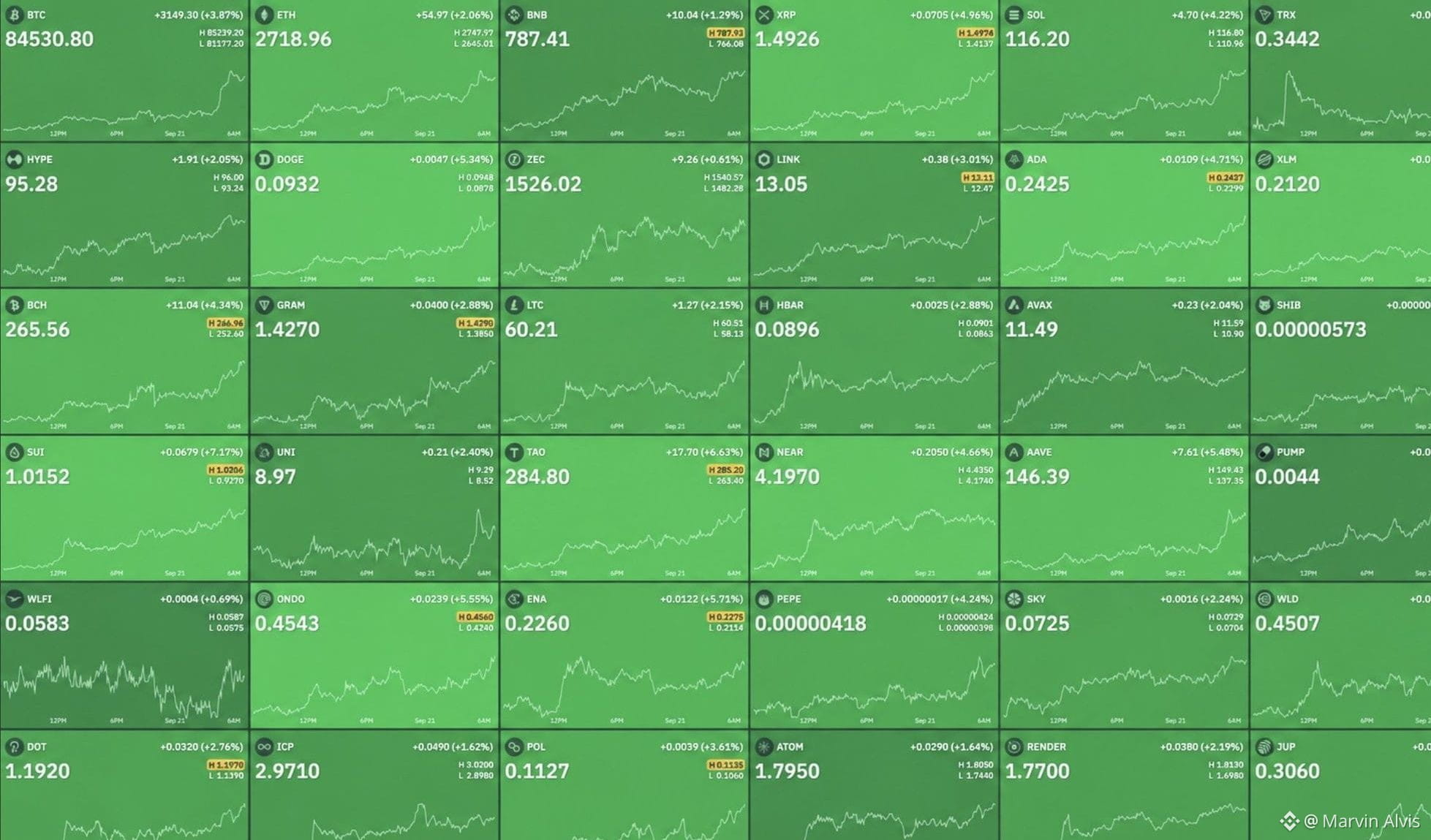
1
122
·
--
Bullish
Verified
I’ve been watching OVERTAKE, and the interesting part isn’t just the sudden attention around $TAKE.
The project is building a gaming-focused ecosystem around digital-asset trading, with its marketplace using Sui and smart-contract escrow to make transactions more transparent.
What matters now is execution: Will gamers and developers actually use it at scale?
The infrastructure is taking shape, but long-term adoption will tell the real story. I’m watching the usage, integrations and ecosystem activity more than the headlines.
$TAKE
{future}(TAKEUSDT)
$ETC
{spot}(ETCUSDT)
I’ve been watching OVERTAKE, and the interesting part isn’t just the sudden attention around $TAKE .
The project is building a gaming-focused ecosystem around digital-asset trading, with its marketplace using Sui and smart-contract escrow to make transactions more transparent.
What matters now is execution: Will gamers and developers actually use it at scale?
The infrastructure is taking shape, but long-term adoption will tell the real story. I’m watching the usage, integrations and ecosystem activity more than the headlines.
$TAKE
$ETC
The project is building a gaming-focused ecosystem around digital-asset trading, with its marketplace using Sui and smart-contract escrow to make transactions more transparent.
What matters now is execution: Will gamers and developers actually use it at scale?
The infrastructure is taking shape, but long-term adoption will tell the real story. I’m watching the usage, integrations and ecosystem activity more than the headlines.
$TAKE
$ETC
OVERTAKE
78%
smart-contract
22%
integrations
0%
9 votes • Voting closed
1.2k
Log in to explore more content
Join global crypto users on Binance Square
⚡️ Get latest and useful information about crypto.
💬 Trusted by the world’s largest crypto exchange.
👍 Discover real insights from verified creators.
Email / Phone number