

Sang Schwamberger vicY
16 Posts

Sang Schwamberger vicY
Report
Block User
0 Following
0 Followers
6 Liked
Posts
·
--
Bullish
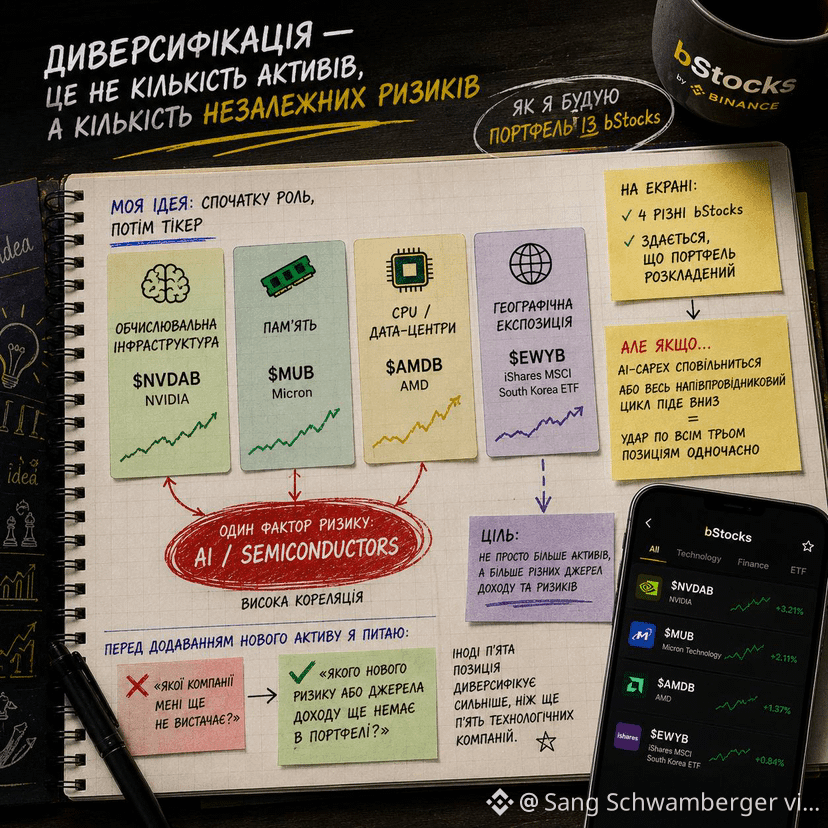
#bstockscis I tried to put together a portfolio with bStocks, but I forbade myself from looking at the company names.
The rule is simple: first determine what role each position is supposed to play, and only then choose the ticker.
I ended up with something like this:
🧠 computing infrastructure → $NVDAB
💾 memory → $MUB
🖥️ CPU / data centers → $AMDB
🌏 geographic exposure → $EWYB
And then I noticed a problem.
On the screen it looks like 4 different bStocks. Psychologically it seems: the portfolio is already pretty well diversified.
But if AI capex slows down, or if the entire semiconductor cycle goes down, the first three positions could all get hit by the same factor.
So the number of tickers ≠ the number of independent risk exposures.
That’s what changed the way I look at a list of bStocks. Now, before adding a new asset, I no longer ask:
“What company am I still missing?”
Instead I ask:
“What new risk or source of income is still not in the portfolio?”
Sometimes the fifth position diversifies more strongly than another five tech companies.
And how do you count diversification: by the number of assets or by the number of different risk factors?
@BinanceCIS
#bStocksCIS
{spot}(NVDABUSDT)
{spot}(MUBUSDT)
{spot}(AMDBUSDT)
#bstockscis I tried to put together a portfolio with bStocks, but I forbade myself from looking at the company names.
The rule is simple: first determine what role each position is supposed to play, and only then choose the ticker.
I ended up with something like this:
🧠 computing infrastructure → $NVDAB
💾 memory → $MUB
🖥️ CPU / data centers → $AMDB
🌏 geographic exposure → $EWYB
And then I noticed a problem.
On the screen it looks like 4 different bStocks. Psychologically it seems: the portfolio is already pretty well diversified.
But if AI capex slows down, or if the entire semiconductor cycle goes down, the first three positions could all get hit by the same factor.
So the number of tickers ≠ the number of independent risk exposures.
That’s what changed the way I look at a list of bStocks. Now, before adding a new asset, I no longer ask:
“What company am I still missing?”
Instead I ask:
“What new risk or source of income is still not in the portfolio?”
Sometimes the fifth position diversifies more strongly than another five tech companies.
And how do you count diversification: by the number of assets or by the number of different risk factors?
@BinanceCIS
#bStocksCIS
The rule is simple: first determine what role each position is supposed to play, and only then choose the ticker.
I ended up with something like this:
🧠 computing infrastructure → $NVDAB
💾 memory → $MUB
🖥️ CPU / data centers → $AMDB
🌏 geographic exposure → $EWYB
And then I noticed a problem.
On the screen it looks like 4 different bStocks. Psychologically it seems: the portfolio is already pretty well diversified.
But if AI capex slows down, or if the entire semiconductor cycle goes down, the first three positions could all get hit by the same factor.
So the number of tickers ≠ the number of independent risk exposures.
That’s what changed the way I look at a list of bStocks. Now, before adding a new asset, I no longer ask:
“What company am I still missing?”
Instead I ask:
“What new risk or source of income is still not in the portfolio?”
Sometimes the fifth position diversifies more strongly than another five tech companies.
And how do you count diversification: by the number of assets or by the number of different risk factors?
@BinanceCIS
#bStocksCIS
1
2
137
·
--
Bullish
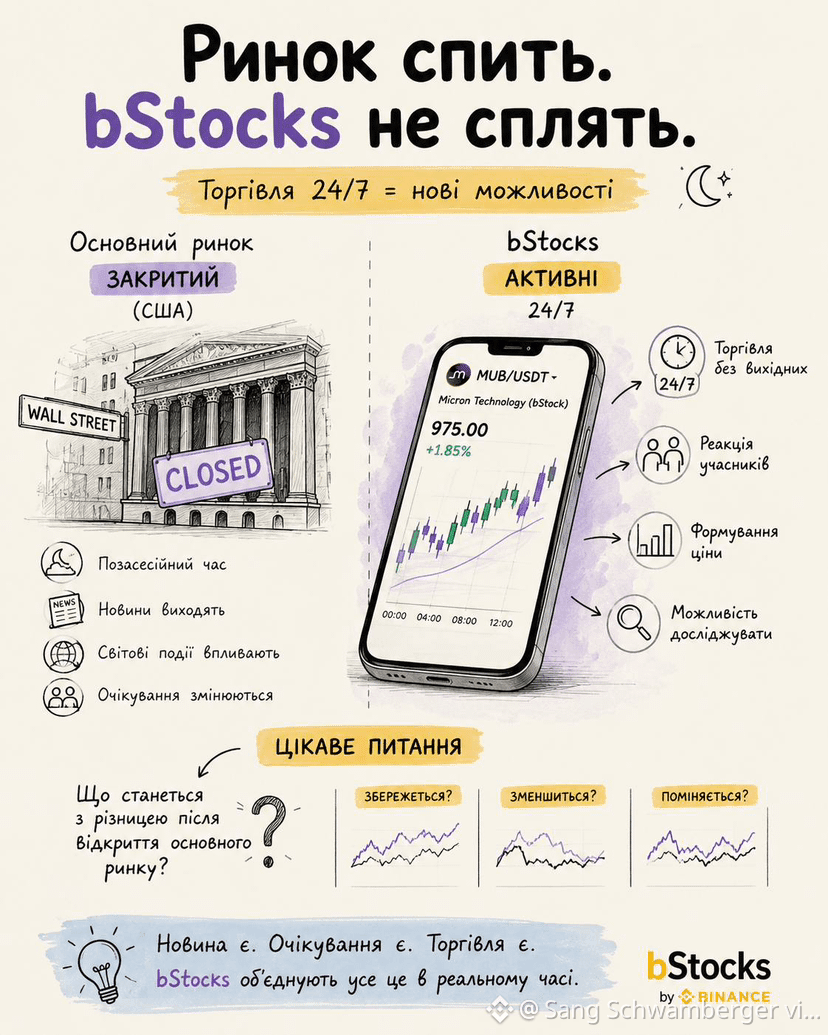
#bstockscis There’s one thing in bStocks that I initially took a bit too literally.
If $MUB is tied to Micron, and the U.S. market is already closed—where does the new bStock price come from?
After all, the company doesn’t just disappear at 23:00 😅
After the market closes, news continues to come out, other assets move, and expectations for the sector change. And yet $MUB remains available for trading 24/7.
So at night we get an interesting situation: new information is already available, bStocks participants can react to it, while the main session for the underlying stock is still closed.
Because of this, I now look at the overnight chart a little differently.
For example, if after a major news event $MUB moves sharply, I’m not only interested in the move itself. What’s interesting is what happens to that gap after the main market opens.
Will it stay? Will it shrink? Or will the stock market move in an entirely different direction?
I want to collect a few cases like this and compare them.
I think it’s exactly these kinds of details that best show how unusually the traditional market and 24/7 trading come together.
@BinanceCIS
#bStocksCIS
#bstockscis There’s one thing in bStocks that I initially took a bit too literally.
If $MUB is tied to Micron, and the U.S. market is already closed—where does the new bStock price come from?
After all, the company doesn’t just disappear at 23:00 😅
After the market closes, news continues to come out, other assets move, and expectations for the sector change. And yet $MUB remains available for trading 24/7.
So at night we get an interesting situation: new information is already available, bStocks participants can react to it, while the main session for the underlying stock is still closed.
Because of this, I now look at the overnight chart a little differently.
For example, if after a major news event $MUB moves sharply, I’m not only interested in the move itself. What’s interesting is what happens to that gap after the main market opens.
Will it stay? Will it shrink? Or will the stock market move in an entirely different direction?
I want to collect a few cases like this and compare them.
I think it’s exactly these kinds of details that best show how unusually the traditional market and 24/7 trading come together.
@BinanceCIS
#bStocksCIS
If $MUB is tied to Micron, and the U.S. market is already closed—where does the new bStock price come from?
After all, the company doesn’t just disappear at 23:00 😅
After the market closes, news continues to come out, other assets move, and expectations for the sector change. And yet $MUB remains available for trading 24/7.
So at night we get an interesting situation: new information is already available, bStocks participants can react to it, while the main session for the underlying stock is still closed.
Because of this, I now look at the overnight chart a little differently.
For example, if after a major news event $MUB moves sharply, I’m not only interested in the move itself. What’s interesting is what happens to that gap after the main market opens.
Will it stay? Will it shrink? Or will the stock market move in an entirely different direction?
I want to collect a few cases like this and compare them.
I think it’s exactly these kinds of details that best show how unusually the traditional market and 24/7 trading come together.
@BinanceCIS
#bStocksCIS
89
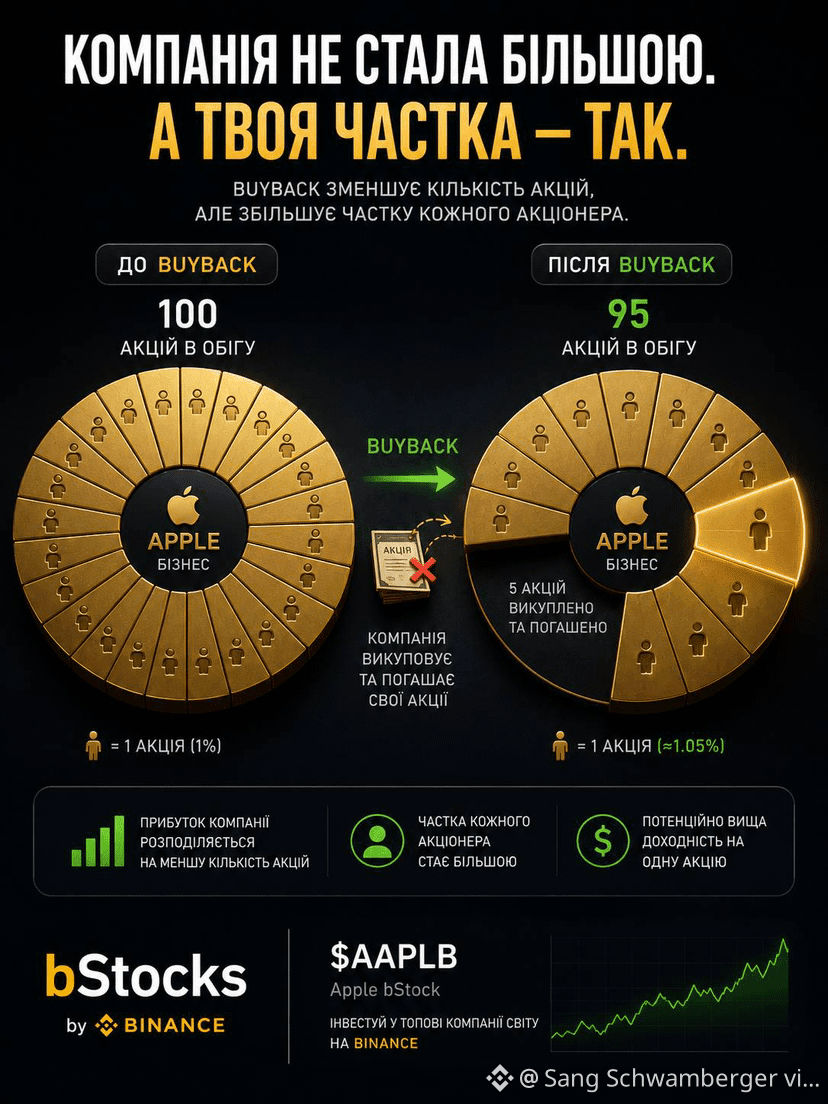
#bstockscis Imagine a strange situation.
You have $AAPLB lying around. Apple hasn’t released a new iPhone, hasn’t increased profit overnight, and hasn’t announced a revolutionary product.
But the share of the business that belongs to one ordinary share potentially becomes a little larger.
How?
The company simply buys its own shares.
Earlier, I used to think of a buyback as a sort of technical news item: “Apple will spend billions on a share repurchase.”
And then I started wondering what actually happens.
Let’s say there were, hypothetically, 100 shares of the company.
The company bought some of them and retired them.
That leaves 95.
The business itself doesn’t automatically become 5% bigger. But now profits are distributed across fewer shares.
And this is where bStocks made me ask an even more interesting question.
If $AAPLB is economically tied to Apple’s underlying stock, then what matters to me isn’t only its chart.
It also matters what the company itself does with its shares.
Dividends, splits, buybacks — all of this happens far from the crypto market, but it can matter for the asset we see on Binance.
So now, when opening bStock, I more and more often first ask: “What is the company doing right now?”
And only then do I look at the candles.
It’s interesting—who even checks company buybacks before buying their bStocks?
@BinanceCIS #bStocksCIS
#bstockscis Imagine a strange situation.
You have $AAPLB lying around. Apple hasn’t released a new iPhone, hasn’t increased profit overnight, and hasn’t announced a revolutionary product.
But the share of the business that belongs to one ordinary share potentially becomes a little larger.
How?
The company simply buys its own shares.
Earlier, I used to think of a buyback as a sort of technical news item: “Apple will spend billions on a share repurchase.”
And then I started wondering what actually happens.
Let’s say there were, hypothetically, 100 shares of the company.
The company bought some of them and retired them.
That leaves 95.
The business itself doesn’t automatically become 5% bigger. But now profits are distributed across fewer shares.
And this is where bStocks made me ask an even more interesting question.
If $AAPLB is economically tied to Apple’s underlying stock, then what matters to me isn’t only its chart.
It also matters what the company itself does with its shares.
Dividends, splits, buybacks — all of this happens far from the crypto market, but it can matter for the asset we see on Binance.
So now, when opening bStock, I more and more often first ask: “What is the company doing right now?”
And only then do I look at the candles.
It’s interesting—who even checks company buybacks before buying their bStocks?
@BinanceCIS #bStocksCIS
You have $AAPLB lying around. Apple hasn’t released a new iPhone, hasn’t increased profit overnight, and hasn’t announced a revolutionary product.
But the share of the business that belongs to one ordinary share potentially becomes a little larger.
How?
The company simply buys its own shares.
Earlier, I used to think of a buyback as a sort of technical news item: “Apple will spend billions on a share repurchase.”
And then I started wondering what actually happens.
Let’s say there were, hypothetically, 100 shares of the company.
The company bought some of them and retired them.
That leaves 95.
The business itself doesn’t automatically become 5% bigger. But now profits are distributed across fewer shares.
And this is where bStocks made me ask an even more interesting question.
If $AAPLB is economically tied to Apple’s underlying stock, then what matters to me isn’t only its chart.
It also matters what the company itself does with its shares.
Dividends, splits, buybacks — all of this happens far from the crypto market, but it can matter for the asset we see on Binance.
So now, when opening bStock, I more and more often first ask: “What is the company doing right now?”
And only then do I look at the candles.
It’s interesting—who even checks company buybacks before buying their bStocks?
@BinanceCIS #bStocksCIS
132
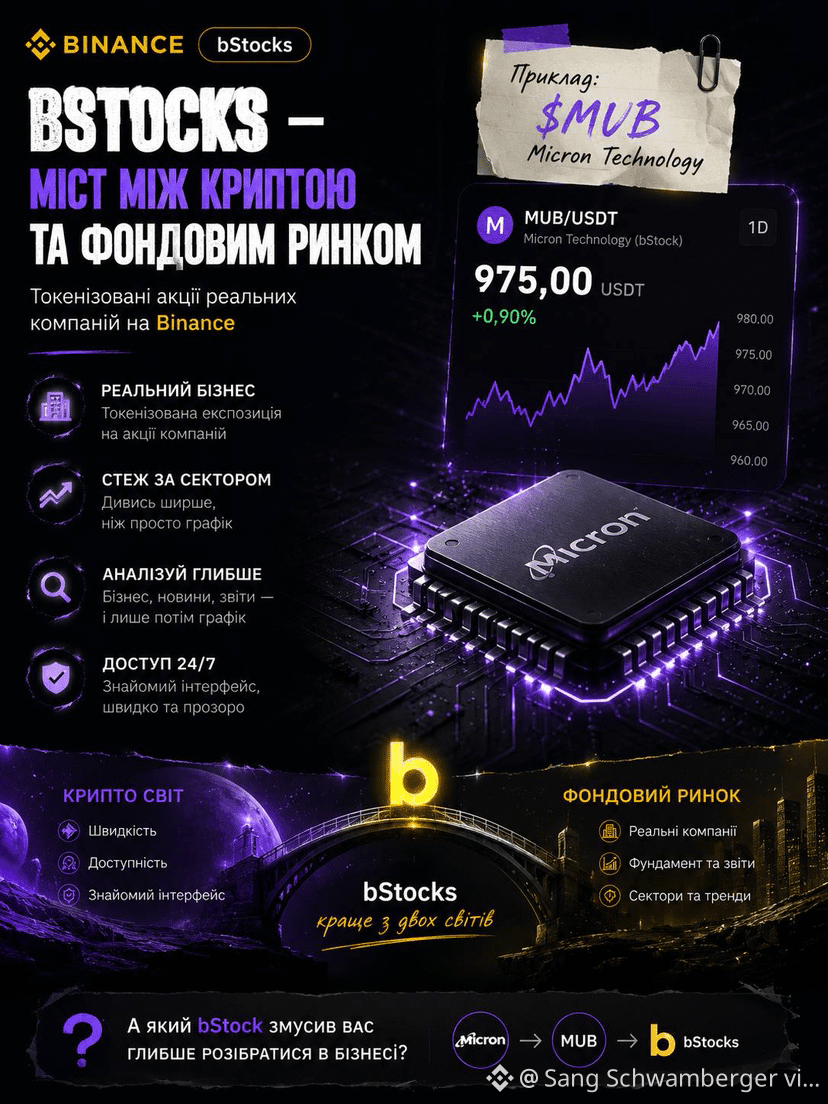
#bstockscis At first, I was looking at bStocks almost like «crypto with the company’s logo»—a familiar interface, a pair with USDT, a chart, buying and selling.
But over time I realized: just watching the chart here isn’t enough.
Let’s take $MUB —Micron Technology. Now, before I judge the token’s movement, I’m interested in what’s happening with the company itself: demand for memory, AI infrastructure, reporting, and the situation in the semiconductor sector.
And only then do I go back to the $MUB chart on Binance.
That’s what became interesting to me about bStocks: crypto has trained me to quickly access things with a familiar interface, and stocks make you look deeper—at the business and the entire sector.
Maybe tokenization changes not only how people access stocks, but also how crypto users analyze the market.
For example, I started following semiconductors much more often through $MUB .
Which bStock made you dig deeper into the company itself?
@BinanceCIS
#bStocksCIS
{spot}(MUBUSDT)
#bstockscis At first, I was looking at bStocks almost like «crypto with the company’s logo»—a familiar interface, a pair with USDT, a chart, buying and selling.
But over time I realized: just watching the chart here isn’t enough.
Let’s take $MUB —Micron Technology. Now, before I judge the token’s movement, I’m interested in what’s happening with the company itself: demand for memory, AI infrastructure, reporting, and the situation in the semiconductor sector.
And only then do I go back to the $MUB chart on Binance.
That’s what became interesting to me about bStocks: crypto has trained me to quickly access things with a familiar interface, and stocks make you look deeper—at the business and the entire sector.
Maybe tokenization changes not only how people access stocks, but also how crypto users analyze the market.
For example, I started following semiconductors much more often through $MUB .
Which bStock made you dig deeper into the company itself?
@BinanceCIS
#bStocksCIS
But over time I realized: just watching the chart here isn’t enough.
Let’s take $MUB —Micron Technology. Now, before I judge the token’s movement, I’m interested in what’s happening with the company itself: demand for memory, AI infrastructure, reporting, and the situation in the semiconductor sector.
And only then do I go back to the $MUB chart on Binance.
That’s what became interesting to me about bStocks: crypto has trained me to quickly access things with a familiar interface, and stocks make you look deeper—at the business and the entire sector.
Maybe tokenization changes not only how people access stocks, but also how crypto users analyze the market.
For example, I started following semiconductors much more often through $MUB .
Which bStock made you dig deeper into the company itself?
@BinanceCIS
#bStocksCIS
102
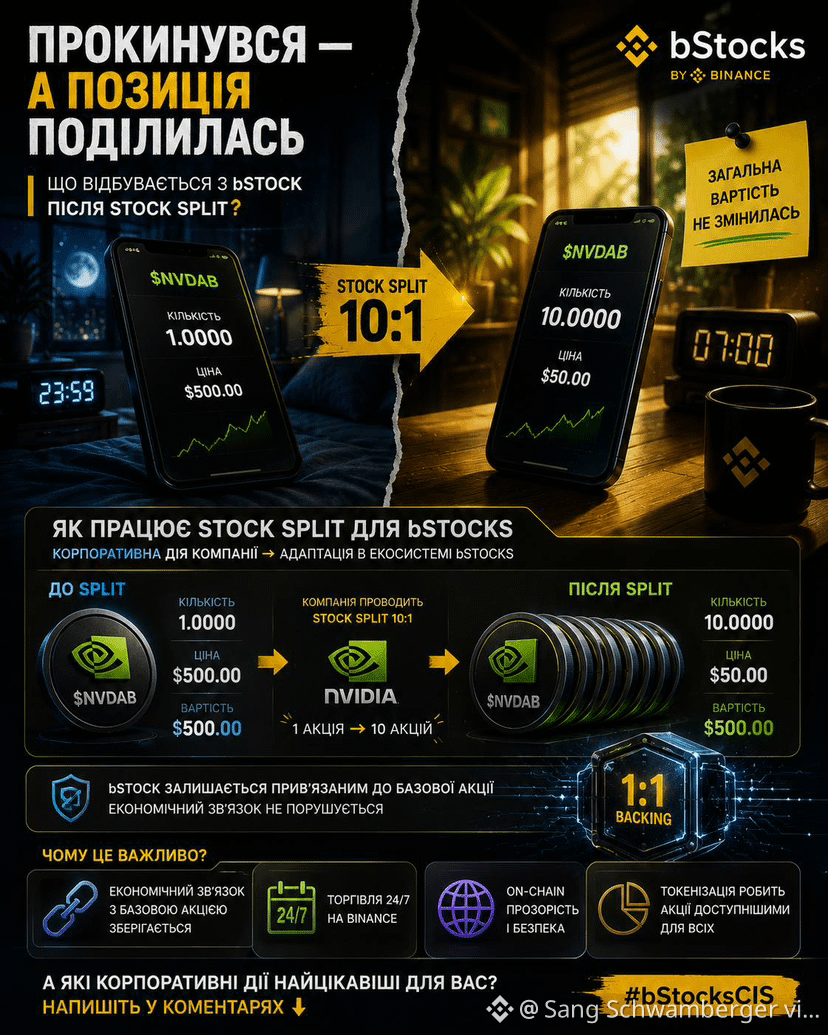
#bstockscis Imagine: you go to sleep with 1 token tied to a $500 share event, and the next day you see 10 tokens of roughly $50 each.
No extra money appeared. So what happened to bStock? 😅
That’s the question I asked myself when I started figuring out how tokenized assets handle a stock split.
With a regular stock it’s simple: a 10:1 split turns one share into ten, proportionally lowering the price. The total value of your position doesn’t change because of the split itself.
But bStock is a separate tokenized product connected to the underlying asset.
That’s why corporate actions affecting the underlying asset must also be reflected in bStocks, so the economic link to the underlying share is preserved.
And I think it’s precisely these kinds of moments that explain the concept of 1:1 backing better than the wording “backed by a share.”
$NVDAB can trade 24/7 and live on-chain, but behind the blockchain “shell” there’s still a real company with its corporate events.
That’s why I’m interested in bStocks: it’s not only 24/7 trading, but an attempt to carry over the logic of a traditional asset into an on-chain environment.
Next, we should look at a reverse split? 👀
@BinanceCIS #bStockCIS
#bstockscis Imagine: you go to sleep with 1 token tied to a $500 share event, and the next day you see 10 tokens of roughly $50 each.
No extra money appeared. So what happened to bStock? 😅
That’s the question I asked myself when I started figuring out how tokenized assets handle a stock split.
With a regular stock it’s simple: a 10:1 split turns one share into ten, proportionally lowering the price. The total value of your position doesn’t change because of the split itself.
But bStock is a separate tokenized product connected to the underlying asset.
That’s why corporate actions affecting the underlying asset must also be reflected in bStocks, so the economic link to the underlying share is preserved.
And I think it’s precisely these kinds of moments that explain the concept of 1:1 backing better than the wording “backed by a share.”
$NVDAB can trade 24/7 and live on-chain, but behind the blockchain “shell” there’s still a real company with its corporate events.
That’s why I’m interested in bStocks: it’s not only 24/7 trading, but an attempt to carry over the logic of a traditional asset into an on-chain environment.
Next, we should look at a reverse split? 👀
@BinanceCIS #bStockCIS
No extra money appeared. So what happened to bStock? 😅
That’s the question I asked myself when I started figuring out how tokenized assets handle a stock split.
With a regular stock it’s simple: a 10:1 split turns one share into ten, proportionally lowering the price. The total value of your position doesn’t change because of the split itself.
But bStock is a separate tokenized product connected to the underlying asset.
That’s why corporate actions affecting the underlying asset must also be reflected in bStocks, so the economic link to the underlying share is preserved.
And I think it’s precisely these kinds of moments that explain the concept of 1:1 backing better than the wording “backed by a share.”
$NVDAB can trade 24/7 and live on-chain, but behind the blockchain “shell” there’s still a real company with its corporate events.
That’s why I’m interested in bStocks: it’s not only 24/7 trading, but an attempt to carry over the logic of a traditional asset into an on-chain environment.
Next, we should look at a reverse split? 👀
@BinanceCIS #bStockCIS
104
·
--
Bullish
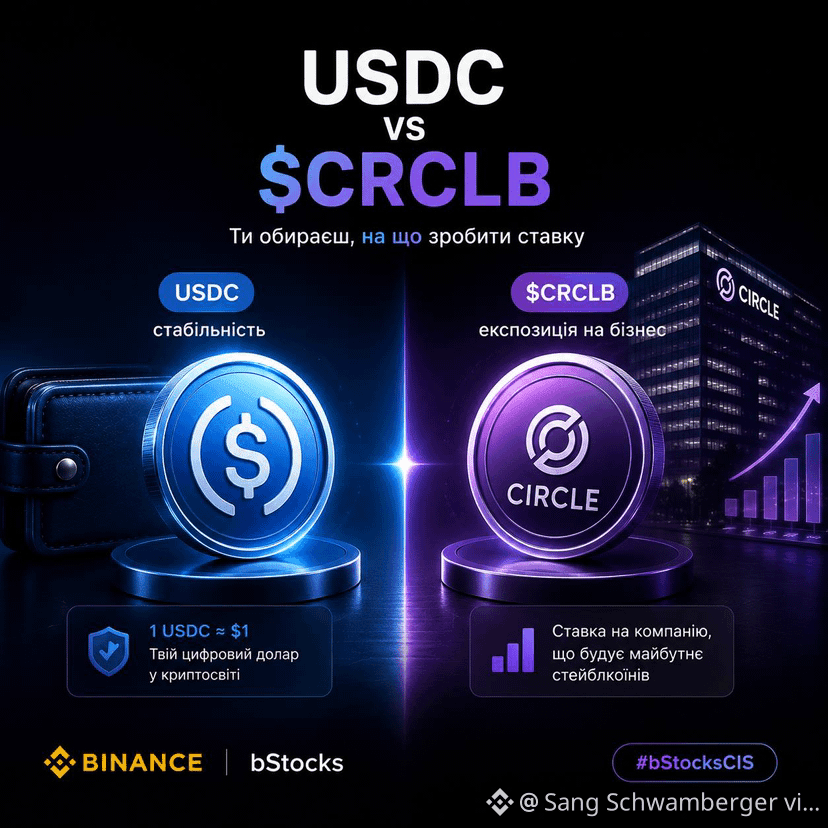
#bstockscis USDC is lying in the wallet. $CRCLB — this is already a bet on the business behind USDC. And this is absolutely not the same thing.
That’s why, among bStocks, I was interested in Circle.
When we hold a stablecoin, the expectation is simple: 1 USDC ≈ $1. Circle’s growth should not turn one USDC into two.
And $CRCLB provides a different exposure — to the company itself.
Here’s the interesting part: a crypto user can use the company’s product for years, but never consider the company itself as an asset.
With Circle, this connection is especially clear.
If stablecoin usage continues to grow, it’s interesting to watch not only USDC anymore. What matters are reserves, revenue, competition, and regulation — everything that affects Circle’s business.
So $CRCLB for me is not just “a stock in a crypto wrapper.”
It’s an opportunity to look at familiar crypto infrastructure from the other side of the balance sheet:
you use the product → you research the business behind it.
That’s the kind of bStocks I’m interested in — when the company is already familiar to you through its product.
What’s more interesting to you: the crypto asset itself, or the company building the infrastructure around it?
@BinanceCIS #bStocksCIS
{spot}(CRCLBUSDT)
#bstockscis USDC is lying in the wallet. $CRCLB — this is already a bet on the business behind USDC. And this is absolutely not the same thing.
That’s why, among bStocks, I was interested in Circle.
When we hold a stablecoin, the expectation is simple: 1 USDC ≈ $1. Circle’s growth should not turn one USDC into two.
And $CRCLB provides a different exposure — to the company itself.
Here’s the interesting part: a crypto user can use the company’s product for years, but never consider the company itself as an asset.
With Circle, this connection is especially clear.
If stablecoin usage continues to grow, it’s interesting to watch not only USDC anymore. What matters are reserves, revenue, competition, and regulation — everything that affects Circle’s business.
So $CRCLB for me is not just “a stock in a crypto wrapper.”
It’s an opportunity to look at familiar crypto infrastructure from the other side of the balance sheet:
you use the product → you research the business behind it.
That’s the kind of bStocks I’m interested in — when the company is already familiar to you through its product.
What’s more interesting to you: the crypto asset itself, or the company building the infrastructure around it?
@BinanceCIS #bStocksCIS
That’s why, among bStocks, I was interested in Circle.
When we hold a stablecoin, the expectation is simple: 1 USDC ≈ $1. Circle’s growth should not turn one USDC into two.
And $CRCLB provides a different exposure — to the company itself.
Here’s the interesting part: a crypto user can use the company’s product for years, but never consider the company itself as an asset.
With Circle, this connection is especially clear.
If stablecoin usage continues to grow, it’s interesting to watch not only USDC anymore. What matters are reserves, revenue, competition, and regulation — everything that affects Circle’s business.
So $CRCLB for me is not just “a stock in a crypto wrapper.”
It’s an opportunity to look at familiar crypto infrastructure from the other side of the balance sheet:
you use the product → you research the business behind it.
That’s the kind of bStocks I’m interested in — when the company is already familiar to you through its product.
What’s more interesting to you: the crypto asset itself, or the company building the infrastructure around it?
@BinanceCIS #bStocksCIS
102
#bstockscis 99,65%. It was this number that made me look differently at $TSLAB .
Not the Tesla price. Not the chart. And not even the 24/7 trading.
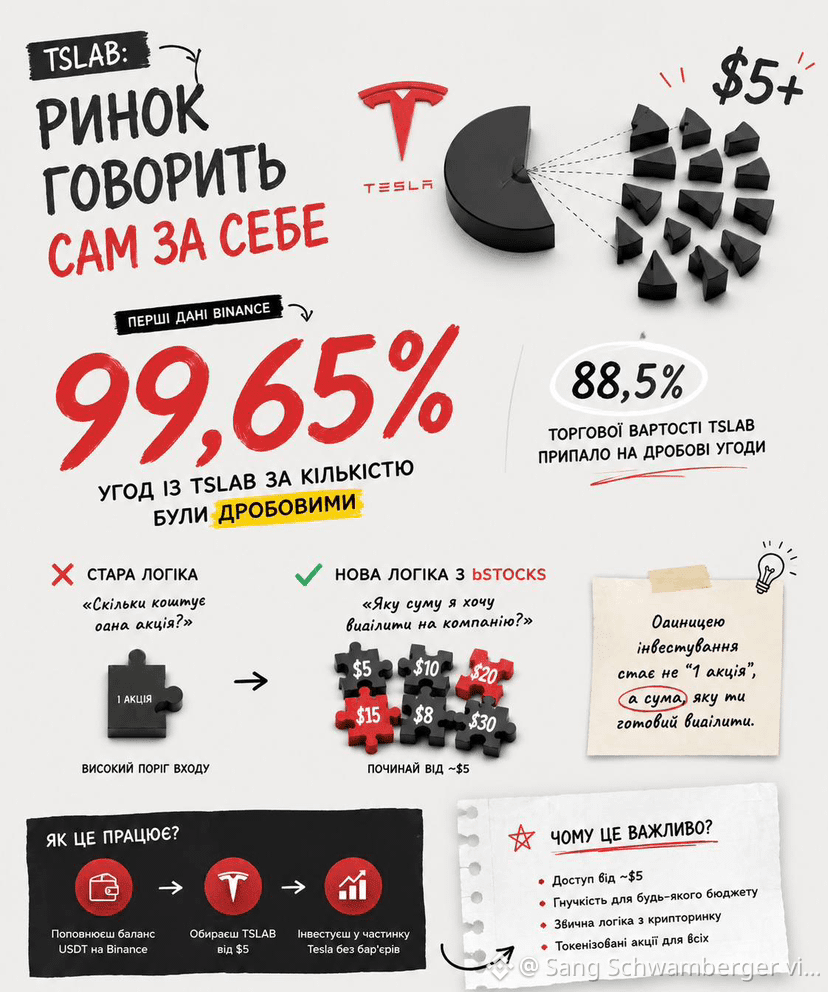
According to initial data from Binance, about 99.65% of TSLAB transactions by quantity were fractional. And they accounted for roughly 88.5% of TSLAB trading value.
So fractional buys here aren’t just a feature added “for show.”
It seems users are genuinely building positions in small portions.
And that changes the way people think.
Instead of:
“How much does one share cost?”
the question becomes:
“How much money do I want to allocate to this company?”
If you want $10 of exposure to Tesla, you don’t necessarily have to wait until you can afford a whole share. bStocks let you start at about $5.
For a crypto user, this model feels completely natural. We’ve long stopped thinking that to buy BTC you first need to save up for 1 BTC.
Now that same principle is gradually coming to tokenized stocks.
I think this is where one of the most interesting changes happens: the unit of investing becomes not “1 share,” but the amount you’re ready to put in.
Do you think fractional ownership will become the standard way to buy stocks over time?
@BinanceCIS #bStockCIS $TSLAB
{spot}(TSLABUSDT)
#bstockscis 99,65%. It was this number that made me look differently at $TSLAB .
Not the Tesla price. Not the chart. And not even the 24/7 trading.
According to initial data from Binance, about 99.65% of TSLAB transactions by quantity were fractional. And they accounted for roughly 88.5% of TSLAB trading value.
So fractional buys here aren’t just a feature added “for show.”
It seems users are genuinely building positions in small portions.
And that changes the way people think.
Instead of:
“How much does one share cost?”
the question becomes:
“How much money do I want to allocate to this company?”
If you want $10 of exposure to Tesla, you don’t necessarily have to wait until you can afford a whole share. bStocks let you start at about $5.
For a crypto user, this model feels completely natural. We’ve long stopped thinking that to buy BTC you first need to save up for 1 BTC.
Now that same principle is gradually coming to tokenized stocks.
I think this is where one of the most interesting changes happens: the unit of investing becomes not “1 share,” but the amount you’re ready to put in.
Do you think fractional ownership will become the standard way to buy stocks over time?
@BinanceCIS #bStockCIS $TSLAB
Not the Tesla price. Not the chart. And not even the 24/7 trading.
According to initial data from Binance, about 99.65% of TSLAB transactions by quantity were fractional. And they accounted for roughly 88.5% of TSLAB trading value.
So fractional buys here aren’t just a feature added “for show.”
It seems users are genuinely building positions in small portions.
And that changes the way people think.
Instead of:
“How much does one share cost?”
the question becomes:
“How much money do I want to allocate to this company?”
If you want $10 of exposure to Tesla, you don’t necessarily have to wait until you can afford a whole share. bStocks let you start at about $5.
For a crypto user, this model feels completely natural. We’ve long stopped thinking that to buy BTC you first need to save up for 1 BTC.
Now that same principle is gradually coming to tokenized stocks.
I think this is where one of the most interesting changes happens: the unit of investing becomes not “1 share,” but the amount you’re ready to put in.
Do you think fractional ownership will become the standard way to buy stocks over time?
@BinanceCIS #bStockCIS $TSLAB
137
·
--
Bullish
#bstockscis Є a bit of a strange situation: for years we’ve been using stablecoins, but we think much less often about the business behind them.
That’s why among bStocks, $CRCLB interested me the most.
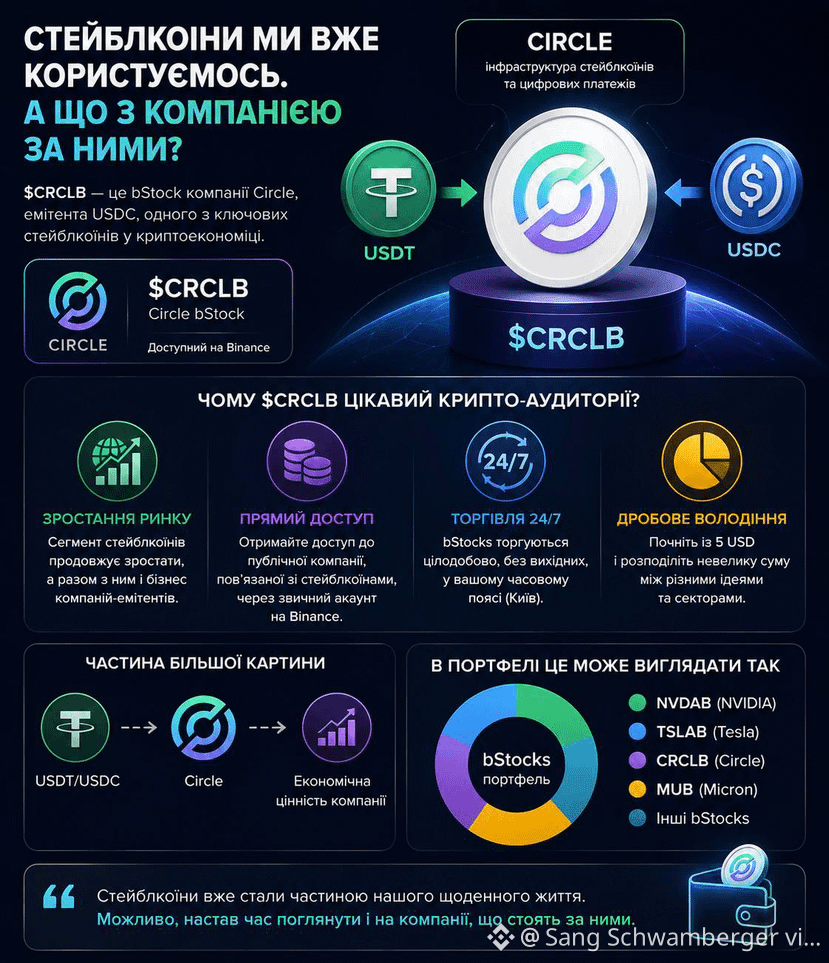
Circle for the crypto market is not just another American company. Its business is directly tied to stablecoin infrastructure. So here we get an interesting construction:
USDT → buy $CRCLB → gain access to a company whose business develops within the same digital financial economy.
And for me, this is a completely different kind of position than, say, $NVDAB .
When buying NVIDIA, I’m looking at AI, data centers, and demand for chips.
And Circle makes me look at whether stablecoins will continue taking a share of global payments and settlements.
That’s how I’m starting to perceive bStocks right now: not as a list of well-known logos, but as an opportunity to choose different economic stories within a single portfolio.
And here, fractional positions are especially appropriate. You don’t have to make one company a big bet—you can split a smaller amount across different ideas.
It would be interesting to see even more companies from the crypto industry among bStocks.
And what sector would you add next?
@BinanceCIS #bStocksCIS
#bstockscis Є a bit of a strange situation: for years we’ve been using stablecoins, but we think much less often about the business behind them.
That’s why among bStocks, $CRCLB interested me the most.
Circle for the crypto market is not just another American company. Its business is directly tied to stablecoin infrastructure. So here we get an interesting construction:
USDT → buy $CRCLB → gain access to a company whose business develops within the same digital financial economy.
And for me, this is a completely different kind of position than, say, $NVDAB .
When buying NVIDIA, I’m looking at AI, data centers, and demand for chips.
And Circle makes me look at whether stablecoins will continue taking a share of global payments and settlements.
That’s how I’m starting to perceive bStocks right now: not as a list of well-known logos, but as an opportunity to choose different economic stories within a single portfolio.
And here, fractional positions are especially appropriate. You don’t have to make one company a big bet—you can split a smaller amount across different ideas.
It would be interesting to see even more companies from the crypto industry among bStocks.
And what sector would you add next?
@BinanceCIS #bStocksCIS
That’s why among bStocks, $CRCLB interested me the most.
Circle for the crypto market is not just another American company. Its business is directly tied to stablecoin infrastructure. So here we get an interesting construction:
USDT → buy $CRCLB → gain access to a company whose business develops within the same digital financial economy.
And for me, this is a completely different kind of position than, say, $NVDAB .
When buying NVIDIA, I’m looking at AI, data centers, and demand for chips.
And Circle makes me look at whether stablecoins will continue taking a share of global payments and settlements.
That’s how I’m starting to perceive bStocks right now: not as a list of well-known logos, but as an opportunity to choose different economic stories within a single portfolio.
And here, fractional positions are especially appropriate. You don’t have to make one company a big bet—you can split a smaller amount across different ideas.
It would be interesting to see even more companies from the crypto industry among bStocks.
And what sector would you add next?
@BinanceCIS #bStocksCIS
79
·
--
Bullish
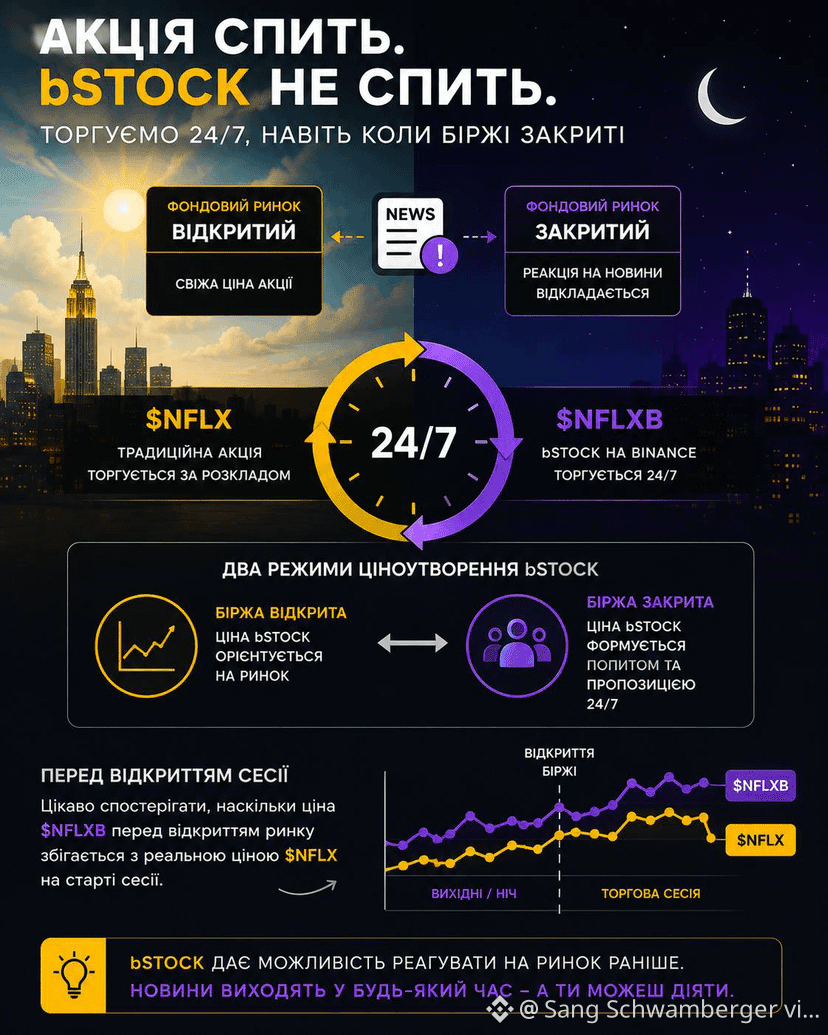
#bstockscis On Saturday, the rally doesn’t move. And its bStock — can.
This moment in bStocks seems to me much more interesting than the fact of tokenization itself.
For example, $NFLX trades on a traditional exchange according to its schedule. But $NFLXB already lives in the Binance crypto infrastructure, where trading doesn’t stop with the closing of the stock session.
And then a situation arises.
Imagine: on Saturday, news about Netflix breaks. In the stock market, the reaction will be visible only after the next session opens. But $NFLXB can already receive bids or offers.
That means that at certain hours, bStock effectively has two pricing modes:
→ when the underlying share is trading — there is a fresh market price to use as a reference;
→ when the exchange is closed — the price $NFLXB is formed within the active 24/7 market.
For me, that’s where the most interesting part begins. I wouldn’t treat weekend movement as a literal “new Netflix price.” Rather, it’s the market participants’ estimate of where the stock might be after the exchange opens.
So I want to watch one specific thing: how closely the bStock price before the session opening matches where the underlying share later actually opens.
Maybe it’s the late-night and weekend hours that will reveal one of the most interesting properties of bStocks.
@BinanceCIS #bStockCIS
#bstockscis On Saturday, the rally doesn’t move. And its bStock — can.
This moment in bStocks seems to me much more interesting than the fact of tokenization itself.
For example, $NFLX trades on a traditional exchange according to its schedule. But $NFLXB already lives in the Binance crypto infrastructure, where trading doesn’t stop with the closing of the stock session.
And then a situation arises.
Imagine: on Saturday, news about Netflix breaks. In the stock market, the reaction will be visible only after the next session opens. But $NFLXB can already receive bids or offers.
That means that at certain hours, bStock effectively has two pricing modes:
→ when the underlying share is trading — there is a fresh market price to use as a reference;
→ when the exchange is closed — the price $NFLXB is formed within the active 24/7 market.
For me, that’s where the most interesting part begins. I wouldn’t treat weekend movement as a literal “new Netflix price.” Rather, it’s the market participants’ estimate of where the stock might be after the exchange opens.
So I want to watch one specific thing: how closely the bStock price before the session opening matches where the underlying share later actually opens.
Maybe it’s the late-night and weekend hours that will reveal one of the most interesting properties of bStocks.
@BinanceCIS #bStockCIS
This moment in bStocks seems to me much more interesting than the fact of tokenization itself.
For example, $NFLX trades on a traditional exchange according to its schedule. But $NFLXB already lives in the Binance crypto infrastructure, where trading doesn’t stop with the closing of the stock session.
And then a situation arises.
Imagine: on Saturday, news about Netflix breaks. In the stock market, the reaction will be visible only after the next session opens. But $NFLXB can already receive bids or offers.
That means that at certain hours, bStock effectively has two pricing modes:
→ when the underlying share is trading — there is a fresh market price to use as a reference;
→ when the exchange is closed — the price $NFLXB is formed within the active 24/7 market.
For me, that’s where the most interesting part begins. I wouldn’t treat weekend movement as a literal “new Netflix price.” Rather, it’s the market participants’ estimate of where the stock might be after the exchange opens.
So I want to watch one specific thing: how closely the bStock price before the session opening matches where the underlying share later actually opens.
Maybe it’s the late-night and weekend hours that will reveal one of the most interesting properties of bStocks.
@BinanceCIS #bStockCIS
1
85
#bstockscis For a long time I watched $NVDAB and $GOOGLB like they were two different bets on AI.
And then I realized it’s a simplified view.
NVIDIA sells what makes it hard to scale AI today—computing infrastructure.
Alphabet, on the other hand, stands on both sides at once.
The company invests resources into AI infrastructure, but at the same time earns from AI through Search, YouTube, Cloud, and its own models.
And that’s why the very same AI race for these companies means different things.
For NVIDIA, I’m interested in:
whether the companies will keep buying more computing power.
For Alphabet, the question is different:
whether AI can bring in more money than it costs to scale.
That’s why I stopped looking only at headlines like “the company invests billions in AI.”
Big spending can be great news for the infrastructure provider and at the same time squeeze the margins of the one buying that infrastructure.
For me, that’s one of the advantages of bStocks: you can see them side by side in a single portfolio, but the investment logic behind them is different.
Now, when I read another news story about billions on AI, I ask myself one question:
who pays in this deal, and who gets the money?
And which side of the AI race would you choose? 👇
@BinanceCIS
#bStocksCIS
#bstockscis For a long time I watched $NVDAB and $GOOGLB like they were two different bets on AI.
And then I realized it’s a simplified view.
NVIDIA sells what makes it hard to scale AI today—computing infrastructure.
Alphabet, on the other hand, stands on both sides at once.
The company invests resources into AI infrastructure, but at the same time earns from AI through Search, YouTube, Cloud, and its own models.
And that’s why the very same AI race for these companies means different things.
For NVIDIA, I’m interested in:
whether the companies will keep buying more computing power.
For Alphabet, the question is different:
whether AI can bring in more money than it costs to scale.
That’s why I stopped looking only at headlines like “the company invests billions in AI.”
Big spending can be great news for the infrastructure provider and at the same time squeeze the margins of the one buying that infrastructure.
For me, that’s one of the advantages of bStocks: you can see them side by side in a single portfolio, but the investment logic behind them is different.
Now, when I read another news story about billions on AI, I ask myself one question:
who pays in this deal, and who gets the money?
And which side of the AI race would you choose? 👇
@BinanceCIS
#bStocksCIS
And then I realized it’s a simplified view.
NVIDIA sells what makes it hard to scale AI today—computing infrastructure.
Alphabet, on the other hand, stands on both sides at once.
The company invests resources into AI infrastructure, but at the same time earns from AI through Search, YouTube, Cloud, and its own models.
And that’s why the very same AI race for these companies means different things.
For NVIDIA, I’m interested in:
whether the companies will keep buying more computing power.
For Alphabet, the question is different:
whether AI can bring in more money than it costs to scale.
That’s why I stopped looking only at headlines like “the company invests billions in AI.”
Big spending can be great news for the infrastructure provider and at the same time squeeze the margins of the one buying that infrastructure.
For me, that’s one of the advantages of bStocks: you can see them side by side in a single portfolio, but the investment logic behind them is different.
Now, when I read another news story about billions on AI, I ask myself one question:
who pays in this deal, and who gets the money?
And which side of the AI race would you choose? 👇
@BinanceCIS
#bStocksCIS
$NVDAB — інфраструктура
0%
$GOOGLB — платформи
0%
Тримав би обидві
100%
Спостерігаю
0%
1 votes • Voting closed
1
158
#bstockscis I originally thought that trading bStocks 24/7 was just a nice bonus. But then I realized it really changes how I behave.
With regular stocks, everything is clear: the market closes — you wait.
And when $SPCXB , $NVDAB or other available through bStocks outside standard hours, another problem appears: the opportunity to trade is almost always there, but does that mean you should use it?
For example, on Saturday a big news story about a company comes out. Previously I would simply remember it and wait for the opening of the traditional market. With bStocks, you don’t necessarily have to delay your reaction.
And that’s where I caught myself thinking this:
24/7 gives you more freedom, but at the same time it requires more discipline.
So now I have a simple rule: I don’t open a position just because I can do it right now. First there has to be a reason, and only then the Buy button.
I’m curious about you: the ability to trade bStocks 24/7 — is it an advantage, or an extra temptation? 👀
@BinanceCIS #bStocksCIS
#bstockscis I originally thought that trading bStocks 24/7 was just a nice bonus. But then I realized it really changes how I behave.
With regular stocks, everything is clear: the market closes — you wait.
And when $SPCXB , $NVDAB or other available through bStocks outside standard hours, another problem appears: the opportunity to trade is almost always there, but does that mean you should use it?
For example, on Saturday a big news story about a company comes out. Previously I would simply remember it and wait for the opening of the traditional market. With bStocks, you don’t necessarily have to delay your reaction.
And that’s where I caught myself thinking this:
24/7 gives you more freedom, but at the same time it requires more discipline.
So now I have a simple rule: I don’t open a position just because I can do it right now. First there has to be a reason, and only then the Buy button.
I’m curious about you: the ability to trade bStocks 24/7 — is it an advantage, or an extra temptation? 👀
@BinanceCIS #bStocksCIS
With regular stocks, everything is clear: the market closes — you wait.
And when $SPCXB , $NVDAB or other available through bStocks outside standard hours, another problem appears: the opportunity to trade is almost always there, but does that mean you should use it?
For example, on Saturday a big news story about a company comes out. Previously I would simply remember it and wait for the opening of the traditional market. With bStocks, you don’t necessarily have to delay your reaction.
And that’s where I caught myself thinking this:
24/7 gives you more freedom, but at the same time it requires more discipline.
So now I have a simple rule: I don’t open a position just because I can do it right now. First there has to be a reason, and only then the Buy button.
I’m curious about you: the ability to trade bStocks 24/7 — is it an advantage, or an extra temptation? 👀
@BinanceCIS #bStocksCIS
⚡ Велика перевага
0%
🧠 Головне — дисципліна
0%
📅 Торгую лише у будні
0%
👀 Ще тестую bStocks
0%
0 votes • Voting closed
1
145
#bstockscis If a year ago someone told me that I’d be watching NVIDIA not only through its stock chart, but also through a token in my crypto wallet, I probably wouldn’t have quite understood why this is needed.
And now, $NVDAB became one of the most interesting examples of Binance bStocks for me.
The reason is simple: NVIDIA lives in a world where information doesn’t wait for NASDAQ to open. News about AI, chips, data centers, or competitors can show up at any time. The discussion starts immediately. The crypto market also gets used to reacting to information right away.
And a traditional share is still tied to the infrastructure of the conventional stock market.
That’s where it gets interesting.
In practice, one company ends up at the intersection of two financial cultures: the classic exchange culture and the cryptocurrency one. $NVDAB doesn’t make NVIDIA a different company and doesn’t remove the risks of the asset itself. But it changes the way a crypto user can gain access to it.
And it seems to me that this is exactly what bStocks is underestimating.
We talk a lot about what assets to buy. But much more rarely — about exactly how we get access to them.
For now, I’m seeing $NVDAB as an experiment with this boundary, not as just another ticker.
@BinanceCIS #bStocksCIS
{spot}(NVDABUSDT)
#bstockscis If a year ago someone told me that I’d be watching NVIDIA not only through its stock chart, but also through a token in my crypto wallet, I probably wouldn’t have quite understood why this is needed.
And now, $NVDAB became one of the most interesting examples of Binance bStocks for me.
The reason is simple: NVIDIA lives in a world where information doesn’t wait for NASDAQ to open. News about AI, chips, data centers, or competitors can show up at any time. The discussion starts immediately. The crypto market also gets used to reacting to information right away.
And a traditional share is still tied to the infrastructure of the conventional stock market.
That’s where it gets interesting.
In practice, one company ends up at the intersection of two financial cultures: the classic exchange culture and the cryptocurrency one. $NVDAB doesn’t make NVIDIA a different company and doesn’t remove the risks of the asset itself. But it changes the way a crypto user can gain access to it.
And it seems to me that this is exactly what bStocks is underestimating.
We talk a lot about what assets to buy. But much more rarely — about exactly how we get access to them.
For now, I’m seeing $NVDAB as an experiment with this boundary, not as just another ticker.
@BinanceCIS #bStocksCIS
And now, $NVDAB became one of the most interesting examples of Binance bStocks for me.
The reason is simple: NVIDIA lives in a world where information doesn’t wait for NASDAQ to open. News about AI, chips, data centers, or competitors can show up at any time. The discussion starts immediately. The crypto market also gets used to reacting to information right away.
And a traditional share is still tied to the infrastructure of the conventional stock market.
That’s where it gets interesting.
In practice, one company ends up at the intersection of two financial cultures: the classic exchange culture and the cryptocurrency one. $NVDAB doesn’t make NVIDIA a different company and doesn’t remove the risks of the asset itself. But it changes the way a crypto user can gain access to it.
And it seems to me that this is exactly what bStocks is underestimating.
We talk a lot about what assets to buy. But much more rarely — about exactly how we get access to them.
For now, I’m seeing $NVDAB as an experiment with this boundary, not as just another ticker.
@BinanceCIS #bStocksCIS
91
·
--
Bullish
#bstockscis Most people are discussing which company to choose in bStocks, but I was more interested in something else—what happens after the US market closes.
Previously, if an important news item came out in the evening, there was nothing to do but wait for the exchange to open. Now it’s interesting to watch how tokenized shares on Binance keep trading even when the stock market is already closed.
I specifically opened $NVDAB after the US trading session ended and looked at how the price behaves. It’s an unusual feeling: the news is already affecting the market, and you don’t have to wait until the next day to see the reaction.
For me, that is the main idea behind bStocks. Not just that you can buy a piece of a share, but that information and the market become closer to each other in time.
Now I want to observe how these tokens behave when companies release their quarterly reports. I think that’s exactly when the difference between a classic chart and 24/7 trading will be most noticeable.
@BinanceCIS #bStocksCIS $NVDAB
{spot}(NVDABUSDT)
#bstockscis Most people are discussing which company to choose in bStocks, but I was more interested in something else—what happens after the US market closes.
Previously, if an important news item came out in the evening, there was nothing to do but wait for the exchange to open. Now it’s interesting to watch how tokenized shares on Binance keep trading even when the stock market is already closed.
I specifically opened $NVDAB after the US trading session ended and looked at how the price behaves. It’s an unusual feeling: the news is already affecting the market, and you don’t have to wait until the next day to see the reaction.
For me, that is the main idea behind bStocks. Not just that you can buy a piece of a share, but that information and the market become closer to each other in time.
Now I want to observe how these tokens behave when companies release their quarterly reports. I think that’s exactly when the difference between a classic chart and 24/7 trading will be most noticeable.
@BinanceCIS #bStocksCIS $NVDAB
Previously, if an important news item came out in the evening, there was nothing to do but wait for the exchange to open. Now it’s interesting to watch how tokenized shares on Binance keep trading even when the stock market is already closed.
I specifically opened $NVDAB after the US trading session ended and looked at how the price behaves. It’s an unusual feeling: the news is already affecting the market, and you don’t have to wait until the next day to see the reaction.
For me, that is the main idea behind bStocks. Not just that you can buy a piece of a share, but that information and the market become closer to each other in time.
Now I want to observe how these tokens behave when companies release their quarterly reports. I think that’s exactly when the difference between a classic chart and 24/7 trading will be most noticeable.
@BinanceCIS #bStocksCIS $NVDAB
97
#bstockscis For me, the best way to get to grips with a new tool is not only to read about it, but to study its capabilities carefully. That’s why today I took a look at Binance bStocks. I started exploring $SPCXB to understand what advantages this tool can offer Binance users and how it works in practice.
@BinanceCIS #bStocks #bStocksCIS $SPCXB
#bstockscis For me, the best way to get to grips with a new tool is not only to read about it, but to study its capabilities carefully. That’s why today I took a look at Binance bStocks. I started exploring $SPCXB to understand what advantages this tool can offer Binance users and how it works in practice.
@BinanceCIS #bStocks #bStocksCIS $SPCXB
@BinanceCIS #bStocks #bStocksCIS $SPCXB
107
#bstockscis
@BinanceCIS
#bStocksCIS
$SPCXB
Watch how Binance is developing new tools for users, and Binance bStocks caught my attention. This format is interesting because it opens up even more opportunities for those who want to diversify their interests within a single platform. Today I decided to learn more about $SPCXB and understand what advantages it could provide in the future. It will be interesting to follow the development of this direction.
{spot}(SPCXBUSDT)
#bstockscis
@BinanceCIS
#bStocksCIS
$SPCXB
Watch how Binance is developing new tools for users, and Binance bStocks caught my attention. This format is interesting because it opens up even more opportunities for those who want to diversify their interests within a single platform. Today I decided to learn more about $SPCXB and understand what advantages it could provide in the future. It will be interesting to follow the development of this direction.
@BinanceCIS
#bStocksCIS
$SPCXB
Watch how Binance is developing new tools for users, and Binance bStocks caught my attention. This format is interesting because it opens up even more opportunities for those who want to diversify their interests within a single platform. Today I decided to learn more about $SPCXB and understand what advantages it could provide in the future. It will be interesting to follow the development of this direction.
86
Log in to explore more content
Join global crypto users on Binance Square
⚡️ Get latest and useful information about crypto.
💬 Trusted by the world’s largest crypto exchange.
👍 Discover real insights from verified creators.
Email / Phone number
Trending Topics
BitwiseFilesFinalNEARSpotETFProspectus
59,442 views
1,211 Discussing
#bitwisefilesfinalnearspotetfprospectus
Can $NEAR REALLY reach $562 with an ETF approval? 🚀
The crypto market is buzzing as Bitwise files its final prospectus for a Spot NEAR ETF (Ticker: NRR on NYSE Arca)! 📊🔥
Is institutional money about to unleash the biggest pump in NEAR’s history? Analysts are throwing around mind-blowing price targets:
🎯 Intermediate Target: $155
🎯 2030 Long-Term Target: $562
💡 Let's do the math:
At $562, $NEAR would sit at roughly a $680 Billion market cap—putting it right up there with Ethereum's potential valuation. With NEAR leading the Chain Abstraction & AI crypto narrative, this might not be as crazy as it sounds!
With SEC regulations turning more crypto-friendly and Wall Street knocking on the door, are you Accumulating or Holding?
👇 Drop your realistic price prediction for $NEAR in the comments! 👇
#BitwiseFilesFinalNEARSpotETFProspectus #Altcoins #CryptoNews #ETF
Doomsday-Trader
·5 Likes
·3.5k views
BitgetHackerMoves$83MStolenXRP
27,363 views
153 Discussing
SOLSpotETFWeeklyInflow$188M
16,343 views
121 Discussing