
SabTheTrader
230 Posts

SabTheTrader
Report
Block User
👩💻4 Years NQ & Crypto Female Trader | X: SabTheTrader | Price action has the final say | 币安现货合约8折邀请码: SAB111
Frequent Trader
6.5 Years
62 Following
754 Followers
357 Liked
Posts
All
Quotes
Videos
Live
PINNED
·
--
Verified
Check out this SPCXx IPO Campaign on Binance Wallet, but make sure to understand the rules before diving in. 🚀
Basically, eligible users can submit their subscription intentions through Binance Wallet for a chance to snag SpaceX-related tokenized securities, SPCXx.
But let’s be clear:
SPCXx isn’t directly buying SpaceX stock, nor does it grant any shareholder rights in SpaceX.
It’s more like getting price exposure to SpaceX’s potential IPO through xStocks.
The minimum subscription amount is 100 USDC; the indicative price for each SPCXx is 135 USDC, excluding fees, plus a 5% underwriting service fee.
So, if we go by the indicative price, the estimated total cost per token would be around 141.75 USDC.
Of course, keep in mind:
1⃣ Submitting a subscription ≠ guaranteed allocation
2⃣ SPCXx ≠ direct ownership of SpaceX stock
3⃣ The final issue price isn’t fixed
4⃣ Some regional users may be unable to participate
5⃣ Always read the rules and assess the risks before joining in
What I find noteworthy here is:
Pre-IPO, tokenized securities, and US stock assets on-chain are no longer distant concepts.
More and more exchanges and wallets are slowly bringing traditional market asset exposure to users on-chain.
Binance Wallet’s SPCXx IPO Campaign feels like a new milestone in this trend.
What was once a distant Pre-IPO exposure for the average user is now becoming visible to more people at a lower barrier and more on-chain.
So, I’ll treat it as a case study.
It’s not about blindly chasing SpaceX; it doesn’t mean these types of products are fully matured either.
But the increasing appearance of traditional asset exposure in on-chain wallets is definitely a trend worth watching.
If you’re interested, go check out the rules.
Just make sure to read them carefully before participating. 🤣
* NFA, DYOR.
#币安钱包推出spcxxipo
Check out this SPCXx IPO Campaign on Binance Wallet, but make sure to understand the rules before diving in. 🚀
Basically, eligible users can submit their subscription intentions through Binance Wallet for a chance to snag SpaceX-related tokenized securities, SPCXx.
But let’s be clear:
SPCXx isn’t directly buying SpaceX stock, nor does it grant any shareholder rights in SpaceX.
It’s more like getting price exposure to SpaceX’s potential IPO through xStocks.
The minimum subscription amount is 100 USDC; the indicative price for each SPCXx is 135 USDC, excluding fees, plus a 5% underwriting service fee.
So, if we go by the indicative price, the estimated total cost per token would be around 141.75 USDC.
Of course, keep in mind:
1⃣ Submitting a subscription ≠ guaranteed allocation
2⃣ SPCXx ≠ direct ownership of SpaceX stock
3⃣ The final issue price isn’t fixed
4⃣ Some regional users may be unable to participate
5⃣ Always read the rules and assess the risks before joining in
What I find noteworthy here is:
Pre-IPO, tokenized securities, and US stock assets on-chain are no longer distant concepts.
More and more exchanges and wallets are slowly bringing traditional market asset exposure to users on-chain.
Binance Wallet’s SPCXx IPO Campaign feels like a new milestone in this trend.
What was once a distant Pre-IPO exposure for the average user is now becoming visible to more people at a lower barrier and more on-chain.
So, I’ll treat it as a case study.
It’s not about blindly chasing SpaceX; it doesn’t mean these types of products are fully matured either.
But the increasing appearance of traditional asset exposure in on-chain wallets is definitely a trend worth watching.
If you’re interested, go check out the rules.
Just make sure to read them carefully before participating. 🤣
* NFA, DYOR.
#币安钱包推出spcxxipo
Basically, eligible users can submit their subscription intentions through Binance Wallet for a chance to snag SpaceX-related tokenized securities, SPCXx.
But let’s be clear:
SPCXx isn’t directly buying SpaceX stock, nor does it grant any shareholder rights in SpaceX.
It’s more like getting price exposure to SpaceX’s potential IPO through xStocks.
The minimum subscription amount is 100 USDC; the indicative price for each SPCXx is 135 USDC, excluding fees, plus a 5% underwriting service fee.
So, if we go by the indicative price, the estimated total cost per token would be around 141.75 USDC.
Of course, keep in mind:
1⃣ Submitting a subscription ≠ guaranteed allocation
2⃣ SPCXx ≠ direct ownership of SpaceX stock
3⃣ The final issue price isn’t fixed
4⃣ Some regional users may be unable to participate
5⃣ Always read the rules and assess the risks before joining in
What I find noteworthy here is:
Pre-IPO, tokenized securities, and US stock assets on-chain are no longer distant concepts.
More and more exchanges and wallets are slowly bringing traditional market asset exposure to users on-chain.
Binance Wallet’s SPCXx IPO Campaign feels like a new milestone in this trend.
What was once a distant Pre-IPO exposure for the average user is now becoming visible to more people at a lower barrier and more on-chain.
So, I’ll treat it as a case study.
It’s not about blindly chasing SpaceX; it doesn’t mean these types of products are fully matured either.
But the increasing appearance of traditional asset exposure in on-chain wallets is definitely a trend worth watching.
If you’re interested, go check out the rules.
Just make sure to read them carefully before participating. 🤣
* NFA, DYOR.
#币安钱包推出spcxxipo

33
7
103
65.9k

·
--
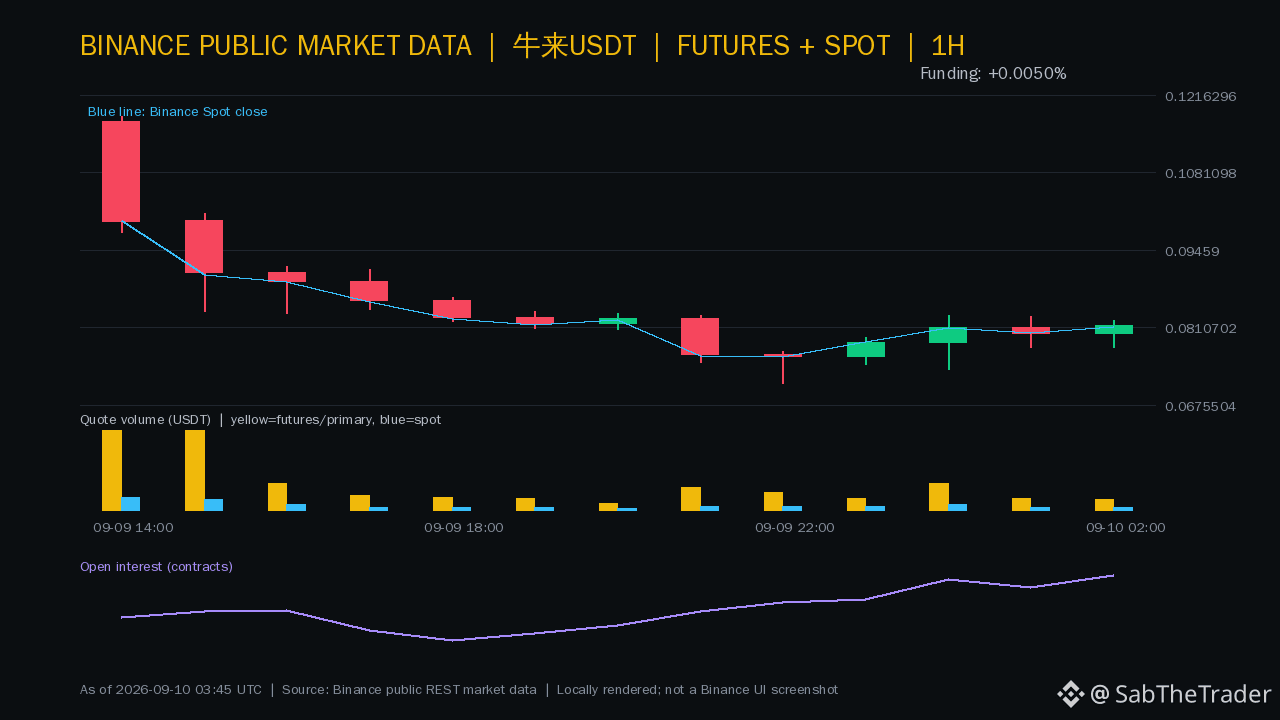
On the first day after listing, Niu Lai quickly shifted from price discovery to a high-volatility drawdown. A Binance official announcement confirmed that the spot market would open at 14:30 UTC on September 9, and a Seed Tag would be applied due to the project being in its early stage and having higher volatility risk. The latest publicly available market snapshot shows that $Niu Lai spot and perpetuals over the past 24 hours fell by 13.87% and 23.69%, respectively, with the contract side declining by about 9.82 percentage points more.
In the just-finished hour, both ends rebounded by 1.47% and 1.62%, respectively. Turnover was approximately 1.28 million and 5.17 million USDT; OI increased by 1.61%, and Funding was +0.005%. Prices rebounded in the short term and positions also increased, but the rate remained close to neutral. This looks more like a test after the heavy churn on day one, and it is not yet enough to confirm that the market has stabilized.⚠️ A Seed Tag indicates a higher risk level and should not be interpreted as a bullish label.
Going forward, if a full hour holds firm at 0.0824, spot trading would continue to expand while OI only increases moderately—then the rebound would have more solid follow-through. If it falls back below 0.0775 and OI continues to rise, additional leverage could amplify a second round of downside.
On the first day after listing, Niu Lai quickly shifted from price discovery to a high-volatility drawdown. A Binance official announcement confirmed that the spot market would open at 14:30 UTC on September 9, and a Seed Tag would be applied due to the project being in its early stage and having higher volatility risk. The latest publicly available market snapshot shows that $Niu Lai spot and perpetuals over the past 24 hours fell by 13.87% and 23.69%, respectively, with the contract side declining by about 9.82 percentage points more.
In the just-finished hour, both ends rebounded by 1.47% and 1.62%, respectively. Turnover was approximately 1.28 million and 5.17 million USDT; OI increased by 1.61%, and Funding was +0.005%. Prices rebounded in the short term and positions also increased, but the rate remained close to neutral. This looks more like a test after the heavy churn on day one, and it is not yet enough to confirm that the market has stabilized.⚠️ A Seed Tag indicates a higher risk level and should not be interpreted as a bullish label.
Going forward, if a full hour holds firm at 0.0824, spot trading would continue to expand while OI only increases moderately—then the rebound would have more solid follow-through. If it falls back below 0.0775 and OI continues to rise, additional leverage could amplify a second round of downside.
In the just-finished hour, both ends rebounded by 1.47% and 1.62%, respectively. Turnover was approximately 1.28 million and 5.17 million USDT; OI increased by 1.61%, and Funding was +0.005%. Prices rebounded in the short term and positions also increased, but the rate remained close to neutral. This looks more like a test after the heavy churn on day one, and it is not yet enough to confirm that the market has stabilized.⚠️ A Seed Tag indicates a higher risk level and should not be interpreted as a bullish label.
Going forward, if a full hour holds firm at 0.0824, spot trading would continue to expand while OI only increases moderately—then the rebound would have more solid follow-through. If it falls back below 0.0775 and OI continues to rise, additional leverage could amplify a second round of downside.
80
·
--
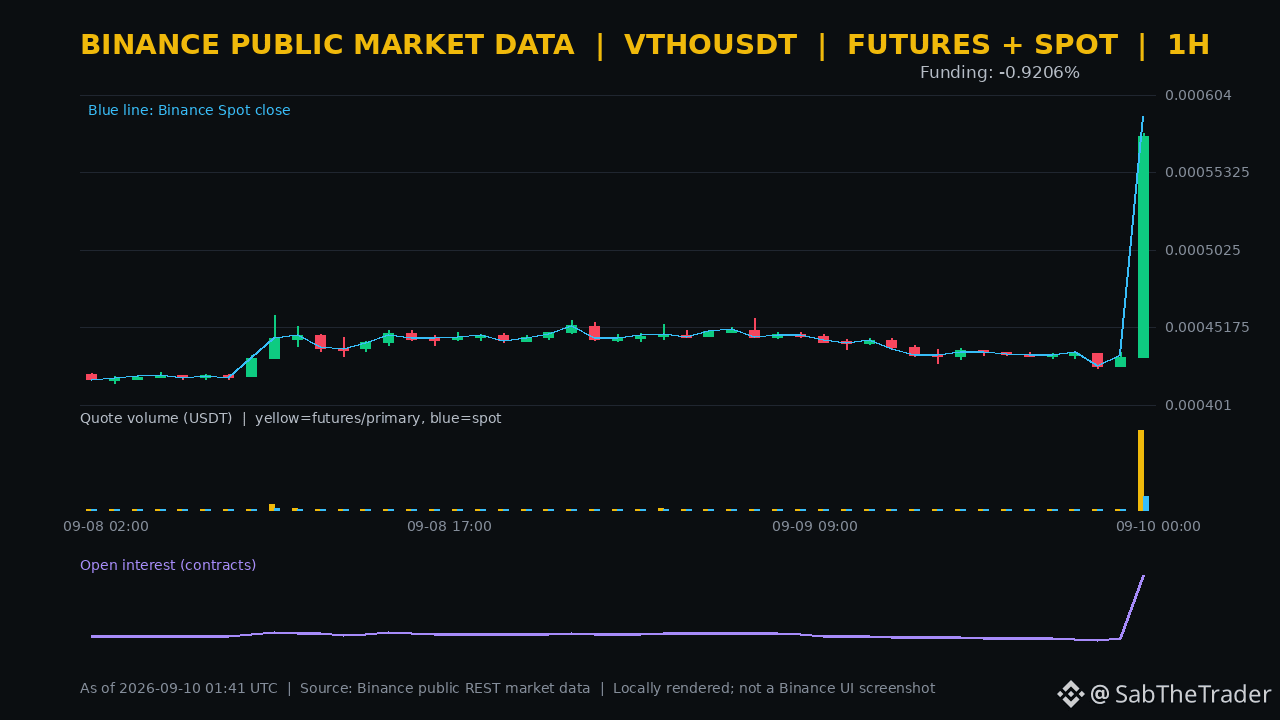
After nearly a day of quiet, VTHO suddenly surged in volume during the just-concluded hour. Binance’s public data shows spot prices rising from 0.000434 to 0.000590, and perpetuals rising from 0.0004324 to 0.0005771, with increases of 35.94% and 33.46% respectively. The trading amounts around $VTHO are approximately 2.68 million and 15.79 million USDT on both ends, reaching about 65x and 127x of the previous hour, respectively.
Entering the next hour that is not yet finished, OI (open interest) has grown from about 2.397 billion to 4.881 billion, an increase of 103.59%, while Funding remains at -0.9206%. Prices, trading activity, and positioning have all expanded together, but the deeply negative funding rate suggests that short pressure has not disappeared. Public OI alone can only confirm that total positions have increased; it cannot determine the direction of the newly added positions. ⚠️ This kind of structure could continue to squeeze shorts, or it could trigger a rapid sell-off due to leverage stacking too quickly.
For the short term, first watch whether 0.000577—0.000590 can hold. If, after a pullback, spot trading remains active and OI no longer accelerates out of control, then the bullish structure has a basis to continue. If it breaks below 0.000570 and OI shrinks quickly, the freshly added leverage is more likely to amplify a reversal move.
After nearly a day of quiet, VTHO suddenly surged in volume during the just-concluded hour. Binance’s public data shows spot prices rising from 0.000434 to 0.000590, and perpetuals rising from 0.0004324 to 0.0005771, with increases of 35.94% and 33.46% respectively. The trading amounts around $VTHO are approximately 2.68 million and 15.79 million USDT on both ends, reaching about 65x and 127x of the previous hour, respectively.
Entering the next hour that is not yet finished, OI (open interest) has grown from about 2.397 billion to 4.881 billion, an increase of 103.59%, while Funding remains at -0.9206%. Prices, trading activity, and positioning have all expanded together, but the deeply negative funding rate suggests that short pressure has not disappeared. Public OI alone can only confirm that total positions have increased; it cannot determine the direction of the newly added positions. ⚠️ This kind of structure could continue to squeeze shorts, or it could trigger a rapid sell-off due to leverage stacking too quickly.
For the short term, first watch whether 0.000577—0.000590 can hold. If, after a pullback, spot trading remains active and OI no longer accelerates out of control, then the bullish structure has a basis to continue. If it breaks below 0.000570 and OI shrinks quickly, the freshly added leverage is more likely to amplify a reversal move.
Entering the next hour that is not yet finished, OI (open interest) has grown from about 2.397 billion to 4.881 billion, an increase of 103.59%, while Funding remains at -0.9206%. Prices, trading activity, and positioning have all expanded together, but the deeply negative funding rate suggests that short pressure has not disappeared. Public OI alone can only confirm that total positions have increased; it cannot determine the direction of the newly added positions. ⚠️ This kind of structure could continue to squeeze shorts, or it could trigger a rapid sell-off due to leverage stacking too quickly.
For the short term, first watch whether 0.000577—0.000590 can hold. If, after a pullback, spot trading remains active and OI no longer accelerates out of control, then the bullish structure has a basis to continue. If it breaks below 0.000570 and OI shrinks quickly, the freshly added leverage is more likely to amplify a reversal move.
262
·
--
Verified
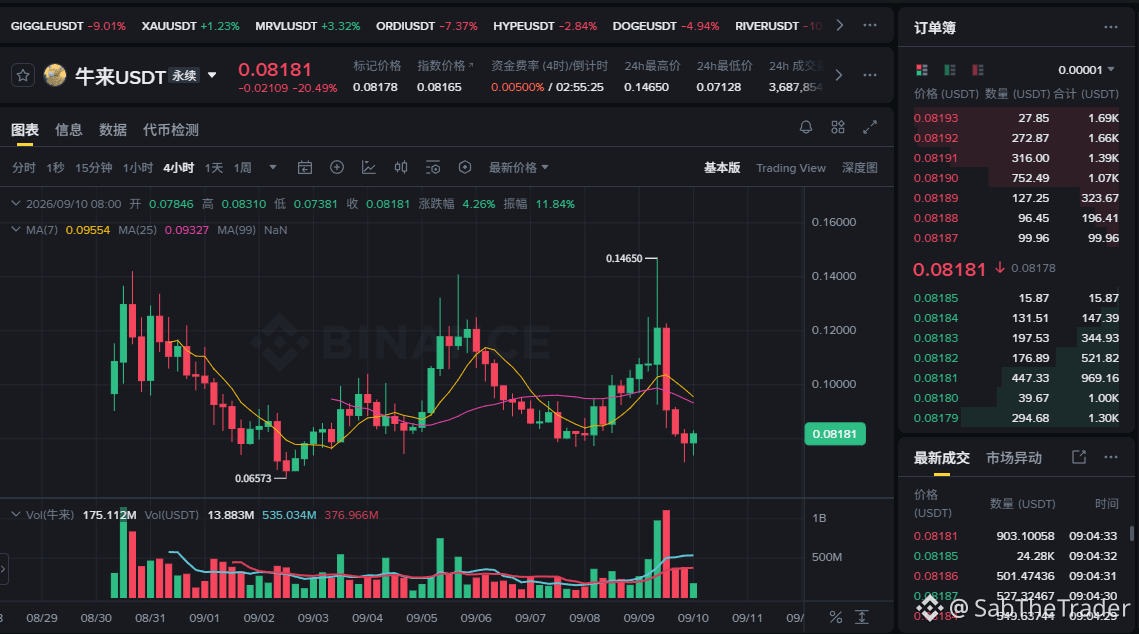
$牛来 Yesterday officially launched on Binance Spot 🐮
If you connect the timeline from the past two weeks, it’s actually quite interesting:
On August 30, Binance Futures first listed Cowlai USDT perpetuals, with a maximum leverage of 10x.
On September 9, Cowlai officially moved from Alpha to Binance Spot, opening spot trading pairs such as USDT / USDC, and also adding a Seed Tag.
Right after that, Earn, Convert, VIP Loan, and Margin were added as well.
In other words, within a short period of time, Cowlai had progressed from the Alpha stage to a more complete trading and capital-use scenario on Binance.
But the price hasn’t immediately “taken off” just because it went live on spot.
Based on current data, the spot-market pullback on day one is about 18.44%, which suggests the market is still in a very clear price-discovery phase, with significant disagreement among market participants.
I think we can continue to watch a few things next:
① After the listing, whether trading volume can hold up
② After the first round of selling pressure is released, where the price starts to stabilize
③ After Margin and the derivatives/contracts side are added, how long/short capital re-prices
④ Can BNB Chain meme hype continue to bring it traffic?
After all, the Seed Tag itself already indicates: high volatility, high risk.
As the product line expands, it means more trading entry points and liquidity tools are available; as for whether capital is willing to keep paying the bill, that’s ultimately up to the order book.
For now, I’ll put it on the watchlist. 👀
$牛来
{future}(牛来USDT)
$牛来 Yesterday officially launched on Binance Spot 🐮
If you connect the timeline from the past two weeks, it’s actually quite interesting:
On August 30, Binance Futures first listed Cowlai USDT perpetuals, with a maximum leverage of 10x.
On September 9, Cowlai officially moved from Alpha to Binance Spot, opening spot trading pairs such as USDT / USDC, and also adding a Seed Tag.
Right after that, Earn, Convert, VIP Loan, and Margin were added as well.
In other words, within a short period of time, Cowlai had progressed from the Alpha stage to a more complete trading and capital-use scenario on Binance.
But the price hasn’t immediately “taken off” just because it went live on spot.
Based on current data, the spot-market pullback on day one is about 18.44%, which suggests the market is still in a very clear price-discovery phase, with significant disagreement among market participants.
I think we can continue to watch a few things next:
① After the listing, whether trading volume can hold up
② After the first round of selling pressure is released, where the price starts to stabilize
③ After Margin and the derivatives/contracts side are added, how long/short capital re-prices
④ Can BNB Chain meme hype continue to bring it traffic?
After all, the Seed Tag itself already indicates: high volatility, high risk.
As the product line expands, it means more trading entry points and liquidity tools are available; as for whether capital is willing to keep paying the bill, that’s ultimately up to the order book.
For now, I’ll put it on the watchlist. 👀
$牛来
If you connect the timeline from the past two weeks, it’s actually quite interesting:
On August 30, Binance Futures first listed Cowlai USDT perpetuals, with a maximum leverage of 10x.
On September 9, Cowlai officially moved from Alpha to Binance Spot, opening spot trading pairs such as USDT / USDC, and also adding a Seed Tag.
Right after that, Earn, Convert, VIP Loan, and Margin were added as well.
In other words, within a short period of time, Cowlai had progressed from the Alpha stage to a more complete trading and capital-use scenario on Binance.
But the price hasn’t immediately “taken off” just because it went live on spot.
Based on current data, the spot-market pullback on day one is about 18.44%, which suggests the market is still in a very clear price-discovery phase, with significant disagreement among market participants.
I think we can continue to watch a few things next:
① After the listing, whether trading volume can hold up
② After the first round of selling pressure is released, where the price starts to stabilize
③ After Margin and the derivatives/contracts side are added, how long/short capital re-prices
④ Can BNB Chain meme hype continue to bring it traffic?
After all, the Seed Tag itself already indicates: high volatility, high risk.
As the product line expands, it means more trading entry points and liquidity tools are available; as for whether capital is willing to keep paying the bill, that’s ultimately up to the order book.
For now, I’ll put it on the watchlist. 👀
$牛来
684
·
--
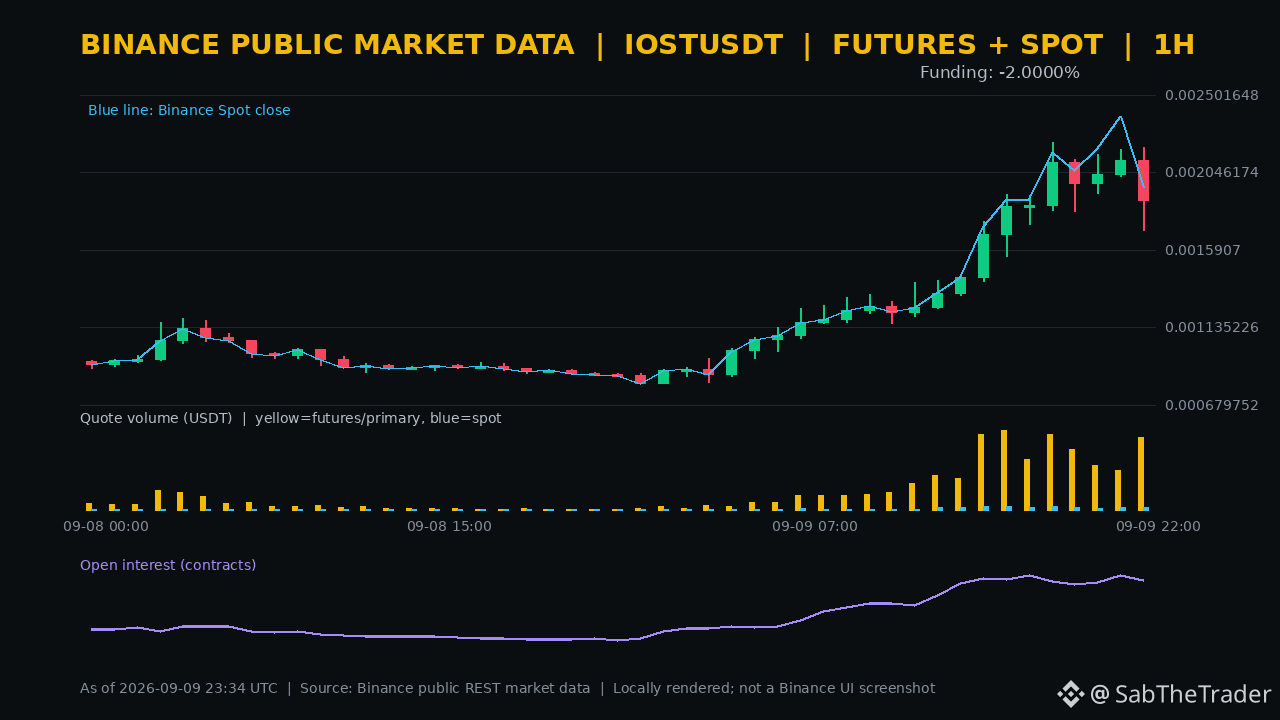
After surging to the intraday high, IOST sharply turned downward in the just-finished hourly K-line. Binance’s public data shows that spot fell 17.57% and perpetuals fell 11.16%; trading volumes were about 4.05 million and 102 million USDT, respectively, with quarter-over-quarter increases of 39.01% and 84.27%. The closing prices at both ends of $IOST were 0.001956 and 0.001882, respectively.
In the past 24 hours, the price was still up by about 120%, and the number of OI also expanded by about 57.62%, but the latest hourly OI has already dropped 2.94%, and Funding has fallen to -2%. The pullback from the highs comes with increased volume; leverage has not fully exited, and the deeply negative funding rate has risen again, increasing short-term squeeze risk. Here, it’s not something you can simply bottom-pick, nor can you treat negative Funding as a guaranteed rebound signal.
If the price regains 0.00196 and spot trading remains active while OI no longer declines, there will be grounds to repair the structure. If it breaks below the just-finished hour’s low of 0.00170, and OI continues to contract, the market is more likely to enter a second leg of deleveraging.
After surging to the intraday high, IOST sharply turned downward in the just-finished hourly K-line. Binance’s public data shows that spot fell 17.57% and perpetuals fell 11.16%; trading volumes were about 4.05 million and 102 million USDT, respectively, with quarter-over-quarter increases of 39.01% and 84.27%. The closing prices at both ends of $IOST were 0.001956 and 0.001882, respectively.
In the past 24 hours, the price was still up by about 120%, and the number of OI also expanded by about 57.62%, but the latest hourly OI has already dropped 2.94%, and Funding has fallen to -2%. The pullback from the highs comes with increased volume; leverage has not fully exited, and the deeply negative funding rate has risen again, increasing short-term squeeze risk. Here, it’s not something you can simply bottom-pick, nor can you treat negative Funding as a guaranteed rebound signal.
If the price regains 0.00196 and spot trading remains active while OI no longer declines, there will be grounds to repair the structure. If it breaks below the just-finished hour’s low of 0.00170, and OI continues to contract, the market is more likely to enter a second leg of deleveraging.
In the past 24 hours, the price was still up by about 120%, and the number of OI also expanded by about 57.62%, but the latest hourly OI has already dropped 2.94%, and Funding has fallen to -2%. The pullback from the highs comes with increased volume; leverage has not fully exited, and the deeply negative funding rate has risen again, increasing short-term squeeze risk. Here, it’s not something you can simply bottom-pick, nor can you treat negative Funding as a guaranteed rebound signal.
If the price regains 0.00196 and spot trading remains active while OI no longer declines, there will be grounds to repair the structure. If it breaks below the just-finished hour’s low of 0.00170, and OI continues to contract, the market is more likely to enter a second leg of deleveraging.
326
·
--
🎙️ Let’s talk about market trends trading and DCA into BNB!

End
03 h 26 m 27 s
17.2k
38
32
·
--
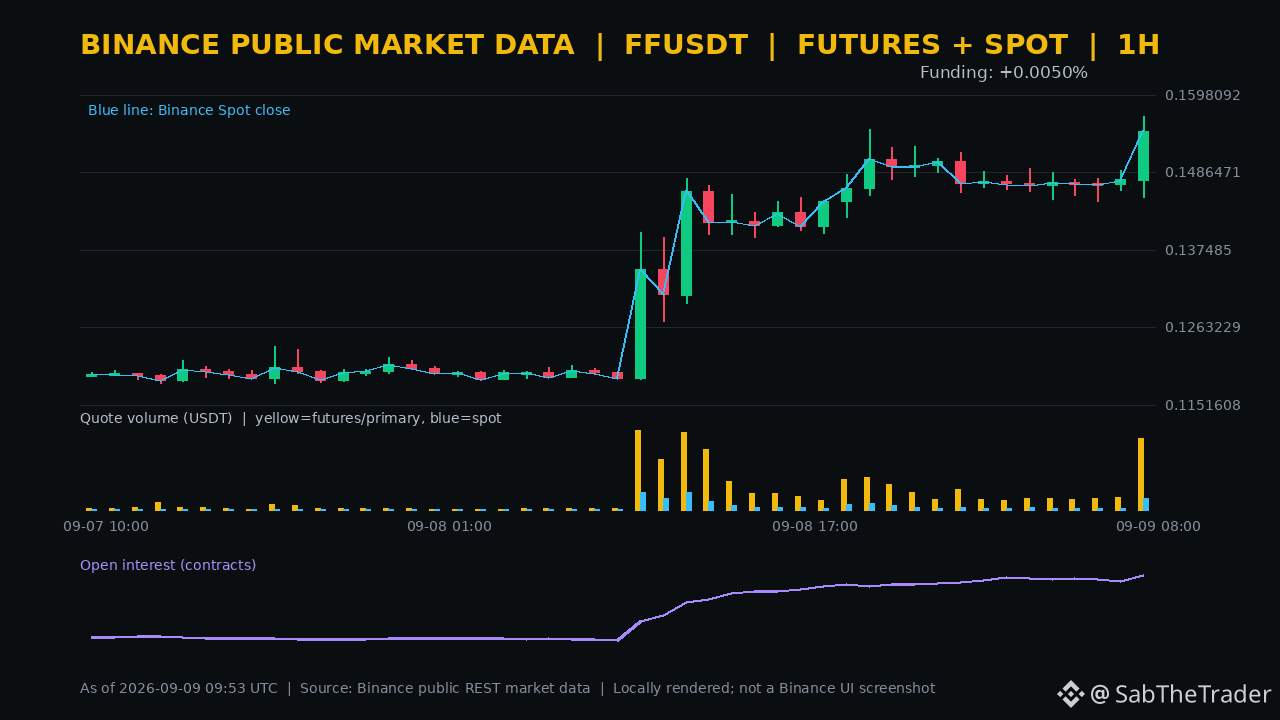
After several hours of consolidation, FF accelerated again in the most recently completed hourly K-bar. According to public Binance data, spot and perpetuals rose 4.86% and 4.77%, respectively. Turnover was about 1.81 million and 110 million USDT; both expanded around 5.44x and 4.91x from the previous period, respectively. On both sides, $FF closed near 0.1546, approaching the 24-hour high.
This surge in volume is not driven only by the derivatives side: spot and perpetuals expanded in tandem. Over rolling 1 hour, open interest (OI) increased by 0.66%, and over roughly 24 hours it rose by 5.43%; funding was about +0.005%. A volume-price resonance is in place, but the OI increase is clearly smaller than the成交 (trade) increase, suggesting heavy turnover. Therefore, it’s not safe to interpret all the newly added trading volume as one-sided long entries.
👀 The short-term confirmation line is near 0.1567. If price holds above it, during the next full hour the spot turnover is likely to keep expanding with OI increasing modestly—then a breakout would have continuity. If price falls back below 0.1451 and OI contracts in sync, this volume surge is more likely to turn into profit-taking at a high level.
After several hours of consolidation, FF accelerated again in the most recently completed hourly K-bar. According to public Binance data, spot and perpetuals rose 4.86% and 4.77%, respectively. Turnover was about 1.81 million and 110 million USDT; both expanded around 5.44x and 4.91x from the previous period, respectively. On both sides, $FF closed near 0.1546, approaching the 24-hour high.
This surge in volume is not driven only by the derivatives side: spot and perpetuals expanded in tandem. Over rolling 1 hour, open interest (OI) increased by 0.66%, and over roughly 24 hours it rose by 5.43%; funding was about +0.005%. A volume-price resonance is in place, but the OI increase is clearly smaller than the成交 (trade) increase, suggesting heavy turnover. Therefore, it’s not safe to interpret all the newly added trading volume as one-sided long entries.
👀 The short-term confirmation line is near 0.1567. If price holds above it, during the next full hour the spot turnover is likely to keep expanding with OI increasing modestly—then a breakout would have continuity. If price falls back below 0.1451 and OI contracts in sync, this volume surge is more likely to turn into profit-taking at a high level.
This surge in volume is not driven only by the derivatives side: spot and perpetuals expanded in tandem. Over rolling 1 hour, open interest (OI) increased by 0.66%, and over roughly 24 hours it rose by 5.43%; funding was about +0.005%. A volume-price resonance is in place, but the OI increase is clearly smaller than the成交 (trade) increase, suggesting heavy turnover. Therefore, it’s not safe to interpret all the newly added trading volume as one-sided long entries.
👀 The short-term confirmation line is near 0.1567. If price holds above it, during the next full hour the spot turnover is likely to keep expanding with OI increasing modestly—then a breakout would have continuity. If price falls back below 0.1451 and OI contracts in sync, this volume surge is more likely to turn into profit-taking at a high level.
1
114
·
--
yeah
yeah


奋斗Hustle1688
·
--
[Replay] 🎙️ Let's talk about Binance Coin shares MeMe
02 h 50 m 23 s · 6.5k listens
27

·
--
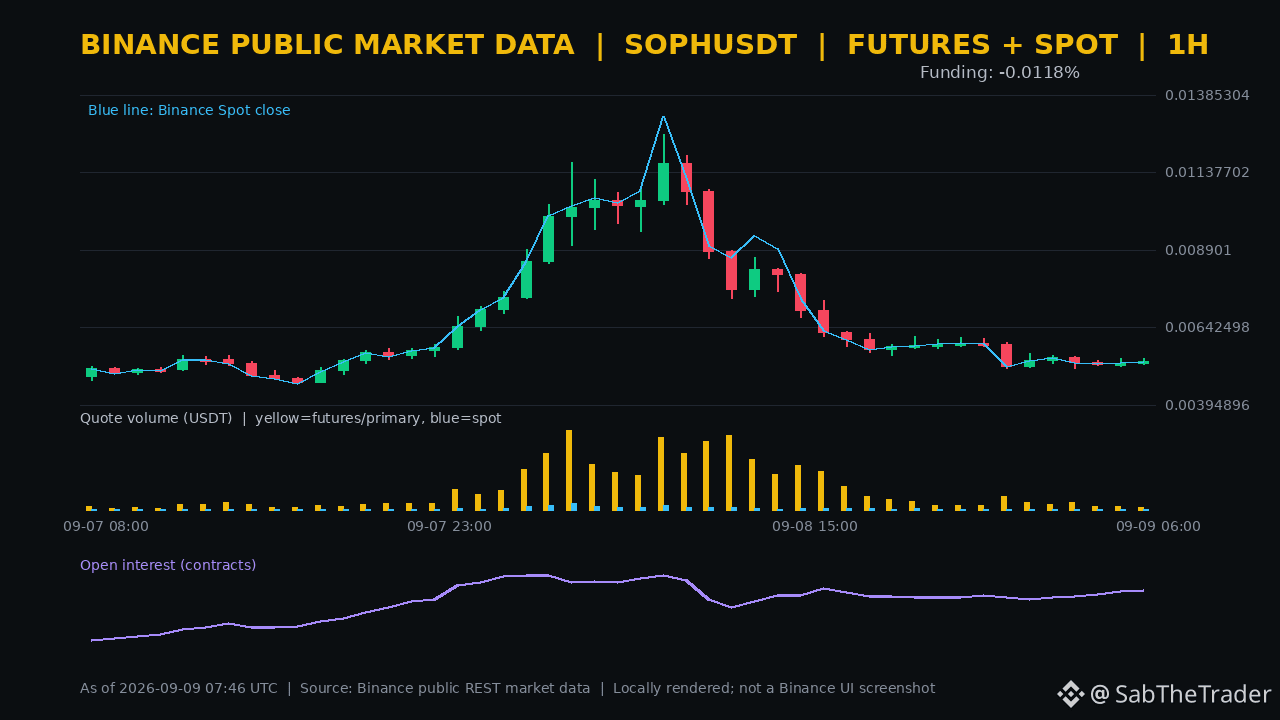
Yesterday we were still discussing the continuation conditions after the SOPH doubling, but within 24 hours the structure has completely flipped. Binance spot and perpetuals both fell over the last rolling 24 hours by 46.50% and 46.15% respectively; trading volume was about 46.31 million and 896 million USDT. The latest prices at both ends of $SOPH have both returned to around 0.0054.
In the full 1 hour we’ve just finished, spot and perpetuals only rebounded 0.56% and 0.81%, but trading volume decreased month-over-month by 13.55% and 25.84%. Quantity OI increased 0.95% within 1 hour, yet over roughly 24 hours it’s still down 6.90%, and Funding is about -0.0118%. The combination of a downswing followed by a low-volume rebound plus a small amount of new leverage means this is not yet confirmation that the selloff has ended.
⚠️ I won’t equate a large drop directly with a bottom. If the price can regain and hold above 0.00542, then in the next full hour, if spot trading expands and OI stops falling, the rebound will have more solid follow-through. If it breaks below 0.00525 and OI continues to contract, the deleveraging trend could still extend further downward.
Yesterday we were still discussing the continuation conditions after the SOPH doubling, but within 24 hours the structure has completely flipped. Binance spot and perpetuals both fell over the last rolling 24 hours by 46.50% and 46.15% respectively; trading volume was about 46.31 million and 896 million USDT. The latest prices at both ends of $SOPH have both returned to around 0.0054.
In the full 1 hour we’ve just finished, spot and perpetuals only rebounded 0.56% and 0.81%, but trading volume decreased month-over-month by 13.55% and 25.84%. Quantity OI increased 0.95% within 1 hour, yet over roughly 24 hours it’s still down 6.90%, and Funding is about -0.0118%. The combination of a downswing followed by a low-volume rebound plus a small amount of new leverage means this is not yet confirmation that the selloff has ended.
⚠️ I won’t equate a large drop directly with a bottom. If the price can regain and hold above 0.00542, then in the next full hour, if spot trading expands and OI stops falling, the rebound will have more solid follow-through. If it breaks below 0.00525 and OI continues to contract, the deleveraging trend could still extend further downward.
In the full 1 hour we’ve just finished, spot and perpetuals only rebounded 0.56% and 0.81%, but trading volume decreased month-over-month by 13.55% and 25.84%. Quantity OI increased 0.95% within 1 hour, yet over roughly 24 hours it’s still down 6.90%, and Funding is about -0.0118%. The combination of a downswing followed by a low-volume rebound plus a small amount of new leverage means this is not yet confirmation that the selloff has ended.
⚠️ I won’t equate a large drop directly with a bottom. If the price can regain and hold above 0.00542, then in the next full hour, if spot trading expands and OI stops falling, the rebound will have more solid follow-through. If it breaks below 0.00525 and OI continues to contract, the deleveraging trend could still extend further downward.
143
·
--
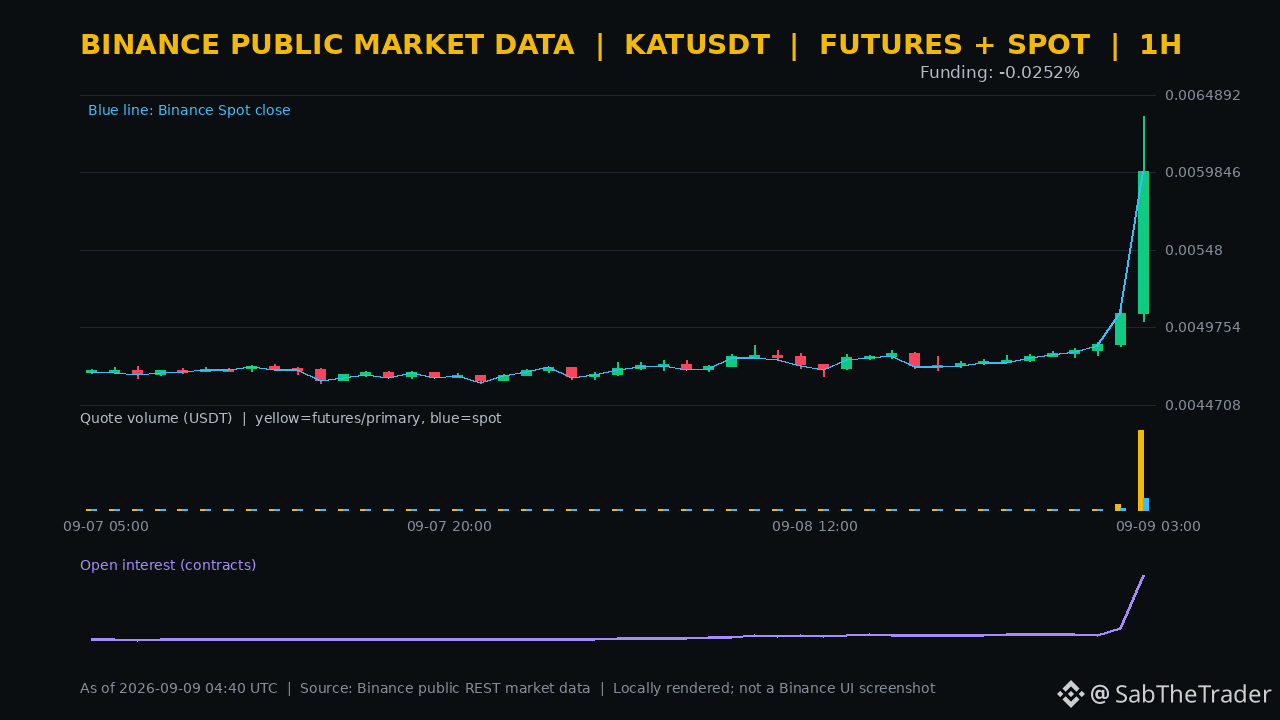
18% of the surge is concentrated in the hour that just ended. According to Binance’s publicly available data, KAT spot and perpetuals rose 18.15% and 18.28% respectively, closing around 0.00599. Trading volume was about 3.37 million and 23.23 million USDT, with the hour-over-hour figures expanding by roughly 7.7x and 13.2x, respectively. The hourly high at $KAT was in the range of 0.00634–0.00635.
Rolling 1-hour OI increased by another 12.44%, and over roughly 24 hours it increased by 73.30%. Price, trading volume, and positions all expanded in sync. However, Funding is still around -0.0268%, and the long fee rate does not appear crowded yet. OI alone only indicates that total positions have grown; it can’t tell the direction of newly added positions.
👀 For this kind of sharp spike within a single hour, I don’t treat negative Funding as a reason to chase. If 0.00635 is able to hold effectively, and spot trading volume and OI continue to rise afterward, then a sustained move has some justification through confirmation. If the price falls back below 0.0050 and OI rapidly shrinks, then the leverage that just entered is more likely to amplify the pullback and profit-taking.
18% of the surge is concentrated in the hour that just ended. According to Binance’s publicly available data, KAT spot and perpetuals rose 18.15% and 18.28% respectively, closing around 0.00599. Trading volume was about 3.37 million and 23.23 million USDT, with the hour-over-hour figures expanding by roughly 7.7x and 13.2x, respectively. The hourly high at $KAT was in the range of 0.00634–0.00635.
Rolling 1-hour OI increased by another 12.44%, and over roughly 24 hours it increased by 73.30%. Price, trading volume, and positions all expanded in sync. However, Funding is still around -0.0268%, and the long fee rate does not appear crowded yet. OI alone only indicates that total positions have grown; it can’t tell the direction of newly added positions.
👀 For this kind of sharp spike within a single hour, I don’t treat negative Funding as a reason to chase. If 0.00635 is able to hold effectively, and spot trading volume and OI continue to rise afterward, then a sustained move has some justification through confirmation. If the price falls back below 0.0050 and OI rapidly shrinks, then the leverage that just entered is more likely to amplify the pullback and profit-taking.
Rolling 1-hour OI increased by another 12.44%, and over roughly 24 hours it increased by 73.30%. Price, trading volume, and positions all expanded in sync. However, Funding is still around -0.0268%, and the long fee rate does not appear crowded yet. OI alone only indicates that total positions have grown; it can’t tell the direction of newly added positions.
👀 For this kind of sharp spike within a single hour, I don’t treat negative Funding as a reason to chase. If 0.00635 is able to hold effectively, and spot trading volume and OI continue to rise afterward, then a sustained move has some justification through confirmation. If the price falls back below 0.0050 and OI rapidly shrinks, then the leverage that just entered is more likely to amplify the pullback and profit-taking.
140
·
--
Verified
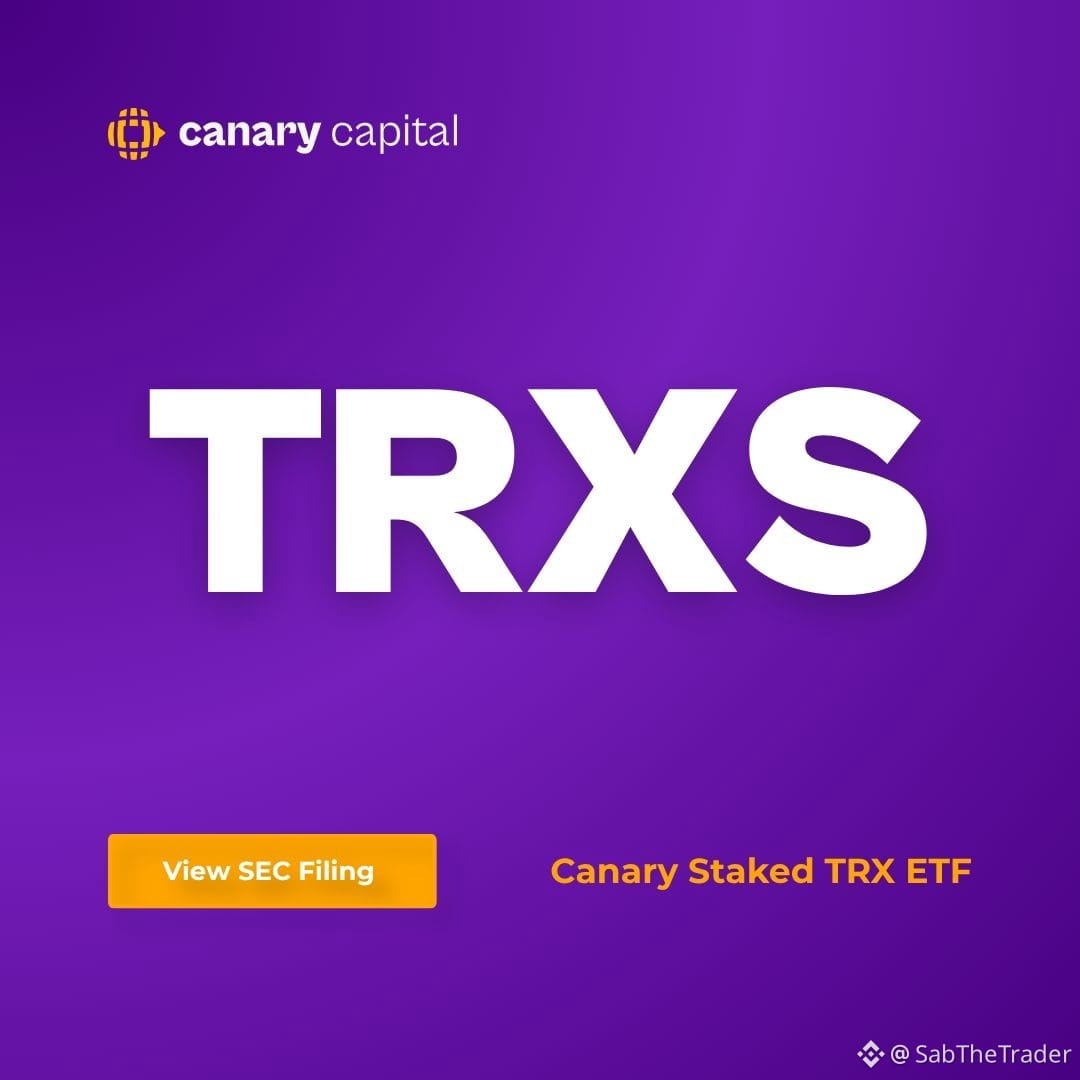
An American exchange-traded product that directly holds TRX and participates in staking has just cleared a key regulatory document milestone. The Canary Staked TRX ETF filed its final prospectus on September 8; on the same day, its Form 8-A/A stated that Cboe BZX has approved its listing application. The fund is intended to trade under the ticker TRXS, and it will directly hold $TRX. The documents state that, under normal circumstances, it is expected that at least 90% of TRX will participate in staking.
Here, we need to separate two concepts: the exchange approval of the listing application, the securities registration becoming effective—this is not an “SEC approval of an ETF.” The prospectus also makes clear that the SEC has neither approved nor endorsed the ETF. Moreover, at the time of review, the first transaction had not yet been confirmed.
TRX on Binance spot and perpetuals (24h) has risen only about 1.56%, while open interest (OI) increased by around 1.00% over 24 hours. Even though the event certainty has improved, it has not yet translated into a clear chase for the breakout.
📌 I’ll wait for the actual post-listing trading and redemption/creation clues for TRXS. If spot TRX continues to see increased volume, with OI rising moderately and Funding staying neutral, then the institutional-channel narrative would have staying power. If liquidity is lukewarm after the product opens, then in the short term it will look more like expectations being priced in.
An American exchange-traded product that directly holds TRX and participates in staking has just cleared a key regulatory document milestone. The Canary Staked TRX ETF filed its final prospectus on September 8; on the same day, its Form 8-A/A stated that Cboe BZX has approved its listing application. The fund is intended to trade under the ticker TRXS, and it will directly hold $TRX . The documents state that, under normal circumstances, it is expected that at least 90% of TRX will participate in staking.
Here, we need to separate two concepts: the exchange approval of the listing application, the securities registration becoming effective—this is not an “SEC approval of an ETF.” The prospectus also makes clear that the SEC has neither approved nor endorsed the ETF. Moreover, at the time of review, the first transaction had not yet been confirmed.
TRX on Binance spot and perpetuals (24h) has risen only about 1.56%, while open interest (OI) increased by around 1.00% over 24 hours. Even though the event certainty has improved, it has not yet translated into a clear chase for the breakout.
📌 I’ll wait for the actual post-listing trading and redemption/creation clues for TRXS. If spot TRX continues to see increased volume, with OI rising moderately and Funding staying neutral, then the institutional-channel narrative would have staying power. If liquidity is lukewarm after the product opens, then in the short term it will look more like expectations being priced in.
Here, we need to separate two concepts: the exchange approval of the listing application, the securities registration becoming effective—this is not an “SEC approval of an ETF.” The prospectus also makes clear that the SEC has neither approved nor endorsed the ETF. Moreover, at the time of review, the first transaction had not yet been confirmed.
TRX on Binance spot and perpetuals (24h) has risen only about 1.56%, while open interest (OI) increased by around 1.00% over 24 hours. Even though the event certainty has improved, it has not yet translated into a clear chase for the breakout.
📌 I’ll wait for the actual post-listing trading and redemption/creation clues for TRXS. If spot TRX continues to see increased volume, with OI rising moderately and Funding staying neutral, then the institutional-channel narrative would have staying power. If liquidity is lukewarm after the product opens, then in the short term it will look more like expectations being priced in.
1
172
·
--
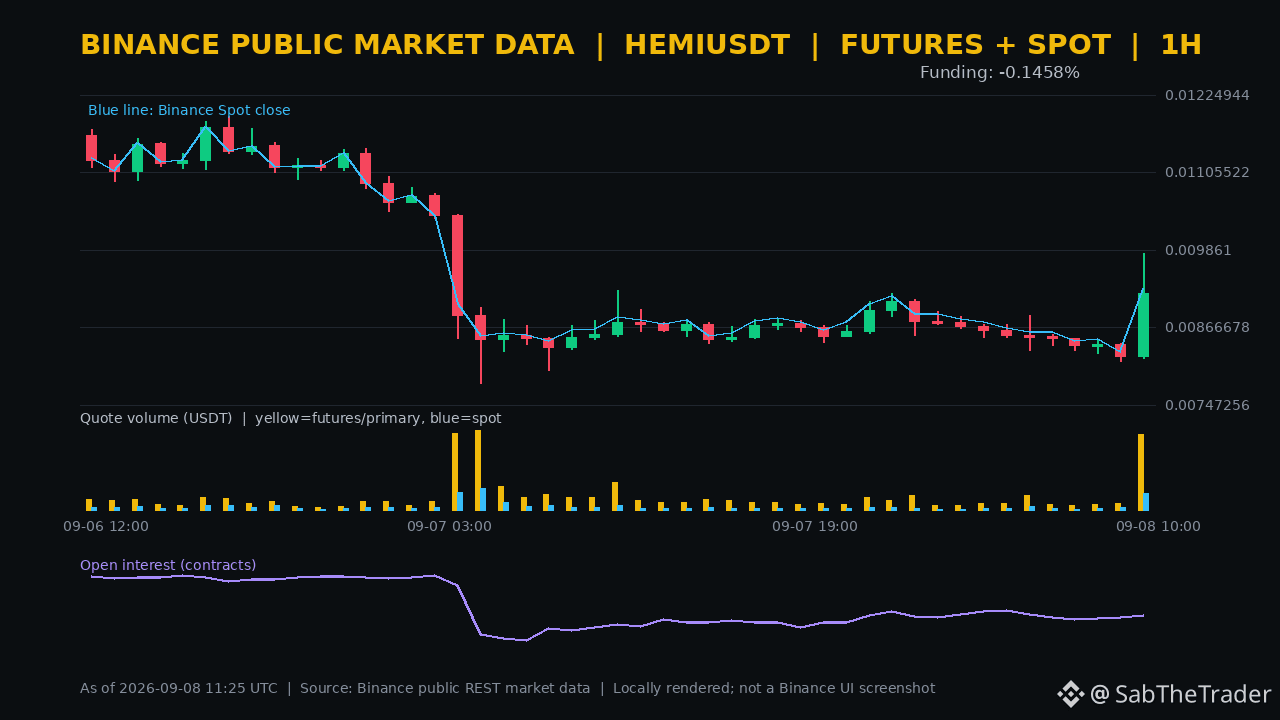
In the just-ended one-hour K period, spot HEMI and perpetuals rose in sync, and trading volume showed a magnitude-scale surge. According to publicly available Binance data, spot rose 11.69% to close at 0.00927, while perpetuals rose 11.91% to close at 0.009198. Trading volumes at both ends were approximately 3.83 million and 17.55 million USDT, with quarter-over-quarter increases of 706% and 1062%, respectively. The hourly high around $HEMI was concentrated near 0.0098.
Price and volume both moved upward, but OI (open interest) actually fell by about 1.46%, and funding was around -0.146%. This looks more like a possible combination of spot buying pressure stacking up with short covering. However, public data cannot confirm the direction of positioning. Also, the 24-hour spot gain is only about 7.17%, so this burst in volume has not yet proven that the trend has fully reversed.
⚠️ 0.0098 is the next confirmation level. If price regains and holds above it, spot trading volume should keep expanding and OI should switch back to increasing—then a breakout would gain support from newly added positions. If it falls back below 0.00827, while OI continues to contract, this high-volume bullish candle is more likely to turn into profit-taking after a brief squeeze.
In the just-ended one-hour K period, spot HEMI and perpetuals rose in sync, and trading volume showed a magnitude-scale surge. According to publicly available Binance data, spot rose 11.69% to close at 0.00927, while perpetuals rose 11.91% to close at 0.009198. Trading volumes at both ends were approximately 3.83 million and 17.55 million USDT, with quarter-over-quarter increases of 706% and 1062%, respectively. The hourly high around $HEMI was concentrated near 0.0098.
Price and volume both moved upward, but OI (open interest) actually fell by about 1.46%, and funding was around -0.146%. This looks more like a possible combination of spot buying pressure stacking up with short covering. However, public data cannot confirm the direction of positioning. Also, the 24-hour spot gain is only about 7.17%, so this burst in volume has not yet proven that the trend has fully reversed.
⚠️ 0.0098 is the next confirmation level. If price regains and holds above it, spot trading volume should keep expanding and OI should switch back to increasing—then a breakout would gain support from newly added positions. If it falls back below 0.00827, while OI continues to contract, this high-volume bullish candle is more likely to turn into profit-taking after a brief squeeze.
Price and volume both moved upward, but OI (open interest) actually fell by about 1.46%, and funding was around -0.146%. This looks more like a possible combination of spot buying pressure stacking up with short covering. However, public data cannot confirm the direction of positioning. Also, the 24-hour spot gain is only about 7.17%, so this burst in volume has not yet proven that the trend has fully reversed.
⚠️ 0.0098 is the next confirmation level. If price regains and holds above it, spot trading volume should keep expanding and OI should switch back to increasing—then a breakout would gain support from newly added positions. If it falls back below 0.00827, while OI continues to contract, this high-volume bullish candle is more likely to turn into profit-taking after a brief squeeze.
361
·
--
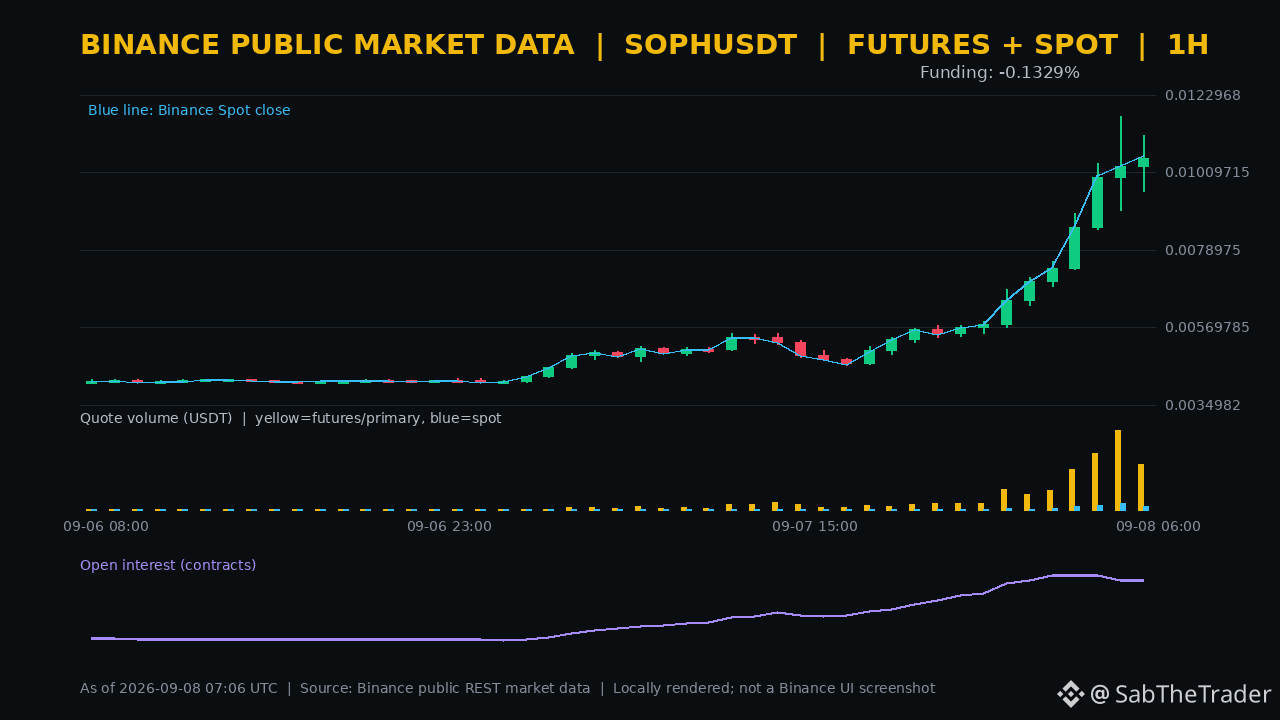
After the 24-hour doubling, SOPH put out another bullish hour-K line, but trading volume has already started to fade. Binance spot and perpetuals rose 2.52% and 2.25% respectively, with trading amounts of about 5.6 million and 67.10 million USDT; both decreased by about 43% quarter-over-quarter. $SOPH both sides closed near 0.0105, with the hourly high around 0.0112.
When stretched to 24 hours, spot and perpetuals are still up 112% and 111% respectively, with OI quantity increasing by about 118%; however, the latest 1-hour OI increased by only 0.54%, and Funding fell to around -0.1329%. Prices continue to rise, trading volume shrinks, and short-term positioning expansion is limited—possibly due to rotation at higher levels or short-covering. Public data cannot confirm the exact direction; negative Funding also does not guarantee continued upside.
📌 0.0112 is the short-term confirmation level. If price holds above it, and spot trading volume expands again while OI continues to increase, the trend would have new evidence to continue; if it breaks below the just-ended hour’s low of 0.0096, and both volume and OI contract, the de-leveraging risk after the doubling could quickly intensify.
After the 24-hour doubling, SOPH put out another bullish hour-K line, but trading volume has already started to fade. Binance spot and perpetuals rose 2.52% and 2.25% respectively, with trading amounts of about 5.6 million and 67.10 million USDT; both decreased by about 43% quarter-over-quarter. $SOPH both sides closed near 0.0105, with the hourly high around 0.0112.
When stretched to 24 hours, spot and perpetuals are still up 112% and 111% respectively, with OI quantity increasing by about 118%; however, the latest 1-hour OI increased by only 0.54%, and Funding fell to around -0.1329%. Prices continue to rise, trading volume shrinks, and short-term positioning expansion is limited—possibly due to rotation at higher levels or short-covering. Public data cannot confirm the exact direction; negative Funding also does not guarantee continued upside.
📌 0.0112 is the short-term confirmation level. If price holds above it, and spot trading volume expands again while OI continues to increase, the trend would have new evidence to continue; if it breaks below the just-ended hour’s low of 0.0096, and both volume and OI contract, the de-leveraging risk after the doubling could quickly intensify.
When stretched to 24 hours, spot and perpetuals are still up 112% and 111% respectively, with OI quantity increasing by about 118%; however, the latest 1-hour OI increased by only 0.54%, and Funding fell to around -0.1329%. Prices continue to rise, trading volume shrinks, and short-term positioning expansion is limited—possibly due to rotation at higher levels or short-covering. Public data cannot confirm the exact direction; negative Funding also does not guarantee continued upside.
📌 0.0112 is the short-term confirmation level. If price holds above it, and spot trading volume expands again while OI continues to increase, the trend would have new evidence to continue; if it breaks below the just-ended hour’s low of 0.0096, and both volume and OI contract, the de-leveraging risk after the doubling could quickly intensify.
187
·
--
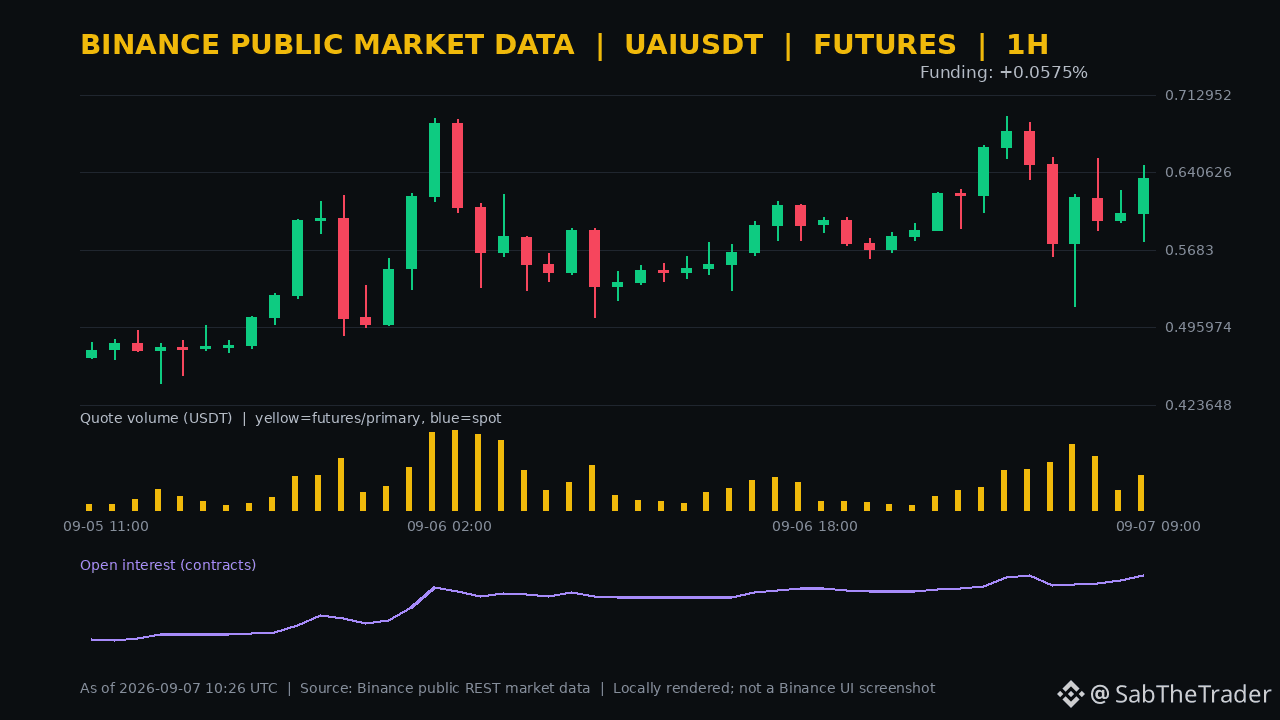
Latest complete 1 hour: UAI sustainable growth up 5.39%, with trading volume about 7.89 million USDT, up 74% month-over-month; OI (open interest) quantity increased by 3.09% in the same period. $UAI closed near 0.6351, not far from this hour’s high of 0.647; price, trading volume, and positioning expanded in the same direction in the short term.
⚠️ Looking at the 24-hour period, perpetual trading volume is about 129.2 million USDT, still 24% less than the previous complete 24 hours; the latest Funding is around +0.0575%. Buy-side demand in this hour is strong, but medium-term trading volume has not expanded in sync, and long positions’ cost basis is also rising. OI can only confirm that total positions increased; it cannot determine whether the newly added positions are all long.
0.647 is the short-term confirmation level. If price holds above it, and if subsequent trading volume and OI continue to rise, there will be conditions to test the prior high of 0.6908 again; if it breaks below this hour’s low of 0.5758, and OI contracts, then newly added leverage is more likely to turn into deleveraging pressure.
Latest complete 1 hour: UAI sustainable growth up 5.39%, with trading volume about 7.89 million USDT, up 74% month-over-month; OI (open interest) quantity increased by 3.09% in the same period. $UAI closed near 0.6351, not far from this hour’s high of 0.647; price, trading volume, and positioning expanded in the same direction in the short term.
⚠️ Looking at the 24-hour period, perpetual trading volume is about 129.2 million USDT, still 24% less than the previous complete 24 hours; the latest Funding is around +0.0575%. Buy-side demand in this hour is strong, but medium-term trading volume has not expanded in sync, and long positions’ cost basis is also rising. OI can only confirm that total positions increased; it cannot determine whether the newly added positions are all long.
0.647 is the short-term confirmation level. If price holds above it, and if subsequent trading volume and OI continue to rise, there will be conditions to test the prior high of 0.6908 again; if it breaks below this hour’s low of 0.5758, and OI contracts, then newly added leverage is more likely to turn into deleveraging pressure.
⚠️ Looking at the 24-hour period, perpetual trading volume is about 129.2 million USDT, still 24% less than the previous complete 24 hours; the latest Funding is around +0.0575%. Buy-side demand in this hour is strong, but medium-term trading volume has not expanded in sync, and long positions’ cost basis is also rising. OI can only confirm that total positions increased; it cannot determine whether the newly added positions are all long.
0.647 is the short-term confirmation level. If price holds above it, and if subsequent trading volume and OI continue to rise, there will be conditions to test the prior high of 0.6908 again; if it breaks below this hour’s low of 0.5758, and OI contracts, then newly added leverage is more likely to turn into deleveraging pressure.
152
·
--
See translation
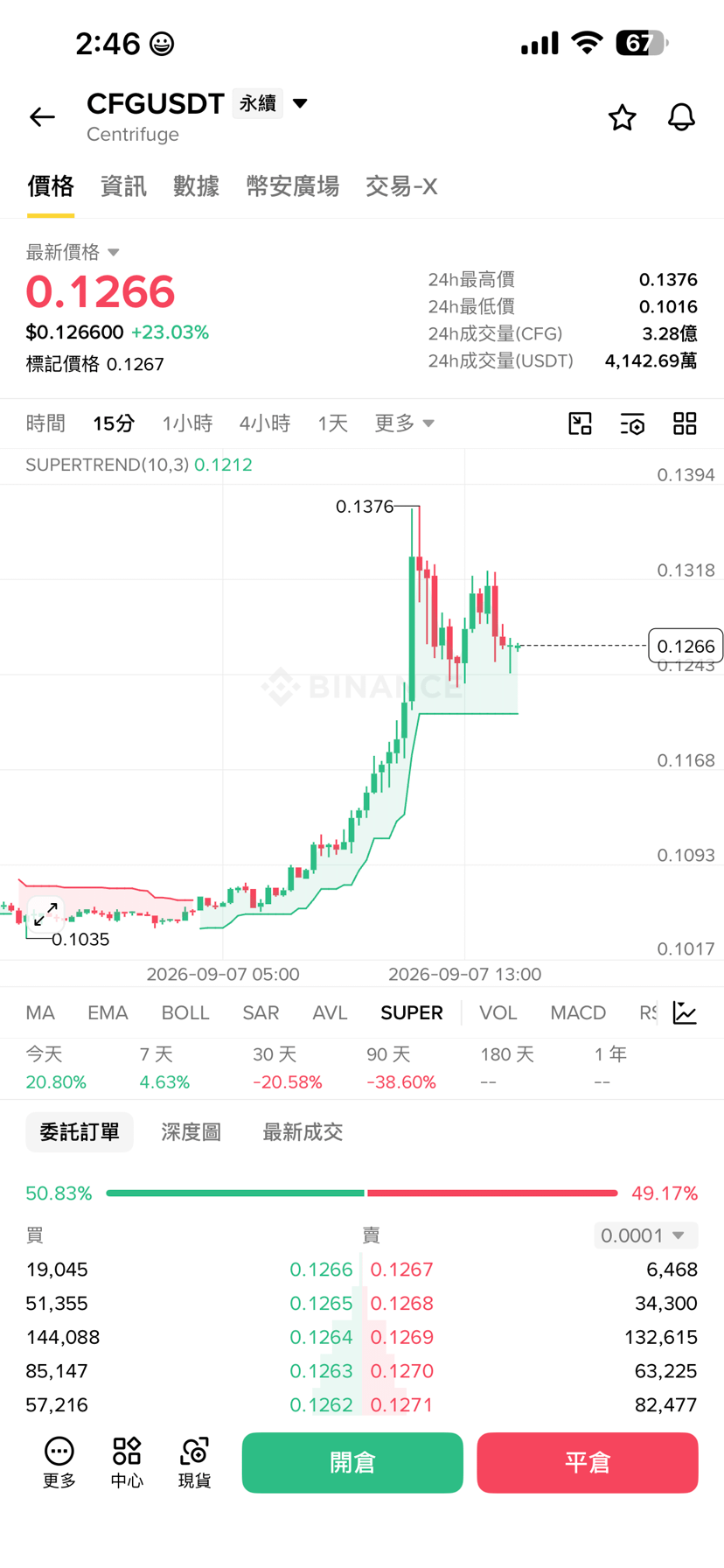
刚结束的一小时里,CFG现货上涨5.02%,永续上涨4.87%,但两边成交额反而比前一小时分别少25%和32%。$CFG 一度收在0.1317附近,随后回到约0.1283,价格上冲没有得到同步增量成交确认。
永续数量OI同一小时增加4.82%,约24小时增加72.55%,Funding却降到约-0.1320%。价格上涨、仓位增加而费率深负,说明多空分歧仍大;OI只能确认总仓位扩张,不能判断新增仓位方向,负Funding也不等于必然反弹。
0.1317是短线重新转强的第一道门槛。若价格收回该位,现货和永续成交重新放大,才有条件再测0.1384;若跌破刚才小时低点0.1238,同时OI开始收缩,这轮新增杠杆更可能转成去杠杆压力。
刚结束的一小时里,CFG现货上涨5.02%,永续上涨4.87%,但两边成交额反而比前一小时分别少25%和32%。$CFG 一度收在0.1317附近,随后回到约0.1283,价格上冲没有得到同步增量成交确认。
永续数量OI同一小时增加4.82%,约24小时增加72.55%,Funding却降到约-0.1320%。价格上涨、仓位增加而费率深负,说明多空分歧仍大;OI只能确认总仓位扩张,不能判断新增仓位方向,负Funding也不等于必然反弹。
0.1317是短线重新转强的第一道门槛。若价格收回该位,现货和永续成交重新放大,才有条件再测0.1384;若跌破刚才小时低点0.1238,同时OI开始收缩,这轮新增杠杆更可能转成去杠杆压力。
永续数量OI同一小时增加4.82%,约24小时增加72.55%,Funding却降到约-0.1320%。价格上涨、仓位增加而费率深负,说明多空分歧仍大;OI只能确认总仓位扩张,不能判断新增仓位方向,负Funding也不等于必然反弹。
0.1317是短线重新转强的第一道门槛。若价格收回该位,现货和永续成交重新放大,才有条件再测0.1384;若跌破刚才小时低点0.1238,同时OI开始收缩,这轮新增杠杆更可能转成去杠杆压力。
166
·
--
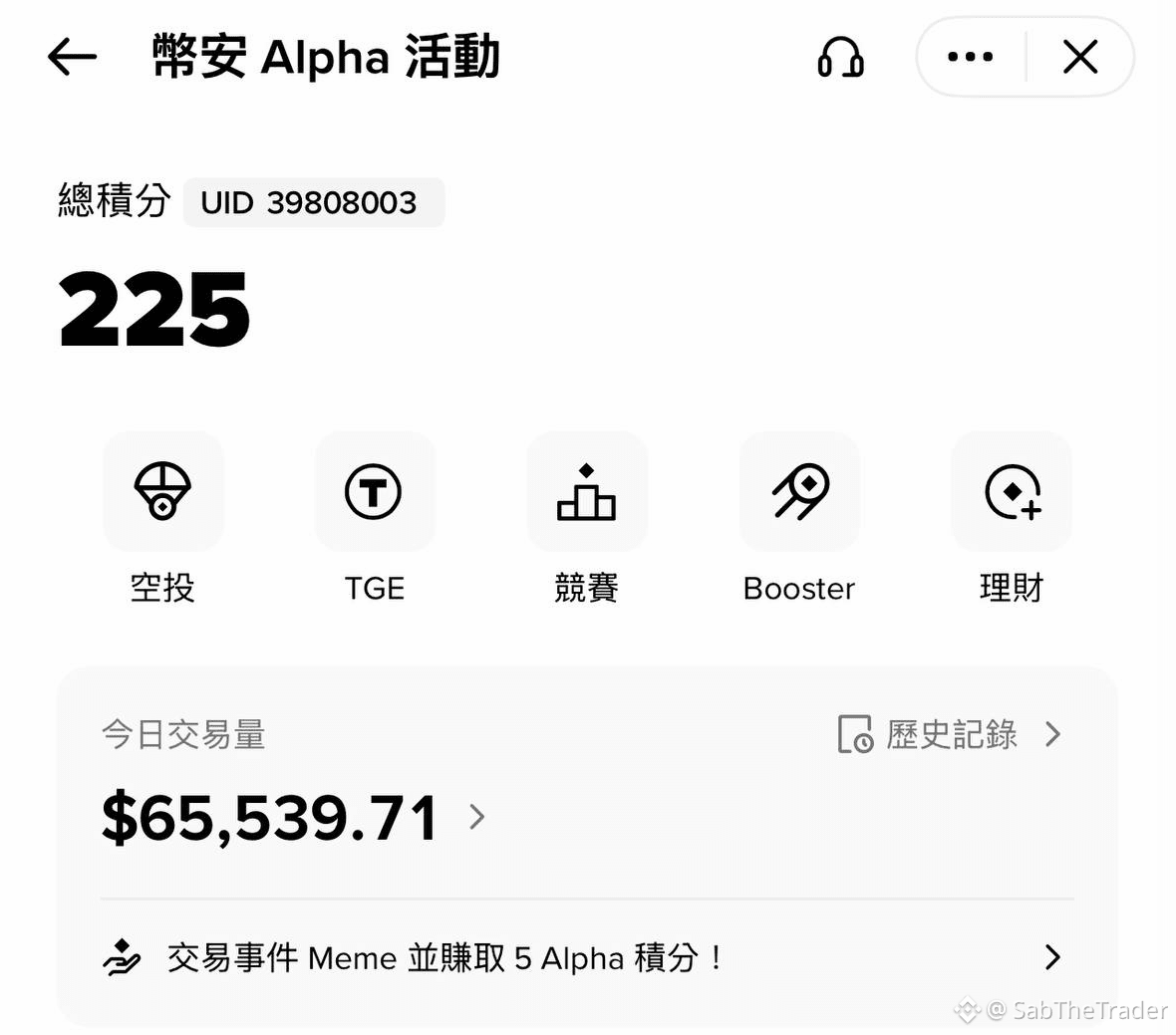
I got up early this morning and refreshed yesterday's Alpha to get the new wallet task, and ended up losing 2.3 U😵
🦄 Hope I can smoothly get 5 points
🍀 Hope today's airdrop is a bit more generous, so our 230 points can get something!!!
I got up early this morning and refreshed yesterday's Alpha to get the new wallet task, and ended up losing 2.3 U😵
🦄 Hope I can smoothly get 5 points
🍀 Hope today's airdrop is a bit more generous, so our 230 points can get something!!!
🦄 Hope I can smoothly get 5 points
🍀 Hope today's airdrop is a bit more generous, so our 230 points can get something!!!
10
7
1.4k
·
--
This one-hour candle pushed TAO near the 24-hour high. Binance spot traded about 8.32 million USDT, up 143% month over month; perpetuals traded about 30.65 million USDT, up 81%, and prices on both sides rose about 4.1%. As of 04:20 (UTC+8), $TAO spot was around 269.0, not far from the 24-hour high of 270.3.
Quantity OI increased 2.55% in the same hour, and only about 2.64% over the past 24 hours, meaning the net position buildup over the past day was almost entirely concentrated in the hour that just ended; Funding remains around +0.0050%, and no obvious crowded long funding has appeared yet. However, OI only records the total size of positions and cannot confirm the direction of the newly added positions, and the simultaneous volume increase in spot and perpetuals alone cannot guarantee that the breakout will continue.
270.3 is the key confirmation level right now. If the price holds above it, and subsequent spot trading volume and OI can continue to rise, this resonance will have a basis for continuation; if it falls back again into the 256.9—257.3 hourly breakout zone and OI contracts, the newly entered leveraged positions may turn into deleveraging pressure.
This one-hour candle pushed TAO near the 24-hour high. Binance spot traded about 8.32 million USDT, up 143% month over month; perpetuals traded about 30.65 million USDT, up 81%, and prices on both sides rose about 4.1%. As of 04:20 (UTC+8), $TAO spot was around 269.0, not far from the 24-hour high of 270.3.
Quantity OI increased 2.55% in the same hour, and only about 2.64% over the past 24 hours, meaning the net position buildup over the past day was almost entirely concentrated in the hour that just ended; Funding remains around +0.0050%, and no obvious crowded long funding has appeared yet. However, OI only records the total size of positions and cannot confirm the direction of the newly added positions, and the simultaneous volume increase in spot and perpetuals alone cannot guarantee that the breakout will continue.
270.3 is the key confirmation level right now. If the price holds above it, and subsequent spot trading volume and OI can continue to rise, this resonance will have a basis for continuation; if it falls back again into the 256.9—257.3 hourly breakout zone and OI contracts, the newly entered leveraged positions may turn into deleveraging pressure.
Quantity OI increased 2.55% in the same hour, and only about 2.64% over the past 24 hours, meaning the net position buildup over the past day was almost entirely concentrated in the hour that just ended; Funding remains around +0.0050%, and no obvious crowded long funding has appeared yet. However, OI only records the total size of positions and cannot confirm the direction of the newly added positions, and the simultaneous volume increase in spot and perpetuals alone cannot guarantee that the breakout will continue.
270.3 is the key confirmation level right now. If the price holds above it, and subsequent spot trading volume and OI can continue to rise, this resonance will have a basis for continuation; if it falls back again into the 256.9—257.3 hourly breakout zone and OI contracts, the newly entered leveraged positions may turn into deleveraging pressure.
1
171
·
--
In the latest full 1-hour period, both spot and perpetuals saw a simultaneous surge in volume, and the rise in $LAYER also concentrated in this one candlestick. Spot trading volume was about 2.35 million USDT, up about 564% from the previous period; perpetual trading volume was about 12.1 million USDT, up about 1197%, with prices on both sides rising 16.8% and 17.0%, respectively.
Open interest increased by 37.7% in the same hour and by about 48.5% over 24 hours, indicating that leveraged positions did indeed enter quickly; however, funding is still about -0.0181%/4h, meaning the long-short pricing has not yet shifted into a clear positive premium along with the price. Still, OI growth can only confirm position expansion, not whether the newly added positions are all long.
As of 00:43 (UTC+8), spot is around 0.0827, having pulled back from the hourly high of 0.0893. If the price regains a foothold above 0.0893, and subsequent trading volume and OI continue to rise in tandem, this breakout will have grounds to continue; if it falls back toward 0.075 and OI contracts, it looks more like deleveraging after a spike. Spot trading volume over the past 24 hours was only about 4.27 million USDT, and low liquidity will amplify volatility on both sides.
In the latest full 1-hour period, both spot and perpetuals saw a simultaneous surge in volume, and the rise in $LAYER also concentrated in this one candlestick. Spot trading volume was about 2.35 million USDT, up about 564% from the previous period; perpetual trading volume was about 12.1 million USDT, up about 1197%, with prices on both sides rising 16.8% and 17.0%, respectively.
Open interest increased by 37.7% in the same hour and by about 48.5% over 24 hours, indicating that leveraged positions did indeed enter quickly; however, funding is still about -0.0181%/4h, meaning the long-short pricing has not yet shifted into a clear positive premium along with the price. Still, OI growth can only confirm position expansion, not whether the newly added positions are all long.
As of 00:43 (UTC+8), spot is around 0.0827, having pulled back from the hourly high of 0.0893. If the price regains a foothold above 0.0893, and subsequent trading volume and OI continue to rise in tandem, this breakout will have grounds to continue; if it falls back toward 0.075 and OI contracts, it looks more like deleveraging after a spike. Spot trading volume over the past 24 hours was only about 4.27 million USDT, and low liquidity will amplify volatility on both sides.
Open interest increased by 37.7% in the same hour and by about 48.5% over 24 hours, indicating that leveraged positions did indeed enter quickly; however, funding is still about -0.0181%/4h, meaning the long-short pricing has not yet shifted into a clear positive premium along with the price. Still, OI growth can only confirm position expansion, not whether the newly added positions are all long.
As of 00:43 (UTC+8), spot is around 0.0827, having pulled back from the hourly high of 0.0893. If the price regains a foothold above 0.0893, and subsequent trading volume and OI continue to rise in tandem, this breakout will have grounds to continue; if it falls back toward 0.075 and OI contracts, it looks more like deleveraging after a spike. Spot trading volume over the past 24 hours was only about 4.27 million USDT, and low liquidity will amplify volatility on both sides.
55
Log in to explore more content
Join global crypto users on Binance Square
⚡️ Get latest and useful information about crypto.
💬 Trusted by the world’s largest crypto exchange.
👍 Discover real insights from verified creators.
Email / Phone number
Trending Topics
AppleDebutsFoldablePhone
20,314 views
407 Discussing
Apple just dropped the foldable iPhone — and the market is paying attention. This isn't just another product cycle; it's a new product category, a new CEO on stage, and a $1,999 price tag that pushes $AAPL further into ultra-premium territory. Foldables are the narrative, and Apple is now the headline.
#appledebutsfoldablephone #EUExtendsCentralContactPointToCASPs #US10YTreasuryYieldHitsHighestSinceNov2023 #BrentCrudeTops$100 #USTreasuryToBuyBackUpTo$6BLongDatedDebt
KimHotbae
·2 Likes
·2.3k views
IranSaysReadyToEscalateWarWithUS
679 views
33 Discussing
EUExtendsCentralContactPointToCASPs
4,413 views
132 Discussing