DD-滴滴

Square Verified
推特同名: rtk17025 喜欢随意分享
145 Following
10.4K+ Followers
3.0K+ Liked
Posts
PINNED
·
--
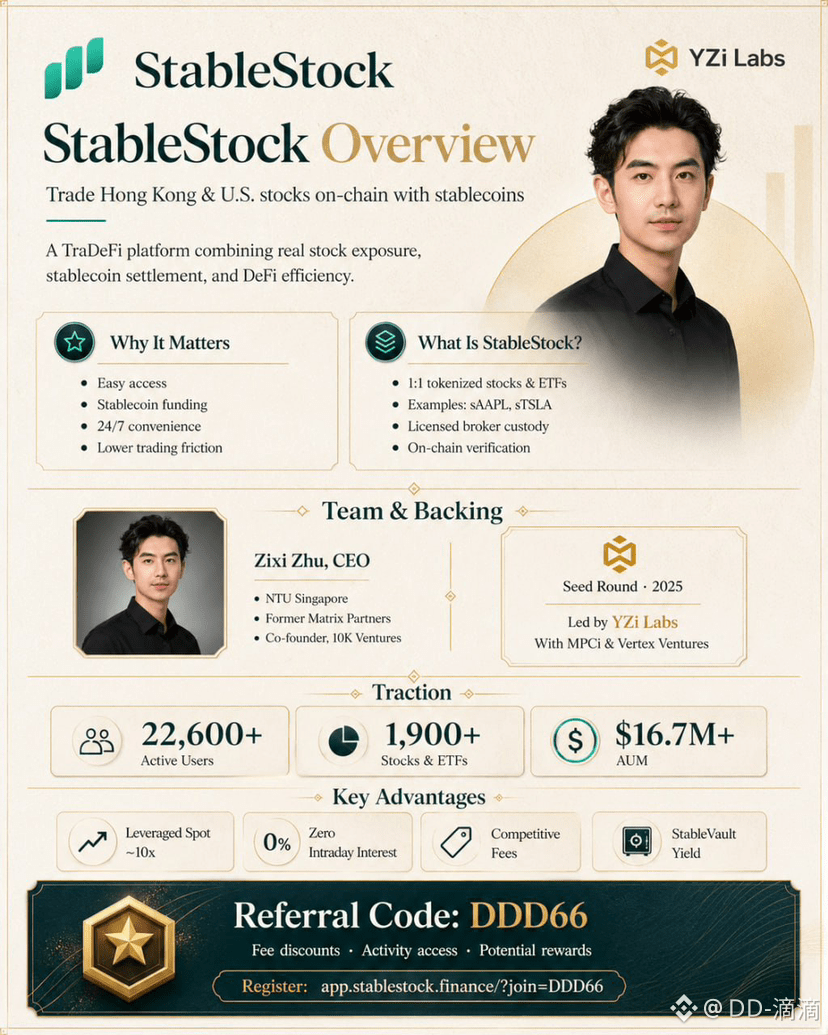
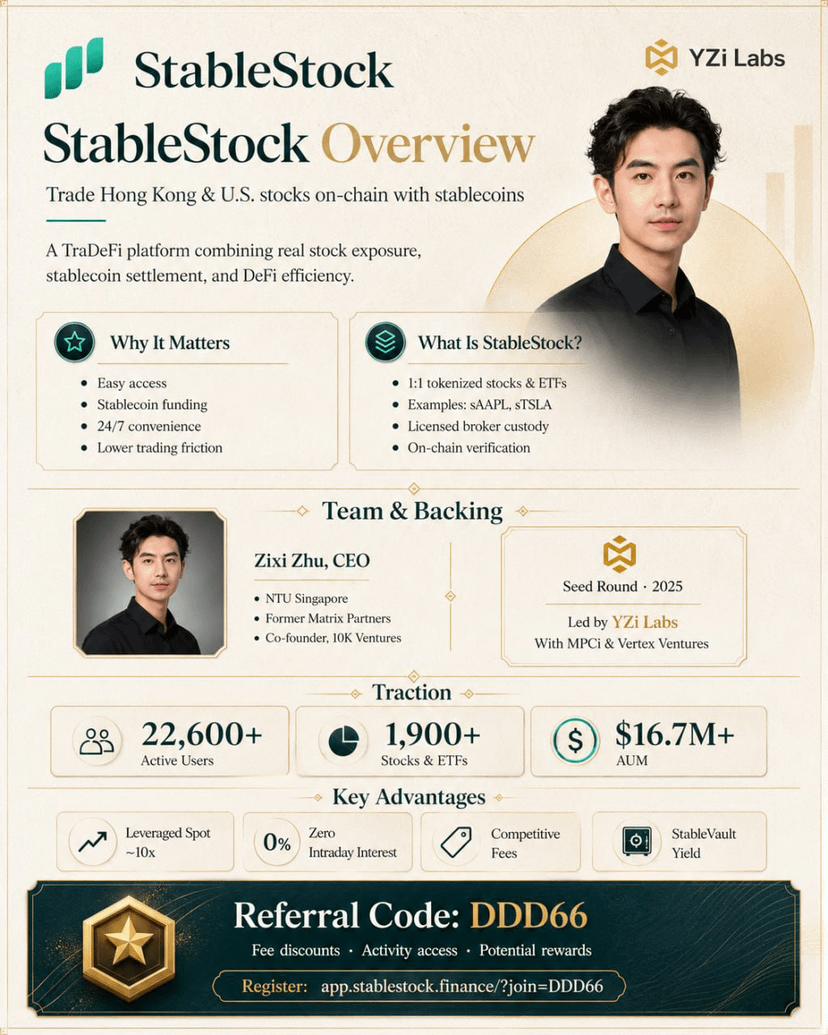
StableStock StableStock is a TraDeFi platform that lets users trade real U.S. and Hong Kong stocks directly with stablecoins (USDT/USDC). It tokenizes stocks 1:1 into on-chain assets (e.g. $AAPL , $TSLA ) backed by licensed brokers. ### Why It Exists Traditional stock investing has high barriers: complicated overseas account opening, slow and expensive deposits, limited trading hours, high fees, and poor integration with crypto/DeFi. StableStock solves these issues by enabling stablecoin-based trading with on-chain transparency. ### Key Features - Leveraged Spot tradingup to ~10x - Zero intraday interest— no financing fees if positions are closed the same day - Competitive fees (extra discounts available via referral) - StableVault— stake idle assets to earn DeFi yield while holding stock exposure ### Team & Backing - **CEO**: Zixi Zhu (ex-Matrix Partners crypto investment head) - **Funding**: 2025 seed round led by YZi Labs, with Matrix Partners and Vertex Ventures - Current traction: 22,600+ users and $16.7M+ AUM ### How to Register 1. Go to: <https://app.stablestock.finance/?join=DDD66> 2. Sign up with email or wallet 3. Enter referral code: **DDD66** Using the code gives top-tier fee discounts and access to promotions. After registration, deposit stablecoins and start trading U.S. & Hong Kong stocks instantly.
StableStock

StableStock is a TraDeFi platform that lets users trade real U.S. and Hong Kong stocks directly with stablecoins (USDT/USDC). It tokenizes stocks 1:1 into on-chain assets (e.g. $AAPL , $TSLA ) backed by licensed brokers.

### Why It Exists

Traditional stock investing has high barriers: complicated overseas account opening, slow and expensive deposits, limited trading hours, high fees, and poor integration with crypto/DeFi.

StableStock solves these issues by enabling stablecoin-based trading with on-chain transparency.

### Key Features

- Leveraged Spot tradingup to ~10x
- Zero intraday interest— no financing fees if positions are closed the same day
- Competitive fees (extra discounts available via referral)
- StableVault— stake idle assets to earn DeFi yield while holding stock exposure

### Team & Backing

- **CEO**: Zixi Zhu (ex-Matrix Partners crypto investment head)
- **Funding**: 2025 seed round led by YZi Labs, with Matrix Partners and Vertex Ventures
- Current traction: 22,600+ users and $16.7M+ AUM

### How to Register

1. Go to: <https://app.stablestock.finance/?join=DDD66>
2. Sign up with email or wallet
3. Enter referral code: **DDD66**

Using the code gives top-tier fee discounts and access to promotions.

After registration, deposit stablecoins and start trading U.S. & Hong Kong stocks instantly.
AAPLonAlpha
TSLAUS+4,46%
PINNED
It's already 2026 now, yet many people still have no idea about the progress of the RWA crypto market. They don’t know where perps are being “printed” and where you can buy them; they don’t even know how to buy heavily before the pre-IPO—let alone things like behavioral finance, etc. All of it is compiled into <Encryption Newcomers’ First Lesson> Send/Link, https://cryptofirstclass.notion.site/
It's already 2026 now, yet many people still have no idea about the progress of the RWA crypto market. They don’t know where perps are being “printed” and where you can buy them; they don’t even know how to buy heavily before the pre-IPO—let alone things like behavioral finance, etc.
All of it is compiled into <Encryption Newcomers’ First Lesson>
Send/Link, https://cryptofirstclass.notion.site/
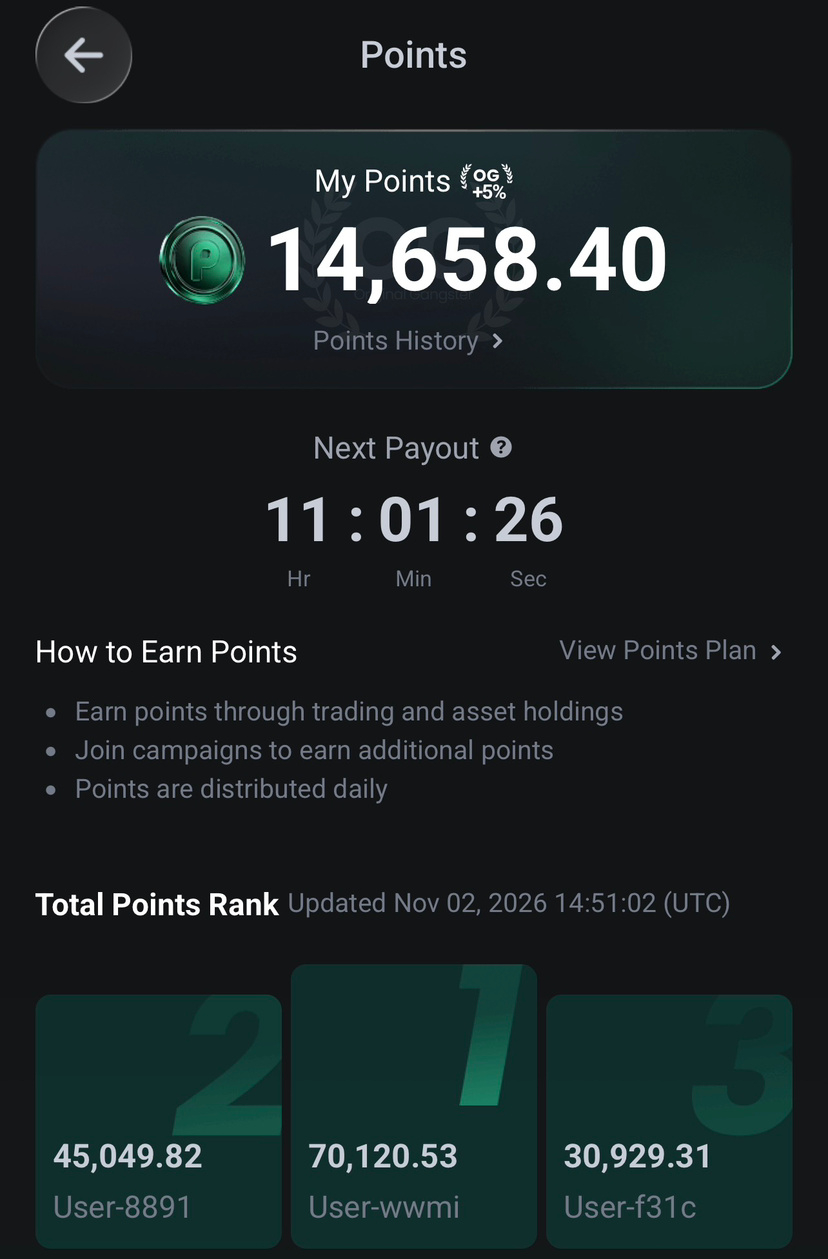
Before I knew it, I’d been trading StableStock on Binance for almost a year. Thanks for the retroactive trading points. They’re a great way to recognize the past participation of early users who kept using the platform. I’m still optimistic about Binance and StableStock’s future. StableStock currently supports U.S., Korean, and Hong Kong stocks, with plans to open up the Taiwan and Japan markets in the future. The fast, smooth mobile experience, transparent fees, and ample trading depth are all reasons I keep using it. The potential for future airdrops also gives me something extra to look forward to in my everyday trading. If you haven’t joined yet, feel free to use my official referral code DDDDD6 or sign up through the official link below: app.stablestock.finance/?join=DDDDD6
Before I knew it, I’d been trading StableStock on Binance for almost a year.

Thanks for the retroactive trading points. They’re a great way to recognize the past participation of early users who kept using the platform.

I’m still optimistic about Binance and StableStock’s future.

StableStock currently supports U.S., Korean, and Hong Kong stocks, with plans to open up the Taiwan and Japan markets in the future. The fast, smooth mobile experience, transparent fees, and ample trading depth are all reasons I keep using it.

The potential for future airdrops also gives me something extra to look forward to in my everyday trading.

If you haven’t joined yet, feel free to use my official referral code DDDDD6 or sign up through the official link below:

app.stablestock.finance/?join=DDDDD6
Verified
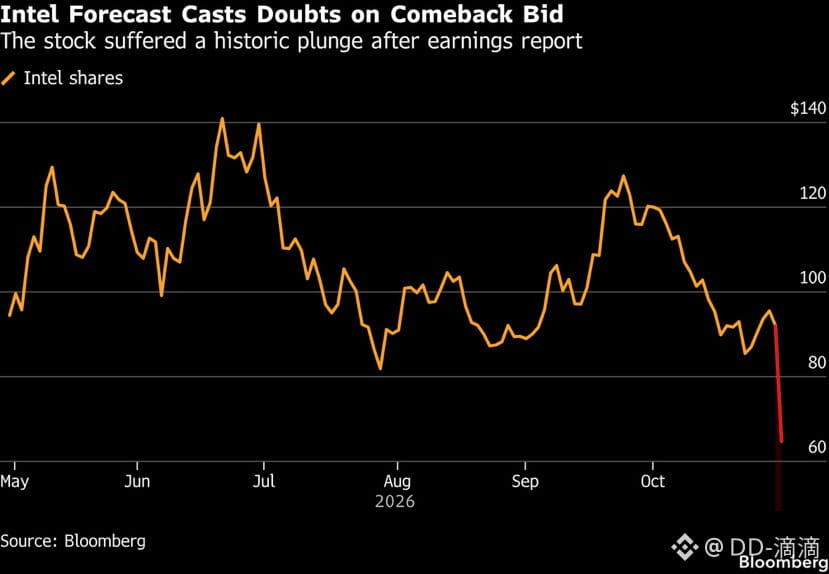
$INTC dropped nearly 29% on Friday, its worst day since 1974, erasing roughly $140 billion. $GOOGL fell about 13% the day before, its worst session on record, wiping out around $500 billion. $INTC beat on the quarter but guided Q4 revenue to $15-16 billion versus roughly $17 billion expected and EPS of $0.25 versus $0.43. Management pointed to a weak PC market and rising memory prices that are squeezing client demand. Data center and AI revenue still grew strongly, up nearly 80%. GOOGL also missed on revenue and earnings. Cloud more than doubled, but search advertising growth slowed as AI Mode reduced traditional ad monetization. Capex hit $51.4 billion in the quarter, pushing free cash flow negative. The selloff has been amplified by heavy hedge-fund de-grossing, the largest in a decade according to Morgan Stanley data, with short interest rising across many semiconductor and related names. PC weakness at Intel looks tied to memory cost pressure and may linger into the first half of next year. Server and AI infrastructure demand has not shown the same break. Hyperscalers continue signing longer memory LTAs, and the Marvell-Lumentum deal has raised the strategic value of remaining independent laser suppliers as buyers look for alternatives outside a competitor’s control. The gap between strong data-center results and weak PC guidance, plus the cash-flow impact of elevated AI spending, is what the market is currently pricing. Volatility remains high.
$INTC dropped nearly 29% on Friday, its worst day since 1974, erasing roughly $140 billion. $GOOGL fell about 13% the day before, its worst session on record, wiping out around $500 billion.
$INTC beat on the quarter but guided Q4 revenue to $15-16 billion versus roughly $17 billion expected and EPS of $0.25 versus $0.43. Management pointed to a weak PC market and rising memory prices that are squeezing client demand. Data center and AI revenue still grew strongly, up nearly 80%.

GOOGL also missed on revenue and earnings. Cloud more than doubled, but search advertising growth slowed as AI Mode reduced traditional ad monetization. Capex hit $51.4 billion in the quarter, pushing free cash flow negative.

The selloff has been amplified by heavy hedge-fund de-grossing, the largest in a decade according to Morgan Stanley data, with short interest rising across many semiconductor and related names.

PC weakness at Intel looks tied to memory cost pressure and may linger into the first half of next year. Server and AI infrastructure demand has not shown the same break. Hyperscalers continue signing longer memory LTAs, and the Marvell-Lumentum deal has raised the strategic value of remaining independent laser suppliers as buyers look for alternatives outside a competitor’s control.

The gap between strong data-center results and weak PC guidance, plus the cash-flow impact of elevated AI spending, is what the market is currently pricing. Volatility remains high.
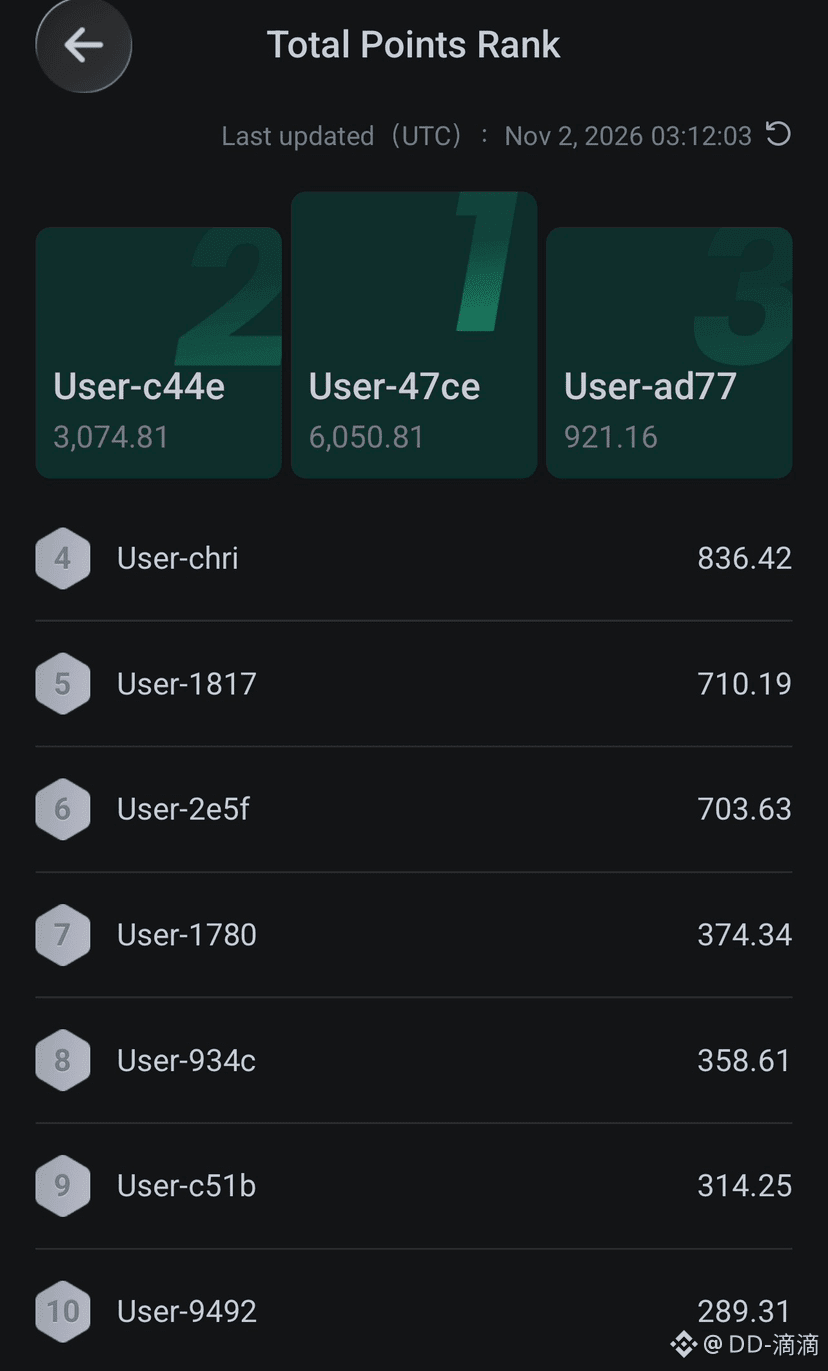
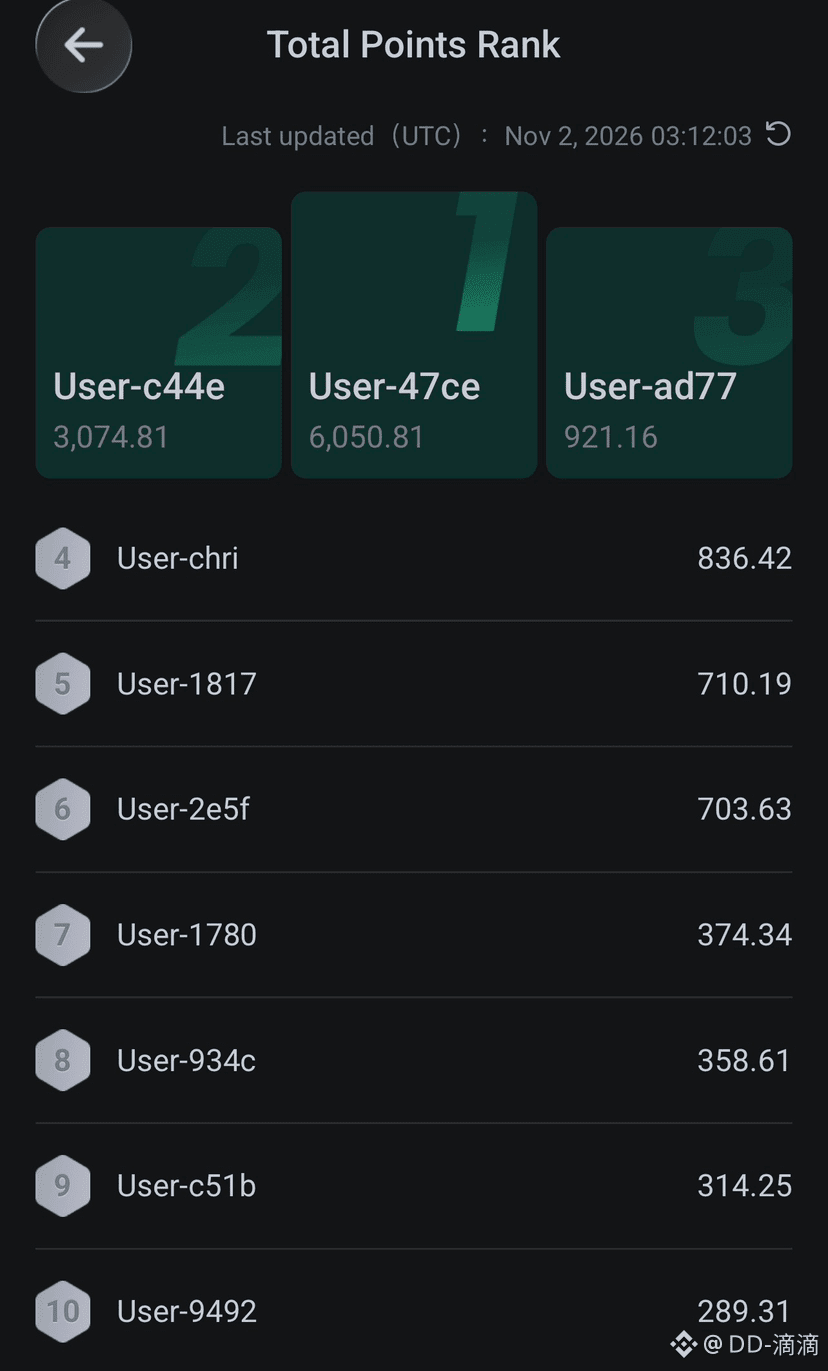
Stablestock is giving away money If you subscribed at 135 on it before, remember to check your points: $SPCX
Stablestock is giving away money

If you subscribed at 135 on it before, remember to check your points: $SPCX
DD-滴滴
·
--
StableStock

StableStock is a TraDeFi platform that lets users trade real U.S. and Hong Kong stocks directly with stablecoins (USDT/USDC). It tokenizes stocks 1:1 into on-chain assets (e.g. $AAPL , $TSLA ) backed by licensed brokers.

### Why It Exists

Traditional stock investing has high barriers: complicated overseas account opening, slow and expensive deposits, limited trading hours, high fees, and poor integration with crypto/DeFi.

StableStock solves these issues by enabling stablecoin-based trading with on-chain transparency.

### Key Features

- Leveraged Spot tradingup to ~10x
- Zero intraday interest— no financing fees if positions are closed the same day
- Competitive fees (extra discounts available via referral)
- StableVault— stake idle assets to earn DeFi yield while holding stock exposure

### Team & Backing

- **CEO**: Zixi Zhu (ex-Matrix Partners crypto investment head)
- **Funding**: 2025 seed round led by YZi Labs, with Matrix Partners and Vertex Ventures
- Current traction: 22,600+ users and $16.7M+ AUM

### How to Register

1. Go to: <https://app.stablestock.finance/?join=DDD66>
2. Sign up with email or wallet
3. Enter referral code: **DDD66**

Using the code gives top-tier fee discounts and access to promotions.

After registration, deposit stablecoins and start trading U.S. & Hong Kong stocks instantly.
Stablestock, which I shared before, has secured new funding and is giving points to existing users. Remember to check it out. The earlier token launch and liquidity depth at $SPCX and $NVDA were both great. If you haven't registered yet, you can use my official invitation code: DDDDD6 https://app.stablestock.finance/?join=DDDDD6
Stablestock, which I shared before, has secured new funding and is giving points to existing users.

Remember to check it out.

The earlier token launch and liquidity depth at $SPCX and $NVDA were both great.

If you haven't registered yet, you can use my official invitation code: DDDDD6

https://app.stablestock.finance/?join=DDDDD6
DD-滴滴
·
--
StableStock

StableStock is a TraDeFi platform that lets users trade real U.S. and Hong Kong stocks directly with stablecoins (USDT/USDC). It tokenizes stocks 1:1 into on-chain assets (e.g. $AAPL , $TSLA ) backed by licensed brokers.

### Why It Exists

Traditional stock investing has high barriers: complicated overseas account opening, slow and expensive deposits, limited trading hours, high fees, and poor integration with crypto/DeFi.

StableStock solves these issues by enabling stablecoin-based trading with on-chain transparency.

### Key Features

- Leveraged Spot tradingup to ~10x
- Zero intraday interest— no financing fees if positions are closed the same day
- Competitive fees (extra discounts available via referral)
- StableVault— stake idle assets to earn DeFi yield while holding stock exposure

### Team & Backing

- **CEO**: Zixi Zhu (ex-Matrix Partners crypto investment head)
- **Funding**: 2025 seed round led by YZi Labs, with Matrix Partners and Vertex Ventures
- Current traction: 22,600+ users and $16.7M+ AUM

### How to Register

1. Go to: <https://app.stablestock.finance/?join=DDD66>
2. Sign up with email or wallet
3. Enter referral code: **DDD66**

Using the code gives top-tier fee discounts and access to promotions.

After registration, deposit stablecoins and start trading U.S. & Hong Kong stocks instantly.
The big one is coming.
DD-滴滴
·
--
StableStock

StableStock is a TraDeFi platform that lets users trade real U.S. and Hong Kong stocks directly with stablecoins (USDT/USDC). It tokenizes stocks 1:1 into on-chain assets (e.g. $AAPL , $TSLA ) backed by licensed brokers.

### Why It Exists

Traditional stock investing has high barriers: complicated overseas account opening, slow and expensive deposits, limited trading hours, high fees, and poor integration with crypto/DeFi.

StableStock solves these issues by enabling stablecoin-based trading with on-chain transparency.

### Key Features

- Leveraged Spot tradingup to ~10x
- Zero intraday interest— no financing fees if positions are closed the same day
- Competitive fees (extra discounts available via referral)
- StableVault— stake idle assets to earn DeFi yield while holding stock exposure

### Team & Backing

- **CEO**: Zixi Zhu (ex-Matrix Partners crypto investment head)
- **Funding**: 2025 seed round led by YZi Labs, with Matrix Partners and Vertex Ventures
- Current traction: 22,600+ users and $16.7M+ AUM

### How to Register

1. Go to: <https://app.stablestock.finance/?join=DDD66>
2. Sign up with email or wallet
3. Enter referral code: **DDD66**

Using the code gives top-tier fee discounts and access to promotions.

After registration, deposit stablecoins and start trading U.S. & Hong Kong stocks instantly.
Holding $LYN 19.1K USDT
$LYN Then return to spot-long, futures-short arbitrage.
Holding $LYN 20.6K USDT
$LYN Going long on spot and short on futures to earn funding fees is the best—just wait two hours and collect your rent.
$BTC Around $83,000, still down about 34% from its October 2025 ATH of $126,080. Its market share has risen to nearly 60%, indicating relative resilience. Technically, it is trading above the 50-day and 200-day moving averages, but faces double-top resistance near $87,200. The RSI is neutral and the MACD is weak, with the price consolidating in the $81,000–$85,000 range in the short term. A breakout above $85,000–$87,000 would confirm a bullish turn; a drop below $81,000 could lead to a retest of $80,000. ETFs have seen recent net outflows, but cumulative inflows remain substantial, suggesting the institutional base is still intact. CPI data will determine the near-term direction. $ETH Around $2,500, notably weaker than $BTC. ETFs have recorded large net outflows for several consecutive days, mainly from BlackRock ETHA, as institutional appetite for allocations declines. Technically, a potential double bottom has formed near $2,400, with a neckline around $2,575. A decisive breakout could pave the way for a test of $2,760; otherwise, the price may revisit $2,400. The short-term structure is bearish, and signs of renewed capital inflows are needed. $SOL Around $107–$110, with the steepest weekly decline. It has broken below its ascending channel and key support at $109, and is now testing the $100–$107 range. The RSI is weakening, and sellers have the upper hand in the short term. A break below $100 could open the way to around $93. The Alpenglow upgrade, which targets finality in approximately 150 milliseconds, is in progress, with mainnet launch expected around late October. If implemented successfully, it could serve as a catalyst for a rebound. ETFs have also ended a prolonged period of net inflows and shifted to modest outflows. Overall, amid high macroeconomic yields and uncertainty over CPI, capital is favoring the most liquid assets, while altcoins are relatively underperforming. All three assets are consolidating in ranges in the short term. If risk appetite improves or CPI comes in softer than expected, $BTC may be the first to break out, while $ETH and $SOL will need additional catalysts. The medium-term outlook still depends on monetary easing and continued institutional allocations. If inflation rebounds or risk assets fall further, all three could pull back in tandem. Investors should assess the risks for themselves. This is not investment advice.
$BTC Around $83,000, still down about 34% from its October 2025 ATH of $126,080. Its market share has risen to nearly 60%, indicating relative resilience. Technically, it is trading above the 50-day and 200-day moving averages, but faces double-top resistance near $87,200. The RSI is neutral and the MACD is weak, with the price consolidating in the $81,000–$85,000 range in the short term. A breakout above $85,000–$87,000 would confirm a bullish turn; a drop below $81,000 could lead to a retest of $80,000. ETFs have seen recent net outflows, but cumulative inflows remain substantial, suggesting the institutional base is still intact. CPI data will determine the near-term direction.

$ETH Around $2,500, notably weaker than $BTC . ETFs have recorded large net outflows for several consecutive days, mainly from BlackRock ETHA, as institutional appetite for allocations declines. Technically, a potential double bottom has formed near $2,400, with a neckline around $2,575. A decisive breakout could pave the way for a test of $2,760; otherwise, the price may revisit $2,400. The short-term structure is bearish, and signs of renewed capital inflows are needed.

$SOL Around $107–$110, with the steepest weekly decline. It has broken below its ascending channel and key support at $109, and is now testing the $100–$107 range. The RSI is weakening, and sellers have the upper hand in the short term. A break below $100 could open the way to around $93. The Alpenglow upgrade, which targets finality in approximately 150 milliseconds, is in progress, with mainnet launch expected around late October. If implemented successfully, it could serve as a catalyst for a rebound. ETFs have also ended a prolonged period of net inflows and shifted to modest outflows.

Overall, amid high macroeconomic yields and uncertainty over CPI, capital is favoring the most liquid assets, while altcoins are relatively underperforming. All three assets are consolidating in ranges in the short term. If risk appetite improves or CPI comes in softer than expected, $BTC may be the first to break out, while $ETH and $SOL will need additional catalysts. The medium-term outlook still depends on monetary easing and continued institutional allocations. If inflation rebounds or risk assets fall further, all three could pull back in tandem. Investors should assess the risks for themselves. This is not investment advice.
$LYN has been warning everyone since the top: coins like this should only be shorted to collect funding fees, not bought long. Why does no one ever listen?
With a coin like $LYN , you can open a small short to collect funding fees only when the funding rate is positive.
$LYN : Continue arbitraging only when there is a funding rate differential.
Holding $LYN 19.5K USDT
$LYN currently has no positive funding rate. Wait, close two positions first.
Holding $LYN 19.5K USDT
The returns from strategies like $LYN come from holding spot assets while pairing them with a corresponding amount of perpetual futures short positions. This reduces the impact of price movements on the overall position and collects fees when the funding rate is positive. The key factors to assess are how long the rate can be sustained and how much profit remains after trading costs. Funding fees received on paper do not equal final net profit. Opening and closing fees, slippage, and changes in the spread between spot and futures prices all affect the actual result. If borrowing is involved, interest costs must also be included. When calculating the return on capital, the denominator should include the spot investment, futures margin, and reserve funds to reflect the overall efficiency of the capital. Hedging can reduce directional risk, but it cannot eliminate margin and execution risks. In particular, when margin is managed separately, the futures position may still be liquidated due to a rapid price increase or insufficient margin, even if the spot position is profitable. A negative funding rate or declining liquidity can also make a position that was previously advantageous no longer worth holding. Going forward, the key factors to monitor will be the actual funding rates at settlement, net returns after costs, and the margin buffer. A single period of high funding rates should not be extrapolated directly into annual returns. First, let the strategy run through several settlement cycles, then assess how efficiently the capital is allocated.
The returns from strategies like $LYN come from holding spot assets while pairing them with a corresponding amount of perpetual futures short positions. This reduces the impact of price movements on the overall position and collects fees when the funding rate is positive. The key factors to assess are how long the rate can be sustained and how much profit remains after trading costs.

Funding fees received on paper do not equal final net profit. Opening and closing fees, slippage, and changes in the spread between spot and futures prices all affect the actual result. If borrowing is involved, interest costs must also be included. When calculating the return on capital, the denominator should include the spot investment, futures margin, and reserve funds to reflect the overall efficiency of the capital.

Hedging can reduce directional risk, but it cannot eliminate margin and execution risks. In particular, when margin is managed separately, the futures position may still be liquidated due to a rapid price increase or insufficient margin, even if the spot position is profitable. A negative funding rate or declining liquidity can also make a position that was previously advantageous no longer worth holding.

Going forward, the key factors to monitor will be the actual funding rates at settlement, net returns after costs, and the margin buffer. A single period of high funding rates should not be extrapolated directly into annual returns. First, let the strategy run through several settlement cycles, then assess how efficiently the capital is allocated.
Holding $LYN 19.5K USDT
$LYN Also, to clarify, spot-futures funding rate arbitrage is based on the current positive funding rate. If the funding rate changes, you need to quickly close both positions.
Still, let me clarify: since this is an experimental trade, $LYN , there is still some downside risk. But since we've proposed an experimental hypothesis, we'll test it with a real position.
Still, let me clarify: since this is an experimental trade, $LYN , there is still some downside risk.

But since we've proposed an experimental hypothesis,

we'll test it with a real position.
DD-滴滴
·
--
$LYN Buy spot

Holding an equal-sized short position in futures at the same time to collect funding rates seems like a good option

Earn income every hour

I'll try it with a small position first

This is a real trade, not a hypothetical one
Holding $LYN 19.5K USDT
$LYN Buy spot Holding an equal-sized short position in futures at the same time to collect funding rates seems like a good option Earn income every hour I'll try it with a small position first This is a real trade, not a hypothetical one
$LYN Buy spot

Holding an equal-sized short position in futures at the same time to collect funding rates seems like a good option

Earn income every hour

I'll try it with a small position first

This is a real trade, not a hypothetical one
Holding $OWL 5.3K USDT
$OWL The slippage is relatively high; I also bought a little myself—mainly because I believe in the team’s position in GIWA.
Holding $WARD 10.4K USDT
$WARD bought a bit of WARDEN, looking forward to continued-burning narrative
Log in to explore more content
Join global crypto users on Binance Square
⚡️ Get latest and useful information about crypto.
💬 Trusted by the world’s largest crypto exchange.
👍 Discover real insights from verified creators.
Email / Phone number
Sitemap
Cookie Preferences
Platform T&Cs