

uncle1306
82 Posts
uncle1306
Report
Block User
Підписуйтесь, тут цікаво
74 Following
58 Followers
85 Liked
Posts
·
--
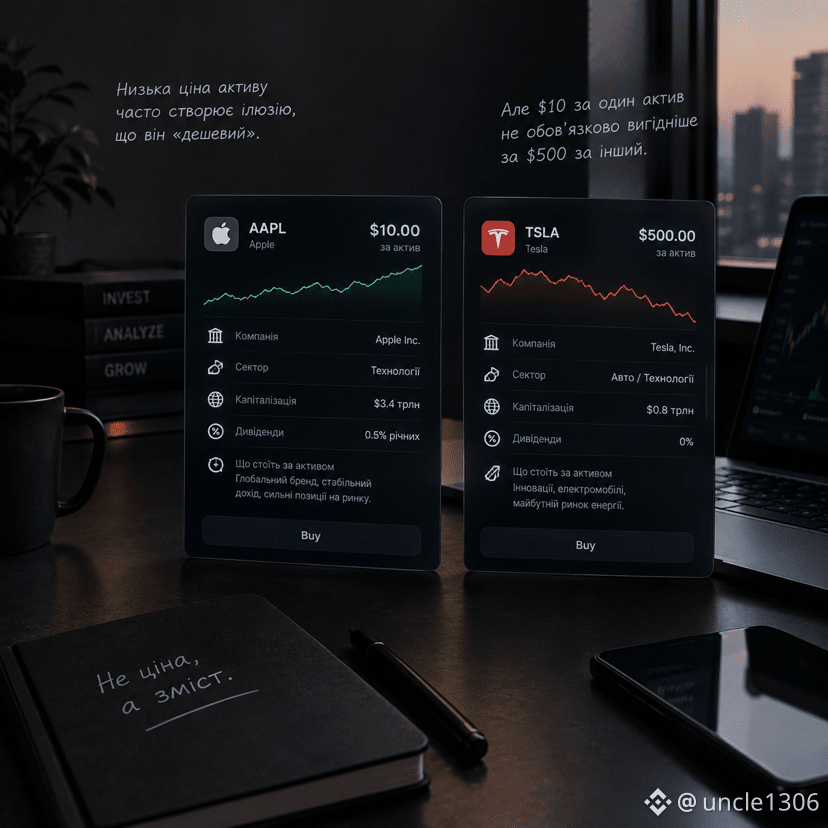
A low asset price often creates the illusion that it’s “cheap.”
But $10 for one asset isn’t necessarily better than $500 for another.
So when evaluating bStocks, I don’t look at the number next to Buy—I look at what the asset actually is and what conditions its use involves.@Binance_Ukraine
A low asset price often creates the illusion that it’s “cheap.”
But $10 for one asset isn’t necessarily better than $500 for another.
So when evaluating bStocks, I don’t look at the number next to Buy—I look at what the asset actually is and what conditions its use involves.@Binance_Ukraine
But $10 for one asset isn’t necessarily better than $500 for another.
So when evaluating bStocks, I don’t look at the number next to Buy—I look at what the asset actually is and what conditions its use involves.@Binance_Ukraine
3
734
·
--
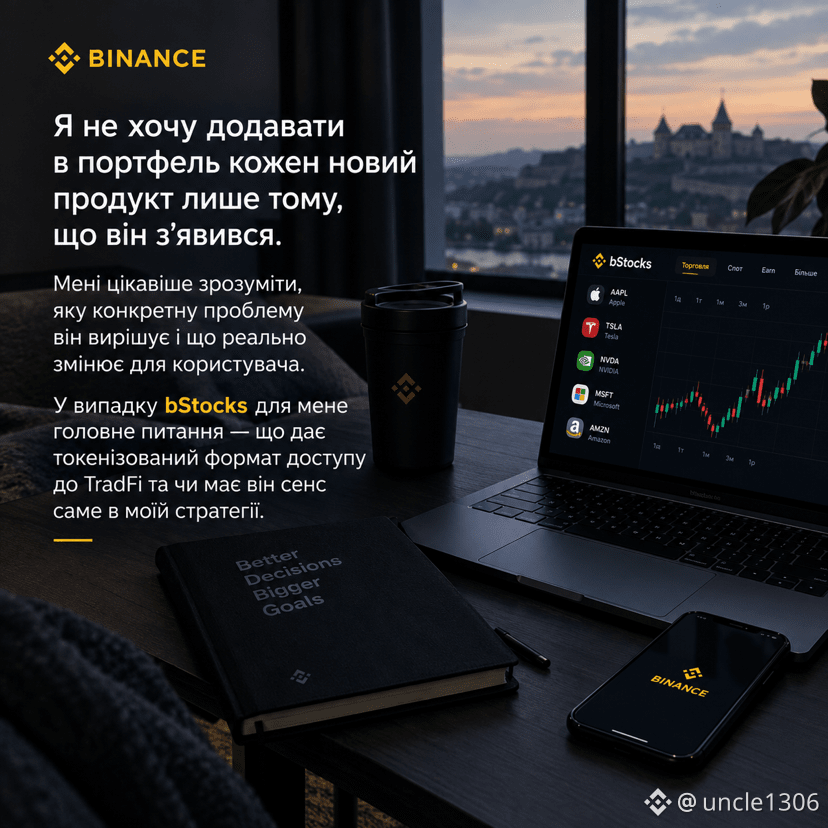
I don’t want to add every new product to my portfolio just because it’s appeared.
I’m more interested in understanding what specific problem it solves and what it really changes for the user.
In the case of bStocks, my main question is what the tokenized access format to TradFi provides and whether it makes sense specifically in my strategy.
Not every new opportunity should automatically become part of a portfolio.@Binance_Ukraine
I don’t want to add every new product to my portfolio just because it’s appeared.
I’m more interested in understanding what specific problem it solves and what it really changes for the user.
In the case of bStocks, my main question is what the tokenized access format to TradFi provides and whether it makes sense specifically in my strategy.
Not every new opportunity should automatically become part of a portfolio.@Binance_Ukraine
I’m more interested in understanding what specific problem it solves and what it really changes for the user.
In the case of bStocks, my main question is what the tokenized access format to TradFi provides and whether it makes sense specifically in my strategy.
Not every new opportunity should automatically become part of a portfolio.@Binance_Ukraine
2
92
·
--
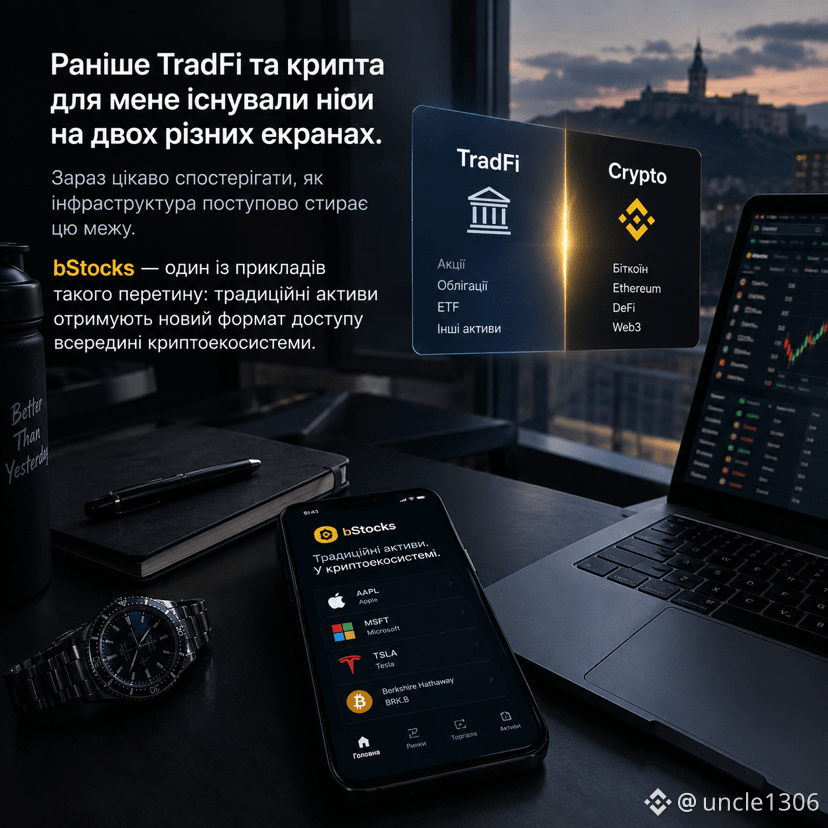
Previously, TradFi and crypto existed for me like two different screens.
Now it’s interesting to watch how infrastructure is gradually erasing this boundary.
bStocks is one example of this intersection: traditional assets get a new way of access within the crypto ecosystem.
I’m interested in seeing solutions like these not only as a user, but as part of a broader transformation of the financial infrastructure.@Binance_Ukraine
Previously, TradFi and crypto existed for me like two different screens.
Now it’s interesting to watch how infrastructure is gradually erasing this boundary.
bStocks is one example of this intersection: traditional assets get a new way of access within the crypto ecosystem.
I’m interested in seeing solutions like these not only as a user, but as part of a broader transformation of the financial infrastructure.@Binance_Ukraine
Now it’s interesting to watch how infrastructure is gradually erasing this boundary.
bStocks is one example of this intersection: traditional assets get a new way of access within the crypto ecosystem.
I’m interested in seeing solutions like these not only as a user, but as part of a broader transformation of the financial infrastructure.@Binance_Ukraine
1
141
·
--
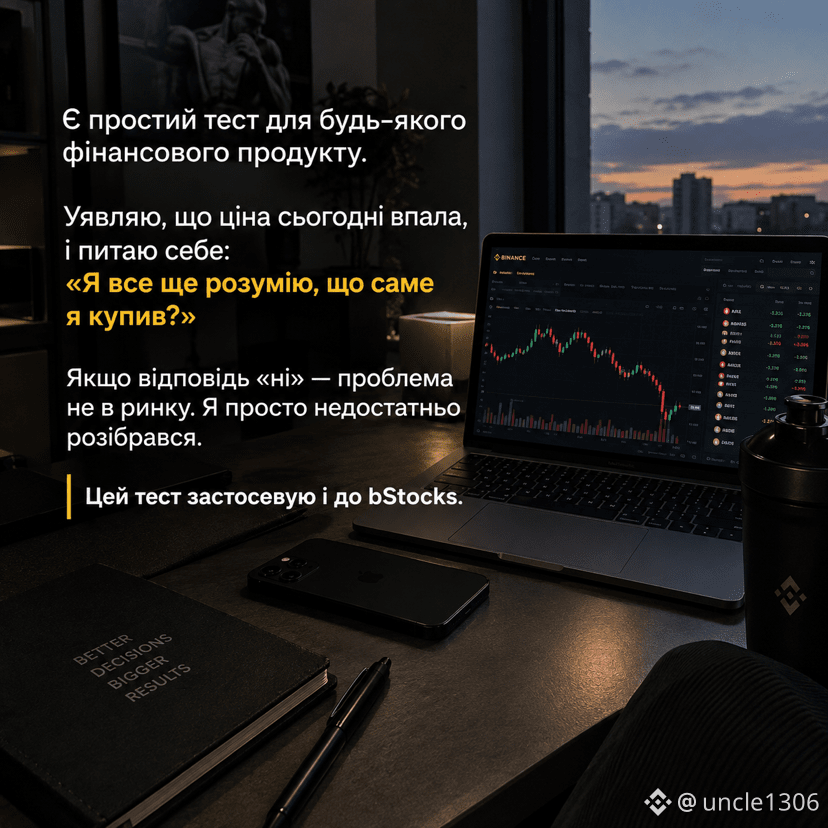
There is a simple test for any financial product.
I imagine that its price has fallen today, and I ask myself: “Do I still understand what exactly I bought?”
If the answer is “no,” then the problem is not the market. I simply didn’t understand the product well enough.
I apply this test to bStocks.@Binance_Ukraine too
There is a simple test for any financial product.
I imagine that its price has fallen today, and I ask myself: “Do I still understand what exactly I bought?”
If the answer is “no,” then the problem is not the market. I simply didn’t understand the product well enough.
I apply this test to bStocks.@Binance_Ukraine too
I imagine that its price has fallen today, and I ask myself: “Do I still understand what exactly I bought?”
If the answer is “no,” then the problem is not the market. I simply didn’t understand the product well enough.
I apply this test to bStocks.@Binance_Ukraine too
4
1.2k
·
--
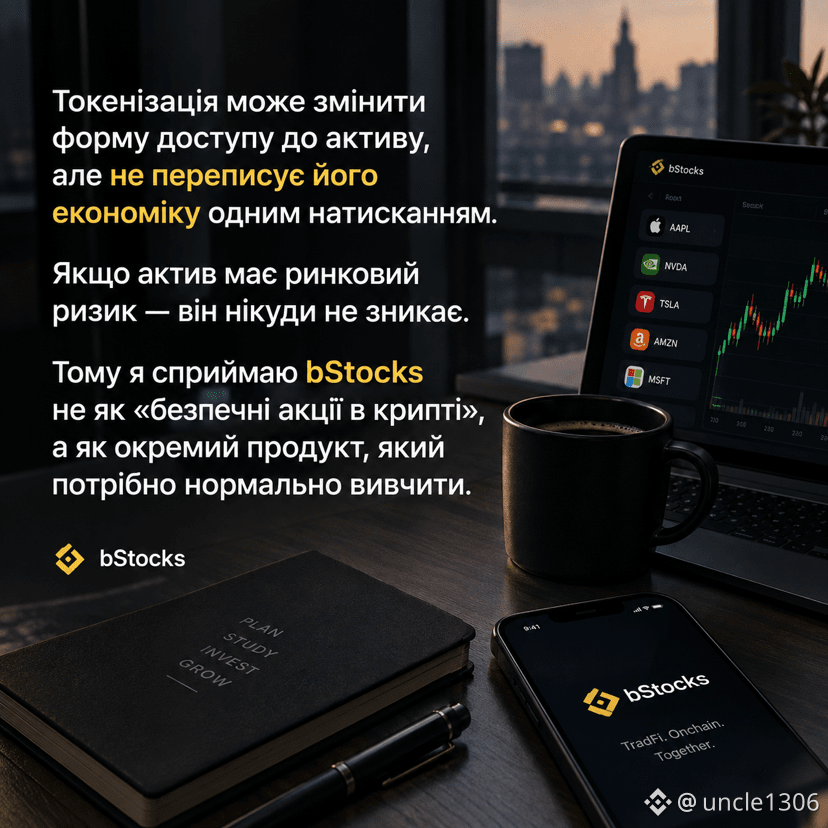
Tokenization can change the form of access to an asset, but it doesn’t rewrite its economics with a single click.
If an asset carries market risk — it doesn’t disappear anywhere.
So I don’t see bStocks as “safe stocks in crypto,” but as a separate product that needs to be properly studied.@Binance_Ukraine
Tokenization can change the form of access to an asset, but it doesn’t rewrite its economics with a single click.
If an asset carries market risk — it doesn’t disappear anywhere.
So I don’t see bStocks as “safe stocks in crypto,” but as a separate product that needs to be properly studied.@Binance_Ukraine
If an asset carries market risk — it doesn’t disappear anywhere.
So I don’t see bStocks as “safe stocks in crypto,” but as a separate product that needs to be properly studied.@Binance_Ukraine
2
97
·
--
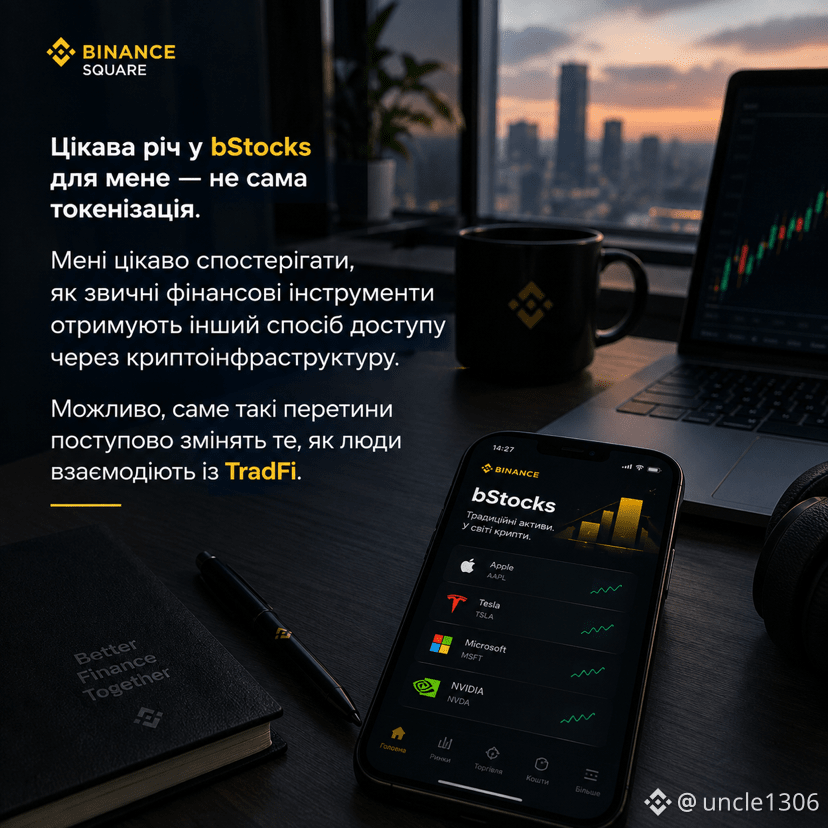
An interesting thing about bStocks for me isn’t the tokenization itself.
I’m interested in observing how familiar financial instruments gain a different way of access through crypto infrastructure.
Perhaps these kinds of intersections will gradually change how people interact with TradFi.@Binance_Ukraine
An interesting thing about bStocks for me isn’t the tokenization itself.
I’m interested in observing how familiar financial instruments gain a different way of access through crypto infrastructure.
Perhaps these kinds of intersections will gradually change how people interact with TradFi.@Binance_Ukraine
I’m interested in observing how familiar financial instruments gain a different way of access through crypto infrastructure.
Perhaps these kinds of intersections will gradually change how people interact with TradFi.@Binance_Ukraine
3
107
·
--
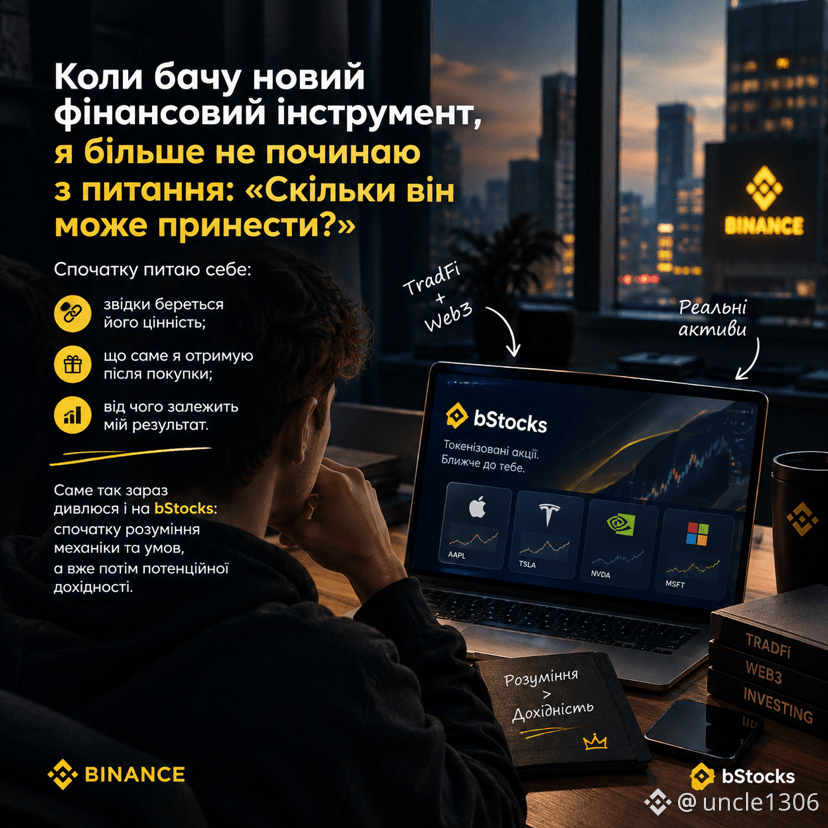
When I see a new financial instrument, I no longer start with the question: “How much can it bring?”
First, I ask myself:
— where does its value come from;
— what exactly I get after the purchase;
— what my result depends on.
That’s how I look at bStocks now: first understanding the mechanics and the conditions, and only then the potential returns.@Binance_Ukraine
When I see a new financial instrument, I no longer start with the question: “How much can it bring?”
First, I ask myself:
— where does its value come from;
— what exactly I get after the purchase;
— what my result depends on.
That’s how I look at bStocks now: first understanding the mechanics and the conditions, and only then the potential returns.@Binance_Ukraine
First, I ask myself:
— where does its value come from;
— what exactly I get after the purchase;
— what my result depends on.
That’s how I look at bStocks now: first understanding the mechanics and the conditions, and only then the potential returns.@Binance_Ukraine
4
456
·
--
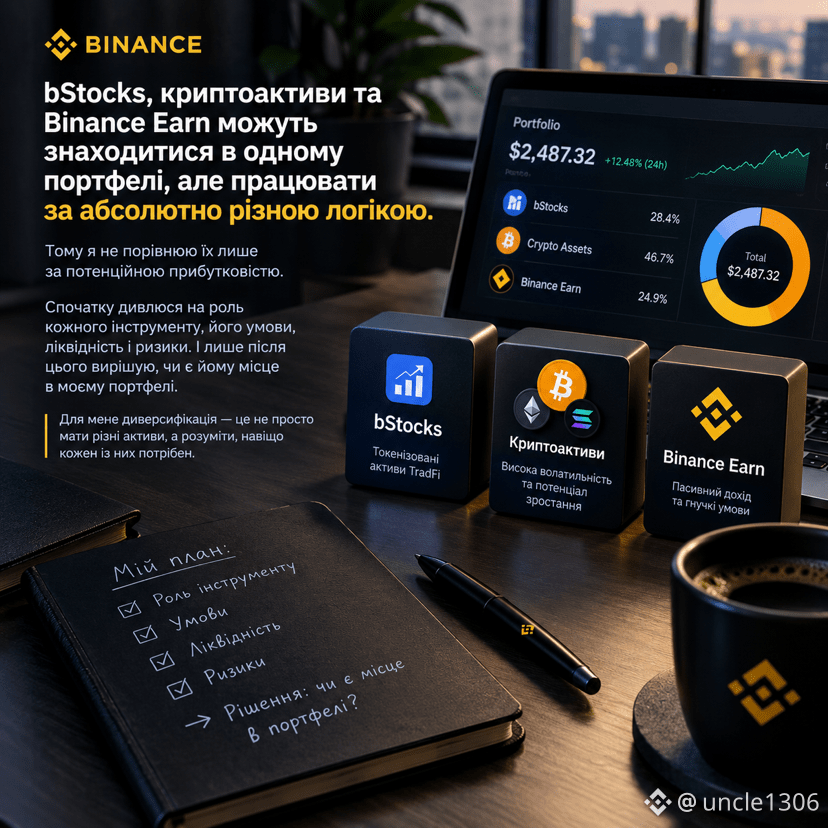
Stocks, crypto assets, and Binance Earn can be in the same portfolio, but they operate on completely different logic.
So I don’t compare them only by potential profitability.
First, I look at the role of each instrument, its terms, liquidity, and risks. And only after that do I decide whether it has a place in my portfolio.
For me, diversification is not just having different assets, but understanding why each of them is needed. @Binance_Ukraine
Stocks, crypto assets, and Binance Earn can be in the same portfolio, but they operate on completely different logic.
So I don’t compare them only by potential profitability.
First, I look at the role of each instrument, its terms, liquidity, and risks. And only after that do I decide whether it has a place in my portfolio.
For me, diversification is not just having different assets, but understanding why each of them is needed. @Binance_Ukraine
So I don’t compare them only by potential profitability.
First, I look at the role of each instrument, its terms, liquidity, and risks. And only after that do I decide whether it has a place in my portfolio.
For me, diversification is not just having different assets, but understanding why each of them is needed. @Binance_Ukraine
2
187
·
--
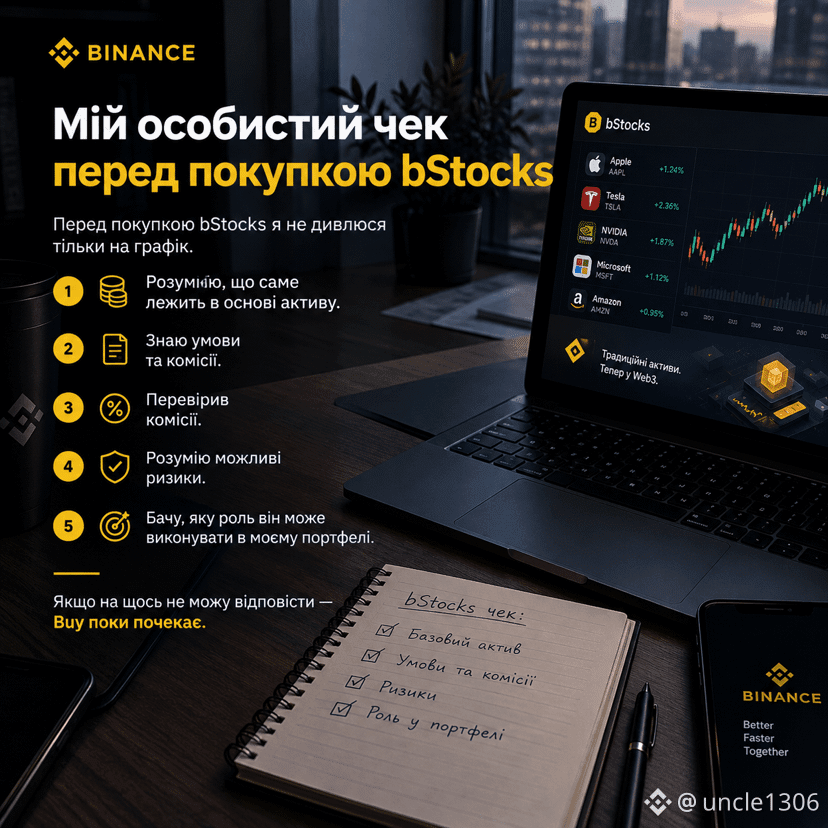
Before buying bStocks, I don’t look only at the chart.
My quick checklist:
🔹 I understand what the underlying asset is based on;
🔹 I know the terms and fees;
🔹 I understand the possible risks;
🔹 I see what role it can play in my portfolio.
If I can’t answer something—Buy will wait. @Binance_Ukraine
Before buying bStocks, I don’t look only at the chart.
My quick checklist:
🔹 I understand what the underlying asset is based on;
🔹 I know the terms and fees;
🔹 I understand the possible risks;
🔹 I see what role it can play in my portfolio.
If I can’t answer something—Buy will wait. @Binance_Ukraine
My quick checklist:
🔹 I understand what the underlying asset is based on;
🔹 I know the terms and fees;
🔹 I understand the possible risks;
🔹 I see what role it can play in my portfolio.
If I can’t answer something—Buy will wait. @Binance_Ukraine
2
4
626
·
--
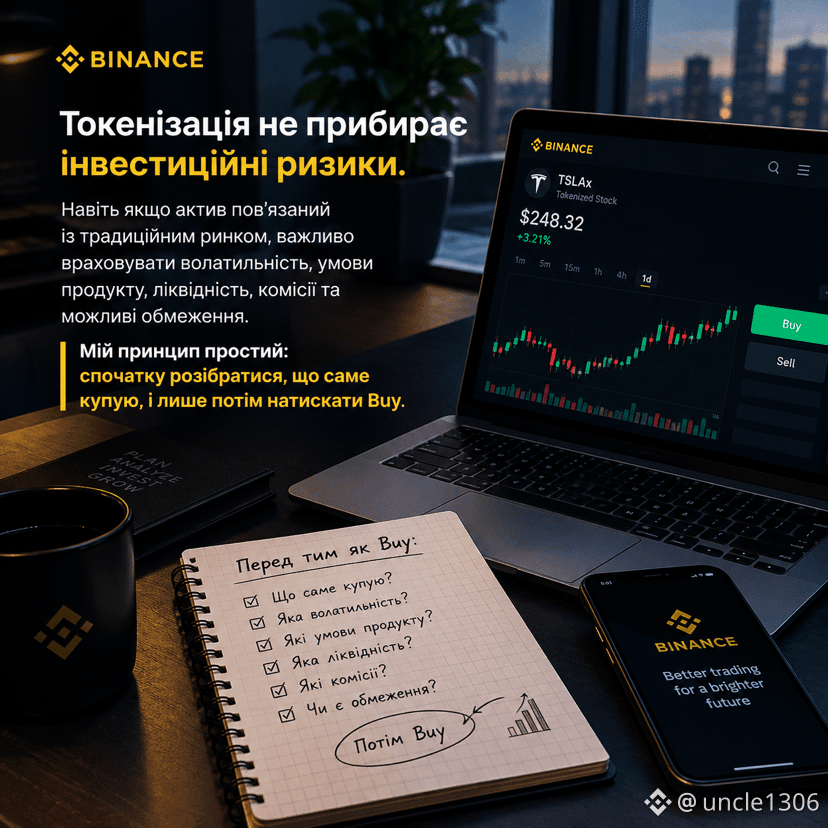
Tokenization does not remove investment risks.
Even if an asset is tied to a traditional market, it’s important to consider volatility, product terms, liquidity, fees, and possible restrictions.
My principle is simple: first figure out exactly what I’m buying, and only then hit Buy.@Binance_Ukraine
Tokenization does not remove investment risks.
Even if an asset is tied to a traditional market, it’s important to consider volatility, product terms, liquidity, fees, and possible restrictions.
My principle is simple: first figure out exactly what I’m buying, and only then hit Buy.@Binance_Ukraine
Even if an asset is tied to a traditional market, it’s important to consider volatility, product terms, liquidity, fees, and possible restrictions.
My principle is simple: first figure out exactly what I’m buying, and only then hit Buy.@Binance_Ukraine
216
·
--
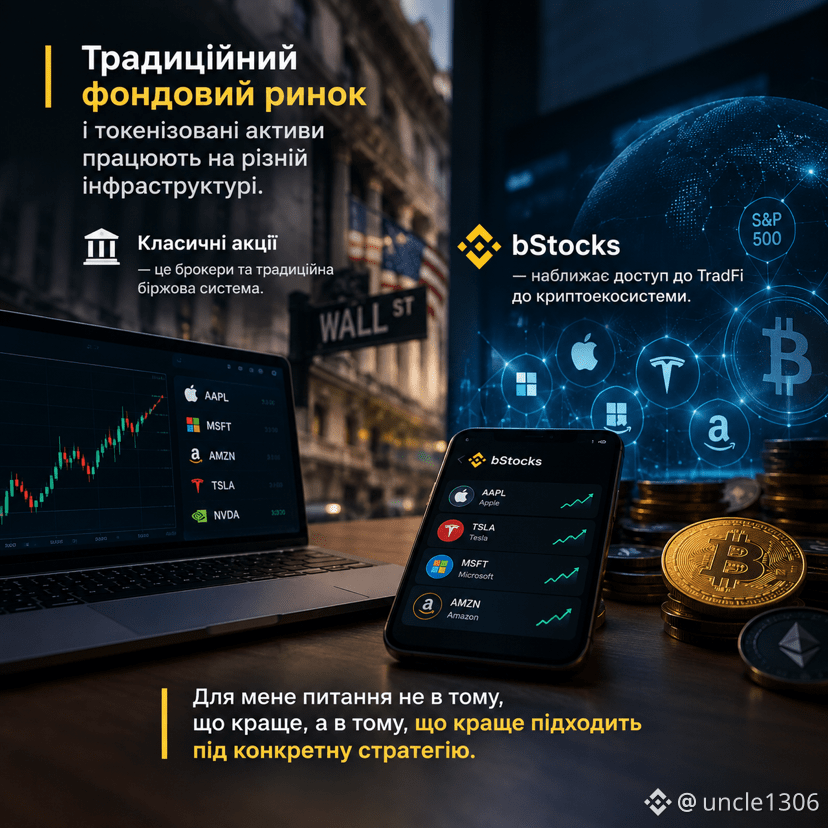
Traditional stock market and tokenized assets run on different infrastructure.
Traditional stocks are brokers and the legacy exchange system. bStocks brings access to TradFi to the crypto ecosystem.
For me, the question isn't about what's better, but what's a better fit for a specific strategy. @Binance_Ukraine
Traditional stock market and tokenized assets run on different infrastructure.
Traditional stocks are brokers and the legacy exchange system. bStocks brings access to TradFi to the crypto ecosystem.
For me, the question isn't about what's better, but what's a better fit for a specific strategy. @Binance_Ukraine
Traditional stocks are brokers and the legacy exchange system. bStocks brings access to TradFi to the crypto ecosystem.
For me, the question isn't about what's better, but what's a better fit for a specific strategy. @Binance_Ukraine
1
81
·
--
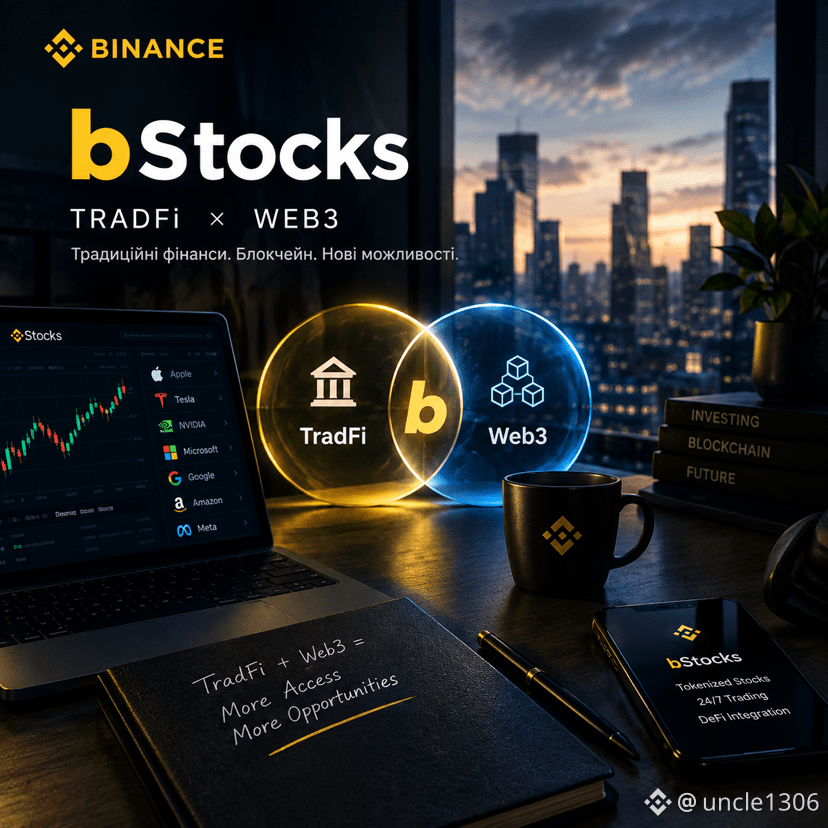
Traditional finance is gradually becoming more digital, and blockchain is opening up new possibilities for working with assets.
That’s why I’m interested in the bStocks concept — it combines TradFi and Web3 approaches. The trend is clear: financial products are moving toward greater accessibility, digitization, and integration with the blockchain ecosystem. @Binance_Ukraine #bstocscis
Traditional finance is gradually becoming more digital, and blockchain is opening up new possibilities for working with assets.
That’s why I’m interested in the bStocks concept — it combines TradFi and Web3 approaches. The trend is clear: financial products are moving toward greater accessibility, digitization, and integration with the blockchain ecosystem. @Binance_Ukraine #bstocscis
That’s why I’m interested in the bStocks concept — it combines TradFi and Web3 approaches. The trend is clear: financial products are moving toward greater accessibility, digitization, and integration with the blockchain ecosystem. @Binance_Ukraine #bstocscis
92
·
--
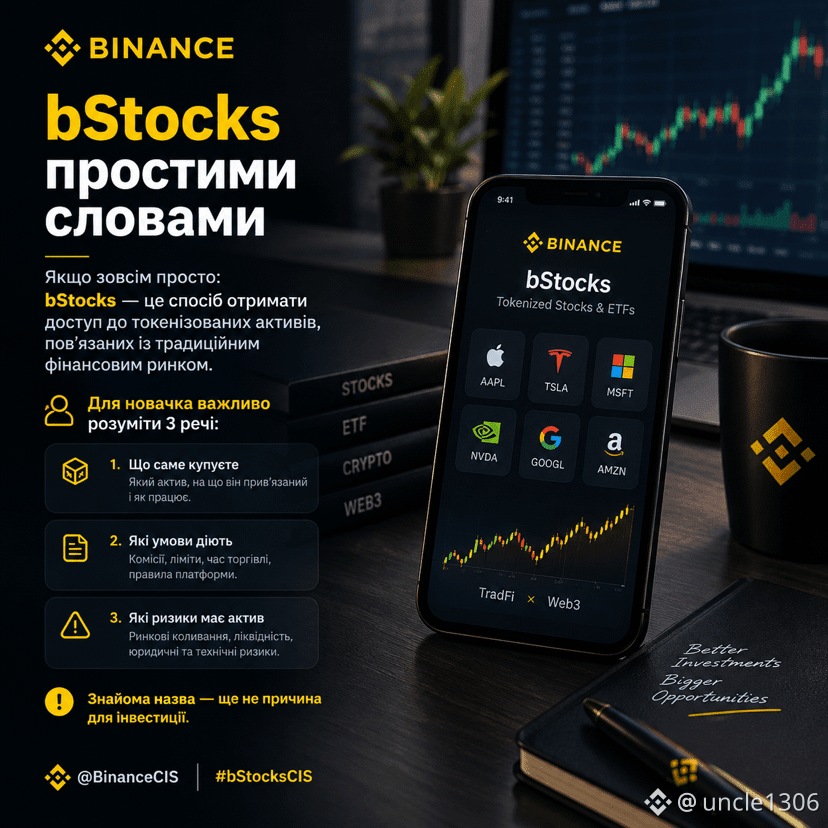
If simply put: bStocks is a way to gain access to tokenized assets linked to the traditional financial market.
For a beginner, it’s important to understand 3 things: what exactly you are buying, what terms apply, and what risks the asset has. A familiar name is not a reason to invest. @Binance_Ukraine #bStocksCIS
If simply put: bStocks is a way to gain access to tokenized assets linked to the traditional financial market.
For a beginner, it’s important to understand 3 things: what exactly you are buying, what terms apply, and what risks the asset has. A familiar name is not a reason to invest. @Binance_Ukraine #bStocksCIS
For a beginner, it’s important to understand 3 things: what exactly you are buying, what terms apply, and what risks the asset has. A familiar name is not a reason to invest. @Binance_Ukraine #bStocksCIS
2
1
433
·
--
@Binance_Ukraine I tested bStocks as a way to gain access to TradFi through the crypto ecosystem. I liked the combination of the familiar stock market with the opportunities of Web3 the most. It’s convenient when everything is in one environment without constantly switching between platforms. At the same time, before using it, it’s important to carefully review the terms and risks.
What do you like about bStocks?
@Binance_Ukraine I tested bStocks as a way to gain access to TradFi through the crypto ecosystem. I liked the combination of the familiar stock market with the opportunities of Web3 the most. It’s convenient when everything is in one environment without constantly switching between platforms. At the same time, before using it, it’s important to carefully review the terms and risks.
What do you like about bStocks?
What do you like about bStocks?
🟢 TradFi + Web3
0%
🔵 Все в одному
100%
🟡 Зручність
0%
🔴 Ризики
0%
1 votes • Voting closed
1
207
·
--
Verified
#bstockscis @BinanceCIS
The stock market is entering a new era 🚀 Binance bStocks combine traditional shares with blockchain technology, opening up new opportunities to access global companies. $TSLA is an example of how stocks can take on a tokenized format. Will bStocks become the future of the stock market?$SPCX
How do you assess the future of Binance bStocks?
#bstockscis @BinanceCIS
The stock market is entering a new era 🚀 Binance bStocks combine traditional shares with blockchain technology, opening up new opportunities to access global companies. $TSLA is an example of how stocks can take on a tokenized format. Will bStocks become the future of the stock market?$SPCX
How do you assess the future of Binance bStocks?
The stock market is entering a new era 🚀 Binance bStocks combine traditional shares with blockchain technology, opening up new opportunities to access global companies. $TSLA is an example of how stocks can take on a tokenized format. Will bStocks become the future of the stock market?$SPCX
How do you assess the future of Binance bStocks?
🚀 Великий потенціал
50%
📈 Стануть популярними
17%
🤔 Потрібно більше часу
17%
❌ Не бачу переваг
16%
6 votes • Voting closed
5
5
160
Log in to explore more content
Join global crypto users on Binance Square
⚡️ Get latest and useful information about crypto.
💬 Trusted by the world’s largest crypto exchange.
👍 Discover real insights from verified creators.
Email / Phone number
Trending Topics
FedMinutesFocusOnOctoberPause
11,219 views
310 Discussing
#fedminutesfocusonoctoberpause
🚨 OCTOBER FED HIKE ODDS COLLAPSE TO 21.6%… Is $BTC About to React? 👀
The Fed is about to give markets another major clue.
Investors are waiting for today’s FOMC minutes — and the biggest question is whether October brings another rate hike… or a pause.
Right now, the odds of a 25-basis-point October hike have fallen to just 21.6%.
That’s a huge shift in expectations.
But here’s what makes this interesting… 👀
The Fed raised rates to 3.75%–4.00% in September, but recent weakness in jobs data and softer inflation have made another immediate hike look less certain.
And for crypto, this matters.
A Fed pause could reduce pressure on financial conditions and potentially improve risk appetite.
That could become a tailwind for BTC
But there’s a catch…
Bitcoin is already under pressure as the dollar and Treasury yields move higher.
So tonight’s minutes could become a volatility trigger.
Dovish Fed → liquidity hopes → bullish .
BTC narrative?
Hawkish Fed → higher-rate fears → more pressure on risk assets?
The real question:
Is October becoming the pause Bitcoin bulls have been waiting for… or could the Fed surprise the market again? 👀
Watch BTC + Fed expectations + Treasury yields closely.
#FederalReserve #Fed #Crypto #InterestRates
$ETH
$SOL
Shae Cassler Sw9r
·11 Likes
·25.7k views
BinanceLaunchesBinanceIntelligence
917,526 views
5,570 Discussing
RobinhoodAdds$25MInBitcoinToBalanceSheet
650 views
27 Discussing