

海盗鸭
3.5k Posts

海盗鸭
Report
Block User
69 Following
137 Followers
348 Liked
Posts
All
Quotes
·
--
Bitquery exposed the “boom” on the XRP Ledger: from September 19 to October 18, 7.79 million of the 7.82 million RLUSD payments—99.6%—came from a bot cluster of 110 addresses, all sent to just 3 recipient addresses, with each payment around a tenth of a cent and only $20 a day spent on fees.
The reality: fewer than 2,000 sending addresses over the entire month. Of the $7.33 billion in settlement volume, $6.98 billion—95%—came from 828 transfers of over $1 million each. The median transfer was just 150 RLUSD.
My take: transaction-count metrics are broken. Using dust transactions to argue that a blockchain is booming is the laziest form of self-deception. If you want to know what’s really happening, look at issuer mints and redemptions, and large settlements—that’s where the real money moves.
When judging $XRP, do you still look at transaction counts, or do you focus only on ETF inflows and the $1.25 level?
Bitquery exposed the “boom” on the XRP Ledger: from September 19 to October 18, 7.79 million of the 7.82 million RLUSD payments—99.6%—came from a bot cluster of 110 addresses, all sent to just 3 recipient addresses, with each payment around a tenth of a cent and only $20 a day spent on fees.
The reality: fewer than 2,000 sending addresses over the entire month. Of the $7.33 billion in settlement volume, $6.98 billion—95%—came from 828 transfers of over $1 million each. The median transfer was just 150 RLUSD.
My take: transaction-count metrics are broken. Using dust transactions to argue that a blockchain is booming is the laziest form of self-deception. If you want to know what’s really happening, look at issuer mints and redemptions, and large settlements—that’s where the real money moves.
When judging $XRP , do you still look at transaction counts, or do you focus only on ETF inflows and the $1.25 level?
7
·
--
This CFTC interpretive statement (issued October 5, published in the Federal Register on October 13, with comments due by December 14) turns a lot of people’s assumptions on their head: paying in full for Bitcoin and declining the credit offered by a platform does not mean the transaction falls outside futures rules. As long as the seller or counterparty has “offered” a financing arrangement that applies—whether it’s in the account-opening documents or the transaction terms—the retail commodity transaction may still fall under CEA Section 2(c)(2)(D), unless an exception such as “actual delivery” applies.
And the bar for actual delivery is meaningful possession and control within 28 days: a balance on an exchange’s ledger generally isn’t enough—you need the private keys. Paying in full also doesn’t, by itself, qualify for an exception.
My take: this isn’t about raising the bar for retail investors; it’s about defining what “BTC on the books” really is. Whether buying coins on a platform counts as spot or leveraged trading depends on whether you actually get the keys—self-custody has become the regulatory-optimal choice for the first time, not just a matter of belief.
Your turn: $BTC —do you keep it in your own wallet or leave it in your platform balance?
24
·
--
On the 19th, BlackRock filed for its third Bitcoin ETF, called Managed Protect. It doesn’t hold Bitcoin; instead, it buys call spreads on IBIT: buying calls with strike prices around 90% and selling calls with higher strike prices to offset the cost, with the remainder allocated to short-term fixed income.
The trade-off is straightforward: upside is capped, while the downside protection is only a buffer, not a guarantee. The prospectus states that the fund does not guarantee a maximum loss of 10%. It also runs three overlapping monthly tranches, so the actual protection is based on a moving average minus fees. The product still needs SEC approval.
My take: this isn’t protection for retail investors. It lets allocation-focused investors price Bitcoin according to their “risk budget”—from holding IBIT outright, to earning premium by selling volatility with BITA, to buying protection. Once institutions enter with a “maximum drawdown of 10%” constraint, the long-term volatility of $BTC could be structurally reduced.
Would you trade capped returns for protection that isn’t guaranteed, or simply hold $BTC outright?

BTC-0,43%
IBITETF-1,62%
43
·
--
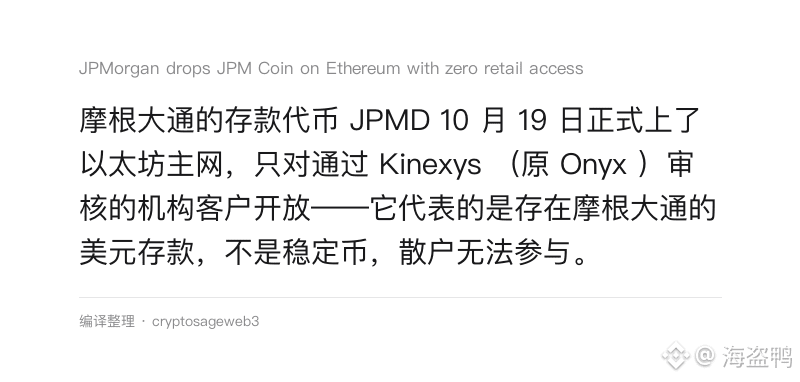
JPMorgan’s deposit token, JPMD, officially went live on the Ethereum mainnet on October 19. It’s available only to institutional clients approved by Kinexys (formerly Onyx). It represents U.S. dollar deposits held at JPMorgan—not a stablecoin—and retail investors can’t participate.
Its purpose is clear: 24/7 peer-to-peer settlement, clearing and collateral for on-chain payments and tokenized assets. The official reason for choosing Ethereum was straightforward: liquidity. According to DefiLlama, around $50 billion is locked in Ethereum applications. Kinexys has processed more than $4 trillion in total, with an average of about $7 billion a day.
But set that figure against JPMorgan’s overall payments business, which handles $12 trillion a day, and it’s just a drop in the bucket. So I think the significance of this move is greater than its transaction volume: Wall Street isn’t here to speculate on crypto—it’s moving the wholesale settlement layer for the dollar onto a public blockchain.
The real question is this: Ethereum ETFs are seeing net outflows this week, while on-chain institutional settlement is growing. Which trend do you trust more? Will $ETH reclaim 2,400 first, or test 2,200 again?
64
·
--
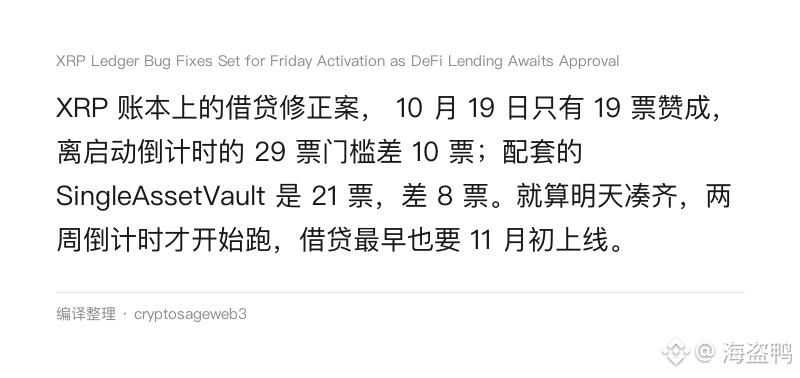
The lending amendment on the XRP Ledger had only 19 votes in favor on October 19, 10 short of the 29-vote threshold needed to start the activation countdown. The accompanying SingleAssetVault amendment had 21 votes, 8 short. Even if they get enough votes tomorrow, the two-week countdown will only just begin, so lending won’t launch until early November at the earliest.
Another proposal is easier to overlook: fixCleanup3_4_0, a bundle of bug fixes, has exactly 29 votes, right on the 80% threshold, and is expected to activate on October 23. It fixes a vulnerability related to PaymentBurn: in certain circumstances, accounts authorized only to destroy tokens could instead create them out of thin air. It also adjusts vault rounding and rules for overdue defaults. Note that this patch does not enable lending.
I’m inclined to think patching first and enabling lending afterward is the right call, but it also exposes a weak spot: the new lending system doesn’t require collateral, creditworthiness is assessed off-chain, and there’s no automatic on-chain liquidation. Risk controls are off-chain; the risk is on-chain.
$XRP Are you waiting until it actually activates in November to get in, or getting in early?
72
·
--
Switzerland’s FINMA approved the country’s first spot Bitcoin ETF aimed at retail investors today.
Two details are worth picking apart: first, it received an exemption from diversification requirements, so the fund holds only Bitcoin, on the grounds that the asset has a sufficiently long trading history. Second, it falls under the framework of the Collective Investment Schemes Act. If the manager goes bankrupt, the fund’s assets are not considered part of the bankruptcy estate—a higher level of legal protection than collateralized ETPs on SIX.
Switzerland approved a fund with crypto exposure in 2021, but it was open only to qualified investors and held a basket of coins. This time, it’s open to the retail public and buys only BTC.
My take: this is a regulatory catch-up, not a new engine for capital inflows. Switzerland’s retail market isn’t big enough to drive marginal buying. The real significance is that it sets a precedent for other European regulators: a single-asset fund can also be exempt from diversification requirements. FINMA also warned that investors could lose a substantial portion of their principal.
Will European capital follow the U.S. and become the next source of marginal buying? Are you trading $BTC directly, or buying this kind of fund wrapper with asset segregation?
#SwitzerlandApprovesFirstBitcoinETF
1
·
--
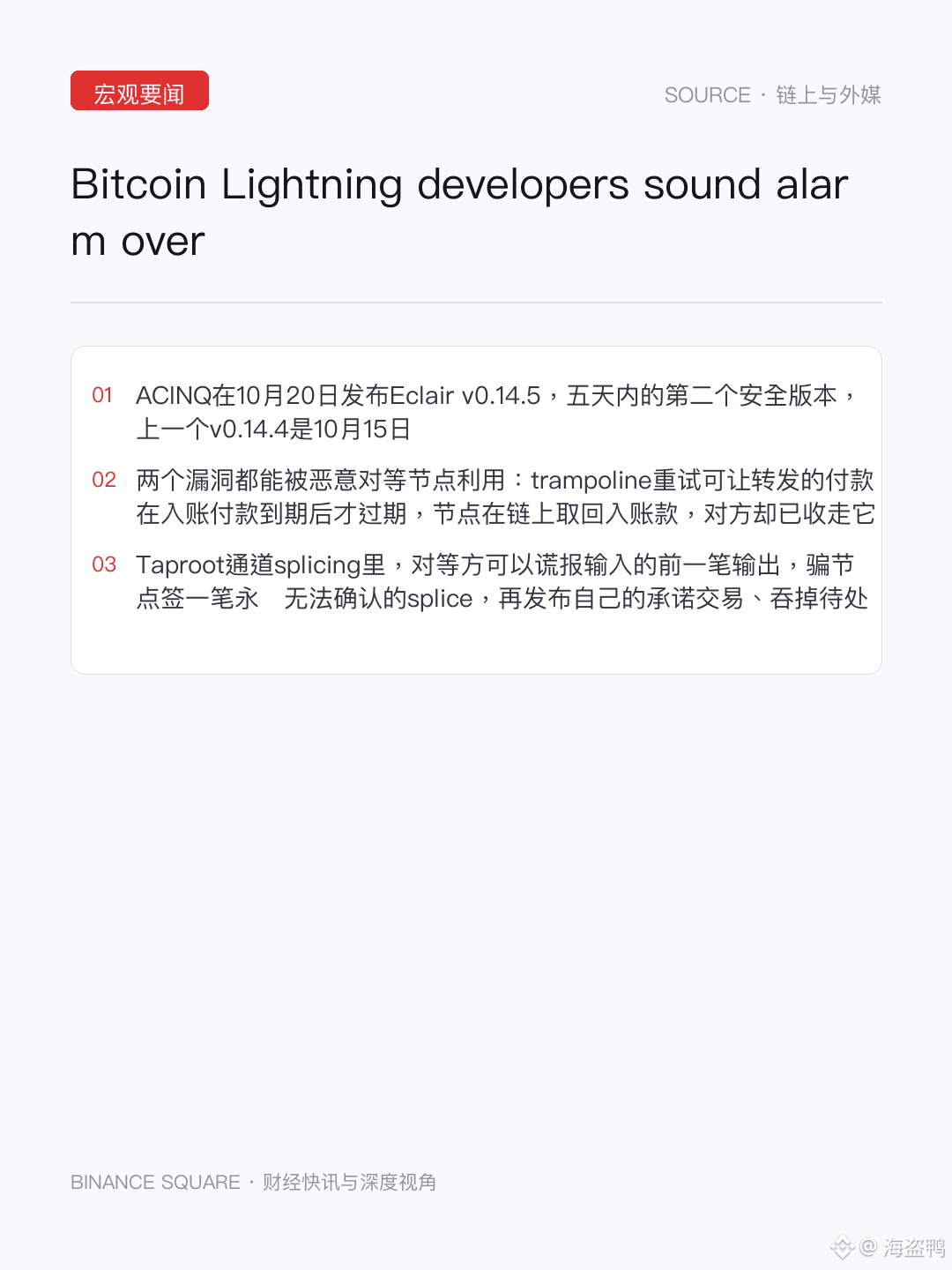
ACINQ released Eclair v0.14.5 on October 20, its second security release in five days; the previous version, v0.14.4, came out on October 15. Both vulnerabilities could be exploited by malicious peers: trampoline retries could cause a forwarded payment to expire only after the incoming payment had expired, letting the node reclaim the incoming funds on-chain while the peer had already claimed the outgoing funds; in Taproot channel splicing, a peer could lie about the previous output of an input, tricking the node into signing a splice that could never confirm, then broadcast its own commitment transaction and steal pending payments.
Upgrading doesn’t require closing existing channels, but the announcement didn’t provide the full range of affected versions or severity ratings, and only said that “no exploitation has been observed.”
My take: the real risk in Lightning is operational—it shifts the responsibility for security onto you. The $BTC main chain is fine, but you have to patch your own node.
When did you last patch your node?
4
·
--
South Korea’s latest regulatory crackdown isn’t about “controlling crypto”—it was prompted by a leak of 100,000 customer records. If you understand what’s going on, there’s one very specific thing you should do tonight.
On October 14, South Korea’s Financial Services Commission (FSC) proposed a cybersecurity reform plan. The incident involved 16 financial companies, including four commercial banks (among them Shinhan and KB Kookmin), four savings banks, and two crypto service providers. The leaked information included names, phone numbers, email addresses, and resident registration numbers. Note that account passwords and card numbers have not been confirmed as leaked. After reviewing a 12-point checklist for 555 financial companies, the FSC found that 130 had deficiencies requiring correction. Common issues included outdated security software, weak monitoring, and a lack of multifactor authentication for critical systems.
There are three key aspects of the reform to remember: assessments of vulnerabilities at large institutions will increase from once a year to at least twice a year; an AI-based threat monitoring framework will be established to counter AI-powered attacks; and executive accountability will be strengthened, with additional inspections permitted in response to urgent threats, beyond the regular assessments. The FSC secretary-general said financial institutions had “repeatedly received warnings but still failed to comply with basic requirements.” The final implementation date has not yet been announced.
My take: The real damage from incidents like this isn’t that “money is stolen on the spot.” It’s that identity data becomes long-term ammunition for phishing. A name, phone number, and resident registration number are enough to create fake messages convincing enough to fool people. So the most effective action for users isn’t switching platforms—it’s replacing SMS verification codes with app-based authenticator codes or a hardware security key. Against SIM hijacking, SMS verification codes offer almost no protection.
A reminder: South Korea is also cracking down on unregistered overseas platforms. Users of these platforms may face restrictions on withdrawals, and moving assets in a panic is itself a risk.
One specific question: Does your account currently use SMS verification codes or a hardware security key? If it’s the former, when do you plan to switch?
#SouthKoreaPlansTighterFinancialCybersecurityRules

1
·
--
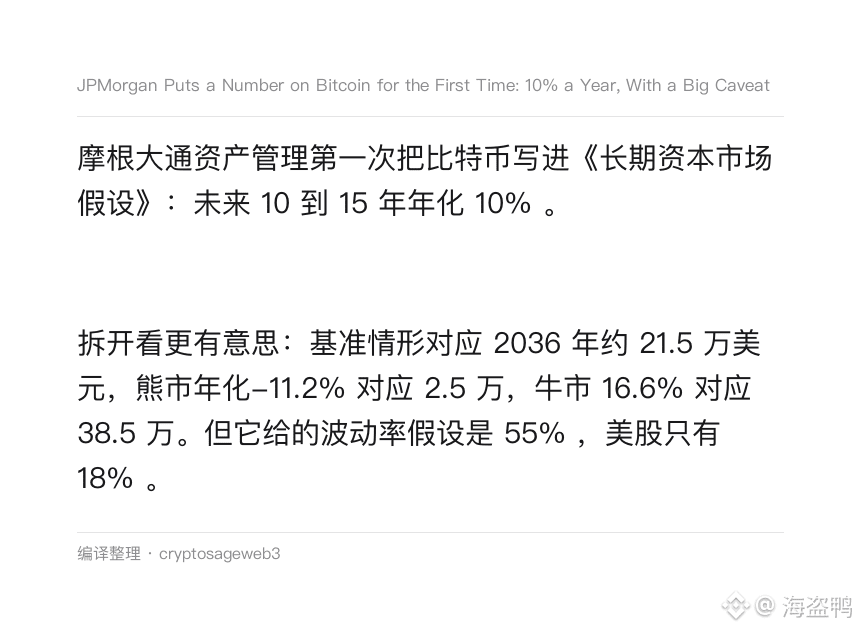
JPMorgan Asset Management has included Bitcoin in its Long-Term Capital Market Assumptions for the first time: 10% annualized returns over the next 10 to 15 years.
The breakdown is even more interesting: the base case puts Bitcoin at around $215,000 by 2036; the bear case, with annualized returns of -11.2%, puts it at $25,000; and the bull case, with returns of 16.6%, puts it at $385,000. But its assumed volatility is 55%, compared with just 18% for US stocks.
For comparison, the figures are 7.5% for US large-cap stocks, 5.5% for gold, and 7% for a 60/40 portfolio. Bitcoin offers the highest returns, at the cost of three times the volatility.
Most importantly, Bitcoin isn’t included in core strategic allocations—the volatility is too high, and its correlation is unstable.
My take: 10% seems conservative. It implies Bitcoin will be just a high-volatility substitute for large-cap stocks over the long term, not digital gold.
$BTC is now around $83,000. Can a 10% annualized return over ten years justify this price? Would you add to your position at the bear-case level, or sit back and watch?
#JPMorganForecastsBitcoinToLeadOverTheNextDecade
6
·
--
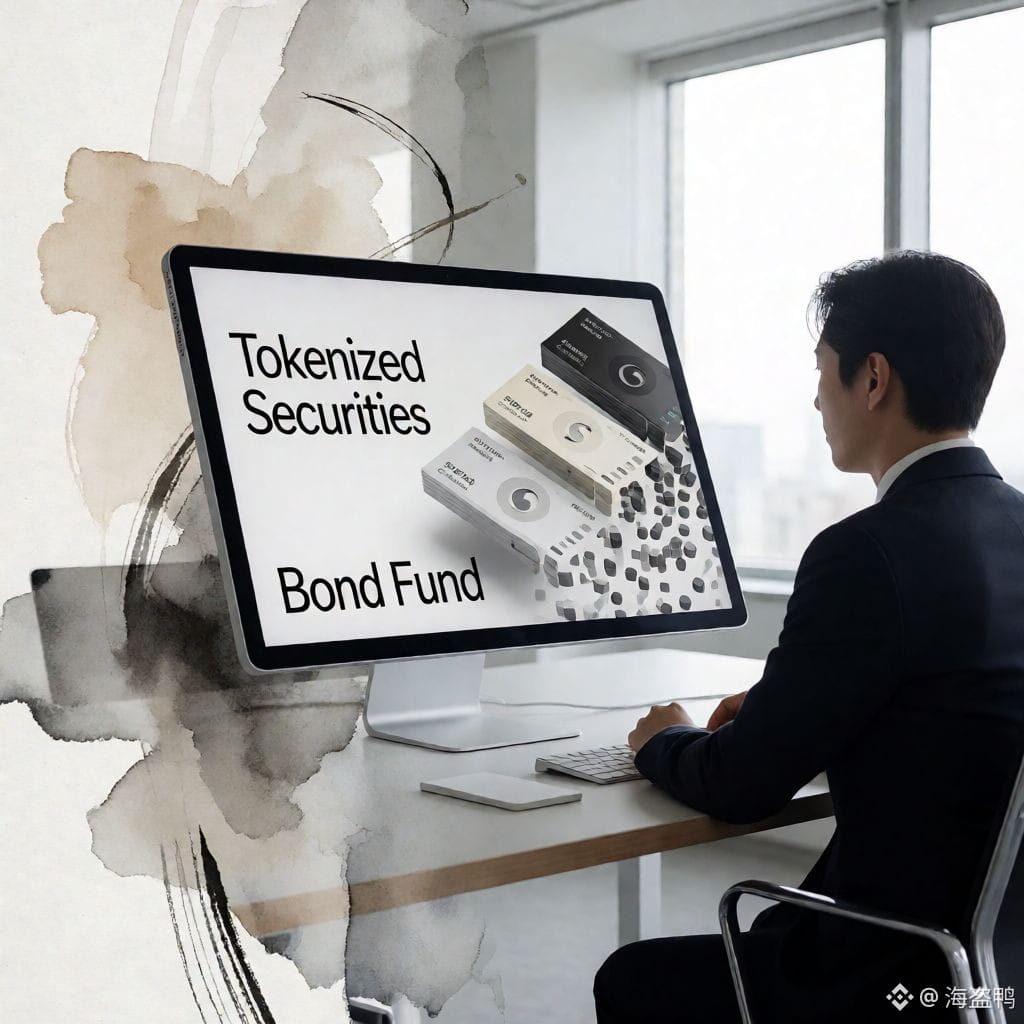
South Korea is moving tokenized securities beyond “fractional investing” and into the mainstream securities market. Proposed revisions to subordinate regulations under the Electronic Securities Act and the Capital Markets Act, advanced by the Financial Services Commission, have entered the legislative notice period (from the 2nd of this month to the 11th of next month). Under the current plan, the accompanying laws will take effect on February 4, 2027, and explicitly define stocks, bonds, and funds as eligible for tokenization.
The most notable feature of the framework is its phased approach. Phase 1, which begins when the laws take effect, is limited to institutional investors: private money market funds, private corporate bonds, and trust-based tokenization of unlisted stocks, alongside a small-scale pilot for publicly offered fractional investment securities. Phase 2 will gradually open up publicly offered securities after evaluating operational stability, efficiency, and demand. Only in Phase 3 will regulators explore integration with payment instruments such as stablecoins, paving the way for on-chain settlement infrastructure. The sequence itself is the answer: lawmakers see the bottleneck not in issuance technology, but in payments and settlement.
The regulatory boundaries are also carefully drawn. Ordinary investors will be capped at net annual purchases of KRW 100 million per over-the-counter trading platform. Non-financial institutions may manage investor accounts as “issuer account management institutions” if they meet requirements including KRW 4 billion in equity capital. And there will be no separate license for tokenized securities: securities firms and over-the-counter exchanges that are already licensed can operate under their existing licenses. The market is already moving: 12 brokerages are jointly advancing the issuance platform “KoSTO,” while several others are preparing their own systems, drawing on models such as Hong Kong’s digital bonds, Japan’s tokenized corporate bonds, and U.S. tokenized funds.
My view is that South Korea has chosen a cautious path: “bonds and funds before stocks, institutions before retail investors, and private offerings before public offerings.” Bonds are easier to price and have more predictable cash flows, making them suitable for first testing the reliability of on-chain registration and settlement; purchase limits will help contain risks for retail investors. This also means there is unlikely to be explosive growth in the short term. The real wildcard is whether stablecoin payments can be integrated in Phase 3. For the sector, the issuance and settlement of these RWA assets are still concentrated on Ethereum and its ecosystem, making $ETH an unavoidable asset to watch.
The question for you: Which will scale faster—the South Korean model of gradual, regulated expansion, or the U.S. market-driven issuance approach? When RWA activity really takes off, are you betting on public-chain settlement layers or licensed issuers?
#SouthKoreaProposesExpandingTokenizedSecuritiesToBondsAndFunds
14
·
--
This time, the problem wasn’t with Ledger’s servers. The device had been tampered with before it ever reached the user.
An investigation disclosed on October 9 found that a Ledger user who bought their device through Southeast Asian reseller CryptoBilis reported having their assets stolen. Independent investigators estimate that the amount involved could exceed $93 million. After taking the device apart, they found that at least one unit had been implanted with an unauthorized hardware module. It could read the 24-word recovery phrase as it appeared on the screen during device setup, then send it directly to the attackers through an LTE (eSIM) module. On October 13, Ledger asked resellers in seven markets—Indonesia, Singapore, Thailand, the Philippines, Vietnam, Malaysia, and Hong Kong—to suspend sales and pull their products from shelves. This was a clear expansion from its earlier warning, which named just one reseller.
Why is this worth thinking about carefully? Because the entire trust model of a hardware wallet rests on the assumption that “the private key never leaves the chip.” But this attack didn’t bypass cryptography; it exploited the supply chain: a third-party piece of hardware was inserted between the screen and the secure chip. Firmware signatures and open-source verification can’t stop it—it’s physically there, disguised as part of the factory-fresh device. Ledger stressed that its infrastructure, systems, and direct sales channels were not compromised. The problem was limited to third-party resale in specific regions, and the company has not verified any cases of theft involving devices bought elsewhere.
My take: a hardware wallet’s security boundary has never really been inside the chip. It’s the question of “where did you get it?” A cold wallet moves the attack surface from online to shipping and retail shelves—and that’s precisely the layer that’s hardest to audit. After all, all of someone’s $BTC and mainstream assets often sit inside a piece of metal no bigger than the palm of your hand. Two things remain to be seen: where in the distribution chain the tampering happened, and who carried it out; and whether Ledger Donjon’s analysis of recovered devices will uncover more affected batches.
So the question ultimately comes down to each crypto holder: would you rather save a few dollars and get your device sooner by buying from a local reseller, or wait for direct shipping from the official website and check the tamper-evident packaging yourself?
#Ledger asks resellers in Southeast Asia and Hong Kong to suspend sales

3
·
--
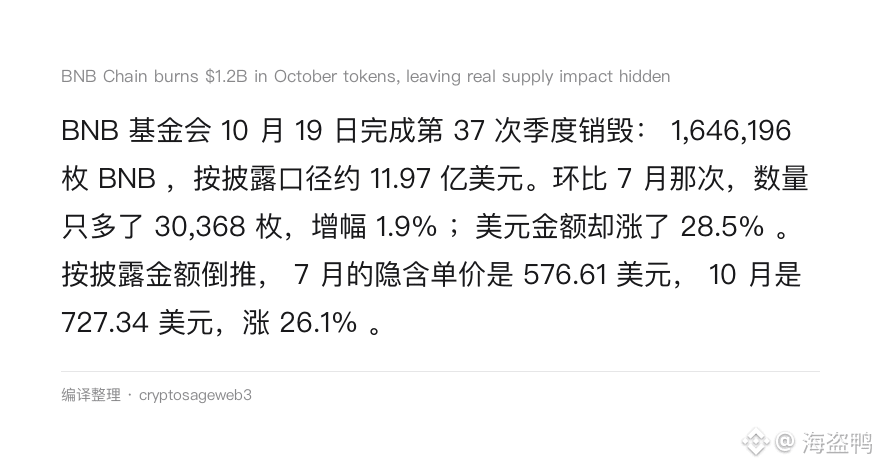
The BNB Foundation completed its 37th quarterly burn on October 19: 1,646,196 BNB, worth approximately $1.197 billion based on the disclosed figure. Compared with the burn in July, the amount was up by just 30,368 BNB, or 1.9%, while its dollar value rose 28.5%. Working backward from the disclosed values, the implied price per BNB was $576.61 in July and $727.34 in October, up 26.1%.
In other words, in this “$1.2 billion burn,” the number of coins burned didn’t increase by much—the valuation per coin did. The remaining total supply is about 131.5 million, with a target of 100 million. Auto-Burn is calculated based on price and blocks produced, so the higher the coin price, the fewer coins are burned for the same dollar amount.
My take: burn announcements are a narrative, not supply and demand. Treating every “another billion-plus burned” headline as bullish news feels more like self-reassurance based on dollar values. If you really want to track deflation, watch the coin-count trend and the remaining 131.5 million.
Question: Would you chase $BNB ’s quarterly burn as bullish news, or do you think it’s already priced in and would rather wait for a pullback?
2
·
--
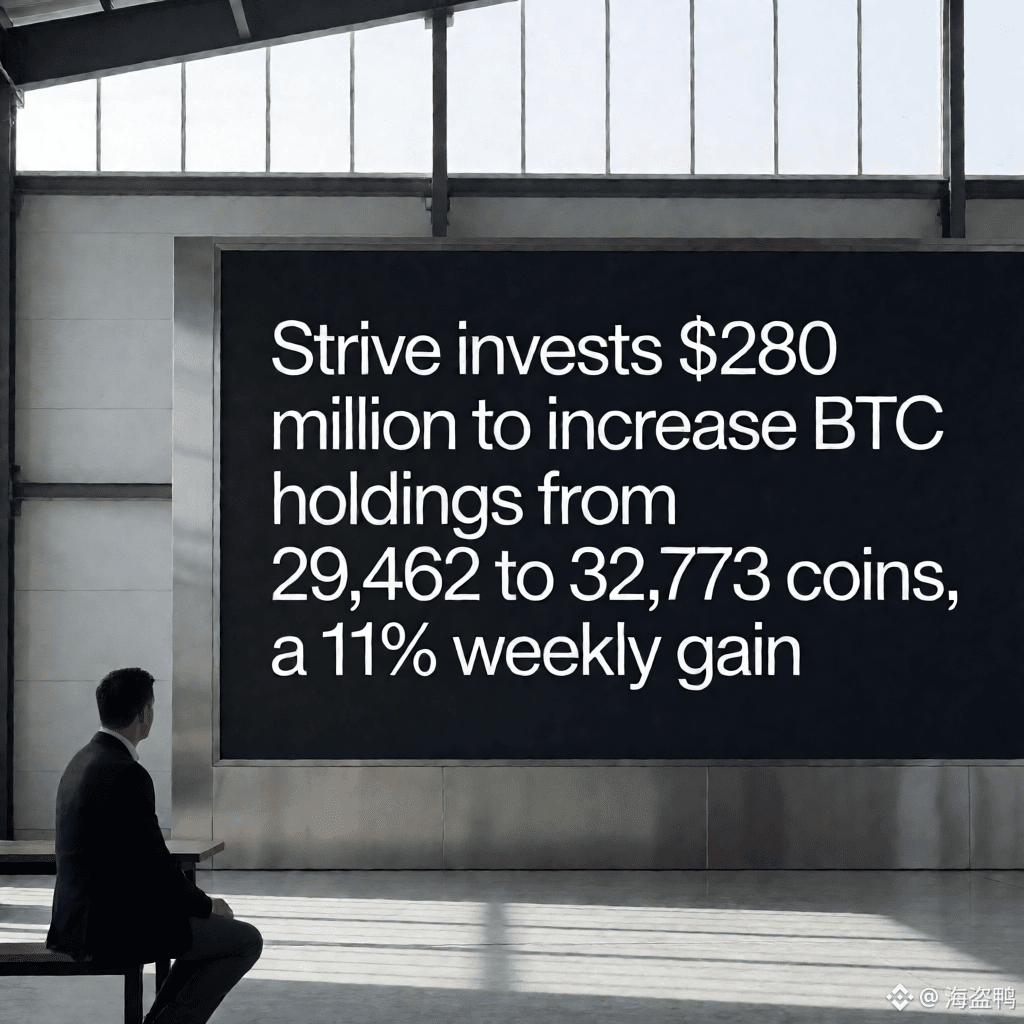
Strive (ASST) added 3,311 bitcoins to its balance sheet this week at an average price of about $84,500, for a total of roughly $280 million. Its holdings rose from 29,462 to 32,773 BTC, an 11.2% increase in a single week. It ranks fifth among U.S.-listed companies holding Bitcoin, behind Strategy, Metaplanet, Twenty One Capital, and MARA.
What really matters isn’t how much it bought, but where the money came from. Strive is taking the route of zero interest-bearing debt and high-yield perpetual preferred stock: its Series A Perpetual Preferred Stock, SATS, carries a fixed annual dividend of 15% and has a fundraising target of about $500 million. At the same time, warrants worth about $208 million were exercised, and another roughly 15.3 million warrants are nearing their expiration date. The company also put the $100 minimum offering price for its Series A Perpetual Preferred Stock, SATA, into its governance documents, making it a binding term. That reassures preferred stockholders, but also locks in a floor for future financing.
I’m inclined to think this is the sharpest, but also most fragile, link among all the “Bitcoin treasury stocks.” A 15% preferred stock dividend is a fixed cash expense, while Bitcoin generates no cash flow. In other words, even if Bitcoin’s price doesn’t fall at all, a long enough sideways market could bring dividend pressure before any losses show up on the balance sheet, forcing the company to issue shares or sell coins at an unfavorable price. Strategy relies on low-cost convertible debt, Metaplanet benefits from a domestic retail investor premium, while Strive has chosen the most expensive source of capital.
One more detail: in less than two months, it bought a total of 11,417 BTC at an average price of about $82,281. The $84,500 price for this latest purchase is higher—it’s accelerating its buying as prices rise, rather than buying the dip.
Keep an eye on three things: whether SATS can raise the full $500 million; the extent of dilution after the warrants are exercised; and what will cover that 15% dividend if $BTC stays around $80,000 through year-end.
Would you rather hold $BTC directly, or a Bitcoin treasury stock with amplified exposure like this?
#StriveSpends280MillionToAdd3311BTC
29
·
--
Zcash rose 8.5% in a day to $1,215.85, pushing its market cap above $20.57 billion and lifting privacy coins—Monero is up 15.29% over the past seven days.
But there’s a detail in the same data: ZEC is still down about 25% over the past month, and its cumulative gain over seven days is just 1.17%. The 8.5% daily jump looks more like a leveraged unwind after oversold conditions than a trend reversal.
The reasons are straightforward: after a steep sell-off, liquidation pressure eased, and expectations for the NU7 upgrade added to the momentum. A high-beta asset like ZEC was naturally bound to bounce harder than the broader market. Over the same period, Bitcoin rose just 1.57% to $83,195, while the total crypto market cap stood at $2.78 trillion.
My take is that chasing high-beta assets in this environment offers the worst risk-reward. Brent crude is nearing $110, the 10-year Treasury yield is still above 5%, and the Fed meets on October 27–28—if any one of these factors turns sour, recently rebounding coins will be among the first to get hit.
With $BTC still not holding above $84,000, would you chase a coin like $ZEC after an 8% intraday bounce?
34
·
--
Evernorth has completed its merger with Armada Acquisition Corp. II, placing about 473 million XRP into a Nasdaq-listed company trading under the ticker XRPN. This isn’t just another crypto-hoarding company going public: for the first time, $XRP has a publicly traded vehicle whose “XRP per share” can be priced.
Let’s pin down the facts: the merger and associated private placement raised more than $1 billion in total (other reports put cash at around $300 million at closing; the difference depends on whether committed subscriptions are included). The company is led by Asheesh Birla and backed by Ripple, SBI, Pantera, GSR, and others. In September, it also secured a $30 million convertible note from NH Investment. Its strategy is an actively managed treasury: put XRP to work in the ecosystem, DeFi yield, tokenized assets, and on-chain settlement, with the goal of increasing the amount of XRP per share over time.
My take: the significance isn’t that “there’s another SPAC,” but that there’s a new valuation anchor. The premium on digital-asset treasuries is a double-edged sword: in a bull market, it can add leverage to the token price; in a downturn, a discount can erode confidence in turn. Companies are also often forced to sell tokens to buy back shares or take on more leverage, amplifying the cycle. The key question for $XRP isn’t whether there are buyers for its treasury, but whether this buyer can keep buying and withstand the lows.
Three things to watch next: the per-share figure in its first holdings disclosure; whether it actually uses XRP to generate on-chain yield rather than letting it sit idle; and whether the XRPL ecosystem can put this capital to work. Do you think a treasury company gives $XRP a second engine, or just moves crypto-market volatility into the stock market?
#XRP Treasury Company Evernorth Completes SPAC Merger
XRP-0,22%
XRPNUS-0,30%
50
·
--
A joint letter submitted to the SEC on October 20 by six organizations—Chainlink Labs, the Cardano Foundation, Hedera, Aptos Labs, Ava Labs, and Stellar—makes a very specific request: move the definition of “digital commodities” and the conclusion that they are “not securities” from the preamble into the binding text of the rules.
Background: The SEC and CFTC’s joint guidance issued on March 17, 2026, already classified $LINK, $ADA, HBAR, APT, AVAX, and XLM as digital commodities, but only in the explanatory section. As a result, exchanges and market makers still don’t dare price them as “non-securities.” The letter also calls for a presumption in favor of secondary-market resales and for the safe harbor to be voluntary.
My take: This isn’t a technical detail—it’s about making the “compliance discount” something that can be priced in. Only when the definition is written into the rules themselves will institutions and market makers feel confident enough to increase their positions.
Will the SEC ultimately copy it verbatim? Which would you bet on first: $LINK or $ADA ?
A joint letter submitted to the SEC on October 20 by six organizations—Chainlink Labs, the Cardano Foundation, Hedera, Aptos Labs, Ava Labs, and Stellar—makes a very specific request: move the definition of “digital commodities” and the conclusion that they are “not securities” from the preamble into the binding text of the rules.
Background: The SEC and CFTC’s joint guidance issued on March 17, 2026, already classified $LINK , $ADA , HBAR, APT, AVAX, and XLM as digital commodities, but only in the explanatory section. As a result, exchanges and market makers still don’t dare price them as “non-securities.” The letter also calls for a presumption in favor of secondary-market resales and for the safe harbor to be voluntary.
My take: This isn’t a technical detail—it’s about making the “compliance discount” something that can be priced in. Only when the definition is written into the rules themselves will institutions and market makers feel confident enough to increase their positions.
Will the SEC ultimately copy it verbatim? Which would you bet on first: $LINK or $ADA ?

75
·
--
The Sui Foundation has put up $30 million (about 43 billion Korean won) to invest in AI training data protocol DATA Network, becoming its largest institutional holder alongside PIP Labs and the DATA Foundation. More noteworthy than the amount is the structure of the deal: this isn’t a financial investment, but a “chain merger.”
According to the disclosed plan, DATA Network will upgrade into a protocol running natively on Sui, and its independent blockchain will be retired. DATA tokens will migrate to Sui at a 1:1 ratio, while investors’ economic and governance rights are preserved during the transition, and their lockup and vesting terms remain unchanged. Walrus, an on-chain storage platform, will become the default storage layer for applications operated by the DATA Foundation: Walrus will handle encrypted storage of original files and access permissions, while Trace records data provenance and usage rights. The old network will continue operating until the transition is complete, with a timeline to be announced by the Sui Foundation.
Why now? The AI industry has more or less exhausted the content available on the open internet. The next bottleneck is datasets that are “consented to and verifiable in origin”—precisely what Trace is working to address. Public data shows that Trace has recorded more than 250 million data contributions since launch, processing over 3 million provenance-proof receipts per day. Kled, a data marketplace connected to it, has processed more than 1.5 billion data registrations. Only this June, the DATA Foundation shifted its focus from general-purpose intellectual property infrastructure to AI training data—a pragmatic direction.
I’m inclined to think this money is buying a strategic foothold, not a protocol: make “data authorization and proof of provenance” verifiable credentials on-chain. Once frontier AI labs are pushed by compliance requirements to provide provenance, the Sui ecosystem will have a way to monetize it. The risks are just as clear: DATA’s token economics will be closely tied to Sui, and demand for Walrus storage will also depend on usage by applications like DATA. That concentration of reliance could magnify the risks. Also, DATA Network co-founder Lee Seung-yoon has joined the Sui Foundation as a strategic advisor. Moving talent and assets together is usually a sign of a deep integration.
So here’s the question: Could “proof of provenance” for AI data become essential infrastructure in the next layer of the stack? Which do you favor: a combination like $SUI’s “public blockchain + storage + data authorization,” or a standalone data protocol?
#SuiFoundation invests $30 million in DATANetwork
The Sui Foundation has put up $30 million (about 43 billion Korean won) to invest in AI training data protocol DATA Network, becoming its largest institutional holder alongside PIP Labs and the DATA Foundation. More noteworthy than the amount is the structure of the deal: this isn’t a financial investment, but a “chain merger.”
According to the disclosed plan, DATA Network will upgrade into a protocol running natively on Sui, and its independent blockchain will be retired. DATA tokens will migrate to Sui at a 1:1 ratio, while investors’ economic and governance rights are preserved during the transition, and their lockup and vesting terms remain unchanged. Walrus, an on-chain storage platform, will become the default storage layer for applications operated by the DATA Foundation: Walrus will handle encrypted storage of original files and access permissions, while Trace records data provenance and usage rights. The old network will continue operating until the transition is complete, with a timeline to be announced by the Sui Foundation.
Why now? The AI industry has more or less exhausted the content available on the open internet. The next bottleneck is datasets that are “consented to and verifiable in origin”—precisely what Trace is working to address. Public data shows that Trace has recorded more than 250 million data contributions since launch, processing over 3 million provenance-proof receipts per day. Kled, a data marketplace connected to it, has processed more than 1.5 billion data registrations. Only this June, the DATA Foundation shifted its focus from general-purpose intellectual property infrastructure to AI training data—a pragmatic direction.
I’m inclined to think this money is buying a strategic foothold, not a protocol: make “data authorization and proof of provenance” verifiable credentials on-chain. Once frontier AI labs are pushed by compliance requirements to provide provenance, the Sui ecosystem will have a way to monetize it. The risks are just as clear: DATA’s token economics will be closely tied to Sui, and demand for Walrus storage will also depend on usage by applications like DATA. That concentration of reliance could magnify the risks. Also, DATA Network co-founder Lee Seung-yoon has joined the Sui Foundation as a strategic advisor. Moving talent and assets together is usually a sign of a deep integration.
So here’s the question: Could “proof of provenance” for AI data become essential infrastructure in the next layer of the stack? Which do you favor: a combination like $SUI ’s “public blockchain + storage + data authorization,” or a standalone data protocol?
#SuiFoundation invests $30 million in DATANetwork

86
·
--
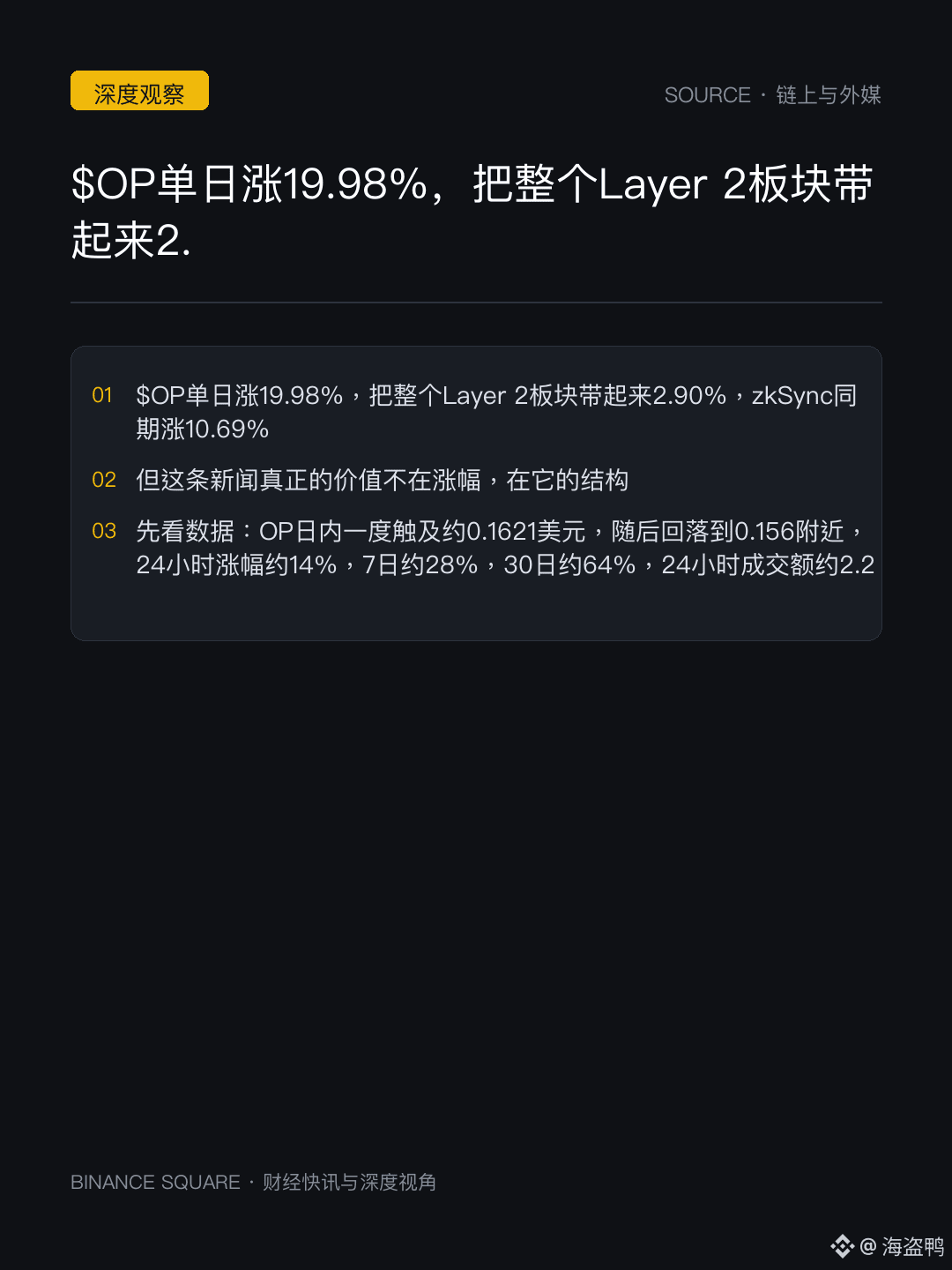
$OP jumped 19.98% in a single day, lifting the entire Layer 2 sector by 2.90%. zkSync rose 10.69% over the same period. But the real significance of this news isn’t the size of the gains—it’s the structure behind them.
First, the numbers: OP briefly touched around $0.1621 intraday before retreating to near $0.156. It was up about 14% over 24 hours, 28% over 7 days, and 64% over 30 days. Its 24-hour trading volume was about $226 million, more than double the previous day’s. At the same time, it remains about 68% below its level a year ago—this is a rebound from a deep trough, not confirmation of a trend.
There are two layers to the drivers. On the surface, Uniswap announced on October 9 that it would hand over Unichain’s production operations to OP Enterprise. The testnet migration is scheduled for October 13 and the mainnet migration for October 29. OP will handle the sequencer, RPC, monitoring, and incident response, while Unichain’s chain ID, contracts, and balances will remain unchanged. This means OP is moving from being a “technology vendor” to a “custodian collecting ongoing operational fees,” adding a revenue stream that doesn’t depend on launching a new chain.
At a deeper level, Upgrade 20 was approved: it authorizes using 50% of Superchain net sequencer revenue to buy back OP. This matters far more than the migration itself—the migration turns someone else’s chain into a source of revenue, while buybacks turn that revenue into demand for the token. For a token like $OP, which has long been criticized for “lacking value capture,” this is the first time protocol revenue has been directly linked to the token price.
But the timeline is a major drawback: buybacks aren’t expected to begin until February 2027, leaving a gap of more than a year. Until then, any price gains will still be driven by expectations. Competition among L2s hasn’t become any less intense, either. Sequencer revenue depends on on-chain activity, and OP doesn’t control that activity on its own.
My take: this is positive because it changes the source of revenue, not because it marks a fundamental turning point. If you want to track it, watch two things: whether the mainnet migration goes ahead as scheduled on October 29, and whether Superchain sequencer revenue is actually growing—not just the token price.
One additional point: L2 fees are ultimately settled in $ETH, so OP’s strength is marginally positive for $ETH. But the price drivers of the two have clearly decoupled.
I’ll leave you with a question: Is this OP rally a one-day short squeeze, or the start of L2 tokens being repriced?
#OP token up 19.98% today
$OP jumped 19.98% in a single day, lifting the entire Layer 2 sector by 2.90%. zkSync rose 10.69% over the same period. But the real significance of this news isn’t the size of the gains—it’s the structure behind them.
First, the numbers: OP briefly touched around $0.1621 intraday before retreating to near $0.156. It was up about 14% over 24 hours, 28% over 7 days, and 64% over 30 days. Its 24-hour trading volume was about $226 million, more than double the previous day’s. At the same time, it remains about 68% below its level a year ago—this is a rebound from a deep trough, not confirmation of a trend.
There are two layers to the drivers. On the surface, Uniswap announced on October 9 that it would hand over Unichain’s production operations to OP Enterprise. The testnet migration is scheduled for October 13 and the mainnet migration for October 29. OP will handle the sequencer, RPC, monitoring, and incident response, while Unichain’s chain ID, contracts, and balances will remain unchanged. This means OP is moving from being a “technology vendor” to a “custodian collecting ongoing operational fees,” adding a revenue stream that doesn’t depend on launching a new chain.
At a deeper level, Upgrade 20 was approved: it authorizes using 50% of Superchain net sequencer revenue to buy back OP. This matters far more than the migration itself—the migration turns someone else’s chain into a source of revenue, while buybacks turn that revenue into demand for the token. For a token like $OP , which has long been criticized for “lacking value capture,” this is the first time protocol revenue has been directly linked to the token price.
But the timeline is a major drawback: buybacks aren’t expected to begin until February 2027, leaving a gap of more than a year. Until then, any price gains will still be driven by expectations. Competition among L2s hasn’t become any less intense, either. Sequencer revenue depends on on-chain activity, and OP doesn’t control that activity on its own.
My take: this is positive because it changes the source of revenue, not because it marks a fundamental turning point. If you want to track it, watch two things: whether the mainnet migration goes ahead as scheduled on October 29, and whether Superchain sequencer revenue is actually growing—not just the token price.
One additional point: L2 fees are ultimately settled in $ETH , so OP’s strength is marginally positive for $ETH . But the price drivers of the two have clearly decoupled.
I’ll leave you with a question: Is this OP rally a one-day short squeeze, or the start of L2 tokens being repriced?
#OP token up 19.98% today
10
·
--
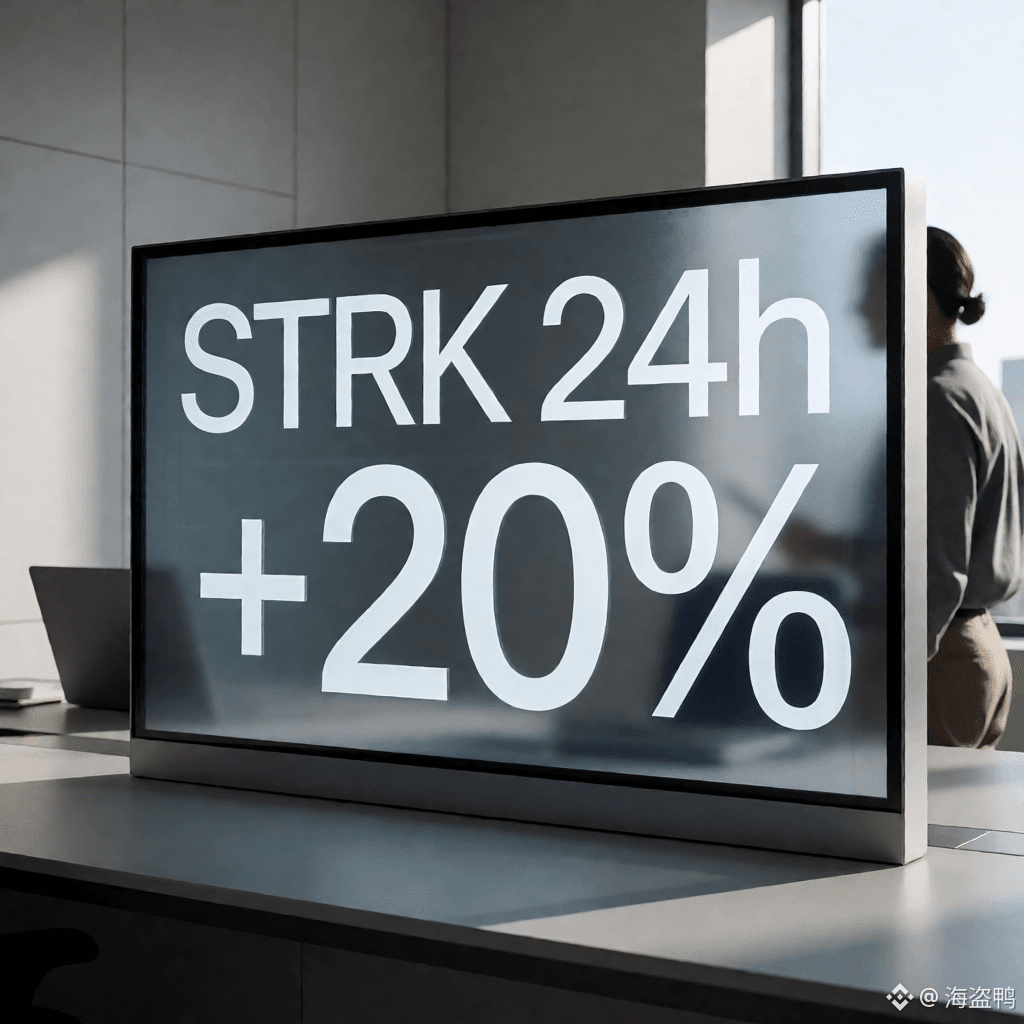
$STRK 24 hours rose about 20%, triggered by StarkWare CEO Eli Ben-Sasson saying Starknet is "actively considering" becoming a Layer 1, with the goal of becoming the first fully quantum-resistant network by 2027. Bulls and bears are actually betting on two completely different things.
Bulls are focused on value capture: as an L2, it currently relies on Ethereum for security, and its upgrade pace follows Ethereum's roadmap (core quantum-resistant infrastructure is reportedly not expected until around 2029). If it becomes an L1, $STRK could evolve from a governance and fee-discount token into a native gas and staking asset. What's more, STARK proofs are based on hashes rather than elliptic curves, and account abstraction lets wallets switch signature schemes without a hard fork. In August, the mainnet already processed experimental transfers using quantum-resistant signatures.
Bears point to three things: First, "actively considering" is not a proposal. There's no governance vote, no timeline, and not even a plan for how the bridge would migrate; 2027 is just a target. Second, the rally is being driven mainly by perpetual futures: futures volume is 4 to 5 times spot volume, open interest rose by more than 50% in 24 hours, and funding rates turned positive—leveraged rallies can reverse at any time. Third, the fundamentals are still far from justified: daily fee revenue is about $13,700 versus a market cap of around $500 million, about 127 million tokens unlock on October 15 (roughly 1.7% of the circulating supply), and the price is still down more than 90% from its all-time high.
I tend to think this move is a narrative-driven revaluation of a deeply discounted asset, combined with a short squeeze—not a trend reversal. What really needs to be verified isn't the token price, but whether a formal governance proposal emerges in the coming weeks and whether developers follow this L1 migration path. How much of a premium would you pay for a quantum-resistance promise for 2027—get in now, or wait for the proposal to land? $STRK
#STRK up about 20% in 24 hours
1
·
--
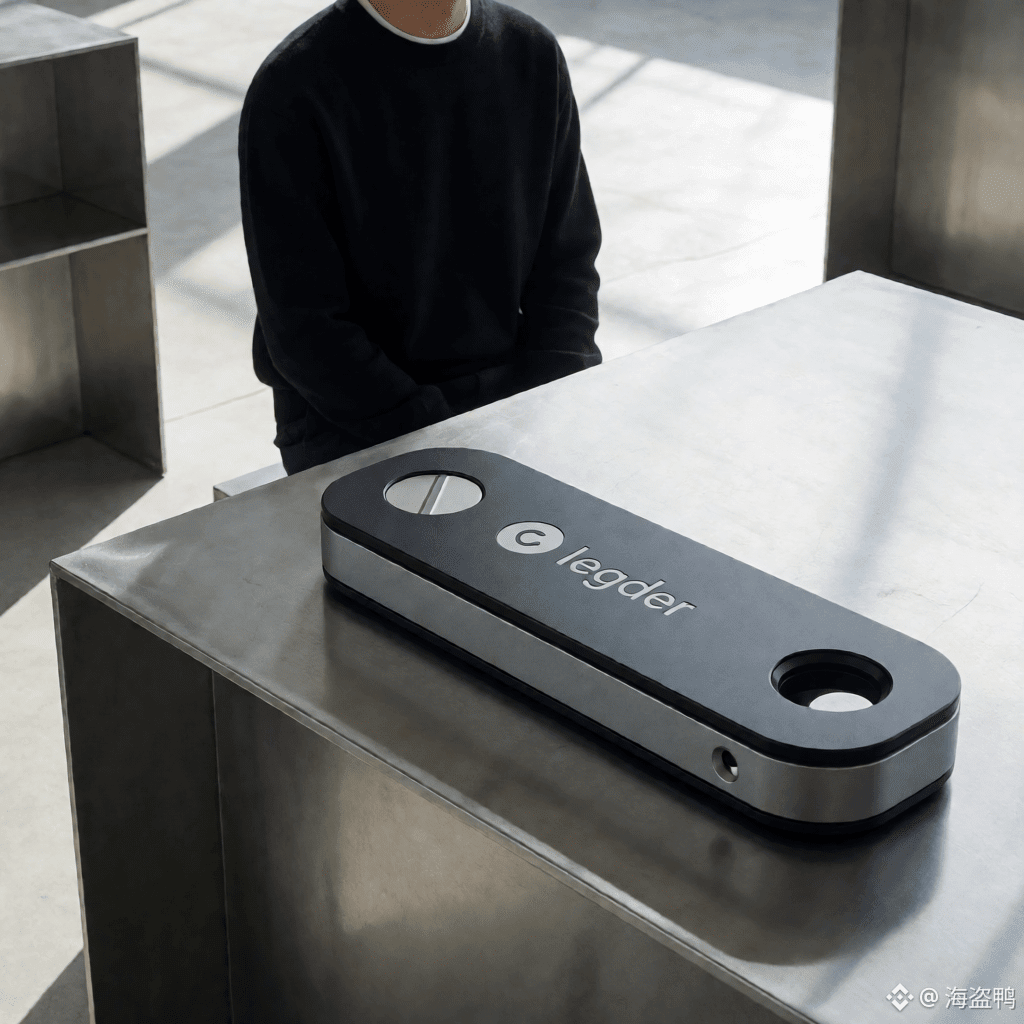
Ledger confirms: An unauthorized hardware implant was indeed found in an affected user’s device. What matters is this isn’t FUD—it’s the manufacturer’s own acknowledgment, and the evidence points to the supply chain, not a firmware hack.
The facts are clear: The incident came to light on October 9. The devices involved were traced to CryptoBilis, a Southeast Asian distributor that has suspended all sales and shipments of hardware wallets. Ledger says there is no indication that its own infrastructure, systems, or services were compromised. It is working with law enforcement and thanked SEAL_911 for helping with the investigation. Estimates of the losses vary: on-chain investigators put them at over $86 million, MistTrack says nearly $90 million, and Bitquery estimates about $92.9 million across 311 wallets. Ledger has not confirmed these figures, and investigators have not yet proven that the implant was the direct cause of the theft. Some reports say the modification may have been a tiny circuit board beneath the screen, possibly used to read its contents—but this, too, has not been officially confirmed.
Here’s what really stings: The whole promise of a hardware wallet is, “I trust this physical device, not the internet.” But when you buy from a third party, you’re trusting an entire supply chain you can’t see. Firmware can be verified with a signature; that little board soldered beneath the screen can’t.
Three practical steps. First, if you bought from CryptoBilis in the past 90 days and haven’t initialized the device, don’t turn it on—contact Ledger directly. Second, if you’ve already initialized it, the safest move is to create a wallet with a new recovery phrase on a brand-new device and then transfer your assets. Changing devices without changing the recovery phrase won’t help. Third, phishing is the biggest threat right now: fake websites are after your 24 words. The official company will never ask for your recovery phrase. And maybe it’s time to rethink keeping all your assets on one device and under one recovery phrase—including your $BTC and $ETH.
What would make you stop trusting a self-custody device—the supply chain in this case, or does the word “hardware” itself make you feel safe?
#LedgerConfirmsUnauthorizedHardwareImplantInUserDevice
Ledger confirms: An unauthorized hardware implant was indeed found in an affected user’s device. What matters is this isn’t FUD—it’s the manufacturer’s own acknowledgment, and the evidence points to the supply chain, not a firmware hack.
The facts are clear: The incident came to light on October 9. The devices involved were traced to CryptoBilis, a Southeast Asian distributor that has suspended all sales and shipments of hardware wallets. Ledger says there is no indication that its own infrastructure, systems, or services were compromised. It is working with law enforcement and thanked SEAL_911 for helping with the investigation. Estimates of the losses vary: on-chain investigators put them at over $86 million, MistTrack says nearly $90 million, and Bitquery estimates about $92.9 million across 311 wallets. Ledger has not confirmed these figures, and investigators have not yet proven that the implant was the direct cause of the theft. Some reports say the modification may have been a tiny circuit board beneath the screen, possibly used to read its contents—but this, too, has not been officially confirmed.
Here’s what really stings: The whole promise of a hardware wallet is, “I trust this physical device, not the internet.” But when you buy from a third party, you’re trusting an entire supply chain you can’t see. Firmware can be verified with a signature; that little board soldered beneath the screen can’t.
Three practical steps. First, if you bought from CryptoBilis in the past 90 days and haven’t initialized the device, don’t turn it on—contact Ledger directly. Second, if you’ve already initialized it, the safest move is to create a wallet with a new recovery phrase on a brand-new device and then transfer your assets. Changing devices without changing the recovery phrase won’t help. Third, phishing is the biggest threat right now: fake websites are after your 24 words. The official company will never ask for your recovery phrase. And maybe it’s time to rethink keeping all your assets on one device and under one recovery phrase—including your $BTC and $ETH .
What would make you stop trusting a self-custody device—the supply chain in this case, or does the word “hardware” itself make you feel safe?
#LedgerConfirmsUnauthorizedHardwareImplantInUserDevice
8
Log in to explore more content
Join global crypto users on Binance Square
⚡️ Get latest and useful information about crypto.
💬 Trusted by the world’s largest crypto exchange.
👍 Discover real insights from verified creators.
Email / Phone number