
Blockman PR - Marketing
904 Posts

Blockman PR - Marketing
Report
Block User
Entrust your press release distribution to us and experience the difference.
Follow us for the latest crypto PR insights, success stories, and industry news.
0 Following
1K Followers
496 Liked
Posts
Article
Onlend Unveils No-Code Infrastructure to Launch Custom Onchain Lending AppsBuilt by a team with experience scaling a leading DeFi lending protocol, Onlend aims to make it easier for fintechs, asset managers, curators, and asset issuers to build and operate their own lending products.
Onlend has publicly unveiled its decentralised infrastructure platform designed to let anyone create, launch, and operate their own onchain lending applications without building the underlying technology from scratch.
The project is entering a market with considerable room for expansion. Global debt surpassed $350 trillion in early 2026, according to the Institute of International Finance, while active loans across DeFi protocols currently stand at approximately $33 billion, according to DefiLlama. Although the figures measure different markets, they illustrate the relatively small scale of onchain lending today.
At the same time, the infrastructure supporting onchain financial activity continues to expand. The stablecoin market has grown beyond $300 billion, while the value of tokenized real-world assets has reached approximately $39 billion, creating new opportunities for lending products built around these assets.
However, launching such products remains challenging. Existing lending protocols offer established markets but can limit how teams configure and operate their lending use cases. Building custom infrastructure, meanwhile, requires significant engineering resources and development time.
Onlend addresses this gap with a permissionless, no-code platform that allows anyone to launch lending applications tailored to their own use-cases, users, and operational requirements.
Through Onlend, builders can configure supported assets (with multi-collateral and multi-borrow optionality), collateral parameters, interest-rate models, price oracles, liquidation mechanisms, fees, and administrative permissions. Applications can operate with open or restricted access, use a customizable white-label interface, and remain actively managed or operate under immutable rules.
One of its main technical differentiators is support for advanced interest-rate models beyond traditional utilization-based curves. These include fixed rates, rates linked to external benchmarks such as staking yields, and targeted rates for specific borrowers.
The flexibility opens several potential applications across financial services.
For fintechs and neobanks, Onlend provides a way to introduce collateral-backed borrowing directly into their existing consumer applications, adding lending functionality without developing the feature from the ground up, nor relying on rigid third-party protocols.
Asset managers and curators can create and manage lending markets aligned with their strategies, retain control over market configurations, and capture revenue through the markets they operate.
Tokenized real-world asset issuers can establish dedicated lending markets using their assets as collateral, while stablecoin issuers, liquid staking protocols, and other DeFi projects can develop lending products tailored to their ecosystems.
Designed for the emerging agentic economy, where AI agents can autonomously lend and borrow capital to finance their operations.
The approach differs from established lending protocols such as Aave, where introducing new assets into governed markets involves an approval process, and Morpho, which enables permissionless market creation but uses immutable market parameters. Onlend combines permissionless application creation with broader customization, ongoing management options, and branded interfaces.
Behind the project is a team with experience at Flowdesk, MEV Capital, and Folks Finance. Its members have previously helped scale the lending protocol to more than $400 million in peak total value locked and $13 billion in cumulative deposits volume.
With initial testnet deployments targeted for Q4 2026, Onlend is positioning itself as infrastructure for a new generation of lending applications, where teams can control their financial products rather than depend entirely on existing lending markets.
Onlend Unveils No-Code Infrastructure to Launch Custom Onchain Lending Apps
Built by a team with experience scaling a leading DeFi lending protocol, Onlend aims to make it easier for fintechs, asset managers, curators, and asset issuers to build and operate their own lending products.
Onlend has publicly unveiled its decentralised infrastructure platform designed to let anyone create, launch, and operate their own onchain lending applications without building the underlying technology from scratch.
The project is entering a market with considerable room for expansion. Global debt surpassed $350 trillion in early 2026, according to the Institute of International Finance, while active loans across DeFi protocols currently stand at approximately $33 billion, according to DefiLlama. Although the figures measure different markets, they illustrate the relatively small scale of onchain lending today.
At the same time, the infrastructure supporting onchain financial activity continues to expand. The stablecoin market has grown beyond $300 billion, while the value of tokenized real-world assets has reached approximately $39 billion, creating new opportunities for lending products built around these assets.
However, launching such products remains challenging. Existing lending protocols offer established markets but can limit how teams configure and operate their lending use cases. Building custom infrastructure, meanwhile, requires significant engineering resources and development time.
Onlend addresses this gap with a permissionless, no-code platform that allows anyone to launch lending applications tailored to their own use-cases, users, and operational requirements.
Through Onlend, builders can configure supported assets (with multi-collateral and multi-borrow optionality), collateral parameters, interest-rate models, price oracles, liquidation mechanisms, fees, and administrative permissions. Applications can operate with open or restricted access, use a customizable white-label interface, and remain actively managed or operate under immutable rules.
One of its main technical differentiators is support for advanced interest-rate models beyond traditional utilization-based curves. These include fixed rates, rates linked to external benchmarks such as staking yields, and targeted rates for specific borrowers.
The flexibility opens several potential applications across financial services.
For fintechs and neobanks, Onlend provides a way to introduce collateral-backed borrowing directly into their existing consumer applications, adding lending functionality without developing the feature from the ground up, nor relying on rigid third-party protocols.
Asset managers and curators can create and manage lending markets aligned with their strategies, retain control over market configurations, and capture revenue through the markets they operate.
Tokenized real-world asset issuers can establish dedicated lending markets using their assets as collateral, while stablecoin issuers, liquid staking protocols, and other DeFi projects can develop lending products tailored to their ecosystems.
Designed for the emerging agentic economy, where AI agents can autonomously lend and borrow capital to finance their operations.
The approach differs from established lending protocols such as Aave, where introducing new assets into governed markets involves an approval process, and Morpho, which enables permissionless market creation but uses immutable market parameters. Onlend combines permissionless application creation with broader customization, ongoing management options, and branded interfaces.
Behind the project is a team with experience at Flowdesk, MEV Capital, and Folks Finance. Its members have previously helped scale the lending protocol to more than $400 million in peak total value locked and $13 billion in cumulative deposits volume.
With initial testnet deployments targeted for Q4 2026, Onlend is positioning itself as infrastructure for a new generation of lending applications, where teams can control their financial products rather than depend entirely on existing lending markets.
2
Article
USDD Reports Strong Treasury Performance, Growth in Key Metrics, and Ecosystem ExpansionUSDD has reported strong treasury performance in Q3 2026, alongside continued growth in key metrics, including circulating supply and total value locked (TVL). These latest milestones reflect the protocol's expanding ecosystem, with growing multichain adoption, new DeFi integrations, and broader opportunities for users to earn, transfer, and deploy USDD.
As a decentralized, overcollateralized stablecoin, USDD is focused on combining stability with practical utility. Let's take a closer look at the key developments behind USDD’s recent growth.
USDD's Growing Market Presence: New Milestones
According to a recent report jointly published by RWA Foundation and Token Terminal, USDD recorded the largest market capitalization increase among the top 10 stablecoin issuers during October 12–19, 2026. USDD’s market capitalization grew by $180.3 million, accounting for approximately 40% of the combined $449.1 million increase recorded by the top 10 issuers.
For comparison, Sky ranked second with an increase of $86 million, while United Stables recorded growth of $22.8 million. This performance highlights USDD's strong momentum relative to other major stablecoin projects.
As of October 29, 2026, USDD's circulating supply has also surpassed $1.48 billion, reinforcing its position as the largest decentralized stablecoin on TRON. Meanwhile, protocol TVL has reached $2.18 billion, reflecting the substantial value of assets supporting the ecosystem.
Beyond these figures, USDD's expanding DeFi integrations and transfer solutions are creating more opportunities for users to put their stablecoins to work. This growing utility provides an important foundation for broader adoption.
Expanding Utility: More Ways to Earn and Transfer USDD
Beyond financial performance, USDD continues to expand its practical applications through new DeFi partnerships and transfer integrations. These developments focus on two important user needs: earning competitive yields and moving stablecoins conveniently.
More Earning Opportunities Across DeFi
USDD Earn allows users to deposit USDD and receive sUSDD, currently offering a base APY of 4% with flexible withdrawals and no fixed lockup period. Users can also explore additional earning opportunities through partner platforms.
USDD has partnered with Binance Wallet and Gate DEX to expand earning opportunities, while campaigns such as TRON DeFi Summer provide additional incentives for users, allowing them to maximize their earning opportunities. For experienced users, there are also advanced lending and looping strategies on Pendle and Morpho to further increase earning potential.
Together, these integrations give users more flexibility to choose strategies based on their investment preferences and risk tolerance. Yields are subject to change, and advanced DeFi strategies involve additional risks.
Making Transfers Easier with GasFree and TokenPocket
USDD is also making transfers simpler and more affordable through integrations with GasFree and TokenPocket. Both solutions allow users to pay supported transaction fees directly in USDD on TRON without separately holding TRX.
On August 17, 2026, GasFree integrated USDD, marking a significant step toward making USDD transfers simpler, more efficient, and more cost-effective for everyday on-chain use. USDD currently supports GasFree transfers on TRON. The wallets currently supporting GasFree access are TronLink, Guarda, Klever Wallet, and eDir. Through GasFree, USDD transfers have cost approximately 0.5 USDD per transaction, compared with approximately 1.5 USDT for comparable USDT transfers.
TokenPocket provides another way to make USDD transfers simpler. With USDD supported as a network fee payment option on TokenPocket, users can keep their transfer activity centered around USDD. TokenPocket's Gas Boost Season campaign has also offered a 50% gas fee subsidy for users paying gas with USDD, further reducing costs for eligible users.
These integrations help reduce friction for wallet-to-wallet transfers, payments, and everyday on-chain activities. By combining earning opportunities with convenient transfers, USDD is becoming more practical for users beyond simply holding or trading stablecoins.
Multichain Expansion: Growing Across TRON, Ethereum, and BNB Chain
USDD's growing presence across TRON, Ethereum, and BNB Chain is another important part of its ecosystem development, allowing it to reach more users and connect with a broader range of DeFi applications. Ethereum, in particular, accounts for a significant share of USDD's multichain supply. As of October 29, 2026, $329.94 million of USDD's $1.48 billion total circulating supply is on Ethereum, representing approximately 22.3%. Supporting multiple networks allows USDD to reach more users and connect with a wider range of DeFi applications.
TRON remains a core ecosystem, with integrations such as Binance Wallet, GasFree, and TokenPocket supporting both earning and transferring. These applications strengthen USDD's utility within TRON's established stablecoin infrastructure.
On Ethereum and BNB Chain, USDD and sUSDD provide access to additional DeFi opportunities. This broader network presence allows users to explore different earning products, lending markets, and liquidity opportunities across ecosystems.
For USDD, multichain expansion is not simply about being available on more blockchains. It is about giving users more ways to put their assets to work and expanding the stablecoin's practical applications.
Record Treasury Performance in Q3
As USDD expands its earning opportunities, transfer utility, and multichain presence, its financial performance and key protocol metrics are also showing steady progress, reflecting growth across both its ecosystem and treasury.
USDD's latest Treasury Report in Q3 2026 revealed another strong quarter, with revenue reaching $9.70 million, up 26.7% quarter over quarter. The treasury balance also surpassed $30 million for the first time, reaching $31.24 million.
A major contributor to this performance was Smart Allocator, USDD's on-chain asset allocation system, which generated $9.11 million in Q3 income. By deploying funds from USDD’s protocol capital across selected DeFi strategies, Smart Allocator supports the protocol's approach to generating sustainable yields over the long term.
Its investment activities and performance are also publicly visible on-chain, allowing users to monitor how assets are allocated. Together, these results demonstrate USDD's growing income-generating capabilities and commitment to transparency.
Beyond the Numbers: What's Next for USDD?
USDD's recent milestones reflect progress across three key areas: growing market presence, stronger treasury performance, and expanding ecosystem utility.
With circulating supply surpassing $1.48 billion, protocol TVL reaching $2.18 billion, and Q3 treasury revenue totaling $9.70 million, USDD has demonstrated significant momentum. At the same time, integrations with treasured ecosystem partners such as Binance Wallet, Gate DEX, GasFree, and TokenPocket are expanding the ways users can earn and transfer USDD.
Looking ahead, continued development across TRON, Ethereum, and BNB Chain will create further opportunities to connect USDD with new applications and users. While future growth depends on market conditions and adoption, the latest milestones highlight USDD's progress toward building a more accessible and useful decentralized stablecoin ecosystem.
USDD Reports Strong Treasury Performance, Growth in Key Metrics, and Ecosystem Expansion
USDD has reported strong treasury performance in Q3 2026, alongside continued growth in key metrics, including circulating supply and total value locked (TVL). These latest milestones reflect the protocol's expanding ecosystem, with growing multichain adoption, new DeFi integrations, and broader opportunities for users to earn, transfer, and deploy USDD.
As a decentralized, overcollateralized stablecoin, USDD is focused on combining stability with practical utility. Let's take a closer look at the key developments behind USDD’s recent growth.
USDD's Growing Market Presence: New Milestones
According to a recent report jointly published by RWA Foundation and Token Terminal, USDD recorded the largest market capitalization increase among the top 10 stablecoin issuers during October 12–19, 2026. USDD’s market capitalization grew by $180.3 million, accounting for approximately 40% of the combined $449.1 million increase recorded by the top 10 issuers.
For comparison, Sky ranked second with an increase of $86 million, while United Stables recorded growth of $22.8 million. This performance highlights USDD's strong momentum relative to other major stablecoin projects.
As of October 29, 2026, USDD's circulating supply has also surpassed $1.48 billion, reinforcing its position as the largest decentralized stablecoin on TRON. Meanwhile, protocol TVL has reached $2.18 billion, reflecting the substantial value of assets supporting the ecosystem.
Beyond these figures, USDD's expanding DeFi integrations and transfer solutions are creating more opportunities for users to put their stablecoins to work. This growing utility provides an important foundation for broader adoption.
Expanding Utility: More Ways to Earn and Transfer USDD
Beyond financial performance, USDD continues to expand its practical applications through new DeFi partnerships and transfer integrations. These developments focus on two important user needs: earning competitive yields and moving stablecoins conveniently.
More Earning Opportunities Across DeFi
USDD Earn allows users to deposit USDD and receive sUSDD, currently offering a base APY of 4% with flexible withdrawals and no fixed lockup period. Users can also explore additional earning opportunities through partner platforms.
USDD has partnered with Binance Wallet and Gate DEX to expand earning opportunities, while campaigns such as TRON DeFi Summer provide additional incentives for users, allowing them to maximize their earning opportunities. For experienced users, there are also advanced lending and looping strategies on Pendle and Morpho to further increase earning potential.
Together, these integrations give users more flexibility to choose strategies based on their investment preferences and risk tolerance. Yields are subject to change, and advanced DeFi strategies involve additional risks.
Making Transfers Easier with GasFree and TokenPocket
USDD is also making transfers simpler and more affordable through integrations with GasFree and TokenPocket. Both solutions allow users to pay supported transaction fees directly in USDD on TRON without separately holding TRX.
On August 17, 2026, GasFree integrated USDD, marking a significant step toward making USDD transfers simpler, more efficient, and more cost-effective for everyday on-chain use. USDD currently supports GasFree transfers on TRON. The wallets currently supporting GasFree access are TronLink, Guarda, Klever Wallet, and eDir. Through GasFree, USDD transfers have cost approximately 0.5 USDD per transaction, compared with approximately 1.5 USDT for comparable USDT transfers.
TokenPocket provides another way to make USDD transfers simpler. With USDD supported as a network fee payment option on TokenPocket, users can keep their transfer activity centered around USDD. TokenPocket's Gas Boost Season campaign has also offered a 50% gas fee subsidy for users paying gas with USDD, further reducing costs for eligible users.
These integrations help reduce friction for wallet-to-wallet transfers, payments, and everyday on-chain activities. By combining earning opportunities with convenient transfers, USDD is becoming more practical for users beyond simply holding or trading stablecoins.
Multichain Expansion: Growing Across TRON, Ethereum, and BNB Chain
USDD's growing presence across TRON, Ethereum, and BNB Chain is another important part of its ecosystem development, allowing it to reach more users and connect with a broader range of DeFi applications. Ethereum, in particular, accounts for a significant share of USDD's multichain supply. As of October 29, 2026, $329.94 million of USDD's $1.48 billion total circulating supply is on Ethereum, representing approximately 22.3%. Supporting multiple networks allows USDD to reach more users and connect with a wider range of DeFi applications.
TRON remains a core ecosystem, with integrations such as Binance Wallet, GasFree, and TokenPocket supporting both earning and transferring. These applications strengthen USDD's utility within TRON's established stablecoin infrastructure.
On Ethereum and BNB Chain, USDD and sUSDD provide access to additional DeFi opportunities. This broader network presence allows users to explore different earning products, lending markets, and liquidity opportunities across ecosystems.
For USDD, multichain expansion is not simply about being available on more blockchains. It is about giving users more ways to put their assets to work and expanding the stablecoin's practical applications.
Record Treasury Performance in Q3
As USDD expands its earning opportunities, transfer utility, and multichain presence, its financial performance and key protocol metrics are also showing steady progress, reflecting growth across both its ecosystem and treasury.
USDD's latest Treasury Report in Q3 2026 revealed another strong quarter, with revenue reaching $9.70 million, up 26.7% quarter over quarter. The treasury balance also surpassed $30 million for the first time, reaching $31.24 million.
A major contributor to this performance was Smart Allocator, USDD's on-chain asset allocation system, which generated $9.11 million in Q3 income. By deploying funds from USDD’s protocol capital across selected DeFi strategies, Smart Allocator supports the protocol's approach to generating sustainable yields over the long term.
Its investment activities and performance are also publicly visible on-chain, allowing users to monitor how assets are allocated. Together, these results demonstrate USDD's growing income-generating capabilities and commitment to transparency.
Beyond the Numbers: What's Next for USDD?
USDD's recent milestones reflect progress across three key areas: growing market presence, stronger treasury performance, and expanding ecosystem utility.
With circulating supply surpassing $1.48 billion, protocol TVL reaching $2.18 billion, and Q3 treasury revenue totaling $9.70 million, USDD has demonstrated significant momentum. At the same time, integrations with treasured ecosystem partners such as Binance Wallet, Gate DEX, GasFree, and TokenPocket are expanding the ways users can earn and transfer USDD.
Looking ahead, continued development across TRON, Ethereum, and BNB Chain will create further opportunities to connect USDD with new applications and users. While future growth depends on market conditions and adoption, the latest milestones highlight USDD's progress toward building a more accessible and useful decentralized stablecoin ecosystem.
377
Article
TRX Options Launch on Blockchain.com, Expanding Global Access to the TRON EcosystemTRON DAO, the community-governed DAO dedicated to accelerating the decentralization of the internet through blockchain technology and decentralized applications (dApps), welcomes the launch of TRX options on Blockchain.com, a global leader in crypto services for retail and institutional users. Available through the Blockchain.com Trading Account in eligible jurisdictions, the launch provides simplified access to TRX, the native utility token of the TRON network.
Blockchain.com is bringing access to TRX options into its consumer app, simplifying the user experience around a product category that has traditionally involved more complex workflows. The product is available to eligible users in supported jurisdictions, subject to applicable law and regulatory requirements.
“The launch of TRX options on Blockchain.com expands access to the TRON ecosystem through one of the industry’s most established global platforms,” said Justin Sun, Founder of TRON. “Blockchain.com has played a longstanding role in bringing digital assets to a broad user base, and this launch gives users another way to gain exposure to the wider TRON ecosystem through a familiar platform.”
TRON is one of the world’s most active blockchain networks with more than 411 million total user accounts, 15 billion transactions and a cumulative transfer volume exceeding $30 trillion. More than $94 billion in circulating USDT is issued on the network, demonstrating TRON’s leading role in global stablecoin settlement activity.
“We’re making digital asset products easier to access and navigate within the familiar, intuitive user experience of the Blockchain.com app,” said Taro Ugen, VP of Consumer at Blockchain.com. “TRX was a natural addition for our new options offering lineup given the scale of the TRON network, its global user base and its established role in fueling the TRON blockchain.”
The launch follows a series of milestones expanding institutional access to the TRON ecosystem this year, including the debut of the Canary Staked TRX ETF (TRXS), the first U.S. staked TRX ETF; native TRX staking and TRC-20 asset custody through Anchorage Digital; the launch of Hamilton Lane’s tokenized Senior Credit Opportunities Fund (HLSCOPE) on TRON through Securitize; and the inclusion of TRX in the S&P Pantera Digital Asset Index. Together, these developments have expanded the range of institutional infrastructure and products providing access to the broader TRON ecosystem.
About TRON DAO
TRON DAO is a community-governed DAO dedicated to accelerating the decentralization of the internet via blockchain technology and dApps.
Founded in September 2017, the TRON blockchain has experienced significant growth since its MainNet launch in May 2018. Today, TRON hosts the largest circulating supply of USD Tether (USDT) stablecoin, which currently exceeds $94 billion. As of October 2026, the TRON blockchain has recorded over 411 million in total user accounts, more than 15 billion in total transactions, and over $27 billion in total value locked (TVL), based on TRONSCAN. Recognized as the global settlement layer for stablecoin transactions and everyday purchases with proven success, TRON is “Moving Trillions, Empowering Billions.”
TRX Options Launch on Blockchain.com, Expanding Global Access to the TRON Ecosystem
TRON DAO, the community-governed DAO dedicated to accelerating the decentralization of the internet through blockchain technology and decentralized applications (dApps), welcomes the launch of TRX options on Blockchain.com, a global leader in crypto services for retail and institutional users. Available through the Blockchain.com Trading Account in eligible jurisdictions, the launch provides simplified access to TRX, the native utility token of the TRON network.
Blockchain.com is bringing access to TRX options into its consumer app, simplifying the user experience around a product category that has traditionally involved more complex workflows. The product is available to eligible users in supported jurisdictions, subject to applicable law and regulatory requirements.
“The launch of TRX options on Blockchain.com expands access to the TRON ecosystem through one of the industry’s most established global platforms,” said Justin Sun, Founder of TRON. “Blockchain.com has played a longstanding role in bringing digital assets to a broad user base, and this launch gives users another way to gain exposure to the wider TRON ecosystem through a familiar platform.”
TRON is one of the world’s most active blockchain networks with more than 411 million total user accounts, 15 billion transactions and a cumulative transfer volume exceeding $30 trillion. More than $94 billion in circulating USDT is issued on the network, demonstrating TRON’s leading role in global stablecoin settlement activity.
“We’re making digital asset products easier to access and navigate within the familiar, intuitive user experience of the Blockchain.com app,” said Taro Ugen, VP of Consumer at Blockchain.com. “TRX was a natural addition for our new options offering lineup given the scale of the TRON network, its global user base and its established role in fueling the TRON blockchain.”
The launch follows a series of milestones expanding institutional access to the TRON ecosystem this year, including the debut of the Canary Staked TRX ETF (TRXS), the first U.S. staked TRX ETF; native TRX staking and TRC-20 asset custody through Anchorage Digital; the launch of Hamilton Lane’s tokenized Senior Credit Opportunities Fund (HLSCOPE) on TRON through Securitize; and the inclusion of TRX in the S&P Pantera Digital Asset Index. Together, these developments have expanded the range of institutional infrastructure and products providing access to the broader TRON ecosystem.
About TRON DAO
TRON DAO is a community-governed DAO dedicated to accelerating the decentralization of the internet via blockchain technology and dApps.
Founded in September 2017, the TRON blockchain has experienced significant growth since its MainNet launch in May 2018. Today, TRON hosts the largest circulating supply of USD Tether (USDT) stablecoin, which currently exceeds $94 billion. As of October 2026, the TRON blockchain has recorded over 411 million in total user accounts, more than 15 billion in total transactions, and over $27 billion in total value locked (TVL), based on TRONSCAN. Recognized as the global settlement layer for stablecoin transactions and everyday purchases with proven success, TRON is “Moving Trillions, Empowering Billions.”
137
Article
Confidential ZEC trading goes live on ShieldTraders can now buy, sell, and provide liquidity for ZEC while keeping their identity, portfolio, and trading strategies confidential.
Shield has launched the first confidential onchain trading pair for ZEC, allowing users to manage their Zcash alongside other assets in its non-custodial wallet.
The new pair gives ZEC holders access to a confidential, non-custodial AMM where they can buy, sell, and provide liquidity without publishing their wallet activity to the market.
The launch expands Shield’s supported markets through its concentrated-liquidity AMM on Aleo. With this launch, Shield adds ZEC support to its non-custodial wallet, allowing users to manage the asset alongside their other supported holdings.
How Zcash protects transaction data
Zcash launched in October 2016 with support for transparent and shielded transactions.
Transparent addresses work much like Bitcoin addresses. Their balances and transaction histories are publicly visible. Shielded transactions encrypt the sender, recipient, and amount, while allowing the network to verify that each transaction follows its rules.
Zcash was the first widespread application of zkSNARKs, demonstrating that a decentralized network could verify transactions without publishing the underlying financial information.
ZEC on Shield
ZEC trades for USDCx in a concentrated-liquidity pool. Traders can move between ZEC and a dollar-denominated asset, and liquidity providers can supply capital within their chosen price ranges.
Shield Swap runs on Aleo, combining publicly verifiable market state with encrypted wallet records. Zero-knowledge proofs allow the network to verify transactions without exposing confidential wallet data.
Traders can inspect prices and available liquidity before confirming a swap. Liquidity providers can evaluate the pool before deciding where to allocate capital. Pool reserves, prices, trade sizes, and fees remain publicly verifiable.
Shield Swap protects your identity, portfolio, and trading strategies. Wallet balances, portfolio composition, and links between trades remain confidential.
Protecting ZEC portfolios
Trading on a transparent chain creates a permanent history associated with wallet addresses. Once an address is associated with a trader, its balances and transaction history become available to anyone following the market.
Fresh addresses can make analysis harder, but trade sizes, timing, and repeated behavior can still provide clues that connect activity. Over time, those connections can reveal how a trader builds a position, rebalances a portfolio, or moves capital between assets.
Shield Swap addresses this exposure. Public market data does not provide a direct view into each participant’s wallet and broader portfolio.
For ZEC holders, this means access to onchain trading without making their wallet history part of the market information available to competitors.
Providing liquidity for ZEC/USDCx
The ZEC/USDCx pool lets traders move between ZEC and a dollar-denominated asset. Liquidity providers choose the price ranges in which they want their capital to be available for trading and earn fees when their liquidity is used.
This gives providers control over how they allocate capital. A narrower range concentrates capital around selected prices. A wider range makes liquidity available across more prices. Providers can adjust their positions as market conditions and their objectives change.
ZEC in your Shield wallet
Shield’s non-custodial wallet now supports ZEC. Users can manage ZEC alongside other supported assets and connect their wallet to Shield to trade or provide liquidity.
A 1-click banner prompt moves assets into the wallet’s shielded balance so they are ready to trade. Wallet balances are held in encrypted records, and users retain control of their keys and funds.
Shield currently covers Aleo network fees for swaps. The liquidity-provider fee is included in the quote before the user approves the trade.
ZEC/USDCx trading is available on Shield. Early access is open to eligible organizations and individual market participants.
Shield is a technology provider. It is not a broker, dealer, or registered intermediary, and does not provide investment, legal, tax, or other advice of any kind. Participants act on their own account and remain responsible for their trading decisions and compliance with applicable law.
Confidential ZEC trading goes live on Shield
Traders can now buy, sell, and provide liquidity for ZEC while keeping their identity, portfolio, and trading strategies confidential.
Shield has launched the first confidential onchain trading pair for ZEC, allowing users to manage their Zcash alongside other assets in its non-custodial wallet.
The new pair gives ZEC holders access to a confidential, non-custodial AMM where they can buy, sell, and provide liquidity without publishing their wallet activity to the market.
The launch expands Shield’s supported markets through its concentrated-liquidity AMM on Aleo. With this launch, Shield adds ZEC support to its non-custodial wallet, allowing users to manage the asset alongside their other supported holdings.
How Zcash protects transaction data
Zcash launched in October 2016 with support for transparent and shielded transactions.
Transparent addresses work much like Bitcoin addresses. Their balances and transaction histories are publicly visible. Shielded transactions encrypt the sender, recipient, and amount, while allowing the network to verify that each transaction follows its rules.
Zcash was the first widespread application of zkSNARKs, demonstrating that a decentralized network could verify transactions without publishing the underlying financial information.
ZEC on Shield
ZEC trades for USDCx in a concentrated-liquidity pool. Traders can move between ZEC and a dollar-denominated asset, and liquidity providers can supply capital within their chosen price ranges.
Shield Swap runs on Aleo, combining publicly verifiable market state with encrypted wallet records. Zero-knowledge proofs allow the network to verify transactions without exposing confidential wallet data.
Traders can inspect prices and available liquidity before confirming a swap. Liquidity providers can evaluate the pool before deciding where to allocate capital. Pool reserves, prices, trade sizes, and fees remain publicly verifiable.
Shield Swap protects your identity, portfolio, and trading strategies. Wallet balances, portfolio composition, and links between trades remain confidential.
Protecting ZEC portfolios
Trading on a transparent chain creates a permanent history associated with wallet addresses. Once an address is associated with a trader, its balances and transaction history become available to anyone following the market.
Fresh addresses can make analysis harder, but trade sizes, timing, and repeated behavior can still provide clues that connect activity. Over time, those connections can reveal how a trader builds a position, rebalances a portfolio, or moves capital between assets.
Shield Swap addresses this exposure. Public market data does not provide a direct view into each participant’s wallet and broader portfolio.
For ZEC holders, this means access to onchain trading without making their wallet history part of the market information available to competitors.
Providing liquidity for ZEC/USDCx
The ZEC/USDCx pool lets traders move between ZEC and a dollar-denominated asset. Liquidity providers choose the price ranges in which they want their capital to be available for trading and earn fees when their liquidity is used.
This gives providers control over how they allocate capital. A narrower range concentrates capital around selected prices. A wider range makes liquidity available across more prices. Providers can adjust their positions as market conditions and their objectives change.
ZEC in your Shield wallet
Shield’s non-custodial wallet now supports ZEC. Users can manage ZEC alongside other supported assets and connect their wallet to Shield to trade or provide liquidity.
A 1-click banner prompt moves assets into the wallet’s shielded balance so they are ready to trade. Wallet balances are held in encrypted records, and users retain control of their keys and funds.
Shield currently covers Aleo network fees for swaps. The liquidity-provider fee is included in the quote before the user approves the trade.
ZEC/USDCx trading is available on Shield. Early access is open to eligible organizations and individual market participants.
Shield is a technology provider. It is not a broker, dealer, or registered intermediary, and does not provide investment, legal, tax, or other advice of any kind. Participants act on their own account and remain responsible for their trading decisions and compliance with applicable law.
212
Article
SUN.io Completes 52nd Buyback and BurnThrough its recurring buyback and burn program, SUN.io continues to channel protocol revenue from SunSwap, SunPump, and SunX into SUN token value accrual, while accelerating SunSwap's cross-platform integrations to reinforce decentralized liquidity.
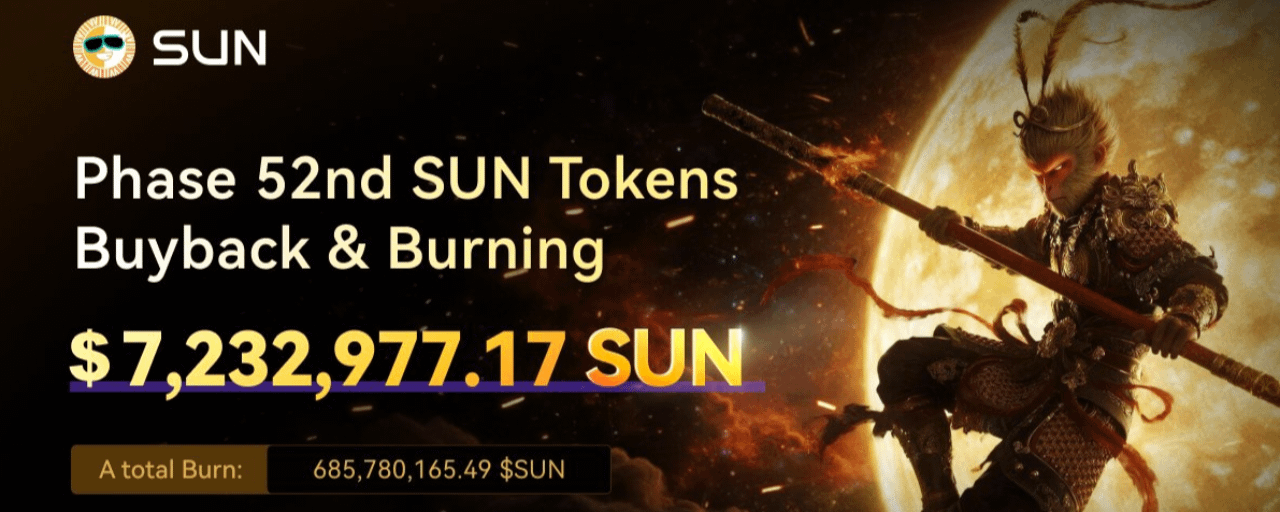
SUN.io, the core DeFi liquidity infrastructure on the TRON network, has successfully executed its 52nd SUN token buyback and burn on October 27, removing more than 7.23 million SUN from circulation.
This round marks the platform's 52nd consecutive burn, bringing the cumulative total to over 685 million SUN tokens, valued at more than $11 million. The recurring, uninterrupted buybacks and burn cycle steadily reduces the circulating supply of SUN, underscoring the protocol's long-term commitment to sustainable ecosystem growth.
To guarantee complete on-chain transparency, SUN.io has launched a dedicated public dashboard for its SUN token buyback and burn program. The portal provides real-time access to program design, key metrics, funding sources, and detailed on-chain records for each burn round, enabling community members to verify the data at any time.
Alongside the ecosystem value accrual from its periodic token burns, SUN.io is rapidly expanding its product footprint—most notably through strategic integrations with its flagship DEX, SunSwap. The platform has recently completed full-stack technical integrations and formed deep strategic partnerships with on-chain trading aggregator Ave.ai, leading multi-chain wallet TokenPocket, and cross-chain liquidity protocol Symbiosis.
These partnerships not only broaden SunSwap's user reach and unlock the potential of its underlying DEX architecture, but also deliver more affordable token swapping and liquidity services with fewer frictions for DeFi participants across the broader TRON ecosystem.
685M+ SUN Burned: Building a Traceable Value Loop Across the SUN Ecosystem
Since the launch of its buyback and burn program in 2021, SUN.io has maintained a consistent execution schedule across multiple market cycles. The first 52 burn rounds executed so far have removed up to 700 million SUN from circulation—representing over $11 million in value and approximately 3.44% of the total token supply. This outstanding track record has helped mitigate the impact of short-term market volatility while rallying SUN holders and ecosystem builders under a clear, dependable value thesis and sustainable roadmap.
According to the Announcement on the 52nd SUN Token Buyback and Burn (July 25, 2026—October 25, 2026), SUN.io executed 7,232,977.17 SUN (over 7.23 million SUN) during this time period.
The cumulative burn volume since the initial round on December 15, 2021 has surpassed the 685 million mark to 685,780,165.49 SUN.
All capital deployed for the buyback was funded by protocol revenues generated across SUN.io's three core verticals. Burn contributions by vertical are:
SunSwap V2: 388,023,868.41 SUNSunPump: 285,879,914.81 SUNSunX: 11,876,382.27 SUN
This multi-stream composition demonstrates that value capture spans the full SUN.io ecosystem. As protocol revenues generated across SunSwap V2, SunPump, and SunX are continuously channeled into the buyback and burn reserve, organic growth in any single vertical translates into direct support for the token's value accrual.
This creates a self-reinforcing flywheel where ecosystem revenue growth continues to fuel protocol buybacks, which in turn contract circulating supply and drive long-term token value accrual.
Every buyback operation adheres strictly to on-chain transparency standards, with transaction hashes for each execution indexed publicly to guarantee a traceable, verifiable paper trail for community audit.
On top of this, the platform's dedicated SUN Buyback & Burn dashboard further institutionalizes the commitment to transparency by centralizing core metrics, execution workflows, revenue allocation breakdown, and historical on-chain transaction records. It shows cumulative burn volumes, upcoming burn accruals, execution rules, and revenue allocations across all verticals. With every historical transaction mapped directly to on-chain addresses for verification, the entire buyback and burn process remains subject to ongoing community audit, reinforcing trust in the platform's transparent value loop.
Backed by verifiable on-chain records and real-time reporting on the official SUN Buyback & Burn dashboard, SUN.io is delivering on its multi-cycle deflationary commitment through radical transparency. By establishing an unbroken, auditable pipeline—routing protocol revenue directly into permanent token burns—the platform reinforces predictable, long-term value accrual for SUN holders.
Live metrics from the dashboard confirm that cumulative on-chain burns have crossed 685 million SUN (approx. $11 million), permanently retiring 3.44% of the total circulating supply. Meanwhile, buyback momentum remains strong, with the latest cycle securing an additional 7.1 million SUN ready for burning.
As the SUN.io ecosystem scales, protocol revenue streams expand alongside it, strengthening the reserve earmarked for future buybacks. This sustained, fully transparent value-return loop provides a robust foundation for the token's long-term value accrual.
SunSwap Accelerates Ecosystem Integrations to Fuel Growth Across TRON's DeFi Landscape
Alongside the continuous rollout of its buyback and burn program, SUN.io is ramping up its product expansion and ecosystem infrastructure. SunSwap, the platform's core DEX, has made significant headway in its strategic partner program, completing end-to-end technical integrations with on-chain trading aggregator Ave.ai, leading multi-chain wallet TokenPocket, and cross-chain liquidity protocol Symbiosis.
These partnerships span three core dimensions: aggregated trading entry points, high-traffic wallet access, and cross-chain liquidity routing. Together, they expand SunSwap's user reach, giving TRON DeFi users lower-friction access to deep liquidity and seamless token swaps.
The SUN.io team is actively onboarding more third-party platforms, extending SunSwap's integration footprint across a broader array of Web3 consumer touchpoints.
The platform's core operating metrics exhibit the same momentum. As of October 26, on-chain data shows SunSwap's total value locked (TVL) approaching $645 million across more than 26,800 active liquidity pools. Network throughput remains steady, with daily on-chain transactions topping 14,000 and average daily trading volume holding above $50 million—solidifying the ecosystem's leadership in the industry.
Growth extends beyond SunSwap, with SUN.io's broader product suite maintaining sharp upward momentum—most notably across its derivatives arm. According to DeFiLlama, total trading volume across all SUN.io product lines approached $15 billion in Q3 2026. Spot DEX trading contributed over $5 billion, while perpetual contract (perp) volume neared $9.7 billion, up roughly 25% quarter-over-quarter from the ~$7.75 billion performance in Q2.
The combined progress of SunSwap's ecosystem integrations and multi-product volume growth points to a broader shift: SUN.io's full-stack liquidity infrastructure now serves a much wider range of on-chain trading needs beyond spot trading, creating a DeFi product matrix where multiple business lines grow in tandem.
On the incentives front, JustLend, the lending platform in the JUST ecosystem, joined forces in July with core TRON-based projects and Binance Web3 Wallet to roll out the $4.5 million TRON DeFi Summer campaign. Participants who supply liquidity to the dedicated SUN pool on JustLend can earn additional boosted yields. The campaign is currently running Season 3 (S3), where APYs in the SUN pool reach up to 25%, offering users a compelling option to co-build ecosystem liquidity while earning on-chain returns.
Between the token-burn feedback loop, volume expansion across core business lines, and active partner-incentive campaigns, SUN.io is activating a clear growth flywheel: infrastructure upgrades drive transaction volume, business growth feeds value back to users, and that value attracts further ecosystem expansion.
Looking ahead, SUN.io, as core DeFi liquidity infrastructure for the TRON ecosystem, plans to continue its buyback and burn program, channeling protocol revenue generated by ecosystem growth into the underlying value of the SUN token. On the product side, the platform will continue securing cross-platform integrations, deepening SunSwap's liquidity, refining the end-to-end user experience, and broadening its product lineup. With ecosystem partners on board, SUN.io will keep expanding its cross-platform integrations and deliver transparent and efficient infrastructure that supports the long-term on-chain growth of TRON DeFi and the diverse trading needs of users worldwide.
SUN.io Completes 52nd Buyback and Burn
Through its recurring buyback and burn program, SUN.io continues to channel protocol revenue from SunSwap, SunPump, and SunX into SUN token value accrual, while accelerating SunSwap's cross-platform integrations to reinforce decentralized liquidity.
SUN.io, the core DeFi liquidity infrastructure on the TRON network, has successfully executed its 52nd SUN token buyback and burn on October 27, removing more than 7.23 million SUN from circulation.
This round marks the platform's 52nd consecutive burn, bringing the cumulative total to over 685 million SUN tokens, valued at more than $11 million. The recurring, uninterrupted buybacks and burn cycle steadily reduces the circulating supply of SUN, underscoring the protocol's long-term commitment to sustainable ecosystem growth.
To guarantee complete on-chain transparency, SUN.io has launched a dedicated public dashboard for its SUN token buyback and burn program. The portal provides real-time access to program design, key metrics, funding sources, and detailed on-chain records for each burn round, enabling community members to verify the data at any time.
Alongside the ecosystem value accrual from its periodic token burns, SUN.io is rapidly expanding its product footprint—most notably through strategic integrations with its flagship DEX, SunSwap. The platform has recently completed full-stack technical integrations and formed deep strategic partnerships with on-chain trading aggregator Ave.ai, leading multi-chain wallet TokenPocket, and cross-chain liquidity protocol Symbiosis.
These partnerships not only broaden SunSwap's user reach and unlock the potential of its underlying DEX architecture, but also deliver more affordable token swapping and liquidity services with fewer frictions for DeFi participants across the broader TRON ecosystem.
685M+ SUN Burned: Building a Traceable Value Loop Across the SUN Ecosystem
Since the launch of its buyback and burn program in 2021, SUN.io has maintained a consistent execution schedule across multiple market cycles. The first 52 burn rounds executed so far have removed up to 700 million SUN from circulation—representing over $11 million in value and approximately 3.44% of the total token supply. This outstanding track record has helped mitigate the impact of short-term market volatility while rallying SUN holders and ecosystem builders under a clear, dependable value thesis and sustainable roadmap.
According to the Announcement on the 52nd SUN Token Buyback and Burn (July 25, 2026—October 25, 2026), SUN.io executed 7,232,977.17 SUN (over 7.23 million SUN) during this time period.
The cumulative burn volume since the initial round on December 15, 2021 has surpassed the 685 million mark to 685,780,165.49 SUN.
All capital deployed for the buyback was funded by protocol revenues generated across SUN.io's three core verticals. Burn contributions by vertical are:
SunSwap V2: 388,023,868.41 SUNSunPump: 285,879,914.81 SUNSunX: 11,876,382.27 SUN
This multi-stream composition demonstrates that value capture spans the full SUN.io ecosystem. As protocol revenues generated across SunSwap V2, SunPump, and SunX are continuously channeled into the buyback and burn reserve, organic growth in any single vertical translates into direct support for the token's value accrual.
This creates a self-reinforcing flywheel where ecosystem revenue growth continues to fuel protocol buybacks, which in turn contract circulating supply and drive long-term token value accrual.
Every buyback operation adheres strictly to on-chain transparency standards, with transaction hashes for each execution indexed publicly to guarantee a traceable, verifiable paper trail for community audit.
On top of this, the platform's dedicated SUN Buyback & Burn dashboard further institutionalizes the commitment to transparency by centralizing core metrics, execution workflows, revenue allocation breakdown, and historical on-chain transaction records. It shows cumulative burn volumes, upcoming burn accruals, execution rules, and revenue allocations across all verticals. With every historical transaction mapped directly to on-chain addresses for verification, the entire buyback and burn process remains subject to ongoing community audit, reinforcing trust in the platform's transparent value loop.
Backed by verifiable on-chain records and real-time reporting on the official SUN Buyback & Burn dashboard, SUN.io is delivering on its multi-cycle deflationary commitment through radical transparency. By establishing an unbroken, auditable pipeline—routing protocol revenue directly into permanent token burns—the platform reinforces predictable, long-term value accrual for SUN holders.
Live metrics from the dashboard confirm that cumulative on-chain burns have crossed 685 million SUN (approx. $11 million), permanently retiring 3.44% of the total circulating supply. Meanwhile, buyback momentum remains strong, with the latest cycle securing an additional 7.1 million SUN ready for burning.
As the SUN.io ecosystem scales, protocol revenue streams expand alongside it, strengthening the reserve earmarked for future buybacks. This sustained, fully transparent value-return loop provides a robust foundation for the token's long-term value accrual.
SunSwap Accelerates Ecosystem Integrations to Fuel Growth Across TRON's DeFi Landscape
Alongside the continuous rollout of its buyback and burn program, SUN.io is ramping up its product expansion and ecosystem infrastructure. SunSwap, the platform's core DEX, has made significant headway in its strategic partner program, completing end-to-end technical integrations with on-chain trading aggregator Ave.ai, leading multi-chain wallet TokenPocket, and cross-chain liquidity protocol Symbiosis.
These partnerships span three core dimensions: aggregated trading entry points, high-traffic wallet access, and cross-chain liquidity routing. Together, they expand SunSwap's user reach, giving TRON DeFi users lower-friction access to deep liquidity and seamless token swaps.
The SUN.io team is actively onboarding more third-party platforms, extending SunSwap's integration footprint across a broader array of Web3 consumer touchpoints.
The platform's core operating metrics exhibit the same momentum. As of October 26, on-chain data shows SunSwap's total value locked (TVL) approaching $645 million across more than 26,800 active liquidity pools. Network throughput remains steady, with daily on-chain transactions topping 14,000 and average daily trading volume holding above $50 million—solidifying the ecosystem's leadership in the industry.
Growth extends beyond SunSwap, with SUN.io's broader product suite maintaining sharp upward momentum—most notably across its derivatives arm. According to DeFiLlama, total trading volume across all SUN.io product lines approached $15 billion in Q3 2026. Spot DEX trading contributed over $5 billion, while perpetual contract (perp) volume neared $9.7 billion, up roughly 25% quarter-over-quarter from the ~$7.75 billion performance in Q2.
The combined progress of SunSwap's ecosystem integrations and multi-product volume growth points to a broader shift: SUN.io's full-stack liquidity infrastructure now serves a much wider range of on-chain trading needs beyond spot trading, creating a DeFi product matrix where multiple business lines grow in tandem.
On the incentives front, JustLend, the lending platform in the JUST ecosystem, joined forces in July with core TRON-based projects and Binance Web3 Wallet to roll out the $4.5 million TRON DeFi Summer campaign. Participants who supply liquidity to the dedicated SUN pool on JustLend can earn additional boosted yields. The campaign is currently running Season 3 (S3), where APYs in the SUN pool reach up to 25%, offering users a compelling option to co-build ecosystem liquidity while earning on-chain returns.
Between the token-burn feedback loop, volume expansion across core business lines, and active partner-incentive campaigns, SUN.io is activating a clear growth flywheel: infrastructure upgrades drive transaction volume, business growth feeds value back to users, and that value attracts further ecosystem expansion.
Looking ahead, SUN.io, as core DeFi liquidity infrastructure for the TRON ecosystem, plans to continue its buyback and burn program, channeling protocol revenue generated by ecosystem growth into the underlying value of the SUN token. On the product side, the platform will continue securing cross-platform integrations, deepening SunSwap's liquidity, refining the end-to-end user experience, and broadening its product lineup. With ecosystem partners on board, SUN.io will keep expanding its cross-platform integrations and deliver transparent and efficient infrastructure that supports the long-term on-chain growth of TRON DeFi and the diverse trading needs of users worldwide.
160
Article
Justin Sun Prize Partners With MathDB, Led by Caltech Professor Tony Yue Yu, on 50-Problem PilotGeneva, Switzerland — October 26, 2026 — The Office of Justin Sun today announced a pilot program for the Justin Sun Prize in collaboration with MathDB, a mathematical research platform developed by Caltech Professor Tony Yue Yu and his team.
The Justin Sun Prize was established to become the “Nobel Prize of the AI Era,” responding to the profound transformation of scientific research and incentives in the new era in a more decentralized, formalized and machine-driven way. Problem-level awards can reach $1 million, subject to the applicable award terms and eligibility requirements.
The collaboration introduces a submission and review process through MathDB. MathDB will accept solution submissions, verify Lean formalizations and review expository materials, while the Justin Sun Prize will separately assess eligibility, attribution, priority and applicable award terms.
“AI is changing the speed at which mathematics can be explored, but speed alone is not scientific progress,” said Justin Sun, founder of the Justin Sun Prize. “The opportunity is to create a framework where human insight and machine intelligence can work together without compromising rigor. Working with MathDB brings mathematical discovery and machine-verifiable proof into the same process, which we believe can help define a more rigorous model for future discoveries.”
The pilot covers 50 problems across four award levels, with problem-level prize pools up to $1 million, depending on the problem. The highest tier includes P versus NP, the Riemann Hypothesis, Yang-Mills Existence and Mass Gap, the Hodge Conjecture, Global Langlands functoriality and the Birch and Swinnerton-Dyer Conjecture, among others. The full list of participating problems and applicable award terms will be available through MathDB and the Justin Sun Prize.
All awards are subject to full eligibility verification, compliance with anti-money laundering (AML/sanctions) laws, and official program rules available at https://www.hejustinsun.com/prize.
To broaden the reach and impact of advanced research, the MathDB pilot program will reward not only solutions to mathematical problems but also engaging and accessible communication of those solutions. The reward is divided into three categories: 50% for the mathematical solution, 30% for Lean formalization and 20% for qualifying exposition.
MathDB is a large-scale community database of mathematical definitions, theorems, conjectures and open problems, with the aim of making mathematical knowledge easier to organize, connect and build upon. The project incorporates Lean formalization and automated proof-verification capability alongside mathematical explanations and supporting research materials. Professor Tony Yue Yu from California Institute of Technology, together with his team, will be leading the scientific aspects of the pilot.
“Solving a fundamental math problem often leads to much more than an answer to the original question,” said Yu. “The process can reveal unexpected connections, introduce powerful tools and open entirely new directions of research. These developments can have an influence that extends across generations and disciplines. The Justin Sun Prize celebrates this spirit of exploration by drawing attention to challenging problems, supporting researchers who pursue them, and encouraging public dissemination of knowledge. Our collaboration with the Justin Sun Prize is grounded in the belief that pursuing fundamental research through decentralized, rigorous and verifiable approaches can accelerate the pace of discovery and scientific progress, and contribute to the advancement of human civilization.”
The full list of participating problems, submission requirements and review procedures will be available through MathDB (https://mathdb.com/) and the Justin Sun Prize (https://www.hejustinsun.com/prize).
About the Office of Justin Sun
The Office of Justin Sun supports Justin Sun’s global business, philanthropic and public initiatives across technology, blockchain, artificial intelligence, scientific research, investment, art and space exploration.
Justin Sun is the Ambassador and former Permanent Representative of Grenada to the World Trade Organization and the Founder of TRON. TRON is the leading blockchain for the stablecoin revolution, processing over $13 trillion in volume since its inception. In the world’s emerging markets, people rely on USDT on TRON to access the global financial system.
A protégé of Alibaba founder Jack Ma, Sun has been recognized internationally for his work in the digital asset industry, including a Forbes cover profile in April 2025 and multiple appearances on the Forbes 30 Under 30 list. In August 2025, he flew aboard Blue Origin’s NS-34 mission, becoming the 712th person in history to travel to space. His broader interests span technology, investment, philanthropy, art, gaming, and space exploration.
About Justin Sun Prize
The Justin Sun Prize is an academic initiative established by Justin Sun to support advances in mathematics, formal verification, and AI-assisted scientific discovery. The prize is decentralized and built around the principle that mathematical work should be judged by the strength, rigor, and verifiability of the proof itself, not the prestige or reputation of those submitting it.
Justin Sun established the prize in his own name as a long-term commitment to return wealth created through mathematics and technology back to mathematics itself. Its legacy is intended to be defined by the body of work it recognizes and the laureates whose discoveries stand the test of time. The prize links clearly defined mathematical challenges to machine-verifiable proof. Its guiding principles are openness, public benefit and open-source access.
Justin Sun Prize Partners With MathDB, Led by Caltech Professor Tony Yue Yu, on 50-Problem Pilot
Geneva, Switzerland — October 26, 2026 — The Office of Justin Sun today announced a pilot program for the Justin Sun Prize in collaboration with MathDB, a mathematical research platform developed by Caltech Professor Tony Yue Yu and his team.
The Justin Sun Prize was established to become the “Nobel Prize of the AI Era,” responding to the profound transformation of scientific research and incentives in the new era in a more decentralized, formalized and machine-driven way. Problem-level awards can reach $1 million, subject to the applicable award terms and eligibility requirements.
The collaboration introduces a submission and review process through MathDB. MathDB will accept solution submissions, verify Lean formalizations and review expository materials, while the Justin Sun Prize will separately assess eligibility, attribution, priority and applicable award terms.
“AI is changing the speed at which mathematics can be explored, but speed alone is not scientific progress,” said Justin Sun, founder of the Justin Sun Prize. “The opportunity is to create a framework where human insight and machine intelligence can work together without compromising rigor. Working with MathDB brings mathematical discovery and machine-verifiable proof into the same process, which we believe can help define a more rigorous model for future discoveries.”
The pilot covers 50 problems across four award levels, with problem-level prize pools up to $1 million, depending on the problem. The highest tier includes P versus NP, the Riemann Hypothesis, Yang-Mills Existence and Mass Gap, the Hodge Conjecture, Global Langlands functoriality and the Birch and Swinnerton-Dyer Conjecture, among others. The full list of participating problems and applicable award terms will be available through MathDB and the Justin Sun Prize.
All awards are subject to full eligibility verification, compliance with anti-money laundering (AML/sanctions) laws, and official program rules available at https://www.hejustinsun.com/prize.
To broaden the reach and impact of advanced research, the MathDB pilot program will reward not only solutions to mathematical problems but also engaging and accessible communication of those solutions. The reward is divided into three categories: 50% for the mathematical solution, 30% for Lean formalization and 20% for qualifying exposition.
MathDB is a large-scale community database of mathematical definitions, theorems, conjectures and open problems, with the aim of making mathematical knowledge easier to organize, connect and build upon. The project incorporates Lean formalization and automated proof-verification capability alongside mathematical explanations and supporting research materials. Professor Tony Yue Yu from California Institute of Technology, together with his team, will be leading the scientific aspects of the pilot.
“Solving a fundamental math problem often leads to much more than an answer to the original question,” said Yu. “The process can reveal unexpected connections, introduce powerful tools and open entirely new directions of research. These developments can have an influence that extends across generations and disciplines. The Justin Sun Prize celebrates this spirit of exploration by drawing attention to challenging problems, supporting researchers who pursue them, and encouraging public dissemination of knowledge. Our collaboration with the Justin Sun Prize is grounded in the belief that pursuing fundamental research through decentralized, rigorous and verifiable approaches can accelerate the pace of discovery and scientific progress, and contribute to the advancement of human civilization.”
The full list of participating problems, submission requirements and review procedures will be available through MathDB (https://mathdb.com/) and the Justin Sun Prize (https://www.hejustinsun.com/prize).
About the Office of Justin Sun
The Office of Justin Sun supports Justin Sun’s global business, philanthropic and public initiatives across technology, blockchain, artificial intelligence, scientific research, investment, art and space exploration.
Justin Sun is the Ambassador and former Permanent Representative of Grenada to the World Trade Organization and the Founder of TRON. TRON is the leading blockchain for the stablecoin revolution, processing over $13 trillion in volume since its inception. In the world’s emerging markets, people rely on USDT on TRON to access the global financial system.
A protégé of Alibaba founder Jack Ma, Sun has been recognized internationally for his work in the digital asset industry, including a Forbes cover profile in April 2025 and multiple appearances on the Forbes 30 Under 30 list. In August 2025, he flew aboard Blue Origin’s NS-34 mission, becoming the 712th person in history to travel to space. His broader interests span technology, investment, philanthropy, art, gaming, and space exploration.
About Justin Sun Prize
The Justin Sun Prize is an academic initiative established by Justin Sun to support advances in mathematics, formal verification, and AI-assisted scientific discovery. The prize is decentralized and built around the principle that mathematical work should be judged by the strength, rigor, and verifiability of the proof itself, not the prestige or reputation of those submitting it.
Justin Sun established the prize in his own name as a long-term commitment to return wealth created through mathematics and technology back to mathematics itself. Its legacy is intended to be defined by the body of work it recognizes and the laureates whose discoveries stand the test of time. The prize links clearly defined mathematical challenges to machine-verifiable proof. Its guiding principles are openness, public benefit and open-source access.
72
Article
JST Buyback & Burn Upgrade: GasFree Revenue and $20.34M Surplus InjectedSummary:
The upgraded JST Buyback and Burn program features the following highlights:
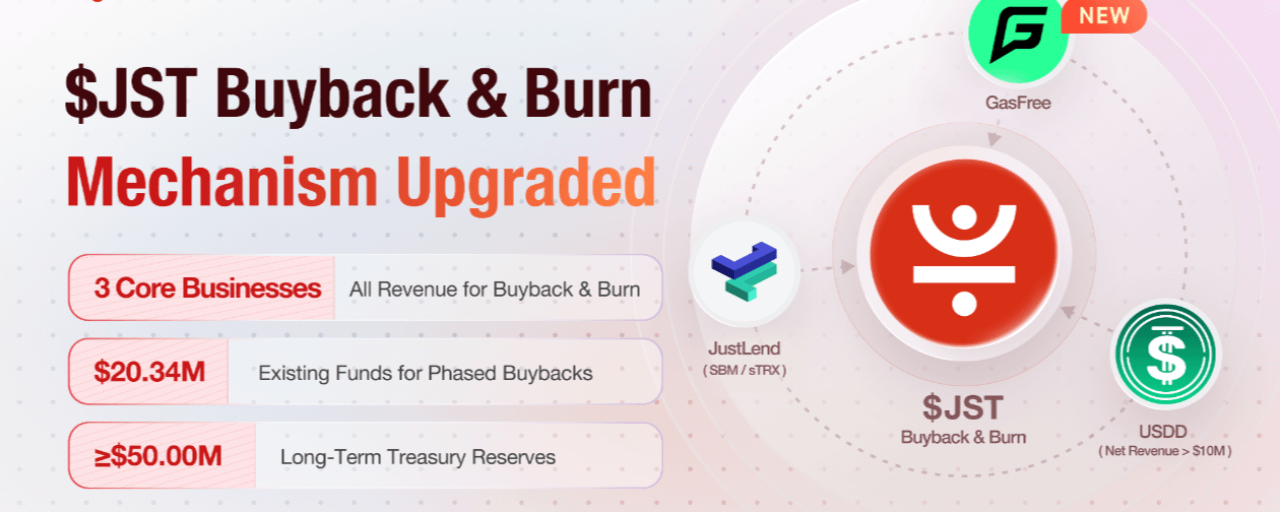
· $50M Treasury Reserve Cushion: Establishes a safety buffer for sustainable ecosystem operations.
· Expanded Funding Sources: Integrates GasFree revenue alongside JustLend and USDD to cover 100% of JUST core products.
· ~$20.34M Capital Injection: Unlocks legacy surplus funds to be released in phases for future buybacks.
· JUST DAO Execution: Complete on-chain execution with full transparency and open-source verification.
Following its recent brand refresh on October 23, JUST—the flagship on-chain DeFi infrastructure on TRON—officially unveiled its upgraded JST Buyback & Burn initiative that strengthens the value-accrual framework of the native governance token. Building on previous funding sources from JustLend and USDD, the upgraded mechanism incorporates business revenue from GasFree while allocating $20.34 million in capital surplus to future token repurchases. These changes diversify the protocol's revenue base and set a structured process for deploying surplus capital.
The updated framework expands JST buyback funding from a dual-revenue stream (i.e., JustLend and USDD) to a more robust three-pillar model (i.e., JustLend, USDD, and GasFree), reinforced by phased injections of existing funds. Beyond simply adding capital, this upgrade ensures that growth in each JUST product line directly accrues to JST's underlying value. It underscores JUST's long-term commitment to token value accrual while tightly aligning protocol incentives with JST holders and the broader community.
JST Buyback & Burn Upgraded: $50M Safety Cushion, GasFree Revenue Integration, and $20.34M Surplus Injection
As the native governance token of the JUST ecosystem, JST's underlying value support and utility mechanisms have always been a central focus for the community. With the successful completion of the 5th buyback and burn on October 16, Phase 1 of the JST Buyback and Burn program concluded smoothly, paving the way for the upgraded mechanism alongside JUST's broader brand refresh.
According to the Announcement: Upgrade to the JST Buyback & Burn Mechanism, the newly updated framework outlines key structural arrangements across five core areas, establishing clear risk boundaries while securing a more stable and predictable capital foundation for future buybacks:
$50M Treasury Safety Floor: A baseline reserve of at least $50 million will be maintained long-term to manage risk scenarios, guarantee liquidity, and ensure protocol solvency under extreme market conditions.More Diversified Funding Sources: The upgraded model integrates GasFree revenue alongside existing JustLend and USDD streams, extending buyback capital across all three core JUST product lines. Specific sources now include revenue from JustLend's sTRX staking and SBM, GasFree income, and the USDD protocol revenue exceeding the $10 million threshold.Structured Surplus Capital Deployment: All protocol funds above the $50 million treasury reserve floor are dedicated entirely to JST buybacks. An initial $20.34 million—sourced from cumulative GasFree earnings and surplus treasury reserves above the safety floor—has been unlocked, and will be deployed across four buyback rounds starting in Q4 2026.Buyback & Burn Execution: The protocol is adopting a "continuous buyback, periodic burn" approach. Funded by 100% of revenue across all product lines, open-market buybacks will adjust dynamically to prevailing market depth and liquidity, with accumulated tokens burned on a regular schedule.On-Chain Governance: All buybacks and burns will be executed by JUST DAO. Key financial figures will be disclosed to the community on a regular basis, and every transaction will remain fully verifiable on-chain.
Compared to Phase 1, this upgrade introduces three structural shifts:
1. Clearer capital boundaries. The $50 million reserve floor creates a solvency backstop while defining the boundaries of capital eligible for buybacks.
2. More diversified funding sources. Rather than relying primarily on JustLend and USDD, integrating GasFree extends revenue capture across the entire JUST ecosystem. Meanwhile, deploying roughly $20.34 million in surplus funds across future tranches smooths buyback execution and ensures an orderly transition between mechanism phases.
3. Streamlined execution under unified governance. By adopting a "continuous buyback, periodic burn" strategy, the consolidated JUST DAO (formerly JustLend DAO) takes full operational ownership of buybacks and burns. This aligns governance and execution under a single authority, matching JUST's brand consolidation and holistic governance roadmap.
In essence, the updated mechanism follows a clear tripartite playbook: secure the downside, deploy surplus capital, and compound with organic growth. It first anchors ecosystem stability with the $50 million reserve floor, primes buyback momentum by releasing roughly $20.34 million in surplus funds, and then hands the baton to ongoing revenues from all three verticals—turning JST buybacks into a sustainable, business-backed deflationary engine.
GasFree Poised to Become the Second Growth Engine for JST Buybacks After JustLend
The integration of GasFree revenue represents the key highlight of this mechanism upgrade. Scheduled to begin capital allocations in Q4 2026, GasFree has demonstrated strong cash-flow generation and is positioned to become the second growth engine for JST buyback funding after JustLend.
Built on TRON, GasFree is a native gasless solution that lets users pay transaction fees directly with the tokens they transfer, removing the friction of holding TRX or other native tokens just to move funds. By enabling single-asset fee settlement, GasFree eliminates one of the most stubborn usability hurdles in on-chain transfers. The service currently supports gasless transfers for both USDT and USDD.
Operationally, GasFree's user base and network activity continue to climb at a rapid pace. As of October 23, GasFree has processed over $157.1 billion in cumulative stablecoin transfer volume across more than 9.14 million transactions, serving an aggregate user base exceeding 500,000 unique addresses. This surging operational momentum provides the solid backing for GasFree to consistently fuel the buyback pool and establish itself as JST's second major growth engine.
From a revenue standpoint, GasFree's profitability is backed by hard data. It has proven to be a vital growth engine since its March 2025 rollout, generating approximately $12.03 million in cumulative revenue through Q3 2026. This performance underpinned the recent extraction of roughly $20.34 million in surplus funds, sourced directly from GasFree's accrued earnings and surplus treasury holdings above the reserve floor.
As GasFree's financial contribution accelerates, JST's buyback-and-burn model enters a new stage of multi-business synergy. The token's value-accrual mechanism is now deeply tied to the growth of the broader JUST ecosystem and fully synchronized with the protocol's multi-product expansion.
Diversified Value Accrual: JUST’s Core Products Unite to Back JST
Under the updated mechanism, GasFree revenue is now directly allocated to JST buybacks, alongside qualifying net revenue from USDD. This marks a pivotal evolution: JST burns no longer rely solely on JustLend. Instead, they are fueled by a diversified, multi-product revenue base spanning JustLend, USDD, and GasFree.
This multi-pronged funding approach mirrors the broader JUST rebrand. Moving forward, JustLend, USDD, and GasFree unite under a single brand and user gateway—with JUST DAO steering cross-product governance, ecosystem synergy, and sustainable tokenomics for JST.
JST serves as the native governance token for the entire JUST ecosystem. Through this unified rebrand and the rollout of JUST DAO governance, JST's value foundation now spans the protocol's core utility layers: lending and resource markets via JustLend, decentralized stablecoin infrastructure via USDD, and gasless transfer settlement via GasFree. JST is no longer anchored to a single product line; its value capture is directly tied to the growth of the entire ecosystem.
As a pillar of TRON’s financial infrastructure, JUST commands roughly $12.2 billion in Total Value Locked (TVL)—consistently securing nearly half of the network's total liquidity, with all three business pillars holding leading positions in their respective verticals.
Among them, JustLend remains foundational: having fully funded the initial phase of JST buybacks and burns, it now provides the core yield baseline under the upgraded mechanism. As of October 23, JustLend's TVL surpassed $7.13 billion, with its supply-borrow market (SBM) driving approximately $3.71 billion, cementing its status as a global DeFi lending leader. In the staking sector, total TRX staked has crossed 9.83 billion. At the same time, through sTRX-powered Energy solutions, JustLend has become a primary Energy gateway for the TRON network, scaling both on-demand Energy purchases and long-term rental services.
Meanwhile, GasFree continues to scale as a key revenue driver. In late September, GasFree partnered with Binance Web3 Wallet to introduce TRC-20 USDT gas fee delegation. Users can now pay network fees directly in USDT without needing to hold TRX. Securing integration with a Tier-1 wallet validates GasFree's business model and significantly expands its addressable market and fee-generation capacity.
JST Buyback & Burn Upgrade: GasFree Revenue and $20.34M Surplus Injected
Summary:
The upgraded JST Buyback and Burn program features the following highlights:
· $50M Treasury Reserve Cushion: Establishes a safety buffer for sustainable ecosystem operations.
· Expanded Funding Sources: Integrates GasFree revenue alongside JustLend and USDD to cover 100% of JUST core products.
· ~$20.34M Capital Injection: Unlocks legacy surplus funds to be released in phases for future buybacks.
· JUST DAO Execution: Complete on-chain execution with full transparency and open-source verification.
Following its recent brand refresh on October 23, JUST—the flagship on-chain DeFi infrastructure on TRON—officially unveiled its upgraded JST Buyback & Burn initiative that strengthens the value-accrual framework of the native governance token. Building on previous funding sources from JustLend and USDD, the upgraded mechanism incorporates business revenue from GasFree while allocating $20.34 million in capital surplus to future token repurchases. These changes diversify the protocol's revenue base and set a structured process for deploying surplus capital.
The updated framework expands JST buyback funding from a dual-revenue stream (i.e., JustLend and USDD) to a more robust three-pillar model (i.e., JustLend, USDD, and GasFree), reinforced by phased injections of existing funds. Beyond simply adding capital, this upgrade ensures that growth in each JUST product line directly accrues to JST's underlying value. It underscores JUST's long-term commitment to token value accrual while tightly aligning protocol incentives with JST holders and the broader community.
JST Buyback & Burn Upgraded: $50M Safety Cushion, GasFree Revenue Integration, and $20.34M Surplus Injection
As the native governance token of the JUST ecosystem, JST's underlying value support and utility mechanisms have always been a central focus for the community. With the successful completion of the 5th buyback and burn on October 16, Phase 1 of the JST Buyback and Burn program concluded smoothly, paving the way for the upgraded mechanism alongside JUST's broader brand refresh.
According to the Announcement: Upgrade to the JST Buyback & Burn Mechanism, the newly updated framework outlines key structural arrangements across five core areas, establishing clear risk boundaries while securing a more stable and predictable capital foundation for future buybacks:
$50M Treasury Safety Floor: A baseline reserve of at least $50 million will be maintained long-term to manage risk scenarios, guarantee liquidity, and ensure protocol solvency under extreme market conditions.More Diversified Funding Sources: The upgraded model integrates GasFree revenue alongside existing JustLend and USDD streams, extending buyback capital across all three core JUST product lines. Specific sources now include revenue from JustLend's sTRX staking and SBM, GasFree income, and the USDD protocol revenue exceeding the $10 million threshold.Structured Surplus Capital Deployment: All protocol funds above the $50 million treasury reserve floor are dedicated entirely to JST buybacks. An initial $20.34 million—sourced from cumulative GasFree earnings and surplus treasury reserves above the safety floor—has been unlocked, and will be deployed across four buyback rounds starting in Q4 2026.Buyback & Burn Execution: The protocol is adopting a "continuous buyback, periodic burn" approach. Funded by 100% of revenue across all product lines, open-market buybacks will adjust dynamically to prevailing market depth and liquidity, with accumulated tokens burned on a regular schedule.On-Chain Governance: All buybacks and burns will be executed by JUST DAO. Key financial figures will be disclosed to the community on a regular basis, and every transaction will remain fully verifiable on-chain.
Compared to Phase 1, this upgrade introduces three structural shifts:
1. Clearer capital boundaries. The $50 million reserve floor creates a solvency backstop while defining the boundaries of capital eligible for buybacks.
2. More diversified funding sources. Rather than relying primarily on JustLend and USDD, integrating GasFree extends revenue capture across the entire JUST ecosystem. Meanwhile, deploying roughly $20.34 million in surplus funds across future tranches smooths buyback execution and ensures an orderly transition between mechanism phases.
3. Streamlined execution under unified governance. By adopting a "continuous buyback, periodic burn" strategy, the consolidated JUST DAO (formerly JustLend DAO) takes full operational ownership of buybacks and burns. This aligns governance and execution under a single authority, matching JUST's brand consolidation and holistic governance roadmap.
In essence, the updated mechanism follows a clear tripartite playbook: secure the downside, deploy surplus capital, and compound with organic growth. It first anchors ecosystem stability with the $50 million reserve floor, primes buyback momentum by releasing roughly $20.34 million in surplus funds, and then hands the baton to ongoing revenues from all three verticals—turning JST buybacks into a sustainable, business-backed deflationary engine.
GasFree Poised to Become the Second Growth Engine for JST Buybacks After JustLend
The integration of GasFree revenue represents the key highlight of this mechanism upgrade. Scheduled to begin capital allocations in Q4 2026, GasFree has demonstrated strong cash-flow generation and is positioned to become the second growth engine for JST buyback funding after JustLend.
Built on TRON, GasFree is a native gasless solution that lets users pay transaction fees directly with the tokens they transfer, removing the friction of holding TRX or other native tokens just to move funds. By enabling single-asset fee settlement, GasFree eliminates one of the most stubborn usability hurdles in on-chain transfers. The service currently supports gasless transfers for both USDT and USDD.
Operationally, GasFree's user base and network activity continue to climb at a rapid pace. As of October 23, GasFree has processed over $157.1 billion in cumulative stablecoin transfer volume across more than 9.14 million transactions, serving an aggregate user base exceeding 500,000 unique addresses. This surging operational momentum provides the solid backing for GasFree to consistently fuel the buyback pool and establish itself as JST's second major growth engine.
From a revenue standpoint, GasFree's profitability is backed by hard data. It has proven to be a vital growth engine since its March 2025 rollout, generating approximately $12.03 million in cumulative revenue through Q3 2026. This performance underpinned the recent extraction of roughly $20.34 million in surplus funds, sourced directly from GasFree's accrued earnings and surplus treasury holdings above the reserve floor.
As GasFree's financial contribution accelerates, JST's buyback-and-burn model enters a new stage of multi-business synergy. The token's value-accrual mechanism is now deeply tied to the growth of the broader JUST ecosystem and fully synchronized with the protocol's multi-product expansion.
Diversified Value Accrual: JUST’s Core Products Unite to Back JST
Under the updated mechanism, GasFree revenue is now directly allocated to JST buybacks, alongside qualifying net revenue from USDD. This marks a pivotal evolution: JST burns no longer rely solely on JustLend. Instead, they are fueled by a diversified, multi-product revenue base spanning JustLend, USDD, and GasFree.
This multi-pronged funding approach mirrors the broader JUST rebrand. Moving forward, JustLend, USDD, and GasFree unite under a single brand and user gateway—with JUST DAO steering cross-product governance, ecosystem synergy, and sustainable tokenomics for JST.
JST serves as the native governance token for the entire JUST ecosystem. Through this unified rebrand and the rollout of JUST DAO governance, JST's value foundation now spans the protocol's core utility layers: lending and resource markets via JustLend, decentralized stablecoin infrastructure via USDD, and gasless transfer settlement via GasFree. JST is no longer anchored to a single product line; its value capture is directly tied to the growth of the entire ecosystem.
As a pillar of TRON’s financial infrastructure, JUST commands roughly $12.2 billion in Total Value Locked (TVL)—consistently securing nearly half of the network's total liquidity, with all three business pillars holding leading positions in their respective verticals.
Among them, JustLend remains foundational: having fully funded the initial phase of JST buybacks and burns, it now provides the core yield baseline under the upgraded mechanism. As of October 23, JustLend's TVL surpassed $7.13 billion, with its supply-borrow market (SBM) driving approximately $3.71 billion, cementing its status as a global DeFi lending leader. In the staking sector, total TRX staked has crossed 9.83 billion. At the same time, through sTRX-powered Energy solutions, JustLend has become a primary Energy gateway for the TRON network, scaling both on-demand Energy purchases and long-term rental services.
Meanwhile, GasFree continues to scale as a key revenue driver. In late September, GasFree partnered with Binance Web3 Wallet to introduce TRC-20 USDT gas fee delegation. Users can now pay network fees directly in USDT without needing to hold TRX. Securing integration with a Tier-1 wallet validates GasFree's business model and significantly expands its addressable market and fee-generation capacity.
105
Article
Paybis Adds iDEAL, BLIK, Multibanco and EPS for Buying Crypto in EuropeCustomers in the Netherlands, Poland, Portugal and Austria can now buy crypto on Paybis through a banking app or a payment reference, with no card details needed. The four methods are the first wave of 13 local payment methods Paybis is adding.
Riga, Latvia October 23, 2026 — Paybis, a global crypto exchange and payment infrastructure provider, today added four local payment methods for buying crypto in Europe. Customers can now pay with iDEAL in the Netherlands, BLIK in Poland, Multibanco in Portugal and EPS in Austria. Cards and bank transfers remain available, but they are no longer the only options.
Four new local payment methods live today: iDEAL, BLIK, Multibanco and EPS.No card details needed: customers confirm payment in their banking app or pay a Multibanco reference.More than 90 cryptocurrencies are available, including Bitcoin, Ethereum, Solana and USDC.First wave of 13 local payment methods; Paybis will support more than 30 ways to pay once all are live.
Local payment methods at national scale
The four methods operate at scale in their home markets. BLIK had 21.6 million active users in Poland at the end of June 2026, according to its operator, Polish Payment Standard. iDEAL processed more than 1.5 billion transactions in 2025 and handled 71% of online purchases in the Netherlands, according to the Dutch Payments Association. The Multibanco network has around 13,000 machines across Portugal, according to SIBS. EPS is offered by more than 11,000 online shops in Austria.
Four methods, four markets
iDEAL Netherlands
Bank selection and confirmation in a banking app
Limit per payment: EUR 50,000
BLIK Poland
Six-digit code from a banking app
Limit per payment: PLN 50,000
Multibanco Portugal
Payment reference, paid at an ATM or in a banking app
Limit per payment: EUR 5,000
EPS Austria
Bank selection and confirmation in online banking
Limit per payment: EUR 10,000
Simple crypto, paid locally
Each method works the way it does for any other online payment in its market. The customer chooses the method at checkout and confirms the payment through their bank, or pays the Multibanco reference. No card details are needed. The crypto goes to the customer’s Paybis Wallet or to any external wallet address. Customers can choose from more than 90 cryptocurrencies, including Bitcoin, Ethereum, Solana and USDC.
“Europe does not pay one way. A customer in Amsterdam reaches for iDEAL, a customer in Warsaw reaches for BLIK, and neither should need a card to buy crypto,” said Innokenty Isers, CEO and Founder of Paybis. “Now customers in the Netherlands, Poland, Portugal and Austria can pay the way they already pay for everything else online. Our philosophy is making crypto easy, and adding local payment methods market by market is how we do that.”
What comes next
iDEAL, BLIK, Multibanco and EPS are the first of 13 local payment methods Paybis is adding. Bancontact, KBC/CBC Bank and Belfius Pay in Belgium and Bancomat Pay in Italy follow in the next wave. Swish, Przelewy24, Vipps and MobilePay come after that. Once all are live, Paybis will support more than 30 ways to pay.
About Paybis
Paybis makes crypto simple for individuals and enterprises. Established in 2014, the company combines a trusted crypto exchange and wallet for buying, selling, swapping and holding over 90 cryptocurrencies, with award-winning crypto-fiat infrastructure. That infrastructure lets businesses transfer capital globally without traditional payment friction.
In 2026, Paybis was recognized as Best Crypto Payment Provider, a testament to its expansive global reach, rapid onboarding protocols, and the deep expertise of the 200 dedicated professionals who drive its operations.
Processing more than $6 billion annually, Paybis is one of the most efficient platforms for acquiring and transacting in digital assets. This commitment to operational excellence is why Paybis maintains one of the highest ratings for crypto companies on Trustpilot, and why 7 million users and hundreds of the world's fastest-growing enterprises consistently rely on its services.
Paybis Adds iDEAL, BLIK, Multibanco and EPS for Buying Crypto in Europe
Customers in the Netherlands, Poland, Portugal and Austria can now buy crypto on Paybis through a banking app or a payment reference, with no card details needed. The four methods are the first wave of 13 local payment methods Paybis is adding.
Riga, Latvia October 23, 2026 — Paybis, a global crypto exchange and payment infrastructure provider, today added four local payment methods for buying crypto in Europe. Customers can now pay with iDEAL in the Netherlands, BLIK in Poland, Multibanco in Portugal and EPS in Austria. Cards and bank transfers remain available, but they are no longer the only options.
Four new local payment methods live today: iDEAL, BLIK, Multibanco and EPS.No card details needed: customers confirm payment in their banking app or pay a Multibanco reference.More than 90 cryptocurrencies are available, including Bitcoin, Ethereum, Solana and USDC.First wave of 13 local payment methods; Paybis will support more than 30 ways to pay once all are live.
Local payment methods at national scale
The four methods operate at scale in their home markets. BLIK had 21.6 million active users in Poland at the end of June 2026, according to its operator, Polish Payment Standard. iDEAL processed more than 1.5 billion transactions in 2025 and handled 71% of online purchases in the Netherlands, according to the Dutch Payments Association. The Multibanco network has around 13,000 machines across Portugal, according to SIBS. EPS is offered by more than 11,000 online shops in Austria.
Four methods, four markets
iDEAL Netherlands
Bank selection and confirmation in a banking app
Limit per payment: EUR 50,000
BLIK Poland
Six-digit code from a banking app
Limit per payment: PLN 50,000
Multibanco Portugal
Payment reference, paid at an ATM or in a banking app
Limit per payment: EUR 5,000
EPS Austria
Bank selection and confirmation in online banking
Limit per payment: EUR 10,000
Simple crypto, paid locally
Each method works the way it does for any other online payment in its market. The customer chooses the method at checkout and confirms the payment through their bank, or pays the Multibanco reference. No card details are needed. The crypto goes to the customer’s Paybis Wallet or to any external wallet address. Customers can choose from more than 90 cryptocurrencies, including Bitcoin, Ethereum, Solana and USDC.
“Europe does not pay one way. A customer in Amsterdam reaches for iDEAL, a customer in Warsaw reaches for BLIK, and neither should need a card to buy crypto,” said Innokenty Isers, CEO and Founder of Paybis. “Now customers in the Netherlands, Poland, Portugal and Austria can pay the way they already pay for everything else online. Our philosophy is making crypto easy, and adding local payment methods market by market is how we do that.”
What comes next
iDEAL, BLIK, Multibanco and EPS are the first of 13 local payment methods Paybis is adding. Bancontact, KBC/CBC Bank and Belfius Pay in Belgium and Bancomat Pay in Italy follow in the next wave. Swish, Przelewy24, Vipps and MobilePay come after that. Once all are live, Paybis will support more than 30 ways to pay.
About Paybis
Paybis makes crypto simple for individuals and enterprises. Established in 2014, the company combines a trusted crypto exchange and wallet for buying, selling, swapping and holding over 90 cryptocurrencies, with award-winning crypto-fiat infrastructure. That infrastructure lets businesses transfer capital globally without traditional payment friction.
In 2026, Paybis was recognized as Best Crypto Payment Provider, a testament to its expansive global reach, rapid onboarding protocols, and the deep expertise of the 200 dedicated professionals who drive its operations.
Processing more than $6 billion annually, Paybis is one of the most efficient platforms for acquiring and transacting in digital assets. This commitment to operational excellence is why Paybis maintains one of the highest ratings for crypto companies on Trustpilot, and why 7 million users and hundreds of the world's fastest-growing enterprises consistently rely on its services.
111
Article
HTX Research Publishes Crypto Market Outlook Ahead of the 2026 U.S. Midterm ElectionsHTX Research, the dedicated research arm of HTX, has published a new report titled Crypto Market Outlook Before and After the 2026 U.S. Midterm Elections.
The report finds that while the midterm elections may reshape policy expectations for the next two years, short-term crypto pricing remains governed by inflation, financing costs, and capital flows. Its base case for the period before and immediately after the vote is one of elevated volatility, repeated repricing, and divergence across assets, rather than a sustained rally driven by a single political narrative.
The report examines how the upcoming elections may affect the pace of crypto legislation, regulatory oversight, and asset pricing. It covers the current macro and funding environment, policy implications under different congressional outcomes, election sensitivity across major crypto asset categories, conditional market scenarios, and a framework of indicators for monitoring developments from the pre-election period through the first half of 2027.
The full report is available at: https://square.htx.com/htx-research-latest-report-crypto-market-outlook-before-and-after-the-2026-u-s-midterm-elections/
*The above content is not an investment advice and does not constitute any offer or solicitation to offer or recommendation of any investment product.
About HTX Research
HTX Research is the dedicated research arm of HTX Group, responsible for conducting in-depth analyses, producing comprehensive reports, and delivering expert evaluations across a broad spectrum of topics, including cryptocurrency, blockchain technology, and emerging market trends. Committed to providing data-driven insights and strategic foresight, HTX Research plays a pivotal role in shaping industry perspectives and supporting informed decision-making within the digital asset space. Through rigorous research methodologies and cutting-edge analytics, HTX Research remains at the forefront of innovation, driving thought leadership and fostering a deeper understanding of evolving market dynamics.
HTX Research Publishes Crypto Market Outlook Ahead of the 2026 U.S. Midterm Elections
HTX Research, the dedicated research arm of HTX, has published a new report titled Crypto Market Outlook Before and After the 2026 U.S. Midterm Elections.
The report finds that while the midterm elections may reshape policy expectations for the next two years, short-term crypto pricing remains governed by inflation, financing costs, and capital flows. Its base case for the period before and immediately after the vote is one of elevated volatility, repeated repricing, and divergence across assets, rather than a sustained rally driven by a single political narrative.
The report examines how the upcoming elections may affect the pace of crypto legislation, regulatory oversight, and asset pricing. It covers the current macro and funding environment, policy implications under different congressional outcomes, election sensitivity across major crypto asset categories, conditional market scenarios, and a framework of indicators for monitoring developments from the pre-election period through the first half of 2027.
The full report is available at: https://square.htx.com/htx-research-latest-report-crypto-market-outlook-before-and-after-the-2026-u-s-midterm-elections/
*The above content is not an investment advice and does not constitute any offer or solicitation to offer or recommendation of any investment product.
About HTX Research
HTX Research is the dedicated research arm of HTX Group, responsible for conducting in-depth analyses, producing comprehensive reports, and delivering expert evaluations across a broad spectrum of topics, including cryptocurrency, blockchain technology, and emerging market trends. Committed to providing data-driven insights and strategic foresight, HTX Research plays a pivotal role in shaping industry perspectives and supporting informed decision-making within the digital asset space. Through rigorous research methodologies and cutting-edge analytics, HTX Research remains at the forefront of innovation, driving thought leadership and fostering a deeper understanding of evolving market dynamics.
2
Article
GRVT Burns 1.1 Million Tokens as Countdown to Grvt 2.0 BeginsThe discretionary buyback represents close to 1% of circulating supply and precedes four planned product milestones culminating in Grvt 2.0.
Grvt, a self-custodial trading platform built on its own zero-knowledge (ZK) chain, announced that the Foundation's token issuer has completed its first GRVT token buyback, purchasing and burning 1.1 million GRVT tokens on the open market.
The transaction permanently removed close to 1% of GRVT's circulating supply at the time of purchase. It marks the first of five milestones ahead of the planned launch of Grvt 2.0 at the end of November 2026.
A discretionary buyback with on-chain verification
The Foundation's token issuer intends to conduct further buybacks on a monthly basis. Each transaction remains entirely at the issuer's discretion, with no predetermined purchase amount or guaranteed schedule.
Buybacks are executed through an independent execution partner, with purchased tokens transferred to a designated burn address and permanently removed from circulation.
The transactions can be independently verified through the public buyback dashboard, which records the number of tokens purchased and burned, the percentage of circulating supply represented, cumulative burns and on-chain transaction hashes.
"The GRVT token is an important part of the ecosystem we are building," said Hong, co-founder and CEO of Grvt. "We welcome the issuer's buybacks as a demonstration of its long-term commitment to the ecosystem and community. Grvt is expanding its products and markets, and the issuer’s buybacks sit alongside that as a supportive mechanism aimed at reducing circulating token supply."
Grvt outlines four product milestones
The announcement follows GRVT's token generation event in July 2026 and precedes a series of planned launches.
Grvt Earn, scheduled for the end of October, will introduce yield opportunities backed by tokenized fixed-income assets, with target yields of up to 11%. Returns are expected to derive from underlying asset cash flows, including interest, premiums and invoice-related income. Asset-supplying partners will be announced at launch. Target yields are not guaranteed.
Stable Funding Perps, scheduled for November, will introduce perpetual futures linked to commodities, stocks, foreign exchange and indices. The contracts are planned to carry zero trading fees and use once-daily funding. Grvt aims to list more than 1,000 markets by the end of December 2026.
Yield as Margin, also scheduled for November, will allow eligible Grvt Earn balances to support trading positions while continuing to accrue yield, subject to applicable product terms and risk parameters.
Grvt 2.0, scheduled for the end of November, will consolidate these capabilities into a single self-custodial app, alongside a new name, visual identity and the company's 2027 roadmap.
Addressing idle capital
The expansion follows a survey of Grvt traders conducted earlier in 2026. Six in ten respondents reported keeping at least a quarter of their capital on the platform idle, while many reported moving funds elsewhere to pursue yields of 8% or more.
Grvt's upcoming products aim to reduce the separation between earning yield and deploying capital for trading.
"Traders shouldn't have to choose between putting their capital to work and keeping it ready to trade," Hong said. "Grvt 2.0 is designed around a single self-custodial balance that can support both activities."
Founded in 2022, Grvt currently supports perpetual futures across approximately 200 cryptocurrency and real-world asset markets.
The GRVT token launched in July 2026 and confers no ownership, profit or other economic rights.
About Grvt
Grvt is a self-custodial trading platform operating on its own zero-knowledge chain. The platform supports cryptocurrency and real-world asset perpetual futures and is developing products that allow eligible balances to earn yield while supporting trading activity.
GRVT Burns 1.1 Million Tokens as Countdown to Grvt 2.0 Begins
The discretionary buyback represents close to 1% of circulating supply and precedes four planned product milestones culminating in Grvt 2.0.
Grvt, a self-custodial trading platform built on its own zero-knowledge (ZK) chain, announced that the Foundation's token issuer has completed its first GRVT token buyback, purchasing and burning 1.1 million GRVT tokens on the open market.
The transaction permanently removed close to 1% of GRVT's circulating supply at the time of purchase. It marks the first of five milestones ahead of the planned launch of Grvt 2.0 at the end of November 2026.
A discretionary buyback with on-chain verification
The Foundation's token issuer intends to conduct further buybacks on a monthly basis. Each transaction remains entirely at the issuer's discretion, with no predetermined purchase amount or guaranteed schedule.
Buybacks are executed through an independent execution partner, with purchased tokens transferred to a designated burn address and permanently removed from circulation.
The transactions can be independently verified through the public buyback dashboard, which records the number of tokens purchased and burned, the percentage of circulating supply represented, cumulative burns and on-chain transaction hashes.
"The GRVT token is an important part of the ecosystem we are building," said Hong, co-founder and CEO of Grvt. "We welcome the issuer's buybacks as a demonstration of its long-term commitment to the ecosystem and community. Grvt is expanding its products and markets, and the issuer’s buybacks sit alongside that as a supportive mechanism aimed at reducing circulating token supply."
Grvt outlines four product milestones
The announcement follows GRVT's token generation event in July 2026 and precedes a series of planned launches.
Grvt Earn, scheduled for the end of October, will introduce yield opportunities backed by tokenized fixed-income assets, with target yields of up to 11%. Returns are expected to derive from underlying asset cash flows, including interest, premiums and invoice-related income. Asset-supplying partners will be announced at launch. Target yields are not guaranteed.
Stable Funding Perps, scheduled for November, will introduce perpetual futures linked to commodities, stocks, foreign exchange and indices. The contracts are planned to carry zero trading fees and use once-daily funding. Grvt aims to list more than 1,000 markets by the end of December 2026.
Yield as Margin, also scheduled for November, will allow eligible Grvt Earn balances to support trading positions while continuing to accrue yield, subject to applicable product terms and risk parameters.
Grvt 2.0, scheduled for the end of November, will consolidate these capabilities into a single self-custodial app, alongside a new name, visual identity and the company's 2027 roadmap.
Addressing idle capital
The expansion follows a survey of Grvt traders conducted earlier in 2026. Six in ten respondents reported keeping at least a quarter of their capital on the platform idle, while many reported moving funds elsewhere to pursue yields of 8% or more.
Grvt's upcoming products aim to reduce the separation between earning yield and deploying capital for trading.
"Traders shouldn't have to choose between putting their capital to work and keeping it ready to trade," Hong said. "Grvt 2.0 is designed around a single self-custodial balance that can support both activities."
Founded in 2022, Grvt currently supports perpetual futures across approximately 200 cryptocurrency and real-world asset markets.
The GRVT token launched in July 2026 and confers no ownership, profit or other economic rights.
About Grvt
Grvt is a self-custodial trading platform operating on its own zero-knowledge chain. The platform supports cryptocurrency and real-world asset perpetual futures and is developing products that allow eligible balances to earn yield while supporting trading activity.
61
Article
TRON Settles $2.2T in Q3, Captures 73% of All Stablecoin Volume as First TRX ETF Launches: CoinDeskTRON reinforced its position as a leading blockchain network for stablecoin settlement in the third quarter of 2026, with trillions in transaction volume, record USDT supply, growing payment card adoption, and the debut of the first U.S. spot staked TRX exchange-traded fund (ETF), according to independent research reports from CoinDesk Data and Nansen.
CoinDesk
CoinDesk’s TRON Network Quarterly Report: Q3 2026 provides a technical assessment of the TRON network from July to September 2026. The findings span network and ecosystem developments, core on-chain metrics, and DeFi activity across lending and decentralized exchanges (DEX).
Key Insights from CoinDesk:
Stablecoin Settlement: TRON accounted for approximately 73% of stablecoin transfer volume at the end of Q3 2026, the highest share among blockchain networks.Stablecoin Market Share & USDT Growth: USDT on TRON reached an all-time high of just over $92.7 billion in Q3 2026, lifting TRON’s share of the total USDT market to a 2026 high of 50.6% in mid-September. TRON’s share of total stablecoin market capitalization also rose to 30.2%. Crypto-Card Payments & DeFi Activity: TRON ranked first among chains by crypto-card payment volume in Q3 2026, capturing a 27.5% share worth approximately $638 million as total card volumes grew 60.5% QoQ to $2.32 billion. Total value locked (TVL) on the network rose 26.6% QoQ to $5.7 billion with lending the largest sector at 68%, and JustLend active loans up from $127M to $199M.
Nansen
Nansen’s TRON Quarterly Report: Q3 2026 examines the network’s settlement scale and on-chain behavior over the quarter. It covers stablecoin settlement volume, transaction and address activity, institutional developments, and how users and transactions are distributed across labeled entities on TRON.
Key Insights from Nansen:
Stablecoin Settlement at Scale: TRON settled $2.21 trillion in stablecoins in Q3 2026, with average daily settlement rising 3.9% to $24.05 billion. Cumulative transaction volume on the network also surpassed $30 trillion as of September 23.User Growth & On-Chain Activity: TRON’s user base continued to grow in Q3 2026, with average rolling monthly active addresses up 9.8% QoQ to 18 million, while the network processed an average of 11.68 million successful transactions per day.Expanded Institutional Access: Canary Capital launched the Canary Staked TRX ETF (TRXS), the first U.S. spot staked TRX ETF, on September 9, and TRON DAO rang the Cboe closing bell on September 29 to mark its debut. Anchorage Digital also added native TRX staking and TRC-20 custody as the second phase of its TRON integration.
Across both reports, TRON’s third quarter showed a network growing in volume and in reach at the same time. Stablecoin settlement continued to climb, everyday spending through crypto cards accelerated, and new regulated products gave institutions a direct path to TRX. With that foundation in place, TRON enters the final quarter of 2026 as a settlement network that is increasingly accessible to retail users and institutions alike.
About TRON DAO
TRON DAO is a community-governed DAO dedicated to accelerating the decentralization of the internet via blockchain technology and dApps.
Founded in September 2017, the TRON blockchain has experienced significant growth since its MainNet launch in May 2018. Today, TRON hosts the largest circulating supply of USD Tether (USDT) stablecoin, which currently exceeds $94 billion. As of October 2026, the TRON blockchain has recorded over 410 million in total user accounts, more than 15 billion in total transactions, and over $28 billion in total value locked (TVL), based on TRONSCAN. Recognized as the global settlement layer for stablecoin transactions and everyday purchases with proven success, TRON is “Moving Trillions, Empowering Billions.”
TRON Settles $2.2T in Q3, Captures 73% of All Stablecoin Volume as First TRX ETF Launches: CoinDesk
TRON reinforced its position as a leading blockchain network for stablecoin settlement in the third quarter of 2026, with trillions in transaction volume, record USDT supply, growing payment card adoption, and the debut of the first U.S. spot staked TRX exchange-traded fund (ETF), according to independent research reports from CoinDesk Data and Nansen.
CoinDesk
CoinDesk’s TRON Network Quarterly Report: Q3 2026 provides a technical assessment of the TRON network from July to September 2026. The findings span network and ecosystem developments, core on-chain metrics, and DeFi activity across lending and decentralized exchanges (DEX).
Key Insights from CoinDesk:
Stablecoin Settlement: TRON accounted for approximately 73% of stablecoin transfer volume at the end of Q3 2026, the highest share among blockchain networks.Stablecoin Market Share & USDT Growth: USDT on TRON reached an all-time high of just over $92.7 billion in Q3 2026, lifting TRON’s share of the total USDT market to a 2026 high of 50.6% in mid-September. TRON’s share of total stablecoin market capitalization also rose to 30.2%. Crypto-Card Payments & DeFi Activity: TRON ranked first among chains by crypto-card payment volume in Q3 2026, capturing a 27.5% share worth approximately $638 million as total card volumes grew 60.5% QoQ to $2.32 billion. Total value locked (TVL) on the network rose 26.6% QoQ to $5.7 billion with lending the largest sector at 68%, and JustLend active loans up from $127M to $199M.
Nansen
Nansen’s TRON Quarterly Report: Q3 2026 examines the network’s settlement scale and on-chain behavior over the quarter. It covers stablecoin settlement volume, transaction and address activity, institutional developments, and how users and transactions are distributed across labeled entities on TRON.
Key Insights from Nansen:
Stablecoin Settlement at Scale: TRON settled $2.21 trillion in stablecoins in Q3 2026, with average daily settlement rising 3.9% to $24.05 billion. Cumulative transaction volume on the network also surpassed $30 trillion as of September 23.User Growth & On-Chain Activity: TRON’s user base continued to grow in Q3 2026, with average rolling monthly active addresses up 9.8% QoQ to 18 million, while the network processed an average of 11.68 million successful transactions per day.Expanded Institutional Access: Canary Capital launched the Canary Staked TRX ETF (TRXS), the first U.S. spot staked TRX ETF, on September 9, and TRON DAO rang the Cboe closing bell on September 29 to mark its debut. Anchorage Digital also added native TRX staking and TRC-20 custody as the second phase of its TRON integration.
Across both reports, TRON’s third quarter showed a network growing in volume and in reach at the same time. Stablecoin settlement continued to climb, everyday spending through crypto cards accelerated, and new regulated products gave institutions a direct path to TRX. With that foundation in place, TRON enters the final quarter of 2026 as a settlement network that is increasingly accessible to retail users and institutions alike.
About TRON DAO
TRON DAO is a community-governed DAO dedicated to accelerating the decentralization of the internet via blockchain technology and dApps.
Founded in September 2017, the TRON blockchain has experienced significant growth since its MainNet launch in May 2018. Today, TRON hosts the largest circulating supply of USD Tether (USDT) stablecoin, which currently exceeds $94 billion. As of October 2026, the TRON blockchain has recorded over 410 million in total user accounts, more than 15 billion in total transactions, and over $28 billion in total value locked (TVL), based on TRONSCAN. Recognized as the global settlement layer for stablecoin transactions and everyday purchases with proven success, TRON is “Moving Trillions, Empowering Billions.”
127
Article
Probly Wraps Up TOKEN2049 Singapore and WHALE3RAProbly, an on-chain prediction market for sports, politics, crypto, finance, and global events, has concluded its participation as a Gold Sponsor of TOKEN2049 Singapore and co-host of the WHALE3RA Afterparty alongside BloFin, TxFlow, and other ecosystem partners.
Across TOKEN2049 week, Probly connected with traders, builders, infrastructure teams, partners, and Web3 communities around the growing role of prediction markets as a way to express views on real-world events.
The week also gave Probly an opportunity to introduce its approach to prediction markets to a broader crypto-native audience: simple access, broad market coverage, self-custody USDC, peer-to-peer trading, and verifiable on-chain settlement.
From Market Opinions to On-Chain Signals
Prediction markets are increasingly becoming an interface for turning expectations about future events into market signals. For Probly, TOKEN2049 provided an opportunity to bring that idea directly to an audience already accustomed to trading changing market conditions, information, and expectations.
The name Probly comes from “probably,” the word people use when the outcome of an event remains uncertain. It is also inspired by P(A), the mathematical notation used to represent the probability of an event.
Probly currently supports 5,100 events and 47,000 markets across Sports, Geopolitics, Crypto, Finance, Economy, and Politics. The platform also offers 172 active live markets for same-day trading, including high-frequency Crypto “Up or Down” rolling markets across BTC, ETH, SOL, and XRP.
Probly is the first prediction market application developed through TxFlow Improvement Protocol 3 (TIP3). Settlement through TxFlow enables on-chain settlement, automatic USDC payouts, and no manual claim step.
Bringing the Prediction Market Conversation to WHALE3RA
Probly also co-hosted WHALE3RA at MARQUEE Singapore during TOKEN2049 week alongside BloFin, TxFlow, and other ecosystem partners.
The event brought together traders, builders, funds, exchanges, infrastructure teams, and Web3 communities, giving Probly an opportunity to engage directly with many of the audiences shaping the next generation of crypto products.
For Probly, these conversations reinforced an important direction for the product: prediction markets should not be limited to occasional major events. They can become a more active interface for following changing information, forming a view, and trading expectations as events develop.
What Comes Next for Probly
Following TOKEN2049 Singapore, Probly will continue developing its prediction market experience around accessibility, broader event coverage, frequent trading opportunities, and transparent on-chain infrastructure.
The company will also continue working with ecosystem and infrastructure partners as it develops new ways for users to express views on future outcomes through on-chain markets.
TOKEN2049 and WHALE3RA marked another step in bringing Probly’s core idea to a wider audience: uncertainty is everywhere, and markets can make collective expectations around what happens next more visible, transparent, and useful.
Before It Happens.
About Probly
Probly is a prediction market built on TxFlow L1 through TxFlow Improvement Protocol 3 (TIP3). It turns views about future events into continuously updated market signals across sports, crypto, economics, news, culture, weather, and other real-world categories.
Probly combines real-time markets, broad event coverage, fully on-chain settlement, and self-custodied USDC infrastructure. Its mission is to make collective expectations more immediate, transparent, and useful by converting uncertainty into a price.
Important Notice
This announcement is provided for general informational purposes only. It does not constitute an offer, solicitation, recommendation, or invitation to enter into any transaction, event contract, any transaction, event contract, derivative, or other product, derivative, or other product. Nothing in this announcement constitutes investment, financial, legal, or trading advice. References to market information, probability indicators, settlement infrastructure, or product functionality should not be interpreted as a recommendation to participate in any market. References to third-party companies, platforms, and products are provided solely for general industry context. They do not imply affiliation, endorsement, or partnership except where expressly stated.
Probly’s availability, functionality, event coverage, account features, wallet support, and eligibility requirements may vary by jurisdiction. Access is subject to applicable laws, regulations, product rules, geographic restrictions, and eligibility requirements. No person should access or use the application in a jurisdiction where doing so would be prohibited or would require an authorisation that has not been obtained.
Probly Wraps Up TOKEN2049 Singapore and WHALE3RA
Probly, an on-chain prediction market for sports, politics, crypto, finance, and global events, has concluded its participation as a Gold Sponsor of TOKEN2049 Singapore and co-host of the WHALE3RA Afterparty alongside BloFin, TxFlow, and other ecosystem partners.
Across TOKEN2049 week, Probly connected with traders, builders, infrastructure teams, partners, and Web3 communities around the growing role of prediction markets as a way to express views on real-world events.
The week also gave Probly an opportunity to introduce its approach to prediction markets to a broader crypto-native audience: simple access, broad market coverage, self-custody USDC, peer-to-peer trading, and verifiable on-chain settlement.
From Market Opinions to On-Chain Signals
Prediction markets are increasingly becoming an interface for turning expectations about future events into market signals. For Probly, TOKEN2049 provided an opportunity to bring that idea directly to an audience already accustomed to trading changing market conditions, information, and expectations.
The name Probly comes from “probably,” the word people use when the outcome of an event remains uncertain. It is also inspired by P(A), the mathematical notation used to represent the probability of an event.
Probly currently supports 5,100 events and 47,000 markets across Sports, Geopolitics, Crypto, Finance, Economy, and Politics. The platform also offers 172 active live markets for same-day trading, including high-frequency Crypto “Up or Down” rolling markets across BTC, ETH, SOL, and XRP.
Probly is the first prediction market application developed through TxFlow Improvement Protocol 3 (TIP3). Settlement through TxFlow enables on-chain settlement, automatic USDC payouts, and no manual claim step.
Bringing the Prediction Market Conversation to WHALE3RA
Probly also co-hosted WHALE3RA at MARQUEE Singapore during TOKEN2049 week alongside BloFin, TxFlow, and other ecosystem partners.
The event brought together traders, builders, funds, exchanges, infrastructure teams, and Web3 communities, giving Probly an opportunity to engage directly with many of the audiences shaping the next generation of crypto products.
For Probly, these conversations reinforced an important direction for the product: prediction markets should not be limited to occasional major events. They can become a more active interface for following changing information, forming a view, and trading expectations as events develop.
What Comes Next for Probly
Following TOKEN2049 Singapore, Probly will continue developing its prediction market experience around accessibility, broader event coverage, frequent trading opportunities, and transparent on-chain infrastructure.
The company will also continue working with ecosystem and infrastructure partners as it develops new ways for users to express views on future outcomes through on-chain markets.
TOKEN2049 and WHALE3RA marked another step in bringing Probly’s core idea to a wider audience: uncertainty is everywhere, and markets can make collective expectations around what happens next more visible, transparent, and useful.
Before It Happens.
About Probly
Probly is a prediction market built on TxFlow L1 through TxFlow Improvement Protocol 3 (TIP3). It turns views about future events into continuously updated market signals across sports, crypto, economics, news, culture, weather, and other real-world categories.
Probly combines real-time markets, broad event coverage, fully on-chain settlement, and self-custodied USDC infrastructure. Its mission is to make collective expectations more immediate, transparent, and useful by converting uncertainty into a price.
Important Notice
This announcement is provided for general informational purposes only. It does not constitute an offer, solicitation, recommendation, or invitation to enter into any transaction, event contract, any transaction, event contract, derivative, or other product, derivative, or other product. Nothing in this announcement constitutes investment, financial, legal, or trading advice. References to market information, probability indicators, settlement infrastructure, or product functionality should not be interpreted as a recommendation to participate in any market. References to third-party companies, platforms, and products are provided solely for general industry context. They do not imply affiliation, endorsement, or partnership except where expressly stated.
Probly’s availability, functionality, event coverage, account features, wallet support, and eligibility requirements may vary by jurisdiction. Access is subject to applicable laws, regulations, product rules, geographic restrictions, and eligibility requirements. No person should access or use the application in a jurisdiction where doing so would be prohibited or would require an authorisation that has not been obtained.
83
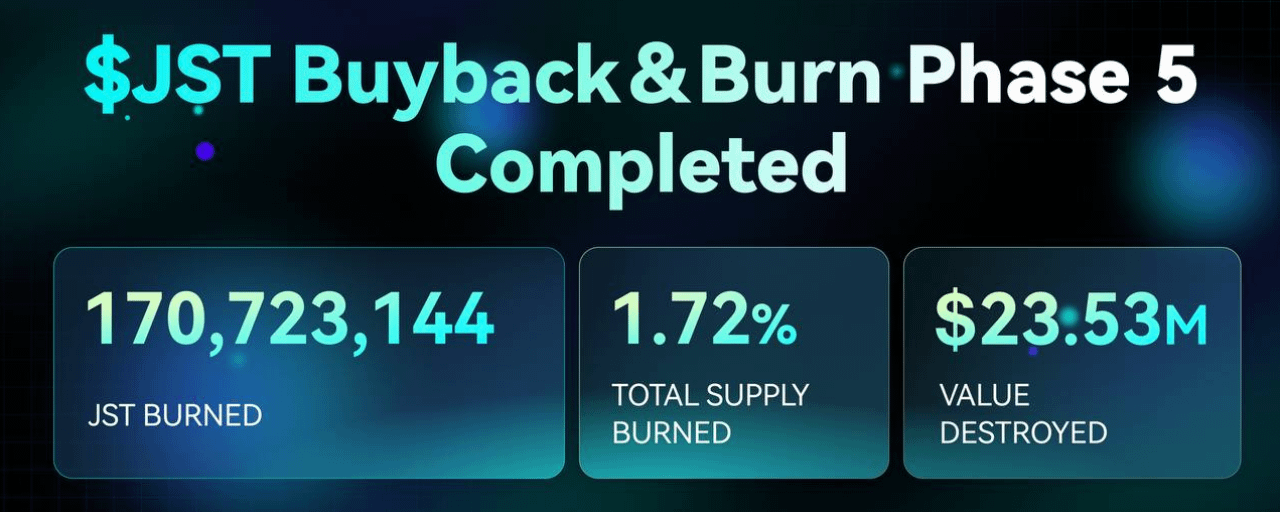
Article
JUST Completes 5th JST Buyback & Burn Over the past year, JUST has completed five consecutive large-scale buyback-and-burn rounds, permanently removing 1.88B JST tokens from circulation and pushing cumulative deflation toward 19%. Following this milestone, the buyback and burn mechanism is set to undergo a comprehensive upgrade.
On October 17, JUST, the leading DeFi infrastructure in the TRON ecosystem, announced the completion of its fifth buyback and burn of its native token JST as scheduled. Over 170M JST were burned in this round (approx. 1.72% of total supply), backed by nearly $23.53M in capital deployed—all funded directly by JustLend DAO's net operating revenue.
Over the past five rounds, a total of 1.88B JST tokens have been burned, driving the cumulative deflation rate past 19% with over $100M revenue deployed.
JST has reached a key operational milestone following this latest burn: the remaining 70% of JustLend DAO's initial treasury reserves has been fully deployed according to the original plan. This marks the successful completion of the first phase , paving the way for a major mechanism upgrade.
170M+ Tokens (~$23.53M) Burned in JST's Fifth Buyback Round
According to the official announcement released, the fifth JST buyback and burn was successfully completed. As a routine buyback for Q3 2026, a total of 170,723,144 JST tokens (approx. 170M) were burned, representing about 1.72% of the total token supply, with a total value exceeding $23.53M.
Maintaining similar levels of burn scale and capital investment to the previous four rounds, this burn round continues the stable, predictable execution cadence of JST buybacks and burns.
Looking further into the source of funds, the funds invested in this buyback and burn came entirely from JustLend DAO's net operating income, specifically composed of two parts: the remaining $10.34M from JustLend DAO's existing income and the $9.28M QoQ increase in Q3's net income.
In terms of quarterly revenue performance, JustLend DAO's Q3 net income remained steady compared to previous quarters. With quarterly earnings consistently anchored at the eight-figure ($10M+) level, the ecosystem's core revenue streams continue to prove their resilience.
At the same time, deploying the remaining 70% of the initial revenue reserve means that the early-stage treasury reserve plan has officially reached its conclusion—setting the stage for a brand-new phase of the buyback program.
One Year, Five Burns: JST's Price Soars 300% with $100M Deployed from JustLend DAO's Revenue
From its launch in October 2025 to the fifth round on October 16, 2026, the JST buyback and burn mechanism has completed one full year of operation across five consecutive burn rounds. A total of approximately 1.881B JST tokens have been burned, representing a cumulative deflation rate of > 19% with more than $100M deployed from JustLend's revenue.
A breakdown of the five buyback and burn executions is as follows:
- Round 1 (October 19, 2025): Burned ~559M JST (~5.66% of total supply), with ~$17.72M deployed.
- Round 2 (January 14, 2026): Burned ~525M JST (~5.3% of total supply), with ~$21M deployed.
- Round 3 (April 15, 2026): Burned ~271M JST (~2.74% of total supply), with ~$21.3M deployed.
- Round 4 (July 17, 2026): Burned a total of ~355M JST (~3.59% of total supply), with ~$34.59M deployed. In addition to the routine quarterly buyback, this round incorporated dedicated burn funds from USDJ's historical stability fees (~$10.39M) for the first time.
- Round 5 (October 16, 2026): Burned ~170M JST (~1.72% of total supply), with ~$23.53M deployed.
In terms of operational intensity, the execution of five consecutive rounds in a single year—averaging roughly $20M per round, with over $100M committed from real protocol earnings and nearly one-fifth of the total token supply burned—places JST among a select tier of buyback programs rarely seen in the DeFi sector.
This continuous execution has transformed the buyback from a series of short-term news catalysts into a permanent value engine. Rather than acting as an isolated marketing tactic, the program transmits its impact systematically through a five-pillar chain: Capital Foundation—Execution Assurance—Transparency & Trust—Deflationary Scarcity—Market Feedback, cementing a durable foundation for long-term valuation.
On the capital foundation, JST buybacks rely directly on authentic business cash flows. Except for the historical USDJ stability fee allocation in Round 4, every dollar of the $100M+ deployed across all five rounds originated directly from JustLend DAO's organic operating earnings.
In execution assurance, both capital scale and operational cadence have been uncompromisingly delivered. Single-round commitments began at $17.72M in Round 1, stabilized around $20M thereafter, and reached $34.59M in Round 4. Throughout all five quarters, every burn landed strictly on schedule—free from delays, disruptions, or arbitrary cuts.
For transparency and trust, every buyback follows the standard procedure of "pre-disclosed rules, on-schedule execution, and verifiable on-chain proof", backed by immutable on-chain transaction records and open official disclosures.
In deflationary impact, around 1.881B JST tokens have been burned across five rounds, contracting total supply from 9.9B down to ~8.02B—a nearly 19% reduction that continuously compounds structural scarcity.
Ultimately, market feedback validates the mechanism through synchronized gains in both token price and market cap. CoinGecko data shows JST climbing steadily from its ~$0.03 low in October 2025 to an October 10 peak of $0.142—a 300%+ year-to-date surge marking a new high since 2022—while circulating market cap surged past $1B.
This closed-loop flywheel—fueled by authentic revenue, reliable execution, complete transparency, structural deflation, and market validation—has elevated the buyback program far beyond short-term hype, solidifying it as the central pillar sustaining JST's long-term economic value.
Buyback Mechanism Poised for Comprehensive Upgrade as Capital Sources Diversify
With five consecutive rounds now complete, the JST buyback program arrives at a watershed moment: the first phase officially concludes, setting the stage for a new upgraded phase.
Looking back at the initial phase, the framework was initially structured to draw backing jointly from JustLend DAO and USDD. Under the original terms, USDD's cross-chain ecosystem revenue was to feed into the buyback pool once cumulative earnings hit $10M—a threshold not yet reached. Consequently, this early phase operated primarily on JustLend DAO's accumulated treasury reserves alongside the increment in quarterly net revenue. Specifically, the $59M+ reserve earmarked at inception under the plan of "30% upfront, 70% in phased tranches" has now been fully deployed across five rounds. This signifies that the initial phase has smoothly achieved its objectives, clearing the path for the comprehensive upgrade.
As outlined in the JST Q1 2026 financial report released in April, the upgraded JST buyback mechanism will broaden capital sources beyond the existing framework by incorporating revenues from new business streams such as GasFree, providing deeper and more diversified funding for ongoing buybacks.
With the upgraded phase around the corner, JST's long-term deflationary momentum and value-return capabilities are poised to enter an even more sustainable and predictable cycle.
JUST Completes 5th JST Buyback & Burn
Over the past year, JUST has completed five consecutive large-scale buyback-and-burn rounds, permanently removing 1.88B JST tokens from circulation and pushing cumulative deflation toward 19%. Following this milestone, the buyback and burn mechanism is set to undergo a comprehensive upgrade.
On October 17, JUST, the leading DeFi infrastructure in the TRON ecosystem, announced the completion of its fifth buyback and burn of its native token JST as scheduled. Over 170M JST were burned in this round (approx. 1.72% of total supply), backed by nearly $23.53M in capital deployed—all funded directly by JustLend DAO's net operating revenue.
Over the past five rounds, a total of 1.88B JST tokens have been burned, driving the cumulative deflation rate past 19% with over $100M revenue deployed.
JST has reached a key operational milestone following this latest burn: the remaining 70% of JustLend DAO's initial treasury reserves has been fully deployed according to the original plan. This marks the successful completion of the first phase , paving the way for a major mechanism upgrade.
170M+ Tokens (~$23.53M) Burned in JST's Fifth Buyback Round
According to the official announcement released, the fifth JST buyback and burn was successfully completed. As a routine buyback for Q3 2026, a total of 170,723,144 JST tokens (approx. 170M) were burned, representing about 1.72% of the total token supply, with a total value exceeding $23.53M.
Maintaining similar levels of burn scale and capital investment to the previous four rounds, this burn round continues the stable, predictable execution cadence of JST buybacks and burns.
Looking further into the source of funds, the funds invested in this buyback and burn came entirely from JustLend DAO's net operating income, specifically composed of two parts: the remaining $10.34M from JustLend DAO's existing income and the $9.28M QoQ increase in Q3's net income.
In terms of quarterly revenue performance, JustLend DAO's Q3 net income remained steady compared to previous quarters. With quarterly earnings consistently anchored at the eight-figure ($10M+) level, the ecosystem's core revenue streams continue to prove their resilience.
At the same time, deploying the remaining 70% of the initial revenue reserve means that the early-stage treasury reserve plan has officially reached its conclusion—setting the stage for a brand-new phase of the buyback program.
One Year, Five Burns: JST's Price Soars 300% with $100M Deployed from JustLend DAO's Revenue
From its launch in October 2025 to the fifth round on October 16, 2026, the JST buyback and burn mechanism has completed one full year of operation across five consecutive burn rounds. A total of approximately 1.881B JST tokens have been burned, representing a cumulative deflation rate of > 19% with more than $100M deployed from JustLend's revenue.
A breakdown of the five buyback and burn executions is as follows:
- Round 1 (October 19, 2025): Burned ~559M JST (~5.66% of total supply), with ~$17.72M deployed.
- Round 2 (January 14, 2026): Burned ~525M JST (~5.3% of total supply), with ~$21M deployed.
- Round 3 (April 15, 2026): Burned ~271M JST (~2.74% of total supply), with ~$21.3M deployed.
- Round 4 (July 17, 2026): Burned a total of ~355M JST (~3.59% of total supply), with ~$34.59M deployed. In addition to the routine quarterly buyback, this round incorporated dedicated burn funds from USDJ's historical stability fees (~$10.39M) for the first time.
- Round 5 (October 16, 2026): Burned ~170M JST (~1.72% of total supply), with ~$23.53M deployed.
In terms of operational intensity, the execution of five consecutive rounds in a single year—averaging roughly $20M per round, with over $100M committed from real protocol earnings and nearly one-fifth of the total token supply burned—places JST among a select tier of buyback programs rarely seen in the DeFi sector.
This continuous execution has transformed the buyback from a series of short-term news catalysts into a permanent value engine. Rather than acting as an isolated marketing tactic, the program transmits its impact systematically through a five-pillar chain: Capital Foundation—Execution Assurance—Transparency & Trust—Deflationary Scarcity—Market Feedback, cementing a durable foundation for long-term valuation.
On the capital foundation, JST buybacks rely directly on authentic business cash flows. Except for the historical USDJ stability fee allocation in Round 4, every dollar of the $100M+ deployed across all five rounds originated directly from JustLend DAO's organic operating earnings.
In execution assurance, both capital scale and operational cadence have been uncompromisingly delivered. Single-round commitments began at $17.72M in Round 1, stabilized around $20M thereafter, and reached $34.59M in Round 4. Throughout all five quarters, every burn landed strictly on schedule—free from delays, disruptions, or arbitrary cuts.
For transparency and trust, every buyback follows the standard procedure of "pre-disclosed rules, on-schedule execution, and verifiable on-chain proof", backed by immutable on-chain transaction records and open official disclosures.
In deflationary impact, around 1.881B JST tokens have been burned across five rounds, contracting total supply from 9.9B down to ~8.02B—a nearly 19% reduction that continuously compounds structural scarcity.
Ultimately, market feedback validates the mechanism through synchronized gains in both token price and market cap. CoinGecko data shows JST climbing steadily from its ~$0.03 low in October 2025 to an October 10 peak of $0.142—a 300%+ year-to-date surge marking a new high since 2022—while circulating market cap surged past $1B.
This closed-loop flywheel—fueled by authentic revenue, reliable execution, complete transparency, structural deflation, and market validation—has elevated the buyback program far beyond short-term hype, solidifying it as the central pillar sustaining JST's long-term economic value.
Buyback Mechanism Poised for Comprehensive Upgrade as Capital Sources Diversify
With five consecutive rounds now complete, the JST buyback program arrives at a watershed moment: the first phase officially concludes, setting the stage for a new upgraded phase.
Looking back at the initial phase, the framework was initially structured to draw backing jointly from JustLend DAO and USDD. Under the original terms, USDD's cross-chain ecosystem revenue was to feed into the buyback pool once cumulative earnings hit $10M—a threshold not yet reached. Consequently, this early phase operated primarily on JustLend DAO's accumulated treasury reserves alongside the increment in quarterly net revenue. Specifically, the $59M+ reserve earmarked at inception under the plan of "30% upfront, 70% in phased tranches" has now been fully deployed across five rounds. This signifies that the initial phase has smoothly achieved its objectives, clearing the path for the comprehensive upgrade.
As outlined in the JST Q1 2026 financial report released in April, the upgraded JST buyback mechanism will broaden capital sources beyond the existing framework by incorporating revenues from new business streams such as GasFree, providing deeper and more diversified funding for ongoing buybacks.
With the upgraded phase around the corner, JST's long-term deflationary momentum and value-return capabilities are poised to enter an even more sustainable and predictable cycle.
121
Article
DSA Joins Nacha Payments Innovation Alliance Fall Meeting to Discuss the Future of Digital PaymentsThe Digital Sovereignty Alliance (DSA), a nonprofit organization dedicated to advancing clear and ethical public policy, research, and education related to emerging technologies, participated in Nacha’s Payments Innovation Alliance Fall Meeting, where DSA Senior Policy Advisor Molly Woodman joined industry leaders to discuss emerging technologies, regulatory developments, and the future of domestic and global payments.
Held October 14-16 at the InterContinental Chicago Magnificent Mile in Chicago, Illinois, the three-day meeting brought together stakeholders from across the financial services and payments industries to exchange insights, address operational challenges, and explore opportunities for innovation. Discussions focused on evolving payment technologies, regulatory considerations, and practical approaches to navigating an increasingly complex financial landscape.
As part of the Alliance’s ongoing initiatives, Woodman facilitated discussions surrounding the newly launched Next-Gen Currency Project Team, a project co-led by Nacha and DSA. The team explores the global use of digital assets, including stablecoins and tokenized deposits, for money movement. Its work focuses on developing tools to bridge digital assets and traditional payment systems, tracking regulatory developments, identifying operational implications, and providing educational resources to the payments industry.
Throughout the meeting, participants also examined practical challenges facing financial institutions as emerging technologies reshape payment systems. Topics included expectations for financial institutions regarding agentic payments, the reliability of multifactor authentication methods as technology evolves, and emerging approaches to Know Your Agent (KYA) frameworks. Discussions highlighted the importance of industry collaboration in addressing operational uncertainties and developing workable solutions as regulatory frameworks continue to evolve.
“It’s been encouraging to watch financial institutions brainstorm together on how to build some continuity in areas where regulation hasn’t caught up yet,” said Molly Woodman, Senior Policy Advisor at DSA.
DSA’s participation reflects its ongoing commitment to supporting informed policy discussions and collaboration across the financial services and emerging technology sectors. Through its involvement in the Next-Gen Currency Project Team and broader industry engagement, DSA works to advance approaches that support responsible innovation, regulatory clarity, and the integration of emerging technologies into the evolving payments landscape.
About the Digital Sovereignty Alliance
The Digital Sovereignty Alliance (DSA) is a nonprofit social welfare organization committed to advocating for public policies that support ethical innovation in decentralized technologies, blockchain, cryptocurrency, Web3, and artificial intelligence. DSA conducts research, organizes educational events, and promotes policies that prioritize public welfare and digital sovereignty.
DSA Joins Nacha Payments Innovation Alliance Fall Meeting to Discuss the Future of Digital Payments
The Digital Sovereignty Alliance (DSA), a nonprofit organization dedicated to advancing clear and ethical public policy, research, and education related to emerging technologies, participated in Nacha’s Payments Innovation Alliance Fall Meeting, where DSA Senior Policy Advisor Molly Woodman joined industry leaders to discuss emerging technologies, regulatory developments, and the future of domestic and global payments.
Held October 14-16 at the InterContinental Chicago Magnificent Mile in Chicago, Illinois, the three-day meeting brought together stakeholders from across the financial services and payments industries to exchange insights, address operational challenges, and explore opportunities for innovation. Discussions focused on evolving payment technologies, regulatory considerations, and practical approaches to navigating an increasingly complex financial landscape.
As part of the Alliance’s ongoing initiatives, Woodman facilitated discussions surrounding the newly launched Next-Gen Currency Project Team, a project co-led by Nacha and DSA. The team explores the global use of digital assets, including stablecoins and tokenized deposits, for money movement. Its work focuses on developing tools to bridge digital assets and traditional payment systems, tracking regulatory developments, identifying operational implications, and providing educational resources to the payments industry.
Throughout the meeting, participants also examined practical challenges facing financial institutions as emerging technologies reshape payment systems. Topics included expectations for financial institutions regarding agentic payments, the reliability of multifactor authentication methods as technology evolves, and emerging approaches to Know Your Agent (KYA) frameworks. Discussions highlighted the importance of industry collaboration in addressing operational uncertainties and developing workable solutions as regulatory frameworks continue to evolve.
“It’s been encouraging to watch financial institutions brainstorm together on how to build some continuity in areas where regulation hasn’t caught up yet,” said Molly Woodman, Senior Policy Advisor at DSA.
DSA’s participation reflects its ongoing commitment to supporting informed policy discussions and collaboration across the financial services and emerging technology sectors. Through its involvement in the Next-Gen Currency Project Team and broader industry engagement, DSA works to advance approaches that support responsible innovation, regulatory clarity, and the integration of emerging technologies into the evolving payments landscape.
About the Digital Sovereignty Alliance
The Digital Sovereignty Alliance (DSA) is a nonprofit social welfare organization committed to advocating for public policies that support ethical innovation in decentralized technologies, blockchain, cryptocurrency, Web3, and artificial intelligence. DSA conducts research, organizes educational events, and promotes policies that prioritize public welfare and digital sovereignty.
55
Article
Bitcoin's Quantum Transition Won't Stop at BitcoinAs quantum computing advances, the challenge extends beyond Bitcoin's cryptography to the financial infrastructure built around it.
Quantum computing is emerging as one of Bitcoin's long-term security challenges. A sufficiently powerful quantum computer could theoretically compromise the digital signatures protecting Bitcoin transactions, potentially exposing funds associated with vulnerable public keys.
While no publicly demonstrated quantum computer is currently capable of such an attack at scale, the implications extend beyond Bitcoin itself. As Bitcoin becomes increasingly integrated into decentralized finance (DeFi) through tokenized assets such as Wrapped Bitcoin (WBTC), a future cryptographic transition would affect not only the Bitcoin network, but also the financial infrastructure built around it.
The question is no longer simply whether Bitcoin can become quantum-resistant, but whether the broader ecosystem can evolve alongside it.
Beyond the Bitcoin Network
Bitcoin's transition to quantum-resistant cryptography would require more than introducing new signature schemes. Wallets, exchanges, custodians and infrastructure providers would need to adapt their systems, potentially migrating existing BTC holdings to new security standards.
Proposals such as BIP-360 reflect ongoing efforts to explore Bitcoin's future cryptographic architecture. Yet coordinating adoption across a decentralized ecosystem could take years.
For tokenized Bitcoin, the challenge becomes more complex. Even if Bitcoin adopts quantum-resistant cryptography, the custody systems, smart contracts and networks supporting tokenized assets would still require independent security assessments.
Securing Bitcoin itself does not automatically secure everything built around it.
WBTC and the Next Generation of Bitcoin Infrastructure
As an established tokenized Bitcoin asset in DeFi, WBTC illustrates the scale and complexity of securing Bitcoin across multiple financial ecosystems.
With 116,000 WBTC in circulation, representing approximately $9.5 billion in Bitcoin-backed assets, WBTC's infrastructure supports Bitcoin liquidity across lending protocols, decentralized exchanges and multiple blockchain networks.
Backed 1:1 by BTC held in custody, WBTC's long-term resilience depends not only on Bitcoin's underlying cryptography, but also on reserve security, custody operations and the infrastructure supporting minting and redemption.
A future quantum-resistant transition could require custodians to evaluate their key-management systems, migrate underlying BTC reserves and maintain operational continuity throughout the process.
Against this backdrop, WBTC is preparing to migrate to new Custodian Bitcoin Deposit Addresses (CBDAs) as part of its custody infrastructure management. Bitcoin address management is relevant to long-term security because public-key exposure can influence vulnerability to potential quantum attacks. However, the security implications depend on address types and transaction histories, and address migration alone does not establish quantum resistance.
WBTC has also publicly announced its exploration of a multi-custodian reserve model, aimed at reducing custody concentration risk and strengthening operational resilience. While diversification does not directly address quantum vulnerabilities, it could provide greater flexibility as security standards evolve, depending on implementation.
Together, these initiatives highlight the importance of both reserve security and operational resilience as Bitcoin's financial ecosystem expands. Neither replaces the need for quantum-resistant cryptography, but both illustrate the infrastructure considerations involved in preparing for future changes.
Preparing for the Next Era
The timeline for quantum computing remains uncertain, but preparing for potential cryptographic changes is a long-term challenge for the entire Bitcoin ecosystem.
For WBTC, this means considering how custody arrangements, reserve management and supporting blockchain infrastructure could evolve alongside Bitcoin's security standards.
Bitcoin's quantum transition may begin with cryptography, but its success will depend on the resilience of the infrastructure connecting Bitcoin to the wider financial ecosystem.
About WBTC - Bitcoin’s Passport to DEFI
WBTC is the new Bitcoin standard. A singular identity for Bitcoin across multiple chains. It brings Bitcoin into environments where speed, capital efficiency, and scale are essential, while maintaining fidelity to Bitcoin’s original principles. There is no second. WBTC stands alone in its role, trusted, verifiable, and engineered for a multichain world.
Disclaimer: Information provided is for information purposes only and is not financial advice. No representation or warranty has been made as to the content, accuracy, timeliness, suitability or completeness of such information. Participation in DeFi carries risks, always do your own research.
Bitcoin's Quantum Transition Won't Stop at Bitcoin
As quantum computing advances, the challenge extends beyond Bitcoin's cryptography to the financial infrastructure built around it.
Quantum computing is emerging as one of Bitcoin's long-term security challenges. A sufficiently powerful quantum computer could theoretically compromise the digital signatures protecting Bitcoin transactions, potentially exposing funds associated with vulnerable public keys.
While no publicly demonstrated quantum computer is currently capable of such an attack at scale, the implications extend beyond Bitcoin itself. As Bitcoin becomes increasingly integrated into decentralized finance (DeFi) through tokenized assets such as Wrapped Bitcoin (WBTC), a future cryptographic transition would affect not only the Bitcoin network, but also the financial infrastructure built around it.
The question is no longer simply whether Bitcoin can become quantum-resistant, but whether the broader ecosystem can evolve alongside it.
Beyond the Bitcoin Network
Bitcoin's transition to quantum-resistant cryptography would require more than introducing new signature schemes. Wallets, exchanges, custodians and infrastructure providers would need to adapt their systems, potentially migrating existing BTC holdings to new security standards.
Proposals such as BIP-360 reflect ongoing efforts to explore Bitcoin's future cryptographic architecture. Yet coordinating adoption across a decentralized ecosystem could take years.
For tokenized Bitcoin, the challenge becomes more complex. Even if Bitcoin adopts quantum-resistant cryptography, the custody systems, smart contracts and networks supporting tokenized assets would still require independent security assessments.
Securing Bitcoin itself does not automatically secure everything built around it.
WBTC and the Next Generation of Bitcoin Infrastructure
As an established tokenized Bitcoin asset in DeFi, WBTC illustrates the scale and complexity of securing Bitcoin across multiple financial ecosystems.
With 116,000 WBTC in circulation, representing approximately $9.5 billion in Bitcoin-backed assets, WBTC's infrastructure supports Bitcoin liquidity across lending protocols, decentralized exchanges and multiple blockchain networks.
Backed 1:1 by BTC held in custody, WBTC's long-term resilience depends not only on Bitcoin's underlying cryptography, but also on reserve security, custody operations and the infrastructure supporting minting and redemption.
A future quantum-resistant transition could require custodians to evaluate their key-management systems, migrate underlying BTC reserves and maintain operational continuity throughout the process.
Against this backdrop, WBTC is preparing to migrate to new Custodian Bitcoin Deposit Addresses (CBDAs) as part of its custody infrastructure management. Bitcoin address management is relevant to long-term security because public-key exposure can influence vulnerability to potential quantum attacks. However, the security implications depend on address types and transaction histories, and address migration alone does not establish quantum resistance.
WBTC has also publicly announced its exploration of a multi-custodian reserve model, aimed at reducing custody concentration risk and strengthening operational resilience. While diversification does not directly address quantum vulnerabilities, it could provide greater flexibility as security standards evolve, depending on implementation.
Together, these initiatives highlight the importance of both reserve security and operational resilience as Bitcoin's financial ecosystem expands. Neither replaces the need for quantum-resistant cryptography, but both illustrate the infrastructure considerations involved in preparing for future changes.
Preparing for the Next Era
The timeline for quantum computing remains uncertain, but preparing for potential cryptographic changes is a long-term challenge for the entire Bitcoin ecosystem.
For WBTC, this means considering how custody arrangements, reserve management and supporting blockchain infrastructure could evolve alongside Bitcoin's security standards.
Bitcoin's quantum transition may begin with cryptography, but its success will depend on the resilience of the infrastructure connecting Bitcoin to the wider financial ecosystem.
About WBTC - Bitcoin’s Passport to DEFI
WBTC is the new Bitcoin standard. A singular identity for Bitcoin across multiple chains. It brings Bitcoin into environments where speed, capital efficiency, and scale are essential, while maintaining fidelity to Bitcoin’s original principles. There is no second. WBTC stands alone in its role, trusted, verifiable, and engineered for a multichain world.
Disclaimer: Information provided is for information purposes only and is not financial advice. No representation or warranty has been made as to the content, accuracy, timeliness, suitability or completeness of such information. Participation in DeFi carries risks, always do your own research.
108
Article
XDC now listed on Robinhood, expanding access to millions of U.S. usersThe XDC token is available to trade for eligible U.S. customers on Robinhood Crypto starting today, bringing a blockchain built for trade finance and institutional settlement to a mainstream retail audience
Robinhood Crypto has integrated support for XDC Network, allowing eligible U.S. retail customers to trade the XDC token on its platform from now. The listing opens XDC, the native token of a Layer-1 blockchain built for trade finance, payments and tokenized real-world assets, to 2.3 million users on the Robinhood platform.
“We built XDC for the part of finance most people never see, the payments, documents and settlement that keep global trade moving,” says Ritesh Kakkad, Co-Founder, XDC Network. “Trade finance proved what the network can do. Bringing it to retail users widens who can access that infrastructure without changing what it is built for. The same network institutions rely on to move value across borders is now within reach of everyday users.”
Until now, XDC has been mostly leveraged by institutions, including banks, trade finance providers, tokenization platforms and developers. From now, it is also available to everyday U.S. traders on Robinhood, next to bitcoin and ether.
The listing follows steady institutional growth on the network. Deutsche Telekom, SBI Holdings, NTT DOCOMO Global and Clear Street are among the firms running validators on XDC.
The listing follows a run of institutional partnerships across the network. Deutsche Telekom, SBI Holdings, NTT DOCOMO Global, Clear Street and Taurus are among the firms helping run and secure XDC as validators. On the payments side, XDC has integrated with Bridge, a Stripe company, joined Mastercard’s Crypto Partner Program and powers OrbitX’s USDC corporate cards, which let businesses spend digital balances on everyday expenses.
Trade finance rarely makes headlines, yet the World Trade Organization estimates that up to 80% of global trade depends on it. Access to it is uneven. The Asian Development Bank puts the gap between what businesses request and what banks approve at about $2.5 trillion, and small and mid-sized exporters are turned away most often, partly because much of the process still runs on paper. XDC Network moves trade documents and payments on chain, cutting the time and cost of settlement. Its ISO 20022 compatibility lets it connect with the messaging systems banks already use.
Not all crypto assets are available in every state. Trading digital assets involves significant risk, including the risk of substantial loss. Access on Robinhood is subject to its terms and eligibility requirements. This announcement is for information only and does not constitute investment advice.
About XDC Network
XDC Network is an open-source, EVM-compatible Layer-1 blockchain built for payments, trade finance and real-world assets, offering high throughput, low fees and enterprise-grade security, while being ISO 20022–compliant to support interoperability with global financial messaging and payment systems. XDC Network underpins a growing ecosystem of regulated digital money, trade, and settlement solutions across the globe.
XDC now listed on Robinhood, expanding access to millions of U.S. users
The XDC token is available to trade for eligible U.S. customers on Robinhood Crypto starting today, bringing a blockchain built for trade finance and institutional settlement to a mainstream retail audience
Robinhood Crypto has integrated support for XDC Network, allowing eligible U.S. retail customers to trade the XDC token on its platform from now. The listing opens XDC, the native token of a Layer-1 blockchain built for trade finance, payments and tokenized real-world assets, to 2.3 million users on the Robinhood platform.
“We built XDC for the part of finance most people never see, the payments, documents and settlement that keep global trade moving,” says Ritesh Kakkad, Co-Founder, XDC Network. “Trade finance proved what the network can do. Bringing it to retail users widens who can access that infrastructure without changing what it is built for. The same network institutions rely on to move value across borders is now within reach of everyday users.”
Until now, XDC has been mostly leveraged by institutions, including banks, trade finance providers, tokenization platforms and developers. From now, it is also available to everyday U.S. traders on Robinhood, next to bitcoin and ether.
The listing follows steady institutional growth on the network. Deutsche Telekom, SBI Holdings, NTT DOCOMO Global and Clear Street are among the firms running validators on XDC.
The listing follows a run of institutional partnerships across the network. Deutsche Telekom, SBI Holdings, NTT DOCOMO Global, Clear Street and Taurus are among the firms helping run and secure XDC as validators. On the payments side, XDC has integrated with Bridge, a Stripe company, joined Mastercard’s Crypto Partner Program and powers OrbitX’s USDC corporate cards, which let businesses spend digital balances on everyday expenses.
Trade finance rarely makes headlines, yet the World Trade Organization estimates that up to 80% of global trade depends on it. Access to it is uneven. The Asian Development Bank puts the gap between what businesses request and what banks approve at about $2.5 trillion, and small and mid-sized exporters are turned away most often, partly because much of the process still runs on paper. XDC Network moves trade documents and payments on chain, cutting the time and cost of settlement. Its ISO 20022 compatibility lets it connect with the messaging systems banks already use.
Not all crypto assets are available in every state. Trading digital assets involves significant risk, including the risk of substantial loss. Access on Robinhood is subject to its terms and eligibility requirements. This announcement is for information only and does not constitute investment advice.
About XDC Network
XDC Network is an open-source, EVM-compatible Layer-1 blockchain built for payments, trade finance and real-world assets, offering high throughput, low fees and enterprise-grade security, while being ISO 20022–compliant to support interoperability with global financial messaging and payment systems. XDC Network underpins a growing ecosystem of regulated digital money, trade, and settlement solutions across the globe.
4
Article
BingX EU Secures MiCAR License, Advancing Regulated Crypto Services Across EuropeVIENNA, October 15, 2026 – BingX EU (MEGE zweite GmbH) has secured its Markets in Crypto-Assets Regulation (MiCA or MiCAR) license from Austria’s Financial Market Authority (FMA), that will enable the platform to offer regulated crypto services across 29 countries of the European Economic Area (EEA), subject to ongoing passporting arrangements. The authorization marks a significant milestone in BingX's European expansion, providing EEA users with access to digital asset services under a unified regulatory framework built on transparency, security, and investor protection.
The authorization reflects BingX EU's long-term commitment to responsible growth in Europe. As digital assets become increasingly integrated into the financial system, regulatory clarity plays an essential role in strengthening user confidence, supporting institutional participation, and enabling sustainable industry development. Through its regulated European entity, BingX EU will provide compliant crypto services designed to meet the evolving needs of both retail and institutional users across the EEA.
"Our priority is to provide European users with trusted and locally regulated trading experience," said Daniel Lai, Chief Executive Officer of BingX EU. "Operating under MiCAR will allow us to deliver our services under a clear regulatory framework that gives users confidence while supporting the long-term development of Europe's digital ecosystem. It also enables us to combine innovation with the high standards of security, transparency and accountability that European users and institutions expect. We believe this foundation can help create a more accessible and sustainable environment for the continued adoption of digital assets across the region."
Looking forward, BingX EU will continue working closely with Austria’s FMA and other European regulators as it prepares for the launch of its regulated services across the European Economic Area. BingX EU remains committed to operating within Europe’s regulatory framework while providing users with secure, transparent and compliant access to digital asset services.
About BingX EU
MEGE zweite GmbH ("BingX EU") is a MiCAR-regulated crypto-asset platform, headquartered in Vienna, licensed as a Crypto-Asset Service Provider (CASP) under the Markets in Crypto-Assets Regulation (MiCAR). Dedicated to serving clients across 29 countries in the European Economic Area, BingX EU delivers fully regulated services in alignment with European standards for investor protection and market integrity. Under its MiCAR authorization, BingX EU provides a platform that offers regulated broker services, such as crypto custody, exchange, and other crypto services.
About BingX
Founded in 2018, BingX is one of the the world’s leading multi-asset trading platform, serving more than 40 million users worldwide. The company has been the Principal Partner of Chelsea FC since 2024 and became the Official Team Partner of Scuderia Ferrari HP in 2026.
Disclaimers: The content qualifies as a marketing communication under the Markets in Crypto-Assets Regulation (MiCAR) and is issued by MEGE zweite GmbH (BingX EU). It does not constitute investment advice.
BingX EU Secures MiCAR License, Advancing Regulated Crypto Services Across Europe
VIENNA, October 15, 2026 – BingX EU (MEGE zweite GmbH) has secured its Markets in Crypto-Assets Regulation (MiCA or MiCAR) license from Austria’s Financial Market Authority (FMA), that will enable the platform to offer regulated crypto services across 29 countries of the European Economic Area (EEA), subject to ongoing passporting arrangements. The authorization marks a significant milestone in BingX's European expansion, providing EEA users with access to digital asset services under a unified regulatory framework built on transparency, security, and investor protection.
The authorization reflects BingX EU's long-term commitment to responsible growth in Europe. As digital assets become increasingly integrated into the financial system, regulatory clarity plays an essential role in strengthening user confidence, supporting institutional participation, and enabling sustainable industry development. Through its regulated European entity, BingX EU will provide compliant crypto services designed to meet the evolving needs of both retail and institutional users across the EEA.
"Our priority is to provide European users with trusted and locally regulated trading experience," said Daniel Lai, Chief Executive Officer of BingX EU. "Operating under MiCAR will allow us to deliver our services under a clear regulatory framework that gives users confidence while supporting the long-term development of Europe's digital ecosystem. It also enables us to combine innovation with the high standards of security, transparency and accountability that European users and institutions expect. We believe this foundation can help create a more accessible and sustainable environment for the continued adoption of digital assets across the region."
Looking forward, BingX EU will continue working closely with Austria’s FMA and other European regulators as it prepares for the launch of its regulated services across the European Economic Area. BingX EU remains committed to operating within Europe’s regulatory framework while providing users with secure, transparent and compliant access to digital asset services.
About BingX EU
MEGE zweite GmbH ("BingX EU") is a MiCAR-regulated crypto-asset platform, headquartered in Vienna, licensed as a Crypto-Asset Service Provider (CASP) under the Markets in Crypto-Assets Regulation (MiCAR). Dedicated to serving clients across 29 countries in the European Economic Area, BingX EU delivers fully regulated services in alignment with European standards for investor protection and market integrity. Under its MiCAR authorization, BingX EU provides a platform that offers regulated broker services, such as crypto custody, exchange, and other crypto services.
About BingX
Founded in 2018, BingX is one of the the world’s leading multi-asset trading platform, serving more than 40 million users worldwide. The company has been the Principal Partner of Chelsea FC since 2024 and became the Official Team Partner of Scuderia Ferrari HP in 2026.
Disclaimers: The content qualifies as a marketing communication under the Markets in Crypto-Assets Regulation (MiCAR) and is issued by MEGE zweite GmbH (BingX EU). It does not constitute investment advice.
3
Article
Cumulative TradFi Trading Volume Approaches $6B Amid 13th Anniversary CelebrationApia, Samoa, October 14, 2026 - The crypto market saw a notable rally in the just-concluded third quarter. It was also the quarter in which HTX turned 13. Over the past 13 years, the industry has weathered multiple bull and bear cycles, and HTX has stood alongside users worldwide throughout them. Resilience in navigating market cycles has been a defining characteristic of HTX over the past 13 years.
To mark its anniversary themed "Resilience Reveals the Future", HTX launched the 13th-Anniversary Carnival and Trading Championship #3, among other celebratory events, in the third quarter, celebrating alongside users worldwide. Meanwhile, the platform continued to invest in TradFi, trending assets, yield products, and global compliance, delivering an outstanding quarterly performance report.
13th-Anniversary Celebrations Conclude, with Participation from Users Worldwide
On August 13, HTX kicked off its 13th-anniversary celebrations with the Anniversary Carnival. Its spot, futures, Earn and lending businesses rolled out exclusive anniversary promotions in succession, launching a celebration that lasted more than a month.
The annual trading competition Trading Championship #3 was the centerpiece of the anniversary celebrations. It attracted 45,000 registrations and generated 6.8 billion USDT in futures trading volume, making it the platform's largest campaign of the quarter by both participation and trading volume. Meanwhile, HTX futures copy trading volume grew 21% quarter over quarter.
For spot trading, a series of 13th-anniversary campaigns, including the Individual Challenge, Trending Cryptos Margin Trading Carnival, and Points Tasks, played a key role in driving spot trading growth during the quarter. Over the three-month period, HTX launched 14 themed spot trading campaigns, attracting more than 46,000 registrations and generating over 500 million USDT in trading volume across the campaigns.
For 13 years, HTX and users worldwide have navigated one market cycle after another together. The anniversary celebrations were both a gesture of appreciation for users’ long-term support and a reflection of HTX’s determination to carry its resilience into the next 13 years.
TradFi Asset Offerings Expand as Quarterly Trading Volume More Than Doubles
In the third quarter, HTX listed 183 new futures assets, including 154 stocks and index-related assets. As of now, the platform offers 278 tradable stock assets, spanning US stocks, major global indices and ETFs, pre-IPO unicorns, and leading companies in Japan and South Korea, continuing to lead the industry in multi-market stock asset coverage.
HTX's asset lineup focuses on four key sectors: AI hardware and semiconductor computing power, global e-commerce and internet companies, leading Asia-Pacific companies and major indices, and high-dividend blue-chip stocks. AI and semiconductor computing, leading Asia-Pacific companies, and pre-IPO unicorns were key themes throughout the quarter. Popular assets such as POLYMARKET, OURA and MOONSHOT were also listed. Eligible users can access global market opportunities through HTX without switching between platforms. This service is not available in jurisdictions subject to regulatory restrictions.
The expanded asset lineup drove rapid growth in trading volume. So far the cumulative TradFi trading volume on HTX has approached $6 billion, with $4.1 billion generated in the third quarter alone, more than doubling the cumulative total from the previous quarter.
The trading experience was upgraded alongside these developments. Stock perpetual futures feature a dividend settlement mechanism, allowing position values to adjust more continuously when an underlying stock goes ex-dividend and reducing the impact of non-trading-related price adjustments on users’ positions. TradFi asset detail pages include market data, news updates, and company profile, bringing key information together in one place. Dedicated categories for stocks, commodities and ETFs have also been added to market rankings, making it easier for users to discover assets. HTX has also upgraded its TradFi trading fee structure, bringing its net trading fees into the industry’s top tier.
HTX is also taking a longer-term view of the convergence of traditional finance and crypto markets. As real-world assets (RWAs), particularly tokenized stocks, become an increasingly important area of development in the global digital asset industry, the platform is monitoring regulatory developments and exploring regulatory frameworks and compliance pathways in preparation for future product innovation. All related products and services offered by the platform operate within the framework of applicable laws and regulations, and access restrictions are applied to users in certain jurisdictions as required.
Trending Assets Emerge as Earn and Lending Products Put Funds to Work Efficiently
In the third quarter, HTX listed new projects attracting strong market interest, several of which were first listed on the platform. Niulai was the quarter's top-performing newly listed token, recording a peak gain of more than 500%. DOS and STONK each recorded peak gains of 240% after listing.
Earn and lending products expanded alongside new asset listings. During the quarter, HTX Earn changed the launch schedule for its new-token products from weekly updates to real-time synchronization with new listings, allowing users to access corresponding Earn products as soon as eligible popular tokens become available. Nearly 500,000 users participated in HTX Earn during the quarter, with subscription amounts totaling nearly 1 billion USDT. SVIP Flexible Earn products added BTC and ETH, expanding the options available to users with large holdings. In addition, SmartEarn introduced a trading-linked APY boost, offering a base APY of 4% upon activation and up to 9% APY for users who meet the required trading volume threshold. This further expands the yield potential for idle assets.
Margin and Convert features added 21 tradable assets, with XAUT becoming the first precious metal asset available through Convert. This further expanded the range of assets available for trading, borrowing and use as collateral. Loan interest rates are adjusted frequently in response to market conditions across more than 50 cryptocurrencies. Interest rates for large loans remain among the lower levels in the industry.
Risk management tools were also upgraded. Trailing stop orders and MMR TP/SL orders were launched successively. Stop-loss levels can automatically track market movements, giving users with large positions and high leverage greater flexibility in managing risk.
Advancing Global Compliance and Making a Major Brand Appearance at TOKEN2049
Compliance is a prerequisite for global expansion. In the third quarter, HTX made further progress on compliance initiatives in several key markets. In Dubai, the establishment of the relevant applicant entity received preliminary approval from the Virtual Assets Regulatory Authority (VARA), with subsequent regulatory applications and compliance reviews proceeding as planned. In Pakistan, following the formal publication of virtual asset service regulations and the launch of a licensing application process, HTX continued to advance the establishment of its local entity, its formal license application, and the development of its compliance framework, building on the No Objection Certificate (NoC) already obtained from the Pakistan Virtual Assets Regulatory Authority (PVARA).
HTX continued to strengthen its presence in regional markets. In August, HTX Ventures participated in Conviction Vietnam, building connections with local users and Web3 ecosystem partners. As the fourth quarter began, HTX appeared at TOKEN2049, a major annual gathering for the global crypto industry. Held in Singapore from October 7–8, the event brought together projects, investment firms, developers, and industry builders from around the world. HTX Ventures exhibited at the Sands Expo and Convention Centre in Singapore, engaging invited guests through brand displays and on-site interactions. Justin Sun, adviser to HTX and a core supporter of HTX DAO, attended related events and delivered a speech. He visited the HTX Ventures booth to meet with the team and other industry participants.
At Future Night, a private, invitation-only event hosted by HTX DAO during the same period, Justin Sun shared his views on industry trends via video. He noted that the crypto industry is becoming more closely connected with traditional finance. AI is changing how wealth is created, while crypto and digital finance are transforming how wealth is held and transferred. He also said that stablecoins could play a greater role in global payments and settlement, while the on-chain adoption of traditional assets such as bonds, funds and gold is likely to continue developing. The free flow of value in the digital world, he said, will be an important trend to watch over the next decade.
During the event, HTX DAO also hosted a private VIP dinner. Justin Sun met face to face with industry representatives, ecosystem contributors, and partners to exchange views on industry developments, market changes, product experiences, and future collaboration.
HTX DAO Ecosystem Expands as Q3 $HTX Burn Approaches
HTX DAO continued to support the long-term value of $HTX in the third quarter by steadily implementing its deflationary mechanism through quarterly token burns, while expanding $HTX use cases and building consensus among developers and the community. These efforts aim to lay a solid foundation for the ecosystem's long-term development.
On July 15, HTX DAO completed its Q2 2026 $HTX token burn, valued at more than $13.6 million, bringing cumulative burns and donations to 117.79 trillion tokens. In line with its quarterly burn schedule, the Q3 $HTX token burn is scheduled to take place on October 15.
On the ecosystem front, HTX DAO focused on developers and the community. The Genesis Hackathon, co-hosted by HTX DAO and B.AI, attracted more than 200 developer teams exploring $HTX use cases, AI agent finance, on-chain asset management, and DAO tools. At Future Night, HTX DAO ambassador Molly shared that several projects developed by global university teams participating in the hackathon had advanced to further incubation stages and were exploring ways to integrate with use cases across the $HTX ecosystem.
Molly also shared that nearly 200 active volunteers were independently contributing to HTX DAO community development. In the fourth quarter, HTX DAO plans to develop regional community nodes to support members in organizing events and exchanging ideas. She also noted that HTX, as an ecosystem participant, continues to optimize withdrawal fees, gather user feedback, and improve the app experience.
Navigating Market Cycles with Resilience, Shaping the Future Together with Users Worldwide
Thirteen years ago, HTX began as a digital asset trading platform. Today, it has grown into a comprehensive blockchain ecosystem serving users worldwide. Over the years, markets have experienced both highs and lows, and the industry landscape has evolved. Throughout these changes, HTX has remained committed to putting users first. Regardless of market conditions, improving its products and prioritizing the security of user assets remain among the platform's top priorities.
Standing at the beginning of its 14th year, HTX will continue to navigate market cycles with resilience and build the future together with users worldwide.
About HTX
Founded in 2013, HTX has evolved from a virtual asset exchange into a comprehensive ecosystem of blockchain businesses that span digital asset trading, derivatives, research, investments, incubation, and other businesses.
Guided by its vision to “Achieve Financial Freedom for 8 Billion People Worldwide,” HTX works to make the digital asset space more accessible to a broader audience. The platform continues to develop its products and services in response to user needs and an evolving industry landscape.
Cumulative TradFi Trading Volume Approaches $6B Amid 13th Anniversary Celebration
Apia, Samoa, October 14, 2026 - The crypto market saw a notable rally in the just-concluded third quarter. It was also the quarter in which HTX turned 13. Over the past 13 years, the industry has weathered multiple bull and bear cycles, and HTX has stood alongside users worldwide throughout them. Resilience in navigating market cycles has been a defining characteristic of HTX over the past 13 years.
To mark its anniversary themed "Resilience Reveals the Future", HTX launched the 13th-Anniversary Carnival and Trading Championship #3, among other celebratory events, in the third quarter, celebrating alongside users worldwide. Meanwhile, the platform continued to invest in TradFi, trending assets, yield products, and global compliance, delivering an outstanding quarterly performance report.
13th-Anniversary Celebrations Conclude, with Participation from Users Worldwide
On August 13, HTX kicked off its 13th-anniversary celebrations with the Anniversary Carnival. Its spot, futures, Earn and lending businesses rolled out exclusive anniversary promotions in succession, launching a celebration that lasted more than a month.
The annual trading competition Trading Championship #3 was the centerpiece of the anniversary celebrations. It attracted 45,000 registrations and generated 6.8 billion USDT in futures trading volume, making it the platform's largest campaign of the quarter by both participation and trading volume. Meanwhile, HTX futures copy trading volume grew 21% quarter over quarter.
For spot trading, a series of 13th-anniversary campaigns, including the Individual Challenge, Trending Cryptos Margin Trading Carnival, and Points Tasks, played a key role in driving spot trading growth during the quarter. Over the three-month period, HTX launched 14 themed spot trading campaigns, attracting more than 46,000 registrations and generating over 500 million USDT in trading volume across the campaigns.
For 13 years, HTX and users worldwide have navigated one market cycle after another together. The anniversary celebrations were both a gesture of appreciation for users’ long-term support and a reflection of HTX’s determination to carry its resilience into the next 13 years.
TradFi Asset Offerings Expand as Quarterly Trading Volume More Than Doubles
In the third quarter, HTX listed 183 new futures assets, including 154 stocks and index-related assets. As of now, the platform offers 278 tradable stock assets, spanning US stocks, major global indices and ETFs, pre-IPO unicorns, and leading companies in Japan and South Korea, continuing to lead the industry in multi-market stock asset coverage.
HTX's asset lineup focuses on four key sectors: AI hardware and semiconductor computing power, global e-commerce and internet companies, leading Asia-Pacific companies and major indices, and high-dividend blue-chip stocks. AI and semiconductor computing, leading Asia-Pacific companies, and pre-IPO unicorns were key themes throughout the quarter. Popular assets such as POLYMARKET, OURA and MOONSHOT were also listed. Eligible users can access global market opportunities through HTX without switching between platforms. This service is not available in jurisdictions subject to regulatory restrictions.
The expanded asset lineup drove rapid growth in trading volume. So far the cumulative TradFi trading volume on HTX has approached $6 billion, with $4.1 billion generated in the third quarter alone, more than doubling the cumulative total from the previous quarter.
The trading experience was upgraded alongside these developments. Stock perpetual futures feature a dividend settlement mechanism, allowing position values to adjust more continuously when an underlying stock goes ex-dividend and reducing the impact of non-trading-related price adjustments on users’ positions. TradFi asset detail pages include market data, news updates, and company profile, bringing key information together in one place. Dedicated categories for stocks, commodities and ETFs have also been added to market rankings, making it easier for users to discover assets. HTX has also upgraded its TradFi trading fee structure, bringing its net trading fees into the industry’s top tier.
HTX is also taking a longer-term view of the convergence of traditional finance and crypto markets. As real-world assets (RWAs), particularly tokenized stocks, become an increasingly important area of development in the global digital asset industry, the platform is monitoring regulatory developments and exploring regulatory frameworks and compliance pathways in preparation for future product innovation. All related products and services offered by the platform operate within the framework of applicable laws and regulations, and access restrictions are applied to users in certain jurisdictions as required.
Trending Assets Emerge as Earn and Lending Products Put Funds to Work Efficiently
In the third quarter, HTX listed new projects attracting strong market interest, several of which were first listed on the platform. Niulai was the quarter's top-performing newly listed token, recording a peak gain of more than 500%. DOS and STONK each recorded peak gains of 240% after listing.
Earn and lending products expanded alongside new asset listings. During the quarter, HTX Earn changed the launch schedule for its new-token products from weekly updates to real-time synchronization with new listings, allowing users to access corresponding Earn products as soon as eligible popular tokens become available. Nearly 500,000 users participated in HTX Earn during the quarter, with subscription amounts totaling nearly 1 billion USDT. SVIP Flexible Earn products added BTC and ETH, expanding the options available to users with large holdings. In addition, SmartEarn introduced a trading-linked APY boost, offering a base APY of 4% upon activation and up to 9% APY for users who meet the required trading volume threshold. This further expands the yield potential for idle assets.
Margin and Convert features added 21 tradable assets, with XAUT becoming the first precious metal asset available through Convert. This further expanded the range of assets available for trading, borrowing and use as collateral. Loan interest rates are adjusted frequently in response to market conditions across more than 50 cryptocurrencies. Interest rates for large loans remain among the lower levels in the industry.
Risk management tools were also upgraded. Trailing stop orders and MMR TP/SL orders were launched successively. Stop-loss levels can automatically track market movements, giving users with large positions and high leverage greater flexibility in managing risk.
Advancing Global Compliance and Making a Major Brand Appearance at TOKEN2049
Compliance is a prerequisite for global expansion. In the third quarter, HTX made further progress on compliance initiatives in several key markets. In Dubai, the establishment of the relevant applicant entity received preliminary approval from the Virtual Assets Regulatory Authority (VARA), with subsequent regulatory applications and compliance reviews proceeding as planned. In Pakistan, following the formal publication of virtual asset service regulations and the launch of a licensing application process, HTX continued to advance the establishment of its local entity, its formal license application, and the development of its compliance framework, building on the No Objection Certificate (NoC) already obtained from the Pakistan Virtual Assets Regulatory Authority (PVARA).
HTX continued to strengthen its presence in regional markets. In August, HTX Ventures participated in Conviction Vietnam, building connections with local users and Web3 ecosystem partners. As the fourth quarter began, HTX appeared at TOKEN2049, a major annual gathering for the global crypto industry. Held in Singapore from October 7–8, the event brought together projects, investment firms, developers, and industry builders from around the world. HTX Ventures exhibited at the Sands Expo and Convention Centre in Singapore, engaging invited guests through brand displays and on-site interactions. Justin Sun, adviser to HTX and a core supporter of HTX DAO, attended related events and delivered a speech. He visited the HTX Ventures booth to meet with the team and other industry participants.
At Future Night, a private, invitation-only event hosted by HTX DAO during the same period, Justin Sun shared his views on industry trends via video. He noted that the crypto industry is becoming more closely connected with traditional finance. AI is changing how wealth is created, while crypto and digital finance are transforming how wealth is held and transferred. He also said that stablecoins could play a greater role in global payments and settlement, while the on-chain adoption of traditional assets such as bonds, funds and gold is likely to continue developing. The free flow of value in the digital world, he said, will be an important trend to watch over the next decade.
During the event, HTX DAO also hosted a private VIP dinner. Justin Sun met face to face with industry representatives, ecosystem contributors, and partners to exchange views on industry developments, market changes, product experiences, and future collaboration.
HTX DAO Ecosystem Expands as Q3 $HTX Burn Approaches
HTX DAO continued to support the long-term value of $HTX in the third quarter by steadily implementing its deflationary mechanism through quarterly token burns, while expanding $HTX use cases and building consensus among developers and the community. These efforts aim to lay a solid foundation for the ecosystem's long-term development.
On July 15, HTX DAO completed its Q2 2026 $HTX token burn, valued at more than $13.6 million, bringing cumulative burns and donations to 117.79 trillion tokens. In line with its quarterly burn schedule, the Q3 $HTX token burn is scheduled to take place on October 15.
On the ecosystem front, HTX DAO focused on developers and the community. The Genesis Hackathon, co-hosted by HTX DAO and B.AI, attracted more than 200 developer teams exploring $HTX use cases, AI agent finance, on-chain asset management, and DAO tools. At Future Night, HTX DAO ambassador Molly shared that several projects developed by global university teams participating in the hackathon had advanced to further incubation stages and were exploring ways to integrate with use cases across the $HTX ecosystem.
Molly also shared that nearly 200 active volunteers were independently contributing to HTX DAO community development. In the fourth quarter, HTX DAO plans to develop regional community nodes to support members in organizing events and exchanging ideas. She also noted that HTX, as an ecosystem participant, continues to optimize withdrawal fees, gather user feedback, and improve the app experience.
Navigating Market Cycles with Resilience, Shaping the Future Together with Users Worldwide
Thirteen years ago, HTX began as a digital asset trading platform. Today, it has grown into a comprehensive blockchain ecosystem serving users worldwide. Over the years, markets have experienced both highs and lows, and the industry landscape has evolved. Throughout these changes, HTX has remained committed to putting users first. Regardless of market conditions, improving its products and prioritizing the security of user assets remain among the platform's top priorities.
Standing at the beginning of its 14th year, HTX will continue to navigate market cycles with resilience and build the future together with users worldwide.
About HTX
Founded in 2013, HTX has evolved from a virtual asset exchange into a comprehensive ecosystem of blockchain businesses that span digital asset trading, derivatives, research, investments, incubation, and other businesses.
Guided by its vision to “Achieve Financial Freedom for 8 Billion People Worldwide,” HTX works to make the digital asset space more accessible to a broader audience. The platform continues to develop its products and services in response to user needs and an evolving industry landscape.
5
Article
Artoco Announces Next-Phase NFT Product RoadmapArtoco Announces Next-Phase NFT Product Roadmap, Expanding Into Staking, Fractionalization, Rental and Digital Asset Trading
As digital asset applications expand beyond ownership verification and recordkeeping, Artoco plans to broaden its NFT product ecosystem across asset management, usage and circulation
COLORADO, United States, 2026 — Digital technology company Artoco Ltd today announced its next-phase product roadmap, outlining plans to advance development across NFT staking, NFT fractionalization, NFT rental and a proprietary digital asset trading platform as the company expands its capabilities across digital asset management, usage and circulation.
Founded in 2020 and headquartered in Colorado, Artoco currently has 3 million registered users worldwide. In recent years, the company has continued to develop infrastructure around NFT technology, blockchain-based authentication, digital asset ownership verification and asset traceability, while exploring applications across digital copyright, education, charitable initiatives and digital content.
As its user base expands and digital asset use cases continue to evolve, Artoco is extending its product strategy beyond foundational authentication and asset recordkeeping toward a broader range of NFT management and application scenarios.
Extending Digital Asset Ownership Into Broader NFT Applications
After an early period in which the NFT market was largely associated with digital art, collectibles and secondary-market trading, industry attention has increasingly shifted toward asset authenticity, verifiability, utility and long-term application.
Against this backdrop, Artoco plans to explore additional ways for verified digital assets to be managed and used across its ecosystem.
The company’s next-phase roadmap is expected to progressively connect the following areas:
On-chain ownership verification → Digital asset management → NFT staking → NFT fractionalization → NFT rental → Market trading
The roadmap is intended to connect Artoco’s existing blockchain-based authentication and asset-recording capabilities with a broader range of NFT applications and future digital asset circulation infrastructure.
Advancing NFT Staking Applications
Artoco plans to advance the development of NFT staking-related functionality, exploring additional ways for blockchain-verified digital assets to be used while they remain held by their owners.
Traditional NFT applications have largely centered on display, collection and trading. Through new product mechanisms, Artoco aims to explore how verified NFTs may participate in a wider range of asset-management and platform-based use cases after ownership has been established on-chain.
This direction is also expected to build on Artoco’s existing work in blockchain authentication, asset traceability and open technical architecture.
Specific product mechanisms, availability and supported markets will be determined gradually based on development progress and applicable regulatory requirements.
Exploring NFT Fractionalization
NFT fractionalization is another area included in Artoco’s next-phase product roadmap.
Traditional NFTs are typically held and transferred as complete digital assets. For certain higher-value assets or assets associated with specific digital rights, full ownership may create limitations in terms of participation and liquidity.
Artoco plans to explore technical mechanisms that may allow certain rights associated with eligible NFTs to be represented in smaller digital units, creating more flexible approaches to participation, management and circulation.
The significance of this model extends beyond changing the unit in which an NFT is held or transferred. It may also create new ways to connect digital ownership records, rights management and market circulation.
Because fractionalized digital assets may be subject to different regulatory requirements across jurisdictions, Artoco intends to develop and introduce any related functionality in accordance with applicable laws, market conditions and product readiness.
Expanding NFT Utility Through Rental
In addition to staking and fractionalization, Artoco plans to explore NFT rental functionality.
Unlike the outright sale or transfer of an NFT, a rental model focuses on temporary usage rights. This may allow an asset owner to retain underlying ownership while granting another user access to certain rights or functions for a defined period.
Artoco plans to further study how this model could be applied to digital content, digital copyright, membership rights and other digital assets with usage-based characteristics.
This direction reflects a broader shift in NFT applications, where value is increasingly being explored not only through ownership and trading, but also through usage, authorization and circulation.
Proprietary Digital Asset Trading Platform Included in the Next-Phase Roadmap
As it expands its NFT application capabilities, Artoco also plans to develop a proprietary digital asset trading platform.
The platform is expected to form part of Artoco’s next-stage digital asset infrastructure, further connecting its existing blockchain-based ownership verification and asset-management capabilities with future NFT applications and potential market circulation.
Through this development, Artoco aims to progressively build a product architecture spanning digital asset creation, verification, management, usage and circulation.
Digital asset trading activities are subject to different legal and regulatory frameworks across jurisdictions. The categories of assets supported, trading mechanisms, user eligibility and geographic availability of any future platform will therefore be determined in accordance with applicable laws and actual product-development progress.
Moving Digital Assets From Recordkeeping Toward Application
By including NFT staking, fractionalization, rental and a proprietary trading platform in its next-phase roadmap, Artoco is extending its product ecosystem beyond digital asset authentication and recordkeeping toward a broader digital asset application layer.
The company has previously explored applications across digital copyright, education, charitable initiatives and digital content, while continuing to expand the use of blockchain authentication, asset traceability and digital trust infrastructure.
Going forward, Artoco plans to continue developing a product ecosystem spanning ownership verification, management, usage and circulation, while introducing related capabilities in line with technological development, user demand and regulatory requirements across different markets.
About Artoco Ltd
Artoco Ltd was founded in 2020 and is headquartered in Colorado, United States. The company focuses on NFT technology, blockchain-based authentication, digital asset ownership verification and asset traceability.
Artoco currently has 3 million registered users worldwide and continues to explore applications across digital copyright, education, charitable initiatives, digital content and other digital asset use cases. The company aims to provide verifiable and traceable infrastructure for digital content and digital assets while continuing to expand its digital asset management and application capabilities.
Artoco Announces Next-Phase NFT Product Roadmap
Artoco Announces Next-Phase NFT Product Roadmap, Expanding Into Staking, Fractionalization, Rental and Digital Asset Trading
As digital asset applications expand beyond ownership verification and recordkeeping, Artoco plans to broaden its NFT product ecosystem across asset management, usage and circulation
COLORADO, United States, 2026 — Digital technology company Artoco Ltd today announced its next-phase product roadmap, outlining plans to advance development across NFT staking, NFT fractionalization, NFT rental and a proprietary digital asset trading platform as the company expands its capabilities across digital asset management, usage and circulation.
Founded in 2020 and headquartered in Colorado, Artoco currently has 3 million registered users worldwide. In recent years, the company has continued to develop infrastructure around NFT technology, blockchain-based authentication, digital asset ownership verification and asset traceability, while exploring applications across digital copyright, education, charitable initiatives and digital content.
As its user base expands and digital asset use cases continue to evolve, Artoco is extending its product strategy beyond foundational authentication and asset recordkeeping toward a broader range of NFT management and application scenarios.
Extending Digital Asset Ownership Into Broader NFT Applications
After an early period in which the NFT market was largely associated with digital art, collectibles and secondary-market trading, industry attention has increasingly shifted toward asset authenticity, verifiability, utility and long-term application.
Against this backdrop, Artoco plans to explore additional ways for verified digital assets to be managed and used across its ecosystem.
The company’s next-phase roadmap is expected to progressively connect the following areas:
On-chain ownership verification → Digital asset management → NFT staking → NFT fractionalization → NFT rental → Market trading
The roadmap is intended to connect Artoco’s existing blockchain-based authentication and asset-recording capabilities with a broader range of NFT applications and future digital asset circulation infrastructure.
Advancing NFT Staking Applications
Artoco plans to advance the development of NFT staking-related functionality, exploring additional ways for blockchain-verified digital assets to be used while they remain held by their owners.
Traditional NFT applications have largely centered on display, collection and trading. Through new product mechanisms, Artoco aims to explore how verified NFTs may participate in a wider range of asset-management and platform-based use cases after ownership has been established on-chain.
This direction is also expected to build on Artoco’s existing work in blockchain authentication, asset traceability and open technical architecture.
Specific product mechanisms, availability and supported markets will be determined gradually based on development progress and applicable regulatory requirements.
Exploring NFT Fractionalization
NFT fractionalization is another area included in Artoco’s next-phase product roadmap.
Traditional NFTs are typically held and transferred as complete digital assets. For certain higher-value assets or assets associated with specific digital rights, full ownership may create limitations in terms of participation and liquidity.
Artoco plans to explore technical mechanisms that may allow certain rights associated with eligible NFTs to be represented in smaller digital units, creating more flexible approaches to participation, management and circulation.
The significance of this model extends beyond changing the unit in which an NFT is held or transferred. It may also create new ways to connect digital ownership records, rights management and market circulation.
Because fractionalized digital assets may be subject to different regulatory requirements across jurisdictions, Artoco intends to develop and introduce any related functionality in accordance with applicable laws, market conditions and product readiness.
Expanding NFT Utility Through Rental
In addition to staking and fractionalization, Artoco plans to explore NFT rental functionality.
Unlike the outright sale or transfer of an NFT, a rental model focuses on temporary usage rights. This may allow an asset owner to retain underlying ownership while granting another user access to certain rights or functions for a defined period.
Artoco plans to further study how this model could be applied to digital content, digital copyright, membership rights and other digital assets with usage-based characteristics.
This direction reflects a broader shift in NFT applications, where value is increasingly being explored not only through ownership and trading, but also through usage, authorization and circulation.
Proprietary Digital Asset Trading Platform Included in the Next-Phase Roadmap
As it expands its NFT application capabilities, Artoco also plans to develop a proprietary digital asset trading platform.
The platform is expected to form part of Artoco’s next-stage digital asset infrastructure, further connecting its existing blockchain-based ownership verification and asset-management capabilities with future NFT applications and potential market circulation.
Through this development, Artoco aims to progressively build a product architecture spanning digital asset creation, verification, management, usage and circulation.
Digital asset trading activities are subject to different legal and regulatory frameworks across jurisdictions. The categories of assets supported, trading mechanisms, user eligibility and geographic availability of any future platform will therefore be determined in accordance with applicable laws and actual product-development progress.
Moving Digital Assets From Recordkeeping Toward Application
By including NFT staking, fractionalization, rental and a proprietary trading platform in its next-phase roadmap, Artoco is extending its product ecosystem beyond digital asset authentication and recordkeeping toward a broader digital asset application layer.
The company has previously explored applications across digital copyright, education, charitable initiatives and digital content, while continuing to expand the use of blockchain authentication, asset traceability and digital trust infrastructure.
Going forward, Artoco plans to continue developing a product ecosystem spanning ownership verification, management, usage and circulation, while introducing related capabilities in line with technological development, user demand and regulatory requirements across different markets.
About Artoco Ltd
Artoco Ltd was founded in 2020 and is headquartered in Colorado, United States. The company focuses on NFT technology, blockchain-based authentication, digital asset ownership verification and asset traceability.
Artoco currently has 3 million registered users worldwide and continues to explore applications across digital copyright, education, charitable initiatives, digital content and other digital asset use cases. The company aims to provide verifiable and traceable infrastructure for digital content and digital assets while continuing to expand its digital asset management and application capabilities.
129
Article
Justin Sun Shares AI and Quantum Vision at TOKEN2049 Singapore and Blockworks DAS AsiaTRON DAO, the community-governed DAO dedicated to accelerating the decentralization of the internet through blockchain technology and decentralized applications (dApps), participated in TOKEN2049 Singapore as Title Sponsor and in Blockworks’ Digital Asset Summit (DAS) Asia 2026 at the Marina Bay Sands. TRON Founder Justin Sun joined fireside discussions at both conferences, sharing his views on stablecoins, institutional adoption, AI-driven commerce, machine-to-machine payments and the need for quantum-resilient blockchain infrastructure.
On October 7, Sun joined Michael Ippolito, Co-Founder of Blockworks, on the main stage at DAS Asia 2026 for a fireside titled “In Conversation with Justin Sun.” Organized by Blockworks, DAS Asia is an institution-focused digital asset conference examining the intersection of traditional finance and the digital asset economy. The conversation covered the evolution of stablecoins, institutional adoption, agentic AI payments and TRON’s role in the global digital asset economy.
Sun highlighted the growing role of tokenized assets and stablecoins as practical financial infrastructure, particularly for cross-border payments and access to digital dollars and U.S.-based assets. He also discussed the emerging role of AI agents in the economy, predicting that within the near future, AI agents will increasingly make payments, purchase digital services and manage financial activity on behalf of users.
On October 8, Sun joined Kevin Follonier, Founder of When Shift Happens, for “Fireside Chat with Justin Sun” on the TOKEN2049 main stage. The discussion explored the future of blockchain, stablecoins, AI agents and the broader evolution of global finance. Sun also discussed the need to prepare blockchain networks for quantum computing, noting that TRON has already made meaningful progress toward post-quantum readiness, with end-to-end post-quantum signature support deployed on the Nile testnet.
Furthermore, pointing to the mathematics behind the cryptography that secures blockchain networks, Sun turned to the Justin Sun Prize, which he describes as the “Nobel Prize of the AI Era.” Structured as a zero-trust, decentralized academic bounty mechanism built around a “problem list,” the prize recognizes breakthroughs in fundamental disciplines verified through machine formal verification. It seeks to accelerate fundamental research through collaboration between humans and AI.
“AI agents using crypto will become the industry’s biggest use case within the next five years,” said Sun. “As AI agents begin to transact, pay and operate autonomously, blockchain will become the financial infrastructure behind them. TRON’s focus is to provide the fast, efficient and accessible settlement layer that can support this next generation of global finance.”
TRON DAO also hosted a dedicated booth at the conference, giving attendees the opportunity to connect with the broader TRON community and learn about the ecosystem’s work across stablecoin payments, decentralized applications and AI-driven financial infrastructure. Beyond the conference floor, TRON DAO also hosted a Creators and Media Networking Happy Hour, welcoming industry leaders for an evening of light bites and conversation.
Across both events, the discussions underscored TRON’s focus on building blockchain infrastructure for a rapidly evolving financial system being shaped by stablecoins, tokenized assets, AI agents and increasingly resilient digital-asset networks.
About TRON DAO
TRON DAO is a community-governed DAO dedicated to accelerating the decentralization of the internet via blockchain technology and dApps.
Founded in September 2017, the TRON blockchain has experienced significant growth since its MainNet launch in May 2018. Today, TRON hosts the largest circulating supply of USD Tether (USDT) stablecoin, which currently exceeds $94 billion. As of October 2026, the TRON blockchain has recorded over 407 million in total user accounts, more than 15 billion in total transactions, and over $28 billion in total value locked (TVL), based on TRONSCAN. Recognized as the global settlement layer for stablecoin transactions and everyday purchases with proven success, TRON is “Moving Trillions, Empowering Billions.”
Justin Sun Shares AI and Quantum Vision at TOKEN2049 Singapore and Blockworks DAS Asia
TRON DAO, the community-governed DAO dedicated to accelerating the decentralization of the internet through blockchain technology and decentralized applications (dApps), participated in TOKEN2049 Singapore as Title Sponsor and in Blockworks’ Digital Asset Summit (DAS) Asia 2026 at the Marina Bay Sands. TRON Founder Justin Sun joined fireside discussions at both conferences, sharing his views on stablecoins, institutional adoption, AI-driven commerce, machine-to-machine payments and the need for quantum-resilient blockchain infrastructure.
On October 7, Sun joined Michael Ippolito, Co-Founder of Blockworks, on the main stage at DAS Asia 2026 for a fireside titled “In Conversation with Justin Sun.” Organized by Blockworks, DAS Asia is an institution-focused digital asset conference examining the intersection of traditional finance and the digital asset economy. The conversation covered the evolution of stablecoins, institutional adoption, agentic AI payments and TRON’s role in the global digital asset economy.
Sun highlighted the growing role of tokenized assets and stablecoins as practical financial infrastructure, particularly for cross-border payments and access to digital dollars and U.S.-based assets. He also discussed the emerging role of AI agents in the economy, predicting that within the near future, AI agents will increasingly make payments, purchase digital services and manage financial activity on behalf of users.
On October 8, Sun joined Kevin Follonier, Founder of When Shift Happens, for “Fireside Chat with Justin Sun” on the TOKEN2049 main stage. The discussion explored the future of blockchain, stablecoins, AI agents and the broader evolution of global finance. Sun also discussed the need to prepare blockchain networks for quantum computing, noting that TRON has already made meaningful progress toward post-quantum readiness, with end-to-end post-quantum signature support deployed on the Nile testnet.
Furthermore, pointing to the mathematics behind the cryptography that secures blockchain networks, Sun turned to the Justin Sun Prize, which he describes as the “Nobel Prize of the AI Era.” Structured as a zero-trust, decentralized academic bounty mechanism built around a “problem list,” the prize recognizes breakthroughs in fundamental disciplines verified through machine formal verification. It seeks to accelerate fundamental research through collaboration between humans and AI.
“AI agents using crypto will become the industry’s biggest use case within the next five years,” said Sun. “As AI agents begin to transact, pay and operate autonomously, blockchain will become the financial infrastructure behind them. TRON’s focus is to provide the fast, efficient and accessible settlement layer that can support this next generation of global finance.”
TRON DAO also hosted a dedicated booth at the conference, giving attendees the opportunity to connect with the broader TRON community and learn about the ecosystem’s work across stablecoin payments, decentralized applications and AI-driven financial infrastructure. Beyond the conference floor, TRON DAO also hosted a Creators and Media Networking Happy Hour, welcoming industry leaders for an evening of light bites and conversation.
Across both events, the discussions underscored TRON’s focus on building blockchain infrastructure for a rapidly evolving financial system being shaped by stablecoins, tokenized assets, AI agents and increasingly resilient digital-asset networks.
About TRON DAO
TRON DAO is a community-governed DAO dedicated to accelerating the decentralization of the internet via blockchain technology and dApps.
Founded in September 2017, the TRON blockchain has experienced significant growth since its MainNet launch in May 2018. Today, TRON hosts the largest circulating supply of USD Tether (USDT) stablecoin, which currently exceeds $94 billion. As of October 2026, the TRON blockchain has recorded over 407 million in total user accounts, more than 15 billion in total transactions, and over $28 billion in total value locked (TVL), based on TRONSCAN. Recognized as the global settlement layer for stablecoin transactions and everyday purchases with proven success, TRON is “Moving Trillions, Empowering Billions.”
115
Log in to explore more content
Join global crypto users on Binance Square
⚡️ Get latest and useful information about crypto.
💬 Trusted by the world’s largest crypto exchange.
👍 Discover real insights from verified creators.
Email / Phone number
Trending Topics
BTCRebounds80K
29,667 views
546 Discussing
BITCOIN UPDATE I’M STILL BEARISH, AND HERE’S WHY! 🚨⚠️
As you all witnessed, BTC bounced back from the $75,700 area and touched $81K. First, the market trapped long traders, and then it trapped short traders.
I’m still bearish. First of all, as everyone knows, Democrats won today’s US midterm elections, and in my view, this outcome is bearish for the market.
The market can remain volatile in the short term and trap as many traders as it wants, but that doesn’t change the overall market outlook.
There are several important upcoming events, including US Non Farm Payrolls (November 6), US CPI Inflation (November 10), US PPI (November 13), US Retail Sales (November 17), FOMC Meeting Minutes (November 18), US PCE Inflation (November 25), Federal Reserve interest rate expectations, the US Dollar Index (DXY), Treasury Yields, Nasdaq performance, Bitcoin ETF flows, and ongoing( Iran ) Israel geopolitical developments. All of these could have a significant impact on Bitcoin and the overall crypto market.
But don’t get too carried away by Bitcoin’s recent movement. Technically speaking, there hasn’t been any major bullish move yet. Yesterday, BTC was trading between $80K and $82K, and even today, it’s still around the same range.
If you want to turn bullish, that’s entirely your choice.
In my previous post, I clearly explained that BTC had technical support in the $75K / $76K zone, and the price bounced from that support and made its way back towards $80K. But this wasn’t something I had failed to mention before. In fact, I repeatedly mentioned in my posts that BTC could move towards $80K, $81K, or even $82K.
Despite that, I’m still bearish.
And I don’t have just one reason to support my bearish outlook. I have several reasons, which I’ve already explained in my previous posts.
For now, I’ll continue to wait for BTC to drop below $74K, which I believe could happen very soon. In my view, such a correction is also necessary for the market.
Anyone looking for crypto guidance just let me know.
#BTCRebounds80K
Strategic Adviser
·3 Likes
·1.4k views
Binance98PercentReplenished
26,286 views
478 Discussing
USMidterms-WhatAreMarketsExpecting?
299,744 views
1,966 Discussing