

Bitcoin.org
3.2k Posts

Bitcoin.org
Report
Block User
Bitcoin is an open source censorship-resistant peer-to-peer immutable network. Trackable digital gold. Don't trust; verify. Not your keys; not your coins.
0 Following
12.8K+ Followers
3.9K+ Liked
Posts
·
--
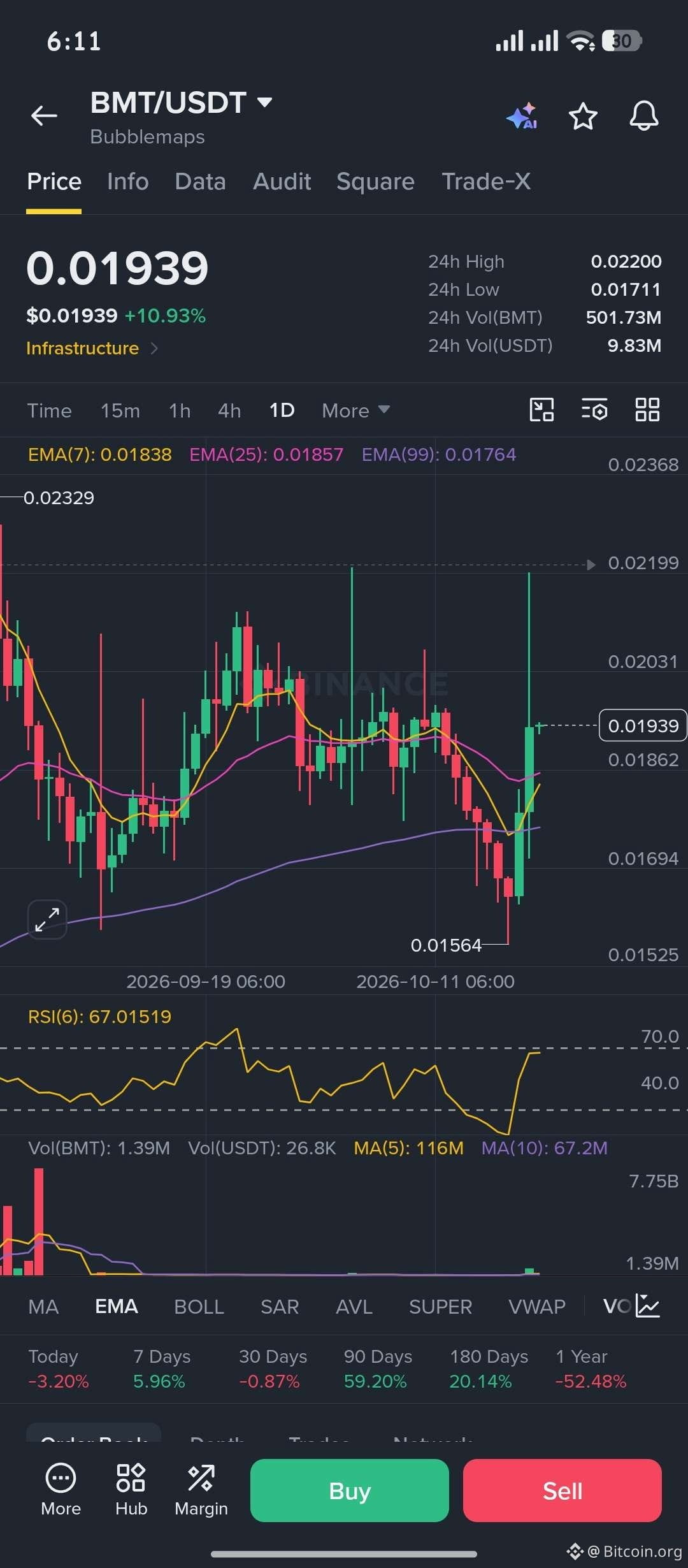
$BMT is back in play, and this time the chart backs the thesis.
Bubblemaps is the tool a lot of everyday trenchers already use to check rugpull risk and spot bundlers before aping into a new launch. If you've ever pulled up a bubble map to see who actually holds a token's supply, that's this project. Beyond the retail use case, Bubblemaps' API gets used by CEXs directly for token research and supply analysis, real backend infrastructure, not just a browser tool.
Price just ripped 10.93% to 0.01939, bouncing hard off a low of 0.01564 after a rough stretch that had it fading toward 0.01525. RSI(6) jumped to 67.02, climbing fast after sitting below 40 for days, that's a real momentum shift, not noise.
Volume confirms it, 501.73M BMT traded in 24h, among the heaviest volume prints on this chart in weeks. 90 day is still up a strong 59.20%, so this dip and recovery is happening inside a bigger uptrend, not against it.
For a tool this embedded in how the space actually vets new launches, this still trades at a market cap that feels small relative to its actual usage. Bounced off support, volume confirming, infrastructure doing real work underneath the price.
$BMT
$BMT is back in play, and this time the chart backs the thesis.
Bubblemaps is the tool a lot of everyday trenchers already use to check rugpull risk and spot bundlers before aping into a new launch. If you've ever pulled up a bubble map to see who actually holds a token's supply, that's this project. Beyond the retail use case, Bubblemaps' API gets used by CEXs directly for token research and supply analysis, real backend infrastructure, not just a browser tool.
Price just ripped 10.93% to 0.01939, bouncing hard off a low of 0.01564 after a rough stretch that had it fading toward 0.01525. RSI(6) jumped to 67.02, climbing fast after sitting below 40 for days, that's a real momentum shift, not noise.
Volume confirms it, 501.73M BMT traded in 24h, among the heaviest volume prints on this chart in weeks. 90 day is still up a strong 59.20%, so this dip and recovery is happening inside a bigger uptrend, not against it.
For a tool this embedded in how the space actually vets new launches, this still trades at a market cap that feels small relative to its actual usage. Bounced off support, volume confirming, infrastructure doing real work underneath the price.
$BMT
Bubblemaps is the tool a lot of everyday trenchers already use to check rugpull risk and spot bundlers before aping into a new launch. If you've ever pulled up a bubble map to see who actually holds a token's supply, that's this project. Beyond the retail use case, Bubblemaps' API gets used by CEXs directly for token research and supply analysis, real backend infrastructure, not just a browser tool.
Price just ripped 10.93% to 0.01939, bouncing hard off a low of 0.01564 after a rough stretch that had it fading toward 0.01525. RSI(6) jumped to 67.02, climbing fast after sitting below 40 for days, that's a real momentum shift, not noise.
Volume confirms it, 501.73M BMT traded in 24h, among the heaviest volume prints on this chart in weeks. 90 day is still up a strong 59.20%, so this dip and recovery is happening inside a bigger uptrend, not against it.
For a tool this embedded in how the space actually vets new launches, this still trades at a market cap that feels small relative to its actual usage. Bounced off support, volume confirming, infrastructure doing real work underneath the price.
$BMT
5
362
·
--
What does an opportunity look like?
Even in a bear market, there are plenty of opportunities across the ecosystem.
Right now, $SUI is trading below $1. That could be an opportunity to accumulate this potential gem at a lower price and prepare for what comes next.
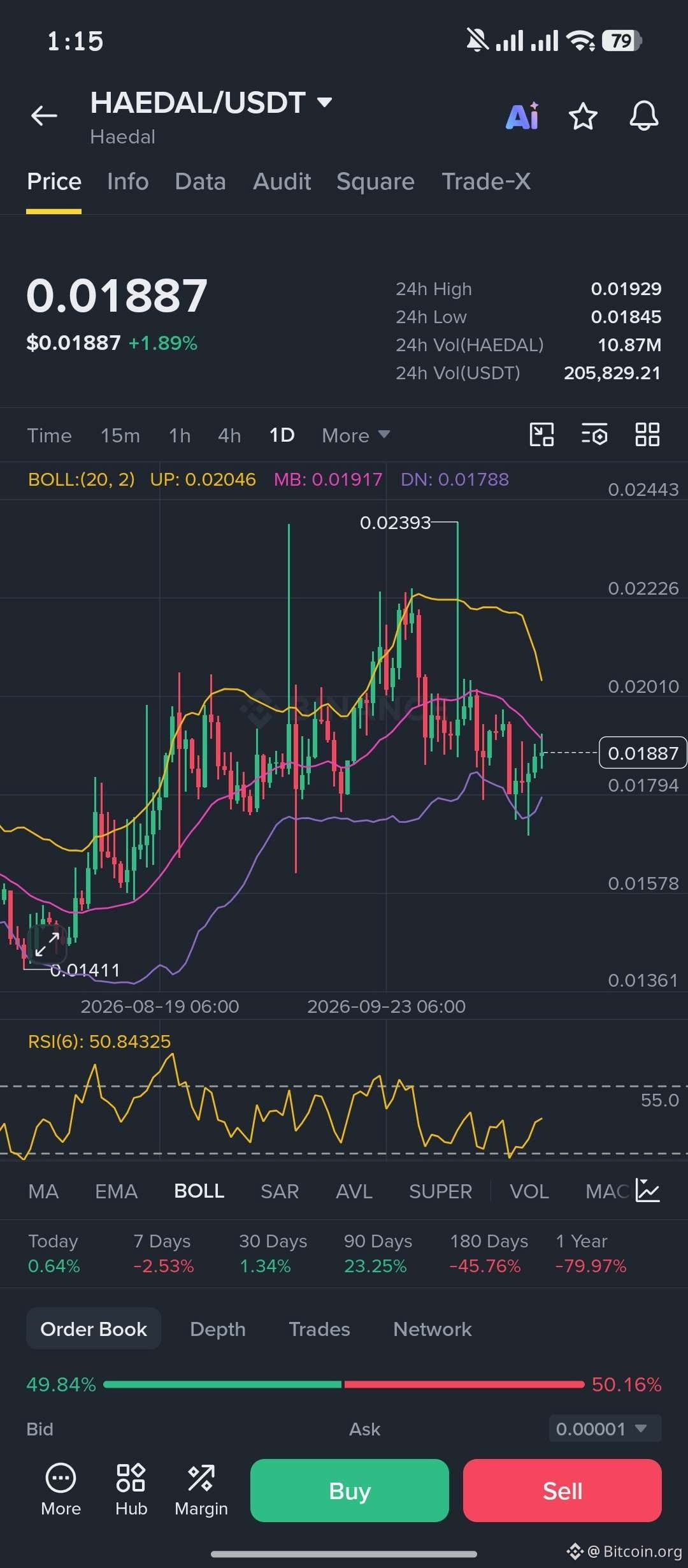
Already holding SUI? You can put it to work with Haedal Liquid Staking and its Lending Vault.
Here’s how it works:
1. Connect a compatible Sui wallet to Haedal.
2. Stake your SUI and receive liquid staking tokens (haSUI).
3. Deposit your haSUI into the Lending Vault.
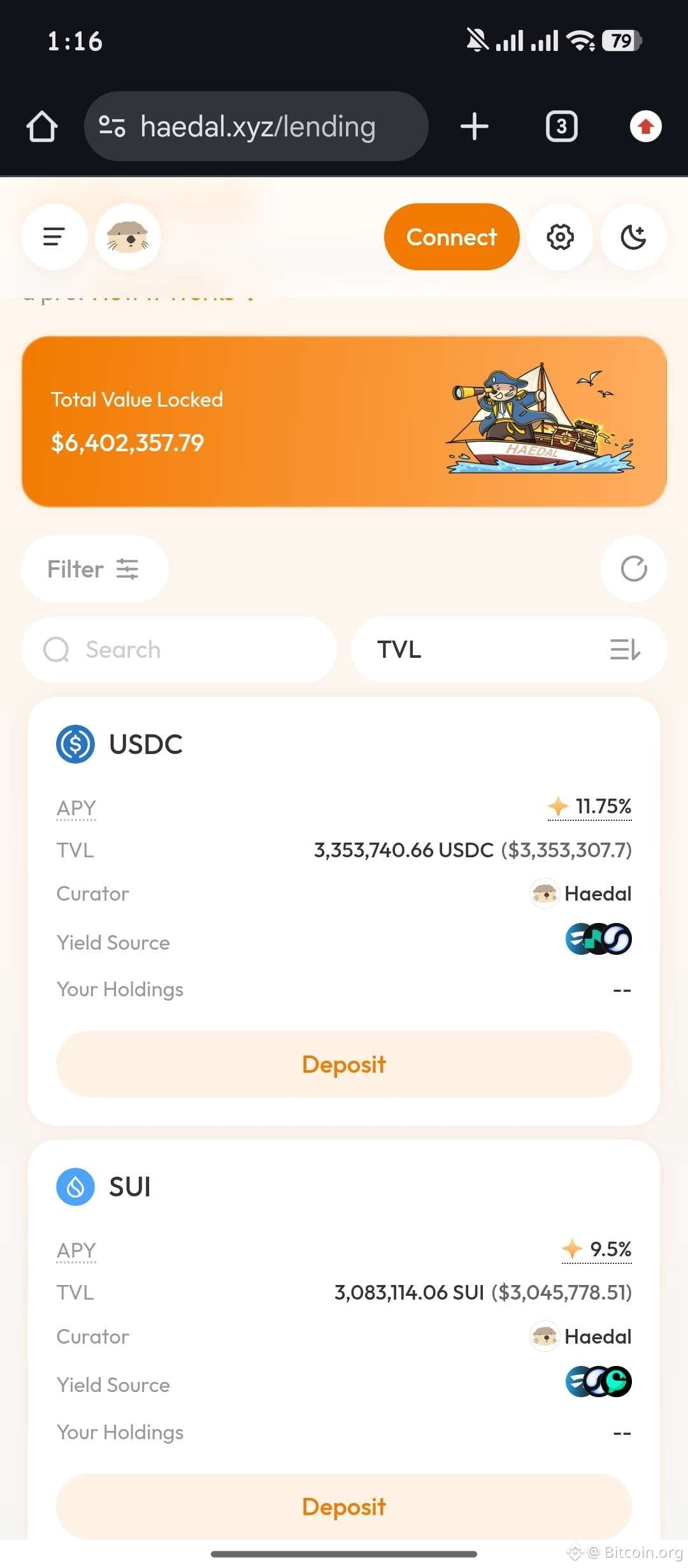
4. Let the vault automatically allocate and rebalance assets to pursue higher APYs.
Simple steps to make your SUI work for you.
If you're concerned about risk, consider using DCA to build your SUI position gradually instead of entering all at once.
Haedal has already reached 40M+ in liquid staking and 6.3M+ in its lending vault, showing activity even during this market consolidation.
$HAEDAL continues to stand strong while the market consolidates.
#DeFi
What does an opportunity look like?
Even in a bear market, there are plenty of opportunities across the ecosystem.
Right now, $SUI is trading below $1. That could be an opportunity to accumulate this potential gem at a lower price and prepare for what comes next.
Already holding SUI? You can put it to work with Haedal Liquid Staking and its Lending Vault.
Here’s how it works:
1. Connect a compatible Sui wallet to Haedal.
2. Stake your SUI and receive liquid staking tokens (haSUI).
3. Deposit your haSUI into the Lending Vault.
4. Let the vault automatically allocate and rebalance assets to pursue higher APYs.
Simple steps to make your SUI work for you.
If you're concerned about risk, consider using DCA to build your SUI position gradually instead of entering all at once.
Haedal has already reached 40M+ in liquid staking and 6.3M+ in its lending vault, showing activity even during this market consolidation.
$HAEDAL continues to stand strong while the market consolidates.
#DeFi
Even in a bear market, there are plenty of opportunities across the ecosystem.
Right now, $SUI is trading below $1. That could be an opportunity to accumulate this potential gem at a lower price and prepare for what comes next.
Already holding SUI? You can put it to work with Haedal Liquid Staking and its Lending Vault.
Here’s how it works:
1. Connect a compatible Sui wallet to Haedal.
2. Stake your SUI and receive liquid staking tokens (haSUI).
3. Deposit your haSUI into the Lending Vault.
4. Let the vault automatically allocate and rebalance assets to pursue higher APYs.
Simple steps to make your SUI work for you.
If you're concerned about risk, consider using DCA to build your SUI position gradually instead of entering all at once.
Haedal has already reached 40M+ in liquid staking and 6.3M+ in its lending vault, showing activity even during this market consolidation.
$HAEDAL continues to stand strong while the market consolidates.
#DeFi
1
1
4
827
·
--
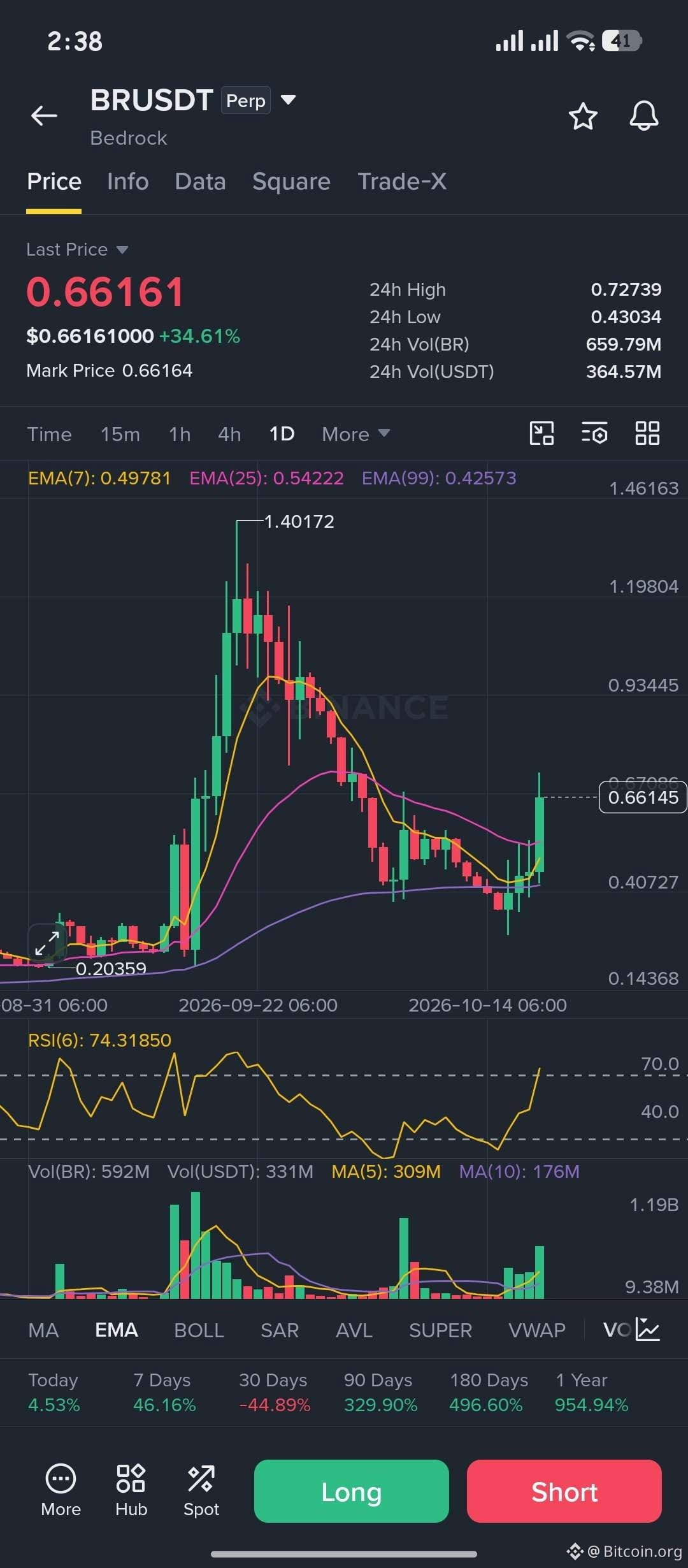
$BR just reclaimed the level everyone thought was dead.
Up 34.61% today, trading at 0.66161 after bouncing hard off the 0.40 zone it had been stuck consolidating in for weeks. RSI(6) at 74.3, climbing fast after spending most of the past month sitting below 40, that's a real shift in momentum, not just a wick.
Look at the full structure. This thing spiked to 1.40172 back in late September, then spent weeks grinding down through 0.93, 0.67, 0.40, basically giving back most of that initial move. 30 day is still negative at -44.89%, that's the damage from that fade still showing. But today's candle just broke clean above the recent chop, reclaiming both the EMA(7) at 0.498 trajectory and the top of its multi week range.
Volume confirms it's real, 659.79M BR traded today, 364.57M USDT, among the heaviest volume days since the original spike. This isn't a thin bounce, real size is rotating back in.
Zoom out further and the bigger picture still favors the bulls, up 329.90% over 90 days, 496.60% over 180 days, 954.94% over the past year. The 30 day pullback was a correction inside a much larger uptrend, not a trend reversal, and today's reclaim is the first real sign that correction might be done.
$BR
$BR just reclaimed the level everyone thought was dead.
Up 34.61% today, trading at 0.66161 after bouncing hard off the 0.40 zone it had been stuck consolidating in for weeks. RSI(6) at 74.3, climbing fast after spending most of the past month sitting below 40, that's a real shift in momentum, not just a wick.
Look at the full structure. This thing spiked to 1.40172 back in late September, then spent weeks grinding down through 0.93, 0.67, 0.40, basically giving back most of that initial move. 30 day is still negative at -44.89%, that's the damage from that fade still showing. But today's candle just broke clean above the recent chop, reclaiming both the EMA(7) at 0.498 trajectory and the top of its multi week range.
Volume confirms it's real, 659.79M BR traded today, 364.57M USDT, among the heaviest volume days since the original spike. This isn't a thin bounce, real size is rotating back in.
Zoom out further and the bigger picture still favors the bulls, up 329.90% over 90 days, 496.60% over 180 days, 954.94% over the past year. The 30 day pullback was a correction inside a much larger uptrend, not a trend reversal, and today's reclaim is the first real sign that correction might be done.
$BR
Up 34.61% today, trading at 0.66161 after bouncing hard off the 0.40 zone it had been stuck consolidating in for weeks. RSI(6) at 74.3, climbing fast after spending most of the past month sitting below 40, that's a real shift in momentum, not just a wick.
Look at the full structure. This thing spiked to 1.40172 back in late September, then spent weeks grinding down through 0.93, 0.67, 0.40, basically giving back most of that initial move. 30 day is still negative at -44.89%, that's the damage from that fade still showing. But today's candle just broke clean above the recent chop, reclaiming both the EMA(7) at 0.498 trajectory and the top of its multi week range.
Volume confirms it's real, 659.79M BR traded today, 364.57M USDT, among the heaviest volume days since the original spike. This isn't a thin bounce, real size is rotating back in.
Zoom out further and the bigger picture still favors the bulls, up 329.90% over 90 days, 496.60% over 180 days, 954.94% over the past year. The 30 day pullback was a correction inside a much larger uptrend, not a trend reversal, and today's reclaim is the first real sign that correction might be done.
$BR
2
597
·
--
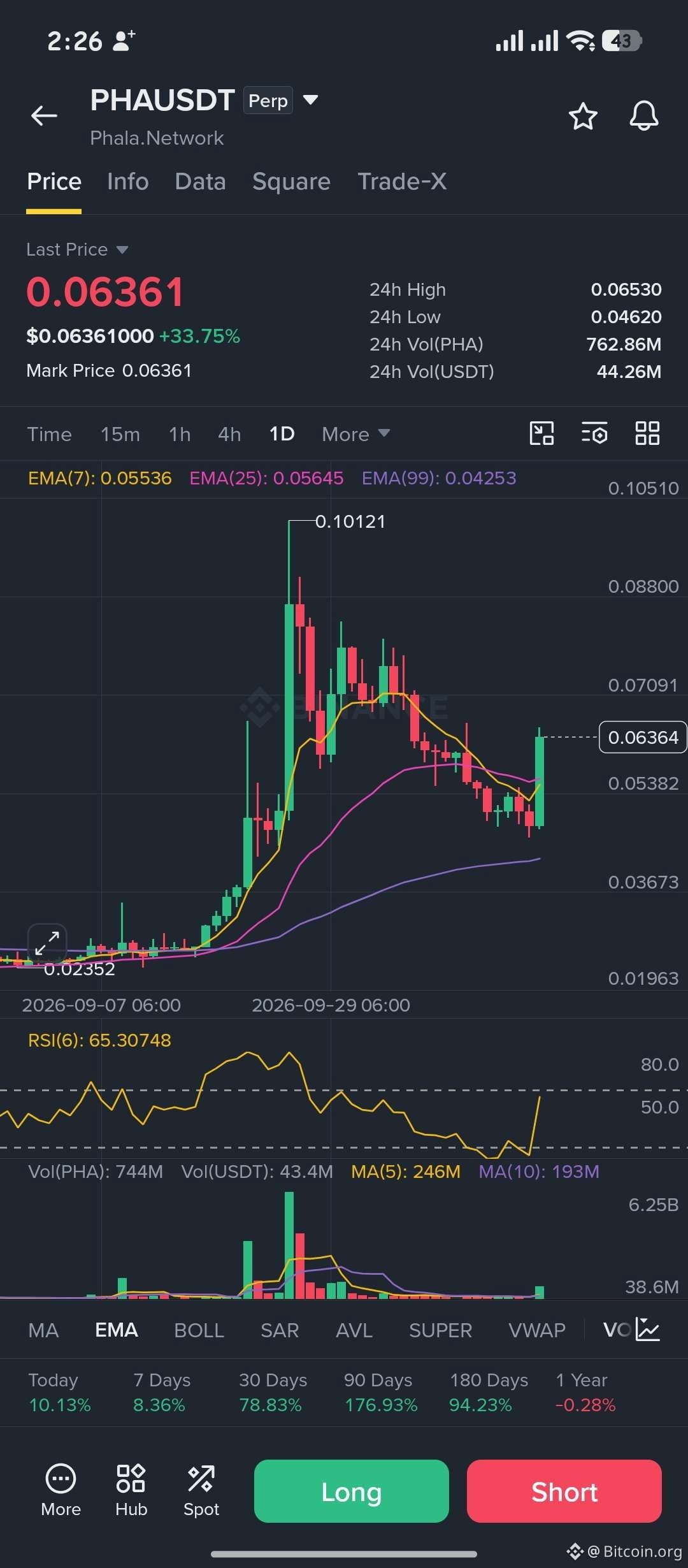
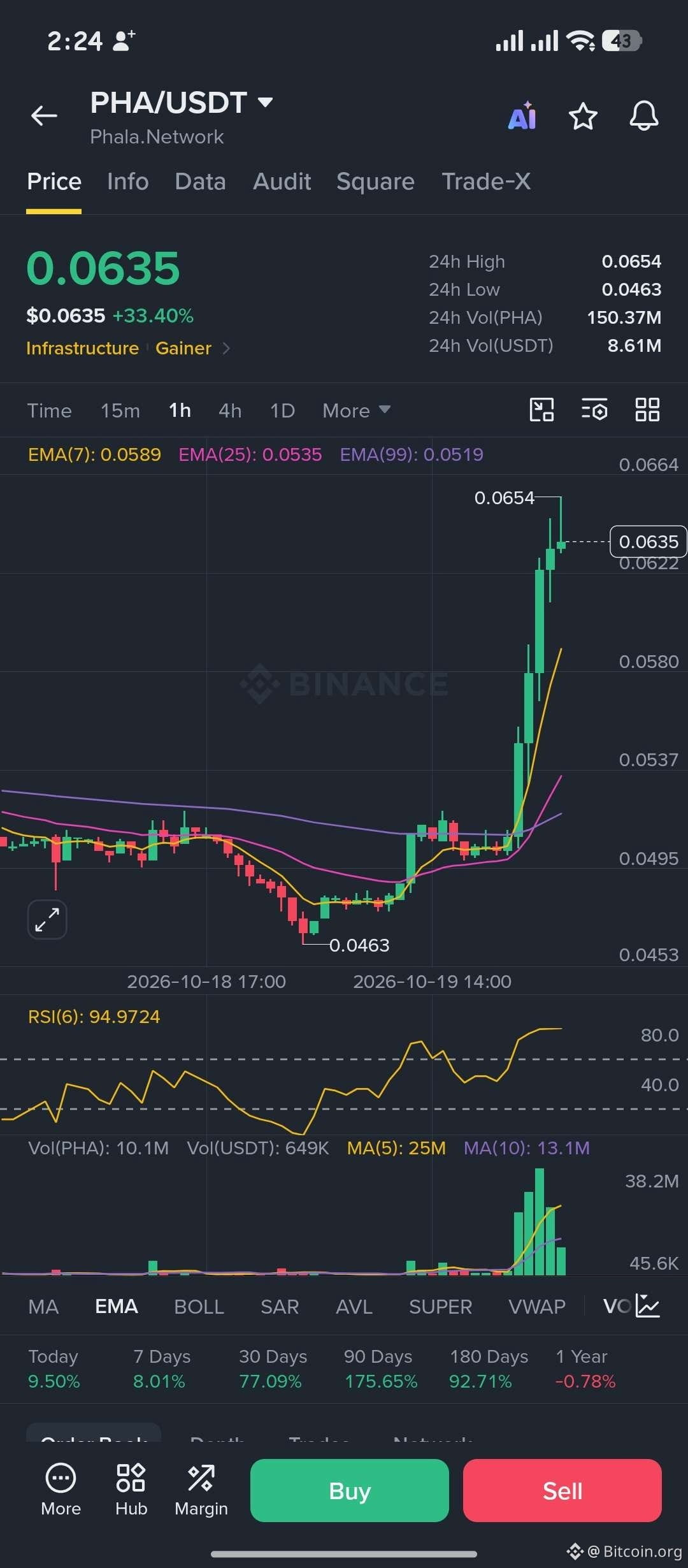
$PHA just punched higher to $0.06361 on the perps, up 33.75% with volume ripping and price sitting clean above the short and mid EMAs. RSI at 65 still has room to run after the recent pullback, and the 30-day and 90-day numbers are already strong. The chart looks like the recovery is trying to stick after the big move off the August lows.
This is the confidential AI compute play that migrated off Polkadot onto Ethereum L2, using TEEs so AI agents and inference can stay private but still verifiable. You stake PHA for vPHA, earn yield, and that same vPHA backs GPU workers and governance. The main staking vault is holding the bulk of the locked value while smaller StakePools and Vaults handle optimized delegation. Total locked is still modest relative to the narrative, which is the gap that needs closing.
Compared with something like Secret, Phala is more focused on scalable private AI cloud and GPU workloads than pure private smart contracts. The tech is solid. What’s missing is clearer value flowing back to holders and broader real usage of the Cloud product. Roadmap 2.0 is the next shot at fixing that with better token utility, payments for compute, and mechanisms that can start tying revenue to the token.
Core idea is simple: become the trusted private execution layer for AI that actually talks to blockchains without leaking data. If the roadmap delivers and confidential inference demand keeps growing, the chart has room to keep pricing it in. Still early if the utility lands. $PHA
$PHA just punched higher to $0.06361 on the perps, up 33.75% with volume ripping and price sitting clean above the short and mid EMAs. RSI at 65 still has room to run after the recent pullback, and the 30-day and 90-day numbers are already strong. The chart looks like the recovery is trying to stick after the big move off the August lows.
This is the confidential AI compute play that migrated off Polkadot onto Ethereum L2, using TEEs so AI agents and inference can stay private but still verifiable. You stake PHA for vPHA, earn yield, and that same vPHA backs GPU workers and governance. The main staking vault is holding the bulk of the locked value while smaller StakePools and Vaults handle optimized delegation. Total locked is still modest relative to the narrative, which is the gap that needs closing.
Compared with something like Secret, Phala is more focused on scalable private AI cloud and GPU workloads than pure private smart contracts. The tech is solid. What’s missing is clearer value flowing back to holders and broader real usage of the Cloud product. Roadmap 2.0 is the next shot at fixing that with better token utility, payments for compute, and mechanisms that can start tying revenue to the token.
Core idea is simple: become the trusted private execution layer for AI that actually talks to blockchains without leaking data. If the roadmap delivers and confidential inference demand keeps growing, the chart has room to keep pricing it in. Still early if the utility lands. $PHA
This is the confidential AI compute play that migrated off Polkadot onto Ethereum L2, using TEEs so AI agents and inference can stay private but still verifiable. You stake PHA for vPHA, earn yield, and that same vPHA backs GPU workers and governance. The main staking vault is holding the bulk of the locked value while smaller StakePools and Vaults handle optimized delegation. Total locked is still modest relative to the narrative, which is the gap that needs closing.
Compared with something like Secret, Phala is more focused on scalable private AI cloud and GPU workloads than pure private smart contracts. The tech is solid. What’s missing is clearer value flowing back to holders and broader real usage of the Cloud product. Roadmap 2.0 is the next shot at fixing that with better token utility, payments for compute, and mechanisms that can start tying revenue to the token.
Core idea is simple: become the trusted private execution layer for AI that actually talks to blockchains without leaking data. If the roadmap delivers and confidential inference demand keeps growing, the chart has room to keep pricing it in. Still early if the utility lands. $PHA
1
298
·
--
$GTC is no longer basing, it's breaking out.
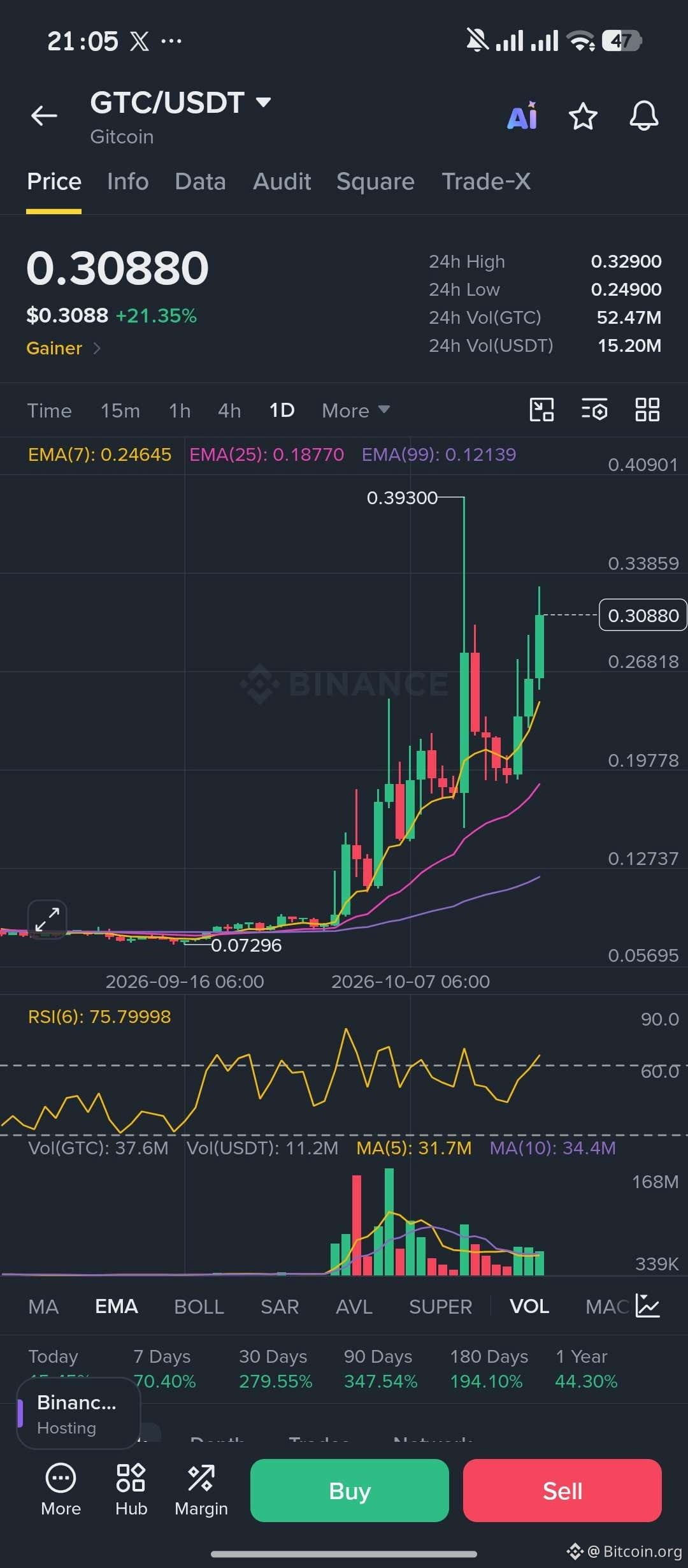
Price at 0.30880, up 21.35% today, now trading above the previous spike's consolidation range entirely. This is the clearest structural move since the initial 0.39300 spike, price just cleared the 0.268 to 0.199 chop zone it was stuck in for days.
Zoom out on the daily chart and the structure is undeniable. From 0.07296 in mid September to 0.308 now, that's a clean trend, higher lows, higher highs, no major structure break anywhere along the way. EMA(7) at 0.24645 sits well below price, confirming this isn't overextended relative to its own momentum, it's accelerating within it.
RSI(6) at 75.8, hot but not historically extreme for this chart, it's touched 80+ multiple times during this run without a full breakdown following. Volume backs the breakout too, 52.47M GTC today, among the strongest volume days on the chart, this move has real participation behind it, not a thin wick.
The numbers across every timeframe confirm the same story, up 70.40% this week, 279.55% this month, 347.54% over 90 days, 44.30% over the full year. Every window is green. That's not a bounce inside a downtrend anymore, that's a trend that's been running clean for weeks.
This is the breakdown, structure held, resistance cleared, volume confirmed. The only question left is how far this leg extends before the next pause.
$GTC
$GTC is no longer basing, it's breaking out.
Price at 0.30880, up 21.35% today, now trading above the previous spike's consolidation range entirely. This is the clearest structural move since the initial 0.39300 spike, price just cleared the 0.268 to 0.199 chop zone it was stuck in for days.
Zoom out on the daily chart and the structure is undeniable. From 0.07296 in mid September to 0.308 now, that's a clean trend, higher lows, higher highs, no major structure break anywhere along the way. EMA(7) at 0.24645 sits well below price, confirming this isn't overextended relative to its own momentum, it's accelerating within it.
RSI(6) at 75.8, hot but not historically extreme for this chart, it's touched 80+ multiple times during this run without a full breakdown following. Volume backs the breakout too, 52.47M GTC today, among the strongest volume days on the chart, this move has real participation behind it, not a thin wick.
The numbers across every timeframe confirm the same story, up 70.40% this week, 279.55% this month, 347.54% over 90 days, 44.30% over the full year. Every window is green. That's not a bounce inside a downtrend anymore, that's a trend that's been running clean for weeks.
This is the breakdown, structure held, resistance cleared, volume confirmed. The only question left is how far this leg extends before the next pause.
$GTC
Price at 0.30880, up 21.35% today, now trading above the previous spike's consolidation range entirely. This is the clearest structural move since the initial 0.39300 spike, price just cleared the 0.268 to 0.199 chop zone it was stuck in for days.
Zoom out on the daily chart and the structure is undeniable. From 0.07296 in mid September to 0.308 now, that's a clean trend, higher lows, higher highs, no major structure break anywhere along the way. EMA(7) at 0.24645 sits well below price, confirming this isn't overextended relative to its own momentum, it's accelerating within it.
RSI(6) at 75.8, hot but not historically extreme for this chart, it's touched 80+ multiple times during this run without a full breakdown following. Volume backs the breakout too, 52.47M GTC today, among the strongest volume days on the chart, this move has real participation behind it, not a thin wick.
The numbers across every timeframe confirm the same story, up 70.40% this week, 279.55% this month, 347.54% over 90 days, 44.30% over the full year. Every window is green. That's not a bounce inside a downtrend anymore, that's a trend that's been running clean for weeks.
This is the breakdown, structure held, resistance cleared, volume confirmed. The only question left is how far this leg extends before the next pause.
$GTC
1
256
·
--
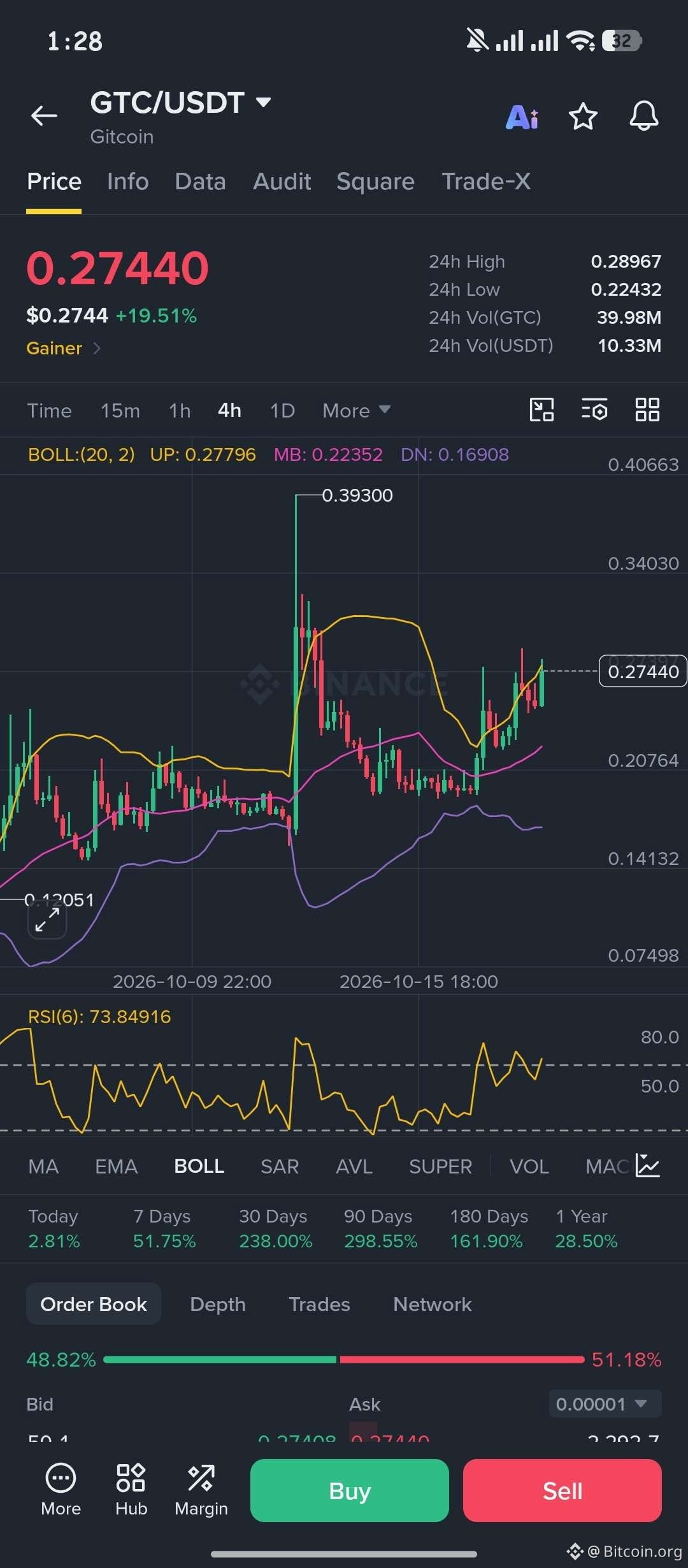
$GTC chart is messy right now, overlapping MAs, choppy wicks, but the structure underneath still favors the bulls.
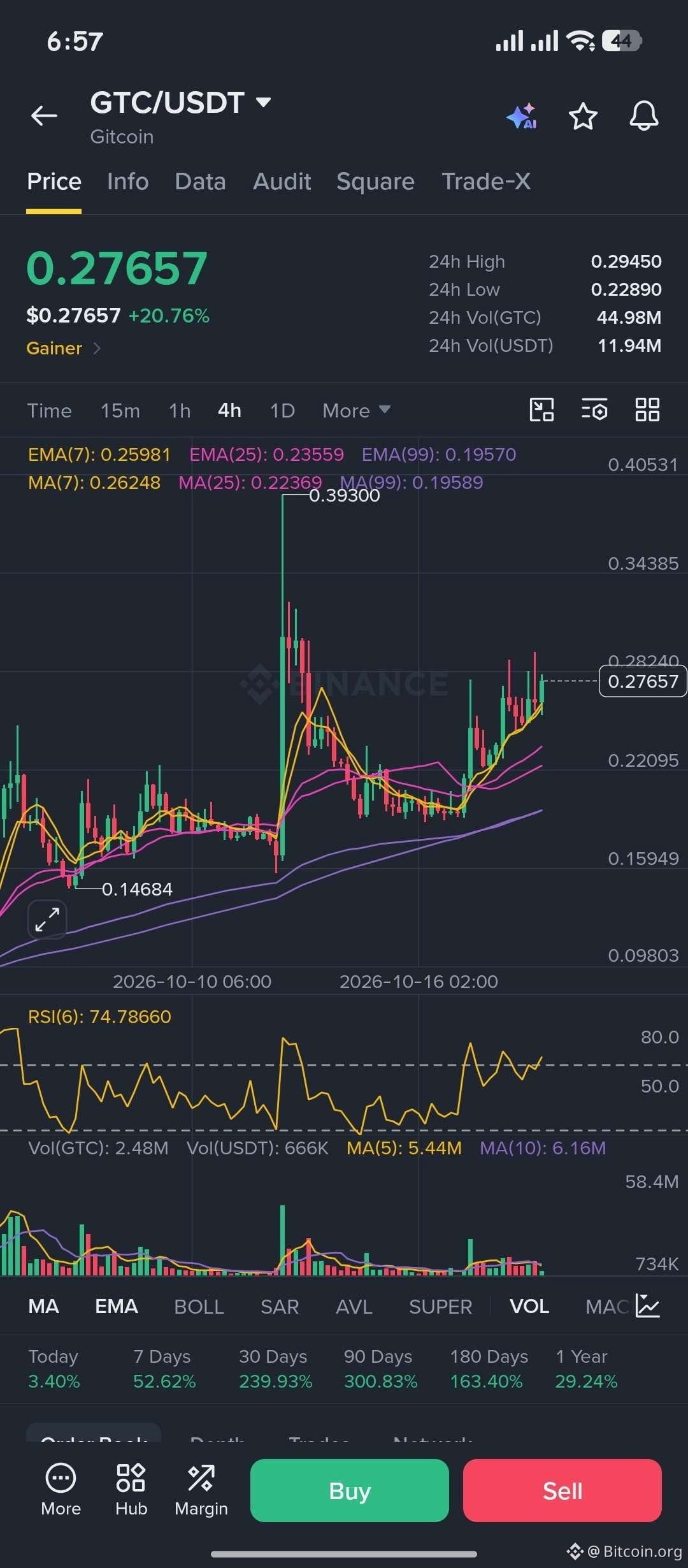
Price at 0.27657, up 20.76%, holding above both the EMA(7) at 0.25981 and MA(7) at 0.26248, meaning short term momentum is still in control despite the noise. RSI(6) at 74.78, climbing again after cooling off mid chart, that pattern, hot, cool, hot again, usually means buyers keep stepping back in on dips instead of giving up.
Why it still looks bullish despite the mess: the broader moving average stack is clean even if price action isn't, MA(7) above MA(25) above MA(99), that's trend confirmation sitting underneath all that candle noise. Volume's real too, 44.98M GTC in 24h, not a thin chop.
Messy candles just mean indecision in the short term, the actual trend data, 52.62% this week, 300.83% over 90 days, says the bigger picture hasn't broken down. Watching if it clears 0.2945 clean, that resolves the mess either way.
$GTC
$GTC chart is messy right now, overlapping MAs, choppy wicks, but the structure underneath still favors the bulls.
Price at 0.27657, up 20.76%, holding above both the EMA(7) at 0.25981 and MA(7) at 0.26248, meaning short term momentum is still in control despite the noise. RSI(6) at 74.78, climbing again after cooling off mid chart, that pattern, hot, cool, hot again, usually means buyers keep stepping back in on dips instead of giving up.
Why it still looks bullish despite the mess: the broader moving average stack is clean even if price action isn't, MA(7) above MA(25) above MA(99), that's trend confirmation sitting underneath all that candle noise. Volume's real too, 44.98M GTC in 24h, not a thin chop.
Messy candles just mean indecision in the short term, the actual trend data, 52.62% this week, 300.83% over 90 days, says the bigger picture hasn't broken down. Watching if it clears 0.2945 clean, that resolves the mess either way.
$GTC
Price at 0.27657, up 20.76%, holding above both the EMA(7) at 0.25981 and MA(7) at 0.26248, meaning short term momentum is still in control despite the noise. RSI(6) at 74.78, climbing again after cooling off mid chart, that pattern, hot, cool, hot again, usually means buyers keep stepping back in on dips instead of giving up.
Why it still looks bullish despite the mess: the broader moving average stack is clean even if price action isn't, MA(7) above MA(25) above MA(99), that's trend confirmation sitting underneath all that candle noise. Volume's real too, 44.98M GTC in 24h, not a thin chop.
Messy candles just mean indecision in the short term, the actual trend data, 52.62% this week, 300.83% over 90 days, says the bigger picture hasn't broken down. Watching if it clears 0.2945 clean, that resolves the mess either way.
$GTC
1
201
·
--
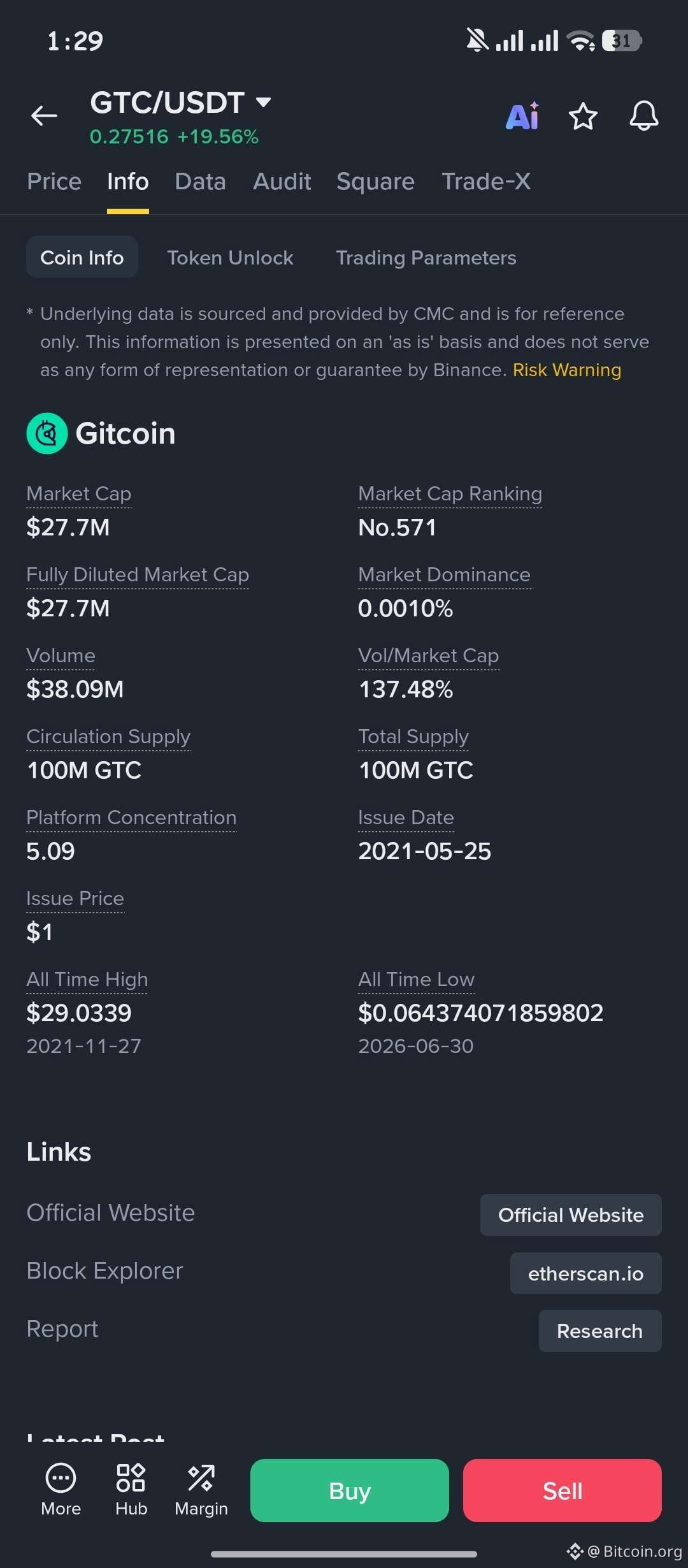
$GTC is getting hotter now.
After the first wave, everyone seems to think it's time to short and print money. But after the sharp drop, GTC is recovering and getting back in shape. It looks like another wave could be coming.
Recently, I've noticed a pattern among top gainers. The first 2–3 days bring a bullish wave. Then some coins slowly fade away, while others create a second wave. That's when FOMO kicks in, everyone jumps in, and suddenly the price dumps or slowly provides liquidity to the whales.
But $GTC has made a strong recovery, and there's still a chance for another breakout.
So, Gitcoin could be ready for another round.
With only 100M total supply, it's the kind of coin whales might love to play with.
Trade smartly.
$GTC is getting hotter now.
After the first wave, everyone seems to think it's time to short and print money. But after the sharp drop, GTC is recovering and getting back in shape. It looks like another wave could be coming.
Recently, I've noticed a pattern among top gainers. The first 2–3 days bring a bullish wave. Then some coins slowly fade away, while others create a second wave. That's when FOMO kicks in, everyone jumps in, and suddenly the price dumps or slowly provides liquidity to the whales.
But $GTC has made a strong recovery, and there's still a chance for another breakout.
So, Gitcoin could be ready for another round.
With only 100M total supply, it's the kind of coin whales might love to play with.
Trade smartly.
After the first wave, everyone seems to think it's time to short and print money. But after the sharp drop, GTC is recovering and getting back in shape. It looks like another wave could be coming.
Recently, I've noticed a pattern among top gainers. The first 2–3 days bring a bullish wave. Then some coins slowly fade away, while others create a second wave. That's when FOMO kicks in, everyone jumps in, and suddenly the price dumps or slowly provides liquidity to the whales.
But $GTC has made a strong recovery, and there's still a chance for another breakout.
So, Gitcoin could be ready for another round.
With only 100M total supply, it's the kind of coin whales might love to play with.
Trade smartly.
1
232
·
--
What is an opportunity to look like?
Even in a bear market there is lots of opportunity riding across the ecosystem.
Right now $SUI is below the 1$ mark.
So there is an opportunity to accumulate this potential gem in this low. Then the real potential opportunity to enter.
Right now you have SUI in your bag.
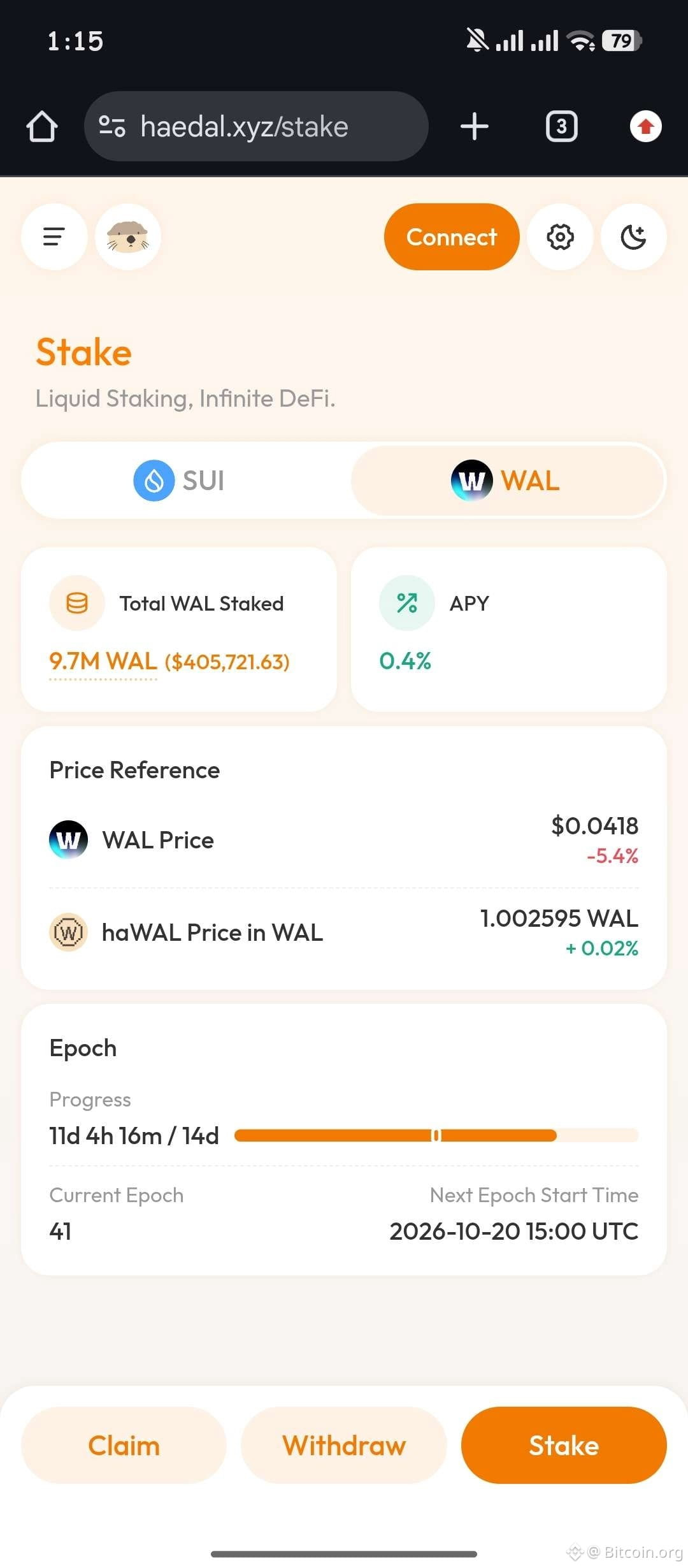
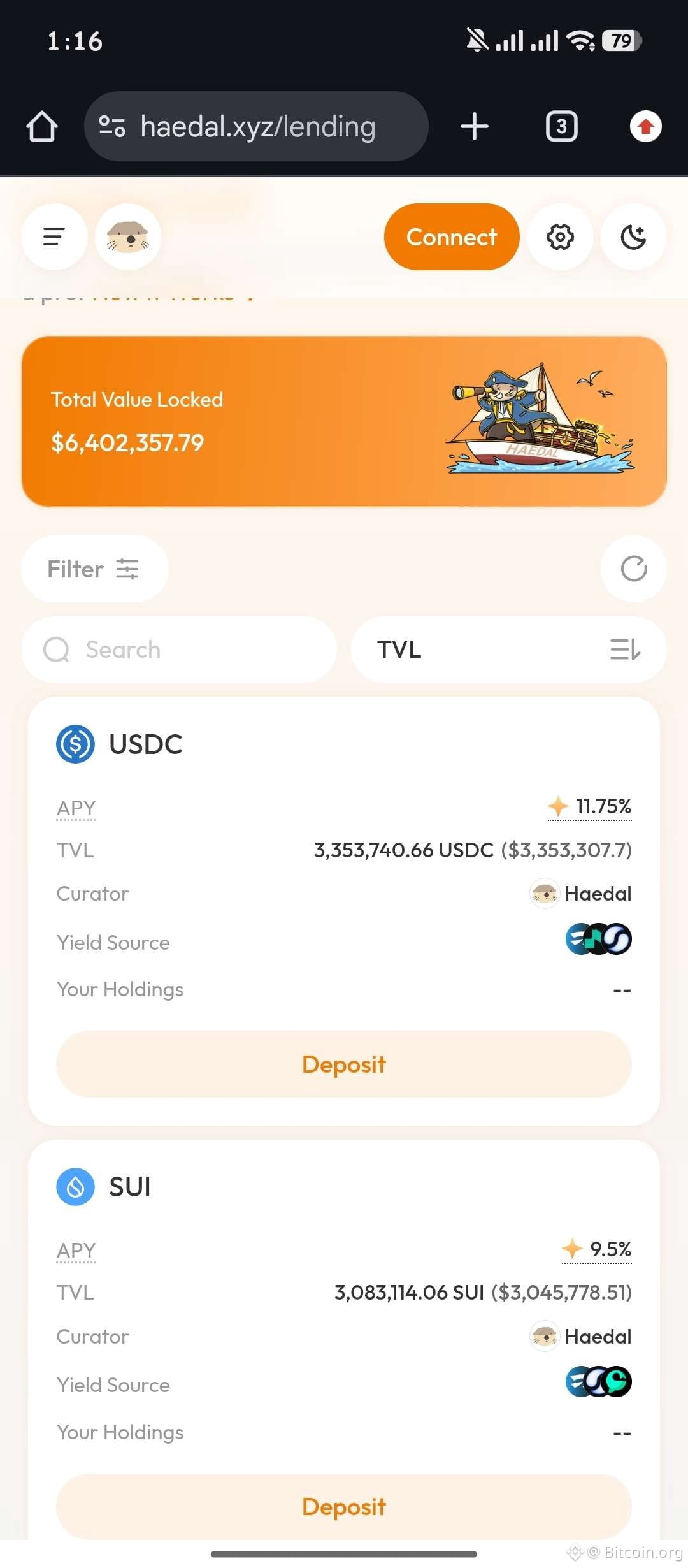
Now you can put it on Haedal Liquid Staking or Lending vault in few simple steps you can double APYs.
First put it liquid staking to get haSUI then put it on the Lending vault.
Steps are simple
1. go to Haedal connect a compatible Sui Wallet
2. stake sui
3. receive the liquid haSUI
4. Select lending vault and put haSUI on it it will auto allocate and rebalance for higher APYs
All three steps make your SUI work.
If it looks that risk to put it all use DCA over sui and put it consistently.
It’s already 40m+ in liquid staking and 6.3m + in the lending vault.
$HAEDAL also stands strong aganist instead of thisd consolidating market.
#DeFi
What is an opportunity to look like?
Even in a bear market there is lots of opportunity riding across the ecosystem.
Right now $SUI is below the 1$ mark.
So there is an opportunity to accumulate this potential gem in this low. Then the real potential opportunity to enter.
Right now you have SUI in your bag.
Now you can put it on Haedal Liquid Staking or Lending vault in few simple steps you can double APYs.
First put it liquid staking to get haSUI then put it on the Lending vault.
Steps are simple
1. go to Haedal connect a compatible Sui Wallet
2. stake sui
3. receive the liquid haSUI
4. Select lending vault and put haSUI on it it will auto allocate and rebalance for higher APYs
All three steps make your SUI work.
If it looks that risk to put it all use DCA over sui and put it consistently.
It’s already 40m+ in liquid staking and 6.3m + in the lending vault.
$HAEDAL also stands strong aganist instead of thisd consolidating market.
#DeFi
Even in a bear market there is lots of opportunity riding across the ecosystem.
Right now $SUI is below the 1$ mark.
So there is an opportunity to accumulate this potential gem in this low. Then the real potential opportunity to enter.
Right now you have SUI in your bag.
Now you can put it on Haedal Liquid Staking or Lending vault in few simple steps you can double APYs.
First put it liquid staking to get haSUI then put it on the Lending vault.
Steps are simple
1. go to Haedal connect a compatible Sui Wallet
2. stake sui
3. receive the liquid haSUI
4. Select lending vault and put haSUI on it it will auto allocate and rebalance for higher APYs
All three steps make your SUI work.
If it looks that risk to put it all use DCA over sui and put it consistently.
It’s already 40m+ in liquid staking and 6.3m + in the lending vault.
$HAEDAL also stands strong aganist instead of thisd consolidating market.
#DeFi
1
586
·
--
$SAND is showing the exact kind of move that looks bullish but actually bearish.
The Sandbox is the virtual world where players build, own, and monetize gaming experiences on Ethereum. SAND is the ERC-20 utility token used for transfers, staking, and governance.
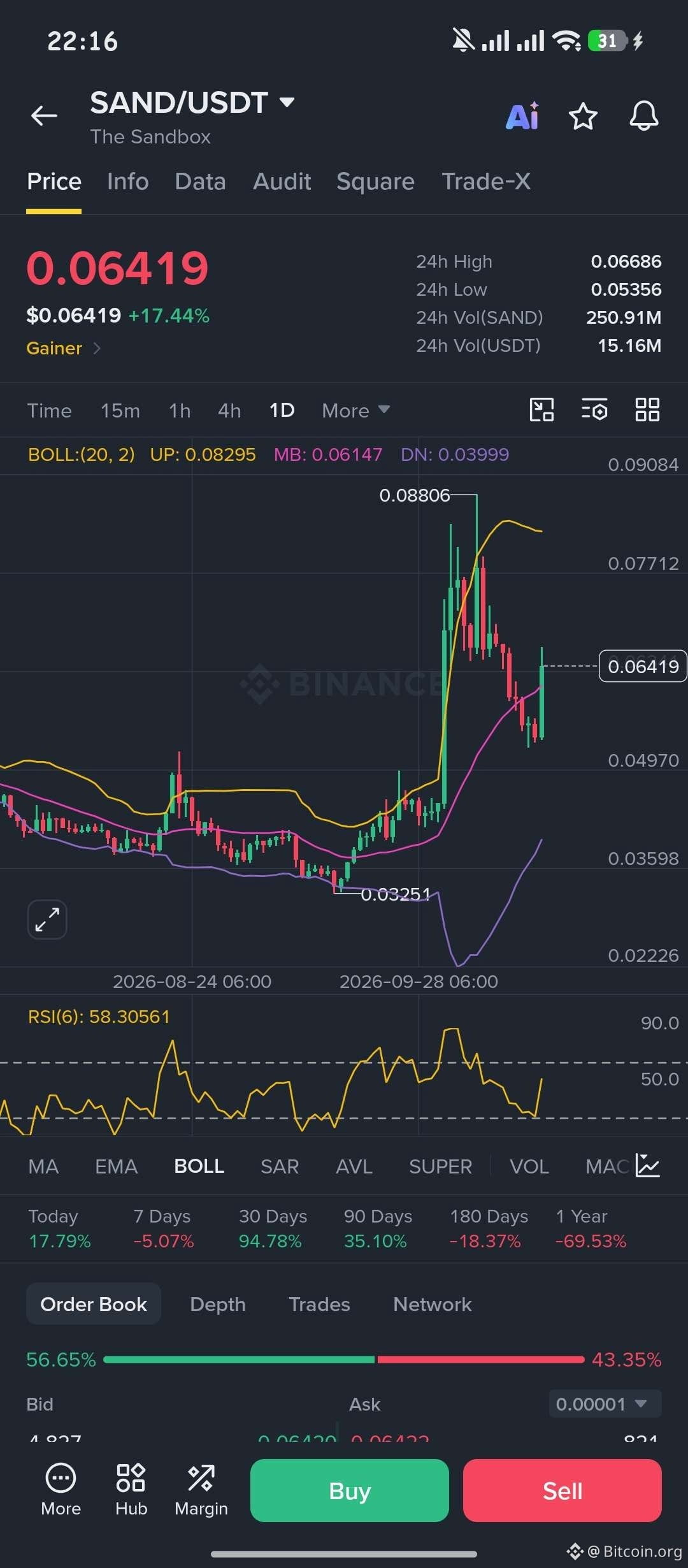
Price spiked to a high of 0.08806 a few days back, dumped hard down to 0.03251, and has now recovered into the 0.064 zone. That's a spike, dump, slow recovery pattern, and right now it's sitting at the recovery stage, not confirmed strength.
Money flow backs the caution. Large orders today are positive at +1.40M, but zoom out to the 5 day picture and it flips negative, -725,516 net outflow, with four of the last five days showing large wallets exiting, -1.10M, -417K, -2.05M, -426K. Today's green day is the outlier against that trend, not proof it's reversed.
RSI(6) on the 1h is already back up to 76.65, overbought, right as price gets rejected from a long upper wick at 0.06686 and struggles under the 0.0644 zone. 7 day is still down 5.25%, 180 day down 18.53%, 1 year down a brutal 69.58%. This bounce is happening inside a much bigger downtrend, not against it.
Spike, dump, slow bounce, overbought again at resistance, with large money still net negative over the week. That's not a setup confirming strength, that's distribution dressed up as recovery.
Keep shorting
$SAND
$SAND is showing the exact kind of move that looks bullish but actually bearish.
The Sandbox is the virtual world where players build, own, and monetize gaming experiences on Ethereum. SAND is the ERC-20 utility token used for transfers, staking, and governance.
Price spiked to a high of 0.08806 a few days back, dumped hard down to 0.03251, and has now recovered into the 0.064 zone. That's a spike, dump, slow recovery pattern, and right now it's sitting at the recovery stage, not confirmed strength.
Money flow backs the caution. Large orders today are positive at +1.40M, but zoom out to the 5 day picture and it flips negative, -725,516 net outflow, with four of the last five days showing large wallets exiting, -1.10M, -417K, -2.05M, -426K. Today's green day is the outlier against that trend, not proof it's reversed.
RSI(6) on the 1h is already back up to 76.65, overbought, right as price gets rejected from a long upper wick at 0.06686 and struggles under the 0.0644 zone. 7 day is still down 5.25%, 180 day down 18.53%, 1 year down a brutal 69.58%. This bounce is happening inside a much bigger downtrend, not against it.
Spike, dump, slow bounce, overbought again at resistance, with large money still net negative over the week. That's not a setup confirming strength, that's distribution dressed up as recovery.
Keep shorting
$SAND
The Sandbox is the virtual world where players build, own, and monetize gaming experiences on Ethereum. SAND is the ERC-20 utility token used for transfers, staking, and governance.
Price spiked to a high of 0.08806 a few days back, dumped hard down to 0.03251, and has now recovered into the 0.064 zone. That's a spike, dump, slow recovery pattern, and right now it's sitting at the recovery stage, not confirmed strength.
Money flow backs the caution. Large orders today are positive at +1.40M, but zoom out to the 5 day picture and it flips negative, -725,516 net outflow, with four of the last five days showing large wallets exiting, -1.10M, -417K, -2.05M, -426K. Today's green day is the outlier against that trend, not proof it's reversed.
RSI(6) on the 1h is already back up to 76.65, overbought, right as price gets rejected from a long upper wick at 0.06686 and struggles under the 0.0644 zone. 7 day is still down 5.25%, 180 day down 18.53%, 1 year down a brutal 69.58%. This bounce is happening inside a much bigger downtrend, not against it.
Spike, dump, slow bounce, overbought again at resistance, with large money still net negative over the week. That's not a setup confirming strength, that's distribution dressed up as recovery.
Keep shorting
$SAND
1
204
·
--
Lately $GTC leaning for downside .
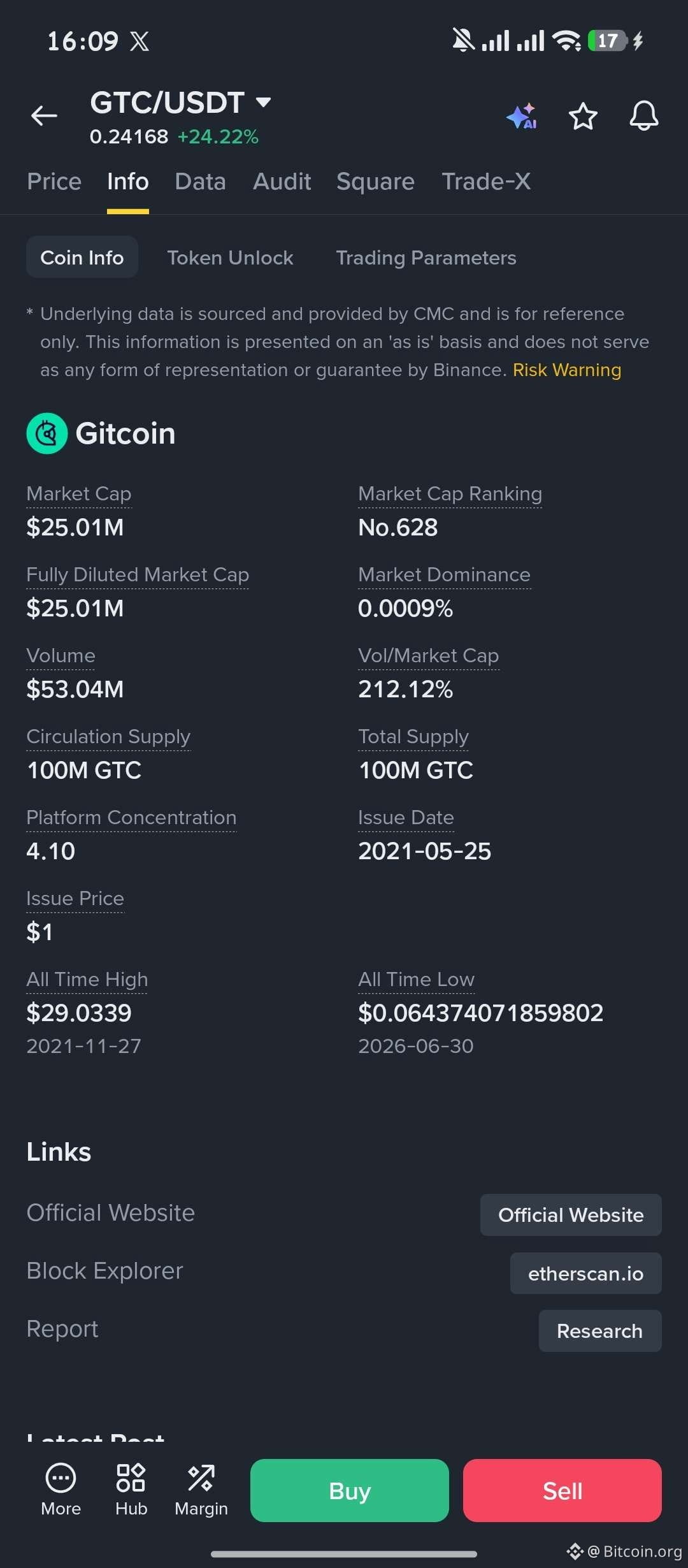
Gitcoin, is the token behind public goods funding in crypto, powering quadratic funding rounds that help developers and open source projects get grants from the community rather than VCs. It's less a trading chip and more governance over how that funding gets allocated.
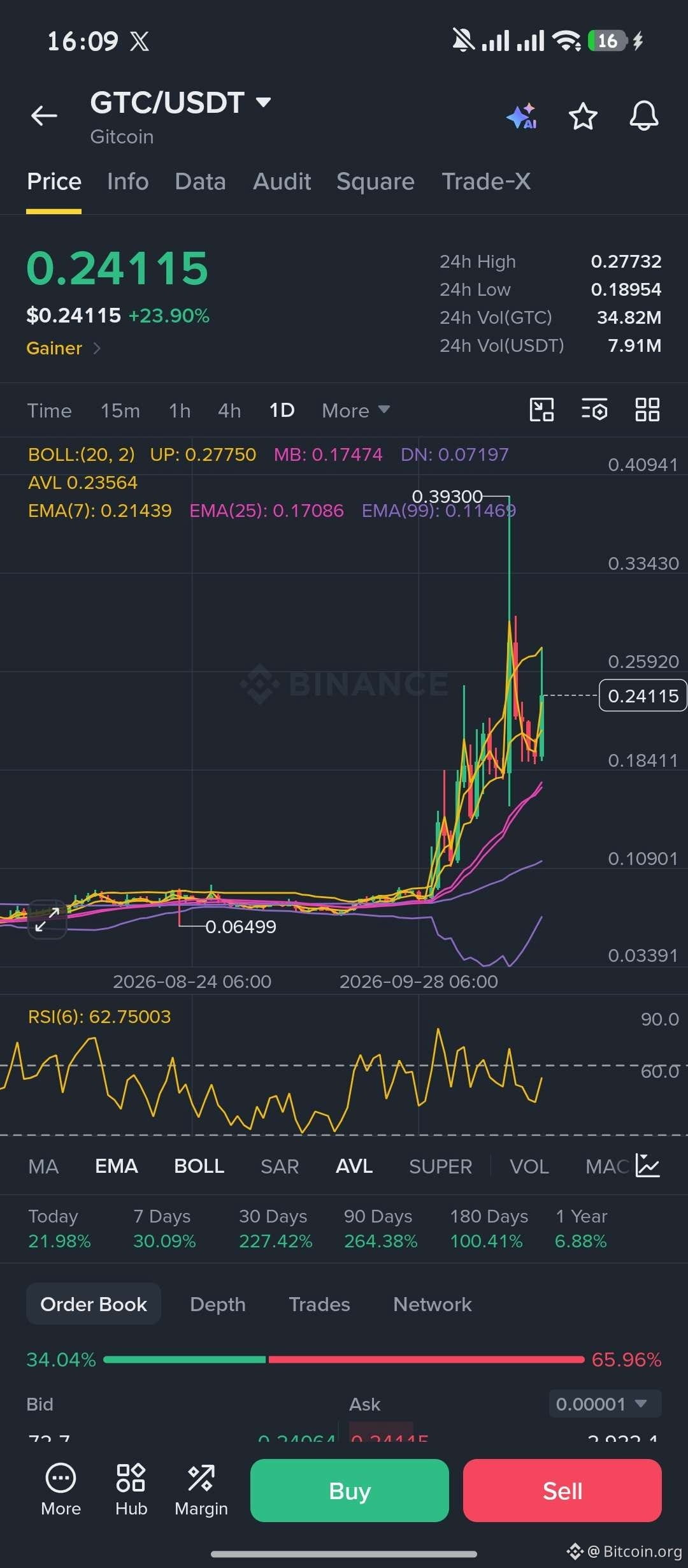
Price hit a high of 0.27732, now fading to around 0.24, RSI(6) dropped to 38 from spike highs, and large order inflow sits at -1.52M today, part of a 5 day net outflow of -3.71M.
Earlier it spiked around 0.324 . That's one point worth noticing. After spiked it got low at 0.19 now it already recovered to managing 0.24 zone. And showing weakness.
But the pattern is simple, $GTC makes it spiked first( all top gainers) and then it make a quick dump or slowly towards the earth. Then retailers work again as exit liquidity makes another spike .
So this is the second one. Stay sharp. Keep shorting.
$GTC
Lately $GTC leaning for downside .
Gitcoin, is the token behind public goods funding in crypto, powering quadratic funding rounds that help developers and open source projects get grants from the community rather than VCs. It's less a trading chip and more governance over how that funding gets allocated.
Price hit a high of 0.27732, now fading to around 0.24, RSI(6) dropped to 38 from spike highs, and large order inflow sits at -1.52M today, part of a 5 day net outflow of -3.71M.
Earlier it spiked around 0.324 . That's one point worth noticing. After spiked it got low at 0.19 now it already recovered to managing 0.24 zone. And showing weakness.
But the pattern is simple, $GTC makes it spiked first( all top gainers) and then it make a quick dump or slowly towards the earth. Then retailers work again as exit liquidity makes another spike .
So this is the second one. Stay sharp. Keep shorting.
$GTC
Gitcoin, is the token behind public goods funding in crypto, powering quadratic funding rounds that help developers and open source projects get grants from the community rather than VCs. It's less a trading chip and more governance over how that funding gets allocated.
Price hit a high of 0.27732, now fading to around 0.24, RSI(6) dropped to 38 from spike highs, and large order inflow sits at -1.52M today, part of a 5 day net outflow of -3.71M.
Earlier it spiked around 0.324 . That's one point worth noticing. After spiked it got low at 0.19 now it already recovered to managing 0.24 zone. And showing weakness.
But the pattern is simple, $GTC makes it spiked first( all top gainers) and then it make a quick dump or slowly towards the earth. Then retailers work again as exit liquidity makes another spike .
So this is the second one. Stay sharp. Keep shorting.
$GTC
1
4
369
·
--
Verified
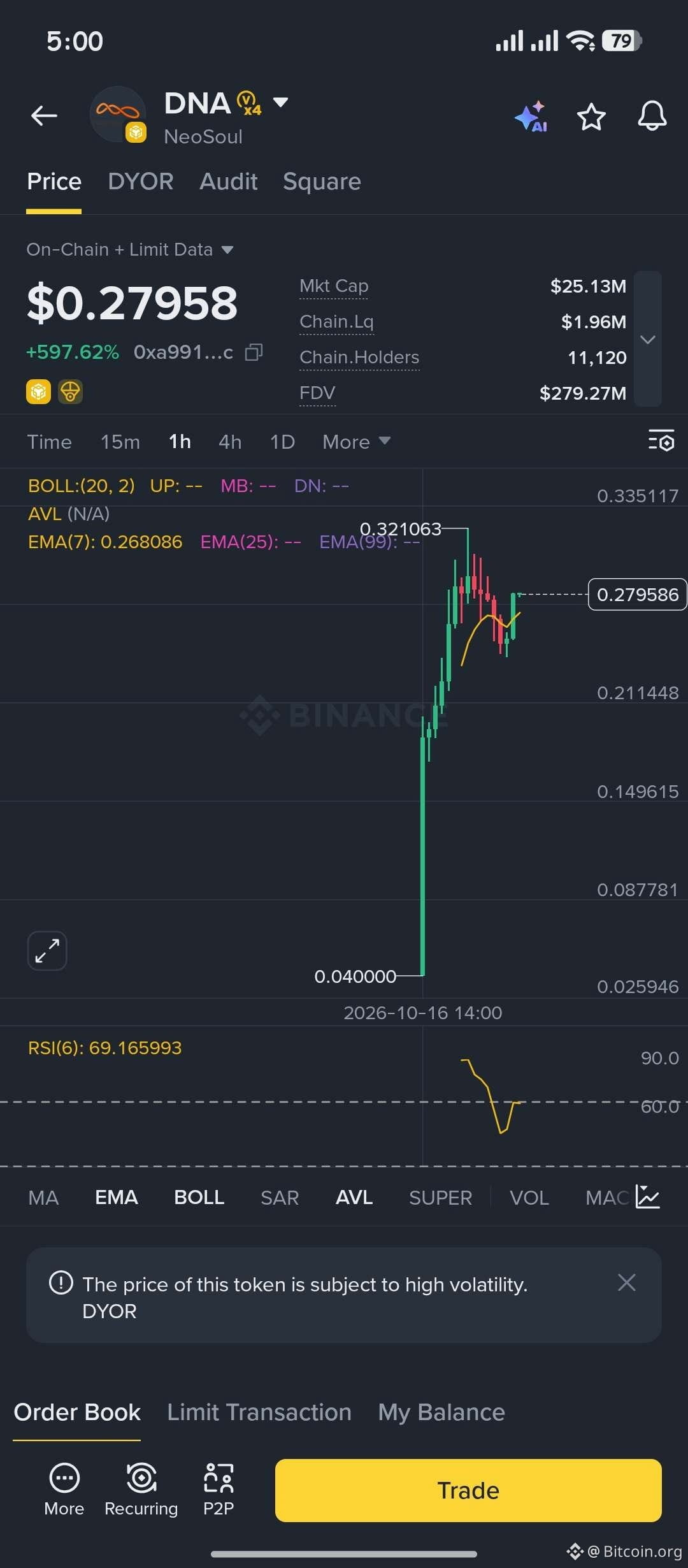
$DNA this alpha drops today and makes a bull trend over a bearish Market...
Look like it's already ready for another breakout.
This kind of AI gem. NeoSoul is building infrastructure for AI Agent Economy, agents learn from real outcomes. It can execute trades within the user set limit or parameters with verifiable data records.
Its on the BNB chain and native for all things at NeoSoul.
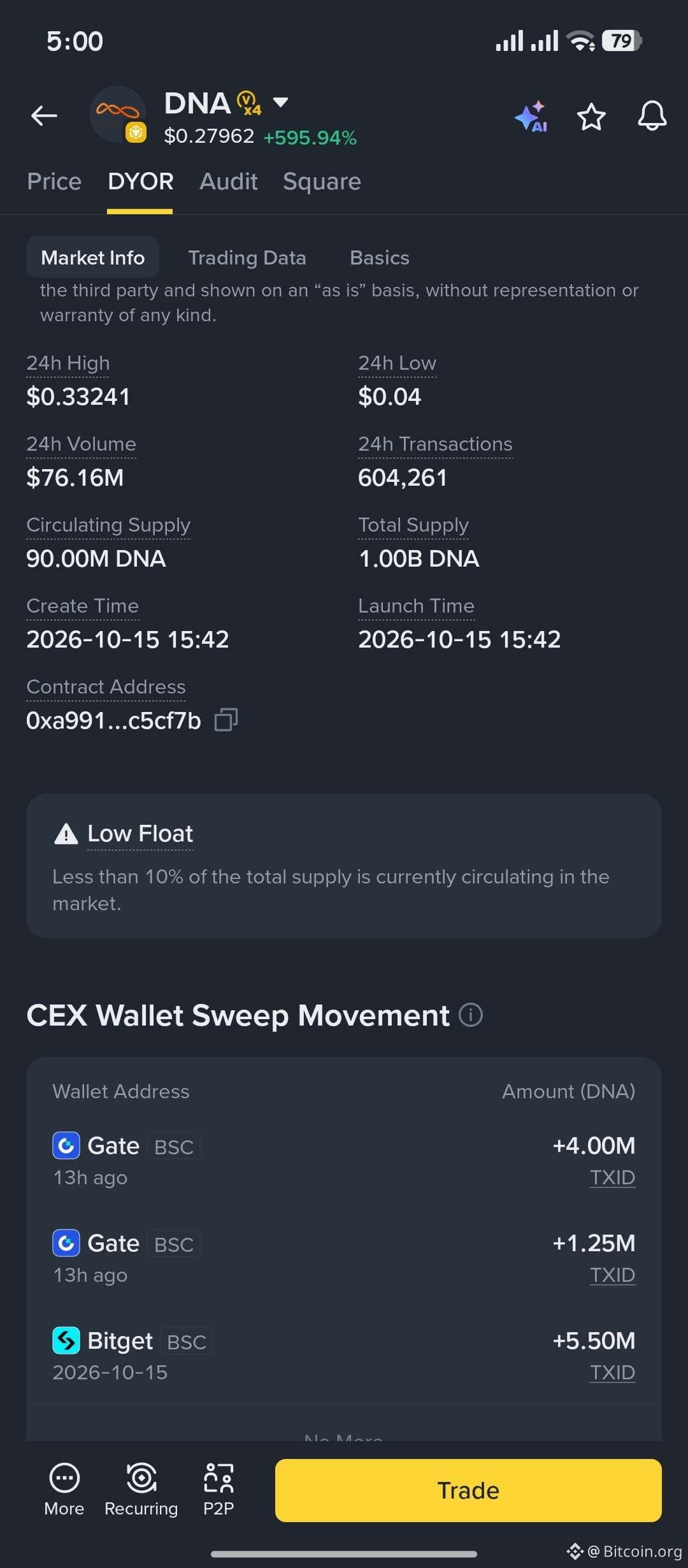
Listed most major cex & dex with only 10% float 130M circulating supply.
Its already touched at a big height . 500% gains getting more attractive.
Right now at 0.28... Looking for another breakout.
React fast to this Alpha.
Stay Sharp.
$DNA
$DNA this alpha drops today and makes a bull trend over a bearish Market...
Look like it's already ready for another breakout.
This kind of AI gem. NeoSoul is building infrastructure for AI Agent Economy, agents learn from real outcomes. It can execute trades within the user set limit or parameters with verifiable data records.
Its on the BNB chain and native for all things at NeoSoul.
Listed most major cex & dex with only 10% float 130M circulating supply.
Its already touched at a big height . 500% gains getting more attractive.
Right now at 0.28... Looking for another breakout.
React fast to this Alpha.
Stay Sharp.
$DNA
Look like it's already ready for another breakout.
This kind of AI gem. NeoSoul is building infrastructure for AI Agent Economy, agents learn from real outcomes. It can execute trades within the user set limit or parameters with verifiable data records.
Its on the BNB chain and native for all things at NeoSoul.
Listed most major cex & dex with only 10% float 130M circulating supply.
Its already touched at a big height . 500% gains getting more attractive.
Right now at 0.28... Looking for another breakout.
React fast to this Alpha.
Stay Sharp.
$DNA
1
2
804
·
--
$TIA ready for the next big move, or just another try before a fresh all time low?
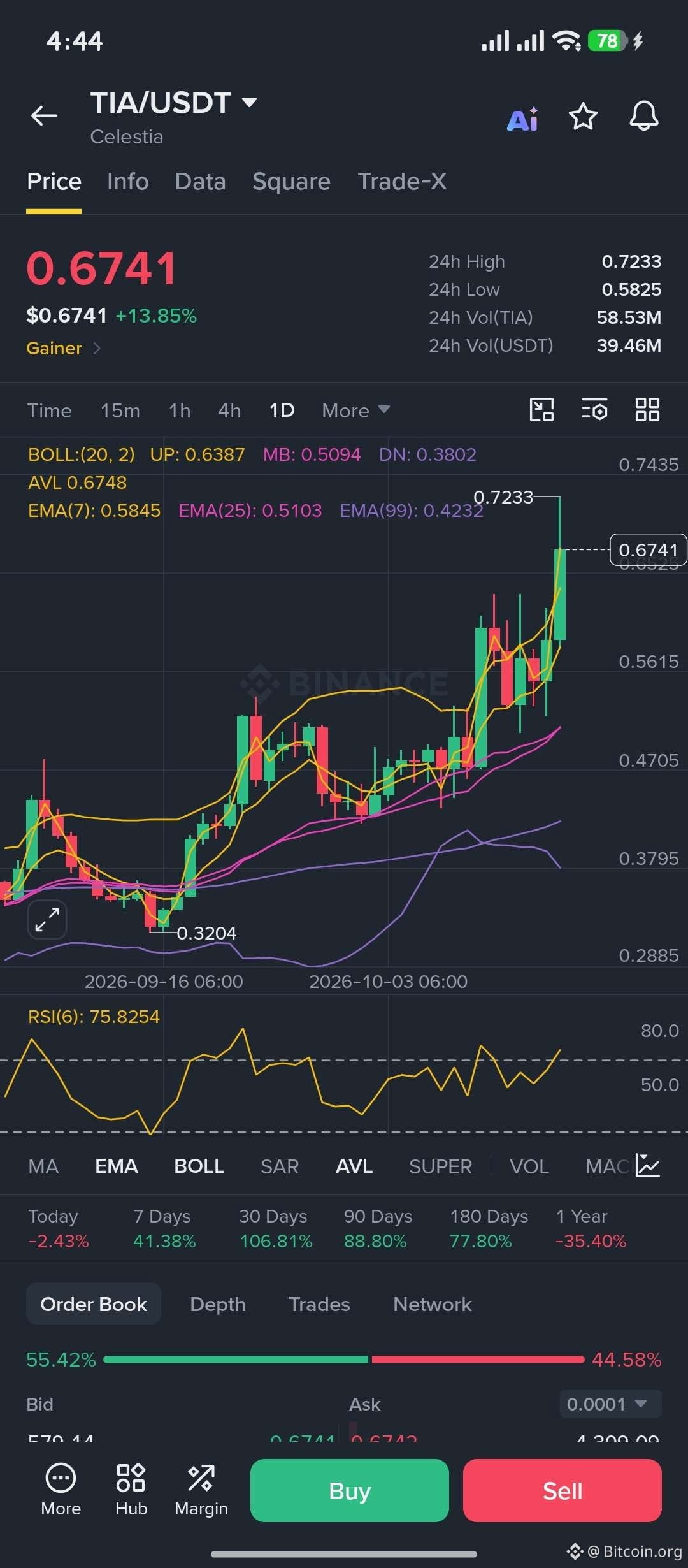
That's the real question after a 14% rip to 0.6741, tapping 0.7233 off a bounce from 0.3204. RSI(6) at 75.8 is hot, but it's breakout hot, price actually cleared the Bollinger band at 0.6387 instead of wicking and fading like it has before.
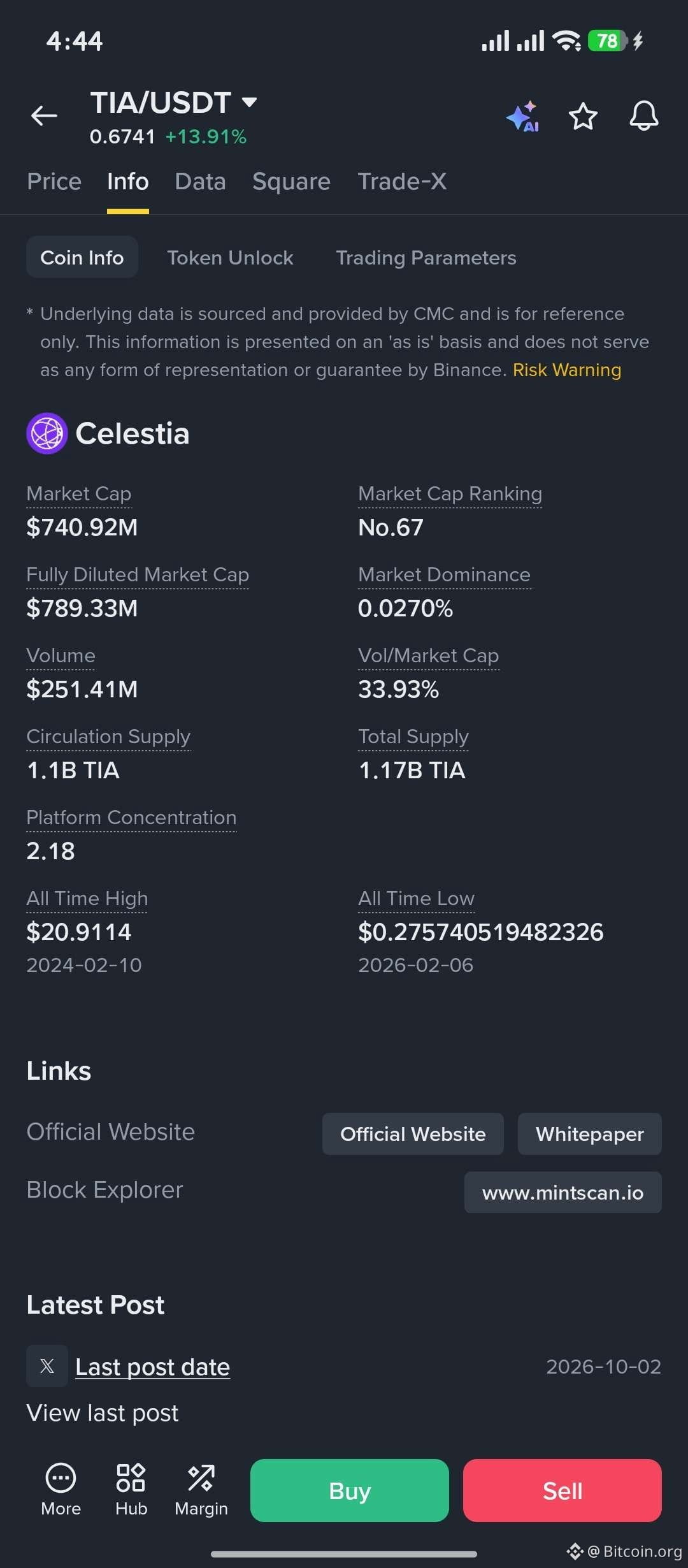
Here's why I'm not just taking this at face value. TIA listed on Binance back in October 2024 at $2, hit a 20.91 ath four months later, then spent the next year getting completely left behind, falling under its own listing price even while BTC kept printing new highs. That's not a coin that's earned the benefit of the doubt yet.
But something does look different this time. 41.38% this week, 106.81% this month, 88.80% over 90 days, and real volume behind it, 251M traded against a 740M cap. That's not the same thin, directionless chop that's defined this token for a year.
So is this the start of something real, or just the market giving TIA one more shot before it disappoints again like it has every other time? Genuinely not sure yet.
The next few days of holding above that breakout level will tell more than this one candle can.
$TIA
$TIA ready for the next big move, or just another try before a fresh all time low?
That's the real question after a 14% rip to 0.6741, tapping 0.7233 off a bounce from 0.3204. RSI(6) at 75.8 is hot, but it's breakout hot, price actually cleared the Bollinger band at 0.6387 instead of wicking and fading like it has before.
Here's why I'm not just taking this at face value. TIA listed on Binance back in October 2024 at $2, hit a 20.91 ath four months later, then spent the next year getting completely left behind, falling under its own listing price even while BTC kept printing new highs. That's not a coin that's earned the benefit of the doubt yet.
But something does look different this time. 41.38% this week, 106.81% this month, 88.80% over 90 days, and real volume behind it, 251M traded against a 740M cap. That's not the same thin, directionless chop that's defined this token for a year.
So is this the start of something real, or just the market giving TIA one more shot before it disappoints again like it has every other time? Genuinely not sure yet.
The next few days of holding above that breakout level will tell more than this one candle can.
$TIA
That's the real question after a 14% rip to 0.6741, tapping 0.7233 off a bounce from 0.3204. RSI(6) at 75.8 is hot, but it's breakout hot, price actually cleared the Bollinger band at 0.6387 instead of wicking and fading like it has before.
Here's why I'm not just taking this at face value. TIA listed on Binance back in October 2024 at $2, hit a 20.91 ath four months later, then spent the next year getting completely left behind, falling under its own listing price even while BTC kept printing new highs. That's not a coin that's earned the benefit of the doubt yet.
But something does look different this time. 41.38% this week, 106.81% this month, 88.80% over 90 days, and real volume behind it, 251M traded against a 740M cap. That's not the same thin, directionless chop that's defined this token for a year.
So is this the start of something real, or just the market giving TIA one more shot before it disappoints again like it has every other time? Genuinely not sure yet.
The next few days of holding above that breakout level will tell more than this one candle can.
$TIA
2
276
·
--
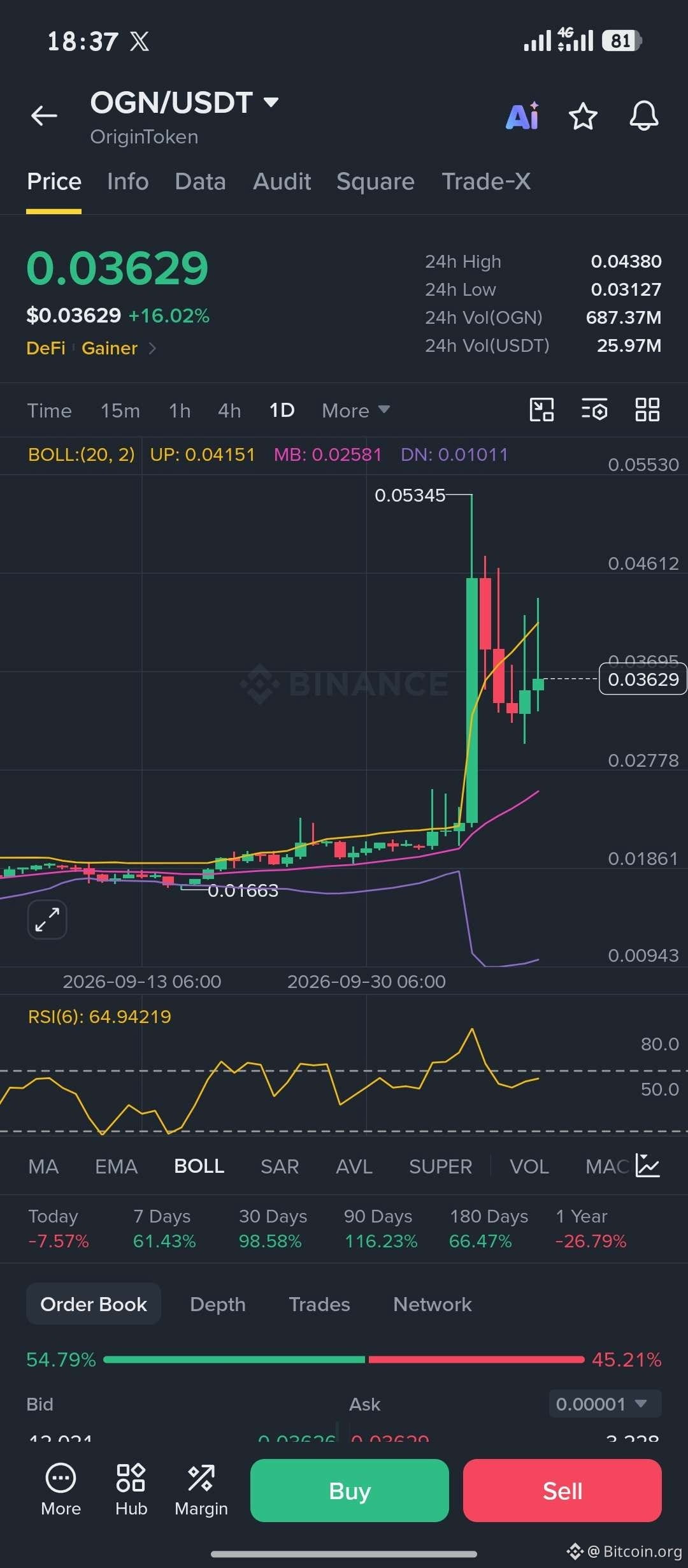
Do you believe the day before it is at 0.052.
I'm talking about the $OGN .
This jumped hard. I posted about it when it was at 0.036
But right now i'm checking this is even below our entry. It is what we need to change.
This gem is pumped hard and makes waves afterwards it follows the same path.
Day 2-3 as top gainers then 3-4 as top losers.
Where its ATH at 3.39 and right now It can't Even hold 0.045 likely.
Supply overhang. So stay sharp don't chase Every gainer.
$OGN 0rigin protocol.
#DeFi
Do you believe the day before it is at 0.052.
I'm talking about the $OGN .
This jumped hard. I posted about it when it was at 0.036
But right now i'm checking this is even below our entry. It is what we need to change.
This gem is pumped hard and makes waves afterwards it follows the same path.
Day 2-3 as top gainers then 3-4 as top losers.
Where its ATH at 3.39 and right now It can't Even hold 0.045 likely.
Supply overhang. So stay sharp don't chase Every gainer.
$OGN 0rigin protocol.
#DeFi
I'm talking about the $OGN .
This jumped hard. I posted about it when it was at 0.036
But right now i'm checking this is even below our entry. It is what we need to change.
This gem is pumped hard and makes waves afterwards it follows the same path.
Day 2-3 as top gainers then 3-4 as top losers.
Where its ATH at 3.39 and right now It can't Even hold 0.045 likely.
Supply overhang. So stay sharp don't chase Every gainer.
$OGN 0rigin protocol.
#DeFi
1
371
·
--
$ZRO is ready for a breakout.
LayerZero is the omnichain interoperability protocol connecting 50+ blockchains, letting assets and messages move across chains without relying on traditional bridges.
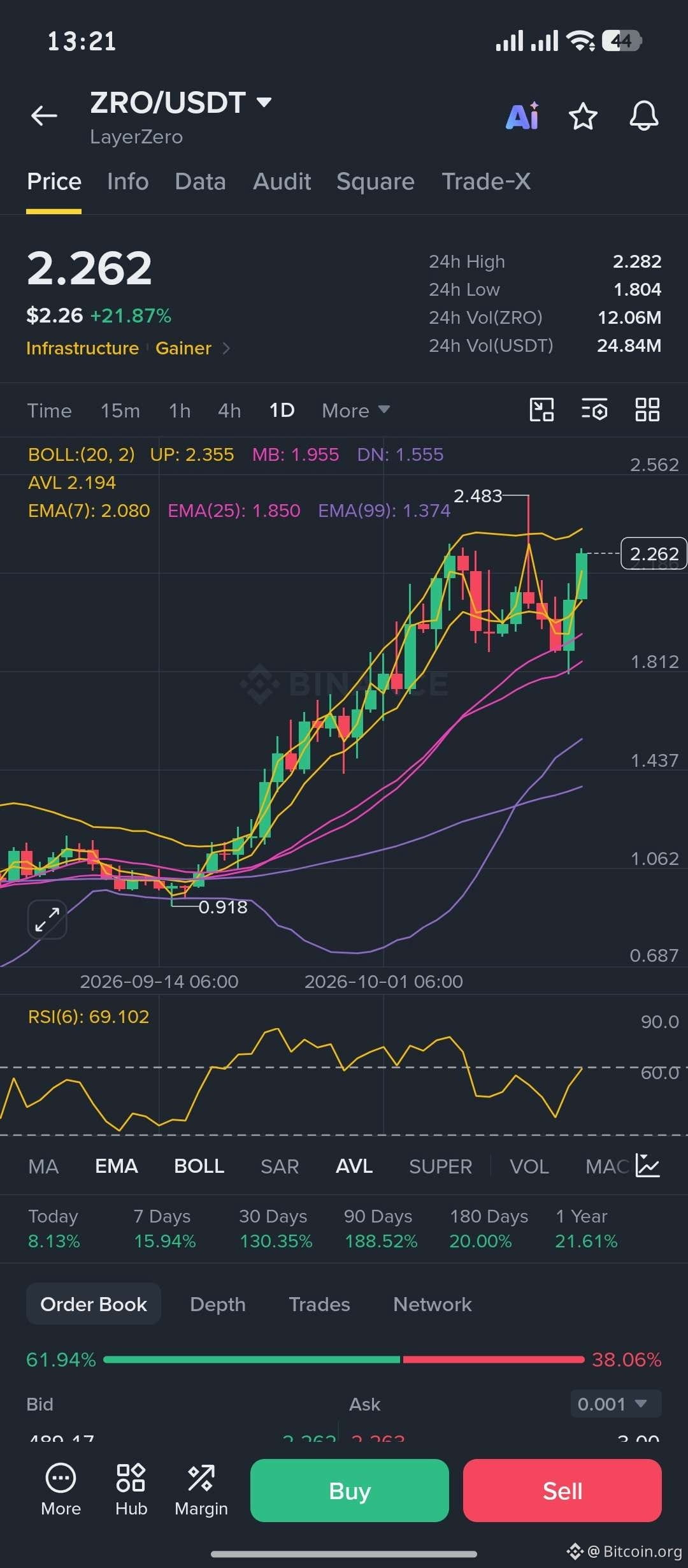
Up 21.87% today, trading at 2.262, tapping a high of 2.282. RSI(6) at 69.1, strong without being extreme, pushing right against the Bollinger upper band at 2.355. Volume backing it too, 24.84M USDT in 24h.
The trend agrees, up 15.94% this week, 130.35% this month, 188.52% over 90 days, 21.61% over the past year. 2.483 is the recent wick high that got rejected, clear that with volume and this isn't just a bounce anymore.
Trendline break clearly for a reasons. Breakout can lead it for next 3.34 zone.
$ZRO
$ZRO is ready for a breakout.
LayerZero is the omnichain interoperability protocol connecting 50+ blockchains, letting assets and messages move across chains without relying on traditional bridges.
Up 21.87% today, trading at 2.262, tapping a high of 2.282. RSI(6) at 69.1, strong without being extreme, pushing right against the Bollinger upper band at 2.355. Volume backing it too, 24.84M USDT in 24h.
The trend agrees, up 15.94% this week, 130.35% this month, 188.52% over 90 days, 21.61% over the past year. 2.483 is the recent wick high that got rejected, clear that with volume and this isn't just a bounce anymore.
Trendline break clearly for a reasons. Breakout can lead it for next 3.34 zone.
$ZRO
LayerZero is the omnichain interoperability protocol connecting 50+ blockchains, letting assets and messages move across chains without relying on traditional bridges.
Up 21.87% today, trading at 2.262, tapping a high of 2.282. RSI(6) at 69.1, strong without being extreme, pushing right against the Bollinger upper band at 2.355. Volume backing it too, 24.84M USDT in 24h.
The trend agrees, up 15.94% this week, 130.35% this month, 188.52% over 90 days, 21.61% over the past year. 2.483 is the recent wick high that got rejected, clear that with volume and this isn't just a bounce anymore.
Trendline break clearly for a reasons. Breakout can lead it for next 3.34 zone.
$ZRO
1
187
·
--
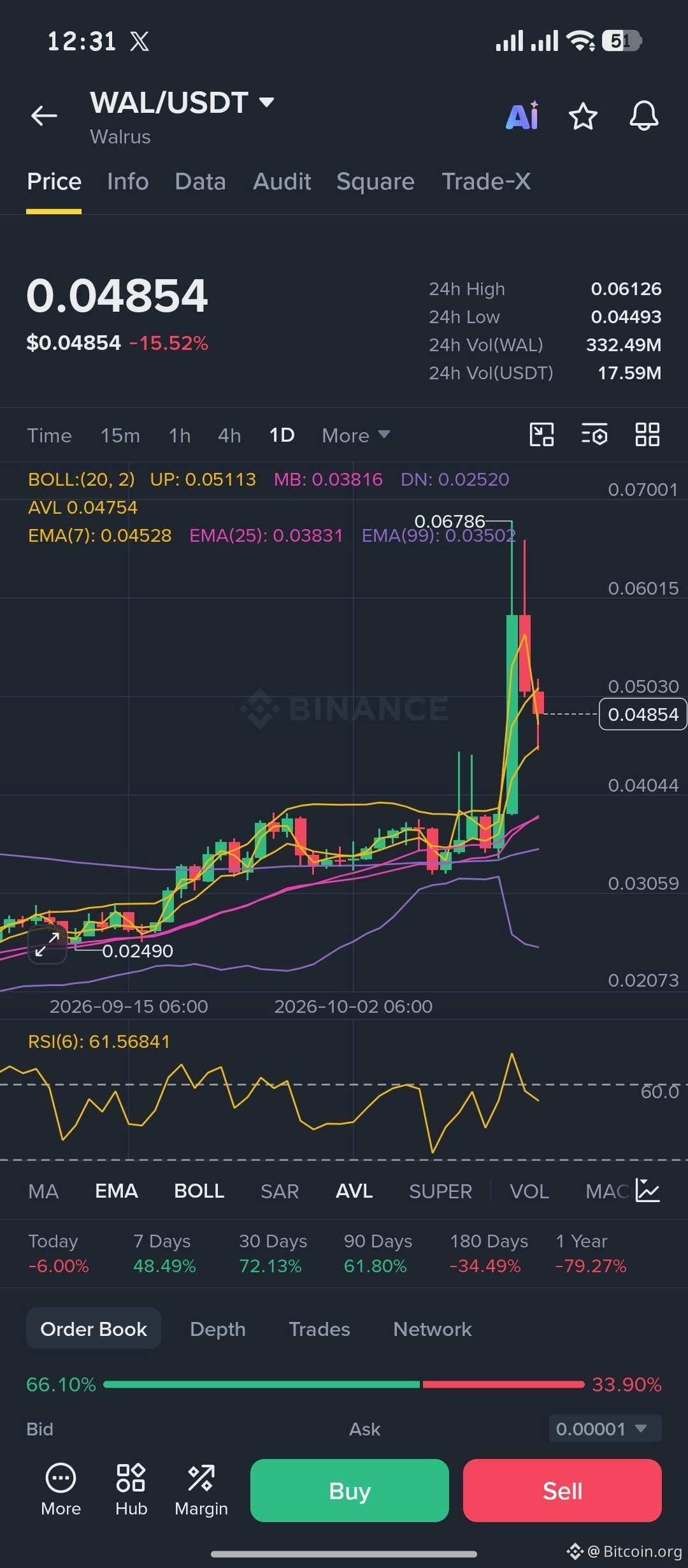
If you think that $WAL is starting to fall you're wrong imo.
After the bullish breakout $WAL just routing for a pullback That's all.
It already looks like the pullback is also ended . It’s already started surging in the lower timeframe.
So stay sharp on this. Don't feel fomo to go downside that it not falling now.
If you think that $WAL is starting to fall you're wrong imo.
After the bullish breakout $WAL just routing for a pullback That's all.
It already looks like the pullback is also ended . It’s already started surging in the lower timeframe.
So stay sharp on this. Don't feel fomo to go downside that it not falling now.
After the bullish breakout $WAL just routing for a pullback That's all.
It already looks like the pullback is also ended . It’s already started surging in the lower timeframe.
So stay sharp on this. Don't feel fomo to go downside that it not falling now.
2
373
·
--
$INJ is proving fundamentals and price can move together.
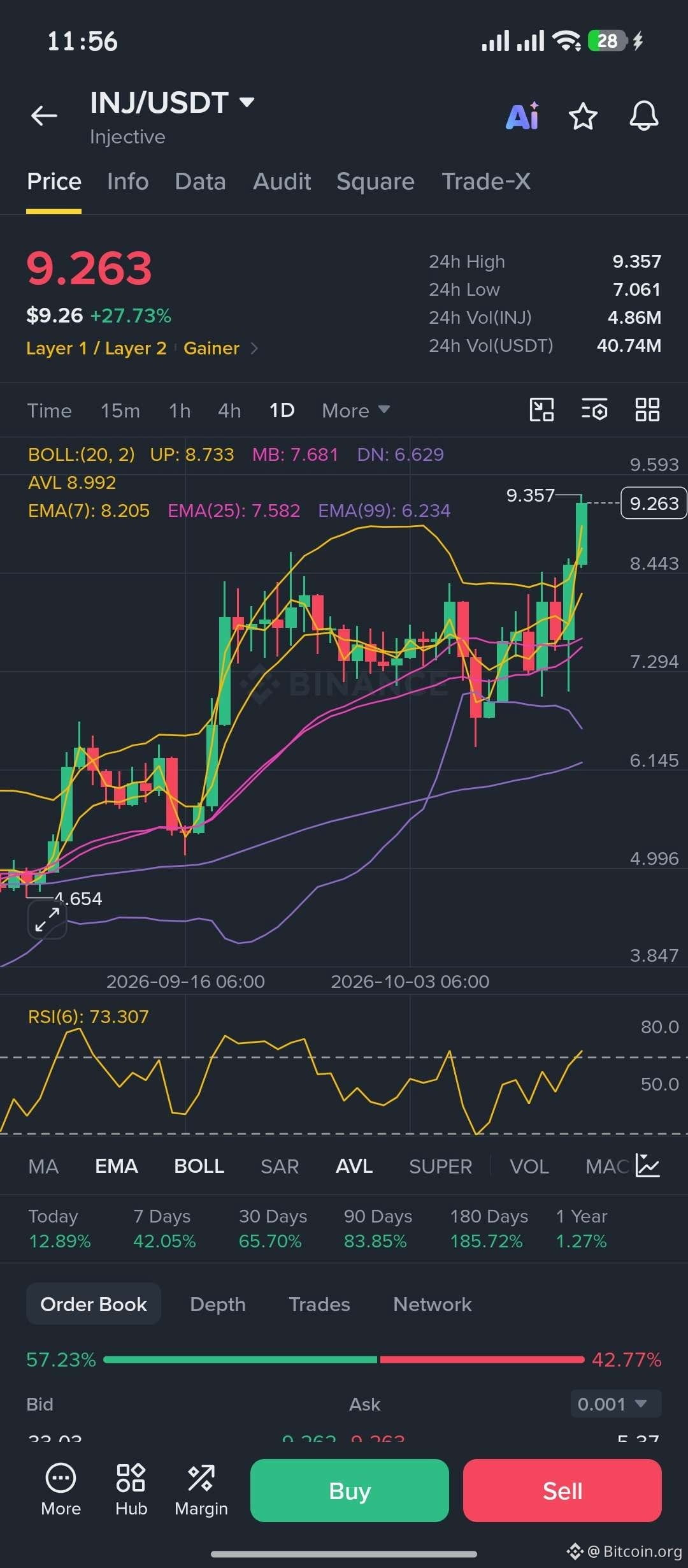
Up 27.73% today, trading at 9.263, after tapping a high of 9.357. RSI(6) sitting at 73.3, strong but not yet extreme, and price just broke decisively above the Bollinger upper band at 8.733, a clean breakout, not a wick that immediately got rejected.
This isn't speculation chasing nothing. In August 2026, Injective Institutional Services became the first Layer-1 blockchain to register as an SEC transfer agent, a real regulatory milestone enabling the issuance and trading of tokenized securities directly through the chain. INJ jumped roughly 8% right on that announcement alone, and the move has continued building since.
Trend backs it completely, up 42.05% this week, 65.70% this month, 83.85% over 90 days, and 185.72% over the past 180 days. Volume is real too, 40.74M USDT traded in 24h.
This sits on top of a genuinely active roadmap, native USDC integration, Coinbase listing native INJ support, regulated CFTC futures through Bitnomial, a staked INJ spot ETF filing from Canary Capital, and an ongoing monthly token burn program removing supply through community buybacks.
Regulatory clarity, real institutional infrastructure, and a chart breaking out on volume, all pointing the same direction at once.
Also already make move on this direction.
$INJ
$INJ is proving fundamentals and price can move together.
Up 27.73% today, trading at 9.263, after tapping a high of 9.357. RSI(6) sitting at 73.3, strong but not yet extreme, and price just broke decisively above the Bollinger upper band at 8.733, a clean breakout, not a wick that immediately got rejected.
This isn't speculation chasing nothing. In August 2026, Injective Institutional Services became the first Layer-1 blockchain to register as an SEC transfer agent, a real regulatory milestone enabling the issuance and trading of tokenized securities directly through the chain. INJ jumped roughly 8% right on that announcement alone, and the move has continued building since.
Trend backs it completely, up 42.05% this week, 65.70% this month, 83.85% over 90 days, and 185.72% over the past 180 days. Volume is real too, 40.74M USDT traded in 24h.
This sits on top of a genuinely active roadmap, native USDC integration, Coinbase listing native INJ support, regulated CFTC futures through Bitnomial, a staked INJ spot ETF filing from Canary Capital, and an ongoing monthly token burn program removing supply through community buybacks.
Regulatory clarity, real institutional infrastructure, and a chart breaking out on volume, all pointing the same direction at once.
Also already make move on this direction.
$INJ
Up 27.73% today, trading at 9.263, after tapping a high of 9.357. RSI(6) sitting at 73.3, strong but not yet extreme, and price just broke decisively above the Bollinger upper band at 8.733, a clean breakout, not a wick that immediately got rejected.
This isn't speculation chasing nothing. In August 2026, Injective Institutional Services became the first Layer-1 blockchain to register as an SEC transfer agent, a real regulatory milestone enabling the issuance and trading of tokenized securities directly through the chain. INJ jumped roughly 8% right on that announcement alone, and the move has continued building since.
Trend backs it completely, up 42.05% this week, 65.70% this month, 83.85% over 90 days, and 185.72% over the past 180 days. Volume is real too, 40.74M USDT traded in 24h.
This sits on top of a genuinely active roadmap, native USDC integration, Coinbase listing native INJ support, regulated CFTC futures through Bitnomial, a staked INJ spot ETF filing from Canary Capital, and an ongoing monthly token burn program removing supply through community buybacks.
Regulatory clarity, real institutional infrastructure, and a chart breaking out on volume, all pointing the same direction at once.
Also already make move on this direction.
$INJ
2
162
·
--
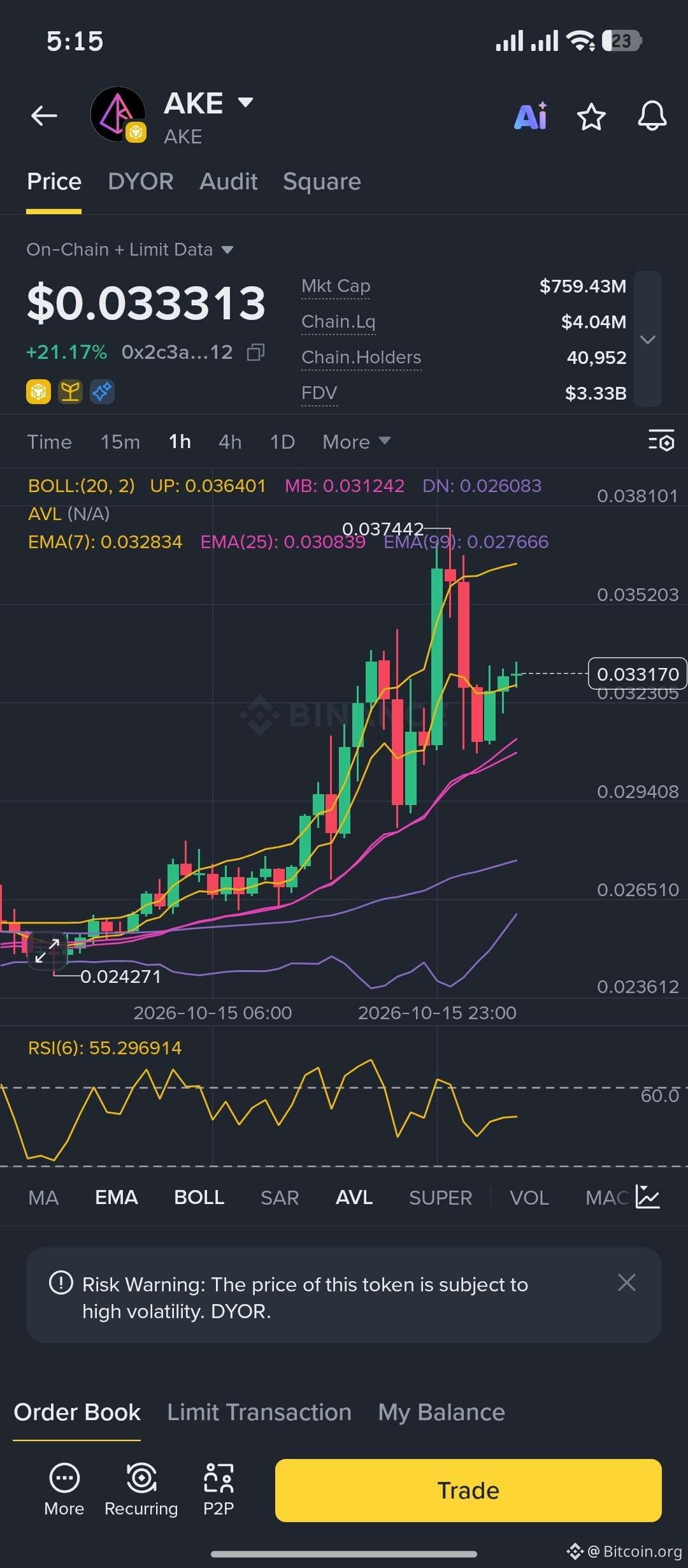
Before writing anything, I need to flag a serious mismatch. The real AKEDO (AKE) token, the BNB Chain AI game-creation platform, trades around $0.0003 to $0.0004, with a market cap near $7.5M. Your screenshot shows AKE at $0.033313 with a $759M market cap, about 100x higher on both price and cap. That's not a rounding difference, that's a different asset.
There's also a completely unrelated project also using " $AKE," a meme coin called Snaky Way, promoted with claims like an "Ethereum Foundation partnership," language that's a classic scam pattern, vague institutional name-dropping with no verifiable source.
So before I write a post, I need to know: is this contract address (0x2c3a...12) actually AKEDO's official contract? If you can share the full address, I can check it against AKEDO's verified contract instead of guessing from a logo and ticker alone. Posting bullish content about the wrong token, or a presale-style copycat, is exactly the kind of mix-up we caught with BR earlier.
Before writing anything, I need to flag a serious mismatch. The real AKEDO (AKE) token, the BNB Chain AI game-creation platform, trades around $0.0003 to $0.0004, with a market cap near $7.5M. Your screenshot shows AKE at $0.033313 with a $759M market cap, about 100x higher on both price and cap. That's not a rounding difference, that's a different asset.
There's also a completely unrelated project also using " $AKE," a meme coin called Snaky Way, promoted with claims like an "Ethereum Foundation partnership," language that's a classic scam pattern, vague institutional name-dropping with no verifiable source.
So before I write a post, I need to know: is this contract address (0x2c3a...12) actually AKEDO's official contract? If you can share the full address, I can check it against AKEDO's verified contract instead of guessing from a logo and ticker alone. Posting bullish content about the wrong token, or a presale-style copycat, is exactly the kind of mix-up we caught with BR earlier.
There's also a completely unrelated project also using " $AKE," a meme coin called Snaky Way, promoted with claims like an "Ethereum Foundation partnership," language that's a classic scam pattern, vague institutional name-dropping with no verifiable source.
So before I write a post, I need to know: is this contract address (0x2c3a...12) actually AKEDO's official contract? If you can share the full address, I can check it against AKEDO's verified contract instead of guessing from a logo and ticker alone. Posting bullish content about the wrong token, or a presale-style copycat, is exactly the kind of mix-up we caught with BR earlier.
1
582
·
--
$BTC we are in an extreme zone.
Right now $BTC tries to break the 80K level below.
The market can now make two things. A sudden move toward the upside for clearing this consolidating channel and break 90K
Or maybe it can just react on the #cpiwatch data so slowly it's got 83 to 80k or more low.
But actual momentum is not going down yet.
Still it can pass 90k easily.
But the real factor is market shipping fear now. Fear index falling. So if it triggers panic selling then it will be tough.
Stay sharp and believe in Data.
$BTC
$BTC we are in an extreme zone.
Right now $BTC tries to break the 80K level below.
The market can now make two things. A sudden move toward the upside for clearing this consolidating channel and break 90K
Or maybe it can just react on the #cpiwatch data so slowly it's got 83 to 80k or more low.
But actual momentum is not going down yet.
Still it can pass 90k easily.
But the real factor is market shipping fear now. Fear index falling. So if it triggers panic selling then it will be tough.
Stay sharp and believe in Data.
$BTC
Right now $BTC tries to break the 80K level below.
The market can now make two things. A sudden move toward the upside for clearing this consolidating channel and break 90K
Or maybe it can just react on the #cpiwatch data so slowly it's got 83 to 80k or more low.
But actual momentum is not going down yet.
Still it can pass 90k easily.
But the real factor is market shipping fear now. Fear index falling. So if it triggers panic selling then it will be tough.
Stay sharp and believe in Data.
$BTC
3
214
·
--
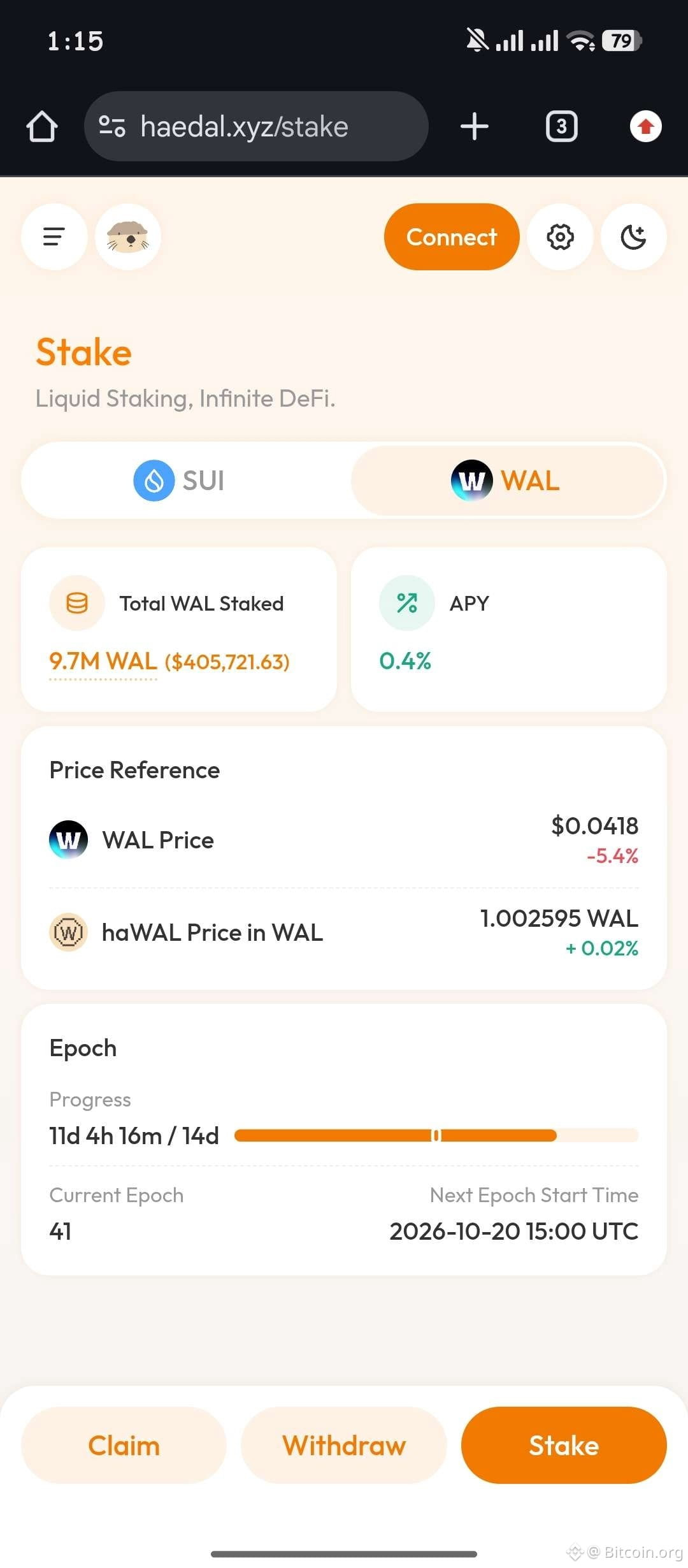
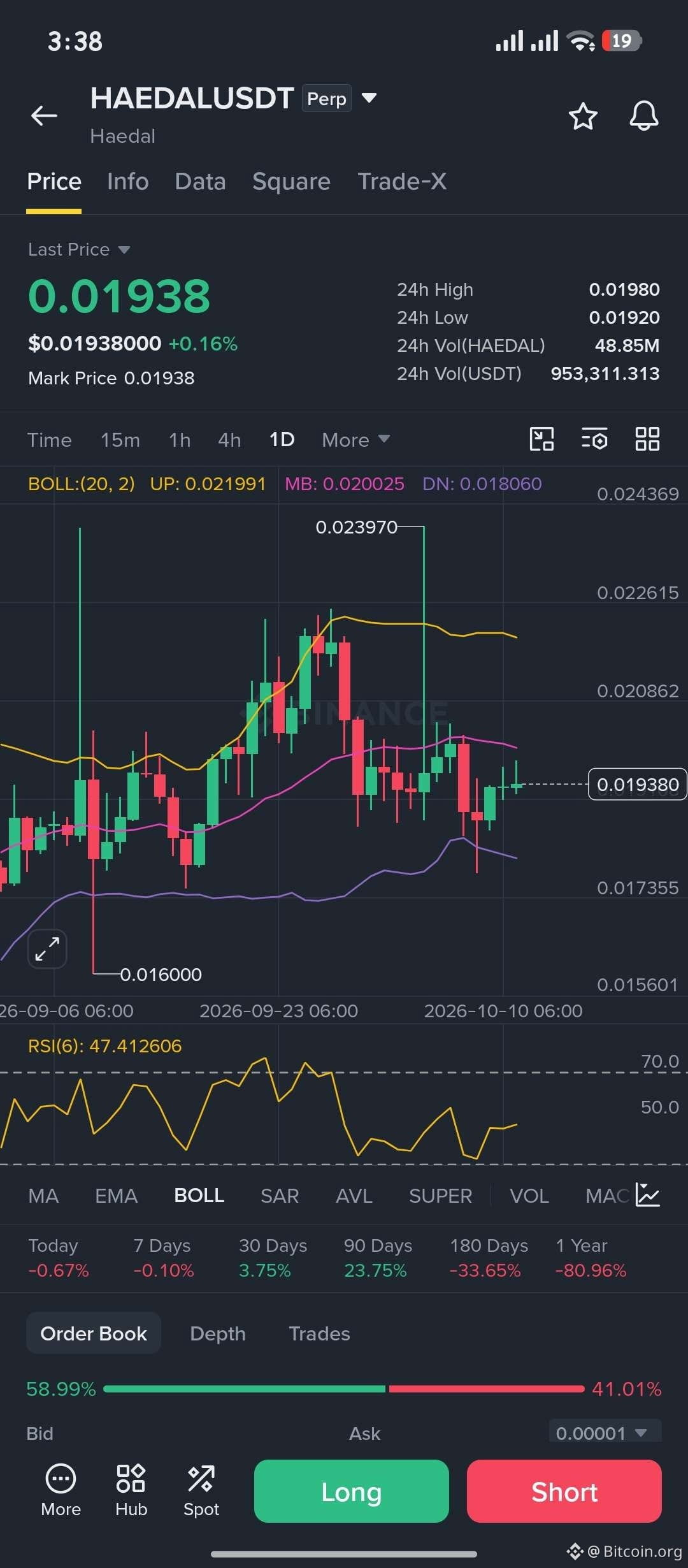
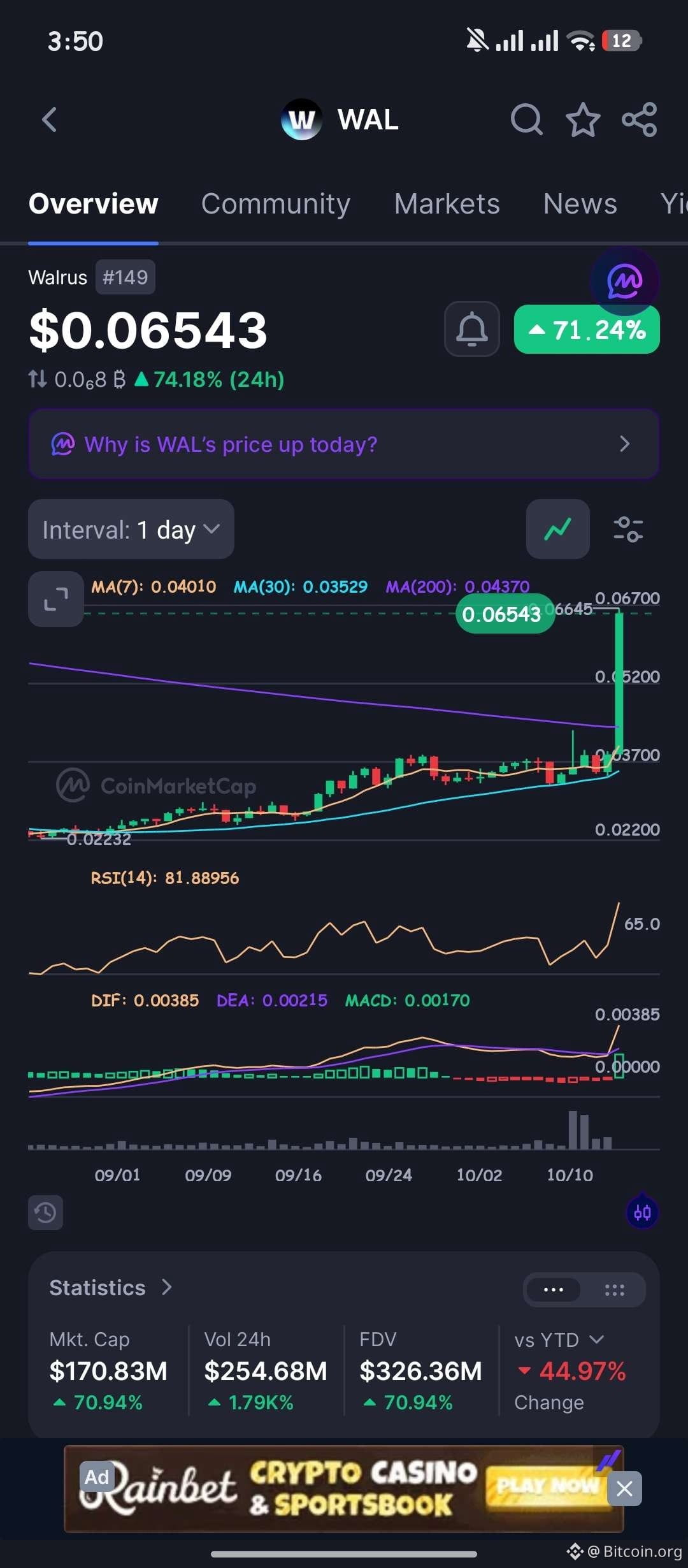
So where the $WAL is going for.
I posted about the Haedal protocol earlier. There i mentioned abiut this gem.
This decentralized storage today makes a big move.
Everyone thinks this project is dead. Even their official x posting ad and boost. But the $HAEDAL protocol reminds me about this again when the 10M milestone reached.
But right now think if you bought that time and put it into the vault right now you should retire.
So Haedal protocol bringing the DeFI alive in $SUI
And Walrus just got boos and is still climbing. #DeFi
So where the $WAL is going for.
I posted about the Haedal protocol earlier. There i mentioned abiut this gem.
This decentralized storage today makes a big move.
Everyone thinks this project is dead. Even their official x posting ad and boost. But the $HAEDAL protocol reminds me about this again when the 10M milestone reached.
But right now think if you bought that time and put it into the vault right now you should retire.
So Haedal protocol bringing the DeFI alive in $SUI
And Walrus just got boos and is still climbing. #DeFi
I posted about the Haedal protocol earlier. There i mentioned abiut this gem.
This decentralized storage today makes a big move.
Everyone thinks this project is dead. Even their official x posting ad and boost. But the $HAEDAL protocol reminds me about this again when the 10M milestone reached.
But right now think if you bought that time and put it into the vault right now you should retire.
So Haedal protocol bringing the DeFI alive in $SUI
And Walrus just got boos and is still climbing. #DeFi
2
711
·
--
The most likely mistake you're about to make is laughing at those dips bcz you haven't bought.
You haven't bought, you're not going through the dip, and you think its ok! $BTC. Wait a moment, who tells you the price gonna wait for you before it start going back up? have you signed some kind of agreement?
honestly, is this how you want to invest or trade? just watching and calling every dip a trap aint a strategy, its just you avoiding the decision.
you don't need all that confusion. Just one thesis, the scenario that invalidates the thesis, and a risk plan to make the most out of it when it actually plays out.
The most likely mistake you're about to make is laughing at those dips bcz you haven't bought.
You haven't bought, you're not going through the dip, and you think its ok! $BTC. Wait a moment, who tells you the price gonna wait for you before it start going back up? have you signed some kind of agreement?
honestly, is this how you want to invest or trade? just watching and calling every dip a trap aint a strategy, its just you avoiding the decision.
you don't need all that confusion. Just one thesis, the scenario that invalidates the thesis, and a risk plan to make the most out of it when it actually plays out.
You haven't bought, you're not going through the dip, and you think its ok! $BTC. Wait a moment, who tells you the price gonna wait for you before it start going back up? have you signed some kind of agreement?
honestly, is this how you want to invest or trade? just watching and calling every dip a trap aint a strategy, its just you avoiding the decision.
you don't need all that confusion. Just one thesis, the scenario that invalidates the thesis, and a risk plan to make the most out of it when it actually plays out.
1
159
Log in to explore more content
Join global crypto users on Binance Square
⚡️ Get latest and useful information about crypto.
💬 Trusted by the world’s largest crypto exchange.
👍 Discover real insights from verified creators.
Email / Phone number
Trending Topics
BitcoinSlipsBelow$80KAgain
0 views
2 Discussing
🚨 $BULLA SHORT SETUP — IS ANOTHER DUMP COMING? 📉🔥
Bears could be getting ready for another move lower. 👀
🔴 SHORT $BULLA/USDT
🎯 Entry: Market Price
✅ Take Profit: $0.0800
🛑 Stop Loss: $0.01400
#BitcoinSlipsBelow$80KAgain #StrategySkipsBitcoinPurchasesSpends$205MOnSTRCBuybacks #BitmineAdds10452ETH #SouthKoreaConsidersEducationTaxOnCryptoExchanges #OCCUrgesCommunityBanksToEnterStablecoinPayments
KimHotbae
·0 Likes
·58 views
StrategySkipsBitcoinPurchasesSpends$205MOnSTRCBuybacks
2,264 views
60 Discussing
BitmineAdds10452ETH
19,048 views
405 Discussing