
两栖韭菜
274 Posts

两栖韭菜
Report
Block User
两栖韭菜|美股 · 币圈 · 比特币
说白了,不喊单不预测,只拆商业模式、护城河、能力圈。
早·隔夜美股复盘晚·币圈周期
佛系老韭菜一枚,跌了我也绿
Occasional Trader
5.5 Years
11 Following
116 Followers
137 Liked
Posts
·
--
Here’s my take: when people are this heavily insured, it’s often not the point when prices are falling the hardest.
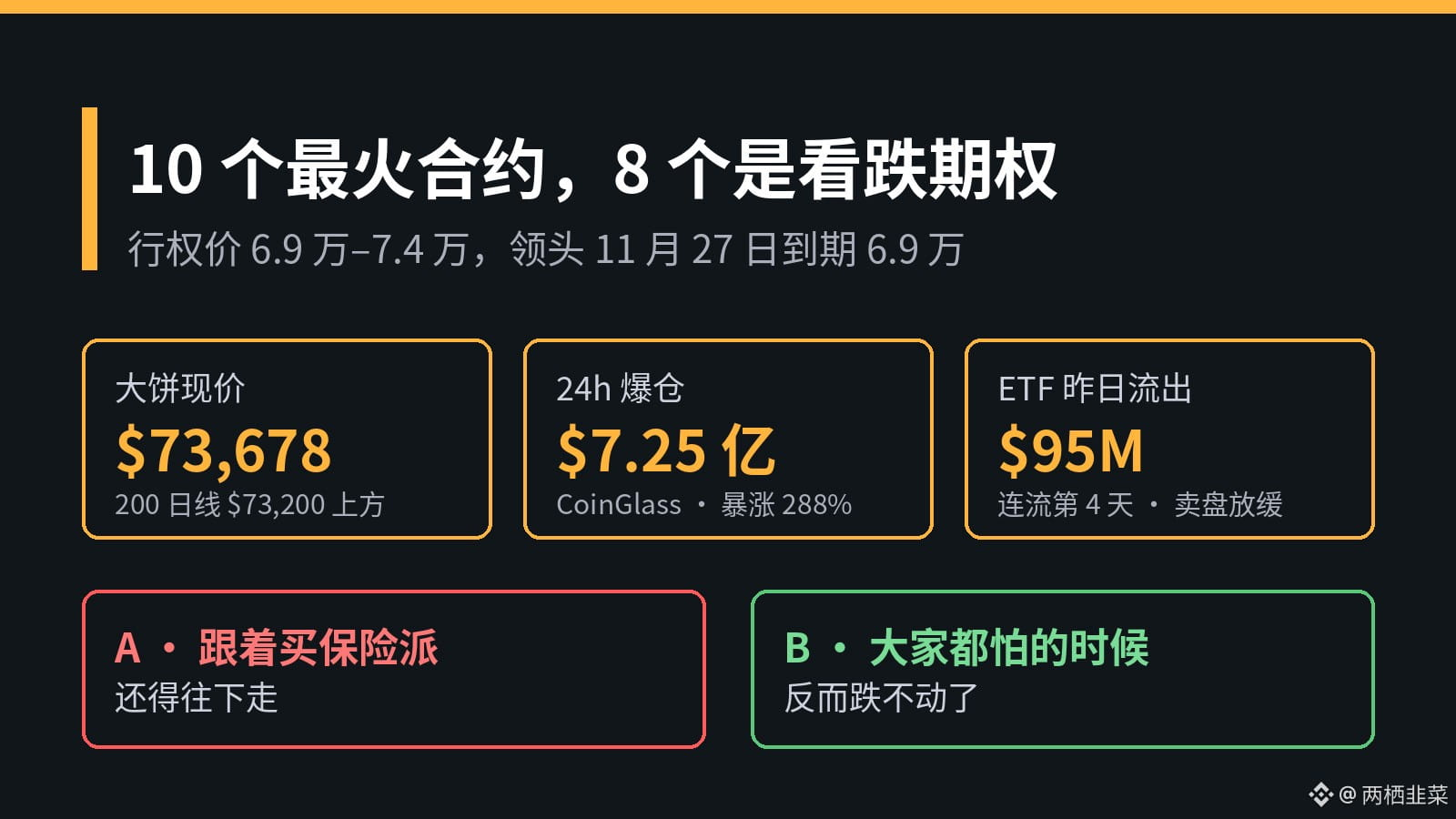
Of Deribit’s 10 most active Bitcoin options, 8 are puts, with strike prices between $69,000 and $74,000. The most popular one expires on November 27. In plain terms, seasoned traders are paying for insurance against a move down to $69,000.
But on the other hand, Bitcoin is hovering around $73,700, still above its 200-day moving average of $73,200; ETFs saw outflows of just $95 million yesterday, so selling pressure has eased considerably; and liquidations totaled $725 million over the past 24 hours.
Which side are you on? A: Follow the insurance buyers—there’s still more downside ahead; B: When everyone’s afraid, maybe the market can’t fall much further?
$BTC
Here’s my take: when people are this heavily insured, it’s often not the point when prices are falling the hardest.
Of Deribit’s 10 most active Bitcoin options, 8 are puts, with strike prices between $69,000 and $74,000. The most popular one expires on November 27. In plain terms, seasoned traders are paying for insurance against a move down to $69,000.
But on the other hand, Bitcoin is hovering around $73,700, still above its 200-day moving average of $73,200; ETFs saw outflows of just $95 million yesterday, so selling pressure has eased considerably; and liquidations totaled $725 million over the past 24 hours.
Which side are you on? A: Follow the insurance buyers—there’s still more downside ahead; B: When everyone’s afraid, maybe the market can’t fall much further?
$BTC
Of Deribit’s 10 most active Bitcoin options, 8 are puts, with strike prices between $69,000 and $74,000. The most popular one expires on November 27. In plain terms, seasoned traders are paying for insurance against a move down to $69,000.
But on the other hand, Bitcoin is hovering around $73,700, still above its 200-day moving average of $73,200; ETFs saw outflows of just $95 million yesterday, so selling pressure has eased considerably; and liquidations totaled $725 million over the past 24 hours.
Which side are you on? A: Follow the insurance buyers—there’s still more downside ahead; B: When everyone’s afraid, maybe the market can’t fall much further?
$BTC
78
·
--
CoreWeave delivered a strong report last night, and Nebius got a boost before it was even its turn, rising 12% premarket. The AI cloud upstarts have been getting hammered lately. Nebius fell from a year-to-date high of $299 all the way to $113, down more than 60%, so today’s bounce is purely riding someone else’s tailwind. It reports its own Q3 results tomorrow before the market opens, with investors looking for revenue of over $900 million, more than five times higher year over year. Can it turn that borrowed wind into its own momentum? We’ll find out tomorrow. $NBIS
CoreWeave delivered a strong report last night, and Nebius got a boost before it was even its turn, rising 12% premarket. The AI cloud upstarts have been getting hammered lately. Nebius fell from a year-to-date high of $299 all the way to $113, down more than 60%, so today’s bounce is purely riding someone else’s tailwind. It reports its own Q3 results tomorrow before the market opens, with investors looking for revenue of over $900 million, more than five times higher year over year. Can it turn that borrowed wind into its own momentum? We’ll find out tomorrow. $NBIS
45
·
--
Article
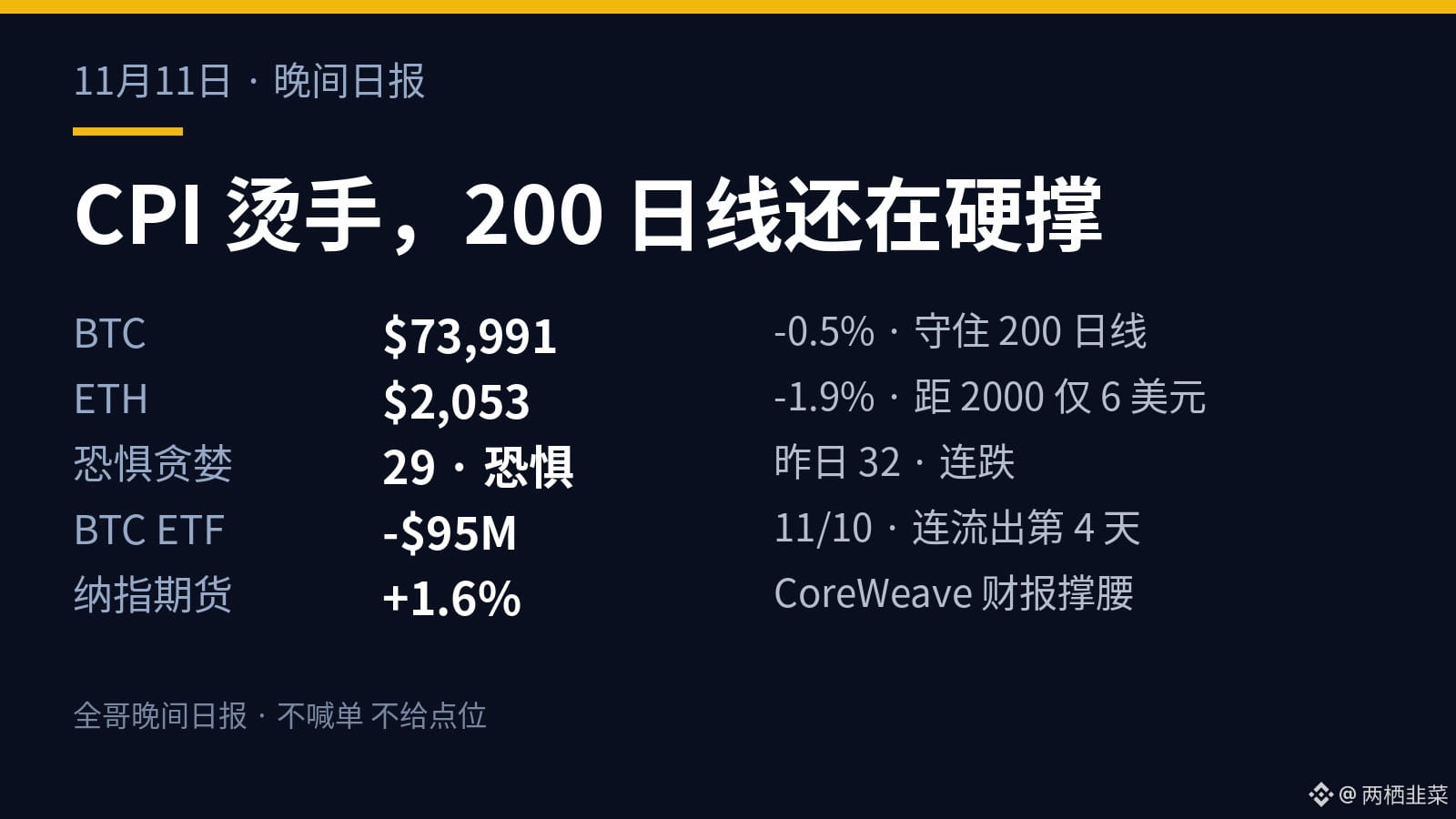
Hot CPI, and the 200-day moving average is still holding firmThe short version: today didn’t fall apart, but it didn’t get back on its feet either. CPI came in hot, a rate hike is all but certain, BTC is clinging to its 200-day moving average, while ETH is getting closer and closer to $2,000—this market is seriously conflicted.
BTC is around $73,990 tonight, down less than 1% over 24 hours, which doesn’t look too bad. But it dipped to a low of $72,727 overnight, with the 200-day moving average sitting around $73,200. In other words, it briefly fell below it during the day and only just managed to climb back above it by evening. It’s down nearly 6% over seven days and 11.8% over a month. At this point, it’s less a support level than the whole village’s last psychological line of defense. ETH is worse off, at around $2,053, down 1.9%, with an overnight low of $2,006—just $6 away from $2,000. It’s down 11% over seven days and 19% over a month. Bitcoin accounts for 60% of the entire market, and money is retreating into BTC, leaving smaller coins and ETH to watch from the sidelines.
Hot CPI, and the 200-day moving average is still holding firm
The short version: today didn’t fall apart, but it didn’t get back on its feet either. CPI came in hot, a rate hike is all but certain, BTC is clinging to its 200-day moving average, while ETH is getting closer and closer to $2,000—this market is seriously conflicted.
BTC is around $73,990 tonight, down less than 1% over 24 hours, which doesn’t look too bad. But it dipped to a low of $72,727 overnight, with the 200-day moving average sitting around $73,200. In other words, it briefly fell below it during the day and only just managed to climb back above it by evening. It’s down nearly 6% over seven days and 11.8% over a month. At this point, it’s less a support level than the whole village’s last psychological line of defense. ETH is worse off, at around $2,053, down 1.9%, with an overnight low of $2,006—just $6 away from $2,000. It’s down 11% over seven days and 19% over a month. Bitcoin accounts for 60% of the entire market, and money is retreating into BTC, leaving smaller coins and ETH to watch from the sidelines.
BTC is around $73,990 tonight, down less than 1% over 24 hours, which doesn’t look too bad. But it dipped to a low of $72,727 overnight, with the 200-day moving average sitting around $73,200. In other words, it briefly fell below it during the day and only just managed to climb back above it by evening. It’s down nearly 6% over seven days and 11.8% over a month. At this point, it’s less a support level than the whole village’s last psychological line of defense. ETH is worse off, at around $2,053, down 1.9%, with an overnight low of $2,006—just $6 away from $2,000. It’s down 11% over seven days and 19% over a month. Bitcoin accounts for 60% of the entire market, and money is retreating into BTC, leaving smaller coins and ETH to watch from the sidelines.
266
·
--
Optical modules finally got a chance to shine today: Cambridge Technology hit the daily limit, while TFC Optical, Eoptolink and Innolight all rose more than 10%. Put simply, these sector leaders had fallen in droves by over 60% from their highs; Eoptolink and Dongshan Precision had even dropped 70%. Today’s bullish candle is, at most, a chance to catch their breath after a brutal sell-off. The news is that Microsoft lobbied the US, which has put its ban on imports of Chinese optical transceivers on hold. Cambridge also said it plans to expand capacity by at least 10 million high-speed optical modules before the end of 2027. Anyone calling a reversal after a 60% plunge and a one-day bounce hasn’t been through the wringer—let’s first see whether the stocks can hold their ground.
Optical modules finally got a chance to shine today: Cambridge Technology hit the daily limit, while TFC Optical, Eoptolink and Innolight all rose more than 10%. Put simply, these sector leaders had fallen in droves by over 60% from their highs; Eoptolink and Dongshan Precision had even dropped 70%. Today’s bullish candle is, at most, a chance to catch their breath after a brutal sell-off. The news is that Microsoft lobbied the US, which has put its ban on imports of Chinese optical transceivers on hold. Cambridge also said it plans to expand capacity by at least 10 million high-speed optical modules before the end of 2027. Anyone calling a reversal after a 60% plunge and a one-day bounce hasn’t been through the wringer—let’s first see whether the stocks can hold their ground.
61
·
--
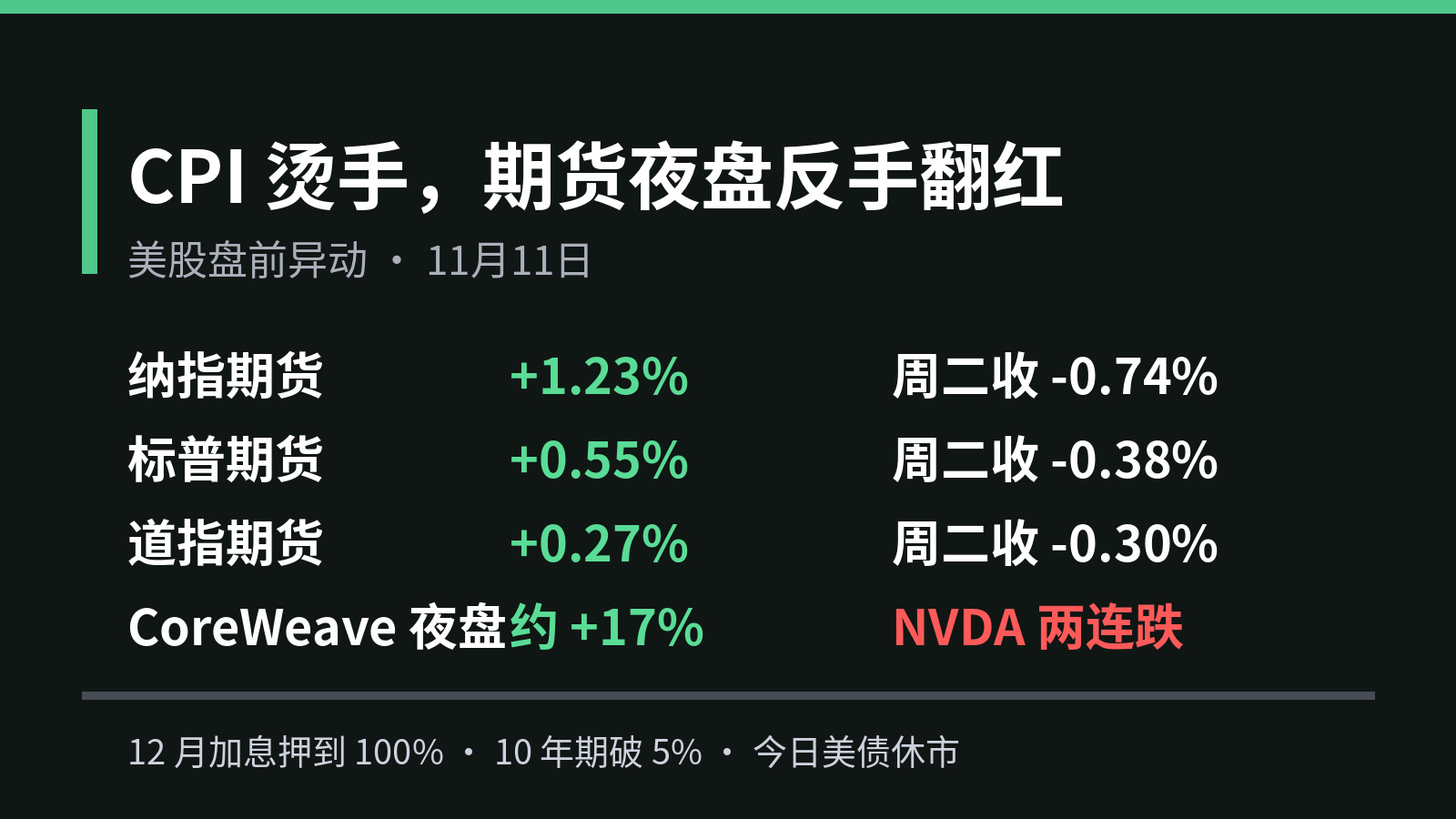
Last night’s CPI came in scorching hot, and the odds of a December rate hike were priced at 100%. The Nasdaq immediately fell 0.74%. But overnight futures turned green across the board: Nasdaq futures reversed course and rose 1.23%, the S&P 500 gained 0.55%, and the Dow rose 0.27%.
Put simply, when stocks were falling, everyone was shouting that rate hikes were deadly. Once they bounced back, people noticed the 10-year yield had already topped 5%—and Tuesday had already seen the sell-off that was due.
Individual stocks were mixed, too: CoreWeave rose nearly 17% overnight on strong earnings; UBS cut Take-Two’s price target but kept its Buy rating, with GTA VI pre-orders at an all-time high; and Nvidia fell for a second straight session, with its earnings report not due until November 17.
Don’t chase the overnight excitement. Wait for the market open and see which stocks are really rebounding.
$NVDA $CRWV
Last night’s CPI came in scorching hot, and the odds of a December rate hike were priced at 100%. The Nasdaq immediately fell 0.74%. But overnight futures turned green across the board: Nasdaq futures reversed course and rose 1.23%, the S&P 500 gained 0.55%, and the Dow rose 0.27%.
Put simply, when stocks were falling, everyone was shouting that rate hikes were deadly. Once they bounced back, people noticed the 10-year yield had already topped 5%—and Tuesday had already seen the sell-off that was due.
Individual stocks were mixed, too: CoreWeave rose nearly 17% overnight on strong earnings; UBS cut Take-Two’s price target but kept its Buy rating, with GTA VI pre-orders at an all-time high; and Nvidia fell for a second straight session, with its earnings report not due until November 17.
Don’t chase the overnight excitement. Wait for the market open and see which stocks are really rebounding.
$NVDA $CRWV
Put simply, when stocks were falling, everyone was shouting that rate hikes were deadly. Once they bounced back, people noticed the 10-year yield had already topped 5%—and Tuesday had already seen the sell-off that was due.
Individual stocks were mixed, too: CoreWeave rose nearly 17% overnight on strong earnings; UBS cut Take-Two’s price target but kept its Buy rating, with GTA VI pre-orders at an all-time high; and Nvidia fell for a second straight session, with its earnings report not due until November 17.
Don’t chase the overnight excitement. Wait for the market open and see which stocks are really rebounding.
$NVDA $CRWV
165
·
--
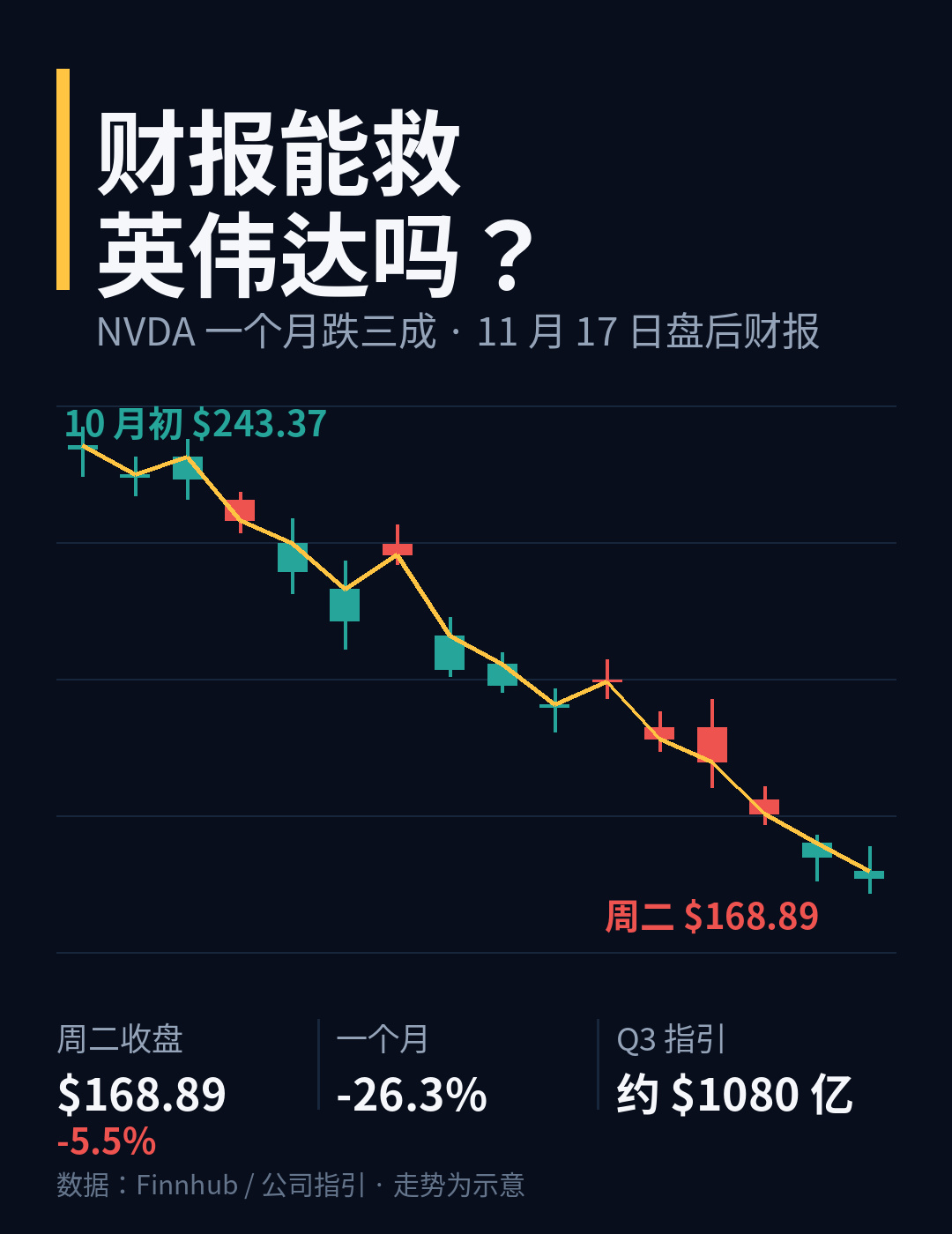
Nvidia fell another 5.5% on Tuesday, closing at $168.89. From its early-October peak of $243, it’s down 30% in just over a month, with more than $470 billion wiped off its market cap in two days.
There are plenty of reasons for the drop: CPI came in hotter than expected, a December rate hike is all but certain, the CEO’s troubles are far from over, and analysts have also cut their price targets—Citi lowered its target from $315 to $285. The market is asking just one question now: Can next Tuesday’s (November 17) after-hours earnings report help turn things around?
The numbers themselves actually aren’t bad: The company’s own guidance calls for revenue of about $108 billion, versus market expectations of $109.2 billion—roughly double year over year—with a gross margin of 74%. But earnings aren’t just about how much a company made this quarter; they’re about whether growth can continue next quarter. The guidance last quarter was already at this level, so simply meeting expectations this time may not be enough to win the market over.
A great company and a great stock are two different things. Nvidia has proven that point several times over the past month. Earnings can lift sentiment, but they can’t cure valuation anxiety—for a real turnaround, the company needs to deliver something the market hasn’t already priced in.
We’ll find out after the close next Tuesday. Do you think it can pull it off this time?
#CanNvidiaEarningsEaseMarketConcerns?
$NVDA
Nvidia fell another 5.5% on Tuesday, closing at $168.89. From its early-October peak of $243, it’s down 30% in just over a month, with more than $470 billion wiped off its market cap in two days.
There are plenty of reasons for the drop: CPI came in hotter than expected, a December rate hike is all but certain, the CEO’s troubles are far from over, and analysts have also cut their price targets—Citi lowered its target from $315 to $285. The market is asking just one question now: Can next Tuesday’s (November 17) after-hours earnings report help turn things around?
The numbers themselves actually aren’t bad: The company’s own guidance calls for revenue of about $108 billion, versus market expectations of $109.2 billion—roughly double year over year—with a gross margin of 74%. But earnings aren’t just about how much a company made this quarter; they’re about whether growth can continue next quarter. The guidance last quarter was already at this level, so simply meeting expectations this time may not be enough to win the market over.
A great company and a great stock are two different things. Nvidia has proven that point several times over the past month. Earnings can lift sentiment, but they can’t cure valuation anxiety—for a real turnaround, the company needs to deliver something the market hasn’t already priced in.
We’ll find out after the close next Tuesday. Do you think it can pull it off this time?
#CanNvidiaEarningsEaseMarketConcerns?
$NVDA
There are plenty of reasons for the drop: CPI came in hotter than expected, a December rate hike is all but certain, the CEO’s troubles are far from over, and analysts have also cut their price targets—Citi lowered its target from $315 to $285. The market is asking just one question now: Can next Tuesday’s (November 17) after-hours earnings report help turn things around?
The numbers themselves actually aren’t bad: The company’s own guidance calls for revenue of about $108 billion, versus market expectations of $109.2 billion—roughly double year over year—with a gross margin of 74%. But earnings aren’t just about how much a company made this quarter; they’re about whether growth can continue next quarter. The guidance last quarter was already at this level, so simply meeting expectations this time may not be enough to win the market over.
A great company and a great stock are two different things. Nvidia has proven that point several times over the past month. Earnings can lift sentiment, but they can’t cure valuation anxiety—for a real turnaround, the company needs to deliver something the market hasn’t already priced in.
We’ll find out after the close next Tuesday. Do you think it can pull it off this time?
#CanNvidiaEarningsEaseMarketConcerns?
$NVDA
201
·
--
Masayoshi Son’s bill this quarter is truly shocking: SoftBank lost ¥1.12 trillion in a single quarter, equivalent to $7 billion, after earning ¥2.5 trillion in the same period last year. Most of the loss came from its U.S. AI data centers—a change in plans for purchasing power-generation equipment led to a loss of ¥597.2 billion in just six months. Put simply, the AI race is burning through money far faster than it’s making any. Even more ironic, the stock was up 13.9% before Tuesday’s earnings report, only to plunge 10% today. In the AI race, someone will have to foot the bill sooner or later. $SFTBY
Masayoshi Son’s bill this quarter is truly shocking: SoftBank lost ¥1.12 trillion in a single quarter, equivalent to $7 billion, after earning ¥2.5 trillion in the same period last year. Most of the loss came from its U.S. AI data centers—a change in plans for purchasing power-generation equipment led to a loss of ¥597.2 billion in just six months. Put simply, the AI race is burning through money far faster than it’s making any. Even more ironic, the stock was up 13.9% before Tuesday’s earnings report, only to plunge 10% today. In the AI race, someone will have to foot the bill sooner or later. $SFTBY
59
·
--
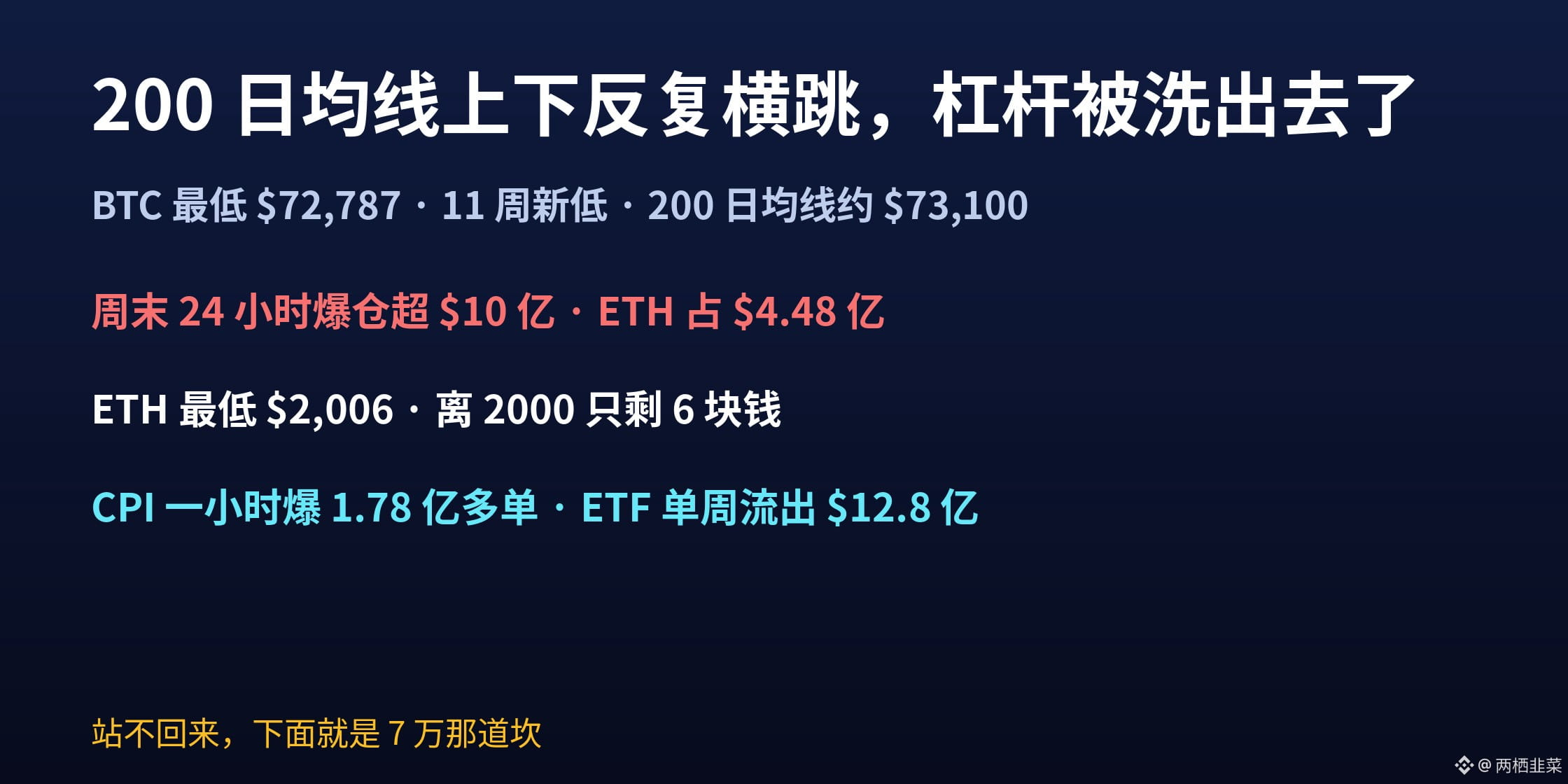
Yesterday, BTC kept swinging above and below the 200-day moving average. 👇
It dropped as low as $72,787, an 11-week low; when CPI came out, $178 million in longs were liquidated in just one hour.
The weekend sell-off was even worse: over $1 billion in liquidations across the market in 24 hours. ETH alone accounted for $448 million, dipping as low as $2,006—just $6 shy of $2,000.
Put simply, this line is the bull market’s last fig leaf. If BTC can’t get back above it, the next hurdle is $70,000.
I’ve been burned by this line before. I always thought, “The moving average will definitely hold,” but when it’s time to break, it breaks.
Breaking below it isn’t scary. What’s scary is still thinking, “This time is different.”
$BTC $ETH
Yesterday, BTC kept swinging above and below the 200-day moving average. 👇
It dropped as low as $72,787, an 11-week low; when CPI came out, $178 million in longs were liquidated in just one hour.
The weekend sell-off was even worse: over $1 billion in liquidations across the market in 24 hours. ETH alone accounted for $448 million, dipping as low as $2,006—just $6 shy of $2,000.
Put simply, this line is the bull market’s last fig leaf. If BTC can’t get back above it, the next hurdle is $70,000.
I’ve been burned by this line before. I always thought, “The moving average will definitely hold,” but when it’s time to break, it breaks.
Breaking below it isn’t scary. What’s scary is still thinking, “This time is different.”
$BTC $ETH
It dropped as low as $72,787, an 11-week low; when CPI came out, $178 million in longs were liquidated in just one hour.
The weekend sell-off was even worse: over $1 billion in liquidations across the market in 24 hours. ETH alone accounted for $448 million, dipping as low as $2,006—just $6 shy of $2,000.
Put simply, this line is the bull market’s last fig leaf. If BTC can’t get back above it, the next hurdle is $70,000.
I’ve been burned by this line before. I always thought, “The moving average will definitely hold,” but when it’s time to break, it breaks.
Breaking below it isn’t scary. What’s scary is still thinking, “This time is different.”
$BTC $ETH
248
·
--
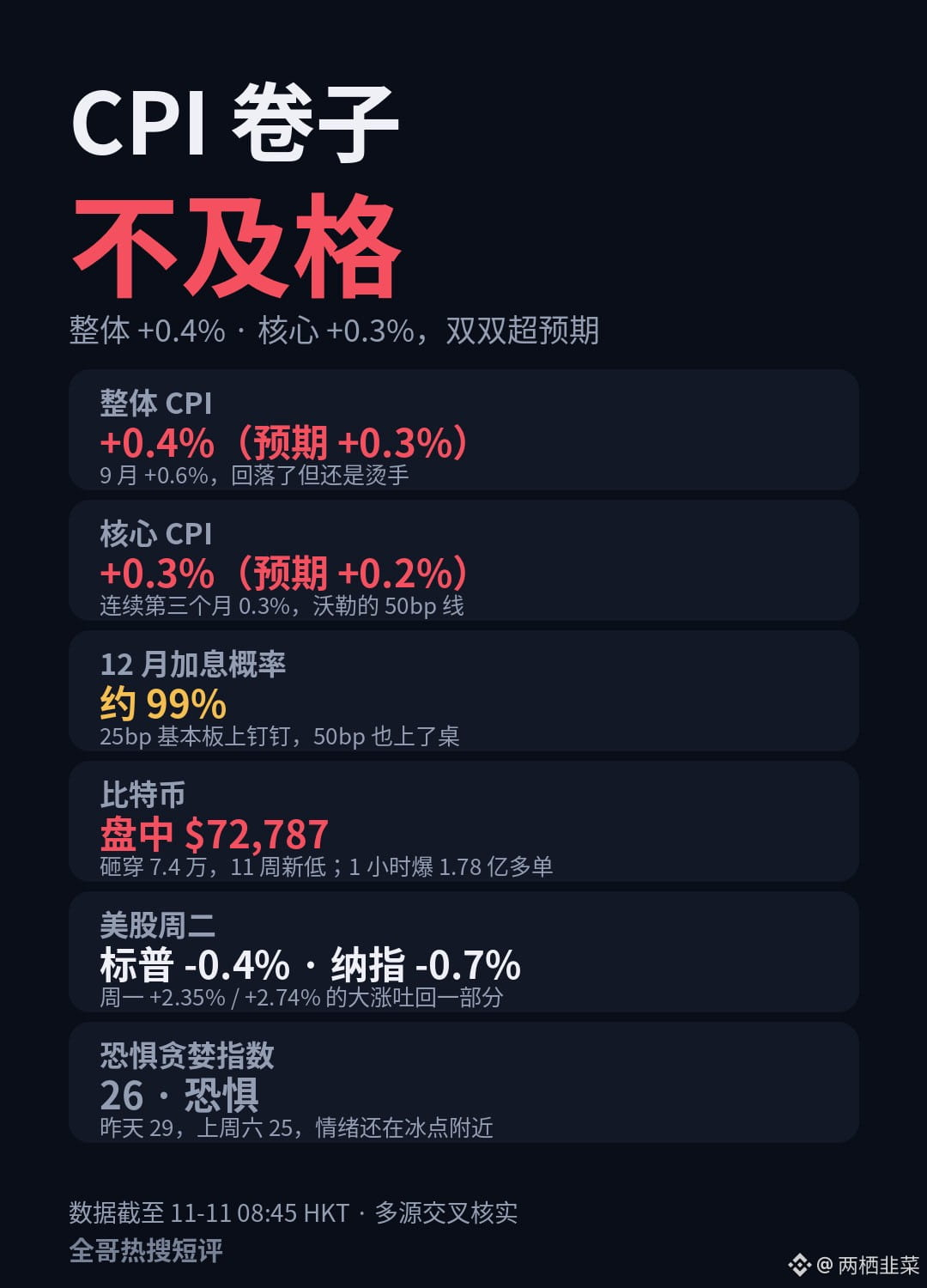
The CPI report card is out, and it’s a fail.
Headline CPI came in at +0.4%, core at +0.3%—both 0.1 percentage points above expectations, with core holding at 0.3% for the third straight month. Waller had just drawn the line at 0.3% last night: hit that number, and a 50-basis-point hike could be on the table. Once the data dropped, the odds of a December rate hike shot up to nearly 99%, and the 10-year Treasury yield briefly broke above 5%.
After Monday’s big rally—the S&P 500 up 2.35% and the Nasdaq up 2.74%—markets gave some of it back the very next day: the S&P 500 fell 0.4%, and the Nasdaq dropped 0.7%. Bitcoin had it worse: CPI came out and it crashed straight through $74,000, hitting an intraday low of $72,800, its lowest in 11 weeks. $178 million in long positions were liquidated in an hour. The Fear and Greed Index is at 26, still stuck in fear territory.
Put simply, September CPI was up 3.7% year over year, with core at 2.6%—still a long way from the 2% target. Inflation is sticky, so put the rate-cut script away for now. The meeting is on December 8. How much they’ll hike is still up in the air; whether they’ll hike at all isn’t.
Don’t rush to buy the dip. Until the data turns around, every rally is borrowed time.
$BTC $SPX
The CPI report card is out, and it’s a fail.
Headline CPI came in at +0.4%, core at +0.3%—both 0.1 percentage points above expectations, with core holding at 0.3% for the third straight month. Waller had just drawn the line at 0.3% last night: hit that number, and a 50-basis-point hike could be on the table. Once the data dropped, the odds of a December rate hike shot up to nearly 99%, and the 10-year Treasury yield briefly broke above 5%.
After Monday’s big rally—the S&P 500 up 2.35% and the Nasdaq up 2.74%—markets gave some of it back the very next day: the S&P 500 fell 0.4%, and the Nasdaq dropped 0.7%. Bitcoin had it worse: CPI came out and it crashed straight through $74,000, hitting an intraday low of $72,800, its lowest in 11 weeks. $178 million in long positions were liquidated in an hour. The Fear and Greed Index is at 26, still stuck in fear territory.
Put simply, September CPI was up 3.7% year over year, with core at 2.6%—still a long way from the 2% target. Inflation is sticky, so put the rate-cut script away for now. The meeting is on December 8. How much they’ll hike is still up in the air; whether they’ll hike at all isn’t.
Don’t rush to buy the dip. Until the data turns around, every rally is borrowed time.
$BTC $SPX
Headline CPI came in at +0.4%, core at +0.3%—both 0.1 percentage points above expectations, with core holding at 0.3% for the third straight month. Waller had just drawn the line at 0.3% last night: hit that number, and a 50-basis-point hike could be on the table. Once the data dropped, the odds of a December rate hike shot up to nearly 99%, and the 10-year Treasury yield briefly broke above 5%.
After Monday’s big rally—the S&P 500 up 2.35% and the Nasdaq up 2.74%—markets gave some of it back the very next day: the S&P 500 fell 0.4%, and the Nasdaq dropped 0.7%. Bitcoin had it worse: CPI came out and it crashed straight through $74,000, hitting an intraday low of $72,800, its lowest in 11 weeks. $178 million in long positions were liquidated in an hour. The Fear and Greed Index is at 26, still stuck in fear territory.
Put simply, September CPI was up 3.7% year over year, with core at 2.6%—still a long way from the 2% target. Inflation is sticky, so put the rate-cut script away for now. The meeting is on December 8. How much they’ll hike is still up in the air; whether they’ll hike at all isn’t.
Don’t rush to buy the dip. Until the data turns around, every rally is borrowed time.
$BTC $SPX
2
·
--
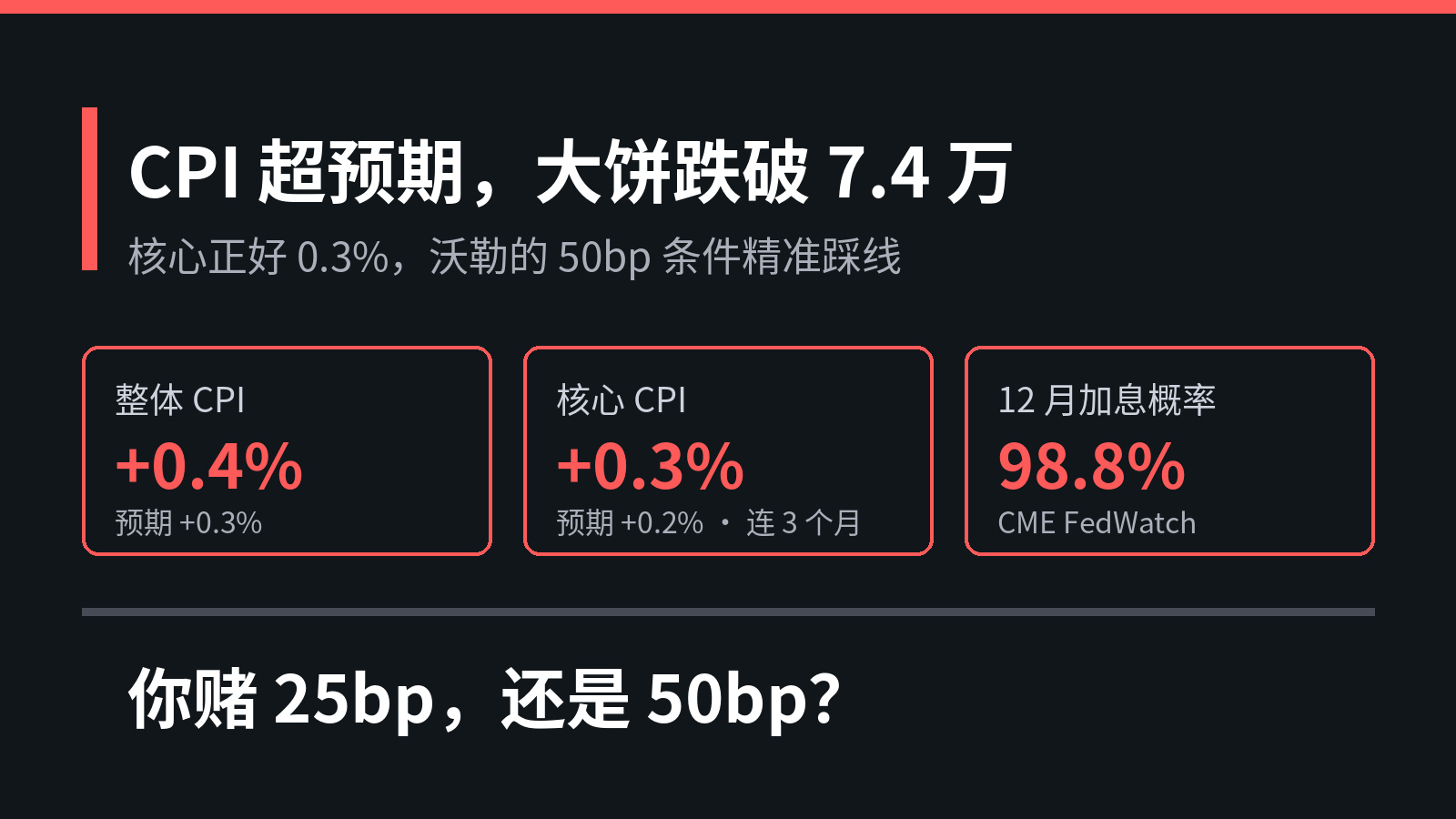
CPI is out, and it came in hotter than expected. Headline was +0.4%, core +0.3%—both well above forecasts. Core has been stuck at 0.3% for three straight months, which annualizes to around 3.6%—nowhere near the 2% target.
Waller said earlier today that they could consider a 50bp hike if core hit 0.3%. And sure enough, core landed right at 0.3%—not a tenth higher or lower. It hit the mark exactly.
Bitcoin promptly fell below 74,000, and Nasdaq futures turned red. In other words, a December rate hike is all but certain. There’s just one question left—
Are you betting on 25bp or 50bp?
$BTC
CPI is out, and it came in hotter than expected. Headline was +0.4%, core +0.3%—both well above forecasts. Core has been stuck at 0.3% for three straight months, which annualizes to around 3.6%—nowhere near the 2% target.
Waller said earlier today that they could consider a 50bp hike if core hit 0.3%. And sure enough, core landed right at 0.3%—not a tenth higher or lower. It hit the mark exactly.
Bitcoin promptly fell below 74,000, and Nasdaq futures turned red. In other words, a December rate hike is all but certain. There’s just one question left—
Are you betting on 25bp or 50bp?
$BTC
Waller said earlier today that they could consider a 50bp hike if core hit 0.3%. And sure enough, core landed right at 0.3%—not a tenth higher or lower. It hit the mark exactly.
Bitcoin promptly fell below 74,000, and Nasdaq futures turned red. In other words, a December rate hike is all but certain. There’s just one question left—
Are you betting on 25bp or 50bp?
$BTC
133
·
--
Sea’s earnings report looks like nothing but good news, yet the stock still took a dive first: revenue hit $8.6 billion, up 43% year over year, and net profit reached $500 million, up 34%—but shares still fell 4.4% in premarket trading. The problem is its lending business: credit provisions surged to $680 million, up 82% from last year. Loans outstanding reached $12.6 billion, growing ever faster, while bad-debt provisions keep climbing. Put simply, its e-commerce business really is making money, but making money from lending means betting tomorrow’s money on today. So tell me: when earnings get better but provisions get heavier, how should we read the numbers? $SE
Sea’s earnings report looks like nothing but good news, yet the stock still took a dive first: revenue hit $8.6 billion, up 43% year over year, and net profit reached $500 million, up 34%—but shares still fell 4.4% in premarket trading. The problem is its lending business: credit provisions surged to $680 million, up 82% from last year. Loans outstanding reached $12.6 billion, growing ever faster, while bad-debt provisions keep climbing. Put simply, its e-commerce business really is making money, but making money from lending means betting tomorrow’s money on today. So tell me: when earnings get better but provisions get heavier, how should we read the numbers? $SE
SEUS-2,48%
4
·
--
Article
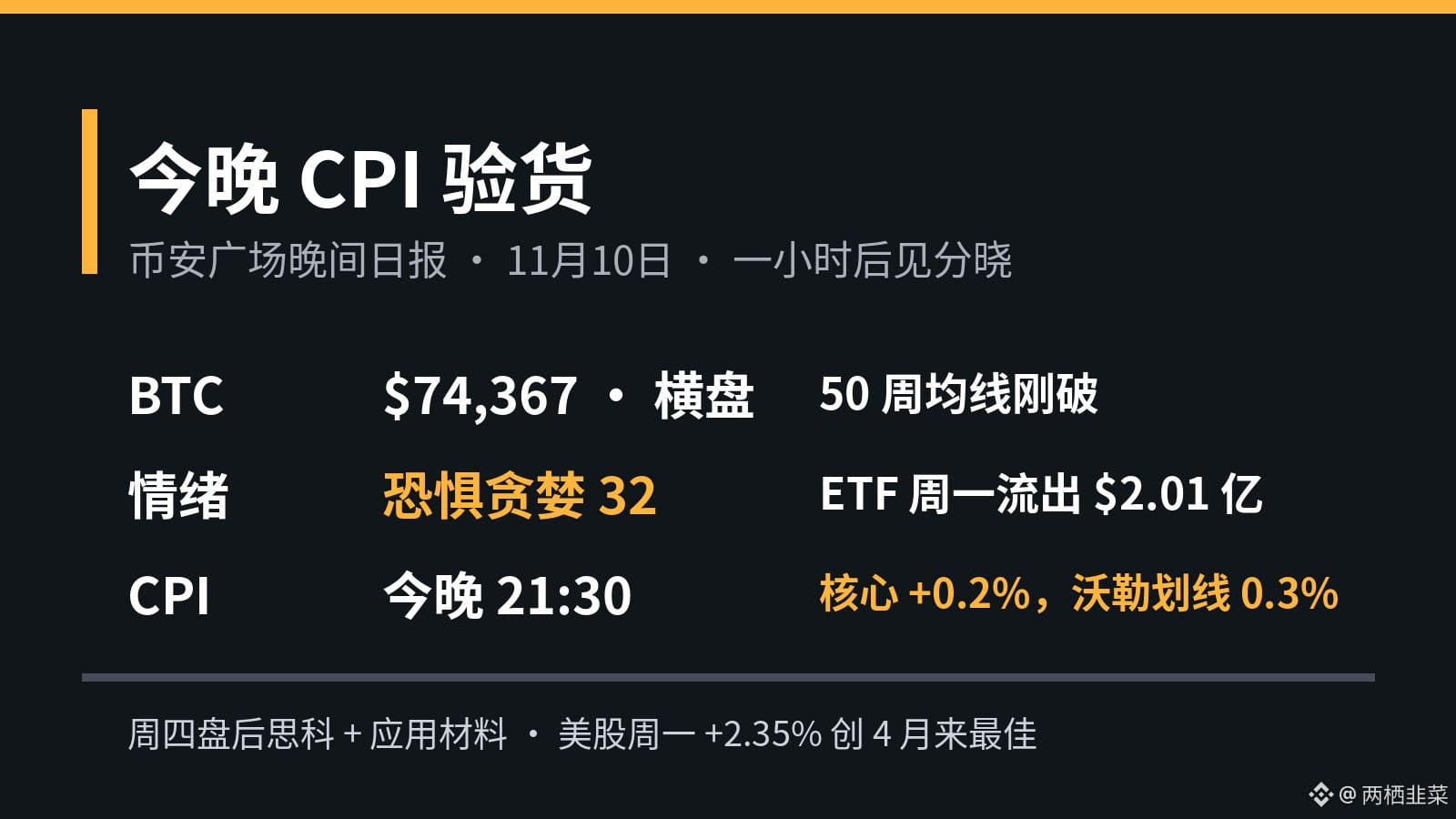
Tonight’s CPI puts Monday’s rally to the test—will it hold?The bottom line: tonight’s 9:30 CPI report will put Monday’s big rally to the test. If the data is good, Monday’s 2.35% gain may mark the start of a rebound; if it’s bad, that rally was just a dead-cat bounce, and the gains will be given back.
Here’s what happened. Before the market even got the CPI report today, it got a blunt warning. Fed Governor Waller, speaking in London, laid it out plainly: a rate hike in December is likely, and if core CPI rises by more than 0.3%, a hefty 50-basis-point hike could also be on the table. His remarks sent the two-year Treasury yield jumping 6 basis points, to 4.61%. Think about it: the expected core CPI reading is just 0.2%, while Waller drew the line at 0.3%—a gap of just 0.1 percentage point. Tonight, that one number could turn the whole market on its head.
Tonight’s CPI puts Monday’s rally to the test—will it hold?
The bottom line: tonight’s 9:30 CPI report will put Monday’s big rally to the test. If the data is good, Monday’s 2.35% gain may mark the start of a rebound; if it’s bad, that rally was just a dead-cat bounce, and the gains will be given back.
Here’s what happened. Before the market even got the CPI report today, it got a blunt warning. Fed Governor Waller, speaking in London, laid it out plainly: a rate hike in December is likely, and if core CPI rises by more than 0.3%, a hefty 50-basis-point hike could also be on the table. His remarks sent the two-year Treasury yield jumping 6 basis points, to 4.61%. Think about it: the expected core CPI reading is just 0.2%, while Waller drew the line at 0.3%—a gap of just 0.1 percentage point. Tonight, that one number could turn the whole market on its head.
Here’s what happened. Before the market even got the CPI report today, it got a blunt warning. Fed Governor Waller, speaking in London, laid it out plainly: a rate hike in December is likely, and if core CPI rises by more than 0.3%, a hefty 50-basis-point hike could also be on the table. His remarks sent the two-year Treasury yield jumping 6 basis points, to 4.61%. Think about it: the expected core CPI reading is just 0.2%, while Waller drew the line at 0.3%—a gap of just 0.1 percentage point. Tonight, that one number could turn the whole market on its head.
108
·
--
Chip stocks had everyone on edge last week, but today TSMC came back with the receipts: October revenue hit NT$586.89 billion, up 59.7% year over year—a record high for a single month. Stock prices can be scary, but orders don’t lie: sentiment is what’s falling, while real money is rolling in. $TSM
Chip stocks had everyone on edge last week, but today TSMC came back with the receipts: October revenue hit NT$586.89 billion, up 59.7% year over year—a record high for a single month. Stock prices can be scary, but orders don’t lie: sentiment is what’s falling, while real money is rolling in. $TSM
55
·
--
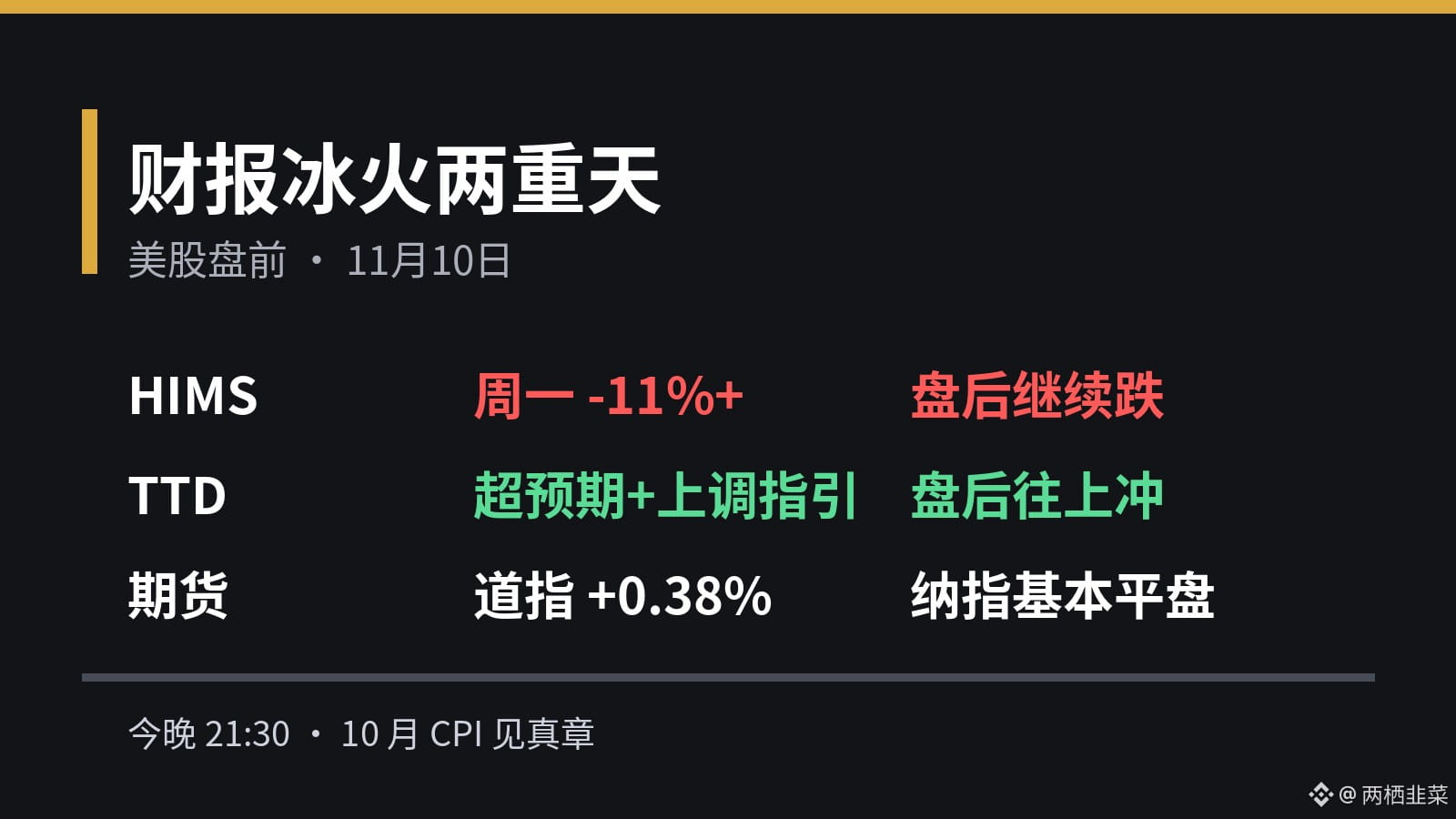
This morning’s premarket spotlight wasn’t on the indexes—it was on earnings: some stocks took a hit, while others got a boost.
Hims & Hers reported a loss-making third quarter. It fell more than 11% by Monday’s close and kept sliding after hours. Put simply, selling branded weight-loss drugs and selling generics are two very different businesses when it comes to profits.
Trade Desk was the exact opposite: third-quarter results beat expectations, its guidance was raised, and the stock surged after hours.
The broader market was cooling off: Dow futures +0.38%, S&P 500 +0.16%, and the Nasdaq was basically flat. Nvidia is still in the hot seat: its board launched an independent investigation, and shares fell 4.27% on Monday—the only one in the AI pack that didn’t join the rally. MARA’s third-quarter revenue missed expectations, and shares fell 0.75% after hours.
One day of gains in the broader market doesn’t mean a reversal. Earnings season is the real test. Tonight at 21:30, the CPI will have the final say.
$HIMS $TTD
This morning’s premarket spotlight wasn’t on the indexes—it was on earnings: some stocks took a hit, while others got a boost.
Hims & Hers reported a loss-making third quarter. It fell more than 11% by Monday’s close and kept sliding after hours. Put simply, selling branded weight-loss drugs and selling generics are two very different businesses when it comes to profits.
Trade Desk was the exact opposite: third-quarter results beat expectations, its guidance was raised, and the stock surged after hours.
The broader market was cooling off: Dow futures +0.38%, S&P 500 +0.16%, and the Nasdaq was basically flat. Nvidia is still in the hot seat: its board launched an independent investigation, and shares fell 4.27% on Monday—the only one in the AI pack that didn’t join the rally. MARA’s third-quarter revenue missed expectations, and shares fell 0.75% after hours.
One day of gains in the broader market doesn’t mean a reversal. Earnings season is the real test. Tonight at 21:30, the CPI will have the final say.
$HIMS $TTD
Hims & Hers reported a loss-making third quarter. It fell more than 11% by Monday’s close and kept sliding after hours. Put simply, selling branded weight-loss drugs and selling generics are two very different businesses when it comes to profits.
Trade Desk was the exact opposite: third-quarter results beat expectations, its guidance was raised, and the stock surged after hours.
The broader market was cooling off: Dow futures +0.38%, S&P 500 +0.16%, and the Nasdaq was basically flat. Nvidia is still in the hot seat: its board launched an independent investigation, and shares fell 4.27% on Monday—the only one in the AI pack that didn’t join the rally. MARA’s third-quarter revenue missed expectations, and shares fell 0.75% after hours.
One day of gains in the broader market doesn’t mean a reversal. Earnings season is the real test. Tonight at 21:30, the CPI will have the final say.
$HIMS $TTD
190
·
--
AI stocks were just hammered last week, with the Nasdaq down 3.4% for the week. Everyone in the market was asking whether the AI bubble was about to burst. At this very moment, Anthropic says it won’t wait.
According to a November 9 report by The Wall Street Journal, Anthropic isn’t delaying its IPO. It’s holding its roadshow this week, aiming to list on the Nasdaq on November 19 or 20 under the ticker ANT, and get it done before Thanksgiving. It filed its S-1 back on October 26.
The valuation story is the most interesting part: At the peak of the excitement, the market was talking about nearly $2 trillion. After AI stocks pulled back last week, Bloomberg put the figure at $1.1–1.3 trillion on November 6, and CNBC had it at $1–1.5 trillion on November 9. For the same company, in just half a month, the valuation has shrunk by nearly half. Put simply, it’s not that people don’t want in—they just want to buy in cheaper.
The comparison is OpenAI, which just pushed its IPO back to 2027, while Anthropic is determined to charge ahead. One is worried about the price; the other is worried about waiting.
I used to chase the title of “biggest IPO in history,” too. It took me a while to realize that the bigger the headline, the more important it is to ask whether the company actually makes money. Anthropic brought in $16.3 billion in revenue in the first half of the year—and it also lost quite a lot. The whole market will be scrutinizing the numbers with a magnifying glass during those roadshow days.
It’s going public even with its valuation cut in half. Do you think it doesn’t need the money, or is it afraid that if it waits, the price will get even cheaper?
#AnthropicRefusesToDelayIPO—WhatWillItsValuationBeForThisWeeksRoadshow?
$ANT
AI stocks were just hammered last week, with the Nasdaq down 3.4% for the week. Everyone in the market was asking whether the AI bubble was about to burst. At this very moment, Anthropic says it won’t wait.
According to a November 9 report by The Wall Street Journal, Anthropic isn’t delaying its IPO. It’s holding its roadshow this week, aiming to list on the Nasdaq on November 19 or 20 under the ticker ANT, and get it done before Thanksgiving. It filed its S-1 back on October 26.
The valuation story is the most interesting part: At the peak of the excitement, the market was talking about nearly $2 trillion. After AI stocks pulled back last week, Bloomberg put the figure at $1.1–1.3 trillion on November 6, and CNBC had it at $1–1.5 trillion on November 9. For the same company, in just half a month, the valuation has shrunk by nearly half. Put simply, it’s not that people don’t want in—they just want to buy in cheaper.
The comparison is OpenAI, which just pushed its IPO back to 2027, while Anthropic is determined to charge ahead. One is worried about the price; the other is worried about waiting.
I used to chase the title of “biggest IPO in history,” too. It took me a while to realize that the bigger the headline, the more important it is to ask whether the company actually makes money. Anthropic brought in $16.3 billion in revenue in the first half of the year—and it also lost quite a lot. The whole market will be scrutinizing the numbers with a magnifying glass during those roadshow days.
It’s going public even with its valuation cut in half. Do you think it doesn’t need the money, or is it afraid that if it waits, the price will get even cheaper?
#AnthropicRefusesToDelayIPO—WhatWillItsValuationBeForThisWeeksRoadshow?
$ANT
According to a November 9 report by The Wall Street Journal, Anthropic isn’t delaying its IPO. It’s holding its roadshow this week, aiming to list on the Nasdaq on November 19 or 20 under the ticker ANT, and get it done before Thanksgiving. It filed its S-1 back on October 26.
The valuation story is the most interesting part: At the peak of the excitement, the market was talking about nearly $2 trillion. After AI stocks pulled back last week, Bloomberg put the figure at $1.1–1.3 trillion on November 6, and CNBC had it at $1–1.5 trillion on November 9. For the same company, in just half a month, the valuation has shrunk by nearly half. Put simply, it’s not that people don’t want in—they just want to buy in cheaper.
The comparison is OpenAI, which just pushed its IPO back to 2027, while Anthropic is determined to charge ahead. One is worried about the price; the other is worried about waiting.
I used to chase the title of “biggest IPO in history,” too. It took me a while to realize that the bigger the headline, the more important it is to ask whether the company actually makes money. Anthropic brought in $16.3 billion in revenue in the first half of the year—and it also lost quite a lot. The whole market will be scrutinizing the numbers with a magnifying glass during those roadshow days.
It’s going public even with its valuation cut in half. Do you think it doesn’t need the money, or is it afraid that if it waits, the price will get even cheaper?
#AnthropicRefusesToDelayIPO—WhatWillItsValuationBeForThisWeeksRoadshow?
$ANT

182
·
--
Renting GPUs is crazier than buying them: B200 hourly rental rates have surged 74% in three months. They’re now nearly $10 an hour and still climbing. Put simply, there aren’t enough GPUs to go around, and those renting them out make money before those hoarding them do. Chip prices may be falling, but there’s no shortage of buyers for computing power. $NVDA
Renting GPUs is crazier than buying them: B200 hourly rental rates have surged 74% in three months. They’re now nearly $10 an hour and still climbing. Put simply, there aren’t enough GPUs to go around, and those renting them out make money before those hoarding them do. Chip prices may be falling, but there’s no shortage of buyers for computing power. $NVDA
169
·
--
Bitcoin’s weekly close fell below $75,000, breaking its 50-week average for the first time in two months.
Put simply, this line is the bull market’s floor: above it, it’s a pullback; below it, Bitcoin has to prove itself all over again.
The whales have flipped too—on Hyperliquid, big players have gone from net long to net short, while technical indicators haven’t reached oversold territory yet.
CPI is out tonight at 21:30. Can Bitcoin reclaim this floor?
$BTC
Bitcoin’s weekly close fell below $75,000, breaking its 50-week average for the first time in two months.
Put simply, this line is the bull market’s floor: above it, it’s a pullback; below it, Bitcoin has to prove itself all over again.
The whales have flipped too—on Hyperliquid, big players have gone from net long to net short, while technical indicators haven’t reached oversold territory yet.
CPI is out tonight at 21:30. Can Bitcoin reclaim this floor?
$BTC
Put simply, this line is the bull market’s floor: above it, it’s a pullback; below it, Bitcoin has to prove itself all over again.
The whales have flipped too—on Hyperliquid, big players have gone from net long to net short, while technical indicators haven’t reached oversold territory yet.
CPI is out tonight at 21:30. Can Bitcoin reclaim this floor?
$BTC

87
·
--
Last Thursday, the Philadelphia Semiconductor Index plunged 12% in a single day, Nvidia fell 9%, AMD dropped 17%, and the Nasdaq slid straight into a technical correction.
On Monday, the same stocks bounced back: the Semiconductor Index rose 7%, AMD surged 13% in a day, and the Nasdaq gained 2.7%.
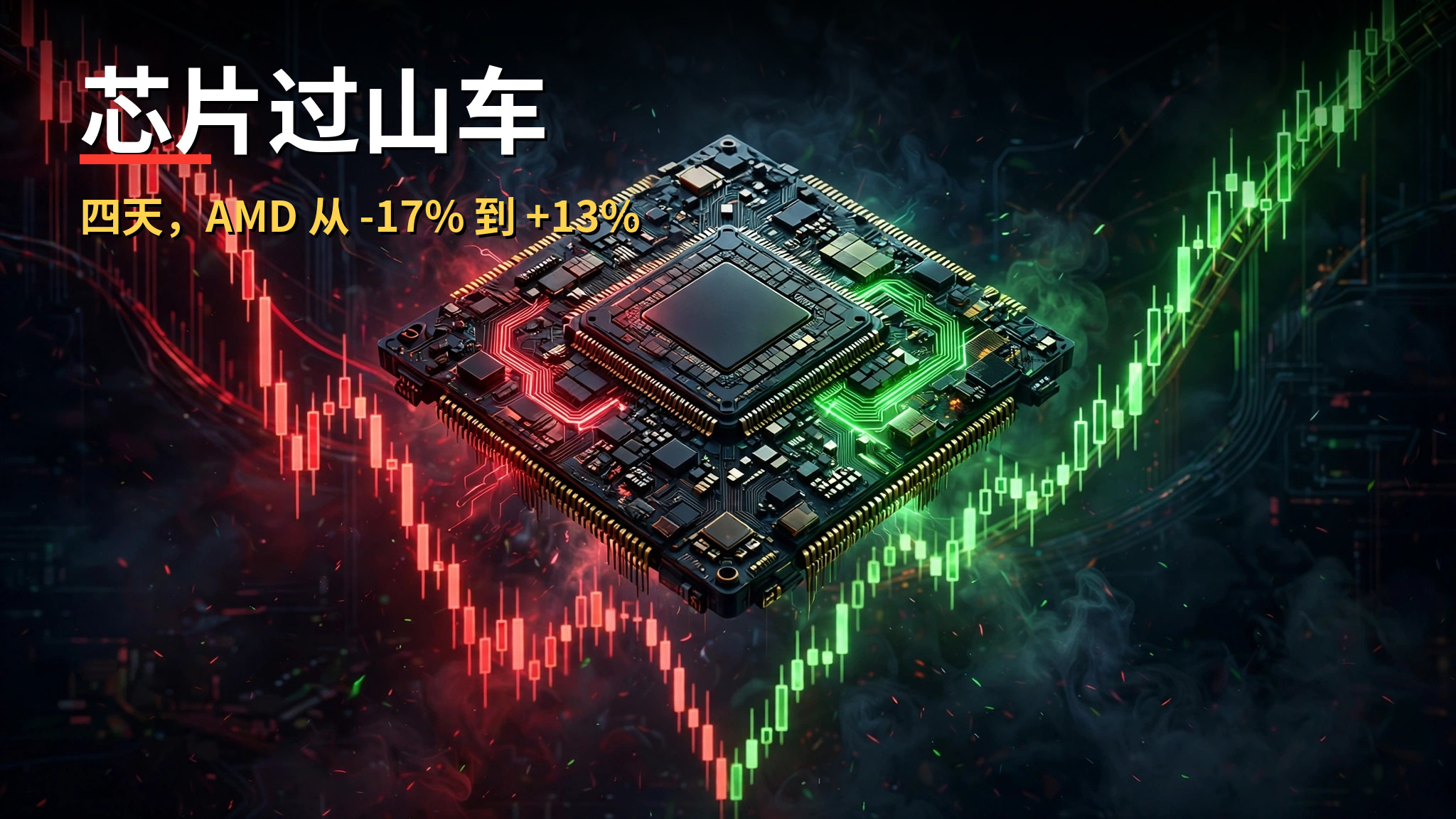
The same AMD went from -17% to +13% in four days. Did the business change? No. AMD’s data center revenue grew 97% in the third quarter, and Google Cloud chose its chips too. What changed was the market’s mood and the multiples it was willing to pay.
Put simply, what sold off wasn’t chips—it was the question of whether there’s any limit to AI spending. After the midterm elections, rumors of tighter regulation made everyone run for the exits first and ask questions later; once the rumors died down, they rushed back in. Nvidia was the exception: it still fell 4% on Monday, weighed down by its own CEO’s scandal, unrelated to the broader market.
It’s the same in crypto: the Fear and Greed Index is at 29, Bitcoin is hovering around 75,000, and ETFs saw $1.28 billion in outflows last week. The fear is real, but what people are afraid of is no different from last Thursday.
Tonight’s October CPI report is the next test. Nobody dared to buy on the day it fell 12%; everyone wanted to chase it on the day it rose 13%—that’s how most people lose money.
$NVDA $AMD $BTC
Last Thursday, the Philadelphia Semiconductor Index plunged 12% in a single day, Nvidia fell 9%, AMD dropped 17%, and the Nasdaq slid straight into a technical correction.
On Monday, the same stocks bounced back: the Semiconductor Index rose 7%, AMD surged 13% in a day, and the Nasdaq gained 2.7%.
The same AMD went from -17% to +13% in four days. Did the business change? No. AMD’s data center revenue grew 97% in the third quarter, and Google Cloud chose its chips too. What changed was the market’s mood and the multiples it was willing to pay.
Put simply, what sold off wasn’t chips—it was the question of whether there’s any limit to AI spending. After the midterm elections, rumors of tighter regulation made everyone run for the exits first and ask questions later; once the rumors died down, they rushed back in. Nvidia was the exception: it still fell 4% on Monday, weighed down by its own CEO’s scandal, unrelated to the broader market.
It’s the same in crypto: the Fear and Greed Index is at 29, Bitcoin is hovering around 75,000, and ETFs saw $1.28 billion in outflows last week. The fear is real, but what people are afraid of is no different from last Thursday.
Tonight’s October CPI report is the next test. Nobody dared to buy on the day it fell 12%; everyone wanted to chase it on the day it rose 13%—that’s how most people lose money.
$NVDA $AMD $BTC
On Monday, the same stocks bounced back: the Semiconductor Index rose 7%, AMD surged 13% in a day, and the Nasdaq gained 2.7%.
The same AMD went from -17% to +13% in four days. Did the business change? No. AMD’s data center revenue grew 97% in the third quarter, and Google Cloud chose its chips too. What changed was the market’s mood and the multiples it was willing to pay.
Put simply, what sold off wasn’t chips—it was the question of whether there’s any limit to AI spending. After the midterm elections, rumors of tighter regulation made everyone run for the exits first and ask questions later; once the rumors died down, they rushed back in. Nvidia was the exception: it still fell 4% on Monday, weighed down by its own CEO’s scandal, unrelated to the broader market.
It’s the same in crypto: the Fear and Greed Index is at 29, Bitcoin is hovering around 75,000, and ETFs saw $1.28 billion in outflows last week. The fear is real, but what people are afraid of is no different from last Thursday.
Tonight’s October CPI report is the next test. Nobody dared to buy on the day it fell 12%; everyone wanted to chase it on the day it rose 13%—that’s how most people lose money.
$NVDA $AMD $BTC
212
·
--
Tomorrow night at 21:30, October CPI drops. The month-over-month figure is expected to be +0.3%, with core at +0.2%; the year-over-year figure won’t even be published—the data will basically determine whether rates get raised in December.
Before the market opens tonight, Bitcoin is at 74,800, just a step away from the 200-day moving average at 73,200. The Fear & Greed Index is at 29, its fourth day huddled in fear territory. Nvidia is still down 6% premarket—the leader is taking a hit first.
Put simply, trying to guess the direction on CPI eve is no different from flipping a coin with your eyes closed. I’m sitting this one out tonight and saving my ammo for tomorrow.
What about you? Going all in and holding on, or staying on the sidelines until CPI?
$BTC $NVDA
Tomorrow night at 21:30, October CPI drops. The month-over-month figure is expected to be +0.3%, with core at +0.2%; the year-over-year figure won’t even be published—the data will basically determine whether rates get raised in December.
Before the market opens tonight, Bitcoin is at 74,800, just a step away from the 200-day moving average at 73,200. The Fear & Greed Index is at 29, its fourth day huddled in fear territory. Nvidia is still down 6% premarket—the leader is taking a hit first.
Put simply, trying to guess the direction on CPI eve is no different from flipping a coin with your eyes closed. I’m sitting this one out tonight and saving my ammo for tomorrow.
What about you? Going all in and holding on, or staying on the sidelines until CPI?
$BTC $NVDA
Before the market opens tonight, Bitcoin is at 74,800, just a step away from the 200-day moving average at 73,200. The Fear & Greed Index is at 29, its fourth day huddled in fear territory. Nvidia is still down 6% premarket—the leader is taking a hit first.
Put simply, trying to guess the direction on CPI eve is no different from flipping a coin with your eyes closed. I’m sitting this one out tonight and saving my ammo for tomorrow.
What about you? Going all in and holding on, or staying on the sidelines until CPI?
$BTC $NVDA

353
·
--
During last week’s AI bloodbath, AMD fell 11% in five days and 26% in a month—it looked like the bubble had burst. Then today before the market opened, Oppenheimer turned around and upgraded it to Outperform, setting a price target of $600. It’s also betting that data center revenue will grow 135% next year, making up 85% of the company’s revenue. Think about it: data center revenue was already $8.55 billion in Q3, nearly doubling, and Q4 guidance is $17 billion. The business hasn’t changed; people’s sentiment has. The same stock was a bubble last week and a hot favorite this week. The key to getting rich slowly is to stay in the game. $AMD
During last week’s AI bloodbath, AMD fell 11% in five days and 26% in a month—it looked like the bubble had burst. Then today before the market opened, Oppenheimer turned around and upgraded it to Outperform, setting a price target of $600. It’s also betting that data center revenue will grow 135% next year, making up 85% of the company’s revenue. Think about it: data center revenue was already $8.55 billion in Q3, nearly doubling, and Q4 guidance is $17 billion. The business hasn’t changed; people’s sentiment has. The same stock was a bubble last week and a hot favorite this week. The key to getting rich slowly is to stay in the game. $AMD
37
Log in to explore more content
Join global crypto users on Binance Square
⚡️ Get latest and useful information about crypto.
💬 Trusted by the world’s largest crypto exchange.
👍 Discover real insights from verified creators.
Email / Phone number
Trending Topics
HotCPIDecemberHikePriced
226,912 views
2,367 Discussing
CPI Market Watch | US CPI Rises 0.4% in October, Hotter Than 0.3% Forecast
Binance News
·31 Likes
·43.6k views
StrategyFaces$2.8BSelloffRiskFromMSCIRemoval
8,054 views
91 Discussing
AnthropicRejectsIPODelayValuationinQuestion
307,657 views
2,627 Discussing