

阿东爱喝酒
362 Posts

阿东爱喝酒
Report
Block User
所发文章仅为个人观点分享,不构成任何投资建议。加密货币投资风险极高,请根据自身情况谨慎决策,永远不要投入超过自己承受能力的资金 BP-BBC779F4E0DE
Occasional Trader
5.5 Years
88 Following
18.1K+ Followers
4.7K+ Liked
Posts
All
Quotes
·
--
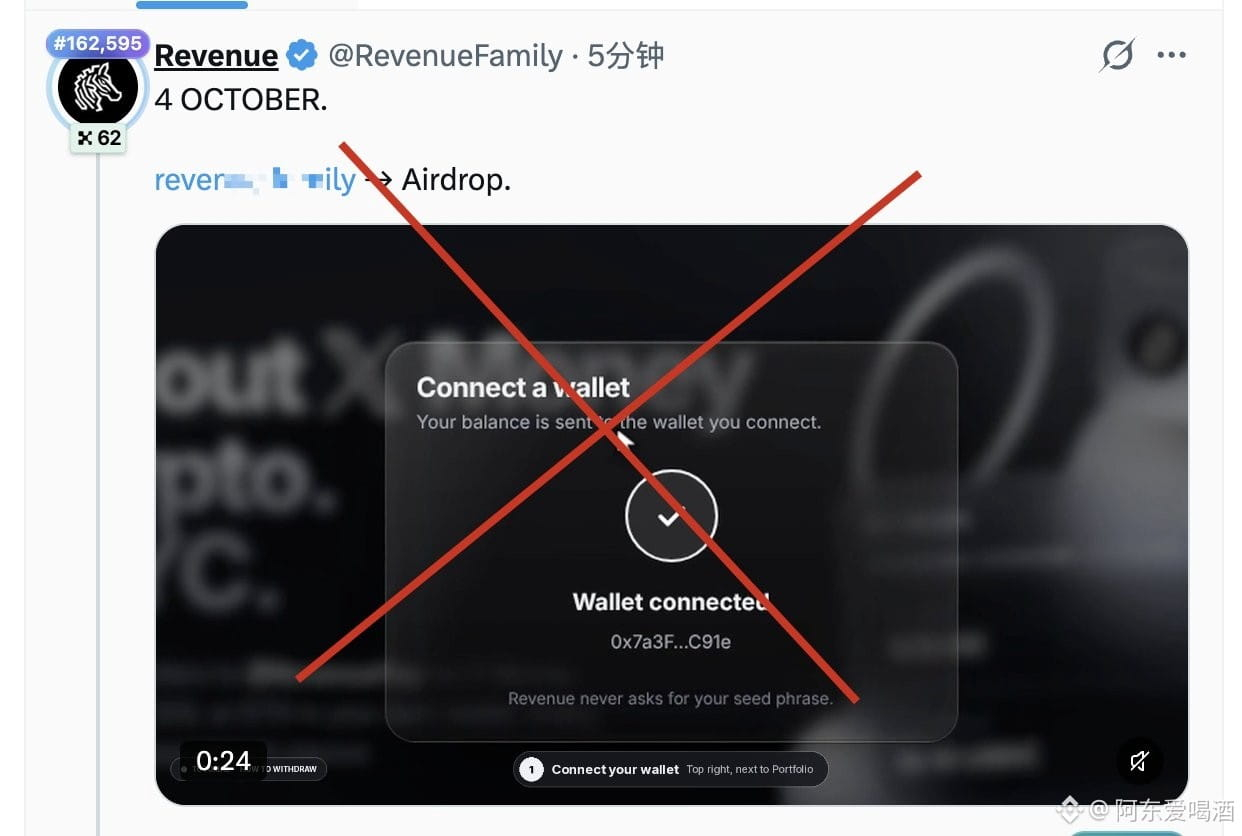
🚨 Emergency Scams Alert: Don’t click @RevenueFamily’s “airdrop”!
It’s already been verified—once you click, they’ll drain your wallet and directly steal your seed phrase. No free money, just a lost wallet. Big loss.
Let’s repeat the 3 anti-scam rules:
1. Never give out your seed phrase or private key to anyone, not even if the whole world shows up—no exceptions
2. Airdrops only count official channels. Don’t click any links in the comments or in DMs
3. Before connecting your wallet, check the signing request carefully. If you can’t understand it, don’t sign
Greed for a small gain leads to a big loss. Share this with friends who are still trying to grab the airdrop.
$ETH #安全 #防骗
🚨 Emergency Scams Alert: Don’t click @RevenueFamily’s “airdrop”!
It’s already been verified—once you click, they’ll drain your wallet and directly steal your seed phrase. No free money, just a lost wallet. Big loss.
Let’s repeat the 3 anti-scam rules:
1. Never give out your seed phrase or private key to anyone, not even if the whole world shows up—no exceptions
2. Airdrops only count official channels. Don’t click any links in the comments or in DMs
3. Before connecting your wallet, check the signing request carefully. If you can’t understand it, don’t sign
Greed for a small gain leads to a big loss. Share this with friends who are still trying to grab the airdrop.
$ETH #安全 #防骗
It’s already been verified—once you click, they’ll drain your wallet and directly steal your seed phrase. No free money, just a lost wallet. Big loss.
Let’s repeat the 3 anti-scam rules:
1. Never give out your seed phrase or private key to anyone, not even if the whole world shows up—no exceptions
2. Airdrops only count official channels. Don’t click any links in the comments or in DMs
3. Before connecting your wallet, check the signing request carefully. If you can’t understand it, don’t sign
Greed for a small gain leads to a big loss. Share this with friends who are still trying to grab the airdrop.
$ETH #安全 #防骗
866
·
--
7 years, nearly $7 billion—North Korean hackers’ "performance record" in crypto:
$2 billion in 2025, $1.7 billion in 2022, $1.3 billion in 2024, and from 2026 to now, already $1 billion.
Now there’s a saying in the circle: once a Web3 project gets stolen, the first reaction isn’t to check for vulnerabilities—it’s to ask, "Was it North Korean hackers?" Getting blamed to this extent is a one-of-a-kind achievement.
On a more serious note: these people specifically target exchanges and cross-chain bridges, biding their time for months to map out the process before striking. Large assets go into a cold wallet; check before signing three times. It’s old advice, but it really works.
While you’re studying candlestick charts, they’re studying your wallet.
$BTC #安全 #hacker
7 years, nearly $7 billion—North Korean hackers’ "performance record" in crypto:
$2 billion in 2025, $1.7 billion in 2022, $1.3 billion in 2024, and from 2026 to now, already $1 billion.
Now there’s a saying in the circle: once a Web3 project gets stolen, the first reaction isn’t to check for vulnerabilities—it’s to ask, "Was it North Korean hackers?" Getting blamed to this extent is a one-of-a-kind achievement.
On a more serious note: these people specifically target exchanges and cross-chain bridges, biding their time for months to map out the process before striking. Large assets go into a cold wallet; check before signing three times. It’s old advice, but it really works.
While you’re studying candlestick charts, they’re studying your wallet.
$BTC #安全 #hacker
$2 billion in 2025, $1.7 billion in 2022, $1.3 billion in 2024, and from 2026 to now, already $1 billion.
Now there’s a saying in the circle: once a Web3 project gets stolen, the first reaction isn’t to check for vulnerabilities—it’s to ask, "Was it North Korean hackers?" Getting blamed to this extent is a one-of-a-kind achievement.
On a more serious note: these people specifically target exchanges and cross-chain bridges, biding their time for months to map out the process before striking. Large assets go into a cold wallet; check before signing three times. It’s old advice, but it really works.
While you’re studying candlestick charts, they’re studying your wallet.
$BTC #安全 #hacker
55
·
--
Selling vegetables beauty—every grandpa and grandma’s eyes went wide
Selling vegetables beauty—every grandpa and grandma’s eyes went wide


1
872
·
--
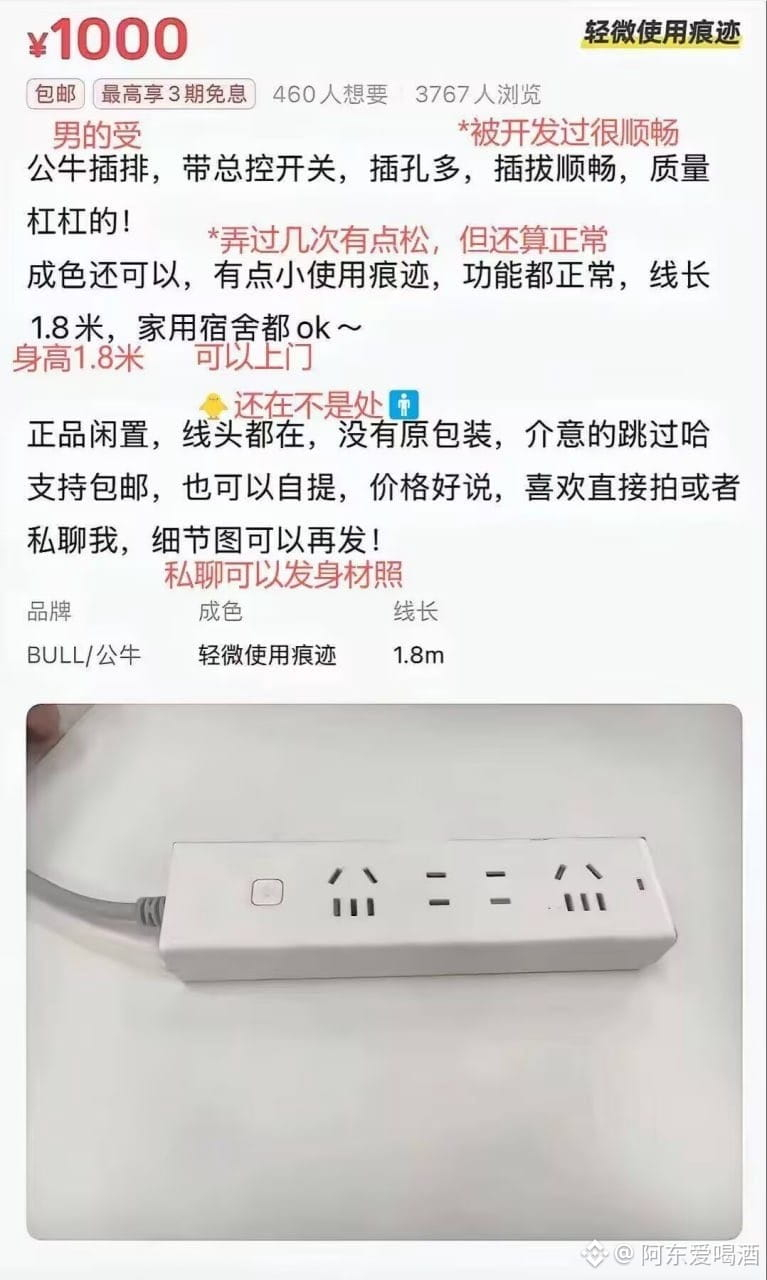
Selling a second-hand power strip on Xianyu—it's impressive how you can write the copy like this.
“Bull power strip, with a master control switch, lots of outlets, smooth to plug and unplug”—that part is still kind of normal. But the further you go, the weirder it gets: “been used and it’s super smooth” “man’s receiving” “height 1.8 meters can come to your place” “DM and I can send body photos.”
After reading it, all I want to ask is: are you selling a power strip, or are you selling yourself? The difficulty of reading comprehension—people reviewing for the Gaokao Chinese exam would probably shake their heads.
In the comments, tell me: what’s the most outrageous Xianyu listing description you’ve ever seen?
#闲鱼 #搞笑 #Reading Comprehension
Selling a second-hand power strip on Xianyu—it's impressive how you can write the copy like this.
“Bull power strip, with a master control switch, lots of outlets, smooth to plug and unplug”—that part is still kind of normal. But the further you go, the weirder it gets: “been used and it’s super smooth” “man’s receiving” “height 1.8 meters can come to your place” “DM and I can send body photos.”
After reading it, all I want to ask is: are you selling a power strip, or are you selling yourself? The difficulty of reading comprehension—people reviewing for the Gaokao Chinese exam would probably shake their heads.
In the comments, tell me: what’s the most outrageous Xianyu listing description you’ve ever seen?
#闲鱼 #搞笑 #Reading Comprehension
“Bull power strip, with a master control switch, lots of outlets, smooth to plug and unplug”—that part is still kind of normal. But the further you go, the weirder it gets: “been used and it’s super smooth” “man’s receiving” “height 1.8 meters can come to your place” “DM and I can send body photos.”
After reading it, all I want to ask is: are you selling a power strip, or are you selling yourself? The difficulty of reading comprehension—people reviewing for the Gaokao Chinese exam would probably shake their heads.
In the comments, tell me: what’s the most outrageous Xianyu listing description you’ve ever seen?
#闲鱼 #搞笑 #Reading Comprehension
174
·
--
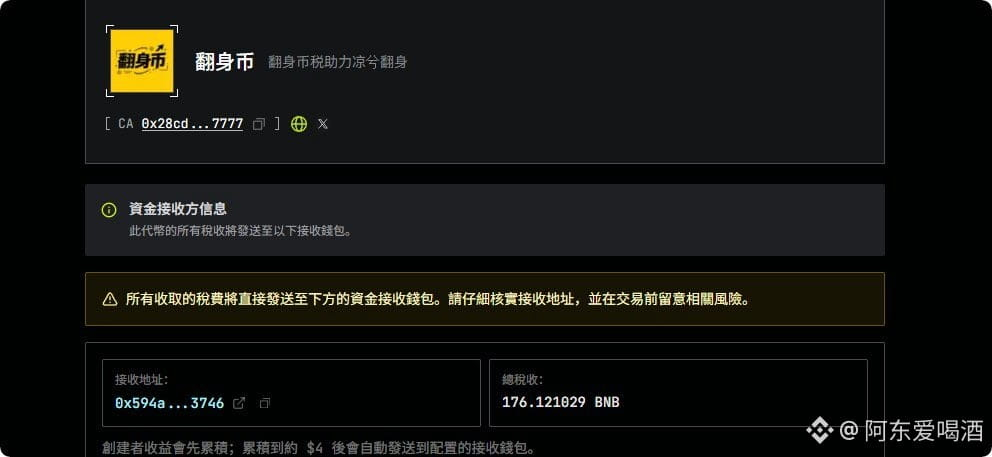
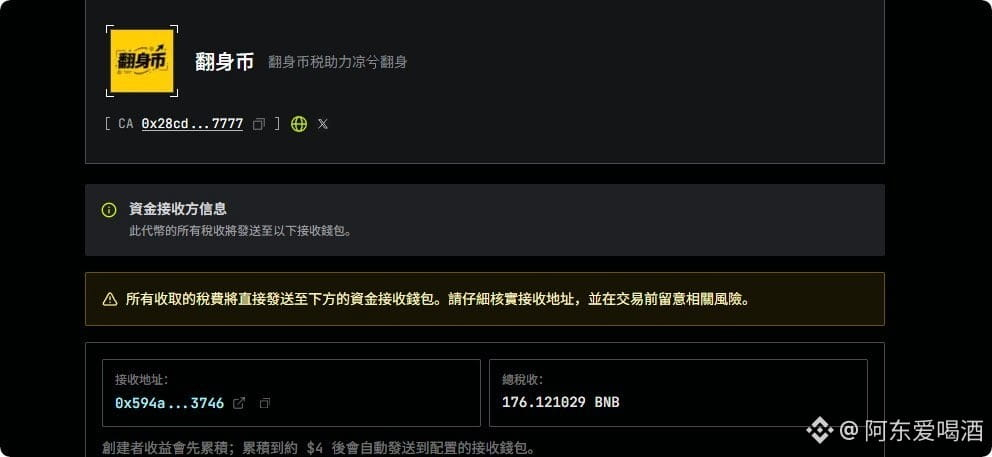
Issue tokens and collect taxes— even the reaper has to keep up with the times.
Lengxi’s "turnaround coin"— just the trading tax alone netted 167 $BNB, worth $140,000. Add the few coins issued earlier and what he paid out of pocket himself, and conservatively this round still comes to $500,000 in the bag.
Whether the bag-holders ever really turned their fortunes around is unknown. But the token issuer has definitely turned around for good— the daycare/powder money is there, and yacht money may be too.
In the past, cutting the greenhorns relied on hype and callouts. Now they directly write the taxes into the contract— even the business model has upgraded. All you can say is: it’s a case of those who are willing taking the bait.
$BNB #Meme币 #币圈
Issue tokens and collect taxes— even the reaper has to keep up with the times.
Lengxi’s "turnaround coin"— just the trading tax alone netted 167 $BNB , worth $140,000. Add the few coins issued earlier and what he paid out of pocket himself, and conservatively this round still comes to $500,000 in the bag.
Whether the bag-holders ever really turned their fortunes around is unknown. But the token issuer has definitely turned around for good— the daycare/powder money is there, and yacht money may be too.
In the past, cutting the greenhorns relied on hype and callouts. Now they directly write the taxes into the contract— even the business model has upgraded. All you can say is: it’s a case of those who are willing taking the bait.
$BNB #Meme币 #币圈
Lengxi’s "turnaround coin"— just the trading tax alone netted 167 $BNB , worth $140,000. Add the few coins issued earlier and what he paid out of pocket himself, and conservatively this round still comes to $500,000 in the bag.
Whether the bag-holders ever really turned their fortunes around is unknown. But the token issuer has definitely turned around for good— the daycare/powder money is there, and yacht money may be too.
In the past, cutting the greenhorns relied on hype and callouts. Now they directly write the taxes into the contract— even the business model has upgraded. All you can say is: it’s a case of those who are willing taking the bait.
$BNB #Meme币 #币圈
560
·
--
Liangxi’s turnaround coin tax has already been collected—167 BNB worth $140k
Plus the other coins he sent out and what he pulled in—that round, conservatively, is about $500k
Whether the buyers who took over know about the turnaround or not, but Liangxi has fully turned things around
After all, Liàngc hòu has to earn milk money for his son
Liangxi’s takeover army also made contributions—this is a good thing
Liangxi’s turnaround coin tax has already been collected—167 BNB worth $140k
Plus the other coins he sent out and what he pulled in—that round, conservatively, is about $500k
Whether the buyers who took over know about the turnaround or not, but Liangxi has fully turned things around
After all, Liàngc hòu has to earn milk money for his son
Liangxi’s takeover army also made contributions—this is a good thing
Plus the other coins he sent out and what he pulled in—that round, conservatively, is about $500k
Whether the buyers who took over know about the turnaround or not, but Liangxi has fully turned things around
After all, Liàngc hòu has to earn milk money for his son
Liangxi’s takeover army also made contributions—this is a good thing
1
1
2.2k
·
--
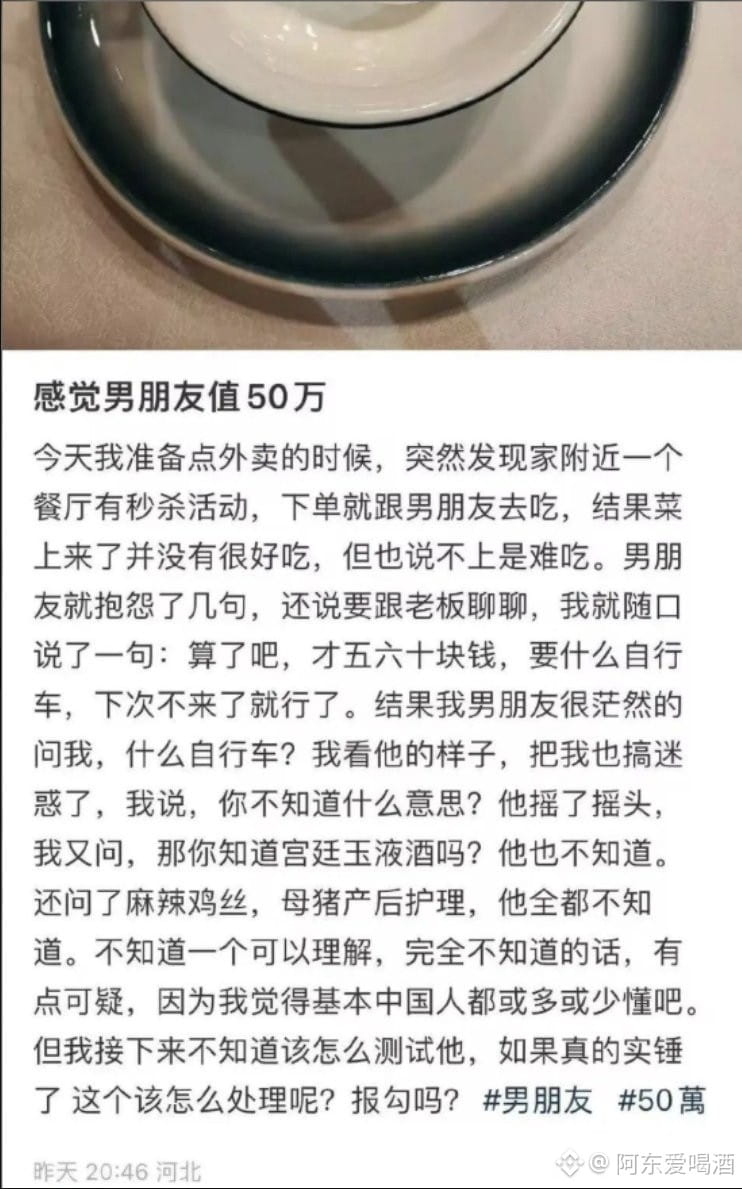
Women, to stay away from their boyfriend
Staged him as a spy for her boyfriend
😱😱😱
Women, to stay away from their boyfriend
Staged him as a spy for her boyfriend
😱😱😱
Staged him as a spy for her boyfriend
😱😱😱

1.4k
·
--
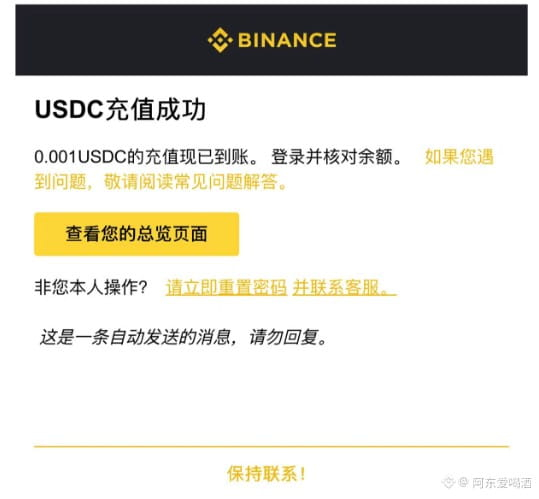
Just cashed out, and your wallet suddenly shows an incoming deposit for 0.001 $USDC for no reason? A lot of people’s first reaction is that the exchange is buggy—actually, this is a classic dust attack.
Scammers send out tiny transfers in batches to active addresses, and your address gets added to their target list. The next time you make a transfer, it’s easy to copy the scammer address from your transaction history just because it looks familiar, and the money will be lost right away. $SOL is the most rampant on-chain, and it also happens from time to time on EVM chains.
There’s only one way to prevent it: every time you send a transfer, verify the full address from your address book or the official website—never be tempted to save time and copy it from the transaction records.
Just cashed out, and your wallet suddenly shows an incoming deposit for 0.001 $USDC for no reason? A lot of people’s first reaction is that the exchange is buggy—actually, this is a classic dust attack.
Scammers send out tiny transfers in batches to active addresses, and your address gets added to their target list. The next time you make a transfer, it’s easy to copy the scammer address from your transaction history just because it looks familiar, and the money will be lost right away. $SOL is the most rampant on-chain, and it also happens from time to time on EVM chains.
There’s only one way to prevent it: every time you send a transfer, verify the full address from your address book or the official website—never be tempted to save time and copy it from the transaction records.
Scammers send out tiny transfers in batches to active addresses, and your address gets added to their target list. The next time you make a transfer, it’s easy to copy the scammer address from your transaction history just because it looks familiar, and the money will be lost right away. $SOL is the most rampant on-chain, and it also happens from time to time on EVM chains.
There’s only one way to prevent it: every time you send a transfer, verify the full address from your address book or the official website—never be tempted to save time and copy it from the transaction records.
1.6k
·
--
The weather is wonderful, and I went hiking with my female colleague.
Sure enough, the scenery was picture-perfect—so beautiful it was beyond words.
The weather is wonderful, and I went hiking with my female colleague.
Sure enough, the scenery was picture-perfect—so beautiful it was beyond words.
Sure enough, the scenery was picture-perfect—so beautiful it was beyond words.


152
·
--
The bride price is 188,000!
Which one will you choose?
Don’t look at other people’s expressions—
boldly make your choice!
The bride price is 188,000!
Which one will you choose?
Don’t look at other people’s expressions—
boldly make your choice!
Which one will you choose?
Don’t look at other people’s expressions—
boldly make your choice!


241
·
--
Bride price 180,800— not a single bit less.
Left guy, right guy— which one do you choose? Don’t look at other people’s faces; boldly say your answer.
Quickly do the math: 180,800 can be exchanged for 0.3 BTC at today’s rates. With 0.3 “big cakes,” you can marry a wife— would you do this deal or not? See you in the comments.
$BTC #彩礼 #情感
Bride price 180,800— not a single bit less.
Left guy, right guy— which one do you choose? Don’t look at other people’s faces; boldly say your answer.
Quickly do the math: 180,800 can be exchanged for 0.3 BTC at today’s rates. With 0.3 “big cakes,” you can marry a wife— would you do this deal or not? See you in the comments.
$BTC #彩礼 #情感
Left guy, right guy— which one do you choose? Don’t look at other people’s faces; boldly say your answer.
Quickly do the math: 180,800 can be exchanged for 0.3 BTC at today’s rates. With 0.3 “big cakes,” you can marry a wife— would you do this deal or not? See you in the comments.
$BTC #彩礼 #情感


189
·
--
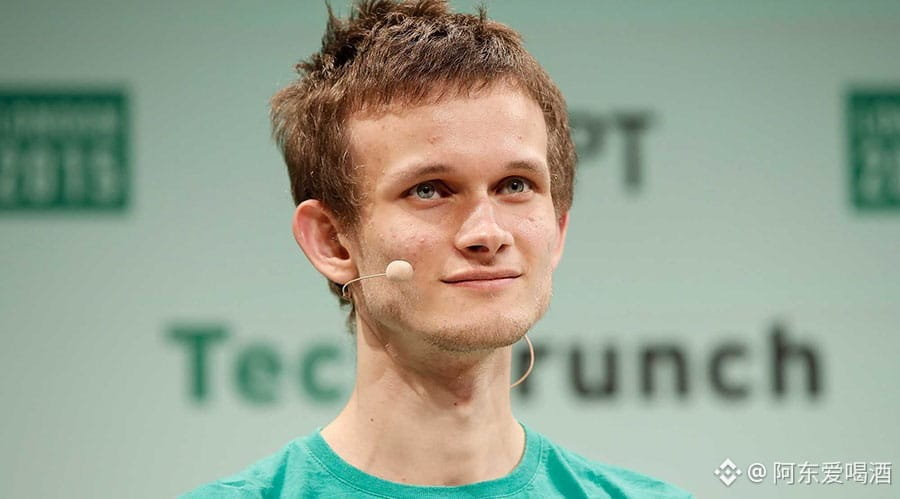
Ethereum founder Vitalik has just transferred 1,009 ETH worth about $2.94 million, and Lookonchain marked it immediately.
First, the conclusion: the funds are moving between wallets he controls and have not gone to exchanges, so there’s no visible selling pressure for now. But every time V God makes a move, the market reacts reflexively and becomes tense—emotionally, it’s already bowed in defeat.
ETH is currently trading at $2,912, down 30% over the past month, and the $3,000 level is a battleground for both bulls and bears.
What’s interesting is that V God just promoted the privacy tool Kohaku at Devcon. While working on privacy infrastructure, he’s also organizing his wallets. This combination of moves looks like preparation for the next phase.
$ETH #以太坊 #行情
Ethereum founder Vitalik has just transferred 1,009 ETH worth about $2.94 million, and Lookonchain marked it immediately.
First, the conclusion: the funds are moving between wallets he controls and have not gone to exchanges, so there’s no visible selling pressure for now. But every time V God makes a move, the market reacts reflexively and becomes tense—emotionally, it’s already bowed in defeat.
ETH is currently trading at $2,912, down 30% over the past month, and the $3,000 level is a battleground for both bulls and bears.
What’s interesting is that V God just promoted the privacy tool Kohaku at Devcon. While working on privacy infrastructure, he’s also organizing his wallets. This combination of moves looks like preparation for the next phase.
$ETH #以太坊 #行情
First, the conclusion: the funds are moving between wallets he controls and have not gone to exchanges, so there’s no visible selling pressure for now. But every time V God makes a move, the market reacts reflexively and becomes tense—emotionally, it’s already bowed in defeat.
ETH is currently trading at $2,912, down 30% over the past month, and the $3,000 level is a battleground for both bulls and bears.
What’s interesting is that V God just promoted the privacy tool Kohaku at Devcon. While working on privacy infrastructure, he’s also organizing his wallets. This combination of moves looks like preparation for the next phase.
$ETH #以太坊 #行情
61
·
--
Bitcoin touched 85,650 last night, and is now trading around 83,524. The 24-hour low is 82,956, with an amplitude of less than 3.3%. Bulls and bears are trading back and forth around 83,000–84,000.
Ethereum 2,689; BNB 768—up by less than one point.
Low-volume consolidation like a grinding mill; don’t rush before the direction is chosen.
#BTC #ETH #BNB #行情
Bitcoin touched 85,650 last night, and is now trading around 83,524. The 24-hour low is 82,956, with an amplitude of less than 3.3%. Bulls and bears are trading back and forth around 83,000–84,000.
Ethereum 2,689; BNB 768—up by less than one point.
Low-volume consolidation like a grinding mill; don’t rush before the direction is chosen.
#BTC #ETH #BNB #行情
Ethereum 2,689; BNB 768—up by less than one point.
Low-volume consolidation like a grinding mill; don’t rush before the direction is chosen.
#BTC #ETH #BNB #行情
469
·
--
Volatility has been compressed to the extreme; next, it’s going to release.
Script: First, fall to around 78,000 to grind for a few days, then quickly probe down to 72,000 and rebound. After that, make a new high and continue the next trend.
October ends up on the month, but the first half will decline and the second half will recover.
#BTC #比特币 #Market analysis
Volatility has been compressed to the extreme; next, it’s going to release.
Script: First, fall to around 78,000 to grind for a few days, then quickly probe down to 72,000 and rebound. After that, make a new high and continue the next trend.
October ends up on the month, but the first half will decline and the second half will recover.
#BTC #比特币 #Market analysis
Script: First, fall to around 78,000 to grind for a few days, then quickly probe down to 72,000 and rebound. After that, make a new high and continue the next trend.
October ends up on the month, but the first half will decline and the second half will recover.
#BTC #比特币 #Market analysis
227
·
--
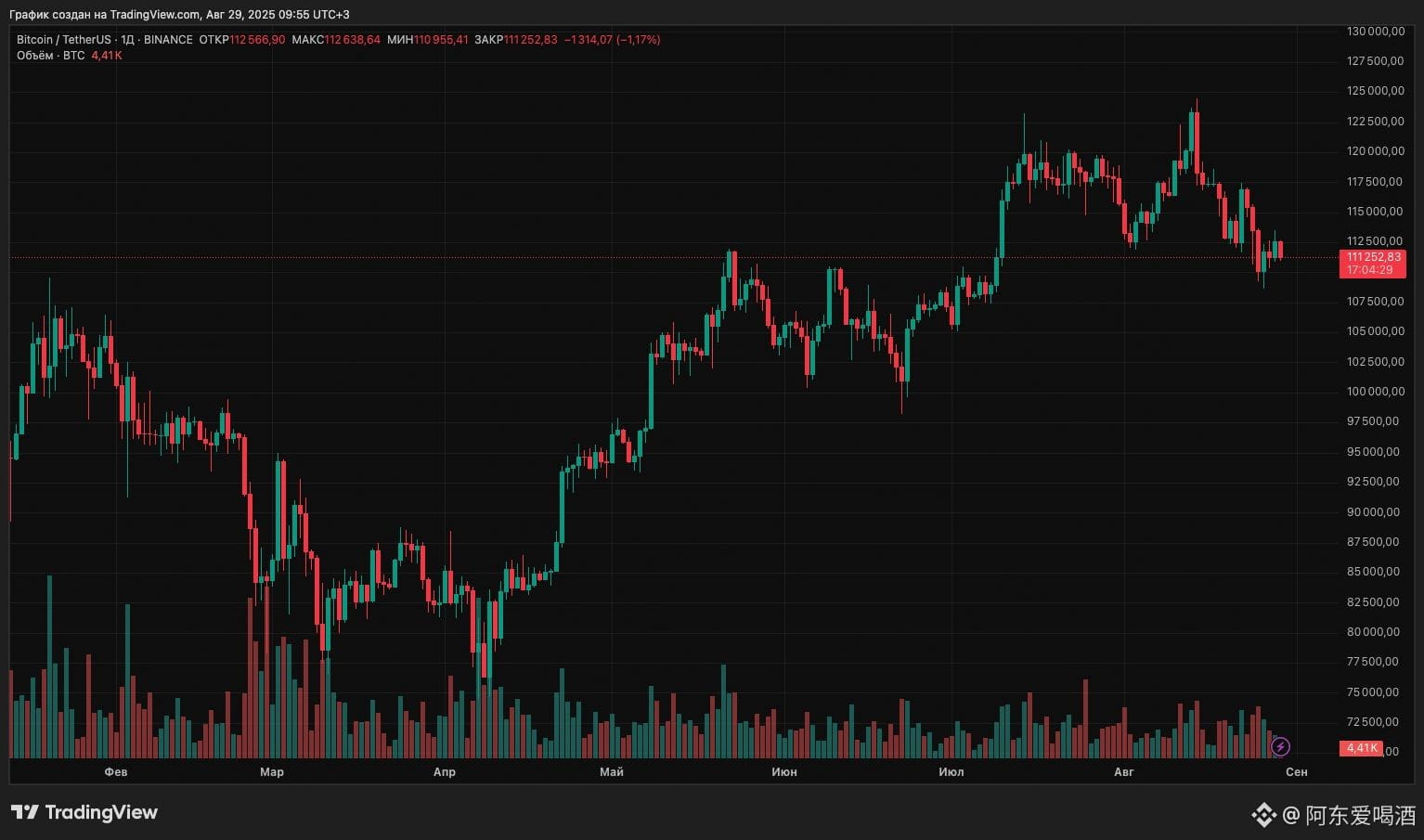
During the National Day holiday, don’t go by mood with BTC—just look at two lines:
80,500–83,000: The recent repeated pin-point area. The daily candle closes below the range—holiday narratives turn bearish directly. Look down to 78,000–80,000.
85,000–86,000: The cost basis of long-term holders has piled up here. If it can’t break through, everything is a fake breakout.
During the holiday, keep a light position—move only after a breakdown.
#BTC #比特币 #Market Analysis
During the National Day holiday, don’t go by mood with BTC—just look at two lines:
80,500–83,000: The recent repeated pin-point area. The daily candle closes below the range—holiday narratives turn bearish directly. Look down to 78,000–80,000.
85,000–86,000: The cost basis of long-term holders has piled up here. If it can’t break through, everything is a fake breakout.
During the holiday, keep a light position—move only after a breakdown.
#BTC #比特币 #Market Analysis
80,500–83,000: The recent repeated pin-point area. The daily candle closes below the range—holiday narratives turn bearish directly. Look down to 78,000–80,000.
85,000–86,000: The cost basis of long-term holders has piled up here. If it can’t break through, everything is a fake breakout.
During the holiday, keep a light position—move only after a breakdown.
#BTC #比特币 #Market Analysis
83
·
--
90-day live contract, #1 on the profit leaderboard: +12.99 million U, +412.77%.
The doctor said that in his twenties, his heart, liver, and spleen are like those of someone in their forties. He said: I trade crypto; my heart has long been used to storms and rough seas. The doctor told him to stay up less late and not drink alcohol, and he replied with three crying-face emojis.
The price of making money in this line of work is sometimes written right on the medical checkup report.
#合约 #实盘 #BTC
90-day live contract, #1 on the profit leaderboard: +12.99 million U, +412.77%.
The doctor said that in his twenties, his heart, liver, and spleen are like those of someone in their forties. He said: I trade crypto; my heart has long been used to storms and rough seas. The doctor told him to stay up less late and not drink alcohol, and he replied with three crying-face emojis.
The price of making money in this line of work is sometimes written right on the medical checkup report.
#合约 #实盘 #BTC
The doctor said that in his twenties, his heart, liver, and spleen are like those of someone in their forties. He said: I trade crypto; my heart has long been used to storms and rough seas. The doctor told him to stay up less late and not drink alcohol, and he replied with three crying-face emojis.
The price of making money in this line of work is sometimes written right on the medical checkup report.
#合约 #实盘 #BTC
76
·
--
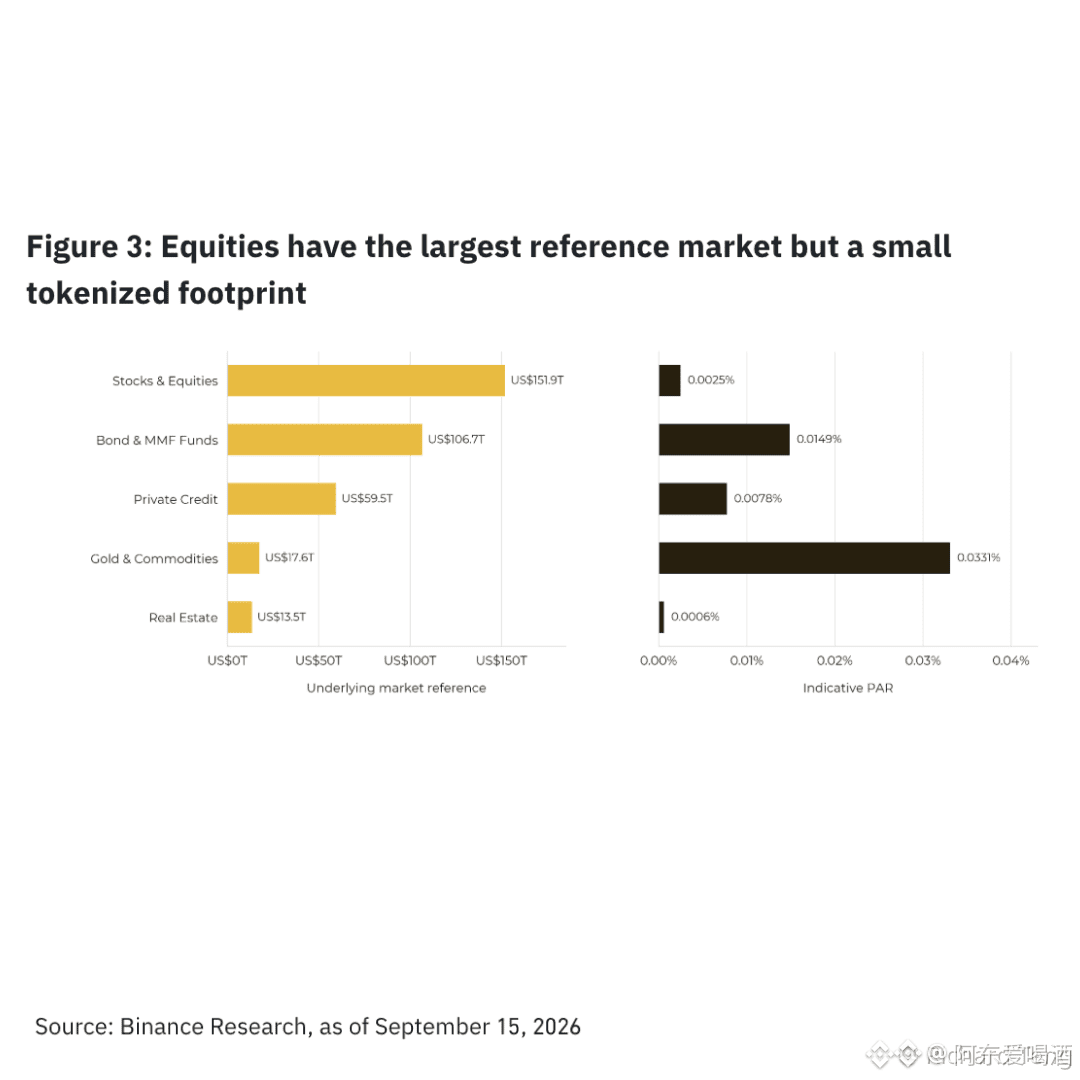
Tokenized stocks in the 2020s are up 390%. Sounds impressive, but the truth is: they account for only 0.0029% of the US stock market’s $15.19 trillion market cap—so small it doesn’t even amount to a fraction.
Binance Research’s benchmark projection is to reach $349 billion by 2030, growing from today’s $4.43 billion—nearly 80x.
This ride in RWA—on-chain US stocks might just be the starting point.
#RWA #代币化股票 #BinanceResearch #BTC
Tokenized stocks in the 2020s are up 390%. Sounds impressive, but the truth is: they account for only 0.0029% of the US stock market’s $15.19 trillion market cap—so small it doesn’t even amount to a fraction.
Binance Research’s benchmark projection is to reach $349 billion by 2030, growing from today’s $4.43 billion—nearly 80x.
This ride in RWA—on-chain US stocks might just be the starting point.
#RWA #代币化股票 #BinanceResearch #BTC
Binance Research’s benchmark projection is to reach $349 billion by 2030, growing from today’s $4.43 billion—nearly 80x.
This ride in RWA—on-chain US stocks might just be the starting point.
#RWA #代币化股票 #BinanceResearch #BTC
173
·
--
"Seven years ago, 1 million in full allocation—now lying on a Maldivian resort"—you can see posts like this every bear market year. In the comments there are always two camps: one says they regret it, the other says it was hindsight.
I want to say the third camp: don’t settle the score for the past—calculate for the future.
Seven years ago, when BTC was just a few thousand, you didn’t dare to buy. Three years ago, at 60k, you didn’t dare. Last month, at 80k, you still didn’t dare. The problem has never been "should have known." It’s been "even if you knew, you still didn’t dare."
So let’s make the problem smaller: no need for 1 million, no need for a full position. This month, can you start a DCA with 1% of your capital? Seven years from now, when you look back, today will be your "seven years ago."
#BTC
"Seven years ago, 1 million in full allocation—now lying on a Maldivian resort"—you can see posts like this every bear market year. In the comments there are always two camps: one says they regret it, the other says it was hindsight.
I want to say the third camp: don’t settle the score for the past—calculate for the future.
Seven years ago, when BTC was just a few thousand, you didn’t dare to buy. Three years ago, at 60k, you didn’t dare. Last month, at 80k, you still didn’t dare. The problem has never been "should have known." It’s been "even if you knew, you still didn’t dare."
So let’s make the problem smaller: no need for 1 million, no need for a full position. This month, can you start a DCA with 1% of your capital? Seven years from now, when you look back, today will be your "seven years ago."
#BTC
I want to say the third camp: don’t settle the score for the past—calculate for the future.
Seven years ago, when BTC was just a few thousand, you didn’t dare to buy. Three years ago, at 60k, you didn’t dare. Last month, at 80k, you still didn’t dare. The problem has never been "should have known." It’s been "even if you knew, you still didn’t dare."
So let’s make the problem smaller: no need for 1 million, no need for a full position. This month, can you start a DCA with 1% of your capital? Seven years from now, when you look back, today will be your "seven years ago."
#BTC

202
Log in to explore more content
Join global crypto users on Binance Square
⚡️ Get latest and useful information about crypto.
💬 Trusted by the world’s largest crypto exchange.
👍 Discover real insights from verified creators.
Email / Phone number
Trending Topics
BNBSurpasses$790
13,061 views
109 Discussing
$BNB strategic long plan -> FOCUS NOW
BNB has created 2 strong lows after taking out internal liquidity
I'm expecting a move towards swing high $815-$830 and looking for a long on a retest of the green box
#BNBSurpasses$790 #bnb
Ghost Writer
·5 Likes
·6.3k views
ZamaRises15.99%ToIntradayHigh$0.09
8,509 views
89 Discussing
BitcoinSpotETFsDraw$6.34BInflowsInQ3
4,432 views
73 Discussing