
Bitcoffee
414 Posts

Bitcoffee
Follow me for the latest news on the market 🤝🏻
0 Following
883 Followers
1.1K+ Liked
Posts
Agents Are Buying Data About You Now 🕵️
AI agents already hold wallets and pay each other, and a lot of what they trade is information about people.
$FET runs a network where agents find each other and settle payments without a person approving each one.
That network is not the only one, and the agents on $VIRTUAL moved $13.23B in a single month across more than 17,000 agents, nearly all on a chain anyone can read.
So every purchase an agent makes is a public signal of what it wanted and what it paid.
An agent is easier to profile than a person because it acts constantly and on a schedule.
Midnight keeps the inputs unreadable while the agent still proves it followed the rules it was given, so an operator can check their own agent without publishing how it behaves.
That decides whether agents can ever trade anything genuinely valuable with each other.
Agents will be moving serious money within two years, and the ones running in the open will be the easiest to copy.
#Privacy #AI
AI agents already hold wallets and pay each other, and a lot of what they trade is information about people.
$FET runs a network where agents find each other and settle payments without a person approving each one.
That network is not the only one, and the agents on $VIRTUAL moved $13.23B in a single month across more than 17,000 agents, nearly all on a chain anyone can read.
So every purchase an agent makes is a public signal of what it wanted and what it paid.
An agent is easier to profile than a person because it acts constantly and on a schedule.
Midnight keeps the inputs unreadable while the agent still proves it followed the rules it was given, so an operator can check their own agent without publishing how it behaves.
That decides whether agents can ever trade anything genuinely valuable with each other.
Agents will be moving serious money within two years, and the ones running in the open will be the easiest to copy.
#Privacy #AI
Every Token Transfer Shows The Amount 👁️
Millions of token transfers settle on $SOL every day and the amount on every single one is visible to anyone who looks.
That is how the token standard works, so moving to a different app on the same chain changes nothing about it.
And it is not a Solana problem specifically, it is what happens when a ledger has to be verifiable by anyone.
The other version already exists on Ethereum, where $ZAMA runs confidential token transfers and the amount never appears in the clear.
It works, and it runs at roughly 20 transactions a second today, which is a long way from what Solana moves.
So one side of this industry has the guarantee without the throughput and the other has the throughput without the guarantee.
That trade-off is the thing I would want closed before calling any of this finished.
Arcium deployed on Solana first, which means everything already running there can reach its confidential compute network without moving chains.
Each node in that network holds only a fragment of a computation, so no single operator ever sees the whole input.
So the computation returns an answer that nobody ever assembled the question for.
That part has been live since February 2, with more than 4,000 nodes and over 30 apps in production, and teams on it have raised more than $7.5M.
But C-SPL is the piece that brings the same idea to the token standard, sealing transfer amounts while tokens keep working the way they already do.
It has not shipped, and I would rather say that plainly than let anyone assume otherwise.
Sealing a computation is live and sealing an amount is not, and I will be watching which Solana DeFi apps move the week the second one ships.
#DeFi #Solana
Millions of token transfers settle on $SOL every day and the amount on every single one is visible to anyone who looks.
That is how the token standard works, so moving to a different app on the same chain changes nothing about it.
And it is not a Solana problem specifically, it is what happens when a ledger has to be verifiable by anyone.
The other version already exists on Ethereum, where $ZAMA runs confidential token transfers and the amount never appears in the clear.
It works, and it runs at roughly 20 transactions a second today, which is a long way from what Solana moves.
So one side of this industry has the guarantee without the throughput and the other has the throughput without the guarantee.
That trade-off is the thing I would want closed before calling any of this finished.
Arcium deployed on Solana first, which means everything already running there can reach its confidential compute network without moving chains.
Each node in that network holds only a fragment of a computation, so no single operator ever sees the whole input.
So the computation returns an answer that nobody ever assembled the question for.
That part has been live since February 2, with more than 4,000 nodes and over 30 apps in production, and teams on it have raised more than $7.5M.
But C-SPL is the piece that brings the same idea to the token standard, sealing transfer amounts while tokens keep working the way they already do.
It has not shipped, and I would rather say that plainly than let anyone assume otherwise.
Sealing a computation is live and sealing an amount is not, and I will be watching which Solana DeFi apps move the week the second one ships.
#DeFi #Solana
The AI trade found demand. Now margins matter.
$AKT built a decentralized marketplace where users can rent compute from independent providers, proving there is real demand for alternatives to traditional cloud infrastructure.
B3IQ goes after the next problem: companies renting the same predictable GPU capacity month after month.
$B3 takes users closer to ownership and it’s built for companies that keep renting the same predictable GPU capacity month after month.
B3 builds, hosts and operates the systems, while buyers finance their way into ownership instead of staying permanent renters.
The shift is simple: turn recurring compute spend into an asset you eventually own.
That matters more as AI companies scale, because compute stops being just infrastructure and starts becoming a margin decision.
B3IQ is building for that shift.
#AI #Altcoin Season#
$AKT built a decentralized marketplace where users can rent compute from independent providers, proving there is real demand for alternatives to traditional cloud infrastructure.
B3IQ goes after the next problem: companies renting the same predictable GPU capacity month after month.
$B3 takes users closer to ownership and it’s built for companies that keep renting the same predictable GPU capacity month after month.
B3 builds, hosts and operates the systems, while buyers finance their way into ownership instead of staying permanent renters.
The shift is simple: turn recurring compute spend into an asset you eventually own.
That matters more as AI companies scale, because compute stops being just infrastructure and starts becoming a margin decision.
B3IQ is building for that shift.
#AI #Altcoin Season#
RWA found an asset nobody expected.
$AVAX holders have been positioned in the thesis that real-world value belongs onchain. Most of the conversation has been about yield. Treasuries. Real estate.
Nobody was talking about automotive IP.
$DMC is the DeLorean IP, tokenized. 40 years of global brand equity. Films, licensing, cultural presence on every continent. The kind of real-world value that was sitting in front of the market the whole time.
The RWA thesis just expanded into a category nobody priced on Solana.
#Altcoin Season#
$AVAX holders have been positioned in the thesis that real-world value belongs onchain. Most of the conversation has been about yield. Treasuries. Real estate.
Nobody was talking about automotive IP.
$DMC is the DeLorean IP, tokenized. 40 years of global brand equity. Films, licensing, cultural presence on every continent. The kind of real-world value that was sitting in front of the market the whole time.
The RWA thesis just expanded into a category nobody priced on Solana.
#Altcoin Season#
Will Titan ever launch its token? 🤔
This chart tried, and failed, more times than I can count on one hand.
11% chance right now, flat overall. Spike, sold off, spike again, sold off again, over and over, and it's settled right back near where it always lands.
$114,676 in volume backs up just how seriously the crowd has tested this level already.
I'm taking No. Repeated rejection at the same spot usually means that's the real ceiling for now.
A good chunk of that size has run through $ARB , a smarter use of the coin than just watching its price sit still.
$SOL tends to fund the other side just as often, and its footprint here keeps expanding too.
Close this position whenever suits you, no need to wait around for the deadline.
Polymarket keeps proving it's the place to trade what you actually understand.
#Altcoin Season#
This chart tried, and failed, more times than I can count on one hand.
11% chance right now, flat overall. Spike, sold off, spike again, sold off again, over and over, and it's settled right back near where it always lands.
$114,676 in volume backs up just how seriously the crowd has tested this level already.
I'm taking No. Repeated rejection at the same spot usually means that's the real ceiling for now.
A good chunk of that size has run through $ARB , a smarter use of the coin than just watching its price sit still.
$SOL tends to fund the other side just as often, and its footprint here keeps expanding too.
Close this position whenever suits you, no need to wait around for the deadline.
Polymarket keeps proving it's the place to trade what you actually understand.
#Altcoin Season#
AI Outputs Need Tamper-Evident Seals 📦
$TAO made machine-generated intelligence something markets can value and exchange.
The next step is letting AI agents act with wallets, budgets and rules of their own.
The problem is that an output only shows what happened at the end.
It does not prove which model ran or whether the agent stayed inside its risk limits.
Think about a sealed package.
You do not need to watch the factory. The seal gives you something specific to inspect before accepting what is inside.
A zero knowledge (Zk) proof can do the same for an agent.
It can show that agreed rules were followed without revealing the private model, inputs or strategy.
A dashboard cannot offer the same assurance when the operator controls the dashboard.
zkVerify acts like the independent scanner for that cryptographic seal.
It does not create the proof or decide whether the agent made a smart choice.
It checks that the proof is mathematically valid and records a result other systems can use.
I think this becomes basic infrastructure once agents start handling meaningful capital without a human approving every action.
More autonomous wallets create more claims that need independent verification.
#AI #Altcoin Season#
$TAO made machine-generated intelligence something markets can value and exchange.
The next step is letting AI agents act with wallets, budgets and rules of their own.
The problem is that an output only shows what happened at the end.
It does not prove which model ran or whether the agent stayed inside its risk limits.
Think about a sealed package.
You do not need to watch the factory. The seal gives you something specific to inspect before accepting what is inside.
A zero knowledge (Zk) proof can do the same for an agent.
It can show that agreed rules were followed without revealing the private model, inputs or strategy.
A dashboard cannot offer the same assurance when the operator controls the dashboard.
zkVerify acts like the independent scanner for that cryptographic seal.
It does not create the proof or decide whether the agent made a smart choice.
It checks that the proof is mathematically valid and records a result other systems can use.
I think this becomes basic infrastructure once agents start handling meaningful capital without a human approving every action.
More autonomous wallets create more claims that need independent verification.
#AI #Altcoin Season#
Tokenized Stocks Now Pay LP Incentives 🔥
When $XLM sits in the RWA conversation and $AERO sits on the liquidity side, the gap between tokenization and usable markets becomes clear.
Putting Nvidia, Apple, Google and Meta exposure onchain gives crypto users access to familiar assets through familiar rails.
But access does not create a healthy market, because every tokenized stock still needs enough liquidity for people to enter, exit and move size efficiently.
A stock token sitting idle in a wallet does nothing for that depth.
The next stage is making those assets productive inside DeFi without turning every holder into a full-time LP manager.
That manual gap is where an agent can become more useful than another trading interface.
Bankr has now connected its natural-language agent to Aerodrome liquidity management.
A user can tell the agent to acquire a supported Base stock token and place it into an Aerodrome pool, combining the purchase and LP workflow in one request.
Bankr already lets users launch stock-paired tokens. This campaign extends the same agentic rail into post-launch liquidity.
The incentive structure is straightforward.
• Hold NVDAc, AAPLc, GOOGLc or METAc until the campaign ends and receive up to 3% cashback, capped at $10 per wallet.
• LP one of those assets through Aerodrome and earn trading fees plus uncapped daily cashback incentives.
The second route interests me because it rewards users for supporting the market around the asset, rather than only holding it.
My read is that Bankr is testing whether a plain-language agent can turn tokenized equities into active onchain markets without adding more manual execution.
LP risk still applies, and participation is limited to eligible jurisdictions.
If the workflow is simple enough for ordinary users, agent-managed liquidity could become an important part of the tokenized stock stack on Base.
That is the part of this campaign I’ll be watching.
#RWA #DeFi
When $XLM sits in the RWA conversation and $AERO sits on the liquidity side, the gap between tokenization and usable markets becomes clear.
Putting Nvidia, Apple, Google and Meta exposure onchain gives crypto users access to familiar assets through familiar rails.
But access does not create a healthy market, because every tokenized stock still needs enough liquidity for people to enter, exit and move size efficiently.
A stock token sitting idle in a wallet does nothing for that depth.
The next stage is making those assets productive inside DeFi without turning every holder into a full-time LP manager.
That manual gap is where an agent can become more useful than another trading interface.
Bankr has now connected its natural-language agent to Aerodrome liquidity management.
A user can tell the agent to acquire a supported Base stock token and place it into an Aerodrome pool, combining the purchase and LP workflow in one request.
Bankr already lets users launch stock-paired tokens. This campaign extends the same agentic rail into post-launch liquidity.
The incentive structure is straightforward.
• Hold NVDAc, AAPLc, GOOGLc or METAc until the campaign ends and receive up to 3% cashback, capped at $10 per wallet.
• LP one of those assets through Aerodrome and earn trading fees plus uncapped daily cashback incentives.
The second route interests me because it rewards users for supporting the market around the asset, rather than only holding it.
My read is that Bankr is testing whether a plain-language agent can turn tokenized equities into active onchain markets without adding more manual execution.
LP risk still applies, and participation is limited to eligible jurisdictions.
If the workflow is simple enough for ordinary users, agent-managed liquidity could become an important part of the tokenized stock stack on Base.
That is the part of this campaign I’ll be watching.
#RWA #DeFi
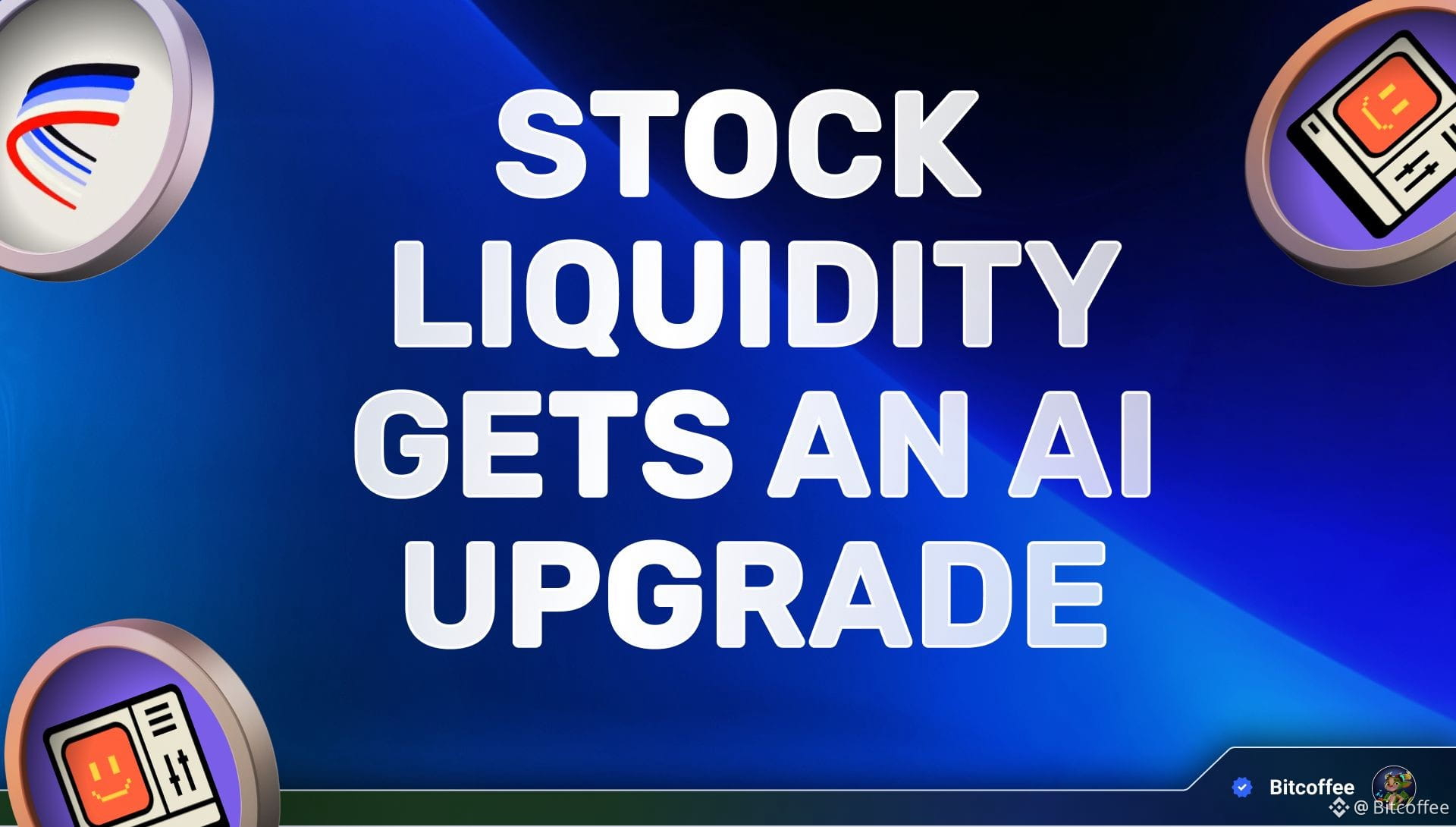
138 institutions publishing market data to one crypto network is bigger than another integration headline.
$ZEC and $HBAR traders should care because trust is no longer a vague RWA word. Pyth is turning it into the data layer that decides settlement, collateral, risk and 24/7 market execution.
Kalshi. Revolut. Fenics. Coinbase. Jane Street. SGX FX. Cboe. Tradeweb. Virtu.
Different institutions. Different markets. One distribution layer.
Pyth Pro’s July 2026 report shows 3,501 feeds, including 1,901 equity feeds. That is the part I’m watching because financial markets are becoming software-defined, and every software-defined market needs live prices before anything useful can happen.
Kalshi uses Pyth Pro for commodities resolution.
Coinbase uses Pyth across crypto, equities and FX for real-time pricing, collateral valuation and liquidation infrastructure.
SGX FX contributes institutional currency pricing across global liquidity hubs.
Fenics brings dealer-to-dealer fixed-income data into the network.
My read: Pyth is building the supply chain for market data.
Institutions contribute prices from the markets closest to real activity. Pyth distributes that data through real-time infrastructure. Exchanges, prediction markets, risk systems and financial products use it across asset classes.
That model becomes more important as crypto moves into tokenized securities, RWA perps, prediction markets, AI workflows and venues that trade around the clock.
The next market data layer will not be built around one venue or one asset.
It will be built around direct institutional data moving into real-time applications.
That common thread is Pyth.
#Altcoin Season# #RWA
$ZEC and $HBAR traders should care because trust is no longer a vague RWA word. Pyth is turning it into the data layer that decides settlement, collateral, risk and 24/7 market execution.
Kalshi. Revolut. Fenics. Coinbase. Jane Street. SGX FX. Cboe. Tradeweb. Virtu.
Different institutions. Different markets. One distribution layer.
Pyth Pro’s July 2026 report shows 3,501 feeds, including 1,901 equity feeds. That is the part I’m watching because financial markets are becoming software-defined, and every software-defined market needs live prices before anything useful can happen.
Kalshi uses Pyth Pro for commodities resolution.
Coinbase uses Pyth across crypto, equities and FX for real-time pricing, collateral valuation and liquidation infrastructure.
SGX FX contributes institutional currency pricing across global liquidity hubs.
Fenics brings dealer-to-dealer fixed-income data into the network.
My read: Pyth is building the supply chain for market data.
Institutions contribute prices from the markets closest to real activity. Pyth distributes that data through real-time infrastructure. Exchanges, prediction markets, risk systems and financial products use it across asset classes.
That model becomes more important as crypto moves into tokenized securities, RWA perps, prediction markets, AI workflows and venues that trade around the clock.
The next market data layer will not be built around one venue or one asset.
It will be built around direct institutional data moving into real-time applications.
That common thread is Pyth.
#Altcoin Season# #RWA
CLARITY compliance is already running 🔥
Space and Time published the full CLARITY Compliance Framework and what most people missed is that it is not a roadmap.
It is live infrastructure mapping to every single obligation the Digital Asset Market Clarity Act introduces.
Protocol transparency: insider token allocations, DAO governance votes, treasury movements, decentralization metrics, all indexed onchain and queryable by any regulator on demand.
Tokenization: proof of reserves, tokenized RWA backing, real-time NAV, custody attestations, all reconciled continuously between onchain token state and offchain asset data.
Stablecoin and protocol rewards: activity-based cashback eligibility proven from real behavior, wash trading caught automatically, distribution through smart contracts with no central authority deciding who qualifies.
Markets and credit: wash trading surveillance, broker-dealer disclosure feeds, liquidity data, institutional lending lifecycle, all indexed the moment it happens.
$ZK has been making verifiable computation the expected baseline for infrastructure and $LINK has been the standard for trusted data delivery across chains for years.
Both point toward a world where Space and Time's CLARITY framework is not a differentiator.
It is the minimum.
The disclosure bar is rising across every surface simultaneously and Space and Time is the only layer that clears all of them at once.
Projects scrambling to comply after the bill passes will spend months building what is already running here.
#Altcoin Season#
Space and Time published the full CLARITY Compliance Framework and what most people missed is that it is not a roadmap.
It is live infrastructure mapping to every single obligation the Digital Asset Market Clarity Act introduces.
Protocol transparency: insider token allocations, DAO governance votes, treasury movements, decentralization metrics, all indexed onchain and queryable by any regulator on demand.
Tokenization: proof of reserves, tokenized RWA backing, real-time NAV, custody attestations, all reconciled continuously between onchain token state and offchain asset data.
Stablecoin and protocol rewards: activity-based cashback eligibility proven from real behavior, wash trading caught automatically, distribution through smart contracts with no central authority deciding who qualifies.
Markets and credit: wash trading surveillance, broker-dealer disclosure feeds, liquidity data, institutional lending lifecycle, all indexed the moment it happens.
$ZK has been making verifiable computation the expected baseline for infrastructure and $LINK has been the standard for trusted data delivery across chains for years.
Both point toward a world where Space and Time's CLARITY framework is not a differentiator.
It is the minimum.
The disclosure bar is rising across every surface simultaneously and Space and Time is the only layer that clears all of them at once.
Projects scrambling to comply after the bill passes will spend months building what is already running here.
#Altcoin Season#
$500K is live. Trading fees on eligible stock products: $0. 👀 $AAVE and $ENA traders already spend plenty of time thinking about yield, collateral and capital efficiency. I’d apply the same mindset to MEXC’s AI stock round. Instead of trying to nail one ticker, build around where the AI money is actually moving. NVDA gives you GPUs. MU gives you memory. TSMC sits underneath chip production. MSFT and ORCL take you further into cloud and software. Five stocks. One view on AI. During MEXC 0808, eligible RealStocks, Tokenized Stocks and Stock Futures are running at 0 trading fees, so changing the basket or rotating between names doesn’t keep adding trading costs. The current Stock Card round sits inside a $500K Stock Season, with 888 USDT, 788 USDT and 688 USDT going to the top three cards. There’s another up-to-$200K around the stock push through Kaito Studio too, split between stock-product education and referrals. If you already have an AI thesis sitting on a watchlist, this is probably the week I’d actually put it to work on MEXC. #Altcoin Season# #Trading
Bots Read Your Swap Before It Fills 🤖 Every swap you send sits in the open long enough for somebody faster to trade in front of it. $JUP handles roughly 95% of Solana's aggregator volume and over $20B a year, and every route it builds is fully readable while it is still working. That is an enormous amount of order flow sitting visible before the person who sent it gets filled. And hiding everything is not the answer either, since $XMR conceals a payment so completely that no venue can prove the trade followed any rules at all. So retail either trades in public and pays for it, or trades somewhere no regulated platform will go. So Midnight lets the order stay unreadable while it runs and still produces proof it cleared the rules afterwards. Webisoft is building a trading venue on that design right now. That chain has made over 1.5 million blocks since March, one every 6 seconds, with no downtime reported. Front-running is the tax nobody agreed to pay, and the venues that remove it will not have to advertise very hard. #Privacy #DeFi
Claiming An Airdrop Exposes Your Wallet 🚨 To claim most airdrops you have to connect the wallet that qualified, which ties your main holdings to that claim forever. There is a real attempt to work around this on $IOTA, where Argentina's national transplant authority and 24 provincial agencies went live this month verifying records on chain. That method posts only a fingerprint of a record and keeps the record itself off chain completely. So it can prove nothing was tampered with, and it cannot prove anything about what is inside. Optional hiding hits the same wall, and $ZEC can shield the transfer beautifully but cannot tell a project you held the right amount on the right day. So Midnight proves the fact itself, letting you show you qualified at the snapshot without revealing which wallet you used or what else is in it. Midnames, Identus and Triple Play are building that kind of check on it now. And the check gets stronger this way, because no project has to store a list of your addresses to run it. Every farmer already runs ten wallets to dodge this, and the chain that removes the reason to will pick up all of them. #Privacy #Identity
$LIT Traders Just Got A Major Trading Upgrade 🚀 An AI trading agent with 28K+ winning trades that finds opportunities, automatically manages risk and protects your gains is now available on Lighter. It's Pear Protocol's free trading agent, Agent Pear, bringing the same tools traders have been using to execute smarter trades on $HYPE with limited directional risk. It scans for pair and basket opportunities, combines quant analysis with news and sentiment, pressure-tests your ideas and constructs positions around your preferred risk, sizing and leverage. It'll even remember how you trade, monitor markets 24/7, automatically rebalance baskets as conditions change and execute everything for you directly through Pear. Basically, LIT traders just got a free quant they can talk to like a friend to help find, build, manage and execute better trades without doing all of that analysis manually. And this is definitely the best week to try it. Pear's trading competition now includes $15K in LIT token rewards, 4 Fuego NFTs, an F1 ticket around TOKEN2049, and five leaderboard spots that split 10% of Pear's treasury take. Agent Pear is officially LIT 🍐 #Altcoin Season#

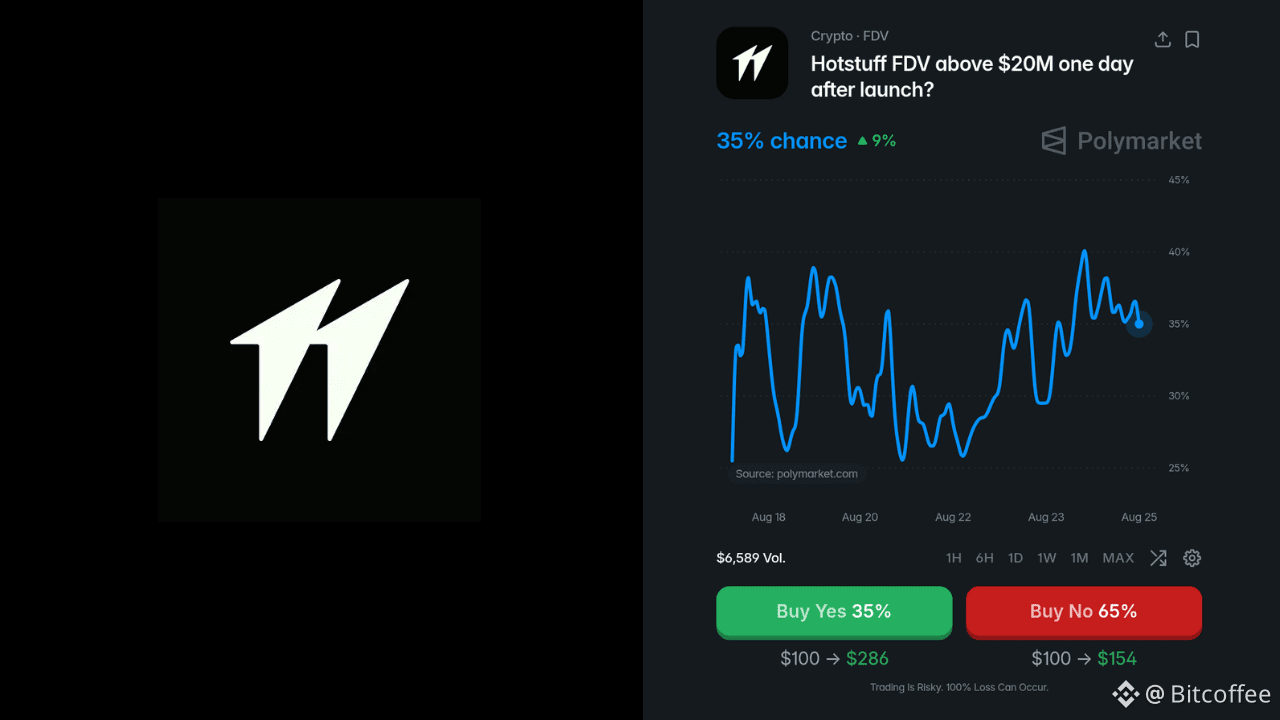
Will Hotstuff's FDV clear $20M? 📈 Hotstuff's still a newer name in the FDV launch conversation, the kind of market most people haven't found yet. Actually breaking out? Maybe, yeah. 35% chance right now, up 9%. Only $6,589 in volume so far, which makes this a genuinely early opportunity if you've got a read on it. This chart has been wild the whole stretch, swinging between the mid 20s and high 30s over and over again. The most recent push landed right near the top of that whole range, not the middle or bottom. I'm leaning Yes here, even as the underdog side technically. Landing near the top of an established range after that much chop is usually a tell. $SOL and $POL both tend to show up in these smaller, early stage FDV questions before the bigger volume ever arrives. Polymarket's lead in this space honestly isn't close right now, no other platform touches this many categories at the same time the way this one does. Then there's the perp launch talk going around. If that's actually real, this whole early stage feels tiny compared to what's coming for this platform. Polymarket still feels like the most solid way to actually make something off a read like this instead of just watching it play out. Fair to land on either side of this one though, it's genuinely close. #Altcoin Season#
Nothing You Trade Today Ever Gets Deleted 🧠 Nothing written to a public blockchain is ever removed, so what you do today becomes a permanent record for tools nobody has built yet. $ZEC saw the value sitting in its hidden pool pass $1B this August, as holders moved money out of the open and behind proofs instead. That is people paying today for protection they will not need until much later, which is the whole shape of this problem. The opposite is easier to see on $XRP , where an open ledger keeps balances and identities readable and every one of those records stays exactly where it was written. So the tools for reading old data get cheaper every year while your history sits still and waits for them. That gap is the entire argument, because a decision you make about privacy today gets judged by software that does not exist yet. Midnight handles it by never writing the data down in readable form, so what stays on the chain is a proof instead of a record waiting to be cracked. You can still hand the real data to whoever is entitled to see it, and nobody else earns that access just by waiting long enough. The Glacier Drop went out to more than 8 million wallets across 8 ecosystems, which is a lot of people whose very first transaction here was hidden by default. I now assume every public transaction I make will eventually get traced back to me, because being wrong about that only costs you in one direction. #Privacy #Altcoin Season#
DRB Didn't Wait For Coinbase To Get Noticed 📡 Getting picked up by a major exchange's asset roadmap used to be treated as the finish line for a small token. The grind before that moment was always the same story: months of quiet farming, hoping the right account noticed you first, and then a listing if you’re lucky. $DRB just skipped most of that story, after Coinbase added it to their Asset Roadmap this week. DRB didn't come from a slow community build either. It came out of Bankr, the AI agent that lets anyone deploy a token straight from a tweet, and DRB was made specifically for Grok. $VIRTUAL already proved a token built around an AI agent could hold real market cap instead of fading as a novelty, so DRB launching straight out of an agent and into Coinbase's roadmap isn't happening in a vacuum. That origin is exactly why 0xdeployer tagging Elon Musk directly on X this week reads as more than a normal shoutout attempt. With this move 0xdeployer is pulling on the flywheel in public, right after an exchange validated it from the outside. If he’s successful this could close the loop back to the account DRB was built around in the first place. What's easy to miss watching just DRB is that the same Bankr pipeline has quietly built out Quotient, GME, Zaibatsu Wagies, Gitlawb, and BNKR itself over the past months, with almost nobody outside the ecosystem paying attention. Bitcoin's recent push higher is doing what it always does, sending risk appetite back down into exactly this kind of micro cap. The difference this time is the tokens were already built and shipping before that attention arrived, instead of getting rushed out to chase a narrative. Bankr SZN isn't one token catching a bid. It's an entire pipeline that finished building right before the market started paying attention. I'm bullish on the rest of that pipeline getting found before everyone else catches up. #Altcoin Season# #AI Agents 🤖#
The infrastructure was ready. Now the IP arrives. $AVAX built something most chains didn't. Custom infrastructure for serious projects that need their own environment without compromising the underlying network. That architecture was built for exactly this kind of asset. $DMC is bringing one of the most recognized automotive IP assets in the world onchain. The DeLorean. 40 years of global brand equity. Real partnerships opening. Real products being built around it. The Avalanche ecosystem built the infrastructure before knowing exactly what would use it. This is the kind of IP it was waiting for. #Altcoin Season#

Pick your model, pick your tradeoff. 💸 I spent time mapping every option available to institutional capital looking for collateralized credit and every single one came with a constraint that made it unworkable at serious scale. Pooled DeFi vaults move fast but bind every depositor to protocol-set terms and a shared risk pool that has nothing to do with their specific deal. Proof-of-reserve snapshots prove collateral existed last Tuesday at 4pm and stop being accurate the moment they are published. Tri-party custody arrangements buy verification at the cost of a third counterparty involved in every move the borrower wants to make. Virtual Vaults by Space and Time is the first structure I have seen that removes all three constraints simultaneously. Structure the vault to the negotiated deal, collateral mix, haircuts, margin thresholds, liquidation logic, all configured per counterparty relationship rather than protocol defaults. Space and Time generates continuous tamperproof proof of vault state from the moment it is set up. The lender verifies collateral the instant it moves. The borrower keeps full custody throughout. Neither side waits on a third party. The institutional credit market that $NEAR 's developer ecosystem is building into and the capital markets that $HYPE is scaling both hit the same collateral verification wall eventually. Virtual Vaults is the first structure that makes that wall disappear without asking anyone to give something up. Vaults without tradeoffs is not a tagline. It is the actual product. #Altcoin Season# #RWA
Verified
Gold Got Smaller, Then Useful 🪙 Buying gold used to mean committing to an entire coin or bar, whether you wanted that much exposure or not. $XAUt solved that specific problem first, breaking physical gold down into smaller digital units anyone could actually hold. That fixed access, but the gold still just sat there afterward, doing exactly what gold has always done and nothing more. Most holders never expected anything different, gold was never supposed to be an active asset in the first place. Theoriq Gold Vault is the part that comes next, letting that same fractional gold start earning instead of sitting idle. Recent 30 day trailing yield on the vault landed around 3.6%, denominated in the gold itself rather than in dollars. That detail matters more than it sounds, compounding in the asset you already hold rather than converting in and out of it. $PAXG helped normalize this whole category years before yield ever entered the picture, proving people would trust tokenized gold at all. Smaller units solved who could own gold, a working yield layer solves what that ownership actually does for you. Both problems needed solving, and I think it's notable they're finally being solved by two different teams working in the same direction. #Altcoin Season# #RWA
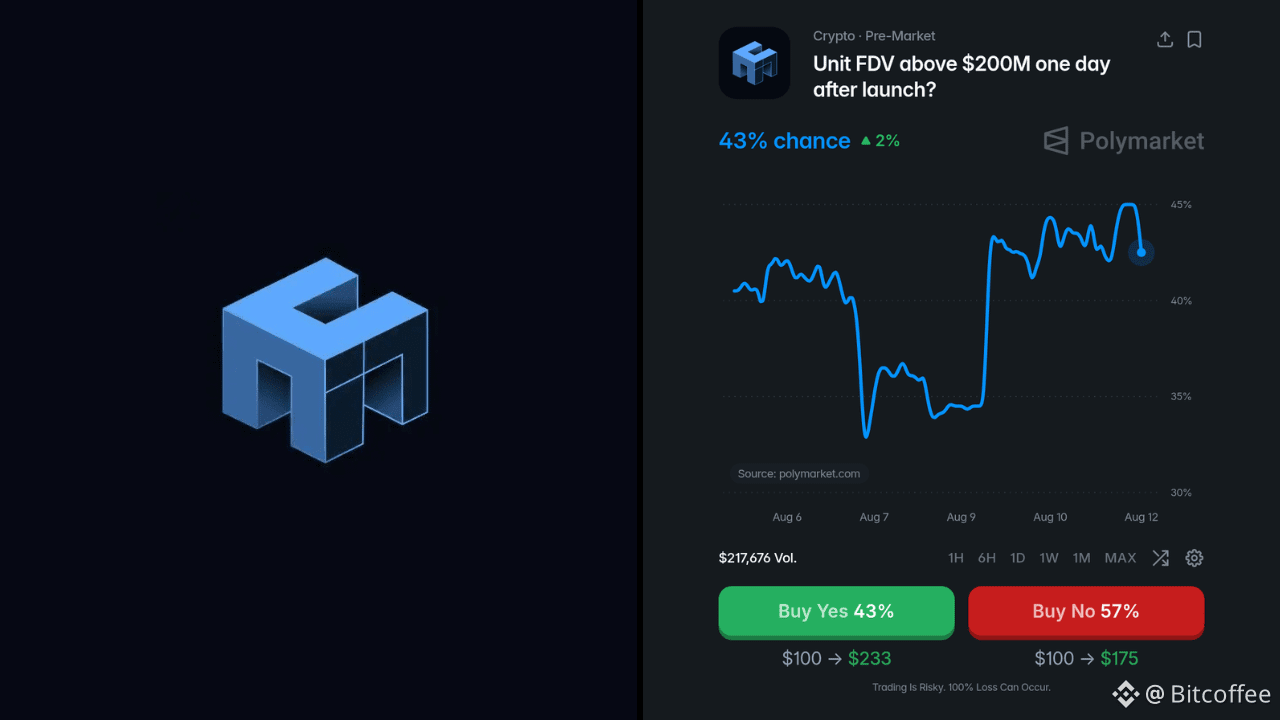
Will Unit's FDV clear $200M? 📈 Instead of holding $BNB and waiting around, here's what I did with this one today. Unit's been gaining attention for bringing tokenized versions of major assets onto newer chains lately. 43% chance right now, up slightly, and $217,676 in volume shows this is a market plenty of people are already watching closely. The chart dropped hard early, into the mid 30s, before recovering sharply back up near where it sits now. That kind of full recovery after a real scare usually says more about underlying demand than the dip itself did at the time. I'm leaning Yes here, even as the underdog side on paper. Momentum coming out of a recovery like that tends to carry further than people initially expect. A decent amount of that recovery volume has moved through $SOL specifically over the past few days. Polymarket is still one of the more solid ways to actually profit from calls like this instead of just watching the chart from the sidelines. You're free to land wherever you want on it though. #Altcoin Season#
Log in to explore more content