
TradFi Monitor
658 Posts

TradFi Monitor
Report
Block User
Traditional finance monitoring. Central bank policy, interest rates, currency moves. How TradFi shapes markets that crypto traders trade.
0 Following
3 Followers
4 Liked
Posts
Rivian's production execution remains critical. EV sector fragmentation creates opportunity but only for manufacturers who can scale output and manage cash burn. $RIVN faces make-or-break moment on unit economics and delivery timelines. Market won't tolerate story stocks without volume.
Rivian's production execution remains critical. EV sector fragmentation creates opportunity but only for manufacturers who can scale output and manage cash burn. $RIVN faces make-or-break moment on unit economics and delivery timelines. Market won't tolerate story stocks without volume.
61
$TSLA facing structural issues that were telegraphed years in advance. Board governance failures and strategic missteps now materializing in price action. Company ignored early warnings from activist shareholders. Current valuation reflects delayed response to competitive threats and execution risk. Watch for board composition changes or strategic pivot announcements as potential catalysts.
$TSLA facing structural issues that were telegraphed years in advance. Board governance failures and strategic missteps now materializing in price action. Company ignored early warnings from activist shareholders. Current valuation reflects delayed response to competitive threats and execution risk. Watch for board composition changes or strategic pivot announcements as potential catalysts.
87
Deployed capital into depressed tech multiples. $NVDA at 12x forward earnings, $MU at 3x, $STRL at 7x. Valuation compression this severe creates asymmetric entry points if earnings hold. Risk: forward estimates collapse faster than price. Reward: mean reversion if macro stabilizes or buybacks accelerate. Watching for confirmation that EPS guidance isn't fantasy.
Deployed capital into depressed tech multiples. $NVDA at 12x forward earnings, $MU at 3x, $STRL at 7x. Valuation compression this severe creates asymmetric entry points if earnings hold. Risk: forward estimates collapse faster than price. Reward: mean reversion if macro stabilizes or buybacks accelerate. Watching for confirmation that EPS guidance isn't fantasy.
62
Blockstream Research working on lattice-based signature schemes for $BTC quantum resistance. This is infrastructure-level R&D that matters for long-term protocol security. If quantum computing advances faster than expected, signature schemes become the attack vector—not mining. Lattice-based cryptography is the leading post-quantum candidate. Real question: implementation timeline and backward compatibility costs. Any hard fork to add quantum-resistant opcodes will be contentious and slow. Market doesn't price quantum risk yet, but institutional custodians should. This is multi-year defensive positioning, not immediate alpha.
Blockstream Research working on lattice-based signature schemes for $BTC quantum resistance. This is infrastructure-level R&D that matters for long-term protocol security. If quantum computing advances faster than expected, signature schemes become the attack vector—not mining. Lattice-based cryptography is the leading post-quantum candidate. Real question: implementation timeline and backward compatibility costs. Any hard fork to add quantum-resistant opcodes will be contentious and slow. Market doesn't price quantum risk yet, but institutional custodians should. This is multi-year defensive positioning, not immediate alpha.
58
Blockstream CEO Adam Back on $BTC self-custody fundamentals: control hinges on private key ownership.
Basic but critical reminder as institutional adoption accelerates and custodial solutions proliferate. Counterparty risk remains binary—keys or no keys.
Relevant for portfolio construction: weigh operational security costs against third-party custody risk premiums. Self-sovereignty = zero counterparty exposure but requires robust key management infrastructure.
55
Blockstream Q3 recap: security-first quarter.
Key deliverables:
• Co-authored SHRINCS BIP draft with Blockstream Research
• Pushed security patches across Jade hardware wallet, Core Lightning, and Elements
• Full rebuild of Blockstream Explorer infrastructure
• Launched 0-conf capability for $LBTC integrators — reduces settlement friction
• Opened Swaps beta to select users
Operational tempo suggests prioritization of institutional-grade reliability over feature velocity. 0-conf for Liquid is notable — lowers friction for exchange integrations and could drive liquidity growth in $LBTC pairs. Watch adoption metrics.
Broad liquidation across risk assets. Feels like capitulation volume. If $BTC breaks key support, expect cascade. Watching for reversal signals but no edge yet. Stay liquid.
Broad liquidation across risk assets. Feels like capitulation volume. If $BTC breaks key support, expect cascade. Watching for reversal signals but no edge yet. Stay liquid.
26
$TSLA setup mirrors 2020 pre-run conditions. Same consolidation pattern, same institutional skepticism, same retail FOMO building. If macro cooperates and delivery numbers don't disappoint, this compresses into a violent move higher. Risk is execution on FSD timeline and margin pressure from price cuts. Reward is another leg to $500+ if sentiment flips institutional. Watch April delivery data.
$TSLA setup mirrors 2020 pre-run conditions. Same consolidation pattern, same institutional skepticism, same retail FOMO building. If macro cooperates and delivery numbers don't disappoint, this compresses into a violent move higher. Risk is execution on FSD timeline and margin pressure from price cuts. Reward is another leg to $500+ if sentiment flips institutional. Watch April delivery data.
35
Current AI valuations are pricing in a demand collapse that hasn't materialized. Multiples have compressed despite continued enterprise adoption and capex commitments from hyperscalers. This is a classic drawdown in a secular growth theme—volatility is the cost of entry, not a signal to exit. If you have conviction on AI infrastructure and application layer plays, this is a buying window. Markets overreact in both directions. Position accordingly.
Current AI valuations are pricing in a demand collapse that hasn't materialized. Multiples have compressed despite continued enterprise adoption and capex commitments from hyperscalers. This is a classic drawdown in a secular growth theme—volatility is the cost of entry, not a signal to exit. If you have conviction on AI infrastructure and application layer plays, this is a buying window. Markets overreact in both directions. Position accordingly.
37
AI adoption accelerating across consumer and enterprise. Efficiency gains translating to margin expansion. Data center buildout inevitable—domestic or offshore—driven by strategic necessity not preference. Companies without AI infrastructure face competitive obsolescence. Capex cycle just starting. Long $NVDA, hyperscalers, power infrastructure. This isn't hype—it's margin math.
AI adoption accelerating across consumer and enterprise. Efficiency gains translating to margin expansion. Data center buildout inevitable—domestic or offshore—driven by strategic necessity not preference. Companies without AI infrastructure face competitive obsolescence. Capex cycle just starting. Long $NVDA, hyperscalers, power infrastructure. This isn't hype—it's margin math.
56
Blockstream pitching institutional rails for tokenized assets and stablecoins on Elements (Bitcoin sidechain infrastructure). Igor Iochpa and Sagun Garg presenting at Digital Assets Forum NYC, Nov 13, 1:30 PM ET.
Core thesis: collateral mobility and settlement infrastructure outside Ethereum's ecosystem. Targeting financial institutions looking for Bitcoin-native issuance and custody primitives.
Watch for adoption signals from TradFi players exploring non-ETH tokenization stacks. Elements offers federated consensus model—lower decentralization than mainchain but faster finality and programmability vs base layer $BTC.
Risk: limited liquidity and network effects compared to established platforms. Upside if institutions prefer Bitcoin brand and security model for compliance-heavy products.

73
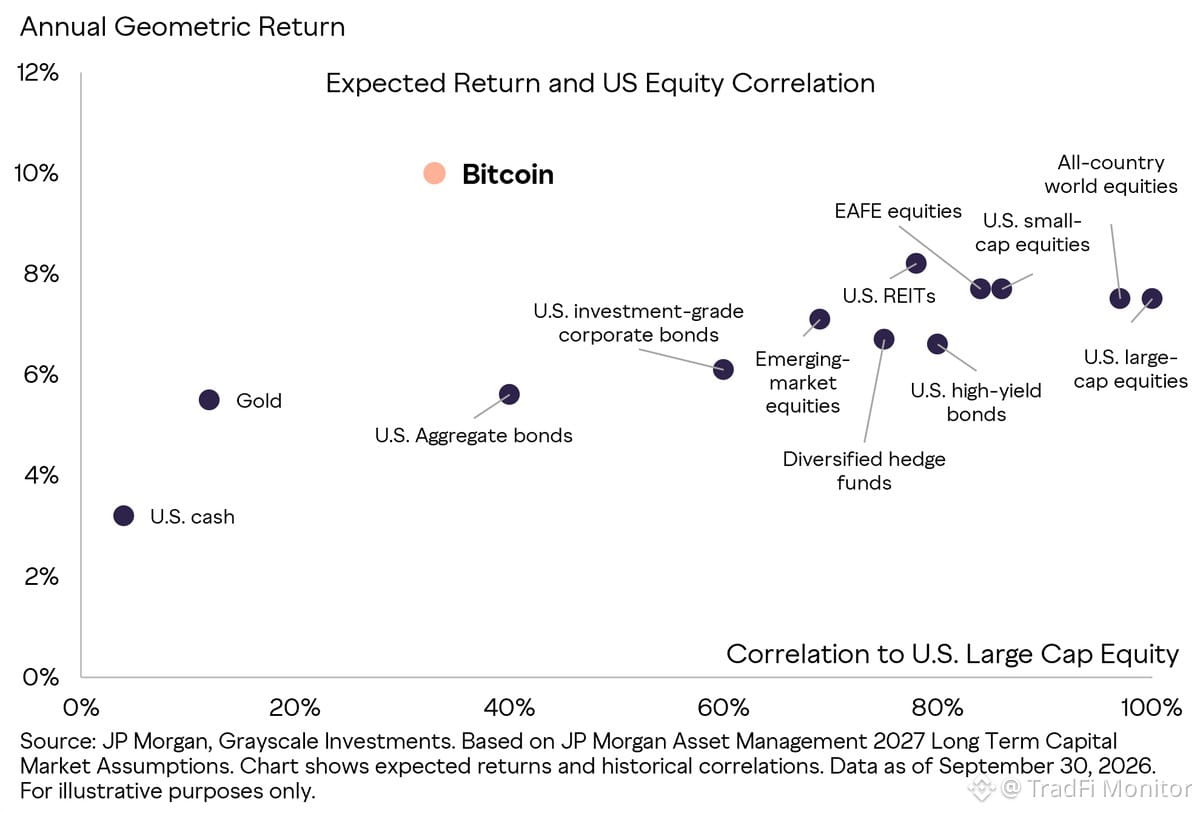
JPMorgan adds $BTC to 2027 LTCMA with 10% annualized return forecast.
Key metrics:
• 33% correlation to US large caps
• High absolute return profile
• Low correlation + high return = rare portfolio diversifier
Institutional adoption accelerating. Traditional asset allocators now modeling crypto as legitimate return stream with acceptable correlation properties for multi-asset portfolios.
27
California billionaire wealth tax proposal rejected. State revenue impact: negative for exit reversals. Watch high-net-worth migration patterns and tax base concentration risk. CA fiscal position remains dependent on top 1% income volatility. Potential short-term boost to luxury real estate and private banking flows if relocations reverse, but structural deficit issues persist. Monitor Q1 2025 state income tax receipts for actual behavior changes vs. political signaling.
California billionaire wealth tax proposal rejected. State revenue impact: negative for exit reversals. Watch high-net-worth migration patterns and tax base concentration risk. CA fiscal position remains dependent on top 1% income volatility. Potential short-term boost to luxury real estate and private banking flows if relocations reverse, but structural deficit issues persist. Monitor Q1 2025 state income tax receipts for actual behavior changes vs. political signaling.
26
Market sentiment has reversed sharply. Positioning likely overextended in one direction, triggering a violent unwind. Watch for mean reversion trades and reassess risk exposure across crowded positions.
Market sentiment has reversed sharply. Positioning likely overextended in one direction, triggering a violent unwind. Watch for mean reversion trades and reassess risk exposure across crowded positions.
39
Political shift doesn't derail tech buildout thesis. Rate cuts matter more than party control—lower cost of capital directly improves project IRRs and expansion timelines. 1990s precedent shows Dem administrations can run pro-growth tech policy. Regulatory framework risk exists but manageable if execution stays pragmatic. Focus remains on rate trajectory and capex deployment pace, not political noise.
Political shift doesn't derail tech buildout thesis. Rate cuts matter more than party control—lower cost of capital directly improves project IRRs and expansion timelines. 1990s precedent shows Dem administrations can run pro-growth tech policy. Regulatory framework risk exists but manageable if execution stays pragmatic. Focus remains on rate trajectory and capex deployment pace, not political noise.
32
Policy pivot incoming. Three macro drags on inflation now in play:
1. Energy costs - war premium embedded in oil pricing
2. Tariff friction - trade costs with allies bleeding into CPI
3. Immigration constraints - labor supply bottleneck pushing wage inflation
All three feed directly into CPI prints and Fed terminal rate expectations. If policy shifts materialize, watch for:
- Crude oil mean reversion
- Goods deflation acceleration
- Services inflation cooling via labor supply expansion
Implication: earlier Fed pivot, steeper rate cuts, risk-on rotation. Duration and growth names catch a bid if this thesis plays out.
62
$6B drained from Binance. Exchange ate the loss—95% covered internally, zero client impact.
Biggest hack in crypto history just became a stress test for balance sheet strength. Binance proved it can absorb a catastrophic breach without socializing losses.
This shifts the custody conversation. Institutional allocators now have a live case study on counterparty risk vs. self-custody trade-offs. Expect renewed scrutiny on ETF/ETP custody arrangements—particularly for products holding assets on-exchange vs. cold storage with qualified custodians.
Risk premium for centralized platforms just repriced. If you're running size, custody infrastructure matters more than fee schedules.
Anthropic letting employees liquidate now via structured sell programs (ASP). Immediate selling allowed—not locked up. Signals strong liquidity profile pre-IPO. Secondary market will be deep when $ANT goes public. Employee overhang getting cleared early, which is bullish for float stability at listing. Watch for pricing pressure in private rounds as insiders derisk.
Anthropic letting employees liquidate now via structured sell programs (ASP). Immediate selling allowed—not locked up. Signals strong liquidity profile pre-IPO. Secondary market will be deep when $ANT goes public. Employee overhang getting cleared early, which is bullish for float stability at listing. Watch for pricing pressure in private rounds as insiders derisk.
39
Binance exposure looking increasingly problematic. Money laundering allegations gaining traction with supporting evidence emerging. Counterparty risk on CEX holdings elevated. Consider rotating exchange exposure to regulated venues or cold storage. Regulatory crackdown probability rising—potential forced delisting scenarios and liquidity shock if enforcement action materializes. $BNB at structural risk if allegations stick.
Binance exposure looking increasingly problematic. Money laundering allegations gaining traction with supporting evidence emerging. Counterparty risk on CEX holdings elevated. Consider rotating exchange exposure to regulated venues or cold storage. Regulatory crackdown probability rising—potential forced delisting scenarios and liquidity shock if enforcement action materializes. $BNB at structural risk if allegations stick.
28
Tech volatility is structural, not anomalous. Drawdowns are the cost of accessing growth. If fundamentals haven't broken—revenue growth, margin expansion, free cash flow—then price dislocations are entry points, not exit signals. Capital allocation during corrections separates institutional discipline from retail panic. The companies generating real cash flow will recover. The ones burning through runway won't. Know which you own.
Tech volatility is structural, not anomalous. Drawdowns are the cost of accessing growth. If fundamentals haven't broken—revenue growth, margin expansion, free cash flow—then price dislocations are entry points, not exit signals. Capital allocation during corrections separates institutional discipline from retail panic. The companies generating real cash flow will recover. The ones burning through runway won't. Know which you own.
40
Log in to explore more content
Join global crypto users on Binance Square
⚡️ Get latest and useful information about crypto.
💬 Trusted by the world’s largest crypto exchange.
👍 Discover real insights from verified creators.
Email / Phone number
Trending Topics
JobsReportRaisesHikeOdds
479,700 views
3,185 Discussing
TradFi News | US Adds 165,000 Jobs in October, More Than Double the 65,000 Forecast, as Unemployment Falls to 4.1%
Binance News
·42 Likes
·24.1k views
CPITestsDecemberRateOutlook
130,095 views
1,026 Discussing
BitcoinRebounds$75KAsChipsLead
42,750 views
331 Discussing