


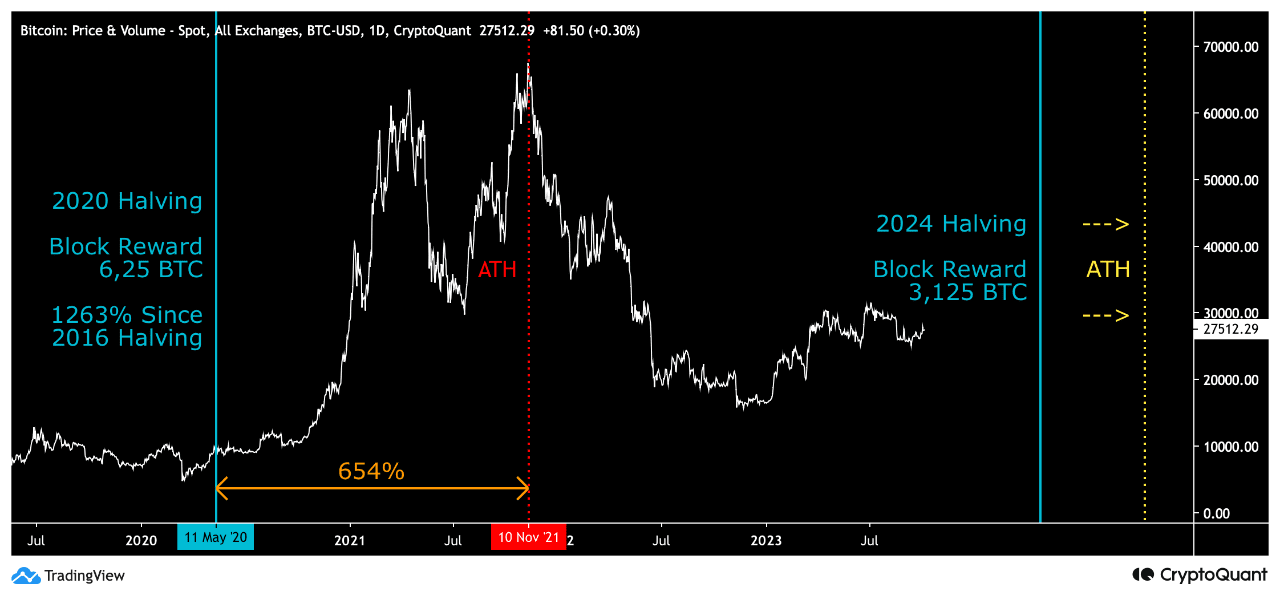
Bitcoin's halving events, which recur in four-year cycles, are an essential part of the market, literally halving the miners' block reward, which dropped from 12,5 bitcoins to 6,25 bitcoins in 2020. Similarly, the 2024 halving will halve the block reward again, reducing it to 3,125 bitcoin units.
Now bitcoin's 2024 halving event is only 200 days away. A look at historical data shows that bitcoin’s price increased by 1263 percent between the halvings of 2016 and 2020. Praeterea, BTCUSD climbed 654 percent (orange) between the halving event of 2020 (turquoise) and the 2021 ATH (red). If we assume that bitcoin trades at its "fair value" of 30 643 USD during April's halving (turquoise), 654% would uplift it to $231 048 (yellow).
If bitcoin’s starting point is $40 000 at the April halving event, a 654 percent increase would respectively propel it to above and beyond of $300 000. Of course, these scenarios are speculative, and halving cycles do not necessarily mimic each other linearly. The presented valuation levels are approximate.
In combination with a spot ETF, the halving cycle is expected to increase the appetite of both retail and institutional investors. Quoting the famous words of Anthony Pompliano, bitcoin’s return profile is asymmetric because its upside potential significantly outweighs the downsides.
While bitcoin will likely hit six figures after the 2024 halving event, the time window of ”retail priced” bitcoin is consequently closing. As a unique asset class, bitcoin has allowed millions of retail investors to front-run institutions, however the opportunity will not last forever.
Written by oinonen_t