

#sec
sec
334.1M views
1.4M Discussing
Hot
Latest

·
--
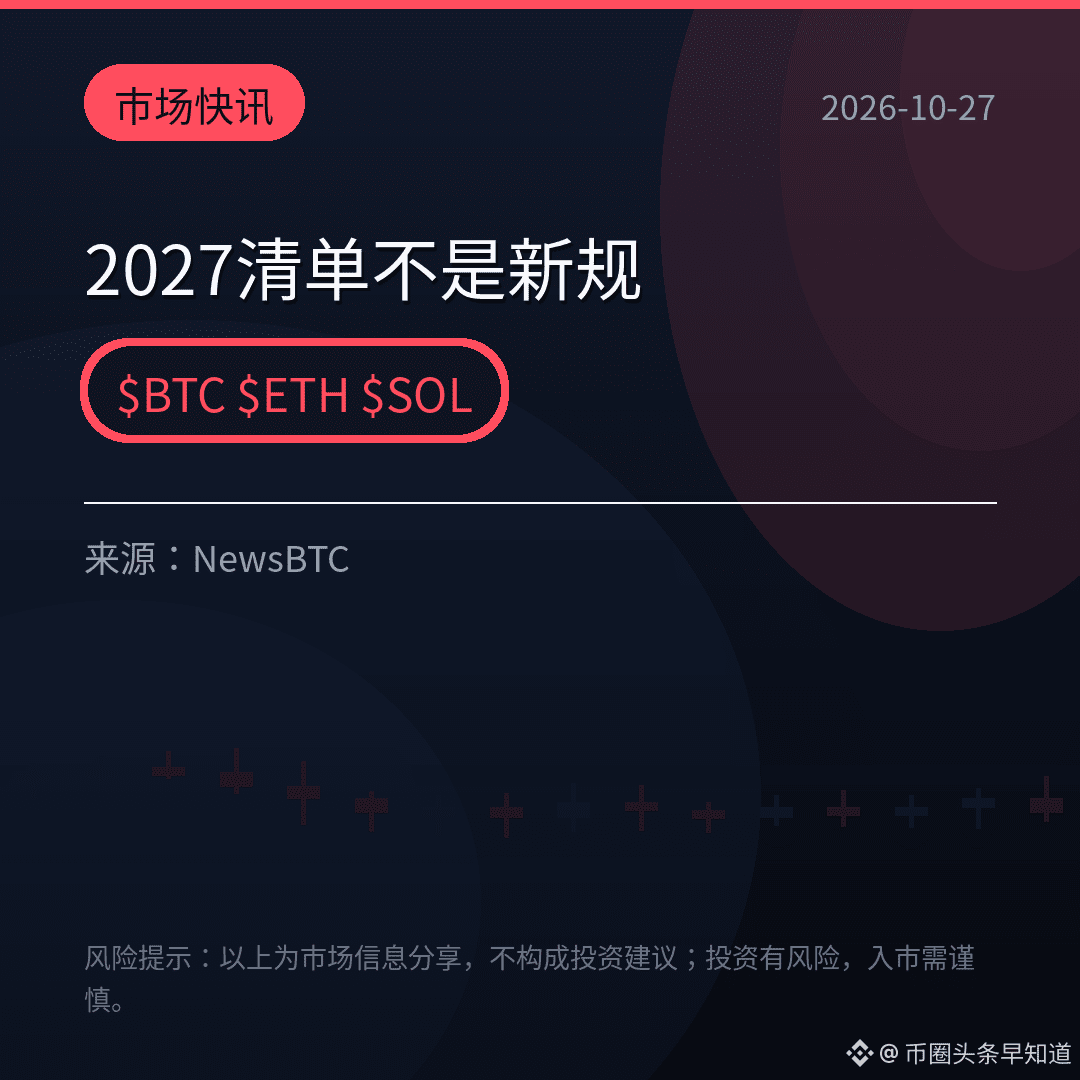
【Market Update】The SEC’s 2027 list isn’t a new rule, but an examination agenda.
Published by the Division of Examinations on October 23, the list covers investment advisers, funds, broker-dealers, and clearing agencies. Routine areas of focus include conflicts of interest, custody of client information, and operational resilience. It also calls out tokenization and AI: on-chain shares still raise questions about who maintains the ledger, what happens when a transaction fails, and how investors can exercise their rights. AI could affect compliance, fraud, and market operations.
The list calls out technologies, not companies—is the signal clear enough?
$BTC $ETH $SOL
#SEC #代币化 #AI
(Source: NewsBTC)
⚠️Risk warning: The above is for sharing market information only and does not constitute investment advice. Investing involves risks; please exercise caution when entering the market.
【Market Update】The SEC’s 2027 list isn’t a new rule, but an examination agenda.
Published by the Division of Examinations on October 23, the list covers investment advisers, funds, broker-dealers, and clearing agencies. Routine areas of focus include conflicts of interest, custody of client information, and operational resilience. It also calls out tokenization and AI: on-chain shares still raise questions about who maintains the ledger, what happens when a transaction fails, and how investors can exercise their rights. AI could affect compliance, fraud, and market operations.
The list calls out technologies, not companies—is the signal clear enough?
$BTC $ETH $SOL
#SEC #代币化 #AI
(Source: NewsBTC)
⚠️Risk warning: The above is for sharing market information only and does not constitute investment advice. Investing involves risks; please exercise caution when entering the market.
Published by the Division of Examinations on October 23, the list covers investment advisers, funds, broker-dealers, and clearing agencies. Routine areas of focus include conflicts of interest, custody of client information, and operational resilience. It also calls out tokenization and AI: on-chain shares still raise questions about who maintains the ledger, what happens when a transaction fails, and how investors can exercise their rights. AI could affect compliance, fraud, and market operations.
The list calls out technologies, not companies—is the signal clear enough?
$BTC $ETH $SOL
#SEC #代币化 #AI
(Source: NewsBTC)
⚠️Risk warning: The above is for sharing market information only and does not constitute investment advice. Investing involves risks; please exercise caution when entering the market.
271
·
--
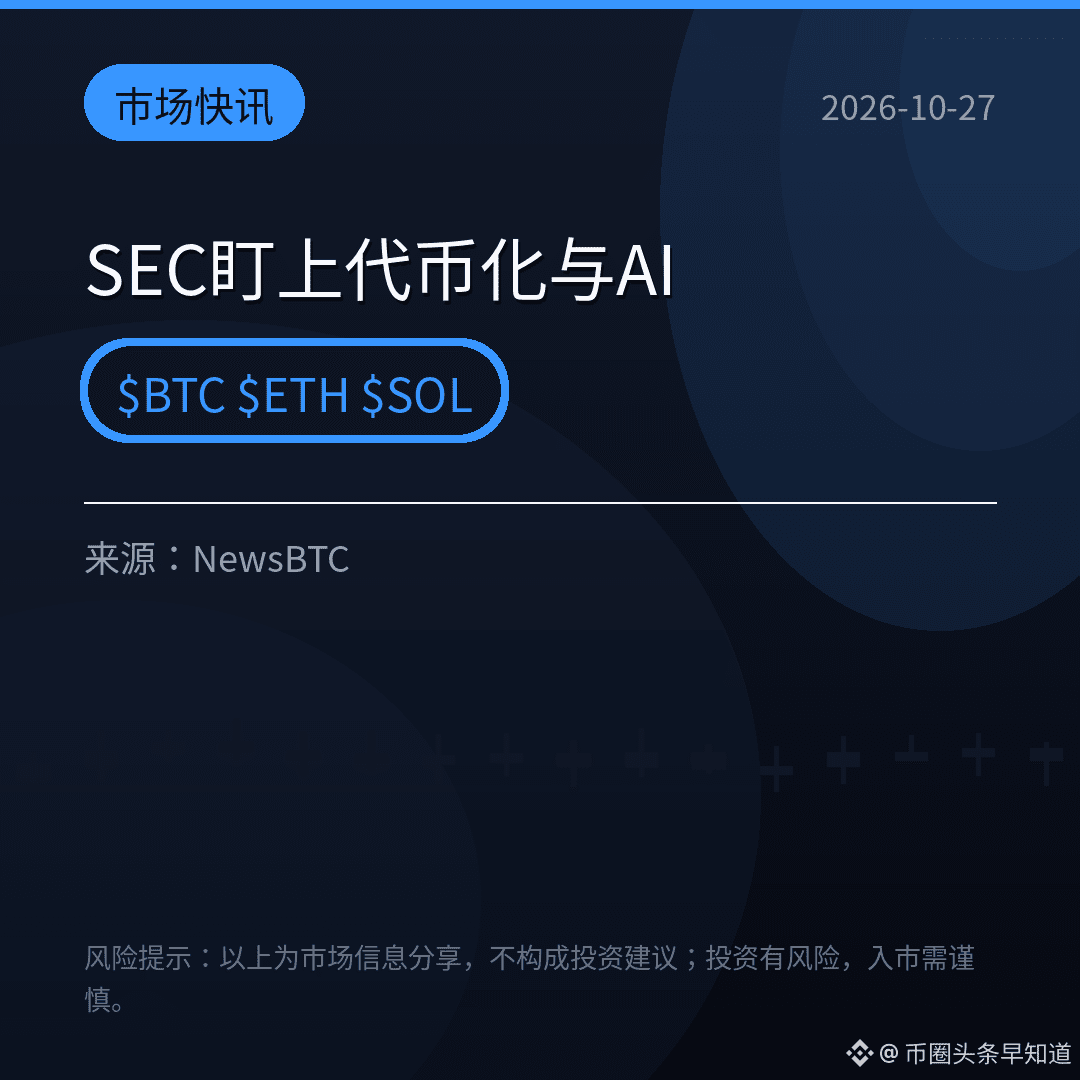
【Market Update】SEC’s 2027 Examination Priorities: Tokenization and AI both make the list!
The 2027 fiscal-year examination priorities, announced on October 23, cover investment advisers, funds, broker-dealers, and clearing agencies. AI is also in the spotlight, with implications for compliance, fraud, and market operations. Don’t misread this: making the list is neither a green light nor a ban—no matter how fast things move on-chain, internal controls must keep up. Who oversees the ledger? What happens if a transaction falls through? Both questions matter.
Is regulators’ focus on tokenization good news or bad news?
$BTC $ETH $SOL
#SEC #代币化 #AI
(Source: NewsBTC)
⚠️Risk warning: The above is shared for market information purposes only and does not constitute investment advice. Investing involves risk; proceed with caution.
【Market Update】SEC’s 2027 Examination Priorities: Tokenization and AI both make the list!
The 2027 fiscal-year examination priorities, announced on October 23, cover investment advisers, funds, broker-dealers, and clearing agencies. AI is also in the spotlight, with implications for compliance, fraud, and market operations. Don’t misread this: making the list is neither a green light nor a ban—no matter how fast things move on-chain, internal controls must keep up. Who oversees the ledger? What happens if a transaction falls through? Both questions matter.
Is regulators’ focus on tokenization good news or bad news?
$BTC $ETH $SOL
#SEC #代币化 #AI
(Source: NewsBTC)
⚠️Risk warning: The above is shared for market information purposes only and does not constitute investment advice. Investing involves risk; proceed with caution.
The 2027 fiscal-year examination priorities, announced on October 23, cover investment advisers, funds, broker-dealers, and clearing agencies. AI is also in the spotlight, with implications for compliance, fraud, and market operations. Don’t misread this: making the list is neither a green light nor a ban—no matter how fast things move on-chain, internal controls must keep up. Who oversees the ledger? What happens if a transaction falls through? Both questions matter.
Is regulators’ focus on tokenization good news or bad news?
$BTC $ETH $SOL
#SEC #代币化 #AI
(Source: NewsBTC)
⚠️Risk warning: The above is shared for market information purposes only and does not constitute investment advice. Investing involves risk; proceed with caution.
381
·
--
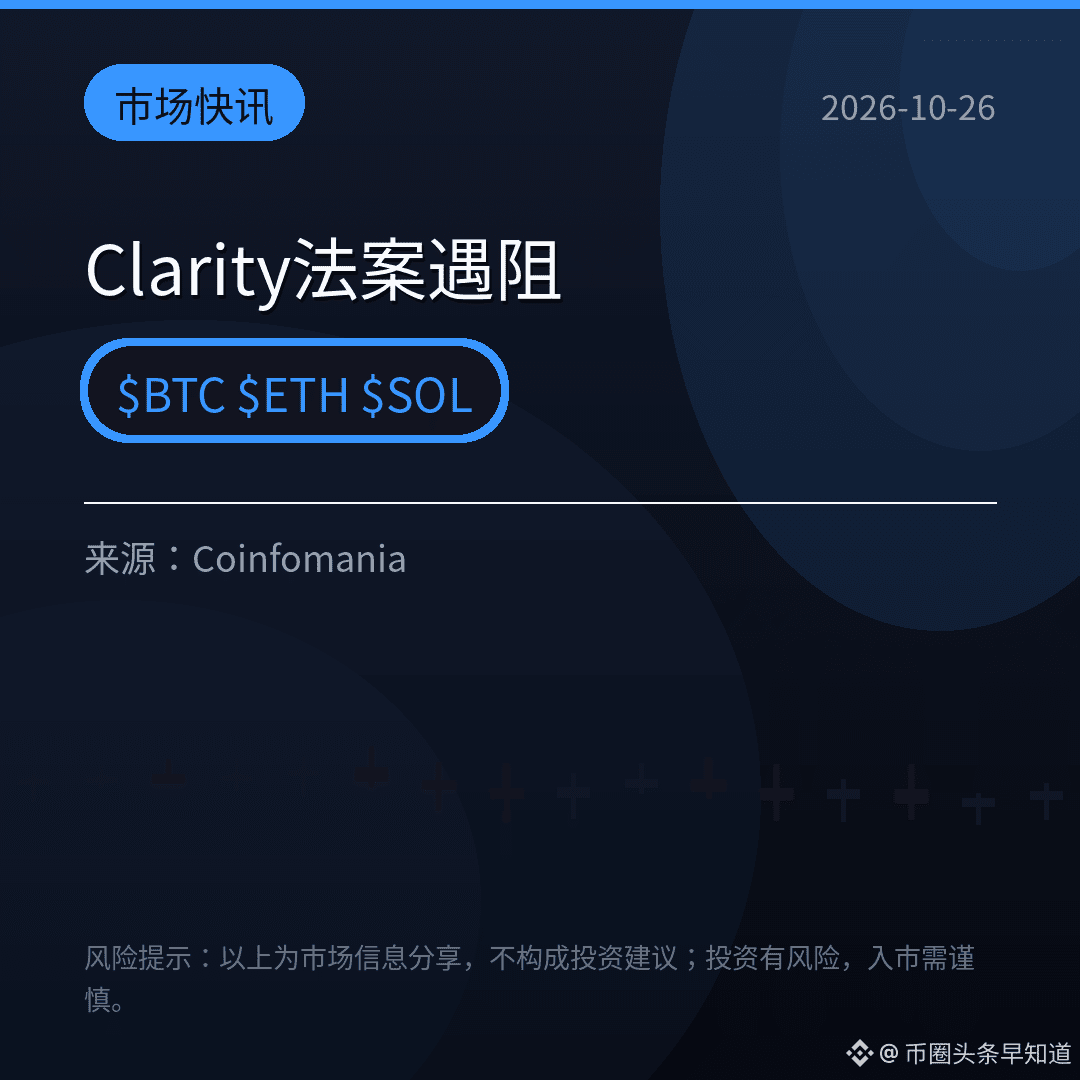
【Market Update】The Clarity Act is stalled: Democrats voted against it, and the SEC’s expanded powers will have to wait.
The bill would empower the SEC to deny, suspend, or revoke certifications for crypto projects, with material misrepresentations grounds for revocation. Lummis says the expanded powers are on the table, but consensus hasn’t been reached.
With regulation still unresolved, the market continues to price in uncertainty.
Is this investor protection, or another lock on innovation? Which side are you on?
$BTC $ETH $SOL
#Clarity法案 #SEC #CryptoRegulation
(Source: Coinfomania)
⚠️Risk warning: The above is shared for informational purposes only and does not constitute investment advice. Investing involves risk; proceed with caution.
【Market Update】The Clarity Act is stalled: Democrats voted against it, and the SEC’s expanded powers will have to wait.
The bill would empower the SEC to deny, suspend, or revoke certifications for crypto projects, with material misrepresentations grounds for revocation. Lummis says the expanded powers are on the table, but consensus hasn’t been reached.
With regulation still unresolved, the market continues to price in uncertainty.
Is this investor protection, or another lock on innovation? Which side are you on?
$BTC $ETH $SOL
#Clarity法案 #SEC #CryptoRegulation
(Source: Coinfomania)
⚠️Risk warning: The above is shared for informational purposes only and does not constitute investment advice. Investing involves risk; proceed with caution.
The bill would empower the SEC to deny, suspend, or revoke certifications for crypto projects, with material misrepresentations grounds for revocation. Lummis says the expanded powers are on the table, but consensus hasn’t been reached.
With regulation still unresolved, the market continues to price in uncertainty.
Is this investor protection, or another lock on innovation? Which side are you on?
$BTC $ETH $SOL
#Clarity法案 #SEC #CryptoRegulation
(Source: Coinfomania)
⚠️Risk warning: The above is shared for informational purposes only and does not constitute investment advice. Investing involves risk; proceed with caution.
549

·
--
SEC 2027 examination priorities spotlight AI superintelligence and tokenization, clarifying crypto regulatory signals
According to Decrypt, the SEC’s Division of Examinations has listed “super intelligence and other advanced technologies” as one of its key examination priorities for 2027. Cointelegraph reports that the SEC’s latest priorities also treat tokenization as an emerging market risk, while cryptocurrency itself is not listed as a separate examination priority.
This is worth noting because it shifts regulatory attention from whether a particular coin is compliant to which technological structures could pose systemic risks. The fact that AI superintelligence and tokenization are both singled out suggests the SEC may focus more on how these technologies interact and transmit risk through markets, rather than only on trading activity itself.
From a regulatory standpoint, calling out tokenization risks separately may mean that related assets will face closer scrutiny in areas such as issuance, valuation, clearing, and investor protection. If future examinations require more disclosure or compliance measures, the costs of compliance for related projects could rise, and the market may take a more cautious view of how they are valued.
But there is another side to consider: the fact that cryptocurrency is not listed as a separate examination priority could lead the market to interpret this as insufficient regulatory attention. If investors take “not singled out” to mean that crypto is not a high regulatory priority, sentiment in the short term could remain neutral, or even prompt discussion that regulation is falling short of expectations.
What will be worth watching next is whether the SEC’s Division of Examinations issues more detailed guidance, and whether new compliance requirements emerge for tokenization-related projects. If regulatory signals continue to strengthen, the market may reassess the compliance pathways and risk premiums of related assets.
#SEC #Tokenization #CryptoRegulation
The above is an informational summary and personal analysis, and does not constitute investment advice.
SEC 2027 examination priorities spotlight AI superintelligence and tokenization, clarifying crypto regulatory signals
According to Decrypt, the SEC’s Division of Examinations has listed “super intelligence and other advanced technologies” as one of its key examination priorities for 2027. Cointelegraph reports that the SEC’s latest priorities also treat tokenization as an emerging market risk, while cryptocurrency itself is not listed as a separate examination priority.
This is worth noting because it shifts regulatory attention from whether a particular coin is compliant to which technological structures could pose systemic risks. The fact that AI superintelligence and tokenization are both singled out suggests the SEC may focus more on how these technologies interact and transmit risk through markets, rather than only on trading activity itself.
From a regulatory standpoint, calling out tokenization risks separately may mean that related assets will face closer scrutiny in areas such as issuance, valuation, clearing, and investor protection. If future examinations require more disclosure or compliance measures, the costs of compliance for related projects could rise, and the market may take a more cautious view of how they are valued.
But there is another side to consider: the fact that cryptocurrency is not listed as a separate examination priority could lead the market to interpret this as insufficient regulatory attention. If investors take “not singled out” to mean that crypto is not a high regulatory priority, sentiment in the short term could remain neutral, or even prompt discussion that regulation is falling short of expectations.
What will be worth watching next is whether the SEC’s Division of Examinations issues more detailed guidance, and whether new compliance requirements emerge for tokenization-related projects. If regulatory signals continue to strengthen, the market may reassess the compliance pathways and risk premiums of related assets.
#SEC #Tokenization #CryptoRegulation
The above is an informational summary and personal analysis, and does not constitute investment advice.
According to Decrypt, the SEC’s Division of Examinations has listed “super intelligence and other advanced technologies” as one of its key examination priorities for 2027. Cointelegraph reports that the SEC’s latest priorities also treat tokenization as an emerging market risk, while cryptocurrency itself is not listed as a separate examination priority.
This is worth noting because it shifts regulatory attention from whether a particular coin is compliant to which technological structures could pose systemic risks. The fact that AI superintelligence and tokenization are both singled out suggests the SEC may focus more on how these technologies interact and transmit risk through markets, rather than only on trading activity itself.
From a regulatory standpoint, calling out tokenization risks separately may mean that related assets will face closer scrutiny in areas such as issuance, valuation, clearing, and investor protection. If future examinations require more disclosure or compliance measures, the costs of compliance for related projects could rise, and the market may take a more cautious view of how they are valued.
But there is another side to consider: the fact that cryptocurrency is not listed as a separate examination priority could lead the market to interpret this as insufficient regulatory attention. If investors take “not singled out” to mean that crypto is not a high regulatory priority, sentiment in the short term could remain neutral, or even prompt discussion that regulation is falling short of expectations.
What will be worth watching next is whether the SEC’s Division of Examinations issues more detailed guidance, and whether new compliance requirements emerge for tokenization-related projects. If regulatory signals continue to strengthen, the market may reassess the compliance pathways and risk premiums of related assets.
#SEC #Tokenization #CryptoRegulation
The above is an informational summary and personal analysis, and does not constitute investment advice.
27
·
--
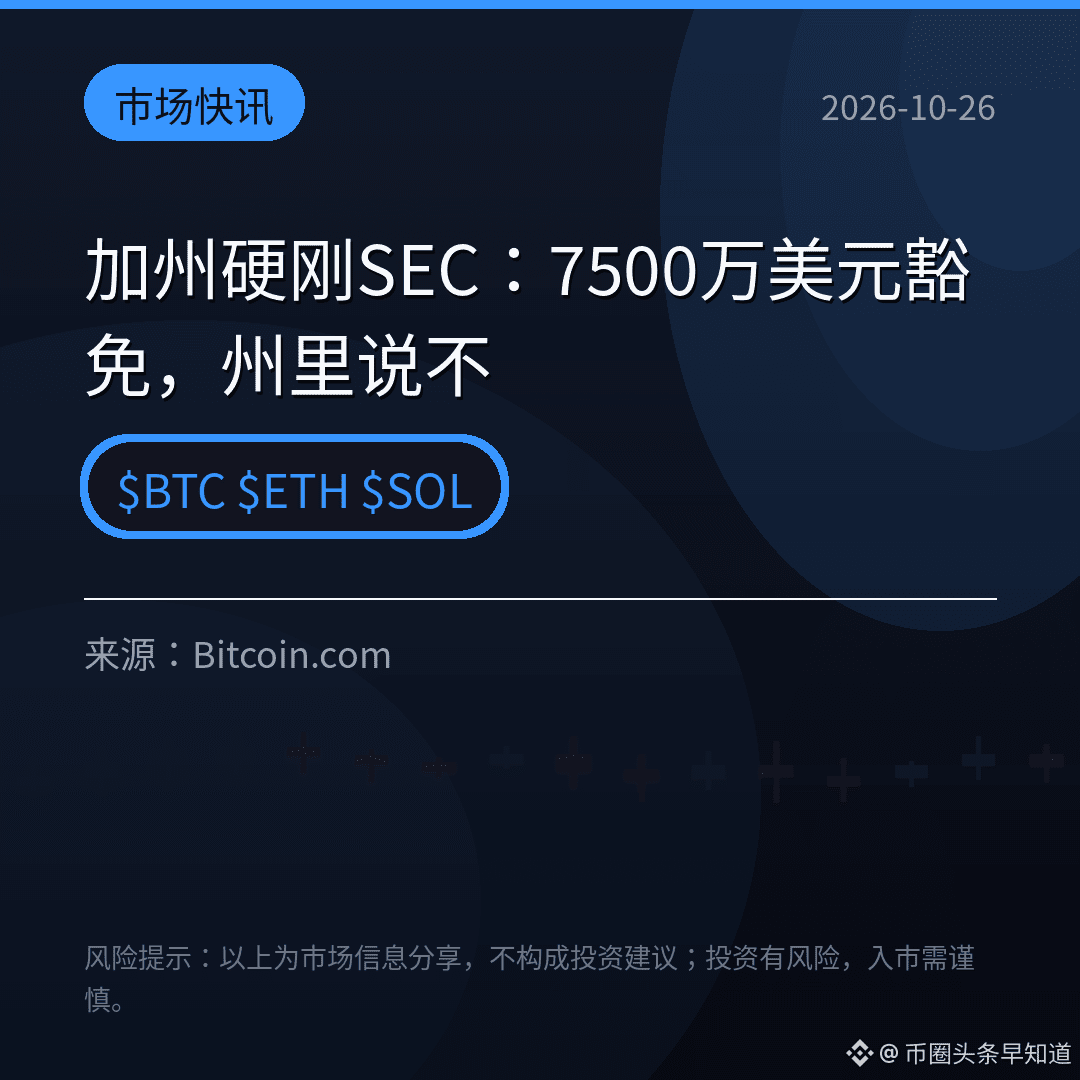
【Market Flash】California takes on the SEC: No crypto fundraising under $75 million can bypass state review. The California Department of Financial Protection and Innovation (DFPI) sent a letter opposing the proposal on October 21.
The federal government grants an exemption, and the state loses its authority to screen offerings before they launch. Anti-fraud investigations would remain, but pre-approval checks would be gone. Mohseni: Federal overreach and a step backward—unacceptable.
The DFPI has recorded nearly 200 new crypto scams, up 30% year over year. Should state authorities guard the gate, or should the federal government let them through? Which side are you on?
$BTC $ETH $SOL
#SEC #加密监管 #California
(Source: Bitcoin.com)
⚠️Risk warning: The above is shared for market information purposes only and does not constitute investment advice. Investing involves risk; proceed with caution.
【Market Flash】California takes on the SEC: No crypto fundraising under $75 million can bypass state review. The California Department of Financial Protection and Innovation (DFPI) sent a letter opposing the proposal on October 21.
The federal government grants an exemption, and the state loses its authority to screen offerings before they launch. Anti-fraud investigations would remain, but pre-approval checks would be gone. Mohseni: Federal overreach and a step backward—unacceptable.
The DFPI has recorded nearly 200 new crypto scams, up 30% year over year. Should state authorities guard the gate, or should the federal government let them through? Which side are you on?
$BTC $ETH $SOL
#SEC #加密监管 #California
(Source: Bitcoin.com)
⚠️Risk warning: The above is shared for market information purposes only and does not constitute investment advice. Investing involves risk; proceed with caution.
The federal government grants an exemption, and the state loses its authority to screen offerings before they launch. Anti-fraud investigations would remain, but pre-approval checks would be gone. Mohseni: Federal overreach and a step backward—unacceptable.
The DFPI has recorded nearly 200 new crypto scams, up 30% year over year. Should state authorities guard the gate, or should the federal government let them through? Which side are you on?
$BTC $ETH $SOL
#SEC #加密监管 #California
(Source: Bitcoin.com)
⚠️Risk warning: The above is shared for market information purposes only and does not constitute investment advice. Investing involves risk; proceed with caution.
319

·
--
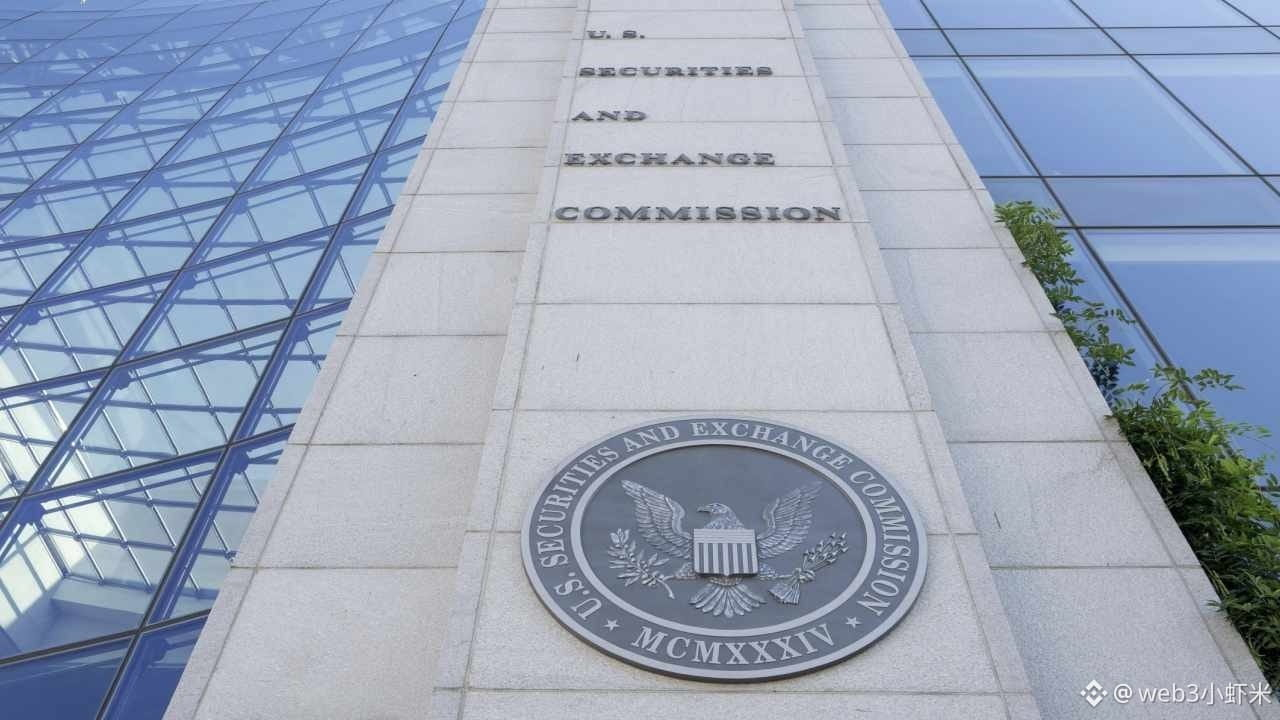
Came across this on Bitcoin.com: California’s DFPI has formally opposed the SEC’s Regulation Crypto Assets, arguing that the federal fundraising exemptions would undermine states’ advance review of crypto offerings.
The key details: the startup exemption allows up to about $5 million over roughly four years; another crypto fundraising exemption allows up to about $75 million every 12 months. Federal anti-fraud rules would remain in place, and states could still investigate fraud, but California is most concerned about losing its “pre-offering screening” process. The DFPI also noted that FBI statistics put crypto scam losses at about $11.3 billion in 2025; the state’s scam-tracking database logged nearly 200 new cases in a year, up about 30% year over year. Ripple, Coinbase, and Nasdaq have offered separate suggestions for revising the proposal; California worries that opening this door too wide could also sweep other investment products into federal exemptions.
The federal government wants to accelerate capital formation, while states want to preserve their gatekeeping reviews. Both sides have a point, but when it comes to implementation, who screens for risk first makes a big difference.
#加密监管 #SEC #California
Came across this on Bitcoin.com: California’s DFPI has formally opposed the SEC’s Regulation Crypto Assets, arguing that the federal fundraising exemptions would undermine states’ advance review of crypto offerings.
The key details: the startup exemption allows up to about $5 million over roughly four years; another crypto fundraising exemption allows up to about $75 million every 12 months. Federal anti-fraud rules would remain in place, and states could still investigate fraud, but California is most concerned about losing its “pre-offering screening” process. The DFPI also noted that FBI statistics put crypto scam losses at about $11.3 billion in 2025; the state’s scam-tracking database logged nearly 200 new cases in a year, up about 30% year over year. Ripple, Coinbase, and Nasdaq have offered separate suggestions for revising the proposal; California worries that opening this door too wide could also sweep other investment products into federal exemptions.
The federal government wants to accelerate capital formation, while states want to preserve their gatekeeping reviews. Both sides have a point, but when it comes to implementation, who screens for risk first makes a big difference.
#加密监管 #SEC #California
The key details: the startup exemption allows up to about $5 million over roughly four years; another crypto fundraising exemption allows up to about $75 million every 12 months. Federal anti-fraud rules would remain in place, and states could still investigate fraud, but California is most concerned about losing its “pre-offering screening” process. The DFPI also noted that FBI statistics put crypto scam losses at about $11.3 billion in 2025; the state’s scam-tracking database logged nearly 200 new cases in a year, up about 30% year over year. Ripple, Coinbase, and Nasdaq have offered separate suggestions for revising the proposal; California worries that opening this door too wide could also sweep other investment products into federal exemptions.
The federal government wants to accelerate capital formation, while states want to preserve their gatekeeping reviews. Both sides have a point, but when it comes to implementation, who screens for risk first makes a big difference.
#加密监管 #SEC #California
31

·
--
State regulators have made their position clear: the federal exemption is too broad and could push state-level review aside.
According to reports by Bitcoin News and others, the California Department of Financial Protection and Innovation (DFPI) submitted a comment letter to the SEC opposing its proposed Crypto Asset Regulation, saying the plan could weaken investor protections and limit states’ ability to review offerings. One part of the proposal would allow eligible issuers to raise up to about $5 million over four years under a startup exemption; another crypto fundraising exemption would allow up to $75 million to be raised over 12 months.
How to read this: The dispute is not about whether to regulate, but how broad the federal safe harbor should be and how much authority state-level reviews would retain. If the exemption threshold is too lenient, issuance costs may fall, but opportunities for regulatory arbitrage may also increase. If state-level feedback is adopted, implementation could move more slowly, but disclosure requirements and local accountability may carry more weight. It is more useful to watch the outcome of the comment period and the final text’s provisions on preserving state review authority than to focus on slogans.
#加密监管 #SEC #加州 #Compliance
State regulators have made their position clear: the federal exemption is too broad and could push state-level review aside.
According to reports by Bitcoin News and others, the California Department of Financial Protection and Innovation (DFPI) submitted a comment letter to the SEC opposing its proposed Crypto Asset Regulation, saying the plan could weaken investor protections and limit states’ ability to review offerings. One part of the proposal would allow eligible issuers to raise up to about $5 million over four years under a startup exemption; another crypto fundraising exemption would allow up to $75 million to be raised over 12 months.
How to read this: The dispute is not about whether to regulate, but how broad the federal safe harbor should be and how much authority state-level reviews would retain. If the exemption threshold is too lenient, issuance costs may fall, but opportunities for regulatory arbitrage may also increase. If state-level feedback is adopted, implementation could move more slowly, but disclosure requirements and local accountability may carry more weight. It is more useful to watch the outcome of the comment period and the final text’s provisions on preserving state review authority than to focus on slogans.
#加密监管 #SEC #加州 #Compliance
According to reports by Bitcoin News and others, the California Department of Financial Protection and Innovation (DFPI) submitted a comment letter to the SEC opposing its proposed Crypto Asset Regulation, saying the plan could weaken investor protections and limit states’ ability to review offerings. One part of the proposal would allow eligible issuers to raise up to about $5 million over four years under a startup exemption; another crypto fundraising exemption would allow up to $75 million to be raised over 12 months.
How to read this: The dispute is not about whether to regulate, but how broad the federal safe harbor should be and how much authority state-level reviews would retain. If the exemption threshold is too lenient, issuance costs may fall, but opportunities for regulatory arbitrage may also increase. If state-level feedback is adopted, implementation could move more slowly, but disclosure requirements and local accountability may carry more weight. It is more useful to watch the outcome of the comment period and the final text’s provisions on preserving state review authority than to focus on slogans.
#加密监管 #SEC #加州 #Compliance
18

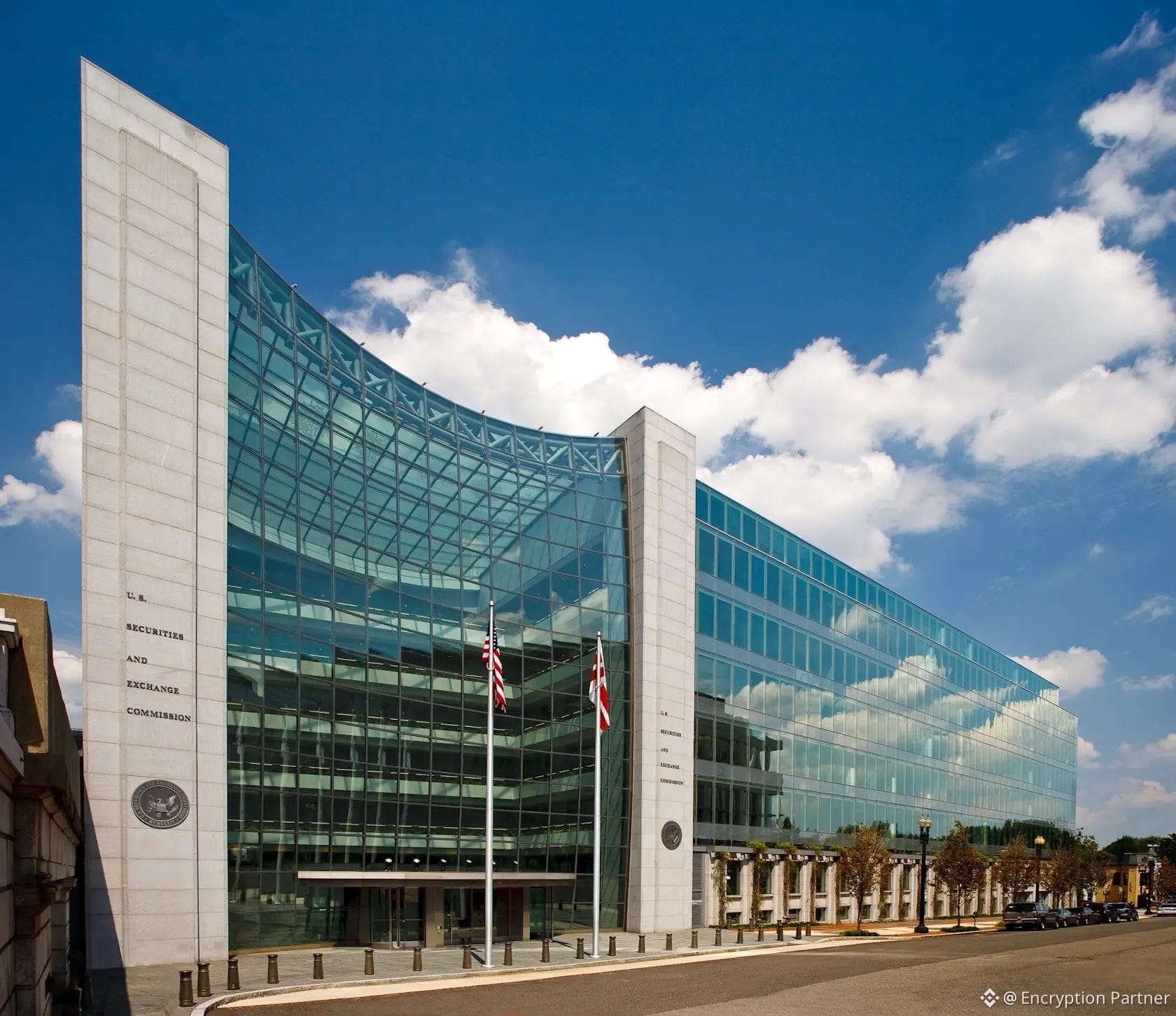
Last Friday, the SEC dropped its 2027 fiscal-year examination priorities, putting tokenization on the high-risk list for the first time: clearing agencies will be expected to scrutinize it, as will critical market systems. It’s listed alongside quantum computing and extended trading hours. And everyone’s got a take:
Companies tokenizing U.S. stocks are sweating as they submit compliance paperwork: the checklist is out—can this business still move fast?
The 22 publicly listed companies that said no are breathing a sigh of relief: they’re scrutinizing the infrastructure, not my letter of opposition.
Crypto veterans are most stunned after reading the whole thing: the words “cryptocurrency” don’t appear at all for the second year in a row—even though 2025 had a whole section devoted to it.
The most painful part: this checklist isn’t a license to operate; it’s an audit sheet—and compliance costs are about to go up, for starters.
Pick a side in the comments: A. Being on the examination list is the first step toward going mainstream; B. The tougher the scrutiny, the less likely Wall Street is to touch it—so this is bearish. Which side are you on?
$BTC $ETH $SOL #SEC #代币化 #WallStreet
Last Friday, the SEC dropped its 2027 fiscal-year examination priorities, putting tokenization on the high-risk list for the first time: clearing agencies will be expected to scrutinize it, as will critical market systems. It’s listed alongside quantum computing and extended trading hours. And everyone’s got a take:
Companies tokenizing U.S. stocks are sweating as they submit compliance paperwork: the checklist is out—can this business still move fast?
The 22 publicly listed companies that said no are breathing a sigh of relief: they’re scrutinizing the infrastructure, not my letter of opposition.
Crypto veterans are most stunned after reading the whole thing: the words “cryptocurrency” don’t appear at all for the second year in a row—even though 2025 had a whole section devoted to it.
The most painful part: this checklist isn’t a license to operate; it’s an audit sheet—and compliance costs are about to go up, for starters.
Pick a side in the comments: A. Being on the examination list is the first step toward going mainstream; B. The tougher the scrutiny, the less likely Wall Street is to touch it—so this is bearish. Which side are you on?
$BTC $ETH $SOL #SEC #代币化 #WallStreet
Companies tokenizing U.S. stocks are sweating as they submit compliance paperwork: the checklist is out—can this business still move fast?
The 22 publicly listed companies that said no are breathing a sigh of relief: they’re scrutinizing the infrastructure, not my letter of opposition.
Crypto veterans are most stunned after reading the whole thing: the words “cryptocurrency” don’t appear at all for the second year in a row—even though 2025 had a whole section devoted to it.
The most painful part: this checklist isn’t a license to operate; it’s an audit sheet—and compliance costs are about to go up, for starters.
Pick a side in the comments: A. Being on the examination list is the first step toward going mainstream; B. The tougher the scrutiny, the less likely Wall Street is to touch it—so this is bearish. Which side are you on?
$BTC $ETH $SOL #SEC #代币化 #WallStreet
21

Article
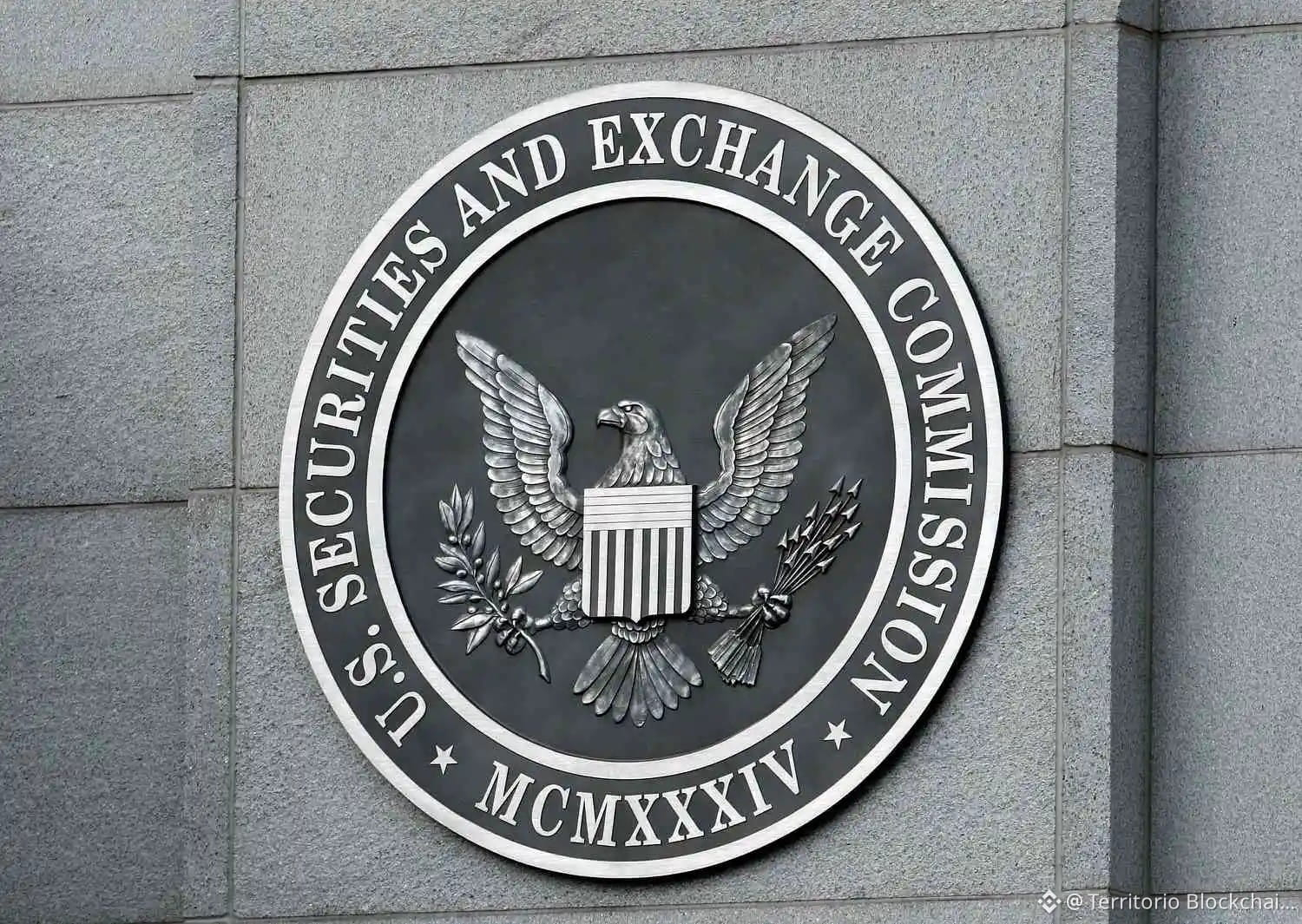
SEC adds tokenization and advanced AI to its list of examination priorities for 2027Where will the U.S. markets regulator focus next year? The SEC’s Division of Examinations has published its priorities for fiscal year 2027, and tokenization is on the list.
The document affects more than 34,000 registered entities, including investment advisers, funds, brokers, clearing agencies, transfer agents, and funding portals.
The areas of greatest interest to this sector:
• Risks associated with the evolution of market infrastructure, “including Treasury clearing reforms, tokenization, and related developments.”
SEC adds tokenization and advanced AI to its list of examination priorities for 2027
Where will the U.S. markets regulator focus next year? The SEC’s Division of Examinations has published its priorities for fiscal year 2027, and tokenization is on the list.
The document affects more than 34,000 registered entities, including investment advisers, funds, brokers, clearing agencies, transfer agents, and funding portals.
The areas of greatest interest to this sector:
• Risks associated with the evolution of market infrastructure, “including Treasury clearing reforms, tokenization, and related developments.”
The document affects more than 34,000 registered entities, including investment advisers, funds, brokers, clearing agencies, transfer agents, and funding portals.
The areas of greatest interest to this sector:
• Risks associated with the evolution of market infrastructure, “including Treasury clearing reforms, tokenization, and related developments.”
178


Article
Our Bizarre Crypto Universe #33The lawsuit that kept XRP in limbo for nearly five years
Imagine your investment plummeting in just a few days—not because of a hack or a scam, but because of a lawsuit. That’s what happened to people holding XRP in December 2020.
The SEC, the U.S. securities regulator, sued Ripple and two of its executives, Brad Garlinghouse and Chris Larsen. The accusation: selling XRP as an unregistered security and raising about $1.3 billion. XRP plunged, and several major exchanges suspended trading.
Our Bizarre Crypto Universe #33
The lawsuit that kept XRP in limbo for nearly five years
Imagine your investment plummeting in just a few days—not because of a hack or a scam, but because of a lawsuit. That’s what happened to people holding XRP in December 2020.
The SEC, the U.S. securities regulator, sued Ripple and two of its executives, Brad Garlinghouse and Chris Larsen. The accusation: selling XRP as an unregistered security and raising about $1.3 billion. XRP plunged, and several major exchanges suspended trading.
Imagine your investment plummeting in just a few days—not because of a hack or a scam, but because of a lawsuit. That’s what happened to people holding XRP in December 2020.
The SEC, the U.S. securities regulator, sued Ripple and two of its executives, Brad Garlinghouse and Chris Larsen. The accusation: selling XRP as an unregistered security and raising about $1.3 billion. XRP plunged, and several major exchanges suspended trading.
1
263

·
--
Article
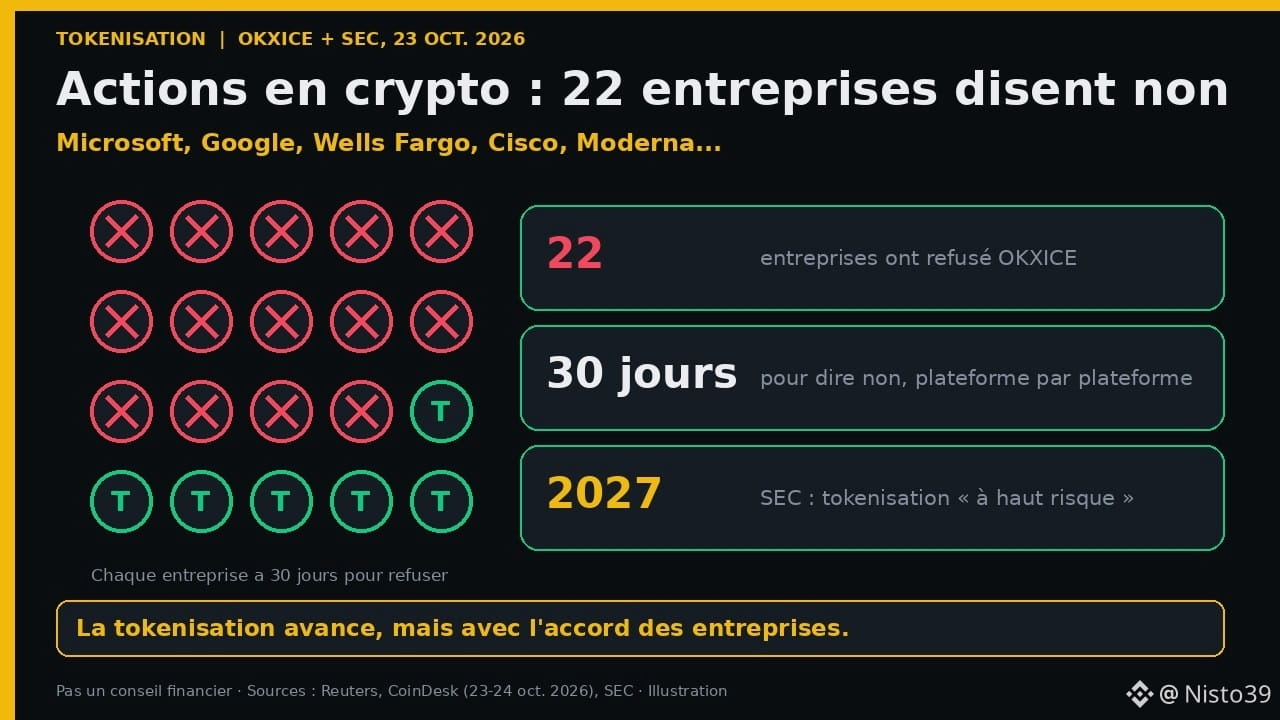
Stocks in crypto: why Microsoft, Google and 20 others are saying no to OKX-ICECheikh is a finance student in Saint-Louis, Senegal. He read in a Telegram group that soon you’ll be able to “buy a piece of Microsoft with crypto, 24/7, for 5 dollars.” He wonders whether it’s happening anytime soon, and whether it’s safe. This week’s news offers a more nuanced answer: big companies have a say, and many are saying no.
📋 The facts (week of October 19–23, 2026)
• OKXICE is a joint venture between crypto platform OKX and Intercontinental Exchange (ICE), the parent company of the New York Stock Exchange. It wants to offer “tokenized” versions of U.S. stocks—that is, blockchain tokens that represent a share.
Stocks in crypto: why Microsoft, Google and 20 others are saying no to OKX-ICE
Cheikh is a finance student in Saint-Louis, Senegal. He read in a Telegram group that soon you’ll be able to “buy a piece of Microsoft with crypto, 24/7, for 5 dollars.” He wonders whether it’s happening anytime soon, and whether it’s safe. This week’s news offers a more nuanced answer: big companies have a say, and many are saying no.
📋 The facts (week of October 19–23, 2026)
• OKXICE is a joint venture between crypto platform OKX and Intercontinental Exchange (ICE), the parent company of the New York Stock Exchange. It wants to offer “tokenized” versions of U.S. stocks—that is, blockchain tokens that represent a share.
📋 The facts (week of October 19–23, 2026)
• OKXICE is a joint venture between crypto platform OKX and Intercontinental Exchange (ICE), the parent company of the New York Stock Exchange. It wants to offer “tokenized” versions of U.S. stocks—that is, blockchain tokens that represent a share.
11

·
--
Bullish
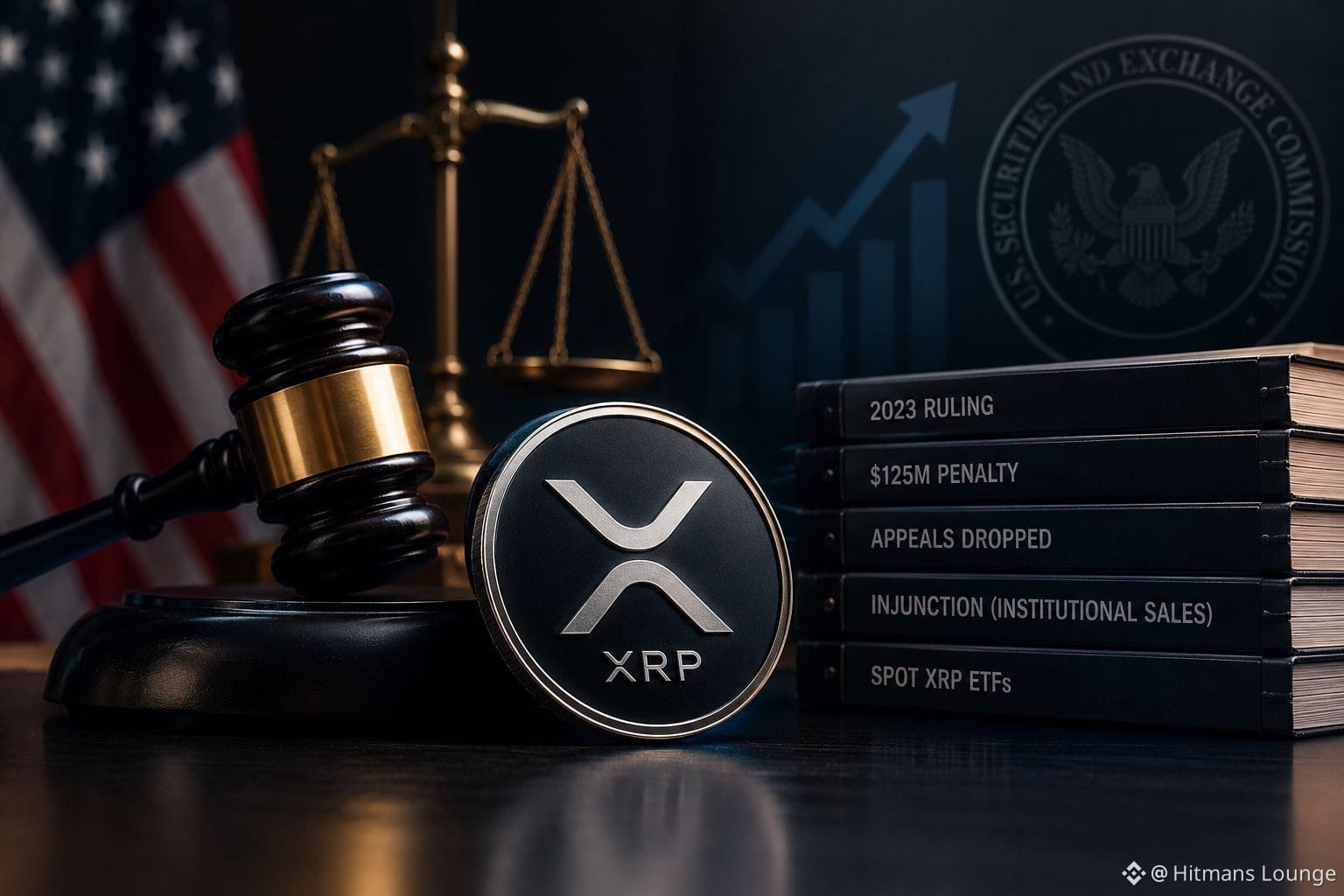
Time for a reality check, XRP army. 🔥
In 2023, Judge Torres ruled that $XRP sold on public exchanges wasn't a security, while Ripple's institutional sales were.
The SEC sought about $2B, but the final penalty was $125M. In August 2025, both sides dropped their appeals and the case ended.
The injunction on institutional sales still stands. Spot XRP ETFs have since launched in the U.S.
Was this the precedent crypto needed? 👇
#XRP #Ripple #SEC
{future}(XRPUSDT)
Time for a reality check, XRP army. 🔥
In 2023, Judge Torres ruled that $XRP sold on public exchanges wasn't a security, while Ripple's institutional sales were.
The SEC sought about $2B, but the final penalty was $125M. In August 2025, both sides dropped their appeals and the case ended.
The injunction on institutional sales still stands. Spot XRP ETFs have since launched in the U.S.
Was this the precedent crypto needed? 👇
#XRP #Ripple #SEC
In 2023, Judge Torres ruled that $XRP sold on public exchanges wasn't a security, while Ripple's institutional sales were.
The SEC sought about $2B, but the final penalty was $125M. In August 2025, both sides dropped their appeals and the case ended.
The injunction on institutional sales still stands. Spot XRP ETFs have since launched in the U.S.
Was this the precedent crypto needed? 👇
#XRP #Ripple #SEC
1
342

·
--
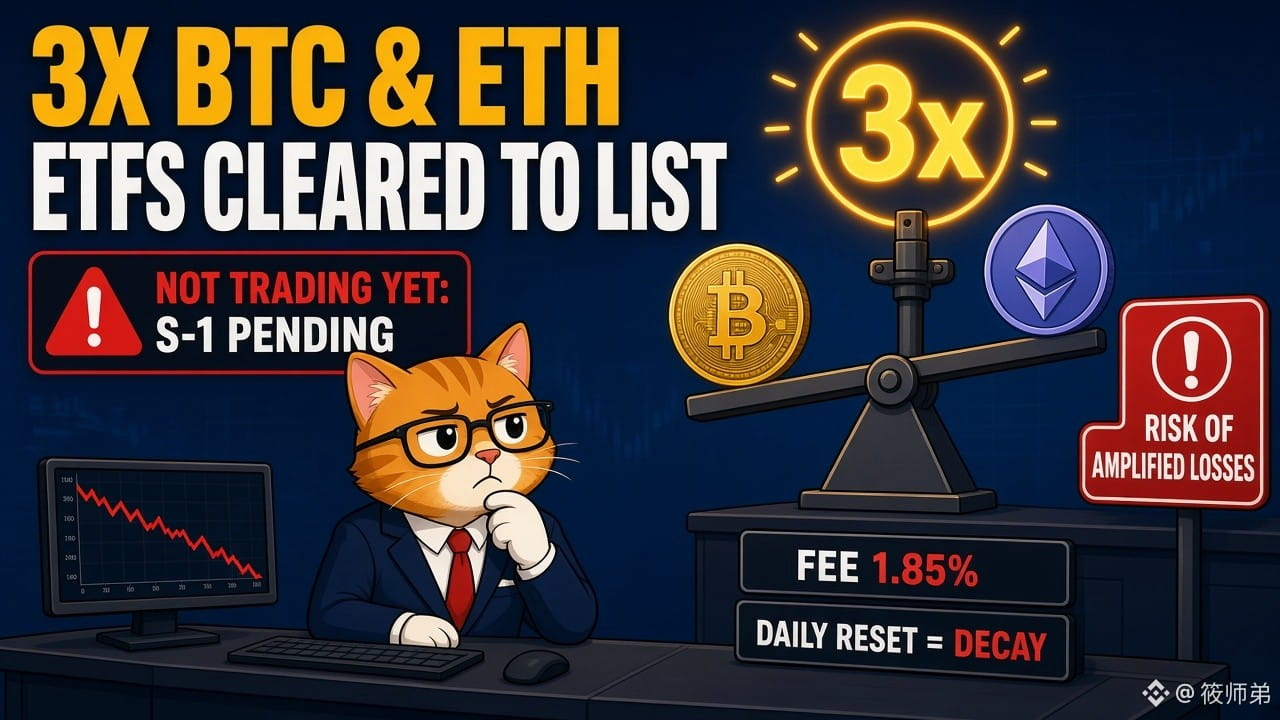
The U.S.’s first 3x BTC/ETH ETFs are approved for listing, but they’re not available to buy yet
📌 On Oct. 2, the SEC approved Cboe BZX’s listing of six 3x leveraged products from Volatility Shares, including 3x Bitcoin (proposed ticker: BITH) and 3x Ethereum (ETHK) (SEC Release 34-106577, published in the Federal Register on 10/7)
📌 The products track 3x the daily performance of front- and second-month CME futures and do not hold spot assets; draft management fee: 1.85% per year (per TSN, citing S-1/A)
📌 The S-1 registration statement is still marked “Subject to Completion.” As of 10/23, no effective registration had appeared on EDGAR, and no launch date has been announced (Crypto Briefing/TSN)
📌 Background: U.S. spot BTC ETFs saw net outflows of $635.6 million on Thursday, the largest this month (Pasar Pulse); BTC returned to around $80,800 on Sunday (Investing.com)
【Take】
This marks the first time U.S. regulators have cleared a 3x leveraged crypto ETF, signaling that Wall Street is opening the door to “leveraging up” for retail investors. But these are futures products that reset daily: in a choppy market, even if the coin price goes nowhere, the fund’s value can erode. The prospectus says it “could lose its entire value in a single day.” They’re more like short-term trading tools than long-term investments.
【Opportunities/Risks】
✅ Watch for the S-1 to become effective. The launch could initially boost CME futures basis and trading volume, so keep an eye on funding rates for related contracts
✅ If volatility increases around the launch, flows into spot ETFs will be a better sentiment indicator
⚠️ The $78,000–$80,000 range is a key near-term support zone for BTC. Leveraged positions could be liquidated in either direction ahead of the 10/28 FOMC meeting
⚠️ With a 1.85% fee, roll costs, and volatility decay, long-term holders are likely to lose out
Would you use a 3x ETF for short-term trades, or do you think it’s just an “upscale gambling table” for retail investors?
#比特币ETF #杠杆ETF #SEC #加密监管 $BTC $ETH
For reference only; not investment advice
The U.S.’s first 3x BTC/ETH ETFs are approved for listing, but they’re not available to buy yet
📌 On Oct. 2, the SEC approved Cboe BZX’s listing of six 3x leveraged products from Volatility Shares, including 3x Bitcoin (proposed ticker: BITH) and 3x Ethereum (ETHK) (SEC Release 34-106577, published in the Federal Register on 10/7)
📌 The products track 3x the daily performance of front- and second-month CME futures and do not hold spot assets; draft management fee: 1.85% per year (per TSN, citing S-1/A)
📌 The S-1 registration statement is still marked “Subject to Completion.” As of 10/23, no effective registration had appeared on EDGAR, and no launch date has been announced (Crypto Briefing/TSN)
📌 Background: U.S. spot BTC ETFs saw net outflows of $635.6 million on Thursday, the largest this month (Pasar Pulse); BTC returned to around $80,800 on Sunday (Investing.com)
【Take】
This marks the first time U.S. regulators have cleared a 3x leveraged crypto ETF, signaling that Wall Street is opening the door to “leveraging up” for retail investors. But these are futures products that reset daily: in a choppy market, even if the coin price goes nowhere, the fund’s value can erode. The prospectus says it “could lose its entire value in a single day.” They’re more like short-term trading tools than long-term investments.
【Opportunities/Risks】
✅ Watch for the S-1 to become effective. The launch could initially boost CME futures basis and trading volume, so keep an eye on funding rates for related contracts
✅ If volatility increases around the launch, flows into spot ETFs will be a better sentiment indicator
⚠️ The $78,000–$80,000 range is a key near-term support zone for BTC. Leveraged positions could be liquidated in either direction ahead of the 10/28 FOMC meeting
⚠️ With a 1.85% fee, roll costs, and volatility decay, long-term holders are likely to lose out
Would you use a 3x ETF for short-term trades, or do you think it’s just an “upscale gambling table” for retail investors?
#比特币ETF #杠杆ETF #SEC #加密监管 $BTC $ETH
For reference only; not investment advice
📌 On Oct. 2, the SEC approved Cboe BZX’s listing of six 3x leveraged products from Volatility Shares, including 3x Bitcoin (proposed ticker: BITH) and 3x Ethereum (ETHK) (SEC Release 34-106577, published in the Federal Register on 10/7)
📌 The products track 3x the daily performance of front- and second-month CME futures and do not hold spot assets; draft management fee: 1.85% per year (per TSN, citing S-1/A)
📌 The S-1 registration statement is still marked “Subject to Completion.” As of 10/23, no effective registration had appeared on EDGAR, and no launch date has been announced (Crypto Briefing/TSN)
📌 Background: U.S. spot BTC ETFs saw net outflows of $635.6 million on Thursday, the largest this month (Pasar Pulse); BTC returned to around $80,800 on Sunday (Investing.com)
【Take】
This marks the first time U.S. regulators have cleared a 3x leveraged crypto ETF, signaling that Wall Street is opening the door to “leveraging up” for retail investors. But these are futures products that reset daily: in a choppy market, even if the coin price goes nowhere, the fund’s value can erode. The prospectus says it “could lose its entire value in a single day.” They’re more like short-term trading tools than long-term investments.
【Opportunities/Risks】
✅ Watch for the S-1 to become effective. The launch could initially boost CME futures basis and trading volume, so keep an eye on funding rates for related contracts
✅ If volatility increases around the launch, flows into spot ETFs will be a better sentiment indicator
⚠️ The $78,000–$80,000 range is a key near-term support zone for BTC. Leveraged positions could be liquidated in either direction ahead of the 10/28 FOMC meeting
⚠️ With a 1.85% fee, roll costs, and volatility decay, long-term holders are likely to lose out
Would you use a 3x ETF for short-term trades, or do you think it’s just an “upscale gambling table” for retail investors?
#比特币ETF #杠杆ETF #SEC #加密监管 $BTC $ETH
For reference only; not investment advice
193
·
--
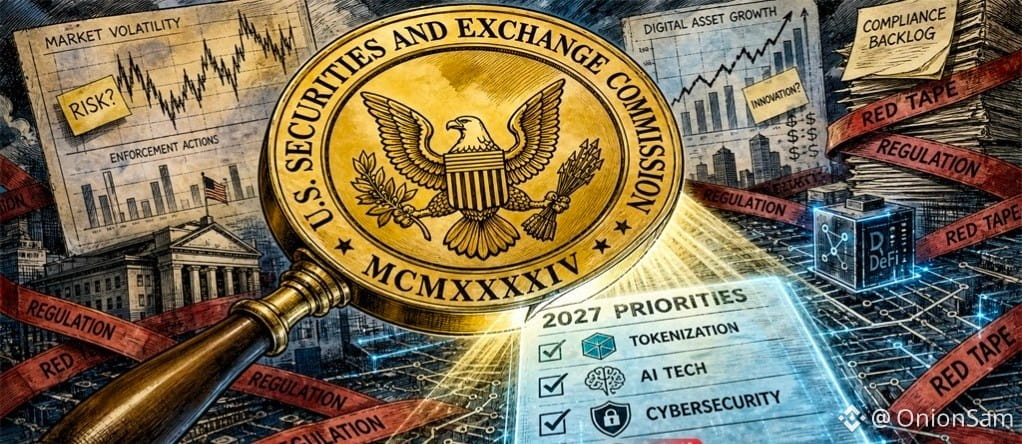
🚨🏛️ #SEC OFFICIAL 2027 PRIORITIES: #Tokenization & SUPER INTELLIGENCE IN THE CROSSHAIRS 📊🤖
🔥 #WallStreet 's Regulatory Roadmap Unveiled! 🔥
📢 The U.S. Securities and Exchange Commission (SEC) has officially published its Division of Examinations’ priorities for fiscal year 2027.
🗓️⚖️ For the first time, the regulator is shifting its core focus toward the institutional integration of asset Tokenization and "Super Intelligence" (SI) tech across global capital markets. 🏛️💻
🛡️ Mechanics Enpacked:
SEC examiners will heavily scrutinize how investment firms, brokers, and clearing agencies manage risks associated with Blockchain-based tokenized securities and advanced AI tools.
⚡📈 Additionally, the mandate triggers aggressive enforcement on #CyberSecurity resilience and strict Anti-Money Laundering (AML) compliance to protect retail and institutional investor funds from algorithmic fraud. 🚫🔐
#RWA
$BTC
{spot}(BTCUSDT)
$LINK
{spot}(LINKUSDT)
$ETH
{spot}(ETHUSDT)
j
🚨🏛️ #SEC OFFICIAL 2027 PRIORITIES: #Tokenization & SUPER INTELLIGENCE IN THE CROSSHAIRS 📊🤖
🔥 #WallStreet 's Regulatory Roadmap Unveiled! 🔥
📢 The U.S. Securities and Exchange Commission (SEC) has officially published its Division of Examinations’ priorities for fiscal year 2027.
🗓️⚖️ For the first time, the regulator is shifting its core focus toward the institutional integration of asset Tokenization and "Super Intelligence" (SI) tech across global capital markets. 🏛️💻
🛡️ Mechanics Enpacked:
SEC examiners will heavily scrutinize how investment firms, brokers, and clearing agencies manage risks associated with Blockchain-based tokenized securities and advanced AI tools.
⚡📈 Additionally, the mandate triggers aggressive enforcement on #CyberSecurity resilience and strict Anti-Money Laundering (AML) compliance to protect retail and institutional investor funds from algorithmic fraud. 🚫🔐
#RWA
$BTC
$LINK
$ETH
j
🔥 #WallStreet 's Regulatory Roadmap Unveiled! 🔥
📢 The U.S. Securities and Exchange Commission (SEC) has officially published its Division of Examinations’ priorities for fiscal year 2027.
🗓️⚖️ For the first time, the regulator is shifting its core focus toward the institutional integration of asset Tokenization and "Super Intelligence" (SI) tech across global capital markets. 🏛️💻
🛡️ Mechanics Enpacked:
SEC examiners will heavily scrutinize how investment firms, brokers, and clearing agencies manage risks associated with Blockchain-based tokenized securities and advanced AI tools.
⚡📈 Additionally, the mandate triggers aggressive enforcement on #CyberSecurity resilience and strict Anti-Money Laundering (AML) compliance to protect retail and institutional investor funds from algorithmic fraud. 🚫🔐
#RWA
$BTC
$LINK
$ETH
j

Good luck 🍀
From OnionSam
Osama Al-Muntasir:
💛
1
127

·
--
The SEC has added “tokenization” to next year’s examination priorities for the first time. I think the signal is more worth considering than the wording itself 👀
On October 23, the SEC’s Division of Examinations announced its examination priorities for fiscal year 2027.
Tokenization appeared in two places for the first time:
First, as a high-risk area in examinations of clearing agencies, alongside default management, securities lending, and operational risk.
Second, as an emerging trend under Reg SCI, mentioned in the same sentence as superintelligence, extended trading hours, and quantum computing.
The comparison makes it clear.
Tokenization wasn’t mentioned in the 2026 priorities.
Crypto assets themselves haven’t had their own section for a second year in a row; the last time they were listed separately was fiscal year 2025.
This doesn’t mean the SEC has given tokenization the green light.
Examination priorities simply tell examiners what to look at. They aren’t new regulations, nor do they mean any platform has been approved.
But when a regulator starts systematically examining “how tokenized assets are cleared, recorded, and risk-managed,” it suggests this has moved beyond concept demos and is approaching integration into market infrastructure.
The timeline also fits:
In September, the SEC had just granted an innovative exemption for tokenized stock trading.
In early October, a joint venture between OKX and Intercontinental Exchange filed an application to offer tokenized versions of more than 60 U.S. stocks.
So I see this in two ways:
For the RWA narrative, this is a step from regulators “watching and waiting” to “building an examination checklist.”
For everyday users, we’re still a long way from being able to “buy with confidence.” The more detailed the checklist, the more it suggests compliance hurdles are rising.
Which side are you more bullish on?
Will tokenized stocks get up and running first, or will regulators narrow the path first?
$ETH
#代币化证券 #RWA #SEC
This is not investment advice. DYOR. Trading involves risk.
The SEC has added “tokenization” to next year’s examination priorities for the first time. I think the signal is more worth considering than the wording itself 👀
On October 23, the SEC’s Division of Examinations announced its examination priorities for fiscal year 2027.
Tokenization appeared in two places for the first time:
First, as a high-risk area in examinations of clearing agencies, alongside default management, securities lending, and operational risk.
Second, as an emerging trend under Reg SCI, mentioned in the same sentence as superintelligence, extended trading hours, and quantum computing.
The comparison makes it clear.
Tokenization wasn’t mentioned in the 2026 priorities.
Crypto assets themselves haven’t had their own section for a second year in a row; the last time they were listed separately was fiscal year 2025.
This doesn’t mean the SEC has given tokenization the green light.
Examination priorities simply tell examiners what to look at. They aren’t new regulations, nor do they mean any platform has been approved.
But when a regulator starts systematically examining “how tokenized assets are cleared, recorded, and risk-managed,” it suggests this has moved beyond concept demos and is approaching integration into market infrastructure.
The timeline also fits:
In September, the SEC had just granted an innovative exemption for tokenized stock trading.
In early October, a joint venture between OKX and Intercontinental Exchange filed an application to offer tokenized versions of more than 60 U.S. stocks.
So I see this in two ways:
For the RWA narrative, this is a step from regulators “watching and waiting” to “building an examination checklist.”
For everyday users, we’re still a long way from being able to “buy with confidence.” The more detailed the checklist, the more it suggests compliance hurdles are rising.
Which side are you more bullish on?
Will tokenized stocks get up and running first, or will regulators narrow the path first?
$ETH
#代币化证券 #RWA #SEC
This is not investment advice. DYOR. Trading involves risk.
On October 23, the SEC’s Division of Examinations announced its examination priorities for fiscal year 2027.
Tokenization appeared in two places for the first time:
First, as a high-risk area in examinations of clearing agencies, alongside default management, securities lending, and operational risk.
Second, as an emerging trend under Reg SCI, mentioned in the same sentence as superintelligence, extended trading hours, and quantum computing.
The comparison makes it clear.
Tokenization wasn’t mentioned in the 2026 priorities.
Crypto assets themselves haven’t had their own section for a second year in a row; the last time they were listed separately was fiscal year 2025.
This doesn’t mean the SEC has given tokenization the green light.
Examination priorities simply tell examiners what to look at. They aren’t new regulations, nor do they mean any platform has been approved.
But when a regulator starts systematically examining “how tokenized assets are cleared, recorded, and risk-managed,” it suggests this has moved beyond concept demos and is approaching integration into market infrastructure.
The timeline also fits:
In September, the SEC had just granted an innovative exemption for tokenized stock trading.
In early October, a joint venture between OKX and Intercontinental Exchange filed an application to offer tokenized versions of more than 60 U.S. stocks.
So I see this in two ways:
For the RWA narrative, this is a step from regulators “watching and waiting” to “building an examination checklist.”
For everyday users, we’re still a long way from being able to “buy with confidence.” The more detailed the checklist, the more it suggests compliance hurdles are rising.
Which side are you more bullish on?
Will tokenized stocks get up and running first, or will regulators narrow the path first?
$ETH
#代币化证券 #RWA #SEC
This is not investment advice. DYOR. Trading involves risk.
63

·
--
Tokenization made the SEC’s exam priorities, but crypto didn’t
On Oct. 23, the SEC announced its exam priorities for fiscal year 2027
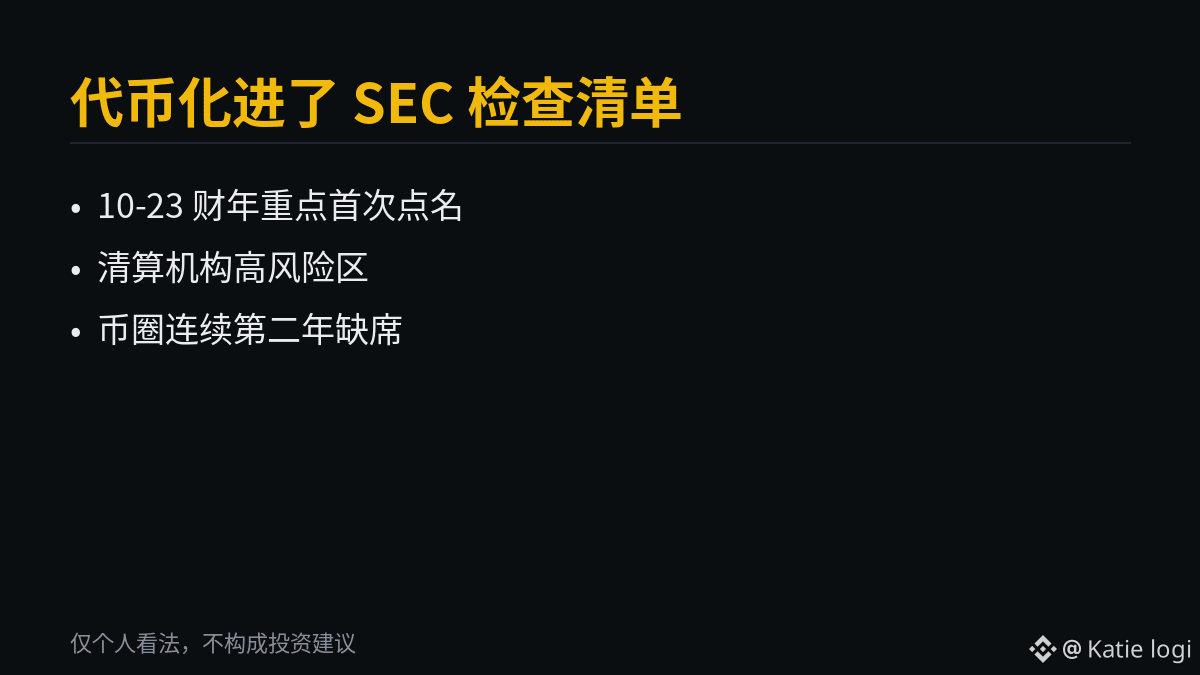
For the first time, tokenization was listed as a high-risk area for clearing agencies
Alongside default management, securities lending, and operational risk
The Regulation SCI section also named tokenized securities
Others called out in the same report included superintelligence, extended trading hours, and quantum computing
Tokenization didn’t appear once in the priorities for 2025 or 2026
The contrast is even more interesting
The entire 20-page report never mentions “crypto” or “digital assets”
For the second year in a row, crypto wasn’t given its own dedicated area
In September, the SEC had just granted tokenized stocks an innovation exemption
First the green light, then onto the exam priorities
Tokenized securities are no longer just a topic for discussion—they’re now something regulators will examine
The exams cover more than 34,000 registered entities
Whoever offers tokenized products will be among the first to have their books scrutinized
It’s now on the exam priorities list
When will trading volume in tokenized stocks merit this level of attention?
Personal opinion only; this is not investment advice
#SEC #代币化 $BTC
Tokenization made the SEC’s exam priorities, but crypto didn’t
On Oct. 23, the SEC announced its exam priorities for fiscal year 2027
For the first time, tokenization was listed as a high-risk area for clearing agencies
Alongside default management, securities lending, and operational risk
The Regulation SCI section also named tokenized securities
Others called out in the same report included superintelligence, extended trading hours, and quantum computing
Tokenization didn’t appear once in the priorities for 2025 or 2026
The contrast is even more interesting
The entire 20-page report never mentions “crypto” or “digital assets”
For the second year in a row, crypto wasn’t given its own dedicated area
In September, the SEC had just granted tokenized stocks an innovation exemption
First the green light, then onto the exam priorities
Tokenized securities are no longer just a topic for discussion—they’re now something regulators will examine
The exams cover more than 34,000 registered entities
Whoever offers tokenized products will be among the first to have their books scrutinized
It’s now on the exam priorities list
When will trading volume in tokenized stocks merit this level of attention?
Personal opinion only; this is not investment advice
#SEC #代币化 $BTC
On Oct. 23, the SEC announced its exam priorities for fiscal year 2027
For the first time, tokenization was listed as a high-risk area for clearing agencies
Alongside default management, securities lending, and operational risk
The Regulation SCI section also named tokenized securities
Others called out in the same report included superintelligence, extended trading hours, and quantum computing
Tokenization didn’t appear once in the priorities for 2025 or 2026
The contrast is even more interesting
The entire 20-page report never mentions “crypto” or “digital assets”
For the second year in a row, crypto wasn’t given its own dedicated area
In September, the SEC had just granted tokenized stocks an innovation exemption
First the green light, then onto the exam priorities
Tokenized securities are no longer just a topic for discussion—they’re now something regulators will examine
The exams cover more than 34,000 registered entities
Whoever offers tokenized products will be among the first to have their books scrutinized
It’s now on the exam priorities list
When will trading volume in tokenized stocks merit this level of attention?
Personal opinion only; this is not investment advice
#SEC #代币化 $BTC
2
·
--
One new word in the regulatory agenda can often set the tone earlier than prices do.
In its FY2027 examination priorities, the SEC’s Division of Examinations for the first time listed “tokenization” as a high-risk area of focus for clearing agencies. In the same document’s SCI compliance section, it also grouped securities tokenization with superintelligence, extended trading hours, and quantum computing as emerging trends. Similar documents barely mentioned the term over the past two years; this marks a clear shift in direction.
How to read this: it doesn’t mean an immediate ban. Rather, scrutiny of RWA and on-chain settlement is likely to intensify in reviews of clearing, default management, and system integrity. Watch the pace of process changes at clearinghouses, custodians, and market makers. Beyond the buzz, compliance costs are the real pricing factor.
#SEC #代币化 #RWA #Regulation
One new word in the regulatory agenda can often set the tone earlier than prices do.
In its FY2027 examination priorities, the SEC’s Division of Examinations for the first time listed “tokenization” as a high-risk area of focus for clearing agencies. In the same document’s SCI compliance section, it also grouped securities tokenization with superintelligence, extended trading hours, and quantum computing as emerging trends. Similar documents barely mentioned the term over the past two years; this marks a clear shift in direction.
How to read this: it doesn’t mean an immediate ban. Rather, scrutiny of RWA and on-chain settlement is likely to intensify in reviews of clearing, default management, and system integrity. Watch the pace of process changes at clearinghouses, custodians, and market makers. Beyond the buzz, compliance costs are the real pricing factor.
#SEC #代币化 #RWA #Regulation
In its FY2027 examination priorities, the SEC’s Division of Examinations for the first time listed “tokenization” as a high-risk area of focus for clearing agencies. In the same document’s SCI compliance section, it also grouped securities tokenization with superintelligence, extended trading hours, and quantum computing as emerging trends. Similar documents barely mentioned the term over the past two years; this marks a clear shift in direction.
How to read this: it doesn’t mean an immediate ban. Rather, scrutiny of RWA and on-chain settlement is likely to intensify in reviews of clearing, default management, and system integrity. Watch the pace of process changes at clearinghouses, custodians, and market makers. Beyond the buzz, compliance costs are the real pricing factor.
#SEC #代币化 #RWA #Regulation
8

·
--
SEC Adds Tokenization to Its 2027 Examination Priorities, Covering 34,000 Registered EntitiesThe U.S. SEC has included tokenization in its examination priorities for fiscal year 2027. On Thursday, its Division of Examinations released eight priorities for FY2027, placing tokenization under “market infrastructure risks,” alongside Treasury clearing reform (Decrypt, October 24).
This means broker-dealers, investment advisers, and transfer agents can expect more inquiries about tokenized products. Another first is “superintelligence and other advanced technologies.” The SEC classifies AI as an emerging technology and is focused on its impact on compliance, fraud prevention, and investor protection. The list covers more than 34,000 registered entities overseen by the Division of Examinations.
SEC Adds Tokenization to Its 2027 Examination Priorities, Covering 34,000 Registered Entities
The U.S. SEC has included tokenization in its examination priorities for fiscal year 2027. On Thursday, its Division of Examinations released eight priorities for FY2027, placing tokenization under “market infrastructure risks,” alongside Treasury clearing reform (Decrypt, October 24).
This means broker-dealers, investment advisers, and transfer agents can expect more inquiries about tokenized products. Another first is “superintelligence and other advanced technologies.” The SEC classifies AI as an emerging technology and is focused on its impact on compliance, fraud prevention, and investor protection. The list covers more than 34,000 registered entities overseen by the Division of Examinations.
This means broker-dealers, investment advisers, and transfer agents can expect more inquiries about tokenized products. Another first is “superintelligence and other advanced technologies.” The SEC classifies AI as an emerging technology and is focused on its impact on compliance, fraud prevention, and investor protection. The list covers more than 34,000 registered entities overseen by the Division of Examinations.
61

SEC flags tokenization as high risk in 2027 market examinations
* SEC prioritizes emerging market risks from tokenization
* Crypto has no separate examination category yet
* 2027 focuses on risk assessment
#BinanceSquare #CryptoNews #SEC #Tokenization
$btc $eth
#vlikevn Titanbot
Source: CoinTelegraph
SEC flags tokenization as high risk in 2027 market examinations
* SEC prioritizes emerging market risks from tokenization
* Crypto has no separate examination category yet
* 2027 focuses on risk assessment
#BinanceSquare #CryptoNews #SEC #Tokenization
$btc $eth
#vlikevn Titanbot
Source: CoinTelegraph
* SEC prioritizes emerging market risks from tokenization
* Crypto has no separate examination category yet
* 2027 focuses on risk assessment
#BinanceSquare #CryptoNews #SEC #Tokenization
$btc $eth
#vlikevn Titanbot
Source: CoinTelegraph
146
·
--
SEC Adds Tokenization to FY2027 Examination Priorities
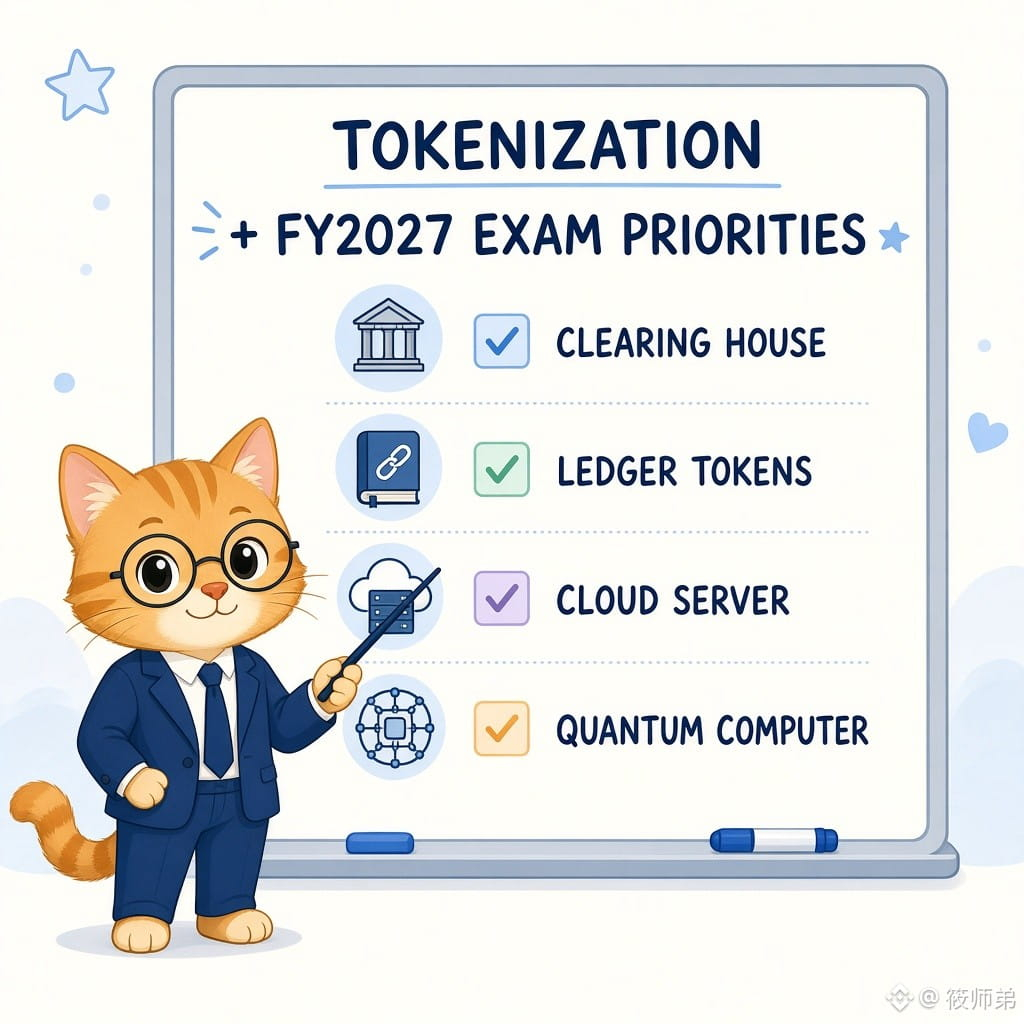
According to the SEC website’s 10/23 press release and “FY2027 Examination Priorities,” the Division of Examinations has highlighted “evolving market infrastructure risks,” specifically naming Treasury clearing reforms and tokenization. For systemically important clearing agencies, tokenization joins default management, recovery and wind-down, securities lending, and operations as a high-risk examination area. Regulation SCI will also focus on securities tokenization, extended trading hours, quantum computing, and reliance on cloud and other third-party providers. The document covers 34,000+ registered entities and states that it creates no new legal obligations; the word “crypto” does not appear in the full text (Coindaro/crypto.news).
[View] The regulatory message is about “how the infrastructure can keep running,” not opening a new chapter on crypto issuance. If clearinghouses and SCI entities move settlement and positions on-chain, compliance and operational burdens will shift upstream to custody, recordkeeping, and disaster recovery. This favors tokenization infrastructure that can meet traditional clearing standards, but is unlikely to directly boost spot-market sentiment in the short term.
[Opportunities/Risks] Watch the pace of tokenization efforts by clearing agencies such as DTCC, and the outcomes of cloud-provider examinations for SCI entities. With next week’s FOMC meeting on 10/27–28 coinciding with midterm-election narratives, risk assets are still likely to remain cautious. $BTC is trading sideways around 81,000, while $ETH is hovering near 2,380; a breakout will require macroeconomic support.
Do you think adding tokenization to the examination checklist supports the compliance narrative, or will it constrain innovation in the short term? Share your thoughts in the comments.
#代币化 #SEC #加密监管 #Macro
$BTC $ETH
For informational purposes only; this is not investment advice.
SEC Adds Tokenization to FY2027 Examination Priorities
According to the SEC website’s 10/23 press release and “FY2027 Examination Priorities,” the Division of Examinations has highlighted “evolving market infrastructure risks,” specifically naming Treasury clearing reforms and tokenization. For systemically important clearing agencies, tokenization joins default management, recovery and wind-down, securities lending, and operations as a high-risk examination area. Regulation SCI will also focus on securities tokenization, extended trading hours, quantum computing, and reliance on cloud and other third-party providers. The document covers 34,000+ registered entities and states that it creates no new legal obligations; the word “crypto” does not appear in the full text (Coindaro/crypto.news).
[View] The regulatory message is about “how the infrastructure can keep running,” not opening a new chapter on crypto issuance. If clearinghouses and SCI entities move settlement and positions on-chain, compliance and operational burdens will shift upstream to custody, recordkeeping, and disaster recovery. This favors tokenization infrastructure that can meet traditional clearing standards, but is unlikely to directly boost spot-market sentiment in the short term.
[Opportunities/Risks] Watch the pace of tokenization efforts by clearing agencies such as DTCC, and the outcomes of cloud-provider examinations for SCI entities. With next week’s FOMC meeting on 10/27–28 coinciding with midterm-election narratives, risk assets are still likely to remain cautious. $BTC is trading sideways around 81,000, while $ETH is hovering near 2,380; a breakout will require macroeconomic support.
Do you think adding tokenization to the examination checklist supports the compliance narrative, or will it constrain innovation in the short term? Share your thoughts in the comments.
#代币化 #SEC #加密监管 #Macro
$BTC $ETH
For informational purposes only; this is not investment advice.
According to the SEC website’s 10/23 press release and “FY2027 Examination Priorities,” the Division of Examinations has highlighted “evolving market infrastructure risks,” specifically naming Treasury clearing reforms and tokenization. For systemically important clearing agencies, tokenization joins default management, recovery and wind-down, securities lending, and operations as a high-risk examination area. Regulation SCI will also focus on securities tokenization, extended trading hours, quantum computing, and reliance on cloud and other third-party providers. The document covers 34,000+ registered entities and states that it creates no new legal obligations; the word “crypto” does not appear in the full text (Coindaro/crypto.news).
[View] The regulatory message is about “how the infrastructure can keep running,” not opening a new chapter on crypto issuance. If clearinghouses and SCI entities move settlement and positions on-chain, compliance and operational burdens will shift upstream to custody, recordkeeping, and disaster recovery. This favors tokenization infrastructure that can meet traditional clearing standards, but is unlikely to directly boost spot-market sentiment in the short term.
[Opportunities/Risks] Watch the pace of tokenization efforts by clearing agencies such as DTCC, and the outcomes of cloud-provider examinations for SCI entities. With next week’s FOMC meeting on 10/27–28 coinciding with midterm-election narratives, risk assets are still likely to remain cautious. $BTC is trading sideways around 81,000, while $ETH is hovering near 2,380; a breakout will require macroeconomic support.
Do you think adding tokenization to the examination checklist supports the compliance narrative, or will it constrain innovation in the short term? Share your thoughts in the comments.
#代币化 #SEC #加密监管 #Macro
$BTC $ETH
For informational purposes only; this is not investment advice.
157
Log in to explore more content
Join global crypto users on Binance Square
⚡️ Get latest and useful information about crypto.
💬 Trusted by the world’s largest crypto exchange.
👍 Discover real insights from verified creators.
Email / Phone number
Trending Topics
1
#BinancePick
3.1M views
153,018 Discussing
2
#EarningsSeason
5.3M views
26,027 Discussing
3
#AnthropicTTMRevenueGrewAbout1200%
32,027 views
436 Discussing
4
#AnthropicS1ExpectedToday
27,347 views
353 Discussing
5
#SouthKoreaReportedlyWeighsFourthCryptoTaxDelay
31,540 views
481 Discussing
6
#FranklinTempletonFilesForTwoDividendToBitcoinETFs
41,633 views
549 Discussing
7
#StrategyMSTRSurpassesNasdaqInMarketCap
31,786 views
391 Discussing
8
#CanadaProposesStablecoinRedemptionWithin3BusinessDays
1,363 views
36 Discussing
9
#ElectrumWalletBugLetRogueServersStealFunds
31,897 views
471 Discussing
10
#ArgentineCourtDismissesLIBRACaseAgainstMilei
47,629 views
590 Discussing