
#rayls
rayls
44,865 views
142 Discussing
Hot
Latest

Article
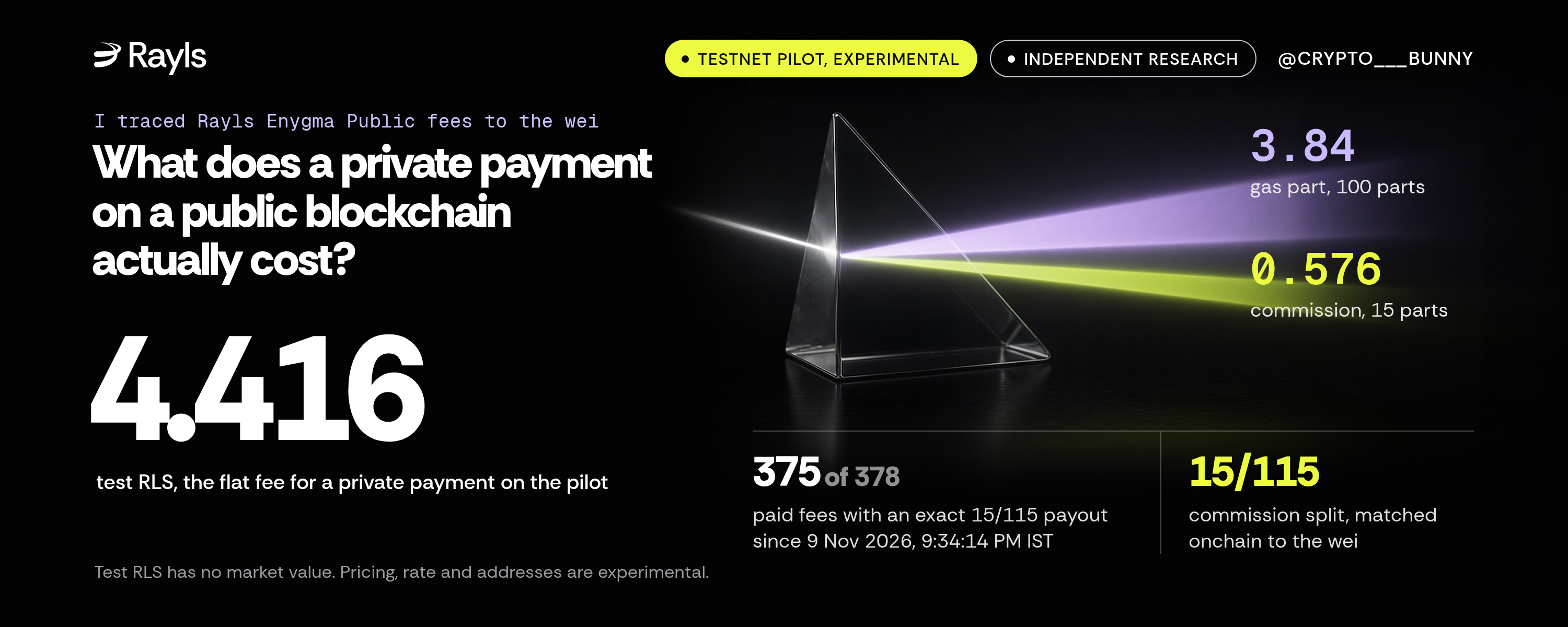
What does a private payment on a public chain cost? I traced Rayls Enygma Public feesRayls is a public blockchain. This is a fee trace of Enygma Public, its testnet pilot for private payments.
Short answer: on the Rayls Enygma Public testnet pilot a private payment costs a flat 4.416 test RLS. That's 3.84 gas plus 0.576 commission, 100 parts to 15. It's the same for 5 RLS or 3 RLS, so the fee says nothing about the amount. The new private swap is flat too, 12.696.
Rayls says Enygma Public is
for people, businesses and regulated platforms whose payments need to stay out of public view but open to oversight
The public can't see who paid who or how much, the deployment's auditor can. (Who sees what: https://docs.rayls.com/docs/enygma-public-who-sees-what) [Documented]
If you're building payroll or a merchant app on it, this is the number you'll pay. I paid it myself on 20 Nov 2026, then traced it onchain and rebuilt it from the wallet's code.
The catch: someone still has to pay the gas
On a public chain anyone sees who paid who and how much, bad for salaries. Hiding the amount isn't enough: every tx needs gas, and paying it from your own wallet signs your name on the "private" payment. [My analysis]
The usual fix is a relayer that sends the tx and pays the gas, and you pay it back privately. Enygma Public works this way. (How Enygma Public works: https://docs.rayls.com/docs/how-enygma-public-works) [Documented]
So what does it charge, and does the fee leak anything? I couldn't find any numbers, so I measured it myself.
How I label things
[Documented] Rayls docs, repo or blog.[Confirmed by the Rayls team] Alex's r/Rayls reply, 20 Nov 2026. [Independently verified] I did or recomputed it from chain data. [My analysis] my read. [Still unconfirmed] open question.
A few terms first
- Gas: the work units a tx uses, which someone has to pay for.
- USDr: the gas token of the Rayls chain, a dollar pegged stablecoin.
- EOA: a normal wallet controlled by a key, not a contract.
- Relayer: a service that sends your tx and pays its gas. You repay it in RLS.
- Shield / unshield: move tokens into or out of your private balance.
- Shielded note: one sealed entry in your private balance.
- Commission: 15 extra parts per 100 parts of gas, paid out in a separate tx.
- Wei: the smallest unit of RLS, so "to the wei" means exact.
- Gas forwarder: a contract (RlsGasForwarder) that runs your signed request and pays the relayer your fee.
- EIP 1967 proxy: a contract that forwards calls to upgradeable logic.
- FeeAggregator / getConfig: a mainnet contract, and its read function that returns the chain fee split.
What Rayls documents about fees
- The relayer pays chain gas and charges you RLS, plus a 15% commission to the Rayls Foundation. USDr shields and unshields cost 0.25%. (How Enygma Public works: https://docs.rayls.com/docs/how-enygma-public-works) [Documented]
- Every Enygma deployment must charge fees in RLS. (Enygma USAGE POLICY: https://github.com/raylsnetwork/Enygma/blob/main/USAGE-POLICY.md) [Documented]
- 50% of RLS from chain fees is burned and 50% goes to validators. (Public chain tokenomics: https://docs.rayls.com/docs/public-chain-tokenomics) [Documented]
- Since April 2026 the Foundation also burns 10% of its monthly unlocked supply. (Rayls tokenomics blog: https://www.rayls.com/blog/rayls-tokenomics-a-united-tradfi-defi-economy) [Documented]
The last two are background, I tested the Enygma fee.
In practice you sign, the relayer sends the tx and pays the gas in USDr, and you pay it in RLS. 1 to 5 seconds later it sends the 15 parts to 0x71AF…8B95 in a separate tx. [Independently verified]
Enygma Public is an experimental testnet pilot. Pricing, the 15% and test addresses will likely change. [Confirmed by the Rayls team] Test RLS and USDr have no value, so no dollar figures here.
What I did and what each action cost
With three throwaway wallets (A, B and C) I ran 20 steps on the testnet, and 14 charged a fee. I saved each app quote, traced each tx and rebuilt each fee from the wallet code.
- Register: 7.20007272 RLS once, commission 0.93913992. tx: https://testnet-explorer.rayls.com/tx/0x150f72f03097bea38cd561dd7a218f020e75704c3c8461b6827dec93d8a11ae3 payout: https://testnet-explorer.rayls.com/tx/0xd57b3418ea64f405c381c14aded2ec2e9aed428d464c9b5f427119e856be1c2c
- Shield: moving 20 RLS private cost 3.52596348 RLS, commission 0.45990828. tx: https://testnet-explorer.rayls.com/tx/0x7f40bd66f847847a14bcbfa0920a892d22124a23f98147957dc63c5913ed33c5 payout: https://testnet-explorer.rayls.com/tx/0xcd015acccf7d9373ff1be8a3ec7c6fa005f1d247f7aa044e5fe937cc0ed98641
- Private send: paying B 5 RLS cost a flat 4.416 RLS, commission 0.576. tx: https://testnet-explorer.rayls.com/tx/0xcf03bec70572a7e00f1c7fa0edd578791a3ab32b6ec8f660cde4f21a1bc7760b payout: https://testnet-explorer.rayls.com/tx/0x4b336e05cfe3d7bcc4d7c0b0fef7ab28942b357e6132b587413e6d121a567772
- Unshield: taking out 3 RLS cost 4.52841756 RLS, commission 0.59066316. tx: https://testnet-explorer.rayls.com/tx/0x32ebfef8963c9af737c77597ea79f5fd2ebce62cd35c754e052be0846e06c159 payout: https://testnet-explorer.rayls.com/tx/0x71d274d10ab2085e9b33f3d16e3a2be34bb3a4f6d48816f475d2302080845150
- Invite: a 30 RLS invite link cost the same 4.416, commission 0.576. tx: https://testnet-explorer.rayls.com/tx/0x116ead0d6b4dd02fe7e74a8719ffd5bb8e04a26170d616a779379e06363db7d4 payout: https://testnet-explorer.rayls.com/tx/0xf826b63dab7ee8fce7b210ba82867d790282056210ba24490482bf52b51b70d4
- Others: the invite claim cost 12.696 RLS, taken from the invite. One shield cost 7.38972336 because paying its gas from private RLS adds a private fee payment, priced at 1,400,000 more gas.
- USDr: shielding 4 took 0.01 USDr and unshielding 2 took 0.005, 0.25% rounded up, on top of the RLS gas fee.
My 4 USDr shield: look at "Fee, 0.25%: 0.0100 USDr" and the gas choice, shielded or public RLS. The shot still has shielded selected, I then switched to public RLS (up to 4.14), final charge 3.8329638 RLS. Real screenshot, 20 Nov 2026.
The app's $ figures are its own display estimate. Test RLS has no value.
All 14 commissions went out 4 to 5 seconds later, at exactly fee x 15/115. [Independently verified]
How I checked a fee that's hidden
Still from my recording: the app quotes 4.42 RLS before I sign, and 2 s later the relayer sends 0.576 RLS to a team test wallet. 20 Nov 2026.
Send: https://testnet-explorer.rayls.com/tx/0x0d6813581b46ee6a967cd02c431357fcfa677060cf0eb51deae45f2ac5a6d8cf
Payout: https://testnet-explorer.rayls.com/tx/0xa5a3beb7bb1850820b5879b040db82c811878fa70525c32a93d3a5cb237d097b
Still from my recording: private send on the explorer, 4.416 recompute, 0.576 payout, relayer EOA, mainnet getConfig. 20 Nov 2026.
Send: https://testnet-explorer.rayls.com/tx/0xcf03bec70572a7e00f1c7fa0edd578791a3ab32b6ec8f660cde4f21a1bc7760b
Payout: https://testnet-explorer.rayls.com/tx/0x4b336e05cfe3d7bcc4d7c0b0fef7ab28942b357e6132b587413e6d121a567772
A private send pays its fee from a shielded note the explorer can't show. The math:
- gas: 1,600,000 gas x 0.0000024 RLS = 3.84 RLS
- commission: 3.84 x 15/100 = 0.576 RLS
- total: 3.84 + 0.576 = 4.416 RLS
My 5 RLS private send: look at the Fees line, 4.42 RLS = 3.84 gas + 0.58 Rayls Foundation (15%), the flat 4.416 rounded. Real screenshot, 20 Nov 2026.
Two things confirm it. The relayer's quote to my wallet said 4416000000000000000 wei, which is 4.416 RLS. And the public payout is 0.576, and 0.576 x 115/15 = 4.416 exactly. [Independently verified]
Where the fee is public, quote, tx fee and recompute all match. [Independently verified]
The fee formula in the wallet code
The fee code is in the live wallet bundle, now index-Dlv-HYaZ.js: https://enygma-testnet.rayls.com/assets/index-Dlv-HYaZ.js. The graphic shows index-Nw3AggQS.js, the build I used. Across all 4 builds only variable names changed. [Independently verified]
The fee comes from the relayer's gas estimate, before you sign:
- request gas = estimate x 1.2 + 20,000. The relayer pads its estimate by 20% plus 20,000 as a safety margin.
- priced gas = request gas + 150,000 + 16 x (calldata bytes + 700). A fixed overhead plus 16 gas per byte of tx data, and 100,000 more with a 0.25% token fee.
- fee = priced gas x 0.0000024 RLS x 115/100. Gas times RLS price, plus 15 parts.
- a private payment skips this: flat 1,600,000 gas.
So you pay the padded estimate, not the gas used, and know the fee before signing.
The 0.0000024 comes from the relayer's info endpoint, not the chain, so alone it proves nothing. The recompute does: 2,608,722 priced gas x 0.0000024 x 1.15 = 7.20007272 RLS, exactly my register fee. [Independently verified]
Wallet A registering @railfeetrace1: look at "up to 8.00 RLS, 6.96 gas + 1.04". Real screenshot, 20 Nov 2026.
The 8.00 is a maximum shown before you sign. The exact quote I signed, and was charged, was 7.20007272, the formula result. [Independently verified]
Does it hold for everyone's fees?
Still from my recording: saved history scan (375 of 378), then fresh_check.py live from the public RPC (16 of 16 at recording time) and the 1 wei control. 20 Nov 2026.
Scripts and data: https://github.com/marwan786797/enygma-fee-trace
Saved scan: 375 of 378 paid fees matched 15/115 to the wei. That's every fee from the current version's launch (9 Nov 16:04 UTC / 9:34 PM IST) to block 24,667,602 (20 Nov 09:41 UTC / 3:11 PM IST). [Independently verified]
The 375 matched payouts add up to 241.39751436 RLS, exactly 15/115 of their 1,850.71427676 RLS of fees. The graphic's 1,862.26140468 also counts the 3 unmatched fees. 341 more payouts are for private fees, most often 1.08 (101 times, from 8.28) and 0.576 (69 times, from the flat 4.416 private send).
8.28 is the flat fee when it can't come from the same note as the payment, like any private USDr payment. My first invite try showed 7.20 gas + 1.08, since no single note covered 26 RLS plus fee. All 121 USDr fees since 27 Oct equal 0.25% rounded up. [Independently verified]
In the repo's fees_history.csv each row is one onchain fee, and ratio_check is my calculation, kept apart.
Fresh check on fees I'd never seen. Then I checked every later fee live from the public RPC. Blocks 24,667,603 to 24,692,010 (to 13:24 UTC / 6:54 PM IST) had 18 fee events. 2 had fee 0 (the relayer charged nothing). The other 16 were paid, 14 by other people. All 16 matched the formula to the wei and had their 15/115 payout.[Independently verified]
As a control I moved the price and the payout by 1 wei, and all 16 failed, so it catches wrong numbers. [Independently verified]
The video shows that first run. On 21 Nov I reran it on everything since the snapshot, blocks 24,667,603 to 24,791,389 (to 04:27 UTC / 9:57 AM IST), so it also covers the time after the swap launch. 47 fee events, 15 with fee 0, 32 paid (30 by other people). All 32 matched the formula to the wei and had their 15/115 payout from the relayer, and the 1 wei control failed all 32. The wallet bundle was still the same file. [Independently verified]
What the Rayls team confirmed
Alex answered my three questions: https://www.reddit.com/r/Rayls/s/EtnvbYGAQ9.
Who gets the 15%? 0x71AF…8B95, a team test wallet for the treasury and auditor, not a Foundation address. Mainnet will use another. [Confirmed by the Rayls team]
Onchain I can only show it's an EOA receiving the payouts. [Independently verified]
Where does the RLS price come from? A fixed test price: 2.4 RLS per million gas, or 50 RLS per USDr at 48 gwei. [Confirmed by the Rayls team]
That's my formula's 0.0000024. [Independently verified]
What is the live chain fee split? Mainnet runs 50/50, the README's 50/30/20 is an example. [Confirmed by the Rayls team]
I read getConfig() on the mainnet FeeAggregator at block 14,858,726 (20 Nov 2026 10:59:20 UTC / 4:29:20 PM IST): 5000 / 0 / 5000, so 50% validators, 0% ecosystem, 50% burn. That's chain gas in USDr, not the Enygma commission. [Independently verified]
Who is who
From the explorer API. [Independently verified]
- Relayer 0xa5f0…0Ac8 and test wallet 0x71AF…8B95: normal EOA wallets.
- Owner 0xBf09…d775: a custom OwnerMultisig contract that needs 2 signers, not a Safe.
- Gas forwarder 0x12B6…CA6d: the verified RlsGasForwarder contract.
- Mainnet FeeAggregator 0x07E1…17E3: an EIP 1967 proxy.
The privacy proof
Still from my recording: 5 RLS and 3 RLS private sends side by side, same 0.576 payout. 20 Nov 2026.
5 RLS send: https://testnet-explorer.rayls.com/tx/0xcf03bec70572a7e00f1c7fa0edd578791a3ab32b6ec8f660cde4f21a1bc7760b
5 RLS payout: https://testnet-explorer.rayls.com/tx/0x4b336e05cfe3d7bcc4d7c0b0fef7ab28942b357e6132b587413e6d121a567772
3 RLS send: https://testnet-explorer.rayls.com/tx/0x404af8ae6776de39a7f2621a9f8d0091b5bdeed4ce916ebfa7bff0ab908defb0
3 RLS payout: https://testnet-explorer.rayls.com/tx/0x55ef82fe61a67f338ac63196753fcf5dde740b6ad2c6ba876db7d85b83af2158
I paid B 5 RLS, then 3, and B paid me 5 back. All three are sent by the relayer to the SharedVault contract with value 0 and leave the same 0.576 RLS payout (steps 6, 10 and 20). [Independently verified]
Rayls' Who sees what page says anyone can see a shielded payment's gas fee. [Documented] Since it's flat, it only shows a payment happened, not who paid who or how much. [My analysis]
New: what does a private swap cost?
Private RLS and USDr swaps went live on the testnet on 20 Nov 2026, with a demo by Alex Jupiter. (Rayls announcement: https://x.com/RaylsLabs/status/2123826546926342459) [Documented]
My 20 RLS swap: look at the Fees line, 12.70 RLS = 11.04 gas + 1.66 Rayls Foundation (15%). Real screenshot, 20 Nov 2026.
Still from my recording of the 20 RLS swap: the app quotes 12.70 RLS, the relayer sends it, and 1 s later it pays 1.656 RLS to a team test wallet. 20 Nov 2026.
Swap: https://testnet-explorer.rayls.com/tx/0xa5de90fa89f2ac28472aaa06efda61036c2c7f99227818376f2b4add78957954
Payout: https://testnet-explorer.rayls.com/tx/0x3a43dc3e7b4cddad8b1732155b053f7f876cb7ddd6ceaf4b2622d82a6f025719
A swap costs a flat 12.696 RLS: 4,600,000 gas x 0.0000024 x 1.15, so 11.04 gas plus 1.656 commission. The relayer quoted the same fee for 1 to 1000 RLS and for USDr to RLS. There's no 0.25% token fee on swaps. [Independently verified]
I swapped 20 RLS, then 50. My shielded balance went 248.752, 216.056, 153.36, so each took the amount plus 12.696 and left a 1.656 payout (12.696 x 15/115). (swap 1: https://testnet-explorer.rayls.com/tx/0xa5de90fa89f2ac28472aaa06efda61036c2c7f99227818376f2b4add78957954, payout: https://testnet-explorer.rayls.com/tx/0x3a43dc3e7b4cddad8b1732155b053f7f876cb7ddd6ceaf4b2622d82a6f025719, swap 2: https://testnet-explorer.rayls.com/tx/0xc2451bfb9f6c028b3e37ae38dd0b75149cc75cb30b30011a680f1b02185f4d35, payout: https://testnet-explorer.rayls.com/tx/0x07c23147646866114d5a7755b4b86890795a9c2b6a47c619162f9dec8d5714b2) Alex's demo swap at block 24,706,084 left the same 1.656 (tx: https://testnet-explorer.rayls.com/tx/0x887b7b4d44719d5813b39dff92bc5cb1336bf47c487da6c51161688d60b8b773, payout: https://testnet-explorer.rayls.com/tx/0xbff76facfe6b237550a1454c049845acff4eba0523abbec2213a4942afa7b2af). [Independently verified]
Like the private send, a flat fee doesn't reveal the swap size. [My analysis]
The other cost is price: every quote paid out exactly 0.99 x the relayer's reference price, about a 1% spread. [Independently verified]
How other private payment systems charge
Two others, from their docs (different trade-offs, not a ranking):
- RAILGUN: 0.25% on shield and unshield, to the RAILGUN treasury. "Broadcasters" pay the gas and take a premium from your private balance, "about 10% above total gas cost most of the time". (deductions: https://docs.railgun.org/wiki/learn/railgun-deductions, costs FAQ: https://docs.railgun.org/community-faqs/readme/costs-and-fees) [Documented]
- Zcash ($ZEC): ZIP 317 prices fees by inputs and outputs ("logical actions") and says the fee "should not leak private information". (ZIP 317: https://zips.z.cash/zip-0317) [Documented]
- Enygma Public: also 0.25% on USDr shield and unshield, but one Rayls relayer and a fixed 15 parts. [Documented] Its flat fees are a simple way to get what ZIP 317 asks for. [My analysis]
What I proved and what I didn't
- Fresh from the chain: my 20 step retrace (rerun 20 Nov about 7 PM IST) and the fresh check.
- Saved data: the 378 fee history (REFRESH=1 bash scripts/run_all.sh refetches it) and the app quotes.
- Taken on trust: the 0.0000024 price, who controls 0x71AF and the swap reference price.
- Not tested: Enygma on mainnet.
Still unconfirmed
Small things I couldn't confirm from public data. It's a testnet pilot, so some may just change before mainnet. [Still unconfirmed]
- 61 of 121 USDr fees are on public USDr sends, but the docs only mention shield and unshield. Intended?
- Three fees on 17 Nov 2026 have no payout. Paid later or skipped?
- The faucet cooldown is 3 hours in the relayer but one hour in the docs. Which?
- Docs say an invite claim also covers registering, but after mine registering asked for 7.2 public RLS. Intended?
- Is the live relayer the same code as the bundle's relayer module? All my tests match it.
- Swaps pay out 0.99 x the relayer's reference price. Where's that price from, and who keeps the 1%?
- A display difference in one quote screen I'd like the team to confirm: Alex's demo swap quote showed 14.60 (12.696 x 1.15) while 12.696 was charged, and his register screen showed 0.00 Foundation while a payout was made.
Reproduce it in 3 commands
No wallet, keys or login needed, just Python 3.
git clone https://github.com/marwan786797/enygma-fee-trace && cd enygma-fee-trace
python3 -m venv .venv && .venv/bin/pip install -r requirements.txt
.venv/bin/python scripts/fresh_check.py
The last line runs the fresh check in about 10 s. bash scripts/run_all.sh reruns the rest.
What this means if you build or use private payments
You can budget for it, and the fee doesn't leak the amount. A private payment is one price, known before you sign. Real gas was 69 to 79% of priced gas in my run (the claim lower), and you never pay more than the quote. [My analysis]
And anyone can audit it. One relayer, one payout address and fixed 15 parts let anyone check fees from public data. The 15% is 15 on top of 100, about 13.04% of what you pay. [My analysis]
One question for @Rayls : will mainnet keep the flat private payment fee?
Try it yourself: open enygma-testnet.rayls.com: https://enygma-testnet.rayls.com, get free test RLS from the faucet, send one private payment, then find your 0.576 payout on the explorer and check the math.
Proof list (all 20 steps)
All on 20 Nov 2026, times UTC / IST. Accounts: A @railfeetrace1, B @railfeetrace2, C @railfeetrace3 (joined through B's invite). Fees in RLS unless marked USDr. "Checked 3 ways" = onchain fee = app quote = formula.
1. Faucet 50 RLS to A, 09:14:18 / 2:44:18 PM. tx: https://testnet-explorer.rayls.com/tx/0xd2dda180d431c7f354e4cfc7f13611f881ba7fa0701ac17949fb2ae71a0612fd
2. Faucet 50 RLS to B, 09:14:22 / 2:44:22 PM. tx: https://testnet-explorer.rayls.com/tx/0x958989528701cb4b46cf7f6e212459f24dbba6cac0c8fa010bac1c819bbf4639
3. A registers, 09:20:44 / 2:50:44 PM. Fee 7.20007272, checked 3 ways. Payout 0.93913992. tx: https://testnet-explorer.rayls.com/tx/0x150f72f03097bea38cd561dd7a218f020e75704c3c8461b6827dec93d8a11ae3 payout: https://testnet-explorer.rayls.com/tx/0xd57b3418ea64f405c381c14aded2ec2e9aed428d464c9b5f427119e856be1c2c
4. A shields 20 RLS (gas from public RLS), 09:23:52 / 2:53:52 PM. Fee 3.52596348, checked 3 ways. Payout 0.45990828. tx: https://testnet-explorer.rayls.com/tx/0x7f40bd66f847847a14bcbfa0920a892d22124a23f98147957dc63c5913ed33c5 payout: https://testnet-explorer.rayls.com/tx/0xcd015acccf7d9373ff1be8a3ec7c6fa005f1d247f7aa044e5fe937cc0ed98641
5. B registers, 09:26:24 / 2:56:24 PM. Fee 7.20007272, checked 3 ways. Payout 0.93913992. tx: https://testnet-explorer.rayls.com/tx/0xdf23fa21962a96cba37b0ca8e3853493d0a1fa6032d54b52ade26ec7902bf19e payout: https://testnet-explorer.rayls.com/tx/0x8d63915db37ae1d93eae2d4f8ecccf0ec6bccd17e6707426fa44a49936a47146
6. A pays B 5 RLS privately, 09:28:50 / 2:58:50 PM. Fee 4.416 (shielded note, app quote). Payout 0.576. tx: https://testnet-explorer.rayls.com/tx/0xcf03bec70572a7e00f1c7fa0edd578791a3ab32b6ec8f660cde4f21a1bc7760b payout: https://testnet-explorer.rayls.com/tx/0x4b336e05cfe3d7bcc4d7c0b0fef7ab28942b357e6132b587413e6d121a567772
7. A unshields 3 RLS to itself, 09:30:34 / 3:00:34 PM. Fee 4.52841756, checked 3 ways. Payout 0.59066316. tx: https://testnet-explorer.rayls.com/tx/0x32ebfef8963c9af737c77597ea79f5fd2ebce62cd35c754e052be0846e06c159 payout: https://testnet-explorer.rayls.com/tx/0x71d274d10ab2085e9b33f3d16e3a2be34bb3a4f6d48816f475d2302080845150
8. B shields 25 RLS (gas from public RLS), 09:32:16 / 3:02:16 PM. Fee 3.52596348, checked 3 ways. Payout 0.45990828. tx: https://testnet-explorer.rayls.com/tx/0x080ede8a21709093e2ab4ec82e4a0f48e164d3156c4f40216b0b9bf78bbb4142 payout: https://testnet-explorer.rayls.com/tx/0x95a1bf3dd07bcb85b44c33ae3f7f52f7c61f607635e84113b23d3ffd71aad3c6
9. B shields 5 RLS (gas from shielded RLS), 09:33:46 / 3:03:46 PM. Fee 7.38972336 (shielded note, app quote). Payout 0.96387696. tx: https://testnet-explorer.rayls.com/tx/0x669b2b59a64debf80262ba21a01f7f50b3a783e35b4821163388354795271bc3 payout: https://testnet-explorer.rayls.com/tx/0x2bc3e3384404348fe12debccbb116fecd9dabbfe21e3cd7823f471a6fc00941d
10. A pays B 3 RLS privately, 09:35:04 / 3:05:04 PM. Fee 4.416 (shielded note, app quote). Payout 0.576. tx: https://testnet-explorer.rayls.com/tx/0x404af8ae6776de39a7f2621a9f8d0091b5bdeed4ce916ebfa7bff0ab908defb0 payout: https://testnet-explorer.rayls.com/tx/0x55ef82fe61a67f338ac63196753fcf5dde740b6ad2c6ba876db7d85b83af2158
11. B shields 5 RLS (gas from public RLS), 09:36:26 / 3:06:26 PM. Fee 3.52580064, checked 3 ways. Payout 0.45988704. tx: https://testnet-explorer.rayls.com/tx/0xef3173e279adfcda2ee61b270d4f46f8843a9dc092704608f41c32d76b71c5c6 payout: https://testnet-explorer.rayls.com/tx/0xef2d6036ab96847619e3b51f1026c031d8115d2feae9a9d63d60498e5dd3f1d2
12. Faucet (reopened) 250 shielded RLS to B, one note, 11:14:41 / 4:44:41 PM. tx: https://testnet-explorer.rayls.com/tx/0x8a3387e2c07e86b049c4426b36d4ea6f54fb3eeaa76eec26bbb643f2e68b3919
13. Faucet (reopened) 10 USDr to A, 11:14:45 / 4:44:45 PM. tx: https://testnet-explorer.rayls.com/tx/0xc034dd85c1cbc4025cd6adb4e43657269acd857eb7f28f312e1ca1df87418ce4
14. A shields 4 USDr (gas from public RLS), 11:16:32 / 4:46:32 PM. Fee 3.8329638, checked 3 ways. Payout 0.4999518. tx: https://testnet-explorer.rayls.com/tx/0x732f75d1fc8cccc6fb0fcc2d79632f40d4d13935eb85bfabf66733eafda9e8c6 payout: https://testnet-explorer.rayls.com/tx/0xf1fc73238fecb68b2f1b2e45375f608921bb4e4e236b6660d7f108430d803127
15. 0.25% token fee on step 14, A to 0x71AF…8B95, 11:16:36 / 4:46:36 PM. 0.01 USDr, 0.25% rounded up. tx: https://testnet-explorer.rayls.com/tx/0x60db7c585a66aad2e06ece47d09d74f764522f4373e4bbd33b36c601bf41a706
16. A unshields 2 USDr to itself (gas from public RLS), 11:21:56 / 4:51:56 PM. Fee 4.75776528, checked 3 ways. Payout 0.62057808. tx: https://testnet-explorer.rayls.com/tx/0xfdaa7706b311a027e937003d49d89a041c086bf1bd5256de66da12c87141e202 payout: https://testnet-explorer.rayls.com/tx/0xe2400171258c3bc39e80e7e5bd531e9be7bfe46095a5e6fa603fe6e7e77dfd11
17. 0.25% token fee on step 16, A to 0x71AF…8B95, 11:22:00 / 4:52:00 PM. 0.005 USDr, 0.25% rounded up. tx: https://testnet-explorer.rayls.com/tx/0xc2211c8322f30275dddbc9dc0d3dcdaf56e2c377d7f2147969524de8f736009e
18. B creates a 30 RLS invite (private, one note), 11:23:38 / 4:53:38 PM. Fee 4.416 (shielded note, app quote). Payout 0.576. tx: https://testnet-explorer.rayls.com/tx/0x116ead0d6b4dd02fe7e74a8719ffd5bb8e04a26170d616a779379e06363db7d4 payout: https://testnet-explorer.rayls.com/tx/0xf826b63dab7ee8fce7b210ba82867d790282056210ba24490482bf52b51b70d4
19. C claims the invite (fee taken out of the 30 RLS), 11:27:28 / 4:57:28 PM. Fee 12.696 (shielded note, app quote). Payout 1.656. tx: https://testnet-explorer.rayls.com/tx/0xbb2c67f40360a36dc6f2c3827e1d2ac63725578fea94208ef064739aefaf1a08 payout: https://testnet-explorer.rayls.com/tx/0xb018c296a547d4ef27acf59eae323934f6bc4be805f57bbb016687dffb28dda8
20. B pays A 5 RLS privately (gas from shielded RLS), 11:46:39 / 5:16:39 PM. Fee 4.416 (shielded note, app quote). Payout 0.576. tx: https://testnet-explorer.rayls.com/tx/0x39d9f8d70d908ae11fb8e6818e93b8bf052a1fff47afe49b992443d852d4da94 payout: https://testnet-explorer.rayls.com/tx/0x32d0873328a58f13d644d5c983e5e699f4b49ca7bf71989ec372323856a88e2c
After the 20 steps:
- App send for app_send.mp4: A pays B 2 RLS privately, 17:51:48 / 11:21:48 PM. Fee 4.416 (relayer response). Payout 0.576, 2 s later. tx: https://testnet-explorer.rayls.com/tx/0x0d6813581b46ee6a967cd02c431357fcfa677060cf0eb51deae45f2ac5a6d8cf payout: https://testnet-explorer.rayls.com/tx/0xa5a3beb7bb1850820b5879b040db82c811878fa70525c32a93d3a5cb237d097b
- Swap: A swaps 20 RLS for 0.02640726 USDr, 17:43:56 / 11:13:56 PM. Fee 12.696 (balance math). Payout 1.656. tx: https://testnet-explorer.rayls.com/tx/0xa5de90fa89f2ac28472aaa06efda61036c2c7f99227818376f2b4add78957954 payout: https://testnet-explorer.rayls.com/tx/0x3a43dc3e7b4cddad8b1732155b053f7f876cb7ddd6ceaf4b2622d82a6f025719
- Swap: A swaps 50 RLS for 0.065571165 USDr, 17:47:27 / 11:17:27 PM. Fee 12.696 (balance math). Payout 1.656. tx: https://testnet-explorer.rayls.com/tx/0xc2451bfb9f6c028b3e37ae38dd0b75149cc75cb30b30011a680f1b02185f4d35 payout: https://testnet-explorer.rayls.com/tx/0x07c23147646866114d5a7755b4b86890795a9c2b6a47c619162f9dec8d5714b2
Sources
- Rayls team answer (Alex, r/Rayls, 20 Nov 2026): https://www.reddit.com/r/Rayls/s/EtnvbYGAQ9
- My scripts and data: https://github.com/marwan786797/enygma-fee-trace
- How Enygma Public works: https://docs.rayls.com/docs/how-enygma-public-works
- Enygma USAGE POLICY: https://github.com/raylsnetwork/Enygma/blob/main/USAGE-POLICY.md
- Public chain tokenomics: https://docs.rayls.com/docs/public-chain-tokenomics
- Rayls tokenomics blog: https://www.rayls.com/blog/rayls-tokenomics-a-united-tradfi-defi-economy
- Who sees what: https://docs.rayls.com/docs/enygma-public-who-sees-what
- Try Enygma Public on testnet (faucet docs): https://docs.rayls.com/docs/try-enygma-public-on-testnet
- Wallet bundle with the fee code (live build at 20 Nov 2026 about 10:50 PM IST): https://enygma-testnet.rayls.com/assets/index-Dlv-HYaZ.js and earlier builds index-Nw3AggQS.js, index-DlzVF1v6.js and index-BRJsQdqQ.js have the same fee code
- Relayer 0xa5f0…0Ac8: https://testnet-explorer.rayls.com/address/0xa5f0C684EB49866a9f62f901Cd85f98a19DA0Ac8
- Team test wallet 0x71AF…8B95: https://testnet-explorer.rayls.com/address/0x71AF09966CBED4434ccA97c40Fa38B8083548B95
- Owner multisig 0xBf09…d775: https://testnet-explorer.rayls.com/address/0xBf099175a241194C38E977735D59CCb22596d775
- Gas forwarder 0x12B6…CA6d: https://testnet-explorer.rayls.com/address/0x12B6640048DEB2e8fFDa4Bc10Bb2a640B70eCA6d
- Mainnet FeeAggregator 0x07E1…17E3 (getConfig at block 14,858,726, 20 Nov 2026 10:59:20 UTC / 4:29:20 PM IST): https://explorer.rayls.com/address/0x07E17E17e17E17e17E17e17e17e17e17E17E17E3
- Fee version live from 9 Nov 2026 16:04 UTC / 9:34 PM IST. History snapshot at block 24,667,602, 20 Nov 2026 09:41:12 UTC / 3:11 PM IST
- Three unmatched fees, 17 Nov 2026 17:07 to 17:11 UTC / 10:37 to 10:41 PM IST: https://testnet-explorer.rayls.com/tx/0x3925cd6f0111f18dadd326ca74d9f72c6cdb14bdc4766eaab51a6deda56eab73 https://testnet-explorer.rayls.com/tx/0xc2bf33d02a4e7ffc8873dfdc3aa8f3dcb9e7cf6ae0ee027af5c865df06223f48 https://testnet-explorer.rayls.com/tx/0xedad565bc48d5580d678dfbb36ceb953f7c71847609e07a46f0e7edd4b31a644
- Fresh formula check window: blocks 24,667,603 to 24,692,010, 20 Nov 2026 09:41 to 13:24 UTC / 3:11 to 6:54 PM IST
- Rerun window: blocks 24,667,603 to 24,791,389, to 21 Nov 2026 04:27 UTC / 9:57 AM IST (python3 scripts/fresh_check.py --to-block 24791389)
- RAILGUN deductions: https://docs.railgun.org/wiki/learn/railgun-deductions
- RAILGUN costs FAQ: https://docs.railgun.org/community-faqs/readme/costs-and-fees
- RAILGUN private transaction UX: https://docs.railgun.org/developer-guide/wallet/transactions/ux-private-transactions
- Zcash ZIP 317: https://zips.z.cash/zip-0317
#Rayls #Privacy #blockchain #Testnet
What does a private payment on a public chain cost? I traced Rayls Enygma Public fees
Rayls is a public blockchain. This is a fee trace of Enygma Public, its testnet pilot for private payments.
Short answer: on the Rayls Enygma Public testnet pilot a private payment costs a flat 4.416 test RLS. That's 3.84 gas plus 0.576 commission, 100 parts to 15. It's the same for 5 RLS or 3 RLS, so the fee says nothing about the amount. The new private swap is flat too, 12.696.
Rayls says Enygma Public is
for people, businesses and regulated platforms whose payments need to stay out of public view but open to oversight
The public can't see who paid who or how much, the deployment's auditor can. (Who sees what: https://docs.rayls.com/docs/enygma-public-who-sees-what) [Documented]
If you're building payroll or a merchant app on it, this is the number you'll pay. I paid it myself on 20 Nov 2026, then traced it onchain and rebuilt it from the wallet's code.
The catch: someone still has to pay the gas
On a public chain anyone sees who paid who and how much, bad for salaries. Hiding the amount isn't enough: every tx needs gas, and paying it from your own wallet signs your name on the "private" payment. [My analysis]
The usual fix is a relayer that sends the tx and pays the gas, and you pay it back privately. Enygma Public works this way. (How Enygma Public works: https://docs.rayls.com/docs/how-enygma-public-works) [Documented]
So what does it charge, and does the fee leak anything? I couldn't find any numbers, so I measured it myself.
How I label things
[Documented] Rayls docs, repo or blog.[Confirmed by the Rayls team] Alex's r/Rayls reply, 20 Nov 2026. [Independently verified] I did or recomputed it from chain data. [My analysis] my read. [Still unconfirmed] open question.
A few terms first
- Gas: the work units a tx uses, which someone has to pay for.
- USDr: the gas token of the Rayls chain, a dollar pegged stablecoin.
- EOA: a normal wallet controlled by a key, not a contract.
- Relayer: a service that sends your tx and pays its gas. You repay it in RLS.
- Shield / unshield: move tokens into or out of your private balance.
- Shielded note: one sealed entry in your private balance.
- Commission: 15 extra parts per 100 parts of gas, paid out in a separate tx.
- Wei: the smallest unit of RLS, so "to the wei" means exact.
- Gas forwarder: a contract (RlsGasForwarder) that runs your signed request and pays the relayer your fee.
- EIP 1967 proxy: a contract that forwards calls to upgradeable logic.
- FeeAggregator / getConfig: a mainnet contract, and its read function that returns the chain fee split.
What Rayls documents about fees
- The relayer pays chain gas and charges you RLS, plus a 15% commission to the Rayls Foundation. USDr shields and unshields cost 0.25%. (How Enygma Public works: https://docs.rayls.com/docs/how-enygma-public-works) [Documented]
- Every Enygma deployment must charge fees in RLS. (Enygma USAGE POLICY: https://github.com/raylsnetwork/Enygma/blob/main/USAGE-POLICY.md) [Documented]
- 50% of RLS from chain fees is burned and 50% goes to validators. (Public chain tokenomics: https://docs.rayls.com/docs/public-chain-tokenomics) [Documented]
- Since April 2026 the Foundation also burns 10% of its monthly unlocked supply. (Rayls tokenomics blog: https://www.rayls.com/blog/rayls-tokenomics-a-united-tradfi-defi-economy) [Documented]
The last two are background, I tested the Enygma fee.
In practice you sign, the relayer sends the tx and pays the gas in USDr, and you pay it in RLS. 1 to 5 seconds later it sends the 15 parts to 0x71AF…8B95 in a separate tx. [Independently verified]
Enygma Public is an experimental testnet pilot. Pricing, the 15% and test addresses will likely change. [Confirmed by the Rayls team] Test RLS and USDr have no value, so no dollar figures here.
What I did and what each action cost
With three throwaway wallets (A, B and C) I ran 20 steps on the testnet, and 14 charged a fee. I saved each app quote, traced each tx and rebuilt each fee from the wallet code.
- Register: 7.20007272 RLS once, commission 0.93913992. tx: https://testnet-explorer.rayls.com/tx/0x150f72f03097bea38cd561dd7a218f020e75704c3c8461b6827dec93d8a11ae3 payout: https://testnet-explorer.rayls.com/tx/0xd57b3418ea64f405c381c14aded2ec2e9aed428d464c9b5f427119e856be1c2c
- Shield: moving 20 RLS private cost 3.52596348 RLS, commission 0.45990828. tx: https://testnet-explorer.rayls.com/tx/0x7f40bd66f847847a14bcbfa0920a892d22124a23f98147957dc63c5913ed33c5 payout: https://testnet-explorer.rayls.com/tx/0xcd015acccf7d9373ff1be8a3ec7c6fa005f1d247f7aa044e5fe937cc0ed98641
- Private send: paying B 5 RLS cost a flat 4.416 RLS, commission 0.576. tx: https://testnet-explorer.rayls.com/tx/0xcf03bec70572a7e00f1c7fa0edd578791a3ab32b6ec8f660cde4f21a1bc7760b payout: https://testnet-explorer.rayls.com/tx/0x4b336e05cfe3d7bcc4d7c0b0fef7ab28942b357e6132b587413e6d121a567772
- Unshield: taking out 3 RLS cost 4.52841756 RLS, commission 0.59066316. tx: https://testnet-explorer.rayls.com/tx/0x32ebfef8963c9af737c77597ea79f5fd2ebce62cd35c754e052be0846e06c159 payout: https://testnet-explorer.rayls.com/tx/0x71d274d10ab2085e9b33f3d16e3a2be34bb3a4f6d48816f475d2302080845150
- Invite: a 30 RLS invite link cost the same 4.416, commission 0.576. tx: https://testnet-explorer.rayls.com/tx/0x116ead0d6b4dd02fe7e74a8719ffd5bb8e04a26170d616a779379e06363db7d4 payout: https://testnet-explorer.rayls.com/tx/0xf826b63dab7ee8fce7b210ba82867d790282056210ba24490482bf52b51b70d4
- Others: the invite claim cost 12.696 RLS, taken from the invite. One shield cost 7.38972336 because paying its gas from private RLS adds a private fee payment, priced at 1,400,000 more gas.
- USDr: shielding 4 took 0.01 USDr and unshielding 2 took 0.005, 0.25% rounded up, on top of the RLS gas fee.
My 4 USDr shield: look at "Fee, 0.25%: 0.0100 USDr" and the gas choice, shielded or public RLS. The shot still has shielded selected, I then switched to public RLS (up to 4.14), final charge 3.8329638 RLS. Real screenshot, 20 Nov 2026.
The app's $ figures are its own display estimate. Test RLS has no value.
All 14 commissions went out 4 to 5 seconds later, at exactly fee x 15/115. [Independently verified]
How I checked a fee that's hidden
Still from my recording: the app quotes 4.42 RLS before I sign, and 2 s later the relayer sends 0.576 RLS to a team test wallet. 20 Nov 2026.
Send: https://testnet-explorer.rayls.com/tx/0x0d6813581b46ee6a967cd02c431357fcfa677060cf0eb51deae45f2ac5a6d8cf
Payout: https://testnet-explorer.rayls.com/tx/0xa5a3beb7bb1850820b5879b040db82c811878fa70525c32a93d3a5cb237d097b
Still from my recording: private send on the explorer, 4.416 recompute, 0.576 payout, relayer EOA, mainnet getConfig. 20 Nov 2026.
Send: https://testnet-explorer.rayls.com/tx/0xcf03bec70572a7e00f1c7fa0edd578791a3ab32b6ec8f660cde4f21a1bc7760b
Payout: https://testnet-explorer.rayls.com/tx/0x4b336e05cfe3d7bcc4d7c0b0fef7ab28942b357e6132b587413e6d121a567772
A private send pays its fee from a shielded note the explorer can't show. The math:
- gas: 1,600,000 gas x 0.0000024 RLS = 3.84 RLS
- commission: 3.84 x 15/100 = 0.576 RLS
- total: 3.84 + 0.576 = 4.416 RLS
My 5 RLS private send: look at the Fees line, 4.42 RLS = 3.84 gas + 0.58 Rayls Foundation (15%), the flat 4.416 rounded. Real screenshot, 20 Nov 2026.
Two things confirm it. The relayer's quote to my wallet said 4416000000000000000 wei, which is 4.416 RLS. And the public payout is 0.576, and 0.576 x 115/15 = 4.416 exactly. [Independently verified]
Where the fee is public, quote, tx fee and recompute all match. [Independently verified]
The fee formula in the wallet code
The fee code is in the live wallet bundle, now index-Dlv-HYaZ.js: https://enygma-testnet.rayls.com/assets/index-Dlv-HYaZ.js. The graphic shows index-Nw3AggQS.js, the build I used. Across all 4 builds only variable names changed. [Independently verified]
The fee comes from the relayer's gas estimate, before you sign:
- request gas = estimate x 1.2 + 20,000. The relayer pads its estimate by 20% plus 20,000 as a safety margin.
- priced gas = request gas + 150,000 + 16 x (calldata bytes + 700). A fixed overhead plus 16 gas per byte of tx data, and 100,000 more with a 0.25% token fee.
- fee = priced gas x 0.0000024 RLS x 115/100. Gas times RLS price, plus 15 parts.
- a private payment skips this: flat 1,600,000 gas.
So you pay the padded estimate, not the gas used, and know the fee before signing.
The 0.0000024 comes from the relayer's info endpoint, not the chain, so alone it proves nothing. The recompute does: 2,608,722 priced gas x 0.0000024 x 1.15 = 7.20007272 RLS, exactly my register fee. [Independently verified]
Wallet A registering @railfeetrace1: look at "up to 8.00 RLS, 6.96 gas + 1.04". Real screenshot, 20 Nov 2026.
The 8.00 is a maximum shown before you sign. The exact quote I signed, and was charged, was 7.20007272, the formula result. [Independently verified]
Does it hold for everyone's fees?
Still from my recording: saved history scan (375 of 378), then fresh_check.py live from the public RPC (16 of 16 at recording time) and the 1 wei control. 20 Nov 2026.
Scripts and data: https://github.com/marwan786797/enygma-fee-trace
Saved scan: 375 of 378 paid fees matched 15/115 to the wei. That's every fee from the current version's launch (9 Nov 16:04 UTC / 9:34 PM IST) to block 24,667,602 (20 Nov 09:41 UTC / 3:11 PM IST). [Independently verified]
The 375 matched payouts add up to 241.39751436 RLS, exactly 15/115 of their 1,850.71427676 RLS of fees. The graphic's 1,862.26140468 also counts the 3 unmatched fees. 341 more payouts are for private fees, most often 1.08 (101 times, from 8.28) and 0.576 (69 times, from the flat 4.416 private send).
8.28 is the flat fee when it can't come from the same note as the payment, like any private USDr payment. My first invite try showed 7.20 gas + 1.08, since no single note covered 26 RLS plus fee. All 121 USDr fees since 27 Oct equal 0.25% rounded up. [Independently verified]
In the repo's fees_history.csv each row is one onchain fee, and ratio_check is my calculation, kept apart.
Fresh check on fees I'd never seen. Then I checked every later fee live from the public RPC. Blocks 24,667,603 to 24,692,010 (to 13:24 UTC / 6:54 PM IST) had 18 fee events. 2 had fee 0 (the relayer charged nothing). The other 16 were paid, 14 by other people. All 16 matched the formula to the wei and had their 15/115 payout.[Independently verified]
As a control I moved the price and the payout by 1 wei, and all 16 failed, so it catches wrong numbers. [Independently verified]
The video shows that first run. On 21 Nov I reran it on everything since the snapshot, blocks 24,667,603 to 24,791,389 (to 04:27 UTC / 9:57 AM IST), so it also covers the time after the swap launch. 47 fee events, 15 with fee 0, 32 paid (30 by other people). All 32 matched the formula to the wei and had their 15/115 payout from the relayer, and the 1 wei control failed all 32. The wallet bundle was still the same file. [Independently verified]
What the Rayls team confirmed
Alex answered my three questions: https://www.reddit.com/r/Rayls/s/EtnvbYGAQ9.
Who gets the 15%? 0x71AF…8B95, a team test wallet for the treasury and auditor, not a Foundation address. Mainnet will use another. [Confirmed by the Rayls team]
Onchain I can only show it's an EOA receiving the payouts. [Independently verified]
Where does the RLS price come from? A fixed test price: 2.4 RLS per million gas, or 50 RLS per USDr at 48 gwei. [Confirmed by the Rayls team]
That's my formula's 0.0000024. [Independently verified]
What is the live chain fee split? Mainnet runs 50/50, the README's 50/30/20 is an example. [Confirmed by the Rayls team]
I read getConfig() on the mainnet FeeAggregator at block 14,858,726 (20 Nov 2026 10:59:20 UTC / 4:29:20 PM IST): 5000 / 0 / 5000, so 50% validators, 0% ecosystem, 50% burn. That's chain gas in USDr, not the Enygma commission. [Independently verified]
Who is who
From the explorer API. [Independently verified]
- Relayer 0xa5f0…0Ac8 and test wallet 0x71AF…8B95: normal EOA wallets.
- Owner 0xBf09…d775: a custom OwnerMultisig contract that needs 2 signers, not a Safe.
- Gas forwarder 0x12B6…CA6d: the verified RlsGasForwarder contract.
- Mainnet FeeAggregator 0x07E1…17E3: an EIP 1967 proxy.
The privacy proof
Still from my recording: 5 RLS and 3 RLS private sends side by side, same 0.576 payout. 20 Nov 2026.
5 RLS send: https://testnet-explorer.rayls.com/tx/0xcf03bec70572a7e00f1c7fa0edd578791a3ab32b6ec8f660cde4f21a1bc7760b
5 RLS payout: https://testnet-explorer.rayls.com/tx/0x4b336e05cfe3d7bcc4d7c0b0fef7ab28942b357e6132b587413e6d121a567772
3 RLS send: https://testnet-explorer.rayls.com/tx/0x404af8ae6776de39a7f2621a9f8d0091b5bdeed4ce916ebfa7bff0ab908defb0
3 RLS payout: https://testnet-explorer.rayls.com/tx/0x55ef82fe61a67f338ac63196753fcf5dde740b6ad2c6ba876db7d85b83af2158
I paid B 5 RLS, then 3, and B paid me 5 back. All three are sent by the relayer to the SharedVault contract with value 0 and leave the same 0.576 RLS payout (steps 6, 10 and 20). [Independently verified]
Rayls' Who sees what page says anyone can see a shielded payment's gas fee. [Documented] Since it's flat, it only shows a payment happened, not who paid who or how much. [My analysis]
New: what does a private swap cost?
Private RLS and USDr swaps went live on the testnet on 20 Nov 2026, with a demo by Alex Jupiter. (Rayls announcement: https://x.com/RaylsLabs/status/2123826546926342459) [Documented]
My 20 RLS swap: look at the Fees line, 12.70 RLS = 11.04 gas + 1.66 Rayls Foundation (15%). Real screenshot, 20 Nov 2026.
Still from my recording of the 20 RLS swap: the app quotes 12.70 RLS, the relayer sends it, and 1 s later it pays 1.656 RLS to a team test wallet. 20 Nov 2026.
Swap: https://testnet-explorer.rayls.com/tx/0xa5de90fa89f2ac28472aaa06efda61036c2c7f99227818376f2b4add78957954
Payout: https://testnet-explorer.rayls.com/tx/0x3a43dc3e7b4cddad8b1732155b053f7f876cb7ddd6ceaf4b2622d82a6f025719
A swap costs a flat 12.696 RLS: 4,600,000 gas x 0.0000024 x 1.15, so 11.04 gas plus 1.656 commission. The relayer quoted the same fee for 1 to 1000 RLS and for USDr to RLS. There's no 0.25% token fee on swaps. [Independently verified]
I swapped 20 RLS, then 50. My shielded balance went 248.752, 216.056, 153.36, so each took the amount plus 12.696 and left a 1.656 payout (12.696 x 15/115). (swap 1: https://testnet-explorer.rayls.com/tx/0xa5de90fa89f2ac28472aaa06efda61036c2c7f99227818376f2b4add78957954, payout: https://testnet-explorer.rayls.com/tx/0x3a43dc3e7b4cddad8b1732155b053f7f876cb7ddd6ceaf4b2622d82a6f025719, swap 2: https://testnet-explorer.rayls.com/tx/0xc2451bfb9f6c028b3e37ae38dd0b75149cc75cb30b30011a680f1b02185f4d35, payout: https://testnet-explorer.rayls.com/tx/0x07c23147646866114d5a7755b4b86890795a9c2b6a47c619162f9dec8d5714b2) Alex's demo swap at block 24,706,084 left the same 1.656 (tx: https://testnet-explorer.rayls.com/tx/0x887b7b4d44719d5813b39dff92bc5cb1336bf47c487da6c51161688d60b8b773, payout: https://testnet-explorer.rayls.com/tx/0xbff76facfe6b237550a1454c049845acff4eba0523abbec2213a4942afa7b2af). [Independently verified]
Like the private send, a flat fee doesn't reveal the swap size. [My analysis]
The other cost is price: every quote paid out exactly 0.99 x the relayer's reference price, about a 1% spread. [Independently verified]
How other private payment systems charge
Two others, from their docs (different trade-offs, not a ranking):
- RAILGUN: 0.25% on shield and unshield, to the RAILGUN treasury. "Broadcasters" pay the gas and take a premium from your private balance, "about 10% above total gas cost most of the time". (deductions: https://docs.railgun.org/wiki/learn/railgun-deductions, costs FAQ: https://docs.railgun.org/community-faqs/readme/costs-and-fees) [Documented]
- Zcash ($ZEC): ZIP 317 prices fees by inputs and outputs ("logical actions") and says the fee "should not leak private information". (ZIP 317: https://zips.z.cash/zip-0317) [Documented]
- Enygma Public: also 0.25% on USDr shield and unshield, but one Rayls relayer and a fixed 15 parts. [Documented] Its flat fees are a simple way to get what ZIP 317 asks for. [My analysis]
What I proved and what I didn't
- Fresh from the chain: my 20 step retrace (rerun 20 Nov about 7 PM IST) and the fresh check.
- Saved data: the 378 fee history (REFRESH=1 bash scripts/run_all.sh refetches it) and the app quotes.
- Taken on trust: the 0.0000024 price, who controls 0x71AF and the swap reference price.
- Not tested: Enygma on mainnet.
Still unconfirmed
Small things I couldn't confirm from public data. It's a testnet pilot, so some may just change before mainnet. [Still unconfirmed]
- 61 of 121 USDr fees are on public USDr sends, but the docs only mention shield and unshield. Intended?
- Three fees on 17 Nov 2026 have no payout. Paid later or skipped?
- The faucet cooldown is 3 hours in the relayer but one hour in the docs. Which?
- Docs say an invite claim also covers registering, but after mine registering asked for 7.2 public RLS. Intended?
- Is the live relayer the same code as the bundle's relayer module? All my tests match it.
- Swaps pay out 0.99 x the relayer's reference price. Where's that price from, and who keeps the 1%?
- A display difference in one quote screen I'd like the team to confirm: Alex's demo swap quote showed 14.60 (12.696 x 1.15) while 12.696 was charged, and his register screen showed 0.00 Foundation while a payout was made.
Reproduce it in 3 commands
No wallet, keys or login needed, just Python 3.
git clone https://github.com/marwan786797/enygma-fee-trace && cd enygma-fee-trace
python3 -m venv .venv && .venv/bin/pip install -r requirements.txt
.venv/bin/python scripts/fresh_check.py
The last line runs the fresh check in about 10 s. bash scripts/run_all.sh reruns the rest.
What this means if you build or use private payments
You can budget for it, and the fee doesn't leak the amount. A private payment is one price, known before you sign. Real gas was 69 to 79% of priced gas in my run (the claim lower), and you never pay more than the quote. [My analysis]
And anyone can audit it. One relayer, one payout address and fixed 15 parts let anyone check fees from public data. The 15% is 15 on top of 100, about 13.04% of what you pay. [My analysis]
One question for @Rayls : will mainnet keep the flat private payment fee?
Try it yourself: open enygma-testnet.rayls.com: https://enygma-testnet.rayls.com, get free test RLS from the faucet, send one private payment, then find your 0.576 payout on the explorer and check the math.
Proof list (all 20 steps)
All on 20 Nov 2026, times UTC / IST. Accounts: A @railfeetrace1, B @railfeetrace2, C @railfeetrace3 (joined through B's invite). Fees in RLS unless marked USDr. "Checked 3 ways" = onchain fee = app quote = formula.
1. Faucet 50 RLS to A, 09:14:18 / 2:44:18 PM. tx: https://testnet-explorer.rayls.com/tx/0xd2dda180d431c7f354e4cfc7f13611f881ba7fa0701ac17949fb2ae71a0612fd
2. Faucet 50 RLS to B, 09:14:22 / 2:44:22 PM. tx: https://testnet-explorer.rayls.com/tx/0x958989528701cb4b46cf7f6e212459f24dbba6cac0c8fa010bac1c819bbf4639
3. A registers, 09:20:44 / 2:50:44 PM. Fee 7.20007272, checked 3 ways. Payout 0.93913992. tx: https://testnet-explorer.rayls.com/tx/0x150f72f03097bea38cd561dd7a218f020e75704c3c8461b6827dec93d8a11ae3 payout: https://testnet-explorer.rayls.com/tx/0xd57b3418ea64f405c381c14aded2ec2e9aed428d464c9b5f427119e856be1c2c
4. A shields 20 RLS (gas from public RLS), 09:23:52 / 2:53:52 PM. Fee 3.52596348, checked 3 ways. Payout 0.45990828. tx: https://testnet-explorer.rayls.com/tx/0x7f40bd66f847847a14bcbfa0920a892d22124a23f98147957dc63c5913ed33c5 payout: https://testnet-explorer.rayls.com/tx/0xcd015acccf7d9373ff1be8a3ec7c6fa005f1d247f7aa044e5fe937cc0ed98641
5. B registers, 09:26:24 / 2:56:24 PM. Fee 7.20007272, checked 3 ways. Payout 0.93913992. tx: https://testnet-explorer.rayls.com/tx/0xdf23fa21962a96cba37b0ca8e3853493d0a1fa6032d54b52ade26ec7902bf19e payout: https://testnet-explorer.rayls.com/tx/0x8d63915db37ae1d93eae2d4f8ecccf0ec6bccd17e6707426fa44a49936a47146
6. A pays B 5 RLS privately, 09:28:50 / 2:58:50 PM. Fee 4.416 (shielded note, app quote). Payout 0.576. tx: https://testnet-explorer.rayls.com/tx/0xcf03bec70572a7e00f1c7fa0edd578791a3ab32b6ec8f660cde4f21a1bc7760b payout: https://testnet-explorer.rayls.com/tx/0x4b336e05cfe3d7bcc4d7c0b0fef7ab28942b357e6132b587413e6d121a567772
7. A unshields 3 RLS to itself, 09:30:34 / 3:00:34 PM. Fee 4.52841756, checked 3 ways. Payout 0.59066316. tx: https://testnet-explorer.rayls.com/tx/0x32ebfef8963c9af737c77597ea79f5fd2ebce62cd35c754e052be0846e06c159 payout: https://testnet-explorer.rayls.com/tx/0x71d274d10ab2085e9b33f3d16e3a2be34bb3a4f6d48816f475d2302080845150
8. B shields 25 RLS (gas from public RLS), 09:32:16 / 3:02:16 PM. Fee 3.52596348, checked 3 ways. Payout 0.45990828. tx: https://testnet-explorer.rayls.com/tx/0x080ede8a21709093e2ab4ec82e4a0f48e164d3156c4f40216b0b9bf78bbb4142 payout: https://testnet-explorer.rayls.com/tx/0x95a1bf3dd07bcb85b44c33ae3f7f52f7c61f607635e84113b23d3ffd71aad3c6
9. B shields 5 RLS (gas from shielded RLS), 09:33:46 / 3:03:46 PM. Fee 7.38972336 (shielded note, app quote). Payout 0.96387696. tx: https://testnet-explorer.rayls.com/tx/0x669b2b59a64debf80262ba21a01f7f50b3a783e35b4821163388354795271bc3 payout: https://testnet-explorer.rayls.com/tx/0x2bc3e3384404348fe12debccbb116fecd9dabbfe21e3cd7823f471a6fc00941d
10. A pays B 3 RLS privately, 09:35:04 / 3:05:04 PM. Fee 4.416 (shielded note, app quote). Payout 0.576. tx: https://testnet-explorer.rayls.com/tx/0x404af8ae6776de39a7f2621a9f8d0091b5bdeed4ce916ebfa7bff0ab908defb0 payout: https://testnet-explorer.rayls.com/tx/0x55ef82fe61a67f338ac63196753fcf5dde740b6ad2c6ba876db7d85b83af2158
11. B shields 5 RLS (gas from public RLS), 09:36:26 / 3:06:26 PM. Fee 3.52580064, checked 3 ways. Payout 0.45988704. tx: https://testnet-explorer.rayls.com/tx/0xef3173e279adfcda2ee61b270d4f46f8843a9dc092704608f41c32d76b71c5c6 payout: https://testnet-explorer.rayls.com/tx/0xef2d6036ab96847619e3b51f1026c031d8115d2feae9a9d63d60498e5dd3f1d2
12. Faucet (reopened) 250 shielded RLS to B, one note, 11:14:41 / 4:44:41 PM. tx: https://testnet-explorer.rayls.com/tx/0x8a3387e2c07e86b049c4426b36d4ea6f54fb3eeaa76eec26bbb643f2e68b3919
13. Faucet (reopened) 10 USDr to A, 11:14:45 / 4:44:45 PM. tx: https://testnet-explorer.rayls.com/tx/0xc034dd85c1cbc4025cd6adb4e43657269acd857eb7f28f312e1ca1df87418ce4
14. A shields 4 USDr (gas from public RLS), 11:16:32 / 4:46:32 PM. Fee 3.8329638, checked 3 ways. Payout 0.4999518. tx: https://testnet-explorer.rayls.com/tx/0x732f75d1fc8cccc6fb0fcc2d79632f40d4d13935eb85bfabf66733eafda9e8c6 payout: https://testnet-explorer.rayls.com/tx/0xf1fc73238fecb68b2f1b2e45375f608921bb4e4e236b6660d7f108430d803127
15. 0.25% token fee on step 14, A to 0x71AF…8B95, 11:16:36 / 4:46:36 PM. 0.01 USDr, 0.25% rounded up. tx: https://testnet-explorer.rayls.com/tx/0x60db7c585a66aad2e06ece47d09d74f764522f4373e4bbd33b36c601bf41a706
16. A unshields 2 USDr to itself (gas from public RLS), 11:21:56 / 4:51:56 PM. Fee 4.75776528, checked 3 ways. Payout 0.62057808. tx: https://testnet-explorer.rayls.com/tx/0xfdaa7706b311a027e937003d49d89a041c086bf1bd5256de66da12c87141e202 payout: https://testnet-explorer.rayls.com/tx/0xe2400171258c3bc39e80e7e5bd531e9be7bfe46095a5e6fa603fe6e7e77dfd11
17. 0.25% token fee on step 16, A to 0x71AF…8B95, 11:22:00 / 4:52:00 PM. 0.005 USDr, 0.25% rounded up. tx: https://testnet-explorer.rayls.com/tx/0xc2211c8322f30275dddbc9dc0d3dcdaf56e2c377d7f2147969524de8f736009e
18. B creates a 30 RLS invite (private, one note), 11:23:38 / 4:53:38 PM. Fee 4.416 (shielded note, app quote). Payout 0.576. tx: https://testnet-explorer.rayls.com/tx/0x116ead0d6b4dd02fe7e74a8719ffd5bb8e04a26170d616a779379e06363db7d4 payout: https://testnet-explorer.rayls.com/tx/0xf826b63dab7ee8fce7b210ba82867d790282056210ba24490482bf52b51b70d4
19. C claims the invite (fee taken out of the 30 RLS), 11:27:28 / 4:57:28 PM. Fee 12.696 (shielded note, app quote). Payout 1.656. tx: https://testnet-explorer.rayls.com/tx/0xbb2c67f40360a36dc6f2c3827e1d2ac63725578fea94208ef064739aefaf1a08 payout: https://testnet-explorer.rayls.com/tx/0xb018c296a547d4ef27acf59eae323934f6bc4be805f57bbb016687dffb28dda8
20. B pays A 5 RLS privately (gas from shielded RLS), 11:46:39 / 5:16:39 PM. Fee 4.416 (shielded note, app quote). Payout 0.576. tx: https://testnet-explorer.rayls.com/tx/0x39d9f8d70d908ae11fb8e6818e93b8bf052a1fff47afe49b992443d852d4da94 payout: https://testnet-explorer.rayls.com/tx/0x32d0873328a58f13d644d5c983e5e699f4b49ca7bf71989ec372323856a88e2c
After the 20 steps:
- App send for app_send.mp4: A pays B 2 RLS privately, 17:51:48 / 11:21:48 PM. Fee 4.416 (relayer response). Payout 0.576, 2 s later. tx: https://testnet-explorer.rayls.com/tx/0x0d6813581b46ee6a967cd02c431357fcfa677060cf0eb51deae45f2ac5a6d8cf payout: https://testnet-explorer.rayls.com/tx/0xa5a3beb7bb1850820b5879b040db82c811878fa70525c32a93d3a5cb237d097b
- Swap: A swaps 20 RLS for 0.02640726 USDr, 17:43:56 / 11:13:56 PM. Fee 12.696 (balance math). Payout 1.656. tx: https://testnet-explorer.rayls.com/tx/0xa5de90fa89f2ac28472aaa06efda61036c2c7f99227818376f2b4add78957954 payout: https://testnet-explorer.rayls.com/tx/0x3a43dc3e7b4cddad8b1732155b053f7f876cb7ddd6ceaf4b2622d82a6f025719
- Swap: A swaps 50 RLS for 0.065571165 USDr, 17:47:27 / 11:17:27 PM. Fee 12.696 (balance math). Payout 1.656. tx: https://testnet-explorer.rayls.com/tx/0xc2451bfb9f6c028b3e37ae38dd0b75149cc75cb30b30011a680f1b02185f4d35 payout: https://testnet-explorer.rayls.com/tx/0x07c23147646866114d5a7755b4b86890795a9c2b6a47c619162f9dec8d5714b2
Sources
- Rayls team answer (Alex, r/Rayls, 20 Nov 2026): https://www.reddit.com/r/Rayls/s/EtnvbYGAQ9
- My scripts and data: https://github.com/marwan786797/enygma-fee-trace
- How Enygma Public works: https://docs.rayls.com/docs/how-enygma-public-works
- Enygma USAGE POLICY: https://github.com/raylsnetwork/Enygma/blob/main/USAGE-POLICY.md
- Public chain tokenomics: https://docs.rayls.com/docs/public-chain-tokenomics
- Rayls tokenomics blog: https://www.rayls.com/blog/rayls-tokenomics-a-united-tradfi-defi-economy
- Who sees what: https://docs.rayls.com/docs/enygma-public-who-sees-what
- Try Enygma Public on testnet (faucet docs): https://docs.rayls.com/docs/try-enygma-public-on-testnet
- Wallet bundle with the fee code (live build at 20 Nov 2026 about 10:50 PM IST): https://enygma-testnet.rayls.com/assets/index-Dlv-HYaZ.js and earlier builds index-Nw3AggQS.js, index-DlzVF1v6.js and index-BRJsQdqQ.js have the same fee code
- Relayer 0xa5f0…0Ac8: https://testnet-explorer.rayls.com/address/0xa5f0C684EB49866a9f62f901Cd85f98a19DA0Ac8
- Team test wallet 0x71AF…8B95: https://testnet-explorer.rayls.com/address/0x71AF09966CBED4434ccA97c40Fa38B8083548B95
- Owner multisig 0xBf09…d775: https://testnet-explorer.rayls.com/address/0xBf099175a241194C38E977735D59CCb22596d775
- Gas forwarder 0x12B6…CA6d: https://testnet-explorer.rayls.com/address/0x12B6640048DEB2e8fFDa4Bc10Bb2a640B70eCA6d
- Mainnet FeeAggregator 0x07E1…17E3 (getConfig at block 14,858,726, 20 Nov 2026 10:59:20 UTC / 4:29:20 PM IST): https://explorer.rayls.com/address/0x07E17E17e17E17e17E17e17e17e17e17E17E17E3
- Fee version live from 9 Nov 2026 16:04 UTC / 9:34 PM IST. History snapshot at block 24,667,602, 20 Nov 2026 09:41:12 UTC / 3:11 PM IST
- Three unmatched fees, 17 Nov 2026 17:07 to 17:11 UTC / 10:37 to 10:41 PM IST: https://testnet-explorer.rayls.com/tx/0x3925cd6f0111f18dadd326ca74d9f72c6cdb14bdc4766eaab51a6deda56eab73 https://testnet-explorer.rayls.com/tx/0xc2bf33d02a4e7ffc8873dfdc3aa8f3dcb9e7cf6ae0ee027af5c865df06223f48 https://testnet-explorer.rayls.com/tx/0xedad565bc48d5580d678dfbb36ceb953f7c71847609e07a46f0e7edd4b31a644
- Fresh formula check window: blocks 24,667,603 to 24,692,010, 20 Nov 2026 09:41 to 13:24 UTC / 3:11 to 6:54 PM IST
- Rerun window: blocks 24,667,603 to 24,791,389, to 21 Nov 2026 04:27 UTC / 9:57 AM IST (python3 scripts/fresh_check.py --to-block 24791389)
- RAILGUN deductions: https://docs.railgun.org/wiki/learn/railgun-deductions
- RAILGUN costs FAQ: https://docs.railgun.org/community-faqs/readme/costs-and-fees
- RAILGUN private transaction UX: https://docs.railgun.org/developer-guide/wallet/transactions/ux-private-transactions
- Zcash ZIP 317: https://zips.z.cash/zip-0317
#Rayls #Privacy #blockchain #Testnet
1
111
·
--
Article
Performance ≠ Payouts: What I Found Inside Rayls Validator Reward MechanicsDoes a validator with significantly higher consensus performance automatically receive a larger share of staking rewards?
I wanted to understand how these two things are connected in Rayls, so I examined the Solidity implementations of "ConsensusRegistry" and "RewardDistributor", along with their integration tests.
What I found was an important distinction between recording validator performance and calculating staking rewards.
1. Two contracts, two different responsibilities
"ConsensusRegistry" calculates and stores validator performance weights using three components in the inspected hybrid implementation:
• Participation Share: 80%
• Anchor Commit Share: 10%
• Stake Tier Share: 10%
These components use different normalization denominators and have their own eligibility conditions.
However, storing a performance weight does not automatically mean another contract uses it.
2. What actually goes into reward calculations?
The inspected "RewardDistributor" implementation follows a different calculation path.
It considers:
• Validator's own stake
• Track A delegated stake
• Track B delegated stake
• Applicable target APYs
• Epoch duration
Track A and Track B reward targets are calculated separately. The contract then compares the combined target with the available reward balance and distributes rewards according to the calculated targets.
The important detail is that the inspected "distributeRewards()" function does not retrieve the stored performance weights from "ConsensusRegistry".
3. The integration test makes the difference clearer
The repository includes a deterministic integration test with four validators having different consensus activity:
• Validator 1: 1,000 leader rounds
• Validator 2: 1,200 leader rounds
• Validator 3: 900 leader rounds
• Validator 4: 50 leader rounds
Their stake composition, delegation amounts and reward conditions are kept identical.
The test deliberately funds the RewardDistributor with the combined calculated target, making the funding ratio equal to one.
Despite the different consensus activity and recorded performance weights, the validators receive approximately equal rewards under these controlled conditions.
4. Beyond one fixed scenario
The same test file also contains a fuzz test.
It explores different delegation amounts, validator commissions and leader-round distributions. This adds another layer of evidence that the observed reward fairness is not limited to one manually selected configuration.
However, it remains a bounded test property, not proof of every possible network configuration or live mainnet behaviour.
5. One important implementation distinction
The repository also contains a newer hybrid performance-weight integration.
But its presence in the codebase does not establish that it is activated on mainnet. In the repository snapshot examined, the relevant integration was still documented as pending, and the mainnet hardfork schedule listed "HybridRewards" as "Never".
My takeaway
Consensus performance and staking reward calculations are related concepts, but they are not necessarily the same mechanism.
In the inspected implementation, ConsensusRegistry records performance weights, while RewardDistributor calculates rewards using stake composition, delegation and target APYs.
That is why looking at a validator's performance weight alone may not tell the complete story about its staking rewards.
I based this investigation on a pinned snapshot of the official Rayls Axyl repository, examining the Solidity implementations, deterministic integration test, fuzz-test logic and hardfork configuration.
The Foundry suite was not independently executed, and live mainnet contract state was not independently verified.
Sometimes the most interesting discovery isn't what a contract calculates, but what the next contract actually reads.
@Rayls
Performance ≠ Payouts: What I Found Inside Rayls Validator Reward Mechanics
Does a validator with significantly higher consensus performance automatically receive a larger share of staking rewards?
I wanted to understand how these two things are connected in Rayls, so I examined the Solidity implementations of "ConsensusRegistry" and "RewardDistributor", along with their integration tests.
What I found was an important distinction between recording validator performance and calculating staking rewards.
1. Two contracts, two different responsibilities
"ConsensusRegistry" calculates and stores validator performance weights using three components in the inspected hybrid implementation:
• Participation Share: 80%
• Anchor Commit Share: 10%
• Stake Tier Share: 10%
These components use different normalization denominators and have their own eligibility conditions.
However, storing a performance weight does not automatically mean another contract uses it.
2. What actually goes into reward calculations?
The inspected "RewardDistributor" implementation follows a different calculation path.
It considers:
• Validator's own stake
• Track A delegated stake
• Track B delegated stake
• Applicable target APYs
• Epoch duration
Track A and Track B reward targets are calculated separately. The contract then compares the combined target with the available reward balance and distributes rewards according to the calculated targets.
The important detail is that the inspected "distributeRewards()" function does not retrieve the stored performance weights from "ConsensusRegistry".
3. The integration test makes the difference clearer
The repository includes a deterministic integration test with four validators having different consensus activity:
• Validator 1: 1,000 leader rounds
• Validator 2: 1,200 leader rounds
• Validator 3: 900 leader rounds
• Validator 4: 50 leader rounds
Their stake composition, delegation amounts and reward conditions are kept identical.
The test deliberately funds the RewardDistributor with the combined calculated target, making the funding ratio equal to one.
Despite the different consensus activity and recorded performance weights, the validators receive approximately equal rewards under these controlled conditions.
4. Beyond one fixed scenario
The same test file also contains a fuzz test.
It explores different delegation amounts, validator commissions and leader-round distributions. This adds another layer of evidence that the observed reward fairness is not limited to one manually selected configuration.
However, it remains a bounded test property, not proof of every possible network configuration or live mainnet behaviour.
5. One important implementation distinction
The repository also contains a newer hybrid performance-weight integration.
But its presence in the codebase does not establish that it is activated on mainnet. In the repository snapshot examined, the relevant integration was still documented as pending, and the mainnet hardfork schedule listed "HybridRewards" as "Never".
My takeaway
Consensus performance and staking reward calculations are related concepts, but they are not necessarily the same mechanism.
In the inspected implementation, ConsensusRegistry records performance weights, while RewardDistributor calculates rewards using stake composition, delegation and target APYs.
That is why looking at a validator's performance weight alone may not tell the complete story about its staking rewards.
I based this investigation on a pinned snapshot of the official Rayls Axyl repository, examining the Solidity implementations, deterministic integration test, fuzz-test logic and hardfork configuration.
The Foundry suite was not independently executed, and live mainnet contract state was not independently verified.
Sometimes the most interesting discovery isn't what a contract calculates, but what the next contract actually reads.
@Rayls
73
Article
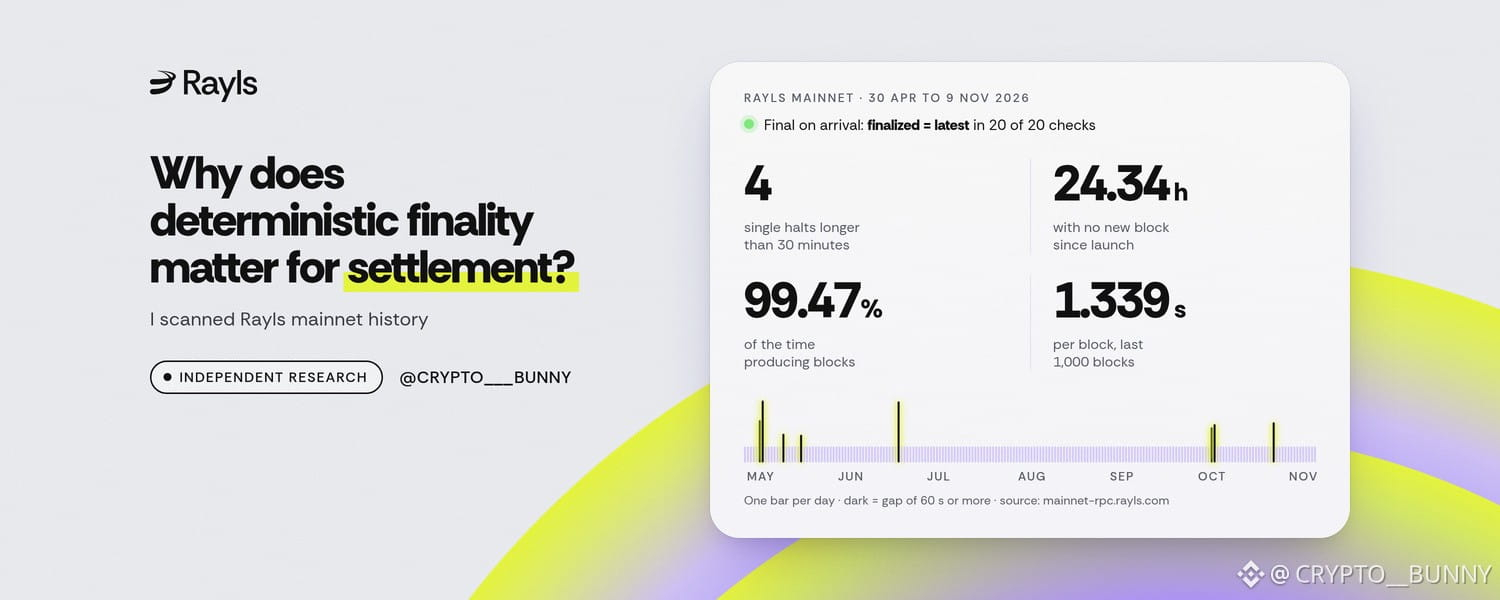
Why does deterministic finality matter for settlement? I scanned Rayls mainnet history.I read every block from launch on 30 Apr to 9 Nov using only the public RPC. No wallet nothing signed
What I found
Finality is real. In 20 out of 20 checks the finalized block and the latest block were the same block with the same hash. So once a block shows up its already final. no waiting for confirmations
Speed is about 1.34s per block not under 1s. Rayls site says under 1s but its own docs table says over 1s so they need one clear number
Since launch the chain had 44 gaps of 60s or more. 24.34h in total so its producing blocks 99.47% of the time. 4 of those were real halts over 30 min and the longest was 11h43m on 5 to 6 May
The weird part is timestamps. I found 203 blocks with old timestamps. On 27 Jul blocks kept coming normally but 32 of them were stamped up to 12h behind. Any explorer that trusts block time would show an 8h outage that never happened. My own first scan fell for it too
Good sign is @Rayls Rayls published a public root cause writeup for the 21 Jun halt and the onchain data lines up with it
My take. Finality is solid and thats what matters most for settlement. What I would fix first is the timestamps. If you build on Rayls order by block number not by time
Full article on my X and all scripts are public: https://github.com/marwan786797/rayls-finality-check
Sources
https://www.rayls.com/
https://docs.rayls.com/docs/axyl-performance-benchmarks
https://explorer.rayls.com/
https://github.com/raylsnetwork/axyl/blob/main/doc/incidents/2026-06-21-mainnet-halt.md
#Rayls $RLS
Why does deterministic finality matter for settlement? I scanned Rayls mainnet history.
I read every block from launch on 30 Apr to 9 Nov using only the public RPC. No wallet nothing signed
What I found
Finality is real. In 20 out of 20 checks the finalized block and the latest block were the same block with the same hash. So once a block shows up its already final. no waiting for confirmations
Speed is about 1.34s per block not under 1s. Rayls site says under 1s but its own docs table says over 1s so they need one clear number
Since launch the chain had 44 gaps of 60s or more. 24.34h in total so its producing blocks 99.47% of the time. 4 of those were real halts over 30 min and the longest was 11h43m on 5 to 6 May
The weird part is timestamps. I found 203 blocks with old timestamps. On 27 Jul blocks kept coming normally but 32 of them were stamped up to 12h behind. Any explorer that trusts block time would show an 8h outage that never happened. My own first scan fell for it too
Good sign is @Rayls Rayls published a public root cause writeup for the 21 Jun halt and the onchain data lines up with it
My take. Finality is solid and thats what matters most for settlement. What I would fix first is the timestamps. If you build on Rayls order by block number not by time
Full article on my X and all scripts are public: https://github.com/marwan786797/rayls-finality-check
Sources
https://www.rayls.com/
https://docs.rayls.com/docs/axyl-performance-benchmarks
https://explorer.rayls.com/
https://github.com/raylsnetwork/axyl/blob/main/doc/incidents/2026-06-21-mainnet-halt.md
#Rayls $RLS
1
156

·
--
Article
What’s the Difference Between Tokenized Deposits and USDT/USDC?I’m Agung Rayls Ambassador.
Lately, many people have been asking me about the difference between tokenized deposits and stablecoins like USDT or USDC. This question often comes from people who are still new to blockchain, and I believe it’s important to answer it clearly and honestly.
I wrote this article based on
@raylslabs
official documentation and blog, combined with my own observations while studying the ecosystem. I’ve tried to keep the language as simple as possible so that even those who are new to Rayls can follow along.
Who Issues the Money?
USDT and USDC are issued by third-party companies (Tether and Circle). They hold reserves and then issue tokens that can circulate freely across many blockchains. Banks can usually hold or sell these tokens, but they do not issue them and have limited direct control.
Tokenized deposits,on the other hand, are issued directly by the bank. According to Rayls’ official documentation, a tokenized deposit is a digital representation of value issued by an institution, often designed for consumer use in retail payments, settlements, or incentive schemes. Within a Rayls Sovereign ledger, these tokens can be securely minted, programmed, and transacted.[](<
https://docs.rayls.com/docs/rayls-node-use-cases-tokenised-deposit
>)
From what I’ve seen in Rayls’ architecture, this is one of the biggest differences: the bank remains the issuer, not just a user.
Control: Who Can Set the Rules?
With USDT/USDC, banks have little direct control. If there’s an issue (fraud, compliance, or a regulator’s request), the bank usually cannot freeze the customer’s tokens on its own.
On Rayls Sovereign, the bank retains control. Official documentation states that institutions can run smart contracts that enforce governance rules such as freezing, seizing, or locking tokens. There’s also a clear mechanism where a deposit can be locked on Sovereign, while a stablecoin representing its value is minted on the Public Chain. The original deposit stays on the institution’s balance sheet and never leaves its perimeter.[](<
https://docs.rayls.com/docs/a-warm-introduction-rayls-sovereign
>)
The flow works like this:
1. The tokenized deposit is registered and activated.
2. The deposit is locked in the institution’s own Rayls Sovereign ledger (not burned).
3. A stablecoin is minted on the Rayls Public Chain against that locked collateral.[](<
https://docs.rayls.com/docs/rayls-node-use-cases-tokenised-deposit
>)
In my view, this is why many institutions are interested. They don’t have to release customer funds just to give them access to the on-chain world.
From the Customer’s Perspective
I often tell friends who are new to this concept:
“If you want your money to still feel like money in the bank, a tokenized deposit is closer. If you want the freedom to move it anywhere in the crypto world, USDT/USDC is a better fit.”
Real Examples Already in Production
Several institutions have already used this approach in production environments, for example:
- XP Inc. issued USDXP (a USD stablecoin) on Rayls infrastructure.
- Several banks in Brazil participated in the Drex pilot with the Central Bank of Brazil, which involves tokenized deposits.
- Nuclea (a major financial market infrastructure in Brazil) has already run tokenization in production.
This is no longer just a concept on paper. Some of it is already live.
Simple Illustration: How the Flow Works
Here’s a simple flow of how a tokenized deposit works on Rayls:
This diagram shows the core mechanism: the deposit stays locked at the bank on Sovereign, while a usable stablecoin is minted on the public chain.
Important Note (For Accuracy)
From the official Rayls documentation and blog that I’ve read:
- A tokenized deposit is a product issued by an institution and remains under their control.
- The lock-and-mint mechanism is supported.
- However, the legal status and whether a tokenized deposit is automatically covered by deposit insurance schemes is not explicitly stated. This still depends on regulations in each country. I don’t want to overclaim on this point.
Quick Conclusion
USDT/USDC and tokenized deposits are both “digital money,” but their purpose and control differ.
- Want maximum freedom in the crypto world → USDT/USDC is more suitable.
- Want on-chain innovation while staying under the bank’s control → Tokenized deposits are more relevant.
In my opinion, both will likely coexist rather than replace each other. Banks need control and compliance, while crypto users need flexibility. Rayls is trying to bridge the two.
If you have questions or want me to explain any part in more detail (for example, the lock-and-mint mechanism or the examples in Brazil), feel free to ask in the comments or DM. I’m happy to discuss this.
---
Sources
1. Tokenised deposits and stablecoins on Rayls Sovereign
https://docs.rayls.com/docs/rayls-node-use-cases-tokenised-deposit
(Main source for definition and lock-and-mint flow)
2. Rayls Sovereign – Introduction
https://docs.rayls.com/docs/a-warm-introduction-rayls-sovereign
(Governance features: freeze, seize, lock)
3. The private-public settlement flow: tokenised deposits and stablecoins on Rayls
https://www.rayls.com/blog/the-private-public-settlement-flow-tokenised-deposits-and-stablecoins-on-rayls
4. Introducing Rayls Sovereign: the onchain gateway for institutions
https://www.rayls.com/blog/introducing-rayls-sovereign-the-onchain-gateway-for-institutions
5. Rayls product pages (Public Chain & Sovereign) for production examples (Drex, Nuclea, etc.)
#Rayls #RWA $RLS
What’s the Difference Between Tokenized Deposits and USDT/USDC?
I’m Agung Rayls Ambassador.
Lately, many people have been asking me about the difference between tokenized deposits and stablecoins like USDT or USDC. This question often comes from people who are still new to blockchain, and I believe it’s important to answer it clearly and honestly.
I wrote this article based on
@raylslabs
official documentation and blog, combined with my own observations while studying the ecosystem. I’ve tried to keep the language as simple as possible so that even those who are new to Rayls can follow along.
Who Issues the Money?
USDT and USDC are issued by third-party companies (Tether and Circle). They hold reserves and then issue tokens that can circulate freely across many blockchains. Banks can usually hold or sell these tokens, but they do not issue them and have limited direct control.
Tokenized deposits,on the other hand, are issued directly by the bank. According to Rayls’ official documentation, a tokenized deposit is a digital representation of value issued by an institution, often designed for consumer use in retail payments, settlements, or incentive schemes. Within a Rayls Sovereign ledger, these tokens can be securely minted, programmed, and transacted.[](<
https://docs.rayls.com/docs/rayls-node-use-cases-tokenised-deposit
>)
From what I’ve seen in Rayls’ architecture, this is one of the biggest differences: the bank remains the issuer, not just a user.
Control: Who Can Set the Rules?
With USDT/USDC, banks have little direct control. If there’s an issue (fraud, compliance, or a regulator’s request), the bank usually cannot freeze the customer’s tokens on its own.
On Rayls Sovereign, the bank retains control. Official documentation states that institutions can run smart contracts that enforce governance rules such as freezing, seizing, or locking tokens. There’s also a clear mechanism where a deposit can be locked on Sovereign, while a stablecoin representing its value is minted on the Public Chain. The original deposit stays on the institution’s balance sheet and never leaves its perimeter.[](<
https://docs.rayls.com/docs/a-warm-introduction-rayls-sovereign
>)
The flow works like this:
1. The tokenized deposit is registered and activated.
2. The deposit is locked in the institution’s own Rayls Sovereign ledger (not burned).
3. A stablecoin is minted on the Rayls Public Chain against that locked collateral.[](<
https://docs.rayls.com/docs/rayls-node-use-cases-tokenised-deposit
>)
In my view, this is why many institutions are interested. They don’t have to release customer funds just to give them access to the on-chain world.
From the Customer’s Perspective
I often tell friends who are new to this concept:
“If you want your money to still feel like money in the bank, a tokenized deposit is closer. If you want the freedom to move it anywhere in the crypto world, USDT/USDC is a better fit.”
Real Examples Already in Production
Several institutions have already used this approach in production environments, for example:
- XP Inc. issued USDXP (a USD stablecoin) on Rayls infrastructure.
- Several banks in Brazil participated in the Drex pilot with the Central Bank of Brazil, which involves tokenized deposits.
- Nuclea (a major financial market infrastructure in Brazil) has already run tokenization in production.
This is no longer just a concept on paper. Some of it is already live.
Simple Illustration: How the Flow Works
Here’s a simple flow of how a tokenized deposit works on Rayls:
This diagram shows the core mechanism: the deposit stays locked at the bank on Sovereign, while a usable stablecoin is minted on the public chain.
Important Note (For Accuracy)
From the official Rayls documentation and blog that I’ve read:
- A tokenized deposit is a product issued by an institution and remains under their control.
- The lock-and-mint mechanism is supported.
- However, the legal status and whether a tokenized deposit is automatically covered by deposit insurance schemes is not explicitly stated. This still depends on regulations in each country. I don’t want to overclaim on this point.
Quick Conclusion
USDT/USDC and tokenized deposits are both “digital money,” but their purpose and control differ.
- Want maximum freedom in the crypto world → USDT/USDC is more suitable.
- Want on-chain innovation while staying under the bank’s control → Tokenized deposits are more relevant.
In my opinion, both will likely coexist rather than replace each other. Banks need control and compliance, while crypto users need flexibility. Rayls is trying to bridge the two.
If you have questions or want me to explain any part in more detail (for example, the lock-and-mint mechanism or the examples in Brazil), feel free to ask in the comments or DM. I’m happy to discuss this.
---
Sources
1. Tokenised deposits and stablecoins on Rayls Sovereign
https://docs.rayls.com/docs/rayls-node-use-cases-tokenised-deposit
(Main source for definition and lock-and-mint flow)
2. Rayls Sovereign – Introduction
https://docs.rayls.com/docs/a-warm-introduction-rayls-sovereign
(Governance features: freeze, seize, lock)
3. The private-public settlement flow: tokenised deposits and stablecoins on Rayls
https://www.rayls.com/blog/the-private-public-settlement-flow-tokenised-deposits-and-stablecoins-on-rayls
4. Introducing Rayls Sovereign: the onchain gateway for institutions
https://www.rayls.com/blog/introducing-rayls-sovereign-the-onchain-gateway-for-institutions
5. Rayls product pages (Public Chain & Sovereign) for production examples (Drex, Nuclea, etc.)
#Rayls #RWA $RLS
168
·
--
Article
Inside Rayls’ First Vault Launch: Deposits, Rewards & Contract Controls@Rayls opened deposits for its first vault on October 15, 2026. Instead of looking only at the launch announcement, I examined the bridge activity, reserve report, reward schedule changes, actual deposit transactions, and vault contract architecture to understand what the available evidence really shows.
Here are the key findings 👇
🔹 1. Bridge Activity and Token Supply
The Polygon bridge-vault records examined showed 264,868.416247 BRL1 in incoming transfers and 9,576.454346 BRL1 in outgoing transfers, leaving a net balance of 255,291.961901 BRL1.
The Rayls explorer displayed a BRL1.p total supply of 255,291.962. These figures closely reconcile to the displayed precision.
This is useful onchain evidence, but it does not independently prove continuous 1:1 backing at every block or timestamp.
🔹 2. What the Proof of Reserves Report Shows
The October 1, 2026, BRL1 Proof of Reserves report listed total reserves of R$19,354,372, distributed across bank deposits, Brazilian Treasury bills (LFTs), and repos.
The report stated collateralisation of 111.35% against the circulating supply at its specified reference point.
There is an important limitation: the report explicitly stated that it had not yet been audited by an independent entity. Its figures should therefore be understood in that context.
🔹 3. Changes to the Reward Schedule
The original weekly reward rates were:
• Week 1: 10,000 RLS per 1,000 BRL1.p
• Week 2: 8,000 RLS
• Week 3: 6,000 RLS
• Week 4: 4,000 RLS
The rates were later reduced by 50% for new deposits, becoming 5,000, 4,000, 3,000, and 2,000 RLS respectively.
Deposits within the first R$250,000 retained the original rates. This distinction matters when assessing individual deposit transactions and their expected reward allocations.
🔹 4. What Actual Deposit Transactions Reveal
I examined two onchain deposits.
The October 16 transaction recorded a deposit of 100,000 BRL1.p with a reward allocation of 1,000,000 RLS, consistent with the original Week 1 rate.
The October 28 transaction recorded a deposit of 5,271.47899 BRL1.p with a reward allocation of 21,085.91596 RLS, consistent with the revised Week 2 rate.
These transactions provide concrete evidence of recorded deposits and calculated reward allocations. They should not be confused with proof that the rewards have already been paid.
🔹 5. Lock-Up Conditions and Reward Delivery
The launch terms included a deposit lock-up, scheduled reward credits into staking, and a 14-day unbonding period for staked rewards.
The reward credit dates specified in the schedule were still in the future as of November 2, 2026. Actual delivery therefore needs to be assessed when those dates arrive, rather than assumed from the deposit records alone.
🔹 6. Vault Contract Architecture
The vault uses an ERC1967 proxy linked to a separate implementation contract. This architecture allows the proxy to route interactions to the implementation.
However, identifying the proxy and implementation does not establish who controls upgrades. The administrator, multisig or timelock arrangements, and complete upgrade history were not independently verified in this analysis.
Final Takeaway
The available evidence shows real onchain deposit activity, reward calculations consistent with the applicable rates, and a close numerical reconciliation between the examined Polygon bridge-vault transfers and the displayed Rayls token supply.
At the same time, several questions must remain separate: independent reserve assurance, actual reward delivery, and the people or mechanisms controlling contract upgrades.
A strong analysis should not treat every claim as proven simply because a transaction or contract exists. It should clearly distinguish verified records, published terms, and details that still require confirmation.
#Rayls $RLS
Inside Rayls’ First Vault Launch: Deposits, Rewards & Contract Controls
@Rayls opened deposits for its first vault on October 15, 2026. Instead of looking only at the launch announcement, I examined the bridge activity, reserve report, reward schedule changes, actual deposit transactions, and vault contract architecture to understand what the available evidence really shows.
Here are the key findings 👇
🔹 1. Bridge Activity and Token Supply
The Polygon bridge-vault records examined showed 264,868.416247 BRL1 in incoming transfers and 9,576.454346 BRL1 in outgoing transfers, leaving a net balance of 255,291.961901 BRL1.
The Rayls explorer displayed a BRL1.p total supply of 255,291.962. These figures closely reconcile to the displayed precision.
This is useful onchain evidence, but it does not independently prove continuous 1:1 backing at every block or timestamp.
🔹 2. What the Proof of Reserves Report Shows
The October 1, 2026, BRL1 Proof of Reserves report listed total reserves of R$19,354,372, distributed across bank deposits, Brazilian Treasury bills (LFTs), and repos.
The report stated collateralisation of 111.35% against the circulating supply at its specified reference point.
There is an important limitation: the report explicitly stated that it had not yet been audited by an independent entity. Its figures should therefore be understood in that context.
🔹 3. Changes to the Reward Schedule
The original weekly reward rates were:
• Week 1: 10,000 RLS per 1,000 BRL1.p
• Week 2: 8,000 RLS
• Week 3: 6,000 RLS
• Week 4: 4,000 RLS
The rates were later reduced by 50% for new deposits, becoming 5,000, 4,000, 3,000, and 2,000 RLS respectively.
Deposits within the first R$250,000 retained the original rates. This distinction matters when assessing individual deposit transactions and their expected reward allocations.
🔹 4. What Actual Deposit Transactions Reveal
I examined two onchain deposits.
The October 16 transaction recorded a deposit of 100,000 BRL1.p with a reward allocation of 1,000,000 RLS, consistent with the original Week 1 rate.
The October 28 transaction recorded a deposit of 5,271.47899 BRL1.p with a reward allocation of 21,085.91596 RLS, consistent with the revised Week 2 rate.
These transactions provide concrete evidence of recorded deposits and calculated reward allocations. They should not be confused with proof that the rewards have already been paid.
🔹 5. Lock-Up Conditions and Reward Delivery
The launch terms included a deposit lock-up, scheduled reward credits into staking, and a 14-day unbonding period for staked rewards.
The reward credit dates specified in the schedule were still in the future as of November 2, 2026. Actual delivery therefore needs to be assessed when those dates arrive, rather than assumed from the deposit records alone.
🔹 6. Vault Contract Architecture
The vault uses an ERC1967 proxy linked to a separate implementation contract. This architecture allows the proxy to route interactions to the implementation.
However, identifying the proxy and implementation does not establish who controls upgrades. The administrator, multisig or timelock arrangements, and complete upgrade history were not independently verified in this analysis.
Final Takeaway
The available evidence shows real onchain deposit activity, reward calculations consistent with the applicable rates, and a close numerical reconciliation between the examined Polygon bridge-vault transfers and the displayed Rayls token supply.
At the same time, several questions must remain separate: independent reserve assurance, actual reward delivery, and the people or mechanisms controlling contract upgrades.
A strong analysis should not treat every claim as proven simply because a transaction or contract exists. It should clearly distinguish verified records, published terms, and details that still require confirmation.
#Rayls $RLS
3
468

Article
How is Rayls staking APY calculated, and how are actual rewards paid out?When looking at the staking APY for @Rayls , is it enough to just check the displayed yield?
To understand the actual yield, there’s one more thing to look at.
How are earnings recorded, calculated as APY, and ultimately paid out as actual rewards?
This time, I directly compared the "RewardCurve" and "RewardDistributor" code in the official Rayls repository.
1. Is network revenue automatically reflected in staking APY?
"RewardCurve" is designed to calculate annual APY by combining the base monthly emission with variable emissions.
How is Rayls staking APY calculated, and how are actual rewards paid out?
When looking at the staking APY for @Rayls , is it enough to just check the displayed yield?
To understand the actual yield, there’s one more thing to look at.
How are earnings recorded, calculated as APY, and ultimately paid out as actual rewards?
This time, I directly compared the "RewardCurve" and "RewardDistributor" code in the official Rayls repository.
1. Is network revenue automatically reflected in staking APY?
"RewardCurve" is designed to calculate annual APY by combining the base monthly emission with variable emissions.
1
103

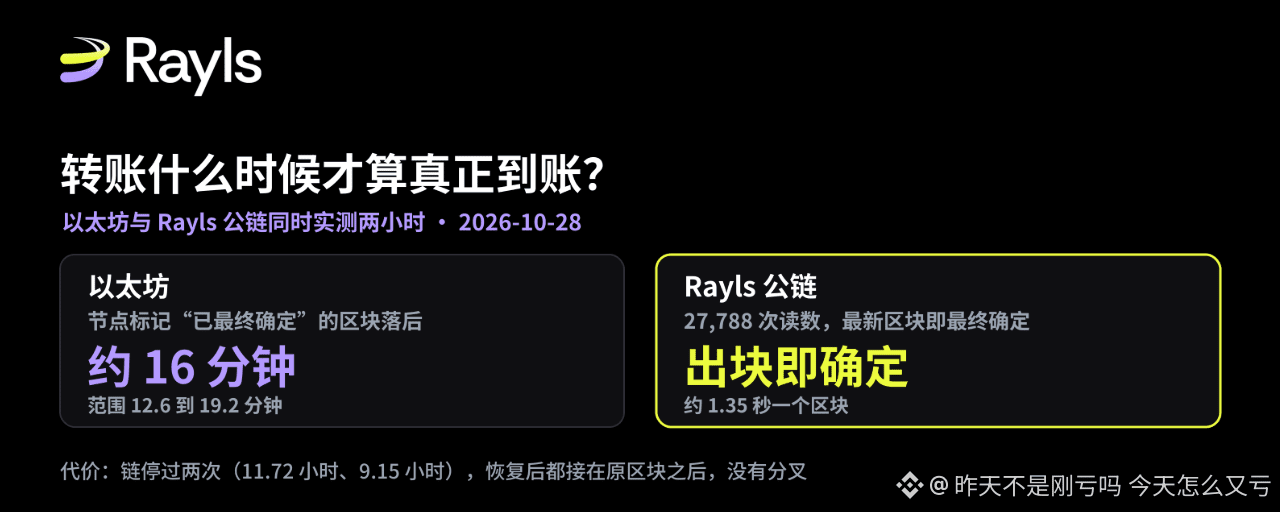
Article
When Has a Blockchain Transfer Truly Arrived? A Real-World Test of "Finality" on Ethereum and RaylsIn my last few posts, I’ve been measuring how long Rayls proofs take to compute. But for banks, there’s a more fundamental question: when has money truly arrived—and can no longer be taken back? This week, I changed direction and had GitHub’s servers monitor both Ethereum and the Rayls public chain for two hours, to see how they answer that question for themselves.
Here’s the short answer first. When banks say a payment has "arrived," they mean two things: it’s legally irrevocable, and it can’t be rolled back technically. On the technical side, Ethereum nodes mark a block as "finalized" 12.6 to 19.2 minutes after the latest block, with a median of 16 minutes. The Rayls public chain, by contrast, marks each block as finalized the moment it is produced, with a new block appearing roughly every 1.35 seconds. This kind of "deterministic finality" comes at a cost: if consensus can’t progress, the chain stops instead of forking. The Rayls public chain has stopped at least twice since launch—once for 11.72 hours and once for 9.15 hours. After both outages, it resumed directly from the block where it had stopped.
When Has a Blockchain Transfer Truly Arrived? A Real-World Test of "Finality" on Ethereum and Rayls
In my last few posts, I’ve been measuring how long Rayls proofs take to compute. But for banks, there’s a more fundamental question: when has money truly arrived—and can no longer be taken back? This week, I changed direction and had GitHub’s servers monitor both Ethereum and the Rayls public chain for two hours, to see how they answer that question for themselves.
Here’s the short answer first. When banks say a payment has "arrived," they mean two things: it’s legally irrevocable, and it can’t be rolled back technically. On the technical side, Ethereum nodes mark a block as "finalized" 12.6 to 19.2 minutes after the latest block, with a median of 16 minutes. The Rayls public chain, by contrast, marks each block as finalized the moment it is produced, with a new block appearing roughly every 1.35 seconds. This kind of "deterministic finality" comes at a cost: if consensus can’t progress, the chain stops instead of forking. The Rayls public chain has stopped at least twice since launch—once for 11.72 hours and once for 9.15 hours. After both outages, it resumed directly from the block where it had stopped.
2
373
Verified
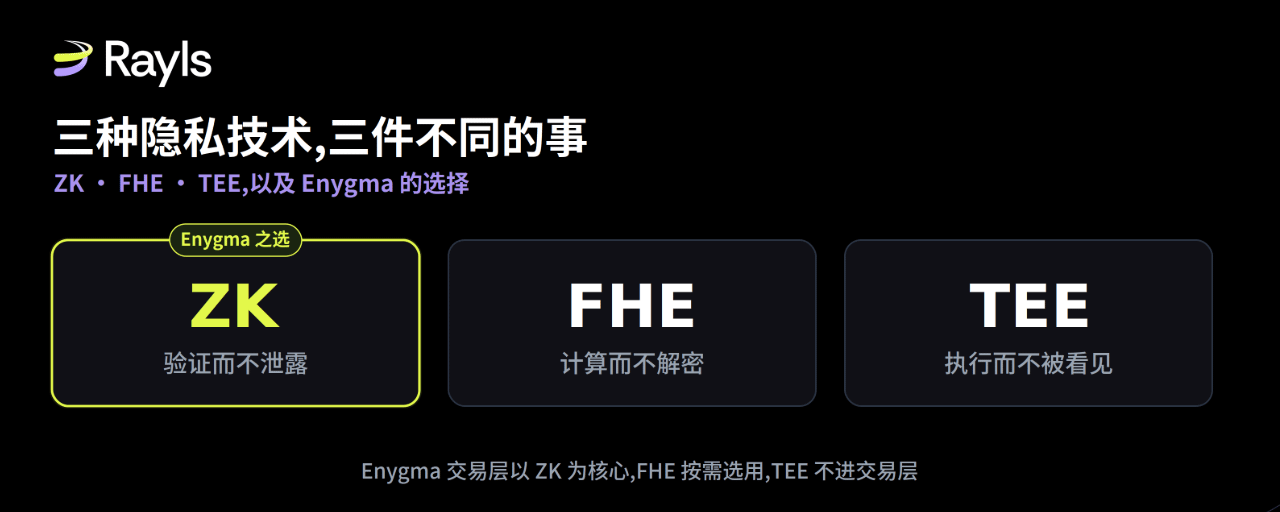
Article
Someone asked me which is strongest: ZK, FHE, or TEE—and I think they asked the wrong question!To be honest, the first time I saw these three abbreviations put together, I thought they were three different answers to the same question: faster, safer—pick one and you’re done. Later I realized that ranking them side by side is like asking, “Which is best—a hammer, a screwdriver, or a wrench?” The answer depends on whether you have a nail, a screw, or a bolt.
The issues they each solve are actually three problems that have been conflated.
The first problem is: I want to prove that something is true, but the data needed for the proof is sensitive, and I don't want to show it to you. A bank wants to tell regulators that a transaction is legal, authorization is correct, and there are no duplicates—yet it doesn't want to put the amounts and the payer/payee details on the ledgers. This kind of proof that is true but doesn't reveal the underlying data is ZK’s home turf. Its charm lies in guaranteeing the conclusion comes from mathematics, not from “I promise you, I won’t let you see.” Regulators or auditors who receive the verification key can check the result, but they can’t touch the underlying data. The cost is also real: it’s good at proving properties of data, but not good at letting multiple parties compute together when no one has complete data, and it’s far more compute-intensive than plaintext.
Someone asked me which is strongest: ZK, FHE, or TEE—and I think they asked the wrong question!
To be honest, the first time I saw these three abbreviations put together, I thought they were three different answers to the same question: faster, safer—pick one and you’re done. Later I realized that ranking them side by side is like asking, “Which is best—a hammer, a screwdriver, or a wrench?” The answer depends on whether you have a nail, a screw, or a bolt.
The issues they each solve are actually three problems that have been conflated.
The first problem is: I want to prove that something is true, but the data needed for the proof is sensitive, and I don't want to show it to you. A bank wants to tell regulators that a transaction is legal, authorization is correct, and there are no duplicates—yet it doesn't want to put the amounts and the payer/payee details on the ledgers. This kind of proof that is true but doesn't reveal the underlying data is ZK’s home turf. Its charm lies in guaranteeing the conclusion comes from mathematics, not from “I promise you, I won’t let you see.” Regulators or auditors who receive the verification key can check the result, but they can’t touch the underlying data. The cost is also real: it’s good at proving properties of data, but not good at letting multiple parties compute together when no one has complete data, and it’s far more compute-intensive than plaintext.
1
385
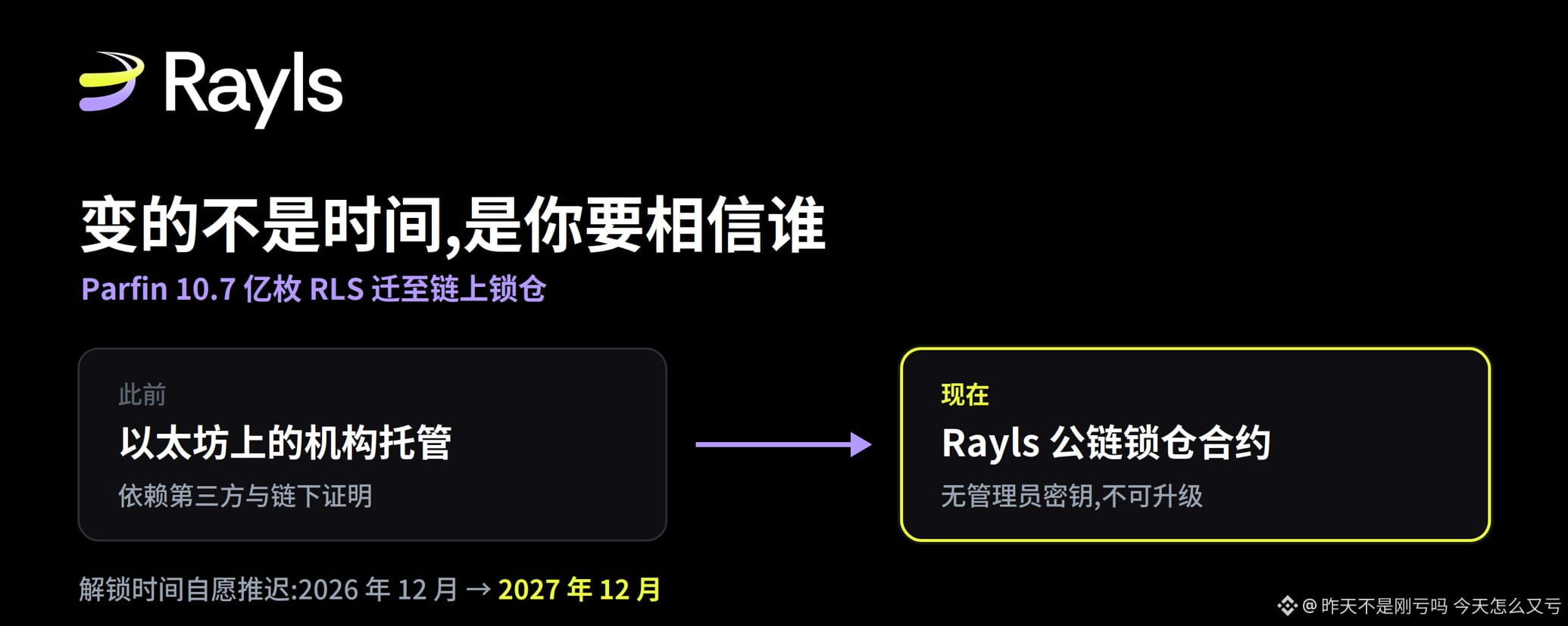
Article
What truly changed with this lockup isn’t the time—it’s who you need to trustWhen I look at lockup announcements, they usually only care about one thing: whether this commitment can be verified. Most projects’ “team lockup” ultimately comes down to a single sentence—you either choose to believe it or you don’t. This time is a bit different, so I checked on-chain.
First, let’s state the facts clearly. Parfin is the core technology provider behind Rayls. It is responsible for developing privacy nodes, the private network, the Enygma privacy framework, and the Rayls mainnet. As compensation for its work prior to the TGE, it received 1,070,493,535 RLS tokens—about 11% of the initial total supply of 10 billion.
This batch of tokens was previously held by an institutional custodian on Ethereum. The reason is straightforward: at the time of the TGE, the Rayls chain hadn’t gone live yet, so the tokens could only be held in custody. Now that the mainnet is available, this batch has been migrated to the Rayls chain and locked in a smart contract that can be publicly verified. At the same time, the unlock date has been pushed back from December 2026 to December 2027.
What truly changed with this lockup isn’t the time—it’s who you need to trust
When I look at lockup announcements, they usually only care about one thing: whether this commitment can be verified. Most projects’ “team lockup” ultimately comes down to a single sentence—you either choose to believe it or you don’t. This time is a bit different, so I checked on-chain.
First, let’s state the facts clearly. Parfin is the core technology provider behind Rayls. It is responsible for developing privacy nodes, the private network, the Enygma privacy framework, and the Rayls mainnet. As compensation for its work prior to the TGE, it received 1,070,493,535 RLS tokens—about 11% of the initial total supply of 10 billion.
This batch of tokens was previously held by an institutional custodian on Ethereum. The reason is straightforward: at the time of the TGE, the Rayls chain hadn’t gone live yet, so the tokens could only be held in custody. Now that the mainnet is available, this batch has been migrated to the Rayls chain and locked in a smart contract that can be publicly verified. At the same time, the unlock date has been pushed back from December 2026 to December 2027.
170
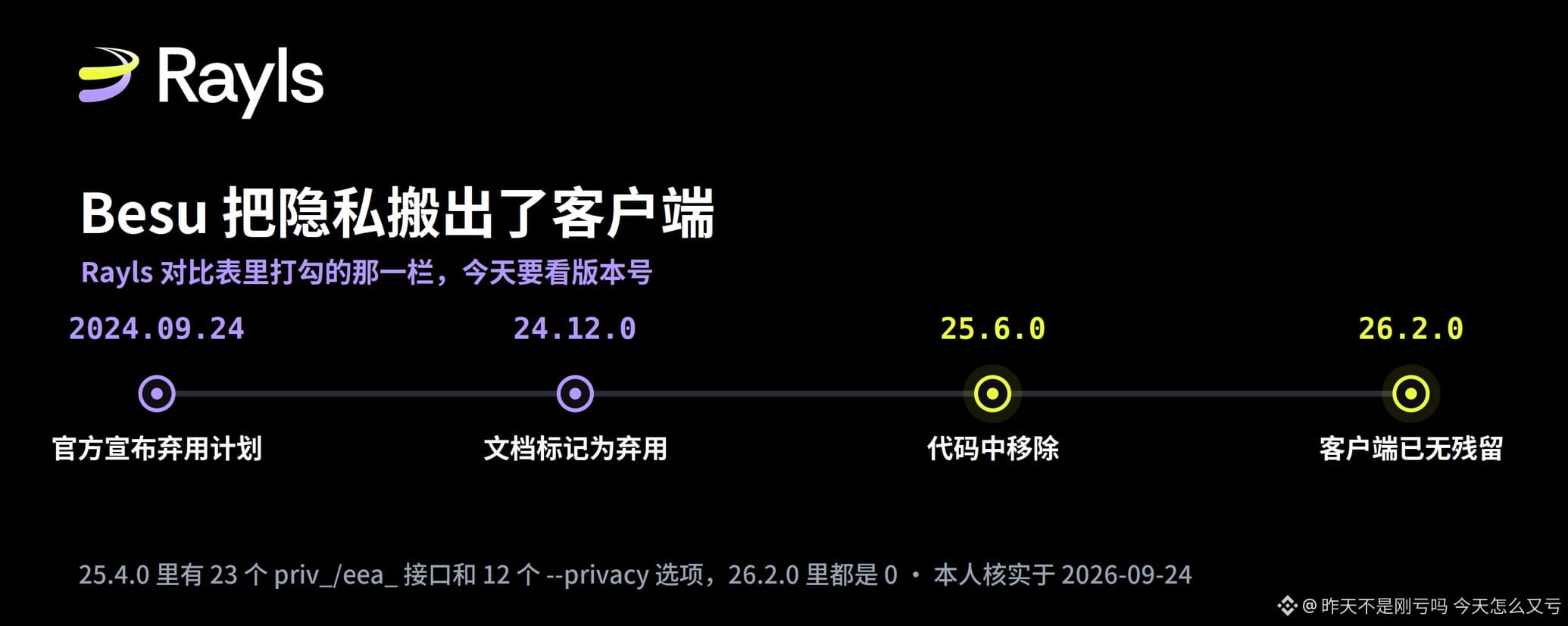
Article
Rayls’ comparison table says Besu supports privacy, so I counted it in its codeIn the Rayls official website supplier comparison table, there are nine rows, and I chose the one labeled “Privacy.” The reason is simple: privacy is important, and Besu is open source—its documentation and code are both available for me to look up.
In the comparison table, Rayls checks both rows—“Isolated Privacy” and “Cryptographic Privacy”—while Besu only checks the first row. I planned to verify using the other party’s own documentation, so I looked up Besu’s documentation, then pulled down its code and counted it line by line.
The conclusion isn’t “Besu doesn’t work.” The real difference is this: these two companies place privacy at different layers, and Besu moved it away earlier than many people think.
Rayls’ comparison table says Besu supports privacy, so I counted it in its code
In the Rayls official website supplier comparison table, there are nine rows, and I chose the one labeled “Privacy.” The reason is simple: privacy is important, and Besu is open source—its documentation and code are both available for me to look up.
In the comparison table, Rayls checks both rows—“Isolated Privacy” and “Cryptographic Privacy”—while Besu only checks the first row. I planned to verify using the other party’s own documentation, so I looked up Besu’s documentation, then pulled down its code and counted it line by line.
The conclusion isn’t “Besu doesn’t work.” The real difference is this: these two companies place privacy at different layers, and Besu moved it away earlier than many people think.
281
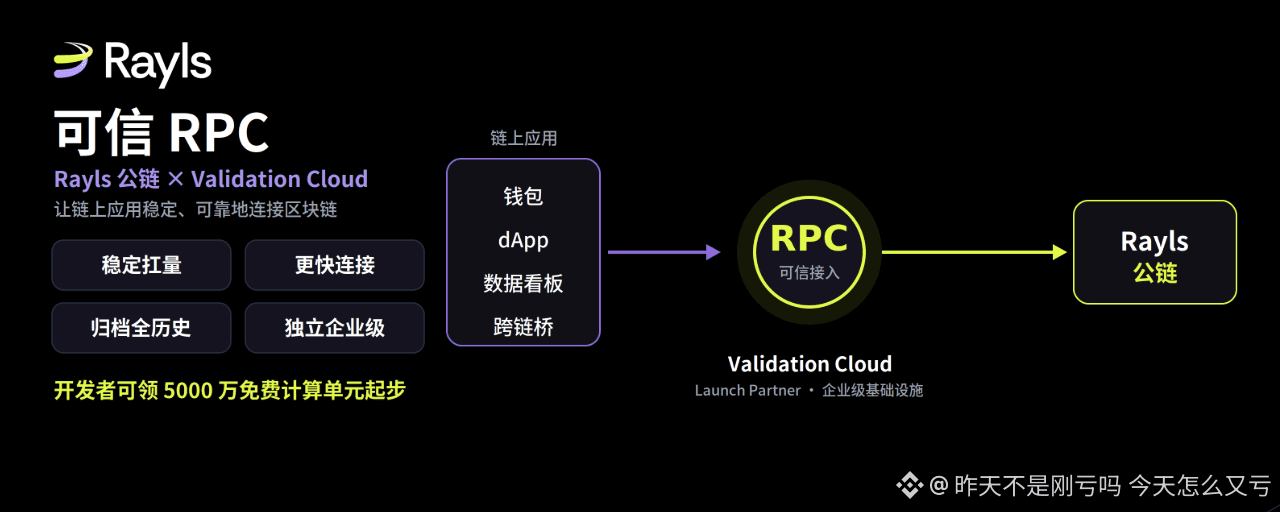
Article
Good news, good news, good news!!!! Rayls public chain has integrated a trusted RPC!!!Brothers, I’ve been lurking in the Rayls community for a long time. I know everyone is very dissatisfied with the team—so am I. But the team is really doing work and has been putting in effort. It’s just that the Rayls team is taking a compliance-first route. Brothers, don’t give up—leave it to time. I believe the Rayls team will ultimately deliver the exam papers that satisfy us. Let me share some good news with you brothers—it's about the recent Rayls team integrating with an RPC. This is a very important thing!!
A quick overview at a glance
What is RPC
You can think of RPC as a dedicated hotline between an application and the blockchain.
Good news, good news, good news!!!! Rayls public chain has integrated a trusted RPC!!!
Brothers, I’ve been lurking in the Rayls community for a long time. I know everyone is very dissatisfied with the team—so am I. But the team is really doing work and has been putting in effort. It’s just that the Rayls team is taking a compliance-first route. Brothers, don’t give up—leave it to time. I believe the Rayls team will ultimately deliver the exam papers that satisfy us. Let me share some good news with you brothers—it's about the recent Rayls team integrating with an RPC. This is a very important thing!!
A quick overview at a glance
What is RPC
You can think of RPC as a dedicated hotline between an application and the blockchain.
1
460
Partly True
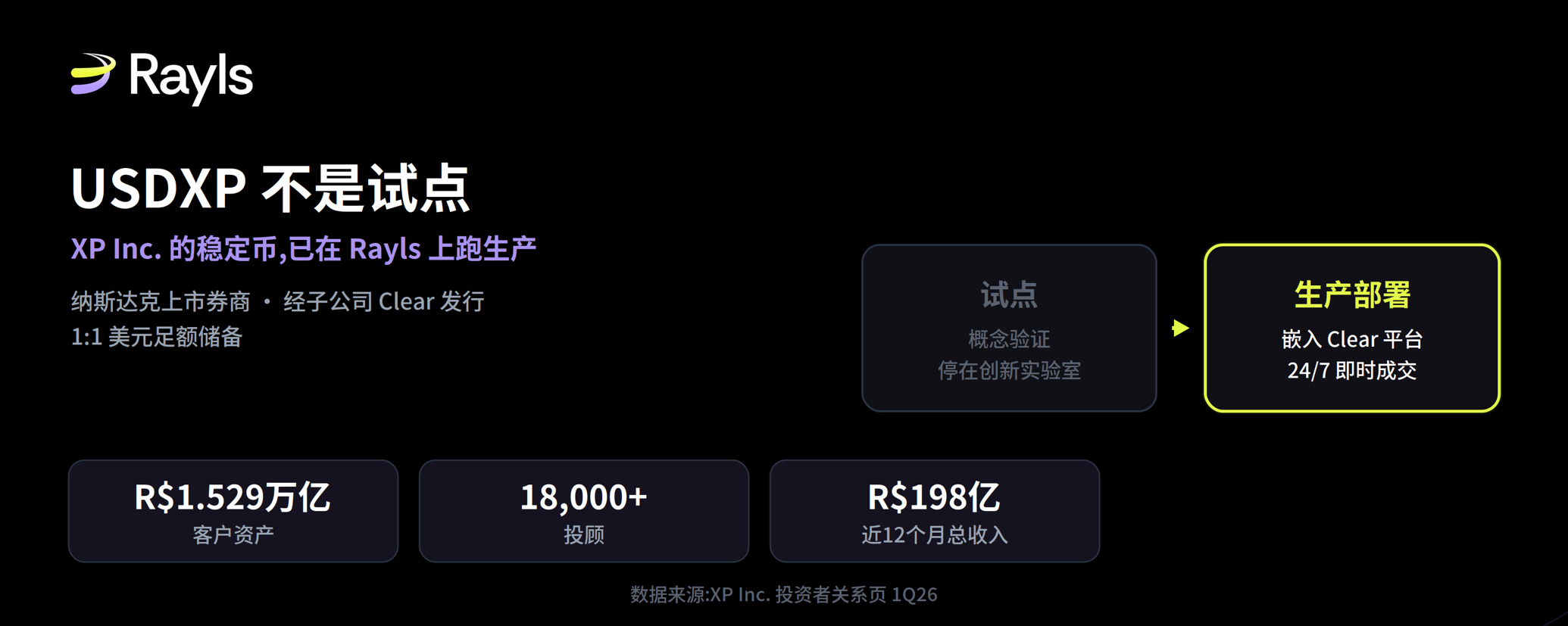
Article
To judge whether an institution is truly on-chain, look at one thing: can ordinary customers use it directly?In the crypto circle, you can see “some traditional finance giant is moving into blockchain” every week. I mostly swipe past headlines like this, because in most cases they end up in an innovation lab, issue a press release, and then there’s no follow-up. There’s a very simple way to judge whether something is true: for an ordinary customer, in their own app, can they directly click in and use it?
XP Inc. This time it met the standard.
First, get a clear picture of the company, because its scale determines how much weight this carries. XP is a Brazil-based investment platform listed on Nasdaq, ticker symbol XP. I checked its investor relations page for Q1 2026 data: customer assets are on the order of R$152.9 billion reais—more precisely, R$1.529 trillion; there are more than 18,000 financial advisors; and over the past twelve months, total revenue is R$19.8 billion reais, with pre-tax profit of R$5.8 billion reais.
To judge whether an institution is truly on-chain, look at one thing: can ordinary customers use it directly?
In the crypto circle, you can see “some traditional finance giant is moving into blockchain” every week. I mostly swipe past headlines like this, because in most cases they end up in an innovation lab, issue a press release, and then there’s no follow-up. There’s a very simple way to judge whether something is true: for an ordinary customer, in their own app, can they directly click in and use it?
XP Inc. This time it met the standard.
First, get a clear picture of the company, because its scale determines how much weight this carries. XP is a Brazil-based investment platform listed on Nasdaq, ticker symbol XP. I checked its investor relations page for Q1 2026 data: customer assets are on the order of R$152.9 billion reais—more precisely, R$1.529 trillion; there are more than 18,000 financial advisors; and over the past twelve months, total revenue is R$19.8 billion reais, with pre-tax profit of R$5.8 billion reais.
1
274
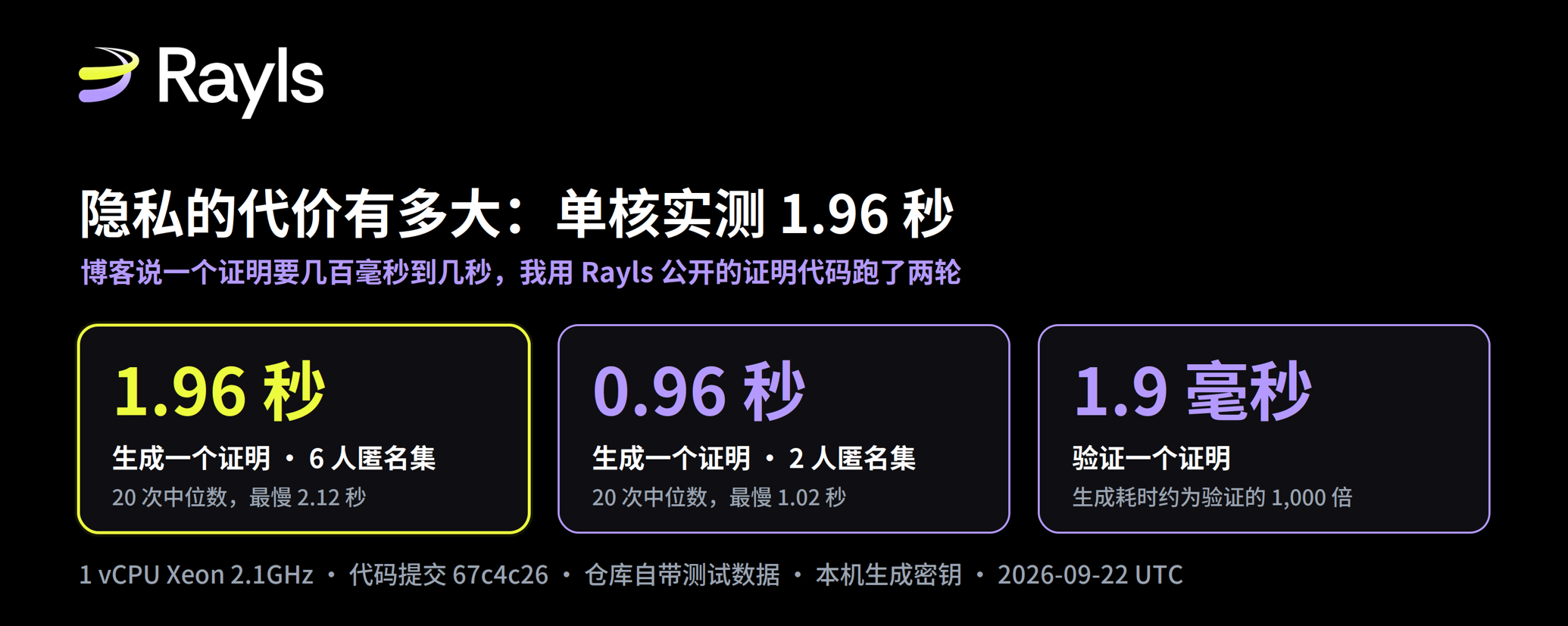
Article
Rayls says privacy has a cost—I've run its proof code onceOn September 19, Rayls published a post (“Privacy has a price”). The title said “honest math,” but the entire piece only provided a single range of numbers: a proof takes anywhere from a few hundred milliseconds to a few seconds. For weeks I kept writing about Rayls’ privacy architecture; this time I’m sharing the new stuff with everyone. I pulled down the publicly released proof code, ran it dozens of times in practice, and I’m sharing this interesting conclusion!
Let’s first talk about what the blog covers. Its core argument can be summarized in two sentences. The first sentence is where the cost comes from: confidential transactions are more expensive than transparent ones—mainly because generating zero-knowledge proofs is costly, while verification is relatively cheap. Even a basic confidential transfer proof takes several hundred milliseconds to a few seconds on ordinary commercial hardware. The second sentence is what you should ask: institutions shouldn’t only ask about TPS; they should ask what the throughput is under the level of privacy and auditability they actually need when facing real business workloads. The blog argues that the volume in interbank settlement isn’t large, and it falls well within what confidential settlement systems can handle.
Rayls says privacy has a cost—I've run its proof code once
On September 19, Rayls published a post (“Privacy has a price”). The title said “honest math,” but the entire piece only provided a single range of numbers: a proof takes anywhere from a few hundred milliseconds to a few seconds. For weeks I kept writing about Rayls’ privacy architecture; this time I’m sharing the new stuff with everyone. I pulled down the publicly released proof code, ran it dozens of times in practice, and I’m sharing this interesting conclusion!
Let’s first talk about what the blog covers. Its core argument can be summarized in two sentences. The first sentence is where the cost comes from: confidential transactions are more expensive than transparent ones—mainly because generating zero-knowledge proofs is costly, while verification is relatively cheap. Even a basic confidential transfer proof takes several hundred milliseconds to a few seconds on ordinary commercial hardware. The second sentence is what you should ask: institutions shouldn’t only ask about TPS; they should ask what the throughput is under the level of privacy and auditability they actually need when facing real business workloads. The blog argues that the volume in interbank settlement isn’t large, and it falls well within what confidential settlement systems can handle.
1
290
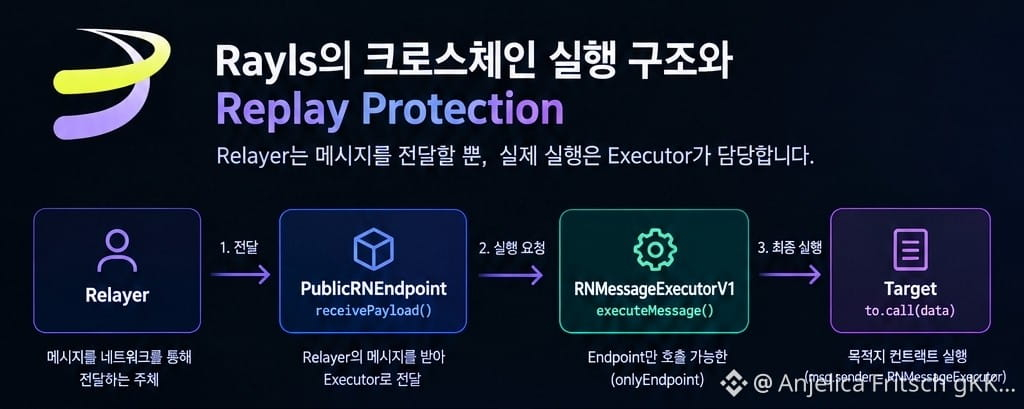
Article
Does the Relayer in Rayls Really Execute Messages?$RLS
While reviewing the Rayls Relayer code again, I noticed something odd.
If the Relayer is the one delivering messages, shouldn’t it also have RELAYER permission for "executeMessage()"?
But when I traced the actual code, that wasn’t the case.
Instead, Rayls separates the authority to deliver messages from the authority to actually execute them.
On the Public Chain, the first place the Relayer enters is "PublicRNEndpoint.receivePayload()".
Rather than executing the message directly here,
Does the Relayer in Rayls Really Execute Messages?
$RLS
While reviewing the Rayls Relayer code again, I noticed something odd.
If the Relayer is the one delivering messages, shouldn’t it also have RELAYER permission for "executeMessage()"?
But when I traced the actual code, that wasn’t the case.
Instead, Rayls separates the authority to deliver messages from the authority to actually execute them.
On the Public Chain, the first place the Relayer enters is "PublicRNEndpoint.receivePayload()".
Rather than executing the message directly here,
1
122
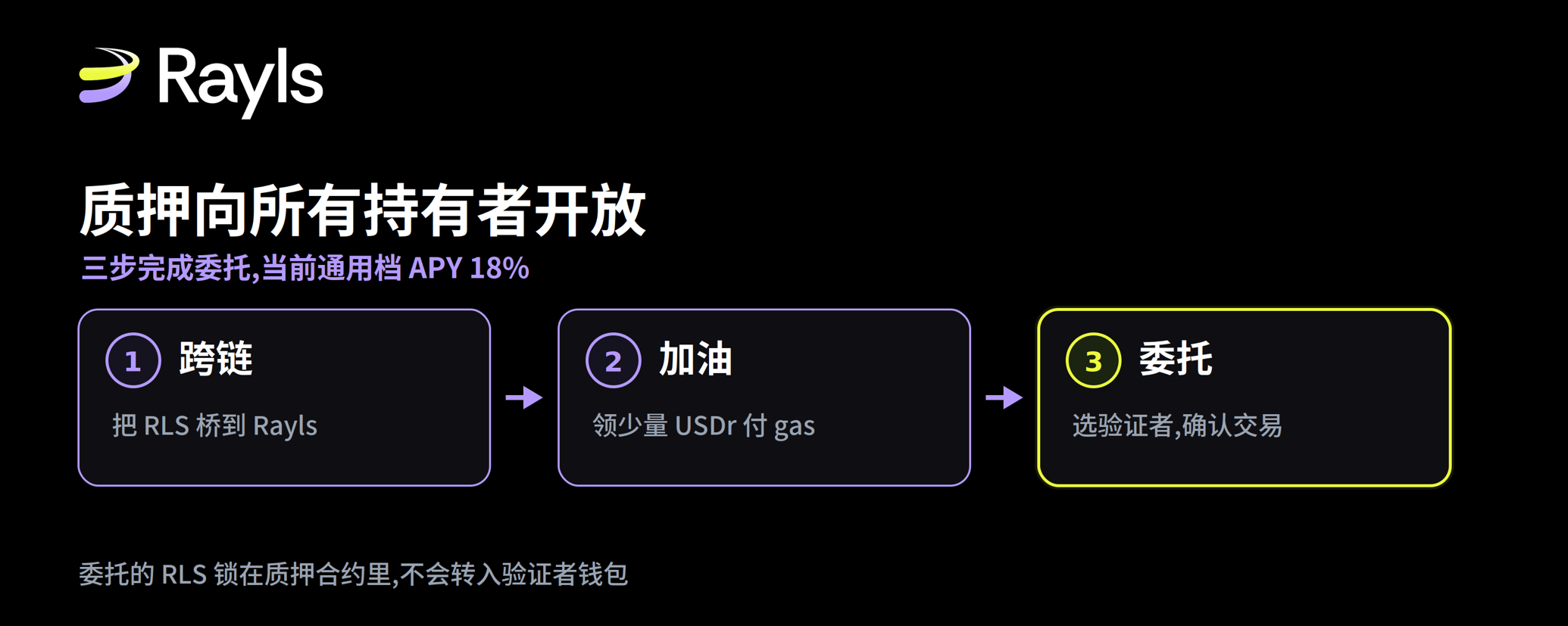
Article
Staking is now open to everyone, but there are a few things you should know firstI started staking from the batch of pre-commitments in June, so I’ve gone through this whole process already. This time it’s open to everyone. A lot of people around me have been asking how to operate it and what to watch out for, so I’m just going to lay everything out clearly in one go.
First, let’s talk about the change itself.
Rayls uses delegated proof-of-stake: validators run nodes, produce blocks, and help secure the public chain. Regular holders don’t need to run nodes themselves—they can delegate their RLS to a validator and share part of the staking rewards.
This mechanism went live in June, but at the time it was only available to wallets that participated in the pre-commitment plan and the liquidity seed activities. Those participants locked their tokens before the mainnet launch, and the official team offered a three-month 55% boosted annualized return. They even sent 1 USDr to each qualifying wallet so they wouldn’t even have to worry about having gas.
Staking is now open to everyone, but there are a few things you should know first
I started staking from the batch of pre-commitments in June, so I’ve gone through this whole process already. This time it’s open to everyone. A lot of people around me have been asking how to operate it and what to watch out for, so I’m just going to lay everything out clearly in one go.
First, let’s talk about the change itself.
Rayls uses delegated proof-of-stake: validators run nodes, produce blocks, and help secure the public chain. Regular holders don’t need to run nodes themselves—they can delegate their RLS to a validator and share part of the staking rewards.
This mechanism went live in June, but at the time it was only available to wallets that participated in the pre-commitment plan and the liquidity seed activities. Those participants locked their tokens before the mainnet launch, and the official team offered a three-month 55% boosted annualized return. They even sent 1 USDr to each qualifying wallet so they wouldn’t even have to worry about having gas.
285
Partly True
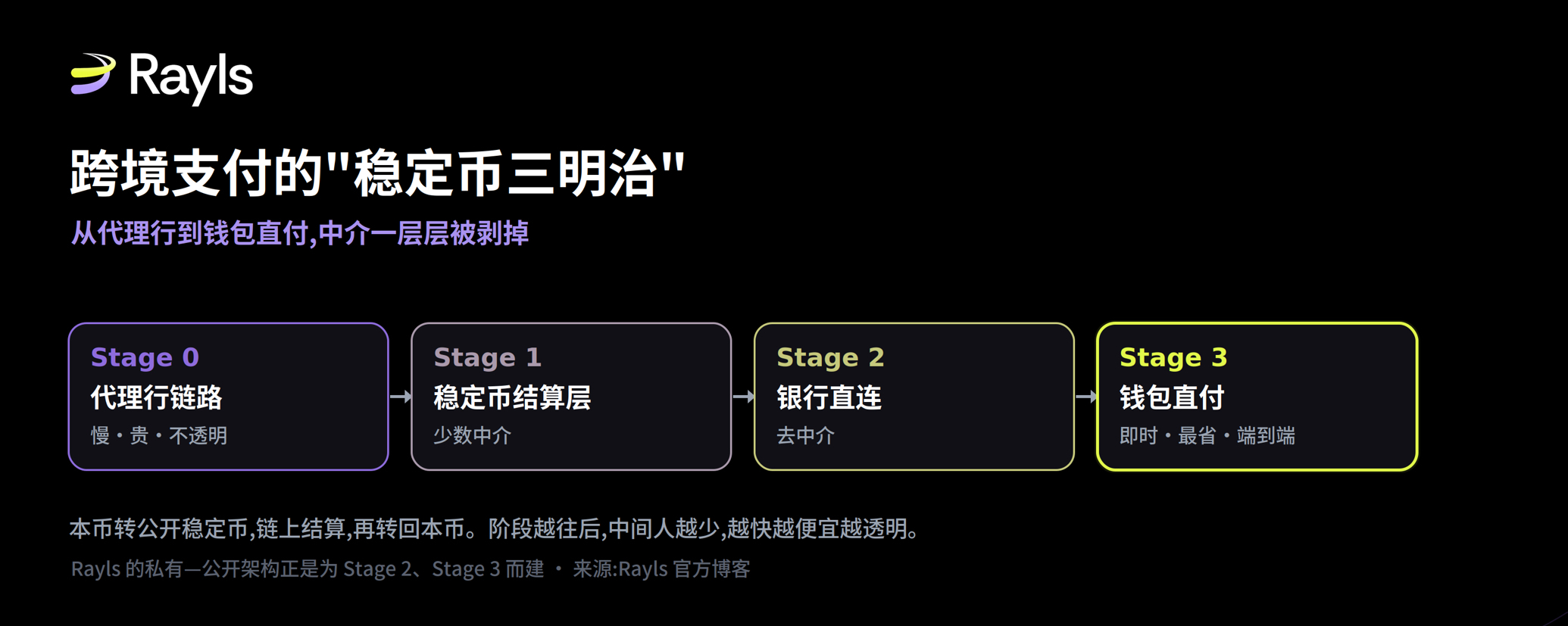
Article
A cross-border remittance being broken down into a “sandwich”In my previous article about XP, I kept wondering about one thing: once an institutional stablecoin like USDXP is issued, how exactly does it participate in real cross-border settlement? This piece is my attempt to fill in that gap, and it also helped me finally understand a term for the first time: “stablecoin sandwich.”
First, let’s explain this term. It’s actually very visual. A single cross-border payment: the two ends are your local currency, with a layer of public stablecoin in the middle. The payer converts their local currency into a USD stablecoin; the stablecoin completes the cross-border settlement on-chain; then the payee converts it back into their own local currency. Doesn’t it look like two slices of bread with that middle layer in between? That’s the phrase the industry started using to describe stablecoin-based cross-border settlement.
A cross-border remittance being broken down into a “sandwich”
In my previous article about XP, I kept wondering about one thing: once an institutional stablecoin like USDXP is issued, how exactly does it participate in real cross-border settlement? This piece is my attempt to fill in that gap, and it also helped me finally understand a term for the first time: “stablecoin sandwich.”
First, let’s explain this term. It’s actually very visual. A single cross-border payment: the two ends are your local currency, with a layer of public stablecoin in the middle. The payer converts their local currency into a USD stablecoin; the stablecoin completes the cross-border settlement on-chain; then the payee converts it back into their own local currency. Doesn’t it look like two slices of bread with that middle layer in between? That’s the phrase the industry started using to describe stablecoin-based cross-border settlement.
418
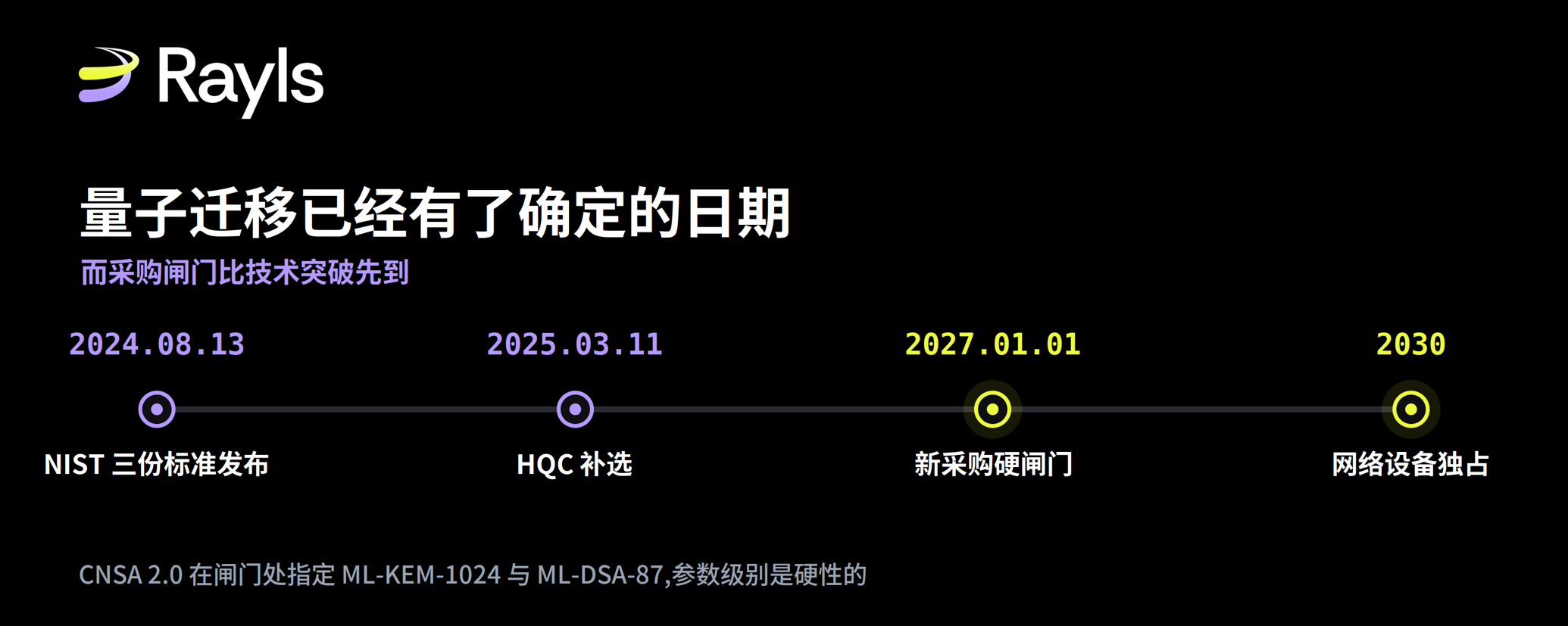
Article
The words "post-quantum" only count if they are specified down to the parameter levelI started staking RLS back in the pre-commitment phase, and when I read the official blog, it was usually to see whether my position would be affected. This August 30 article about quantum stuff was different: the whole piece was teaching institutions how to do procurement, with little direct relevance to someone like me, a retail investor. But I still read it to the end, because it opened with a pretty strict rule, and that rule eventually brought me back to the article itself.
The rule is like this: if a claim says something is "quantum-safe" but doesn’t clearly state which standardized algorithm it uses and at what parameter level, then it isn’t a claim at all, just a label.
The words "post-quantum" only count if they are specified down to the parameter level
I started staking RLS back in the pre-commitment phase, and when I read the official blog, it was usually to see whether my position would be affected. This August 30 article about quantum stuff was different: the whole piece was teaching institutions how to do procurement, with little direct relevance to someone like me, a retail investor. But I still read it to the end, because it opened with a pretty strict rule, and that rule eventually brought me back to the article itself.
The rule is like this: if a claim says something is "quantum-safe" but doesn’t clearly state which standardized algorithm it uses and at what parameter level, then it isn’t a claim at all, just a label.
260
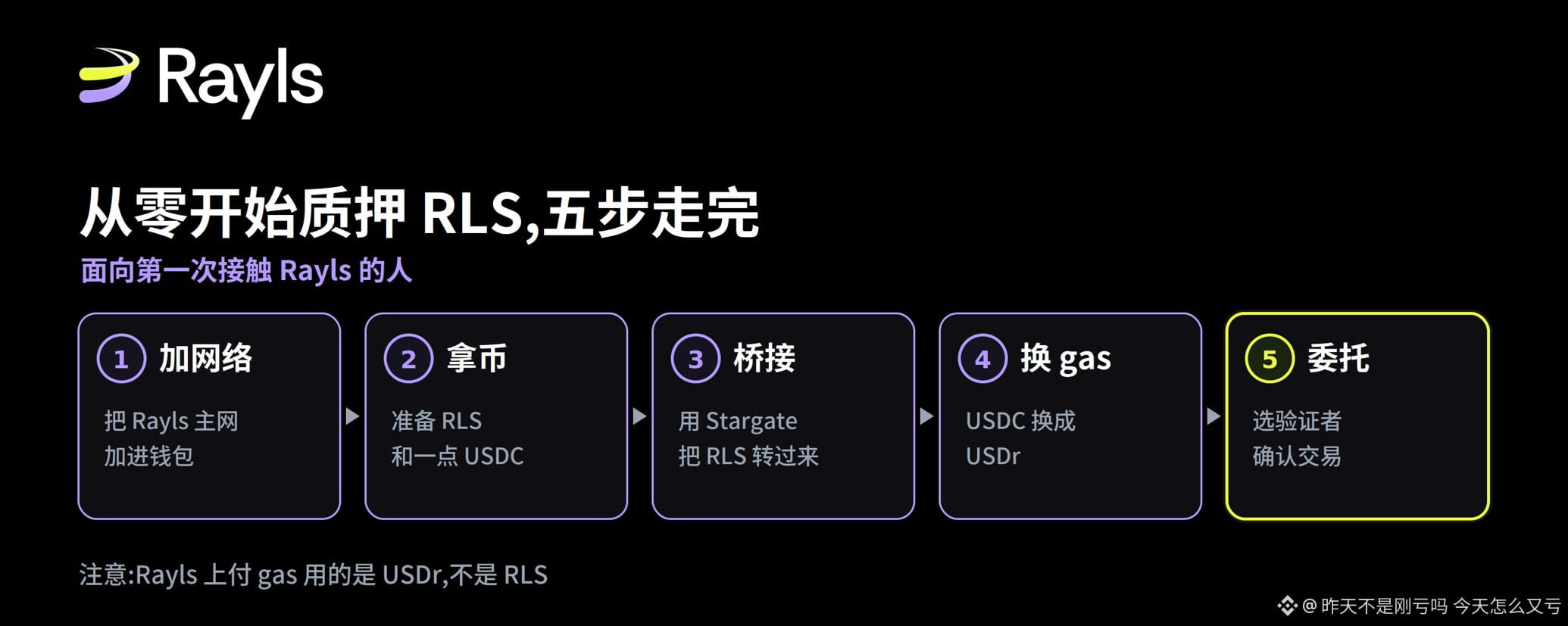
Article
Stake RLS from Scratch: A Complete Step-by-Step Guide Written for BeginnersIn the previous post, I talked about the staking being opened up itself. But in the backend, the most frequently asked question from many brothers was actually the same sentence: exactly how do you do it? So this time, I went through the whole process again from start to finish, and wrote down every step and every spot that’s easy to get stuck. Just follow it.
Here’s the link to the previous post: [质押开放给所有人了,但有几件事最好先知道](https://www.binance.com/zh-cn/square/post/355871701721682)
First, let’s make it clear who this article is for. If you’ve never come across Rayls at all— and even aren’t very familiar with terms like wallets or bridging— then this is written for you. For every piece of technical terminology, I’ll briefly explain it along the way.
Stake RLS from Scratch: A Complete Step-by-Step Guide Written for Beginners
In the previous post, I talked about the staking being opened up itself. But in the backend, the most frequently asked question from many brothers was actually the same sentence: exactly how do you do it? So this time, I went through the whole process again from start to finish, and wrote down every step and every spot that’s easy to get stuck. Just follow it.
Here’s the link to the previous post: 质押开放给所有人了,但有几件事最好先知道
First, let’s make it clear who this article is for. If you’ve never come across Rayls at all— and even aren’t very familiar with terms like wallets or bridging— then this is written for you. For every piece of technical terminology, I’ll briefly explain it along the way.
2
1
515
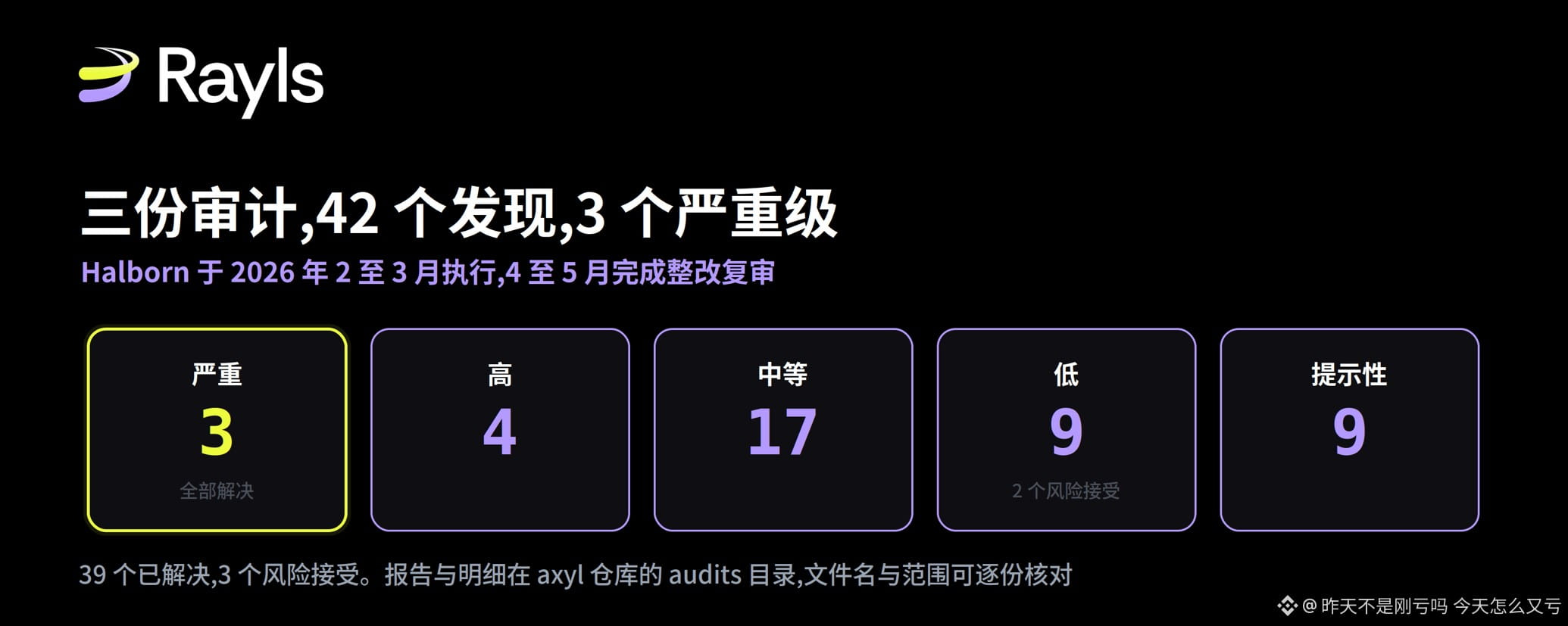
Article
42 questions across three audit reports, including 3 critical onesI started staking RLS back in the pre-commitment phase—it was just something I got into by reading the official materials. After the name “Sovereign” was introduced, most of the discussion ended up lingering on “is it just a name change?” I think that question is backwards. The name doesn’t matter; what matters is what was changed underneath, and how much a firm can get that it can independently verify during due diligence. For every number in this piece, I’ve provided the exact source; you can reproduce it by following along.
First, let me clarify something. Because last week I wrote an article about auditability, some readers may have seen it.
Most of the content here is new. It comes from Axyl’s code repositories, the audit directories within those repos, and Axyl’s performance benchmarks documentation page. I hadn’t touched any of those before. Only the small section about key custody continues the conclusion from the previous article—I’ll mark it there. I separate what’s new from what’s old because what I “looked up this week” versus what I “looked up before” should be something readers can distinguish for themselves.
42 questions across three audit reports, including 3 critical ones
I started staking RLS back in the pre-commitment phase—it was just something I got into by reading the official materials. After the name “Sovereign” was introduced, most of the discussion ended up lingering on “is it just a name change?” I think that question is backwards. The name doesn’t matter; what matters is what was changed underneath, and how much a firm can get that it can independently verify during due diligence. For every number in this piece, I’ve provided the exact source; you can reproduce it by following along.
First, let me clarify something. Because last week I wrote an article about auditability, some readers may have seen it.
Most of the content here is new. It comes from Axyl’s code repositories, the audit directories within those repos, and Axyl’s performance benchmarks documentation page. I hadn’t touched any of those before. Only the small section about key custody continues the conclusion from the previous article—I’ll mark it there. I separate what’s new from what’s old because what I “looked up this week” versus what I “looked up before” should be something readers can distinguish for themselves.
348
·
--
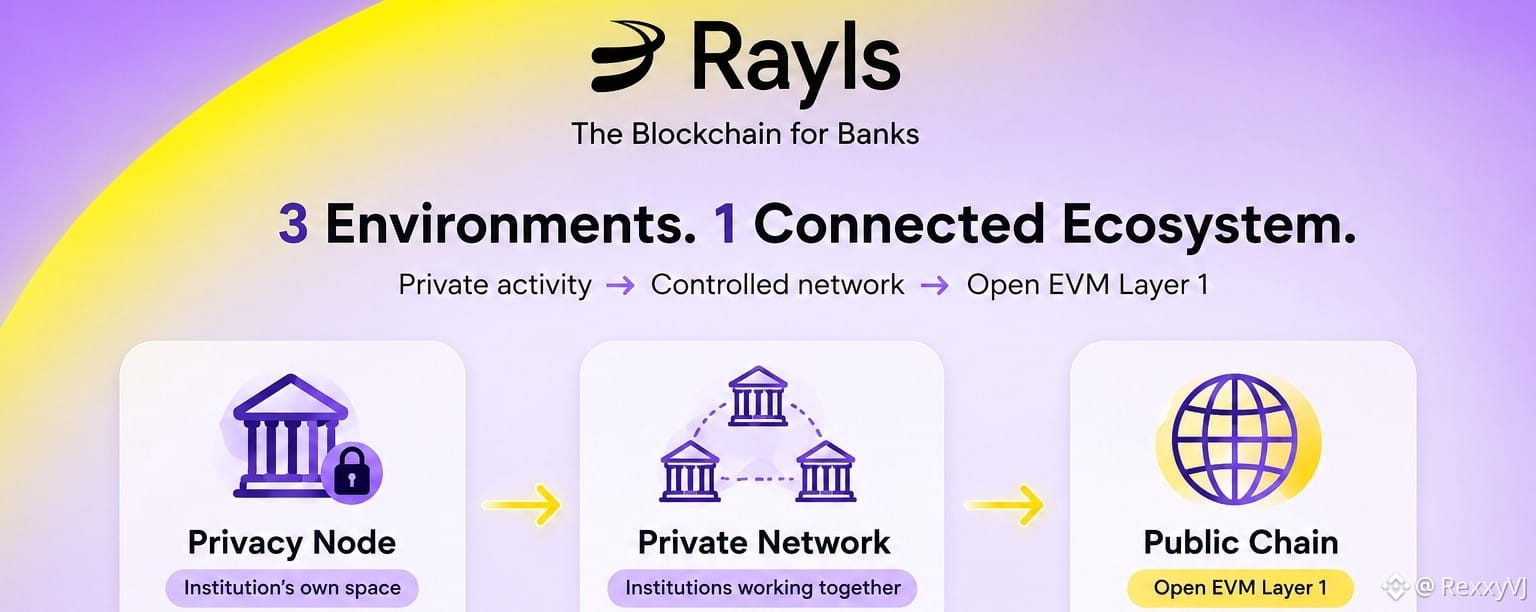
Article
The part of Rayls that finally made sense to meI’ve been going through the Rayls docs, and one thing I initially found confusing was the difference between a Privacy Node, Private Network, and Public Chain.
After looking at how they connect, it became much easier to understand.
They each have a different role.
1. Privacy Node: the institution’s own blockchain
A Rayls Privacy Node is an EVM-compatible chain operated by a single institution.
What happens inside the institution stays inside its own environment.
It can issue tokens, manage balances, run smart contracts and handle its internal activity there.
One detail I found important: a Privacy Node is not a validator.
The docs describe it more like the institution’s own onchain environment, where its data, keys and workflows are controlled by the institution itself.
That makes sense for banks because they need control over sensitive financial information.
2. Private Network: where institutions interact
The next part is the Rayls Private Network.
This is a permissioned blockchain network where multiple institutions can connect through their Privacy Nodes.
So instead of every institution keeping its own isolated blockchain, they can interact with other approved participants while keeping transactions private.
Rayls uses a Private Network Hub to coordinate these interactions.
This is where Enygma becomes interesting.
Enygma is Rayls’ privacy protocol for confidential transactions. The docs show how it can be used for private token transfers and Delivery-versus-Payment, where two assets can be exchanged while keeping sensitive transaction information protected.
There is also an auditor role, so privacy doesn't simply mean that nobody can ever inspect anything.
That balance between confidentiality and authorised visibility is one of the things I found interesting while going through the docs.
3. Public Chain: the open side
Then there is the Rayls Public Chain.
This is an EVM-compatible Layer 1 designed to connect the institutional side with the open blockchain ecosystem.
This is where public applications, assets and DeFi can operate.
The current docs also mention over 10,000 TPS and sub-second deterministic finality through Rayls' Axyl consensus.
So the Public Chain isn't simply another place to store assets.
It is the open side of the architecture.
The simple way I understand it now
Think about an institution issuing a tokenised asset.
Privacy Node
The institution creates and manages the asset in its own environment.
↓
Private Network
The institution can interact with other approved institutions privately.
↓
Public Chain
The asset can reach the open blockchain ecosystem and public liquidity when appropriate.
Of course, the actual flow depends on the use case. The important part is that Rayls doesn't force every activity into the same environment.
Each environment has a specific job.
And this is where Rayls Enygma fits
This was probably the most interesting part for me.
Blockchain usually gives you transparency by default, but financial institutions often need the opposite for sensitive transactions.
Enygma is designed to provide confidential transactions while keeping them verifiable and auditable.
For example, Rayls documents describe confidential transfers where the sender, recipient and amount can be hidden from public view, while authorised auditors can still access the necessary information.
It also supports private DvP flows for tokenised assets.
So the goal isn't simply:
"make everything private."
It is more about giving different participants different levels of visibility depending on what they are authorised to see.
What I took away from exploring Rayls
Before going through the docs, I mostly thought of Rayls as another blockchain project focused on institutions.
After looking at the architecture, I see the idea differently.
The Privacy Node gives an institution its own controlled onchain environment.
The Private Network lets approved institutions interact.
The Public Chain connects that institutional infrastructure to the open blockchain world.
And Enygma provides the privacy layer for sensitive activity.
That separation is probably the part of Rayls I found most interesting.
Instead of asking institutions to choose between private infrastructure and public blockchain access, Rayls is building a way for the two sides to work together.
That was the part that clicked for me after actually going through the docs.
@Rayls #Rayls
The part of Rayls that finally made sense to me
I’ve been going through the Rayls docs, and one thing I initially found confusing was the difference between a Privacy Node, Private Network, and Public Chain.
After looking at how they connect, it became much easier to understand.
They each have a different role.
1. Privacy Node: the institution’s own blockchain
A Rayls Privacy Node is an EVM-compatible chain operated by a single institution.
What happens inside the institution stays inside its own environment.
It can issue tokens, manage balances, run smart contracts and handle its internal activity there.
One detail I found important: a Privacy Node is not a validator.
The docs describe it more like the institution’s own onchain environment, where its data, keys and workflows are controlled by the institution itself.
That makes sense for banks because they need control over sensitive financial information.
2. Private Network: where institutions interact
The next part is the Rayls Private Network.
This is a permissioned blockchain network where multiple institutions can connect through their Privacy Nodes.
So instead of every institution keeping its own isolated blockchain, they can interact with other approved participants while keeping transactions private.
Rayls uses a Private Network Hub to coordinate these interactions.
This is where Enygma becomes interesting.
Enygma is Rayls’ privacy protocol for confidential transactions. The docs show how it can be used for private token transfers and Delivery-versus-Payment, where two assets can be exchanged while keeping sensitive transaction information protected.
There is also an auditor role, so privacy doesn't simply mean that nobody can ever inspect anything.
That balance between confidentiality and authorised visibility is one of the things I found interesting while going through the docs.
3. Public Chain: the open side
Then there is the Rayls Public Chain.
This is an EVM-compatible Layer 1 designed to connect the institutional side with the open blockchain ecosystem.
This is where public applications, assets and DeFi can operate.
The current docs also mention over 10,000 TPS and sub-second deterministic finality through Rayls' Axyl consensus.
So the Public Chain isn't simply another place to store assets.
It is the open side of the architecture.
The simple way I understand it now
Think about an institution issuing a tokenised asset.
Privacy Node
The institution creates and manages the asset in its own environment.
↓
Private Network
The institution can interact with other approved institutions privately.
↓
Public Chain
The asset can reach the open blockchain ecosystem and public liquidity when appropriate.
Of course, the actual flow depends on the use case. The important part is that Rayls doesn't force every activity into the same environment.
Each environment has a specific job.
And this is where Rayls Enygma fits
This was probably the most interesting part for me.
Blockchain usually gives you transparency by default, but financial institutions often need the opposite for sensitive transactions.
Enygma is designed to provide confidential transactions while keeping them verifiable and auditable.
For example, Rayls documents describe confidential transfers where the sender, recipient and amount can be hidden from public view, while authorised auditors can still access the necessary information.
It also supports private DvP flows for tokenised assets.
So the goal isn't simply:
"make everything private."
It is more about giving different participants different levels of visibility depending on what they are authorised to see.
What I took away from exploring Rayls
Before going through the docs, I mostly thought of Rayls as another blockchain project focused on institutions.
After looking at the architecture, I see the idea differently.
The Privacy Node gives an institution its own controlled onchain environment.
The Private Network lets approved institutions interact.
The Public Chain connects that institutional infrastructure to the open blockchain world.
And Enygma provides the privacy layer for sensitive activity.
That separation is probably the part of Rayls I found most interesting.
Instead of asking institutions to choose between private infrastructure and public blockchain access, Rayls is building a way for the two sides to work together.
That was the part that clicked for me after actually going through the docs.
@Rayls #Rayls
3
100
Log in to explore more content
Join global crypto users on Binance Square
⚡️ Get latest and useful information about crypto.
💬 Trusted by the world’s largest crypto exchange.
👍 Discover real insights from verified creators.
Email / Phone number
Trending Topics
1
#NVIDIAReinstatesJensenHuangasCEO
35,611 views
644 Discussing
2
#WillMarketsStageAThanksgivingReliefRally?
137,691 views
1,722 Discussing
3
#WillOctCorePCEShiftFedHikeExpectations?
52,502 views
725 Discussing
4
#BitcoinEndsRecord17DayStreakOfLowerHighs
8,929 views
219 Discussing
5
#TradersPriceOut50bpDecemberFedHike
6,358 views
133 Discussing
6
#EvolveAtBinanceBlockchainWeek
114,455 views
989 Discussing
7
#TrumpBackedAmericanBitcoinRaisesHoldingsToOver8500BTC
911 views
30 Discussing
8
#MuskWarnsOfAICashCrunch
61,797 views
690 Discussing
9
#TradFiForBeginners
1.1M views
5,988 Discussing
10
#SkyPSMUSDCLiquidityReboundsTo$1.77B
483 views
12 Discussing