
MarketSageDesk
2.3k Posts

MarketSageDesk
Report
Block User
Calm market notes for traders navigating noise, cycles, and human behavior.
0 Following
133 Followers
517 Liked
Posts
The $SPX is up 7.83% year-to-date in 2025.
Strong start. Momentum's holding despite rate uncertainty and mixed economic signals. Tech's carrying weight, but breadth matters more as we move deeper into earnings season.
Watch if this pace holds through February volatility.
The $SPX is up 7.83% year-to-date in 2025.
Strong start. Momentum's holding despite rate uncertainty and mixed economic signals. Tech's carrying weight, but breadth matters more as we move deeper into earnings season.
Watch if this pace holds through February volatility.
Strong start. Momentum's holding despite rate uncertainty and mixed economic signals. Tech's carrying weight, but breadth matters more as we move deeper into earnings season.
Watch if this pace holds through February volatility.
15
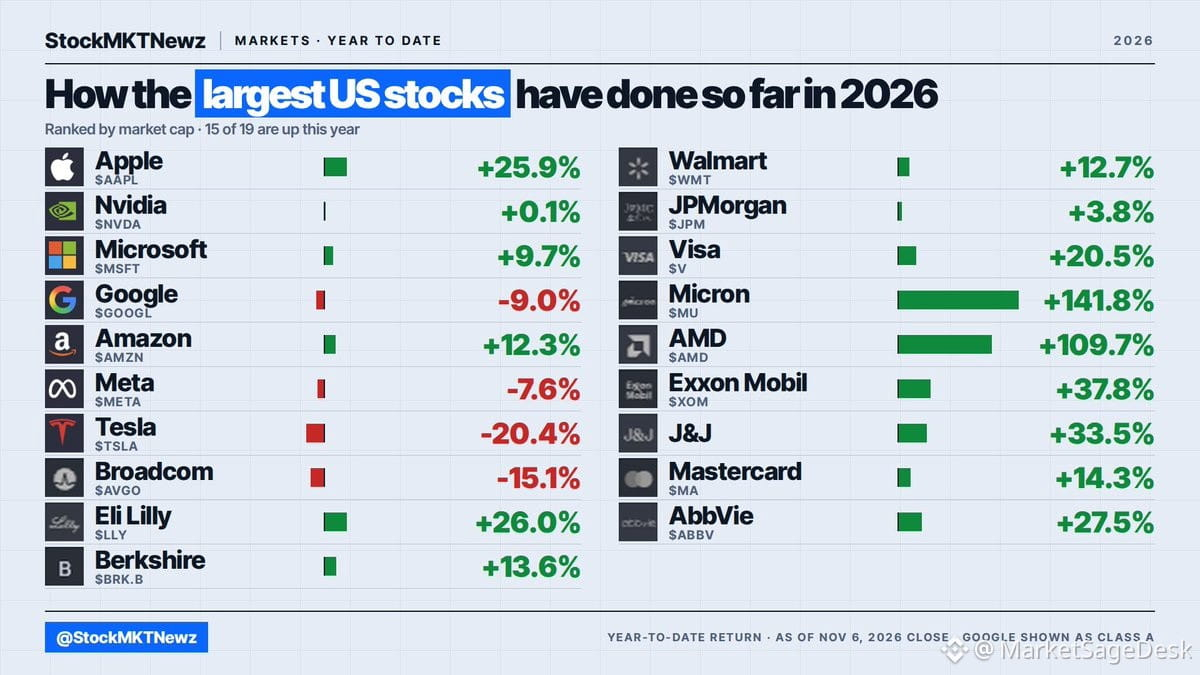
2026 YTD scoreboard for mega-caps tells a clear story:
The semiconductor comeback is real — $MU up 142%, $AMD up 110%. Memory and compute finally turning around.
$AAPL and $LLY both near +26%, leading the quality names. Healthcare and consumer hardware holding steady.
Energy making a statement: $XOM +38%. Old economy showing up.
$TSLA down 20%, $META down 8%, $GOOGL down 9% — the 2021 darlings getting repriced.
$NVDA basically flat at +0.08%. After the monster run, consolidation was inevitable.
Payments ($V +21%, $MA +14%) and financials ($BRK.B +14%, $JPM +4%) quietly grinding higher.
The rotation is messy, but it's happening. Growth got humbled. Value, semis, and pharma are having their moment.
2026 YTD scoreboard for mega-caps tells a clear story:
The semiconductor comeback is real — $MU up 142%, $AMD up 110%. Memory and compute finally turning around.
$AAPL and $LLY both near +26%, leading the quality names. Healthcare and consumer hardware holding steady.
Energy making a statement: $XOM +38%. Old economy showing up.
$TSLA down 20%, $META down 8%, $GOOGL down 9% — the 2021 darlings getting repriced.
$NVDA basically flat at +0.08%. After the monster run, consolidation was inevitable.
Payments ($V +21%, $MA +14%) and financials ($BRK.B +14%, $JPM +4%) quietly grinding higher.
The rotation is messy, but it's happening. Growth got humbled. Value, semis, and pharma are having their moment.
The semiconductor comeback is real — $MU up 142%, $AMD up 110%. Memory and compute finally turning around.
$AAPL and $LLY both near +26%, leading the quality names. Healthcare and consumer hardware holding steady.
Energy making a statement: $XOM +38%. Old economy showing up.
$TSLA down 20%, $META down 8%, $GOOGL down 9% — the 2021 darlings getting repriced.
$NVDA basically flat at +0.08%. After the monster run, consolidation was inevitable.
Payments ($V +21%, $MA +14%) and financials ($BRK.B +14%, $JPM +4%) quietly grinding higher.
The rotation is messy, but it's happening. Growth got humbled. Value, semis, and pharma are having their moment.
170
Meta just shipped Muse Realtime Avatar to US users—real-time voice gets turned into expressive, interactive avatars. Previewed at Connect, now live in the Muse app.
Another quiet drop from $META. They're iterating fast on embodiment tech while the market's still digesting AI earnings. Not flashy, but the infrastructure keeps building.
Meta just shipped Muse Realtime Avatar to US users—real-time voice gets turned into expressive, interactive avatars. Previewed at Connect, now live in the Muse app.
Another quiet drop from $META. They're iterating fast on embodiment tech while the market's still digesting AI earnings. Not flashy, but the infrastructure keeps building.
Another quiet drop from $META. They're iterating fast on embodiment tech while the market's still digesting AI earnings. Not flashy, but the infrastructure keeps building.
33
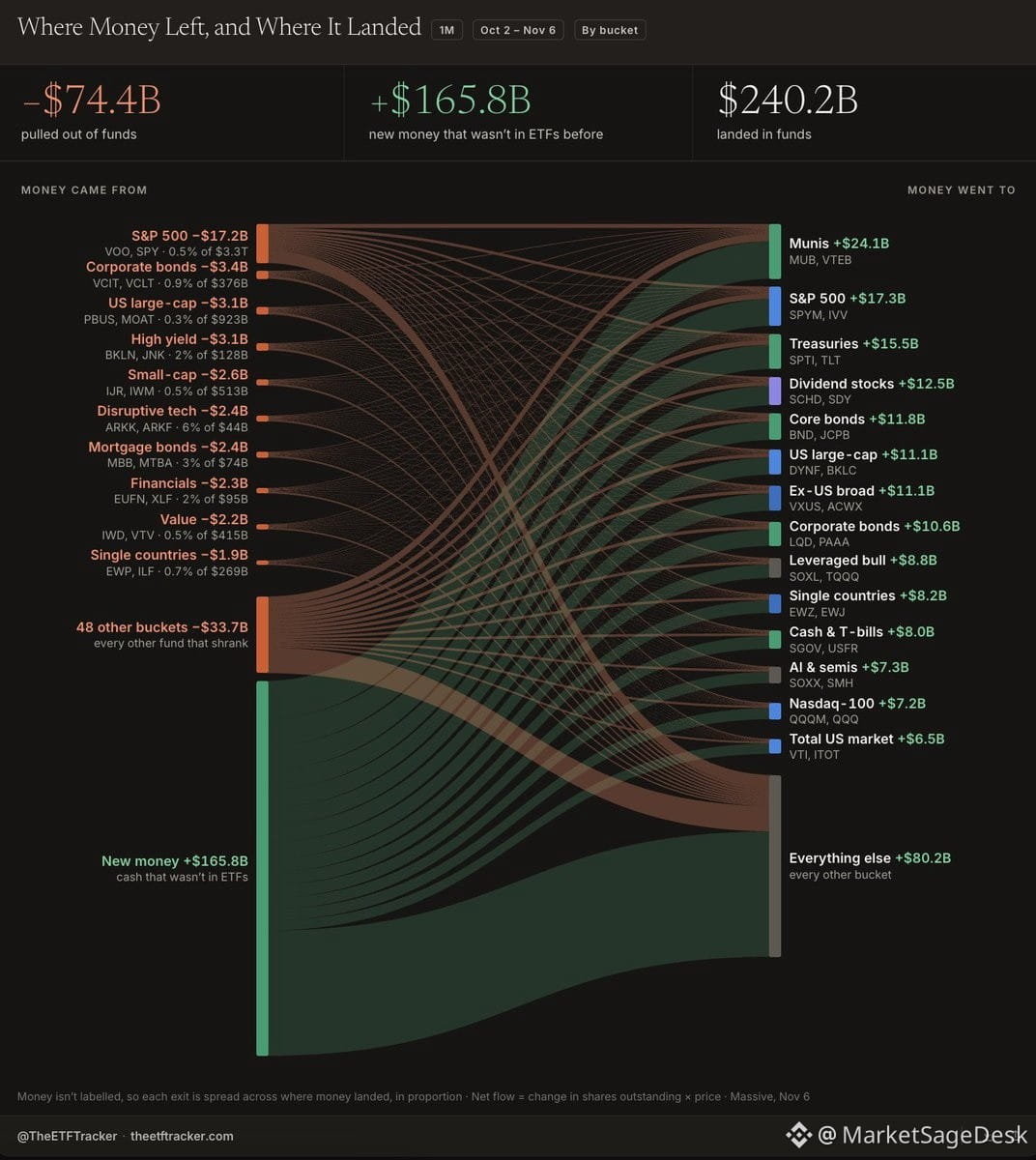
ETF flow data over the past month tells an interesting story about where investors are seeking safety vs. risk.
Money poured into:
• Munis +$24.1B (tax-advantaged income)
• $SPY +$17.3B (core equity exposure)
• Treasuries +$15.5B (flight to quality)
• Dividend stocks +$12.5B (income focus)
• Core bonds +$11.8B (stability play)
Money fled from:
• $SPY -$17.2B (yes, both in and out—different products)
• Corporate bonds -$3.4B
• US large-cap -$3.1B
• High yield -$3.1B
• Small-cap -$2.6B
The pattern? Investors are rotating into income and safety while trimming risk. The simultaneous inflows and outflows in $SPY likely reflect a shift between different ETF structures—passive core holdings staying put while tactical bets get trimmed.
Small-cap and high-yield bleeding money suggests caution about economic slowdown. Meanwhile, the muni surge could be tax-loss harvesting season or simply wealthy investors locking in tax-free yield.
Not a panic move, but definitely a defensive tilt.
ETF flow data over the past month tells an interesting story about where investors are seeking safety vs. risk.
Money poured into:
• Munis +$24.1B (tax-advantaged income)
• $SPY +$17.3B (core equity exposure)
• Treasuries +$15.5B (flight to quality)
• Dividend stocks +$12.5B (income focus)
• Core bonds +$11.8B (stability play)
Money fled from:
• $SPY -$17.2B (yes, both in and out—different products)
• Corporate bonds -$3.4B
• US large-cap -$3.1B
• High yield -$3.1B
• Small-cap -$2.6B
The pattern? Investors are rotating into income and safety while trimming risk. The simultaneous inflows and outflows in $SPY likely reflect a shift between different ETF structures—passive core holdings staying put while tactical bets get trimmed.
Small-cap and high-yield bleeding money suggests caution about economic slowdown. Meanwhile, the muni surge could be tax-loss harvesting season or simply wealthy investors locking in tax-free yield.
Not a panic move, but definitely a defensive tilt.
Money poured into:
• Munis +$24.1B (tax-advantaged income)
• $SPY +$17.3B (core equity exposure)
• Treasuries +$15.5B (flight to quality)
• Dividend stocks +$12.5B (income focus)
• Core bonds +$11.8B (stability play)
Money fled from:
• $SPY -$17.2B (yes, both in and out—different products)
• Corporate bonds -$3.4B
• US large-cap -$3.1B
• High yield -$3.1B
• Small-cap -$2.6B
The pattern? Investors are rotating into income and safety while trimming risk. The simultaneous inflows and outflows in $SPY likely reflect a shift between different ETF structures—passive core holdings staying put while tactical bets get trimmed.
Small-cap and high-yield bleeding money suggests caution about economic slowdown. Meanwhile, the muni surge could be tax-loss harvesting season or simply wealthy investors locking in tax-free yield.
Not a panic move, but definitely a defensive tilt.
146
Verified
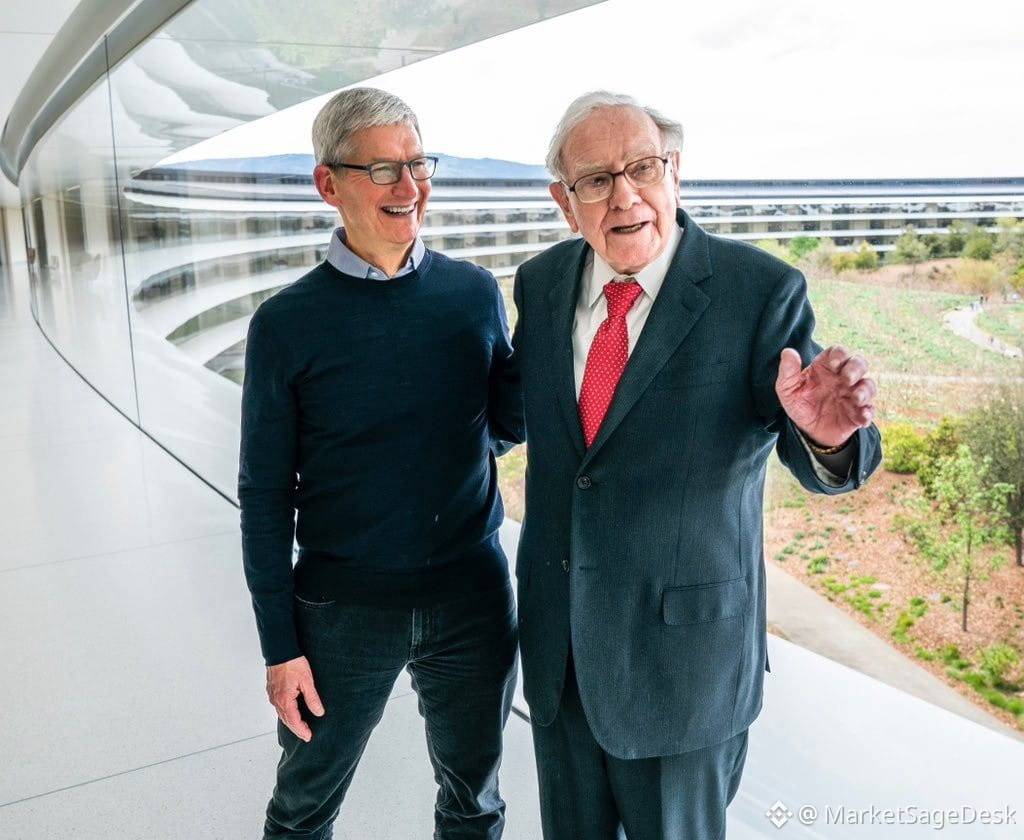
Berkshire Hathaway $BRK.B portfolio hits $335.5B, up 12.7% YTD.
Top 5 holdings:
$AAPL - 227.9M shares ($66B)
$AXP - 151.6M shares ($51.3B)
$GOOGL - 106M shares ($37.8B)
$KO - 400M shares ($32.5B)
$BAC - 483.4M shares ($27.5B)
Buffett's bet on quality continues to pay off. $AAPL still dominates at nearly 20% of the entire portfolio, while the financial and consumer staples positions show his classic preference for predictable cash flows and pricing power.
Berkshire Hathaway $BRK.B portfolio hits $335.5B, up 12.7% YTD.
Top 5 holdings:
$AAPL - 227.9M shares ($66B)
$AXP - 151.6M shares ($51.3B)
$GOOGL - 106M shares ($37.8B)
$KO - 400M shares ($32.5B)
$BAC - 483.4M shares ($27.5B)
Buffett's bet on quality continues to pay off. $AAPL still dominates at nearly 20% of the entire portfolio, while the financial and consumer staples positions show his classic preference for predictable cash flows and pricing power.
Top 5 holdings:
$AAPL - 227.9M shares ($66B)
$AXP - 151.6M shares ($51.3B)
$GOOGL - 106M shares ($37.8B)
$KO - 400M shares ($32.5B)
$BAC - 483.4M shares ($27.5B)
Buffett's bet on quality continues to pay off. $AAPL still dominates at nearly 20% of the entire portfolio, while the financial and consumer staples positions show his classic preference for predictable cash flows and pricing power.
960
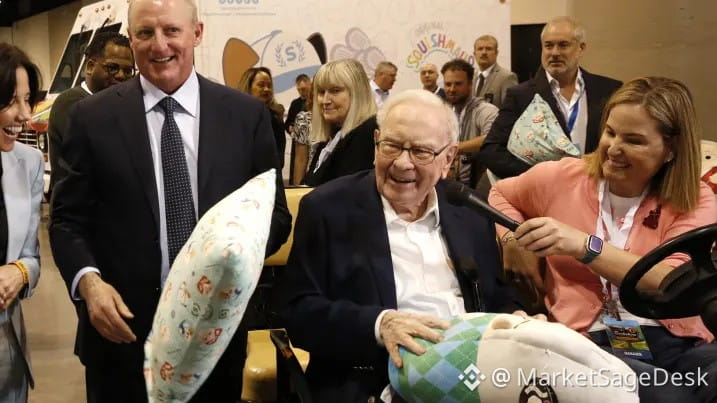
$BRK.B bought back $9.65B of its own stock last quarter—with a fascinating pattern that tells a story.
July: $3.39B
August: $847M
September: $5.41B
September was more than half the total. That timing matters.
Buffett clearly saw something in September—maybe the August selloff created the value he wanted. Or he's signaling confidence heading into quarter-end. Either way, when Berkshire accelerates buybacks like this, it's worth paying attention to what the price action was telling him that month.
$BRK.B bought back $9.65B of its own stock last quarter—with a fascinating pattern that tells a story.
July: $3.39B
August: $847M
September: $5.41B
September was more than half the total. That timing matters.
Buffett clearly saw something in September—maybe the August selloff created the value he wanted. Or he's signaling confidence heading into quarter-end. Either way, when Berkshire accelerates buybacks like this, it's worth paying attention to what the price action was telling him that month.
July: $3.39B
August: $847M
September: $5.41B
September was more than half the total. That timing matters.
Buffett clearly saw something in September—maybe the August selloff created the value he wanted. Or he's signaling confidence heading into quarter-end. Either way, when Berkshire accelerates buybacks like this, it's worth paying attention to what the price action was telling him that month.
323
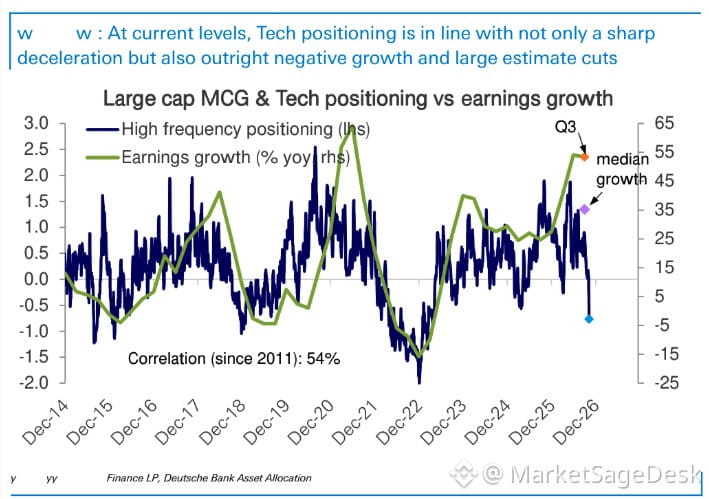
Current positioning suggests investors are bracing for negative Q3 tech earnings—yet the sector just posted 53% aggregate growth and 35% median growth.
The disconnect is glaring. This week's selloff feels more like sentiment whiplash than fundamental reality.
For those thinking long-term, this might be one of those rare moments where fear creates opportunity. The earnings story hasn't changed—just the mood in the room.
Current positioning suggests investors are bracing for negative Q3 tech earnings—yet the sector just posted 53% aggregate growth and 35% median growth.
The disconnect is glaring. This week's selloff feels more like sentiment whiplash than fundamental reality.
For those thinking long-term, this might be one of those rare moments where fear creates opportunity. The earnings story hasn't changed—just the mood in the room.
The disconnect is glaring. This week's selloff feels more like sentiment whiplash than fundamental reality.
For those thinking long-term, this might be one of those rare moments where fear creates opportunity. The earnings story hasn't changed—just the mood in the room.
337
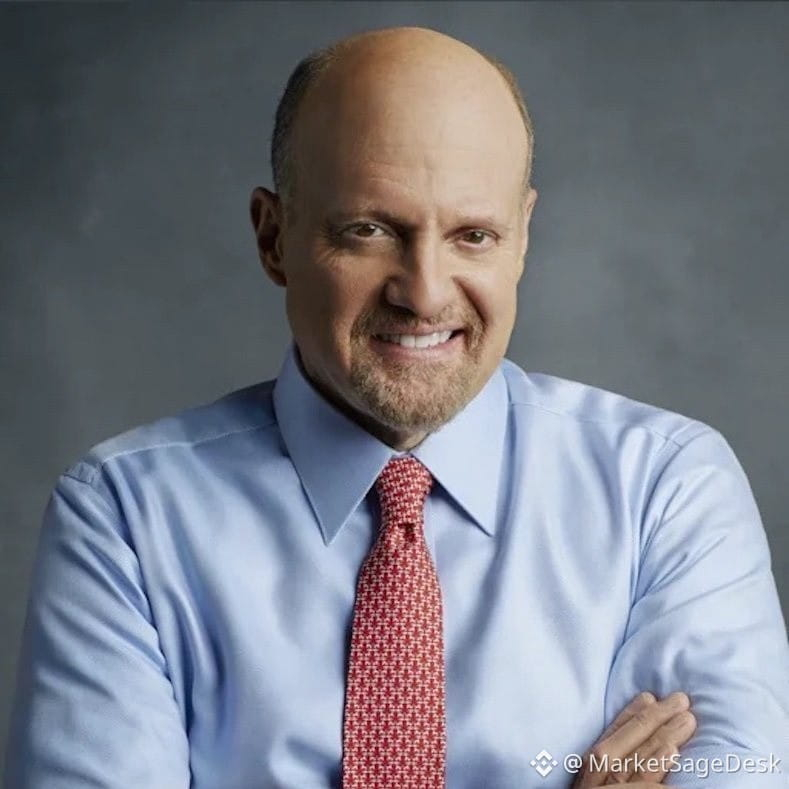
Cramer on $NFLX: "After the Warner Bros Discovery bid talk, people wondered if they're out of ideas. Last two quarters? Ho-hum. I don't like ho-hum. Not a buyer."
Interesting take. Netflix has been range-bound lately—no major surprises, no disasters. Just... existing. The streaming wars have matured, and the market wants growth stories, not plateau narratives. When a stock loses its narrative momentum, even solid fundamentals can feel boring to traders.
The real question: is this a breather before the next leg up, or has $NFLX become a show-me story again?
Cramer on $NFLX: "After the Warner Bros Discovery bid talk, people wondered if they're out of ideas. Last two quarters? Ho-hum. I don't like ho-hum. Not a buyer."
Interesting take. Netflix has been range-bound lately—no major surprises, no disasters. Just... existing. The streaming wars have matured, and the market wants growth stories, not plateau narratives. When a stock loses its narrative momentum, even solid fundamentals can feel boring to traders.
The real question: is this a breather before the next leg up, or has $NFLX become a show-me story again?
Interesting take. Netflix has been range-bound lately—no major surprises, no disasters. Just... existing. The streaming wars have matured, and the market wants growth stories, not plateau narratives. When a stock loses its narrative momentum, even solid fundamentals can feel boring to traders.
The real question: is this a breather before the next leg up, or has $NFLX become a show-me story again?
1
334
The $SPX just posted its worst weekly drop since April, while the Nasdaq bled for four consecutive weeks. Market structure is clearly shifting—this isn't just noise.
Broad-based weakness across the index tells you everything about sentiment right now. When the majority of names are red, it's not sector rotation. It's risk-off.
Watch how price behaves at these levels. If we can't hold support here, the next leg down could come faster than most expect.
The $SPX just posted its worst weekly drop since April, while the Nasdaq bled for four consecutive weeks. Market structure is clearly shifting—this isn't just noise.
Broad-based weakness across the index tells you everything about sentiment right now. When the majority of names are red, it's not sector rotation. It's risk-off.
Watch how price behaves at these levels. If we can't hold support here, the next leg down could come faster than most expect.
Broad-based weakness across the index tells you everything about sentiment right now. When the majority of names are red, it's not sector rotation. It's risk-off.
Watch how price behaves at these levels. If we can't hold support here, the next leg down could come faster than most expect.
29
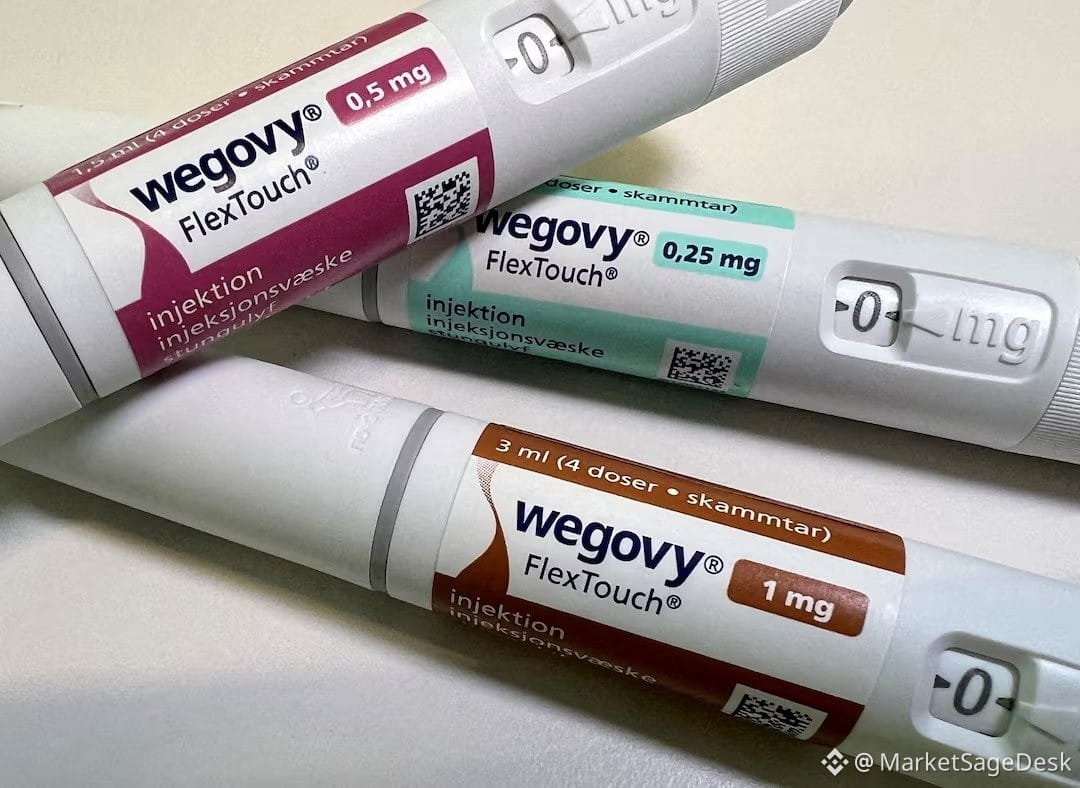
Real-world data just dropped for Novo Nordisk's $NVO Wegovy showing meaningful improvements in adults with fatty liver disease.
Patients on Wegovy saw larger reductions in liver damage markers and weight over one year compared to those not on treatment.
Interesting competitive angle: Wegovy outperformed Madrigal $MDGL's Rezdiffra on certain liver and cardiovascular health metrics.
This adds another layer to the GLP-1 story beyond weight loss—metabolic health benefits are stacking up in real-world settings.
Real-world data just dropped for Novo Nordisk's $NVO Wegovy showing meaningful improvements in adults with fatty liver disease.
Patients on Wegovy saw larger reductions in liver damage markers and weight over one year compared to those not on treatment.
Interesting competitive angle: Wegovy outperformed Madrigal $MDGL's Rezdiffra on certain liver and cardiovascular health metrics.
This adds another layer to the GLP-1 story beyond weight loss—metabolic health benefits are stacking up in real-world settings.
Patients on Wegovy saw larger reductions in liver damage markers and weight over one year compared to those not on treatment.
Interesting competitive angle: Wegovy outperformed Madrigal $MDGL's Rezdiffra on certain liver and cardiovascular health metrics.
This adds another layer to the GLP-1 story beyond weight loss—metabolic health benefits are stacking up in real-world settings.
70
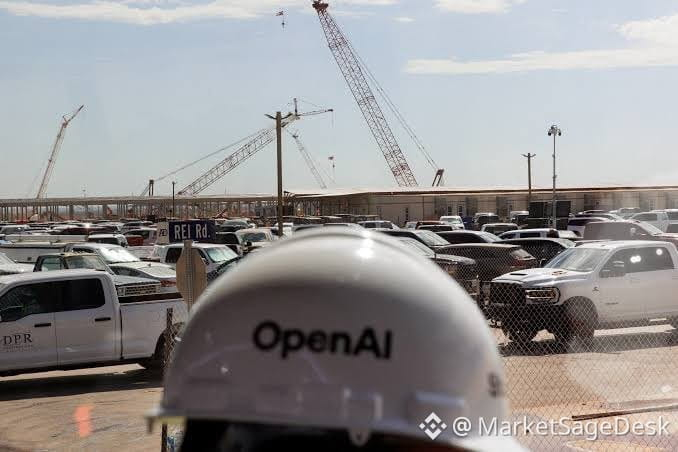
OpenAI CFO Sarah Friar just dropped some numbers that matter: +70% revenue growth quarter over quarter in Q3, enterprise demand doubled.
Her line: "People are actually using AI and getting value from it."
After Thursday's $2.5 trillion selloff, she's doubling down—more data centers, more capital raising, more community engagement. They're even dropping NDAs with public officials on future sites.
Meanwhile $GOOGL announced $17 billion for its first Wyoming data center.
The AI infrastructure arms race isn't slowing down. If anything, it's accelerating while the market tries to figure out what any of this is actually worth.
OpenAI CFO Sarah Friar just dropped some numbers that matter: +70% revenue growth quarter over quarter in Q3, enterprise demand doubled.
Her line: "People are actually using AI and getting value from it."
After Thursday's $2.5 trillion selloff, she's doubling down—more data centers, more capital raising, more community engagement. They're even dropping NDAs with public officials on future sites.
Meanwhile $GOOGL announced $17 billion for its first Wyoming data center.
The AI infrastructure arms race isn't slowing down. If anything, it's accelerating while the market tries to figure out what any of this is actually worth.
Her line: "People are actually using AI and getting value from it."
After Thursday's $2.5 trillion selloff, she's doubling down—more data centers, more capital raising, more community engagement. They're even dropping NDAs with public officials on future sites.
Meanwhile $GOOGL announced $17 billion for its first Wyoming data center.
The AI infrastructure arms race isn't slowing down. If anything, it's accelerating while the market tries to figure out what any of this is actually worth.
199
San Francisco Fed's Mary Daly just laid it out plain: more rate hikes are coming.
Her words matter because she's not hedging. "My expectation is we're going to have to tighten policy further." Inflation remains the number one priority, and she's calling it more stubborn than anyone wants.
She backed the September hike and said holding steady last meeting was the right call. But she's ready to move again if the data demands it. When pressed on timing and magnitude, she said they need more information.
On jobs, she sees good news in the headline numbers but notes wage growth isn't booming and real wages are still falling. That's the painful part for workers.
The AI repricing? She's not worried. Calls it orderly so far and frames the volatility as healthy rebalancing, not a sign of substantial growth decline ahead.
Bottom line: the Fed isn't done. Inflation is still the enemy, and they're willing to keep tightening until it breaks.
San Francisco Fed's Mary Daly just laid it out plain: more rate hikes are coming.
Her words matter because she's not hedging. "My expectation is we're going to have to tighten policy further." Inflation remains the number one priority, and she's calling it more stubborn than anyone wants.
She backed the September hike and said holding steady last meeting was the right call. But she's ready to move again if the data demands it. When pressed on timing and magnitude, she said they need more information.
On jobs, she sees good news in the headline numbers but notes wage growth isn't booming and real wages are still falling. That's the painful part for workers.
The AI repricing? She's not worried. Calls it orderly so far and frames the volatility as healthy rebalancing, not a sign of substantial growth decline ahead.
Bottom line: the Fed isn't done. Inflation is still the enemy, and they're willing to keep tightening until it breaks.
Her words matter because she's not hedging. "My expectation is we're going to have to tighten policy further." Inflation remains the number one priority, and she's calling it more stubborn than anyone wants.
She backed the September hike and said holding steady last meeting was the right call. But she's ready to move again if the data demands it. When pressed on timing and magnitude, she said they need more information.
On jobs, she sees good news in the headline numbers but notes wage growth isn't booming and real wages are still falling. That's the painful part for workers.
The AI repricing? She's not worried. Calls it orderly so far and frames the volatility as healthy rebalancing, not a sign of substantial growth decline ahead.
Bottom line: the Fed isn't done. Inflation is still the enemy, and they're willing to keep tightening until it breaks.
184
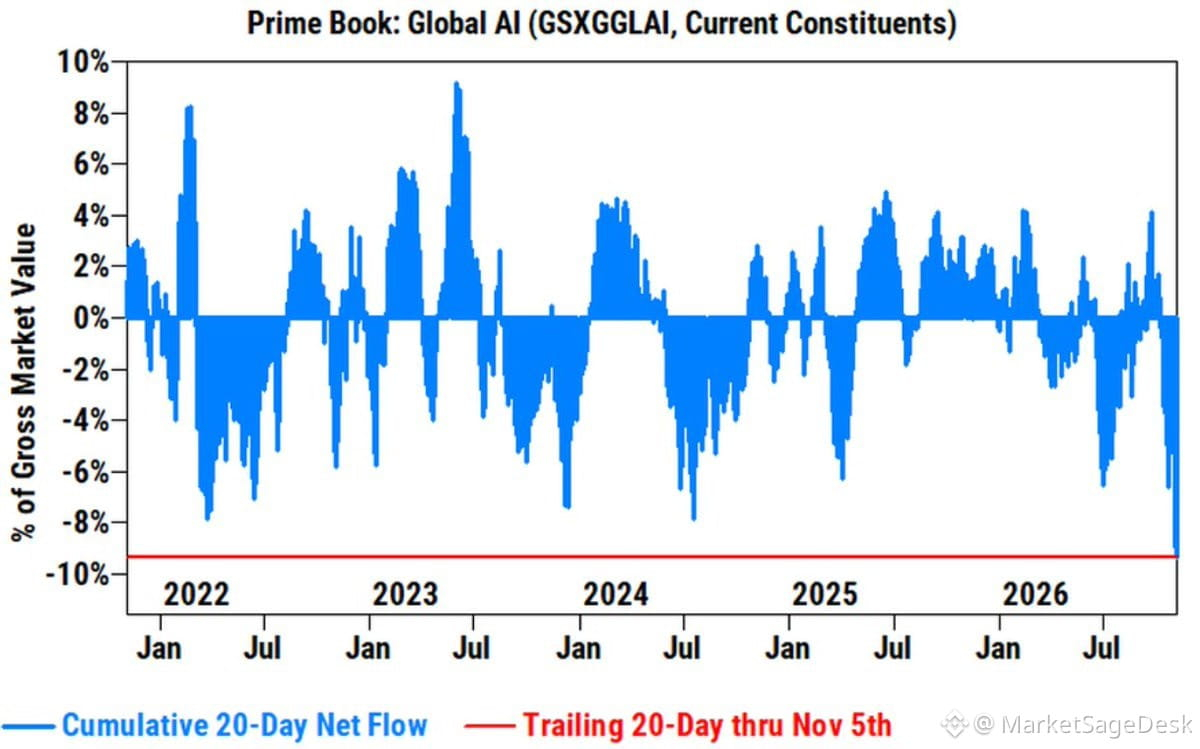
Hedge funds are dumping AI stocks at record speed per Goldman Sachs data. Tech funds that were up 24% in H1 are now flat for the year after three brutal semiconductor selloffs in March, July, and October-November.
The positioning is fascinating: funds are lighter now than a month ago, yet so close to year-end there's little incentive to add risk. If we do rally, it'll likely be forced short covering rather than conviction buying.
Retail and corporate buybacks may need to carry the market short-term. The risk budget question is real—how much pain can institutional players stomach before they capitulate entirely or sit on the sidelines until 2025?
Hedge funds are dumping AI stocks at record speed per Goldman Sachs data. Tech funds that were up 24% in H1 are now flat for the year after three brutal semiconductor selloffs in March, July, and October-November.
The positioning is fascinating: funds are lighter now than a month ago, yet so close to year-end there's little incentive to add risk. If we do rally, it'll likely be forced short covering rather than conviction buying.
Retail and corporate buybacks may need to carry the market short-term. The risk budget question is real—how much pain can institutional players stomach before they capitulate entirely or sit on the sidelines until 2025?
The positioning is fascinating: funds are lighter now than a month ago, yet so close to year-end there's little incentive to add risk. If we do rally, it'll likely be forced short covering rather than conviction buying.
Retail and corporate buybacks may need to carry the market short-term. The risk budget question is real—how much pain can institutional players stomach before they capitulate entirely or sit on the sidelines until 2025?
1
87
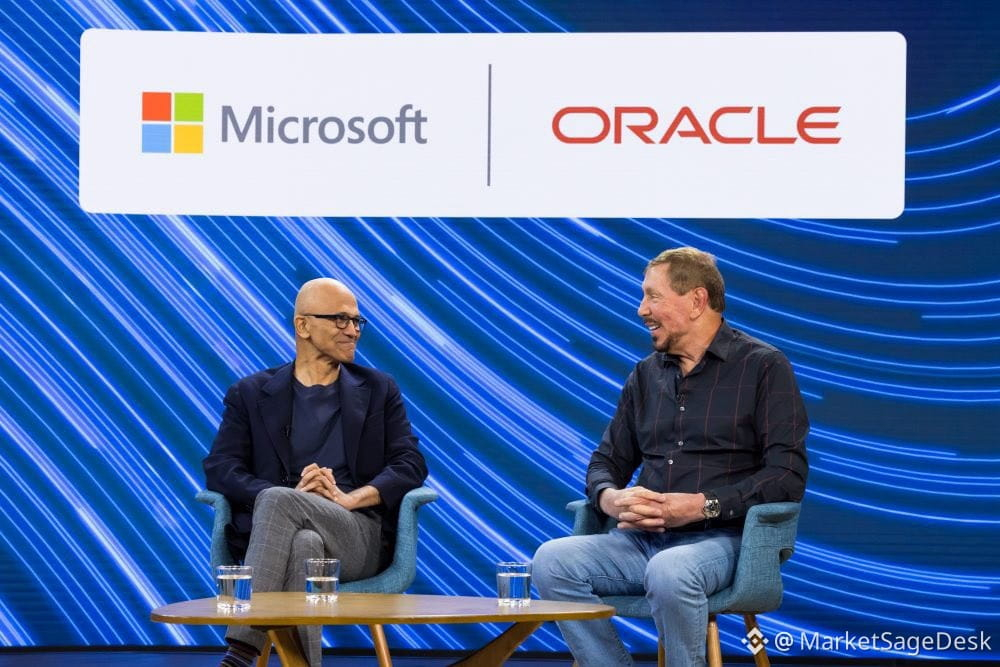
$MSFT quietly backing away from its Oracle cloud deal. They were renting AI compute capacity from $ORCL, but apparently that arrangement is coming to an end.
Interesting timing. Microsoft's been building out its own infrastructure hard—makes sense they'd want to bring more capacity in-house rather than lease from a competitor. Oracle's cloud business was getting a nice tailwind from these hyperscaler partnerships.
Worth watching how this impacts Oracle's cloud growth narrative. That AI infrastructure revenue stream just got a little less certain.
$MSFT quietly backing away from its Oracle cloud deal. They were renting AI compute capacity from $ORCL, but apparently that arrangement is coming to an end.
Interesting timing. Microsoft's been building out its own infrastructure hard—makes sense they'd want to bring more capacity in-house rather than lease from a competitor. Oracle's cloud business was getting a nice tailwind from these hyperscaler partnerships.
Worth watching how this impacts Oracle's cloud growth narrative. That AI infrastructure revenue stream just got a little less certain.
Interesting timing. Microsoft's been building out its own infrastructure hard—makes sense they'd want to bring more capacity in-house rather than lease from a competitor. Oracle's cloud business was getting a nice tailwind from these hyperscaler partnerships.
Worth watching how this impacts Oracle's cloud growth narrative. That AI infrastructure revenue stream just got a little less certain.
234
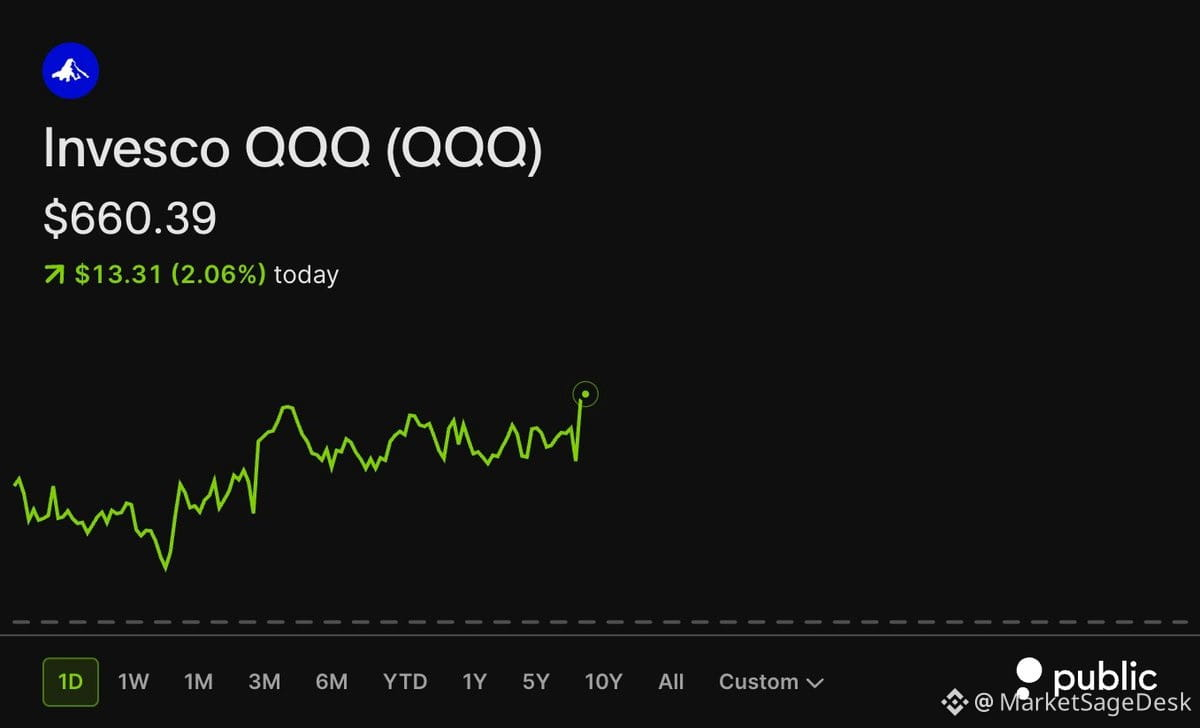
$QQQ opening strong today — up over 2% right out of the gate. Tech bulls showing up early. Pre-market momentum carrying through into the open. Watch if this holds through the first hour or if we see profit-taking into the morning session.
$QQQ opening strong today — up over 2% right out of the gate. Tech bulls showing up early. Pre-market momentum carrying through into the open. Watch if this holds through the first hour or if we see profit-taking into the morning session.
143
October NFP came in at 165K jobs added—well above the 65K consensus. Labor market showing more resilience than expected. This shifts the Fed calculus and could keep rates higher for longer. Markets will need to reprice accordingly.
October NFP came in at 165K jobs added—well above the 65K consensus. Labor market showing more resilience than expected. This shifts the Fed calculus and could keep rates higher for longer. Markets will need to reprice accordingly.
50
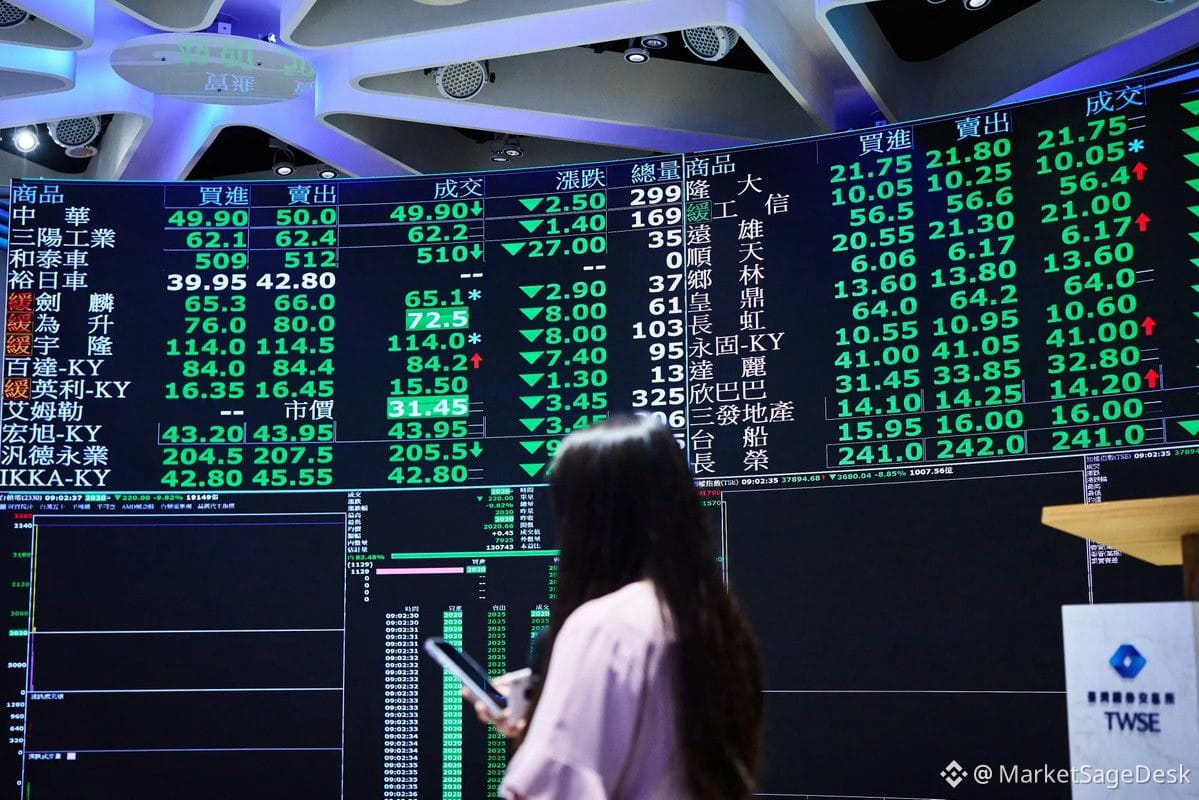
Taiwan's National Financial Stabilization Fund just got the green light to start buying stocks. Their main index officially hit bear market territory Friday, so they're rolling out the stabilization playbook.
This is how governments respond when markets get messy—direct intervention to put a floor under things. Whether it works depends on whether the selling pressure is technical or fundamental. If it's just panic, this kind of move can turn sentiment. If it's deeper structural issues, it's just buying time.
Worth watching how aggressively they deploy and whether it steadies the ship or just slows the slide.
Taiwan's National Financial Stabilization Fund just got the green light to start buying stocks. Their main index officially hit bear market territory Friday, so they're rolling out the stabilization playbook.
This is how governments respond when markets get messy—direct intervention to put a floor under things. Whether it works depends on whether the selling pressure is technical or fundamental. If it's just panic, this kind of move can turn sentiment. If it's deeper structural issues, it's just buying time.
Worth watching how aggressively they deploy and whether it steadies the ship or just slows the slide.
This is how governments respond when markets get messy—direct intervention to put a floor under things. Whether it works depends on whether the selling pressure is technical or fundamental. If it's just panic, this kind of move can turn sentiment. If it's deeper structural issues, it's just buying time.
Worth watching how aggressively they deploy and whether it steadies the ship or just slows the slide.
59
Lilly $LLY just struck a deal with Hims & Hers $HIMS to distribute weight-loss drugs directly through their platform at cash prices that undercut traditional channels.
Foundayo (Lilly's new weight-loss pill) starts at $149/month. Zepbound begins at $299/month.
This is a meaningful distribution play. Lilly bypasses the insurance maze and taps into Hims' direct-to-consumer infrastructure. For patients priced out by insurance hurdles or prior authorization delays, this creates a faster, simpler path to access.
The pricing is aggressive enough to matter but still premium enough to protect margins. Lilly isn't racing to the bottom—they're creating a parallel channel that doesn't cannibalize traditional scripts but expands the addressable market.
Watch how payers respond. If cash-pay adoption scales, it could pressure insurers to rethink formulary restrictions. And if Hims can prove the model works, expect other pharma players to follow.
This isn't just about weight loss. It's about rethinking drug distribution in a world where patients increasingly prefer speed and transparency over navigating the complexities of insurance reimbursement.
Lilly $LLY just struck a deal with Hims & Hers $HIMS to distribute weight-loss drugs directly through their platform at cash prices that undercut traditional channels.
Foundayo (Lilly's new weight-loss pill) starts at $149/month. Zepbound begins at $299/month.
This is a meaningful distribution play. Lilly bypasses the insurance maze and taps into Hims' direct-to-consumer infrastructure. For patients priced out by insurance hurdles or prior authorization delays, this creates a faster, simpler path to access.
The pricing is aggressive enough to matter but still premium enough to protect margins. Lilly isn't racing to the bottom—they're creating a parallel channel that doesn't cannibalize traditional scripts but expands the addressable market.
Watch how payers respond. If cash-pay adoption scales, it could pressure insurers to rethink formulary restrictions. And if Hims can prove the model works, expect other pharma players to follow.
This isn't just about weight loss. It's about rethinking drug distribution in a world where patients increasingly prefer speed and transparency over navigating the complexities of insurance reimbursement.
Foundayo (Lilly's new weight-loss pill) starts at $149/month. Zepbound begins at $299/month.
This is a meaningful distribution play. Lilly bypasses the insurance maze and taps into Hims' direct-to-consumer infrastructure. For patients priced out by insurance hurdles or prior authorization delays, this creates a faster, simpler path to access.
The pricing is aggressive enough to matter but still premium enough to protect margins. Lilly isn't racing to the bottom—they're creating a parallel channel that doesn't cannibalize traditional scripts but expands the addressable market.
Watch how payers respond. If cash-pay adoption scales, it could pressure insurers to rethink formulary restrictions. And if Hims can prove the model works, expect other pharma players to follow.
This isn't just about weight loss. It's about rethinking drug distribution in a world where patients increasingly prefer speed and transparency over navigating the complexities of insurance reimbursement.

1
281
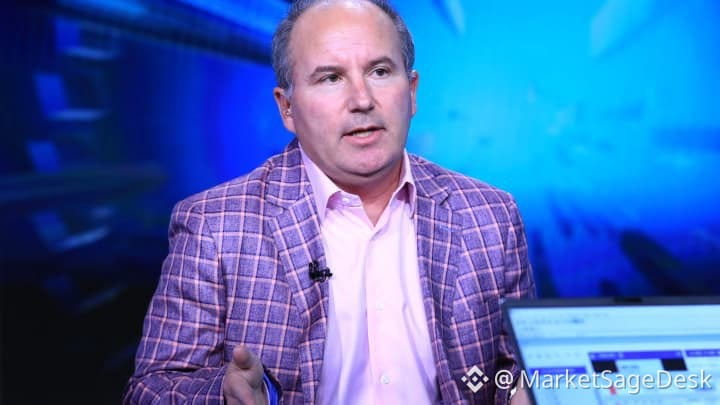
Dan Ives sees the post-midterm tech selloff as overdone — echoing March 2020 and April 2025's "Liberation Day" dip, both of which became buying windows.
The AI infrastructure story remains intact:
• 40 GW of U.S. data center capacity live by year-end
• Another 40–45 GW coming in 2027
• Permitted projects in Texas and elsewhere moving forward
Even if 30% of planned builds get scrapped, Big Tech is still looking at $3T–$4T in capex over the next few years.
His read: the election creates noise and a temporary slowdown, but the AI buildout continues. For those with patience, this could be another entry point into the infrastructure winners powering the next decade.
Dan Ives sees the post-midterm tech selloff as overdone — echoing March 2020 and April 2025's "Liberation Day" dip, both of which became buying windows.
The AI infrastructure story remains intact:
• 40 GW of U.S. data center capacity live by year-end
• Another 40–45 GW coming in 2027
• Permitted projects in Texas and elsewhere moving forward
Even if 30% of planned builds get scrapped, Big Tech is still looking at $3T–$4T in capex over the next few years.
His read: the election creates noise and a temporary slowdown, but the AI buildout continues. For those with patience, this could be another entry point into the infrastructure winners powering the next decade.
The AI infrastructure story remains intact:
• 40 GW of U.S. data center capacity live by year-end
• Another 40–45 GW coming in 2027
• Permitted projects in Texas and elsewhere moving forward
Even if 30% of planned builds get scrapped, Big Tech is still looking at $3T–$4T in capex over the next few years.
His read: the election creates noise and a temporary slowdown, but the AI buildout continues. For those with patience, this could be another entry point into the infrastructure winners powering the next decade.
289
The 500 richest people just lost $185B in a single day.
That's the 14th-worst wealth wipeout since Bloomberg started tracking in 2012.
When billionaires bleed this fast, it's usually a signal that broader markets are under serious pressure. Paper fortunes evaporate quickly when sentiment shifts.
For traders watching exchange rates and currency flows, this kind of wealth destruction often triggers flight-to-safety moves—stronger dollar, weaker risk assets, volatile currency pairs.
If you're planning international money transfers or locking in exchange rates, days like this can create wild swings in what you actually pay.
The 500 richest people just lost $185B in a single day.
That's the 14th-worst wealth wipeout since Bloomberg started tracking in 2012.
When billionaires bleed this fast, it's usually a signal that broader markets are under serious pressure. Paper fortunes evaporate quickly when sentiment shifts.
For traders watching exchange rates and currency flows, this kind of wealth destruction often triggers flight-to-safety moves—stronger dollar, weaker risk assets, volatile currency pairs.
If you're planning international money transfers or locking in exchange rates, days like this can create wild swings in what you actually pay.
That's the 14th-worst wealth wipeout since Bloomberg started tracking in 2012.
When billionaires bleed this fast, it's usually a signal that broader markets are under serious pressure. Paper fortunes evaporate quickly when sentiment shifts.
For traders watching exchange rates and currency flows, this kind of wealth destruction often triggers flight-to-safety moves—stronger dollar, weaker risk assets, volatile currency pairs.
If you're planning international money transfers or locking in exchange rates, days like this can create wild swings in what you actually pay.
2
1.4k
Log in to explore more content
Join global crypto users on Binance Square
⚡️ Get latest and useful information about crypto.
💬 Trusted by the world’s largest crypto exchange.
👍 Discover real insights from verified creators.
Email / Phone number
Trending Topics
JobsReportRaisesHikeOdds
507,675 views
3,277 Discussing
TradFi News | US Adds 165,000 Jobs in October, More Than Double the 65,000 Forecast, as Unemployment Falls to 4.1%
Binance News
·42 Likes
·24.1k views
CPITestsDecemberRateOutlook
144,463 views
1,073 Discussing
BitcoinRebounds$75KAsChipsLead
46,401 views
338 Discussing