
BlockchainReporter
27.8k Posts

BlockchainReporter
 Square Verified+
Report
Block User
The World's Page on Emerging Tech | Cryptocurrencies | Bitcoin | Blockchain | NFT | blockchainreporter.net
2 Following
42.0K+ Followers
180.1K+ Liked
Posts
Article
FivebalanceUSA Launches Scam Stomper Token on Pump.funMiami, United States, November 5th, 2026, Chainwire
FivebalanceUSA brings verified corporate identity to a platform defined by anonymous creators, with the goal of proving that legitimate projects can launch on the Pump.fun platform.
FivebalanceUSA, the company behind the scam-detection app Scam Stomper, has launched its meme token on Solana via pump.fun, positioning it as the platform’s first token issued by a verifiably registered and credentialed company rather than an anonymous creator. It’s technically an altcoin masquerading as a meme token.
Pump.fun has become one of the fastest-growing token launch platforms in crypto, but its openness has also made it a magnet for anonymous and fraudulent token creators, the exact pattern Scam Stomper was built to identify and help users avoid. The Scam Stomper token is issued by a company that holds a registered U.S. trademark, an active SAM.gov registration, and an SBA registration, identifiers that require verifiable legal registration and are publicly checkable by anyone.
“One of the biggest issues on pump.fun besides liquidity is not knowing who is actually behind a token,” said James McCoy, founder and CEO of FivebalanceUSA“Anyone can verify our trademark, our Government and Florida vendor credentials. That’s not something an anonymous wallet can produce.”
FivebalanceUSA operates two live, cross-platform applications: Scam Stomper, a scam pattern recognition app, and Fivebalance Mental Wellness, both distributed on iOS, Android, and the Samsung Galaxy Stores. The company has also submitted a federal grant application for the Fivebalance Mental Wellness app, with a decision expected in late November. The official token address and ticker can be found on the official company website, https://fivebalance.com. Visitors to the site will also find additional information about the company, the apps, and the company’s mission.
The FivebalanceUSA team is scheduled to appear in an interview on The Prince Miller Show, with the episode expected to release in late November. The YouTube channel is hosted by Gerald “Prince” Miller, who turned his life around after serving 34 and a half years in prison and went on to launch the show. It has more than 52,000 subscribers and focuses on urban culture. “This is one of the ways we’re giving back to the culture and bringing positivity to society,” said McCoy. “Prince and I come from the same neighborhood, so the interest is mutual.”
About FivebalanceUSA
FivebalanceUSA.LLC is a Florida-based company holding a registered U.S. trademark, U.S. government credentials, and Florida state vendor credentials. The company builds consumer applications including Scam Stomper, a scam pattern recognition platform, and Fivebalance Mental Wellness. More information is available at https://fivebalance.com.
Disclaimer:
Information in this release and on Fivebalance.com is for informational purposes only and is not financial or investment advice. Cryptocurrency, carries risk, including the loss of all funds. Always do your own research and consult a licensed professional. “FivebalanceUSA” is a registered trademark of FivebalanceUSA.LLC (U.S. Patent and Trademark Office Registration No. 7302623). The Fivebalance Mental Wellness app is not an approved FDA medical device, nor does it proclaim to be.
Contact
Vice President of operationsPerry FrancisFivebalanceUSAhello@fivebalance.com
This is a press release / sponsored content. Read our Sponsored Content Policy. This article is not intended as financial advice. Educational purposes only.
FivebalanceUSA Launches Scam Stomper Token on Pump.fun
Miami, United States, November 5th, 2026, Chainwire
FivebalanceUSA brings verified corporate identity to a platform defined by anonymous creators, with the goal of proving that legitimate projects can launch on the Pump.fun platform.
FivebalanceUSA, the company behind the scam-detection app Scam Stomper, has launched its meme token on Solana via pump.fun, positioning it as the platform’s first token issued by a verifiably registered and credentialed company rather than an anonymous creator. It’s technically an altcoin masquerading as a meme token.
Pump.fun has become one of the fastest-growing token launch platforms in crypto, but its openness has also made it a magnet for anonymous and fraudulent token creators, the exact pattern Scam Stomper was built to identify and help users avoid. The Scam Stomper token is issued by a company that holds a registered U.S. trademark, an active SAM.gov registration, and an SBA registration, identifiers that require verifiable legal registration and are publicly checkable by anyone.
“One of the biggest issues on pump.fun besides liquidity is not knowing who is actually behind a token,” said James McCoy, founder and CEO of FivebalanceUSA“Anyone can verify our trademark, our Government and Florida vendor credentials. That’s not something an anonymous wallet can produce.”
FivebalanceUSA operates two live, cross-platform applications: Scam Stomper, a scam pattern recognition app, and Fivebalance Mental Wellness, both distributed on iOS, Android, and the Samsung Galaxy Stores. The company has also submitted a federal grant application for the Fivebalance Mental Wellness app, with a decision expected in late November. The official token address and ticker can be found on the official company website, https://fivebalance.com. Visitors to the site will also find additional information about the company, the apps, and the company’s mission.
The FivebalanceUSA team is scheduled to appear in an interview on The Prince Miller Show, with the episode expected to release in late November. The YouTube channel is hosted by Gerald “Prince” Miller, who turned his life around after serving 34 and a half years in prison and went on to launch the show. It has more than 52,000 subscribers and focuses on urban culture. “This is one of the ways we’re giving back to the culture and bringing positivity to society,” said McCoy. “Prince and I come from the same neighborhood, so the interest is mutual.”
About FivebalanceUSA
FivebalanceUSA.LLC is a Florida-based company holding a registered U.S. trademark, U.S. government credentials, and Florida state vendor credentials. The company builds consumer applications including Scam Stomper, a scam pattern recognition platform, and Fivebalance Mental Wellness. More information is available at https://fivebalance.com.
Disclaimer:
Information in this release and on Fivebalance.com is for informational purposes only and is not financial or investment advice. Cryptocurrency, carries risk, including the loss of all funds. Always do your own research and consult a licensed professional. “FivebalanceUSA” is a registered trademark of FivebalanceUSA.LLC (U.S. Patent and Trademark Office Registration No. 7302623). The Fivebalance Mental Wellness app is not an approved FDA medical device, nor does it proclaim to be.
Contact
Vice President of operationsPerry FrancisFivebalanceUSAhello@fivebalance.com
This is a press release / sponsored content. Read our Sponsored Content Policy. This article is not intended as financial advice. Educational purposes only.
119

Article
IPX Plans to Bring ‘minicoin’ Payments to LINE FRIENDS Online and Offline Stores, Expanding IP Ex...Seoul, South Korea, November 5th, 2026, Chainwire
With phased rollout targeted for the first half of 2027, the service is expected to connect LINE FRIENDS’ online and offline commerce with the Web3 ecosystem, offering customers in Korea and abroad an additional payment option for purchasing physical products with minicoin
Digital IP entertainment company IPX (formerly LINE FRIENDS) plans to introduce a payment service using ‘minicoin’ at LINE FRIENDS online and offline stores. The service is intended to make digital asset payments a seamless extension of the fan experience, linking fans’ engagement with character IP to the point of purchase and connecting IPX’s online and offline commerce with a Web3-based digital ecosystem.
For more than a decade, IPX has brought its character IPs to life through products, content, and pop-ups, extending these experiences across online and offline channels worldwide. Building on its expertise in IP and retail, the introduction of this service presents a new digital IP commerce model that integrates digital asset payment technology into IP merchandise purchases.
Minicoin is a utility coin developed and issued by Mini Labs under an official license granted by IPX to use its globally popular ‘minini’ character IP. Its blockchain-based ecosystem seeks to transparently record activities generated through interactions between IP and fans, including creation, consumption, and transactions, and link them to registration and settlement processes.
The minicoin payment service is planned for phased rollout across LINE FRIENDS stores in Korea and abroad, with a rollout targeted for the first half of 2027. The service is expected to offer international visitors and overseas fans additional payment options. K-POP SQUARE, which opened in the heart of Seoul’s Hongdae district in June 2025, welcomed over one million visitors in its first year, approximately 80% of whom were international fans from more than 90 countries. As digital assets gain traction as payment methods worldwide, the service is expected to see strong demand.
“This service rollout marks an important step toward using digital assets to purchase physical merchandise, beyond trading and use within specific platforms,” said an IPX official. “We believe that the value of IP can grow further as it expands beyond connecting with fans through content and products to finding new ways to engage with them across the digital IP ecosystem. We will continue to explore new IP business opportunities that connect IP, fans, and commerce together in this evolving landscape.”
About IPX (F.K.A. LINE FRIENDS)
IPX is the new corporate name of LINE FRIENDS, a global character brand that started with original characters including BROWN, CONY, and SALLY, created for use as stickers for the leading mobile messenger app LINE and its 200 million active users worldwide. IPX has announced a new business strategy that it would accelerate the global expansion of its IP businesses by diversifying its IP portfolios targeting all ages and advancing its digital and retail business. IPX provides diverse IP experiences including BT21(BTS), ZO&FRIENDS(G-DRAGON), minini, and JOGUMAN. It has also carried out its IP-based business by partnering with global companies including Netflix (original animated series) and HoYoverse (Genshin Impact) to win the hearts of over 50 million Millennials and Generation Z worldwide. IPX currently operates in 18 markets worldwide, including Seoul, New York, LA, Tokyo, and Shanghai, and operates on 8 online sales platforms.
Contacts
ManagerJiwoo HongBursonjiwoo.hong@bursonglobal.comSr. DirectorHanna ParkBursonhanna.park@bursonglobal.com
This is a press release / sponsored content. Read our Sponsored Content Policy. This article is not intended as financial advice. Educational purposes only.
IPX Plans to Bring ‘minicoin’ Payments to LINE FRIENDS Online and Offline Stores, Expanding IP Ex...
Seoul, South Korea, November 5th, 2026, Chainwire
With phased rollout targeted for the first half of 2027, the service is expected to connect LINE FRIENDS’ online and offline commerce with the Web3 ecosystem, offering customers in Korea and abroad an additional payment option for purchasing physical products with minicoin
Digital IP entertainment company IPX (formerly LINE FRIENDS) plans to introduce a payment service using ‘minicoin’ at LINE FRIENDS online and offline stores. The service is intended to make digital asset payments a seamless extension of the fan experience, linking fans’ engagement with character IP to the point of purchase and connecting IPX’s online and offline commerce with a Web3-based digital ecosystem.
For more than a decade, IPX has brought its character IPs to life through products, content, and pop-ups, extending these experiences across online and offline channels worldwide. Building on its expertise in IP and retail, the introduction of this service presents a new digital IP commerce model that integrates digital asset payment technology into IP merchandise purchases.
Minicoin is a utility coin developed and issued by Mini Labs under an official license granted by IPX to use its globally popular ‘minini’ character IP. Its blockchain-based ecosystem seeks to transparently record activities generated through interactions between IP and fans, including creation, consumption, and transactions, and link them to registration and settlement processes.
The minicoin payment service is planned for phased rollout across LINE FRIENDS stores in Korea and abroad, with a rollout targeted for the first half of 2027. The service is expected to offer international visitors and overseas fans additional payment options. K-POP SQUARE, which opened in the heart of Seoul’s Hongdae district in June 2025, welcomed over one million visitors in its first year, approximately 80% of whom were international fans from more than 90 countries. As digital assets gain traction as payment methods worldwide, the service is expected to see strong demand.
“This service rollout marks an important step toward using digital assets to purchase physical merchandise, beyond trading and use within specific platforms,” said an IPX official. “We believe that the value of IP can grow further as it expands beyond connecting with fans through content and products to finding new ways to engage with them across the digital IP ecosystem. We will continue to explore new IP business opportunities that connect IP, fans, and commerce together in this evolving landscape.”
About IPX (F.K.A. LINE FRIENDS)
IPX is the new corporate name of LINE FRIENDS, a global character brand that started with original characters including BROWN, CONY, and SALLY, created for use as stickers for the leading mobile messenger app LINE and its 200 million active users worldwide. IPX has announced a new business strategy that it would accelerate the global expansion of its IP businesses by diversifying its IP portfolios targeting all ages and advancing its digital and retail business. IPX provides diverse IP experiences including BT21(BTS), ZO&FRIENDS(G-DRAGON), minini, and JOGUMAN. It has also carried out its IP-based business by partnering with global companies including Netflix (original animated series) and HoYoverse (Genshin Impact) to win the hearts of over 50 million Millennials and Generation Z worldwide. IPX currently operates in 18 markets worldwide, including Seoul, New York, LA, Tokyo, and Shanghai, and operates on 8 online sales platforms.
Contacts
ManagerJiwoo HongBursonjiwoo.hong@bursonglobal.comSr. DirectorHanna ParkBursonhanna.park@bursonglobal.com
This is a press release / sponsored content. Read our Sponsored Content Policy. This article is not intended as financial advice. Educational purposes only.
139
Article
Tria Brings Gacha Culture Onchain: Public Launch of Real Pokémon and One Piece Cards, Uncapped Bi...New York, New York, November 4th, 2026, Chainwire
The public launch combines digital pack openings, real graded collectibles, Tria Wallet payments, uncapped 1% Bitcoin back rewarded daily, and a monthly leaderboard competition.
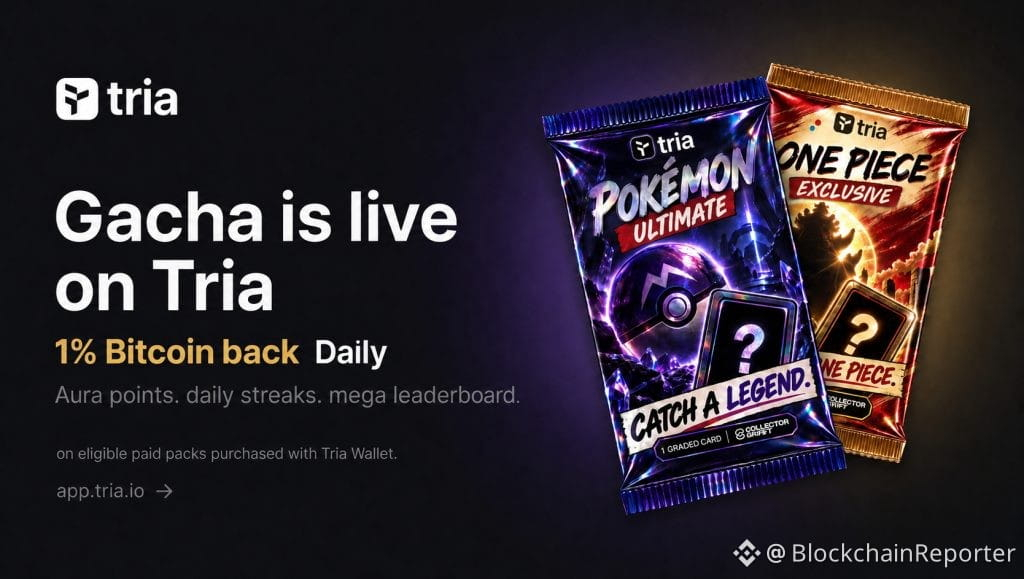
Tria, the self-custodial neofinance platform with more than 600,000 users, today announced the public launch of Tria Gacha, bringing the culture of surprise-driven collecting onchain with real graded Pokémon and One Piece trading cards, uncapped Bitcoin rewards and a new monthly leaderboard competition.
Following an initial rollout to waitlisted users, Gacha is now opening to the public. Collectors can purchase digital packs, reveal real physical trading cards and choose to keep their collectibles, sell them back through the app or request physical delivery where supported.
Why Tria Is Launching Gacha
Trading cards were already a meaningful spending category for Tria users but purchases through existing platforms can involve restricted payment options, complicated checkouts and failed transactions. Gacha brings that activity into the Tria app, where collectors can purchase packs directly through Tria Wallet.
“Collecting is already part of how our community spends, and Gacha has become a culture built around the excitement of the reveal,” said Vijit Katta, co-founder and CEO of Tria. “We’re bringing that culture onchain, combining real graded cards with Bitcoin rewards and the ability to keep, sell or ship what you pull, all through the same app people use to manage their money.”
New Card Packs, Bitcoin Rewards and Aura
The public launch adds $500 Pokémon packs and $50 and $500 One Piece packs to the existing lineup. Available packs and stock are shown in the Tria app. Packs are purchased through Tria Wallet, with randomized reveals determining which physical collectibles users receive.
The launch also introduces:
Uncapped Bitcoin rewards: Eligible paid pack purchases earn 1% back in Bitcoin, with no limit on total rewards.
Aura points: Every qualifying paid pack earns Aura points, rewarding collectors for their participation.
Daily streak multipliers: Qualifying purchases on consecutive days increase Aura earnings to 1.5× beginning on day seven and 2× beginning on day 14.
Unified rewards dashboard: Collectors can track Bitcoin rewards, Aura points, streaks and leaderboard standings in the Tria app.
Bitcoin rewards are distributed automatically, beginning November 6, with daily payouts thereafter. Streak multipliers apply to Aura earnings only.
Inaugural Gacha Leaderboard Begins November 4
Tria is launching a monthly Gacha leaderboard competition alongside the public rollout, with the inaugural campaign running from November 4 through December 1 at 12:00 AM UTC.
Collectors can track their live rankings throughout the competition, with standings determined by eligible paid pack spending, less refunds.
Competition prizes will be revealed November 20. Final rankings will be confirmed within 48 hours of the campaign’s conclusion, with prizes distributed within seven days.
Tria Gacha is available through the Tria mobile app in supported markets. Pack contents are randomized, and the value of a revealed card may be lower or higher than the purchase price. Physical delivery is subject to availability and shipping fees. Aura points have no cash value and cannot currently be redeemed.
For more information, visit app.tria.so.
About Tria
Tria is a self-custodial neofinance platform serving more than 600,000 users, bringing together digital asset management, payments, trading and rewards in a single app. Built for crypto-native users, Tria enables people to manage and spend their assets while retaining control of their funds.
Contact
Jon PhillipsPhillComm GlobalTria@PhillComm.Global
This is a press release / sponsored content. Read our Sponsored Content Policy. This article is not intended as financial advice. Educational purposes only.
Tria Brings Gacha Culture Onchain: Public Launch of Real Pokémon and One Piece Cards, Uncapped Bi...
New York, New York, November 4th, 2026, Chainwire
The public launch combines digital pack openings, real graded collectibles, Tria Wallet payments, uncapped 1% Bitcoin back rewarded daily, and a monthly leaderboard competition.
Tria, the self-custodial neofinance platform with more than 600,000 users, today announced the public launch of Tria Gacha, bringing the culture of surprise-driven collecting onchain with real graded Pokémon and One Piece trading cards, uncapped Bitcoin rewards and a new monthly leaderboard competition.
Following an initial rollout to waitlisted users, Gacha is now opening to the public. Collectors can purchase digital packs, reveal real physical trading cards and choose to keep their collectibles, sell them back through the app or request physical delivery where supported.
Why Tria Is Launching Gacha
Trading cards were already a meaningful spending category for Tria users but purchases through existing platforms can involve restricted payment options, complicated checkouts and failed transactions. Gacha brings that activity into the Tria app, where collectors can purchase packs directly through Tria Wallet.
“Collecting is already part of how our community spends, and Gacha has become a culture built around the excitement of the reveal,” said Vijit Katta, co-founder and CEO of Tria. “We’re bringing that culture onchain, combining real graded cards with Bitcoin rewards and the ability to keep, sell or ship what you pull, all through the same app people use to manage their money.”
New Card Packs, Bitcoin Rewards and Aura
The public launch adds $500 Pokémon packs and $50 and $500 One Piece packs to the existing lineup. Available packs and stock are shown in the Tria app. Packs are purchased through Tria Wallet, with randomized reveals determining which physical collectibles users receive.
The launch also introduces:
Uncapped Bitcoin rewards: Eligible paid pack purchases earn 1% back in Bitcoin, with no limit on total rewards.
Aura points: Every qualifying paid pack earns Aura points, rewarding collectors for their participation.
Daily streak multipliers: Qualifying purchases on consecutive days increase Aura earnings to 1.5× beginning on day seven and 2× beginning on day 14.
Unified rewards dashboard: Collectors can track Bitcoin rewards, Aura points, streaks and leaderboard standings in the Tria app.
Bitcoin rewards are distributed automatically, beginning November 6, with daily payouts thereafter. Streak multipliers apply to Aura earnings only.
Inaugural Gacha Leaderboard Begins November 4
Tria is launching a monthly Gacha leaderboard competition alongside the public rollout, with the inaugural campaign running from November 4 through December 1 at 12:00 AM UTC.
Collectors can track their live rankings throughout the competition, with standings determined by eligible paid pack spending, less refunds.
Competition prizes will be revealed November 20. Final rankings will be confirmed within 48 hours of the campaign’s conclusion, with prizes distributed within seven days.
Tria Gacha is available through the Tria mobile app in supported markets. Pack contents are randomized, and the value of a revealed card may be lower or higher than the purchase price. Physical delivery is subject to availability and shipping fees. Aura points have no cash value and cannot currently be redeemed.
For more information, visit app.tria.so.
About Tria
Tria is a self-custodial neofinance platform serving more than 600,000 users, bringing together digital asset management, payments, trading and rewards in a single app. Built for crypto-native users, Tria enables people to manage and spend their assets while retaining control of their funds.
Contact
Jon PhillipsPhillComm GlobalTria@PhillComm.Global
This is a press release / sponsored content. Read our Sponsored Content Policy. This article is not intended as financial advice. Educational purposes only.
193
Verified
Article
NEAR Mobile Hits #1 in Finance App Rankings and Charts Across 38 Countries As NEAR Ecosystem Gain...Escaldes-Engordany, Andorra, November 4th, 2026, Chainwire
With over 1 million downloads, the NEAR ecosystem’s largest mobile wallet expands its global reach while launching gasless cross-chain swaps across 120+ assets and 35+ blockchains powered by NEAR Intents.
NEAR Mobile is gaining international traction, appearing in App Store rankings across 38 countries over a recent 31-day period, according to app ranking data from Toplify.
The self-custodial wallet reached #1 in Finance in Serbia, #2 in Hungary, and #4 in Moldova and Oman, highlighting its growing visibility across international markets. NEAR Mobile also recently reached #7 in Finance in Finland and Nigeria.
These milestones come amid growing attention around the NEAR ecosystem and its chain abstraction infrastructure. NEAR Intents, the protocol powering cross-chain execution across the ecosystem, has surpassed $33 billion in cumulative volume across 35 blockchains.
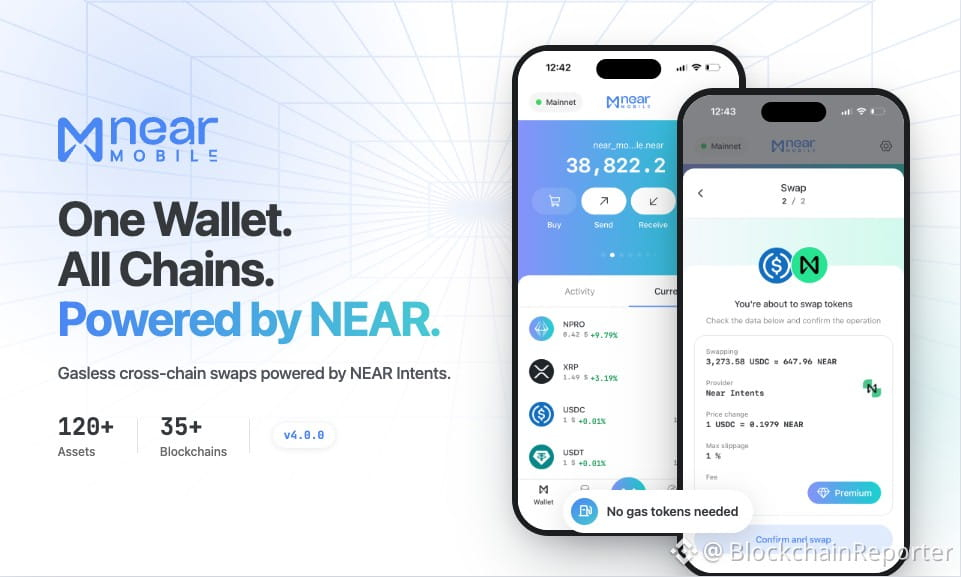
With more than one million downloads, NEAR Mobile is the largest mobile wallet in the NEAR ecosystem and continues to expand its capabilities with version 4.0.0, introducing a gasless experience designed to make blockchain interactions significantly simpler.
From Global Adoption to a Gasless Multichain Experience
As NEAR Mobile expands its international reach, its latest update addresses one of crypto’s biggest usability challenges: gas fees.
Traditionally, users interacting with multiple blockchains must maintain different native tokens to pay transaction fees, even when they already hold the assets they want to transfer or swap.
With version 4.0.0, NEAR Mobile sponsors relayer fees for supported transactions, enabling users to swap and move assets across supported networks without needing to hold NEAR or maintain native gas tokens across different blockchains.
Powered by NEAR Intents, NEAR Mobile provides access to more than 120 assets across 35+ blockchains, combining cross-chain execution, unified balances, staking and self-custodial asset management in a single mobile interface.
One Wallet. All Chains. Powered by NEAR.
Unified Balances Across 35+ Blockchains
Beyond removing gas complexity, NEAR Mobile addresses another major challenge in crypto: fragmented liquidity.
A user holding USDC across Ethereum, Base, BNB Chain and TRON traditionally has separate balances that may require manual bridging and network switching to use together.
Through NEAR Intents, NEAR Mobile can present supported liquidity from multiple networks as a unified balance, allowing users to send or swap aggregated assets without manually bridging funds first.
Cross-chain swaps can settle in seconds, bringing the experience closer to using a single financial account rather than navigating multiple independent blockchains.
By abstracting networks, bridges and gas tokens, NEAR Mobile makes NEAR’s chain abstraction technology accessible to everyday users.
The Largest Mobile Wallet in the NEAR Ecosystem
With over one million downloads and growing visibility across international Finance App Store rankings, NEAR Mobile has established itself as a leading consumer application within the NEAR ecosystem.
Available on both iOS and Android, the self-custodial NEAR wallet allows users to create and manage NEAR accounts, send and receive assets, stake NEAR and access multichain functionality directly from their phones.
NEAR Mobile supports onboarding through Google, Apple ID or email, combining a familiar mobile experience with self-custody and on-chain account recovery.
Experienced users can alternatively create or import wallets using a traditional mnemonic phrase.
The wallet also provides NEAR staking and access to NPRO staking, currently offering up to 8.58% APY.
As NEAR’s chain abstraction ecosystem continues expanding, NEAR Mobile aims to make its infrastructure accessible through an intuitive consumer-facing application.
NEAR Mobile at a Glance
1M+ downloads
App Store rankings across 38 countries in a recent 31-day period
#1 Finance in Serbia, #2 Hungary, #4 Moldova and Oman
120+ assets across 35+ blockchains
Gasless transactions for supported actions
Cross-chain swaps powered by NEAR Intents
Unified multichain balances
NEAR and NPRO staking
Google, Apple ID, email and mnemonic onboarding
On-chain account recovery and self-custody
Available on iOS and Android
About NEAR Mobile
NEAR Mobile is the largest self-custodial mobile wallet in the NEAR ecosystem, with more than 1 million downloads across iOS and Android.
Powered by NEAR Intents, the wallet enables users to manage NEAR, stake assets and access more than 120 tokens across 35+ blockchains through gasless cross-chain functionality and unified balances.
Its mission is to make NEAR’s chain abstraction infrastructure accessible to everyone by removing the complexity of networks, bridges and gas tokens.
One Wallet. All Chains. Powered by NEAR.
Contact
NEAR MobileFerran PratPeersyst Technology Global SLfprat@peersyst.com
This is a press release / sponsored content. Read our Sponsored Content Policy. This article is not intended as financial advice. Educational purposes only.
NEAR Mobile Hits #1 in Finance App Rankings and Charts Across 38 Countries As NEAR Ecosystem Gain...
Escaldes-Engordany, Andorra, November 4th, 2026, Chainwire
With over 1 million downloads, the NEAR ecosystem’s largest mobile wallet expands its global reach while launching gasless cross-chain swaps across 120+ assets and 35+ blockchains powered by NEAR Intents.
NEAR Mobile is gaining international traction, appearing in App Store rankings across 38 countries over a recent 31-day period, according to app ranking data from Toplify.
The self-custodial wallet reached #1 in Finance in Serbia, #2 in Hungary, and #4 in Moldova and Oman, highlighting its growing visibility across international markets. NEAR Mobile also recently reached #7 in Finance in Finland and Nigeria.
These milestones come amid growing attention around the NEAR ecosystem and its chain abstraction infrastructure. NEAR Intents, the protocol powering cross-chain execution across the ecosystem, has surpassed $33 billion in cumulative volume across 35 blockchains.
With more than one million downloads, NEAR Mobile is the largest mobile wallet in the NEAR ecosystem and continues to expand its capabilities with version 4.0.0, introducing a gasless experience designed to make blockchain interactions significantly simpler.
From Global Adoption to a Gasless Multichain Experience
As NEAR Mobile expands its international reach, its latest update addresses one of crypto’s biggest usability challenges: gas fees.
Traditionally, users interacting with multiple blockchains must maintain different native tokens to pay transaction fees, even when they already hold the assets they want to transfer or swap.
With version 4.0.0, NEAR Mobile sponsors relayer fees for supported transactions, enabling users to swap and move assets across supported networks without needing to hold NEAR or maintain native gas tokens across different blockchains.
Powered by NEAR Intents, NEAR Mobile provides access to more than 120 assets across 35+ blockchains, combining cross-chain execution, unified balances, staking and self-custodial asset management in a single mobile interface.
One Wallet. All Chains. Powered by NEAR.
Unified Balances Across 35+ Blockchains
Beyond removing gas complexity, NEAR Mobile addresses another major challenge in crypto: fragmented liquidity.
A user holding USDC across Ethereum, Base, BNB Chain and TRON traditionally has separate balances that may require manual bridging and network switching to use together.
Through NEAR Intents, NEAR Mobile can present supported liquidity from multiple networks as a unified balance, allowing users to send or swap aggregated assets without manually bridging funds first.
Cross-chain swaps can settle in seconds, bringing the experience closer to using a single financial account rather than navigating multiple independent blockchains.
By abstracting networks, bridges and gas tokens, NEAR Mobile makes NEAR’s chain abstraction technology accessible to everyday users.
The Largest Mobile Wallet in the NEAR Ecosystem
With over one million downloads and growing visibility across international Finance App Store rankings, NEAR Mobile has established itself as a leading consumer application within the NEAR ecosystem.
Available on both iOS and Android, the self-custodial NEAR wallet allows users to create and manage NEAR accounts, send and receive assets, stake NEAR and access multichain functionality directly from their phones.
NEAR Mobile supports onboarding through Google, Apple ID or email, combining a familiar mobile experience with self-custody and on-chain account recovery.
Experienced users can alternatively create or import wallets using a traditional mnemonic phrase.
The wallet also provides NEAR staking and access to NPRO staking, currently offering up to 8.58% APY.
As NEAR’s chain abstraction ecosystem continues expanding, NEAR Mobile aims to make its infrastructure accessible through an intuitive consumer-facing application.
NEAR Mobile at a Glance
1M+ downloads
App Store rankings across 38 countries in a recent 31-day period
#1 Finance in Serbia, #2 Hungary, #4 Moldova and Oman
120+ assets across 35+ blockchains
Gasless transactions for supported actions
Cross-chain swaps powered by NEAR Intents
Unified multichain balances
NEAR and NPRO staking
Google, Apple ID, email and mnemonic onboarding
On-chain account recovery and self-custody
Available on iOS and Android
About NEAR Mobile
NEAR Mobile is the largest self-custodial mobile wallet in the NEAR ecosystem, with more than 1 million downloads across iOS and Android.
Powered by NEAR Intents, the wallet enables users to manage NEAR, stake assets and access more than 120 tokens across 35+ blockchains through gasless cross-chain functionality and unified balances.
Its mission is to make NEAR’s chain abstraction infrastructure accessible to everyone by removing the complexity of networks, bridges and gas tokens.
One Wallet. All Chains. Powered by NEAR.
Contact
NEAR MobileFerran PratPeersyst Technology Global SLfprat@peersyst.com
This is a press release / sponsored content. Read our Sponsored Content Policy. This article is not intended as financial advice. Educational purposes only.
3
598

Article
Louvre Abu Dhabi Opens Its Doors to Digital Assets and AI for the First Time With Proof of TalkAbu Dhabi, United Arab Emirates, November 3rd, 2026, Chainwire
Binance founder CZ to open the December 3–4 summit, alongside leaders from Franklin Templeton, BlackRock, DTCC and other global institutions
Louvre Abu Dhabi will open its doors to digital assets and AI for the first time as Proof of Talk brings its executive summit to the Gulf on December 3–4, 2026. Following four editions at the Louvre Palace in Paris, the event marks a new chapter for Proof of Talk, bringing together leaders from global finance, digital assets and emerging technologies at one of the region’s most prominent cultural landmarks.
Binance founder Changpeng Zhao (CZ) will open the two-day summit, which will bring together up to 2,000 senior decision-makers, founders and investors, with participation by invitation or curated application. The confirmed speaker lineup includes Jenny Johnson, president and CEO of Franklin Templeton; Richard Teng, CEO of Binance; Tony Ashraf, head of digital assets for the Middle East at BlackRock; Nadine Chakar, global head of digital assets at DTCC; and Kim Hochfeld, senior managing director and global head of cash, digital and securities lending at State Street Investment Management.
“In Paris, the Louvre stands for heritage. In Abu Dhabi, it stands for the bridge between cultures. And now it welcomes the future of finance. That says a lot about how far digital assets and AI have come, from the fringe to the core, and the people who decide what comes next will be in that room,” said Zohair Dehnadi, founder and CEO of Proof of Talk.
StableDay, a dedicated program on focused on stablecoins and tokenized money, will take place on December 3. Bringing together leaders from traditional finance and digital asset companies, the program will feature main-stage discussions and smaller roundtables exploring payments, tokenization and the evolving role of digital money. The roundtable format is designed to encourage direct exchanges between participants rather than traditional speaker-and-audience discussions.
Speakers listed for StableDay include Maurice Gravier, group chief investment officer at Emirates NBD; Jayesh Patel, CEO of Wio Bank; and Mike Kuehnel, chairman of Copper. The roundtable format gives participants an active role in discussions rather than a traditional speaker-and-audience setup.
The summit will also feature Proof of Pitch, giving early-stage companies an opportunity to present their businesses to investors and industry leaders. Separate tracks will focus on digital assets and AI, with the AI program expanding into a dedicated main-stage block on December 4.
Building on its Paris editions, Proof of Talk’s Abu Dhabi debut extends the summit’s approach of bringing senior financial executives, technology founders and investors together for direct discussions. The event will maintain a curated format, with attendance capped and speakers selected by the program team.
Taking place at Louvre Abu Dhabi in the Saadiyat Cultural District, the summit will coincide with Abu Dhabi Grand Prix week, December 3–6, and precede Abu Dhabi Finance Week, December 7–10, positioning it within a series of major international events taking place in the emirate.
Participation is by invitation and curated application. For more information and to apply to attend, visit https://proofoftalk.io/abu-dhabi/.
About Proof of Talk
Born at the Louvre Palace in Paris, Proof of Talk is the executive summit where the leaders of global finance meet the people building the next financial system. It brings together the chief executives of the world’s largest asset managers, banks and payment networks with the founders, investors and regulators shaping digital assets, and with the AI leaders transforming them. After four sold-out editions in Paris, the summit comes to a second Louvre: on 3 and 4 December 2026, for the first time in its history, Louvre Abu Dhabi opens its doors to digital assets and AI. The Louvre stands for what no other venue can: heritage in Paris, a bridge between cultures in Abu Dhabi, and now the future of finance. Attendance is capped and granted by application only. Every speaker is selected by the programme team; no speaking slot is sold. proofoftalk.io
Contact
MarketAcross PRamy@marketacross.com
This is a press release / sponsored content. Read our Sponsored Content Policy. This article is not intended as financial advice. Educational purposes only.
Louvre Abu Dhabi Opens Its Doors to Digital Assets and AI for the First Time With Proof of Talk
Abu Dhabi, United Arab Emirates, November 3rd, 2026, Chainwire
Binance founder CZ to open the December 3–4 summit, alongside leaders from Franklin Templeton, BlackRock, DTCC and other global institutions
Louvre Abu Dhabi will open its doors to digital assets and AI for the first time as Proof of Talk brings its executive summit to the Gulf on December 3–4, 2026. Following four editions at the Louvre Palace in Paris, the event marks a new chapter for Proof of Talk, bringing together leaders from global finance, digital assets and emerging technologies at one of the region’s most prominent cultural landmarks.
Binance founder Changpeng Zhao (CZ) will open the two-day summit, which will bring together up to 2,000 senior decision-makers, founders and investors, with participation by invitation or curated application. The confirmed speaker lineup includes Jenny Johnson, president and CEO of Franklin Templeton; Richard Teng, CEO of Binance; Tony Ashraf, head of digital assets for the Middle East at BlackRock; Nadine Chakar, global head of digital assets at DTCC; and Kim Hochfeld, senior managing director and global head of cash, digital and securities lending at State Street Investment Management.
“In Paris, the Louvre stands for heritage. In Abu Dhabi, it stands for the bridge between cultures. And now it welcomes the future of finance. That says a lot about how far digital assets and AI have come, from the fringe to the core, and the people who decide what comes next will be in that room,” said Zohair Dehnadi, founder and CEO of Proof of Talk.
StableDay, a dedicated program on focused on stablecoins and tokenized money, will take place on December 3. Bringing together leaders from traditional finance and digital asset companies, the program will feature main-stage discussions and smaller roundtables exploring payments, tokenization and the evolving role of digital money. The roundtable format is designed to encourage direct exchanges between participants rather than traditional speaker-and-audience discussions.
Speakers listed for StableDay include Maurice Gravier, group chief investment officer at Emirates NBD; Jayesh Patel, CEO of Wio Bank; and Mike Kuehnel, chairman of Copper. The roundtable format gives participants an active role in discussions rather than a traditional speaker-and-audience setup.
The summit will also feature Proof of Pitch, giving early-stage companies an opportunity to present their businesses to investors and industry leaders. Separate tracks will focus on digital assets and AI, with the AI program expanding into a dedicated main-stage block on December 4.
Building on its Paris editions, Proof of Talk’s Abu Dhabi debut extends the summit’s approach of bringing senior financial executives, technology founders and investors together for direct discussions. The event will maintain a curated format, with attendance capped and speakers selected by the program team.
Taking place at Louvre Abu Dhabi in the Saadiyat Cultural District, the summit will coincide with Abu Dhabi Grand Prix week, December 3–6, and precede Abu Dhabi Finance Week, December 7–10, positioning it within a series of major international events taking place in the emirate.
Participation is by invitation and curated application. For more information and to apply to attend, visit https://proofoftalk.io/abu-dhabi/.
About Proof of Talk
Born at the Louvre Palace in Paris, Proof of Talk is the executive summit where the leaders of global finance meet the people building the next financial system. It brings together the chief executives of the world’s largest asset managers, banks and payment networks with the founders, investors and regulators shaping digital assets, and with the AI leaders transforming them. After four sold-out editions in Paris, the summit comes to a second Louvre: on 3 and 4 December 2026, for the first time in its history, Louvre Abu Dhabi opens its doors to digital assets and AI. The Louvre stands for what no other venue can: heritage in Paris, a bridge between cultures in Abu Dhabi, and now the future of finance. Attendance is capped and granted by application only. Every speaker is selected by the programme team; no speaking slot is sold. proofoftalk.io
Contact
MarketAcross PRamy@marketacross.com
This is a press release / sponsored content. Read our Sponsored Content Policy. This article is not intended as financial advice. Educational purposes only.
STTUS-3.07%
BLKUS-3.79%
BENUS-4.75%
1
253
Bitcoin Drops Below $77,000 As Chip Rout Deepens Ahead of U.S. MidtermsBitcoin slid back below $77,000 on Tuesday, erasing Monday’s recovery, as a deepening sell-off in U.S. semiconductor stocks spilled into global equities and traders braced for the first results of the U.S. midterm elections. The token fell about 2% to just under $77,000 in Asian trading, according to CoinGecko pricing, leaving it below the roughly $77,600 level it touched late Sunday.
The drop is not a crypto-specific move. A gauge of U.S. chipmakers has now fallen 12% over three sessions, dragging the Nasdaq 100 down roughly 10% from its peak — the threshold traders use to call a technical correction — while the S&P 500 slipped 0.5%. Bitcoin, which has traded as a high-beta risk asset through the year’s macro swings, tracked that equity weakness rather than any news out of the digital-asset sector.
A Crowded Week of Catalysts
The sell-off lands in the middle of an unusually dense stretch of the calendar. Apple and Palantir reported earnings on November 2, voters headed to the polls for the U.S. midterms on November 3, and the October jobs report follows on November 6. Each of those events carries a risk read for crypto: earnings shape the AI-and-chips trade that has dominated equities, the midterms carry the fate of crypto legislation including the CLARITY Act, and the jobs report feeds the Federal Reserve’s December rate calculus.
Market commentary has flagged a specific fear around the midterms: if Democrats secure a majority, crypto-market legislation could stall, because the party has previously demanded stronger ethics provisions in the CLARITY Act. That is a political risk being priced alongside the equity rout, not a confirmed policy outcome.
Where Bitcoin’s Support Sits
Bitcoin has held above its 100-day moving average, which sat at roughly $76,463 as of November 1, according to market data cited by Traders Union. That level, alongside the $77,000 round number, is the line traders are watching: a sustained break below the moving average would mark the first such close in months, while a hold keeps the asset inside the range it has traded since slipping from $80,000.
Ether traded near $2,250, down about 1.7%, with most major altcoins lower in line with the broader risk-off tone. Ripple’s XRP was a relative outperformer, down less than 1%.
Why the Chip Rout Matters for Crypto
The semiconductor sell-off matters for digital assets in two ways. First, it is the direct driver of the equity weakness Bitcoin has been mirroring — when the AI-and-chips trade unwinds, the risk budget that had supported crypto’s correlation to tech equities shrinks with it. Second, the chip rout is the same AI-adjacent theme that has been a tailwind for the tokenization of compute and AI-related crypto narratives, so a sustained equity correction there would remove a sentiment prop rather than add one.
None of this changes Bitcoin’s own supply-and-demand setup, which analysts have described as tightening: exchange outflows have pointed to a supply squeeze ahead of the post-election period, a signal that long-term holders are moving coins off venues even as short-term price action wobbles.
What to Watch
The immediate markers are the midterm results as they come in, the closing levels of the chipmakers index, and whether Bitcoin holds $76,463 through the week. A close back above $77,600 would suggest the dip was a leveraged flush rather than a change in trend; a decisive break of the 100-day moving average would open the next leg lower.
As with any risk-off episode, the distinction matters: the move so far is best read as positioning ahead of a dense catalyst calendar — a chip rout and an election — rather than a confirmed deterioration in Bitcoin’s own fundamentals.
This article is not intended as financial advice. Educational purposes only.
Bitcoin Drops Below $77,000 As Chip Rout Deepens Ahead of U.S. Midterms
Bitcoin slid back below $77,000 on Tuesday, erasing Monday’s recovery, as a deepening sell-off in U.S. semiconductor stocks spilled into global equities and traders braced for the first results of the U.S. midterm elections. The token fell about 2% to just under $77,000 in Asian trading, according to CoinGecko pricing, leaving it below the roughly $77,600 level it touched late Sunday.
The drop is not a crypto-specific move. A gauge of U.S. chipmakers has now fallen 12% over three sessions, dragging the Nasdaq 100 down roughly 10% from its peak — the threshold traders use to call a technical correction — while the S&P 500 slipped 0.5%. Bitcoin, which has traded as a high-beta risk asset through the year’s macro swings, tracked that equity weakness rather than any news out of the digital-asset sector.
A Crowded Week of Catalysts
The sell-off lands in the middle of an unusually dense stretch of the calendar. Apple and Palantir reported earnings on November 2, voters headed to the polls for the U.S. midterms on November 3, and the October jobs report follows on November 6. Each of those events carries a risk read for crypto: earnings shape the AI-and-chips trade that has dominated equities, the midterms carry the fate of crypto legislation including the CLARITY Act, and the jobs report feeds the Federal Reserve’s December rate calculus.
Market commentary has flagged a specific fear around the midterms: if Democrats secure a majority, crypto-market legislation could stall, because the party has previously demanded stronger ethics provisions in the CLARITY Act. That is a political risk being priced alongside the equity rout, not a confirmed policy outcome.
Where Bitcoin’s Support Sits
Bitcoin has held above its 100-day moving average, which sat at roughly $76,463 as of November 1, according to market data cited by Traders Union. That level, alongside the $77,000 round number, is the line traders are watching: a sustained break below the moving average would mark the first such close in months, while a hold keeps the asset inside the range it has traded since slipping from $80,000.
Ether traded near $2,250, down about 1.7%, with most major altcoins lower in line with the broader risk-off tone. Ripple’s XRP was a relative outperformer, down less than 1%.
Why the Chip Rout Matters for Crypto
The semiconductor sell-off matters for digital assets in two ways. First, it is the direct driver of the equity weakness Bitcoin has been mirroring — when the AI-and-chips trade unwinds, the risk budget that had supported crypto’s correlation to tech equities shrinks with it. Second, the chip rout is the same AI-adjacent theme that has been a tailwind for the tokenization of compute and AI-related crypto narratives, so a sustained equity correction there would remove a sentiment prop rather than add one.
None of this changes Bitcoin’s own supply-and-demand setup, which analysts have described as tightening: exchange outflows have pointed to a supply squeeze ahead of the post-election period, a signal that long-term holders are moving coins off venues even as short-term price action wobbles.
What to Watch
The immediate markers are the midterm results as they come in, the closing levels of the chipmakers index, and whether Bitcoin holds $76,463 through the week. A close back above $77,600 would suggest the dip was a leveraged flush rather than a change in trend; a decisive break of the 100-day moving average would open the next leg lower.
As with any risk-off episode, the distinction matters: the move so far is best read as positioning ahead of a dense catalyst calendar — a chip rout and an election — rather than a confirmed deterioration in Bitcoin’s own fundamentals.
This article is not intended as financial advice. Educational purposes only.
1
361
Article
Coinhub Funded Goes Live: Crypto Prop Firm Offers Funded Trading Accounts Up to $200K & 30-Minute...Charlestown, Saint Kitts and Nevis, November 3rd, 2026, Chainwire
Trade 28+ crypto pairs plus forex, indices, metals and commodities on a funded account with payouts in USDT every 14 days, and compete against other traders at the Tokyo, London and New York opens. Code LAUNCH takes 25% off any challenge through November.
Coinhub Funded, the crypto-native prop firm from the Coinhub brand, went live today with funded trading accounts of up to $200,000 and Coinhub Funded Tournaments, 30-minute trading contests on $100,000 simulated accounts where traders test their skill against the field for prizes paid in USDT. Both are live now at coinhubfunded.com , and the code LAUNCH takes 25% off any challenge or Instant Funding account through November 30, 2026
Coinhub Funded launches November 2, 2026 with funded trading accounts up to $200K and daily trading tournaments.
A crypto-first prop firm
Traders qualify through a 2-Step or 1-Step evaluation with no time limit, or start on a funded account the same day with Instant Funding. Challenges start at $75 and no identity check is required until a trader passes. Funded traders keep up to 90% of the profit and can request a payout every 14 days, sent in USDT on Ethereum, Tron or BNB Smart Chain within one to three business days; on 2-Step and 1-Step accounts the challenge fee is refunded with the third payout. As a crypto prop firm, Coinhub Funded offers 28+ crypto pairs around the clock on trading days alongside forex, indices, metals and commodities.
Nine tournaments a day, prizes in USDT
Coinhub Funded Tournaments start three times at each of the Tokyo open (00:00 UTC), the London open (8:00 a.m. London time) and the New York opening bell (9:30 a.m. Eastern), every weekday: a free tier, a $25 tier and a $100 tier. Entry fees are paid in USDT, 90% of them form the prize pool, and the pool is paid in USDT to the top finishers. First place in a free tournament wins 25 USDT, and every free entrant receives a 20% code toward a challenge. The tournaments are a separate skill contest and have no effect on any challenge or funded account; the schedule is at coinhubfunded.com/tournaments and the contest rules at https://coinhubfunded.com/tournament-rules/.
Coinhub Funded Tournaments: three 30-minute contests at each of the Tokyo, London and New York opens, with Free, $25 and $100 tiers and prizes paid in USDT.
Coinhub Funded at a glance
Funded trading accounts up to $200K; challenges from $75; Instant Funding from $125
28+ crypto pairs plus forex, indices, metals and commodities from one account
Profit split 80/20, or 90/10 with the add-on; payouts every 14 days in USDT
No time limit on the evaluation; challenge fee refunded with the third payout
Nine 30-minute tournaments every weekday; Free, $25 and $100 tiers; prizes in USDT
Buy crypto with cash at 2,000+ Coinhub ATMs to pay for a challenge or a tournament entry
Code LAUNCH: 25% off any challenge or Instant Funding account through November 30, 2026
“Traders have used the Coinhub name to move in and out of crypto since 2019, and now they can use it to get funded,” said Quincy Mathis, Operations Manager at Coinhub Funded. “There is no clock on the evaluation and you get paid in USDT. And with the tournaments, anyone can sit down at the Tokyo, London or New York open and test their skill against other traders for a USDT prize.”
Frequently asked questions
What is Coinhub Funded? A crypto-native proprietary trading firm (Prop Firm) that gives traders a funded trading account of up to $200K after a simulated evaluation, with profit splits up to 90% and payouts in USDT. It operates under the Coinhub brand, known for its Bitcoin ATM network, online exchange and wallet.
How do the trading tournaments work? Nine 30-minute tournaments run every weekday on $100,000 simulated accounts, at the Tokyo, London and New York opens, in Free, $25 and $100 tiers; 90% of paid entry fees form the prize pool. Prizes are paid in USDT after identity verification. Tournaments are open to adults outside restricted jurisdictions, excluding residents of Arizona, Arkansas, Delaware, Iowa, Louisiana, Montana, New York, South Carolina, Tennessee and Washington.
Is there a launch offer? Yes. Code LAUNCH takes 25% off any challenge or Instant Funding account through November 30, 2026.
About Coinhub Funded
Coinhub Funded is a crypto native proprietary trading firm offering funded trading accounts of up to $200K across crypto, forex, indices, metals and commodities, with payouts in USDT, and Coinhub Funded Tournaments, 30-minute trading contests on simulated accounts with prizes paid in USDT. It is part of the Coinhub ecosystem, which has operated since 2019 and includes 2,000+ Bitcoin ATMs across 25+ US states, an online exchange and a self custody wallet, and operates under the Coinhub name and logo through an IP license agreement. Learn more at coinhubfunded.com and follow @CoinhubFunded on X.
Contact
Marketing DirectorBrian S. SmithCoinhub Fundedbsmith@coinhubfunded.com
This is a press release / sponsored content. Read our Sponsored Content Policy. This article is not intended as financial advice. Educational purposes only.
Coinhub Funded Goes Live: Crypto Prop Firm Offers Funded Trading Accounts Up to $200K & 30-Minute...
Charlestown, Saint Kitts and Nevis, November 3rd, 2026, Chainwire
Trade 28+ crypto pairs plus forex, indices, metals and commodities on a funded account with payouts in USDT every 14 days, and compete against other traders at the Tokyo, London and New York opens. Code LAUNCH takes 25% off any challenge through November.
Coinhub Funded, the crypto-native prop firm from the Coinhub brand, went live today with funded trading accounts of up to $200,000 and Coinhub Funded Tournaments, 30-minute trading contests on $100,000 simulated accounts where traders test their skill against the field for prizes paid in USDT. Both are live now at coinhubfunded.com , and the code LAUNCH takes 25% off any challenge or Instant Funding account through November 30, 2026
Coinhub Funded launches November 2, 2026 with funded trading accounts up to $200K and daily trading tournaments.
A crypto-first prop firm
Traders qualify through a 2-Step or 1-Step evaluation with no time limit, or start on a funded account the same day with Instant Funding. Challenges start at $75 and no identity check is required until a trader passes. Funded traders keep up to 90% of the profit and can request a payout every 14 days, sent in USDT on Ethereum, Tron or BNB Smart Chain within one to three business days; on 2-Step and 1-Step accounts the challenge fee is refunded with the third payout. As a crypto prop firm, Coinhub Funded offers 28+ crypto pairs around the clock on trading days alongside forex, indices, metals and commodities.
Nine tournaments a day, prizes in USDT
Coinhub Funded Tournaments start three times at each of the Tokyo open (00:00 UTC), the London open (8:00 a.m. London time) and the New York opening bell (9:30 a.m. Eastern), every weekday: a free tier, a $25 tier and a $100 tier. Entry fees are paid in USDT, 90% of them form the prize pool, and the pool is paid in USDT to the top finishers. First place in a free tournament wins 25 USDT, and every free entrant receives a 20% code toward a challenge. The tournaments are a separate skill contest and have no effect on any challenge or funded account; the schedule is at coinhubfunded.com/tournaments and the contest rules at https://coinhubfunded.com/tournament-rules/.
Coinhub Funded Tournaments: three 30-minute contests at each of the Tokyo, London and New York opens, with Free, $25 and $100 tiers and prizes paid in USDT.
Coinhub Funded at a glance
Funded trading accounts up to $200K; challenges from $75; Instant Funding from $125
28+ crypto pairs plus forex, indices, metals and commodities from one account
Profit split 80/20, or 90/10 with the add-on; payouts every 14 days in USDT
No time limit on the evaluation; challenge fee refunded with the third payout
Nine 30-minute tournaments every weekday; Free, $25 and $100 tiers; prizes in USDT
Buy crypto with cash at 2,000+ Coinhub ATMs to pay for a challenge or a tournament entry
Code LAUNCH: 25% off any challenge or Instant Funding account through November 30, 2026
“Traders have used the Coinhub name to move in and out of crypto since 2019, and now they can use it to get funded,” said Quincy Mathis, Operations Manager at Coinhub Funded. “There is no clock on the evaluation and you get paid in USDT. And with the tournaments, anyone can sit down at the Tokyo, London or New York open and test their skill against other traders for a USDT prize.”
Frequently asked questions
What is Coinhub Funded? A crypto-native proprietary trading firm (Prop Firm) that gives traders a funded trading account of up to $200K after a simulated evaluation, with profit splits up to 90% and payouts in USDT. It operates under the Coinhub brand, known for its Bitcoin ATM network, online exchange and wallet.
How do the trading tournaments work? Nine 30-minute tournaments run every weekday on $100,000 simulated accounts, at the Tokyo, London and New York opens, in Free, $25 and $100 tiers; 90% of paid entry fees form the prize pool. Prizes are paid in USDT after identity verification. Tournaments are open to adults outside restricted jurisdictions, excluding residents of Arizona, Arkansas, Delaware, Iowa, Louisiana, Montana, New York, South Carolina, Tennessee and Washington.
Is there a launch offer? Yes. Code LAUNCH takes 25% off any challenge or Instant Funding account through November 30, 2026.
About Coinhub Funded
Coinhub Funded is a crypto native proprietary trading firm offering funded trading accounts of up to $200K across crypto, forex, indices, metals and commodities, with payouts in USDT, and Coinhub Funded Tournaments, 30-minute trading contests on simulated accounts with prizes paid in USDT. It is part of the Coinhub ecosystem, which has operated since 2019 and includes 2,000+ Bitcoin ATMs across 25+ US states, an online exchange and a self custody wallet, and operates under the Coinhub name and logo through an IP license agreement. Learn more at coinhubfunded.com and follow @CoinhubFunded on X.
Contact
Marketing DirectorBrian S. SmithCoinhub Fundedbsmith@coinhubfunded.com
This is a press release / sponsored content. Read our Sponsored Content Policy. This article is not intended as financial advice. Educational purposes only.
221
Verified
Article
Tria Launches Agentic Trading, Allowing AI Agents to Execute Crypto Trades Without Giving Up Cont...New York, New York, October 30th, 2026, Chainwire
Developed in response to demand from private-beta traders, the new feature connects AI tools including Claude, ChatGPT, Codex, Cursor and others to automated perpetual futures trading on Hyperliquid and Decibel.
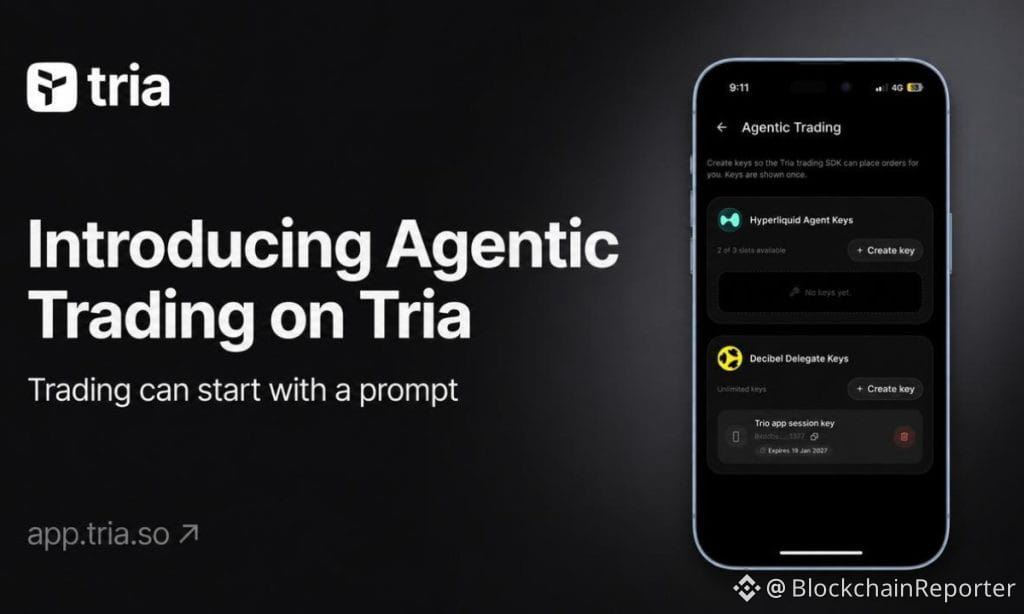
Tria, the self-custodial neofinance platform serving more than 600,000 users, today announced the launch of Agentic Trading, allowing users to connect AI agents such as Claude, ChatGPT, and Cursor to execute cryptocurrency trading strategies automatically. Powered by the Tria Trade SDK, the feature enables perpetual futures trading on Hyperliquid and Decibel directly through users’ existing Tria accounts, without transferring funds to a separate AI-controlled wallet.
Additional information and integration instructions are available through the Tria Trade SDK documentation.
The launch comes as AI plays a growing role in how retail investors research markets, develop strategies, and make trading decisions. An April 2026 survey by Investing.com found that 62% of U.S. retail investors surveyed had used AI to inform investment decisions, yet only 4.5% of those who had experimented with AI reported using automated trading algorithms. Tria is helping close that gap by making AI-powered trade execution more accessible to everyday crypto traders.
With Agentic Trading, users can define conditions for entering and exiting positions and authorize AI agents to execute supported trades when those conditions are met. For example, a trader could instruct an agent to monitor Bitcoin’s price, open a position at a specified entry point, and close it when a predetermined target is reached, eliminating the need to continuously monitor charts and manually place each order.
“Traders in our private beta have been asking for this capability, and we’re delivering it while continuing to build out the platform,” said Vijit Katta, Co-Founder and CEO of Tria. “AI is already changing how people analyze markets, but traders increasingly want to use it to execute their strategies as well. We’re giving them that capability through tools they already know, while making sure they retain control over their funds and trading permissions.”
Automated Trading with Self-Custodial Control
A key distinction of Agentic Trading is its permission-based approach to account access. Users authorize agents through dedicated trading keys that allow them to open and close supported positions but cannot be used to withdraw funds.
Traders can set expiration periods for these keys, monitor positions opened or closed by their agents within the Tria app, and revoke trading access whenever needed. Trades are executed through Hyperliquid and Decibel based on user-defined instructions, with custody and account permissions remaining under the user’s control.
The feature was developed in response to requests from strategy-focused traders during Tria’s private beta, reflecting the company’s emphasis on incorporating customer feedback into its product development. As AI becomes more widely used in trading, Tria is expanding its capabilities to support traders who want greater flexibility in building and automating their own strategies.
To get started, users select a trading venue—Hyperliquid or Decibel—within the Tria app, create a trading key for that venue, configure permissions, and follow the integration instructions for their preferred AI tool. Once connected, they can automate supported strategies and track trading activity directly through Tria.
Risk Disclosure: AI-assisted trading does not guarantee profitable outcomes. Trade-only permissions prevent agents from withdrawing funds but do not prevent trading losses. Perpetual futures trading involves substantial financial risk, including the potential loss of trading collateral.
About Tria
Tria is a self-custodial neofinance platform serving more than 600,000 users, bringing trading and other financial services into one app. The platform enables users to manage digital assets while retaining control of their funds, with support for perpetual futures trading through Hyperliquid and Decibel.
Users can start using Tria: https://link.tria.so/4i5Tmab
Learn more about Tria: https://link.tria.so/4hZbgeK
Contact
Jon PhillipsPhillComm GlobalTria@PhillComm.Global
This is a press release / sponsored content. Read our Sponsored Content Policy. This article is not intended as financial advice. Educational purposes only.
Tria Launches Agentic Trading, Allowing AI Agents to Execute Crypto Trades Without Giving Up Cont...
New York, New York, October 30th, 2026, Chainwire
Developed in response to demand from private-beta traders, the new feature connects AI tools including Claude, ChatGPT, Codex, Cursor and others to automated perpetual futures trading on Hyperliquid and Decibel.
Tria, the self-custodial neofinance platform serving more than 600,000 users, today announced the launch of Agentic Trading, allowing users to connect AI agents such as Claude, ChatGPT, and Cursor to execute cryptocurrency trading strategies automatically. Powered by the Tria Trade SDK, the feature enables perpetual futures trading on Hyperliquid and Decibel directly through users’ existing Tria accounts, without transferring funds to a separate AI-controlled wallet.
Additional information and integration instructions are available through the Tria Trade SDK documentation.
The launch comes as AI plays a growing role in how retail investors research markets, develop strategies, and make trading decisions. An April 2026 survey by Investing.com found that 62% of U.S. retail investors surveyed had used AI to inform investment decisions, yet only 4.5% of those who had experimented with AI reported using automated trading algorithms. Tria is helping close that gap by making AI-powered trade execution more accessible to everyday crypto traders.
With Agentic Trading, users can define conditions for entering and exiting positions and authorize AI agents to execute supported trades when those conditions are met. For example, a trader could instruct an agent to monitor Bitcoin’s price, open a position at a specified entry point, and close it when a predetermined target is reached, eliminating the need to continuously monitor charts and manually place each order.
“Traders in our private beta have been asking for this capability, and we’re delivering it while continuing to build out the platform,” said Vijit Katta, Co-Founder and CEO of Tria. “AI is already changing how people analyze markets, but traders increasingly want to use it to execute their strategies as well. We’re giving them that capability through tools they already know, while making sure they retain control over their funds and trading permissions.”
Automated Trading with Self-Custodial Control
A key distinction of Agentic Trading is its permission-based approach to account access. Users authorize agents through dedicated trading keys that allow them to open and close supported positions but cannot be used to withdraw funds.
Traders can set expiration periods for these keys, monitor positions opened or closed by their agents within the Tria app, and revoke trading access whenever needed. Trades are executed through Hyperliquid and Decibel based on user-defined instructions, with custody and account permissions remaining under the user’s control.
The feature was developed in response to requests from strategy-focused traders during Tria’s private beta, reflecting the company’s emphasis on incorporating customer feedback into its product development. As AI becomes more widely used in trading, Tria is expanding its capabilities to support traders who want greater flexibility in building and automating their own strategies.
To get started, users select a trading venue—Hyperliquid or Decibel—within the Tria app, create a trading key for that venue, configure permissions, and follow the integration instructions for their preferred AI tool. Once connected, they can automate supported strategies and track trading activity directly through Tria.
Risk Disclosure: AI-assisted trading does not guarantee profitable outcomes. Trade-only permissions prevent agents from withdrawing funds but do not prevent trading losses. Perpetual futures trading involves substantial financial risk, including the potential loss of trading collateral.
About Tria
Tria is a self-custodial neofinance platform serving more than 600,000 users, bringing trading and other financial services into one app. The platform enables users to manage digital assets while retaining control of their funds, with support for perpetual futures trading through Hyperliquid and Decibel.
Users can start using Tria: https://link.tria.so/4i5Tmab
Learn more about Tria: https://link.tria.so/4hZbgeK
Contact
Jon PhillipsPhillComm GlobalTria@PhillComm.Global
This is a press release / sponsored content. Read our Sponsored Content Policy. This article is not intended as financial advice. Educational purposes only.
2.1k
Article
Uniswap Labs Releases TJAR, Permissionless Infrastructure for Onchain Fee ConversionNew York, United States, October 29th, 2026, Chainwire
Uniswap Labs today released TJAR, permissionless infrastructure that converts an app’s onchain fees into a single token. Robinhood is the first integration partner, with more coming soon.
Today, apps that charge a fee are paid in whatever tokens their user’s trade. Over time, that adds up to thousands of different tokens, across every chain they support. Typically, consolidating these holdings into a few chosen tokens has meant building custom conversion infrastructure.
TJAR replaces that infrastructure with an open market. Apps deposit their fees into a Token Jar. Searchers compete to convert them, and the app automatically receives fees in its chosen token.
The Token Jar framework was first built for Uniswap Protocol fees. In September, Token Jar handled more than $15.3M in conversions. TJAR lets any team use the same system for its own fees.
TJAR is now live on seven chains. Documentation, deployment addresses, and guides are available on the Uniswap Developer Platform.
About Uniswap Labs
Uniswap Labs is a core contributor to the Uniswap Protocol, the world’s largest decentralized exchange, with more than $4.7 trillion in all-time trading volume. Uniswap Labs builds products trusted by millions of users and leading financial institutions to access onchain liquidity, including the Uniswap Web App, Uniswap Wallet, Uniswap API, and UniswapX.
For more information, please visit https://app.uniswap.org
Contact
Bridgett Freymedia@uniswap.org
This is a press release / sponsored content. Read our Sponsored Content Policy. This article is not intended as financial advice. Educational purposes only.
Uniswap Labs Releases TJAR, Permissionless Infrastructure for Onchain Fee Conversion
New York, United States, October 29th, 2026, Chainwire
Uniswap Labs today released TJAR, permissionless infrastructure that converts an app’s onchain fees into a single token. Robinhood is the first integration partner, with more coming soon.
Today, apps that charge a fee are paid in whatever tokens their user’s trade. Over time, that adds up to thousands of different tokens, across every chain they support. Typically, consolidating these holdings into a few chosen tokens has meant building custom conversion infrastructure.
TJAR replaces that infrastructure with an open market. Apps deposit their fees into a Token Jar. Searchers compete to convert them, and the app automatically receives fees in its chosen token.
The Token Jar framework was first built for Uniswap Protocol fees. In September, Token Jar handled more than $15.3M in conversions. TJAR lets any team use the same system for its own fees.
TJAR is now live on seven chains. Documentation, deployment addresses, and guides are available on the Uniswap Developer Platform.
About Uniswap Labs
Uniswap Labs is a core contributor to the Uniswap Protocol, the world’s largest decentralized exchange, with more than $4.7 trillion in all-time trading volume. Uniswap Labs builds products trusted by millions of users and leading financial institutions to access onchain liquidity, including the Uniswap Web App, Uniswap Wallet, Uniswap API, and UniswapX.
For more information, please visit https://app.uniswap.org
Contact
Bridgett Freymedia@uniswap.org
This is a press release / sponsored content. Read our Sponsored Content Policy. This article is not intended as financial advice. Educational purposes only.
574
Article
Apex Fusion Foundation Joins the Agentic AI Foundation & Opens Vector As Live Environment for Age...Zug, Switzerland, October 29th, 2026, Chainwire
The Swiss foundation is contributing to AAIF working groups that define how AI agents identify themselves, delegate work and answer for what they do. This week its Head of Ecosystem showed working-group members four agents running live on Vector, ready for anyone to test.
Apex Fusion Foundation today announced that it has joined the Agentic AI Foundation (AAIF) as an Associate Member. AAIF is the Linux Foundation body that hosts the open standards shaping how AI agents connect to tools and to each other, including the Model Context Protocol (MCP), Agent2Agent (A2A) and AGENTS.md. Its members include Anthropic, OpenAI, Google, Microsoft, AWS and IBM.
The Linux Foundation named Apex Fusion among AAIF’s new members on October 22 at AGNTCon + MCPCon North America in San Jose, where AAIF announced it had reached 305 member organizations in less than a year. Other new Associate Members this quarter include the US National Institute of Standards and Technology (NIST), Mozilla and SLAC National Accelerator Laboratory.
“The agent economy is being defined now, and the decisions made in these working groups will shape it for years,” said Christopher Greenwood, CEO of Apex Fusion Foundation. “Joining AAIF puts Apex Fusion alongside the organizations setting those standards. Our contribution is a neutral, live environment where the standards can be tested with real agents and real settlement, not only debated. We want governments, industry, universities and builders to use it.”
Defining how agents identify, delegate and answer for their work
Apex Fusion is contributing to AAIF’s working groups, where engineers from across the industry are agreeing on the shared building blocks of the agent economy: how an agent proves who it is, how it hands work to other agents, and who is accountable when something goes wrong. The work is led by Filip Blagojević, Head of Ecosystem at Apex Fusion Foundation.
The Identity and Trust working group is drafting a first agent identity primitive, a common definition of how agents are identified and trusted, aligned with AAIF’s shared taxonomy of agentic AI terms. Blagojević has taken part in the taxonomy sessions that settle core terms, including what counts as a sub-agent and who the principal behind an agent is.
His position is that every agent must trace back to a principal, a person or organization that remains answerable for the agent’s actions. An agent that no one is responsible for is a design fault, and any court will look for someone accountable. He has also proposed a dedicated focus on delegation, the chain through which one agent hires others, as the group’s work moves to its next primitives.
From discussion to a live environment
Working-group members agreed they needed something operational: a place to test their definitions against real agents. On October 22, Blagojević presented Vector to the group as that place. Vector is Apex Fusion’s neutral settlement layer for AI agents, an open public network with validators across Europe that anyone can reach without asking for access.
“We do not want to live only in the abstract,” Blagojević said. “Vector gives the working group a shared place to try ideas out, see what holds and fix what doesn’t.”
Four agents are now running on Vector mainnet, and anyone can watch them work live on the Vector agent dashboard:
Agent History returns the full public record of any agent on Vector: its history, stake and completed jobs. It runs without a language model.
Document Pipeline reads documents with the open-source Chandra OCR model and returns text, summaries or structured data.
Audio Snippets turns audio and video files into word-timed transcripts.
Advocate builds the strongest one-sided case for a position, with its bias declared in its public listing and in every answer.
Document Pipeline and Advocate hire other agents to complete their work. This puts delegation and sub-agents, two of the most debated ideas in the working group, into practice.
Every agent follows the same path. It registers an on-chain identity with a refundable deposit. It stakes value behind its capability, which can be taken away through dispute resolution if it fails to deliver. It publishes a listing with its price, response window, endpoint and a fingerprint of its public description, so any change leaves a visible history.
Every job then settles with a signed receipt on the public ledger, which anyone can inspect on the Vector explorer. The receipt shows that the job was escrowed, which supplier did it, and a fingerprint of the answer, all cryptographically verifiable. The prompt and the answer themselves stay private. Which parts of an agent interaction should be public is one of the questions the group can now explore with live examples.
Members engaged directly with the questions the environment opens up: transaction speed, the trust boundaries between public and private systems, and which parts of the group’s identity draft a successful agent-to-agent exchange would validate. Next, Apex Fusion will upgrade Vector’s agent identifiers to follow the W3C Decentralized Identifier (DID) standard.
Hiring and deploying agents on Vector
Anyone can hire the four agents from a chat client such as Claude Code through Vector’s hosted MCP server, with setup covered in the Vector AI documentation. Builders who want to launch their own agent start from an open-source agent template, released under the MIT license, with step-by-step documentation that an AI coding assistant can follow.
Testing costs are minimal, and adversarial testing is welcome: the team has asked participants to try to break the agents and report what they find. “Every agent we have deployed is open source, and the best feedback we can get is someone trying to break it,” Blagojević added. Anyone with an idea for an agent can describe it and the team will build it.
Built to test research in live code
Vector is also where Apex Fusion tests research against working systems. This month its team replicated SwarmWorld, a study from MIT’s Laboratory for Atomistic and Molecular Mechanics on how societies of AI agents invent and share technology. Using MIT’s code unchanged on an open-weight model and four consumer graphics cards, the replication reproduced the study’s core result and deployed the same agents on Vector.
Building on that work, Apex Fusion has deployed Paper-to-Agent, which turns a research paper into a live agent running as code. Findings can then be checked on-chain and in real time inside a working environment. This applies to new research and to papers published years ago whose assumptions can now be tested again. Apex Fusion is opening Paper-to-Agent to universities, research groups and labs.
Why the agent economy needs a token-based layer
Trust between agents that have never met needs something at stake. Agents need to show who they are, back their claims with value, hold value in escrow until work is delivered, and build a record that others can check.
On Vector, AP3X, the network’s AI agent utility token, is the unit that makes this work. Agents use it to register, to stake behind their capabilities, to hold work in escrow and to settle jobs. Reputation is built on stake and on a verifiable record of completed work. Without a shared unit of value there is nothing to stake, nothing to hold in escrow and no reputation to earn.
A record of delivery
Vector has been live on mainnet since August 2025, and at the start of 2026 the foundation made a deliberate decision to focus fully on the AI agent economy. Since then:
In its genealogy project, agents scoped, specified, sourced, escrowed, validated and settled more than 25,000 work packages, paid directly on Vector.
Deloitte signed a partnership agreement with Apex Fusion and has deployed on Vector.
Vector connects to more than 150 chains, including Base, through LayerZero.
The team is working with Kevin Hammond (Ensurable Systems) and Neil Davies (PNSol), both architects of Cardano’s consensus protocol, on faster settlement for agent transactions.
Get involved
Apex Fusion is looking for partners who want to help move the standards of the agent economy forward and test them in a live environment. It is inviting:
Governments and public bodies exploring sovereign AI capability, digital records and accountable automation
Enterprises that need AI output their auditors can verify
Universities, research labs and frontier labs that want to test research in live code
Builders and individuals who want to deploy agents and give them a verifiable track record
AAIF’s working groups are open to participants from across the industry. Organizations interested in contributing alongside Apex Fusion, or in deploying on Vector, can contact the foundation directly.
About Apex Fusion Foundation
Apex Fusion Foundation is a Swiss foundation based in Zug. It builds Vector, a neutral settlement, accountability and provenance layer for AI agents. On Vector, agents prove who they are, stake behind their claims, exchange escrowed work and settle with signed, auditable receipts on a public ledger. Vector runs on Prime, the Apex Fusion base chain, and connects to more than 150 chains through LayerZero. AP3X is the ecosystem’s AI agent utility token. Apex Fusion is a member of the Agentic AI Foundation. For more information, visit apexfusion.ai.
About the Agentic AI Foundation
The Agentic AI Foundation (AAIF), part of the Linux Foundation, is the neutral home for open standards, protocols and infrastructure in agentic AI. Its founding projects include MCP, goose and AGENTS.md, and it governs the core standards that let agents work across platforms. AAIF has 305 member organizations. For more information, visit aaif.io.
Contact
Christopher Greenwoodchristopher.greenwood@foundation.apexfusion.org
This is a press release / sponsored content. Read our Sponsored Content Policy. This article is not intended as financial advice. Educational purposes only.
Apex Fusion Foundation Joins the Agentic AI Foundation & Opens Vector As Live Environment for Age...
Zug, Switzerland, October 29th, 2026, Chainwire
The Swiss foundation is contributing to AAIF working groups that define how AI agents identify themselves, delegate work and answer for what they do. This week its Head of Ecosystem showed working-group members four agents running live on Vector, ready for anyone to test.
Apex Fusion Foundation today announced that it has joined the Agentic AI Foundation (AAIF) as an Associate Member. AAIF is the Linux Foundation body that hosts the open standards shaping how AI agents connect to tools and to each other, including the Model Context Protocol (MCP), Agent2Agent (A2A) and AGENTS.md. Its members include Anthropic, OpenAI, Google, Microsoft, AWS and IBM.
The Linux Foundation named Apex Fusion among AAIF’s new members on October 22 at AGNTCon + MCPCon North America in San Jose, where AAIF announced it had reached 305 member organizations in less than a year. Other new Associate Members this quarter include the US National Institute of Standards and Technology (NIST), Mozilla and SLAC National Accelerator Laboratory.
“The agent economy is being defined now, and the decisions made in these working groups will shape it for years,” said Christopher Greenwood, CEO of Apex Fusion Foundation. “Joining AAIF puts Apex Fusion alongside the organizations setting those standards. Our contribution is a neutral, live environment where the standards can be tested with real agents and real settlement, not only debated. We want governments, industry, universities and builders to use it.”
Defining how agents identify, delegate and answer for their work
Apex Fusion is contributing to AAIF’s working groups, where engineers from across the industry are agreeing on the shared building blocks of the agent economy: how an agent proves who it is, how it hands work to other agents, and who is accountable when something goes wrong. The work is led by Filip Blagojević, Head of Ecosystem at Apex Fusion Foundation.
The Identity and Trust working group is drafting a first agent identity primitive, a common definition of how agents are identified and trusted, aligned with AAIF’s shared taxonomy of agentic AI terms. Blagojević has taken part in the taxonomy sessions that settle core terms, including what counts as a sub-agent and who the principal behind an agent is.
His position is that every agent must trace back to a principal, a person or organization that remains answerable for the agent’s actions. An agent that no one is responsible for is a design fault, and any court will look for someone accountable. He has also proposed a dedicated focus on delegation, the chain through which one agent hires others, as the group’s work moves to its next primitives.
From discussion to a live environment
Working-group members agreed they needed something operational: a place to test their definitions against real agents. On October 22, Blagojević presented Vector to the group as that place. Vector is Apex Fusion’s neutral settlement layer for AI agents, an open public network with validators across Europe that anyone can reach without asking for access.
“We do not want to live only in the abstract,” Blagojević said. “Vector gives the working group a shared place to try ideas out, see what holds and fix what doesn’t.”
Four agents are now running on Vector mainnet, and anyone can watch them work live on the Vector agent dashboard:
Agent History returns the full public record of any agent on Vector: its history, stake and completed jobs. It runs without a language model.
Document Pipeline reads documents with the open-source Chandra OCR model and returns text, summaries or structured data.
Audio Snippets turns audio and video files into word-timed transcripts.
Advocate builds the strongest one-sided case for a position, with its bias declared in its public listing and in every answer.
Document Pipeline and Advocate hire other agents to complete their work. This puts delegation and sub-agents, two of the most debated ideas in the working group, into practice.
Every agent follows the same path. It registers an on-chain identity with a refundable deposit. It stakes value behind its capability, which can be taken away through dispute resolution if it fails to deliver. It publishes a listing with its price, response window, endpoint and a fingerprint of its public description, so any change leaves a visible history.
Every job then settles with a signed receipt on the public ledger, which anyone can inspect on the Vector explorer. The receipt shows that the job was escrowed, which supplier did it, and a fingerprint of the answer, all cryptographically verifiable. The prompt and the answer themselves stay private. Which parts of an agent interaction should be public is one of the questions the group can now explore with live examples.
Members engaged directly with the questions the environment opens up: transaction speed, the trust boundaries between public and private systems, and which parts of the group’s identity draft a successful agent-to-agent exchange would validate. Next, Apex Fusion will upgrade Vector’s agent identifiers to follow the W3C Decentralized Identifier (DID) standard.
Hiring and deploying agents on Vector
Anyone can hire the four agents from a chat client such as Claude Code through Vector’s hosted MCP server, with setup covered in the Vector AI documentation. Builders who want to launch their own agent start from an open-source agent template, released under the MIT license, with step-by-step documentation that an AI coding assistant can follow.
Testing costs are minimal, and adversarial testing is welcome: the team has asked participants to try to break the agents and report what they find. “Every agent we have deployed is open source, and the best feedback we can get is someone trying to break it,” Blagojević added. Anyone with an idea for an agent can describe it and the team will build it.
Built to test research in live code
Vector is also where Apex Fusion tests research against working systems. This month its team replicated SwarmWorld, a study from MIT’s Laboratory for Atomistic and Molecular Mechanics on how societies of AI agents invent and share technology. Using MIT’s code unchanged on an open-weight model and four consumer graphics cards, the replication reproduced the study’s core result and deployed the same agents on Vector.
Building on that work, Apex Fusion has deployed Paper-to-Agent, which turns a research paper into a live agent running as code. Findings can then be checked on-chain and in real time inside a working environment. This applies to new research and to papers published years ago whose assumptions can now be tested again. Apex Fusion is opening Paper-to-Agent to universities, research groups and labs.
Why the agent economy needs a token-based layer
Trust between agents that have never met needs something at stake. Agents need to show who they are, back their claims with value, hold value in escrow until work is delivered, and build a record that others can check.
On Vector, AP3X, the network’s AI agent utility token, is the unit that makes this work. Agents use it to register, to stake behind their capabilities, to hold work in escrow and to settle jobs. Reputation is built on stake and on a verifiable record of completed work. Without a shared unit of value there is nothing to stake, nothing to hold in escrow and no reputation to earn.
A record of delivery
Vector has been live on mainnet since August 2025, and at the start of 2026 the foundation made a deliberate decision to focus fully on the AI agent economy. Since then:
In its genealogy project, agents scoped, specified, sourced, escrowed, validated and settled more than 25,000 work packages, paid directly on Vector.
Deloitte signed a partnership agreement with Apex Fusion and has deployed on Vector.
Vector connects to more than 150 chains, including Base, through LayerZero.
The team is working with Kevin Hammond (Ensurable Systems) and Neil Davies (PNSol), both architects of Cardano’s consensus protocol, on faster settlement for agent transactions.
Get involved
Apex Fusion is looking for partners who want to help move the standards of the agent economy forward and test them in a live environment. It is inviting:
Governments and public bodies exploring sovereign AI capability, digital records and accountable automation
Enterprises that need AI output their auditors can verify
Universities, research labs and frontier labs that want to test research in live code
Builders and individuals who want to deploy agents and give them a verifiable track record
AAIF’s working groups are open to participants from across the industry. Organizations interested in contributing alongside Apex Fusion, or in deploying on Vector, can contact the foundation directly.
About Apex Fusion Foundation
Apex Fusion Foundation is a Swiss foundation based in Zug. It builds Vector, a neutral settlement, accountability and provenance layer for AI agents. On Vector, agents prove who they are, stake behind their claims, exchange escrowed work and settle with signed, auditable receipts on a public ledger. Vector runs on Prime, the Apex Fusion base chain, and connects to more than 150 chains through LayerZero. AP3X is the ecosystem’s AI agent utility token. Apex Fusion is a member of the Agentic AI Foundation. For more information, visit apexfusion.ai.
About the Agentic AI Foundation
The Agentic AI Foundation (AAIF), part of the Linux Foundation, is the neutral home for open standards, protocols and infrastructure in agentic AI. Its founding projects include MCP, goose and AGENTS.md, and it governs the core standards that let agents work across platforms. AAIF has 305 member organizations. For more information, visit aaif.io.
Contact
Christopher Greenwoodchristopher.greenwood@foundation.apexfusion.org
This is a press release / sponsored content. Read our Sponsored Content Policy. This article is not intended as financial advice. Educational purposes only.
1
365
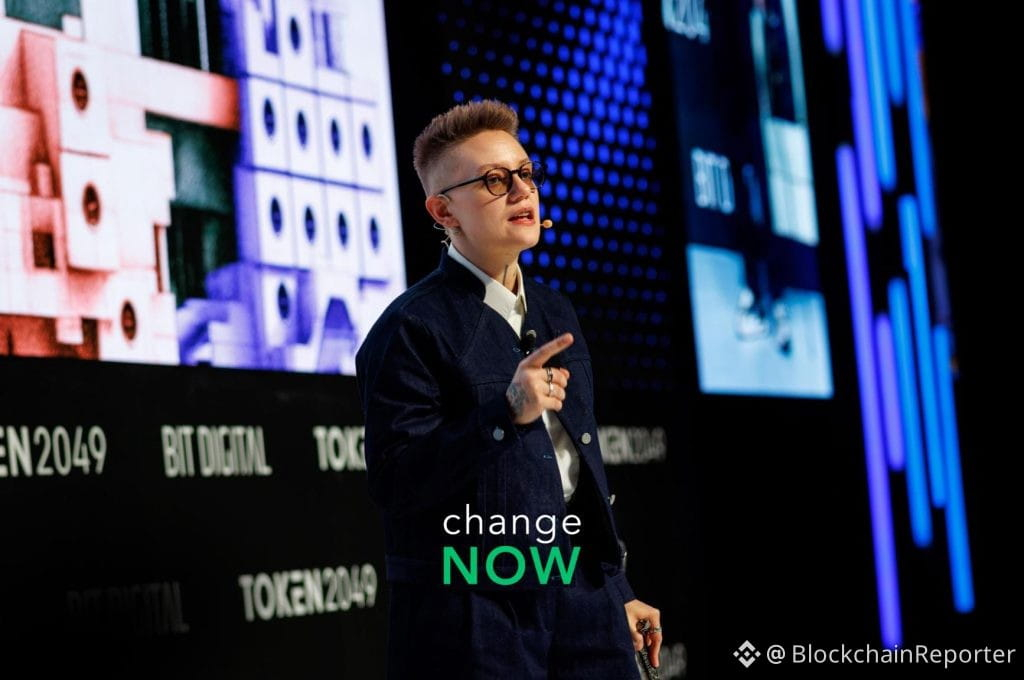
Article
MetaMask, Trezor, WalletConnect and Other Industry Leaders Join ChangeNOW At TOKEN2049Kingstown, Saint Vincent and the Grenadines, October 28th, 2026, Chainwire
ChangeNOW’s TOKEN2049 Singapore program featured four panel discussions with speakers from MetaMask, Trezor, WalletConnect, and other projects, a series of NOW Effect interviews, and a keynote by Chief Strategy Officer Pauline Shangett.
In her Bit Digital Stage talk, “Next Billion Users Should Never Touch Blockchain,” Shangett argued that people should be able to use crypto without choosing networks, managing gas or navigating separate services. She presented crypto super apps as a way to bring everyday financial tasks into one product.
At the ChangeNOW booth, The Block’s Kelvin Sparks moderated a wallet panel with MetaMask, Trezor and ChangeNOW. Speakers discussed how wallets are expanding as more services move into a single interface, alongside security and user approval for AI agents.
“The user shouldn’t have to think about gas. The user shouldn’t have to go through multiple steps to switch from one network to another, when a lot of that can be done in the background,” said Yana, Head of Business Development & Account Management at ChangeNOW.
The infrastructure session brought together Banxa, RocketX, WalletConnect and Aztec Labs to discuss transaction routing, privacy for on-chain payments and collaboration amongst specialized providers.
A panel on crypto super apps including Pulsar Money, Rubic, Hercules and CoinRoutes debated whether payments, trading or a broader variety of financial services would give consumers a reason to return regularly. Shangett identified payments as one potential foundation for these apps.
The fourth panel featured CoinEasy, The Block of Media and ChangeNOW. Speakers examined AI’s impact on search, SEO and audience monetization, discussing communities, podcasts and video, as well as opportunities to integrate crypto swaps into media and analytics platforms.
Journalist Ramia Farrage hosted NOW Effect interviews with representatives of Stellar, Injective, NEAR Intents, USDD, Sonic and Zcash. The conversations covered cross-border payments, institutional participation in DeFi, stablecoins, privacy and blockchain usability.
The panels and interviews were recorded for release as part of ChangeNOW’s TOKEN2049 coverage. Further highlights from the event are available in the company’s Day 1 and Day 2 recaps.
About ChangeNOW
ChangeNOW.io is a crypto super app built for every crypto move, giving newcomers, professionals, and businesses the tools they need to access Web3 finance in a simple and secure way.
Since 2017, ChangeNOW has grown from a fast, secure, and limitless instant exchange into a trusted platform where storage, swaps, trading, staking, and asset management are covered in one simple experience for millions of clients worldwide.
Contact
PR TeamCHN Group LLCpr@changenow.io
This is a press release / sponsored content. Read our Sponsored Content Policy. This article is not intended as financial advice. Educational purposes only.
MetaMask, Trezor, WalletConnect and Other Industry Leaders Join ChangeNOW At TOKEN2049
Kingstown, Saint Vincent and the Grenadines, October 28th, 2026, Chainwire
ChangeNOW’s TOKEN2049 Singapore program featured four panel discussions with speakers from MetaMask, Trezor, WalletConnect, and other projects, a series of NOW Effect interviews, and a keynote by Chief Strategy Officer Pauline Shangett.
In her Bit Digital Stage talk, “Next Billion Users Should Never Touch Blockchain,” Shangett argued that people should be able to use crypto without choosing networks, managing gas or navigating separate services. She presented crypto super apps as a way to bring everyday financial tasks into one product.
At the ChangeNOW booth, The Block’s Kelvin Sparks moderated a wallet panel with MetaMask, Trezor and ChangeNOW. Speakers discussed how wallets are expanding as more services move into a single interface, alongside security and user approval for AI agents.
“The user shouldn’t have to think about gas. The user shouldn’t have to go through multiple steps to switch from one network to another, when a lot of that can be done in the background,” said Yana, Head of Business Development & Account Management at ChangeNOW.
The infrastructure session brought together Banxa, RocketX, WalletConnect and Aztec Labs to discuss transaction routing, privacy for on-chain payments and collaboration amongst specialized providers.
A panel on crypto super apps including Pulsar Money, Rubic, Hercules and CoinRoutes debated whether payments, trading or a broader variety of financial services would give consumers a reason to return regularly. Shangett identified payments as one potential foundation for these apps.
The fourth panel featured CoinEasy, The Block of Media and ChangeNOW. Speakers examined AI’s impact on search, SEO and audience monetization, discussing communities, podcasts and video, as well as opportunities to integrate crypto swaps into media and analytics platforms.
Journalist Ramia Farrage hosted NOW Effect interviews with representatives of Stellar, Injective, NEAR Intents, USDD, Sonic and Zcash. The conversations covered cross-border payments, institutional participation in DeFi, stablecoins, privacy and blockchain usability.
The panels and interviews were recorded for release as part of ChangeNOW’s TOKEN2049 coverage. Further highlights from the event are available in the company’s Day 1 and Day 2 recaps.
About ChangeNOW
ChangeNOW.io is a crypto super app built for every crypto move, giving newcomers, professionals, and businesses the tools they need to access Web3 finance in a simple and secure way.
Since 2017, ChangeNOW has grown from a fast, secure, and limitless instant exchange into a trusted platform where storage, swaps, trading, staking, and asset management are covered in one simple experience for millions of clients worldwide.
Contact
PR TeamCHN Group LLCpr@changenow.io
This is a press release / sponsored content. Read our Sponsored Content Policy. This article is not intended as financial advice. Educational purposes only.
829
Fed Rate Decision October 2026: Bitcoin’s December TestThe Federal Reserve left the federal funds target range unchanged at 3.75%–4.00% on October 28, 2026, setting the starting point for Bitcoin’s next macroeconomic test: how much tighter or looser U.S. policy will look by December.
The Fed’s meeting calendar puts the next scheduled decision on December 9, exactly 42 days away. Incoming economic data have considerable room to reshape expectations over those six weeks. For Bitcoin, the consequential question is whether investors begin pricing a higher or lower rate path.
A decision can satisfy expectations for October while still changing the outlook for December. That distinction is central to understanding the Fed’s influence on crypto.
Why December Now Matters for Bitcoin
The Federal Reserve entered this meeting after raising its target range by 25 basis points to 3.75%–4.00% on September 16. That recent tightening provides the starting point for interpreting October’s outcome.
Holding the range preserves September’s increase; raising it adds restraint; lowering it reverses at least part of that step. The decision was not unanimous — Lisa D. Cook and Beth M. Hammack dissented in favor of a quarter-point hike — and the longer-term signal depends on officials’ explanation of the action.
Markets therefore face two separate judgments: what policymakers did today, and what their explanation implies about the next decision. A widely anticipated action can produce a limited response, while a change in expectations for future policy can move financial conditions immediately.
For Bitcoin, that creates a useful analytical question: has the expected cost of holding risk increased or decreased relative to the outlook before the release?
Inflation and Hiring Pull in Different Directions
September’s inflation and employment reports explain why that question remains difficult.
The Bureau of Labor Statistics reported annual headline CPI inflation of 3.7% and core inflation of 2.6%. Monthly increases were 0.6% and 0.3%, respectively. Those figures leave policymakers with continuing price pressure to assess.
BlockchainReporter’s coverage of Bitcoin after the September CPI release examined the immediate crypto response to that data.
The employment report supplied a different signal: nonfarm payrolls increased by 29,000, while unemployment stood at 4.2%.
Read together, these releases create a policy tension. Persistent inflation gives officials a reason to keep borrowing costs restrictive. Limited hiring growth gives them a reason to consider how much additional restraint the economy can absorb.
Neither release settles the December decision. A single payroll estimate is subject to revision, and one inflation report cannot establish a lasting trend. Their combination makes the Fed’s assessment of competing risks particularly consequential for assets whose value depends heavily on investor appetite.
How the December Outlook Reaches Bitcoin
The New York Fed describes monetary policy as influencing credit costs, asset prices, longer-term interest rates and the dollar. Those channels provide the framework for interpreting a potential Bitcoin response.
If investors raise their expectations for December interest rates, short-term Treasury yields could rise and dollar assets could become more attractive. That can increase the opportunity cost of holding Bitcoin, which offers no contractual interest payment.
A lower expected rate path could ease those pressures. The reason for that repricing still matters: improving inflation with resilient activity presents a different backdrop from a sharp deterioration in employment.
The October 16 rebound in Bitcoin provides a recent point of comparison when distinguishing a price recovery from a durable improvement in macro conditions. Investor allocations, market positioning and crypto-specific developments can each outweigh a favorable or unfavorable Fed signal.
Fed Rate Decision October 2026: Three Market Scenarios
The following scenarios are analytical possibilities, measured against expectations immediately before the announcement. They describe potential transmission rather than an observed market reaction.
Shift in December Expectations Possible Dollar and Yield Response Potential Bitcoin Implication Higher expected rates Short-term yields could rise; the dollar could strengthen More competition from interest-bearing assets and pressure on risk appetite Lower expected rates as inflation improves Yields could ease; dollar strength could fade A more supportive backdrop if growth remains resilient Lower expected rates as growth deteriorates Yields could fall; safe-haven demand could support the dollar Recession concerns could outweigh relief from lower borrowing costs
The third scenario deserves particular attention. A market that anticipates easier policy because economic conditions are weakening may simultaneously reduce exposure to speculative assets. In that setting, falling yields and falling Bitcoin prices would be economically consistent.
The key variable is the information behind the expected policy change.
Warsh’s Press Conference Is the Next Test
Fed Chair Kevin Warsh is scheduled to hold his press conference at 2:30 p.m. Eastern time. His explanation will provide the next opportunity to assess the balance between inflation control and employment risks.
October is not scheduled to include a new Summary of Economic Projections. The next scheduled projections accompany the December meeting. That makes the statement and press conference especially relevant to interpreting today’s decision, while leaving considerable uncertainty about individual policymakers’ preferred rate paths.
The most useful distinction will be between confidence that inflation is improving and concern that activity is weakening. Both could reduce the perceived need for further tightening, but they would carry different implications for Bitcoin demand.
A 42-Day Macro Test for Bitcoin
The period through December 9 will allow new evidence to confirm or challenge today’s message. Inflation, employment and broader financial conditions can each change the case for the next move.
For Bitcoin, a durable improvement in the macro backdrop would involve more than a favorable interpretation of one announcement. It would require manageable borrowing costs alongside sufficient confidence in growth to sustain demand for risk.
The October decision establishes where policy stands today. The next six weeks will test whether the economy can deliver lower inflation without a meaningful deterioration in hiring—and whether investors see that combination as a reason to commit capital to Bitcoin.
This article is not intended as financial advice. Educational purposes only.
Fed Rate Decision October 2026: Bitcoin’s December Test
The Federal Reserve left the federal funds target range unchanged at 3.75%–4.00% on October 28, 2026, setting the starting point for Bitcoin’s next macroeconomic test: how much tighter or looser U.S. policy will look by December.
The Fed’s meeting calendar puts the next scheduled decision on December 9, exactly 42 days away. Incoming economic data have considerable room to reshape expectations over those six weeks. For Bitcoin, the consequential question is whether investors begin pricing a higher or lower rate path.
A decision can satisfy expectations for October while still changing the outlook for December. That distinction is central to understanding the Fed’s influence on crypto.
Why December Now Matters for Bitcoin
The Federal Reserve entered this meeting after raising its target range by 25 basis points to 3.75%–4.00% on September 16. That recent tightening provides the starting point for interpreting October’s outcome.
Holding the range preserves September’s increase; raising it adds restraint; lowering it reverses at least part of that step. The decision was not unanimous — Lisa D. Cook and Beth M. Hammack dissented in favor of a quarter-point hike — and the longer-term signal depends on officials’ explanation of the action.
Markets therefore face two separate judgments: what policymakers did today, and what their explanation implies about the next decision. A widely anticipated action can produce a limited response, while a change in expectations for future policy can move financial conditions immediately.
For Bitcoin, that creates a useful analytical question: has the expected cost of holding risk increased or decreased relative to the outlook before the release?
Inflation and Hiring Pull in Different Directions
September’s inflation and employment reports explain why that question remains difficult.
The Bureau of Labor Statistics reported annual headline CPI inflation of 3.7% and core inflation of 2.6%. Monthly increases were 0.6% and 0.3%, respectively. Those figures leave policymakers with continuing price pressure to assess.
BlockchainReporter’s coverage of Bitcoin after the September CPI release examined the immediate crypto response to that data.
The employment report supplied a different signal: nonfarm payrolls increased by 29,000, while unemployment stood at 4.2%.
Read together, these releases create a policy tension. Persistent inflation gives officials a reason to keep borrowing costs restrictive. Limited hiring growth gives them a reason to consider how much additional restraint the economy can absorb.
Neither release settles the December decision. A single payroll estimate is subject to revision, and one inflation report cannot establish a lasting trend. Their combination makes the Fed’s assessment of competing risks particularly consequential for assets whose value depends heavily on investor appetite.
How the December Outlook Reaches Bitcoin
The New York Fed describes monetary policy as influencing credit costs, asset prices, longer-term interest rates and the dollar. Those channels provide the framework for interpreting a potential Bitcoin response.
If investors raise their expectations for December interest rates, short-term Treasury yields could rise and dollar assets could become more attractive. That can increase the opportunity cost of holding Bitcoin, which offers no contractual interest payment.
A lower expected rate path could ease those pressures. The reason for that repricing still matters: improving inflation with resilient activity presents a different backdrop from a sharp deterioration in employment.
The October 16 rebound in Bitcoin provides a recent point of comparison when distinguishing a price recovery from a durable improvement in macro conditions. Investor allocations, market positioning and crypto-specific developments can each outweigh a favorable or unfavorable Fed signal.
Fed Rate Decision October 2026: Three Market Scenarios
The following scenarios are analytical possibilities, measured against expectations immediately before the announcement. They describe potential transmission rather than an observed market reaction.
Shift in December Expectations Possible Dollar and Yield Response Potential Bitcoin Implication Higher expected rates Short-term yields could rise; the dollar could strengthen More competition from interest-bearing assets and pressure on risk appetite Lower expected rates as inflation improves Yields could ease; dollar strength could fade A more supportive backdrop if growth remains resilient Lower expected rates as growth deteriorates Yields could fall; safe-haven demand could support the dollar Recession concerns could outweigh relief from lower borrowing costs
The third scenario deserves particular attention. A market that anticipates easier policy because economic conditions are weakening may simultaneously reduce exposure to speculative assets. In that setting, falling yields and falling Bitcoin prices would be economically consistent.
The key variable is the information behind the expected policy change.
Warsh’s Press Conference Is the Next Test
Fed Chair Kevin Warsh is scheduled to hold his press conference at 2:30 p.m. Eastern time. His explanation will provide the next opportunity to assess the balance between inflation control and employment risks.
October is not scheduled to include a new Summary of Economic Projections. The next scheduled projections accompany the December meeting. That makes the statement and press conference especially relevant to interpreting today’s decision, while leaving considerable uncertainty about individual policymakers’ preferred rate paths.
The most useful distinction will be between confidence that inflation is improving and concern that activity is weakening. Both could reduce the perceived need for further tightening, but they would carry different implications for Bitcoin demand.
A 42-Day Macro Test for Bitcoin
The period through December 9 will allow new evidence to confirm or challenge today’s message. Inflation, employment and broader financial conditions can each change the case for the next move.
For Bitcoin, a durable improvement in the macro backdrop would involve more than a favorable interpretation of one announcement. It would require manageable borrowing costs alongside sufficient confidence in growth to sustain demand for risk.
The October decision establishes where policy stands today. The next six weeks will test whether the economy can deliver lower inflation without a meaningful deterioration in hiring—and whether investors see that combination as a reason to commit capital to Bitcoin.
This article is not intended as financial advice. Educational purposes only.
1
676
Article
Mirae Asset Securities and Grvt Collaborate on Tokenised Funding Note IssuanceSingapore, Singapore, October 27th, 2026, Chainwire
The collaboration begins with Grvt’s subscription to Mirae Asset Securities’ tokenised funding notes, with potential future tokenised products (e.g., tokenised Treasuries, corporate bonds and ETFs) to be explored, subject to applicable regulatory requirements.
Mirae Asset Securities (HK) Limited, the Hong Kong subsidiary of Korea’s leading securities firm, has arranged an issuance of tokenised funding notes under its affiliate’s structured notes programme, to which Grvt has subscribed. Grvt intends to use the resulting exposure in connection with Grvt Earn, subject to applicable requirements.
Grvt Earn is offered and operated independently by Grvt and is available only to eligible users in permitted jurisdictions. Grvt has subscribed for the notes. Any use of the resulting exposure in connection with Grvt Earn is independently determined and managed by Grvt.
From Tokenised Funding Notes to Tokenised ETFs
Tokenised funding notes are the starting point. The two firms will next explore additional tokenised products (including Treasuries and ETFs) on a non-committed and exploratory basis, subject to applicable regulatory approvals and product/compliance clearance.
Mirae Asset Financial Group oversees more than US$1 trillion in client assets worldwide as of Sep 2026. The parties intend to explore opportunities involving selected tokenised products, subject to applicable regulatory requirements.
The transaction represents an initial collaboration between the two firms. The parties may explore further opportunities involving tokenised products, subject to applicable legal and regulatory requirements and their respective internal approvals.
Mirae Asset Securities’ Digital Asset Expansion
Mirae Asset Securities has moved quickly to connect traditional finance and digital assets in 2026. In January, it became the first Korean securities firm to issue digital bonds in Hong Kong. In April, Mirae Asset Securities (HK) Limited became the first Korean-owned brokerage to receive the Securities and Futures Commission (“SFC”) approval to offer digital asset trading to retail investors. In July, it launched MAPS in Hong Kong, a single app for traditional and digital assets with products allowed by the SFC.
“When Korea’s leading securities firm explores opportunities in tokenised assets, collaboration with market participants plays an important role. Grvt’s subscription to Mirae Asset Securities’ tokenised funding notes marks an initial step in this collaboration. Together, we intend to explore opportunities involving tokenised Treasuries, corporate bonds and, over time, ETFs for eligible investors in permitted jurisdictions, subject to applicable regulatory requirements.” Hong Yea, Co-founder and CEO, Grvt
“We see tokenisation as an important area of development for capital markets. Grvt’s subscription to this tokenised funding note issuance represents an opportunity to explore the use of tokenised securities in new market structures. We look forward to exploring further opportunities.”
“This issuance marks a step forward in our digital asset strategy, bringing our structured product capabilities into tokenised markets. We look forward to exploring further opportunities with Grvt, subject to applicable regulatory requirements and internal approvals.” Kelly Sohn, Head of Digital Assets, Mirae Asset Securities (HK) Limited
About Grvt
Grvt is an onchain platform, live since 2024. Users trade, invest, and earn from a single account that only their own key can move. Grvt has served more than 198,000 wallets and reached a peak of US$109 million in total value locked on 22nd March 2026. It is backed by ZKsync, Further Ventures, 500 Global and Hack VC, and works with ecosystem partners including Ondo Finance, Aave, Morpho, Plume and OpenEden. Learn more at grvt.io.
About Mirae Asset Securities (HK) Limited
Mirae Asset Securities (HK) Limited (SFC CE No.: BJB333) is a member of the Mirae Asset Financial Group. Its parent company, Mirae Asset Securities Co., is one of the largest securities firms in South Korea. Established in Hong Kong, Mirae Asset Securities (HK) Limited serves as an important platform for connecting clients to global markets, supported by Mirae Asset’s international network, investment expertise, and long-standing commitment to innovation.
Disclaimer: This announcement is for information only and does not constitute an offer or solicitation to buy or sell any securities, virtual assets or other products. Grvt is not licensed or registered with the Securities and Futures Commission, and Grvt Earn has not been authorised by the SFC and is not offered to the public in Hong Kong. Grvt Earn is independently offered and operated by Grvt; its availability depends on jurisdiction and eligibility, and yields are variable and not guaranteed. Mirae Asset Securities (HK) Limited and its affiliates do not operate, distribute or recommend Grvt Earn and are not responsible for its operation, availability, performance or returns. Information about Grvt and Grvt Earn has been provided by Grvt and has not been independently verified by Mirae Asset Securities (HK) Limited or its affiliates.
Contact
Lesner ChuaGRVT ASIA PTE. LTDlesner.chua@grvt.io
This is a press release / sponsored content. Read our Sponsored Content Policy. This article is not intended as financial advice. Educational purposes only.
Mirae Asset Securities and Grvt Collaborate on Tokenised Funding Note Issuance
Singapore, Singapore, October 27th, 2026, Chainwire
The collaboration begins with Grvt’s subscription to Mirae Asset Securities’ tokenised funding notes, with potential future tokenised products (e.g., tokenised Treasuries, corporate bonds and ETFs) to be explored, subject to applicable regulatory requirements.
Mirae Asset Securities (HK) Limited, the Hong Kong subsidiary of Korea’s leading securities firm, has arranged an issuance of tokenised funding notes under its affiliate’s structured notes programme, to which Grvt has subscribed. Grvt intends to use the resulting exposure in connection with Grvt Earn, subject to applicable requirements.
Grvt Earn is offered and operated independently by Grvt and is available only to eligible users in permitted jurisdictions. Grvt has subscribed for the notes. Any use of the resulting exposure in connection with Grvt Earn is independently determined and managed by Grvt.
From Tokenised Funding Notes to Tokenised ETFs
Tokenised funding notes are the starting point. The two firms will next explore additional tokenised products (including Treasuries and ETFs) on a non-committed and exploratory basis, subject to applicable regulatory approvals and product/compliance clearance.
Mirae Asset Financial Group oversees more than US$1 trillion in client assets worldwide as of Sep 2026. The parties intend to explore opportunities involving selected tokenised products, subject to applicable regulatory requirements.
The transaction represents an initial collaboration between the two firms. The parties may explore further opportunities involving tokenised products, subject to applicable legal and regulatory requirements and their respective internal approvals.
Mirae Asset Securities’ Digital Asset Expansion
Mirae Asset Securities has moved quickly to connect traditional finance and digital assets in 2026. In January, it became the first Korean securities firm to issue digital bonds in Hong Kong. In April, Mirae Asset Securities (HK) Limited became the first Korean-owned brokerage to receive the Securities and Futures Commission (“SFC”) approval to offer digital asset trading to retail investors. In July, it launched MAPS in Hong Kong, a single app for traditional and digital assets with products allowed by the SFC.
“When Korea’s leading securities firm explores opportunities in tokenised assets, collaboration with market participants plays an important role. Grvt’s subscription to Mirae Asset Securities’ tokenised funding notes marks an initial step in this collaboration. Together, we intend to explore opportunities involving tokenised Treasuries, corporate bonds and, over time, ETFs for eligible investors in permitted jurisdictions, subject to applicable regulatory requirements.” Hong Yea, Co-founder and CEO, Grvt
“We see tokenisation as an important area of development for capital markets. Grvt’s subscription to this tokenised funding note issuance represents an opportunity to explore the use of tokenised securities in new market structures. We look forward to exploring further opportunities.”
“This issuance marks a step forward in our digital asset strategy, bringing our structured product capabilities into tokenised markets. We look forward to exploring further opportunities with Grvt, subject to applicable regulatory requirements and internal approvals.” Kelly Sohn, Head of Digital Assets, Mirae Asset Securities (HK) Limited
About Grvt
Grvt is an onchain platform, live since 2024. Users trade, invest, and earn from a single account that only their own key can move. Grvt has served more than 198,000 wallets and reached a peak of US$109 million in total value locked on 22nd March 2026. It is backed by ZKsync, Further Ventures, 500 Global and Hack VC, and works with ecosystem partners including Ondo Finance, Aave, Morpho, Plume and OpenEden. Learn more at grvt.io.
About Mirae Asset Securities (HK) Limited
Mirae Asset Securities (HK) Limited (SFC CE No.: BJB333) is a member of the Mirae Asset Financial Group. Its parent company, Mirae Asset Securities Co., is one of the largest securities firms in South Korea. Established in Hong Kong, Mirae Asset Securities (HK) Limited serves as an important platform for connecting clients to global markets, supported by Mirae Asset’s international network, investment expertise, and long-standing commitment to innovation.
Disclaimer: This announcement is for information only and does not constitute an offer or solicitation to buy or sell any securities, virtual assets or other products. Grvt is not licensed or registered with the Securities and Futures Commission, and Grvt Earn has not been authorised by the SFC and is not offered to the public in Hong Kong. Grvt Earn is independently offered and operated by Grvt; its availability depends on jurisdiction and eligibility, and yields are variable and not guaranteed. Mirae Asset Securities (HK) Limited and its affiliates do not operate, distribute or recommend Grvt Earn and are not responsible for its operation, availability, performance or returns. Information about Grvt and Grvt Earn has been provided by Grvt and has not been independently verified by Mirae Asset Securities (HK) Limited or its affiliates.
Contact
Lesner ChuaGRVT ASIA PTE. LTDlesner.chua@grvt.io
This is a press release / sponsored content. Read our Sponsored Content Policy. This article is not intended as financial advice. Educational purposes only.
203
Article
PrimeXBT Brings Tesla, SpaceX, NVIDIA and More to Crypto Futures With New Tokenised StocksCastries, Saint Lucia, October 27th, 2026, Chainwire
PrimeXBT, a global multi-asset broker and crypto asset service provider, has announced a major expansion of its offering, introducing Tokenised Stocks, a new category of Crypto Futures available on its native PXTrader 2.0 platform. The launch gives crypto traders access to price movements linked to some of the world’s most prominent companies, bringing opportunities from traditional equity markets into the crypto trading environment.
The new category includes seven USDT-denominated Crypto Futures linked to SpaceX (SPCX/USDT), NVIDIA (NVDA/USDT), Tesla (TSLA/USDT), Circle (CRCL/USDT), Apple (AAPL/USDT), Alphabet (GOOGL/USDT) and Robinhood (HOOD/USDT). Traders can take long or short positions and respond to market developments around the clock, including outside traditional stock exchange hours. The contracts provide exposure to company-linked price movements without ownership of the underlying shares.
“Big Tech remains at the centre of market attention, with AI investment, corporate earnings and growth expectations driving sentiment across global equities. Earnings season in particular can bring significant price movements, as investors reassess company performance and future prospects,” commented Jonatan Randin, Senior Market Analyst at PrimeXBT. “With tokenised stocks, we’re opening up new opportunities to crypto traders, allowing them to participate in major equity market trends through a familiar crypto trading environment.”
Alongside Tokenised Stocks, PrimeXBT has added Lighter (LIT/USDT), Monad (MON/USDT), Venice Token (VVV/USDT), Canton (CC/USDT), Stable (STABLE/USDT), JUST (JST/USDT) and Midnight (NIGHT/USDT) to its PXTrader 2.0 lineup of over 170 Crypto Futures, further strengthening the depth and diversity of its offering across DeFi, AI, Gaming, Payments, Layer 1 and 2 networks, blockchain infrastructure, NFTs, Meme coins and the Metaverse. The broker has also introduced new Crypto CFDs on Monero (XMR/USD), Hyperliquid (HYPE/USD) and Zcash (ZEC/USD) on PXTrader 2.0, with corresponding USDT-quoted instruments available on MetaTrader 5.
PrimeXBT has also expanded its blockchain network support with the addition of Arbitrum, Optimism and Base, joining existing networks including Bitcoin, Ethereum, Tron, BNB Smart Chain and Solana. Additionally, the broker has added Tether Gold (XAUT), a tokenized gold asset, to its internal Exchange, expanding its offering of over 50 cryptocurrencies and digital assets.
The expanded offering is supported by flexible crypto funding and crypto-denominated accounts in USDT, USDC, BTC and ETH, allowing clients to trade without converting their holdings into fiat. PrimeXBT offers competitive Crypto Futures fees of 0.01% for makers and 0.045% for takers, with further discounts through its volume-based VIP program. New clients automatically receive VIP 4 status for their first 14 days, reducing Crypto Futures taker fees by 33%, while high-volume traders can unlock fees as low as 0.015% and Bitcoin CFD spreads from $19 at the highest VIP tier.
The launch reflects the growing convergence of crypto and traditional financial markets, bringing a wider range of global market trends into the crypto trading environment. From artificial intelligence and electric vehicles to space technology and digital finance, PrimeXBT continues to broaden trading opportunities beyond digital assets, reinforcing its position as an innovative multi-asset broker connecting markets through one trading ecosystem.
To learn more about the Crypto Futures offering, users can visit PrimeXBT’s website.
About PrimeXBT
PrimeXBT is a global multi-asset broker and crypto asset service provider trusted by traders in more than 150 countries. The platform bridges traditional and digital markets within one integrated environment, redefining versatility and innovation in online trading. Clients can access Forex, CFDs on indices, commodities, shares, crypto, and Crypto Futures, as well as buy, store and exchange cryptocurrencies. This unified experience extends across both the native PXTrader 2.0 platform and MetaTrader 5, supported by advanced risk-management tools and a wide range of funding options in crypto, fiat and local payment methods. Since 2018, PrimeXBT has focused on empowering traders through broad multi-asset access, fair and transparent conditions, professional-grade technology and dedicated human support. By combining expertise, trust and a client-first approach, PrimeXBT sets a benchmark of excellence in the financial industry and provides traders with the tools they need to trade, grow and succeed with confidence.
Disclaimer: The content provided here is for informational purposes only and is not intended as personal investment advice and does not constitute a solicitation or invitation to engage in any financial transactions, investments, or related activities. Past performance is not a reliable indicator of future results. The financial products offered by the Company are complex and come with a high risk of losing money rapidly due to leverage. These products may not be suitable for all investors. Before engaging, you should consider whether you understand how these leveraged products work and whether you can afford the high risk of losing your money. The Company does not accept clients from the Restricted Jurisdictions as indicated on its website / T&Cs. Some products and services, including MT5, may not be available in your jurisdiction. The applicable legal entity and its respective products and services depend on the client’s country of residence and the entity with which the client has established a contractual relationship during registration.
Contact
PrimeXBTpr@primexbt.com
This is a press release / sponsored content. Read our Sponsored Content Policy. This article is not intended as financial advice. Educational purposes only.
PrimeXBT Brings Tesla, SpaceX, NVIDIA and More to Crypto Futures With New Tokenised Stocks
Castries, Saint Lucia, October 27th, 2026, Chainwire
PrimeXBT, a global multi-asset broker and crypto asset service provider, has announced a major expansion of its offering, introducing Tokenised Stocks, a new category of Crypto Futures available on its native PXTrader 2.0 platform. The launch gives crypto traders access to price movements linked to some of the world’s most prominent companies, bringing opportunities from traditional equity markets into the crypto trading environment.
The new category includes seven USDT-denominated Crypto Futures linked to SpaceX (SPCX/USDT), NVIDIA (NVDA/USDT), Tesla (TSLA/USDT), Circle (CRCL/USDT), Apple (AAPL/USDT), Alphabet (GOOGL/USDT) and Robinhood (HOOD/USDT). Traders can take long or short positions and respond to market developments around the clock, including outside traditional stock exchange hours. The contracts provide exposure to company-linked price movements without ownership of the underlying shares.
“Big Tech remains at the centre of market attention, with AI investment, corporate earnings and growth expectations driving sentiment across global equities. Earnings season in particular can bring significant price movements, as investors reassess company performance and future prospects,” commented Jonatan Randin, Senior Market Analyst at PrimeXBT. “With tokenised stocks, we’re opening up new opportunities to crypto traders, allowing them to participate in major equity market trends through a familiar crypto trading environment.”
Alongside Tokenised Stocks, PrimeXBT has added Lighter (LIT/USDT), Monad (MON/USDT), Venice Token (VVV/USDT), Canton (CC/USDT), Stable (STABLE/USDT), JUST (JST/USDT) and Midnight (NIGHT/USDT) to its PXTrader 2.0 lineup of over 170 Crypto Futures, further strengthening the depth and diversity of its offering across DeFi, AI, Gaming, Payments, Layer 1 and 2 networks, blockchain infrastructure, NFTs, Meme coins and the Metaverse. The broker has also introduced new Crypto CFDs on Monero (XMR/USD), Hyperliquid (HYPE/USD) and Zcash (ZEC/USD) on PXTrader 2.0, with corresponding USDT-quoted instruments available on MetaTrader 5.
PrimeXBT has also expanded its blockchain network support with the addition of Arbitrum, Optimism and Base, joining existing networks including Bitcoin, Ethereum, Tron, BNB Smart Chain and Solana. Additionally, the broker has added Tether Gold (XAUT), a tokenized gold asset, to its internal Exchange, expanding its offering of over 50 cryptocurrencies and digital assets.
The expanded offering is supported by flexible crypto funding and crypto-denominated accounts in USDT, USDC, BTC and ETH, allowing clients to trade without converting their holdings into fiat. PrimeXBT offers competitive Crypto Futures fees of 0.01% for makers and 0.045% for takers, with further discounts through its volume-based VIP program. New clients automatically receive VIP 4 status for their first 14 days, reducing Crypto Futures taker fees by 33%, while high-volume traders can unlock fees as low as 0.015% and Bitcoin CFD spreads from $19 at the highest VIP tier.
The launch reflects the growing convergence of crypto and traditional financial markets, bringing a wider range of global market trends into the crypto trading environment. From artificial intelligence and electric vehicles to space technology and digital finance, PrimeXBT continues to broaden trading opportunities beyond digital assets, reinforcing its position as an innovative multi-asset broker connecting markets through one trading ecosystem.
To learn more about the Crypto Futures offering, users can visit PrimeXBT’s website.
About PrimeXBT
PrimeXBT is a global multi-asset broker and crypto asset service provider trusted by traders in more than 150 countries. The platform bridges traditional and digital markets within one integrated environment, redefining versatility and innovation in online trading. Clients can access Forex, CFDs on indices, commodities, shares, crypto, and Crypto Futures, as well as buy, store and exchange cryptocurrencies. This unified experience extends across both the native PXTrader 2.0 platform and MetaTrader 5, supported by advanced risk-management tools and a wide range of funding options in crypto, fiat and local payment methods. Since 2018, PrimeXBT has focused on empowering traders through broad multi-asset access, fair and transparent conditions, professional-grade technology and dedicated human support. By combining expertise, trust and a client-first approach, PrimeXBT sets a benchmark of excellence in the financial industry and provides traders with the tools they need to trade, grow and succeed with confidence.
Disclaimer: The content provided here is for informational purposes only and is not intended as personal investment advice and does not constitute a solicitation or invitation to engage in any financial transactions, investments, or related activities. Past performance is not a reliable indicator of future results. The financial products offered by the Company are complex and come with a high risk of losing money rapidly due to leverage. These products may not be suitable for all investors. Before engaging, you should consider whether you understand how these leveraged products work and whether you can afford the high risk of losing your money. The Company does not accept clients from the Restricted Jurisdictions as indicated on its website / T&Cs. Some products and services, including MT5, may not be available in your jurisdiction. The applicable legal entity and its respective products and services depend on the client’s country of residence and the entity with which the client has established a contractual relationship during registration.
Contact
PrimeXBTpr@primexbt.com
This is a press release / sponsored content. Read our Sponsored Content Policy. This article is not intended as financial advice. Educational purposes only.
169
Article
Ritual Launches AI-Native Layer 1 for Autonomous AgentsNew York, United States, October 26th, 2026, Chainwire
Ritual Chain turns AI agents into persistent economic actors that control their own wallets, onchain identity, and private state.
Ritual, a lab for autonomous intelligence founded by former Polychain Capital partners Niraj Pant and Akilesh Potti, has launched Ritual Chain, an EVM-compatible Layer 1. Unlike conventional blockchains built primarily to execute financial transactions, Ritual Chain is designed to support software that can independently use intelligence, control capital, interact with external services, and continue operating without constant human intervention. The network makes AI model access, private computation, and autonomous scheduling native capabilities for EVM applications.
This makes the reason for building a new chain clearer while preserving the technical differentiation.
The most visible demonstration of that combination is long-lived AI agents, the kind designed to operate for months or years rather than a single session. An agent on Ritual Chain persists independently of the machine or operator that created it, controls and spends funds held in its own non-custodial wallet, and can keep sensitive prompts and keys confidential from compute operators through trusted execution environments.
The network launches with integrations to Phala Network, Nous Research, LayerZero and Stargate, following a public testnet that has been live since June and processed over 40 million transactions, both agent- and human-originated. Ritual Chain delivers sub-300 millisecond block times, placing it among the fastest Layer 1 networks in the industry. Ritual Chain includes 15 native precompiles that bring capabilities like LLM inference, web access, and autonomous scheduling directly into the execution layer. The protocol has been audited by Zellic.
Ritual introduces a new execution and verification architecture that allows computationally intensive work to be delegated to specialized nodes and verified by the network, avoiding the replicated execution required by most blockchains. This execute-once, verify-many-times model allows the network to support far larger workloads, including AI inference, without requiring every validator to perform the same computation.
Long Horizon Agents Require Dedicated Blockchain Infrastructure
Most AI agents today live inside a session: they run while a human is watching, on infrastructure someone else controls, with an API key that can be revoked at any time. That is fine for a chatbot. It does not work for an agent meant to manage its own treasury, run a recurring paid service, or coordinate with other agents over long periods. A long-lived agent needs continuity that does not depend on its creator, capital it actually controls, and privacy from the machines it runs on. On Ritual Chain, an agent’s state and identity are held onchain, its scheduled work continues within the permissions and budget it was given, and its sensitive inputs can be processed inside trusted execution environments designed to shield them from node operators.
Continuity is handled at the protocol level. If an agent stops, the chain’s heartbeat mechanism can restart it within the permissions and budget it was given; no keeper network or off-chain cron job is required, and an agent’s state and identity survive beyond its deployer’s involvement. Economic autonomy comes from agent-controlled wallets: an agent controls its own funds, prices its own services, and settles its own transactions without a human signer in the loop. For confidential workloads, trusted execution environments are designed to isolate an agent’s sensitive prompts, keys, and strategy data from the node operators running its compute.
“As we move toward AGI, intelligence is beginning to separate from human agency and enter the economy on its own terms. It can hold assets, make commitments, transact, and persist independently. Once that becomes possible at scale, humans are no longer the only entities capable of forming markets or economic relationships. Ritual provides the infrastructure for those actors to exist and operate on their own,” said Niraj Pant, co-founder of Ritual.
Ritual Chain Launches With Core Infrastructure Partners
Ritual Chain launches with its core infrastructure partners in place. Phala Network provides the GPU-backed trusted execution environments that run Ritual’s confidential inference, so delegated AI work executes on hardware that attests to what it ran. LayerZero serves as the network’s cross-chain messaging layer, with Stargate enabling USDC to move between Ritual Chain and other networks from day one. On the application side, Nous Research is bringing Hermes to Ritual Chain.
Unlike chains that add AI access through external oracles, Ritual Chain makes AI execution part of the protocol. Smart contracts can call a language model, fetch data from the web, run private computation, or schedule their own future execution as directly as they transfer assets. Developers deploy standard EVM contracts and gain those capabilities without new tooling.
Backed by Archetype and Polychain
Ritual has raised more than $30 million from Archetype and Polychain Capital, with advisors including NEAR co-founder Illia Polosukhin, Gauntlet founder Tarun Chitra, and BitMEX co-founder Arthur Hayes. Archetype led the company’s 2023 round.
“Programmable value and programmable intelligence are the two most important technologies since the internet, and Ritual mainnet is where they finally run on the same rails. When we led the round in 2023, a chain that could execute agentic and autonomous work natively did not exist. Today it does,” said Ash Egan, Founder and General Partner of Archetype.
Developers can deploy from day one on external sites hosted at docs.ritualfoundation.org; the network explorer is at explorer.ritualfoundation.org.
About Ritual
Ritual is a lab for autonomous intelligence. Its first network, Ritual Chain, is an EVM-compatible Layer 1 where applications can use AI models, access external services, and carry out private or scheduled work alongside onchain transactions, with delegated computation executed in trusted hardware and verified onchain. Founded in 2023 by former Polychain Capital partners Niraj Pant and Akilesh Potti, Ritual has raised $30M+ from Archetype and Polychain Capital, with a team drawn from Polychain, DeepMind, a16z crypto, Flashbots, and Palantir. ritual.net
Contact
Jody RebakRitualjody@ritual.net
This is a press release / sponsored content. Read our Sponsored Content Policy. This article is not intended as financial advice. Educational purposes only.
Ritual Launches AI-Native Layer 1 for Autonomous Agents
New York, United States, October 26th, 2026, Chainwire
Ritual Chain turns AI agents into persistent economic actors that control their own wallets, onchain identity, and private state.
Ritual, a lab for autonomous intelligence founded by former Polychain Capital partners Niraj Pant and Akilesh Potti, has launched Ritual Chain, an EVM-compatible Layer 1. Unlike conventional blockchains built primarily to execute financial transactions, Ritual Chain is designed to support software that can independently use intelligence, control capital, interact with external services, and continue operating without constant human intervention. The network makes AI model access, private computation, and autonomous scheduling native capabilities for EVM applications.
This makes the reason for building a new chain clearer while preserving the technical differentiation.
The most visible demonstration of that combination is long-lived AI agents, the kind designed to operate for months or years rather than a single session. An agent on Ritual Chain persists independently of the machine or operator that created it, controls and spends funds held in its own non-custodial wallet, and can keep sensitive prompts and keys confidential from compute operators through trusted execution environments.
The network launches with integrations to Phala Network, Nous Research, LayerZero and Stargate, following a public testnet that has been live since June and processed over 40 million transactions, both agent- and human-originated. Ritual Chain delivers sub-300 millisecond block times, placing it among the fastest Layer 1 networks in the industry. Ritual Chain includes 15 native precompiles that bring capabilities like LLM inference, web access, and autonomous scheduling directly into the execution layer. The protocol has been audited by Zellic.
Ritual introduces a new execution and verification architecture that allows computationally intensive work to be delegated to specialized nodes and verified by the network, avoiding the replicated execution required by most blockchains. This execute-once, verify-many-times model allows the network to support far larger workloads, including AI inference, without requiring every validator to perform the same computation.
Long Horizon Agents Require Dedicated Blockchain Infrastructure
Most AI agents today live inside a session: they run while a human is watching, on infrastructure someone else controls, with an API key that can be revoked at any time. That is fine for a chatbot. It does not work for an agent meant to manage its own treasury, run a recurring paid service, or coordinate with other agents over long periods. A long-lived agent needs continuity that does not depend on its creator, capital it actually controls, and privacy from the machines it runs on. On Ritual Chain, an agent’s state and identity are held onchain, its scheduled work continues within the permissions and budget it was given, and its sensitive inputs can be processed inside trusted execution environments designed to shield them from node operators.
Continuity is handled at the protocol level. If an agent stops, the chain’s heartbeat mechanism can restart it within the permissions and budget it was given; no keeper network or off-chain cron job is required, and an agent’s state and identity survive beyond its deployer’s involvement. Economic autonomy comes from agent-controlled wallets: an agent controls its own funds, prices its own services, and settles its own transactions without a human signer in the loop. For confidential workloads, trusted execution environments are designed to isolate an agent’s sensitive prompts, keys, and strategy data from the node operators running its compute.
“As we move toward AGI, intelligence is beginning to separate from human agency and enter the economy on its own terms. It can hold assets, make commitments, transact, and persist independently. Once that becomes possible at scale, humans are no longer the only entities capable of forming markets or economic relationships. Ritual provides the infrastructure for those actors to exist and operate on their own,” said Niraj Pant, co-founder of Ritual.
Ritual Chain Launches With Core Infrastructure Partners
Ritual Chain launches with its core infrastructure partners in place. Phala Network provides the GPU-backed trusted execution environments that run Ritual’s confidential inference, so delegated AI work executes on hardware that attests to what it ran. LayerZero serves as the network’s cross-chain messaging layer, with Stargate enabling USDC to move between Ritual Chain and other networks from day one. On the application side, Nous Research is bringing Hermes to Ritual Chain.
Unlike chains that add AI access through external oracles, Ritual Chain makes AI execution part of the protocol. Smart contracts can call a language model, fetch data from the web, run private computation, or schedule their own future execution as directly as they transfer assets. Developers deploy standard EVM contracts and gain those capabilities without new tooling.
Backed by Archetype and Polychain
Ritual has raised more than $30 million from Archetype and Polychain Capital, with advisors including NEAR co-founder Illia Polosukhin, Gauntlet founder Tarun Chitra, and BitMEX co-founder Arthur Hayes. Archetype led the company’s 2023 round.
“Programmable value and programmable intelligence are the two most important technologies since the internet, and Ritual mainnet is where they finally run on the same rails. When we led the round in 2023, a chain that could execute agentic and autonomous work natively did not exist. Today it does,” said Ash Egan, Founder and General Partner of Archetype.
Developers can deploy from day one on external sites hosted at docs.ritualfoundation.org; the network explorer is at explorer.ritualfoundation.org.
About Ritual
Ritual is a lab for autonomous intelligence. Its first network, Ritual Chain, is an EVM-compatible Layer 1 where applications can use AI models, access external services, and carry out private or scheduled work alongside onchain transactions, with delegated computation executed in trusted hardware and verified onchain. Founded in 2023 by former Polychain Capital partners Niraj Pant and Akilesh Potti, Ritual has raised $30M+ from Archetype and Polychain Capital, with a team drawn from Polychain, DeepMind, a16z crypto, Flashbots, and Palantir. ritual.net
Contact
Jody RebakRitualjody@ritual.net
This is a press release / sponsored content. Read our Sponsored Content Policy. This article is not intended as financial advice. Educational purposes only.
212
Verified
Article
Square Tech and GOAT Network Sign MOU to Advance AI Agent-Powered Stablecoin Payments in South KoreaOakland, San Francisco, California, USA, October 22nd, 2026, Chainwire
Square Tech to explore AI agent-powered payment solutions as part of its Digital Solutions (DS) business
Initial focus on integrating GOAT Network’s technology into a stablecoin payment program for foreign tourists, currently under development with Lordsystem
Proposed safeguards include verifiable on-chain identity, spending limits, and user authorization, with a phased rollout subject to Korean legal and regulatory review
Square Tech (KOSDAQ: 148250) announced today that it has signed a Memorandum of Understanding (MOU) with GOAT Network, the Bitcoin-secured infrastructure for agentic commerce, to explore AI agent-powered stablecoin payment services in South Korea as part of its Digital Solutions business. DAC Labs, the core infrastructure developer behind GOAT Network, has also joined the agreement to provide technical support.
As an initial priority, the companies will explore integrating GOAT Network’s AI agent payment technology into a stablecoin payment program for foreign tourists that Square Tech is currently developing with Lordsystem, a South Korean mobile identity verification company. The program aims to enable foreign visitors to verify their identities using mobile passports and make payments at participating merchants in South Korea using US dollar-denominated stablecoins. The partners will also evaluate potential expansion into additional services, including digital gift card and voucher purchases, subject to applicable legal and regulatory reviews.
Under the agreement, Square Tech will lead domestic business development, merchant partnerships, and regulatory engagement. GOAT Network will provide its AI agent payment technology and network infrastructure, while DAC Labs will support technical integration, security reviews, and network operations.
The collaboration comes as South Korea continues to develop its regulatory frameworks for artificial intelligence and digital assets. The country’s AI Basic Act, formally known as the Act on the Development of Artificial Intelligence and Establishment of a Foundation for Trust, came into effect in January 2026. Meanwhile, discussions are underway in the National Assembly on the proposed Digital Asset Basic Act, which seeks to establish a regulatory framework for digital assets, including Korean won-denominated stablecoins.
At Korea Blockchain Week 2026 in Seoul, GOAT Network demonstrated these capabilities through an interactive agent-powered purchasing experience, highlighting early consumer interest in AI-driven commerce. The collaboration with Square Tech represents a further step toward bringing these capabilities into real-world payment applications.
The proposed solution will incorporate technical safeguards designed to ensure trust, security, and transparency when AI agents execute payments on behalf of users. Each AI agent will be assigned a verifiable on-chain identity based on the ERC-8004 standard. Spending limits, user authorization mechanisms, and comprehensive transaction records will also be implemented to enable transparent monitoring of AI agent payment activities.
In the initial phase, the companies plan to support US dollar-denominated stablecoins through arrangements that meet applicable licensing and regulatory requirements. They also intend to establish the technical foundation for potential support of Korean won-denominated stablecoins as South Korea’s digital asset regulatory framework evolves.
Kangho Kim, CEO of Square Tech, said: “South Korea is rapidly establishing the regulatory foundations for AI and digital assets. The next important step is translating these developments into practical services that consumers and merchants can use. Through this collaboration, Square Tech aims to integrate global technologies into South Korea’s domestic payment environment and regulatory framework, while building a new payment ecosystem that brings AI and stablecoins into everyday transactions.”
Kevin Liu, Co-Founder and CEO of GOAT Network, said: “The next evolution of AI agents goes beyond understanding user requests to making purchases on their behalf. For agentic commerce to scale, businesses need to make their products and services accessible to AI agents, while consumers need assurance that purchases are authorized, spending stays within defined limits, and payments are secure. Through our collaboration with Square Tech, we aim to explore how these capabilities can support real-world commerce in South Korea.”
The companies intend to comply with all applicable South Korean laws and regulations, including the Electronic Financial Transactions Act, the Virtual Asset User Protection Act, the Foreign Exchange Transactions Act, and the Act on Reporting and Use of Certain Financial Transaction Information. Where necessary, they will work with appropriately licensed service providers to deliver the proposed services. Consumer-facing features will be introduced in phases, subject to legal and regulatory review.
About Square Tech
Square Tech was founded in 2002 and is based in Hwaseong, Gyeonggi Province, South Korea. The company develops and produces LTCC (Low Temperature Co-fired Ceramic) components and substrates used in the telecommunications, defense, and automotive industries, and has been listed on KOSDAQ since 2016. Through its Digital Solutions business, Square Tech is expanding into digital asset payments. The company is developing a stablecoin payment program for foreign tourists with Lordsystem, a South Korean mobile identity verification company, and is pursuing cooperation with Anchorage Digital, a US-based institutional digital asset platform, on institutional digital asset infrastructure.
About GOAT Network
GOAT Network is Bitcoin-secured infrastructure for agentic commerce, connecting businesses, consumers, developers, and AI agents. Its core product, GOAT Flow, makes products and services discoverable, understandable, and purchasable by AI agents, while GOAT AgentKit provides developers with tools to build agent-native applications. GOAT Network’s core infrastructure is developed by DAC Labs, a research and engineering company specializing in blockchain infrastructure, zero-knowledge technology, and AI agent systems.
Contact
COOSophia LiGOAT Networkcontact@goat.network
This is a press release / sponsored content. Read our Sponsored Content Policy. This article is not intended as financial advice. Educational purposes only.
Square Tech and GOAT Network Sign MOU to Advance AI Agent-Powered Stablecoin Payments in South Korea
Oakland, San Francisco, California, USA, October 22nd, 2026, Chainwire
Square Tech to explore AI agent-powered payment solutions as part of its Digital Solutions (DS) business
Initial focus on integrating GOAT Network’s technology into a stablecoin payment program for foreign tourists, currently under development with Lordsystem
Proposed safeguards include verifiable on-chain identity, spending limits, and user authorization, with a phased rollout subject to Korean legal and regulatory review
Square Tech (KOSDAQ: 148250) announced today that it has signed a Memorandum of Understanding (MOU) with GOAT Network, the Bitcoin-secured infrastructure for agentic commerce, to explore AI agent-powered stablecoin payment services in South Korea as part of its Digital Solutions business. DAC Labs, the core infrastructure developer behind GOAT Network, has also joined the agreement to provide technical support.
As an initial priority, the companies will explore integrating GOAT Network’s AI agent payment technology into a stablecoin payment program for foreign tourists that Square Tech is currently developing with Lordsystem, a South Korean mobile identity verification company. The program aims to enable foreign visitors to verify their identities using mobile passports and make payments at participating merchants in South Korea using US dollar-denominated stablecoins. The partners will also evaluate potential expansion into additional services, including digital gift card and voucher purchases, subject to applicable legal and regulatory reviews.
Under the agreement, Square Tech will lead domestic business development, merchant partnerships, and regulatory engagement. GOAT Network will provide its AI agent payment technology and network infrastructure, while DAC Labs will support technical integration, security reviews, and network operations.
The collaboration comes as South Korea continues to develop its regulatory frameworks for artificial intelligence and digital assets. The country’s AI Basic Act, formally known as the Act on the Development of Artificial Intelligence and Establishment of a Foundation for Trust, came into effect in January 2026. Meanwhile, discussions are underway in the National Assembly on the proposed Digital Asset Basic Act, which seeks to establish a regulatory framework for digital assets, including Korean won-denominated stablecoins.
At Korea Blockchain Week 2026 in Seoul, GOAT Network demonstrated these capabilities through an interactive agent-powered purchasing experience, highlighting early consumer interest in AI-driven commerce. The collaboration with Square Tech represents a further step toward bringing these capabilities into real-world payment applications.
The proposed solution will incorporate technical safeguards designed to ensure trust, security, and transparency when AI agents execute payments on behalf of users. Each AI agent will be assigned a verifiable on-chain identity based on the ERC-8004 standard. Spending limits, user authorization mechanisms, and comprehensive transaction records will also be implemented to enable transparent monitoring of AI agent payment activities.
In the initial phase, the companies plan to support US dollar-denominated stablecoins through arrangements that meet applicable licensing and regulatory requirements. They also intend to establish the technical foundation for potential support of Korean won-denominated stablecoins as South Korea’s digital asset regulatory framework evolves.
Kangho Kim, CEO of Square Tech, said: “South Korea is rapidly establishing the regulatory foundations for AI and digital assets. The next important step is translating these developments into practical services that consumers and merchants can use. Through this collaboration, Square Tech aims to integrate global technologies into South Korea’s domestic payment environment and regulatory framework, while building a new payment ecosystem that brings AI and stablecoins into everyday transactions.”
Kevin Liu, Co-Founder and CEO of GOAT Network, said: “The next evolution of AI agents goes beyond understanding user requests to making purchases on their behalf. For agentic commerce to scale, businesses need to make their products and services accessible to AI agents, while consumers need assurance that purchases are authorized, spending stays within defined limits, and payments are secure. Through our collaboration with Square Tech, we aim to explore how these capabilities can support real-world commerce in South Korea.”
The companies intend to comply with all applicable South Korean laws and regulations, including the Electronic Financial Transactions Act, the Virtual Asset User Protection Act, the Foreign Exchange Transactions Act, and the Act on Reporting and Use of Certain Financial Transaction Information. Where necessary, they will work with appropriately licensed service providers to deliver the proposed services. Consumer-facing features will be introduced in phases, subject to legal and regulatory review.
About Square Tech
Square Tech was founded in 2002 and is based in Hwaseong, Gyeonggi Province, South Korea. The company develops and produces LTCC (Low Temperature Co-fired Ceramic) components and substrates used in the telecommunications, defense, and automotive industries, and has been listed on KOSDAQ since 2016. Through its Digital Solutions business, Square Tech is expanding into digital asset payments. The company is developing a stablecoin payment program for foreign tourists with Lordsystem, a South Korean mobile identity verification company, and is pursuing cooperation with Anchorage Digital, a US-based institutional digital asset platform, on institutional digital asset infrastructure.
About GOAT Network
GOAT Network is Bitcoin-secured infrastructure for agentic commerce, connecting businesses, consumers, developers, and AI agents. Its core product, GOAT Flow, makes products and services discoverable, understandable, and purchasable by AI agents, while GOAT AgentKit provides developers with tools to build agent-native applications. GOAT Network’s core infrastructure is developed by DAC Labs, a research and engineering company specializing in blockchain infrastructure, zero-knowledge technology, and AI agent systems.
Contact
COOSophia LiGOAT Networkcontact@goat.network
This is a press release / sponsored content. Read our Sponsored Content Policy. This article is not intended as financial advice. Educational purposes only.
2
1
417
AEREDIUM Puts Policy Guardrails Around AI Agents That Write Code and Move MoneyAEREDIUM, a digital asset infrastructure company, announced two products on October 22 that check what an AI agent may do before it does it. The Chair supervises coding agents. MCP Connector governs agents that make payments and trades. Both run through the company’s new AI platform, and AEREDIUM says they went live on October 13. A policy engine answers every proposed action with one of three outcomes: approved, denied or held for a person.
The launch lands as agents move from drafting text to touching real systems. Coinbase opened payment rails for AI agents to corporate clients in July, and in April the founder of a car-rental software startup said a coding agent deleted his production database and its backups in one nine-second API call, Decrypt reported. OWASP maps prompt injection to six of the ten categories in its Top 10 for Agentic Applications, Help Net Security noted in June. AEREDIUM CEO Albert Dadon frames the problem simply: the challenge “isn’t just making these agents more capable, but making sure they operate within the rules we set.”
How The Chair supervises coding agents
The Chair sits between an AI coding agent and an organization’s development environment, and it checks each tool call before the call runs. AEREDIUM says that covers executing commands, modifying files, merging code and pushing changes. Calls the organization’s rules already cover are approved or denied automatically. Everything else is held. Held requests land in a control panel, where authorized users approve or reject them, and each verdict produces a signed receipt that records what the agent attempted, which policy applied and who authorized it.
The product page adds detail the announcement leaves out. Every command is read twice, the second time by a model that asks twelve questions, among them whether the command reaches the network, installs anything, deletes or starts a machine. Where that second reading can’t rule out an act the policy forbids, the receipt says so. A Claude Code plugin handles integration, and a governed shell covers other agents, including OpenAI’s. Teams build policy by answering a questionnaire, not by writing code. After a 30-day trial, The Chair costs $10 per person a month, or $80 a year.
MCP Connector puts a wallet behind the rules
MCP Connector pairs the same policy engine with a digital asset wallet. Each agent gets its own wallet, its own policy and a designated owner. The owner picks the agent’s role, approves its mandate with a passkey and can halt or delete the agent at any time. Two roles exist today. A Payer can send USDC, USDT, PYUSD and EURC to addresses the owner has approved, but it can’t trade. A Trader can trade on designated exchanges inside its own wallet, but it can’t send funds out. The product page names Curve, Uniswap and PancakeSwap as the venues.
Custody is the central claim. AEREDIUM says the wallet signs with threshold signatures generated inside secure enclaves, so no complete private key is ever created and the company holds no key to the owner’s funds. MCP Connector supports Ethereum, Arbitrum and Base and keeps transaction records for seven years. It’s designed for Claude, and the company says it’s open to OpenAI and other frameworks. Plans start at $49 a month for three agents. Trades carry a 0.05% service fee, and transfers carry none.
Who it is for, and what isn’t proven yet
The Chair targets software teams that use AI coding agents, and MCP Connector targets organizations that let agents handle money. Signed, retained records also give audit and compliance staff something to check. Both tools belong to a wider build-out of agent infrastructure. Binance’s Agent OS, live since August 20, lets outside AI tools read account data and place supported trades with the user’s permission, and XDC Network picked Concordium as the identity verification layer for its agent payments marketplace on October 14.
Plenty is still unproven. The release names no customers, and neither product page cites an outside audit of the signing design. The Chair’s second reading is a model’s judgment, and the page gives no accuracy figures. Held requests also depend on someone answering them. Demand is the bigger unknown. TRM Labs’ September analysis called x402 the most widely used agent payment rail, yet put the share of its screened commerce that appears to be agentic at between 0.6% and 7.5%. And MCP Connector enables just two of the policy engine’s twelve roles so far.
The next signals are concrete: named customers, an independent review of the custody design, and data on how often the engine holds or blocks an agent in live use.
AEREDIUM Puts Policy Guardrails Around AI Agents That Write Code and Move Money
AEREDIUM, a digital asset infrastructure company, announced two products on October 22 that check what an AI agent may do before it does it. The Chair supervises coding agents. MCP Connector governs agents that make payments and trades. Both run through the company’s new AI platform, and AEREDIUM says they went live on October 13. A policy engine answers every proposed action with one of three outcomes: approved, denied or held for a person.
The launch lands as agents move from drafting text to touching real systems. Coinbase opened payment rails for AI agents to corporate clients in July, and in April the founder of a car-rental software startup said a coding agent deleted his production database and its backups in one nine-second API call, Decrypt reported. OWASP maps prompt injection to six of the ten categories in its Top 10 for Agentic Applications, Help Net Security noted in June. AEREDIUM CEO Albert Dadon frames the problem simply: the challenge “isn’t just making these agents more capable, but making sure they operate within the rules we set.”
How The Chair supervises coding agents
The Chair sits between an AI coding agent and an organization’s development environment, and it checks each tool call before the call runs. AEREDIUM says that covers executing commands, modifying files, merging code and pushing changes. Calls the organization’s rules already cover are approved or denied automatically. Everything else is held. Held requests land in a control panel, where authorized users approve or reject them, and each verdict produces a signed receipt that records what the agent attempted, which policy applied and who authorized it.
The product page adds detail the announcement leaves out. Every command is read twice, the second time by a model that asks twelve questions, among them whether the command reaches the network, installs anything, deletes or starts a machine. Where that second reading can’t rule out an act the policy forbids, the receipt says so. A Claude Code plugin handles integration, and a governed shell covers other agents, including OpenAI’s. Teams build policy by answering a questionnaire, not by writing code. After a 30-day trial, The Chair costs $10 per person a month, or $80 a year.
MCP Connector puts a wallet behind the rules
MCP Connector pairs the same policy engine with a digital asset wallet. Each agent gets its own wallet, its own policy and a designated owner. The owner picks the agent’s role, approves its mandate with a passkey and can halt or delete the agent at any time. Two roles exist today. A Payer can send USDC, USDT, PYUSD and EURC to addresses the owner has approved, but it can’t trade. A Trader can trade on designated exchanges inside its own wallet, but it can’t send funds out. The product page names Curve, Uniswap and PancakeSwap as the venues.
Custody is the central claim. AEREDIUM says the wallet signs with threshold signatures generated inside secure enclaves, so no complete private key is ever created and the company holds no key to the owner’s funds. MCP Connector supports Ethereum, Arbitrum and Base and keeps transaction records for seven years. It’s designed for Claude, and the company says it’s open to OpenAI and other frameworks. Plans start at $49 a month for three agents. Trades carry a 0.05% service fee, and transfers carry none.
Who it is for, and what isn’t proven yet
The Chair targets software teams that use AI coding agents, and MCP Connector targets organizations that let agents handle money. Signed, retained records also give audit and compliance staff something to check. Both tools belong to a wider build-out of agent infrastructure. Binance’s Agent OS, live since August 20, lets outside AI tools read account data and place supported trades with the user’s permission, and XDC Network picked Concordium as the identity verification layer for its agent payments marketplace on October 14.
Plenty is still unproven. The release names no customers, and neither product page cites an outside audit of the signing design. The Chair’s second reading is a model’s judgment, and the page gives no accuracy figures. Held requests also depend on someone answering them. Demand is the bigger unknown. TRM Labs’ September analysis called x402 the most widely used agent payment rail, yet put the share of its screened commerce that appears to be agentic at between 0.6% and 7.5%. And MCP Connector enables just two of the policy engine’s twelve roles so far.
The next signals are concrete: named customers, an independent review of the custody design, and data on how often the engine holds or blocks an agent in live use.
274
Article
GRVT Burns 1.1 Million Tokens As Countdown to Grvt 2.0 BeginsSingapore, Singapore, October 20th, 2026, Chainwire
The discretionary buyback represents close to 1% of circulating supply and precedes four planned product milestones culminating in Grvt 2.0.
Grvt, a self-custodial trading platform built on its own zero-knowledge (ZK) chain, announced that the Foundation’s token issuer has completed its first GRVT token buyback, purchasing and burning 1.1 million GRVT tokens on the open market.
The transaction permanently removed close to 1% of GRVT’s circulating supply at the time of purchase. It marks the first of five milestones ahead of the planned launch of Grvt 2.0 at the end of November 2026.
A Discretionary Buyback with On-Chain Verification
The Foundation’s token issuer intends to conduct further buybacks on a monthly basis. Each transaction remains entirely at the issuer’s discretion, with no predetermined purchase amount or guaranteed schedule.
Buybacks are executed through an independent execution partner, with purchased tokens transferred to a designated burn address and permanently removed from circulation.
The transactions can be independently verified through the public buyback dashboard, which records the number of tokens purchased and burned, the percentage of circulating supply represented, cumulative burns and on-chain transaction hashes.
“The GRVT token is an important part of the ecosystem we are building,” said Hong, co-founder and CEO of Grvt. “We welcome the issuer’s buybacks as a demonstration of its long-term commitment to the ecosystem and community. Grvt is expanding its products and markets, and the issuer’s buybacks sit alongside that as a supportive mechanism aimed at reducing circulating token supply.”
Grvt Outlines Four Product Milestones
The announcement follows GRVT’s token generation event in July 2026 and precedes a series of planned launches.Grvt Earn, scheduled for the End of October, will introduce yield opportunities backed by tokenized assets, with target yields of up to 11%. Potential returns are expected to derive from underlying asset cash flows, including interest, premiums and invoice-related income. Asset-supplying partners will be announced at launch. Target yields are not guaranteed.
Stable Funding Perps, scheduled for November, will introduce perpetual futures linked to commodities, stocks, foreign exchange and indices. The contracts are planned to carry zero trading fees and use once-daily funding. Grvt aims to list more than 1,000 markets by the end of December 2026.
Yield as Margin, also scheduled for November, will allow eligible Grvt Earn balances to support trading positions while continuing to accrue yield, subject to applicable product terms and risk parameters.
Grvt 2.0, scheduled for the End of November, will consolidate these capabilities into a single self-custodial app, alongside a new name, visual identity, and the company’s 2027 roadmap.
Addressing Idle Capital
The expansion follows a survey of Grvt traders conducted earlier in 2026. Six in ten respondents reported keeping at least a quarter of their capital on the platform idle, while many reported moving funds elsewhere to pursue yields of 8% or more.
Grvt’s upcoming products aim to reduce the separation between earning yield and deploying capital for trading.
“Traders shouldn’t have to choose between putting their capital to work and keeping it ready to trade,” Hong said. “Grvt 2.0 is designed around a single self-custodial balance that can support both activities.”
Founded in 2022, Grvt currently supports perpetual futures across approximately 200 cryptocurrency and real-world asset markets.
The GRVT token launched in July 2026 and confers no ownership, profit or other economic rights.
Further details are available in the full announcement.
About Grvt
Grvt is a self-custodial trading platform operating on its own zero-knowledge chain. The platform supports cryptocurrency and real-world asset perpetual futures and is developing products that allow eligible balances to earn yield while supporting trading activity.
Learn more at grvt.io.
Contact
Head of MarketingLesner ChuaGRVT ASIA PTE. LTDlesner.chua@grvt.io
This article is not intended as financial advice. Educational purposes only.
GRVT Burns 1.1 Million Tokens As Countdown to Grvt 2.0 Begins
Singapore, Singapore, October 20th, 2026, Chainwire
The discretionary buyback represents close to 1% of circulating supply and precedes four planned product milestones culminating in Grvt 2.0.
Grvt, a self-custodial trading platform built on its own zero-knowledge (ZK) chain, announced that the Foundation’s token issuer has completed its first GRVT token buyback, purchasing and burning 1.1 million GRVT tokens on the open market.
The transaction permanently removed close to 1% of GRVT’s circulating supply at the time of purchase. It marks the first of five milestones ahead of the planned launch of Grvt 2.0 at the end of November 2026.
A Discretionary Buyback with On-Chain Verification
The Foundation’s token issuer intends to conduct further buybacks on a monthly basis. Each transaction remains entirely at the issuer’s discretion, with no predetermined purchase amount or guaranteed schedule.
Buybacks are executed through an independent execution partner, with purchased tokens transferred to a designated burn address and permanently removed from circulation.
The transactions can be independently verified through the public buyback dashboard, which records the number of tokens purchased and burned, the percentage of circulating supply represented, cumulative burns and on-chain transaction hashes.
“The GRVT token is an important part of the ecosystem we are building,” said Hong, co-founder and CEO of Grvt. “We welcome the issuer’s buybacks as a demonstration of its long-term commitment to the ecosystem and community. Grvt is expanding its products and markets, and the issuer’s buybacks sit alongside that as a supportive mechanism aimed at reducing circulating token supply.”
Grvt Outlines Four Product Milestones
The announcement follows GRVT’s token generation event in July 2026 and precedes a series of planned launches.Grvt Earn, scheduled for the End of October, will introduce yield opportunities backed by tokenized assets, with target yields of up to 11%. Potential returns are expected to derive from underlying asset cash flows, including interest, premiums and invoice-related income. Asset-supplying partners will be announced at launch. Target yields are not guaranteed.
Stable Funding Perps, scheduled for November, will introduce perpetual futures linked to commodities, stocks, foreign exchange and indices. The contracts are planned to carry zero trading fees and use once-daily funding. Grvt aims to list more than 1,000 markets by the end of December 2026.
Yield as Margin, also scheduled for November, will allow eligible Grvt Earn balances to support trading positions while continuing to accrue yield, subject to applicable product terms and risk parameters.
Grvt 2.0, scheduled for the End of November, will consolidate these capabilities into a single self-custodial app, alongside a new name, visual identity, and the company’s 2027 roadmap.
Addressing Idle Capital
The expansion follows a survey of Grvt traders conducted earlier in 2026. Six in ten respondents reported keeping at least a quarter of their capital on the platform idle, while many reported moving funds elsewhere to pursue yields of 8% or more.
Grvt’s upcoming products aim to reduce the separation between earning yield and deploying capital for trading.
“Traders shouldn’t have to choose between putting their capital to work and keeping it ready to trade,” Hong said. “Grvt 2.0 is designed around a single self-custodial balance that can support both activities.”
Founded in 2022, Grvt currently supports perpetual futures across approximately 200 cryptocurrency and real-world asset markets.
The GRVT token launched in July 2026 and confers no ownership, profit or other economic rights.
Further details are available in the full announcement.
About Grvt
Grvt is a self-custodial trading platform operating on its own zero-knowledge chain. The platform supports cryptocurrency and real-world asset perpetual futures and is developing products that allow eligible balances to earn yield while supporting trading activity.
Learn more at grvt.io.
Contact
Head of MarketingLesner ChuaGRVT ASIA PTE. LTDlesner.chua@grvt.io
This article is not intended as financial advice. Educational purposes only.
1
678
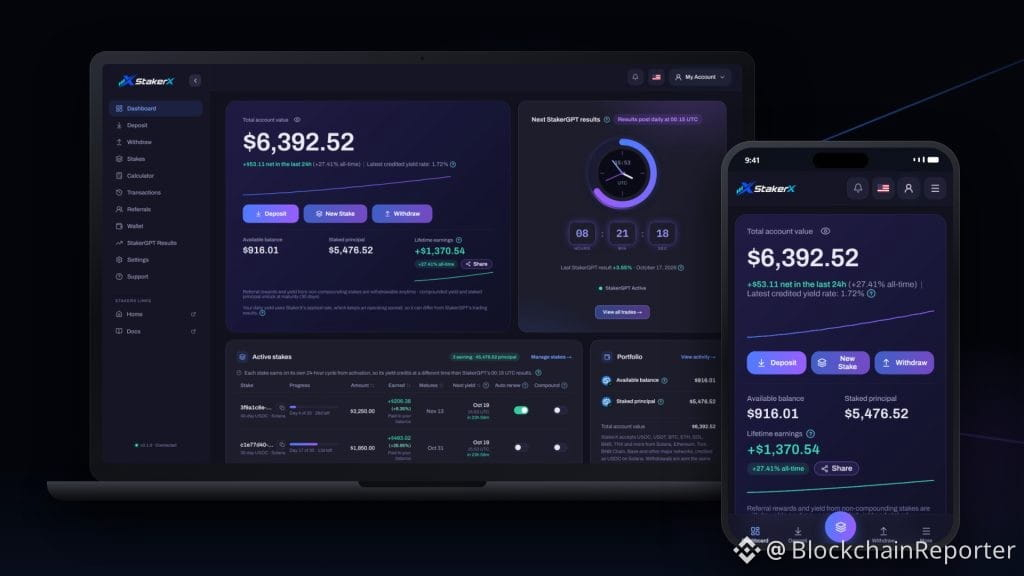
Article
StakerX’s AI Agent Surpasses Passes $40M Staked Assets on Solana Within Three Months of LaunchZug, Switzerland, October 19th, 2026, Chainwire
StakerX’s AI Agent Surpasses Passes $40M Staked Assets on Solana Within Three Months of Launch
StakerGPT trades crypto markets around the clock and publishes every trade it makes, as more than 8,200 users join the platform
StakerX.ai, an agentic trading platform built by Switzerland-based StakerX Strategies AG, has passed $40 million in assets staked on Solana less than three months after its public launch on July 13, 2026. Users fund their stakes with more than 40 cryptocurrencies from most major blockchains, and StakerGPT, the platform’s agentic trading agent, puts that capital to work in crypto perpetual futures markets every day.
An AI agent that shows its work
An agentic system is AI software that carries out a multi-step task on its own. StakerGPT is built on rare-access Claude Mythos: it monitors crypto markets around the clock, reasons over potential trade setups, filters them through risk controls and routes the approved trades for execution, without a human placing each order.
Every trade is public. StakerX publishes the full record daily at stakerx.ai/trades, with the market, direction, entry and exit prices and return of each position, including both live-executed and signal-derived trades. As of October 18, 2026, the record holds 804 trades across 139 trading days since June 1, 2026, so anyone can check what the agent did on any given day instead of relying on summary figures.
Fund it with almost any coin
Users can deposit USDC, USDT, BTC, ETH, SOL, BNB, TRX and more than 30 other cryptocurrencies from Solana, Ethereum, Bitcoin, BNB Chain, Base, Arbitrum, Polygon, Tron and other networks. Each deposit is converted and credited as USDC, a dollar-backed stablecoin, on Solana, so users do not need to bridge or swap anything themselves. Stakes start at $10 and run for 30 days.
Three months of growth
As of October 18, 2026, StakerX.ai reports:
$40 million currently staked on the platform
More than 8,200 registered users, of whom more than 3,000 have funded an account
804 trades published across 139 trading days
More than 27,700 completed withdrawals, totalling $10+ million
Nearly $12 million in yield credited to users since launch
Coming to the App Store and Google Play
StakerX is preparing native mobile apps for iOS and Android, expected in December 2026, which will bring the dashboard, deposits and the live StakerGPT trade record to the Apple App Store and Google Play. The platform is available today on the web at stakerx.ai.
About StakerX
StakerX is an agentic trading platform built and operated by StakerX Strategies AG, a quantitative trading and investment firm based in Switzerland. Its AI trading agent, StakerGPT, is built on rare-access Claude Mythos and evaluates crypto markets, applies risk filters and routes trades, and the platform publishes every trade in its record daily. Its goal is to make agentic trading accessible to anyone who holds crypto, from any chain, with every trade on the record. StakerX launched publicly on July 13, 2026. More information is available at stakerx.ai.
Media contact
Rimma S. – StakerX Strategies AG | Media Relations
support@stakerx.ai
Contact
Media RelationsVince MuellerStakerX Strategies AGsupport@stakerx.ai
This article is not intended as financial advice. Educational purposes only.
StakerX’s AI Agent Surpasses Passes $40M Staked Assets on Solana Within Three Months of Launch
Zug, Switzerland, October 19th, 2026, Chainwire
StakerX’s AI Agent Surpasses Passes $40M Staked Assets on Solana Within Three Months of Launch
StakerGPT trades crypto markets around the clock and publishes every trade it makes, as more than 8,200 users join the platform
StakerX.ai, an agentic trading platform built by Switzerland-based StakerX Strategies AG, has passed $40 million in assets staked on Solana less than three months after its public launch on July 13, 2026. Users fund their stakes with more than 40 cryptocurrencies from most major blockchains, and StakerGPT, the platform’s agentic trading agent, puts that capital to work in crypto perpetual futures markets every day.
An AI agent that shows its work
An agentic system is AI software that carries out a multi-step task on its own. StakerGPT is built on rare-access Claude Mythos: it monitors crypto markets around the clock, reasons over potential trade setups, filters them through risk controls and routes the approved trades for execution, without a human placing each order.
Every trade is public. StakerX publishes the full record daily at stakerx.ai/trades, with the market, direction, entry and exit prices and return of each position, including both live-executed and signal-derived trades. As of October 18, 2026, the record holds 804 trades across 139 trading days since June 1, 2026, so anyone can check what the agent did on any given day instead of relying on summary figures.
Fund it with almost any coin
Users can deposit USDC, USDT, BTC, ETH, SOL, BNB, TRX and more than 30 other cryptocurrencies from Solana, Ethereum, Bitcoin, BNB Chain, Base, Arbitrum, Polygon, Tron and other networks. Each deposit is converted and credited as USDC, a dollar-backed stablecoin, on Solana, so users do not need to bridge or swap anything themselves. Stakes start at $10 and run for 30 days.
Three months of growth
As of October 18, 2026, StakerX.ai reports:
$40 million currently staked on the platform
More than 8,200 registered users, of whom more than 3,000 have funded an account
804 trades published across 139 trading days
More than 27,700 completed withdrawals, totalling $10+ million
Nearly $12 million in yield credited to users since launch
Coming to the App Store and Google Play
StakerX is preparing native mobile apps for iOS and Android, expected in December 2026, which will bring the dashboard, deposits and the live StakerGPT trade record to the Apple App Store and Google Play. The platform is available today on the web at stakerx.ai.
About StakerX
StakerX is an agentic trading platform built and operated by StakerX Strategies AG, a quantitative trading and investment firm based in Switzerland. Its AI trading agent, StakerGPT, is built on rare-access Claude Mythos and evaluates crypto markets, applies risk filters and routes trades, and the platform publishes every trade in its record daily. Its goal is to make agentic trading accessible to anyone who holds crypto, from any chain, with every trade on the record. StakerX launched publicly on July 13, 2026. More information is available at stakerx.ai.
Media contact
Rimma S. – StakerX Strategies AG | Media Relations
support@stakerx.ai
Contact
Media RelationsVince MuellerStakerX Strategies AGsupport@stakerx.ai
This article is not intended as financial advice. Educational purposes only.
StakerX’s AI Agent Surpasses Passes $40M Staked Assets on Solana Within Three Months of Launch
StakerGPT trades crypto markets around the clock and publishes every trade it makes, as more than 8,200 users join the platform
StakerX.ai, an agentic trading platform built by Switzerland-based StakerX Strategies AG, has passed $40 million in assets staked on Solana less than three months after its public launch on July 13, 2026. Users fund their stakes with more than 40 cryptocurrencies from most major blockchains, and StakerGPT, the platform’s agentic trading agent, puts that capital to work in crypto perpetual futures markets every day.
An AI agent that shows its work
An agentic system is AI software that carries out a multi-step task on its own. StakerGPT is built on rare-access Claude Mythos: it monitors crypto markets around the clock, reasons over potential trade setups, filters them through risk controls and routes the approved trades for execution, without a human placing each order.
Every trade is public. StakerX publishes the full record daily at stakerx.ai/trades, with the market, direction, entry and exit prices and return of each position, including both live-executed and signal-derived trades. As of October 18, 2026, the record holds 804 trades across 139 trading days since June 1, 2026, so anyone can check what the agent did on any given day instead of relying on summary figures.
Fund it with almost any coin
Users can deposit USDC, USDT, BTC, ETH, SOL, BNB, TRX and more than 30 other cryptocurrencies from Solana, Ethereum, Bitcoin, BNB Chain, Base, Arbitrum, Polygon, Tron and other networks. Each deposit is converted and credited as USDC, a dollar-backed stablecoin, on Solana, so users do not need to bridge or swap anything themselves. Stakes start at $10 and run for 30 days.
Three months of growth
As of October 18, 2026, StakerX.ai reports:
$40 million currently staked on the platform
More than 8,200 registered users, of whom more than 3,000 have funded an account
804 trades published across 139 trading days
More than 27,700 completed withdrawals, totalling $10+ million
Nearly $12 million in yield credited to users since launch
Coming to the App Store and Google Play
StakerX is preparing native mobile apps for iOS and Android, expected in December 2026, which will bring the dashboard, deposits and the live StakerGPT trade record to the Apple App Store and Google Play. The platform is available today on the web at stakerx.ai.
About StakerX
StakerX is an agentic trading platform built and operated by StakerX Strategies AG, a quantitative trading and investment firm based in Switzerland. Its AI trading agent, StakerGPT, is built on rare-access Claude Mythos and evaluates crypto markets, applies risk filters and routes trades, and the platform publishes every trade in its record daily. Its goal is to make agentic trading accessible to anyone who holds crypto, from any chain, with every trade on the record. StakerX launched publicly on July 13, 2026. More information is available at stakerx.ai.
Media contact
Rimma S. – StakerX Strategies AG | Media Relations
support@stakerx.ai
Contact
Media RelationsVince MuellerStakerX Strategies AGsupport@stakerx.ai
This article is not intended as financial advice. Educational purposes only.
1
204

Article
Tria Debuts $120K Tria Grand Prix Perpetual Futures Trading Competition—2 Champions to Ferrari F1...New York, New York, October 16th, 2026, Chainwire
The three-month championship brings Hyperliquid and Decibel traders together for cash prizes and exclusive Ferrari Formula 1 experiences at Suzuka, as tokenization expands access to global financial markets.
Tria, the self-custodial financial platform unifying trading, yield, and payments, today announced the launch of the Tria Grand Prix, a three-month global perpetual futures trading competition featuring $120,000 in prizes and an extraordinary grand prize: three-day Ferrari F1 Paddock Club experiences for the competition’s two top eligible traders at the 2027 Formula 1 Japanese Grand Prix.
Running from October 16, 2026, through January 16, 2027, the championship brings together perpetual futures trading on Hyperliquid and Decibel through a single competition on Tria. Participants will compete across nine cash-prize rounds and a season-long leaderboard, culminating in two winners receiving exclusive Ferrari Paddock Club access for the April 9–11 Formula 1 race weekend at Suzuka Circuit, including premium hospitality overlooking the Ferrari team garage, pit-lane access and other F1 experiences.
How the Tria Grand Prix Works
The Tria Grand Prix combines eligible trading activity across Hyperliquid and Decibel, two decentralized perpetual futures exchanges integrated into the Tria application. Qualifying trades executed through either venue on Tria contribute to the same championship standings, enabling participants to compete across supported cryptocurrency and traditional-asset-linked markets without switching between separate applications.
Prizes and Rewards
The competition features nine cash-prize rounds, season-long championship rewards and daily Gacha raffles:
$90,000 in USDC prizes: Nine competition rounds, each awarding $10,000 in USDC.
Ferrari F1 Paddock Club: One three-day Ferrari Paddock Club experience for each of the top two qualifying championship traders at the 2027 Japanese Grand Prix.
Championship rewards: Gacha packs awarded according to qualifying championship rank, plus one month of VIP 7 status for the top 20 qualifying traders.
Daily raffle: One $50 Gacha pack awarded each day through a raffle.
Eligibility and Championship Rankings
Participation is automatic. Eligible users enter the competition by placing qualifying, fee-paying perpetual futures trades through Tria on Hyperliquid or Decibel, with no separate registration required. Only eligible trades executed through the Tria application count toward competition standings.
Season-long championship rankings are determined by total eligible trading volume. To qualify for any championship reward, including Ferrari Paddock Club experiences, rank-based Gacha packs and VIP 7 benefits, participants must generate at least $5 million in cumulative eligible trading volume during the competition. This threshold refers to aggregate trading activity, not a minimum deposit or account balance. The nine individual cash-prize rounds have separate qualification requirements.
The two highest-ranked qualifying traders will receive three-day Ferrari Paddock Club experiences at the Formula 1 Japanese Grand Prix, April 9–11, 2027. The Suzuka finale will bring the championship to one of Formula 1’s most celebrated circuits, giving its winners access to Ferrari’s race-weekend hospitality and an extraordinary vantage point on the action.
A Global Championship for a New Era of Financial Markets
The Tria Grand Prix launches as tokenization and onchain financial infrastructure expand access to markets traditionally separated by geography, financial intermediaries and local trading systems. Tria is seeing this shift firsthand, with traders in Japan and South Korea using the platform to access U.S. equity- and commodity-linked markets, while users in markets such as the United Arab Emirates can gain exposure to Korean stocks through onchain trading instruments.
These cross-border opportunities illustrate a broader transformation in global finance: investors increasingly expect access to markets outside their home countries without navigating separate brokerage relationships, fragmented infrastructure or multiple trading applications. By integrating Hyperliquid and Decibel into one self-custodial environment, Tria connects cryptocurrency trading with opportunities linked to traditional financial assets, bringing participants from different markets into a shared global competition.
“Someone in Japan or Korea can trade exposure to American stocks and commodities, while someone sitting in Dubai can access markets linked to Korean equities. That is a profound change in how global financial participation works,” said Vijit Katta, Co-Founder and CEO of Tria. “Tokenization is breaking down the geographic barriers that have historically determined which markets people can access. We’re building for a world where capital can move across markets as easily as information moves across the internet. The Tria Grand Prix brings that vision to life by putting traders from different parts of the world into the same championship, with the chance to finish the season inside Ferrari’s F1 Paddock Club at Suzuka.”
The championship also demonstrates how Tria’s broader financial platform connects activities that have traditionally operated through separate services. Users can trade across supported markets, manage digital assets, earn yield and make payments through the same self-custodial application, supported by Tria’s cross-chain infrastructure.
Tria has grown to more than 600,000 users across over 150 countries, reflecting increasing demand for financial applications that combine global reach, asset control and access to multiple markets. The Grand Prix will bring this international user base together in a single competition while providing further insight into how participants across different regions engage with onchain trading and traditional financial markets.
About Tria
Tria is a self-custodial neofinance platform bringing trading, yield, payments and cross-chain asset management into one application. Through integrations with platforms including Hyperliquid and Decibel, and its BestPath routing infrastructure, Tria enables users to access digital assets and onchain financial markets while maintaining control of their assets. The platform serves more than 600,000 users across over 150 countries.
Start using Tria: https://link.tria.so/4i5Tmab
Learn more about Tria: https://link.tria.so/4hZbgeK
Contact
Jon PhillipsPhillComm GlobalTria@PhillComm.Global
This article is not intended as financial advice. Educational purposes only.
Tria Debuts $120K Tria Grand Prix Perpetual Futures Trading Competition—2 Champions to Ferrari F1...
New York, New York, October 16th, 2026, Chainwire
The three-month championship brings Hyperliquid and Decibel traders together for cash prizes and exclusive Ferrari Formula 1 experiences at Suzuka, as tokenization expands access to global financial markets.
Tria, the self-custodial financial platform unifying trading, yield, and payments, today announced the launch of the Tria Grand Prix, a three-month global perpetual futures trading competition featuring $120,000 in prizes and an extraordinary grand prize: three-day Ferrari F1 Paddock Club experiences for the competition’s two top eligible traders at the 2027 Formula 1 Japanese Grand Prix.
Running from October 16, 2026, through January 16, 2027, the championship brings together perpetual futures trading on Hyperliquid and Decibel through a single competition on Tria. Participants will compete across nine cash-prize rounds and a season-long leaderboard, culminating in two winners receiving exclusive Ferrari Paddock Club access for the April 9–11 Formula 1 race weekend at Suzuka Circuit, including premium hospitality overlooking the Ferrari team garage, pit-lane access and other F1 experiences.
How the Tria Grand Prix Works
The Tria Grand Prix combines eligible trading activity across Hyperliquid and Decibel, two decentralized perpetual futures exchanges integrated into the Tria application. Qualifying trades executed through either venue on Tria contribute to the same championship standings, enabling participants to compete across supported cryptocurrency and traditional-asset-linked markets without switching between separate applications.
Prizes and Rewards
The competition features nine cash-prize rounds, season-long championship rewards and daily Gacha raffles:
$90,000 in USDC prizes: Nine competition rounds, each awarding $10,000 in USDC.
Ferrari F1 Paddock Club: One three-day Ferrari Paddock Club experience for each of the top two qualifying championship traders at the 2027 Japanese Grand Prix.
Championship rewards: Gacha packs awarded according to qualifying championship rank, plus one month of VIP 7 status for the top 20 qualifying traders.
Daily raffle: One $50 Gacha pack awarded each day through a raffle.
Eligibility and Championship Rankings
Participation is automatic. Eligible users enter the competition by placing qualifying, fee-paying perpetual futures trades through Tria on Hyperliquid or Decibel, with no separate registration required. Only eligible trades executed through the Tria application count toward competition standings.
Season-long championship rankings are determined by total eligible trading volume. To qualify for any championship reward, including Ferrari Paddock Club experiences, rank-based Gacha packs and VIP 7 benefits, participants must generate at least $5 million in cumulative eligible trading volume during the competition. This threshold refers to aggregate trading activity, not a minimum deposit or account balance. The nine individual cash-prize rounds have separate qualification requirements.
The two highest-ranked qualifying traders will receive three-day Ferrari Paddock Club experiences at the Formula 1 Japanese Grand Prix, April 9–11, 2027. The Suzuka finale will bring the championship to one of Formula 1’s most celebrated circuits, giving its winners access to Ferrari’s race-weekend hospitality and an extraordinary vantage point on the action.
A Global Championship for a New Era of Financial Markets
The Tria Grand Prix launches as tokenization and onchain financial infrastructure expand access to markets traditionally separated by geography, financial intermediaries and local trading systems. Tria is seeing this shift firsthand, with traders in Japan and South Korea using the platform to access U.S. equity- and commodity-linked markets, while users in markets such as the United Arab Emirates can gain exposure to Korean stocks through onchain trading instruments.
These cross-border opportunities illustrate a broader transformation in global finance: investors increasingly expect access to markets outside their home countries without navigating separate brokerage relationships, fragmented infrastructure or multiple trading applications. By integrating Hyperliquid and Decibel into one self-custodial environment, Tria connects cryptocurrency trading with opportunities linked to traditional financial assets, bringing participants from different markets into a shared global competition.
“Someone in Japan or Korea can trade exposure to American stocks and commodities, while someone sitting in Dubai can access markets linked to Korean equities. That is a profound change in how global financial participation works,” said Vijit Katta, Co-Founder and CEO of Tria. “Tokenization is breaking down the geographic barriers that have historically determined which markets people can access. We’re building for a world where capital can move across markets as easily as information moves across the internet. The Tria Grand Prix brings that vision to life by putting traders from different parts of the world into the same championship, with the chance to finish the season inside Ferrari’s F1 Paddock Club at Suzuka.”
The championship also demonstrates how Tria’s broader financial platform connects activities that have traditionally operated through separate services. Users can trade across supported markets, manage digital assets, earn yield and make payments through the same self-custodial application, supported by Tria’s cross-chain infrastructure.
Tria has grown to more than 600,000 users across over 150 countries, reflecting increasing demand for financial applications that combine global reach, asset control and access to multiple markets. The Grand Prix will bring this international user base together in a single competition while providing further insight into how participants across different regions engage with onchain trading and traditional financial markets.
About Tria
Tria is a self-custodial neofinance platform bringing trading, yield, payments and cross-chain asset management into one application. Through integrations with platforms including Hyperliquid and Decibel, and its BestPath routing infrastructure, Tria enables users to access digital assets and onchain financial markets while maintaining control of their assets. The platform serves more than 600,000 users across over 150 countries.
Start using Tria: https://link.tria.so/4i5Tmab
Learn more about Tria: https://link.tria.so/4hZbgeK
Contact
Jon PhillipsPhillComm GlobalTria@PhillComm.Global
This article is not intended as financial advice. Educational purposes only.
1
497
Log in to explore more content
Join global crypto users on Binance Square
⚡️ Get latest and useful information about crypto.
💬 Trusted by the world’s largest crypto exchange.
👍 Discover real insights from verified creators.
Email / Phone number
Trending Topics
BinanceReopensWithdrawalsForMoreAssets
768,778 views
4,253 Discussing
Security Incident | Recovery Update #8: Withdrawals for More Assets to Reopen (2026-11-05)
Binance Announcement
·336 Likes
·1.4M views
Binance98PercentReplenished
140,456 views
1,641 Discussing
USStocksSlipandCryptoMarketUnderBroadPressure
313 views
89 Discussing