

#bitcoincoreidentifiesthreevulnerabilities
bitcoincoreidentifiesthreevulnerabilities
30,127 views
446 Discussing
Hot
Latest

·
--
#bitcoincoreidentifiesthreevulnerabilities
🚨 Critical Security Update: Bitcoin Core Discloses Three Vulnerabilities 🛠️🔒
Bitcoin Core has just officially disclosed three new vulnerabilities impacting node software. While the market has largely brushed off the news and funds remain completely safe, this is a crucial reminder for node operators to patch immediately!
Here is a breakdown of what you need to know:
The Main Flaw (Medium Severity): A malicious peer can exploit socket monitoring differences (via TCP urgent data) to flood non-Linux nodes—specifically those running Windows, macOS, or BSD—into memory exhaustion and force a crash. (Linux nodes are unaffected.)
Gradual Memory Drain (Medium Severity): A second issue involves slow memory growth tied to paused peers running older protocol standards.
Undo-File Overflow (Low Severity): A third bug could theoretically corrupt reorg undo data, though exploitation conditions are extremely impractical.
The Good News:
Zero Funds at Risk: These are node reliability and availability risks (causing crashes or dropped syncs), not consensus flaws or a threat to your coins.
Fixes Are Already Live: Patches have officially dropped in versions 29.5, 30.4, 31.2, and 32.1.
AI-Assisted Audit: Interestingly, at least two of these bugs were surfaced using Project Loupe, an AI-driven scanning tool by Spiral, highlighting how AI code auditing$ is reshaping security.
The Bottom Line: If you run a full node (especially on Windows or macOS), the biggest vulnerability isn't the bug itself—it's failing to update! Make sure your node is running the latest patched release.
Are you running a full node, and have you already updated? Drop your thoughts below!
#BitcoinCoreIdentifiesThreeVulnerabilities #Bitcoin #CryptoSecurity #BinanceSquare $BTC $SOL
{spot}(SOLUSDT)
{spot}(BTCUSDT)
#bitcoincoreidentifiesthreevulnerabilities
🚨 Critical Security Update: Bitcoin Core Discloses Three Vulnerabilities 🛠️🔒
Bitcoin Core has just officially disclosed three new vulnerabilities impacting node software. While the market has largely brushed off the news and funds remain completely safe, this is a crucial reminder for node operators to patch immediately!
Here is a breakdown of what you need to know:
The Main Flaw (Medium Severity): A malicious peer can exploit socket monitoring differences (via TCP urgent data) to flood non-Linux nodes—specifically those running Windows, macOS, or BSD—into memory exhaustion and force a crash. (Linux nodes are unaffected.)
Gradual Memory Drain (Medium Severity): A second issue involves slow memory growth tied to paused peers running older protocol standards.
Undo-File Overflow (Low Severity): A third bug could theoretically corrupt reorg undo data, though exploitation conditions are extremely impractical.
The Good News:
Zero Funds at Risk: These are node reliability and availability risks (causing crashes or dropped syncs), not consensus flaws or a threat to your coins.
Fixes Are Already Live: Patches have officially dropped in versions 29.5, 30.4, 31.2, and 32.1.
AI-Assisted Audit: Interestingly, at least two of these bugs were surfaced using Project Loupe, an AI-driven scanning tool by Spiral, highlighting how AI code auditing$ is reshaping security.
The Bottom Line: If you run a full node (especially on Windows or macOS), the biggest vulnerability isn't the bug itself—it's failing to update! Make sure your node is running the latest patched release.
Are you running a full node, and have you already updated? Drop your thoughts below!
#BitcoinCoreIdentifiesThreeVulnerabilities #Bitcoin #CryptoSecurity #BinanceSquare $BTC $SOL

1
2k

·
--
Bearish
#bitcoincoreidentifiesthreevulnerabilities Bitcoin Core developers have officially disclosed three newly identified vulnerabilities within the core network codebase. This proactive disclosure highlights the ongoing rigor of open-source security audits and continuous peer review. The identified flaws, which primarily relate to denial-of-service vectors and memory management, have already been addressed in recent patch updates. Importantly, no consensus failures or user fund losses are reported.
For the broader crypto market, this news strongly reinforces Bitcoin’s foundational security model. While retail investors might initially react negatively to the word vulnerability, institutional participants view transparent bug bounties and swift patching as a clear sign of network maturity. It clearly demonstrates that the protocol's defense mechanisms are working exactly as intended.
Traders should closely monitor node upgrade adoption rates over the coming weeks. High migration to the patched versions will further solidify overall network resilience. Meanwhile, this event serves as a vital reminder that infrastructure security remains a primary driver of long-term institutional confidence and price stability. Observing how quickly the community patches these issues provides valuable insight into network health.
#Bitcoin #CryptoSecurity #BTC
$NIL $CHIP $ERA
{future}(ERAUSDT)
{future}(CHIPUSDT)
{future}(NILUSDT)
#bitcoincoreidentifiesthreevulnerabilities Bitcoin Core developers have officially disclosed three newly identified vulnerabilities within the core network codebase. This proactive disclosure highlights the ongoing rigor of open-source security audits and continuous peer review. The identified flaws, which primarily relate to denial-of-service vectors and memory management, have already been addressed in recent patch updates. Importantly, no consensus failures or user fund losses are reported.
For the broader crypto market, this news strongly reinforces Bitcoin’s foundational security model. While retail investors might initially react negatively to the word vulnerability, institutional participants view transparent bug bounties and swift patching as a clear sign of network maturity. It clearly demonstrates that the protocol's defense mechanisms are working exactly as intended.
Traders should closely monitor node upgrade adoption rates over the coming weeks. High migration to the patched versions will further solidify overall network resilience. Meanwhile, this event serves as a vital reminder that infrastructure security remains a primary driver of long-term institutional confidence and price stability. Observing how quickly the community patches these issues provides valuable insight into network health.
#Bitcoin #CryptoSecurity #BTC
$NIL $CHIP $ERA

604

·
--
Bullish
#bitcoincoreidentifiesthreevulnerabilities 🚨 BITCOIN CORE DISCLOSES 3 SECURITY VULNERABILITIES — NODE OPERATORS, UPDATE NOW! 🔒
Bitcoin Core officially disclosed three vulnerabilities on October 28, 2026. The issues mainly affect node stability and data integrity, making this an important security update for anyone running a full node.
🔍 Here’s What You Need to Know:
⚠️ 1. TCP Urgent Data Bug — Medium Severity
A malicious peer could exploit a socket-monitoring flaw to exhaust memory and crash Bitcoin Core nodes running on Windows, macOS, and BSD. Linux nodes are unaffected by this specific issue.
⚠️ 2. Gradual Memory Growth — Medium Severity
Older peers that do not support BIP31 ping messages could cause memory usage to grow over time by keeping message queues from clearing properly.
⚠️ 3. Undo-File Overflow — Low Severity
Under extreme conditions, specially constructed blocks could corrupt undo data and cause node failures. The fix addresses 64-bit systems, but 32-bit systems and nodes storing block data on FAT32 remain affected.
🛡️ Are Your Bitcoin Funds at Risk?
These disclosures primarily concern node availability and data integrity—not a direct wallet-draining attack. However, node crashes and corrupted data can still disrupt operations, so operators should take the advisories seriously.
✅ Patches Released
Fixes were included in Bitcoin Core versions 29.5, 30.4, 31.2, and 32.1. Check the official advisories and upgrade to an appropriate supported release. Verify the remaining platform-specific limitations before assuming every issue is resolved.
🤖 AI-Assisted Security
your software yet?
#Bitcoin #BitcoinCore #CryptoSecurity #Cybersecurity #BinanceSquare
$BTC $ETH $SOL

1

·
--
#bitcoincoreidentifiesthreevulnerabilities
🚨 BITCOIN CORE PATCHES 3 SECURITY BUGS!
Bitcoin Core disclosed three vulnerabilities that could crash nodes or corrupt data. Fixes are available, and user funds are not at risk.
👀 The bigger question: Will node operators update in time?
📊 Meanwhile, all eyes are on $BTC and the $80K support level.
Will BTC hold $80K, or will this headline trigger a breakdown?."CLICK ON THE BELOW YELLOW COIN TAG TO GO TO DESIRED TRADING PAGE TO GET BENEFIT TRADE"$BTC
{spot}(BTCUSDT)
#BitcoinSecurity #BTCPrice
#bitcoincoreidentifiesthreevulnerabilities
🚨 BITCOIN CORE PATCHES 3 SECURITY BUGS!
Bitcoin Core disclosed three vulnerabilities that could crash nodes or corrupt data. Fixes are available, and user funds are not at risk.
👀 The bigger question: Will node operators update in time?
📊 Meanwhile, all eyes are on $BTC and the $80K support level.
Will BTC hold $80K, or will this headline trigger a breakdown?."CLICK ON THE BELOW YELLOW COIN TAG TO GO TO DESIRED TRADING PAGE TO GET BENEFIT TRADE"$BTC
#BitcoinSecurity #BTCPrice

1
9

·
--
🚨 BITCOIN CORE UNCOVERS 3 SECURITY VULNERABILITIES — AI PLAYS A KEY ROLE!
Bitcoin Core has disclosed three security vulnerabilities after an AI-assisted scan identified flaws in its code.
⚠️ The biggest concern? A remote attacker could potentially exhaust memory and crash Bitcoin nodes running Windows, macOS, or BSD.
The three vulnerabilities include:
• A remote memory-exhaustion attack
• A flaw allowing memory to accumulate over time
• A low-severity blockchain undo-file overflow issue
The good news: Developers have already released patches across Bitcoin Core versions 29.5, 30.4, 31.2, and 32.1.
This is not evidence that Bitcoin itself has been compromised.
However, it highlights how critical node security is to the network's resilience.
AI is becoming a powerful tool for finding vulnerabilities before attackers exploit them.
🔥 Could AI become Bitcoin's strongest security defense — or introduce new risks?
#bitcoincoreidentifiesthreevulnerabilities $BTC
{future}(BTCUSDT)
🚨 BITCOIN CORE UNCOVERS 3 SECURITY VULNERABILITIES — AI PLAYS A KEY ROLE!
Bitcoin Core has disclosed three security vulnerabilities after an AI-assisted scan identified flaws in its code.
⚠️ The biggest concern? A remote attacker could potentially exhaust memory and crash Bitcoin nodes running Windows, macOS, or BSD.
The three vulnerabilities include:
• A remote memory-exhaustion attack
• A flaw allowing memory to accumulate over time
• A low-severity blockchain undo-file overflow issue
The good news: Developers have already released patches across Bitcoin Core versions 29.5, 30.4, 31.2, and 32.1.
This is not evidence that Bitcoin itself has been compromised.
However, it highlights how critical node security is to the network's resilience.
AI is becoming a powerful tool for finding vulnerabilities before attackers exploit them.
🔥 Could AI become Bitcoin's strongest security defense — or introduce new risks?
#bitcoincoreidentifiesthreevulnerabilities $BTC

9

$BTC — BITCOIN CORE DISCLOSES 3 SECURITY VULNERABILITIES!Bitcoin Core has disclosed three software vulnerabilities, with fixes released across supported versions. The good news? These are primarily node reliability and availability issues, not a confirmed attack on users’ Bitcoin funds.
Here’s what the community needs to know 👇
🛠️ 1. Memory Exhaustion — Medium Severity
A malicious peer could exploit TCP urgent data to overwhelm certain non-Linux nodes, potentially crashing systems running Windows, macOS or BSD. Linux nodes are not affected by this particular bug.
⚠️ 2. Gradual Memory Growth — Medium Severity
A separate issue could cause memory usage to increase when nodes communicate with certain older-protocol peers, potentially affecting performance and stability.
🔍 3. Undo-File Overflow — Low Severity
Under specific conditions, unusually large undo files could corrupt node data and cause shutdowns. The attack is considered impractical in typical circumstances, but some configurations remain affected.
✅ Which Versions Include Fixes?
Bitcoin Core released patched versions:
29.530.431.232.1
Node operators should follow the official security advisories and upgrade guidance. The undo-file issue has additional caveats for 32-bit systems and nodes storing block data on FAT32.
🤖 AI Is Playing a Bigger Role in Crypto Security
At least two of these vulnerabilities were identified through Project Loupe, an automated AI-assisted code-scanning initiative at Spiral. It’s a reminder that AI can help uncover software weaknesses—but human validation and timely patches remain essential.
📊 What Does This Mean for $BTC and $SOL ?
There is no confirmed evidence in these disclosures that users’ coins were stolen or Bitcoin’s consensus rules were compromised. Still, node crashes and reliability problems matter because healthy infrastructure is essential to the network.
My takeaway: Don’t panic over the headline—but don’t ignore the update either. If you operate a Bitcoin Core node, check your version against the official advisories and apply the appropriate fix.
💬 Are you running your own Bitcoin node, or do you rely on an exchange or wallet provider?
#BitcoinCoreIdentifiesThreeVulnerabilities #Bitcoin #CryptoSecurity #BinanceSquare
{spot}(BTCUSDT)
{spot}(SOLUSDT)
$BTC — BITCOIN CORE DISCLOSES 3 SECURITY VULNERABILITIES!
Bitcoin Core has disclosed three software vulnerabilities, with fixes released across supported versions. The good news? These are primarily node reliability and availability issues, not a confirmed attack on users’ Bitcoin funds.
Here’s what the community needs to know 👇
🛠️ 1. Memory Exhaustion — Medium Severity
A malicious peer could exploit TCP urgent data to overwhelm certain non-Linux nodes, potentially crashing systems running Windows, macOS or BSD. Linux nodes are not affected by this particular bug.
⚠️ 2. Gradual Memory Growth — Medium Severity
A separate issue could cause memory usage to increase when nodes communicate with certain older-protocol peers, potentially affecting performance and stability.
🔍 3. Undo-File Overflow — Low Severity
Under specific conditions, unusually large undo files could corrupt node data and cause shutdowns. The attack is considered impractical in typical circumstances, but some configurations remain affected.
✅ Which Versions Include Fixes?
Bitcoin Core released patched versions:
29.530.431.232.1
Node operators should follow the official security advisories and upgrade guidance. The undo-file issue has additional caveats for 32-bit systems and nodes storing block data on FAT32.
🤖 AI Is Playing a Bigger Role in Crypto Security
At least two of these vulnerabilities were identified through Project Loupe, an automated AI-assisted code-scanning initiative at Spiral. It’s a reminder that AI can help uncover software weaknesses—but human validation and timely patches remain essential.
📊 What Does This Mean for $BTC and $SOL ?
There is no confirmed evidence in these disclosures that users’ coins were stolen or Bitcoin’s consensus rules were compromised. Still, node crashes and reliability problems matter because healthy infrastructure is essential to the network.
My takeaway: Don’t panic over the headline—but don’t ignore the update either. If you operate a Bitcoin Core node, check your version against the official advisories and apply the appropriate fix.
💬 Are you running your own Bitcoin node, or do you rely on an exchange or wallet provider?
#BitcoinCoreIdentifiesThreeVulnerabilities #Bitcoin #CryptoSecurity #BinanceSquare
32


#bitcoincoreidentifiesthreevulnerabilities
🛡️ $BITCOIN Core Identifies Three Vulnerabilities: What $BTC Users Should Know 🔍
Imagine your computer quietly helping secure Bitcoin around the clock. Then developers discover flaws that could cause some nodes to crash or shut down. The immediate question is simple: how serious are these risks, and what happens next?
On October 28, Bitcoin Core disclosed three security vulnerabilities after fixes became available across supported release branches. The findings were identified through an automated AI-assisted security scan, then validated by developers.
Two vulnerabilities could allow malicious peers to exhaust node memory under specific conditions. One particularly affected non-Linux systems, including Windows, macOS, and BSD. The third involved undo-file overflow under extreme conditions and could cause node failures.
Here is the important distinction: these findings do not mean Bitcoin's entire network or users' funds have been compromised. The disclosed issues primarily concern node stability, and the advisories do not report whether any were exploited.
Bitcoin Core released fixes in versions 29.5, 30.4, 31.2, and 32.1. However, 32-bit systems and nodes storing blocks on FAT32 remain affected by the undo-file issue.
My take: Bitcoin's resilience depends not on pretending vulnerabilities never exist, but on finding, disclosing, and fixing them responsibly. AI-assisted security research could help developers identify weaknesses earlier, although human validation remains essential.
A strong network is not one without bugs. It is one that responds when bugs are found.
Do you think AI-assisted security scanning will become essential for protecting Bitcoin and other blockchain networks?
Disclaimer: For educational purposes only. Not financial or investment advice.
#BitcoinSecurity #Bitcoin #GrowWithSAC $EVAA
#BitcoinCoreIdentifiesThreeVulnerabilities

170

#bitcoincoreidentifiesthreevulnerabilities
🚨 $BITCOIN Core Exposes 3 Vulnerabilities: Is Your Node Protected? 🚨
The strongest fortress is not the one that never finds a weakness. It is the one that fixes it before the weakness becomes a disaster.
On October 28, Bitcoin Core publicly disclosed three vulnerabilities discovered through automated AI-assisted code scanning and verified by human developers.
The first flaw could allow a malicious peer to exhaust memory and crash nodes on Windows, macOS, and BSD. The second involved unbounded memory growth from certain outdated peer connections. The third could corrupt blockchain undo data under extreme conditions, potentially forcing affected nodes to shut down.
Developers released patched versions 29.5, 30.4, 31.2, and 32.1. However, the third issue still affects certain 32-bit systems and nodes storing blockchain data on FAT32 drives.
My Take: The most important story is not simply that Bitcoin Core had bugs. Every complex software system can contain vulnerabilities. What matters is how quickly weaknesses are identified, independently verified, patched, and communicated.
AI-assisted security scanning could accelerate this process, helping developers discover flaws before malicious actors exploit them. But automated detection is only one part of security. Human validation, responsible disclosure, and timely upgrades remain essential.
For Bitcoin, trust depends on continuous maintenance, not claims of perfection. These disclosures do not mean the Bitcoin network itself has been compromised.
Security is not a promise that nothing can go wrong. It is the discipline of fixing what can.
Have you updated your Bitcoin Core node to a patched version?
Disclaimer: Educational content only, not financial advice.
#Bitcoin #CryptoSecurity #GrowWithSAC $BTC $INIT
#BitcoinCoreIdentifiesThreeVulnerabilities

1
214

#BitcoinCoreIdentifiesThreeVulnerabilities
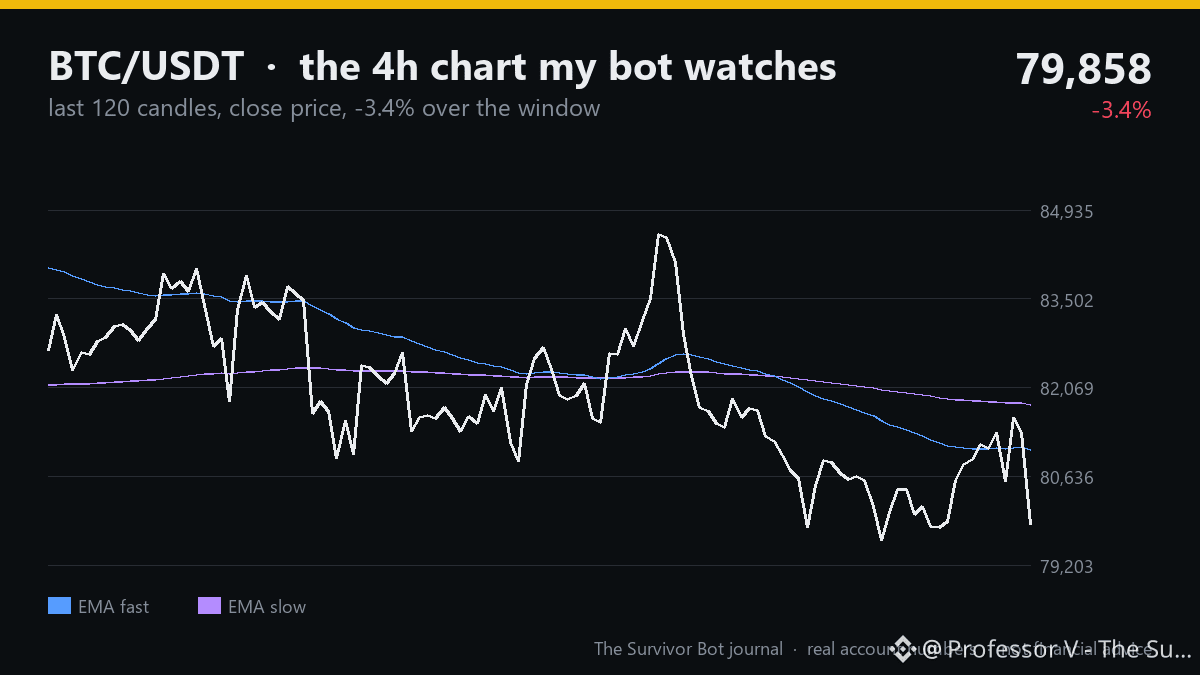
$BTC 79,969 and my bot sits at 95.79 USDT equity
Bitcoin Core disclosed three vulnerabilities affecting non-Linux nodes, with patches released in versions 29.5-32.1.
The bugs allow memory exhaustion, gradual drain, and potential undo-data corruption, but no funds are at risk.
For BTC the news highlights network security rather than price pressure, and the market has stayed largely flat.
My bot holds no open BTC position, equity is 95.79 USDT, down -68.3% since start, 4h trend is downtrend while daily bias is up.
With a neutral news mood (-0.08) the bot follows its rule of not opening new longs on risk-off signals; today it remains idle, ready to enter only if bias stays up and mood improves.
Levels I'm watching on BTC: 79,969 entry, 95.79 stop
Daily numbers, no cherry-picking. Follow if you want the losses too.
#BitcoinCoreIdentifiesThreeVulnerabilities #TheSurvivorBot
79

·
--
Bullish
#BitcoinCoreIdentifiesThreeVulnerabilities
Bitcoin Core Identifies Three Vulnerabilities — What Should Crypto Investors Know?
Bitcoin Core has reportedly identified three vulnerabilities, putting renewed attention on one of Bitcoin’s most important priorities: network security and software reliability.
Bitcoin Core is the reference implementation used by many Bitcoin nodes. Vulnerabilities in its software can matter because they may affect node stability, network operations, or the way certain transactions and messages are handled, depending on their nature and severity.
🔍 Why Does This Matter?
Bitcoin’s security depends not only on cryptography but also on reliable software, careful testing, and timely updates. Identifying vulnerabilities is an important part of maintaining that security. However, the number of reported vulnerabilities alone does not tell us how serious the situation is.
📊 What Could It Mean for BTC?
From a market perspective, the key questions are whether the vulnerabilities are exploitable, which software versions are affected, whether fixes are available, and how widely operators need to update their nodes.
A confirmed security issue could create short-term uncertainty if it threatens network reliability. On the other hand, identifying and responsibly fixing flaws can strengthen confidence in Bitcoin’s long-term infrastructure.
⚠️ What Traders Should Watch
• The official Bitcoin Core security advisories and release notes
• The severity and potential impact of each vulnerability
• Whether patched versions are available and recommended
• Any verified effect on node operations or network reliability
My Take: This is primarily a technical security story, not automatically a bullish or bearish BTC catalyst. Until the exact vulnerabilities, affected versions, and remediation details are verified, drawing strong conclusions about Bitcoin’s price would be premature.
#BitcoinCore #CryptoSecurity #Blockchain
$BTC $BULLA $IDOL
{future}(IDOLUSDT)
{future}(BULLAUSDT)
{future}(BTCUSDT)
#BitcoinCoreIdentifiesThreeVulnerabilities
Bitcoin Core Identifies Three Vulnerabilities — What Should Crypto Investors Know?
Bitcoin Core has reportedly identified three vulnerabilities, putting renewed attention on one of Bitcoin’s most important priorities: network security and software reliability.
Bitcoin Core is the reference implementation used by many Bitcoin nodes. Vulnerabilities in its software can matter because they may affect node stability, network operations, or the way certain transactions and messages are handled, depending on their nature and severity.
🔍 Why Does This Matter?
Bitcoin’s security depends not only on cryptography but also on reliable software, careful testing, and timely updates. Identifying vulnerabilities is an important part of maintaining that security. However, the number of reported vulnerabilities alone does not tell us how serious the situation is.
📊 What Could It Mean for BTC?
From a market perspective, the key questions are whether the vulnerabilities are exploitable, which software versions are affected, whether fixes are available, and how widely operators need to update their nodes.
A confirmed security issue could create short-term uncertainty if it threatens network reliability. On the other hand, identifying and responsibly fixing flaws can strengthen confidence in Bitcoin’s long-term infrastructure.
⚠️ What Traders Should Watch
• The official Bitcoin Core security advisories and release notes
• The severity and potential impact of each vulnerability
• Whether patched versions are available and recommended
• Any verified effect on node operations or network reliability
My Take: This is primarily a technical security story, not automatically a bullish or bearish BTC catalyst. Until the exact vulnerabilities, affected versions, and remediation details are verified, drawing strong conclusions about Bitcoin’s price would be premature.
#BitcoinCore #CryptoSecurity #Blockchain
$BTC $BULLA $IDOL

297

·
--
#bitcoincoreidentifiesthreevulnerabilities
Three Bitcoin Core bugs just went public. Here’s who should care. 🔐
If your node runs on Windows, macOS or BSD, one flaw lets a malicious peer exhaust memory and crash it. Linux nodes are unaffected by it.
The three issues, per early reports:
Remote memory exhaustion crashing non-Linux nodes Gradual memory drain over time Possible corruption of undo data
Fixes: Bitcoin Core 29.5, 30.4, 31.2 and 32.1. Some setups, like 32-bit systems and FAT32 storage, reportedly stay exposed to a storage-related bug.
What most posts miss: two of the three bugs were reportedly found by Project Loupe, Spiral’s AI-driven tool. AI-assisted auditing is now surfacing real node flaws.
The reports describe node crashes and data issues. Nothing in them points to lost funds. For node operators, it’s an update-now item.
Are you running a full node, and have you patched? 👇
Not financial advice. Verify on bitcoincore.org.
$BTC
{future}(BTCUSDT)
#Bitcoin #CryptoSecurity #BitcoinCore
#bitcoincoreidentifiesthreevulnerabilities
Three Bitcoin Core bugs just went public. Here’s who should care. 🔐
If your node runs on Windows, macOS or BSD, one flaw lets a malicious peer exhaust memory and crash it. Linux nodes are unaffected by it.
The three issues, per early reports:
Remote memory exhaustion crashing non-Linux nodes Gradual memory drain over time Possible corruption of undo data
Fixes: Bitcoin Core 29.5, 30.4, 31.2 and 32.1. Some setups, like 32-bit systems and FAT32 storage, reportedly stay exposed to a storage-related bug.
What most posts miss: two of the three bugs were reportedly found by Project Loupe, Spiral’s AI-driven tool. AI-assisted auditing is now surfacing real node flaws.
The reports describe node crashes and data issues. Nothing in them points to lost funds. For node operators, it’s an update-now item.
Are you running a full node, and have you patched? 👇
Not financial advice. Verify on bitcoincore.org.
$BTC
#Bitcoin #CryptoSecurity #BitcoinCore

raju1324:
Thanks for separating node reliability from fund safety. For operators, I’d verify the exact affected release branch and platform against the Bitcoin Core advisory, back up wallet and node data as appropriate, then update from the official source. The patch status matters more than short-term price reaction here.
2
1
571

·
--
#BitcoinCoreIdentifiesThreeVulnerabilities
Bitcoin Core Patches Three Vulnerabilities: What Node Operators Should Do Now
$BTC
{spot}(BTCUSDT)
Bitcoin Core disclosed three vulnerabilities on October 28 and released fixes in versions 29.5, 30.4, 31.2 and 32.1. The most notable one lets a malicious peer crash nodes running Windows, macOS or BSD by exhausting memory, while Linux nodes are unaffected. A second flaw allows gradual memory exhaustion, and a third can corrupt stored blockchain undo data. The first two are rated medium severity and the third low, and some setups, such as 32-bit systems and FAT32 storage, remain exposed to the third. The advisories do not say whether any exploitation has been seen, and Bitcoin Core calls exploitation impractical. Spiral's AI-driven Project Loupe is credited with finding at least two of the three.
My take: for most holders this is not a direct risk, since the reported impacts are node crashes, memory exhaustion and data corruption, not loss of coins. It matters most for people running their own nodes, who should upgrade to a patched version. The bigger story is the pace of AI-assisted bug hunting. Bitcoin Core recently added a faster disclosure route for easily rediscoverable flaws, which means patches and public advisories now arrive together, leaving operators less time to update. Core Lightning also warned earlier this month that attackers were targeting unpatched nodes, so patching quickly is the practical lesson here.
Do you run your own node, and how quickly do you apply security updates? Let me know below 👇
This is my analysis, not financial advice.
Follow me for more trading content and market updates.
#bitcoin #BTC #BinanceSquare
#BitcoinCoreIdentifiesThreeVulnerabilities
Bitcoin Core Patches Three Vulnerabilities: What Node Operators Should Do Now
$BTC
Bitcoin Core disclosed three vulnerabilities on October 28 and released fixes in versions 29.5, 30.4, 31.2 and 32.1. The most notable one lets a malicious peer crash nodes running Windows, macOS or BSD by exhausting memory, while Linux nodes are unaffected. A second flaw allows gradual memory exhaustion, and a third can corrupt stored blockchain undo data. The first two are rated medium severity and the third low, and some setups, such as 32-bit systems and FAT32 storage, remain exposed to the third. The advisories do not say whether any exploitation has been seen, and Bitcoin Core calls exploitation impractical. Spiral's AI-driven Project Loupe is credited with finding at least two of the three.
My take: for most holders this is not a direct risk, since the reported impacts are node crashes, memory exhaustion and data corruption, not loss of coins. It matters most for people running their own nodes, who should upgrade to a patched version. The bigger story is the pace of AI-assisted bug hunting. Bitcoin Core recently added a faster disclosure route for easily rediscoverable flaws, which means patches and public advisories now arrive together, leaving operators less time to update. Core Lightning also warned earlier this month that attackers were targeting unpatched nodes, so patching quickly is the practical lesson here.
Do you run your own node, and how quickly do you apply security updates? Let me know below 👇
This is my analysis, not financial advice.
Follow me for more trading content and market updates.
#bitcoin #BTC #BinanceSquare
1
70

·
--
bitcoin core just disclosed three bugs, and the market barely blinked
#BitcoinCoreIdentifiesThreeVulnerabilities
one lets a bad peer crash windows and mac nodes by eating their memory, another slowly leaks memory, the third can corrupt undo data in a reorg. fixes are already out. no funds at risk, just nodes that can drop offline
one read is the process working, bugs patched before anyone used them. the other is that plenty of operators never click update
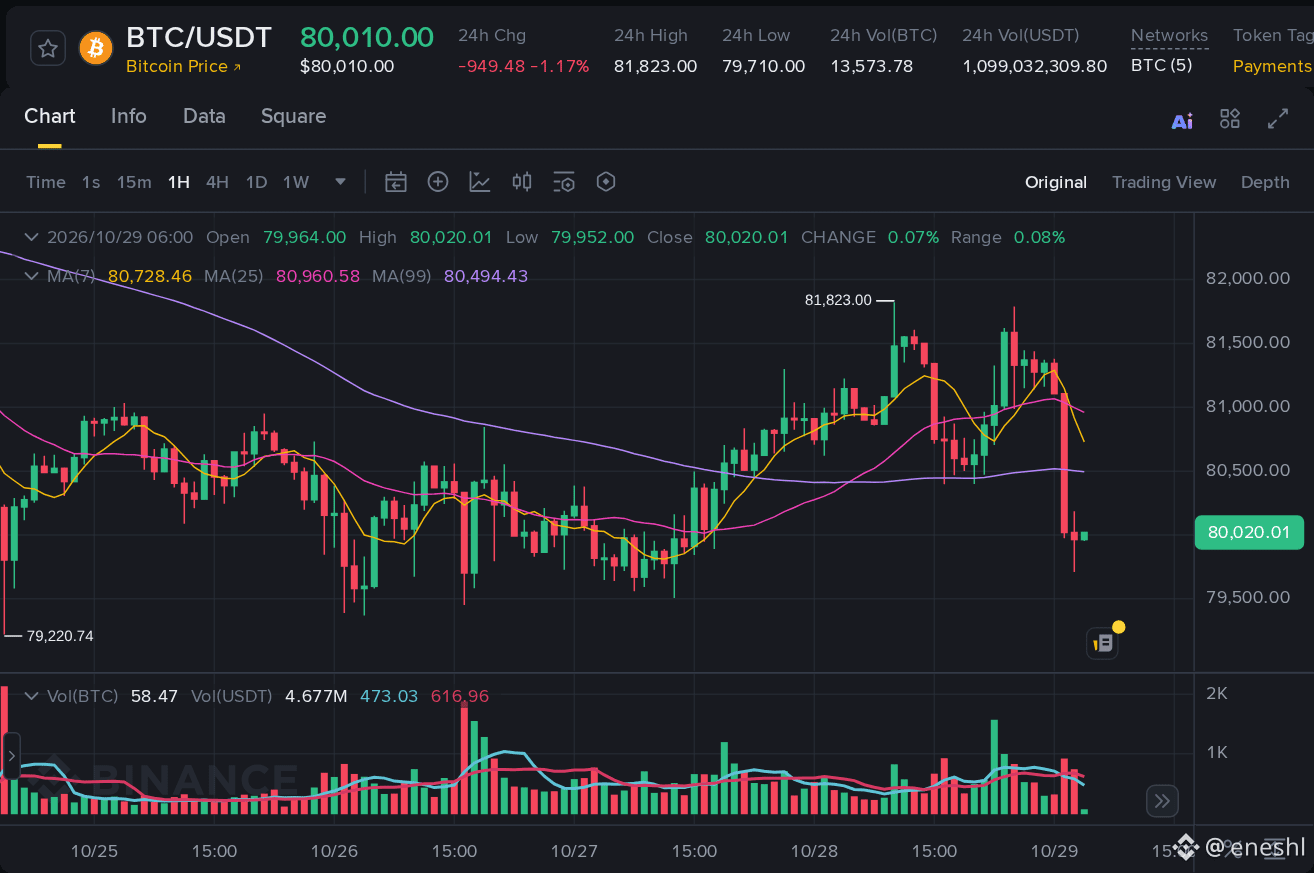
im not watching the bug, im watching if $BTC holds 80k while this headline floats around. security noise only moves price when the level is already weak
does 80k hold, or does a boring patch note become the excuse to break it ?
alikumail111:
Security patches are a positive sign, but node operators need to keep their software updated. 🛡️ The key is whether these vulnerabilities affect confidence or network stability—not just short-term price action. I’d watch both patch adoption and BTC’s reaction around $80K before drawing conclusions. 📊
1
3
587

·
--
#BitcoinCoreIdentifiesThreeVulnerabilities
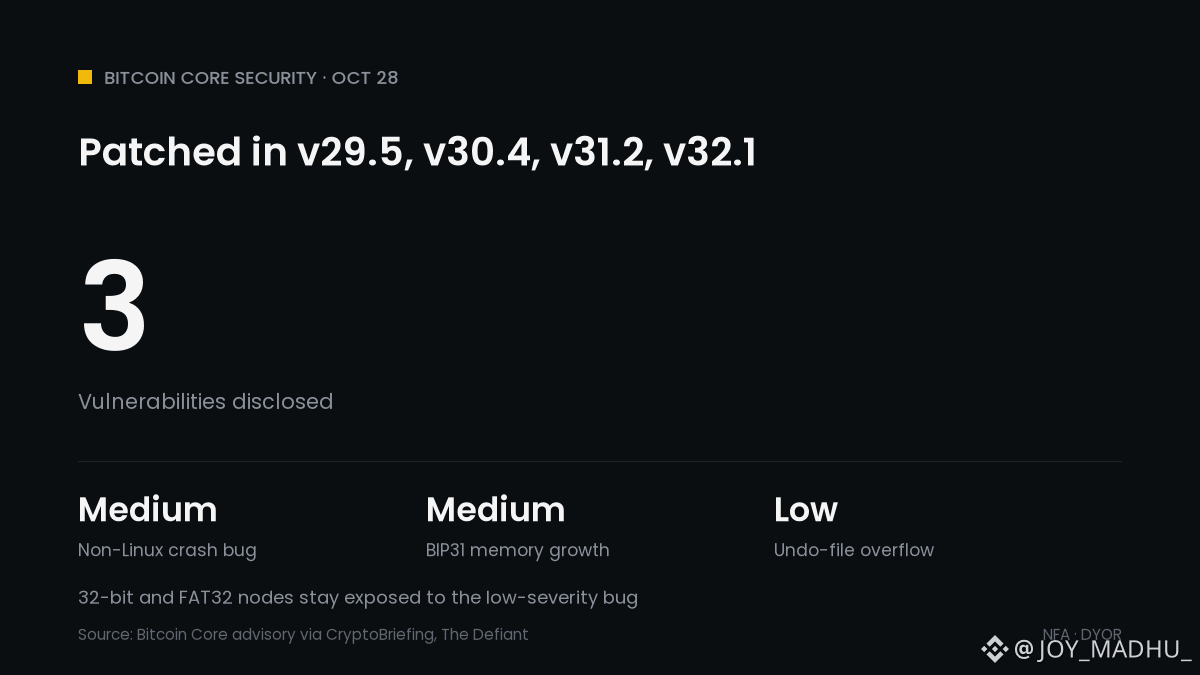
🛠️ Bitcoin Core Patches 3 Bugs: Update Your Node
📅 Oct 28: Bitcoin Core disclosed three vulnerabilities, all already fixed
⚠️ Medium: a malicious peer can send TCP urgent data to exhaust memory and crash Windows, macOS and BSD nodes. Linux is not affected
⚠️ Medium: paused peers that don't support BIP31 can slowly grow a node's memory
🔹 Low: an undo-file overflow could corrupt reorg data. 32-bit systems and FAT32 storage stay exposed even after the fix
✅ Fixed in v29.5, v30.4, v31.2 and v32.1
🤖 Two bugs were found by Spiral's AI-driven Project Loupe, one by L0rinc
📌 No CVEs were assigned this time
What it means for Bitcoin: these are node crash risks, not a threat to funds or consensus. The real risk is operators who never update.
Node runners, have you upgraded yet? 👇
$BTC
#CryptoNews #Bitcoin #BitcoinCoreIdentifiesThreeVulnerabilities
86

Bitcoin Core, the primary software client for the Bitcoin network, has recently identified three significant vulnerabilities. This discovery highlights the ongoing efforts in maintaining the robustness and security of the Bitcoin protocol. While these vulnerabilities have been addressed or are in the process of being patched, their identification underscores the importance of continuous development and rigorous testing within the crypto space. Users should always ensure they are running the latest versions of their Bitcoin Core software to benefit from these security updates. The swift response from the development team is a testament to the community's commitment to network integrity, reinforcing confidence in Bitcoin's long-term security infrastructure.
This proactive approach to security is crucial for the stability of the entire ecosystem. It's a reminder that even established protocols require constant vigilance against potential threats. The market often reacts to such news, but the focus here is on the resilience and self-correcting nature of Bitcoin's development process, which ultimately strengthens user trust and the network's overall health.
#BitcoinCoreIdentifiesThreeVulnerabilities $BTC
154

#BitcoinCoreIdentifiesThreeVulnerabilities
🚨 Bitcoin Core discloses three vulnerabilities 🚨
Bitcoin Core developers have published three security advisories affecting versions before v25.0. 🔐
⚠️ CVE-2024-35202 (high severity): attackers could remotely crash nodes through a flaw in blocktxn message handling.
🧱 Mutated blocks (medium): a peer could disrupt block propagation by wiping other peers' download states.
📡 Oversized inv-to-send sets (medium): could slow node communication and cause denial of service.
The good news: all three are already fixed. ✅ The disclosures were announced Oct 9, 2024, as part of the project's new transparency policy. 📢
👉 Still on an older version? Update your node now! 🛡️
#Bitcoin #BitcoinCore #CyberSecurity #Crypto
Note: these disclosures date to October 2024. I didn't find a brand-new advisory with this exact headline, so you may want to confirm the date fits your post.
#BitcoinDunyamiz
#StrategyShareholdersApproveDailyDividends
#CanMicrosoftDeliverOnAI
#Nadeemgujjar143
@Square-Creator-f3ffb6967ae3 @Square-Creator-278591073ae8a @punk2898
$BTC
{spot}(BTCUSDT)
$BNB
{spot}(BNBUSDT)
$SOL
{spot}(SOLUSDT)
#BitcoinCoreIdentifiesThreeVulnerabilities
🚨 Bitcoin Core discloses three vulnerabilities 🚨
Bitcoin Core developers have published three security advisories affecting versions before v25.0. 🔐
⚠️ CVE-2024-35202 (high severity): attackers could remotely crash nodes through a flaw in blocktxn message handling.
🧱 Mutated blocks (medium): a peer could disrupt block propagation by wiping other peers' download states.
📡 Oversized inv-to-send sets (medium): could slow node communication and cause denial of service.
The good news: all three are already fixed. ✅ The disclosures were announced Oct 9, 2024, as part of the project's new transparency policy. 📢
👉 Still on an older version? Update your node now! 🛡️
#Bitcoin #BitcoinCore #CyberSecurity #Crypto
Note: these disclosures date to October 2024. I didn't find a brand-new advisory with this exact headline, so you may want to confirm the date fits your post.
#BitcoinDunyamiz
#StrategyShareholdersApproveDailyDividends
#CanMicrosoftDeliverOnAI
#Nadeemgujjar143
@aasho @Ayeza998 @punk2898
$BTC
$BNB
$SOL

2
325


Article
El precio de BTC ronda los USD 81,300, reflejando una leve recuperación diaria de entre el 0.5% y..🛡️#bitcoincoreidentifiesthreevulnerabilities 🛡️ El impacto en el precio de Bitcoin (BTC) tras revelarse las tres nuevas vulnerabilidades de Bitcoin Core el 28 de octubre de 2026 demuestra que el mercado asimiló la noticia con resiliencia, cotizando de forma estable por encima de los USD 80,000. A diferencia de los mercados financieros tradicionales, donde un fallo de software crítico suele provocar pánico, los inversores cripto reaccionaron con calma debido a la rápida respuesta de los desarrolladores.#writetoearn $BTC
{future}(BTCUSDT)
🛡️El precio de BTC ronda los USD 81,300, reflejando una leve recuperación diaria de entre el 0.5% y el 2% tras haber tocado un mínimo semanal cercano a los USD 79,300 el pasado lunes.
🛡️ Factores que mitigaron el impacto en el precio
🛡️• Política de parches acelerada por IA: El mercado ya había descontado cambios estructurales en la seguridad. El 22 de octubre, Bitcoin Core eliminó los embargos de confidencialidad de dos semanas para fallos "fáciles de descubrir" (potencialmente detectables mediante Inteligencia Artificial). Esto permitió que las tres vulnerabilidades de hoy se hicieran públicas junto con sus respectivas actualizaciones de software, evitando que los atacantes tuvieran una ventana de explotación libre.
🛡️• Aislamiento del protocolo: Aunque uno de los fallos amenazaba con tumbar nodos de forma remota por agotamiento de memoria, afectaba principalmente a sistemas operativos Windows, macOS y BSD, dejando intactos a los nodos de Linux que sostienen la mayor parte de la infraestructura de minería global. El protocolo de emisión y el registro de propiedad jamás estuvieron en riesgo.
📊 Factores macroeconómicos con mayor peso
🛡️Los analistas de Wall Street coinciden en que la sutil volatilidad actual de Bitcoin no está ligada al código de Bitcoin Core, sino a factores financieros externos:
🛡️• La reunión de la Reserva Federal: El mercado se mantiene cauteloso a la espera de las decisiones sobre las tasas de interés de la Fed de este 28 de octubre, lo que ha provocado salidas de capital institucional de los ETFs de Bitcoin (como el IBIT de BlackRock).
🛡️• Zona de acumulación: Firmas de investigación como Galaxy y CryptoQuant destacan que, pese a los bugs detectados, los fundamentos técnicos como el hash rate global continúan batiendo récords, consolidando el rango actual de los USD 80,000 como una zona clave de acumulación a largo plazo.$ETH
{future}(ETHUSDT)
El precio de BTC ronda los USD 81,300, reflejando una leve recuperación diaria de entre el 0.5% y..
🛡️#bitcoincoreidentifiesthreevulnerabilities 🛡️ El impacto en el precio de Bitcoin (BTC) tras revelarse las tres nuevas vulnerabilidades de Bitcoin Core el 28 de octubre de 2026 demuestra que el mercado asimiló la noticia con resiliencia, cotizando de forma estable por encima de los USD 80,000. A diferencia de los mercados financieros tradicionales, donde un fallo de software crítico suele provocar pánico, los inversores cripto reaccionaron con calma debido a la rápida respuesta de los desarrolladores.#writetoearn $BTC
🛡️El precio de BTC ronda los USD 81,300, reflejando una leve recuperación diaria de entre el 0.5% y el 2% tras haber tocado un mínimo semanal cercano a los USD 79,300 el pasado lunes.
🛡️ Factores que mitigaron el impacto en el precio
🛡️• Política de parches acelerada por IA: El mercado ya había descontado cambios estructurales en la seguridad. El 22 de octubre, Bitcoin Core eliminó los embargos de confidencialidad de dos semanas para fallos "fáciles de descubrir" (potencialmente detectables mediante Inteligencia Artificial). Esto permitió que las tres vulnerabilidades de hoy se hicieran públicas junto con sus respectivas actualizaciones de software, evitando que los atacantes tuvieran una ventana de explotación libre.
🛡️• Aislamiento del protocolo: Aunque uno de los fallos amenazaba con tumbar nodos de forma remota por agotamiento de memoria, afectaba principalmente a sistemas operativos Windows, macOS y BSD, dejando intactos a los nodos de Linux que sostienen la mayor parte de la infraestructura de minería global. El protocolo de emisión y el registro de propiedad jamás estuvieron en riesgo.
📊 Factores macroeconómicos con mayor peso
🛡️Los analistas de Wall Street coinciden en que la sutil volatilidad actual de Bitcoin no está ligada al código de Bitcoin Core, sino a factores financieros externos:
🛡️• La reunión de la Reserva Federal: El mercado se mantiene cauteloso a la espera de las decisiones sobre las tasas de interés de la Fed de este 28 de octubre, lo que ha provocado salidas de capital institucional de los ETFs de Bitcoin (como el IBIT de BlackRock).
🛡️• Zona de acumulación: Firmas de investigación como Galaxy y CryptoQuant destacan que, pese a los bugs detectados, los fundamentos técnicos como el hash rate global continúan batiendo récords, consolidando el rango actual de los USD 80,000 como una zona clave de acumulación a largo plazo.$ETH
684

·
--
#bitcoincoreidentifiesthreevulnerabilities
Trois bugs de Bitcoin Core viennent d’être rendus publics. Qui devrait s’en préoccuper ? 🔐
Si votre nœud fonctionne sous Windows, macOS ou BSD, une faille permet à un pair malveillant d’épuiser la mémoire et de le faire planter. Les nœuds Linux ne sont pas concernés.
D’après les premiers rapports, les trois problèmes sont les suivants :
Épuisement de la mémoire à distance provoquant le plantage des nœuds non Linux Fuite progressive de mémoire au fil du temps Corruption possible des données d’annulation
Correctifs : Bitcoin Core 29.5, 30.4, 31.2 et 32.1. Certaines configurations, comme les systèmes 32 bits et les supports de stockage FAT32, resteraient exposées à un bug lié au stockage.
Ce que la plupart des publications ne mentionnent pas : deux des trois bugs auraient été découverts par Project Loupe, l’outil d’IA de Spiral. L’audit assisté par l’IA révèle désormais de véritables failles dans les nœuds.
Les rapports font état de plantages de nœuds et de problèmes de données. Rien n’indique que des fonds aient été perdus. Pour les opérateurs de nœuds, c’est une mise à jour à installer sans attendre.
Vous exploitez un nœud complet ? Avez-vous installé les correctifs ? 👇
Ceci ne constitue pas un conseil financier. Vérifiez sur bitcoincore.org.
$IDOL
{future}(IDOLUSDT)
$APR
{future}(APRUSDT)
$BTC
{future}(BTCUSDT)
#bitcoincoreidentifiesthreevulnerabilities
Trois bugs de Bitcoin Core viennent d’être rendus publics. Qui devrait s’en préoccuper ? 🔐
Si votre nœud fonctionne sous Windows, macOS ou BSD, une faille permet à un pair malveillant d’épuiser la mémoire et de le faire planter. Les nœuds Linux ne sont pas concernés.
D’après les premiers rapports, les trois problèmes sont les suivants :
Épuisement de la mémoire à distance provoquant le plantage des nœuds non Linux Fuite progressive de mémoire au fil du temps Corruption possible des données d’annulation
Correctifs : Bitcoin Core 29.5, 30.4, 31.2 et 32.1. Certaines configurations, comme les systèmes 32 bits et les supports de stockage FAT32, resteraient exposées à un bug lié au stockage.
Ce que la plupart des publications ne mentionnent pas : deux des trois bugs auraient été découverts par Project Loupe, l’outil d’IA de Spiral. L’audit assisté par l’IA révèle désormais de véritables failles dans les nœuds.
Les rapports font état de plantages de nœuds et de problèmes de données. Rien n’indique que des fonds aient été perdus. Pour les opérateurs de nœuds, c’est une mise à jour à installer sans attendre.
Vous exploitez un nœud complet ? Avez-vous installé les correctifs ? 👇
Ceci ne constitue pas un conseil financier. Vérifiez sur bitcoincore.org.
$IDOL
$APR
$BTC

1
3k

#bitcoincoreidentifiesthreevulnerabilities
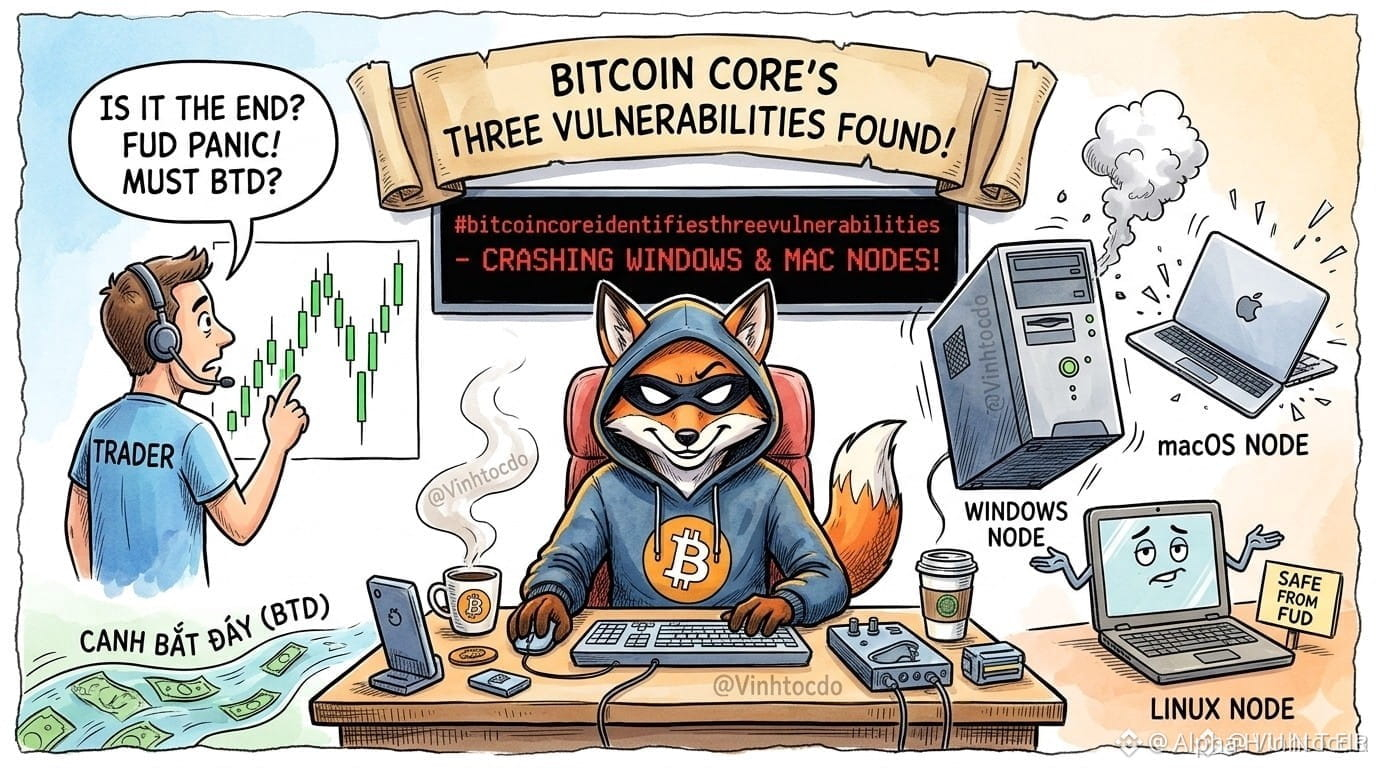
Cette fois, les gars qui font tourner un nœud Bitcoin sous Windows ou macOS sont vraiment dans de beaux draps !
Pour expliquer cette « histoire » simplement : Bitcoin Core vient de révéler 3 failles de sécurité. La plus effrayante est une faille de débordement de mémoire, qui permet à un pirate distant de faire dégager en un instant du réseau les nœuds tournant sous Windows/macOS (heureusement, les pauvres qui utilisent Linux ne sont pas concernés). Les deux autres failles peuvent progressivement vider la mémoire du nœud et corrompre les données d’annulation de la blockchain.
Que doivent faire les traders ? Pas de panique, ne vendez pas tout dans la précipitation : cette faille ne touche que les opérateurs de nœuds, tandis que la blockchain Bitcoin continue de tourner à plein régime. Mettez vos portefeuilles à jour, sécurisez soigneusement vos comptes personnels et profitez de cette petite vague de FUD pour guetter un point d’entrée au plus bas !
⚠️ Ceci ne constitue pas un conseil financier.
$IDOL
{future}(IDOLUSDT)
$INIT
{future}(INITUSDT)
$Q
{future}(QUSDT)
#bitcoincoreidentifiesthreevulnerabilities
Cette fois, les gars qui font tourner un nœud Bitcoin sous Windows ou macOS sont vraiment dans de beaux draps !
Pour expliquer cette « histoire » simplement : Bitcoin Core vient de révéler 3 failles de sécurité. La plus effrayante est une faille de débordement de mémoire, qui permet à un pirate distant de faire dégager en un instant du réseau les nœuds tournant sous Windows/macOS (heureusement, les pauvres qui utilisent Linux ne sont pas concernés). Les deux autres failles peuvent progressivement vider la mémoire du nœud et corrompre les données d’annulation de la blockchain.
Que doivent faire les traders ? Pas de panique, ne vendez pas tout dans la précipitation : cette faille ne touche que les opérateurs de nœuds, tandis que la blockchain Bitcoin continue de tourner à plein régime. Mettez vos portefeuilles à jour, sécurisez soigneusement vos comptes personnels et profitez de cette petite vague de FUD pour guetter un point d’entrée au plus bas !
⚠️ Ceci ne constitue pas un conseil financier.
$IDOL
$INIT
$Q
2
8k

·
--
Bullish
#bitcoincoreidentifiesthreevulnerabilities
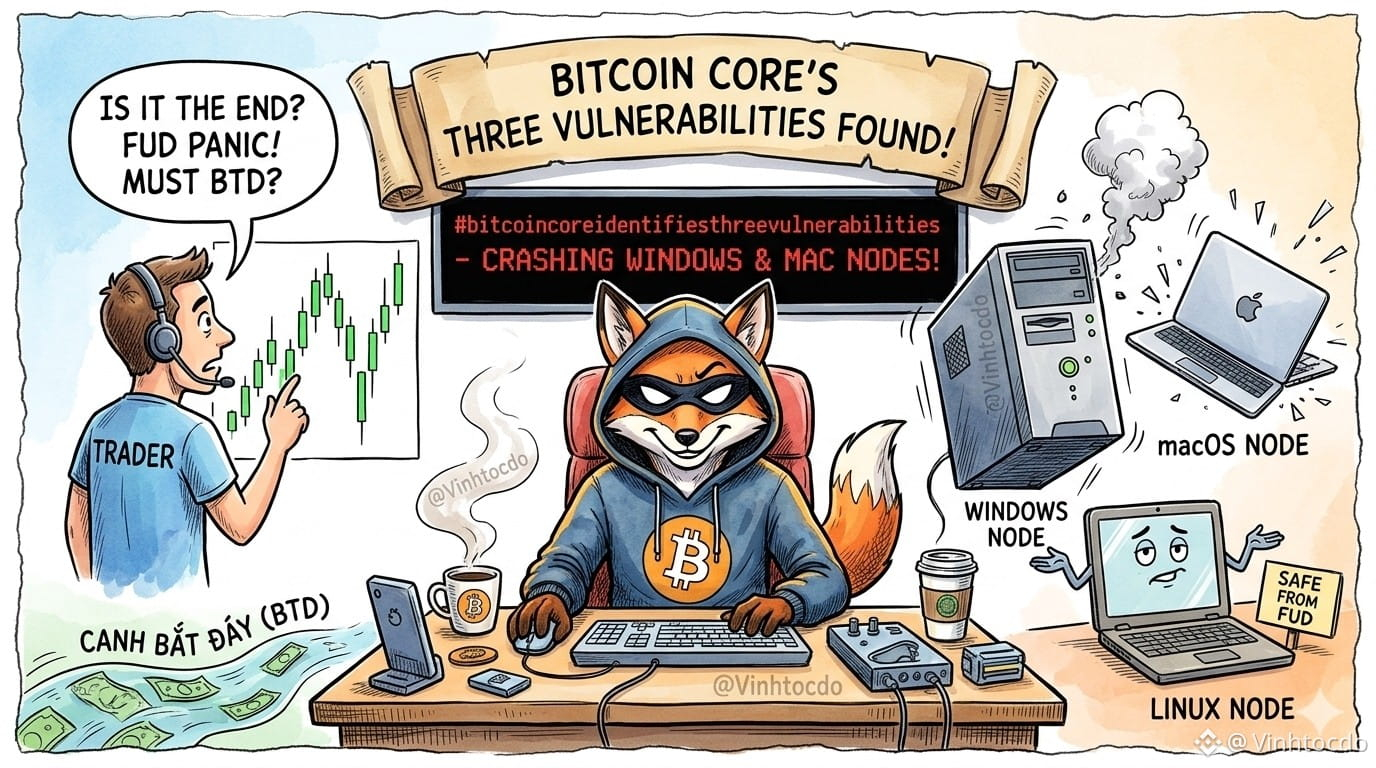
Phen này mấy ông chạy node Bitcoin bằng Windows với macOS "tét nách" thực sự rồi!
Phân tích cái "biến" này cho anh em dễ hiểu: Bitcoin Core vừa lòi ra 3 lỗ hổng bảo mật. Đáng sợ nhất là quả lỗi làm tràn bộ nhớ, cho phép hacker từ xa đá văng node mạng chạy Windows/macOS ra chuồng gà trong một nốt nhạc (may cho hội nhà nghèo xài Linux không bị sao). Hai lỗi còn lại thì từ từ "hút" sạch bộ nhớ node và làm hỏng dữ liệu hoàn tác blockchain.
Trader phải làm gì? Đừng hoảng loạn bán tháo vì lỗi này chỉ đấm vào mấy ông vận hành node chứ blockchain Bitcoin vẫn chạy phăm phăm. Việc của anh em là update ví, bảo mật tài khoản cá nhân thật kỹ và tận dụng nhịp FUD nhẹ này để canh bắt đáy thôi!
⚠️ Đây không phải lời khuyên tài chính.
Đăng ký tài khoản nhận ưu đãi tại: [https://www.binance.com/register?ref=VINHTOCDO](https://www.binance.com/register?ref=VINHTOCDO) (Mã: VINHTOCDO).
Click giao dịch bên dưới để ủng hộ tôi $BTC
{spot}(BTCUSDT)
$ETH
{spot}(ETHUSDT)
$BNB
{spot}(BNBUSDT)
#VINHTOCDO #BitcoinSecurity #CryptoFUD #BlockchainTech #CyberSecurity #tradingStrategy
#bitcoincoreidentifiesthreevulnerabilities
Phen này mấy ông chạy node Bitcoin bằng Windows với macOS "tét nách" thực sự rồi!
Phân tích cái "biến" này cho anh em dễ hiểu: Bitcoin Core vừa lòi ra 3 lỗ hổng bảo mật. Đáng sợ nhất là quả lỗi làm tràn bộ nhớ, cho phép hacker từ xa đá văng node mạng chạy Windows/macOS ra chuồng gà trong một nốt nhạc (may cho hội nhà nghèo xài Linux không bị sao). Hai lỗi còn lại thì từ từ "hút" sạch bộ nhớ node và làm hỏng dữ liệu hoàn tác blockchain.
Trader phải làm gì? Đừng hoảng loạn bán tháo vì lỗi này chỉ đấm vào mấy ông vận hành node chứ blockchain Bitcoin vẫn chạy phăm phăm. Việc của anh em là update ví, bảo mật tài khoản cá nhân thật kỹ và tận dụng nhịp FUD nhẹ này để canh bắt đáy thôi!
⚠️ Đây không phải lời khuyên tài chính.
Đăng ký tài khoản nhận ưu đãi tại: https://www.binance.com/register?ref=VINHTOCDO (Mã: VINHTOCDO).
Click giao dịch bên dưới để ủng hộ tôi $BTC
$ETH
$BNB
#VINHTOCDO #BitcoinSecurity #CryptoFUD #BlockchainTech #CyberSecurity #tradingStrategy
4
1.7k
Log in to explore more content
Join global crypto users on Binance Square
⚡️ Get latest and useful information about crypto.
💬 Trusted by the world’s largest crypto exchange.
👍 Discover real insights from verified creators.
Email / Phone number
Trending Topics
1
#FedWatch
16.3M views
39,045 Discussing
2
#EarningsSeason
6.3M views
31,774 Discussing
3
#USMidtermElections
19,489 views
467 Discussing
4
#BitcoinDropsBelow$80K
16,469 views
81 Discussing
5
#BoEOpensConsultationOnTokenizedCollateralForClearing
136 views
13 Discussing
6
#BrazilCryptoExchangesMustApplyForLicensesByFriday
13,366 views
397 Discussing
7
#ICEPartnersWithTradeXYZToBringPerpetualContractsToUS
616 views
13 Discussing
8
#SolidusLabsReportsSuspected$170MSpoofingOnHyperliquidOilContracts
1,316 views
23 Discussing
9
#StanDruckenmillerBecomesInvestorInTradeXYZ
12,162 views
363 Discussing
10
#RussiaProposedNonCustodialWalletLimitsExcludeIntlSettlements
1,673 views
38 Discussing