
逐梦同行
511 Posts

逐梦同行
Report
Block User
与 BSC 世界同行,为社区 DAO 发声,做币安广场户外直播的坚定支持者!
Open Trade

BTC Holder
Occasional Trader
5.9 Years
43 Following
8.1K+ Followers
713 Liked
Posts
Portfolio
All
Quotes
Videos
Live
·
--
Bullish
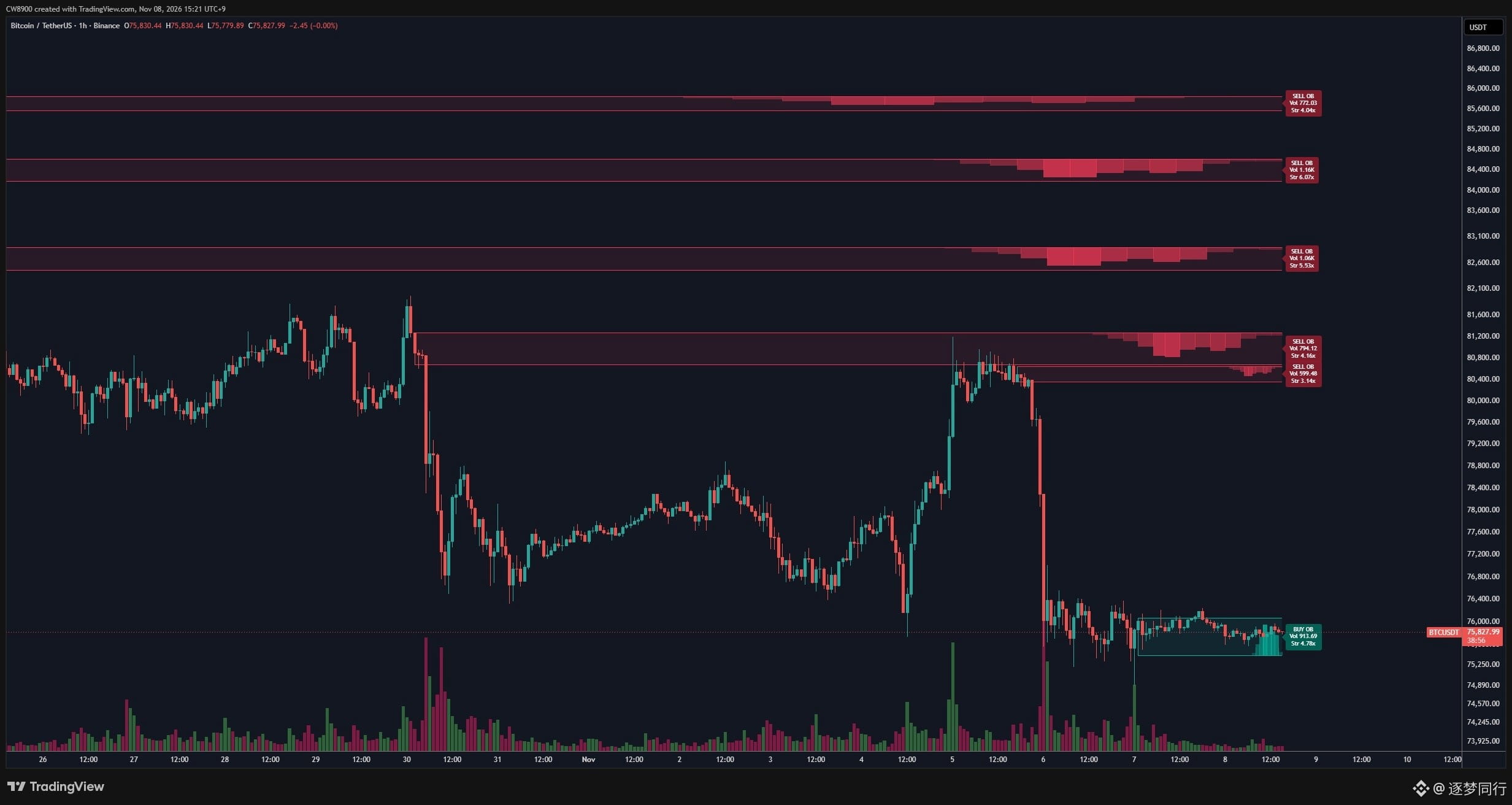
Why Did Crypto Fall in October? Three Key Reasons
Yesterday, we looked back at how bad October was for the crypto market, especially for Bitcoin (BTC). Today, drawing on the same CryptoRank report, let’s unpack the reasons behind the downturn.
The report says it wasn’t caused by a single shock, but by three pressures piling up:
1. A tighter macroeconomic environment
Inflation came in higher than expected, while Treasury yields and the U.S. dollar remained strong. On October 28, the Federal Reserve held interest rates at 3.75%–4%, and two policymakers even voted in favor of a rate hike, dampening risk appetite in the market.
2. Institutional investors pulled back
After strong inflows in August ($3.52 billion) and September ($2.65 billion), U.S. spot Bitcoin ETFs saw outflows of about $514 million in October. Ethereum ETFs lost about $1.61 billion. Combined, outflows reached $2.12 billion, signaling that institutional investors had become markedly more cautious.
3. The Gate token hack happened at the worst possible time
On October 29, a hack/security incident involving the Gate token occurred, with $6.3 billion at stake. It triggered about $1.5 billion in liquidations within 24 hours, nearly 84% of which were long positions. Bitcoin subsequently fell to a six-week low. By the end of the month, the Fear & Greed Index had dropped to 30, returning the market to “Fear” territory.
#BTC #Bitcoin
406
·
--
This Friday, $2.7 billion in BTC options settle early, making them a key intraday market variable.
Key timing gap (important)
33,441 BTC options settle between 07:30 and 08:00 UTC,
while nonfarm payrolls are released at 13:30 UTC—a 5.5-hour gap.
👉 The options settlement does not include the nonfarm payrolls volatility; the real market move begins after settlement.
Positioning structure (bullish bias)
• PCR is only 0.34, with bullish positioning overwhelmingly dominant
• Call concentration: 82,000 and 85,000
• Put support: 72,000–75,000
• Max pain: 79,000 (a brief pullback and shakeout is likely in the short term)
Hedging premium
Put option premiums covering the nonfarm payrolls release have risen sharply, indicating that the market is pricing in macroeconomic uncertainty in advance and that short-term sentiment is cautious.
Nonfarm payrolls market outlook
The market expects this nonfarm payrolls report to be significantly stronger than the previous one:
• Stronger-than-expected data → rate-hike expectations rise, putting pressure on BTC
• Weaker-than-expected data → easing expectations return, supporting a rebound
Summary
Before settlement, BTC will likely trade sideways around the 79,000 max-pain level as positions are shaken out;
after settlement, the nonfarm payrolls report will set the direction for the week.
1
580
·
--

Article
Review of the Congressional Transition Market: Democrats Take Control of Both Chambers as Bitcoin Falls Before RisingI. Key event: A shift in power in the U.S. Congress
In this U.S. election, the Democrats made a major comeback, winning seven key Senate seats in one fell swoop and taking control of the House of Representatives, completely reshaping the balance of power in Congress.
This vote was essentially a collective backlash by voters against soaring oil prices, tensions in the Middle East, and the previous administration’s policies. It also directly reshaped the regulatory outlook and political environment for the crypto industry over the next two years.
II. Bitcoin’s actual market reaction: bearish news triggers a sell-off → dip-buying funds drive a rebound
1. A sharp drop as bearish news is priced in
When the news first broke, panic selling gripped the market. BTC plunged to a seven-week low of $75,618, triggering the liquidation of nearly $300 million in long positions. The market initially priced in the bearish prospect of “crypto-friendly policies losing momentum.”
Review of the Congressional Transition Market: Democrats Take Control of Both Chambers as Bitcoin Falls Before Rising
I. Key event: A shift in power in the U.S. Congress
In this U.S. election, the Democrats made a major comeback, winning seven key Senate seats in one fell swoop and taking control of the House of Representatives, completely reshaping the balance of power in Congress.
This vote was essentially a collective backlash by voters against soaring oil prices, tensions in the Middle East, and the previous administration’s policies. It also directly reshaped the regulatory outlook and political environment for the crypto industry over the next two years.
II. Bitcoin’s actual market reaction: bearish news triggers a sell-off → dip-buying funds drive a rebound
1. A sharp drop as bearish news is priced in
When the news first broke, panic selling gripped the market. BTC plunged to a seven-week low of $75,618, triggering the liquidation of nearly $300 million in long positions. The market initially priced in the bearish prospect of “crypto-friendly policies losing momentum.”
1
3
1.5k

·
--

Article
$ETH|On-chain “redistribution” after the Binance incident: a three-way contest among validators, arbitrageurs, and attackersA Bitquery investigation on October 30 found that amid the on-chain chaos following the $6.3 billion Binance hack, the proceeds did not remain in the attackers’ hands, but were redistributed by infrastructure providers and arbitrage capital:
Key figures (according to Bitquery; pending cross-verification by multiple parties)
• Validators captured most of the nearly $30 million in payments related to the transactions;
• Attackers tried to prevent the stablecoin issuer from freezing the stolen funds, losing about $119 million on unfavorable trades;
• Trading firms and automated bots exploited price gaps, earning about $60 million after costs;
$ETH|On-chain “redistribution” after the Binance incident: a three-way contest among validators, arbitrageurs, and attackers
A Bitquery investigation on October 30 found that amid the on-chain chaos following the $6.3 billion Binance hack, the proceeds did not remain in the attackers’ hands, but were redistributed by infrastructure providers and arbitrage capital:
Key figures (according to Bitquery; pending cross-verification by multiple parties)
• Validators captured most of the nearly $30 million in payments related to the transactions;
• Attackers tried to prevent the stablecoin issuer from freezing the stolen funds, losing about $119 million on unfavorable trades;
• Trading firms and automated bots exploited price gaps, earning about $60 million after costs;
3
361
·
--
🎙️ Build Binance Square, hold BNB | It’s a new Monday—has the market stabilized? Is it time to start building a small long position? Let’s chat~

End
04 h 46 m 48 s
14.2k
50
40

·
--

Article
A $6.3B black swan hits BTC: Amid panic selling, the passive buying paradox takes center stageBinance has suffered the largest security breach in its history, with the amount involved estimated at as much as $6.3 billion, sending a major black swan shock through the crypto market. On-chain investigators ZachXBT and TRM Labs traced the incident to the North Korean hacking group TraderTraitor. After the news broke, Bitcoin plunged from above $80,000, hitting a low of $76,460. Its intraday trading range approached 5%, and it is currently fluctuating weakly between $77,000 and $78,000. The market fear index has fallen to 30, its lowest level since August.
Technical outlook: Key moving-average support enters a battle for control
After a sharp market drop, Bitcoin has reached a critical test level for its medium- to long-term trend.
A $6.3B black swan hits BTC: Amid panic selling, the passive buying paradox takes center stage
Binance has suffered the largest security breach in its history, with the amount involved estimated at as much as $6.3 billion, sending a major black swan shock through the crypto market. On-chain investigators ZachXBT and TRM Labs traced the incident to the North Korean hacking group TraderTraitor. After the news broke, Bitcoin plunged from above $80,000, hitting a low of $76,460. Its intraday trading range approached 5%, and it is currently fluctuating weakly between $77,000 and $78,000. The market fear index has fallen to 30, its lowest level since August.
Technical outlook: Key moving-average support enters a battle for control
After a sharp market drop, Bitcoin has reached a critical test level for its medium- to long-term trend.
Technical outlook: Key moving-average support enters a battle for control
After a sharp market drop, Bitcoin has reached a critical test level for its medium- to long-term trend.
5
2.5k
·
--
🎙️ Building Binance Square, Holding BNB | What happened? Is this another Black Friday? Let’s talk~

End
04 h 42 m 21 s
13.4k
25
31
·
--

Article
Latest Update on Binance Security Incident: $2.54 Billion in Funds Confirmed Frozen; Net Losses and Withdrawal Resumption Still UnclearAt 00:15 UTC on October 30, Binance issued a statement regarding a potential security incident, saying that user funds are safe and that it will cover all losses. Deposits and withdrawals have been temporarily suspended to facilitate a security investigation. Law enforcement and several stablecoin issuers have joined efforts to freeze the relevant funds. As of publication, the amount frozen has been confirmed, but net losses, the cause of the incident, whether SAFU funds will be used, and when withdrawals will resume remain unclear.
Confirmed facts
Binance confirmed that its team is handling the incident around the clock, and that its security team has investigated and frozen the relevant funds, with law enforcement involved in the freeze. The verified total amount frozen is $2.54 billion and may continue to increase. Binance said it will publish a full incident report after the investigation is complete.
Latest Update on Binance Security Incident: $2.54 Billion in Funds Confirmed Frozen; Net Losses and Withdrawal Resumption Still Unclear
At 00:15 UTC on October 30, Binance issued a statement regarding a potential security incident, saying that user funds are safe and that it will cover all losses. Deposits and withdrawals have been temporarily suspended to facilitate a security investigation. Law enforcement and several stablecoin issuers have joined efforts to freeze the relevant funds. As of publication, the amount frozen has been confirmed, but net losses, the cause of the incident, whether SAFU funds will be used, and when withdrawals will resume remain unclear.
Confirmed facts
Binance confirmed that its team is handling the incident around the clock, and that its security team has investigated and frozen the relevant funds, with law enforcement involved in the freeze. The verified total amount frozen is $2.54 billion and may continue to increase. Binance said it will publish a full incident report after the investigation is complete.
4
4k

·
--
Bullish
Datavault’s 817.6 BTC stuck at Biconomy: Not a coin-price event, but an asset-verification and counterparty-risk issue
10/26 SEC filing: $92.2 million** with Scilex, written down by $49 million as of 6/30/2026. After the disclosure, the stock fell about 50%, and management reassessed liquidity and going-concern risks.
The core issue isn’t “whether it has BTC,” but whether the company has unconditional control over it. A balance shown on an exchange but unavailable for withdrawal looks more like a receivable exposure to Scilex, whose recoverability also needs to be assessed. Restatements across four periods point to internal-control and asset-quality issues.
Going forward, focus on just three things: Biconomy’s written clarification of why withdrawals are unavailable, whether Scilex actually pays, and net assets, the audit opinion, and debt covenants after the restatement.
Conclusion: This is a governance and custody-risk event, not a BTC fundamentals event. Wait for verifiable answers; don’t jump the gun.
#BTC #DATAVAULT

1
231
·
--
🎙️ Build Binance Square, Hold BNB | Thursday: The Market Is Volatile—Do Altcoins Still Have a Chance? Come Chat~

End
04 h 51 m 50 s
9.5k
33
30
·
--

Article
Google is building a crypto security system for banks. Why now?Because 76% of losses in the first half of 2026 came from infrastructure and operational vulnerabilities—stolen private keys and seed phrases. It wasn’t a market problem; it was a custody problem. Google’s answer is to use MPC to split wallet keys across multiple independent environments: one share in Google Cloud, one on the bank’s own hardware, and one in another cloud. Transaction limits, destination-wallet whitelists, and multi-party approval can also be configured before signing. The complete private key is never stored in one place, so compromising a single machine isn’t enough to move assets. Alpha is already being used to protect its ETH and Solana assets, with a commercial launch planned for early 2027 and post-quantum cryptography potentially added in the future.
Google is building a crypto security system for banks. Why now?
Because 76% of losses in the first half of 2026 came from infrastructure and operational vulnerabilities—stolen private keys and seed phrases. It wasn’t a market problem; it was a custody problem. Google’s answer is to use MPC to split wallet keys across multiple independent environments: one share in Google Cloud, one on the bank’s own hardware, and one in another cloud. Transaction limits, destination-wallet whitelists, and multi-party approval can also be configured before signing. The complete private key is never stored in one place, so compromising a single machine isn’t enough to move assets. Alpha is already being used to protect its ETH and Solana assets, with a commercial launch planned for early 2027 and post-quantum cryptography potentially added in the future.
1
442

·
--
Bullish
Verified
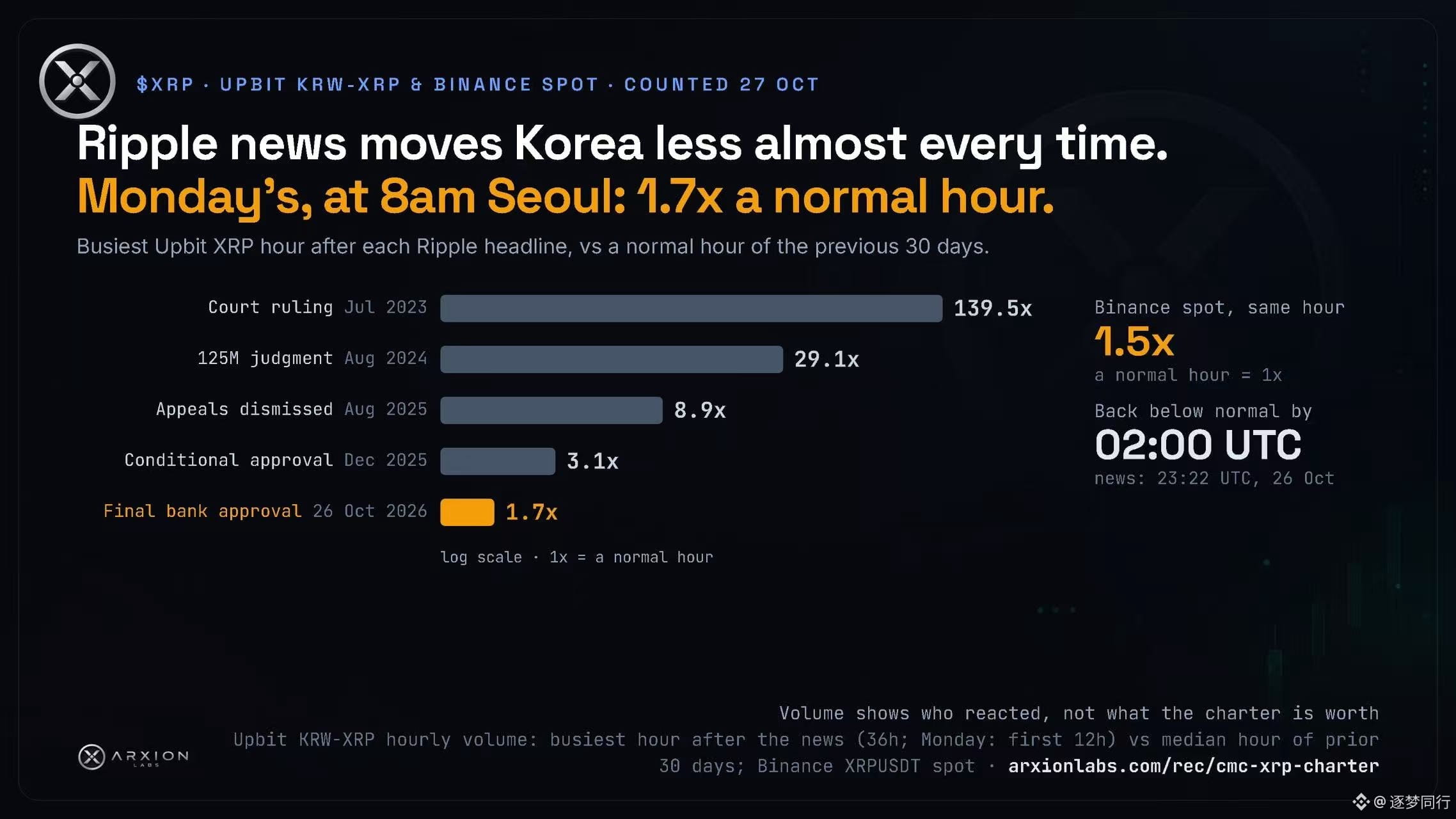
My assessment: At this stage, this is primarily a win for Ripple the company—a “mild, indirect, conditional” bullish catalyst for XRP, not an automatic demand trigger.
Why it is materially positive at the company level
· Final OCC approval of a national trust bank charter means Ripple has a legitimate path under the federal regulatory framework to provide institutional digital-asset custody and manage RLUSD reserves.
· This strengthens Ripple’s infrastructure credibility, institutional partnership capabilities, and compliance narrative, reinforcing the company’s business moat.
Why this does not automatically translate into demand for $XRP
· The approved activities do not require institutions to buy XRP; custody services and RLUSD growth can happen independently of XRP.
· More Ripple clients ≠ more XRP settlement volume. If institutions settle using stablecoins, fiat, or other chains, demand for XRP liquidity will not rise proportionally.
· Conditional approval was already granted in December 2025, so some optimistic expectations may already be priced in. XRP at around $1.32 on October 27, up 2.21% over 24 hours, is only mildly positive and does not prove the announcement drove the move.
Three hard signals to watch for to see whether this can boost XRP demand over the long term
1. Actual growth in XRP settlements: Is the use of XRP as a bridge asset increasing across ODL/payment corridors?
2. Measurable liquidity demand: Are market-making depth, institutional holdings, and RLUSD–XRP trading pairs or reserve structures creating a genuine connection?
3. XRP exposure in custody: Is institutional custody leading to verifiable growth in XRP holdings, rather than just RLUSD and fiat assets?
Conclusion
Classify it as strongly positive at the company level and weakly to moderately positive at the token level, subject to utility validation. Sentiment is positive in the short term, but don’t assume the headline will lead to a sustained 10–20% rebound; a news-driven spike may fade. I’m constructive over the long term, but only if adoption translates into actual XRP settlement, liquidity, and holding demand will it support a lasting revaluation.
#XRP #Ripple💰
2
484

·
--
Bullish
Verified
$BNB Standard ($BNC, formerly CEA Industries) rang the Nasdaq opening bell on October 26, officially bringing its BNB treasury strategy to the U.S. stock market. For funds that cannot hold the tokens directly, this offers a compliant equity route. But between “being able to buy” and “actually buying” lies a discount that the market is already pricing in.
The discount is the central fact, not a footnote
As of late October, BNC’s adjusted NAV was about $7.10 per share, while its share price ranged from $4.70 to $5.40. Its mNAV was about 0.66–0.67, implying a 33%–34% discount. In other words, the market is applying a clear discount to the idea of “holding BNB through a company.” The reasons are concrete: financing relies on issuing shares, making dilution the engine of growth; governance disputes eased with the arrival of a new CEO, but litigation over 10X Capital’s asset management agreement has not been fully resolved; and BNB accounts for more than 90% of assets, so that concentration alone represents a risk exposure.
Institutional exposure ≠ spot buying
In Q2 2026, 40 institutions reported BNC holdings in their 13F filings, with a total value of about $21.7 million. But during the same period, 12 institutions exited their positions and 10 reduced their holdings, with buyers and sellers largely offsetting one another. Buying BNC shares does not automatically translate into an equivalent amount of spot demand for BNB—it is first a judgment about the “wrapper’s valuation,” and only then a judgment about BNB.
CZ’s AI payments narrative: right direction, distant timeline
CZ has positioned BNB Chain as a payment network for AI agents. Its next-generation L1 targets 100,000+ TPS and sub-second finality, with a testnet planned for late 2026 and mainnet for early 2027. BNB Chain already hosts many ERC-8004 agents, but a genuine payment channel between agents (x402) is still on the roadmap. What is visible today is the “number of deployments,” not a “transaction-fee stream.” This is an option, not realized cash flow.
Takeaway
BNC offers regulated equity exposure, not a substitute for spot ownership. For the discount to narrow, governance must improve, dilution must slow, and BNB itself must recover from its weakness—all three are necessary. CZ’s AI narrative is a long-term variable; before the 2027 mainnet launch, it makes more sense to track agent transaction volume than agent registrations.
The bell-ringing marks a milestone in access; the discount reflects the market’s pricing. The full story is that both are true at once.
#BNB #BNC #MacroInsights #风险提示

2
741
·
--
🎙️ Building Binance Square, holding BNB | Tuesday, is it time to buy the dip? Let’s chat~

End
04 h 40 m 27 s
14.7k
32
36
Log in to explore more content
Join global crypto users on Binance Square
⚡️ Get latest and useful information about crypto.
💬 Trusted by the world’s largest crypto exchange.
👍 Discover real insights from verified creators.
Email / Phone number
Trending Topics
BinanceReopensWithdrawalsForHYPE&APT
70,914 views
890 Discussing
Binance Re-Enables Withdrawals for HYPE and APT, Extends List of Restored Assets
Binance News
·32 Likes
·23.2k views
SouthKoreaDraftLawTargets15To20%ShareholderCap
73,020 views
588 Discussing
TradFiForBeginners
172,890 views
1,781 Discussing