
奶牛叔
41 Posts

奶牛叔
 Square Verified
Report
Block User
$19 买入 SOL ,现已赚麻,你就学吧

原创之星
Open Trade

BTC Holder
Frequent Trader
5.8 Years
109 Following
9.8K+ Followers
9.1K+ Liked
1 Badges
Posts
Portfolio
·
--
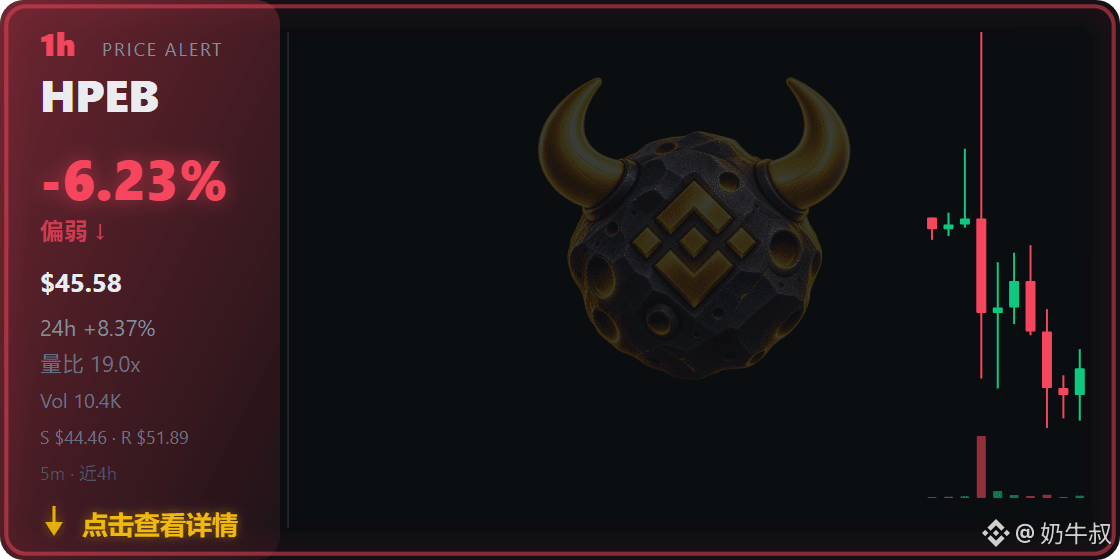
$HPEB Unusual surge in trading volume
[Event] HPEB fell 6.23% over 15 minutes and is currently at 45.5800, with volume 19.0 times the baseline
[Attribution] 15-minute volume reached 19.0 times the recent baseline, indicating a sharp surge in investor attention; the 15-minute decline was 6.23%, a significant move
[What to watch] Watch for confirmation signals from subsequent volume and price direction
[Risk] Short-term volatility is excessive; beware of a rapid reversal when chasing either highs or lows
30
·
--
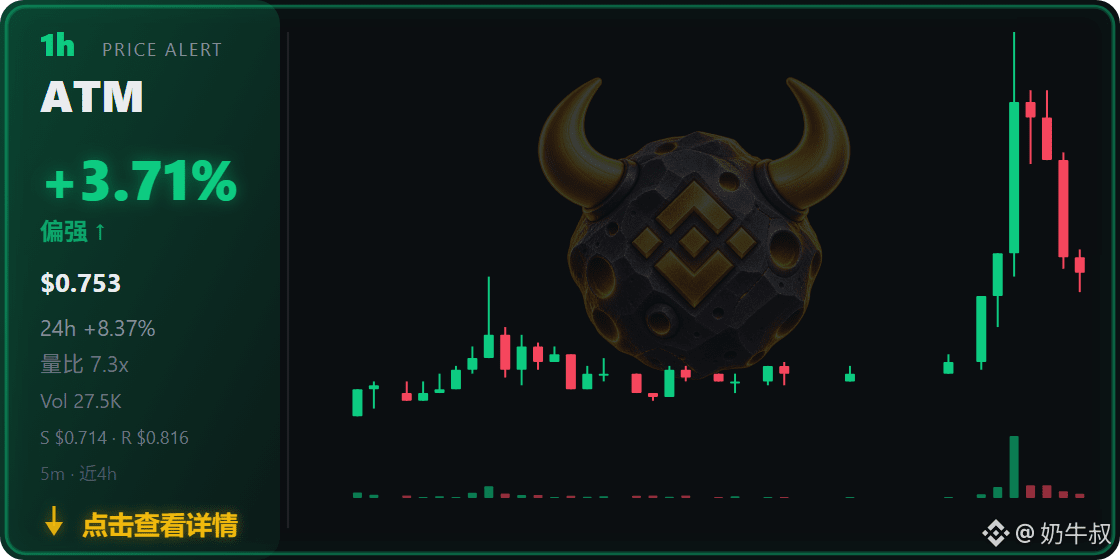
$ATM Unusual volume spike
[Event] ATM rose +3.71% over 15 minutes and is now at 0.753, with volume 7.3 times the baseline
[Attribution] 15-minute volume reached 7.3 times the recent baseline, indicating a sharp rise in investor attention; the 15-minute gain of 3.71% was significant
[What to watch] Look for confirmation signals in subsequent volume and price direction
[Risk] If volume quickly subsides, short-term momentum may weaken
55
·
--
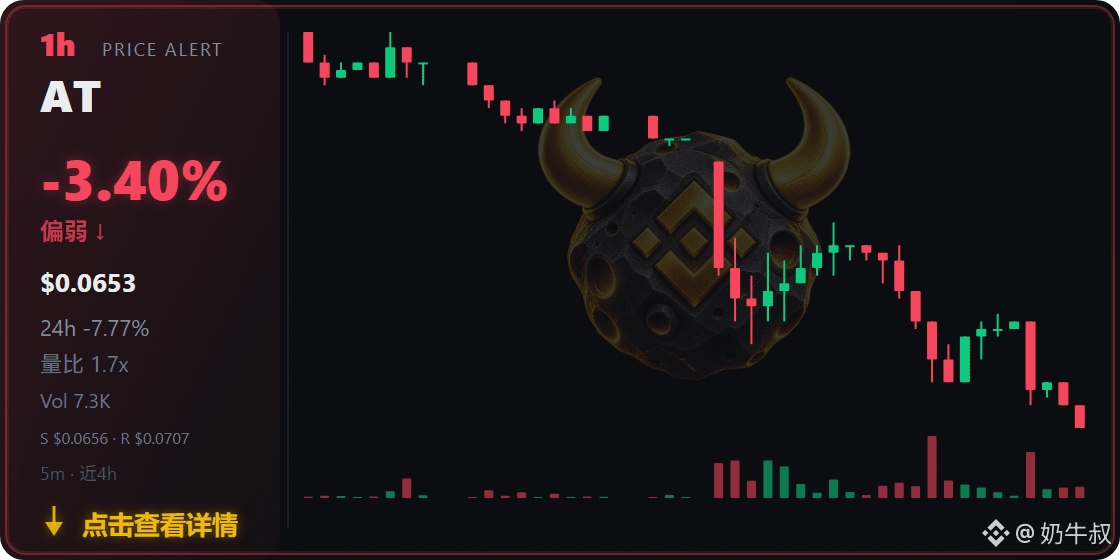
$AT breaks below the 4-hour low
【Event】AT fell 3.40% over 15 minutes, now at 0.0653, with volume at 1.7× baseline
【Attribution】The current price broke below the 4-hour low, forming a short-term breakdown structure; 15-minute volume is 1.7× baseline, a moderate increase; the 15-minute decline was 3.40%, a significant pace; open interest in contracts changed by -0.96% over 15 minutes
【What to watch】After the breakdown, watch whether the price can reclaim the 4-hour low. If it fails, the bearish structure may persist
【Risk】If volume drops quickly, short-term momentum may weaken
61
·
--
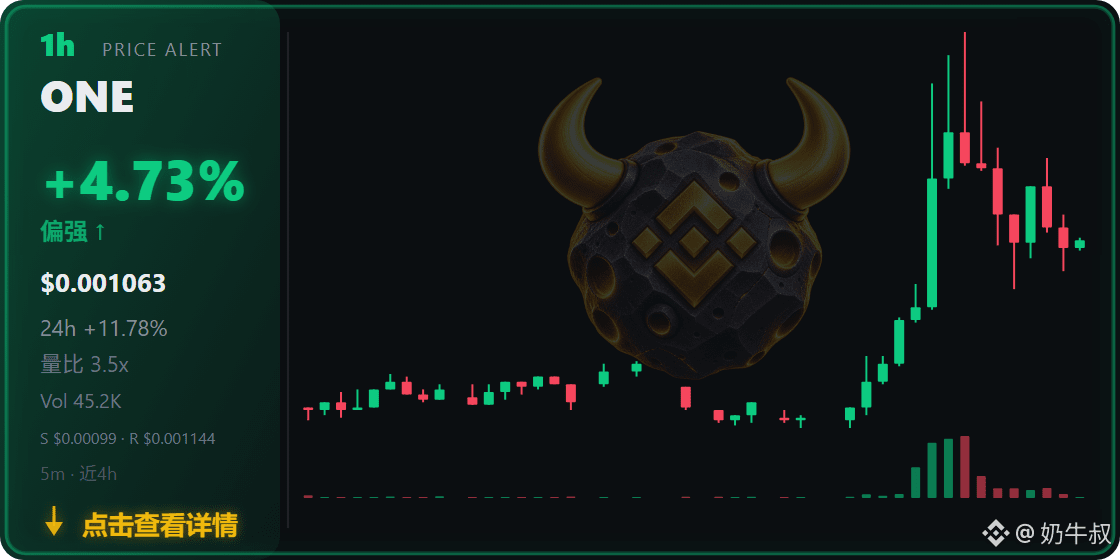
$ONE Volume has increased significantly
[Event] ONE rose 4.73% over 15 minutes and is now at 0.001063, with volume 3.5 times the baseline
[Attribution] 15-minute volume is 3.5 times the recent baseline, indicating a significant increase; ONE rose 4.73% over 15 minutes, showing strong momentum; open interest in contracts changed by -2.53% over 15 minutes, suggesting funds are exiting quickly
[What to watch] Look for confirmation signals from subsequent volume and price direction
[Risk] If volume drops rapidly, short-term momentum may weaken
178
·
--
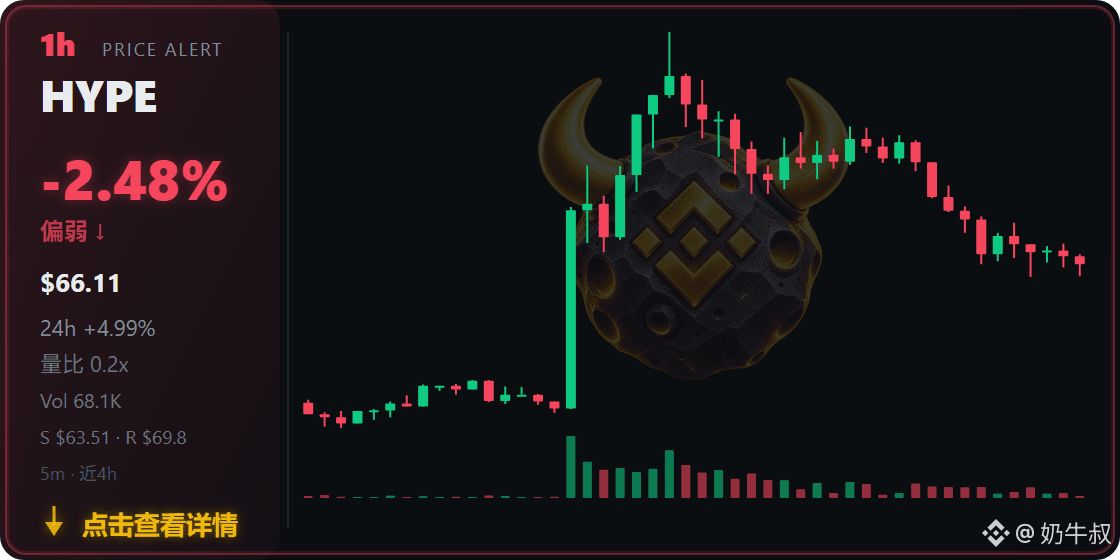
$HYPE Short-term sharp drop
【Occurrence】HYPE fell 2.48% in 15 minutes, currently at 66.1100, with volume at 0.2× baseline
【Attribution】Down 2.48% in 15 minutes, with a notably sharp pace
【What to watch】Look for confirmation signals in subsequent volume and direction
【Risk】If volume quickly declines, short-term momentum may weaken
192
·
--
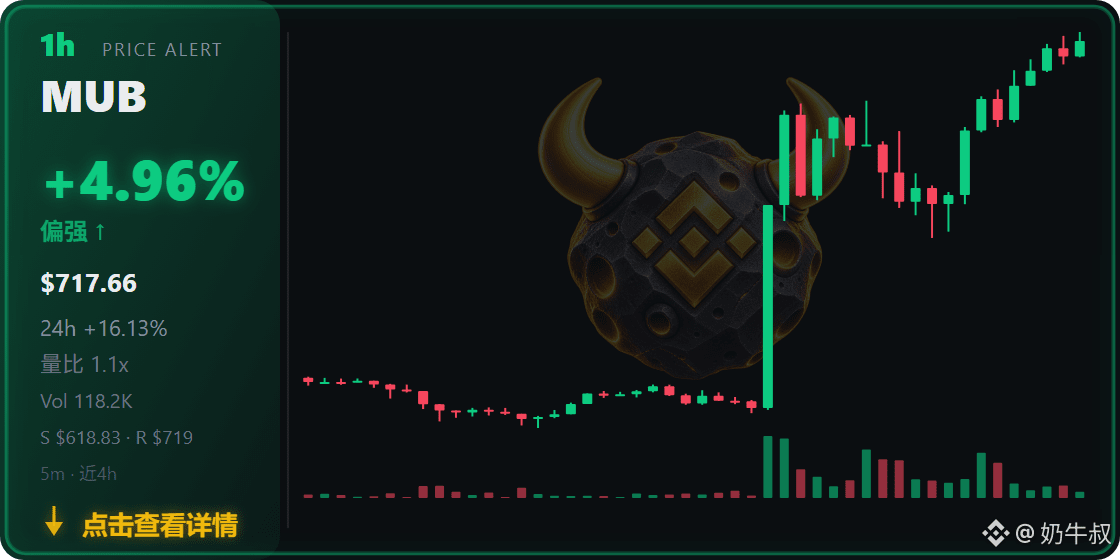
$MUB Short-Term Surge
[Move] MUB is up 4.96% over 15 minutes, currently at 717.66, with volume at 1.1x baseline
[Attribution] The 15-minute gain of 4.96% is significant in pace
[Focus] The current price is nearing the 4-hour high, just 0.19% away; watch for the direction of the breakout
[Risk] If volume quickly declines, short-term momentum may weaken
182
·
--
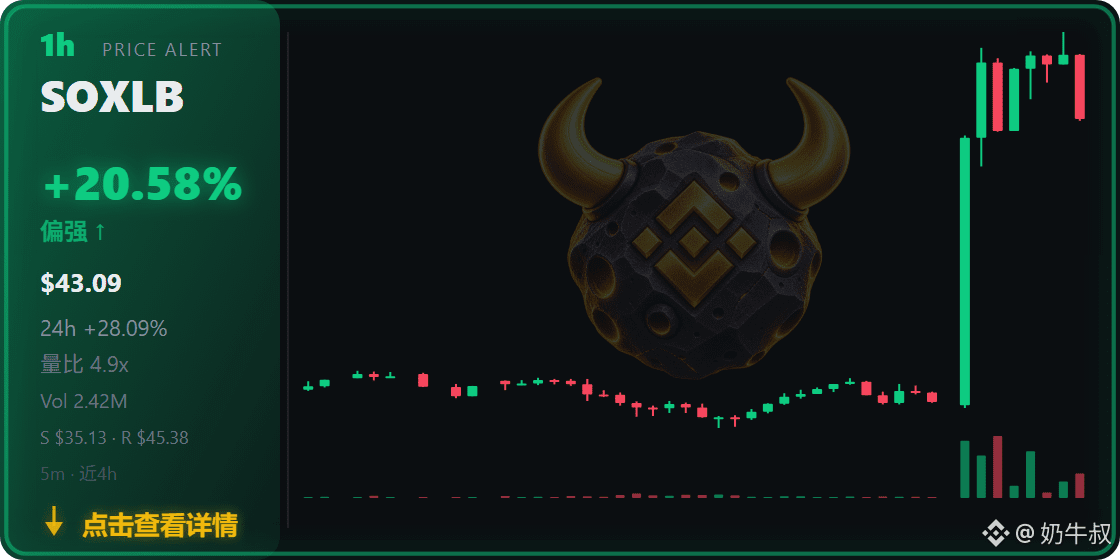
$SOXLB Volume has increased significantly
[Event] SOXLB rose +20.58% over 15 minutes and is now at 43.0900, with volume 4.9 times the baseline
[Attribution] Volume over 15 minutes was 4.9 times the recent baseline, indicating a significant increase; the 15-minute gain was 20.58%, a notably rapid move
[What to watch] Watch for confirmation signals from subsequent volume and price direction
[Risk] Short-term volatility is excessive; beware of a sharp pullback when chasing either highs or lows
278
·
--
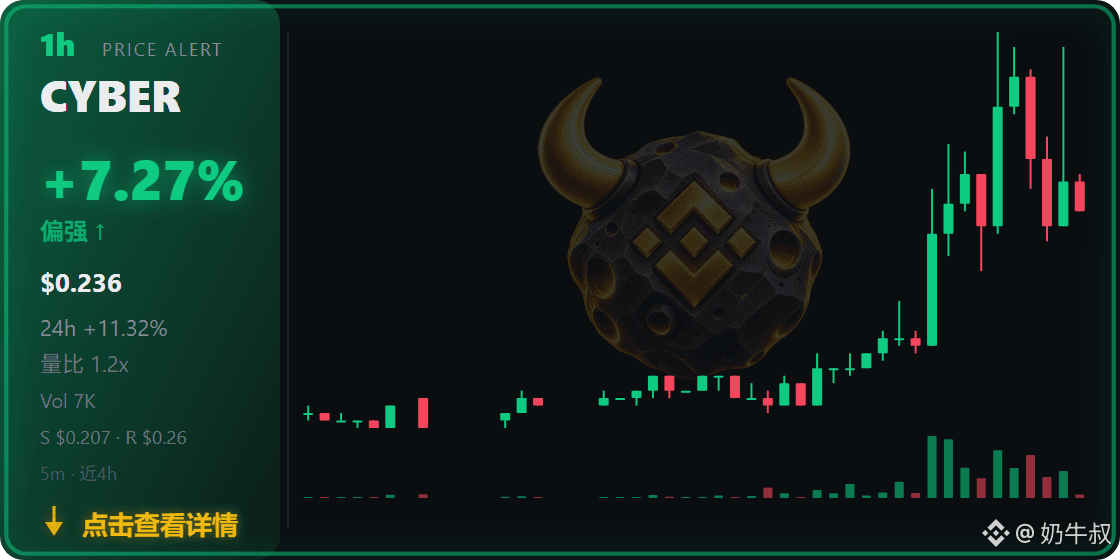
$CYBER Short-lived sharp surge
【Event】CYBER rose +7.27% in 15 minutes, currently at 0.236, with volume at 1.2 times the baseline
【Attribution】Up 7.27% in 15 minutes, a notably fast move; open interest in perpetual futures changed by -3.19% over 15 minutes, suggesting rapid capital outflows; funding rate at -0.799%, indicating crowded short positions
【What to watch】Look for confirmation signals in subsequent volume and price direction
【Risk】The funding rate is low and short positions are crowded, creating a risk of a short-term rebound; short-term volatility is excessive, so beware of a rapid pullback when chasing either highs or lows
269
·
--
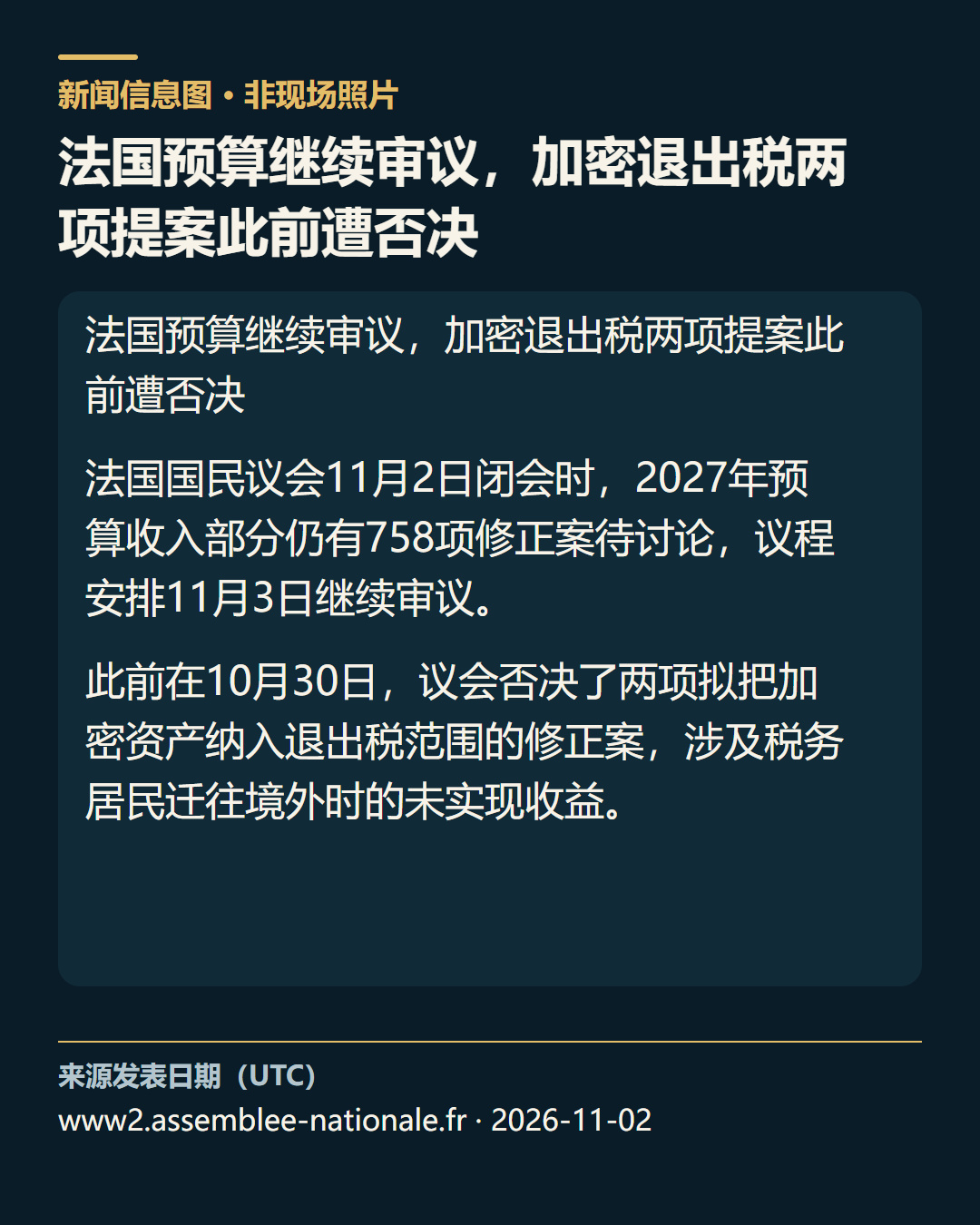
France continues budget deliberations; two crypto exit tax proposals previously rejected
When the French National Assembly adjourned on November 2, 758 amendments to the revenue section of the 2027 budget were still awaiting discussion. Deliberations are scheduled to continue on November 3.
Earlier, on October 30, Parliament rejected two amendments that would have brought crypto assets within the scope of the exit tax, which applies to unrealized gains when tax residents move abroad.
#FranceRejectsTwoCryptoExitTaxProposals
I think the key is to distinguish between individual amendments and the budget as a whole: the rejection of these two amendments does not mean that discussions on the tax treatment of crypto assets are over. What happens next will depend on how the remaining proposals are voted on and what the final version of the budget looks like.
Are you more interested in the tax rules that apply when moving abroad while holding crypto assets, or in the outcome of deliberations on other crypto-related tax proposals?
1
1
1.2k
·
--
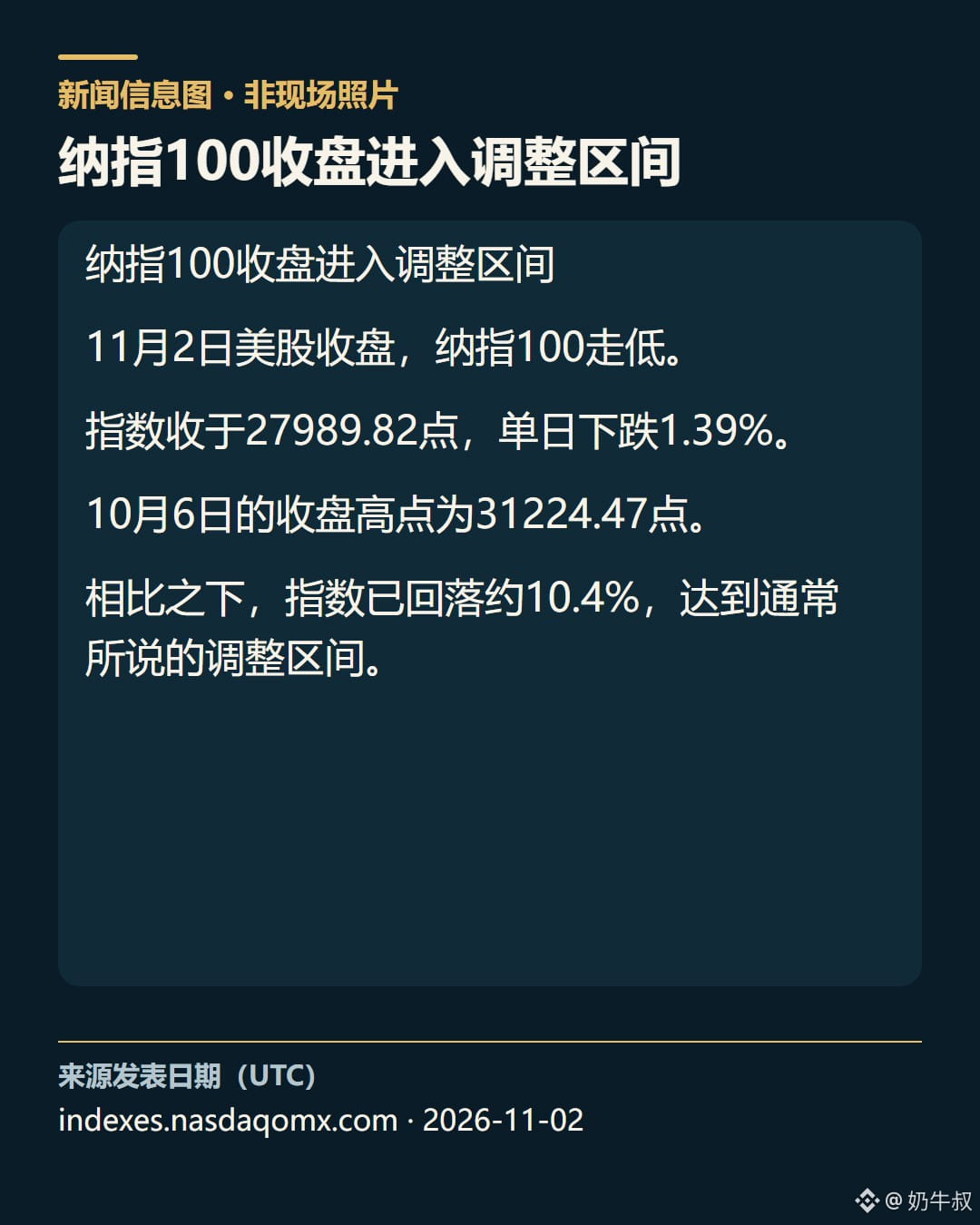
Nasdaq 100 closes in correction territory
U.S. stocks closed lower on November 2, with the Nasdaq 100 falling.
The index closed at 27,989.82, down 1.39% for the day.
Its closing high on October 6 was 31,224.47.
That puts the index down about 10.4%, entering what is commonly called correction territory.
#Nasdaq100EntersCorrectionTerritory
I’m more focused on whether the correction spreads from large-cap tech stocks to a broader range of risk assets. Weakness in the Nasdaq could affect market risk appetite, but the degree of correlation between crypto assets and U.S. stocks can change, so we shouldn’t judge the direction of the crypto market based on a single index.
Next, will you be watching more closely to see whether tech stocks can stabilize, or whether Bitcoin and the Nasdaq continue to move in sync?
748
·
--
Verified
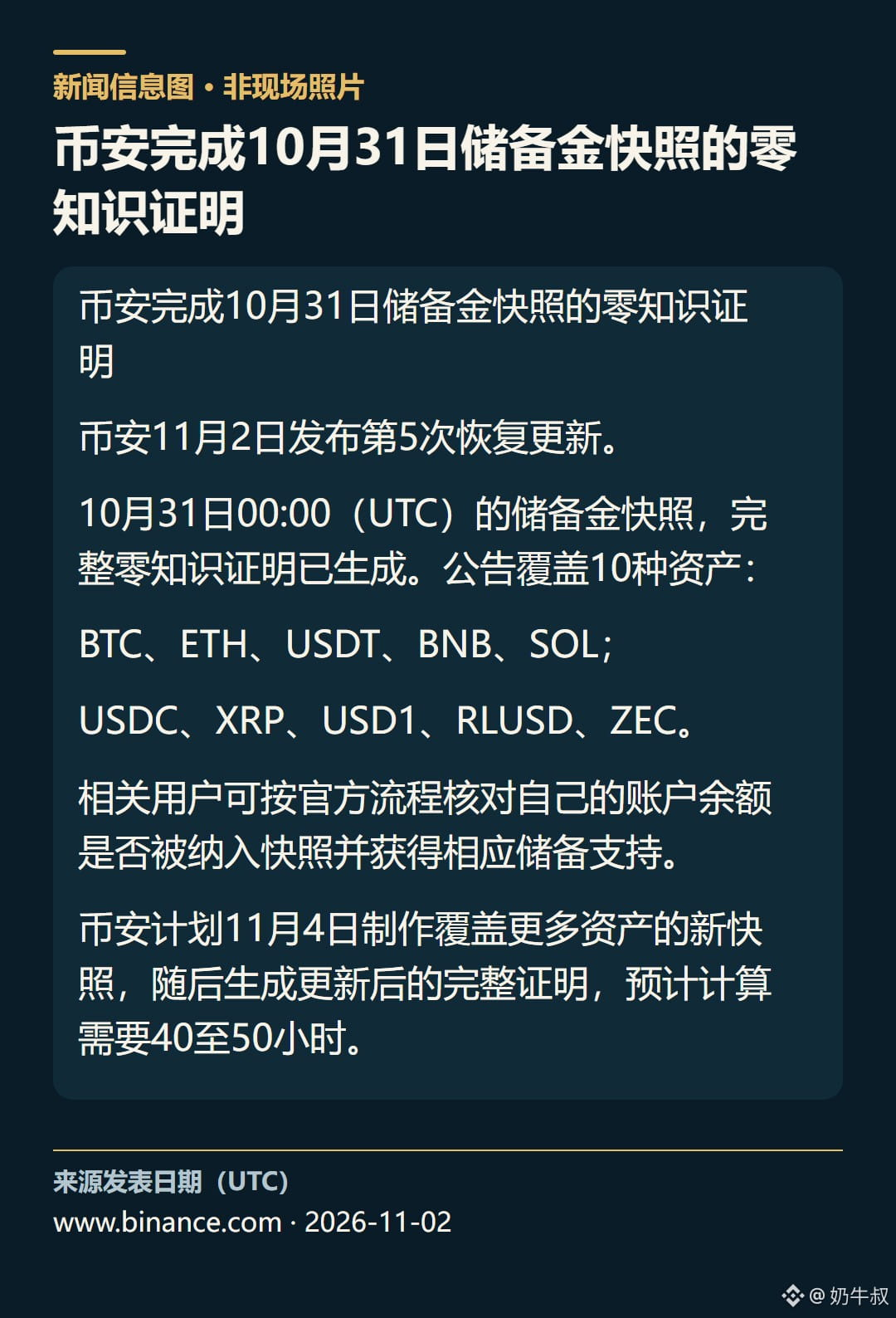
Binance completes zero-knowledge proof for October 31 proof-of-reserves snapshot
Binance发布 its fifth recovery update on November 2.
The complete zero-knowledge proof for the proof-of-reserves snapshot taken at 00:00 (UTC) on October 31 has been generated. The announcement covers 10 assets:
BTC, ETH, USDT, BNB, SOL;
USDC, XRP, USD1, RLUSD, ZEC.
Relevant users can follow the official process to check whether their account balances were included in the snapshot and are backed by the corresponding reserves.
Binance plans to take a new snapshot covering more assets on November 4, then generate an updated complete proof. The computation is expected to take 40 to 50 hours.
#Binance’s October 31 proof-of-reserves snapshot zero-knowledge proof has been generated
In my view, when verifying, the first things to check are the snapshot time, the asset scope, and what questions the proof can answer. A snapshot reflects only the point in time and scope it covers; by itself, it cannot establish the status of any later time or of other assets not covered. It’s worth continuing to track which assets the next round will add and whether individual verification is easy enough to use.
Would you prioritize checking whether your account balance was included, or first learning about the scope of zero-knowledge proof verification?
7
9.2k
·
--
Verified
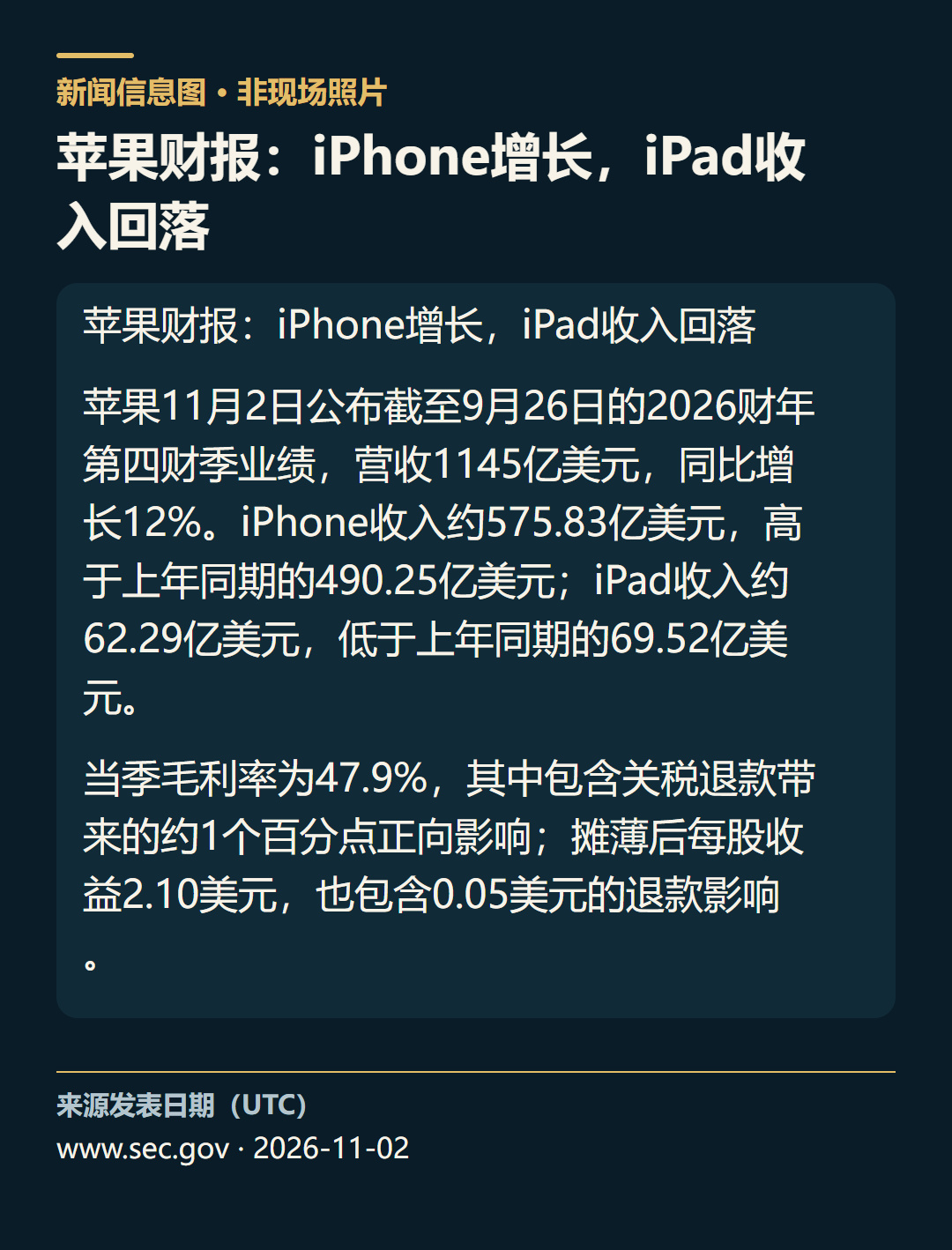
Apple earnings: iPhone grows, iPad revenue declines
Apple reported results on November 2 for the fourth quarter of fiscal 2026, ended September 26, with revenue of $114.5 billion, up 12% year over year. iPhone revenue was about $57.583 billion, up from $49.025 billion in the same period last year; iPad revenue was about $6.229 billion, down from $6.952 billion.
Gross margin for the quarter was 47.9%, including a positive impact of about 1 percentage point from tariff refunds. Diluted earnings per share were $2.10, also including a $0.05 impact from the refunds.
#AppleEarningsMixed
I think these results should be viewed separately: iPhone and iPad revenue trends are diverging, while gross margin includes the effect of refunds, so we shouldn't assume this impact will recur every quarter. Going forward, it’s worth watching changes in the hardware mix and profitability excluding the refund impact.
Are you more focused on whether iPhone revenue can sustain its growth, or on how gross margin changes as the refund impact fades?
1
802
·
--
Verified
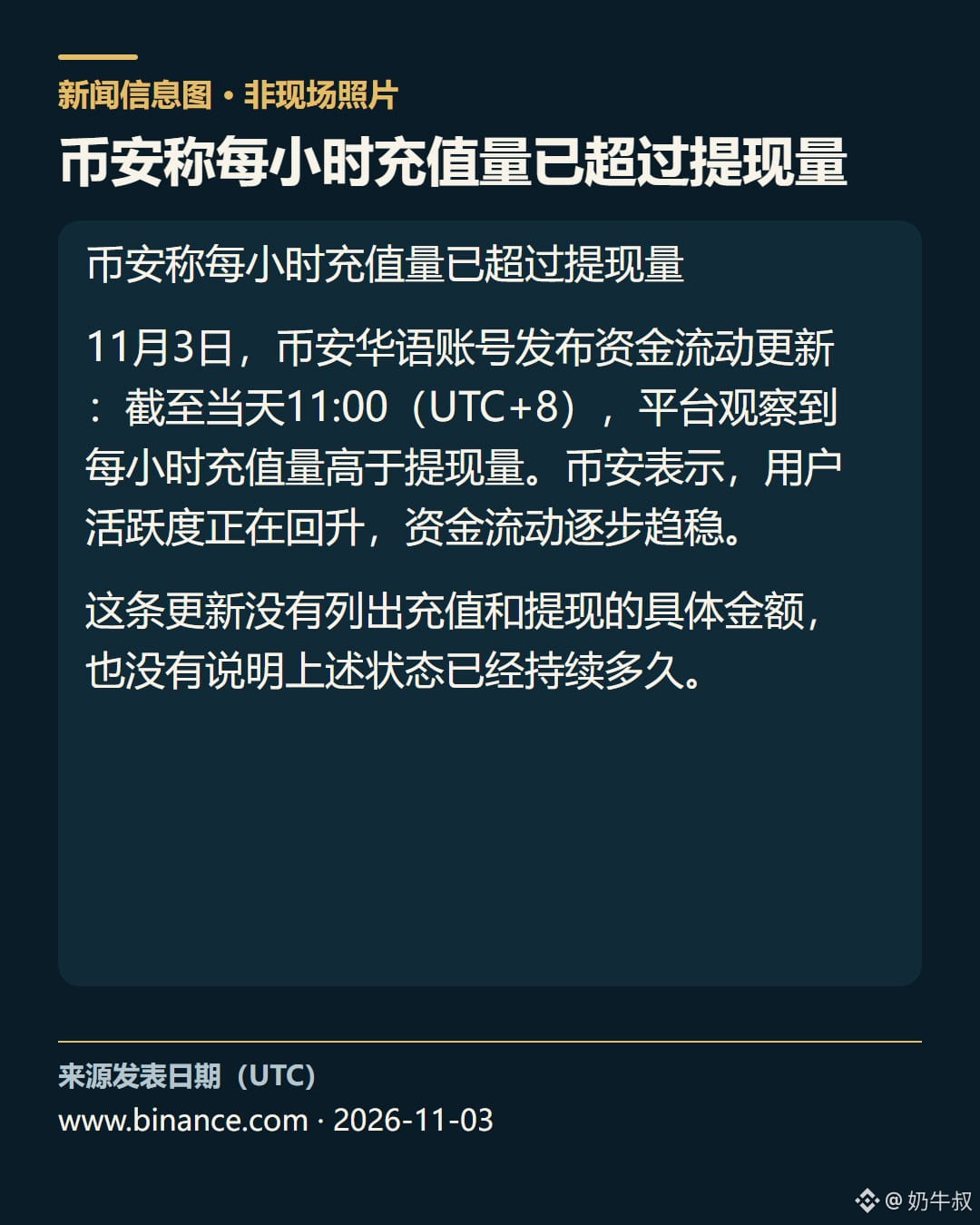
Binance says hourly deposits have exceeded withdrawals
On November 3, Binance’s Chinese-language account posted an update on fund flows: as of 11:00 that day (UTC+8), the platform had observed hourly deposit volumes exceeding withdrawal volumes. Binance said user activity was picking up and fund flows were gradually stabilizing.
The update did not specify the exact amounts deposited or withdrawn, nor did it say how long this situation had lasted.
#BinanceHourlyDepositsHaveExceededWithdrawals
I’d rather track the next few time windows: hourly deposits exceeding withdrawals only compares the two flows at that point in time; by itself, it cannot prove that the cumulative net outflow from earlier periods has been fully reversed. Publishing data on the same basis consistently would make it easier to judge whether the change can continue.
Would you prefer the platform to publish hourly net inflows continuously, or to break down deposit and withdrawal amounts by asset?
3
1.4k
·
--
Verified
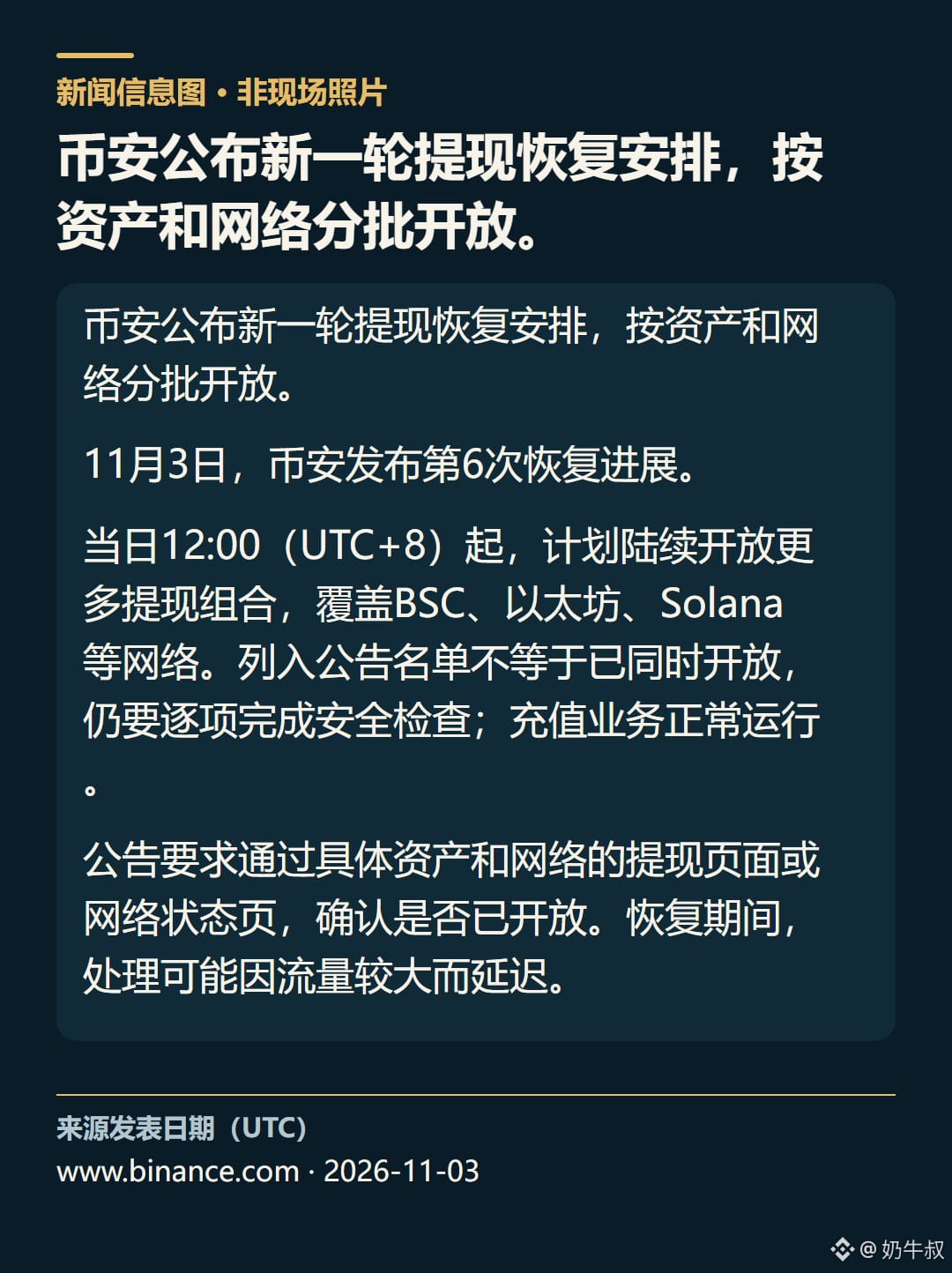
Binance has announced a new schedule for restoring withdrawals, with access reopening in phases by asset and network.
On November 3, Binance published its sixth recovery update.
Starting at 12:00 (UTC+8) that day, more asset-and-network withdrawal combinations are scheduled to become available gradually, covering networks such as BSC, Ethereum, and Solana. Being included in the announcement does not mean withdrawals are already available for all listed combinations; each must still pass security checks. Deposits are operating normally.
The announcement advises users to check the withdrawal page for the specific asset and network, or the network status page, to confirm whether withdrawals are available. Processing may be delayed during the recovery period due to high traffic.
#Binance to restore withdrawals for more assets
What matters most to me is whether the status can be verified for each combination. The availability of the same coin may differ across networks. Progress should be judged by the availability and processing stability of specific combinations, not just by how much longer the list has become.
Would you prefer progress updates broken down by network, or a list of asset recoveries that you can check in real time?
1
11
7.3k
·
--
See an airdrop link? Check these three things first
A page that looks like an official website isn’t necessarily trustworthy. Before you click “Claim,” check these three things:
1. Where did the link come from?
Cross-check the announcement with the project’s official website and accounts that you’ve already verified. Check the full domain—not just the logo, username, or verification badge. Don’t connect your wallet directly through links in DMs, group messages, or search ads.
2. What does this signature allow?
First, review the action, requester, authorized party, and amount shown in your wallet. Watch for token spending permissions, unlimited allowances, and requests that don’t match the purpose of the claim. If you don’t understand a signature, stop and look into it before deciding. Don’t rush to confirm just because a countdown is running.
3. Is anyone asking for your recovery phrase?
If anyone or any page asks you for your recovery phrase or private key to claim, verify, unlock, or get customer support, stop immediately. Don’t send screenshots or enter your details into a form they provide.
Checking these details can help you spot risks, but passing these checks doesn’t guarantee that something is safe.
#BlockchainSecurity
#ScamPrevention
Missing out on one claim is better than giving a wallet’s permissions to an unfamiliar page. Do you check each permission before signing?
1
371
·
--
The UK FCA published consultation paper CP26/36 on October 21, discussing the regulatory perimeter for crypto trading apps and inviting comments until November 18. One key focus of the discussion is which services can be considered purely technical interfaces.
The draft says that even when a program operates according to an algorithm, it may still make decisions on behalf of users that materially affect their trades. For example, selecting a trading venue, deciding when to execute an order, or routing orders based on price or liquidity should all be assessed in light of the product’s actual functionality; no conclusion should be drawn based on any single factor alone. The new cryptoasset regime is scheduled to take effect on October 25, 2027.
#英国算法加密交易应用或需FCA授权
Automated trading tools should at least make two things clear: which parameters are set by the user, and which decisions are made by the algorithm itself. If a bot makes an error when executing a trade, how do you think the user and the platform should share responsibility?

3
591
·
--
On October 22, two new share records for Franklin Templeton’s sgBENJI appeared on the XRP Ledger: approximately 72.18 million shares each, or about 144 million in total. Using the 1.0390 conversion rate shown in the transaction memo, they are worth approximately $150 million.
sgBENJI represents shares in a short-term U.S. dollar money market fund. The fund uses a registration system combining traditional bookkeeping with blockchain technology and supports Stellar and the XRP Ledger. In September 2025, DBS, Franklin Templeton, and Ripple announced a partnership to let eligible clients trade sgBENJI using RLUSD.
These two records have materially increased the number of fund shares on the XRPL. But on-chain issuance alone is not enough to calculate the net inflow of new external capital, much less to treat it as an equivalent $XRP in buying pressure. The next things to watch are how these shares enter actual trading and use, and how the fund’s officially disclosed assets under management change. For RWA projects like this, issuance is only the first step; actual use is what comes next.
Image: DBS (file photo)
#FranklinTempletonXRPLAdds$150MillionInShares
417
·
--
Even when “adding a little extra to the fee,” it’s worth taking another look at the recipient address.
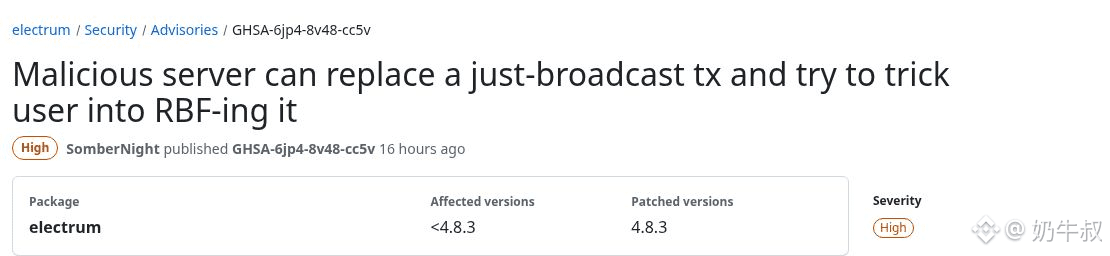
Electrum disclosed a high-severity vulnerability on October 24 that affects versions earlier than 4.8.3. The fix is version 4.8.3. The risk involves malicious servers and users’ subsequent fee-bumping signatures, and the developers have received reports of users losing funds.
I’m more concerned with how the wallet’s confirmation screen is designed. When users think they’re only adjusting the fee, the interface should make the recipient address and amount—and whether either has changed—especially prominent.
When handling transaction $BTC , what matters most to me is “where the money ultimately goes.” Electrum users can upgrade through official channels and verify the download signature.
Which item should the fee-bump confirmation screen highlight first: the recipient address, the amount being sent, or the fee?
#Electrum修复4.8.3前版本高危漏洞
2
1.3k
·
--
#瑞典央行敦促重新评估电子克朗
What I care more about in this discussion is the competition over “which currency to use for payments.”
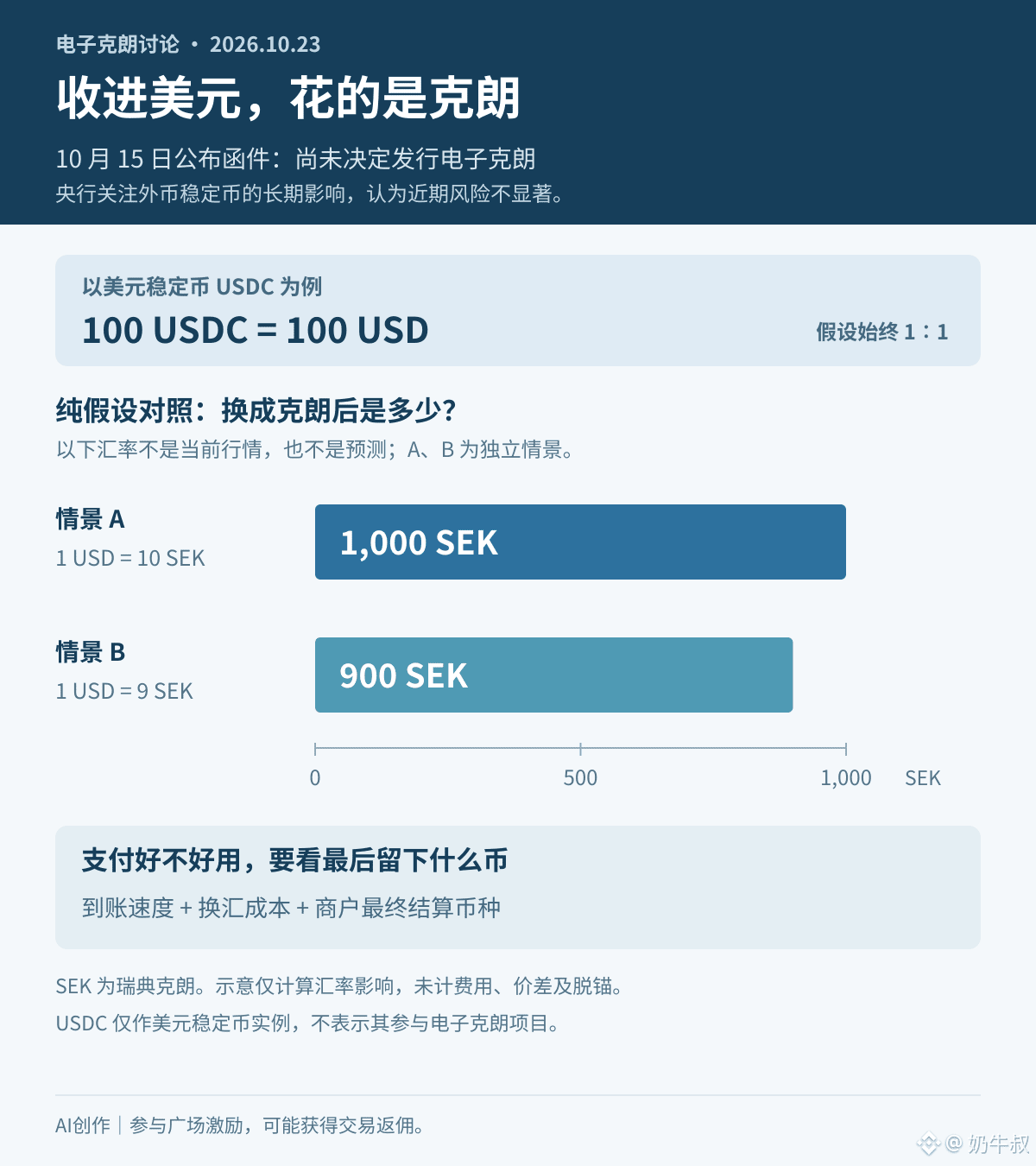
In a letter published on October 15, Sweden’s central bank had still not decided whether to issue an e-krona. It warned that if foreign-currency stablecoins are easier to use, the krona’s role in payments could come under pressure, while judging that the near-term risks are not significant.
Take the dollar stablecoin $USDC as an example: even if it stays pegged at one dollar, how many kronor Swedish merchants ultimately get back still depends on the USD/SEK exchange rate.
When I assess the competitiveness of stablecoin payments, I look at settlement speed, conversion costs, and which currency merchants ultimately keep. An e-krona would also need to address these practical issues if it is to attract users.
When you receive a cross-border payment, what matters more to you: getting it quickly, or how much you receive after converting it into your local currency?
1.3k
·
--
Verified
#股票财报季
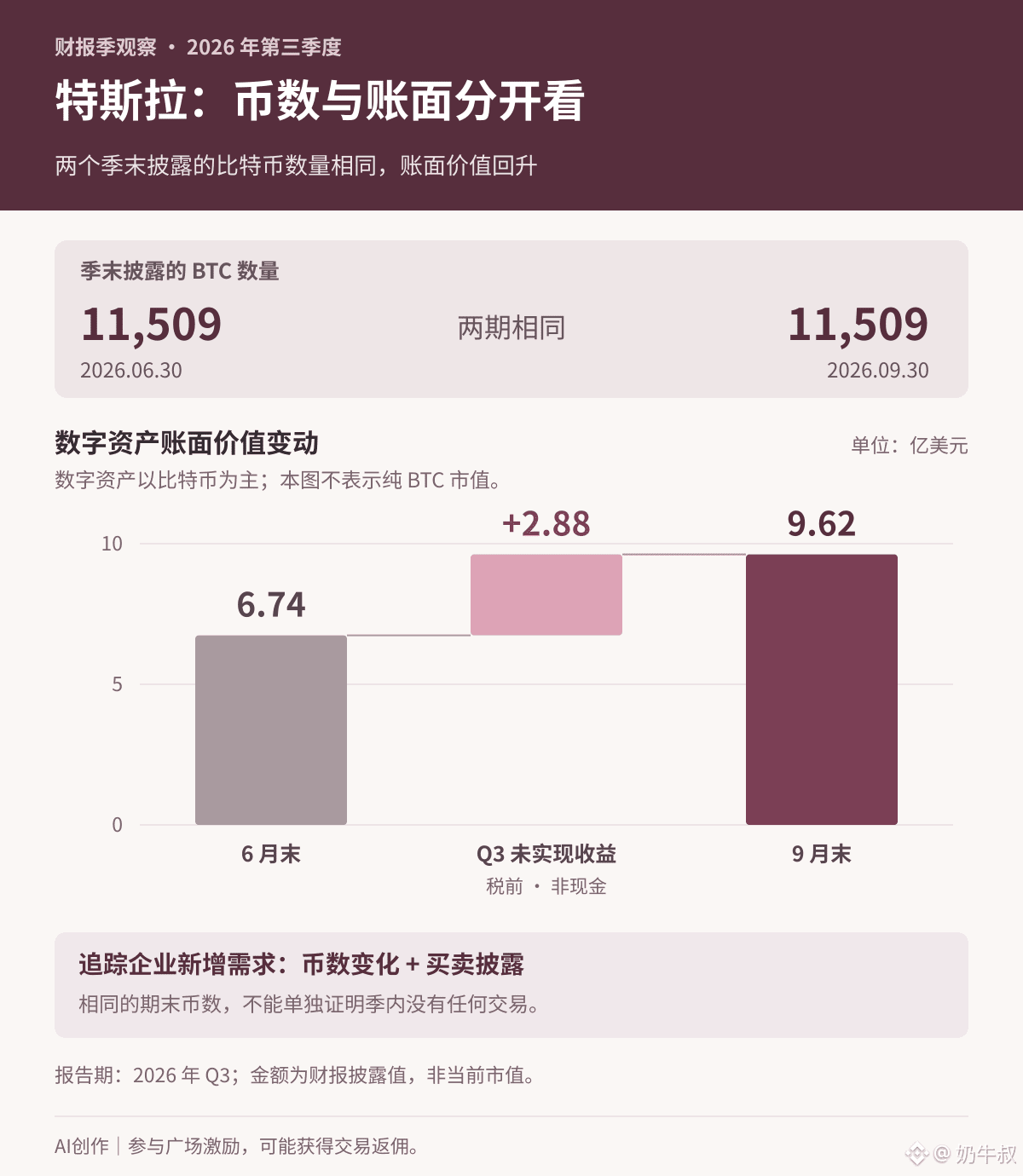
In Tesla’s earnings report, I’m more interested in those 11,509 $BTC.
The amount of Bitcoin disclosed at the end of June and September 2026 was the same; the carrying value of digital assets rose from $674 million to $962 million, and Q3 included a $288 million pre-tax unrealized gain. Bitcoin makes up the bulk of the digital assets.
The rebound in carrying value is impressive. When assessing new corporate demand for Bitcoin, I put more weight on the amount held and disclosures of purchases and sales, since dollar balances can also be amplified by market movements. The same number of coins at the two reporting dates doesn’t, by itself, prove there was no trading during the quarter.
When you read corporate earnings reports, do you focus more on holdings or on gains and losses on the books?
#股票财报季
In Tesla’s earnings report, I’m more interested in those 11,509 $BTC .
The amount of Bitcoin disclosed at the end of June and September 2026 was the same; the carrying value of digital assets rose from $674 million to $962 million, and Q3 included a $288 million pre-tax unrealized gain. Bitcoin makes up the bulk of the digital assets.
The rebound in carrying value is impressive. When assessing new corporate demand for Bitcoin, I put more weight on the amount held and disclosures of purchases and sales, since dollar balances can also be amplified by market movements. The same number of coins at the two reporting dates doesn’t, by itself, prove there was no trading during the quarter.
When you read corporate earnings reports, do you focus more on holdings or on gains and losses on the books?
2
1
8.4k
Log in to explore more content
Join global crypto users on Binance Square
⚡️ Get latest and useful information about crypto.
💬 Trusted by the world’s largest crypto exchange.
👍 Discover real insights from verified creators.
Email / Phone number
Trending Topics
NVIDIAReinstatesJensenHuangasCEO
85,087 views
858 Discussing
TradFi News | Nvidia Board Unanimously Reinstates Jensen Huang as CEO; Shares Jump 30% Premarket
Binance News
·39 Likes
·39.3k views
WillMarketsStageAThanksgivingReliefRally?
190,800 views
1,861 Discussing
WillOctCorePCEShiftFedHikeExpectations?
69,317 views
788 Discussing