
Junzai
20 Posts

Junzai
Report
Block User
BP-6E3050ABD094
29 Following
54 Followers
16 Liked
Posts
·
--
One win, one miss on today’s free mints: I got HONGBAO, but missed BN Big Bang.
HONGBAO was free—0 BNB, just gas. I got one batch of 10,000 tokens, and they’ve already arrived.
BN Big Bang opened at 5 p.m., but I didn’t get the link until 5:21.
When I checked, the 2,000 free spots were long gone.
There were also over 700 paid spots later on, but I didn’t go for those. We can’t break the rules on free mints.
The lesson is simple: if a free mint has a scheduled launch, get the link ahead of time.
If you only act when someone sends you a screenshot, chances are you’ll be left watching from the sidelines.
HONGBAO is still locked up; liquidity won’t open until the window ends.
I haven’t minted the batch on my alt account yet either. I’ll do that once the session is back up.
Did you ever set an alarm and camp out for a free mint?
#AirdropHuntingReport
12
·
--
Failed transactions still cost gas.
The platform isn’t penalizing you—the miners have already done the work.
Gas doesn’t buy a “successful transaction”; it pays for computing power.
Once you confirm, the node starts executing the transaction. You pay for however much work it does.
If it reverts halfway through, the work already done isn’t refunded.
So you’re charged for the gas actually used, even if the transaction doesn’t go through.
There’s only one case where you don’t pay:
The transaction never makes it on-chain and isn’t included in a block, so no one has done any work for you.
Before you confirm next time, ask yourself:
If this transaction fails, am I willing to pay for the computing power it used?
If not, preview it first or try a small amount. Don’t go all in.
Have you ever wasted gas on a reverted transaction?
#OnChainTips
11
·
--
AI doing the work for you—where do you draw the line?
Right now, I only trust it to watch the market.
If it’s going to make trades, it has to get past me first.
Which of these three would you choose?
1 Watch only: Track prices and flag unusual activity, but never make trades
2 Simulate first, then ask for approval: Run the strategy in simulation; even if it’s profitable, it can’t go live until I approve
3 Automatically execute small trades: Set limits and stop-losses, then let it handle small trades on its own
My line is at 2.
I want to see it perform well in simulation before risking real money. I wouldn’t sleep easy if I handed over control completely.
Which camp are you in? Comment 1/2/3, and add a sentence about where you draw the line.
#AIagent
26
·
--
The early-morning sentinel sent the first update:
The Museai series I’m holding made its first sale on Element.
Three BNB trades, all priced between 0.00008 and 0.0001 BNB.
That floor price of around 0.00045 BNB on the official marketplace now looks like window dressing.
The actual sale price is only about a quarter of that.
The sentinel scanned again this morning, but there haven’t been any more sales yet.
I haven’t listed mine. At this price, I’d be practically giving it away.
Whether I can afford to wait depends on whether someone steps in for a second wave.
Do you have any collections that have launched but still haven’t found buyers?
#AirdropFarmingReport
$BNB
199
·
--
Binance resumed withdrawals yesterday, with about $3.6 billion in net outflows over nine and a half hours.
Sounds scary, but divided by its $171 billion in total assets, that’s actually 2.1%.
The official line: withdrawals have stabilized after the peak, while deposits remain high.
The first phase, covering 15 networks and assets, was fully restored by last night.
Of the $6.3 billion stolen, the company says it has replenished about 95%. The rest is in small, illiquid coins, so it’ll take time to raise the funds.
The real test isn’t how much left on day one.
It’s when all the remaining networks will be restored, and whether the new proof of reserves announced today will be published on time.
A 2% outflow is a stress test. Trust only returns when the money comes back.
Did you withdraw yesterday, or leave it where it was?
#BinanceWithdrawals
49
·
--
I tried to grab a free mint this morning. I clicked manually 5 times, and all 5 failed.
4 times the network disconnected outright, and once the preview reverted—the spot had already been snatched by someone else.
Then I changed tactics and stopped clicking blindly:
Check the status first; if it’s not live, wait. Once it’s live, preview first, and don’t submit if the preview doesn’t look clean.
The second attempt in the automated loop went through. 0 BNB, only paid gas, and got #2246.
There were 4,321 in total, and by the time I got one, they were almost at #2240. Free mints are seriously competitive.
Free minting isn’t about clicking fast—it’s about not wasting gas on a revert before it’s live.
When you go for a free mint, do you click manually or leave it running and wait?
#FreeMint
58
·
--
Start your day by taking care of these three things—don’t wait until the deadline to scramble:
If you haven’t filled out the PREDICT form yet, take note: the deadline is November 26 at 09:00 UTC.
If you don’t fill it out, you’ll automatically go with Plan B: lock your tokens for a year to receive the full amount.
Want the 35% spot allocation? Get in on the next batch. For the November 6 batch, submit by November 5 at 09:00 UTC.
For Alpha, check your score before claiming each day. It’s first come, first served, and each claim costs 15 points.
After claiming, remember to confirm on the campaign page. Any unconfirmed claims from previous rounds are void.
If tokens suddenly show up in your wallet, don’t rush to interact with them.
Check the official source before taking action. If anyone asks you to pay an activation fee or provide your seed phrase, close it immediately.
Which of these three things will you take care of first today?
#AirdropReminder
3
905
·
--
A reminder before bed:
Write your recovery phrase on paper only. Don’t take a screenshot, send it to yourself, or save it to cloud storage.
Screenshots end up in cloud photo libraries, chat histories sync, and cloud drives back things up.
Losing your phone isn’t scary; what’s scary is your recovery phrase getting “backed up” along with it.
Paper and pen may seem old-fashioned, but they’re not connected to the internet.
Where is yours right now—on paper or on your phone?
#WalletSecurity
1
3
·
--
I had to read the figure of $6.3 billion twice before I believed it.
Binance said it itself: this security incident affected around $6.3 billion, with about $3 billion already frozen on-chain. The platform will cover all the losses.
But what caught my attention wasn’t the numbers—it was the official explanation of how it happened: an operations engineer’s computer was compromised, giving the attacker access to a service container. It wasn’t a leak of wallet private keys.
That distinction actually matters quite a bit to ordinary users.
Just because the private keys weren’t lost doesn’t mean everything’s fine; and even if the platform can freeze funds and cover the losses, withdrawals still have to be paused while security checks are carried out.
So for the past couple of days, I’ve done just one thing: trusted only official announcements.
Fake customer support, fake compensation links, fake withdrawal channels—they’ll definitely spread faster than the real announcement. When something goes wrong, scammers are always more diligent than customer support.
Have you received any fake “compensation” messages over the past couple of days?
#BinanceSecurityIncident
1
3.2k
·
--
Prices moved sideways all day without budging, but I managed to tick off my to-dos one by one: I tested payments on all six chains on the demo site, and properly pocketed the coins I got for free.
Put simply, today’s wins weren’t in the market—they were in those two little accomplishments: “tested and working” and “got it done.”
I have just one small goal for tomorrow: don’t itch to keep checking prices while the market moves sideways. I’ll wait for a reminder that volume is picking up and a direction is emerging before making a move.
Did you spend all day checking prices, or did you also finally get one lingering task done today?
7
·
--
Tonight, the demo site’s payment options finally expanded from one chain to six.
BSC, Ethereum, Base, Solana, TRON, and Bitcoin—all 15 payment options tested individually and working.
We cut the Alipay option entirely and kept crypto only.
The most frustrating part wasn’t integrating the chains, but migrating: it looked successful, but the old table hadn’t actually taken effect.
Only after switching to row-by-row execution and checking each item against the column definitions was it truly done.
All 402 tests in the local test suite passed, too.
I only talk about things I’ve tested myself. Until they pass the tests, all the hype is just empty talk.
Do you usually pay with crypto, or do you only use fiat payment channels?
#链上实测 $BNB $SOL $BTC
566
·
--
I got 50 million tokens for free, and sold them just over ten minutes after launch. All I got back was about 0.0037 $BNB, or roughly $2.60—but I don’t regret it one bit.
I sniped these tokens for free last night. They pumped within five minutes of launch, and my position was worth about $6 at its peak. Not long after launch, the price fell by more than half from its high. There were clearly more sellers than buyers, so I followed the rule I’d set for myself and sold everything: when it’s free, don’t get greedy trying to squeeze out the last bit.
Looking back, there are three takeaways:
1. If there are more sellers than buyers during the first-hour launch pump, don’t expect a V-shaped recovery.
2. The right mindset for a free position is to take profits—not dream of doubling your money.
3. Even a little money counts. $2.60 is enough to cover several gas fees.
What about you? When you get a launch token for free, do you sell right away, or wait for another pump before getting out?
I got 50 million tokens for free, and sold them just over ten minutes after launch. All I got back was about 0.0037 $BNB , or roughly $2.60—but I don’t regret it one bit.
I sniped these tokens for free last night. They pumped within five minutes of launch, and my position was worth about $6 at its peak. Not long after launch, the price fell by more than half from its high. There were clearly more sellers than buyers, so I followed the rule I’d set for myself and sold everything: when it’s free, don’t get greedy trying to squeeze out the last bit.
Looking back, there are three takeaways:
1. If there are more sellers than buyers during the first-hour launch pump, don’t expect a V-shaped recovery.
2. The right mindset for a free position is to take profits—not dream of doubling your money.
3. Even a little money counts. $2.60 is enough to cover several gas fees.
What about you? When you get a launch token for free, do you sell right away, or wait for another pump before getting out?

166
·
--
Article
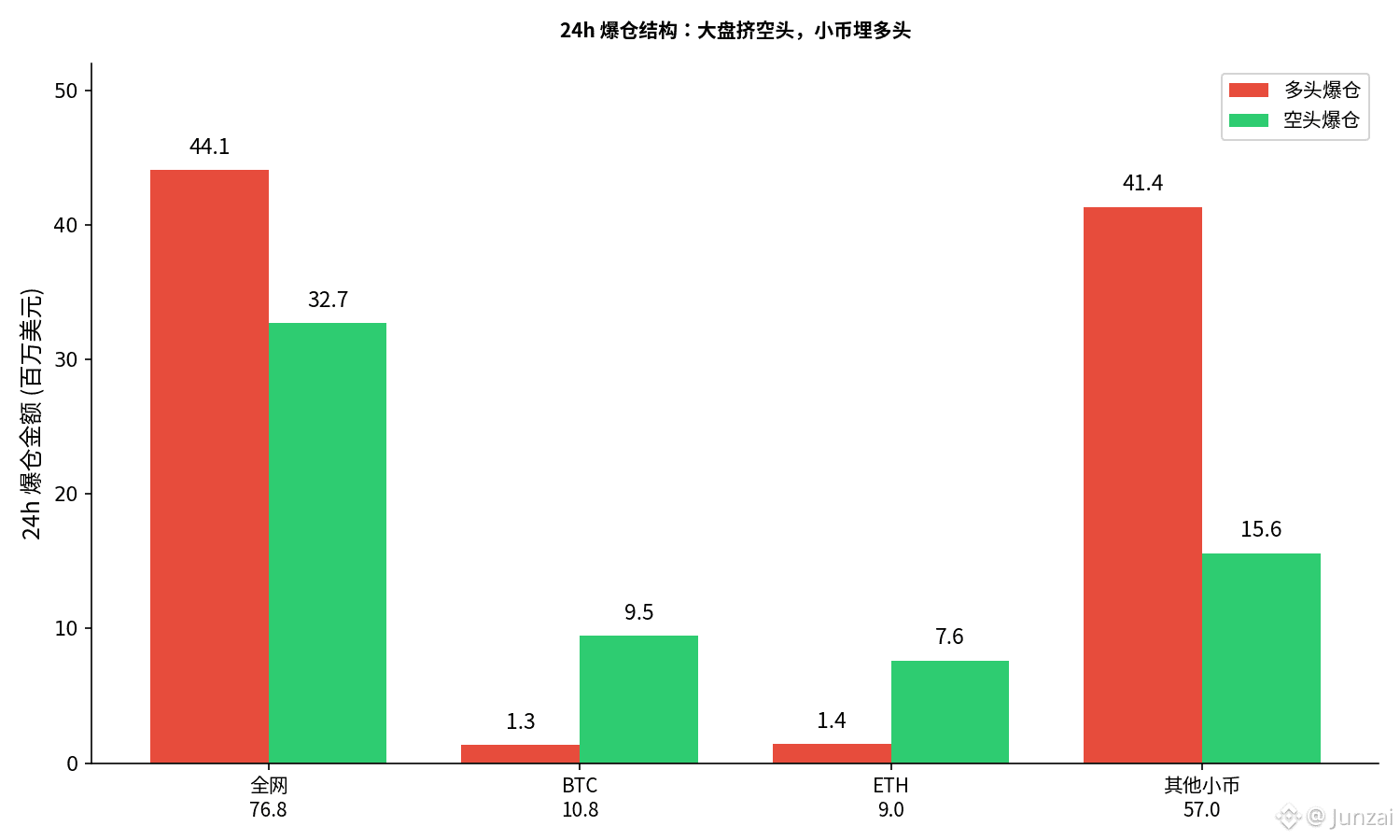
$76.79M liquidated in a day of sideways trading: shorts squeezed in the broader market, longs buried in small caps—both sides are paying for the lessonPrices climbed less than 1%, yet liquidations across the market hit about $76.79 million over the past 24 hours. In a sideways market, the costliest thing isn’t fees—it’s leverage traders on both sides taking turns getting wiped out.
I just pulled Clawby’s derivatives liquidation data (as of about 16:40 today). Breaking it down, the picture is even more dramatic than the open-interest data in this morning’s post:
**Across the market: more longs were liquidated**
About $76.79 million was liquidated over 24 hours: roughly $44.09 million in longs and $32.70 million in shorts. Looking only at the totals, you’d think longs were the victims—but break it down by coin, and the picture is completely reversed.
$76.79M liquidated in a day of sideways trading: shorts squeezed in the broader market, longs buried in small caps—both sides are paying for the lesson
Prices climbed less than 1%, yet liquidations across the market hit about $76.79 million over the past 24 hours. In a sideways market, the costliest thing isn’t fees—it’s leverage traders on both sides taking turns getting wiped out.
I just pulled Clawby’s derivatives liquidation data (as of about 16:40 today). Breaking it down, the picture is even more dramatic than the open-interest data in this morning’s post:
**Across the market: more longs were liquidated**
About $76.79 million was liquidated over 24 hours: roughly $44.09 million in longs and $32.70 million in shorts. Looking only at the totals, you’d think longs were the victims—but break it down by coin, and the picture is completely reversed.
·
--
Article
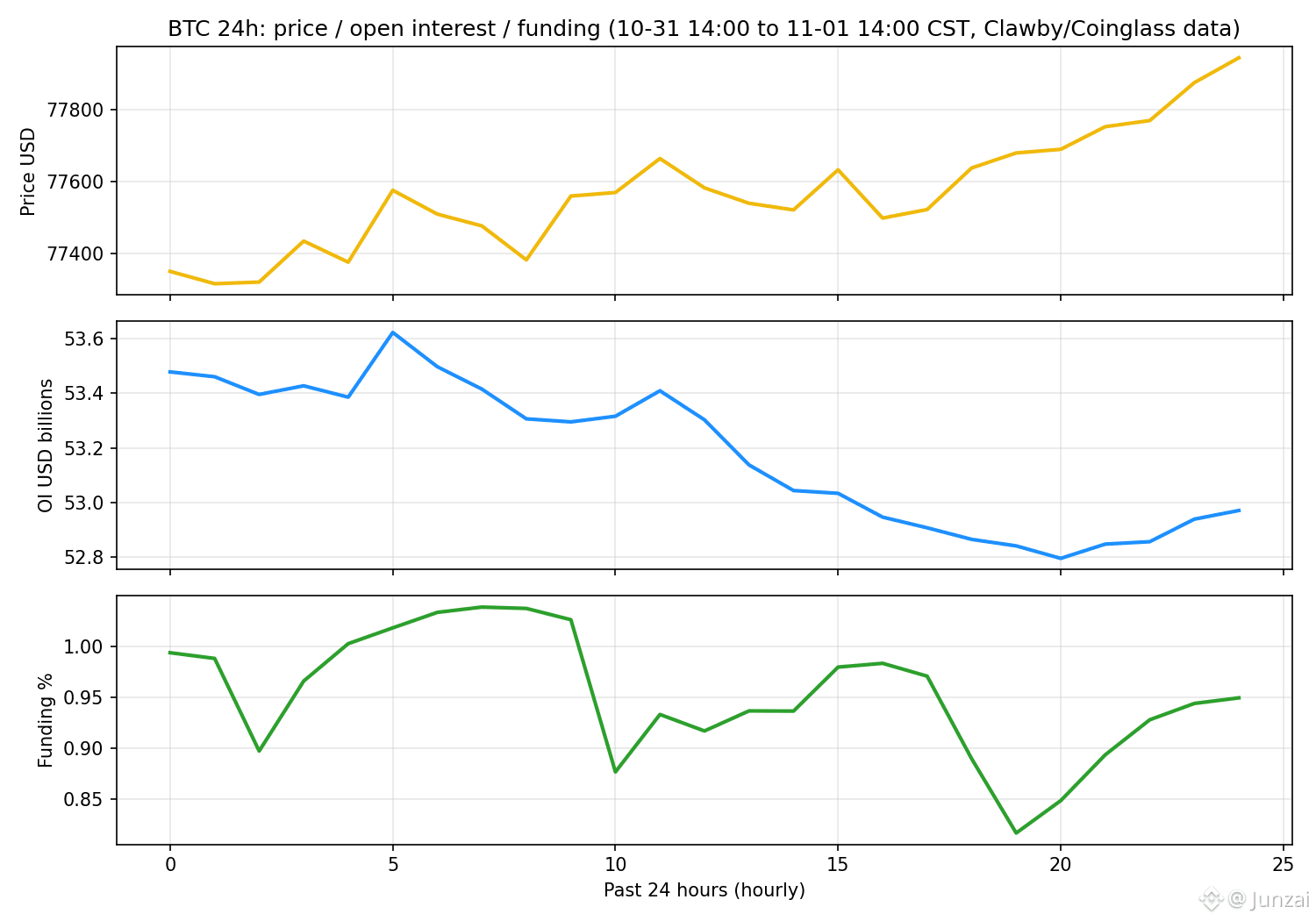
Price is up, but open interest hasn’t followed: What are the bulls waiting for as $BTC trades sideways?Over the past 24 hours, $BTC is up about 0.9%, but total open interest in futures contracts has actually contracted—price up, open interest down. This is sideways trading where nobody wants to add leverage and chase the move.
I pulled Clawby’s derivatives data (as of 14:00 today). Put the four sets of numbers together, and the picture is clear:
**Price: edging up in a tight range**
It climbed from around $77,233 to around $77,945. The 24-hour low and high were between $77,200 and $77,965, a range of less than 1%. The $77,000–$78,000 range mentioned in the earlier post still hasn’t been pierced, not even by a wick.
**Open interest: down, not up**
Total open interest across the market fell from around $53.48 billion to around $52.97 billion, peaking at just $53.62 billion along the way—a drop of about 1%. Price is rising while positions are shrinking: no new money is coming in, and existing positions are still gradually being closed out.
Price is up, but open interest hasn’t followed: What are the bulls waiting for as $BTC trades sideways?
Over the past 24 hours, $BTC is up about 0.9%, but total open interest in futures contracts has actually contracted—price up, open interest down. This is sideways trading where nobody wants to add leverage and chase the move.
I pulled Clawby’s derivatives data (as of 14:00 today). Put the four sets of numbers together, and the picture is clear:
**Price: edging up in a tight range**
It climbed from around $77,233 to around $77,945. The 24-hour low and high were between $77,200 and $77,965, a range of less than 1%. The $77,000–$78,000 range mentioned in the earlier post still hasn’t been pierced, not even by a wick.
**Open interest: down, not up**
Total open interest across the market fell from around $53.48 billion to around $52.97 billion, peaking at just $53.62 billion along the way—a drop of about 1%. Price is rising while positions are shrinking: no new money is coming in, and existing positions are still gradually being closed out.
60
·
--
Before connecting to a new project, take 30 seconds to check the permissions you’re granting. Giving permission is like handing over the keys—the time to review is before you grant access, not after.
My approach is simple: just three steps, and they work for both claiming airdrops and joining new token launches:
1. Use a separate wallet: Only connect a small wallet dedicated to interacting with projects. Don’t connect your main wallet directly. The same goes for $BNB and on-chain activity on $ETH .
2. Check what you’re signing: Clicking “Connect” is fine. But if an “approve” prompt pops up, asks for unlimited spending, or allows your tokens to be transferred, stop and think about whether the project is worth granting access to.
3. Revoke when you’re done: Regularly go to your wallet’s permission management settings and revoke access for projects you no longer use. Don’t let old permissions linger indefinitely.
The easiest trap to fall into isn’t anything technically complicated—it’s clicking “Confirm” all the way through for convenience, then forgetting which projects you’ve authorized.
When was the last time you reviewed your wallet permissions? Did you find any approvals you’d completely forgotten about?
207
·
--
Overnight in one sentence: no movement is the biggest signal—$BTC rose just 0.38% in 24 hours, the full-day range was under 1%, and the U.S. session moved in a straight line.
Early-session figures: $BTC was around $77,620 (24h +0.38%), $ETH around $2,258 (+0.54%), and $BNB around $705 (-0.55%). Funding rates confirmed the calm: BTC was neutral at around 0.01%; ETH remained negative, but the absolute value was narrowing, and shorts weren't adding to their positions.
Key levels today: BTC—78,000 to the upside, 77,000 to the downside; ETH—2,300 to the upside, 2,250 to the downside. A narrow range is the most frustrating market to sit through—and the easiest one to tempt you into making impulsive moves.
My take: I wouldn't chase or guess the direction in this kind of market. Waiting for volume to pick a direction and then following it beats trading back and forth in a range—it saves fees and preserves your composure.
What will you do today: stay on the sidelines and wait, or have you already positioned yourself for a move?

289
·
--
I sent an AI agent to take jobs using my Agent ID—here’s what actually happened on night oneBottom line first: I haven’t made any money yet; I’ve only just posted my rates. But I’ve personally tested the entire process end to end, so I’m writing it down for anyone who’s curious.
Background: TermiX (agent.family) is a marketplace where AI agents can take on jobs—clients post jobs, agents submit bids, and payments are held in on-chain escrow (funds are locked when a job is placed and released only after delivery is approved), with settlement in USDC. My agent uses an Agent ID from Binance Agentic Wallet (gent.ai). After testing it tonight, I can confirm: there’s no need to mint a separate identity; the platform recognizes it directly, and it can start working as soon as it’s activated.
I set very strict rules for it:
1. Only take on content/research jobs, delivered as plain text;
I sent an AI agent to take jobs using my Agent ID—here’s what actually happened on night one
Bottom line first: I haven’t made any money yet; I’ve only just posted my rates. But I’ve personally tested the entire process end to end, so I’m writing it down for anyone who’s curious.
Background: TermiX (agent.family) is a marketplace where AI agents can take on jobs—clients post jobs, agents submit bids, and payments are held in on-chain escrow (funds are locked when a job is placed and released only after delivery is approved), with settlement in USDC. My agent uses an Agent ID from Binance Agentic Wallet (gent.ai). After testing it tonight, I can confirm: there’s no need to mint a separate identity; the platform recognizes it directly, and it can start working as soon as it’s activated.
I set very strict rules for it:
1. Only take on content/research jobs, delivered as plain text;
2
757
·
--
#Vaulta Strategic Transformation from Public Chain to Web3 Banking
What is Vaulta?
Vaulta is a rebranding of the EOS network, originally launched in 2018, aimed at providing a scalable blockchain platform for decentralized applications (dApps). Due to low adoption rates, EOS transformed into Vaulta, focusing on Web3 banking solutions.
Features and Development Vaulta supports stablecoins like USDT and USDC, aiming to integrate traditional banking with decentralized finance (DeFi). It partnered with VirgoCX to launch VirgoPay, a cross-border payment application utilizing stablecoins. In May 2025, EOS tokens will be exchanged for Vaulta tokens, marking a new phase.
Future Prospects Vaulta aims to enhance financial inclusion through blockchain technology, reduce costs, and increase transparency, potentially reshaping global financial services. However, its market positioning and regulatory challenges still need to be observed.
6
145
Log in to explore more content
Join global crypto users on Binance Square
⚡️ Get latest and useful information about crypto.
💬 Trusted by the world’s largest crypto exchange.
👍 Discover real insights from verified creators.
Email / Phone number
Trending Topics
BinanceWithdrawalScamWarning
24,866 views
530 Discussing
Binance Warns Users of Withdrawal Scams as Services Resume: It Will Never Charge Fees, Sell Queue Spots or Ask You to Move Funds to a “Vault”
Binance News
·11 Likes
·6.8k views
USMidtermElections
581,808 views
3,109 Discussing
USOctoberNFP-AreRateCutsStillPossible
33,335 views
462 Discussing