
超人不会飞2020
3.6k Posts

超人不会飞2020
 Square Verified+
Report
Block User
X:@super55668

Top traders by profit in 7D
Open Trade

BTC Holder
Frequent Trader
6.3 Years
653 Following
97.1K+ Followers
157.9K+ Liked
1 Badges
Posts
Portfolio
All
Quotes
Videos
Live
·
--
Nov. 29 Morning Crypto Brief
BTC is hovering around $59,400, down half a percent over the past 24 hours. It dipped again in early trading—looking sluggish. ETH is around $1,640, with sentiment at extreme fear levels.
U.S. spot BTC ETFs saw net outflows of $5.78 billion this month, a new monthly record, with BlackRock’s IBIT accounting for the bulk of them.
The number of BTC held at a loss has topped 11 million, a more dramatic level than during the 2022 bear market. A Hyperliquid whale opened a roughly $150 million long position, lost over $3.5 million in five hours, then switched to a short position.
CZ said that, viewed over a longer time horizon, $60,000 is already a good price, and that security had not received enough attention before the major hack. He Yi said Binance plans to launch tokenized IPOs and IPO subscriptions, pending regulatory approval.
After lying low for several months, the Liquid hacker moved nearly 600 BTC. WLFI sold over 12,000 ETH at a loss, losing nearly $20 million. Armstrong said BTC may have bottomed and could reach $400,000 by 2030; Tom Lee said volatility does not mean the bull market has turned into a bear market.
Keep an eye on Falcon Finance’s roughly $21 million token unlock today, as well as the airdrop and account fees for European users.
{future}(BTCUSDT)
Nov. 29 Morning Crypto Brief
BTC is hovering around $59,400, down half a percent over the past 24 hours. It dipped again in early trading—looking sluggish. ETH is around $1,640, with sentiment at extreme fear levels.
U.S. spot BTC ETFs saw net outflows of $5.78 billion this month, a new monthly record, with BlackRock’s IBIT accounting for the bulk of them.
The number of BTC held at a loss has topped 11 million, a more dramatic level than during the 2022 bear market. A Hyperliquid whale opened a roughly $150 million long position, lost over $3.5 million in five hours, then switched to a short position.
CZ said that, viewed over a longer time horizon, $60,000 is already a good price, and that security had not received enough attention before the major hack. He Yi said Binance plans to launch tokenized IPOs and IPO subscriptions, pending regulatory approval.
After lying low for several months, the Liquid hacker moved nearly 600 BTC. WLFI sold over 12,000 ETH at a loss, losing nearly $20 million. Armstrong said BTC may have bottomed and could reach $400,000 by 2030; Tom Lee said volatility does not mean the bull market has turned into a bear market.
Keep an eye on Falcon Finance’s roughly $21 million token unlock today, as well as the airdrop and account fees for European users.
1
8
2.1k
·
--
🌸Superhuman 100U DCA BTC|Day 106
Just another ordinary day of continuing to DCA. Open Binance Square
Nani~ I also made it onto the 7D profit leaderboard by buying the dip on Bitcoin
So, all you need to do is buy Bitcoin at the right price and leave the rest to time
$BTC
🌸Superhuman 100U DCA BTC|Day 106
Just another ordinary day of continuing to DCA. Open Binance Square
Nani~ I also made it onto the 7D profit leaderboard by buying the dip on Bitcoin
So, all you need to do is buy Bitcoin at the right price and leave the rest to time
$BTC
Just another ordinary day of continuing to DCA. Open Binance Square
Nani~ I also made it onto the 7D profit leaderboard by buying the dip on Bitcoin
So, all you need to do is buy Bitcoin at the right price and leave the rest to time
$BTC

3
14
2.9k
·
--
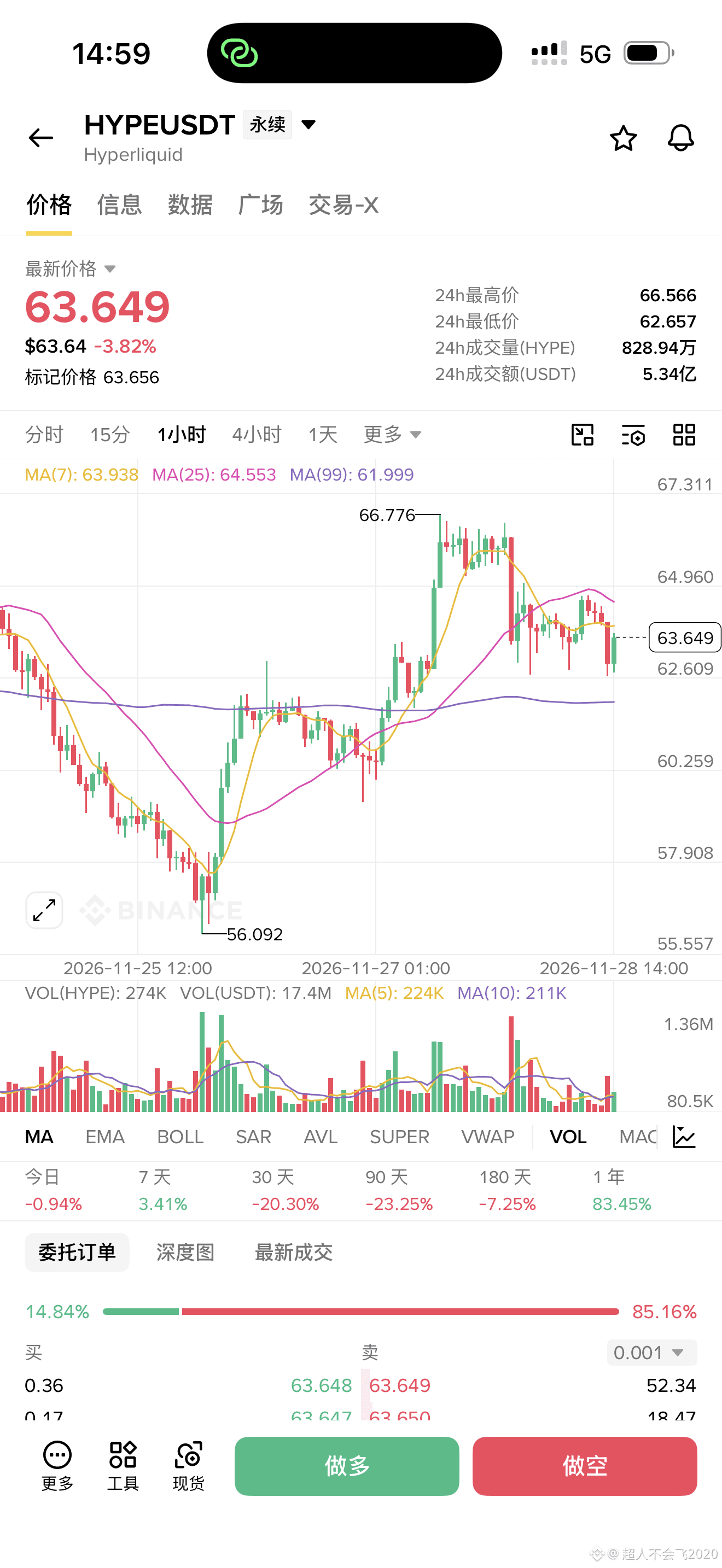
Up $34 million and still not selling: This HYPE whale is stubbornly holding 1.38 million HYPE
martestmoney (0x082e...ca88) is still stubbornly holding a 1.38 million HYPE long position.
The position is worth about $87.86 million, with $34 million in unrealized gains.
Its liquidation price is set at $55.47, leaving a 12.9% buffer from the current price.
This was an aggressive trade.
On October 23 last year, about five hours before Robinhood announced it would list HYPE, the whale went all in. The timing was so precise that people called it an insider-listing whale. Later, it added a bit more around $31–$32, bringing the position to 1.38 million tokens, and hasn’t touched it since.
With HYPE’s recent pullback, nearly $20 million in profits evaporated, but it kept adding margin to the account to stay afloat. 🐂
What exactly is it betting on?
I think this looks more like a position built on extreme conviction.
The Hyperliquid narrative has always been strong. HYPE is its native token, with its liquidity and ecosystem closely intertwined.
This address has barely moved since opening the position. It’s betting not on short-term volatility, but on the long-term premium of the entire sector.
#巨鲸持138万枚HYPE多单浮盈3400万美元
4
6
8.8k
·
--
Bitcoin (BTC) plunged from $62,000 to below $60,000 in just a few minutes. CoinGlass shows nearly $200 million in liquidations over the past hour, amid extreme fear.
But don’t rush to call it another shakeout!
I think this drop should be viewed on three levels:
First: Why did it get dumped? Leverage brought the traders using it down themselves.
A few days ago, BTC bounced to $62,000. Plenty of people thought the bottom was in, jumped in, and went long with leverage. Then, when U.S. markets opened and liquidity returned, selling pressure hit hard. Stop-losses and liquidations triggered a cascade, sending BTC lower and lower.
The chain of events is clear: a rebound lures in buyers → they add leverage → selling hits as liquidity returns → cascading liquidations amplify the drop.
It wasn’t a targeted shakeout. The rebound was built on leverage, so it came fast and disappeared just as fast.
Second: After the dump, can buyers catch it? The key is still spot demand.
The usual playbook is to break a key level first, flush out highly leveraged longs, then see whether spot buyers step in. But this time, that last part is the problem: spot buying is clearly weak, ETFs continue to see outflows, stablecoin liquidity is tightening, and the macro outlook for interest rates is unfavorable. The shakeout is over, but no fresh money has come in to fill the hole.
Third: Where do we go from here? Watch the levels and signals.
$60,000 has now turned from support into resistance. If BTC can’t reclaim it and hold above it, the next support to watch is $57,000–$58,000, followed by around $53,000.
Bottom line: leverage brought the traders using it down themselves. The shakeout is over; the key question is whether fresh money flows in.
#BTC跌破6万美元一小时清算近2亿

3
4
1.4k
·
--
11.28|Crypto Morning Briefing
Bitcoin was around 59,800 this morning, down a little over 1% in the past 24 hours. Ethereum was slightly weaker. U.S. stocks had a solid half-day session last night, with AI stocks rebounding. Anthropic climbed back above its IPO price. Crypto-related stocks fluctuated slightly, but the coins themselves did not strengthen in tandem.
Hayes reminded everyone yesterday that the Fed’s blackout period officially begins today. Weekend liquidity is thin, so beware of people reducing positions early; sell what you can before Monday’s open. Expectations of rate hikes remain relatively high.
On-chain, Q4 whales are still adding to their holdings. Addresses holding 1,000 to 10,000 BTC added a net 121,000 BTC. Even after such a steep price drop, there was no panic. But AguilaTrades’ 40x leveraged long, which had been rolled over repeatedly, was fully liquidated, with a loss of about $3.5 million on that trade. Rolling over the position didn’t save it either.
In other news, Bitcoin’s correlation with gold hit a new high this year, reviving the “digital gold” narrative. CryptoQuant cautioned that USDT supply has been contracting recently, and a sustained rebound will depend on whether stablecoin activity picks up again. Mining difficulty was just adjusted, rising 7.61%.
{future}(BTCUSDT)
11.28|Crypto Morning Briefing
Bitcoin was around 59,800 this morning, down a little over 1% in the past 24 hours. Ethereum was slightly weaker. U.S. stocks had a solid half-day session last night, with AI stocks rebounding. Anthropic climbed back above its IPO price. Crypto-related stocks fluctuated slightly, but the coins themselves did not strengthen in tandem.
Hayes reminded everyone yesterday that the Fed’s blackout period officially begins today. Weekend liquidity is thin, so beware of people reducing positions early; sell what you can before Monday’s open. Expectations of rate hikes remain relatively high.
On-chain, Q4 whales are still adding to their holdings. Addresses holding 1,000 to 10,000 BTC added a net 121,000 BTC. Even after such a steep price drop, there was no panic. But AguilaTrades’ 40x leveraged long, which had been rolled over repeatedly, was fully liquidated, with a loss of about $3.5 million on that trade. Rolling over the position didn’t save it either.
In other news, Bitcoin’s correlation with gold hit a new high this year, reviving the “digital gold” narrative. CryptoQuant cautioned that USDT supply has been contracting recently, and a sustained rebound will depend on whether stablecoin activity picks up again. Mining difficulty was just adjusted, rising 7.61%.
4
2k
·
--
🌸Superman 100U BTC DCA|Day 105
Holiday liquidity is thin, and the market hasn’t made any big moves.
U.S. markets were closed for Thanksgiving. Today is a half-day session for Black Friday, with stock index futures rising in morning trading. The Dow closed higher the previous day, while the Nasdaq and S&P 500 are still digesting volatility in the AI sector, and risk appetite has recovered slightly.
Crypto remains in extreme fear. This rebound is mainly driven by short covering and a simultaneous recovery in risk assets—not by new money flowing into the market.
BTC is still far from its year-to-date high, with moving averages and resistance overhead weighing on it.
Whether it can truly turn stronger comes down to three things: whether U.S. stocks can sustain their momentum, whether ETF flows can return, and whether the Fear and Greed Index can climb from the bottom.
$BTC
2
1
6
2k
·
--
Musk has pulled off another big one
On November 25, SpaceX received the first U.S. license for a space-based data center, allowing it to deploy up to one million satellites for AI computing in orbit.
But the deadlines are tight: at least one satellite must be in orbit by 2033, 100,000 by 2035, and the full constellation deployed by 2040. Musk simply replied that this would be a valuable asset for the U.S. and the whole world.
Why go to all this trouble to put computing power in space?
Put simply, the old problems with ground-based computing are getting harder to manage: huge power consumption, water-intensive cooling, and competition for resources with power grids everywhere. Their solution is to pack GPU clusters into satellites and send them into orbits hundreds of kilometers above Earth. They’ll run on solar power, dissipate heat through radiation into space, communicate with each other via laser links, then transmit results back to Earth. They’re also working with NVIDIA on the payload.
A lot of people think Musk is just making promises.
But I think Starlink has already proved that large-scale satellite constellations can become reality. If Starship can bring launch costs down, this won’t be pure fantasy.
Of course, there’s plenty of opposition, too. Amazon and astronomical organizations are watching the issues of orbital debris and interference with observations. The FCC still pushed it through, which also shows that the U.S. now sees AI computing power as a strategic trump card.
So what does this mean for crypto?
In the short term, it adds fuel to the AI narrative, and sentiment could lift related concepts. It’s a double-edged development for DePIN and decentralized computing: on one hand, it opens up the possibility of putting computing power in space; on the other, it shows that the players who can really solve the energy bottleneck are giants with rockets and deep pockets. Computing tokens that only talk about sharing idle GPUs will need to find a real point of differentiation.
Going with this sentiment, Musk-related assets like BTC and Dogecoin could also benefit.
So my take is:
In the short term, this is a sentiment catalyst. Whether it can work comes down to Starship’s costs and real-world tests of the first batch of satellites.
What do you think—is this an upgrade to the narrative, or the start of another round of hype?
#SpaceX太空数据中心获批,AI芯片需求迎来新增长点?

3
11
2.3k
·
--
After the BEA released October’s PCE data, rate cuts have been pushed back again.
First, the data itself
Core PCE rose 3.3% year over year, above the market forecast of 3.2% and up from 3.1% previously, hitting its highest level since November 2023. Headline PCE reached 3.8%, with a 0.3% monthly increase. The gains may not look dramatic, but inflation is proving very persistent. Add in the upward revision to third-quarter GDP growth to 4.3%—the fastest pace in three years—and with the economy running this hot, inflation will be hard to contain. It’s difficult for the Fed to remain dovish.
So what exactly has this data changed?
Core PCE came in higher than expected, showing that inflation is cooling more slowly. Note that the trend hasn’t reversed; the process has just slowed. Headline PCE’s 0.3% monthly rise is not low either. Combined with the GDP revision, it tells the market that demand is still strong and monetary tightening cannot stop. Investors had been betting on inflation peaking and a policy pivot, but this data has knocked those expectations off course.
Now, let’s look at how policy expectations are being repriced
According to CME FedWatch, the probability of a 25-basis-point rate hike in December is now near 100%, and many are starting to forecast another hike in January. Some Fed officials have also struck a hawkish tone, even discussing the possibility of a 50-basis-point hike. This doesn’t mean a hike is certain; it means the market has been forced to reprice the prospect of higher rates lasting longer.
Back to crypto: the short-term pressure is clear
The dollar and Treasury yields are getting support, while liquidity-sensitive assets like BTC and ETH are likely to weaken first. Investors are choosing to wait on the sidelines and seek safety until the December rate decision. That’s normal. Positions that had been front-running rate cuts now need to be trimmed.
But I don’t think we should be blindly bearish:
This isn’t recessionary tightening. Rate hikes are aimed at curbing overheated demand, not because the economy is about to collapse. Historically, when the economy is resilient and inflation stubborn, risk assets often fall first and then recover. The key is the pace of rate hikes and the gap between expectations and reality.
The biggest impact of this data is that it has completely dashed hopes for near-term rate cuts. High rates will last longer, and ETF inflows may also slow temporarily. Of course, markets can overreact. If employment weakens or PCE falls later on, sentiment could turn around quickly.
So over the next two weeks, expect plenty of back-and-forth.
Rather than fixating on crypto prices, pay closer attention to the dollar index and 10-year Treasury yields. They matter more.
#美国核心PCE超预期,美联储加息预期增强
#纳指期货跌超3%
#特朗普拟重启关税攻势,比特币和美股再度走弱
1
10
1.7k
·
--
Verified
Superhuman 100U DCA BTC | Day 104
I missed buying Nvidia at its low of 124.5 last Friday. Then it suddenly surged on Monday when Jensen Huang returned, and I ended up missing out.
The market is closed today for Thanksgiving, so everyone can sleep in.
$BTC
Superhuman 100U DCA BTC | Day 104
I missed buying Nvidia at its low of 124.5 last Friday. Then it suddenly surged on Monday when Jensen Huang returned, and I ended up missing out.
The market is closed today for Thanksgiving, so everyone can sleep in.
$BTC
I missed buying Nvidia at its low of 124.5 last Friday. Then it suddenly surged on Monday when Jensen Huang returned, and I ended up missing out.
The market is closed today for Thanksgiving, so everyone can sleep in.
$BTC
1
2.2k
·
--
Trump’s tariff hammer is swinging again, and the crypto market is caught in the crossfire.
The Nasdaq fell 3.31%, the Dow plunged nearly 800 points at one point intraday, and gold weakened too. Bitcoin sank to $57,000, putting it down nearly 23% this month, while ETFs continue to see outflows. The tariff news landed like another punch to an already fragile risk market.
A lot of people think Trump is acting emotionally and trying to stay in the spotlight now that he doesn’t control either chamber of Congress!
I don’t think it’s that simple. This is one of his familiar playbooks:
He’s using Section 301 to push trade protectionism and deliver on his promise to bring manufacturing back home. Short-term market volatility is simply not his top priority. From the trade war that began in 2018 to the present, his core objective hasn’t changed: raise barriers to imports and push production back to the US. So this round of tariffs isn’t a spur-of-the-moment move—it’s a continuation of that same strategy.
Following that logic, the biggest risk right now is a convergence of negative factors.
Tariffs drive up the cost of goods, pushing inflation expectations higher. Core PCE is now at 3.3%, leaving the Federal Reserve less room to cut rates. Risk assets are especially sensitive to interest-rate expectations, and Bitcoin is on the front line. The costs of mining rigs, graphics cards, and other computing hardware are also under upward pressure. The overlap of these forces is what’s really weighing on the market.
But if you take a longer view, the picture looks different.
Trade barriers keep escalating, global supply chains are repeatedly disrupted, and confidence in the dollar-based system is gradually eroding. Looking back at the 2018 trade war and the 2022 inflation cycle, Bitcoin has often gone on to rally independently after the panic selling subsided. As geopolitical and trade tensions become the norm, they may actually reinforce Bitcoin’s narrative as a hedge outside the sovereign credit system.
Short-term pressure and the medium- to long-term outlook are really two separate things.
Back in the crypto market, I think there are three things to watch: core PCE, US Treasury yields, and the flow of funds from equities into crypto.
At this stage, keep positions tightly controlled, stay away from leverage, and don’t rush to buy the dip. Once liquidity risks have been fully priced in, then look for opportunities in decentralized assets.
#特朗普拟重启关税攻势,比特币和美股再度走弱
1
2
35
13.4k
·
--
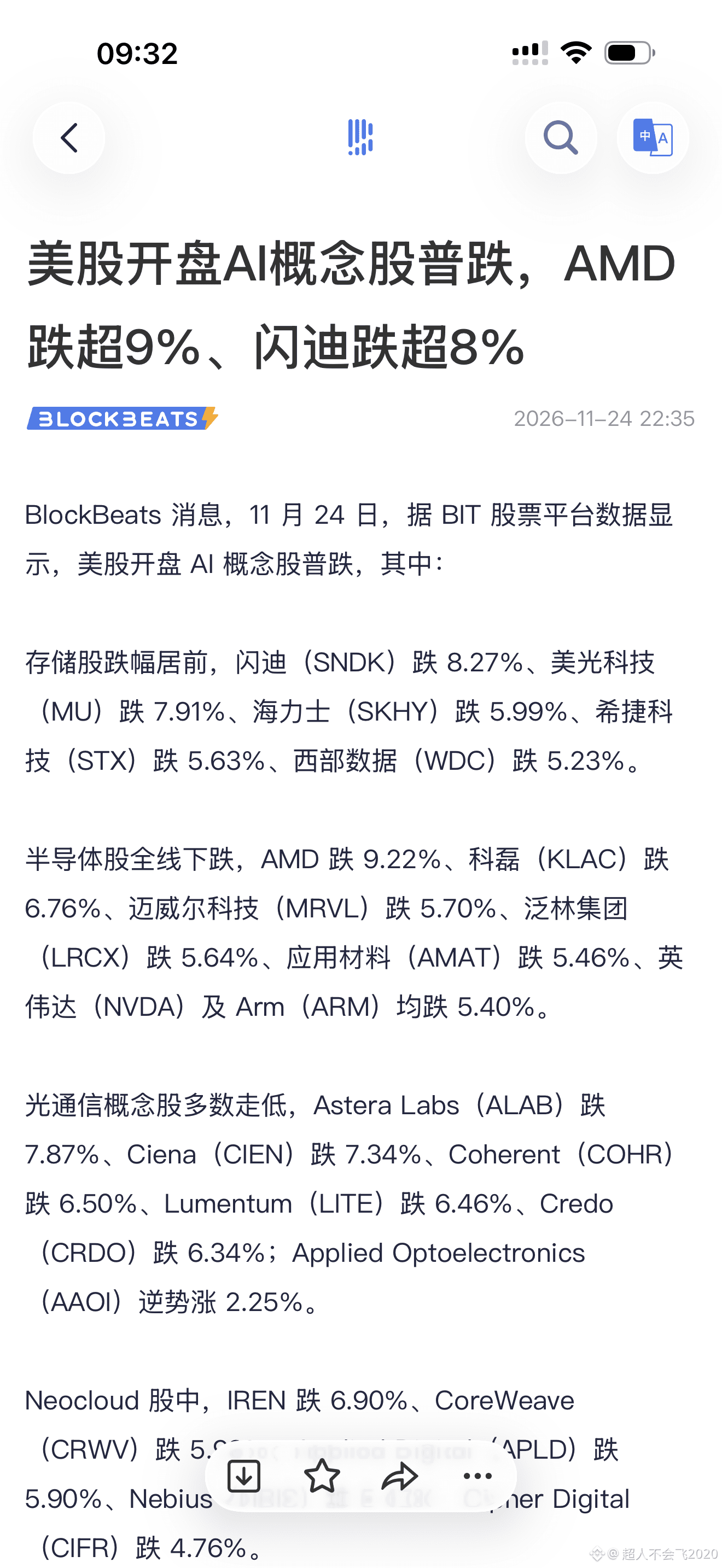
The AI market action over the past few days has been absolutely mind-boggling. 😂
Anthropic went public at an offering price of 83. It opened at 111.5 on its first day, surged to a high of 115.1, then closed at 97.17. Its market cap briefly touched 2 trillion.
Just four days later, it was trading below its offering price: it closed at 81.91 on the 24th, after hitting a low of 75.6. People who bought near the top are down nearly 30%, and almost 200 billion was wiped off its market cap in one fell swoop. That’s one hell of a roller coaster—if you’ve got a weak heart, you probably wouldn’t make it through.
And it’s not just Anthropic. The entire AI sector is taking a beating. Nvidia, computing power, and data-center-related stocks are all still correcting.
The market has cooled off and started doing the math: can all that money poured into computing power actually generate steady profits? Nobody gave that much thought before, but now everyone’s counting on their fingers.
But I don’t think this pullback is surprising.
The AI story was hyped way too much over the past couple of years. Growth that was supposed to happen over the next several years was priced into stocks early, and everyone assumed that with the technology in place, profits would eventually follow. But the reality is right there: computing costs aren’t coming down, open-source models keep getting more competitive, and premium models haven’t yet proven there’s room to charge for them. Add in uncertainty around interest rates and inflation, and it’s perfectly normal for investors to run for cover.
Anyone who’s been in crypto should recognize this pattern. When the narrative is at its peak, prices have already run ahead of expectations. If results don’t catch up, valuations get slashed hard.
That’s where AI is now. The story is still alive, but the market wants real proof of profitability. Hype alone won’t cut it anymore.
But that doesn’t mean AI is finished.
Anthropic has a solid reputation and growth on the enterprise side, and trading below its offering price could actually create an opportunity for more rational pricing. That said, in the short term it still faces pressure from lockup expirations and declining risk appetite.
Put simply, AI is shifting from buying on faith to having to deliver results. This process of deflating the bubble will hurt, but in the long run, it’s not necessarily a bad thing.
#AI概念股普跌,Anthropic跌破发行价
3
2.3k
·
--
Nov 26 | Morning Brief
Global markets swung sharply last night
Media estimates put global asset losses at more than $4 trillion over the past 24 hours. The Nasdaq briefly plunged nearly 4% intraday before sharply paring losses toward the close. The Dow finished higher, while the S&P 500 edged lower. Gold and silver also fell.
BTC briefly plunged to 57,209 on Bitstamp, breaking below 58,000. Long positions were liquidated in another wave, with total crypto futures liquidations reaching about $510 million across the market, most of them longs.
A rebound followed, and BTC climbed back above 59,000 early this morning. Its 24-hour loss narrowed to around 1%. It is now fluctuating between roughly 59,000 and 60,000, but has yet to truly leave the weak range.
October PCE inflation was 3.8% year over year, with core PCE at 3.3%. Third-quarter GDP was revised up to 4.3%, and expectations of a December rate hike rose again. U.S. markets are closed today for Thanksgiving, and ETF flow data will take a day off too.
On-chain activity is running normally. Aave Labs has just launched its savings app to the public. Overall: a rebound after the drop, but buying remains soft, and for now, nobody seems willing to step in above 60,000.
{future}(BTCUSDT)
Nov 26 | Morning Brief
Global markets swung sharply last night
Media estimates put global asset losses at more than $4 trillion over the past 24 hours. The Nasdaq briefly plunged nearly 4% intraday before sharply paring losses toward the close. The Dow finished higher, while the S&P 500 edged lower. Gold and silver also fell.
BTC briefly plunged to 57,209 on Bitstamp, breaking below 58,000. Long positions were liquidated in another wave, with total crypto futures liquidations reaching about $510 million across the market, most of them longs.
A rebound followed, and BTC climbed back above 59,000 early this morning. Its 24-hour loss narrowed to around 1%. It is now fluctuating between roughly 59,000 and 60,000, but has yet to truly leave the weak range.
October PCE inflation was 3.8% year over year, with core PCE at 3.3%. Third-quarter GDP was revised up to 4.3%, and expectations of a December rate hike rose again. U.S. markets are closed today for Thanksgiving, and ETF flow data will take a day off too.
On-chain activity is running normally. Aave Labs has just launched its savings app to the public. Overall: a rebound after the drop, but buying remains soft, and for now, nobody seems willing to step in above 60,000.
7
3.6k
·
--
Superman 100U Bitcoin DCA | Day 103
Bitcoin’s current trend could very well break below 55,000. The major bottom should be around 50,000.
The rebound two days ago, after news that Jensen Huang was returning to his post, didn’t reach my ideal price, so I didn’t sell. That day, my Bitcoin losses probably went from over 40,000U back down to over 10,000U 😂
I currently have 4.64 BTC from DCA and buying the dip. I just checked, and I’m almost 44,000U in the red again, but these are just short-term unrealized losses, so there’s no need to worry too much.
If this rally reaches 65,000, I’ll sell first. If it drops to around 50,000, I’ll keep buying the dip.
$BTC
3
3
2k
·
--
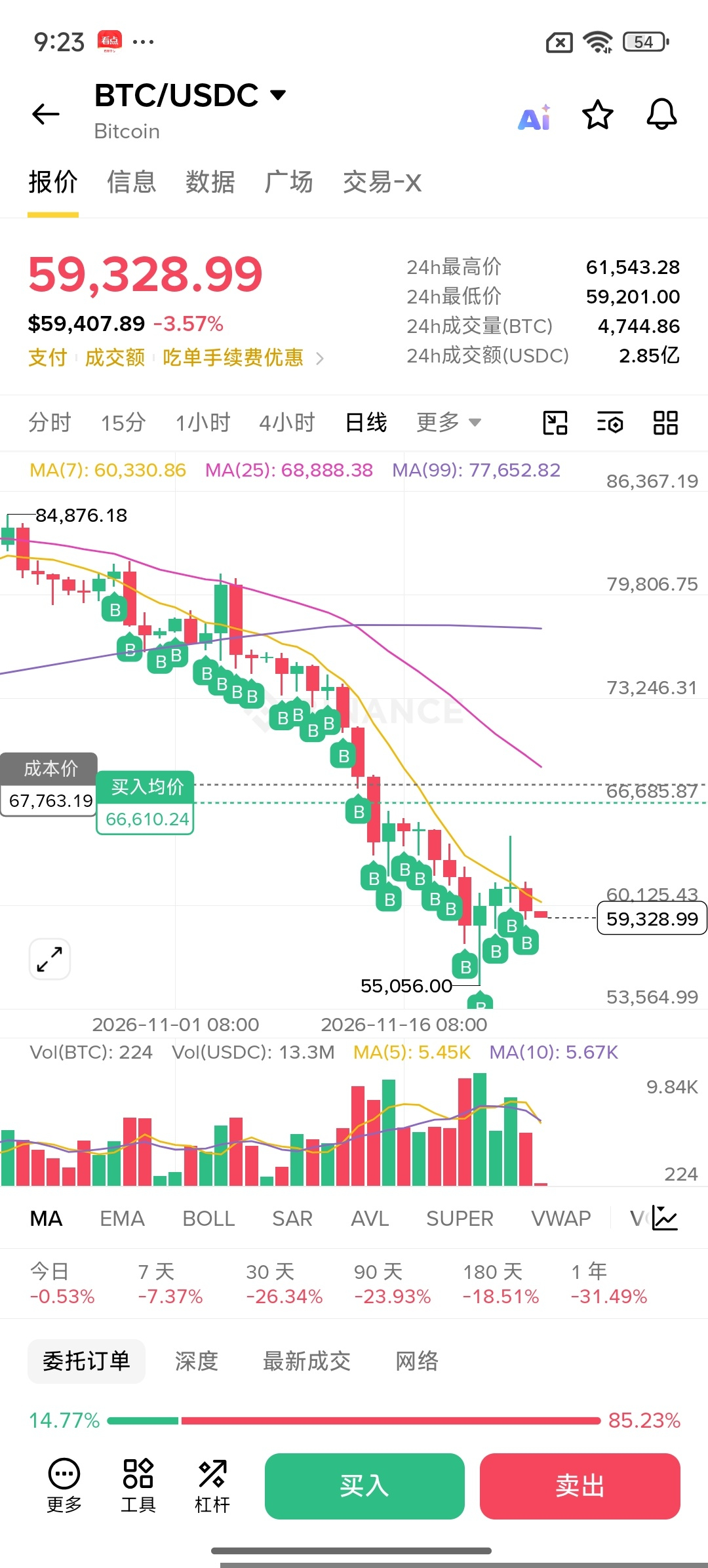
BTC has fallen below $60,000 again 😰
I don’t think this is one of those brief wick-down-and-bounce scenarios.
First, the price action
Since mid-November, BTC has been hovering between $60,000 and $65,000. News of Jensen Huang’s return pushed it up to $64,000, but in less than a day, all those gains were wiped out. It plunged straight through $60,000 and is now fluctuating around $59,500. Trading volume keeps shrinking, and ETFs are still seeing outflows.
Now, about the $60,000 level
It broke below that level once in June this year, and now that it’s happening again, $60,000 is no longer sacred to institutions and leveraged traders. The worst part is that after the drop, there’s no meaningful buying support in sight—just stop-losses and forced liquidations.
The data makes it even clearer
Cumulative ETF outflows in November are nearing $5 billion, with BlackRock’s IBIT often leading the outflows. Institutions aren’t buying the dip; they’re continuing to reduce their positions. Long-term holders are also selling into the rebounds. SOPR has fallen to the low 0.6s, and quite a few longtime holders have already taken losses and exited.
The macro picture isn’t helping either
The dollar is relatively strong, and expectations for rate cuts keep cooling. Bitcoin is now closely tied to U.S. tech stocks, so whenever there’s a hint of trouble in the AI sector, it falls along with them. The previous rebound was just a recovery in sentiment, not a genuine return of capital.
So there’s one main problem right now: no new buyers—a vacuum in demand.
My view: $60,000 is no longer support; it’s just a sentiment trigger. In the short term, the key thing to watch is whether the $58,000–$59,000 range can hold.
#比特币再度跌破6万美元,回吐昨夜反弹涨幅
10
9.2k
·
--
11.25 Morning Briefing
BTC is back near $60,000. It has given back almost all of the rebound sparked by Jensen Huang’s comments and continues to grind out a bottom.
Over the past 24 hours, liquidations across the crypto market totaled $472 million, including $393 million in long positions. More than 110,000 traders were liquidated, dealing another blow to bulls.
U.S. AI stocks weakened: the Nasdaq fell nearly 1.5%, Nvidia dropped nearly 6%, and Anthropic fell below its IPO price, with its intraday market cap topping $1 trillion. Crypto remains closely correlated with tech stocks.
Spot BTC ETFs have seen net outflows for five consecutive days, with $570 million flowing out yesterday, signaling weak fund flows.
⚠️ Reminder: Binance will perform wallet maintenance today at 14:00 Beijing time. Withdrawals will be suspended for about one hour, but trading will not be affected. Don’t leave your withdrawals until the last minute.
BlackRock’s Hong Kong dollar digital liquidity fund is now open for subscriptions, with around $100 million in assets. Professional investors can subscribe using HKDAP.
The market is choppy and leaning weak, so avoid using excessive leverage. Keep a close eye on U.S. AI stocks and PCE expectations.
{spot}(BTCUSDT)
11.25 Morning Briefing
BTC is back near $60,000. It has given back almost all of the rebound sparked by Jensen Huang’s comments and continues to grind out a bottom.
Over the past 24 hours, liquidations across the crypto market totaled $472 million, including $393 million in long positions. More than 110,000 traders were liquidated, dealing another blow to bulls.
U.S. AI stocks weakened: the Nasdaq fell nearly 1.5%, Nvidia dropped nearly 6%, and Anthropic fell below its IPO price, with its intraday market cap topping $1 trillion. Crypto remains closely correlated with tech stocks.
Spot BTC ETFs have seen net outflows for five consecutive days, with $570 million flowing out yesterday, signaling weak fund flows.
⚠️ Reminder: Binance will perform wallet maintenance today at 14:00 Beijing time. Withdrawals will be suspended for about one hour, but trading will not be affected. Don’t leave your withdrawals until the last minute.
BlackRock’s Hong Kong dollar digital liquidity fund is now open for subscriptions, with around $100 million in assets. Professional investors can subscribe using HKDAP.
The market is choppy and leaning weak, so avoid using excessive leverage. Keep a close eye on U.S. AI stocks and PCE expectations.
3
2k
·
--
Superman 100U DCA BTC | Day 102
Bitcoin’s price is swinging sharply between 55,000 and 65,000. Choose a direction.
Stay on the sidelines and adjust your position as needed. Keep a close eye on things over the next couple of days; if it drops further, there’ll be another chance to buy the dip.
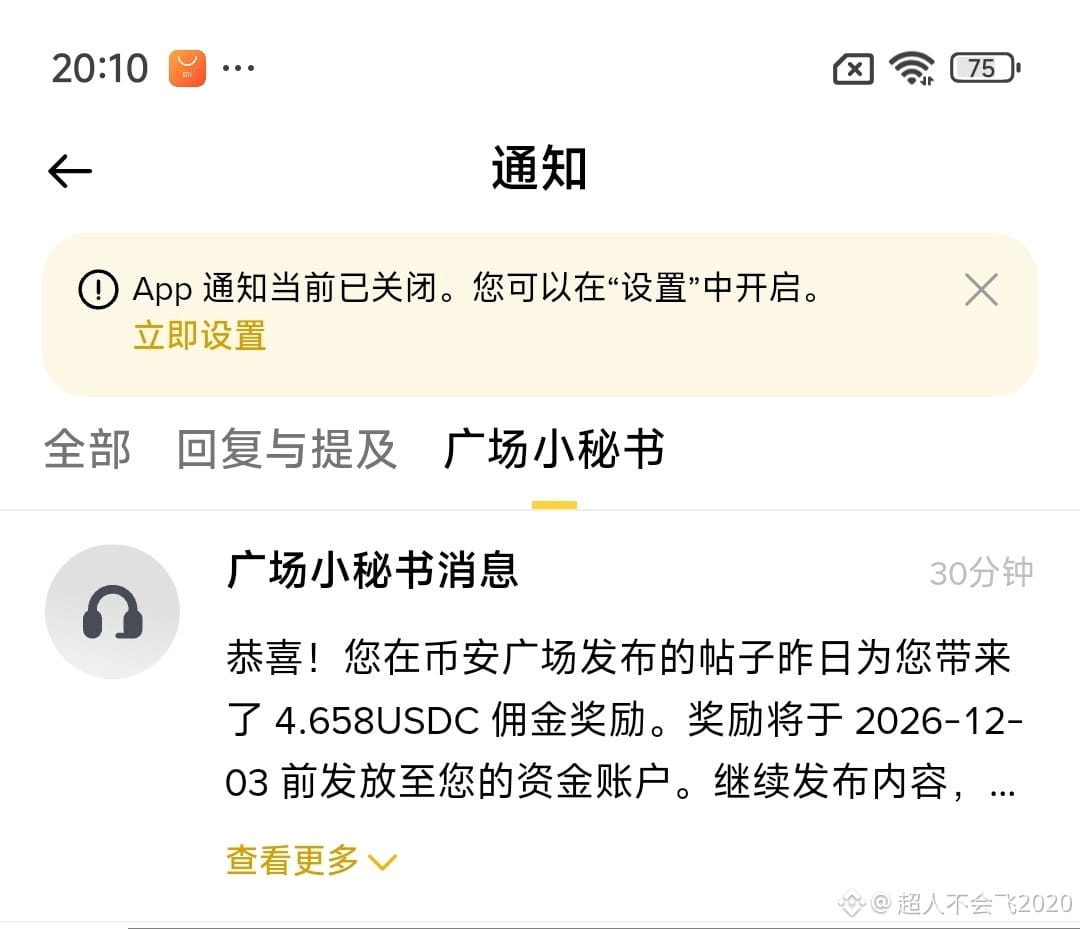
Also, the plaza is about to reach mantou again: 4.658U
$BTC
1.1k
·
--
BTC has rebounded from $55,000 to above $61,000, and plenty of people are calling the bottom confirmed!
I think this looks more like a technical bounce driven by short covering and drying-up liquidity than a trend reversal.
First, how did this rally happen?
The Nasdaq took a beating last week, and BTC drifted lower along with it, even touching its lowest level since last September over the weekend. The sharp drop wiped out a ton of leveraged long positions. Once that leverage was flushed out, shorts closed their positions, and the price naturally bounced. This kind of rally tends to come and go quickly, especially with Europe and the US heading into holidays this week and liquidity already thin.
Next, the key variables to watch this week
Wednesday’s PCE inflation and revised GDP data: If the numbers come in hot, expectations for higher interest rates will rise again, and Bitcoin may not hold up. If the data cools, risk assets may get some breathing room, but it’s still hard to see a sustained rally taking off right away.
Finally, there’s the liquidity issue
US markets are closed for Thanksgiving on Thursday and have a half-day session on Friday, with ETFs halting trading as well. Crypto markets never close, but with big-money players stepping away, volatility could increase. False rallies and breakouts are common during low-liquidity holiday periods.
There’s also the flow of funds
Spot ETFs saw more than $3 billion in net outflows in November. Institutions are still pulling out rather than buying the dip. If funds keep flowing out during the rebound, this rally will have very little substance.
So, my view is:
In the short term, BTC could reach $63,000–$65,000, but that would just be a recovery after an excessive drop, not the start of a new bull run.
For a trend reversal, we’d need to see:
BTC hold above $62,000, ETF flows turn positive, macro conditions signal rate cuts, and fear ease. None of these has happened yet.
#感恩节交易周开启,市场能否迎来修复性反弹?
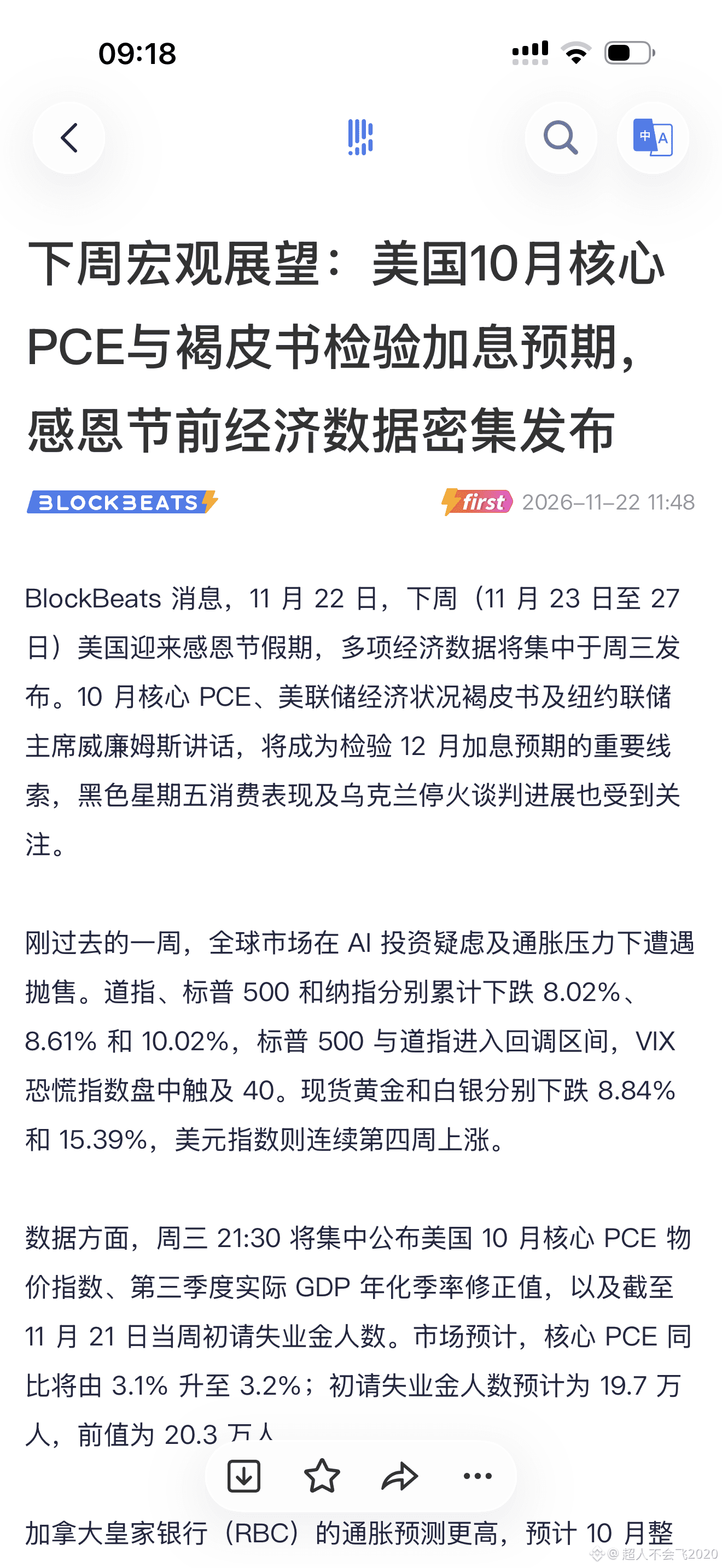
32
5
85
75.2k
·
--
November 24 | Crypto Morning Briefing
Bitcoin rebounded along with U.S. stocks last night, rising before pulling back. It is currently fluctuating around $61,000. This rebound was mainly driven by short covering. The Fear & Greed Index remains in the extreme fear zone, and spot ETFs saw continued net outflows last week, leaving market sentiment fragile.
Key event: 11 days after Jensen Huang resigned, Nvidia’s board unanimously approved his return, with Trump publicly voicing his support. The news sent Nvidia shares up 31.5% at the close, adding nearly $1 trillion to its market cap in a single day. The Nasdaq surged, while mining stocks and crypto-related stocks rallied across the board, with IREN and MARA among the top gainers.
The market sees this as a confidence booster for the AI sector, though some believe this alone is not enough to reverse the trend, and that clearer signals of easing from the Federal Reserve are still needed.
Token unlock pressure today: MON and SOSO both have large token unlocks, which could weigh on altcoins. Don’t blindly chase prices higher.
Other news:
1. Strategy continues to accumulate BTC and buy back STRC. Refer to official announcements for its exact holdings and purchase amounts.
2. The cash costs of many publicly listed mining companies are now above current prices, and some mining facilities have begun converting their power and buildings into AI computing centers.
Also, keep an eye on Federal Reserve official Williams’ speech, Germany’s IFO data, and U.S. consumer confidence data today.
Overall, volatility remains high. A rebound has emerged, but the fundamentals of ETF outflows and weak sentiment have not changed. Both bulls and bears should avoid being too aggressive in the short term.
{future}(BTCUSDT)
November 24 | Crypto Morning Briefing
Bitcoin rebounded along with U.S. stocks last night, rising before pulling back. It is currently fluctuating around $61,000. This rebound was mainly driven by short covering. The Fear & Greed Index remains in the extreme fear zone, and spot ETFs saw continued net outflows last week, leaving market sentiment fragile.
Key event: 11 days after Jensen Huang resigned, Nvidia’s board unanimously approved his return, with Trump publicly voicing his support. The news sent Nvidia shares up 31.5% at the close, adding nearly $1 trillion to its market cap in a single day. The Nasdaq surged, while mining stocks and crypto-related stocks rallied across the board, with IREN and MARA among the top gainers.
The market sees this as a confidence booster for the AI sector, though some believe this alone is not enough to reverse the trend, and that clearer signals of easing from the Federal Reserve are still needed.
Token unlock pressure today: MON and SOSO both have large token unlocks, which could weigh on altcoins. Don’t blindly chase prices higher.
Other news:
1. Strategy continues to accumulate BTC and buy back STRC. Refer to official announcements for its exact holdings and purchase amounts.
2. The cash costs of many publicly listed mining companies are now above current prices, and some mining facilities have begun converting their power and buildings into AI computing centers.
Also, keep an eye on Federal Reserve official Williams’ speech, Germany’s IFO data, and U.S. consumer confidence data today.
Overall, volatility remains high. A rebound has emerged, but the fundamentals of ETF outflows and weak sentiment have not changed. Both bulls and bears should avoid being too aggressive in the short term.
4
2.9k
·
--
Niu Gulu Renxun makes a powerful comeback
#英伟达恢复黄仁勋CEO职务,市场吹响反攻号角
Niu Gulu Renxun makes a powerful comeback
#英伟达恢复黄仁勋CEO职务,市场吹响反攻号角
#英伟达恢复黄仁勋CEO职务,市场吹响反攻号角
1
4
1.4k
·
--
Superman 100U DCA BTC | Day 101
Keep dollar-cost averaging and patiently wait for the next opportunity. Then go all in to lower the average cost
If prices rise later, sell what I bought at the bottom two days ago first; if they fall, buy the dip
$BTC
Superman 100U DCA BTC | Day 101
Keep dollar-cost averaging and patiently wait for the next opportunity. Then go all in to lower the average cost
If prices rise later, sell what I bought at the bottom two days ago first; if they fall, buy the dip
$BTC
Keep dollar-cost averaging and patiently wait for the next opportunity. Then go all in to lower the average cost
If prices rise later, sell what I bought at the bottom two days ago first; if they fall, buy the dip
$BTC
4
1.3k
Log in to explore more content
Join global crypto users on Binance Square
⚡️ Get latest and useful information about crypto.
💬 Trusted by the world’s largest crypto exchange.
👍 Discover real insights from verified creators.
Email / Phone number
Trending Topics
EvolveAtBinanceBlockchainWeek
2.4M views
20,300 Discussing
Binance Blockchain Week is officially underway! 🌍
On November 28–29, whether you’re in Bangkok or joining from afar, tune in to the livestreams and join the conversation on Binance Square!
Here’s what’s in store 👇
📺 Watch the main stage live
Tune in throughout both days as industry speakers share their perspectives on this year’s theme, “Evolve” From technological innovation to real-world applications, explore what’s next for crypto.
⚔️ Watch two trading competitions
The Aster Open Qualifier and the Binance Trading Master Tournament will both be streamed live. Tune in to follow the traders in action.
🏆 Watch The Blockchain 100 Awards Ceremony
The Blockchain 100 list was selected by the community. Join us in celebrating the creators and the ideas they share!
💬 Join the community conversation
Use #EvolveAtBinanceBlockchainWeek in a post with a photo to share what you’re looking forward to, your views on the industry, or your favorite moments from the event.
The event page is now live! Subscribe to all livestreams with one click so you don’t miss a moment 👏
Binance Blockchain Week
·605 Likes
·930.8k views
WorldLibertyActsToCutLiquidationRisk
25,899 views
297 Discussing
LiquidHackerMoves598BTC
21,036 views
202 Discussing