

Dr diana
4.4k Posts

Dr diana
Report
Block User
949 Following
2.5K+ Followers
9.0K+ Liked
Posts
All
Quotes
Live
·
--
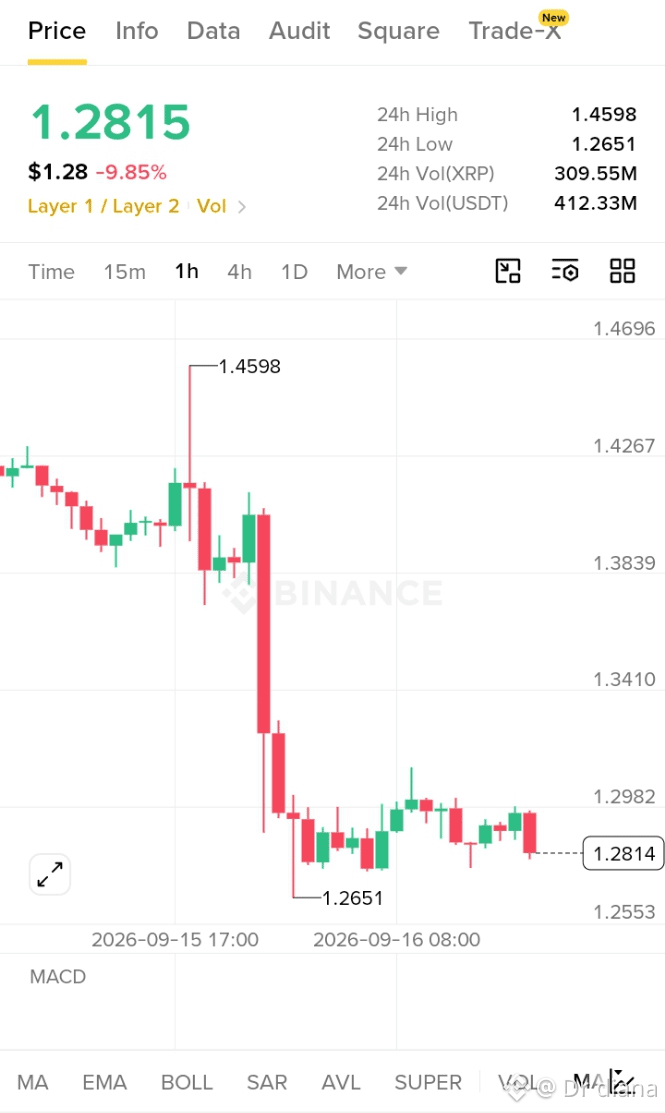
$XRP /USDT — Rebound Setup
Entry: $1.27–$1.29
TP: $1.30 / $1.32 / $1.35
SL: $1.25
$XRP is consolidating near $1.28 after a sharp 9.85% drop. If the $1.265 support holds, a short-term rebound toward $1.30–$1.35 could follow.
#Write2Earrn
$XRP /USDT — Rebound Setup
Entry: $1.27–$1.29
TP: $1.30 / $1.32 / $1.35
SL: $1.25
$XRP is consolidating near $1.28 after a sharp 9.85% drop. If the $1.265 support holds, a short-term rebound toward $1.30–$1.35 could follow.
#Write2Earrn
Entry: $1.27–$1.29
TP: $1.30 / $1.32 / $1.35
SL: $1.25
$XRP is consolidating near $1.28 after a sharp 9.85% drop. If the $1.265 support holds, a short-term rebound toward $1.30–$1.35 could follow.
#Write2Earrn
148
·
--
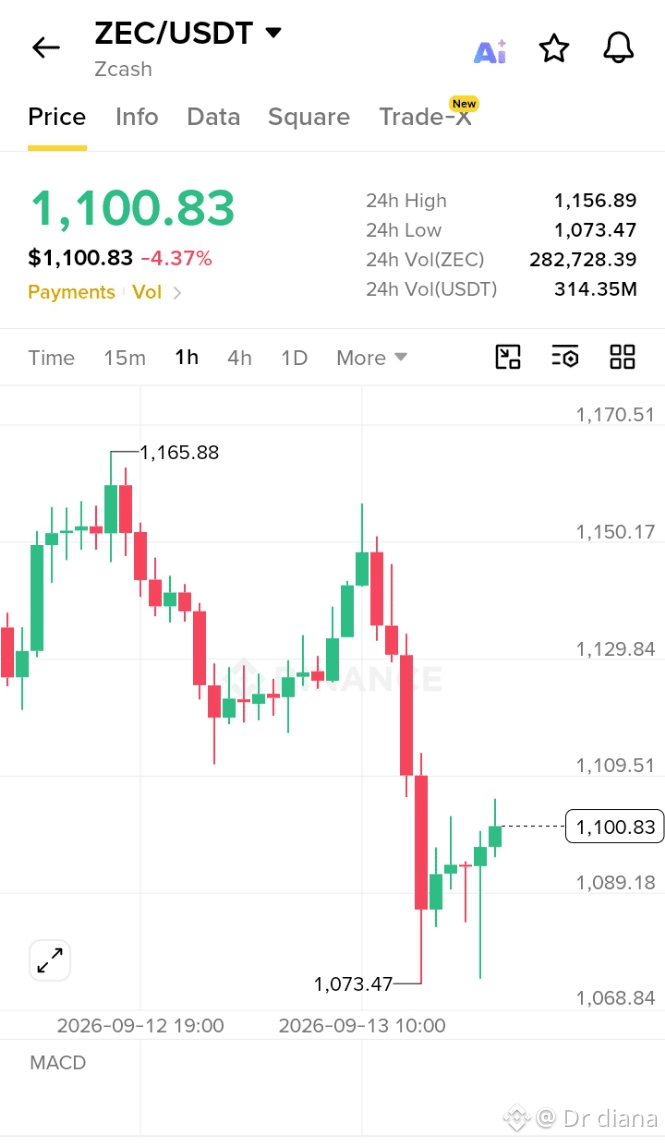
$ZEC /USDT — Quick Rebound Setup
Entry: $1,090–$1,102
TP: $1,110 / $1,130 / $1,150
SL: $1,072
$ZEC is showing a small recovery after bouncing from $1,073. If momentum continues, it may retest the $1,130 zone soon. Manage risk.
#Write2Earn
$ZEC /USDT — Quick Rebound Setup
Entry: $1,090–$1,102
TP: $1,110 / $1,130 / $1,150
SL: $1,072
$ZEC is showing a small recovery after bouncing from $1,073. If momentum continues, it may retest the $1,130 zone soon. Manage risk.
#Write2Earn
Entry: $1,090–$1,102
TP: $1,110 / $1,130 / $1,150
SL: $1,072
$ZEC is showing a small recovery after bouncing from $1,073. If momentum continues, it may retest the $1,130 zone soon. Manage risk.
#Write2Earn
312
·
--
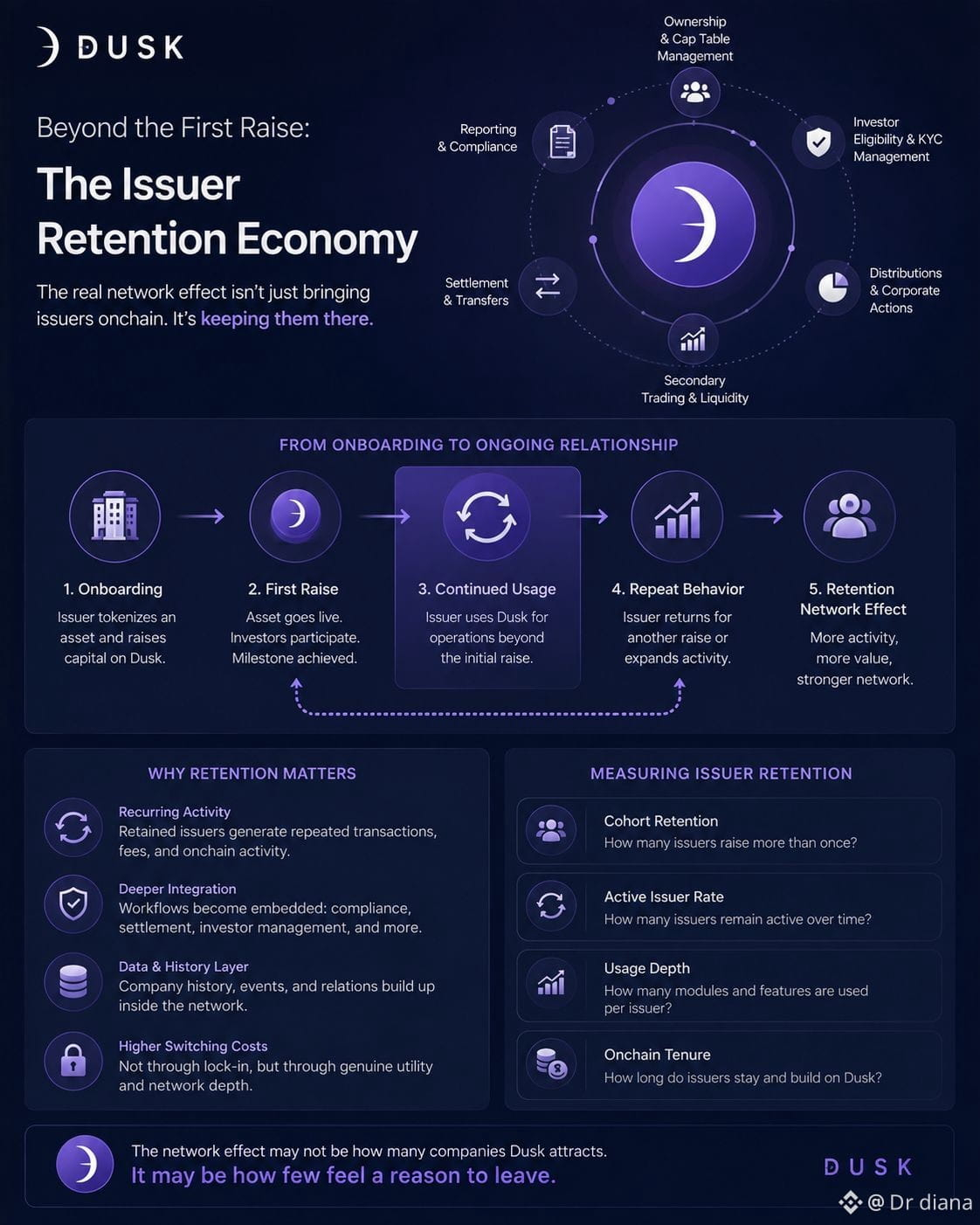
I’ve started wondering whether the first tokenization event is actually the least interesting part of an issuer’s relationship with a network. A company raises capital, the asset appears onchain, everyone counts the issuance… and then what? At first I assumed bringing more issuers onto DUSK was naturally the network effect. But maybe issuer count alone hides something.
The stronger signal might be whether those companies stay.
If an SME raises once and then keeps ownership records, investor eligibility, distributions, secondary trading, settlement and eventually another financing round inside the same Dusk infrastructure, something changes. The network is no longer just helping create an asset. It starts holding the financial history around that asset.
I think of this as an Issuer Retention Economy.
One raise is usage. A second raise from the same company is behavior.
That distinction matters because recurring issuers could create repeated transactions and fees without Dusk constantly needing to acquire completely new financial activity. But there’s an uncomfortable side too. Retention only means something if companies stay because the workflow is genuinely better. If leaving becomes difficult because data, liquidity or compliance context cannot move elsewhere, retention starts looking more like lock-in.
So I’d probably watch issuer cohorts: who raises once, who remains active, and who comes back.
The network effect may not be how many companies Dusk attracts. It may be how few feel a reason to leave.
#dusk $DUSK @Dusk_Foundation $BMT $EDEN
I’ve started wondering whether the first tokenization event is actually the least interesting part of an issuer’s relationship with a network. A company raises capital, the asset appears onchain, everyone counts the issuance… and then what? At first I assumed bringing more issuers onto DUSK was naturally the network effect. But maybe issuer count alone hides something.
The stronger signal might be whether those companies stay.
If an SME raises once and then keeps ownership records, investor eligibility, distributions, secondary trading, settlement and eventually another financing round inside the same Dusk infrastructure, something changes. The network is no longer just helping create an asset. It starts holding the financial history around that asset.
I think of this as an Issuer Retention Economy.
One raise is usage. A second raise from the same company is behavior.
That distinction matters because recurring issuers could create repeated transactions and fees without Dusk constantly needing to acquire completely new financial activity. But there’s an uncomfortable side too. Retention only means something if companies stay because the workflow is genuinely better. If leaving becomes difficult because data, liquidity or compliance context cannot move elsewhere, retention starts looking more like lock-in.
So I’d probably watch issuer cohorts: who raises once, who remains active, and who comes back.
The network effect may not be how many companies Dusk attracts. It may be how few feel a reason to leave.
#dusk $DUSK @Dusk $BMT $EDEN
The stronger signal might be whether those companies stay.
If an SME raises once and then keeps ownership records, investor eligibility, distributions, secondary trading, settlement and eventually another financing round inside the same Dusk infrastructure, something changes. The network is no longer just helping create an asset. It starts holding the financial history around that asset.
I think of this as an Issuer Retention Economy.
One raise is usage. A second raise from the same company is behavior.
That distinction matters because recurring issuers could create repeated transactions and fees without Dusk constantly needing to acquire completely new financial activity. But there’s an uncomfortable side too. Retention only means something if companies stay because the workflow is genuinely better. If leaving becomes difficult because data, liquidity or compliance context cannot move elsewhere, retention starts looking more like lock-in.
So I’d probably watch issuer cohorts: who raises once, who remains active, and who comes back.
The network effect may not be how many companies Dusk attracts. It may be how few feel a reason to leave.
#dusk $DUSK @Dusk $BMT $EDEN
5
269
·
--
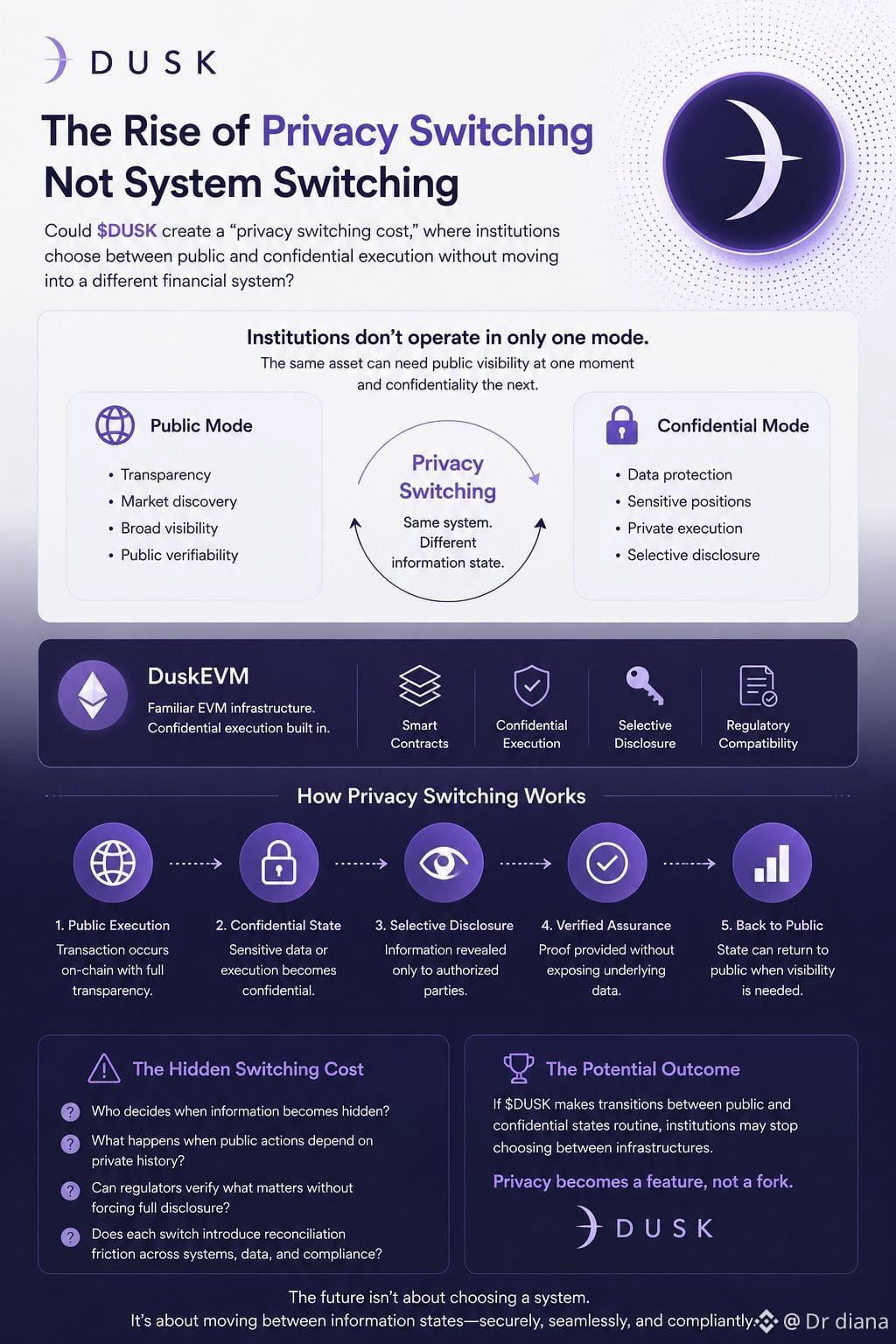
Something about privacy in finance keeps feeling backwards to me. We usually talk as if an institution has to choose what kind of system it wants first — transparent or private — and then build the workflow around that decision. But institutions rarely behave that neatly. The same asset can need public visibility at one moment and restricted information five minutes later.
That makes me wonder whether DUSK could create a kind of “privacy switching cost,” although maybe cost is the wrong word. It might actually be about the cost of not switching.
If DuskEVM lets an institution operate through familiar EVM infrastructure while confidential execution sits inside the same broader environment, then privacy starts looking less like a destination and more like a transaction state. Public when visibility helps. Confidential when investor data, positions, or sensitive execution needs protection. Then selectively disclosed when an authorized party actually needs proof.
At first that sounds like flexibility. But then again, every switch creates a boundary. Who decides when information becomes hidden? What happens when a public action depends on something that happened privately? And can regulators verify the important part without forcing the whole transaction back into disclosure?
That’s where I think the real switching cost appears.
Moving between blockchains is obvious friction. Moving between different information states without breaking ownership, compliance, liquidity, or trust is much quieter.
If DUSK can make those transitions routine, institutions may stop choosing between public and private infrastructure entirely.
But if each switch introduces another reconciliation problem, then the system hasn’t removed fragmentation. It has just moved fragmentation somewhere harder to see.
#dusk $DUSK @Dusk_Foundation $ONG $ANPA.US
Something about privacy in finance keeps feeling backwards to me. We usually talk as if an institution has to choose what kind of system it wants first — transparent or private — and then build the workflow around that decision. But institutions rarely behave that neatly. The same asset can need public visibility at one moment and restricted information five minutes later.
That makes me wonder whether DUSK could create a kind of “privacy switching cost,” although maybe cost is the wrong word. It might actually be about the cost of not switching.
If DuskEVM lets an institution operate through familiar EVM infrastructure while confidential execution sits inside the same broader environment, then privacy starts looking less like a destination and more like a transaction state. Public when visibility helps. Confidential when investor data, positions, or sensitive execution needs protection. Then selectively disclosed when an authorized party actually needs proof.
At first that sounds like flexibility. But then again, every switch creates a boundary. Who decides when information becomes hidden? What happens when a public action depends on something that happened privately? And can regulators verify the important part without forcing the whole transaction back into disclosure?
That’s where I think the real switching cost appears.
Moving between blockchains is obvious friction. Moving between different information states without breaking ownership, compliance, liquidity, or trust is much quieter.
If DUSK can make those transitions routine, institutions may stop choosing between public and private infrastructure entirely.
But if each switch introduces another reconciliation problem, then the system hasn’t removed fragmentation. It has just moved fragmentation somewhere harder to see.
#dusk $DUSK @Dusk $ONG $ANPA.US
That makes me wonder whether DUSK could create a kind of “privacy switching cost,” although maybe cost is the wrong word. It might actually be about the cost of not switching.
If DuskEVM lets an institution operate through familiar EVM infrastructure while confidential execution sits inside the same broader environment, then privacy starts looking less like a destination and more like a transaction state. Public when visibility helps. Confidential when investor data, positions, or sensitive execution needs protection. Then selectively disclosed when an authorized party actually needs proof.
At first that sounds like flexibility. But then again, every switch creates a boundary. Who decides when information becomes hidden? What happens when a public action depends on something that happened privately? And can regulators verify the important part without forcing the whole transaction back into disclosure?
That’s where I think the real switching cost appears.
Moving between blockchains is obvious friction. Moving between different information states without breaking ownership, compliance, liquidity, or trust is much quieter.
If DUSK can make those transitions routine, institutions may stop choosing between public and private infrastructure entirely.
But if each switch introduces another reconciliation problem, then the system hasn’t removed fragmentation. It has just moved fragmentation somewhere harder to see.
#dusk $DUSK @Dusk $ONG $ANPA.US
2
5
171
·
--
I keep thinking about something that sounds backwards… maybe the best way to measure whether a security is actually native to a blockchain is to count how often it has to leave it.
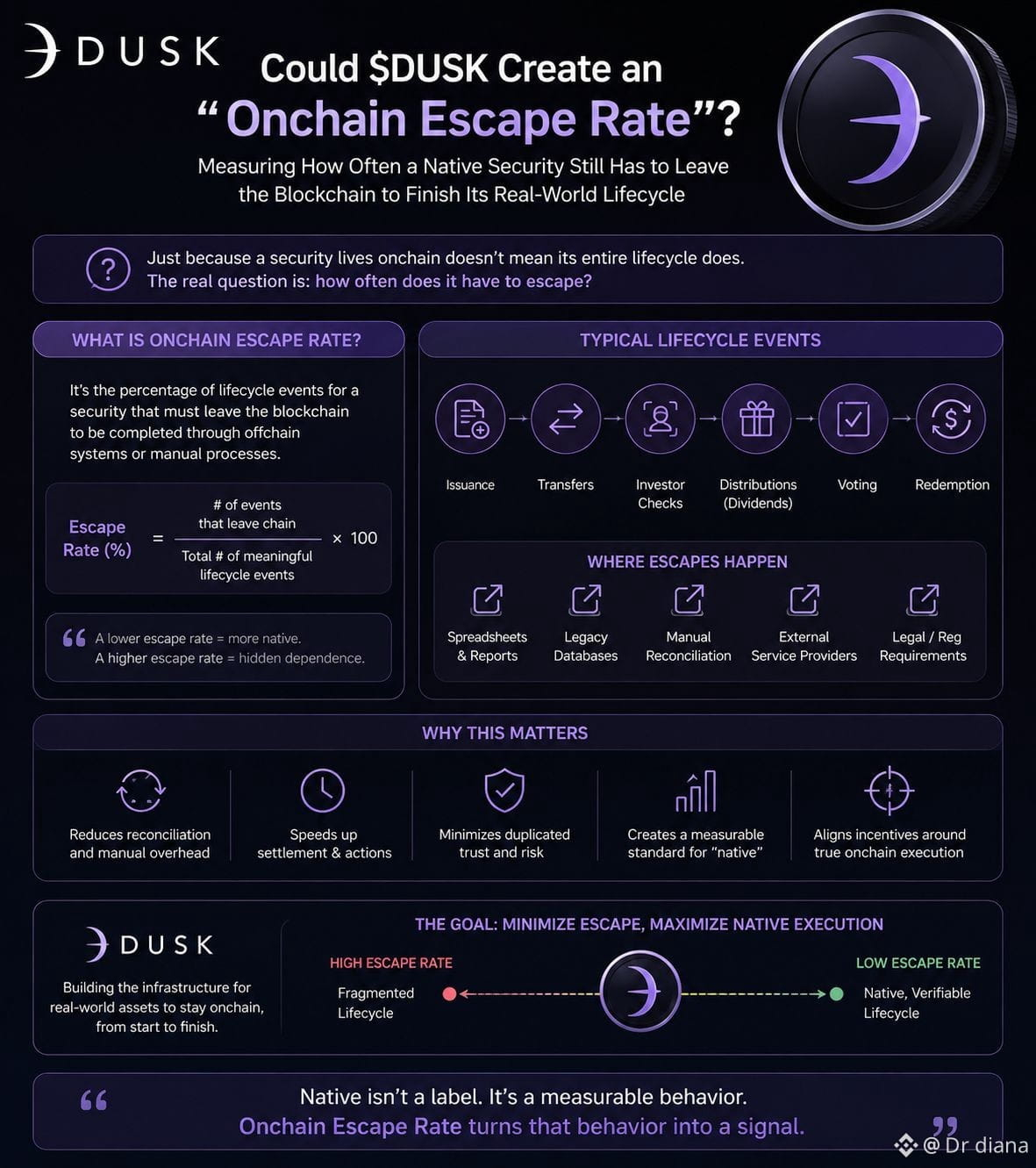
With DUSK, I’d call that the “Onchain Escape Rate.”
A security can be issued onchain, ownership recorded there, trades settled there. At first that looks native. But then a dividend happens and someone exports a spreadsheet. An investor changes status and a separate database gets updated. A corporate action needs manual reconciliation. Redemption arrives and part of the process quietly moves through legacy infrastructure.
The asset never technically left the chain. The workflow did.
That distinction keeps bothering me.
Maybe the useful metric is simple: take every meaningful lifecycle event around a security — issuance, transfers, investor checks, distributions, voting, redemption — and measure what percentage can actually finish without falling back into an external system.
A declining escape rate would probably tell me more than another headline about tokenized value. Although even that gets messy. Some offchain steps exist because law or institutions require them, not because the blockchain failed.
And forcing everything onchain just to improve the number would be meaningless.
So maybe zero escape isn’t even the goal.
The interesting question is whether DUSK can keep the parts that create reconciliation, delay and duplicated trust inside one verifiable lifecycle.
That’s where “native” stops being a label and starts becoming something measurable.
#dusk $DUSK @Dusk_Foundation $PROM $PORTAL
I keep thinking about something that sounds backwards… maybe the best way to measure whether a security is actually native to a blockchain is to count how often it has to leave it.
With DUSK, I’d call that the “Onchain Escape Rate.”
A security can be issued onchain, ownership recorded there, trades settled there. At first that looks native. But then a dividend happens and someone exports a spreadsheet. An investor changes status and a separate database gets updated. A corporate action needs manual reconciliation. Redemption arrives and part of the process quietly moves through legacy infrastructure.
The asset never technically left the chain. The workflow did.
That distinction keeps bothering me.
Maybe the useful metric is simple: take every meaningful lifecycle event around a security — issuance, transfers, investor checks, distributions, voting, redemption — and measure what percentage can actually finish without falling back into an external system.
A declining escape rate would probably tell me more than another headline about tokenized value. Although even that gets messy. Some offchain steps exist because law or institutions require them, not because the blockchain failed.
And forcing everything onchain just to improve the number would be meaningless.
So maybe zero escape isn’t even the goal.
The interesting question is whether DUSK can keep the parts that create reconciliation, delay and duplicated trust inside one verifiable lifecycle.
That’s where “native” stops being a label and starts becoming something measurable.
#dusk $DUSK @Dusk $PROM $PORTAL
With DUSK, I’d call that the “Onchain Escape Rate.”
A security can be issued onchain, ownership recorded there, trades settled there. At first that looks native. But then a dividend happens and someone exports a spreadsheet. An investor changes status and a separate database gets updated. A corporate action needs manual reconciliation. Redemption arrives and part of the process quietly moves through legacy infrastructure.
The asset never technically left the chain. The workflow did.
That distinction keeps bothering me.
Maybe the useful metric is simple: take every meaningful lifecycle event around a security — issuance, transfers, investor checks, distributions, voting, redemption — and measure what percentage can actually finish without falling back into an external system.
A declining escape rate would probably tell me more than another headline about tokenized value. Although even that gets messy. Some offchain steps exist because law or institutions require them, not because the blockchain failed.
And forcing everything onchain just to improve the number would be meaningless.
So maybe zero escape isn’t even the goal.
The interesting question is whether DUSK can keep the parts that create reconciliation, delay and duplicated trust inside one verifiable lifecycle.
That’s where “native” stops being a label and starts becoming something measurable.
#dusk $DUSK @Dusk $PROM $PORTAL
2
4
130
·
--
I keep thinking about how tokenized securities get judged at the moment they appear onchain. An issuance happens, the number looks impressive, and we count that as adoption. But then I wonder what happens to the asset six months later. Or three years later.
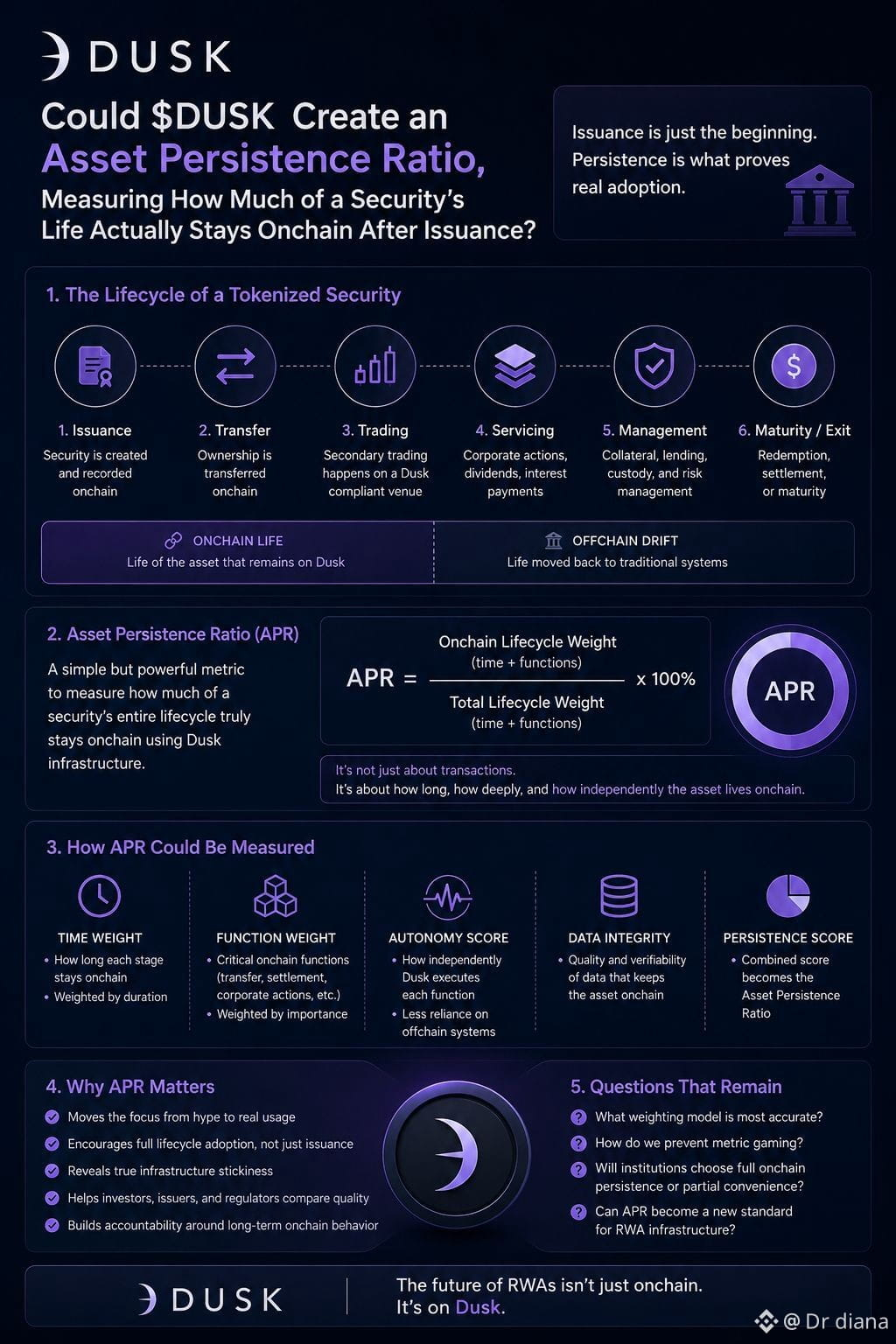
That is where an “Asset Persistence Ratio” for DUSK starts making sense to me.
A security has a surprisingly long life. It gets issued, transferred, traded, settled, maybe used as collateral, then dividends or interest get paid, ownership changes again, disclosures happen. Eventually it matures or gets redeemed. If only the first step happens onchain while everything afterward quietly moves back into databases, emails and traditional intermediaries, I’m not sure the asset was really brought onchain. Maybe its issuance was.
So the ratio I’d want to watch is something like: how much of that entire lifecycle continues using Dusk infrastructure?
At first I thought more onchain steps automatically meant more network demand. But then again, one issuance could generate thousands of transfers while another barely moves and still requires years of servicing. Counting transactions alone would distort the picture.
Maybe persistence needs to measure time and functions, not just activity.
That changes how I look at RWA adoption slightly. The important question may not be how much value enters Dusk.
It might be how rarely that value needs to leave again.
And whether institutions are actually willing to keep the difficult parts onchain is still unresolved.
#dusk $DUSK @Dusk_Foundation $TUT $ZRO
I keep thinking about how tokenized securities get judged at the moment they appear onchain. An issuance happens, the number looks impressive, and we count that as adoption. But then I wonder what happens to the asset six months later. Or three years later.
That is where an “Asset Persistence Ratio” for DUSK starts making sense to me.
A security has a surprisingly long life. It gets issued, transferred, traded, settled, maybe used as collateral, then dividends or interest get paid, ownership changes again, disclosures happen. Eventually it matures or gets redeemed. If only the first step happens onchain while everything afterward quietly moves back into databases, emails and traditional intermediaries, I’m not sure the asset was really brought onchain. Maybe its issuance was.
So the ratio I’d want to watch is something like: how much of that entire lifecycle continues using Dusk infrastructure?
At first I thought more onchain steps automatically meant more network demand. But then again, one issuance could generate thousands of transfers while another barely moves and still requires years of servicing. Counting transactions alone would distort the picture.
Maybe persistence needs to measure time and functions, not just activity.
That changes how I look at RWA adoption slightly. The important question may not be how much value enters Dusk.
It might be how rarely that value needs to leave again.
And whether institutions are actually willing to keep the difficult parts onchain is still unresolved.
#dusk $DUSK @Dusk $TUT $ZRO
That is where an “Asset Persistence Ratio” for DUSK starts making sense to me.
A security has a surprisingly long life. It gets issued, transferred, traded, settled, maybe used as collateral, then dividends or interest get paid, ownership changes again, disclosures happen. Eventually it matures or gets redeemed. If only the first step happens onchain while everything afterward quietly moves back into databases, emails and traditional intermediaries, I’m not sure the asset was really brought onchain. Maybe its issuance was.
So the ratio I’d want to watch is something like: how much of that entire lifecycle continues using Dusk infrastructure?
At first I thought more onchain steps automatically meant more network demand. But then again, one issuance could generate thousands of transfers while another barely moves and still requires years of servicing. Counting transactions alone would distort the picture.
Maybe persistence needs to measure time and functions, not just activity.
That changes how I look at RWA adoption slightly. The important question may not be how much value enters Dusk.
It might be how rarely that value needs to leave again.
And whether institutions are actually willing to keep the difficult parts onchain is still unresolved.
#dusk $DUSK @Dusk $TUT $ZRO
3
4
147
·
--
I keep thinking about how strangely we measure tokenized assets. An issuer brings €10 million of securities onchain, everyone counts the €10 million, and somehow the story almost stops there.
But a security doesn’t stop existing after issuance.
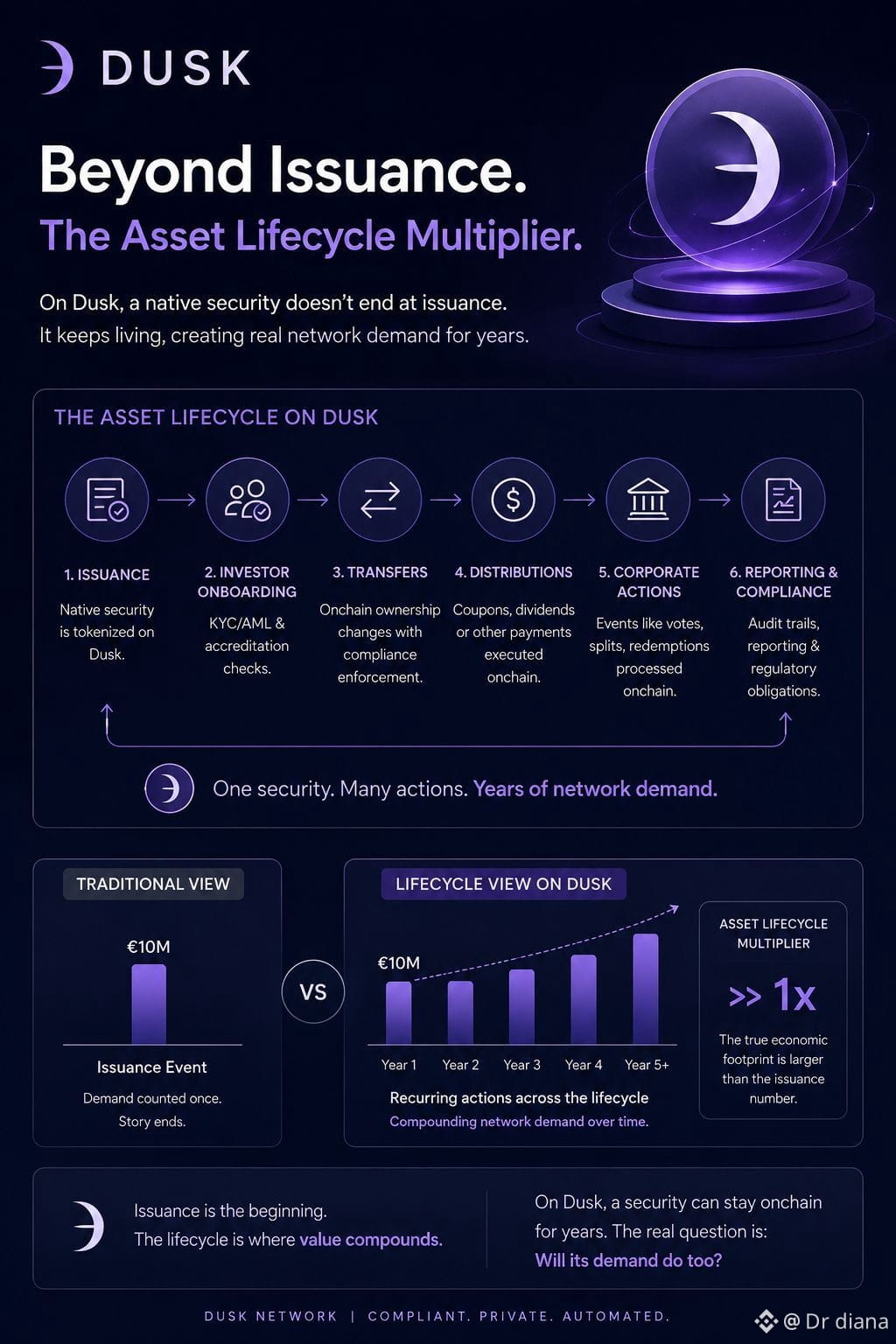
If I understand DUSK correctly, native issuance means the asset can keep living on the same infrastructure as ownership changes, investors get checked, transfers settle, distributions happen, corporate actions are processed, and eventually reporting or compliance reviews appear. One security could keep producing network activity long after the initial tokenization event.
That makes me wonder about an “Asset Lifecycle Multiplier.”
Maybe €1 of issuance isn’t really €1 of network demand. If that asset triggers 20 meaningful actions over several years, its economic footprint on the network could be much larger than the original issuance number suggests.
Although honestly, this is where I become skeptical too. Those actions only matter for DUSK if they actually remain on Dusk. If servicing, compliance, payments or reporting quietly move back into traditional systems, then the lifecycle gets fragmented and the multiplier disappears.
So maybe confirmed issuance is only the starting number.
What I’d really want to know is how much recurring activity each issued asset creates after year one, year two, year five.
One security can stay onchain for years.
Whether its demand does too feels like the harder question.
#dusk $DUSK @Dusk_Foundation $TRUMP $MOVE
I keep thinking about how strangely we measure tokenized assets. An issuer brings €10 million of securities onchain, everyone counts the €10 million, and somehow the story almost stops there.
But a security doesn’t stop existing after issuance.
If I understand DUSK correctly, native issuance means the asset can keep living on the same infrastructure as ownership changes, investors get checked, transfers settle, distributions happen, corporate actions are processed, and eventually reporting or compliance reviews appear. One security could keep producing network activity long after the initial tokenization event.
That makes me wonder about an “Asset Lifecycle Multiplier.”
Maybe €1 of issuance isn’t really €1 of network demand. If that asset triggers 20 meaningful actions over several years, its economic footprint on the network could be much larger than the original issuance number suggests.
Although honestly, this is where I become skeptical too. Those actions only matter for DUSK if they actually remain on Dusk. If servicing, compliance, payments or reporting quietly move back into traditional systems, then the lifecycle gets fragmented and the multiplier disappears.
So maybe confirmed issuance is only the starting number.
What I’d really want to know is how much recurring activity each issued asset creates after year one, year two, year five.
One security can stay onchain for years.
Whether its demand does too feels like the harder question.
#dusk $DUSK @Dusk $TRUMP $MOVE
But a security doesn’t stop existing after issuance.
If I understand DUSK correctly, native issuance means the asset can keep living on the same infrastructure as ownership changes, investors get checked, transfers settle, distributions happen, corporate actions are processed, and eventually reporting or compliance reviews appear. One security could keep producing network activity long after the initial tokenization event.
That makes me wonder about an “Asset Lifecycle Multiplier.”
Maybe €1 of issuance isn’t really €1 of network demand. If that asset triggers 20 meaningful actions over several years, its economic footprint on the network could be much larger than the original issuance number suggests.
Although honestly, this is where I become skeptical too. Those actions only matter for DUSK if they actually remain on Dusk. If servicing, compliance, payments or reporting quietly move back into traditional systems, then the lifecycle gets fragmented and the multiplier disappears.
So maybe confirmed issuance is only the starting number.
What I’d really want to know is how much recurring activity each issued asset creates after year one, year two, year five.
One security can stay onchain for years.
Whether its demand does too feels like the harder question.
#dusk $DUSK @Dusk $TRUMP $MOVE
7
8
293
·
--
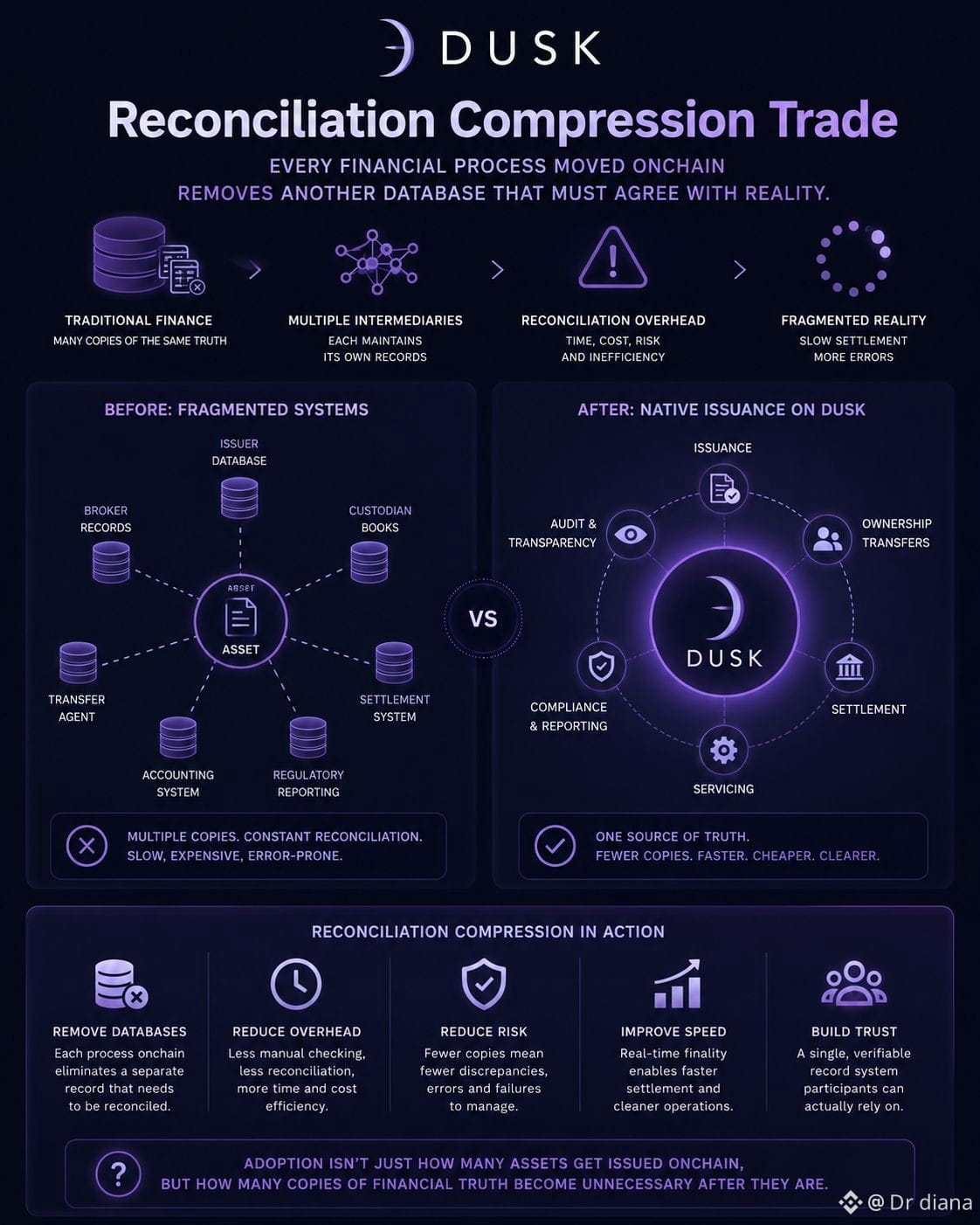
I keep thinking about how strange ownership still is in traditional finance. One asset can somehow exist as the “same” asset across an issuer database, broker records, custodian books, transfer-agent systems, settlement infrastructure… and then everyone spends time making sure those copies still agree.
At first I thought native issuance on DUSK was mostly another tokenization story. Put the security onchain, make transfers cleaner. But if I think about it carefully, the more interesting part might be what disappears around the asset.
If issuance, ownership transfers, settlement and eventually servicing happen against the same underlying ledger, then each process moved there potentially removes another reconciliation point. Not another middleman necessarily. More like another version of reality that has to be checked against every other version.
That feels like a reconciliation compression trade.
And I think the distinction matters. Tokenizing something while the authoritative ownership record still lives somewhere else can actually add another database. Native issuance is more interesting only if the chain becomes the record participants are actually willing to trust.
Still, something feels unresolved. Institutions won’t suddenly delete internal systems because a ledger exists. Compliance records, accounting, cash movements and regulatory reporting can remain fragmented offchain.
So maybe the real adoption metric for DUSK isn’t simply how many assets get issued.
It might be how many separate copies of financial truth become unnecessary after they are.
#dusk $DUSK @Dusk_Foundation $HEMI $ONG
I keep thinking about how strange ownership still is in traditional finance. One asset can somehow exist as the “same” asset across an issuer database, broker records, custodian books, transfer-agent systems, settlement infrastructure… and then everyone spends time making sure those copies still agree.
At first I thought native issuance on DUSK was mostly another tokenization story. Put the security onchain, make transfers cleaner. But if I think about it carefully, the more interesting part might be what disappears around the asset.
If issuance, ownership transfers, settlement and eventually servicing happen against the same underlying ledger, then each process moved there potentially removes another reconciliation point. Not another middleman necessarily. More like another version of reality that has to be checked against every other version.
That feels like a reconciliation compression trade.
And I think the distinction matters. Tokenizing something while the authoritative ownership record still lives somewhere else can actually add another database. Native issuance is more interesting only if the chain becomes the record participants are actually willing to trust.
Still, something feels unresolved. Institutions won’t suddenly delete internal systems because a ledger exists. Compliance records, accounting, cash movements and regulatory reporting can remain fragmented offchain.
So maybe the real adoption metric for DUSK isn’t simply how many assets get issued.
It might be how many separate copies of financial truth become unnecessary after they are.
#dusk $DUSK @Dusk $HEMI $ONG
At first I thought native issuance on DUSK was mostly another tokenization story. Put the security onchain, make transfers cleaner. But if I think about it carefully, the more interesting part might be what disappears around the asset.
If issuance, ownership transfers, settlement and eventually servicing happen against the same underlying ledger, then each process moved there potentially removes another reconciliation point. Not another middleman necessarily. More like another version of reality that has to be checked against every other version.
That feels like a reconciliation compression trade.
And I think the distinction matters. Tokenizing something while the authoritative ownership record still lives somewhere else can actually add another database. Native issuance is more interesting only if the chain becomes the record participants are actually willing to trust.
Still, something feels unresolved. Institutions won’t suddenly delete internal systems because a ledger exists. Compliance records, accounting, cash movements and regulatory reporting can remain fragmented offchain.
So maybe the real adoption metric for DUSK isn’t simply how many assets get issued.
It might be how many separate copies of financial truth become unnecessary after they are.
#dusk $DUSK @Dusk $HEMI $ONG
17
6
314
·
--
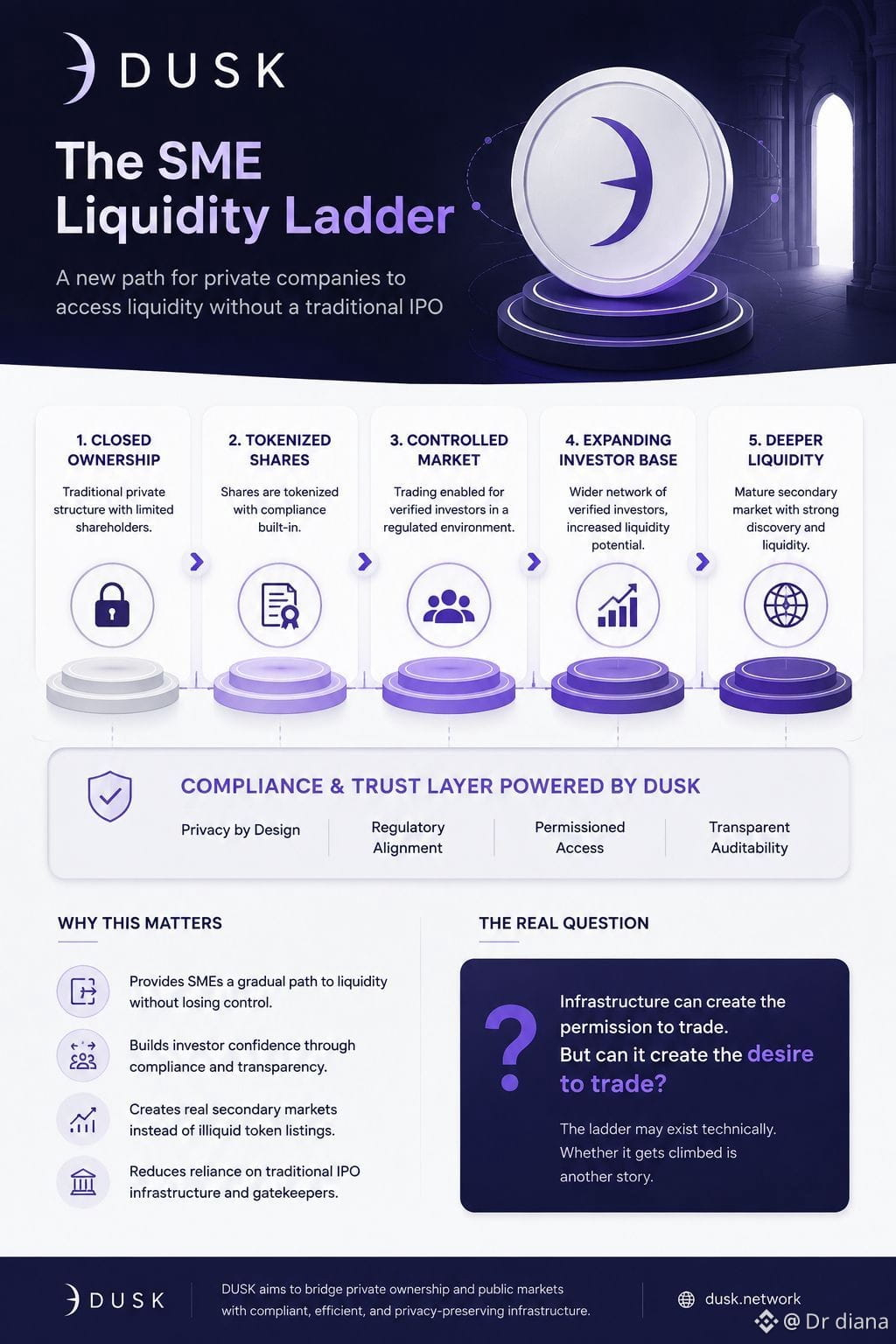
I keep thinking about how strange the jump from private company to public market actually is. A business can spend years with a small, closed shareholder base, then suddenly an IPO asks it to behave like something built for constant public ownership and liquidity. There isn’t much of a middle state.
That’s why I’m curious about whether DUSK could create something closer to an SME liquidity ladder.
The way I understand it, a private company wouldn’t necessarily need to jump straight from closed ownership into a fully public market. It could tokenize shares, let verified investors access them, keep transfers inside compliance rules, then gradually widen that investor network. Ownership becomes more liquid without becoming completely open.
But then again, liquidity doesn’t appear just because shares become transferable.
That distinction bothers me. Infrastructure can create the permission to trade. It can’t create the desire to trade.
If an SME moves from 20 shareholders to 200, then 2,000 verified investors, the interesting signal isn’t simply how many wallets are eligible. It’s whether secondary transactions repeat, whether buyers return, whether sellers can exit without destroying price discovery.
Maybe that creates a new path: private company → controlled market → deeper regulated liquidity, without the traditional IPO being the inevitable destination.
Still, if investor demand remains thin, the ladder exists technically while nobody really climbs it. And I think that’s the part worth watching.
#dusk $DUSK @Dusk_Foundation $RE $TRUMP
I keep thinking about how strange the jump from private company to public market actually is. A business can spend years with a small, closed shareholder base, then suddenly an IPO asks it to behave like something built for constant public ownership and liquidity. There isn’t much of a middle state.
That’s why I’m curious about whether DUSK could create something closer to an SME liquidity ladder.
The way I understand it, a private company wouldn’t necessarily need to jump straight from closed ownership into a fully public market. It could tokenize shares, let verified investors access them, keep transfers inside compliance rules, then gradually widen that investor network. Ownership becomes more liquid without becoming completely open.
But then again, liquidity doesn’t appear just because shares become transferable.
That distinction bothers me. Infrastructure can create the permission to trade. It can’t create the desire to trade.
If an SME moves from 20 shareholders to 200, then 2,000 verified investors, the interesting signal isn’t simply how many wallets are eligible. It’s whether secondary transactions repeat, whether buyers return, whether sellers can exit without destroying price discovery.
Maybe that creates a new path: private company → controlled market → deeper regulated liquidity, without the traditional IPO being the inevitable destination.
Still, if investor demand remains thin, the ladder exists technically while nobody really climbs it. And I think that’s the part worth watching.
#dusk $DUSK @Dusk $RE $TRUMP
That’s why I’m curious about whether DUSK could create something closer to an SME liquidity ladder.
The way I understand it, a private company wouldn’t necessarily need to jump straight from closed ownership into a fully public market. It could tokenize shares, let verified investors access them, keep transfers inside compliance rules, then gradually widen that investor network. Ownership becomes more liquid without becoming completely open.
But then again, liquidity doesn’t appear just because shares become transferable.
That distinction bothers me. Infrastructure can create the permission to trade. It can’t create the desire to trade.
If an SME moves from 20 shareholders to 200, then 2,000 verified investors, the interesting signal isn’t simply how many wallets are eligible. It’s whether secondary transactions repeat, whether buyers return, whether sellers can exit without destroying price discovery.
Maybe that creates a new path: private company → controlled market → deeper regulated liquidity, without the traditional IPO being the inevitable destination.
Still, if investor demand remains thin, the ladder exists technically while nobody really climbs it. And I think that’s the part worth watching.
#dusk $DUSK @Dusk $RE $TRUMP
18
10
125
·
--
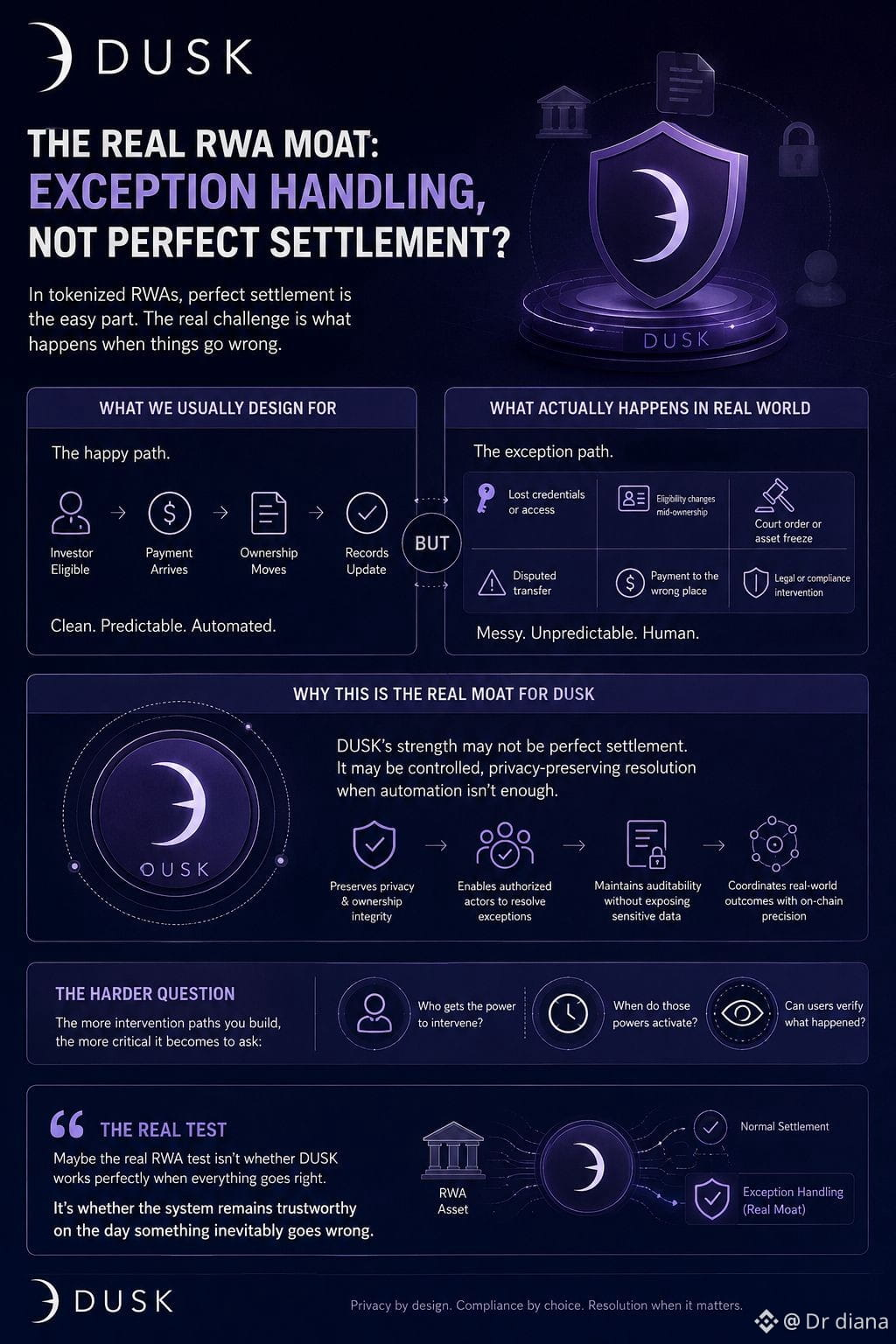
I keep thinking about something slightly uncomfortable with tokenized RWAs. We spend so much time designing settlement for the moment when everything goes right. Buyer is eligible, payment arrives, ownership moves, records update. Clean.
But real finance seems mostly built around what happens when something doesn’t go cleanly.
That’s where I’m starting to see a different possible moat for $DUSK. Maybe perfect settlement is almost the easy part. The harder infrastructure is what happens when an investor loses credentials, eligibility changes halfway through ownership, a court freezes an asset, someone disputes a transfer, or a payment reaches the wrong place.
At first I thought blockchain should remove these exceptions. But then again, regulated assets probably can’t. They carry legal consequences outside the chain. Code can make ownership precise, but it cannot make the messy world producing that ownership disappear.
So exception handling becomes strangely important.
If $DUSK can preserve privacy and ownership integrity while still giving authorized actors a controlled way to resolve these situations, the network starts doing something more difficult than simply automating transactions. It starts coordinating what happens when automation is no longer enough.
Although honestly, that creates another problem. The more intervention paths you build, the more carefully you have to ask who gets those powers, when they activate, and whether users can actually verify what happened.
Maybe the real RWA test isn’t whether $DUSK works perfectly.
It’s whether the system remains trustworthy on the day something inevitably goes wrong.
#dusk $DUSK @Dusk_Foundation
I keep thinking about something slightly uncomfortable with tokenized RWAs. We spend so much time designing settlement for the moment when everything goes right. Buyer is eligible, payment arrives, ownership moves, records update. Clean.
But real finance seems mostly built around what happens when something doesn’t go cleanly.
That’s where I’m starting to see a different possible moat for $DUSK . Maybe perfect settlement is almost the easy part. The harder infrastructure is what happens when an investor loses credentials, eligibility changes halfway through ownership, a court freezes an asset, someone disputes a transfer, or a payment reaches the wrong place.
At first I thought blockchain should remove these exceptions. But then again, regulated assets probably can’t. They carry legal consequences outside the chain. Code can make ownership precise, but it cannot make the messy world producing that ownership disappear.
So exception handling becomes strangely important.
If $DUSK can preserve privacy and ownership integrity while still giving authorized actors a controlled way to resolve these situations, the network starts doing something more difficult than simply automating transactions. It starts coordinating what happens when automation is no longer enough.
Although honestly, that creates another problem. The more intervention paths you build, the more carefully you have to ask who gets those powers, when they activate, and whether users can actually verify what happened.
Maybe the real RWA test isn’t whether $DUSK works perfectly.
It’s whether the system remains trustworthy on the day something inevitably goes wrong.
#dusk $DUSK @Dusk
But real finance seems mostly built around what happens when something doesn’t go cleanly.
That’s where I’m starting to see a different possible moat for $DUSK . Maybe perfect settlement is almost the easy part. The harder infrastructure is what happens when an investor loses credentials, eligibility changes halfway through ownership, a court freezes an asset, someone disputes a transfer, or a payment reaches the wrong place.
At first I thought blockchain should remove these exceptions. But then again, regulated assets probably can’t. They carry legal consequences outside the chain. Code can make ownership precise, but it cannot make the messy world producing that ownership disappear.
So exception handling becomes strangely important.
If $DUSK can preserve privacy and ownership integrity while still giving authorized actors a controlled way to resolve these situations, the network starts doing something more difficult than simply automating transactions. It starts coordinating what happens when automation is no longer enough.
Although honestly, that creates another problem. The more intervention paths you build, the more carefully you have to ask who gets those powers, when they activate, and whether users can actually verify what happened.
Maybe the real RWA test isn’t whether $DUSK works perfectly.
It’s whether the system remains trustworthy on the day something inevitably goes wrong.
#dusk $DUSK @Dusk
22
10
132
·
--
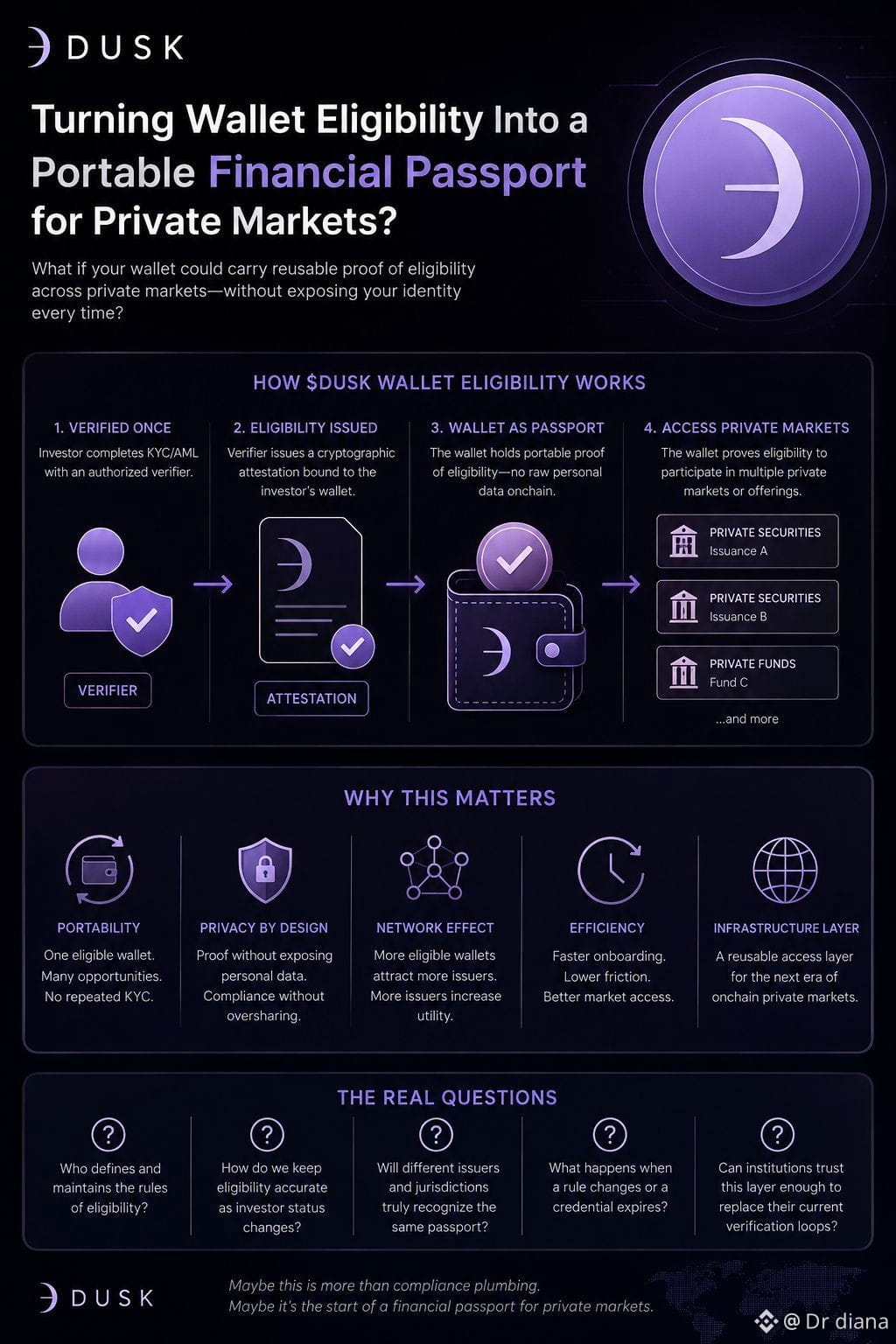
I keep thinking about how strange identity still feels in private markets. You prove who you are, prove you’re allowed to invest, then move to another asset and somehow much of that process starts again. Maybe that repetition is necessary. But it also feels like infrastructure that never really learned how to remember trust.
That’s where DUSK’s wallet eligibility idea gets interesting to me. The way I understand it, an investor could have their eligibility connected to a wallet, so the network can check whether that wallet is allowed to interact with a regulated asset without putting all the underlying personal information onchain.
At first I saw this mostly as compliance plumbing. Now I’m wondering if the more important thing is portability.
If one verified wallet can move between different private securities, issuers and markets while carrying usable proof of eligibility, then the wallet starts behaving almost like a financial passport. Not identity itself. More like reusable permission.
But then again, who decides how portable that permission actually is?
Different issuers have different rules. Jurisdictions change. Investor status can expire. A proof accepted for one security may mean very little for another. Suddenly the difficult part isn’t proving eligibility once, it’s keeping that eligibility accurate while many markets depend on it.
And that creates an interesting network effect. More eligible wallets could make new issuances easier to distribute, which attracts more issuers, which gives those wallets more places to participate.
Maybe DUSK isn’t only trying to put private assets onchain. It could be building a reusable access layer around them.
Whether institutions actually trust that access enough to stop repeating their old verification processes is where I’m still unsure.
#dusk $DUSK @Dusk_Foundation $RED
{spot}(REDUSDT)
I keep thinking about how strange identity still feels in private markets. You prove who you are, prove you’re allowed to invest, then move to another asset and somehow much of that process starts again. Maybe that repetition is necessary. But it also feels like infrastructure that never really learned how to remember trust.
That’s where DUSK’s wallet eligibility idea gets interesting to me. The way I understand it, an investor could have their eligibility connected to a wallet, so the network can check whether that wallet is allowed to interact with a regulated asset without putting all the underlying personal information onchain.
At first I saw this mostly as compliance plumbing. Now I’m wondering if the more important thing is portability.
If one verified wallet can move between different private securities, issuers and markets while carrying usable proof of eligibility, then the wallet starts behaving almost like a financial passport. Not identity itself. More like reusable permission.
But then again, who decides how portable that permission actually is?
Different issuers have different rules. Jurisdictions change. Investor status can expire. A proof accepted for one security may mean very little for another. Suddenly the difficult part isn’t proving eligibility once, it’s keeping that eligibility accurate while many markets depend on it.
And that creates an interesting network effect. More eligible wallets could make new issuances easier to distribute, which attracts more issuers, which gives those wallets more places to participate.
Maybe DUSK isn’t only trying to put private assets onchain. It could be building a reusable access layer around them.
Whether institutions actually trust that access enough to stop repeating their old verification processes is where I’m still unsure.
#dusk $DUSK @Dusk $RED
That’s where DUSK’s wallet eligibility idea gets interesting to me. The way I understand it, an investor could have their eligibility connected to a wallet, so the network can check whether that wallet is allowed to interact with a regulated asset without putting all the underlying personal information onchain.
At first I saw this mostly as compliance plumbing. Now I’m wondering if the more important thing is portability.
If one verified wallet can move between different private securities, issuers and markets while carrying usable proof of eligibility, then the wallet starts behaving almost like a financial passport. Not identity itself. More like reusable permission.
But then again, who decides how portable that permission actually is?
Different issuers have different rules. Jurisdictions change. Investor status can expire. A proof accepted for one security may mean very little for another. Suddenly the difficult part isn’t proving eligibility once, it’s keeping that eligibility accurate while many markets depend on it.
And that creates an interesting network effect. More eligible wallets could make new issuances easier to distribute, which attracts more issuers, which gives those wallets more places to participate.
Maybe DUSK isn’t only trying to put private assets onchain. It could be building a reusable access layer around them.
Whether institutions actually trust that access enough to stop repeating their old verification processes is where I’m still unsure.
#dusk $DUSK @Dusk $RED
27
12
122
·
--
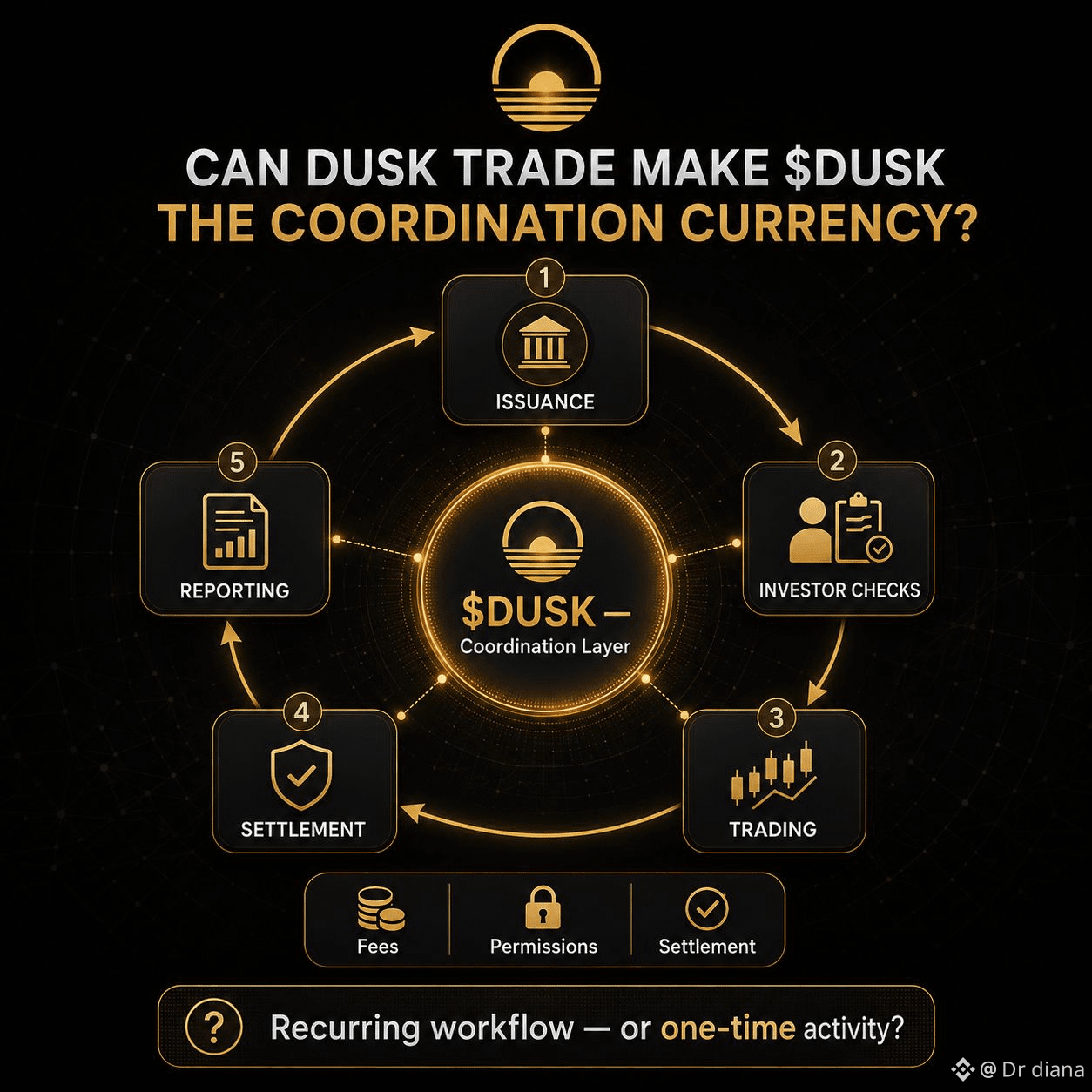
I keep thinking about what “coordination currency” actually means here, because calling DUSK the gas token for Dusk Trade feels too narrow. A securities workflow is not one action. It is issuance, investor checks, trading, settlement, reporting, and sometimes restrictions on who can hold what. Usually those steps sit across different companies, databases, and approval processes that barely talk to each other.
Dusk Trade seems to be saying those separate movements can happen inside one shared system. If that works, DUSK may not just pay for transactions. It could become the common economic layer connecting every participant who needs the workflow to keep moving.
But then again, coordination only creates durable token demand if activity repeats. One tokenized issuance might look impressive, yet the more important question is whether investors keep trading, issuers keep reporting, and institutions keep settling through the same network after the launch attention disappears. Otherwise DUSK risks coordinating announcements more than actual securities activity.
What also bothers me is that regulated markets cannot remove human decisions entirely. Someone still defines eligibility, approves disclosures, responds to disputes, and updates rules. Moving those instructions into code may reduce friction, but it also concentrates importance around whoever controls the permissions and data feeding the system.
So maybe the real test for Dusk Trade is not how many assets it lists. It is whether one asset produces a continuing chain of fees, checks, trades, and settlements that repeatedly returns to DUSK. The workflow sounds unified on paper. Whether its economic value actually accumulates in the token still feels unresolved.
{spot}(PORTALUSDT)
#dusk $DUSK @Dusk_Foundation $GPS $PORTAL
I keep thinking about what “coordination currency” actually means here, because calling DUSK the gas token for Dusk Trade feels too narrow. A securities workflow is not one action. It is issuance, investor checks, trading, settlement, reporting, and sometimes restrictions on who can hold what. Usually those steps sit across different companies, databases, and approval processes that barely talk to each other.
Dusk Trade seems to be saying those separate movements can happen inside one shared system. If that works, DUSK may not just pay for transactions. It could become the common economic layer connecting every participant who needs the workflow to keep moving.
But then again, coordination only creates durable token demand if activity repeats. One tokenized issuance might look impressive, yet the more important question is whether investors keep trading, issuers keep reporting, and institutions keep settling through the same network after the launch attention disappears. Otherwise DUSK risks coordinating announcements more than actual securities activity.
What also bothers me is that regulated markets cannot remove human decisions entirely. Someone still defines eligibility, approves disclosures, responds to disputes, and updates rules. Moving those instructions into code may reduce friction, but it also concentrates importance around whoever controls the permissions and data feeding the system.
So maybe the real test for Dusk Trade is not how many assets it lists. It is whether one asset produces a continuing chain of fees, checks, trades, and settlements that repeatedly returns to DUSK. The workflow sounds unified on paper. Whether its economic value actually accumulates in the token still feels unresolved.
#dusk $DUSK @Dusk $GPS $PORTAL
Dusk Trade seems to be saying those separate movements can happen inside one shared system. If that works, DUSK may not just pay for transactions. It could become the common economic layer connecting every participant who needs the workflow to keep moving.
But then again, coordination only creates durable token demand if activity repeats. One tokenized issuance might look impressive, yet the more important question is whether investors keep trading, issuers keep reporting, and institutions keep settling through the same network after the launch attention disappears. Otherwise DUSK risks coordinating announcements more than actual securities activity.
What also bothers me is that regulated markets cannot remove human decisions entirely. Someone still defines eligibility, approves disclosures, responds to disputes, and updates rules. Moving those instructions into code may reduce friction, but it also concentrates importance around whoever controls the permissions and data feeding the system.
So maybe the real test for Dusk Trade is not how many assets it lists. It is whether one asset produces a continuing chain of fees, checks, trades, and settlements that repeatedly returns to DUSK. The workflow sounds unified on paper. Whether its economic value actually accumulates in the token still feels unresolved.
#dusk $DUSK @Dusk $GPS $PORTAL
28
10
180
·
--
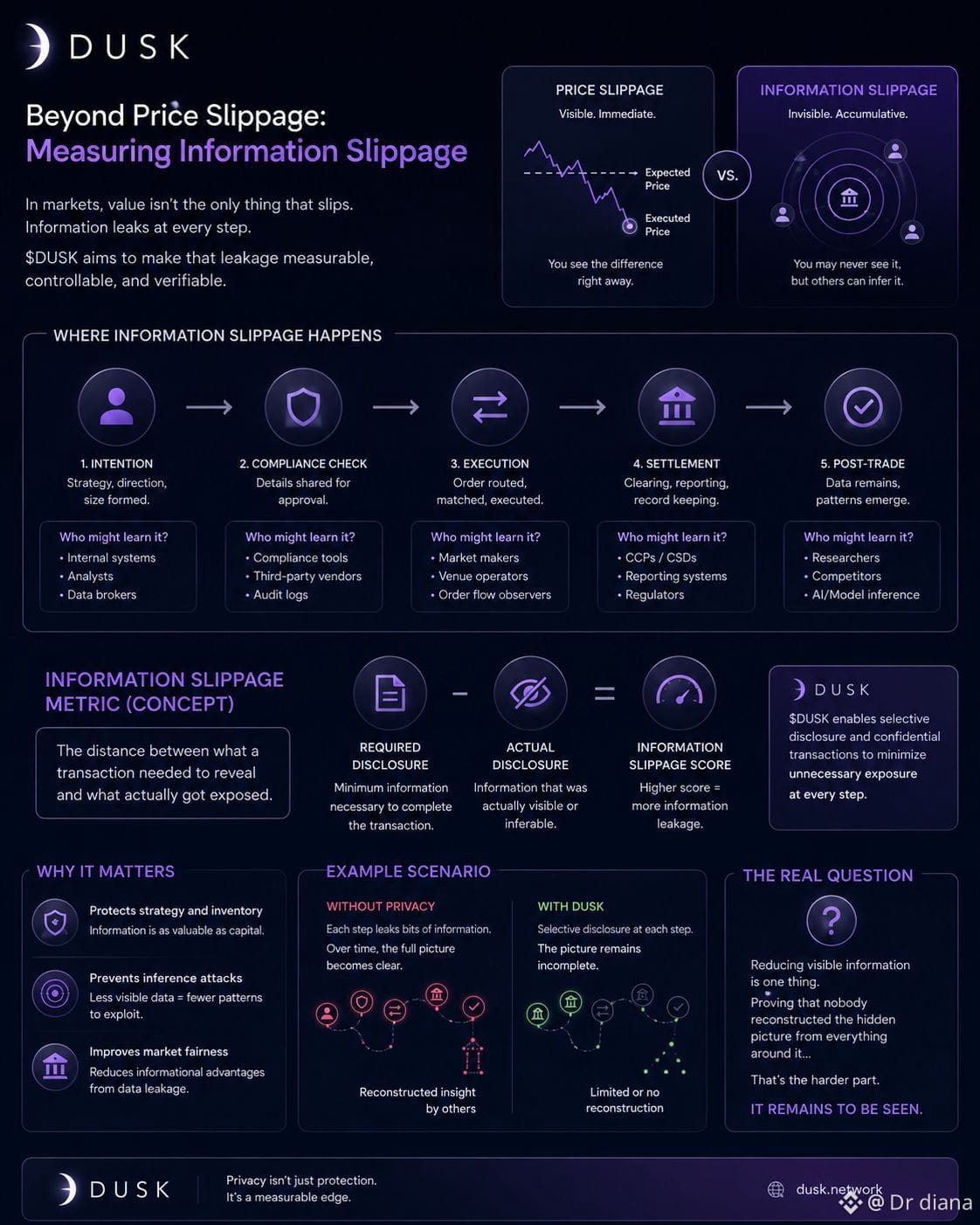
I keep thinking about slippage as something we only notice in price. You try to buy at one level, execution happens somewhere worse, and the difference becomes visible immediately. But institutional markets seem to have another kind of slippage that rarely appears on a chart.
Information leaks while the transaction is moving.
With $DUSK, selective disclosure and confidential transactions make me wonder if that leakage could actually become measurable. Imagine an institution moving from trade intention → compliance check → execution → settlement. At each step, another participant or system might learn something: identity, position size, counterparties, timing, maybe even future intent.
So maybe “information slippage” is the distance between what a transaction needed to reveal and what it actually exposed.
That feels more interesting than simply calling something private.
A trade could settle perfectly while still leaking enough information for someone else to infer inventory or strategy. And oddly, the biggest transaction may not create the biggest leakage. Repeated smaller actions could slowly reconstruct the same picture.
But then again, measuring this becomes uncomfortable. How do you quantify information that should never have escaped in the first place?
Maybe DUSK could eventually make privacy measurable through disclosure surface per transaction, rather than treating confidentiality as yes/no.
Still, reducing visible information is one thing. Proving that nobody reconstructed the hidden picture from everything around it feels much harder.
#dusk $DUSK @Dusk_Foundation $HEMI $DOLO
I keep thinking about slippage as something we only notice in price. You try to buy at one level, execution happens somewhere worse, and the difference becomes visible immediately. But institutional markets seem to have another kind of slippage that rarely appears on a chart.
Information leaks while the transaction is moving.
With $DUSK , selective disclosure and confidential transactions make me wonder if that leakage could actually become measurable. Imagine an institution moving from trade intention → compliance check → execution → settlement. At each step, another participant or system might learn something: identity, position size, counterparties, timing, maybe even future intent.
So maybe “information slippage” is the distance between what a transaction needed to reveal and what it actually exposed.
That feels more interesting than simply calling something private.
A trade could settle perfectly while still leaking enough information for someone else to infer inventory or strategy. And oddly, the biggest transaction may not create the biggest leakage. Repeated smaller actions could slowly reconstruct the same picture.
But then again, measuring this becomes uncomfortable. How do you quantify information that should never have escaped in the first place?
Maybe DUSK could eventually make privacy measurable through disclosure surface per transaction, rather than treating confidentiality as yes/no.
Still, reducing visible information is one thing. Proving that nobody reconstructed the hidden picture from everything around it feels much harder.
#dusk $DUSK @Dusk $HEMI $DOLO
Information leaks while the transaction is moving.
With $DUSK , selective disclosure and confidential transactions make me wonder if that leakage could actually become measurable. Imagine an institution moving from trade intention → compliance check → execution → settlement. At each step, another participant or system might learn something: identity, position size, counterparties, timing, maybe even future intent.
So maybe “information slippage” is the distance between what a transaction needed to reveal and what it actually exposed.
That feels more interesting than simply calling something private.
A trade could settle perfectly while still leaking enough information for someone else to infer inventory or strategy. And oddly, the biggest transaction may not create the biggest leakage. Repeated smaller actions could slowly reconstruct the same picture.
But then again, measuring this becomes uncomfortable. How do you quantify information that should never have escaped in the first place?
Maybe DUSK could eventually make privacy measurable through disclosure surface per transaction, rather than treating confidentiality as yes/no.
Still, reducing visible information is one thing. Proving that nobody reconstructed the hidden picture from everything around it feels much harder.
#dusk $DUSK @Dusk $HEMI $DOLO
50
14
174
·
--
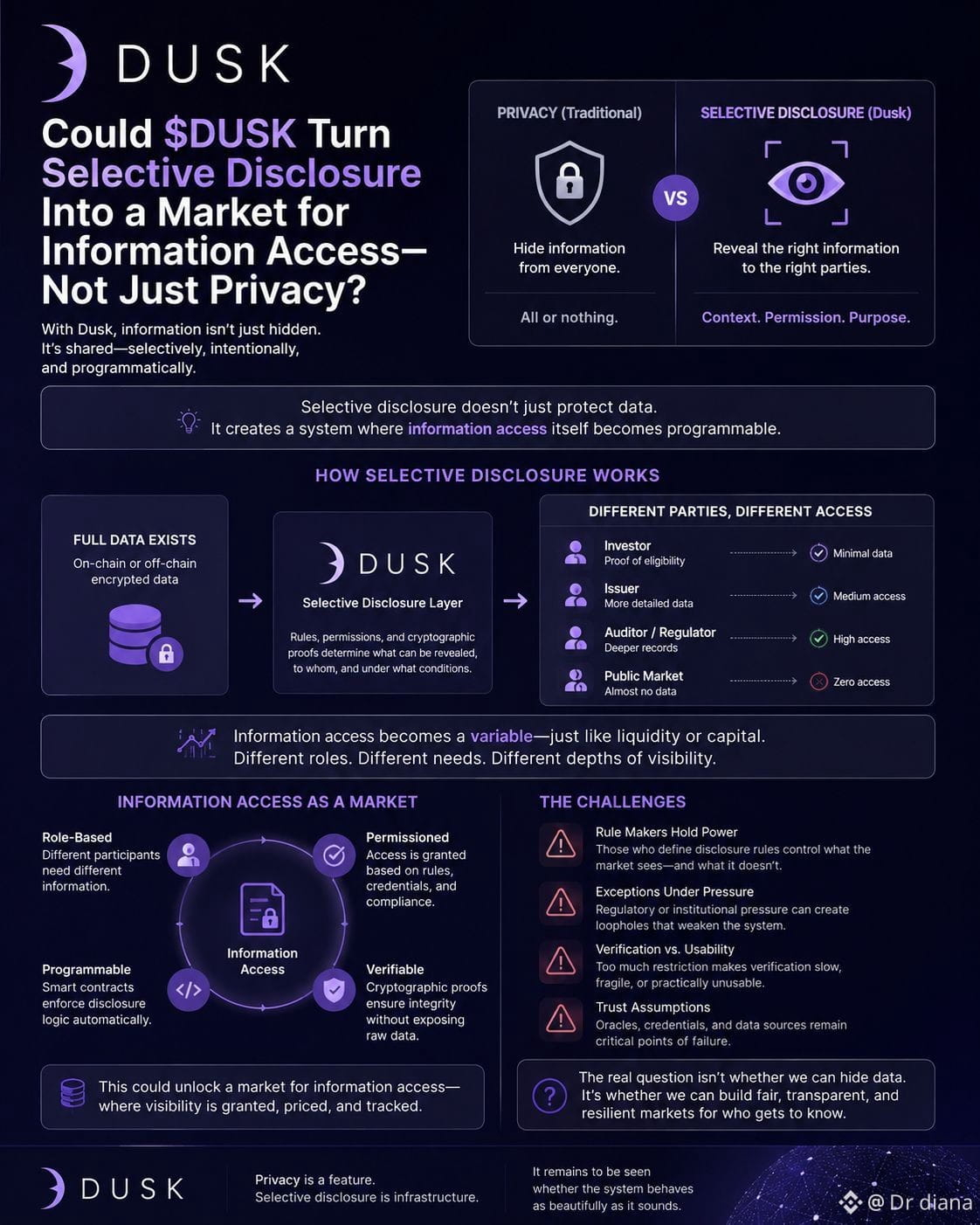
I keep thinking about whether we describe selective disclosure too narrowly.
With $DUSK, the obvious explanation is privacy. Keep sensitive transaction or identity data hidden, then reveal what is necessary when compliance or supervision requires it. At first that sounds like a better privacy system. But if I think about it carefully, something else is happening underneath.
Information itself is getting permissions.
An investor might only need proof that another participant is eligible. An issuer needs more. An auditor may need deeper records. The wider market probably needs almost none of that. So the same asset can exist inside several different information environments at once.
“privacy hides information. selective disclosure decides who gets to know.”
That distinction feels bigger than I initially thought.
Because once access becomes programmable, maybe information starts behaving almost like liquidity. Different participants receive different depths of visibility depending on their role, credentials or legal requirement.
But then again, this creates another problem. Whoever defines those disclosure rules quietly gains a lot of power. Bad permissions could expose too much, while overly restrictive ones could make verification slow or practically useless.
And under institutional pressure, exceptions always appear.
So maybe Dusk isn't only testing whether regulated markets can remain private. The harder question is whether information access itself can become infrastructure without creating a new gatekeeper inside the system.
I'm not fully convinced that boundary stays clean.
#dusk $DUSK @Dusk_Foundation $COW $KII
I keep thinking about whether we describe selective disclosure too narrowly.
With $DUSK , the obvious explanation is privacy. Keep sensitive transaction or identity data hidden, then reveal what is necessary when compliance or supervision requires it. At first that sounds like a better privacy system. But if I think about it carefully, something else is happening underneath.
Information itself is getting permissions.
An investor might only need proof that another participant is eligible. An issuer needs more. An auditor may need deeper records. The wider market probably needs almost none of that. So the same asset can exist inside several different information environments at once.
“privacy hides information. selective disclosure decides who gets to know.”
That distinction feels bigger than I initially thought.
Because once access becomes programmable, maybe information starts behaving almost like liquidity. Different participants receive different depths of visibility depending on their role, credentials or legal requirement.
But then again, this creates another problem. Whoever defines those disclosure rules quietly gains a lot of power. Bad permissions could expose too much, while overly restrictive ones could make verification slow or practically useless.
And under institutional pressure, exceptions always appear.
So maybe Dusk isn't only testing whether regulated markets can remain private. The harder question is whether information access itself can become infrastructure without creating a new gatekeeper inside the system.
I'm not fully convinced that boundary stays clean.
#dusk $DUSK @Dusk $COW $KII
With $DUSK , the obvious explanation is privacy. Keep sensitive transaction or identity data hidden, then reveal what is necessary when compliance or supervision requires it. At first that sounds like a better privacy system. But if I think about it carefully, something else is happening underneath.
Information itself is getting permissions.
An investor might only need proof that another participant is eligible. An issuer needs more. An auditor may need deeper records. The wider market probably needs almost none of that. So the same asset can exist inside several different information environments at once.
“privacy hides information. selective disclosure decides who gets to know.”
That distinction feels bigger than I initially thought.
Because once access becomes programmable, maybe information starts behaving almost like liquidity. Different participants receive different depths of visibility depending on their role, credentials or legal requirement.
But then again, this creates another problem. Whoever defines those disclosure rules quietly gains a lot of power. Bad permissions could expose too much, while overly restrictive ones could make verification slow or practically useless.
And under institutional pressure, exceptions always appear.
So maybe Dusk isn't only testing whether regulated markets can remain private. The harder question is whether information access itself can become infrastructure without creating a new gatekeeper inside the system.
I'm not fully convinced that boundary stays clean.
#dusk $DUSK @Dusk $COW $KII
58
22
290
·
--
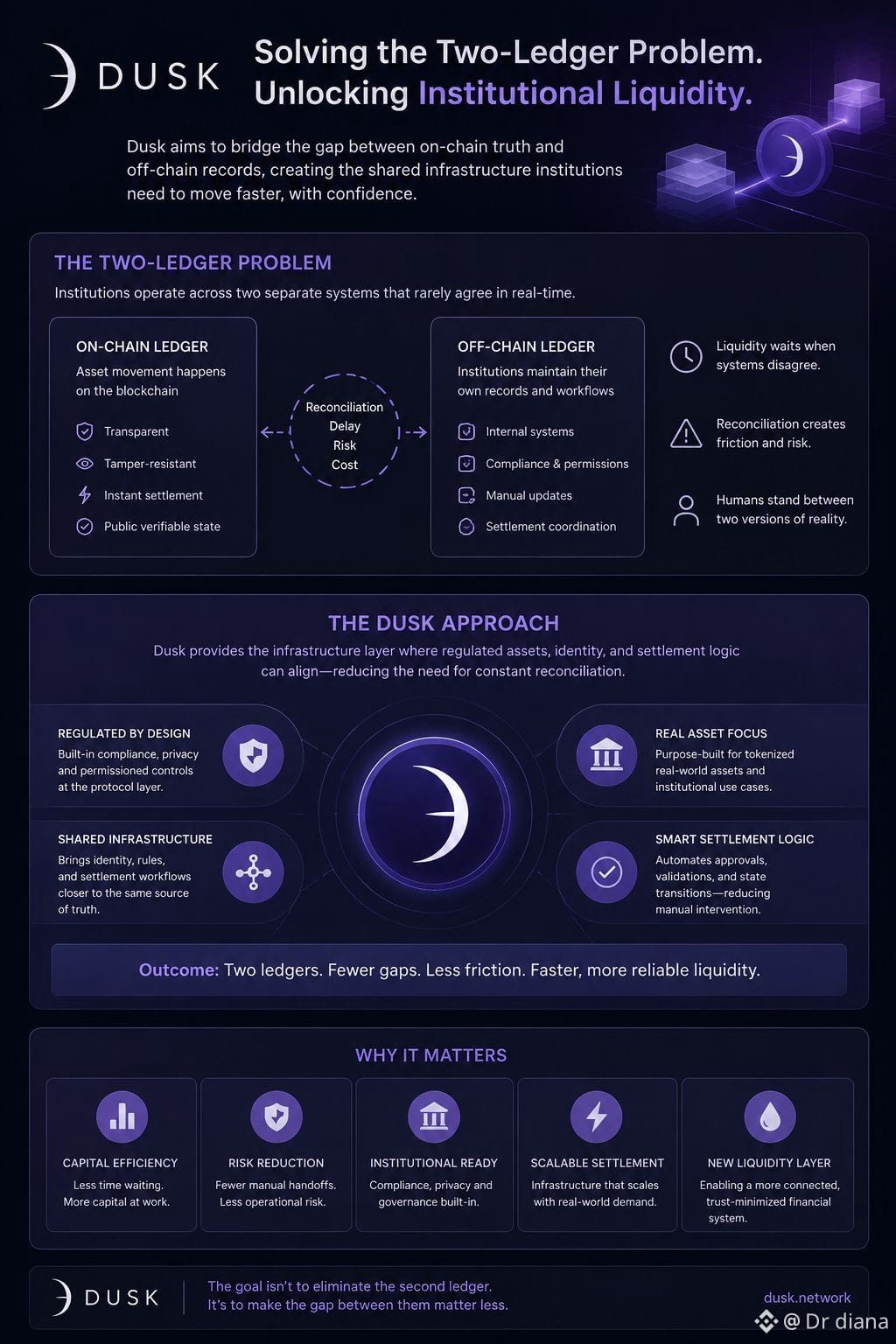
I keep thinking about something with $DUSK… institutions may not actually have a blockchain problem. They might have a synchronization problem.
A security can exist on-chain, but the institution handling it still has its own records somewhere else. Ownership, compliance status, cash movements, settlement instructions. So you end up with two versions of reality that constantly need to agree.
At first that sounds manageable. Just reconcile them.
But then again, reconciliation is basically admitting the systems don't fully trust the same state. One ledger says the asset moved. Another system still needs to check whether it was allowed, update its records, coordinate payment and eventually accept that movement as final.
That delay is where liquidity quietly gets heavier.
What interests me about Dusk is whether regulated assets, identity rules and settlement can start sharing enough infrastructure that this gap becomes smaller. Not “put everything on-chain.” Institutions probably don't want that anyway. More like reducing how often two separate systems need humans standing between them.
And maybe that's an overlooked liquidity problem.
Because liquidity isn't only how many buyers exist.
“Capital also waits when systems disagree about what just happened.”
Still, I'm not fully convinced solving the ledger problem automatically brings institutional liquidity. Banks will keep internal systems. Legal ownership may still depend on jurisdiction. Some reconciliation probably never disappears.
So maybe $DUSK doesn't need to eliminate the second ledger.
Maybe the real opportunity is making it matter less.
Whether institutions value that enough to actually move liquidity is the part I’d watch.
$DUSK #dusk @Dusk_Foundation $ACE
I keep thinking about something with $DUSK … institutions may not actually have a blockchain problem. They might have a synchronization problem.
A security can exist on-chain, but the institution handling it still has its own records somewhere else. Ownership, compliance status, cash movements, settlement instructions. So you end up with two versions of reality that constantly need to agree.
At first that sounds manageable. Just reconcile them.
But then again, reconciliation is basically admitting the systems don't fully trust the same state. One ledger says the asset moved. Another system still needs to check whether it was allowed, update its records, coordinate payment and eventually accept that movement as final.
That delay is where liquidity quietly gets heavier.
What interests me about Dusk is whether regulated assets, identity rules and settlement can start sharing enough infrastructure that this gap becomes smaller. Not “put everything on-chain.” Institutions probably don't want that anyway. More like reducing how often two separate systems need humans standing between them.
And maybe that's an overlooked liquidity problem.
Because liquidity isn't only how many buyers exist.
“Capital also waits when systems disagree about what just happened.”
Still, I'm not fully convinced solving the ledger problem automatically brings institutional liquidity. Banks will keep internal systems. Legal ownership may still depend on jurisdiction. Some reconciliation probably never disappears.
So maybe $DUSK doesn't need to eliminate the second ledger.
Maybe the real opportunity is making it matter less.
Whether institutions value that enough to actually move liquidity is the part I’d watch.
$DUSK #dusk @Dusk $ACE
A security can exist on-chain, but the institution handling it still has its own records somewhere else. Ownership, compliance status, cash movements, settlement instructions. So you end up with two versions of reality that constantly need to agree.
At first that sounds manageable. Just reconcile them.
But then again, reconciliation is basically admitting the systems don't fully trust the same state. One ledger says the asset moved. Another system still needs to check whether it was allowed, update its records, coordinate payment and eventually accept that movement as final.
That delay is where liquidity quietly gets heavier.
What interests me about Dusk is whether regulated assets, identity rules and settlement can start sharing enough infrastructure that this gap becomes smaller. Not “put everything on-chain.” Institutions probably don't want that anyway. More like reducing how often two separate systems need humans standing between them.
And maybe that's an overlooked liquidity problem.
Because liquidity isn't only how many buyers exist.
“Capital also waits when systems disagree about what just happened.”
Still, I'm not fully convinced solving the ledger problem automatically brings institutional liquidity. Banks will keep internal systems. Legal ownership may still depend on jurisdiction. Some reconciliation probably never disappears.
So maybe $DUSK doesn't need to eliminate the second ledger.
Maybe the real opportunity is making it matter less.
Whether institutions value that enough to actually move liquidity is the part I’d watch.
$DUSK #dusk @Dusk $ACE
24
11
173
·
--
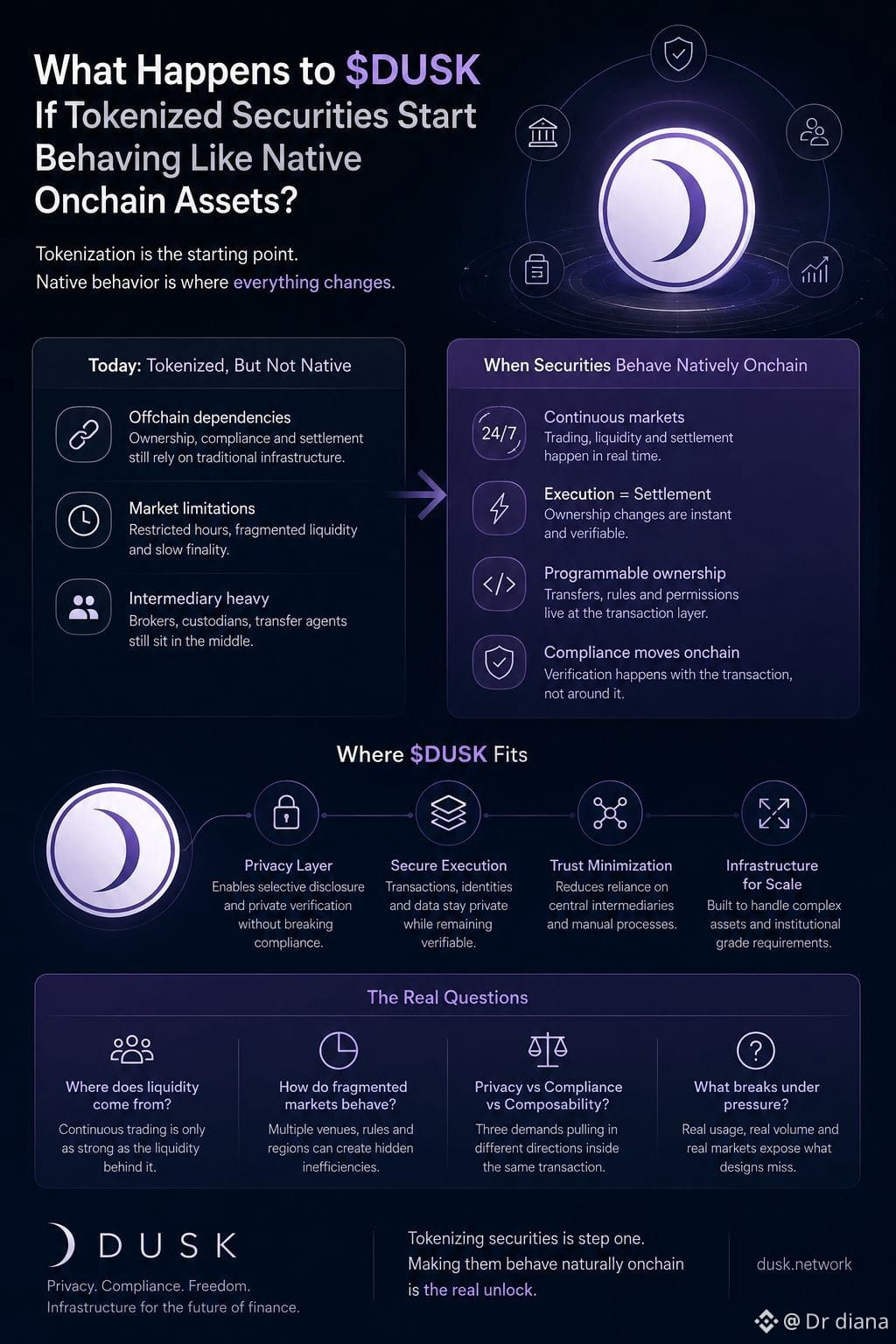
I keep thinking about what actually changes when a tokenized security stops feeling like a tokenized copy of something offchain.
Because right now, a lot of tokenization still seems to inherit the old market underneath it. The asset moves onchain, sure, but eligibility, settlement, ownership checks, trading hours, compliance… pieces of the process still feel like they are asking permission from somewhere else.
$DUSK gets more interesting to me if that starts disappearing.
If securities can be issued, transferred, privately verified and settled inside the same environment, then maybe the token isn't just representing the asset anymore. It starts behaving like the asset itself. And that sounds like a small distinction until you think about what happens next.
Markets could become more continuous. Settlement becomes part of execution instead of something waiting behind it. Ownership changes become programmable. Even compliance starts moving closer to the transaction rather than sitting around it.
But then again, native behavior creates native problems.
If these assets trade continuously, where does liquidity actually come from at 3am? Who handles fragmented markets? What happens when privacy, regulation and composability want three different things from the same transaction?
That's where I'm still unsure about $DUSK.
Getting securities onchain is one problem.
Making them behave naturally there, without quietly rebuilding all the old intermediaries underneath, feels like the much harder one.
#dusk $DUSK @Dusk_Foundation
I keep thinking about what actually changes when a tokenized security stops feeling like a tokenized copy of something offchain.
Because right now, a lot of tokenization still seems to inherit the old market underneath it. The asset moves onchain, sure, but eligibility, settlement, ownership checks, trading hours, compliance… pieces of the process still feel like they are asking permission from somewhere else.
$DUSK gets more interesting to me if that starts disappearing.
If securities can be issued, transferred, privately verified and settled inside the same environment, then maybe the token isn't just representing the asset anymore. It starts behaving like the asset itself. And that sounds like a small distinction until you think about what happens next.
Markets could become more continuous. Settlement becomes part of execution instead of something waiting behind it. Ownership changes become programmable. Even compliance starts moving closer to the transaction rather than sitting around it.
But then again, native behavior creates native problems.
If these assets trade continuously, where does liquidity actually come from at 3am? Who handles fragmented markets? What happens when privacy, regulation and composability want three different things from the same transaction?
That's where I'm still unsure about $DUSK .
Getting securities onchain is one problem.
Making them behave naturally there, without quietly rebuilding all the old intermediaries underneath, feels like the much harder one.
#dusk $DUSK @Dusk
Because right now, a lot of tokenization still seems to inherit the old market underneath it. The asset moves onchain, sure, but eligibility, settlement, ownership checks, trading hours, compliance… pieces of the process still feel like they are asking permission from somewhere else.
$DUSK gets more interesting to me if that starts disappearing.
If securities can be issued, transferred, privately verified and settled inside the same environment, then maybe the token isn't just representing the asset anymore. It starts behaving like the asset itself. And that sounds like a small distinction until you think about what happens next.
Markets could become more continuous. Settlement becomes part of execution instead of something waiting behind it. Ownership changes become programmable. Even compliance starts moving closer to the transaction rather than sitting around it.
But then again, native behavior creates native problems.
If these assets trade continuously, where does liquidity actually come from at 3am? Who handles fragmented markets? What happens when privacy, regulation and composability want three different things from the same transaction?
That's where I'm still unsure about $DUSK .
Getting securities onchain is one problem.
Making them behave naturally there, without quietly rebuilding all the old intermediaries underneath, feels like the much harder one.
#dusk $DUSK @Dusk
27
1
12
150
·
--
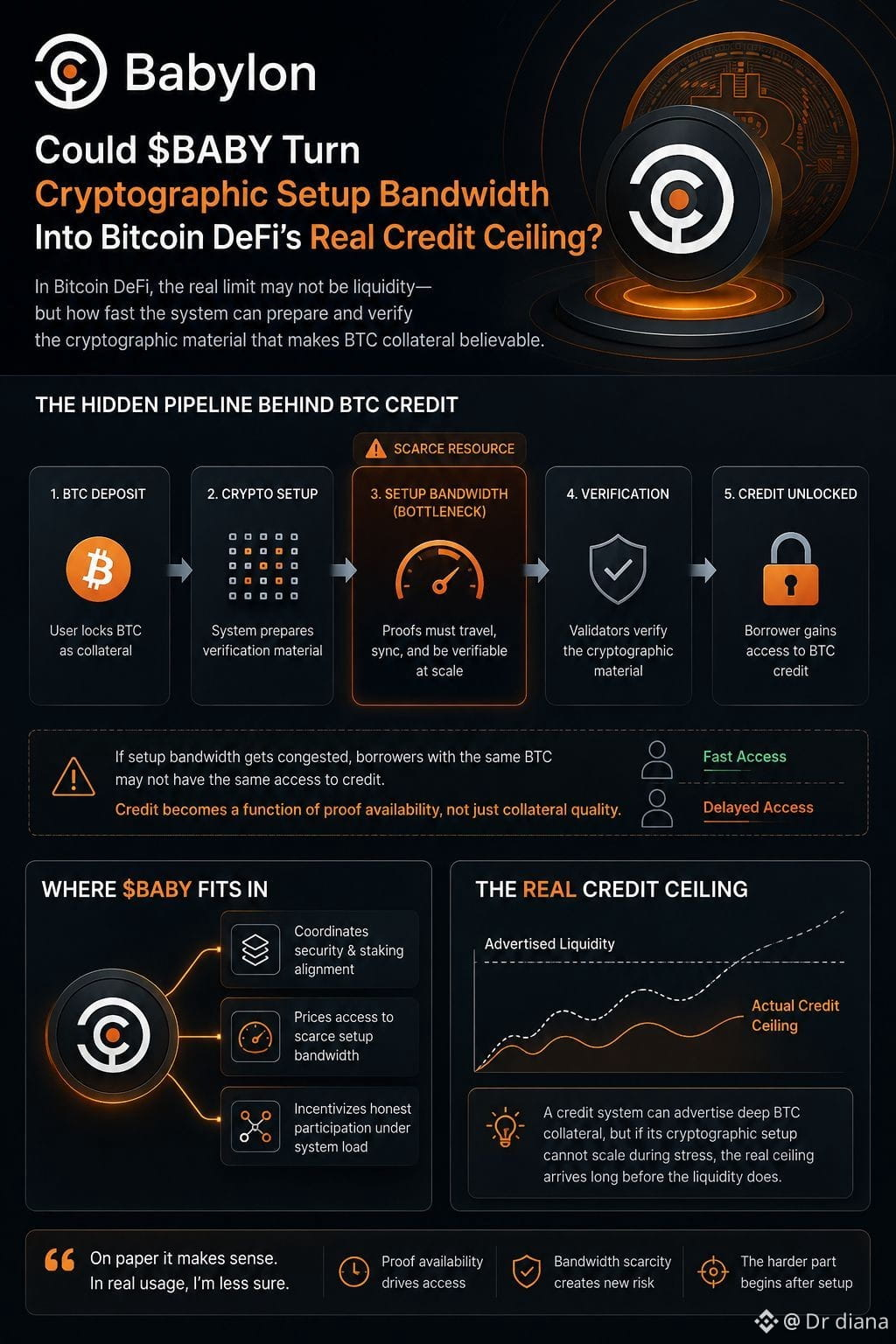
I keep thinking about whether Bitcoin DeFi’s real lending limit is even about liquidity yet. Everyone naturally looks at how much BTC can enter, how much borrowers want, how deep the market becomes. But with Babylon, I’m starting to wonder if the tighter ceiling sits somewhere less visible: how quickly the system can prepare, verify, and move the cryptographic material needed to make that collateral believable.
The way I understand it right now, native BTC credit does not begin when someone deposits Bitcoin. It begins when enough proof can travel through the system without becoming too heavy, too slow, or too expensive to check. At first that sounds like a technical detail. But then again, credit markets are often limited by whatever takes longest to confirm.
If setup bandwidth becomes congested, two borrowers with the same BTC may not have the same practical access to credit. One gets verified quickly. Another waits. Risk is no longer priced only through collateral quality, but through proof availability and system load.
That is where BABY gets interesting to me. Maybe its role is not just coordinating security. Maybe it eventually prices access to scarce verification capacity.
Still, something feels unresolved. A credit system can advertise deep Bitcoin collateral, but if its cryptographic setup cannot scale during stress, the real ceiling may arrive long before the liquidity does.
#baby $BABY @babylonlabs_io $HFT $HEI
I keep thinking about whether Bitcoin DeFi’s real lending limit is even about liquidity yet. Everyone naturally looks at how much BTC can enter, how much borrowers want, how deep the market becomes. But with Babylon, I’m starting to wonder if the tighter ceiling sits somewhere less visible: how quickly the system can prepare, verify, and move the cryptographic material needed to make that collateral believable.
The way I understand it right now, native BTC credit does not begin when someone deposits Bitcoin. It begins when enough proof can travel through the system without becoming too heavy, too slow, or too expensive to check. At first that sounds like a technical detail. But then again, credit markets are often limited by whatever takes longest to confirm.
If setup bandwidth becomes congested, two borrowers with the same BTC may not have the same practical access to credit. One gets verified quickly. Another waits. Risk is no longer priced only through collateral quality, but through proof availability and system load.
That is where BABY gets interesting to me. Maybe its role is not just coordinating security. Maybe it eventually prices access to scarce verification capacity.
Still, something feels unresolved. A credit system can advertise deep Bitcoin collateral, but if its cryptographic setup cannot scale during stress, the real ceiling may arrive long before the liquidity does.
#baby $BABY @BabylonLabs_io $HFT $HEI
The way I understand it right now, native BTC credit does not begin when someone deposits Bitcoin. It begins when enough proof can travel through the system without becoming too heavy, too slow, or too expensive to check. At first that sounds like a technical detail. But then again, credit markets are often limited by whatever takes longest to confirm.
If setup bandwidth becomes congested, two borrowers with the same BTC may not have the same practical access to credit. One gets verified quickly. Another waits. Risk is no longer priced only through collateral quality, but through proof availability and system load.
That is where BABY gets interesting to me. Maybe its role is not just coordinating security. Maybe it eventually prices access to scarce verification capacity.
Still, something feels unresolved. A credit system can advertise deep Bitcoin collateral, but if its cryptographic setup cannot scale during stress, the real ceiling may arrive long before the liquidity does.
#baby $BABY @BabylonLabs_io $HFT $HEI
43
23
476
·
--
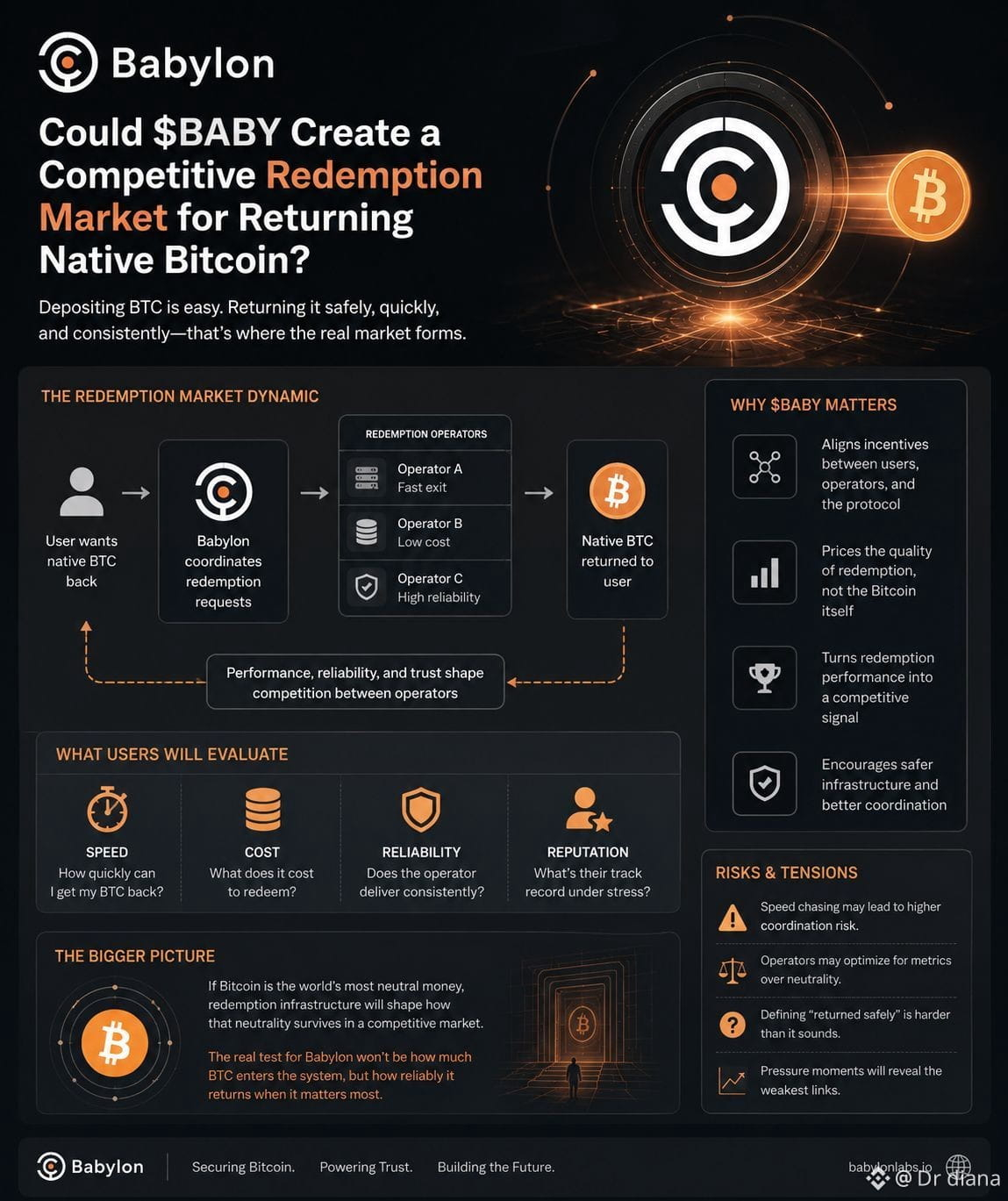
I keep thinking about the moment native Bitcoin has to come back.
Most of the discussion around Babylon and baby seems focused on putting BTC to work, but returning it may become the more revealing side of the system. Depositing collateral is usually simple. Everyone wants activity. Redemption is different because that is when liquidity, verification, timing, and user patience all collide.
At first I assumed redemption would just be a technical exit path. But then again, once multiple operators are involved, it starts looking more like a market. Some paths may return BTC faster. Others may be cheaper, more reliable, or better at handling pressure. $BABY could end up coordinating competition between those paths, not by pricing Bitcoin itself, but by pricing the quality of getting Bitcoin back.
That sounds useful, although honestly it creates another question. What happens when speed becomes more valuable than neutrality? Operators may optimize for visible redemption performance while quietly taking on more coordination risk. Users could begin choosing routes like they choose exchanges now, based on reputation, cost, and withdrawal history.
If I think about it carefully, the strongest signal may not be how much BTC enters Babylon, but how consistently it leaves without friction.
Maybe baby can turn redemption into a competitive service layer. Still, once returning native Bitcoin becomes a market, someone has to define what “returned safely” actually means.
#baby $BABY @babylonlabs_io $VIC
I keep thinking about the moment native Bitcoin has to come back.
Most of the discussion around Babylon and baby seems focused on putting BTC to work, but returning it may become the more revealing side of the system. Depositing collateral is usually simple. Everyone wants activity. Redemption is different because that is when liquidity, verification, timing, and user patience all collide.
At first I assumed redemption would just be a technical exit path. But then again, once multiple operators are involved, it starts looking more like a market. Some paths may return BTC faster. Others may be cheaper, more reliable, or better at handling pressure. $BABY could end up coordinating competition between those paths, not by pricing Bitcoin itself, but by pricing the quality of getting Bitcoin back.
That sounds useful, although honestly it creates another question. What happens when speed becomes more valuable than neutrality? Operators may optimize for visible redemption performance while quietly taking on more coordination risk. Users could begin choosing routes like they choose exchanges now, based on reputation, cost, and withdrawal history.
If I think about it carefully, the strongest signal may not be how much BTC enters Babylon, but how consistently it leaves without friction.
Maybe baby can turn redemption into a competitive service layer. Still, once returning native Bitcoin becomes a market, someone has to define what “returned safely” actually means.
#baby $BABY @BabylonLabs_io $VIC
Most of the discussion around Babylon and baby seems focused on putting BTC to work, but returning it may become the more revealing side of the system. Depositing collateral is usually simple. Everyone wants activity. Redemption is different because that is when liquidity, verification, timing, and user patience all collide.
At first I assumed redemption would just be a technical exit path. But then again, once multiple operators are involved, it starts looking more like a market. Some paths may return BTC faster. Others may be cheaper, more reliable, or better at handling pressure. $BABY could end up coordinating competition between those paths, not by pricing Bitcoin itself, but by pricing the quality of getting Bitcoin back.
That sounds useful, although honestly it creates another question. What happens when speed becomes more valuable than neutrality? Operators may optimize for visible redemption performance while quietly taking on more coordination risk. Users could begin choosing routes like they choose exchanges now, based on reputation, cost, and withdrawal history.
If I think about it carefully, the strongest signal may not be how much BTC enters Babylon, but how consistently it leaves without friction.
Maybe baby can turn redemption into a competitive service layer. Still, once returning native Bitcoin becomes a market, someone has to define what “returned safely” actually means.
#baby $BABY @BabylonLabs_io $VIC
59
27
525
·
--
I keep thinking about something that feels easy to overlook. We usually talk about Bitcoin vaults as places where capital sits safely, but I'm starting to wonder whether the more interesting thing isn't the Bitcoin at all. Maybe it's the behavior surrounding it.
The way I understand it right now is that $BABY isn't only trying to let native BTC participate in DeFi without wrapping it. It also creates an environment where vaults leave behind patterns. How often collateral returns. How long it stays idle. Whether borrowers unwind positions smoothly or only when they're forced to. Those details don't look like credit at first. But then again, maybe credit has always been less about assets and more about repeated behavior.
That's where it gets interesting. Traditional lending often begins by asking who you are. A Bitcoin-backed system might gradually begin by asking how your vault has behaved over time instead. Those are very different questions.
I'm not fully convinced this automatically creates better credit discovery. Incentives can manufacture good-looking histories just as easily as they manufacture TVL. A perfectly clean vault record might simply reflect cautious farming rather than genuine reliability under stress.
Maybe the real shift isn't that Bitcoin becomes collateral for borrowing. Maybe vault networks slowly become machines for observing financial behavior that nobody explicitly set out to measure. On paper that sounds elegant. Whether those observations remain honest once markets become crowded is another question entirely.
#baby $BABY @babylonlabs_io
I keep thinking about something that feels easy to overlook. We usually talk about Bitcoin vaults as places where capital sits safely, but I'm starting to wonder whether the more interesting thing isn't the Bitcoin at all. Maybe it's the behavior surrounding it.
The way I understand it right now is that $BABY isn't only trying to let native BTC participate in DeFi without wrapping it. It also creates an environment where vaults leave behind patterns. How often collateral returns. How long it stays idle. Whether borrowers unwind positions smoothly or only when they're forced to. Those details don't look like credit at first. But then again, maybe credit has always been less about assets and more about repeated behavior.
That's where it gets interesting. Traditional lending often begins by asking who you are. A Bitcoin-backed system might gradually begin by asking how your vault has behaved over time instead. Those are very different questions.
I'm not fully convinced this automatically creates better credit discovery. Incentives can manufacture good-looking histories just as easily as they manufacture TVL. A perfectly clean vault record might simply reflect cautious farming rather than genuine reliability under stress.
Maybe the real shift isn't that Bitcoin becomes collateral for borrowing. Maybe vault networks slowly become machines for observing financial behavior that nobody explicitly set out to measure. On paper that sounds elegant. Whether those observations remain honest once markets become crowded is another question entirely.
#baby $BABY @BabylonLabs_io
The way I understand it right now is that $BABY isn't only trying to let native BTC participate in DeFi without wrapping it. It also creates an environment where vaults leave behind patterns. How often collateral returns. How long it stays idle. Whether borrowers unwind positions smoothly or only when they're forced to. Those details don't look like credit at first. But then again, maybe credit has always been less about assets and more about repeated behavior.
That's where it gets interesting. Traditional lending often begins by asking who you are. A Bitcoin-backed system might gradually begin by asking how your vault has behaved over time instead. Those are very different questions.
I'm not fully convinced this automatically creates better credit discovery. Incentives can manufacture good-looking histories just as easily as they manufacture TVL. A perfectly clean vault record might simply reflect cautious farming rather than genuine reliability under stress.
Maybe the real shift isn't that Bitcoin becomes collateral for borrowing. Maybe vault networks slowly become machines for observing financial behavior that nobody explicitly set out to measure. On paper that sounds elegant. Whether those observations remain honest once markets become crowded is another question entirely.
#baby $BABY @BabylonLabs_io
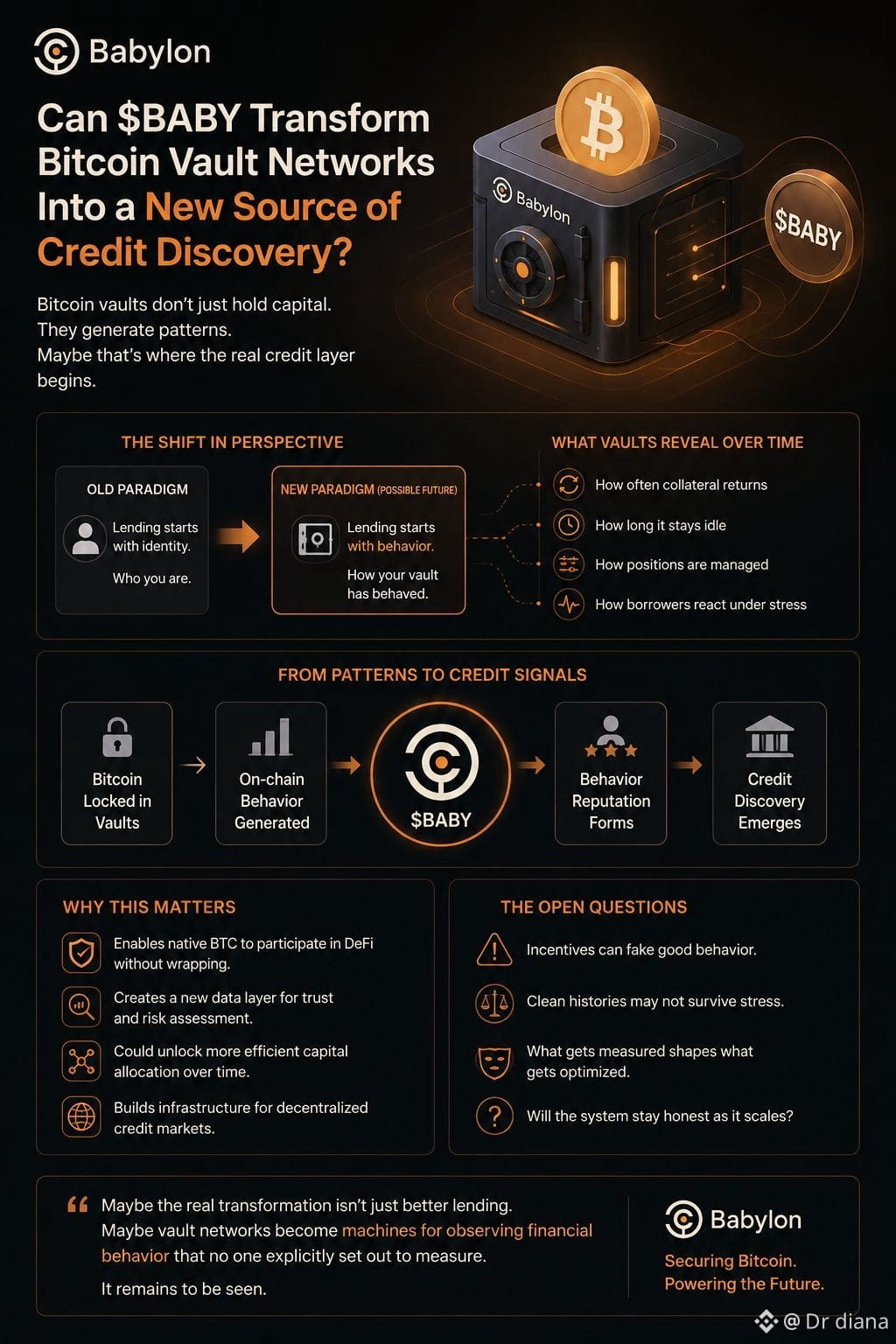
39
18
178
·
--
I keep thinking about something that feels easy to miss. We usually celebrate new DeFi integrations as if every additional protocol automatically makes a network stronger. But maybe that's only true if each integration actually leaves behind something more valuable than another liquidity connection.
That's where I keep coming back to Babylon and $BABY. On the surface, native Bitcoin-backed borrowing feels like another way to make idle BTC productive. But if I think about it carefully, every integration also records behavior. Not just whether Bitcoin was deposited, but how consistently it remained usable, how often collateral survived changing market conditions, and whether that same Bitcoin kept being accepted across different environments without needing trust to be rebuilt each time.
Maybe the integration itself slowly becomes a signal.
That changes the question a little. Instead of asking how many protocols support native Bitcoin collateral, maybe the more interesting question is whether those protocols begin trusting the collateral because of its accumulated history rather than because of marketing announcements or TVL numbers.
Although honestly, I'm not fully convinced that's automatic. More integrations can also multiply inconsistent standards, fragmented assumptions, and different definitions of acceptable risk. A reputation network only works if every participant interprets the same behavior in roughly the same way.
So perhaps the hidden challenge for $BABY isn't connecting Bitcoin to more DeFi at all. It might be whether every new connection strengthens a shared memory... or simply creates another isolated record that nobody else fully trusts.
#baby $BABY @babylonlabs_io
I keep thinking about something that feels easy to miss. We usually celebrate new DeFi integrations as if every additional protocol automatically makes a network stronger. But maybe that's only true if each integration actually leaves behind something more valuable than another liquidity connection.
That's where I keep coming back to Babylon and $BABY . On the surface, native Bitcoin-backed borrowing feels like another way to make idle BTC productive. But if I think about it carefully, every integration also records behavior. Not just whether Bitcoin was deposited, but how consistently it remained usable, how often collateral survived changing market conditions, and whether that same Bitcoin kept being accepted across different environments without needing trust to be rebuilt each time.
Maybe the integration itself slowly becomes a signal.
That changes the question a little. Instead of asking how many protocols support native Bitcoin collateral, maybe the more interesting question is whether those protocols begin trusting the collateral because of its accumulated history rather than because of marketing announcements or TVL numbers.
Although honestly, I'm not fully convinced that's automatic. More integrations can also multiply inconsistent standards, fragmented assumptions, and different definitions of acceptable risk. A reputation network only works if every participant interprets the same behavior in roughly the same way.
So perhaps the hidden challenge for $BABY isn't connecting Bitcoin to more DeFi at all. It might be whether every new connection strengthens a shared memory... or simply creates another isolated record that nobody else fully trusts.
#baby $BABY @BabylonLabs_io
That's where I keep coming back to Babylon and $BABY . On the surface, native Bitcoin-backed borrowing feels like another way to make idle BTC productive. But if I think about it carefully, every integration also records behavior. Not just whether Bitcoin was deposited, but how consistently it remained usable, how often collateral survived changing market conditions, and whether that same Bitcoin kept being accepted across different environments without needing trust to be rebuilt each time.
Maybe the integration itself slowly becomes a signal.
That changes the question a little. Instead of asking how many protocols support native Bitcoin collateral, maybe the more interesting question is whether those protocols begin trusting the collateral because of its accumulated history rather than because of marketing announcements or TVL numbers.
Although honestly, I'm not fully convinced that's automatic. More integrations can also multiply inconsistent standards, fragmented assumptions, and different definitions of acceptable risk. A reputation network only works if every participant interprets the same behavior in roughly the same way.
So perhaps the hidden challenge for $BABY isn't connecting Bitcoin to more DeFi at all. It might be whether every new connection strengthens a shared memory... or simply creates another isolated record that nobody else fully trusts.
#baby $BABY @BabylonLabs_io
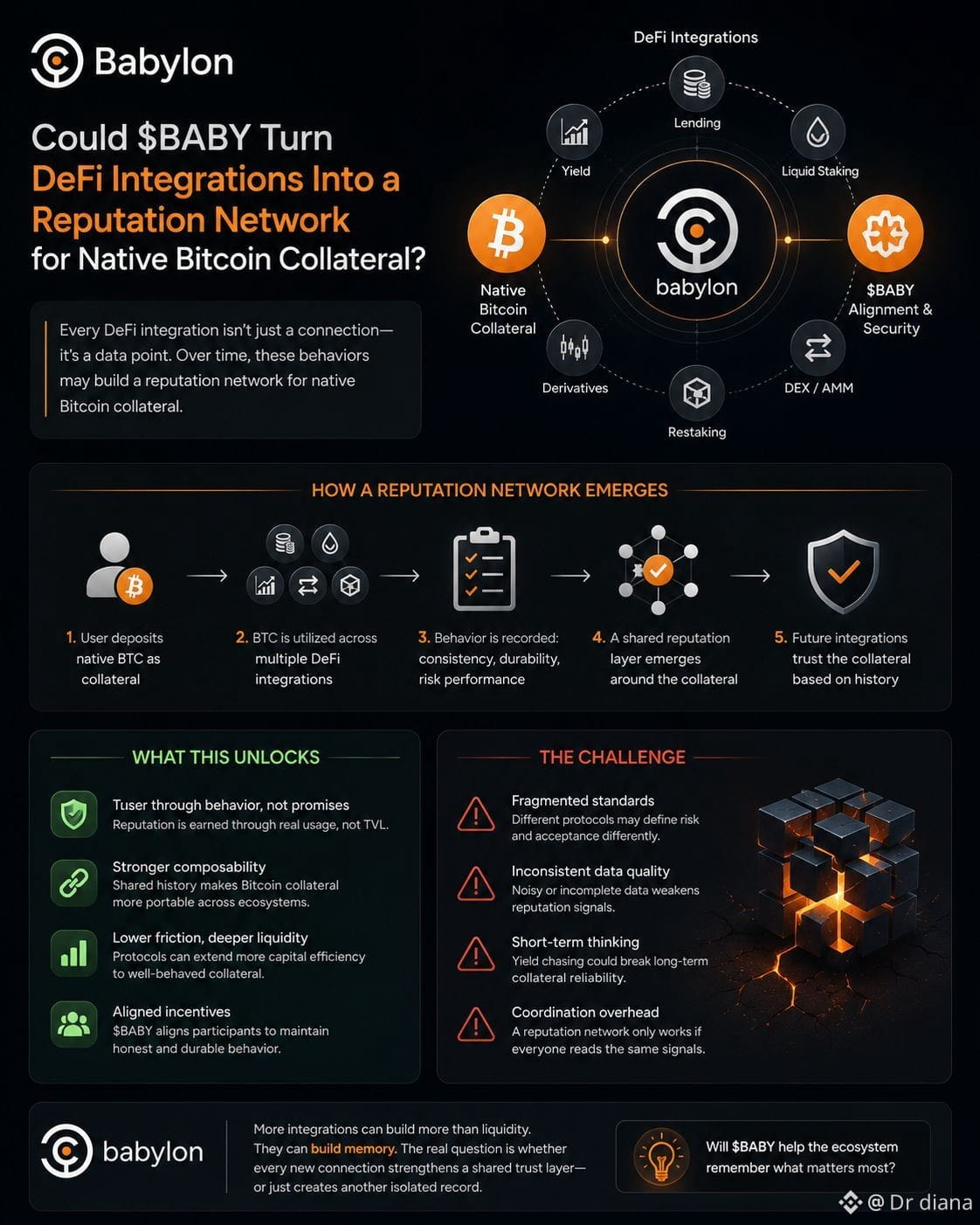
30
15
137
Log in to explore more content
Join global crypto users on Binance Square
⚡️ Get latest and useful information about crypto.
💬 Trusted by the world’s largest crypto exchange.
👍 Discover real insights from verified creators.
Email / Phone number