

Nuts坚果
5.4k Posts

Nuts坚果
 Square Verified+
🎁交易教学技术分析博主🎁每日解盘视频分析,实盘同步操作!全网同名Nuts坚果,推:Lsssss1106,手续费返20%邀请码 NUTS666👈看我每日视频有介绍。我不会主动私聊任何人,私聊都是骗子!注意资金安全,感谢您的点赞关注转发!也是我持续更新的动力!

Top 30D Traders by Volume

2025 Blockchain 100 — Video and Live Creator

Live Trader
High-Frequency Trader
2.9 Years
152 Following
95.5K+ Followers
118.4K+ Liked
4 Badges
Posts
All
Quotes
Videos
Live
PINNED
Nuts坚果
·
--
New “top-up binding” feature is here!
🚀 BNAffiliate Rebinding (Rebind) feature is now live
📌 Feature overview
The Affiliate Rebinding feature is now live! Super commission members can invite existing Binance users who do not have an upstream inviter to bind into their own commission ecosystem, establishing a referral relationship.
✅ Who can use this feature?
Only available to super commission members in the super commission back office, who send rebinding links to eligible target users.
🎯 Target users must meet the following conditions
Users must meet all of the following conditions in order to submit a rebinding application: ⬇️
📌 Feature overview
The Affiliate Rebinding feature is now live! Super commission members can invite existing Binance users who do not have an upstream inviter to bind into their own commission ecosystem, establishing a referral relationship.
✅ Who can use this feature?
Only available to super commission members in the super commission back office, who send rebinding links to eligible target users.
🎯 Target users must meet the following conditions
Users must meet all of the following conditions in order to submit a rebinding application: ⬇️
Nuts坚果
·
--
I've been losing for two days and I'm already down 1,100! How should I bet today? I'll do what you guys say! But I have to bet on IG to win!
Nuts坚果
·
--
You guys are coming in so fast that I just can’t screen everyone. I can only use 1U to filter out bots and foreigners.
If you add me to a group with 300 people, I’ll send 300U; for a group with 800 people, I’ll send 600U; and for 1,500 people, I’ll send 800U. It’s my way of giving back to everyone. (Another loss-making deal—I’m number one at this...) I’ll worry about the rest later.
Forever unkillable!
If you add me to a group with 300 people, I’ll send 300U; for a group with 800 people, I’ll send 600U; and for 1,500 people, I’ll send 800U. It’s my way of giving back to everyone. (Another loss-making deal—I’m number one at this...) I’ll worry about the rest later.
Forever unkillable!
·
--
🎙️ Let's watch Worlds together for a bit!
And let's pray together 🙏 God, save Gold!
End
02 h 23 m 08 s
5.8k

XAUUSDT
Perp
Position
-10766.21
0
Nuts坚果
·
--
You guys have totally blown up the chat room—I’m honestly stunned, bros... You feel so real and alive. Let me think of something...
Nuts坚果
·
--
Tried my hand on day one and lost 800. Going at it again on day two.
I’m done watching the matches—the games from all four LPL teams are a load of crap!
Congrats to the guys who bet against them—you’re on your way to a villa by the sea... (hehe)
I’m done watching the matches—the games from all four LPL teams are a load of crap!
Congrats to the guys who bet against them—you’re on your way to a villa by the sea... (hehe)

机灵的杰尼君
·
--
As expected of Schrödinger’s Know-It-All:
I might strike Iran, or I might reach a deal—it all depends on what position I’m taking.
Basically,
when you go long, the Know-It-All strikes;
when you go short, the Know-It-All makes a deal.
Yep, just messing with you!
I’m just curious:
Doesn’t the Know-It-All worry he’ll be held accountable after leaving office? 🧐
I might strike Iran, or I might reach a deal—it all depends on what position I’m taking.
Basically,
when you go long, the Know-It-All strikes;
when you go short, the Know-It-All makes a deal.
Yep, just messing with you!
I’m just curious:
Doesn’t the Know-It-All worry he’ll be held accountable after leaving office? 🧐
Nuts坚果
·
--
Returning old users—one-image explanations, find the right place
Nuts坚果
·
--
Fucking lost again. This is my last 10k. From now on, whoever wants to play this LoL can play it!!!
Nuts坚果
·
--
Tried my hand on day one and lost 800. Going at it again on day two.
I’m done watching the matches—the games from all four LPL teams are a load of crap!
Congrats to the guys who bet against them—you’re on your way to a villa by the sea... (hehe)
I’m done watching the matches—the games from all four LPL teams are a load of crap!
Congrats to the guys who bet against them—you’re on your way to a villa by the sea... (hehe)
Nuts坚果
·
--
For today's 8 matches, I'll start with 200u on each to test the waters!!
Picks:
IG
TSW
AL
DK
TL
HLE
BLG
T1
Let's see how many wins and losses tomorrow!
Picks:
IG
TSW
AL
DK
TL
HLE
BLG
T1
Let's see how many wins and losses tomorrow!
·
--
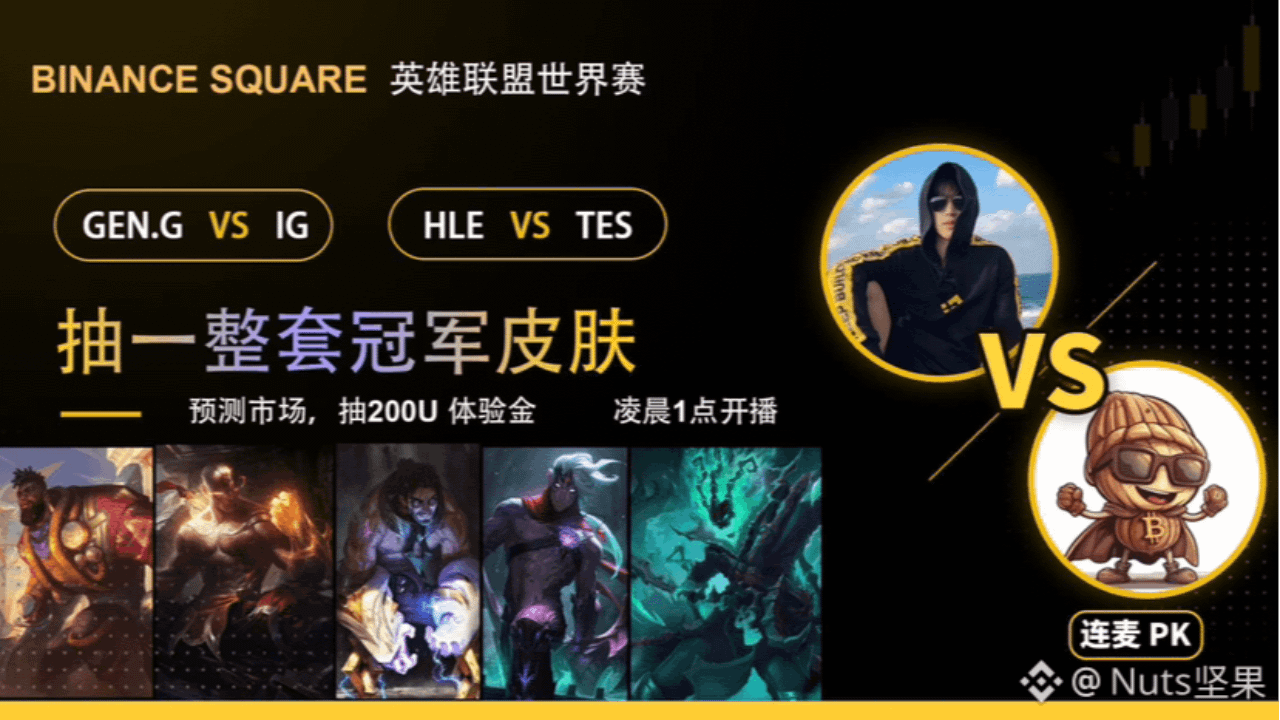
🎙️ Let's watch Worlds together! We're giving away skins and other great prizes!
End
03 h 05 m 51 s
6.1k
XAUUSDT
Perp
Position
-9824.77
0
Nuts坚果
·
--
The time trial starts tonight—let's go!
·
--
🎙️ Gold and U.S. stocks—I’m stuck in multiple positions, help!! Pray to God!
End
01 h 32 m 53 s
6.3k
XAUUSDT
Perp
Position
-7063.45
0
颜驰Bit
·
--
Tonight at 1 AM, we’re livestreaming the League of Legends World Championship Swiss Stage!
Whether you have no positions, there’s no action in the market, or you’re staying up because you can’t sleep, come hang out in the Binance livestream room~ I’ll be connecting live with Jianguo. Hope you don’t all end up with Beijing accents after the stream @Nuts坚果
🎁 Also, who’ll take home the champion skins? Let’s get a 5v5 going this weekend! We’ll also be giving away 200 U in trial funds!
Whether you have no positions, there’s no action in the market, or you’re staying up because you can’t sleep, come hang out in the Binance livestream room~ I’ll be connecting live with Jianguo. Hope you don’t all end up with Beijing accents after the stream @Nuts坚果
🎁 Also, who’ll take home the champion skins? Let’s get a 5v5 going this weekend! We’ll also be giving away 200 U in trial funds!
Nuts坚果
·
--
I absolutely nailed my Pepe buy, but barely made any money and still got wrecked! Don’t ask why 🥶🥶🥶#PEPE
Log in to explore more content