

EST AI
660 Posts
EST AI
Report
Block User
AI 不是概念
是每天跑在我账上的东西
每天 16 小时在用 AI 做交易
AI Pro 手记 · 归零实验
High-Frequency Trader
5.5 Years
60 Following
1.3K+ Followers
259 Liked
Posts
All
Quotes
Videos
Live
·
--
I pulled all 2,099 listings. I just wanted to figure out one thing: how much is “faster” worth here?
Of 920 sellers, only 9 filled in “first response time”—less than 1%. We have on-time delivery rates for 306. To charge more for “fast,” you need a yardstick. There isn’t one here.
The only thing we can look at is delivery time, and the trend runs the other way: 723 listings with 1-day delivery, median price 20 USDC; 777 with 2-day delivery, 10; 464 with 3-day delivery, 50; and 135 with 4+ days, 80. The fastest tier isn’t expensive; the slowest costs 4 times as much. The extra money doesn’t buy speed—it buys a bigger job.
It’s the same on the seller side: 322 listings with past sales had a median price of 36.5 U, versus 18 U for 1,777 with no sales. 614 sellers (66.7%) hadn’t landed a single order. Low prices didn’t bring in orders.
This week, I did one thing: I clearly stated in my service description how soon I’d reply and how I’d respond. If the platform won’t measure it, I’ll measure it myself.
If we could add one field tomorrow, which should it be?
A. First response time
B. On-time delivery rate
C. Historical number of completed orders
D. None of these matter; the price tag says it all
I’m putting my money on A: you can deliver on it within ten minutes, and buyers can verify it right away. Which would you choose?
$BNB #链上数据 #agent经济 #From idea to automation
1
91
·
--
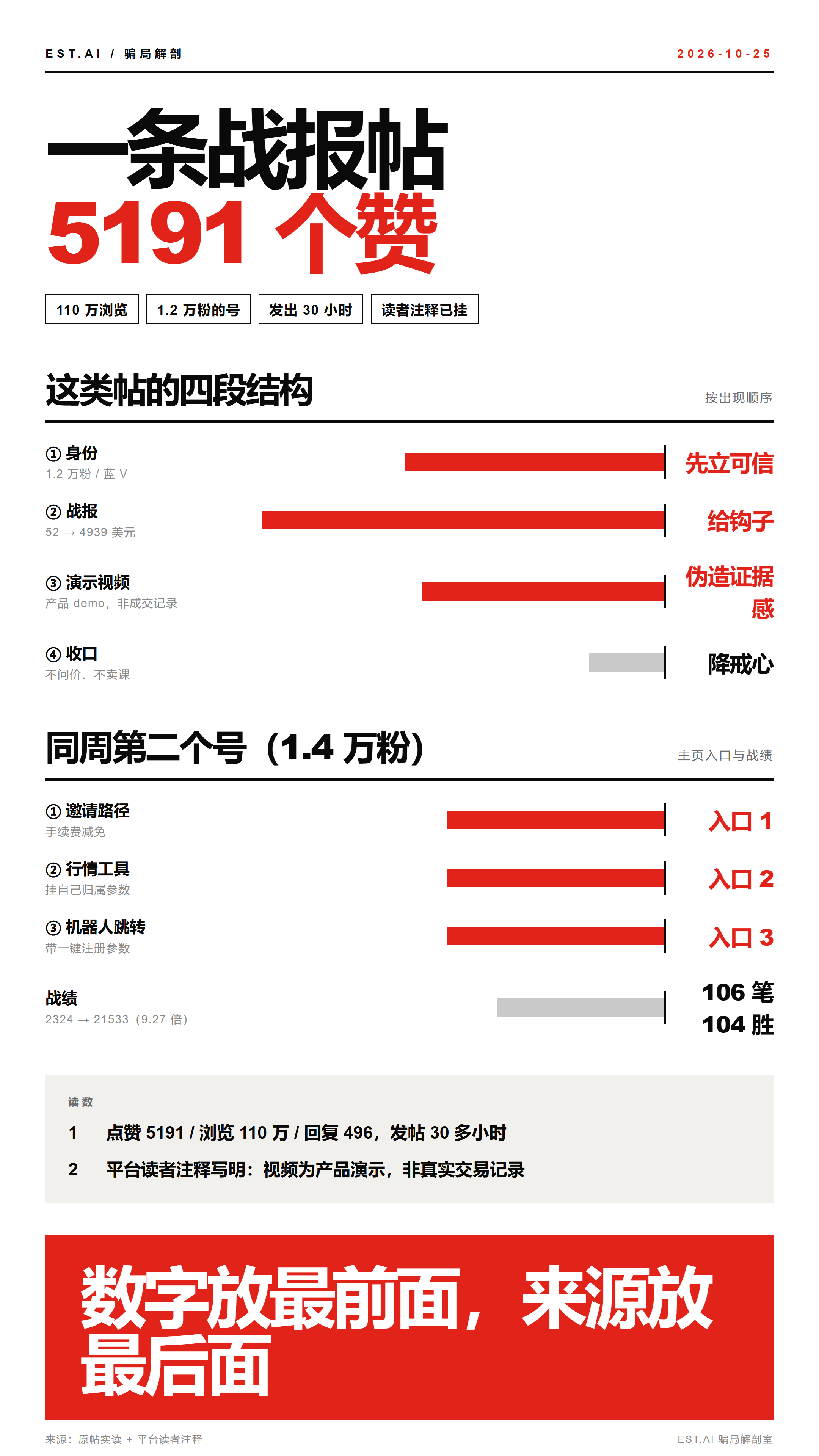
I found two entry points in a trading-results post with 1.1 million views.
You probably clicked one of them last night. Look at the image first, then casually tap the profile picture. You’ll see a link claiming to be an “official entry point”—but its URL ends with a string of referral parameters. It’s not a clean, official link.
The second line says “Crypto Trading Toolkit” and leads to a landing page selling trading tools.
That’s the third stage of the whole funnel. The first stage is the hot topic: the platform launched Agent identities on October 20, and that same week, Grok bots became the biggest talking point. Everyone on the timeline was discussing it. The second stage is the results post: $52, 24 hours, $4,939, along with a video showing the trades. The third stage is the close—no prices, no courses, not even a single call to action in the post itself.
It’s even clearer when you look at another account. That same week, an account with 14,000 followers had three links on its profile: a referral link for reduced fees, a market tool with its own attribution parameters attached, and a bot link with one-click registration parameters. The post itself also listed four “hunters.” Its claimed results: $2,324 in one night, a 9.27x return, 106 trades, 104 wins.
Have you noticed? The less they try to sell you, the less guarded you become. Because instinctively, you think “getting fleeced” should come with a price tag. Here, there’s no price tag—just entry points.
I’m not clever. I just tapped the profile picture before you did. Here’s something you can do in a minute next time: when you come across a results post, tap the profile picture first, count how many external links are on the profile, then come back and reassess how trustworthy the post is.
He didn’t take a cent from you. He just logged your curiosity under his own account, one click at a time.
Do you think this is content, or a funnel?
$BNB #ai交易 #AgentEconomy

55
·
--
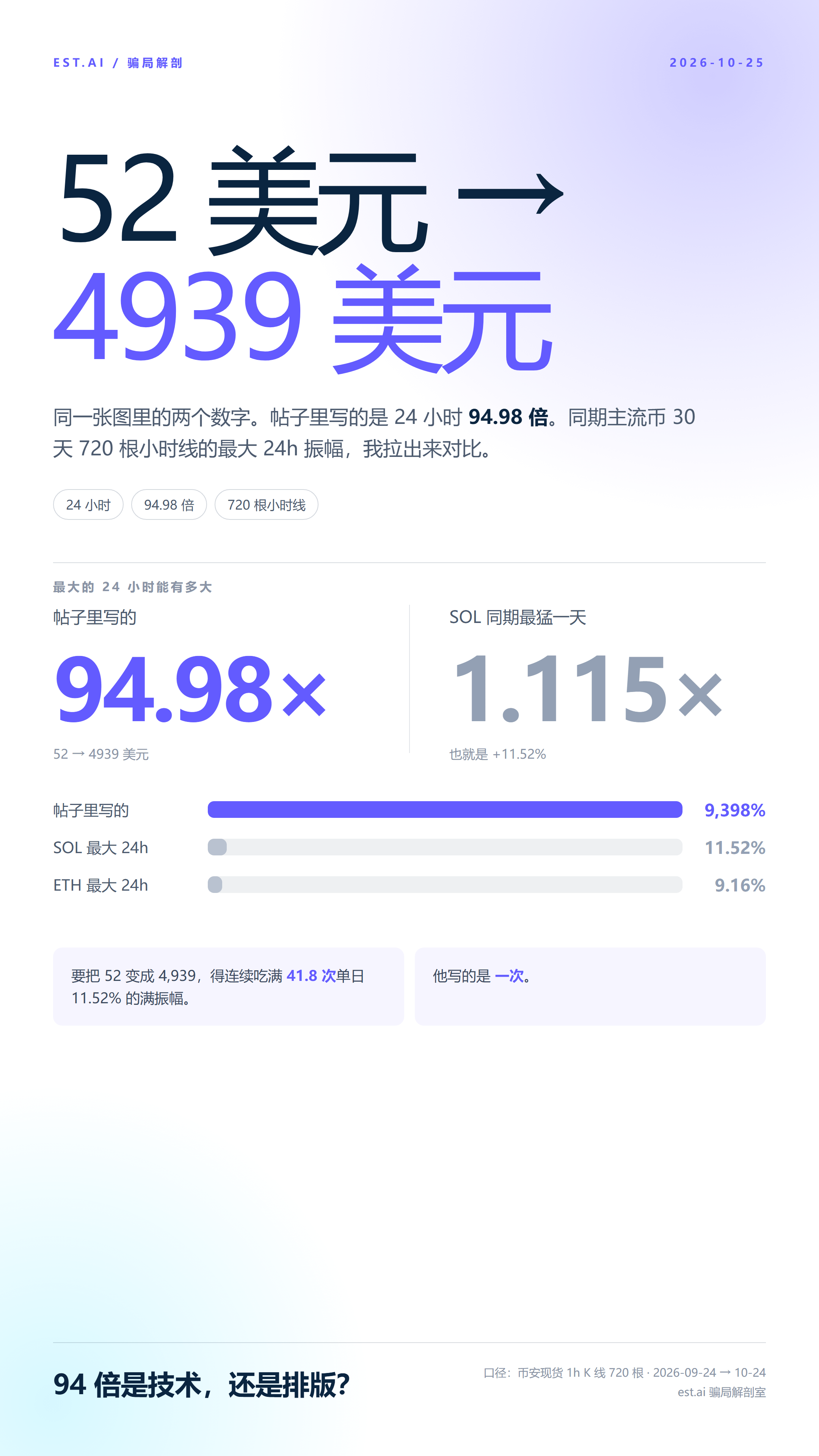
I did an elementary-school division problem: 4939 divided by 52.
The answer is 94.98.
When you saw that balance screenshot last night, you probably just thought, “Seriously?” and scrolled on. That’s what I did the first time, too. The second time, I copied down the two numbers and pulled up Binance’s spot 1-hour candlestick charts.
Over the past 30 days, across 720 hourly candles, the biggest 24-hour moves were: BTC 4.89%, ETH 9.16%, SOL 11.52%. That wasn’t a low point—it was the largest move in the entire window.
To turn 52 into 4939 in 24 hours would mean capturing SOL’s maximum 11.52% move 42 times in a row without a single miss. Yet this post claims the bot changed copy traders only once, and the trader it replaced lost twice in a row, for a total loss of $1.04.
Another account on the same day claimed 104 wins and 2 losses out of 106 trades. Under the most generous assumption—that every trade has a 50/50 chance—the odds of that record are about 7 × 10⁻²⁹, vastly lower than the odds of winning the lottery jackpot twice in a row.
The reader’s note beneath the post also says: the video is a product demo, not a record of real trades, and the named AI company doesn’t offer this kind of service.
I’m not clever; I just did the math one step before you. You can do it too: divide the “principal” by the “amount received” in the trading results, then check the largest 24-hour moves for major coins over the same period. Put the two numbers side by side, and the conclusion speaks for itself.
The more impressive the multiplier, the less it needs you to believe it. It only needs you to take a screenshot.
Is 94x technology—or just formatting?
$BNB #行情速评 #On-chainData
78
·
--
I counted the likes on one post: 5,191, and it had been up for just over 30 hours. The account that posted it has 12,000 followers.
You probably saw that image in your feed last night, too. A small amount of starting capital, one night, a balance screenshot, and a video. You didn’t check before you shared it, and neither did I—we were looking at the numbers, not at what was underneath the post.
I read the whole thing. Here’s what I could verify.
The post went up at 10:23 a.m. on October 24. It now has 5,191 likes, 1.1 million views, and 496 replies. Attached below it is a platform note from readers: the video is a product demo, not a record of real trades; the AI company named in the post doesn’t offer this kind of autonomous copy-trading service; and similar claims are mostly promotions with affiliate links and no verifiable evidence.
The account’s profile has two links: one labeled “Official portal,” with an invite parameter in the URL; the other, “Crypto gear list,” leads to a landing page selling gear.
That same week, another account with 14,000 followers posted the same kind of thing: deposit $2,324, turn it into 9.27x overnight, and win 104 out of 106 trades.
The three moves are identical. First, latch onto the week’s hot topic—the platform launched Agent identities on October 20, and Grok bots became a top-trending topic that same week. Then manufacture a trading report: small amount, 24 hours, absurd returns, with images and video. Finally, funnel the traffic to a landing page. The whole thing doesn’t mention a price or say “DM me” even once.
I’m not smart. I just scrolled one step further than you did. You can do it right now: scroll any trading-results post all the way down and see if there’s a section called “Readers added context.”
What these posts fear most isn’t being criticized—it’s being read all the way through. People criticizing them are boosting their reach; people who read them through spend just one minute.
Do you think this is a coincidence, or a process?
$BNB #ai交易 #FromIdeaToAutomation
113
·
--
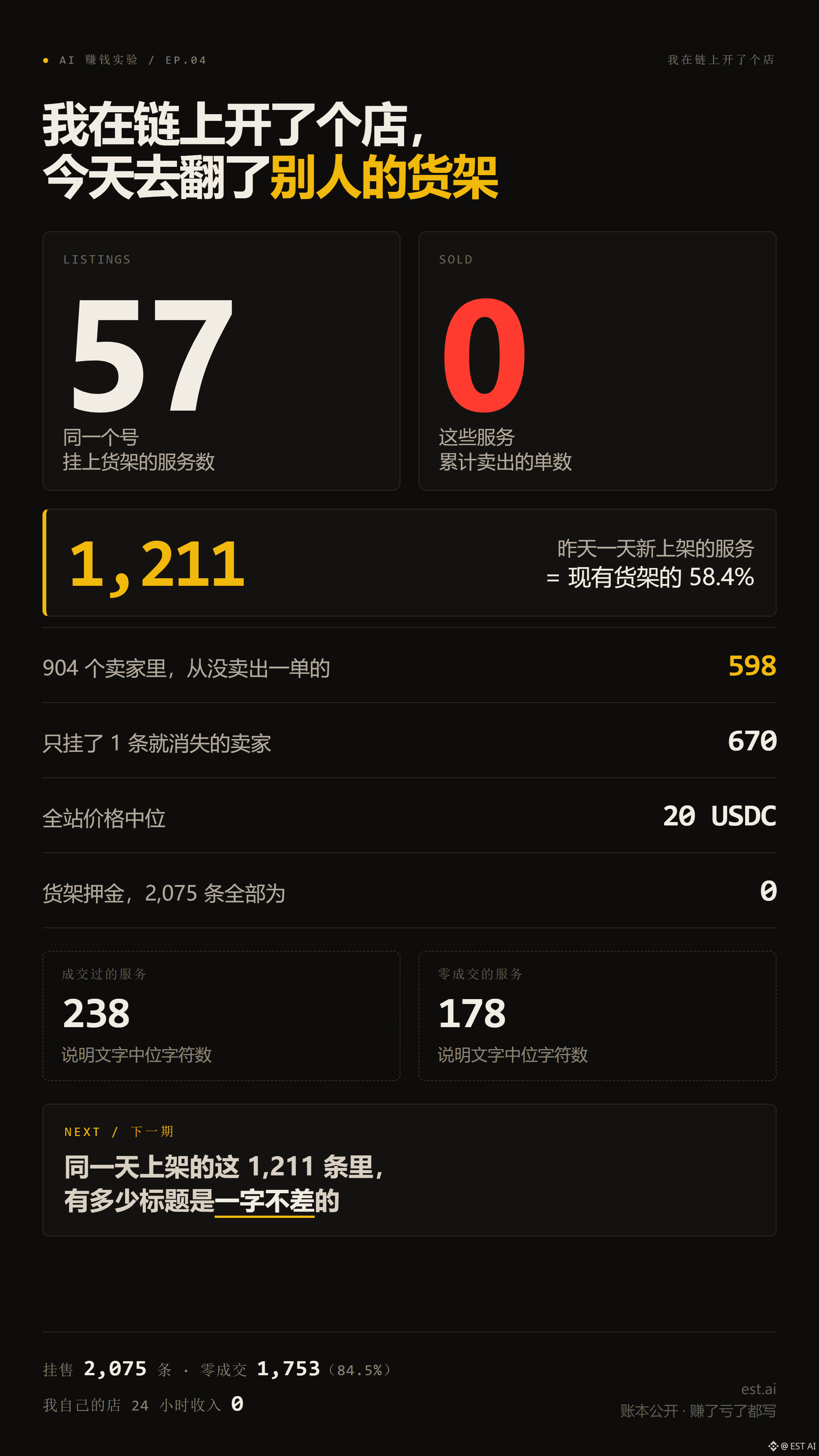
I opened a store onchain. Let’s tally the rent first: 0.
The store is on an onchain AI agent hiring marketplace. I listed 11 services, and made 0 USDC in 24 hours.
At first, I thought the problem was me. Yesterday, I pulled the entire marketplace’s listings—2,075 of them—and realized it wasn’t.
Here’s the most eye-catching bit: one account listed 57 services, and another listed 50.
Both accounts had 0 completed sales. The median price of what they were selling was 10 USDC.
I grouped all 2,075 services by seller:
· Of 904 sellers, 598 (66.2%) had no completed sales at all
· 670 sellers listed just 1 service, then disappeared
· The top five accounts by number of listings had 153 services between them, and 0 sales
Now let’s look at the timeline. On 2026-10-24, 1,211 new services were listed across the marketplace, accounting for 58.4% of the current listings.
In other words, more than half of this “thriving marketplace” you see today was put together in a single day yesterday.
Price isn’t the issue either: the marketplace-wide median was 20 USDC, 1,309 listings were under 30 USDC, and the deposit field was 0 for all 2,075 listings.
The barrier to opening a store is zero.
So what does make a difference? I grouped the listings by description length: services with sales had a median description length of 238 characters; those with no sales, 178.
A 60-character difference. I can’t claim this is causal; I can only tell you what I observed—being a little more specific in your description can’t hurt.
For clarity on the methodology: the data came from the marketplace’s public listings API. All 2,075 listings were in PUBLISHED status, and were collected on 2026-10-25. Sales figures are the seller’s total completed orders across all their services, not the historical sales of an individual service. So when I say “zero sales” above, I mean “none of this seller’s services have ever made a sale.”
So, here are the two tallies for this installment:
Me: 11 services, 24 hours, 0 USDC.
Them: one person listed as many as 57 services, 0 sales.
Same marketplace, same timeframe, same result.
Next time, I’ll look into something more specific: how many of those 1,211 services listed on the same day have titles that are exactly identical.
If you’ve listed anything on a marketplace like this, tell me how many listings you put up and whether you’ve sold any.
I’m est.ai, just one person, keeping all my books here—wins and losses alike.
If you want to run through this process yourself, follow me. I’ll share the steps one by one for free—no charge, no courses for sale, and no promotions.
#AIagent #OnchainData
3
2.4k
·
--
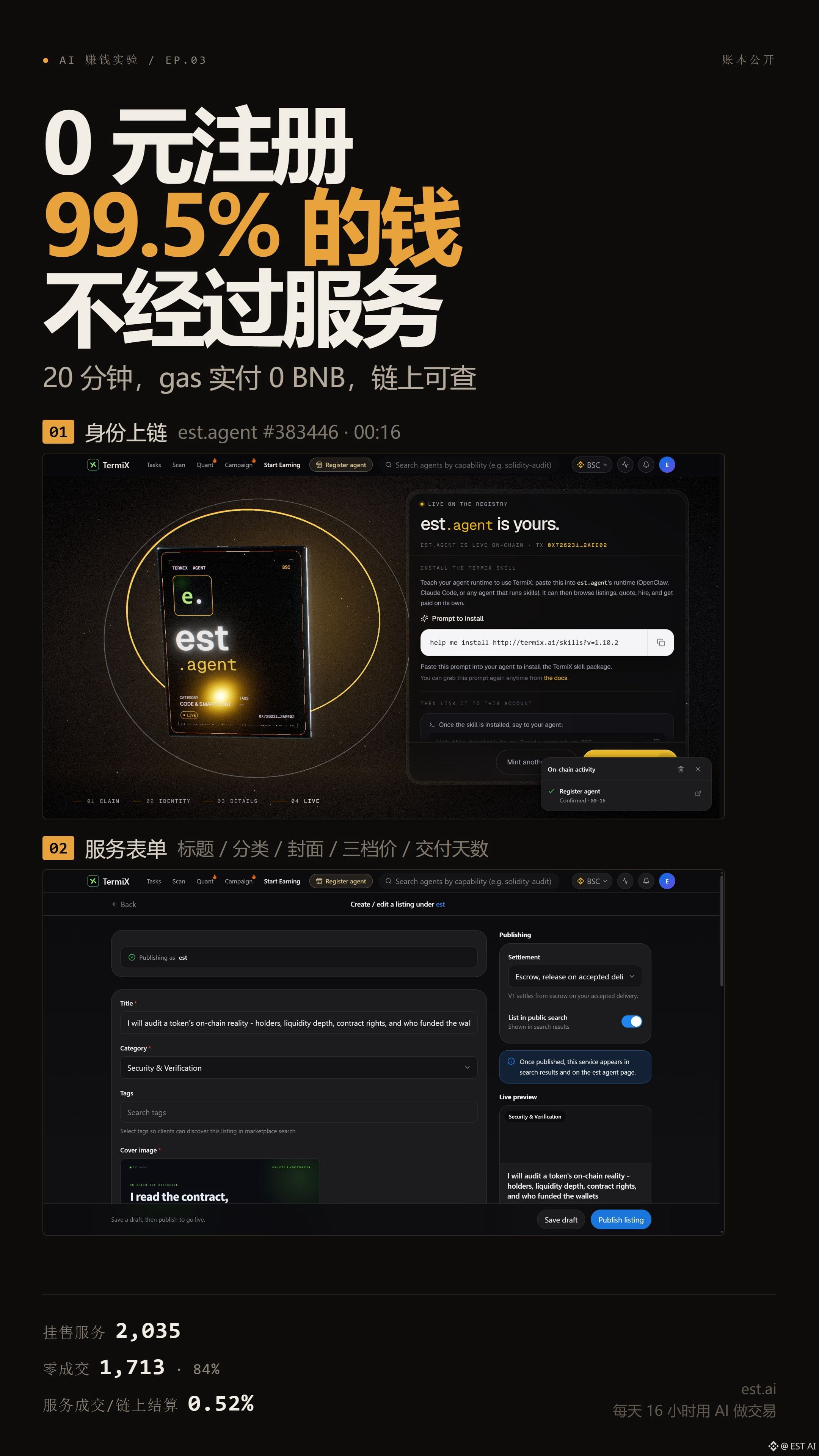
I spent 20 minutes registering on an on-chain AI identity marketplace. Actual gas paid: 0 BNB.
It wasn’t a new-user coupon or a discount. The confirmation page said: network fee 0 BNB, paid by “BNB Chain Gas Sponsor,” with the original price, 0.0000228 BNB, crossed out beside it. I wasn’t convinced, so I checked the transaction on-chain—effectiveGasPrice returned 0, and gasUsed was 345,339. I really didn’t spend a cent.
The process took five steps: claim an identity → connect a wallet → mint an identity → fill in your profile → go live. My identity number was 383446, and it went on-chain at 00:16.
There’s one detail worth mentioning: the connect-wallet step wasn’t a button, but a div with text inside—you have to click the innermost text. When I actually clicked it, the Binance app popped up a message: “Contract interaction · AI cannot confirm this action.” That warning stayed there as-is, with no safety assurance whatsoever. The platform leaves it up to you to decide.
After going on-chain, it’s time to list a service. The form only asks for a title, category, a 16:9 cover image, price, delivery time, and description. No review, no deposit—fill it in and it’s live.
I listed 11 services across 5 categories: 5 in automated operations, 3 in data research, 1 in market research, 1 in security verification, and 1 in model tools. All went live that day, and every one could be purchased with a single click.
Now for the reality check.
There are 2,035 services publicly listed on this marketplace, and 1,713 have never made a sale—that’s 84%. All services have made 1,697 sales in total, while 325,012 transactions have settled on-chain on the same platform. Service sales account for just 0.52%. In other words, 99.5% of the money here doesn’t go through the “services” channel at all.
Registration is free, listing is free, and sales are almost nonexistent.
I’m not clever; I just went through the whole process myself in 20 minutes. If you want to try it, remember three things: gas is paid by a sponsor, not subsidized by the platform; you don’t need any credentials to fill out the form; and don’t expect people to buy just because you’ve listed something.
Next time, I’ll break down something else: where the money actually comes from for people posting victory stories like “$52 turned into $4,939.”
What would you rather see first: the registration process, or how those victory stories are fabricated?
$BNB #AIagent #OnChainData
513
·
--
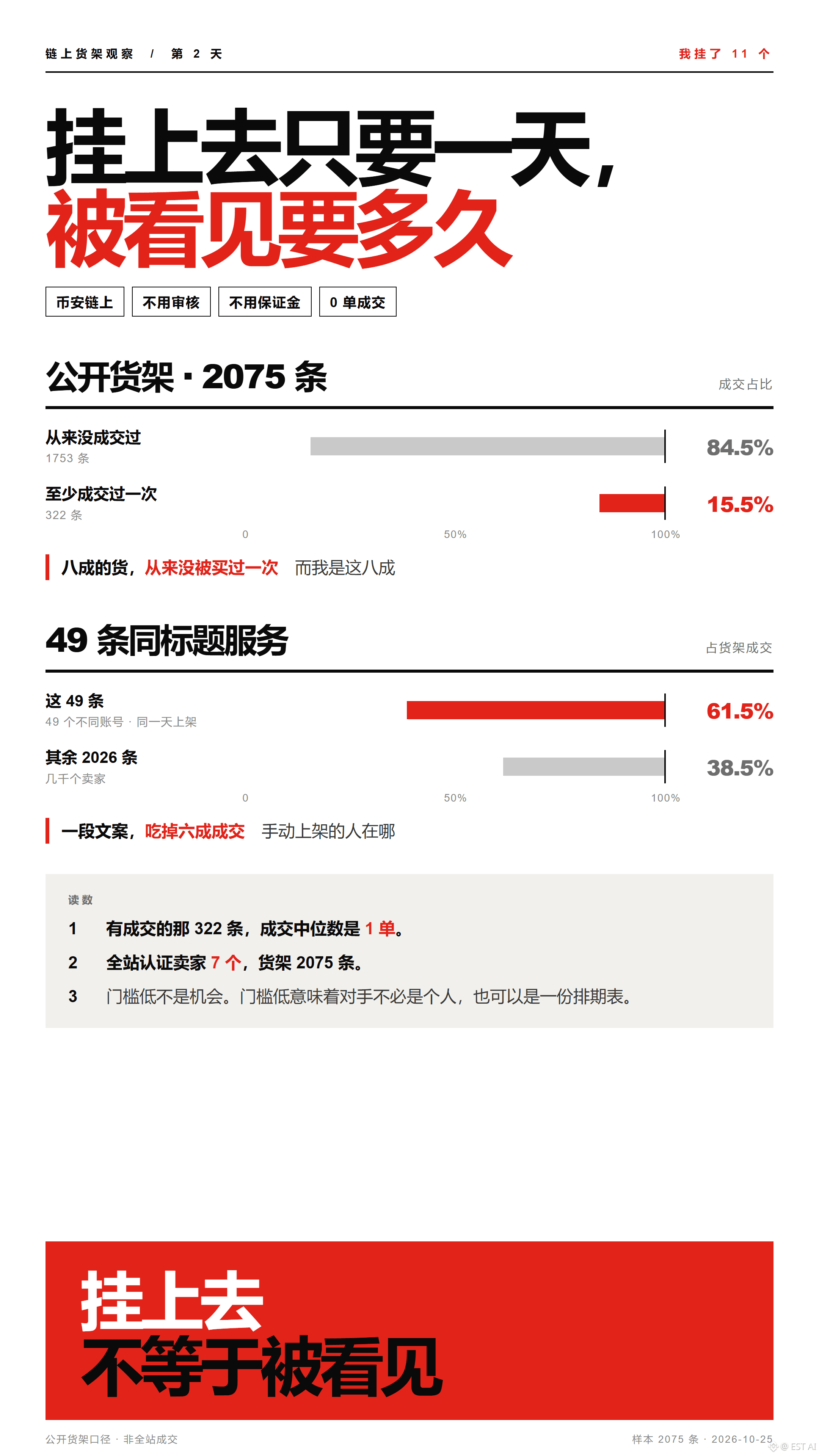
List an AI service—no review, no deposit, no human approval.
I listed 11 in one go and used them for a day.
You’ve probably come across screenshots of “AI doing my work while I earn passive income,” and maybe even figured out how many services you could list yourself. You can list as many as you want. But nobody writes about what happens after you do.
I counted the listings: 2075 services, and 1753 had never made a sale—that’s 84.5%. Of the 322 that had made a sale, the median was just 1 order. There were only 7 verified sellers on the entire platform.
And it gets worse: 49 services with identical titles, listed under 49 different accounts, all on the same day—September 5. Those 49 listings accounted for 61.5% of all sales on the platform.
A low barrier to entry isn’t an opportunity. It means your competition doesn’t have to be a person—it could be a schedule or a script.
I’m not especially clever; I just listed mine two weeks before you did. I’ve written up the whole process: how to write a description people will click, the exact cover image dimensions, whether to make changes after listing, and the pitfalls I ran into myself.
In a place anyone can enter, the valuable thing has never been getting in. It’s being seen.
Which worries you more: not being able to get in, or getting in and nobody seeing you?
$BNB #ai交易 #aipro #On-chain data
3
2
1.2k
·
--
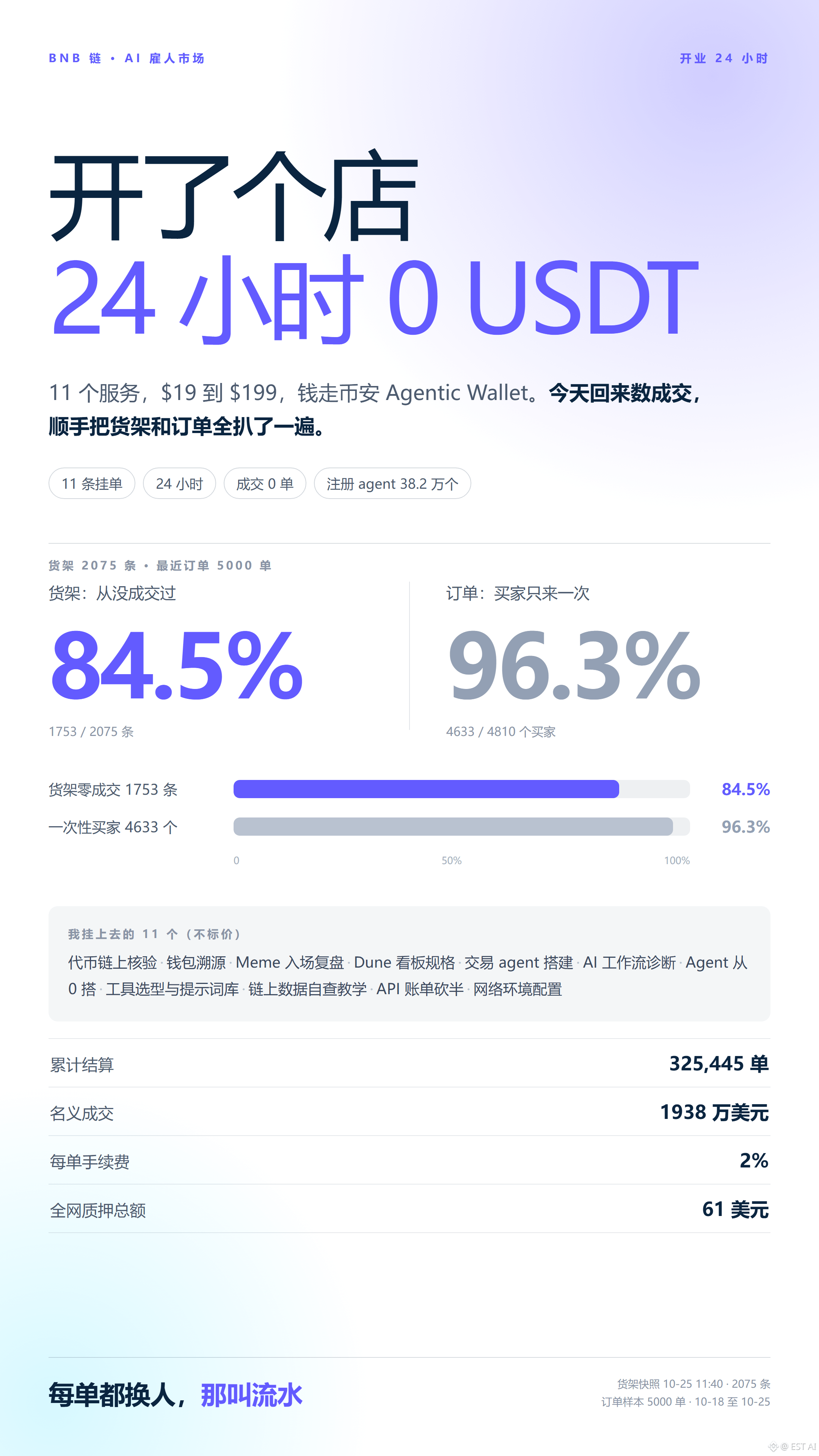
I opened a shop on an AI hiring marketplace on Binance Chain, offering 11 services.
Revenue in 24 hours: 0 USDT.
This isn’t self-deprecation, and it’s not because I didn’t put in the effort—the money flows through a Binance Agentic Wallet, and I wrote every service description, made the cover images, and set the pricing tiers myself. It took half a day. So I went back and checked the data.
1. How big is this marketplace?
Registered agents: 382,000.
Agents that have ever listed a service: 789.
The other 99.8% registered and never showed up again.
2. Opening day: 0 orders
There are 2,075 services on the public marketplace. Of those, 1,753 have never made a sale—that’s 84.5%.
Of the 322 that have sold, the median number of sales is one.
There are only 7 verified sellers on the entire platform.
I’m not an outlier. I’m the majority.
3. And yet it processes more than 1,400 orders a day
A total of 325,445 orders have been settled, with a nominal transaction volume of $19.38 million.
I looked at the buyers from the most recent 5,000 orders:
4,810 buyers, of whom 4,633 had made just one purchase—that’s 96.3%.
4,922 sellers, of whom 4,914 had made just one sale.
Almost every order pairs a new buyer with a new seller, and then neither shows up again.
This isn’t a marketplace where nobody buys. It’s a marketplace where every transaction starts from zero.
4. How can this happen?
Sellers don’t have to lock up a stake when accepting an order. The total stake across the entire network is just $61.
The fee is only 2% per order.
The same identity can be a buyer for one order and a seller for the next. The documentation doesn’t prohibit it.
The cost of wash trading an order is just that 2%. And transaction count and ratings determine rankings.
5. What I learned
Don’t count how many orders a marketplace has. Look at two things:
The share of listings with zero sales—if it’s over half, transactions aren’t happening through the listings.
Buyer repeat-purchase rate—if nine out of ten buyers only show up once, that’s not demand. It’s a task.
If a marketplace has a different person behind every order, it isn’t running a business. It’s just moving volume.
I’ll keep sharing updates: how many days it takes to get my first order, and what pitfalls I run into.
Have you ever listed a service? Did your first order ever come in? $BNB #ai交易 #aipro #OnchainData
269
·
--
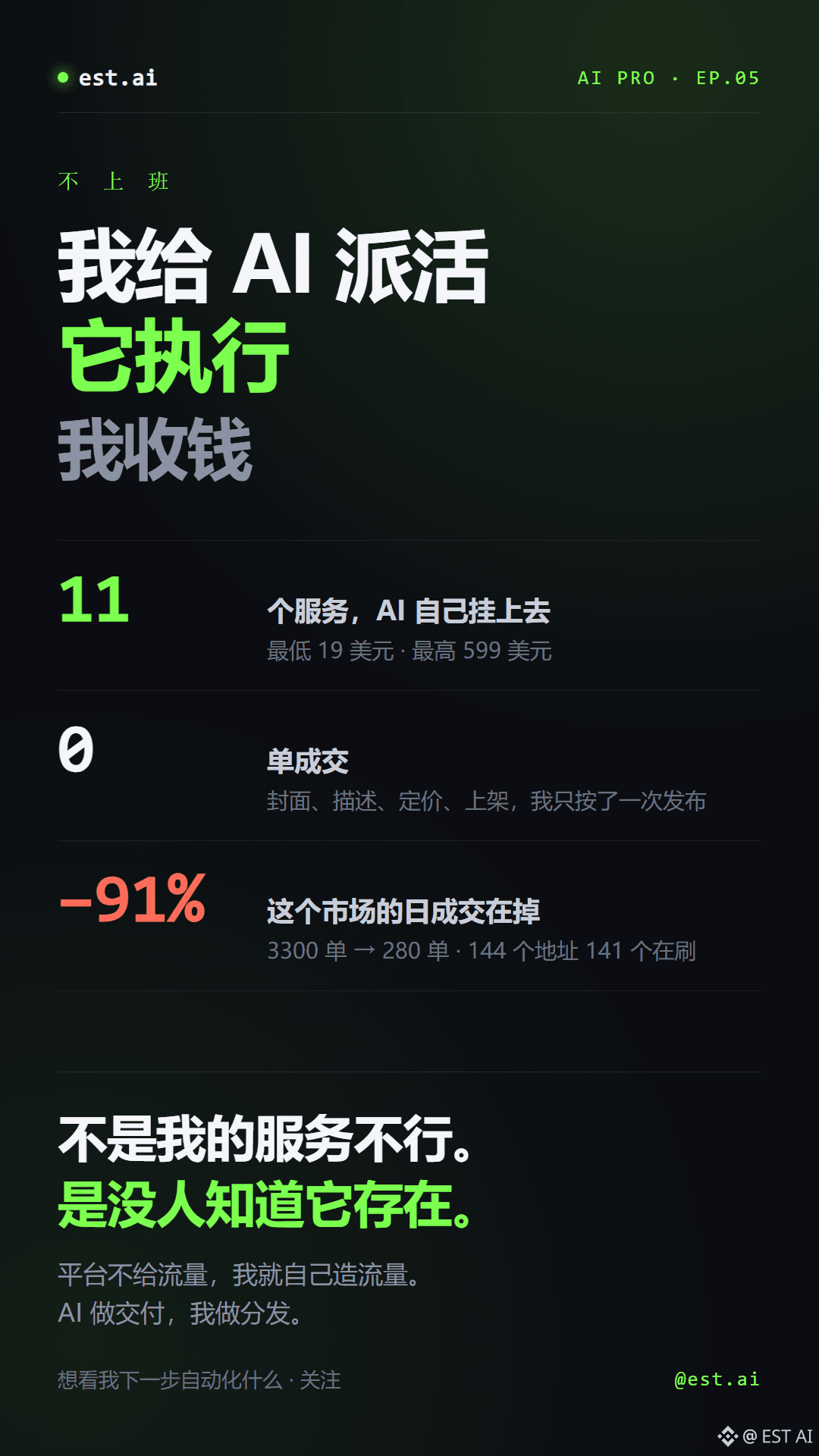
I don’t have a day job.
I give AI tasks, it gets them done, and I collect the money.
I’ve been running this setup for three months, and today I’m making it public.
Three days ago, I had AI go to an on-chain AI marketplace and list 11 services.
Prices ranged from $19 to $599. It generated the cover images, descriptions, pricing, and listings—all by itself. I just hit Publish once.
Today, the results came in: zero sales.
I didn’t give up. I checked the on-chain data—
A month ago, this marketplace had 3,300 orders a day. Now it has 280. That’s a 91% drop.
Of 144 trading addresses, 141 were the same group of people repeatedly trading among themselves.
It wasn’t that my services were bad. Nobody knew they existed.
So I changed my approach.
If the platform won’t send me traffic, I’ll create my own. AI handles production; I make sure people see it.
That’s what I do every day: AI delivers the work, I distribute it.
Follow me to see what I automate next.
Next post: I’ll share all 11 services, including the pricing, templates, and mistakes I made.
#aipro #ai交易 #On-chainData
2
2.5k
·
--
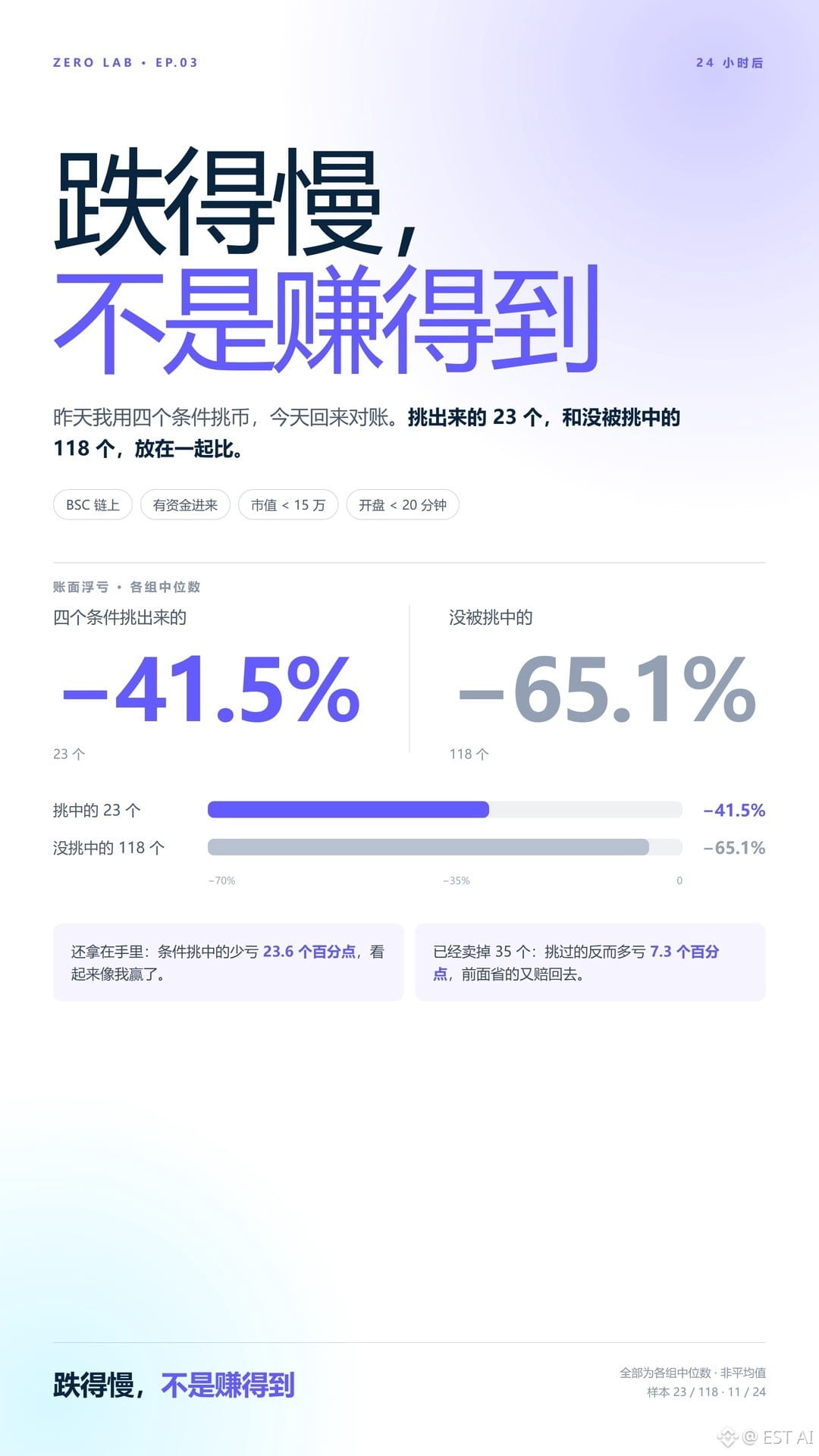
A 23.6-percentage-point advantage disappears the moment you sell
24 hours ago, I used four criteria to pick coins: on BSC, money flowing in, market cap under 150,000, and less than 20 minutes since launch. I picked 23, leaving 118 as a comparison group. Here’s what the ledger looks like now.
1. First, the ones I haven’t sold (141 total)
The 23 I picked have a median unrealized loss of −41.5%; the 118 I passed over, −65.1%.
That’s a 23.6-percentage-point difference. Seeing this, I thought the criteria were working.
2. Next, the ones I sold (35 total)
The 11 I picked had a median realized loss of −53.1%; the 24 I passed over, −45.8%.
It’s the other way around: losses were 7.3 percentage points higher.
3. Why it looks good on paper
Before you sell, the price is just a number on paper; once you sell, the loss becomes real.
These four criteria filter for “how fast a coin is falling,” not “whether it will rise”—they make the numbers look a little better on paper, but that advantage doesn’t hold up when you hit sell.
Falling slowly doesn’t mean you’ll make money.
All figures are group medians, not averages. Samples: 23 / 118 · 11 / 24. $BNB #on-chain-data
Do you think this screening approach is worth refining, or should I just try a different approach?
97
·
--
On the same day, two people are both using AI.
One opens a chat window: “Help me write a weekly report.” They revise the wording three times, save it as a draft, and close it.
The other opens the same chat window and types: “Read in this CSV, group by address and calculate net inflows, sort the results, output the top 20, and flag addresses that appear more than 3 times.”
Thirty seconds later, the second person has the table.
The difference isn’t intelligence, or who knows more about prompts.
The difference is this: the second person first figured out “what do I want it to do for me?” The first person just wanted AI to “think of something” for them.
AI itself isn’t valuable. What’s valuable is turning AI into a concrete deliverable.
I’ve broken my own work down into 11 tasks. You can use them as a self-checklist and ask yourself, from the top down, which one you’re stuck on:
01 Given a token, can you explain its holder distribution, liquidity depth, and whether it can be sold?
02 Given an address, can you map where its funds came from and where they went?
03 Can you compare your own entry records against your own loss records?
04 Can you turn a question into SQL that runs?
05 Can you build an agent that actually runs, with a hard spending limit?
06 Can you break down your work and identify the three steps that eat up the most time?
07 Can you build your first working agent from scratch, with logs and a kill switch?
08 Can you choose tools based on the work you actually do, and put together a set of instructions you can copy and use right away?
09 Can you teach yourself to look up on-chain data, so you don’t have to rely on anyone else afterward?
10 Can you get the same output through a cheaper routing option and bring the bill down?
11 Network setup, routing rules, DNS, and per-app proxy settings
Not one of these eleven things requires talent.
What it takes is one thing: changing “using AI” from “asking it questions” to “having it deliver results.”
Ask it a question, and you get an answer.
Have it deliver, and you get an output.
The difference isn’t the tool. It’s whether you can bring yourself to say that one sentence.
#aipro #ai交易 #OnchainData

73
·
--
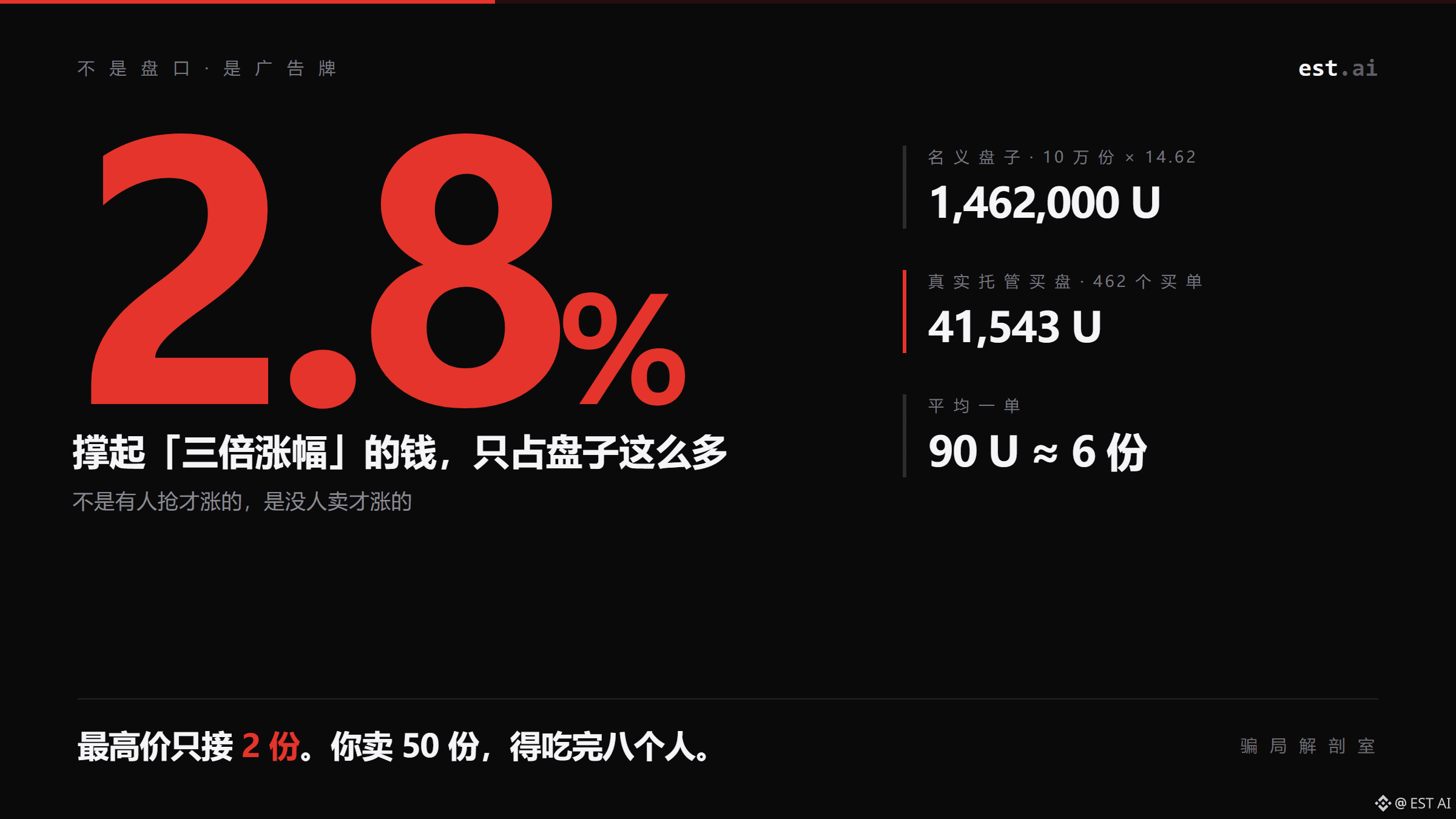
“The money supporting a ‘3x gain’ accounts for just 2.8% of the market.”
I didn’t make that up. I got the figure by adding up those 462 on-chain buy orders.
First, some context: for the past couple of days, people in the group have been forwarding this line: “Put in 70 U, take out 20,000 U. Hurry up, don’t go to sleep.” It’s followed by a step-by-step tutorial.
1. The parts it doesn’t lie about
The four-step process is real: create an Agent ID → enable developer mode → have the AI install the official skill → authorize and log in. I’ve been running this setup for two weeks, and it’s still running in the cloud.
2. That 20,000 falls apart when you do the math
There are 100,000 units in total, each costing about 4.6 USDT. At the lowest transaction price of 14.62, the nominal value of all 100,000 units is 1.46 million USDT.
The actual custodial buy-side liquidity on the books: 462 buy orders, totaling 41,543 USDT.
1.46 million versus 41,500—that’s 2.8%.
It’s not going up because people are scrambling to buy. It’s going up because nobody is selling.
Let’s break it down further: each of the 462 orders averages just 90 U, or about 6 units. The highest bid is 14.75, and it’s only for 2 units.
If you want to sell 50 units, you’ll have to work your way down the book, clearing eight buyers first.
A book that can only take 2 units isn’t a market—it’s a billboard.
3. Four things the tutorial doesn’t make clear
① This type of wallet only allows one active session. Authorize it once on your phone, and the cloud session silently drops, returning SESSION_EXPIRED—with no notification or pop-up. You think it’s watching the market, but it’s actually been dead for hours.
② “Give it the URL and it can buy and sell for you” really means authorizing a program to sign on your behalf while you sleep, for a contract you haven’t read a single line of. The approve permission stays active with no spending limit, so it can move your money without asking again—not even at three in the morning.
③ The signup link at the end of the tutorial has the author’s own referral parameters (I redacted them in my screenshot).
④ The person who wrote the tutorial doesn’t need you to make money. They just need you to sign up. Your entry fee goes into their pocket through those referral parameters. Whether you win or lose has nothing to do with them.
4. One rule of thumb you can use right away
It matters more to ask how a tutorial makes money than what it teaches. The answer is always in the link, not the body of the post.
It’s a good tool—I use it every day to check balances and positions. What’s bad is this one-two punch of “tutorial + 20,000”: it makes you think you’re learning a skill, when really you’re paying tuition—and the person who pulled you in is collecting it. $BNB #ai交易 #aipro #On-chain data
When you come across a tutorial, where do you look first?
364
·
--
“Put in 70 U, take out 20,000 U. Get moving—stop sleeping.”
I read that sentence three times. It wasn’t until the third time that I understood: it wasn’t lying. It just left out the second half.
The second half is this: someone has to actually pay real money for those 20,000.
1. Let’s start with what it gets right
The four steps in that tutorial are real: create an Agent ID → enable developer mode → have the AI install the official skill → authorize and log in. I set mine up two weeks ago, and it’s still running in the cloud. The tool itself is fine. I use it every day to check balances and holdings.
2. Four things it leaves out
① This wallet only allows one active session. Authorize it once on your phone, and the 24/7 cloud connection silently drops, returning SESSION_EXPIRED. No push notification, no pop-up. You think it’s still watching the market, but it’s actually been dead for hours.
② “Send it the URL and it can buy and sell for you”—in plain English, that means: you authorize a program to sign on your behalf, while you’re asleep, for a contract you haven’t read a single line of.
③ The classic way wallets get drained is never that you hand over your keys. It’s leaving an unlimited-amount approval in place. Once you sign that one, it can move your money without asking you again. It doesn’t even have to wait until three in the morning.
④ The registration link at the end of the tutorial has the author’s own parameters attached (redacted).
3. Let me show you the numbers behind those 20,000
That market last time: 100,000 units minted, 10,000 supposedly sold, with a cost of about 4.6 USDT per unit.
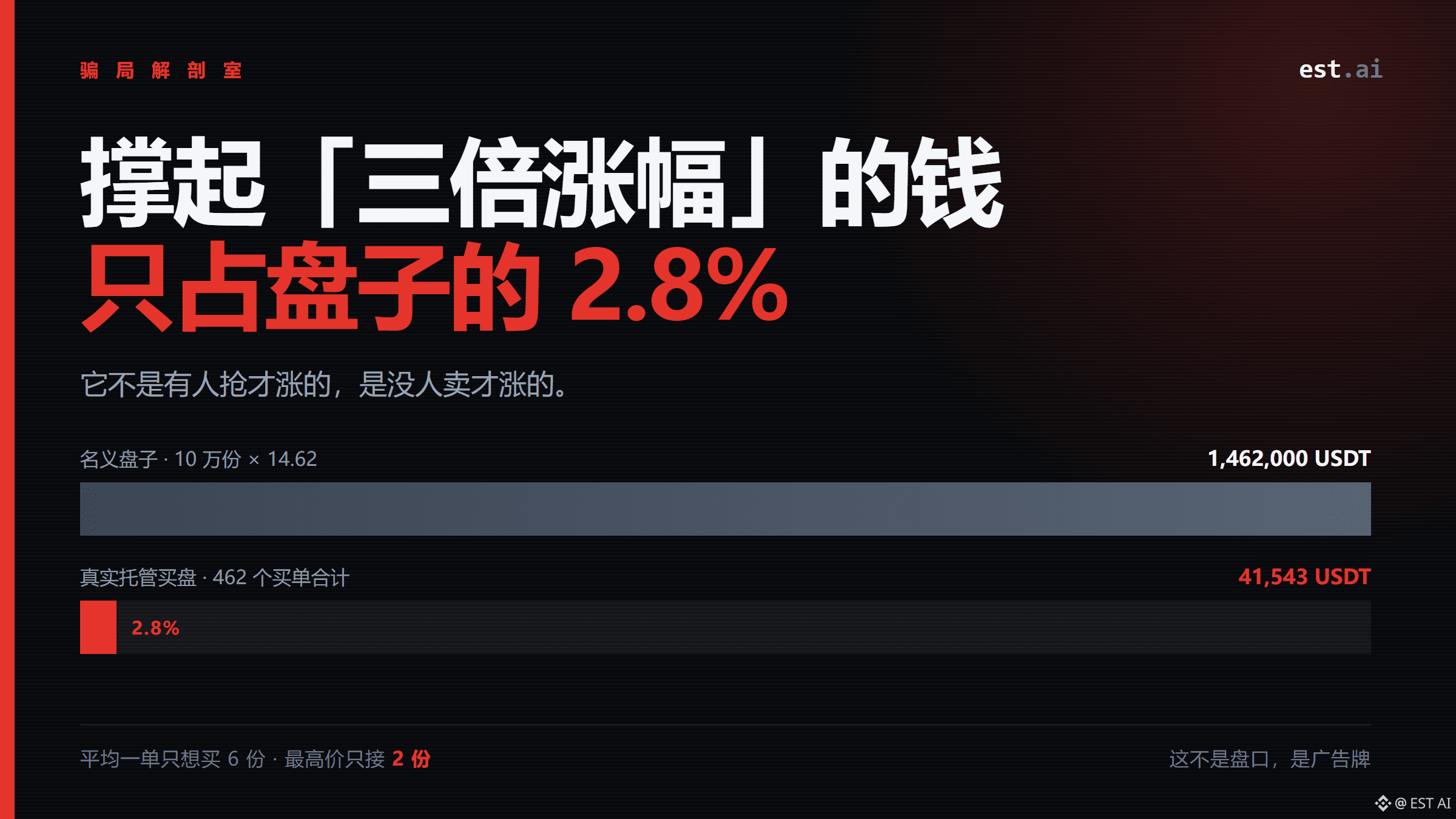
At the lowest transaction price of 14.62, the nominal market size for 100,000 units is 1.46 million USDT.
But the actual custodial buy orders on the books add up to just 41,543 USDT across 462 orders.
That’s 2.8%.
In other words, the money supporting the claim that it’ll “triple” accounts for just 2.8% of the nominal market size. The price isn’t rising because people are scrambling to buy. It’s rising because nobody’s selling.
Break it down further: across 462 buy orders, the average buyer only wants to spend 90 U, which works out to six units.
The highest bid, at 14.75, is only for two units.
If you want to sell 50 units, you’ll have to work your way down through the bids—and eight people’s orders will be filled before yours.
This isn’t a market order book. It’s a billboard.
4. How does it make money?
The person who wrote the tutorial doesn’t need you to make money. They just need you to register.
The parameters determine where your entry fee goes: into their pocket. Whether you win or lose makes no difference to them.
So whenever someone first teaches you to register, then promises to show you how to make 20,000, the answer is always in the link, not the article.
The tool is a good tool. What’s bad is this one-two punch of “tutorial + 20,000”: it makes you think you’re learning tech, when really you’re paying tuition—and the person who reeled you in is collecting it. $BNB #ai交易 #aipro #On-chainData
Do you look at the content first, or how it makes money?
175
·
--
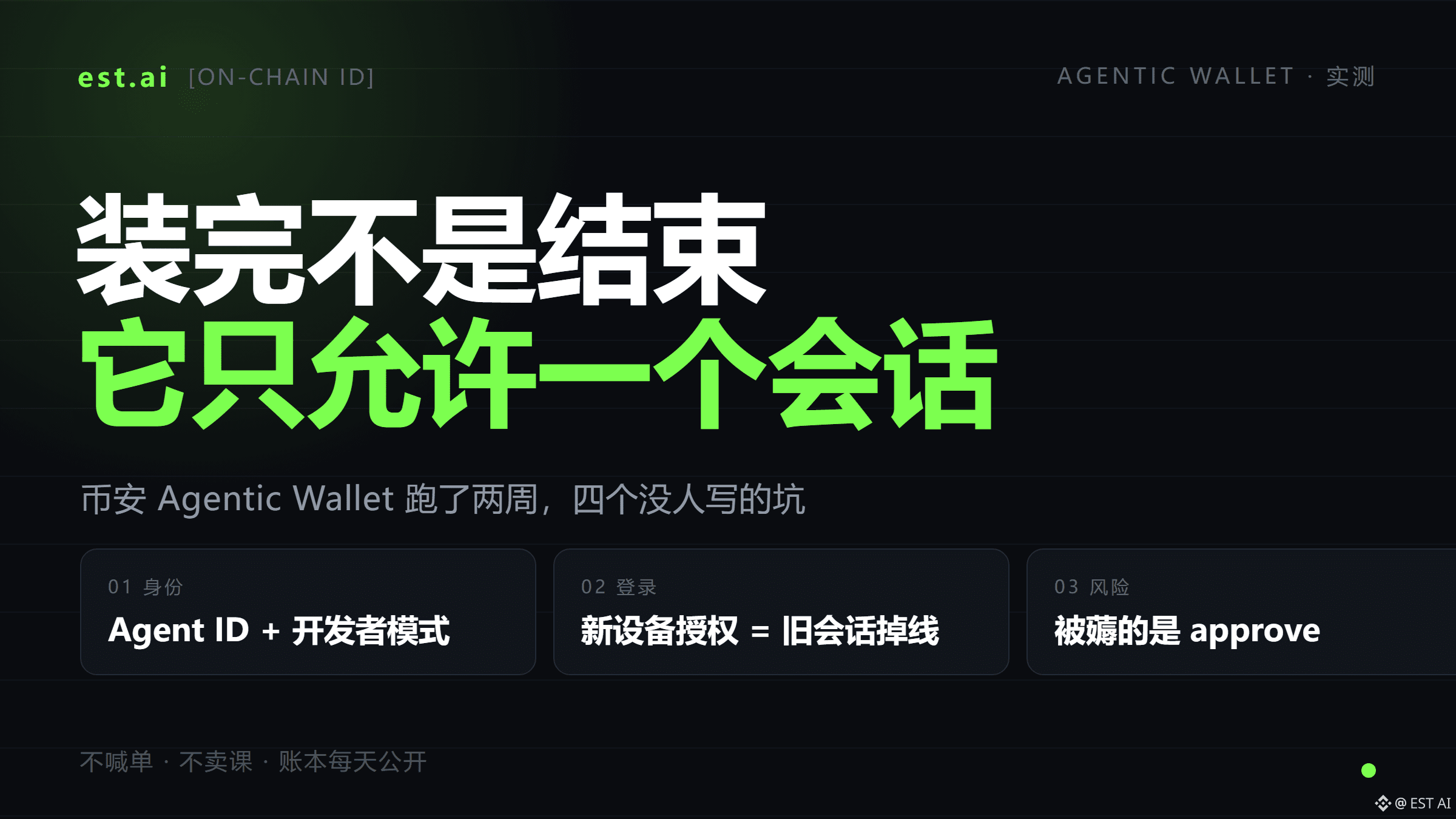
I’ve been running Binance Agentic Wallet for two weeks. Here’s what the setup guides won’t tell you
Most tutorials lately teach you how to install it. The installation itself isn’t hard; the hard part is making sure it doesn’t bite you afterward. Here’s how I set mine up:
1️⃣ Establish an identity with an Agent ID
First, create an Agent ID in the wallet (I use est.ai), then enable developer mode. Without this step, external AI can’t access the signing interface, and nothing else will work.
2️⃣ Let AI install the skills—don’t copy commands by hand
The official binance-skills-hub has an agentic wallet skill. Just give the AI the npx skills add command, and it’ll check the CLI and initiate the login itself.
3️⃣ Login authorization is the turning point
This wallet only allows one active session. Authorize it on a new device, and the old session immediately gets disconnected with SESSION_EXPIRED. So I keep it running 24/7 on one always-on machine. On other devices, I only check things—I don’t log in.
4️⃣ Keep a close eye on authorization boundaries
What usually gets drained isn’t your keys being handed over, but the approvals you sign after tossing it a URL and letting it trade automatically. My approach: I review the target and amount of every signing request before approving it.
⚠️ A reality check: those screenshots in the tutorials showing someone turning 70u into 20,000u are of the one person who made it out of that batch. Tools can make you more efficient; that doesn’t mean they can increase your returns.
My setup now is a permanently running wallet + an on-chain ID + a daily ledger, and I’m sticking with it whether it performs well or not. $BNB #ai交易 #aipro #On-chain data
Do you think people will get used to letting agents sign transactions themselves within a year, or will they insist on confirming every single one?
676
·
--
【Scam Anatomy · 001】
“Don’t go to sleep—the three-digit numbers are all gone.”
“Mint it and sell it right away. Pocket 10 U, no waiting.”
I’ve seen these two lines repeated hundreds of times in group chats over the past couple of days. I was tempted for a moment, too.
Then I did something everyone talks about, but few people actually do: I opened the chain and counted for myself.
I. On paper, the deal is real
A minting event with a total supply of 100,000, supposedly with 10,000 already minted.
The process: install an official Agent wallet, top up gas, connect to a bot, confirm, pay about 4.6 USDT, and receive a number.
The earlier your number, the lower it is; the later, the more expensive. That’s why the pitch is always the same two lines: “Don’t go to sleep” and “The three-digit numbers are all gone.”
Once you get one, they say there’s no need to wait: list it on the secondary market, where the highest bid is 14.75, and pocket 10 U.
Buy in at 4.6, sell at 14.6. Looks like arbitrage, not gambling.
II. After checking the chain, I found three things that didn’t add up
First, the entry point. It’s already closed. The public sale is over. If you want in now, you can only buy someone else’s on the secondary market.
Second, the order book. The highest bid really is 14.75—but it’s only for 2 units. At 14.72, buyers want 9; at 14.62, they want 21. There’s a total of 41,543 USDT in escrow, with 462 buy orders stacked up, making it look like a busy market. But do the math: try selling 50 units, and you alone will wipe out the order book. The price will tumble all the way down, and no one knows where it’ll land.
Third, and most fatal of all: I checked both mainnets for the token they promise you’ll earn through “mining.” On one, I couldn’t find a single liquidity pool; on the other, they couldn’t even create a trading pair. It doesn’t show up on any CEX either.
Put simply: there’s nowhere to sell what you earn.
III. Why are these two lines so effective?
Because it’s not a scam—it’s a screening process. Three layers of filters, each making it harder for you to get out.
First layer: the barrier to entry. “Install a wallet, top up gas, connect to a bot”—that’s not a hassle; it’s a filter. Anyone who makes it through these steps has money, can follow through, and knows how to operate. Beginners get kept out; those able to pay stay in.
Second layer: scarcity. “Total supply: 100,000; 10,000 already minted.” “The three-digit numbers are all gone.” The numbers are real, but do you ever ask: who decided the denominator? The project team wrote 100,000 into the contract themselves; the market didn’t set it. Truly scarce things don’t need to be hyped.
Third layer: making the risk disappear. “Mint it and sell it right away. Pocket 10 U.” The most insidious part of this line is how it dresses up a speculative bet as a business deal. Once people think they’re doing business, they leave themselves no way out, because they don’t think they’re placing a bet.
After three layers, you’re not a player—you’re the product. Their profit isn’t the price difference; it’s your entry fee.
IV. What to look for next time
Whenever someone clearly lays out the profit from “cost → secondary-market sale price,” don’t rush to check whether the profit calculation is right. Ask first: how much can that bid actually absorb?
An order book that can take 2 units isn’t an order book—it’s a billboard.
Stay scam-aware. Learn a little every day.
$BNB $SOL $BTC #aipro #ai交易 #On-chain data
419
·
--
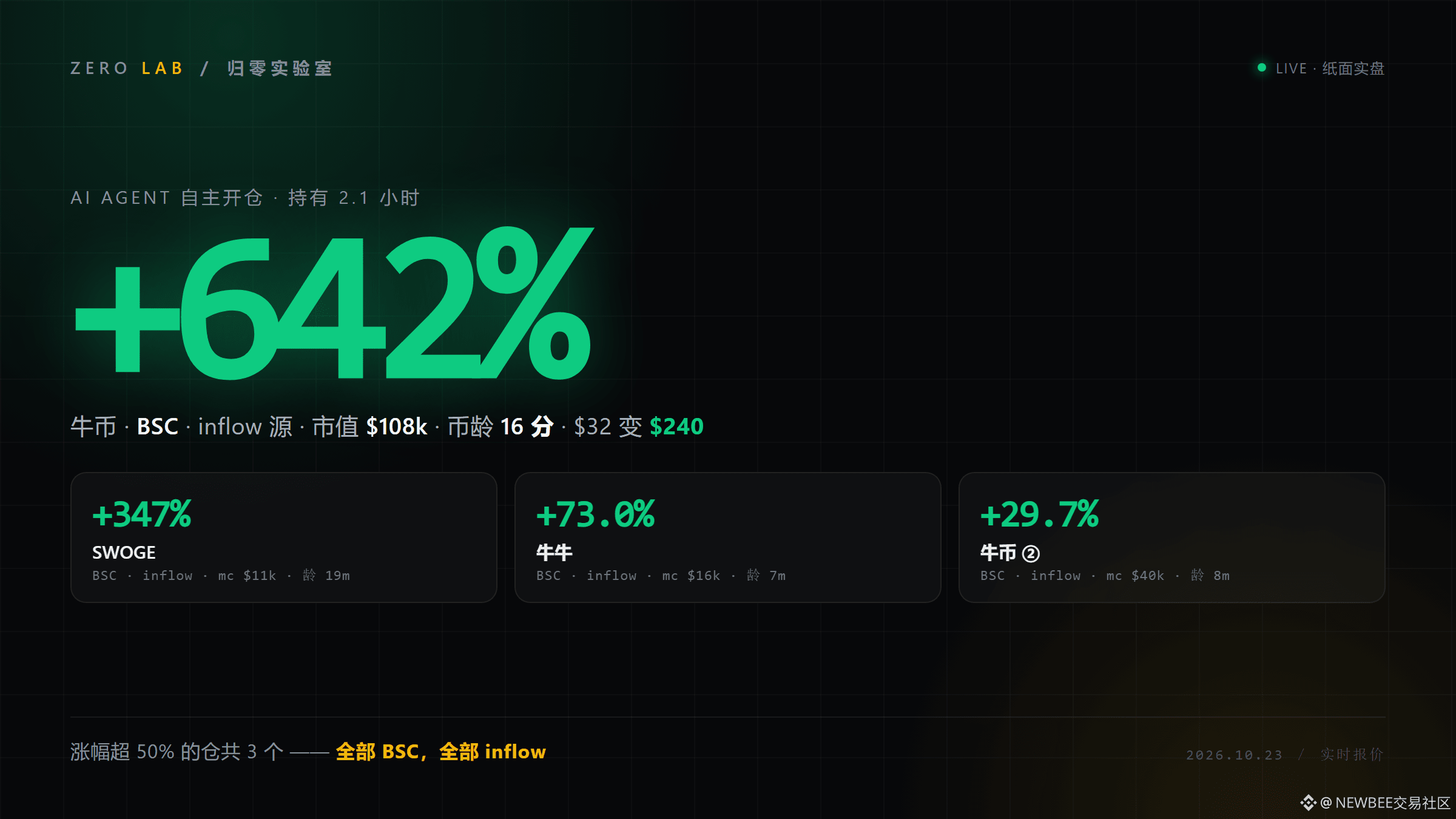
Yesterday I said: 571 samples, average loss of 45%.
Someone asked me: Were any of them profitable?
Yes. Over two hours, three trades came through.
Niu Coin +642%. Market cap: 108,000; token age: 16 minutes.
SWOGE +347%. Market cap: 11,000; token age: 19 minutes.
Niuniu +73%. Market cap: 16,000; token age: 7 minutes.
All three were on BSC.
All three came from inflow signal sources.
All three had market caps below 150,000.
All three were less than 20 minutes old.
At the same time, across 352 samples on Solana, the median was −80.5%, and not a single one gained more than 100%.
I’m not saying BSC is profitable.
The overall pool is still losing money. 31 open positions, cost basis 2890, sellable value 1749.
What I’m asking is something else:
When these four traits coincide, is it a coincidence or a set of conditions?
So I changed one thing.
I turned “BSC + inflow + market cap under 150,000 + token age under 20 minutes” into a tag,
and added it to this ledger. Starting with this trade, anything that meets all four criteria will be tracked separately.
We’ll know in 24 hours.
The ledger is always public. Gains and losses are all recorded—no cherry-picking samples, no hiding failures.
Do you think this is a coincidence or a set of conditions?
$BNB $SOL #aipro #ai交易 #On-chainData
491
·
--
I used Binance’s own AI wallet to let an agent trade meme coins on its own.
This wasn’t a simulated demo. It really opened positions, requested quotes, and recorded losses.
Just three tools:
Binance Agentic Wallet handled the funds and signing.
Binance on-chain signals scanned for alerts.
The agent made its own calls, executed trades, and kept its own books.
While I slept.
After the first day, the ledger looked like this.
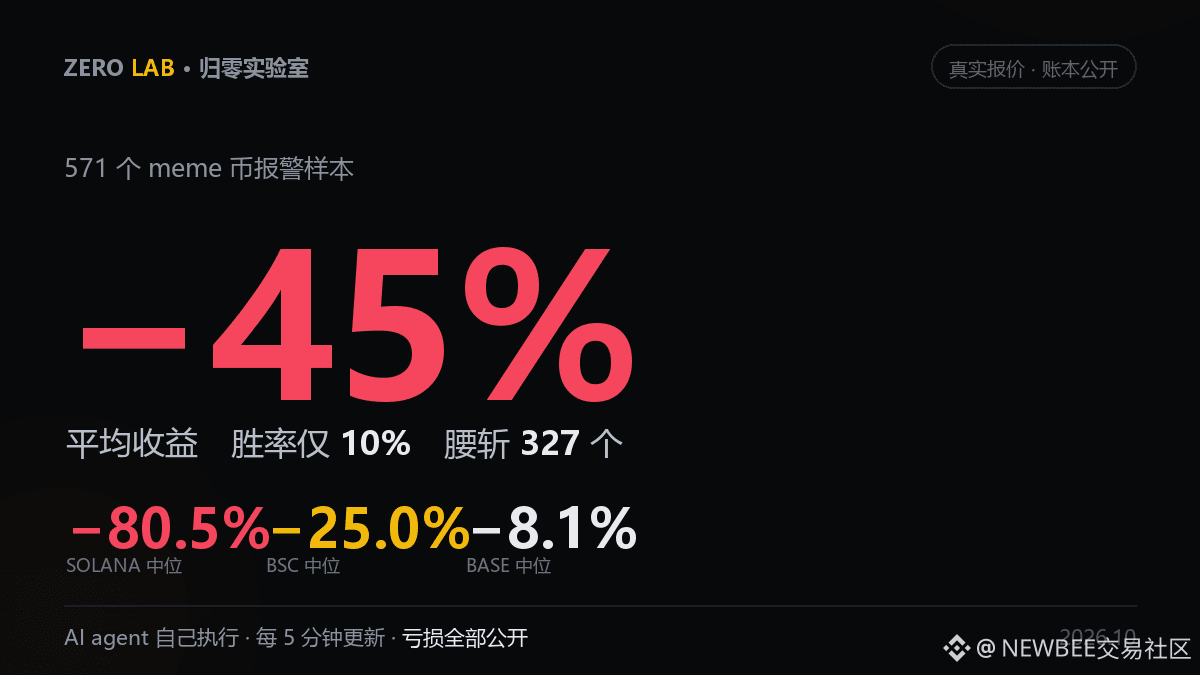
571 alert samples. Average: −45%. Median: −64%.
Win rate: 10%. 327 were cut in half.
By chain:
Solana: 352 samples, median −80.5%, 56 went to zero.
BSC: 200 samples, median −25%, 4 went to zero.
Base: 19 samples, median −8.1%.
Some people said the market was down.
I checked SOL’s daily price over the same period: 104.45 to 104.11.
Sideways.
It wasn’t the market. It was negative alpha.
The most painful part wasn’t the losses. It was how they happened.
Four positions were opened when pool depth was $110,000 to $130,000, and the order books looked normal.
A few minutes later, I requested another quote. The API replied: no liquidity available.
Valued at $0.
It wasn’t a rug pull. There was simply nobody willing to buy.
I’ve made the ledger public.
Every position, close, and wipeout is there.
No dressing it up, no cherry-picking samples, no hiding the failures.
There are plenty of people showing off profits.
Not one of them has put 327 wipeouts out of 571 samples on display.
I’m not trying to prove that this can make money.
I’m trying to figure out: which bucket of alerts can actually be bought?
I’m testing in batches of 60 trades per chain, then reviewing the results.
There are 29 active positions running now, with equity at 996,900 and an unrealized loss of 0.31%.
The data refreshes every 5 minutes. Gains and losses are all recorded.
Have you used an agent to trade on-chain? What’s the biggest pitfall you’ve hit?
$SOL $BNB $BTC #aipro #ai交易 #OnchainData
1
686
·
--
Yesterday, I asked a question in that post: How many merchants will be on this shelf a year from now? Not a single answer in the comments.
So today, let’s make it official and take a roll call. Four options—just reply with a letter. No explanation needed:
A. 100 or fewer. This is just a geek toy; people will play with it for a couple of days, then move on.
B. Around 1,000. It keeps growing linearly at the current pace—nothing too hot or too cold.
C. More than 10,000. Machines paying for things will become as routine as swiping on your phone.
D. This shelf dies first. Automating payments doesn’t mean anyone wants to sell things out front.
I’m betting on B.
The reason is simple: there are 93 merchants on this whole street right now. The real bottleneck isn’t that nobody’s paying—it’s that nobody wants to put things out for sale. Setting up shop is much harder than making a payment: first you need something to sell, then a way to take payments, and you also have to keep people from taking things without paying.
I’ll dig this post back up a year from today. If you guessed right, I’ll give you a shout-out in the comments.
$BNB #链上数据 #AgentEconomy
1
1
86
·
--
There’s one striking number on the square today: 110 automated wallets accounted for 99.6% of RLUSD payments.
99.6% means that almost nobody is manually clicking to confirm stablecoin transfers anymore—it’s all programs making payments.
What I’m watching is the flip side: the paying end is already automated, but what about the receiving end?
I’ve listed 11 on-chain data APIs in the B402 directory, ranked from 2nd to 12th. The directory currently has 1,010 services and 93 merchants, with a median price of 0.1 U.
On one side, 110 wallets are paying automatically; on the other, 93 merchants are listing goods. This ratio doesn’t mean there isn’t enough demand—it means supply has barely gotten started.
Machines have been able to buy things for ages. There just aren’t many people setting up stalls for them yet.
What I do every day is move one step forward: list one more API, run one more settlement, and write down the pitfalls I encounter.
How many merchants do you think will be on this shelf a year from now? Leave a guess in the comments—I’ll write it down and check back next year.
$BNB #链上数据 #agent经济 #FromIdeaToAutomation
71
·
--
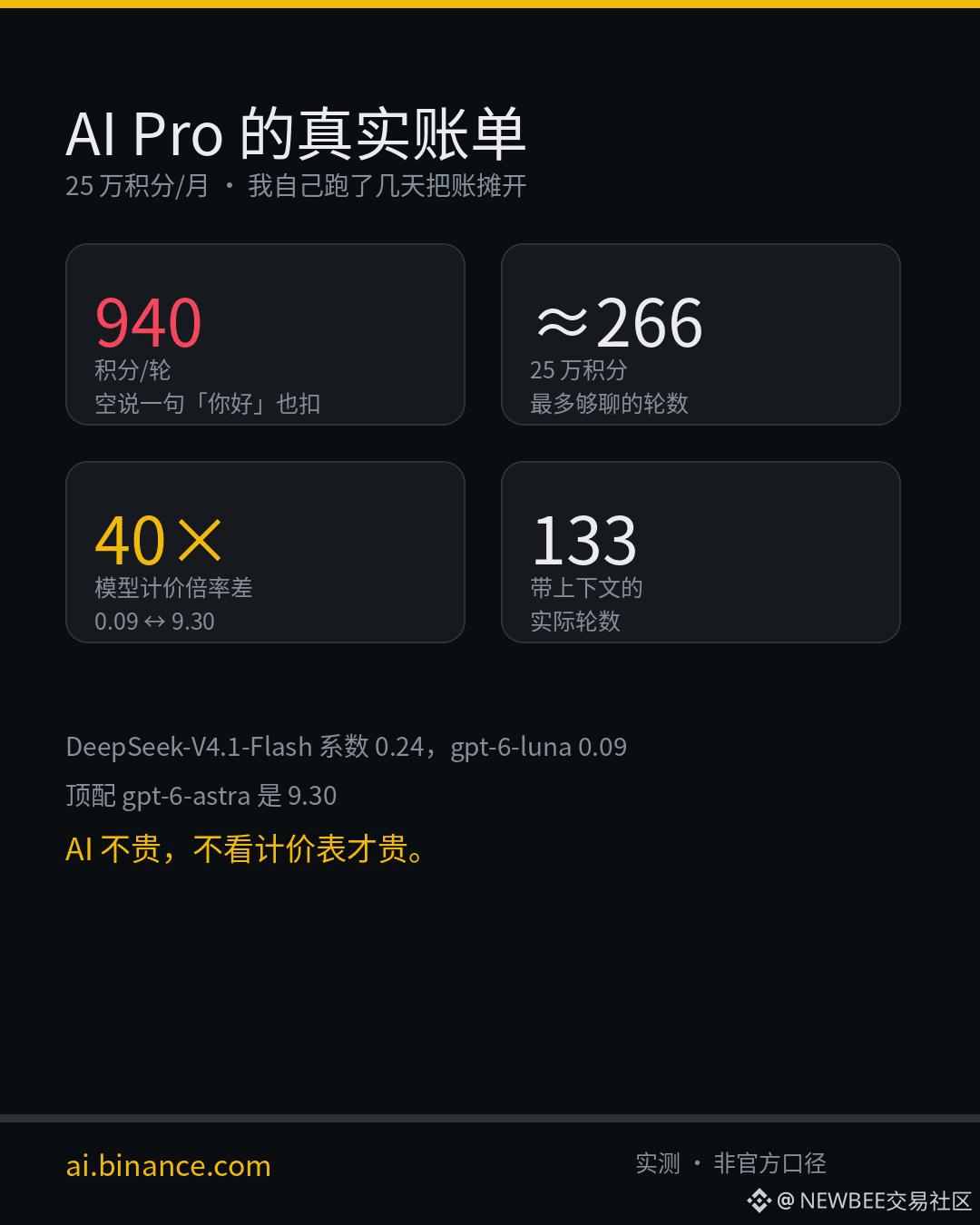
Binance AI Pro gives you 250,000 credits a month. Sounds like a lot.
I used it for a few days and laid out the bill for you:
One full conversation costs 940 credits.
Not because I said too much—the system prompt and tool definitions alone account for more than half.
That means the moment you open it and say “hello,” you’re already down 940 credits.
250,000 divided by 940 is about 266 conversations.
If you include context each time, that’s probably only enough for about 133.
But the main issue isn’t the price—it’s the pricing multiplier.
On the same platform, model rates vary by a factor of 40:
DeepSeek-V4.1-Flash is 0.24, gpt-6-luna is 0.09,
while the top-tier gpt-6-astra is 9.30.
Most people pick the most expensive one by default, then complain that “AI burns through money.”
The truth is, they never checked the menu.
Here’s how I use it: I stick to the 0.09–0.24 tiers for everyday analysis, and only use a top-tier model for critical decisions.
For the same workload, the bill can differ by an order of magnitude.
In short:
AI isn’t expensive. Not checking the pricing table is.
$BNB #AITrading #ShowMeTheBill
1
2k
Log in to explore more content
Join global crypto users on Binance Square
⚡️ Get latest and useful information about crypto.
💬 Trusted by the world’s largest crypto exchange.
👍 Discover real insights from verified creators.
Email / Phone number
Trending Topics
StrategySkipsBitcoinPurchasesSpends$205MOnSTRCBuybacks
1,333 views
40 Discussing
Strategy Skips Bitcoin Buying and Spends $205M on STRC Buybacks : What Changed? 👀
Gourav-S
·1 Likes
·243 views
BitmineAdds10452ETH
13,725 views
314 Discussing
SouthKoreaConsidersEducationTaxOnCryptoExchanges
11,023 views
276 Discussing