
Kri
6.4k Posts

Kri
 Square Verified+
Report
Block User
Top Crypto Content Creator Since 2014 Year! For Partnership X: Sh_Mach

Top Voices

Level 1 Creator
7 Following
143.4K+ Followers
138.9K+ Liked
2 Badges
Posts
Portfolio
All
Quotes
Videos
·
--
Article
SantaHood Expands Beyond Memecoin Roots With Santro Exchange and $SANTACOIN UtilitySantaHood, an early Santa-themed project on Robinhood Chain, is expanding its ecosystem with the launch of Santro Exchange, bringing new utility to its native $SANTACOIN token as the project looks beyond the traditional Christmas memecoin narrative.
SantaHood is taking its Santa-themed crypto experiment beyond memecoin territory with the introduction of Santro Exchange, a trading platform designed to become a central part of the project's growing ecosystem.
Launched in July 2026 on Robinhood Chain, SantaHood entered the market months ahead of the traditional Christmas season. While the project initially attracted attention through its Santa narrative, its team has increasingly focused on building products around its native token, $SANTACOIN.
The official $SANTACOIN contract address on Robinhood Chain is:
0x38bb87cf3e7344a82be7cd671c191f015b97eee6
The strategy is designed to address one of the biggest challenges facing seasonal memecoins: maintaining relevance after the narrative that initially drove attention begins to fade.
Rather than relying exclusively on Christmas speculation, SantaHood is attempting to build an ecosystem where $SANTACOIN has utility throughout the year.
Santro Exchange Becomes the Centerpiece of SantaHood's Utility Push
The biggest development in that strategy is Santro Exchange, which the project is positioning as a centralized trading platform built around the Robinhood Chain ecosystem.
Santro Exchange is scheduled for public launch on September 9, 2026.
The platform is designed with both centralized and decentralized trading components, giving users access to different trading experiences within the broader Santro ecosystem.
More importantly, SantaHood has decided against introducing a separate token for the exchange.
Instead, $SANTACOIN will remain the native and governance token of the ecosystem, connecting SantaHood and Santro Exchange under a single-token structure.
For holders, this means the launch of Santro Exchange is not intended to dilute the existing ecosystem through another token issuance.
The team describes its strategy simply as:
“One ecosystem, one token.”
Exchange Fees to Support $SANTACOIN Buybacks and Burns
One of the most notable elements of Santro Exchange is its planned fee structure.
According to the project, platform fees generated by Santro Exchange will be used to purchase $SANTACOIN from the open market, with purchased tokens subsequently burned.
This creates a direct economic connection between exchange activity and the SantaHood token.
Under the model, increased trading activity could generate additional platform fees, which would translate into market buybacks and further reductions in token supply.
The mechanism can be summarized as:
Trading Activity → Platform Fees → $SANTACOIN Buybacks → Token Burns
The ultimate impact of the mechanism will depend on Santro Exchange attracting sustained users and trading volume after launch.
However, the model represents SantaHood's attempt to move $SANTACOIN beyond purely speculative demand by connecting the token to revenue-generating infrastructure.
SantaHood Has Already Made Token Burns Part of Its Strategy
The exchange mechanism builds on a strategy SantaHood has already been pursuing.
$SANTACOIN launched with a maximum supply of 1 billion tokens.
Since launch, the project says it has conducted multiple market buybacks and permanently removed tokens from circulation through burns.
According to figures provided by the SantaHood team, approximately 15% of the original supply has been burned through its various initiatives.
The project has also introduced a daily buyback-and-burn mechanism, with the goal of continuously reducing supply over time.
Santro Exchange is expected to add another component to this strategy by tying future buybacks to economic activity generated by the platform itself.
$SANTACOIN Utility Expands
SantaHood's broader roadmap places $SANTACOIN at the center of several ecosystem functions.
Beyond its role within Santro Exchange, the token is being positioned for governance, staking and additional holder utilities.
The project is also developing NFT-related functionality intended to provide further benefits within the ecosystem.
By keeping these utilities connected to one asset, SantaHood is attempting to avoid the fragmented token structure seen in some crypto ecosystems where individual products launch their own tokens.
The approach means future SantaHood products could potentially expand the utility of $SANTACOIN rather than compete against it.
Building Before the Christmas Narrative Peaks
Timing has played an important role in SantaHood's strategy.
Rather than launching at the height of the Christmas memecoin season, the project entered Robinhood Chain months earlier and began establishing its ecosystem before December.
That gives SantaHood an opportunity to position itself before seasonal attention around Santa-themed assets potentially increases.
But the team appears equally focused on what happens after Christmas.
Santro Exchange is central to that plan.
Instead of Christmas being the entire reason for the project's existence, SantaHood is treating the seasonal narrative as a potential gateway into a broader ecosystem.
If successful, users initially attracted by the Santa narrative could subsequently interact with Santro Exchange, staking, governance and other products connected to $SANTACOIN.
An Early Bet on Robinhood Chain
SantaHood's expansion also represents a bet on the development of Robinhood Chain.
Emerging blockchain networks often create opportunities for early applications to establish their brands before ecosystems become crowded.
SantaHood is attempting to secure that position by building both a recognizable token brand and trading infrastructure during Robinhood Chain's early development.
Santro Exchange represents the project's largest step in that direction so far.
As with any newly launched crypto platform, however, its longer-term impact will depend on adoption, liquidity, trading activity and the team's ability to execute its roadmap.
For SantaHood, the objective is clear: transform a recognizable meme narrative into an ecosystem with products capable of operating independently of seasonal hype.
From Memecoin to Ecosystem
The launch of Santro Exchange marks an important transition for SantaHood.
The project started with Santa as its identity, but its development strategy now revolves around building utility around $SANTACOIN.
With Santro Exchange, staking, governance, NFT functionality and a fee-funded buyback-and-burn mechanism forming part of the ecosystem, SantaHood is attempting to demonstrate that a memecoin can use its narrative to attract a community while simultaneously developing products around that community.
Whether that strategy succeeds will ultimately depend on adoption.
But as the Christmas season approaches, SantaHood is entering it with something many seasonal tokens do not have: an ecosystem being built beyond the meme.
Readers interested in following the project's development can find SantaHood through its official website and social channels, while Santro Exchange maintains separate channels for exchange-related developments.
SantaHood Official Information
Project: SantaHood
Ticker: $SANTACOIN
Network: Robinhood Chain
Maximum Supply: 1,000,000,000 SANTACOIN
Ecosystem Platform: Santro Exchange
Official Contract Address (CA):
"0x38bb87cf3e7344a82be7cd671c191f015b97eee6"
SantaHood Website: https://Santahood.com
SantaHood X: https://x.com/SantaHoodCoin
SantaHood Telegram: https://t.me/Santahood
Santro Exchange: https://SantroExchange.com
Santro Exchange X: https://x.com/SantroExchange
Santro Exchange Telegram: https://t.me/SantroExchange
Readers should independently verify the contract address through SantaHood's official channels and conduct their own research before interacting with cryptocurrency assets.
SantaHood Expands Beyond Memecoin Roots With Santro Exchange and $SANTACOIN Utility
SantaHood, an early Santa-themed project on Robinhood Chain, is expanding its ecosystem with the launch of Santro Exchange, bringing new utility to its native $SANTACOIN token as the project looks beyond the traditional Christmas memecoin narrative.
SantaHood is taking its Santa-themed crypto experiment beyond memecoin territory with the introduction of Santro Exchange, a trading platform designed to become a central part of the project's growing ecosystem.
Launched in July 2026 on Robinhood Chain, SantaHood entered the market months ahead of the traditional Christmas season. While the project initially attracted attention through its Santa narrative, its team has increasingly focused on building products around its native token, $SANTACOIN.
The official $SANTACOIN contract address on Robinhood Chain is:
0x38bb87cf3e7344a82be7cd671c191f015b97eee6
The strategy is designed to address one of the biggest challenges facing seasonal memecoins: maintaining relevance after the narrative that initially drove attention begins to fade.
Rather than relying exclusively on Christmas speculation, SantaHood is attempting to build an ecosystem where $SANTACOIN has utility throughout the year.
Santro Exchange Becomes the Centerpiece of SantaHood's Utility Push
The biggest development in that strategy is Santro Exchange, which the project is positioning as a centralized trading platform built around the Robinhood Chain ecosystem.
Santro Exchange is scheduled for public launch on September 9, 2026.
The platform is designed with both centralized and decentralized trading components, giving users access to different trading experiences within the broader Santro ecosystem.
More importantly, SantaHood has decided against introducing a separate token for the exchange.
Instead, $SANTACOIN will remain the native and governance token of the ecosystem, connecting SantaHood and Santro Exchange under a single-token structure.
For holders, this means the launch of Santro Exchange is not intended to dilute the existing ecosystem through another token issuance.
The team describes its strategy simply as:
“One ecosystem, one token.”
Exchange Fees to Support $SANTACOIN Buybacks and Burns
One of the most notable elements of Santro Exchange is its planned fee structure.
According to the project, platform fees generated by Santro Exchange will be used to purchase $SANTACOIN from the open market, with purchased tokens subsequently burned.
This creates a direct economic connection between exchange activity and the SantaHood token.
Under the model, increased trading activity could generate additional platform fees, which would translate into market buybacks and further reductions in token supply.
The mechanism can be summarized as:
Trading Activity → Platform Fees → $SANTACOIN Buybacks → Token Burns
The ultimate impact of the mechanism will depend on Santro Exchange attracting sustained users and trading volume after launch.
However, the model represents SantaHood's attempt to move $SANTACOIN beyond purely speculative demand by connecting the token to revenue-generating infrastructure.
SantaHood Has Already Made Token Burns Part of Its Strategy
The exchange mechanism builds on a strategy SantaHood has already been pursuing.
$SANTACOIN launched with a maximum supply of 1 billion tokens.
Since launch, the project says it has conducted multiple market buybacks and permanently removed tokens from circulation through burns.
According to figures provided by the SantaHood team, approximately 15% of the original supply has been burned through its various initiatives.
The project has also introduced a daily buyback-and-burn mechanism, with the goal of continuously reducing supply over time.
Santro Exchange is expected to add another component to this strategy by tying future buybacks to economic activity generated by the platform itself.
$SANTACOIN Utility Expands
SantaHood's broader roadmap places $SANTACOIN at the center of several ecosystem functions.
Beyond its role within Santro Exchange, the token is being positioned for governance, staking and additional holder utilities.
The project is also developing NFT-related functionality intended to provide further benefits within the ecosystem.
By keeping these utilities connected to one asset, SantaHood is attempting to avoid the fragmented token structure seen in some crypto ecosystems where individual products launch their own tokens.
The approach means future SantaHood products could potentially expand the utility of $SANTACOIN rather than compete against it.
Building Before the Christmas Narrative Peaks
Timing has played an important role in SantaHood's strategy.
Rather than launching at the height of the Christmas memecoin season, the project entered Robinhood Chain months earlier and began establishing its ecosystem before December.
That gives SantaHood an opportunity to position itself before seasonal attention around Santa-themed assets potentially increases.
But the team appears equally focused on what happens after Christmas.
Santro Exchange is central to that plan.
Instead of Christmas being the entire reason for the project's existence, SantaHood is treating the seasonal narrative as a potential gateway into a broader ecosystem.
If successful, users initially attracted by the Santa narrative could subsequently interact with Santro Exchange, staking, governance and other products connected to $SANTACOIN.
An Early Bet on Robinhood Chain
SantaHood's expansion also represents a bet on the development of Robinhood Chain.
Emerging blockchain networks often create opportunities for early applications to establish their brands before ecosystems become crowded.
SantaHood is attempting to secure that position by building both a recognizable token brand and trading infrastructure during Robinhood Chain's early development.
Santro Exchange represents the project's largest step in that direction so far.
As with any newly launched crypto platform, however, its longer-term impact will depend on adoption, liquidity, trading activity and the team's ability to execute its roadmap.
For SantaHood, the objective is clear: transform a recognizable meme narrative into an ecosystem with products capable of operating independently of seasonal hype.
From Memecoin to Ecosystem
The launch of Santro Exchange marks an important transition for SantaHood.
The project started with Santa as its identity, but its development strategy now revolves around building utility around $SANTACOIN.
With Santro Exchange, staking, governance, NFT functionality and a fee-funded buyback-and-burn mechanism forming part of the ecosystem, SantaHood is attempting to demonstrate that a memecoin can use its narrative to attract a community while simultaneously developing products around that community.
Whether that strategy succeeds will ultimately depend on adoption.
But as the Christmas season approaches, SantaHood is entering it with something many seasonal tokens do not have: an ecosystem being built beyond the meme.
Readers interested in following the project's development can find SantaHood through its official website and social channels, while Santro Exchange maintains separate channels for exchange-related developments.
SantaHood Official Information
Project: SantaHood
Ticker: $SANTACOIN
Network: Robinhood Chain
Maximum Supply: 1,000,000,000 SANTACOIN
Ecosystem Platform: Santro Exchange
Official Contract Address (CA):
"0x38bb87cf3e7344a82be7cd671c191f015b97eee6"
SantaHood Website: https://Santahood.com
SantaHood X: https://x.com/SantaHoodCoin
SantaHood Telegram: https://t.me/Santahood
Santro Exchange: https://SantroExchange.com
Santro Exchange X: https://x.com/SantroExchange
Santro Exchange Telegram: https://t.me/SantroExchange
Readers should independently verify the contract address through SantaHood's official channels and conduct their own research before interacting with cryptocurrency assets.
SantaHood is taking its Santa-themed crypto experiment beyond memecoin territory with the introduction of Santro Exchange, a trading platform designed to become a central part of the project's growing ecosystem.
Launched in July 2026 on Robinhood Chain, SantaHood entered the market months ahead of the traditional Christmas season. While the project initially attracted attention through its Santa narrative, its team has increasingly focused on building products around its native token, $SANTACOIN.
The official $SANTACOIN contract address on Robinhood Chain is:
0x38bb87cf3e7344a82be7cd671c191f015b97eee6
The strategy is designed to address one of the biggest challenges facing seasonal memecoins: maintaining relevance after the narrative that initially drove attention begins to fade.
Rather than relying exclusively on Christmas speculation, SantaHood is attempting to build an ecosystem where $SANTACOIN has utility throughout the year.
Santro Exchange Becomes the Centerpiece of SantaHood's Utility Push
The biggest development in that strategy is Santro Exchange, which the project is positioning as a centralized trading platform built around the Robinhood Chain ecosystem.
Santro Exchange is scheduled for public launch on September 9, 2026.
The platform is designed with both centralized and decentralized trading components, giving users access to different trading experiences within the broader Santro ecosystem.
More importantly, SantaHood has decided against introducing a separate token for the exchange.
Instead, $SANTACOIN will remain the native and governance token of the ecosystem, connecting SantaHood and Santro Exchange under a single-token structure.
For holders, this means the launch of Santro Exchange is not intended to dilute the existing ecosystem through another token issuance.
The team describes its strategy simply as:
“One ecosystem, one token.”
Exchange Fees to Support $SANTACOIN Buybacks and Burns
One of the most notable elements of Santro Exchange is its planned fee structure.
According to the project, platform fees generated by Santro Exchange will be used to purchase $SANTACOIN from the open market, with purchased tokens subsequently burned.
This creates a direct economic connection between exchange activity and the SantaHood token.
Under the model, increased trading activity could generate additional platform fees, which would translate into market buybacks and further reductions in token supply.
The mechanism can be summarized as:
Trading Activity → Platform Fees → $SANTACOIN Buybacks → Token Burns
The ultimate impact of the mechanism will depend on Santro Exchange attracting sustained users and trading volume after launch.
However, the model represents SantaHood's attempt to move $SANTACOIN beyond purely speculative demand by connecting the token to revenue-generating infrastructure.
SantaHood Has Already Made Token Burns Part of Its Strategy
The exchange mechanism builds on a strategy SantaHood has already been pursuing.
$SANTACOIN launched with a maximum supply of 1 billion tokens.
Since launch, the project says it has conducted multiple market buybacks and permanently removed tokens from circulation through burns.
According to figures provided by the SantaHood team, approximately 15% of the original supply has been burned through its various initiatives.
The project has also introduced a daily buyback-and-burn mechanism, with the goal of continuously reducing supply over time.
Santro Exchange is expected to add another component to this strategy by tying future buybacks to economic activity generated by the platform itself.
$SANTACOIN Utility Expands
SantaHood's broader roadmap places $SANTACOIN at the center of several ecosystem functions.
Beyond its role within Santro Exchange, the token is being positioned for governance, staking and additional holder utilities.
The project is also developing NFT-related functionality intended to provide further benefits within the ecosystem.
By keeping these utilities connected to one asset, SantaHood is attempting to avoid the fragmented token structure seen in some crypto ecosystems where individual products launch their own tokens.
The approach means future SantaHood products could potentially expand the utility of $SANTACOIN rather than compete against it.
Building Before the Christmas Narrative Peaks
Timing has played an important role in SantaHood's strategy.
Rather than launching at the height of the Christmas memecoin season, the project entered Robinhood Chain months earlier and began establishing its ecosystem before December.
That gives SantaHood an opportunity to position itself before seasonal attention around Santa-themed assets potentially increases.
But the team appears equally focused on what happens after Christmas.
Santro Exchange is central to that plan.
Instead of Christmas being the entire reason for the project's existence, SantaHood is treating the seasonal narrative as a potential gateway into a broader ecosystem.
If successful, users initially attracted by the Santa narrative could subsequently interact with Santro Exchange, staking, governance and other products connected to $SANTACOIN.
An Early Bet on Robinhood Chain
SantaHood's expansion also represents a bet on the development of Robinhood Chain.
Emerging blockchain networks often create opportunities for early applications to establish their brands before ecosystems become crowded.
SantaHood is attempting to secure that position by building both a recognizable token brand and trading infrastructure during Robinhood Chain's early development.
Santro Exchange represents the project's largest step in that direction so far.
As with any newly launched crypto platform, however, its longer-term impact will depend on adoption, liquidity, trading activity and the team's ability to execute its roadmap.
For SantaHood, the objective is clear: transform a recognizable meme narrative into an ecosystem with products capable of operating independently of seasonal hype.
From Memecoin to Ecosystem
The launch of Santro Exchange marks an important transition for SantaHood.
The project started with Santa as its identity, but its development strategy now revolves around building utility around $SANTACOIN.
With Santro Exchange, staking, governance, NFT functionality and a fee-funded buyback-and-burn mechanism forming part of the ecosystem, SantaHood is attempting to demonstrate that a memecoin can use its narrative to attract a community while simultaneously developing products around that community.
Whether that strategy succeeds will ultimately depend on adoption.
But as the Christmas season approaches, SantaHood is entering it with something many seasonal tokens do not have: an ecosystem being built beyond the meme.
Readers interested in following the project's development can find SantaHood through its official website and social channels, while Santro Exchange maintains separate channels for exchange-related developments.
SantaHood Official Information
Project: SantaHood
Ticker: $SANTACOIN
Network: Robinhood Chain
Maximum Supply: 1,000,000,000 SANTACOIN
Ecosystem Platform: Santro Exchange
Official Contract Address (CA):
"0x38bb87cf3e7344a82be7cd671c191f015b97eee6"
SantaHood Website: https://Santahood.com
SantaHood X: https://x.com/SantaHoodCoin
SantaHood Telegram: https://t.me/Santahood
Santro Exchange: https://SantroExchange.com
Santro Exchange X: https://x.com/SantroExchange
Santro Exchange Telegram: https://t.me/SantroExchange
Readers should independently verify the contract address through SantaHood's official channels and conduct their own research before interacting with cryptocurrency assets.
1
2
403
·
--
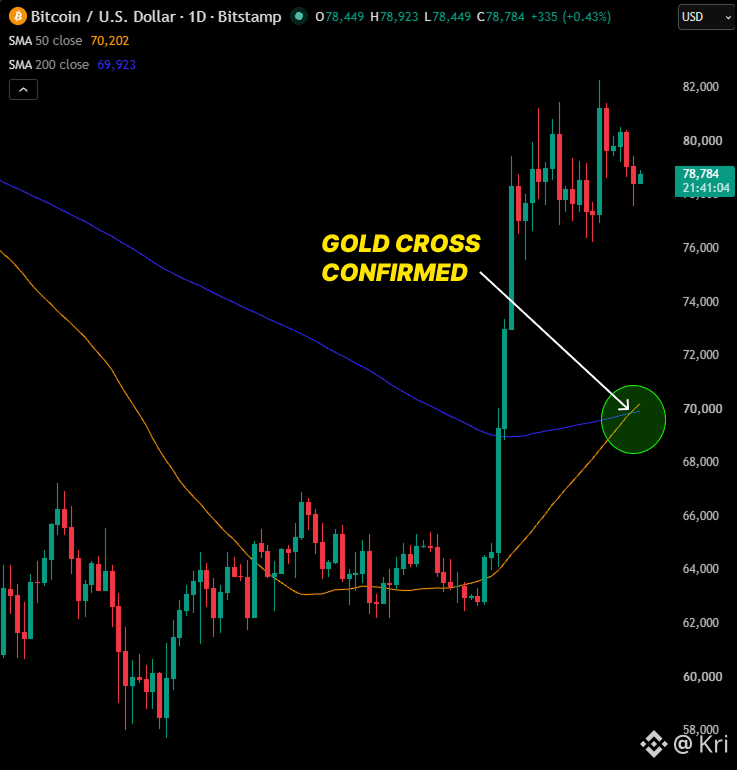
🚨BULLISH: Bitcoin's golden cross has officially confirmed for the first time since November 2025.
Its 50-day average has crossed above the 200-day after spending nearly 280 days below this signal.
The last three completed golden crosses sent Bitcoin up 50%, 45% and 60%.
This time it's backed by $3.8 BILLION in ETF inflows over the last three weeks, the strongest stretch of 2026.
$BTC
{future}(BTCUSDT)
🚨BULLISH: Bitcoin's golden cross has officially confirmed for the first time since November 2025.
Its 50-day average has crossed above the 200-day after spending nearly 280 days below this signal.
The last three completed golden crosses sent Bitcoin up 50%, 45% and 60%.
This time it's backed by $3.8 BILLION in ETF inflows over the last three weeks, the strongest stretch of 2026.
$BTC
Its 50-day average has crossed above the 200-day after spending nearly 280 days below this signal.
The last three completed golden crosses sent Bitcoin up 50%, 45% and 60%.
This time it's backed by $3.8 BILLION in ETF inflows over the last three weeks, the strongest stretch of 2026.
$BTC
1
463
·
--
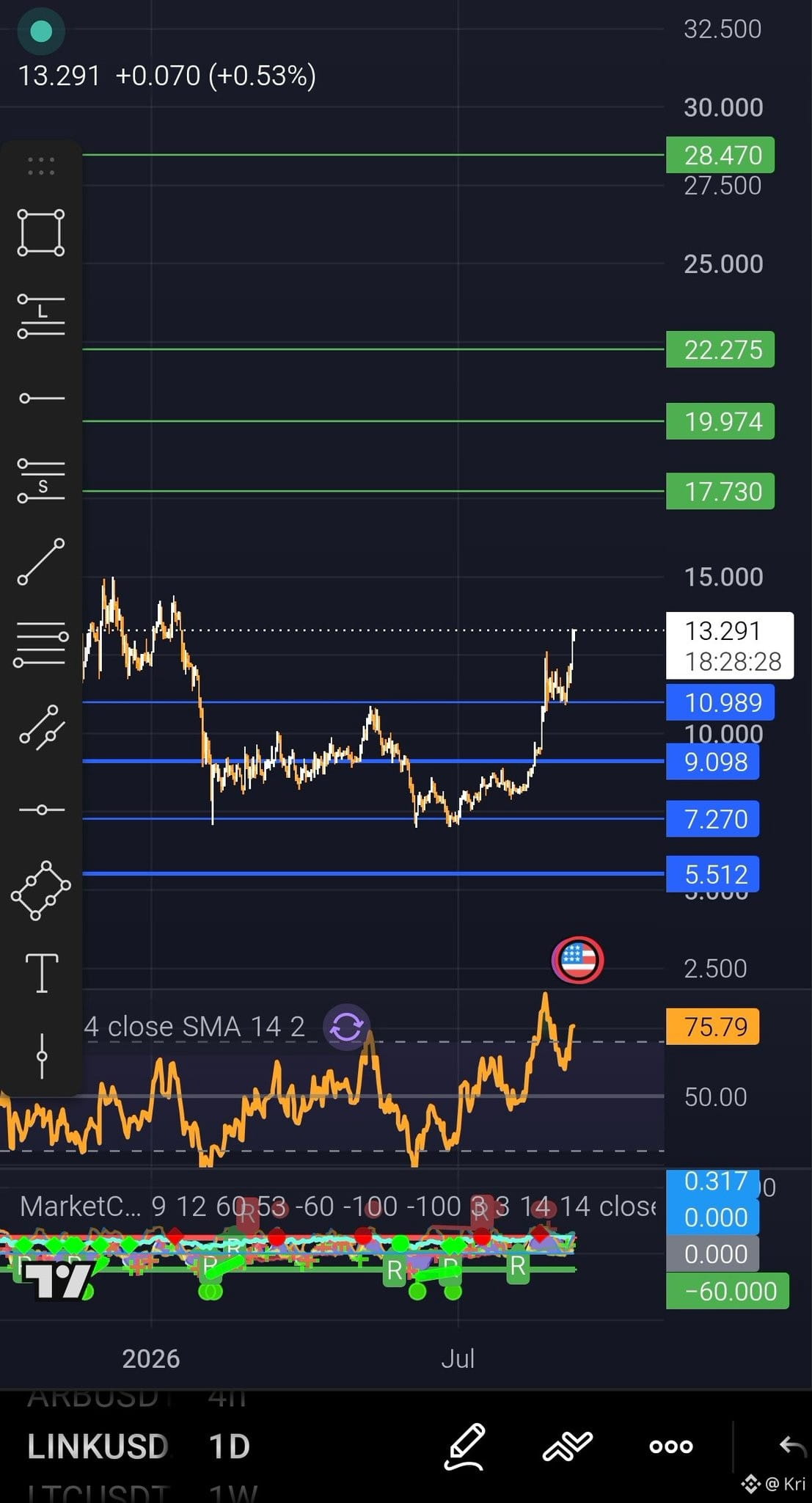
🟢LINK keep doing its thing 🚀
As I said before, $10.9 was the lvl to watch breakout happened and the retest held
Now price is around $13.29, right near the recent high
If $LINK breaks this area cleanly, $17.73 is the next major resistance/target on my chart
RSI is already ~76 tho, so a little pullback wouldn’t surprise me
Lets see 👀
#LINK #Chainlink #Crypto
🟢LINK keep doing its thing 🚀
As I said before, $10.9 was the lvl to watch breakout happened and the retest held
Now price is around $13.29, right near the recent high
If $LINK breaks this area cleanly, $17.73 is the next major resistance/target on my chart
RSI is already ~76 tho, so a little pullback wouldn’t surprise me
Lets see 👀
#LINK #Chainlink #Crypto
As I said before, $10.9 was the lvl to watch breakout happened and the retest held
Now price is around $13.29, right near the recent high
If $LINK breaks this area cleanly, $17.73 is the next major resistance/target on my chart
RSI is already ~76 tho, so a little pullback wouldn’t surprise me
Lets see 👀
#LINK #Chainlink #Crypto
1
2
624
·
--
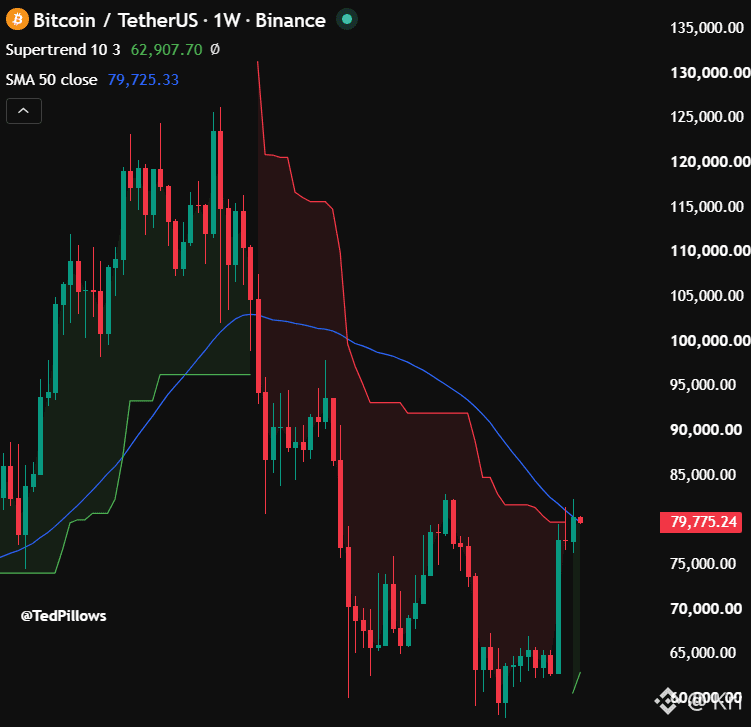
$BTC failed to close above 50W MA.
But the weekly Supertrend is now green for the first time since January 2023.
If Bitcoin reclaims the 50W MA and breaks above $830,000, the bottom is in.
#BTC
{future}(BTCUSDT)
$BTC failed to close above 50W MA.
But the weekly Supertrend is now green for the first time since January 2023.
If Bitcoin reclaims the 50W MA and breaks above $830,000, the bottom is in.
#BTC
But the weekly Supertrend is now green for the first time since January 2023.
If Bitcoin reclaims the 50W MA and breaks above $830,000, the bottom is in.
#BTC
521
·
--
$1,000 invested 15 years ago today would be worth:
• Bitcoin: $8,970,000
• Nvidia: $735,000
• Tesla: $231,000
• Apple: $29,000
• S&P: $8,400
• Gold: $2,150
$NVDAB
$BTC
{future}(BTCUSDT)
$1,000 invested 15 years ago today would be worth:
• Bitcoin: $8,970,000
• Nvidia: $735,000
• Tesla: $231,000
• Apple: $29,000
• S&P: $8,400
• Gold: $2,150
$NVDAB
$BTC
• Bitcoin: $8,970,000
• Nvidia: $735,000
• Tesla: $231,000
• Apple: $29,000
• S&P: $8,400
• Gold: $2,150
$NVDAB
$BTC
1
601
·
--
BREAKING: 🇺🇸 President Trump just said we’re prepared to do another attack on Iran.
#SaudiSaysIranAttackedShipInHormuz
BREAKING: 🇺🇸 President Trump just said we’re prepared to do another attack on Iran.
#SaudiSaysIranAttackedShipInHormuz
#SaudiSaysIranAttackedShipInHormuz
1
620
·
--
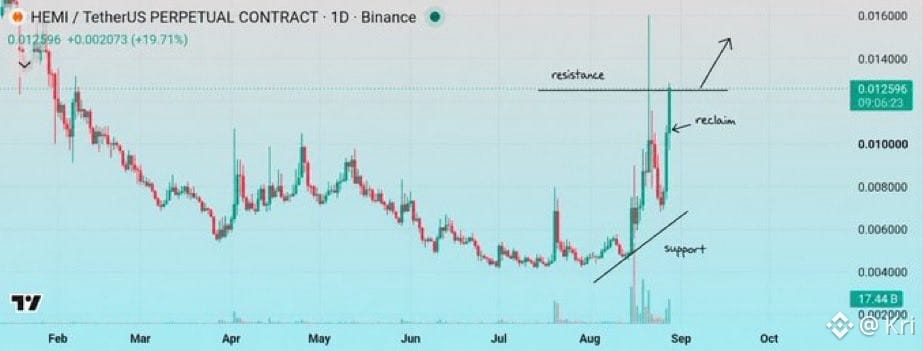
$HEMI is now +87.7% from my $0.00671 call, & I’m still bullish👀
From $0.00986 just 2 days ago, it’s already +27.7%.
Higher lows are holding,$0.010 is reclaimed, volume is expanding, and price is testing $0.0125–$0.013 resistance. If that flips to support, $0.015+ could be next🚀
$HEMI is now +87.7% from my $0.00671 call, & I’m still bullish👀
From $0.00986 just 2 days ago, it’s already +27.7%.
Higher lows are holding,$0.010 is reclaimed, volume is expanding, and price is testing $0.0125–$0.013 resistance. If that flips to support, $0.015+ could be next🚀
From $0.00986 just 2 days ago, it’s already +27.7%.
Higher lows are holding,$0.010 is reclaimed, volume is expanding, and price is testing $0.0125–$0.013 resistance. If that flips to support, $0.015+ could be next🚀
2
1.2k
·
--
Bernstein just called $125K Bitcoin by year-end, that's +58% from ~$79K today.
Their thesis: low-rate era is over, governments debase their way out of $40T in debt, scarce assets win. This cycle's drawdown bottomed near ~50% vs. 75–90% historically, institutions absorbed the dip, not dumped it.
Where others stand:
- Polymarket: 69% chance of $85K by year-end
- Standard Chartered: $100K (analyst now says may be too low)
- Bernstein bull case: $200K mid-2027, $1M by 2033
Content angles to try:
→ Is the debasement trade a real thesis or just the next narrative?
→ If institutions changed the floor, does that cap the upside too?
→ Bernstein vs. Polymarket, who do you trust?
⚠️ NFA - DYOR
$BTC #BTC
{future}(BTCUSDT)
Bernstein just called $125K Bitcoin by year-end, that's +58% from ~$79K today.
Their thesis: low-rate era is over, governments debase their way out of $40T in debt, scarce assets win. This cycle's drawdown bottomed near ~50% vs. 75–90% historically, institutions absorbed the dip, not dumped it.
Where others stand:
- Polymarket: 69% chance of $85K by year-end
- Standard Chartered: $100K (analyst now says may be too low)
- Bernstein bull case: $200K mid-2027, $1M by 2033
Content angles to try:
→ Is the debasement trade a real thesis or just the next narrative?
→ If institutions changed the floor, does that cap the upside too?
→ Bernstein vs. Polymarket, who do you trust?
⚠️ NFA - DYOR
$BTC #BTC
Their thesis: low-rate era is over, governments debase their way out of $40T in debt, scarce assets win. This cycle's drawdown bottomed near ~50% vs. 75–90% historically, institutions absorbed the dip, not dumped it.
Where others stand:
- Polymarket: 69% chance of $85K by year-end
- Standard Chartered: $100K (analyst now says may be too low)
- Bernstein bull case: $200K mid-2027, $1M by 2033
Content angles to try:
→ Is the debasement trade a real thesis or just the next narrative?
→ If institutions changed the floor, does that cap the upside too?
→ Bernstein vs. Polymarket, who do you trust?
⚠️ NFA - DYOR
$BTC #BTC
1
5
922
·
--
Verified
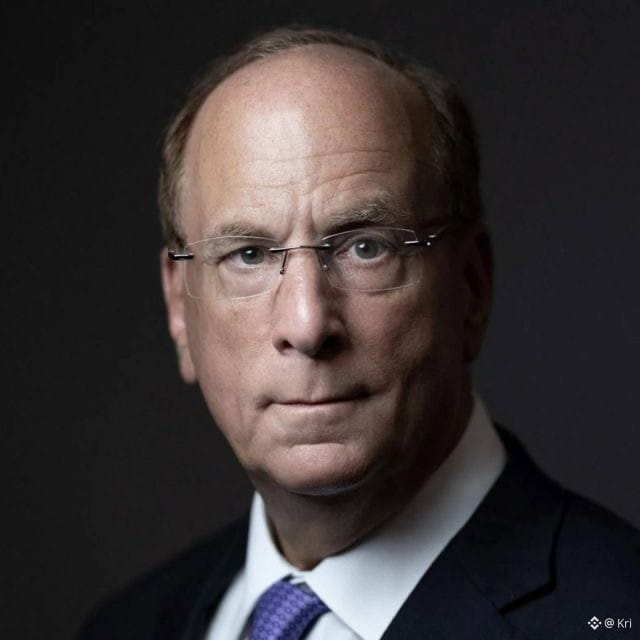
BREAKING : 🇺🇸 BlackRock and other ETFs have bought $232.2 million worth of Bitcoin and $192.4 million worth of Ethereum.
#BlackRock $ETH $BTC
{future}(BTCUSDT)
{future}(ETHUSDT)
BREAKING : 🇺🇸 BlackRock and other ETFs have bought $232.2 million worth of Bitcoin and $192.4 million worth of Ethereum.
#BlackRock $ETH $BTC
#BlackRock $ETH $BTC
2
7
827
·
--
🚨BREAKING:
BINANCE FOUNDER CZ SAYS AI AGENTS WILL MAKE 1,000X MORE TRANSACTIONS THAN HUMANS
"AI WILL USE CRYPTO," HE SAYS
CZ EXPECTS AI TO DRIVE THE NEXT WAVE OF ADOPTION
#CZ $BNB
{future}(BNBUSDT)
🚨BREAKING:
BINANCE FOUNDER CZ SAYS AI AGENTS WILL MAKE 1,000X MORE TRANSACTIONS THAN HUMANS
"AI WILL USE CRYPTO," HE SAYS
CZ EXPECTS AI TO DRIVE THE NEXT WAVE OF ADOPTION
#CZ $BNB
BINANCE FOUNDER CZ SAYS AI AGENTS WILL MAKE 1,000X MORE TRANSACTIONS THAN HUMANS
"AI WILL USE CRYPTO," HE SAYS
CZ EXPECTS AI TO DRIVE THE NEXT WAVE OF ADOPTION
#CZ $BNB
3
472
·
--
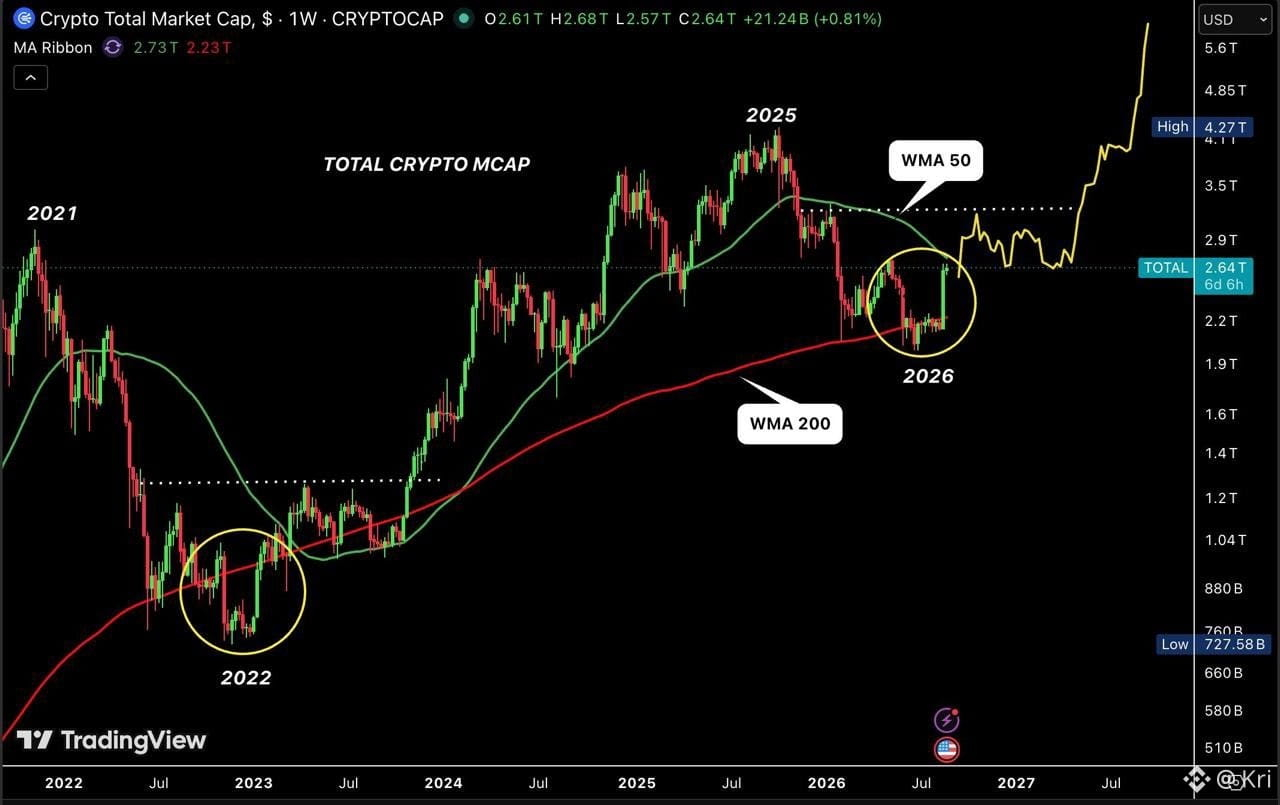
Crypto market cap added $474 Billion in a single week, the largest ever in crypto history.
That’s a 22% pump and the largest weekly candle since February 2021, coming after nearly 3 months of sideways consolidation.
The setup now looks similar to the 2022 bottom, where the market built a base before starting a multi-year rally.
Next resistance is WMA 50 at $2.73 Trillion. A clean breakout above this level could open the path toward $3.25 Trillion.
In 2022, a similar base eventually led to a major multi-year rally.
#BitcoinRises23.6%Weekly $BTC
{future}(BTCUSDT)
Crypto market cap added $474 Billion in a single week, the largest ever in crypto history.
That’s a 22% pump and the largest weekly candle since February 2021, coming after nearly 3 months of sideways consolidation.
The setup now looks similar to the 2022 bottom, where the market built a base before starting a multi-year rally.
Next resistance is WMA 50 at $2.73 Trillion. A clean breakout above this level could open the path toward $3.25 Trillion.
In 2022, a similar base eventually led to a major multi-year rally.
#BitcoinRises23.6%Weekly $BTC
That’s a 22% pump and the largest weekly candle since February 2021, coming after nearly 3 months of sideways consolidation.
The setup now looks similar to the 2022 bottom, where the market built a base before starting a multi-year rally.
Next resistance is WMA 50 at $2.73 Trillion. A clean breakout above this level could open the path toward $3.25 Trillion.
In 2022, a similar base eventually led to a major multi-year rally.
#BitcoinRises23.6%Weekly $BTC
1
1
594
·
--
BREAKING: #bitcoin JUST OFFICIALLY RECORDED ITS HIGHEST WEEKLY PRICE GAIN IN OVER 3 YEARS
💥 BTC ENDS THE WEEK UP OVER 22%
💥 THAT'S $14,000 IN JUST 7 DAYS
NEW HIGHS ARE COMING. BUCKLE UP 🚀
$BTC
{future}(BTCUSDT)
BREAKING: #bitcoin JUST OFFICIALLY RECORDED ITS HIGHEST WEEKLY PRICE GAIN IN OVER 3 YEARS
💥 BTC ENDS THE WEEK UP OVER 22%
💥 THAT'S $14,000 IN JUST 7 DAYS
NEW HIGHS ARE COMING. BUCKLE UP 🚀
$BTC
💥 BTC ENDS THE WEEK UP OVER 22%
💥 THAT'S $14,000 IN JUST 7 DAYS
NEW HIGHS ARE COMING. BUCKLE UP 🚀
$BTC
2
926
·
--
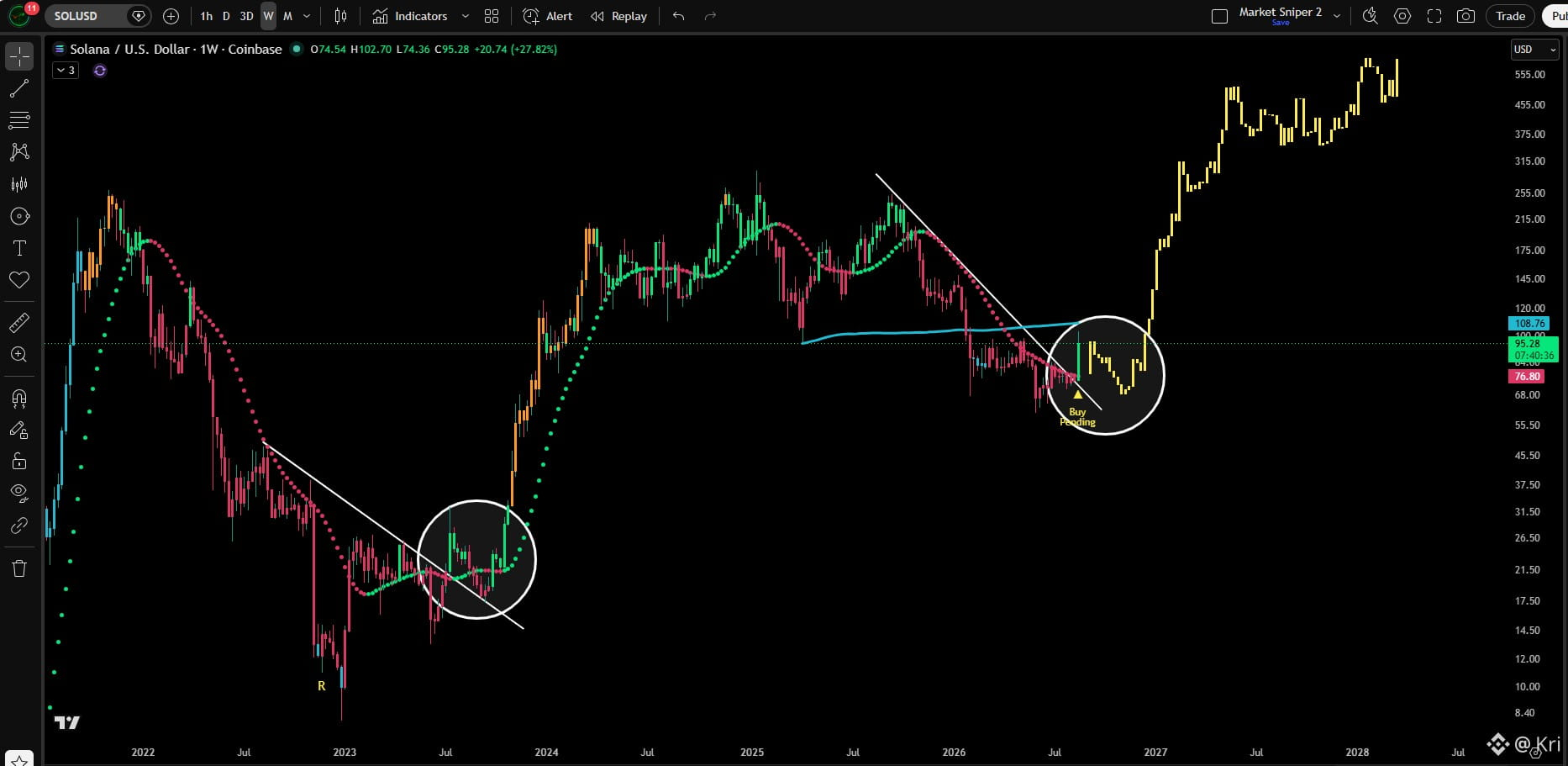
Holding $SOL 2.3K USDT
IF $SOL macro bottom is in, THEN we are still early.
Last weekly buy signal price dropped -35% but then price increased 991%.
Today we will see a weekly candle print a buy signal.
{future}(SOLUSDT)
IF $SOL macro bottom is in, THEN we are still early.
Last weekly buy signal price dropped -35% but then price increased 991%.
Today we will see a weekly candle print a buy signal.
Last weekly buy signal price dropped -35% but then price increased 991%.
Today we will see a weekly candle print a buy signal.
4
728
·
--
🚨 PRESIDENT TRUMP: “You should be buying right now.”
Over $30 TRILLION could soon be unleashed into the crypto market!
GET READY. 🚀
🚨 PRESIDENT TRUMP: “You should be buying right now.”
Over $30 TRILLION could soon be unleashed into the crypto market!
GET READY. 🚀
Over $30 TRILLION could soon be unleashed into the crypto market!
GET READY. 🚀
1
409
·
--
The crypto market is looking better again! 👀
Bitcoin had a strong move, going from around $62K to $77K, while Ethereum climbed from around $1.8K to $2.4K.
The good news? Money is coming back into crypto. More investors are buying again and the market is getting more active.
Another sector we really like right now is RWA (Real World Assets). RWA is growing fast as more real-world assets like stocks, bonds and real estate are moving on-chain.
We believe RWA can be one of the strongest crypto sectors going forward and we are very bullish on it!
#BTC #RWA $BTC
The crypto market is looking better again! 👀
Bitcoin had a strong move, going from around $62K to $77K, while Ethereum climbed from around $1.8K to $2.4K.
The good news? Money is coming back into crypto. More investors are buying again and the market is getting more active.
Another sector we really like right now is RWA (Real World Assets). RWA is growing fast as more real-world assets like stocks, bonds and real estate are moving on-chain.
We believe RWA can be one of the strongest crypto sectors going forward and we are very bullish on it!
#BTC #RWA $BTC
Bitcoin had a strong move, going from around $62K to $77K, while Ethereum climbed from around $1.8K to $2.4K.
The good news? Money is coming back into crypto. More investors are buying again and the market is getting more active.
Another sector we really like right now is RWA (Real World Assets). RWA is growing fast as more real-world assets like stocks, bonds and real estate are moving on-chain.
We believe RWA can be one of the strongest crypto sectors going forward and we are very bullish on it!
#BTC #RWA $BTC
1
1.6k
·
--

Article
MANTRA token plunges 18% to record low as blockchain halts after exploitThe token of MANTRA, a blockchain focused on putting traditional financial assets such as funds and bonds onchain, plunged 18.5% to a record low shortly before the network stopped producing blocks and was halted following a software exploit.
MANTRA fell from $0.005060 to an all-time low of $0.004126 around 11:10 p.m. UTC Thursday, according to CoinGecko. It later recovered to about $0.0044 but remained down roughly 10% over 24 hours, while trading volume jumped nearly 600% to $24 million.
The network produced its last recorded block at about 11:13 p.m. UTC, minutes after the token touched its low. MANTRA announced the halt roughly half an hour later in an X post.
The project has not said whether the price drop was connected to the attack, though security incidents can trigger outsized moves as traders rapidly reassess the risk of holding the affected token.
We're aware of an incident affecting MANTRA Chain and have halted the chain as a precaution while we investigate. All endpoints and transactions are currently frozen.
This means deposits and withdrawals to/from MANTRA Chain are temporarily affected. If you're unsure how this…— MANTRA | The EVM L1 for RWAs (@MANTRA_Chain) August 21, 2026
MANTRA initially said it had frozen all transactions and network endpoints as a precaution while investigating an incident. Deposits and withdrawals were also paused on affected exchanges.
A later update said an attacker had exploited a vulnerability in an “upstream dependency,” meaning software used by MANTRA Chain but developed outside the network itself.
“We have identified the vulnerability and are proceeding to prepare a patched release,” the team said.
MANTRA’s network operators, known as validators, remain offline while developers prepare and test the fix. Restarting the blockchain will require coordination with the wider group of operators that verify transactions and keep the network running.
The project is also tracing fund movements and working with exchanges while it assesses the damage. It has not disclosed which software was exploited, how the attack worked or whether any assets were lost.
“Our assessment of the full impact is ongoing and we are not yet in a position to confirm the complete scope,” MANTRA said.
The outage affects the chain’s public endpoints, validators, bridge operations and MANTRA-managed links used to communicate with other blockchains.
The incident follows a difficult period for the project. MANTRA’s former OM token collapsed more than 90% in April 2025 in a bizarre sell-off, wiping out more than $5 billion in market value.
Inveniam Capital Partners, which invested $20 million in MANTRA last year, said in June it planned to acquire the project. The deal is expected to close in the third quarter.
$MANTRA #mantra
{future}(MANTRAUSDT)
MANTRA token plunges 18% to record low as blockchain halts after exploit
The token of MANTRA, a blockchain focused on putting traditional financial assets such as funds and bonds onchain, plunged 18.5% to a record low shortly before the network stopped producing blocks and was halted following a software exploit.
MANTRA fell from $0.005060 to an all-time low of $0.004126 around 11:10 p.m. UTC Thursday, according to CoinGecko. It later recovered to about $0.0044 but remained down roughly 10% over 24 hours, while trading volume jumped nearly 600% to $24 million.
The network produced its last recorded block at about 11:13 p.m. UTC, minutes after the token touched its low. MANTRA announced the halt roughly half an hour later in an X post.
The project has not said whether the price drop was connected to the attack, though security incidents can trigger outsized moves as traders rapidly reassess the risk of holding the affected token.
We're aware of an incident affecting MANTRA Chain and have halted the chain as a precaution while we investigate. All endpoints and transactions are currently frozen.
This means deposits and withdrawals to/from MANTRA Chain are temporarily affected. If you're unsure how this…— MANTRA | The EVM L1 for RWAs (@MANTRA_Chain) August 21, 2026
MANTRA initially said it had frozen all transactions and network endpoints as a precaution while investigating an incident. Deposits and withdrawals were also paused on affected exchanges.
A later update said an attacker had exploited a vulnerability in an “upstream dependency,” meaning software used by MANTRA Chain but developed outside the network itself.
“We have identified the vulnerability and are proceeding to prepare a patched release,” the team said.
MANTRA’s network operators, known as validators, remain offline while developers prepare and test the fix. Restarting the blockchain will require coordination with the wider group of operators that verify transactions and keep the network running.
The project is also tracing fund movements and working with exchanges while it assesses the damage. It has not disclosed which software was exploited, how the attack worked or whether any assets were lost.
“Our assessment of the full impact is ongoing and we are not yet in a position to confirm the complete scope,” MANTRA said.
The outage affects the chain’s public endpoints, validators, bridge operations and MANTRA-managed links used to communicate with other blockchains.
The incident follows a difficult period for the project. MANTRA’s former OM token collapsed more than 90% in April 2025 in a bizarre sell-off, wiping out more than $5 billion in market value.
Inveniam Capital Partners, which invested $20 million in MANTRA last year, said in June it planned to acquire the project. The deal is expected to close in the third quarter.
$MANTRA #mantra
MANTRA fell from $0.005060 to an all-time low of $0.004126 around 11:10 p.m. UTC Thursday, according to CoinGecko. It later recovered to about $0.0044 but remained down roughly 10% over 24 hours, while trading volume jumped nearly 600% to $24 million.
The network produced its last recorded block at about 11:13 p.m. UTC, minutes after the token touched its low. MANTRA announced the halt roughly half an hour later in an X post.
The project has not said whether the price drop was connected to the attack, though security incidents can trigger outsized moves as traders rapidly reassess the risk of holding the affected token.
We're aware of an incident affecting MANTRA Chain and have halted the chain as a precaution while we investigate. All endpoints and transactions are currently frozen.
This means deposits and withdrawals to/from MANTRA Chain are temporarily affected. If you're unsure how this…— MANTRA | The EVM L1 for RWAs (@MANTRA_Chain) August 21, 2026
MANTRA initially said it had frozen all transactions and network endpoints as a precaution while investigating an incident. Deposits and withdrawals were also paused on affected exchanges.
A later update said an attacker had exploited a vulnerability in an “upstream dependency,” meaning software used by MANTRA Chain but developed outside the network itself.
“We have identified the vulnerability and are proceeding to prepare a patched release,” the team said.
MANTRA’s network operators, known as validators, remain offline while developers prepare and test the fix. Restarting the blockchain will require coordination with the wider group of operators that verify transactions and keep the network running.
The project is also tracing fund movements and working with exchanges while it assesses the damage. It has not disclosed which software was exploited, how the attack worked or whether any assets were lost.
“Our assessment of the full impact is ongoing and we are not yet in a position to confirm the complete scope,” MANTRA said.
The outage affects the chain’s public endpoints, validators, bridge operations and MANTRA-managed links used to communicate with other blockchains.
The incident follows a difficult period for the project. MANTRA’s former OM token collapsed more than 90% in April 2025 in a bizarre sell-off, wiping out more than $5 billion in market value.
Inveniam Capital Partners, which invested $20 million in MANTRA last year, said in June it planned to acquire the project. The deal is expected to close in the third quarter.
$MANTRA #mantra
670
·
--
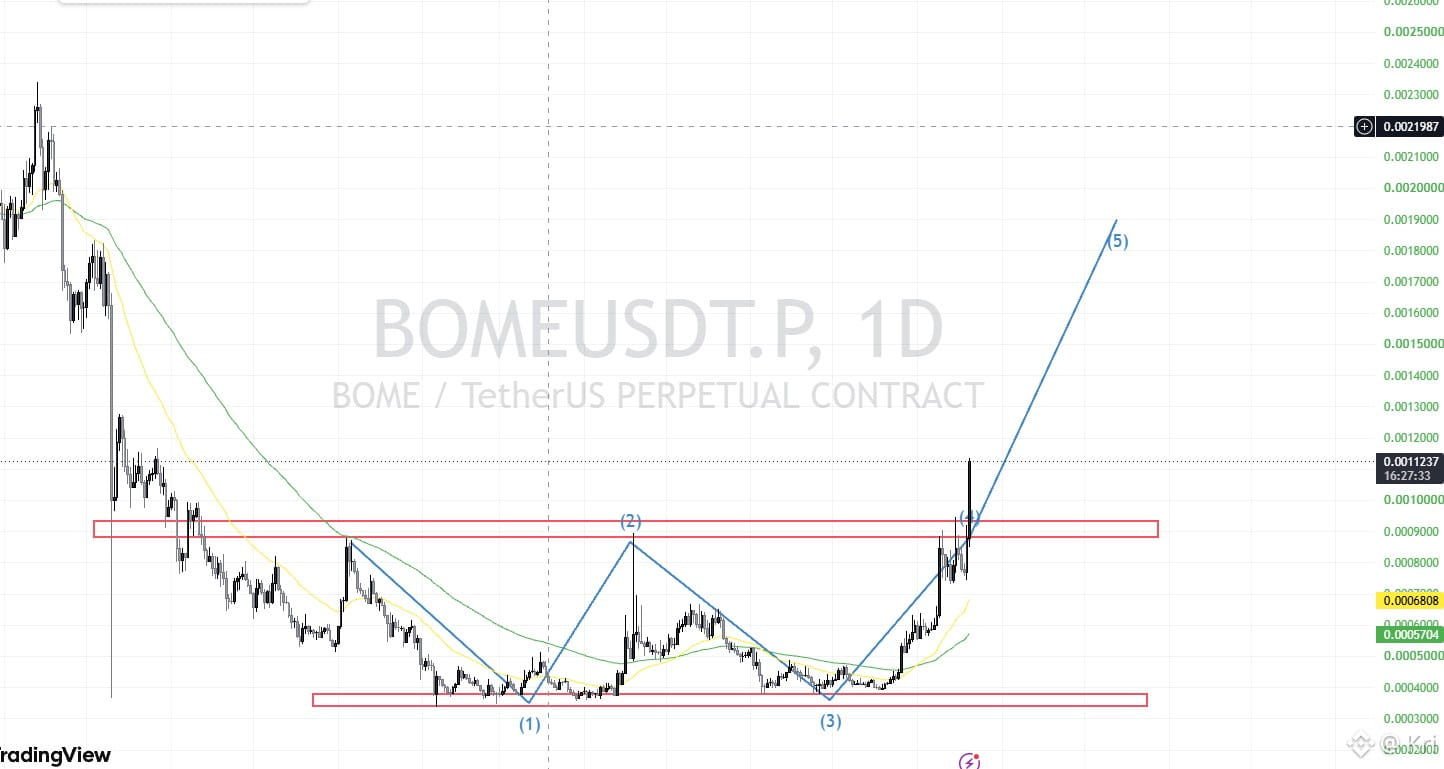
$BOME just broke out of the resistance zone that capped price since the wave 1 top, reclaiming $0.0009 to $0.0011 after basing for weeks between $0.0004 and $0.0006.
The count on this chart reads as a completed 1 through 4 impact structure, with wave 3 bottoming lower than wave 1 before the recent push back above range. If wave 5 plays out with similar proportions to the prior legs, the move projects well above $0.0018, back toward the same zone BOME rejected from at the start of this whole sequence.
Wave counts are subjective and this one still needs the breakout to hold as new support rather than get rejected back into range.
$BOME #Solana #Memecoin
{future}(BOMEUSDT)
This is just my personal opinion, not financial advice.
$BOME just broke out of the resistance zone that capped price since the wave 1 top, reclaiming $0.0009 to $0.0011 after basing for weeks between $0.0004 and $0.0006.
The count on this chart reads as a completed 1 through 4 impact structure, with wave 3 bottoming lower than wave 1 before the recent push back above range. If wave 5 plays out with similar proportions to the prior legs, the move projects well above $0.0018, back toward the same zone BOME rejected from at the start of this whole sequence.
Wave counts are subjective and this one still needs the breakout to hold as new support rather than get rejected back into range.
$BOME #Solana #Memecoin
This is just my personal opinion, not financial advice.
The count on this chart reads as a completed 1 through 4 impact structure, with wave 3 bottoming lower than wave 1 before the recent push back above range. If wave 5 plays out with similar proportions to the prior legs, the move projects well above $0.0018, back toward the same zone BOME rejected from at the start of this whole sequence.
Wave counts are subjective and this one still needs the breakout to hold as new support rather than get rejected back into range.
$BOME #Solana #Memecoin
This is just my personal opinion, not financial advice.
630
Log in to explore more content
Join global crypto users on Binance Square
⚡️ Get latest and useful information about crypto.
💬 Trusted by the world’s largest crypto exchange.
👍 Discover real insights from verified creators.
Email / Phone number
Trending Topics
USAugustPPIRisesLessThanExpected
54,741 views
841 Discussing
🚨 US AUG PPI: Rises LESS Than Expected! Bullish for Crypto? 🚀
PPI +0.4% MoM as expected, but CORE PPI only +0.2% vs +0.3% expected - cooling!
What it means:
• Wholesale inflation softer than feared
• Fed rate hike chance now 62% - but dovish signals coming
• Core PCE revisions expected downward - bullish
• BTC usually pumps on softer PPI
Fed meeting Sep 15-16 - Market now expects pause, not hike?
Is this the green light for Q4 rally?
#Bitcoin #PPI #Fed #CryptoNews #BTC#usaugustppiriseslessthanexpected
True News
·1 Likes
·1.4k views
SECApprovesNasdaqTexasCommodityTrustRule
29,183 views
609 Discussing
ECBRaisesRatesSecondTimeTo2.5%
26,786 views
436 Discussing